The Holy Spirit Church in Potelych: a potters' church with 17th-century wall paintings
This church, they say, was paid for by potters — people who knew everything about clay, yet commissioned a church of wood. Its most valuable feature is not the material either, but what is painted on it: 17th-century wall paintings in which Cossacks stand beside the saints.
In brief
| Address | Potelych village, Lviv District, Lviv Oblast |
| Built | traditionally 1502; according to other data 1555 or 1559–1564 |
| Type | three-part wooden church with two tops |
| Dimensions | about 18 × 7 m |
| Wall paintings | 1620s–1640s |
| Status | UNESCO World Heritage site since 2013 (no. 1424); since 2023 under provisional enhanced protection |
History
Potelych lies north-west of Lviv (more than 50 kilometres in a straight line), a few kilometres from the Polish border. Today it is a village, but it was once a town of potters. According to the Wooden Churches of the Carpathians route, at its height about 240 potters worked here, while Lviv had 45. Radio Svoboda gives a more modest figure — about 50 masters.
Tradition links the church’s origin to a Tatar raid: the old wooden Church of Saints Borys and Hlib was burned, and in 1502 a new one was built on its site. According to a tradition retold by the Wooden Churches of the Carpathians route and by Local History, the construction was financed by the local potters; historians cite no documents for this.
The date 1502 is traditional, but not the only one. A visitation of 1739 wrote that the church had been built “184 years ago, or perhaps more” — that is, around 1555 — and the historian Andrii Pavlyshyn, in a 2021 article based on new documents, believes the church was probably built between 1559 and 1564. The date 1502, he observes, is given by periodicals of the Przemyśl Eparchy without a reference to a source; if it is true at all, it more likely refers to the previous church. Either way, it is among the oldest wooden churches in Ukraine; English Wikipedia calls it the oldest wooden church in the Lviv region.
In the first half of the 17th century the church walls were covered with paintings. Pavlyshyn writes that during that century the church changed its confessional affiliation several times, and in the second half of the 17th century finally became part of the structures of the Kyiv Uniate Metropolitanate. English Wikipedia mentions that Bohdan Khmelnytsky visited the church; the documents cited by Pavlyshyn record only the passage of his troops through Potelych towards Zamość in 1648.
The paintings occupy the walls of the nave and part of the babynets. Among the subjects, Sacred Art of the Lviv Region names the Mother of God of the Caves, the Exaltation of the Holy Cross, the Dormition of the Mother of God and the Lamentation over Christ. The Potelych wall paintings were described academically by the art historian Liudmyla Miliaieva in monographs of 1969 and 1971; the Wooden Churches of the Carpathians route also mentions another view — that the paintings may have appeared at the beginning of the 18th century.
Wood needs constant care, and archival traces of this have survived. In 1718, according to Pavlyshyn, the church was repaired by the carpenter Kazymyr Dominikovych, and in 1736 the same “master of the carpenter’s art” thoroughly repaired the church: new crosses were installed, and the grilles and windows were partly replaced. During repairs in 1909 and 1923 the shingle roofs and wall cladding were replaced with sheet metal.
Under Soviet rule the church was closed — according to Pavlyshyn, for almost half a century — but it was declared a monument of national importance. In 1970–1972 a thorough restoration was carried out to a design by B. Kindzelskyi and I. Mohytych: the sheet metal was removed, the shingles returned, and the paintings restored. Since 8 November 2008 the church has been fully in use again, and on 21 June 2013 it was inscribed on the UNESCO World Heritage List together with seven other Ukrainian and eight Polish wooden churches.
A UNESCO monument also means everyday upkeep. In 2013 ZAXID.NET wrote that the church was cared for by the Sisters of St Joseph, that the community paid for the alarm system out of its own pocket, and that a fungus spreading from one of the corners had been stopped. The fungus was stopped by the then parish priest, Fr Roman Semeniuk.
Chronology
The figures in square brackets are the numbers of the sources in the list at the bottom of the page. The note “according to …” means that the fact is confirmed by only one source. The “Legends” section contains tales and legends: they are recorded in the sources but not confirmed by documents.
The town of potters
- 1262
The Galician-Volhynian Chronicle mentions Telych — present-day Potelych. This is according to the Encyclopedia of Ukraine; the Wooden Churches of the Carpathians route gives 1223. [3, 12, 4]
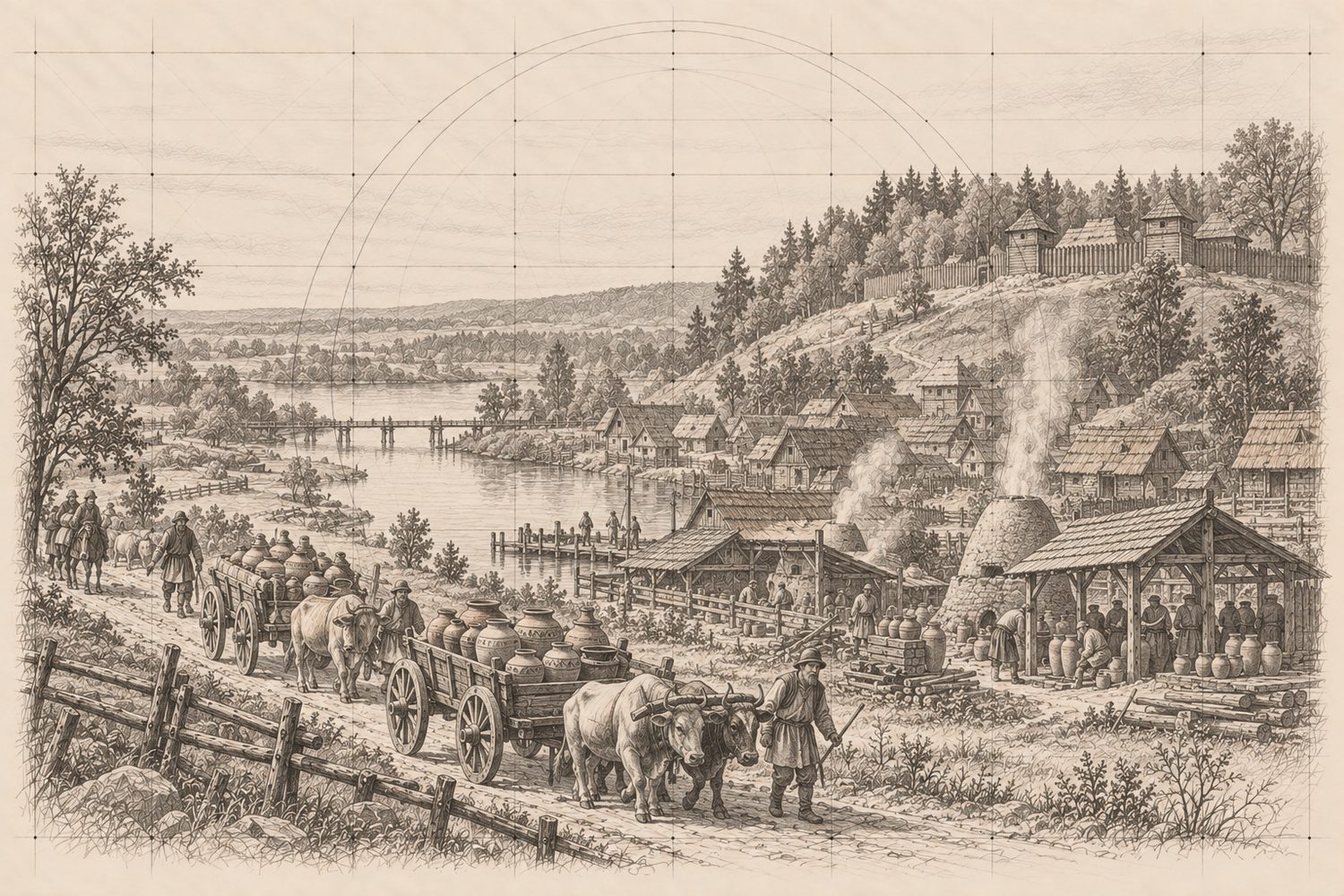
13th century: the town of potters. Illustration: IKONASTONE - 15th c.
The chronicler Jan Długosz wrote: “Potylych is a high mountain in the Belz land.” According to Radio Svoboda. [16]
- 1498
Potelych received Magdeburg law. [3, 12]
The church and its paintings
- 1502
The traditional date of construction: the church was built on the site of the Church of Saints Borys and Hlib, burned by the Tatars. Pavlyshyn notes that this date is given by periodicals of the Przemyśl Eparchy without a reference to a source; if it is true at all, it more likely refers to the previous church. [1, 4, 5, 6, 13]
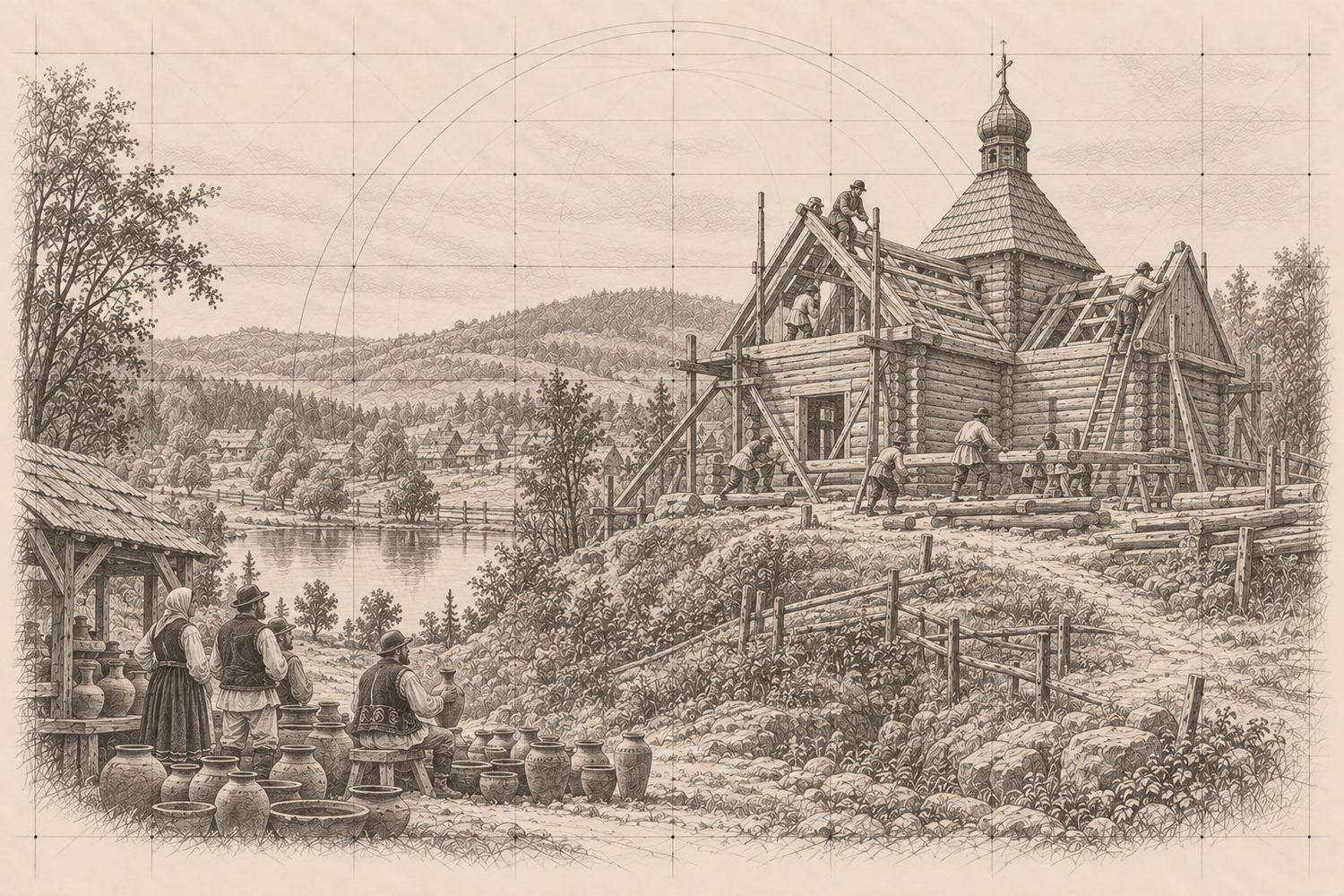
Around 1502 (according to tradition). Illustration: IKONASTONE - 1560s
A Tatar detachment attacked the town; in 1569 King Sigismund II Augustus confirmed new documents in place of those that had been lost. Pavlyshyn suggests that the church may have suffered then as well. [1]
- 1559–1564
According to Pavlyshyn, the most likely time of construction of the Holy Spirit Church: in 1559 an entry in a handwritten “Apostol” still attests a Church of Borys and Hlib on this site, and in 1564, according to tax documents, only two churches operated in Potelych. [1]
- Around 1555
This date is given by the visitation of 1739: the church was built “184 years ago, or perhaps more”. Pavlyshyn links the documents of 1555 to the previous church. [1]
- 1584
The year on an old bell that hung in the church's bell tower until the 20th century. According to Pavlyshyn. [1]
- Early 17th c.
The iconostasis received a carved portal with an icon of the “Saviour Not Made by Hands”; in 1601–1605 the documents mention a priest, Fr Stepan. [1]
- 1620s–1640s
The walls of the nave and babynets were painted in tempera directly on the wood by masters of a single school. The Wooden Churches of the Carpathians route also gives another view — the early 18th century. [1, 2, 4]
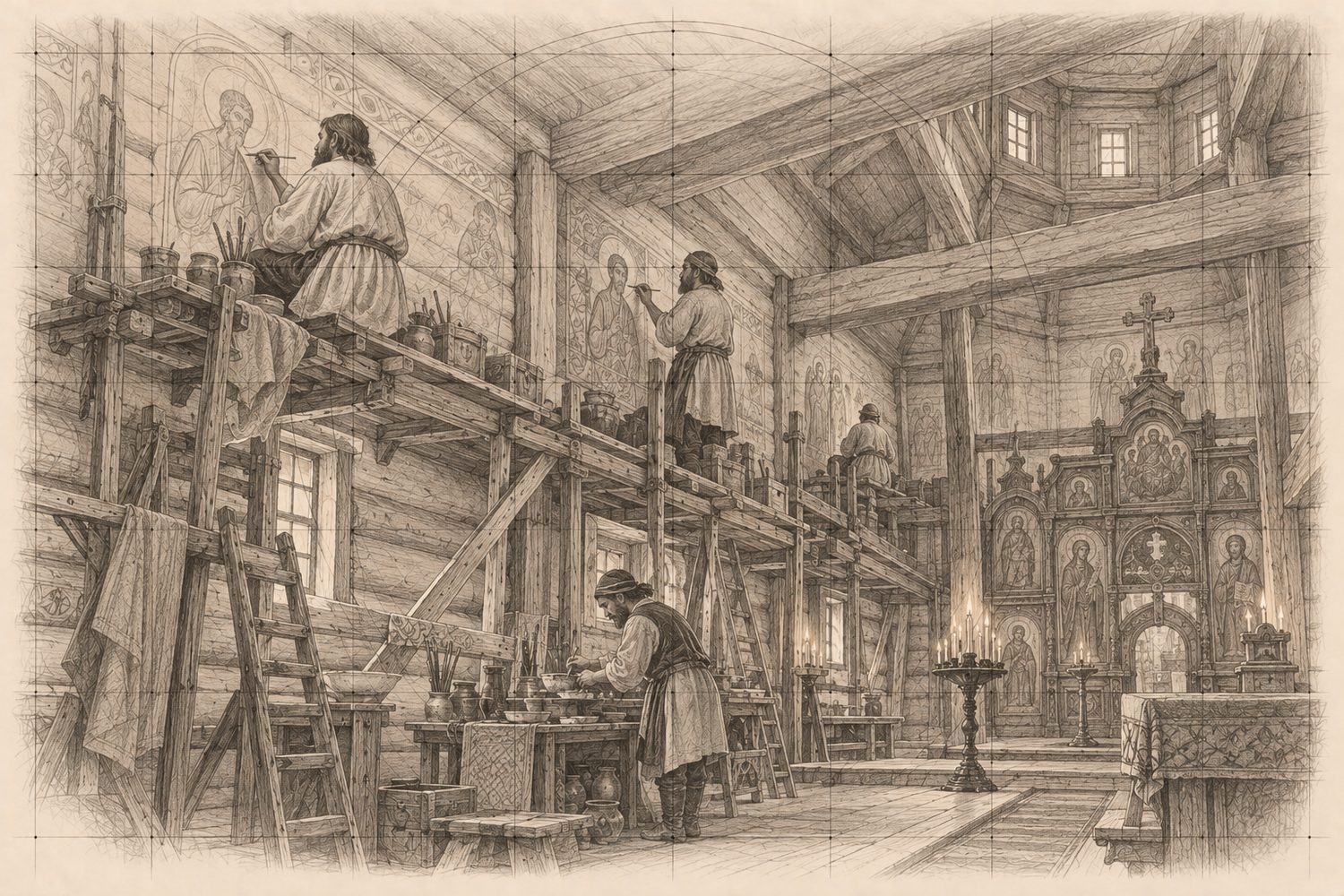
1620s–1640s: the wall paintings. Illustration: IKONASTONE - 17th c.
After the Union of Brest the parish was subject to the Uniate Bishop of Chełm, for a time passed to Orthodox bishops, and in the second half of the century finally entered the Kyiv Uniate Metropolitanate. According to Pavlyshyn. [1]
- 1648
During Bohdan Khmelnytsky's march on Zamość, the priest Fr Illia Prosyk and parishioners were accused of attacking a Catholic church and plundering its property. According to Pavlyshyn. [1]
- 1659
The church began keeping a commemoration book; it was still preserved at the end of the 19th century. [1]
- 1663
The date of an epitaphios which, according to ZAXID.NET, comes from the Holy Spirit Church; it is now in the Holy Trinity Church in Potelych. [9]
- 1670
The iconostasis was renewed with new icons of Christ and the Mother of God for the main tier. According to Pavlyshyn. [1]
- 1683
The Zhovkva painter Ivan Rutkovych painted the icon “Supplication” (in other sources — “Deesis”) with portraits of a burgher couple, its donors. [1, 5, 17]
Visitations and repairs
- 1709
Swedish troops damaged and plundered the church; a 66-year-old townsman was killed near it. According to Pavlyshyn. [1]
- 1718
The church was repaired by the carpenter Kazymyr Dominikovych. [1, 4, 5]
- 1720s–1750s
Rooms were built near the church and rented to local potters, so that the parish would have an income. According to Pavlyshyn. [1]
- 1736
Dominikovych carried out a major repair of the church and the bell tower; new crosses from Nemyriv were installed. [1, 4, 5]
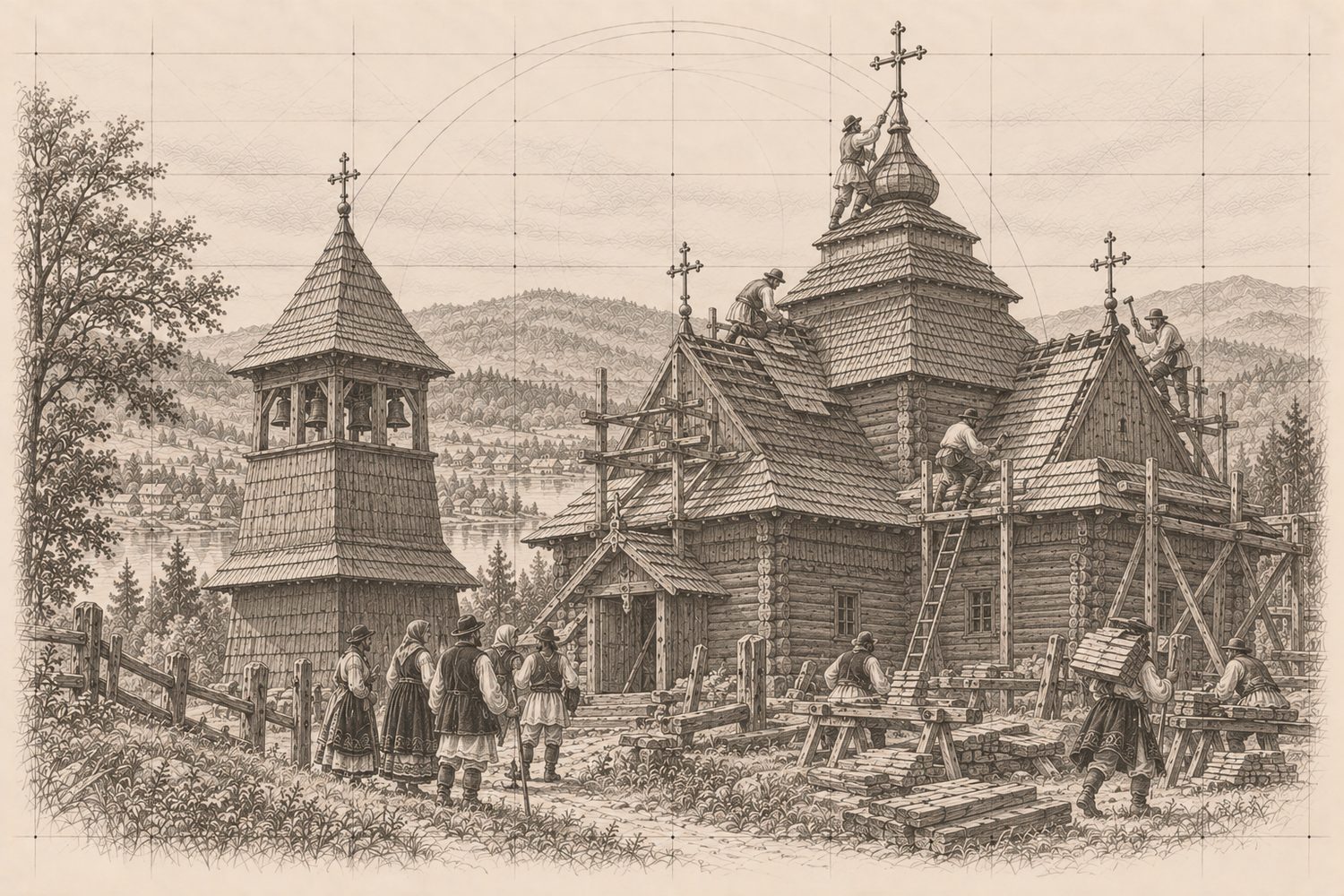
1736: Dominikovych's repair. Illustration: IKONASTONE - 1739
The visitation counted 15 families in the parish and mentioned a field called “Borysivske” — a memory of the previous church. [1]
- 1753
The Wooden Churches of the Carpathians route and Local History mention another repair by Dominikovych, after which the church became two-topped; Pavlyshyn does not have this date. [4, 5]
- 1766–1775
In 1766 about a hundred parishioners were able to attend confession; by 1775 the parish priest Fr Ivan Kyrylovych had moved to the Holy Trinity Church, and the three Potelych parishes were later merged. According to Pavlyshyn. [1]
The 19th and 20th centuries
- 1848
The Austrian government requisitioned the old hakivnytsi (hook guns) kept in the church. According to Pavlyshyn. [1]
- 1909, 1923
The shingle roofs and wall cladding were replaced with sheet metal. Local History names repairs in 1831, 1903 and 1923. [1, 4, 5]
- Soviet period
The church was closed for almost 50 years, yet declared a monument of national importance; the sources do not name the year of closure. According to ZAXID.NET, there were plans to set up a mineral fertiliser store in it, and later to move it to the Shevchenkivskyi Hai museum, but the community did not allow it. [1, 8]
- 1970–1972
Restoration to a design by B. Kindzelskyi and I. Mohytych: the sheet metal was removed, the shingles returned, the paintings restored. [1, 4, 5]
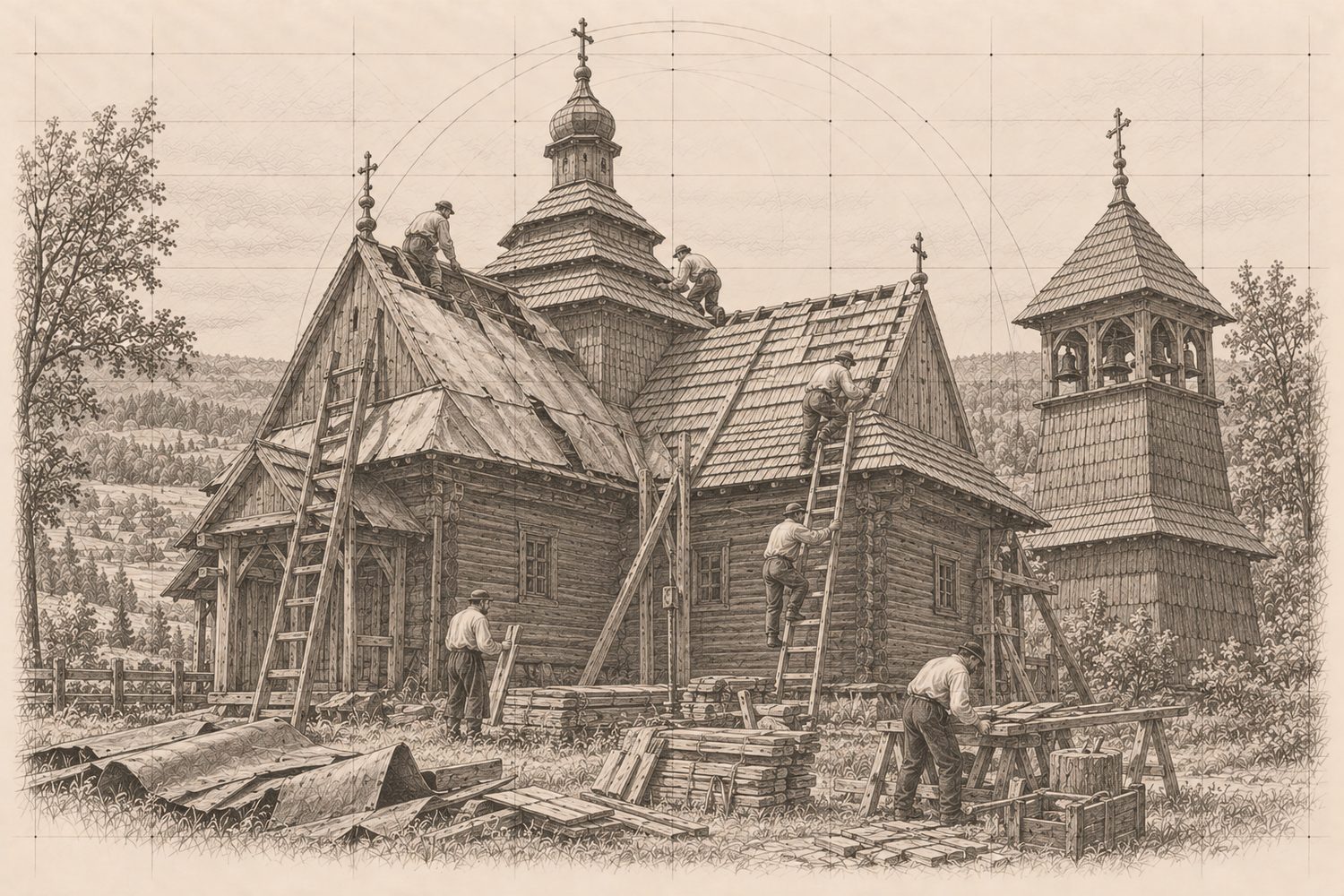
1970–1972: the return of the shingles. Illustration: IKONASTONE
The revived church
- 8 November 2008
The church was again fully in use; the first parish priest was Fr Vasyl Mutka, and from 2011 Fr Roman Semeniuk served. [1, 8]
- 21 June 2013
At the 37th session of the World Heritage Committee the church was inscribed on the UNESCO World Heritage List as part of the property “Wooden Tserkvas of the Carpathian Region in Poland and Ukraine” (16 churches). [1, 10, 11]
- 2018
A phased restoration began: the sills and floor were replaced, a foundation and stone paving were made for the first time; the replacement of the roofing was not completed. [5, 6]
- 26 April 2023
A scientific restoration council on site determined the order of works; UAH 100,000 was allocated for documentation for the restoration of the wall paintings and iconostasis (Suspilne writes of “about 150 thousand”). [6, 13, 19]
- 7 September 2023
The Committee for the Protection of Cultural Property in the Event of Armed Conflict (Second Protocol to the 1954 Hague Convention) added the church to the List of Cultural Property under Provisional Enhanced Protection — among 20 Ukrainian sites. [14, 18]
- October 2023
Specialists from the Polish Instytut Polonika examined the church's paintings and structures. [6, 15]
- October 2024
A joint UNESCO and ICOMOS mission was to document the church by photogrammetry and 3D laser scanning for an emergency response plan (funded by the Government of Japan). According to the Lviv Regional Military Administration. [19]
- 10 April 2026
The parish prepared to carry out the epitaphios on Good Friday; the church administrator said the paintings are about 400 years old. According to Suspilne. [7]
Lost and recreated
| What | What it was | What happened | Where it is now |
|---|---|---|---|
| Church of Borys and Hlib | The predecessor on the same site; mentioned in 1559 | Destroyed, according to tradition, by the Tatars (late 15th century or 1560s) | Not preserved; the memory survives in the name of the field “Borysivske” [1, 4] |
| Bell of 1584 | An old bell in the bell tower | Preserved until the 20th century; its later fate is unknown | Unknown [1] |
| Hakivnytsi (hook guns) | Old guns in the church | Requisitioned in 1848 | Unknown [1] |
| Commemoration book of 1659 | A book of parishioners’ commemorations | Still mentioned at the end of the 19th century | Unknown [1] |
| Epitaphios of 1663 | The Holy Spirit Church | Transferred to another church in the village | Holy Trinity Church in Potelych (according to ZAXID.NET) [9] |
| Icon “Supplication” by I. Rutkovych | Iconostasis, 1683 | Removed from the church | National Museum in Lviv (according to Wikipedia) [17] |
| Icons of the three Potelych churches | Iconostases of the wooden churches | Partly transferred to the museum | More than 50 works are in the National Museum in Lviv [3] |
| Ivan Fedorovych’s “Apostol”, the “Festal Triodion” | The church library | Mentioned by the Wooden Churches of the Carpathians route | Present location not established [4] |
| Shingle covering | Roofs and walls of shingle | Replaced with sheet metal in 1909 and 1923 | Shingles returned in 1970–1972 [1, 4, 5] |
| Sills and floor | The church stood on stones without a foundation | Replaced, foundation made in 2018 | New sills, stone paving [5, 6] |
| Wall paintings of the 1620s–1640s | Nave and babynets | Restored in 1970–1972; two layers on the east wall | In place; restoration is being prepared [1, 13] |
| First tier of the iconostasis | Boundary between the nave and the sanctuary | Moved deeper in during earlier restorations | Stepped form (according to Suspilne) [6] |
| Old trees on the hill’s slopes | Held the slopes | Cut down | Not restored [4] |
Architecture
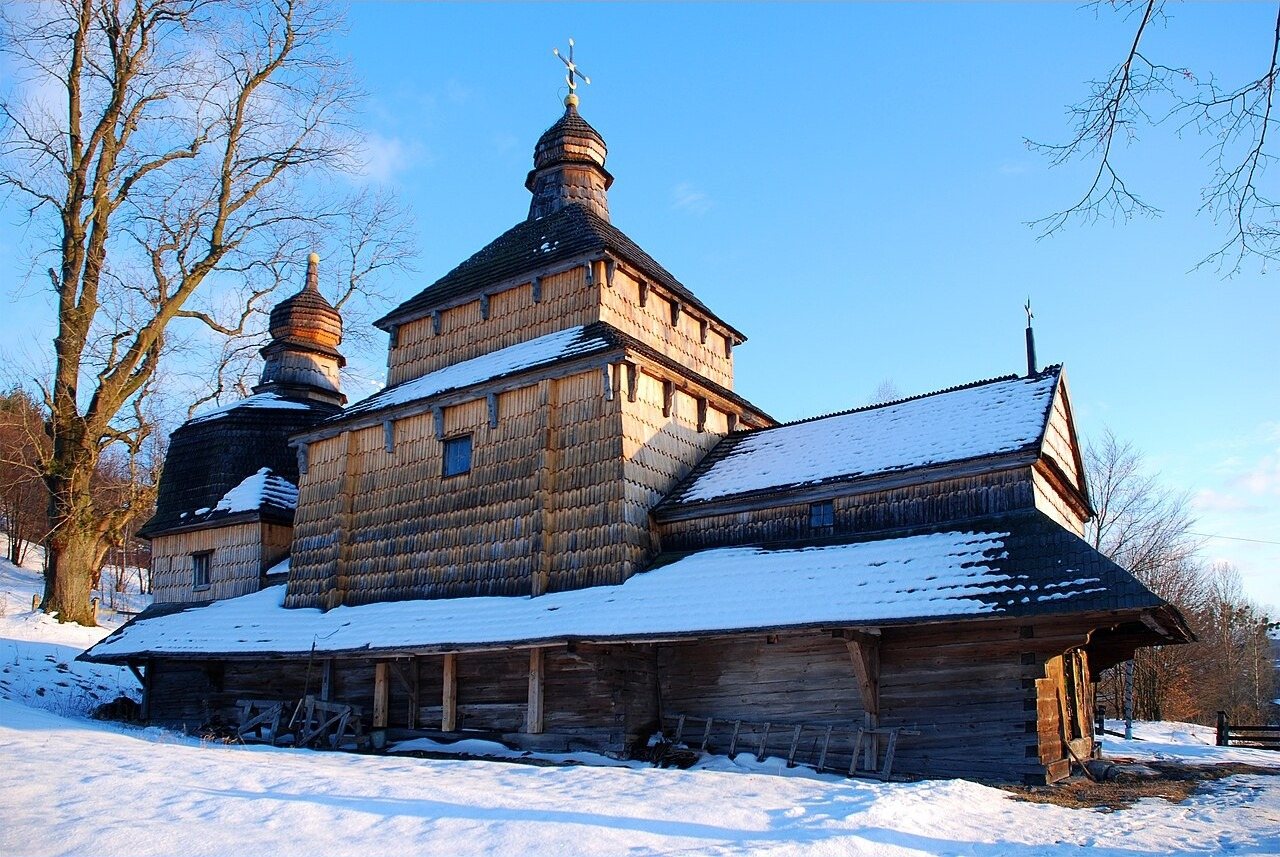
The church is small — about 18 by 7 metres — and three-part: the babynets, the nave and the sanctuary stand one after another from west to east. The Encyclopedia of Ukraine calls it a fairly typical Boyko church with three log frames. Above the central frame rises a tiered pyramidal top which, according to the same encyclopedia, appeared in the 18th century. Above the sanctuary is a dome that the Wooden Churches of the Carpathians route attributes to the Volhynian manner. So the Galician, Boyko and Volhynian traditions meet in the church’s silhouette.
The walls and roofs are covered with shingles. A masonry sacristy is attached to the church — the only part not built of wood.
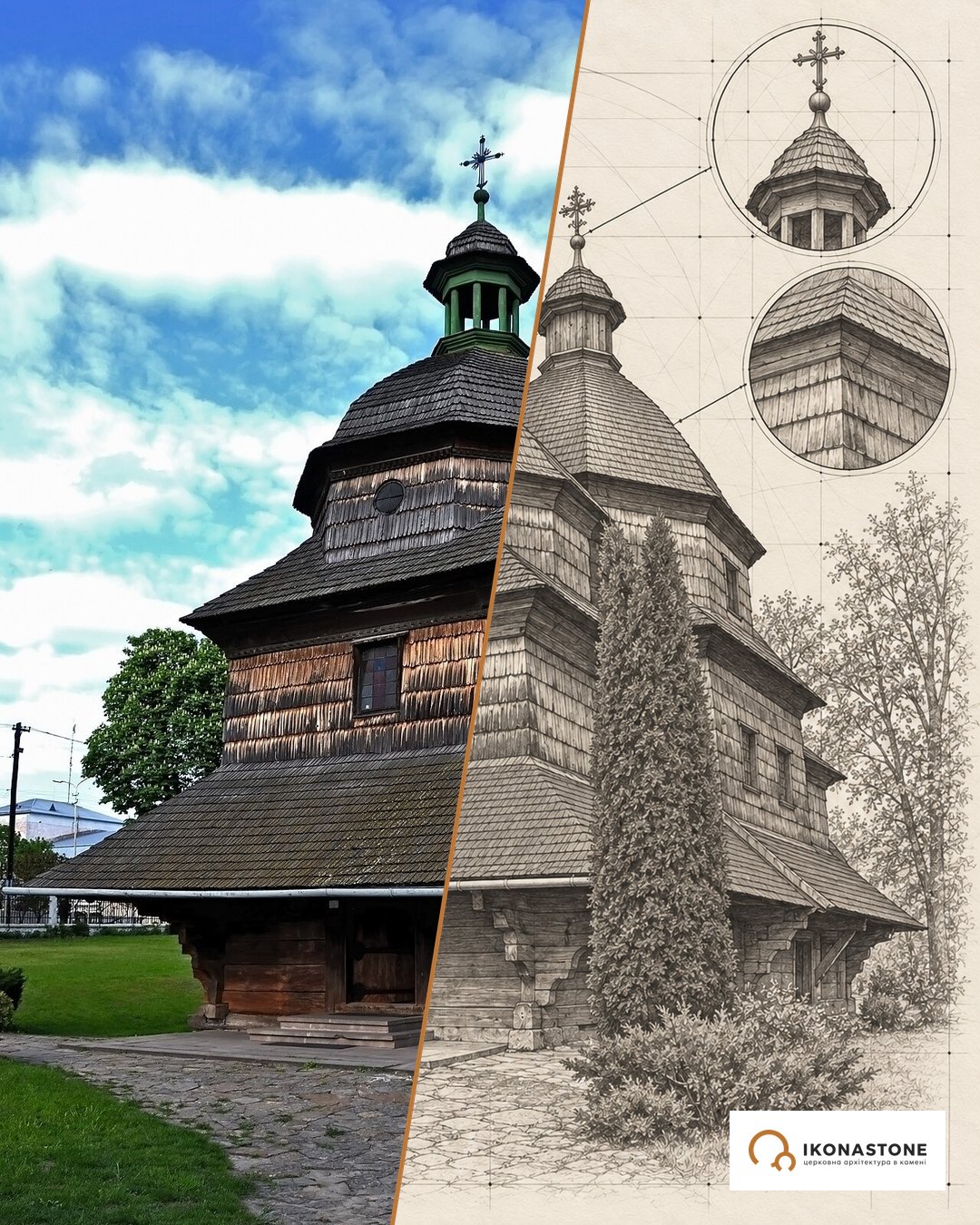
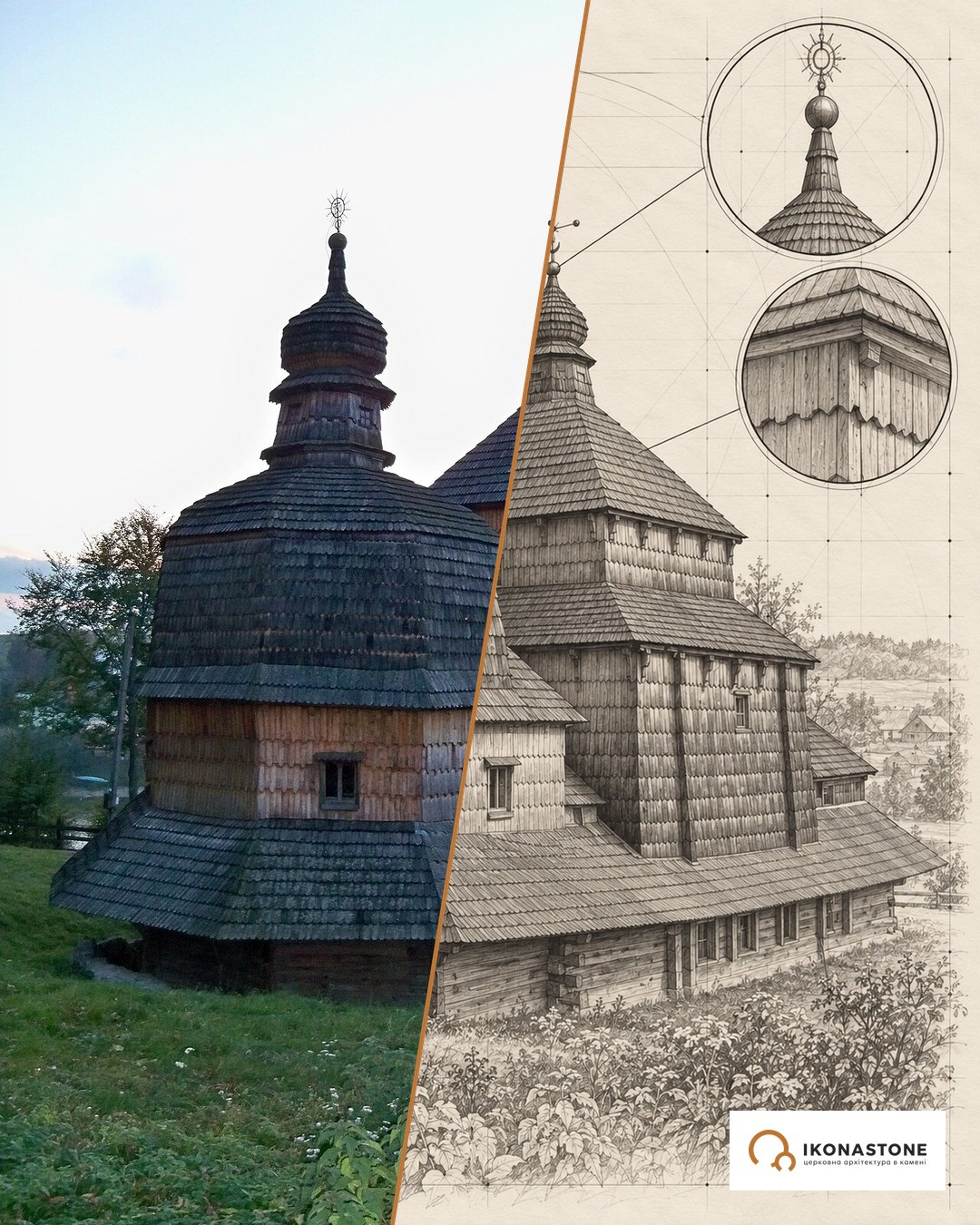
Below are two elements of the church: in a photo and in a drawing. The drawings show the form, not exact dimensions.
The tiered top above the nave
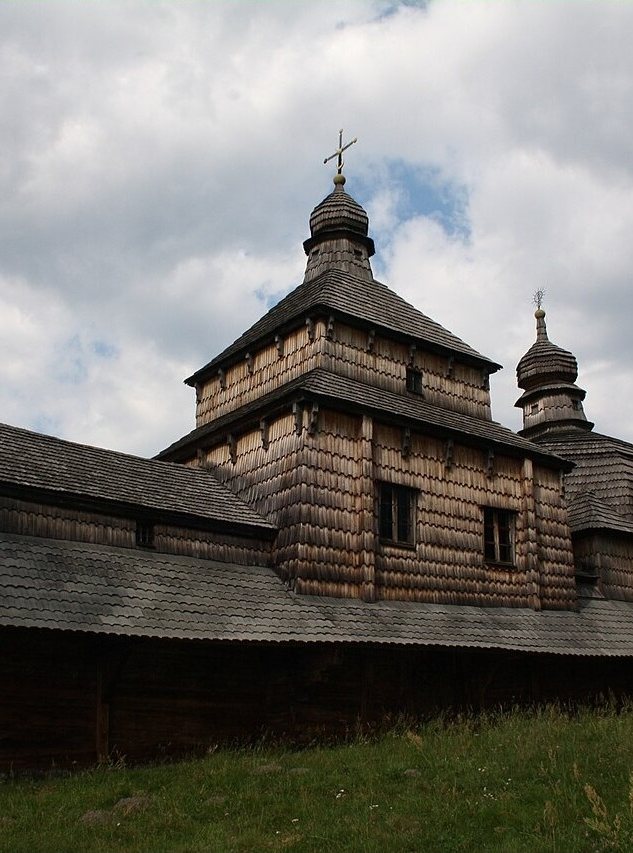
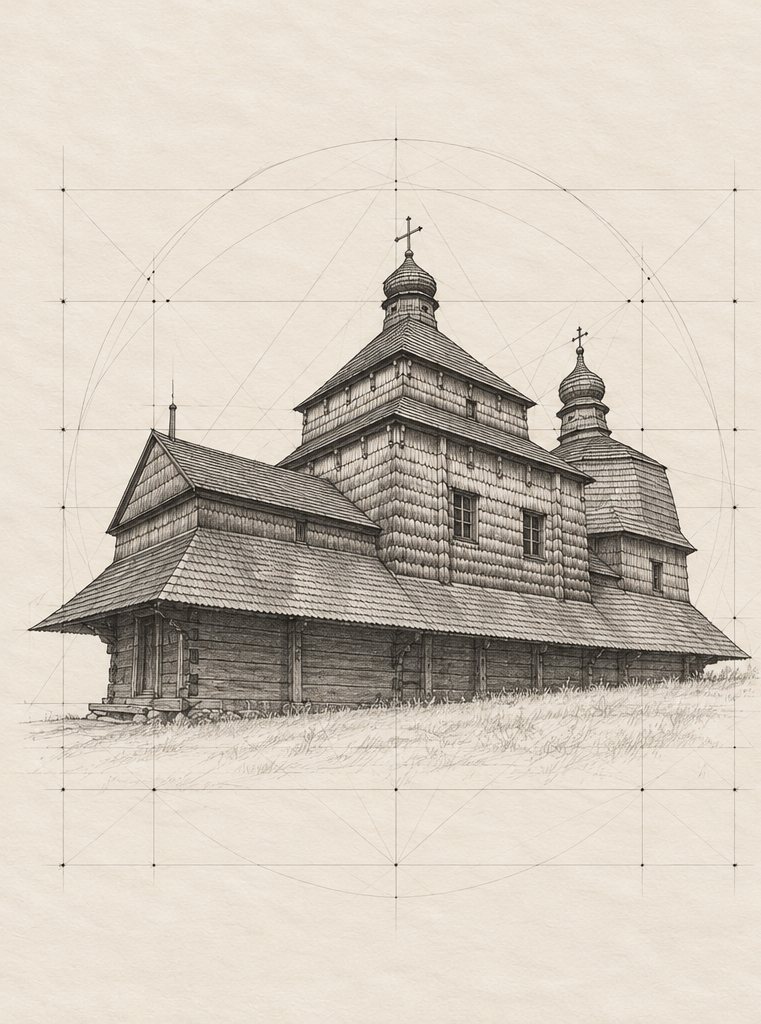
The top rises in steps, like a pyramid of several breaks. This is a Boyko feature: each tier is slightly narrower than the one below, and the silhouette surges upwards without a single dome.
The dome above the sanctuary
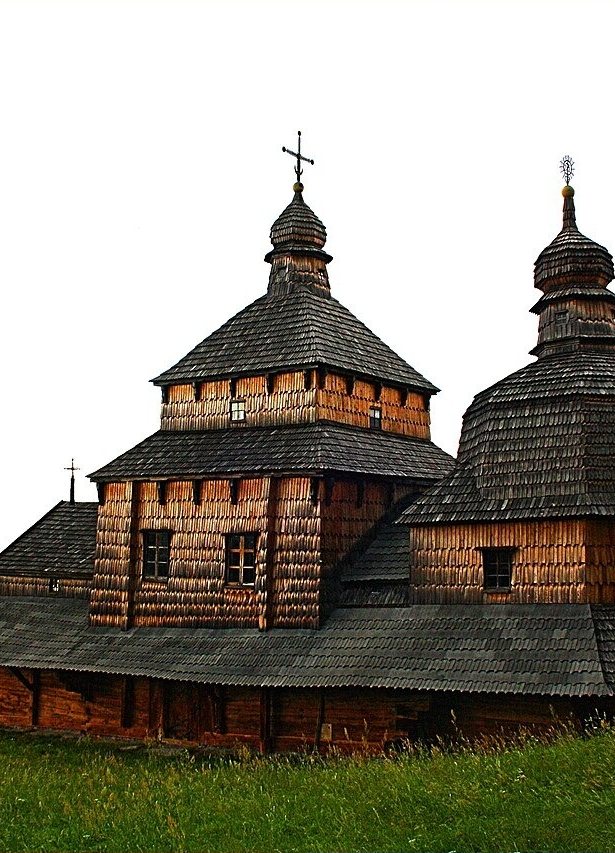
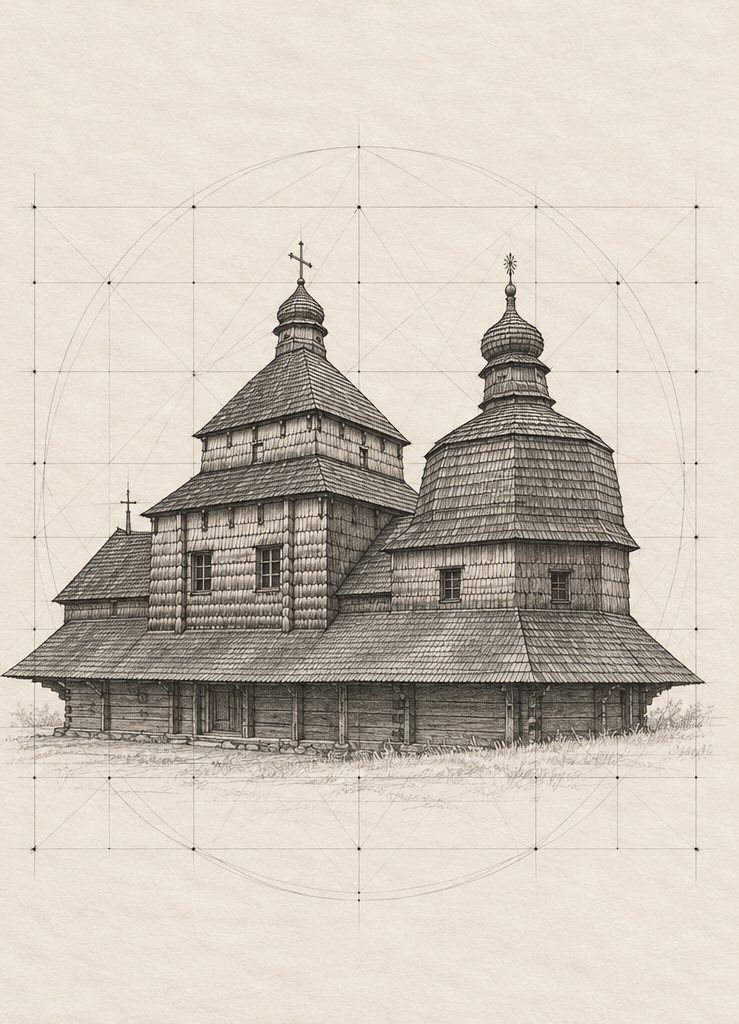
The sanctuary frame is crowned by a dome in the Volhynian manner. Next to the pyramid above the nave it looks like another language in the same sentence — and that is exactly why the church is recognisable at first glance.
Details that are easy to miss
Cossacks on the church walls. The wall paintings of the 1620s–1640s, according to the Encyclopedia of Ukraine, were made by masters of a single school in tempera directly on the walls, and they treated the canons freely. Instead of Emperor Constantine and Empress Helen, the walls show Prince Volodymyr and Princess Olga, and the warriors in Gospel scenes are dressed as Cossacks. The 17th-century church wrote sacred history in the language of its own time.
An iconostasis painted on the wall. The sanctuary has a 17th-century iconostasis, and its upper tiers, according to Sacred Art of the Lviv Region, are not carved but painted directly on the east wall of the nave; in the 19th century they were repainted. A painted iconostasis is a rare case when the boundary between the wall and the altar screen literally disappears.
A fertiliser store that never happened. According to ZAXID.NET, the Soviet authorities wanted to set up a mineral fertiliser store in the church; the community objected, because the chemicals would have destroyed the wood. Later there were attempts to move the church to the Shevchenkivskyi Hai open-air museum in Lviv — and again the community would not allow it. While the church stood closed, people, according to locals, peered inside through a gap in the door; the locals themselves speak of seventy years, although according to the documents the church was closed for almost fifty.
A name inherited from its predecessor. The church that formerly stood on this site was dedicated to Saints Borys and Hlib (an entry of 1559). The memory of it survives in the main-tier icon of Borys and Hlib and in the name of the field “Borysivske”, mentioned by the visitation of 1739. The present dedication is the Descent of the Holy Spirit.
A mysterious millstone. During the restoration of the Holy Trinity Church in Zhovkva in 2019, a millstone of unknown purpose was found in the middle of the church. According to Volodymyr Heryk, a researcher at the Zhovkva Reserve (ZAXID.NET, 2019), the same kind of millstone was found in the central nave of the church in Potelych. Whether it had a sacred meaning has still not been established.
Books from Fedorovych’s press. According to the Wooden Churches of the Carpathians route, the church kept old books, including the 16th-century “Apostol” of Ivan Fedorovych and a 17th-century “Festal Triodion”.
A hill without trees. The same route recalls that the old trees which held the slopes of Horodyshche were later cut down. For a church on a hill this is no small matter: until 2018 it stood without a foundation, and only then were its sills replaced and stone paving laid.
Photo gallery
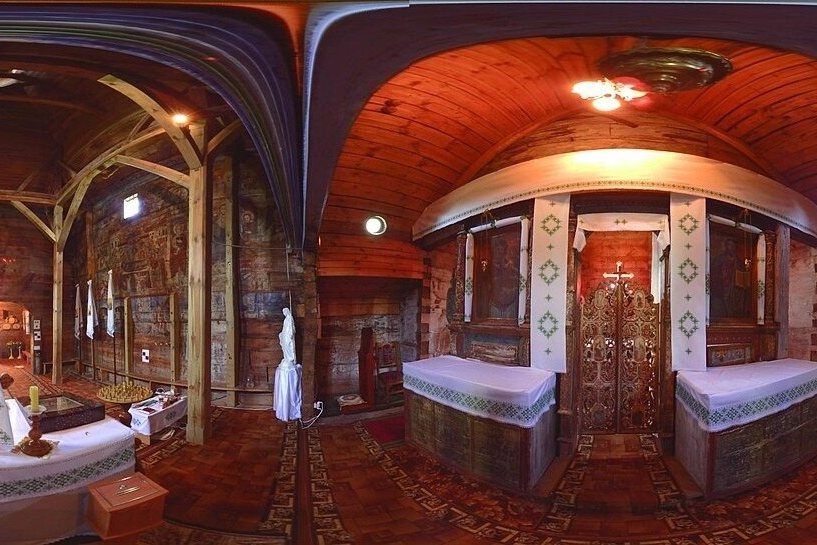
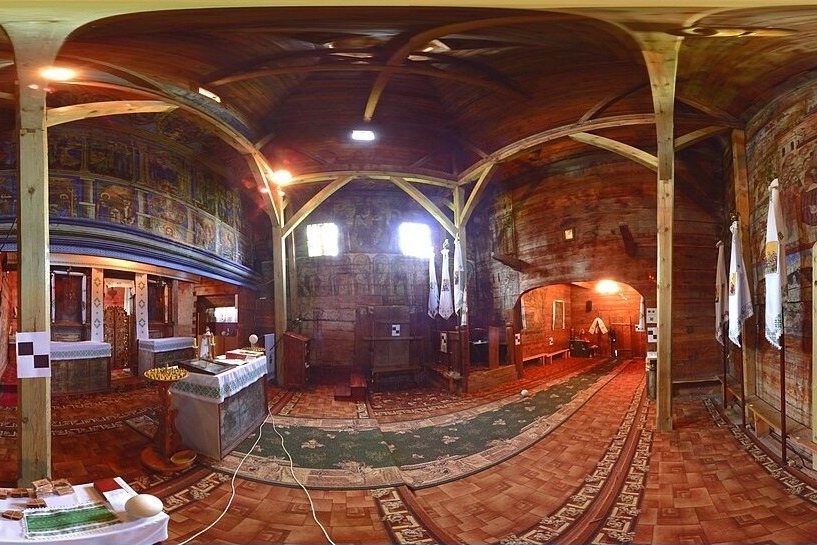
Stone and material
The church is assembled from wooden log frames, and its walls and roofs are covered with shingles. It is often said that the building contains not a single nail; locals say so too in the ZAXID.NET article. According to English Wikipedia, only the sacristy is masonry. The main treasure of the interior is the tempera applied directly to the wooden walls: here the wood is both the structure and the ground for painting.
The story of the sheet metal shows well how material affects a building’s fate. At the beginning of the 20th century the shingles were replaced with sheet metal — practical, durable, modern. Half a century later restorers removed it and gave the church back its shingles. Stone in a church behaves differently, but the rule is the same. A material chosen “for the ages” must be compatible with what already stands nearby. That is why, in an old church, any new piece — an altar table, a candle stand, a step — should first be “placed” on a drawing next to what is already there, and only then should its material be chosen.
On the structure of the altar screen, see the articles “The Ukrainian iconostasis” and “Tiers of the iconostasis”, and the iconostases section. Another Holy Spirit church from the same UNESCO list is the church in Rohatyn; another wooden church from the same UNESCO property is the Church of St Michael the Archangel in Uzhok.
Did you know
In 1736 the carpenter Kazymyr Dominikovych was paid 166 zlotys for the repair, and a pig was added. According to Pavlyshyn. [1]
Besides the Cossacks and Princes Volodymyr and Olga, the masters depicted the Pharisees as the Galician Jews of their day. According to the Encyclopedia of Ukraine. [2]
The walls show Anthony and Theodosius of the Caves; Pavlyshyn links this choice to the reforms of Metropolitan Petro Mohyla. [1]
Pavlyshyn calls the wall paintings “one of the oldest surviving paintings in a wooden church in Ukraine”. [1]
The church kept old hakivnytsi (hook guns); in 1848 the Austrian government requisitioned them. [1]
In the 1720s–1750s the parish rented out to potters the rooms built near the church. [1]
During the Great Northern War the church was plundered, and a 66-year-old townsman was killed near it. [1]
The floor slopes by almost a metre from the entrance to the sanctuary wall; because of the slope the church is called “under the hill”. According to Suspilne. [7]
The “Passion of the Lord” cycle on the walls comprises 25 biblical scenes. According to Radio Svoboda. [16]
Rutkovych painted the “Deesis” icon of 1682 for the Holy Trinity Church, and then repeated the composition for the Holy Spirit Church. According to ZAXID.NET. [9]
Only in 2018 did the church get a foundation for the first time; before that it stood simply on stones. [5, 6]
The church is both on the World Heritage List (since 2013) and under provisional enhanced protection under the Hague Convention (since 2023). [10, 18]
In 2024 a UNESCO and ICOMOS mission was to scan the church with a laser scanner for an emergency action plan. [19]
Legends
Khmelnytsky at the liturgy
According to legend, in 1648 Bohdan Khmelnytsky prayed in this church. Recorded in English Wikipedia and LVIV.MEDIA; the documents record only the passage of his army through Potelych towards Zamość. [1, 11, 14]
A church without a nail
According to legend, the church was assembled without a single nail. So say the locals in the ZAXID.NET article, repeated by LVIV.MEDIA. [8, 14]
The potters' church
According to legend, the church was paid for by the potters after the Tatars burned the old one. Recorded by the Wooden Churches of the Carpathians route and by Local History (“probably”); Pavlyshyn cites no documents for this. [1, 4, 5]
Seventy years behind the gap
According to locals, in Soviet times the church stood closed for 70 years, and people peered inside through a gap in the door. Recorded by ZAXID.NET; according to the documents the church was closed for almost 50 years. [1, 8]
The millstone in the nave
According to Volodymyr Heryk, a researcher at the Zhovkva Reserve, a millstone was found in the central nave of the church, as in the Holy Trinity Church in Zhovkva; he suggests a sacred meaning. Recorded by ZAXID.NET (2019). [20]
People
- Kazymyr Dominikovych — carpenter, repaired the church in 1718 and 1736 (the route and Local History add 1753).
- Ivan Rutkovych — a Zhovkva painter, author of the icon “Supplication” of 1683.
- Fedusko (Theodosius) of Sambir — a master with whom M. Helytovych hypothetically links the icon “Borys and Hlib”.
- Ivan Maliar (“Ivan the Painter”) — a local master, according to Local History the leader of the group that painted the walls (according to one source).
- Sigismund II Augustus — the king who in 1569 confirmed the town’s new privileges after the Tatar attack.
- Fr Illia Prosyk — parish priest accused in 1648 of attacking a Catholic church.
- Fr Mykhailo Durkalevych — parish priest in the visitation of 1720.
- Fr Ivan Kyrylovych — parish priest in 1766, later moved to the Holy Trinity Church.
- Bohdan Khmelnytsky — according to legend, prayed in the church in 1648.
- Liudmyla Miliaieva — art historian, described the wall paintings in monographs of 1969 and 1971.
- Borys Kindzelskyi, Ivan Mohytych — authors of the 1970–1972 restoration design.
- Fr Vasyl Mutka, Fr Taras Kohut, Fr Roman Semeniuk — parish priests after the revival of 2008.
- Fr Mykhailo Zakharkiv — the present pastor (according to Pavlyshyn; Suspilne has “Zakhar”, “Zakharko”).
- Olena Vasylko — director of the architecture department of the Lviv Regional Military Administration, who led the restoration meetings of 2023.
- Andrii Pavlyshyn — historian, author of the 2021 article with the new dating.
How to cite
IKONASTONE. The Church of the Descent of the Holy Spirit in Potelych // Guide to the Churches of Ukraine. URL: https://ikonastone.com/en/guide/holy-spirit-church-potelych/ (accessed DD.MM.YYYY).
FAQ
When was the Holy Spirit Church in Potelych built?
The traditional date is 1502: the church was erected on the site of the Church of Saints Borys and Hlib, burned by the Tatars. According to other data, 1555; the historian Andrii Pavlyshyn (2021) dates the construction to between 1559 and 1564.
Who funded the church?
According to a tradition retold by the Wooden Churches of the Carpathians route and by Local History, the construction was financed by the local potters. Potelych was then a large pottery town.
What makes the church's wall paintings valuable?
The paintings of the 1620s–1640s cover the walls of the nave and part of the babynets (narthex). They were made in tempera directly on the wood by masters of a single school who treated the canons freely: instead of Constantine and Helen they depicted Prince Volodymyr and Princess Olga, and the warriors as Cossacks.
Is the church in use?
Under Soviet rule the church was closed, but it was given monument status and restored in 1970–1972. Since November 2008 the church has been fully in use again.
When was the church added to the UNESCO list?
On 21 June 2013, as part of the transnational property “Wooden Tserkvas of the Carpathian Region in Poland and Ukraine”.
Sources
- А. Павлишин. Матеріали до історії пам'ятки ЮНЕСКО — церкви Св. Духа в Потеличі // Наукові записки ВДПУ. Серія «Історія», 2021, вип. 38, с. 9–16
- Encyclopedia of Ukraine. Potelych Church of the Holy Ghost
- Encyclopedia of Ukraine. Potelych
- Дерев'яні храми Карпат. Church of the Holy Spirit, Potelych
- П. Артимишин. Під покровом Святого Духа: одна з найдавніших дерев'яних церков України // Локальна історія, 19.05.2023
- Суспільне Львів. Церква у селі Потелич, що датується 1502 роком: що відомо про реставрацію (07.05.2023)
- Суспільне Львів. Дерев'яний храм XVI століття в Потеличі готувався до винесення плащаниці (10.04.2026)
- ZAXID.NET. Б. Головко. Дерев'яна перлина ЮНЕСКО під опікою в черниць (07.10.2013)
- ZAXID.NET. О. Шиян. Церква із різьбленими тризубами та ардековими вітражами (12.02.2026)
- UNESCO World Heritage Centre. Wooden Tserkvas of the Carpathian Region in Poland and Ukraine
- Wikipedia (en). Descent of the Holy Spirit Church
- Wikipedia (en). Potelych
- Львівська ОВА. У Потеличі розглядали питання реставрації церкви Зіслання Святого Духа (27.04.2023)
- LVIV.MEDIA. Під посилений захист ЮНЕСКО потрапила церква в Потеличі (11.09.2023)
- LVIV.MEDIA. На Львівщині планують відреставрувати дві стародавні церкви зі списку ЮНЕСКО (14.10.2023)
- Радіо Свобода. Матеріал про Потелич (14.04.2006)
- Wikipedia (en). Ivan Rutkovych
- Міністерство культури та інформаційної політики України. UNESCO has inscribed 20 cultural heritage sites of Ukraine on the List of Cultural Property under Provisional Enhanced Protection (08.09.2023)
- Львівська ОВА. Спільна місія ЮНЕСКО та ІКОМОС: на Львівщині фахівці оглянуть дві святині зі списку всесвітньої спадщини (29.10.2024)
- ZAXID.NET. Під час реставрації жовківської дерев'яної церкви зі списку ЮНЕСКО натрапили на крипту (14.06.2019)
- Town
- Potelych village, Lviv Oblast
- Built
- traditionally 1502; according to other data 1555 or 1559–1564
- Type
- three-part wooden church with two tops
- Material
- wooden log frames, shingles; masonry sacristy; tempera wall paintings
- Research depth
- 29%