The Ukrainian iconostasis: what makes it distinctive
There is a wall in a church that can be seen from anywhere. It does not hold up the roof and does not separate anything that could not be crossed in three steps. Yet it is this wall that decides how the interior will look: where the gaze will stop, where the candlelight will fall, how much gold there is in the space and how much silence.
The Ukrainian iconostasis of the 17th–18th centuries took shape as a form of its own. It is no longer a low barrier but a tall carved structure in which architect, carver and painter work together. The Encyclopedia of Ukraine describes it as a work of several arts: architecture, sculpture and painting. The icons sit between columns and beams covered with fine carving and gilding.
This article is about what such a form consists of, where to see it, and what it teaches those who design a new iconostasis today, in wood or in stone.
In brief
- The Ukrainian Baroque iconostasis is a five-tiered (sometimes six-tiered) carved wall, gilded in every element.
- The main motif of the carving is vegetal: the grapevine, acanthus, flowers and fruit. The vine also carries theological meaning: Christ the Vinedresser.
- Benchmark monuments: the Bohorodchany iconostasis by Yov Kondzelevych (1698–1705, now in Lviv), the iconostasis of the Church of St Paraskeva in Lviv, and the iconostasis of the Church of the Transfiguration in Velyki Sorochyntsi (1732).
- Iconostases of the 19th century had, in some monuments, a different arrangement: fewer tiers, academic painting, classical-order decoration in the spirit of the Renaissance and Empire style.
- Today one works with the tradition not by copying but by choosing a prototype and honestly translating its language into the material.
There is one more reason to discuss it separately. Such a wall is not decoration around the icons but a way of showing how prayer is structured: from the prophets and apostles, through the feasts of the church year, to the images of the Mother of God and Christ in the local tier. The Bohorodchany iconostasis can be “read” tier by tier, like a text, and at the same time one can study an individual detail, as in a miniature.
What is the Ukrainian Baroque iconostasis?
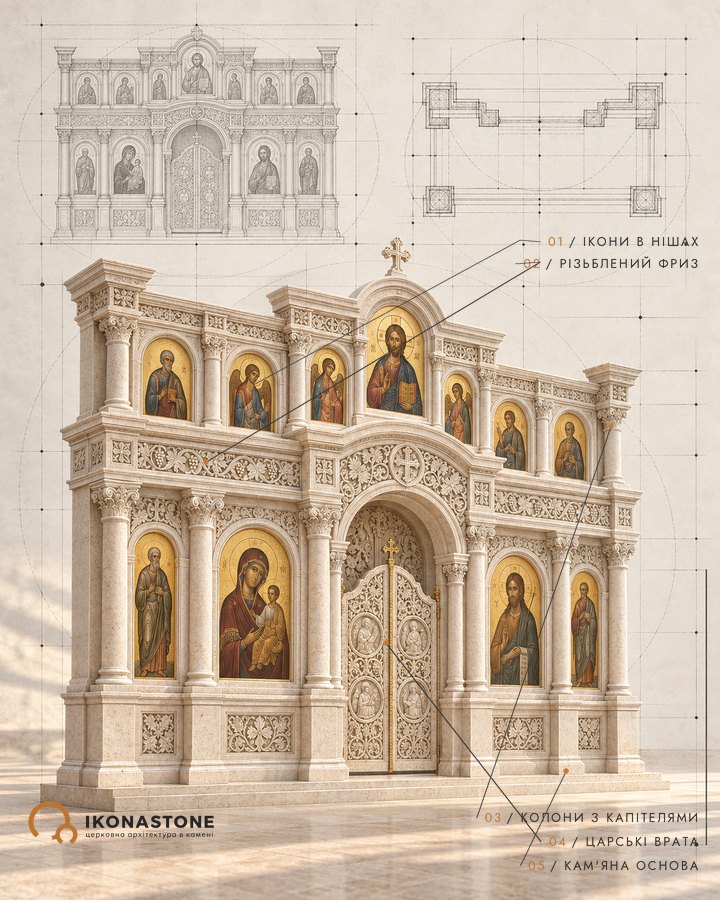
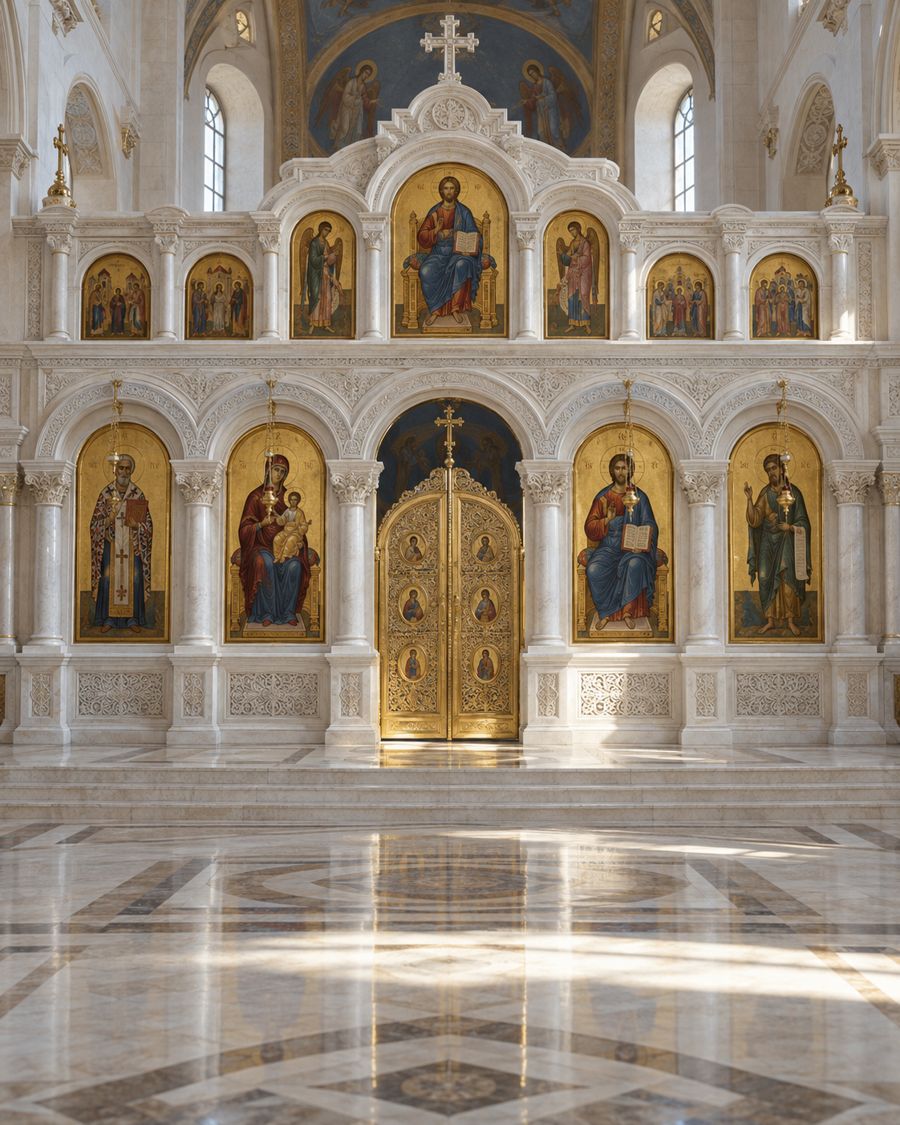
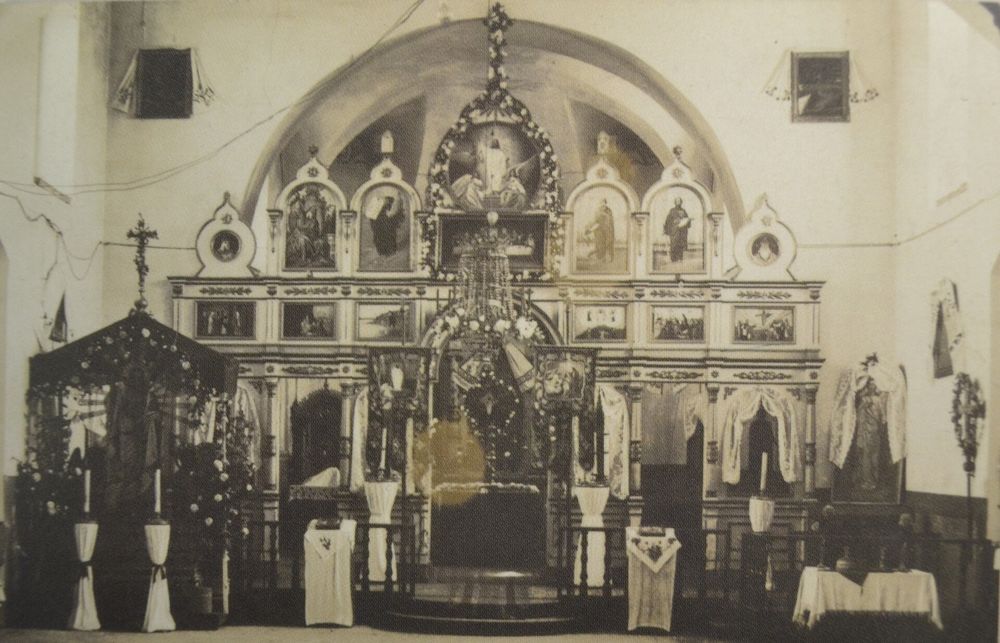
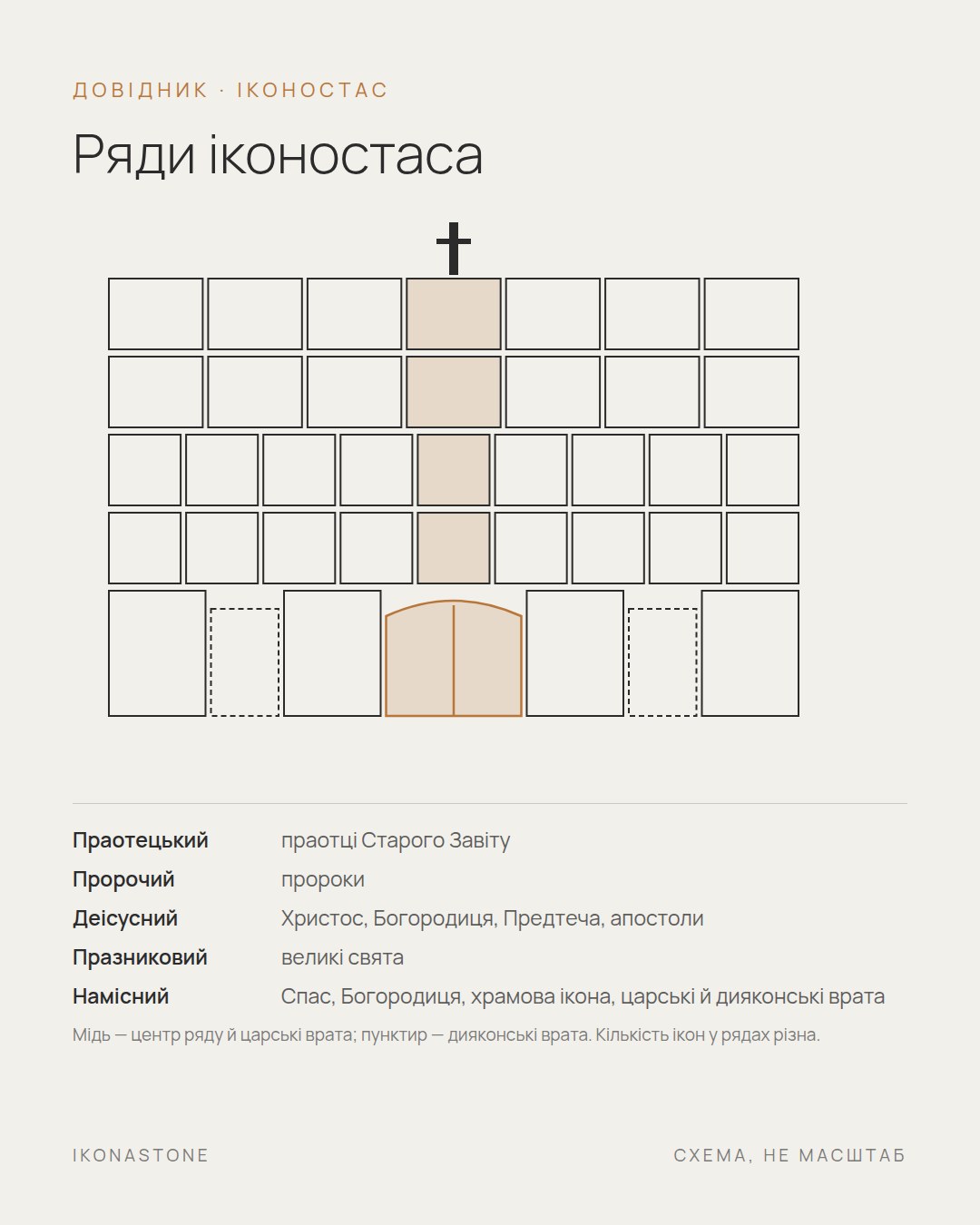
First, its arrangement. The classic Ukrainian iconostasis has five tiers. From the bottom up: the base tier (predella), the local tier, the festal tier, the apostles’ (Deesis) tier and the prophets’ tier. It is crowned by a crucifix, and in some monuments a sixth tier is added. The Bohorodchany iconostasis consists of exactly these five rows; the Encyclopedia of Ukraine adds that over time the iconostasis grew and acquired a fifth, and even a sixth, tier. A recent study likewise names five tiers for Sloboda Ukraine: Deesis, local, base, festal and prophets’.
There is one more detail that is easy to miss. The Baroque character of the structure shows not only in the ornament but in the composition: the tiers rise towards the centre. The researcher Svitlana Olianina dates the appearance of tiers rising towards the centre to the 1660s in Kyiv, the 1670s in Chernihiv, and the second quarter of the 18th century in Western Ukraine. In other words, “the Baroque iconostasis” is not one date but a process that moved at different speeds in different lands.
Why is the carving so dense and golden?
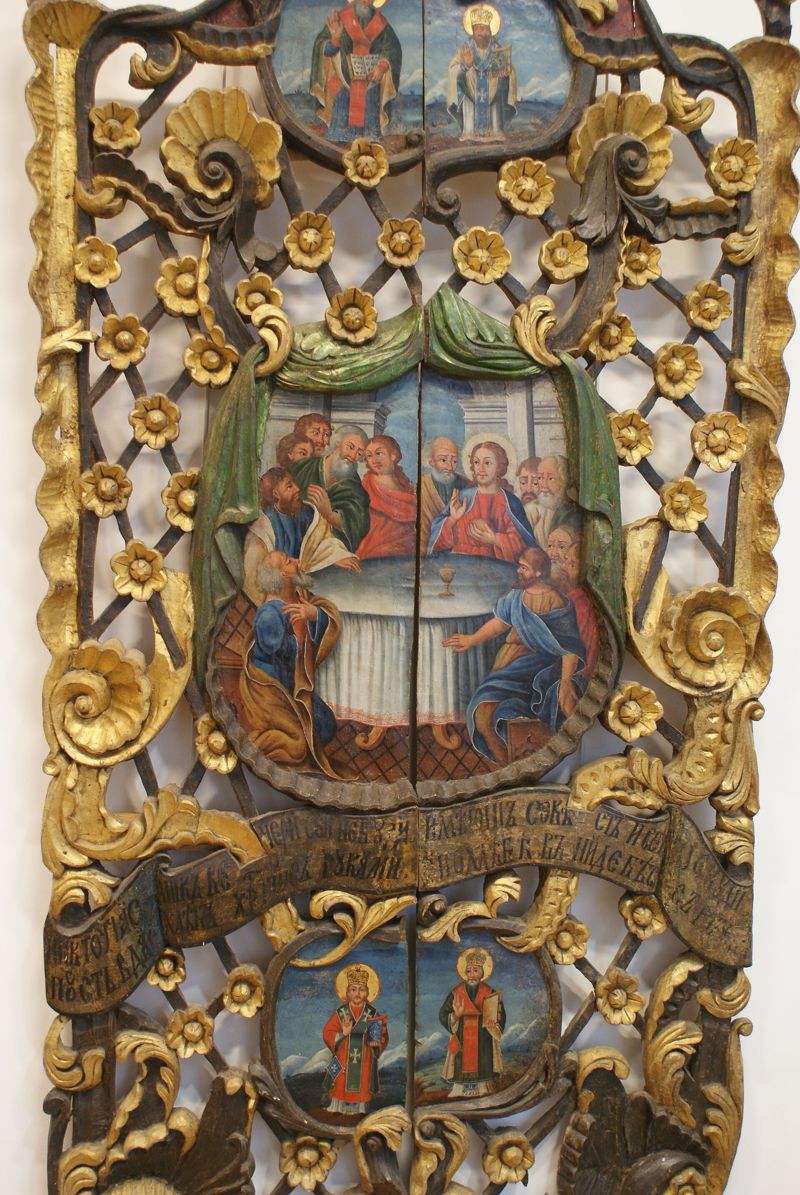
Look at such a wall up close and you will hardly see a smooth surface. Carving covers every element of the structure. Olianina notes that the columns are gradually replaced by openwork forms that merge with the surrounding carved plant decoration.
The gilding works together with the carving. The researcher links continuous gilding to the idea of the Heavenly Jerusalem: gilding every element created an allusion to the golden city. The researcher V. Shulika reads the same density differently and adds that continuous plant carving refers to the image of the garden of Paradise.
The central motif is the grapevine. In the Bohorodchany iconostasis branches and clusters grow from the jaws of lions on the royal doors, and a stylised vine winds around the carved crucifix. This is connected with the image of Christ the Vinedresser. The background of the apostles’ tier there is likewise a carved, gilded ornament. The Encyclopedia of Ukraine sums it up: the icons stand between carved and gilded columns, and the ornament as a rule consists of intertwined grapevines.
Which monuments are worth knowing?
The Bohorodchany iconostasis
It was created by Hieromonk Yov Kondzelevych (1667–1740) with his assistants, painters and carvers. The museum description dates it to 1699–1705, and T. Otkovych’s study to 1698–1705. The iconostasis was intended for the Church of the Exaltation of the Cross of the Maniava Skete. When the skete was dissolved in 1785, the iconostasis was given to the church in the village of Bohorodchany, hence its name. In 1916 the Austrian authorities took it to Vienna; it later ended up in a Warsaw museum, and in 1924, at the request of Metropolitan Andrey Sheptytsky, it was brought to Lviv and handed over to the National Museum.
The iconostasis has five rows: the base, local, festal, apostles’ and prophets’ tiers. At the top stands a carved figure in the round of a pelican feeding its young with its own blood — an allegory of Christ’s self-sacrifice. T. Otkovych calls this crowning element unique: iconostases of this period are usually crowned by a dove or an icon of the Resurrection.
The iconostasis of the Church of St Paraskeva in Lviv
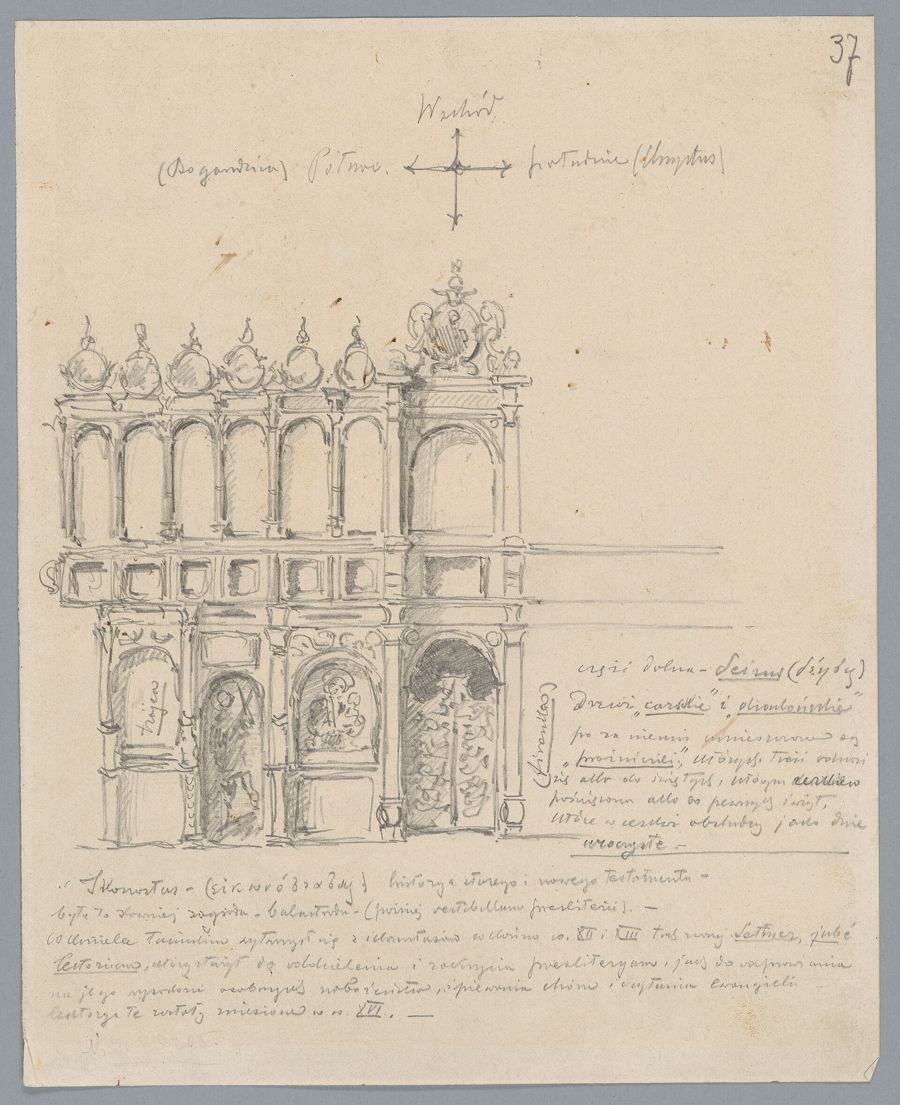
This is one of the earliest large iconostases to have come down to us almost intact. Olianina calls it the earliest fully preserved example of the iconostasis as an architectural facade with arcading and consoles. It has five tiers and some 70 icons. The church was restored after the fire of 1623 at the expense of the Moldavian hospodar Vasile Lupu and was consecrated a second time in 1645. Work on the iconostasis, according to V. Zhyshkovych’s study, lasted from the mid-1610s to 1644, and at least four painters worked on it. The researcher attributes the icons of the local tier to the brush of Fedir Senkovych, although there are sceptics. An additional Passion tier was a novelty for Lviv icon painting.
Iconostases of Galicia and Volyn
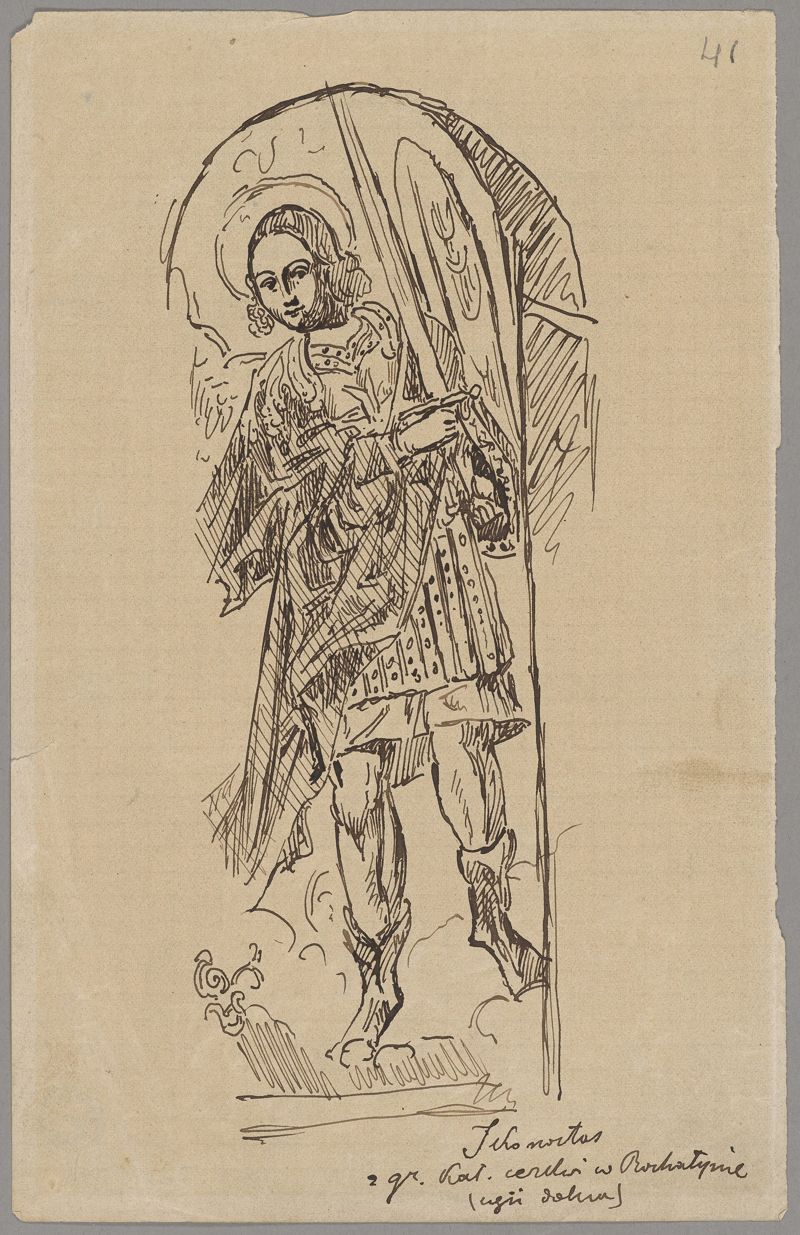
In Galicia the Encyclopedia of Ukraine names Mykola Petrakhnovych’s iconostasis in the Dormition Church in Lviv (1637), the iconostases of the Church of St Paraskeva (1644) and the Church of the Holy Spirit in Rohatyn (1650), as well as works by the Zhovkva master Ivan Rutkovych in Volytsia Derevlianska (1680–1682), Volia Vysotska and Zhovkva (1697–1699). Rutkovych worked in the 1670s and into the early 18th century; scholars call him one of the greatest figures of Ukrainian sacred art, although he signed only a small part of his works, and attribution often remains difficult.
In Volyn the Baroque is visible above all in details: according to I. Miakota’s study, almost all the royal doors of Volyn iconostases of this period had openings with a Baroque outline. The iconostasis of the Holy Trinity Church of the Mezhyrich Monastery is Baroque in its overall impression, while its royal doors are executed in a Renaissance manner.
Dnipro Ukraine and Sloboda Ukraine
The only large Baroque iconostasis built at the expense of the hetmans and the Cossack officer class to have survived, according to the Encyclopedia of Ukraine, is in the Church of the Transfiguration in Velyki Sorochyntsi (1732). It is about 17 metres high and 20 metres wide.
In Sloboda Ukraine the researcher V. Shulika traced how, in the first half of the 18th century, Mannerist ornament gave way to Baroque floral decoration with acanthus leaves and clusters of grapes. From the second third of the century Rococo motifs appear: the diagonal lattice and the rocaille. The iconostasis of the Church of the Transfiguration in Mezhyrich had five tiers, and its royal doors bore the motif of the Tree of Jesse, new for Sloboda Ukraine.
Why these examples give a varied picture
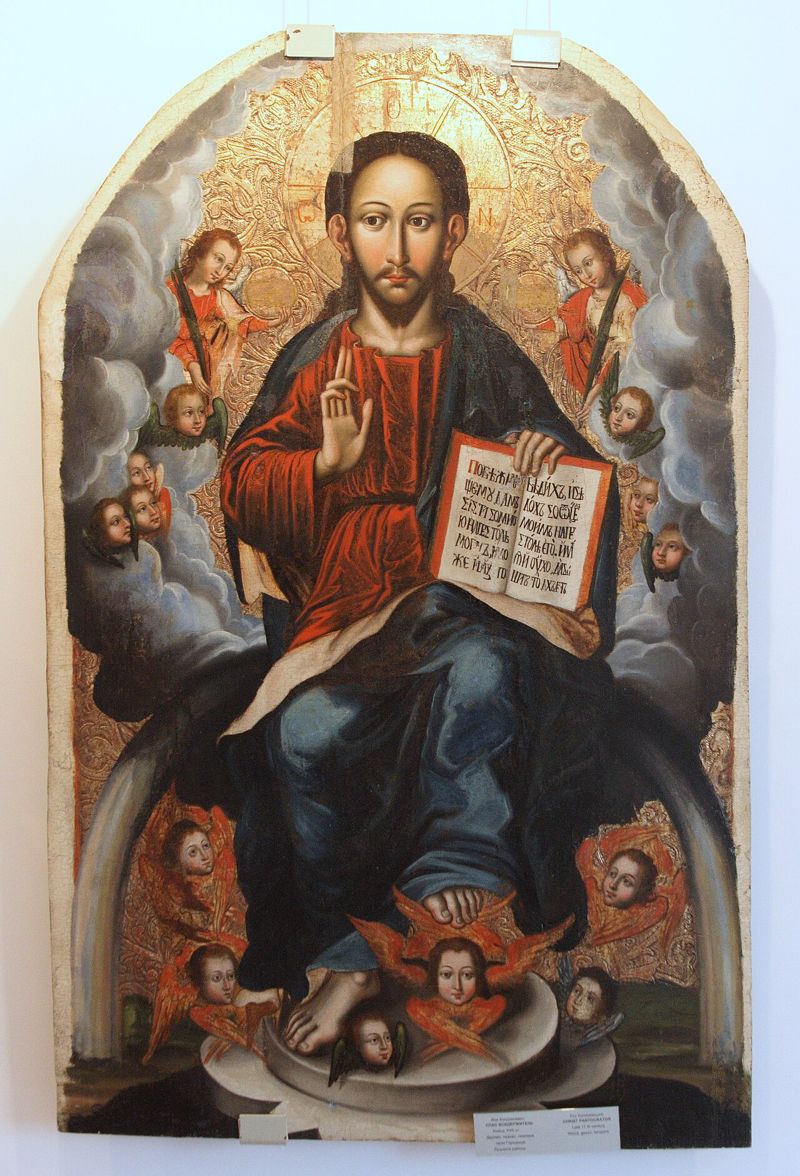
There is no point looking for “a single model”. Olianina notes that in the mid-17th century the character of the carving is still defined as Mannerist, and full Baroque splendour comes later. The Sloboda iconostases of the first half of the 18th century already speak the language of floral Baroque, and from the 1730s Rococo becomes increasingly noticeable. So when someone says “in the Ukrainian Baroque style”, it is worth asking: early or mature, Galician or Dnipro? The answer determines the proportions, the density of the carving and the appearance of the royal doors.
Who were the masters?
Names have survived unevenly. We know the painters better than the carvers. Yov Kondzelevych created the iconostasis for the Maniava Skete, Ivan Rutkovych worked in Zhovkva, and in Lviv Fedir Senkovych and Mykola Petrakhnovych were active. The carvers, however, most often remain nameless in the sources: their work is attested by the ornament itself, not a signature. One documented example is the master Vasyl Petrovskyi, who in 1782 was invited to create the carved iconostasis of the Intercession Cathedral in Okhtyrka. The authors of the study note that Okhtyrka was famous for its carvers.
The Bohorodchany iconostasis shows how this worked: Kondzelevych executed the most complex compositions himself and entrusted the rest to assistant painters and carvers. The Baroque iconostasis is a collective work, and today’s client would do well to keep this in mind: a single contractor rarely handles the design, the carving and the gilding all at once.
How does this type differ from later iconostases?
The comparison is better made by features than by judgements. The 19th-century examples here are taken from studies of churches in Kyiv and Odesa.
| Feature | Ukrainian Baroque iconostasis, 17th–18th c. | Iconostases of the 19th c. (examples from studies) |
|---|---|---|
| Tiers | five tiers, sometimes six | in some monuments only one tier (St Volodymyr’s Cathedral and St Cyril’s Church in Kyiv) |
| Decoration | continuous gilded carving, plant motifs | architrave, frieze, cornice, pilasters with Corinthian capitals; the language of the Renaissance and Empire style (the central iconostasis of the Transfiguration Cathedral in Odesa) |
| Painting | icons in the frames of a carved wall | icons painted in the academic style (Odesa, 1887–1889) |
In the mid-18th century development went further: according to Shulika, Rococo spread on the Left Bank as early as the 1730s, and the iconostasis of the Dormition Cathedral in Okhtyrka (1738), again according to Shulika, combined Rococo and Neoclassicism; in the Sloboda regiments iconostases in the traditional Baroque style were also being created up to 1765. The authors of the study on the Intercession Cathedral in Okhtyrka add that the present plaster iconostasis there “falls far short of the features of the Ukrainian Baroque”.
How to work with this tradition today?
A copy is the simplest and weakest solution. The Baroque iconostasis was born in wood and obeys its logic: thin bridges, deep undercuts, gilding over gesso. Stone has a different language.
So it is worth working from principles. They can be drawn from the monuments discussed above:
- Structure. Five tiers rising towards the centre set the rhythm. This can be kept even in a restrained wall.
- Carving as a theme, not a fill. The grapevine with its clusters works when its design reads from a distance; continuous surface filling in stone should be weighed carefully, because fine ornament reads less well from a distance.
- Gold as an accent. In wood, gilding covers everything. In stone it is better distributed: the vine, the icon frames, the crown of the crucifix.
- Depth of relief. In stone it depends on the type of rock and the thickness of the element. This is a question for the master at the sketch stage, not for the carver during the work.
- Icons. They determine the scale. First the size of the icons and the programme, then the structure.
What to decide before commissioning
- Which prototype is close to you: Galicia, Volyn, Dnipro Ukraine or Sloboda Ukraine?
- How many tiers and what icon programme; whether a prophets’ tier and a crucifix are needed.
- The height and width of the wall, taking into account the vault, the ambo and the passages.
- Material: wood, stone or a combination; what exactly is made of stone and what of wood.
- Gilding: continuous or accent, by what method, and how it will behave in the interior.
- Who will paint the icons and how they will be matched to the carving in size and frame.
- Who will bless the project: the rector, the community, the eparchial commission.
IKONASTONE designs and makes church architecture in stone; if you need an iconostasis in the Ukrainian Baroque tradition, start with the iconostases category. Read about the tiers in the article Tiers of the Iconostasis, about the central part of the wall in The Royal Doors, and about the material in The Stone Iconostasis.
FAQ
How does the Ukrainian iconostasis differ from the Byzantine templon?
At first the iconostasis was a simple support for icons. The Ukrainian iconostasis of the 17th–18th centuries grew into a multi-tiered carved wall with five, and in places even six, tiers, in which architecture, sculpture and painting work together.
How many tiers does a Ukrainian Baroque iconostasis have?
The classic scheme has five tiers: the base tier (predella), the local tier, the festal tier, the apostles' (Deesis) tier and the prophets' tier. A crucifix was set above them, and in some monuments a sixth tier was added.
Why is the carving on the iconostasis so dense and golden?
Scholars link the continuous carving of plant motifs to the image of the garden of Paradise, and the gilding of every element to an allusion to the golden city of the Heavenly Jerusalem. The grapevine also recalls Christ the Vinedresser.
Where can one see the Bohorodchany iconostasis by Yov Kondzelevych?
It is kept in the Andrey Sheptytsky National Museum in Lviv. Created for the church of the Maniava Skete, it passed to the church in Bohorodchany after the skete was dissolved in 1785, and was moved to Lviv in 1924.
Can Baroque carving be done in stone?
Yes, but not as a copy of wood carving. Stone requires a different depth of relief, thickness of bridges and method of gilding, so the language of the Baroque has to be translated rather than transferred.
Where to start when commissioning an iconostasis in the Ukrainian Baroque tradition?
With the choice of a prototype: region, century and number of tiers. Then the icon programme, the height and width of the wall, the material and the gilding method are determined, and only then the design of the carving.
Sources
- T. Otkovych. The iconographic programme and iconographic origin of the subjects of the iconostasis from the Maniava Skete monastery (the Bohorodchany iconostasis), 1698–1705. Narodoznavchi Zoshyty, 2011, No. 6
- The Bohorodchany iconostasis. Andrey Sheptytsky National Museum in Lviv (inv. NML-26615)
- Iconostasis. Encyclopedia of Ukraine
- S. Olianina. The iconostasis as a vision of the Heavenly Jerusalem. Artistic Culture. Topical Issues, 2019, issue 15, part 2
- S. Olianina. The Ukrainian iconostasis: from a functional structure to an architectural frame. Bulletin of NAKKKiM, 2019, No. 1
- S. Olianina. The iconostasis as an image of the garden of Paradise. Culturological Thought, 2019, No. 16
- V. Zhyshkovych. Some remarks on the creative portrait of the painter Fedir… Narodoznavchi Zoshyty, 2019, No. 6
- V. Shulika. The sanctuary screen of the Okhtyrka Dormition Cathedral of 1738. Fine Art, 2020, No. 3
- V. Shulika. Iconostases of the Sumy Regiment in the first half of the 18th century. Bulletin of KSADA, 2022, No. 1
- L. Sokoliuk, O. Sokoliuk. The Okhtyrka Intercession Cathedral: between past and future. HUDPROM, 2023, No. 1
- I. Miakota. Historicism and eclecticism in the aesthetic system of the royal doors of Volyn, second half of the 19th — first third of the 20th century. Narodoznavchi Zoshyty, 2011, No. 5
- A. Tarasenko, H. Akridina. Iconostases of the Transfiguration Cathedral in Odesa. Art and Design, 2020, No. 2
- H. Druziuk, M. Skop. Ivan Rutkovych's icon 'Mother of God Hodegetria'… Narodoznavchi Zoshyty, 2022, No. 1