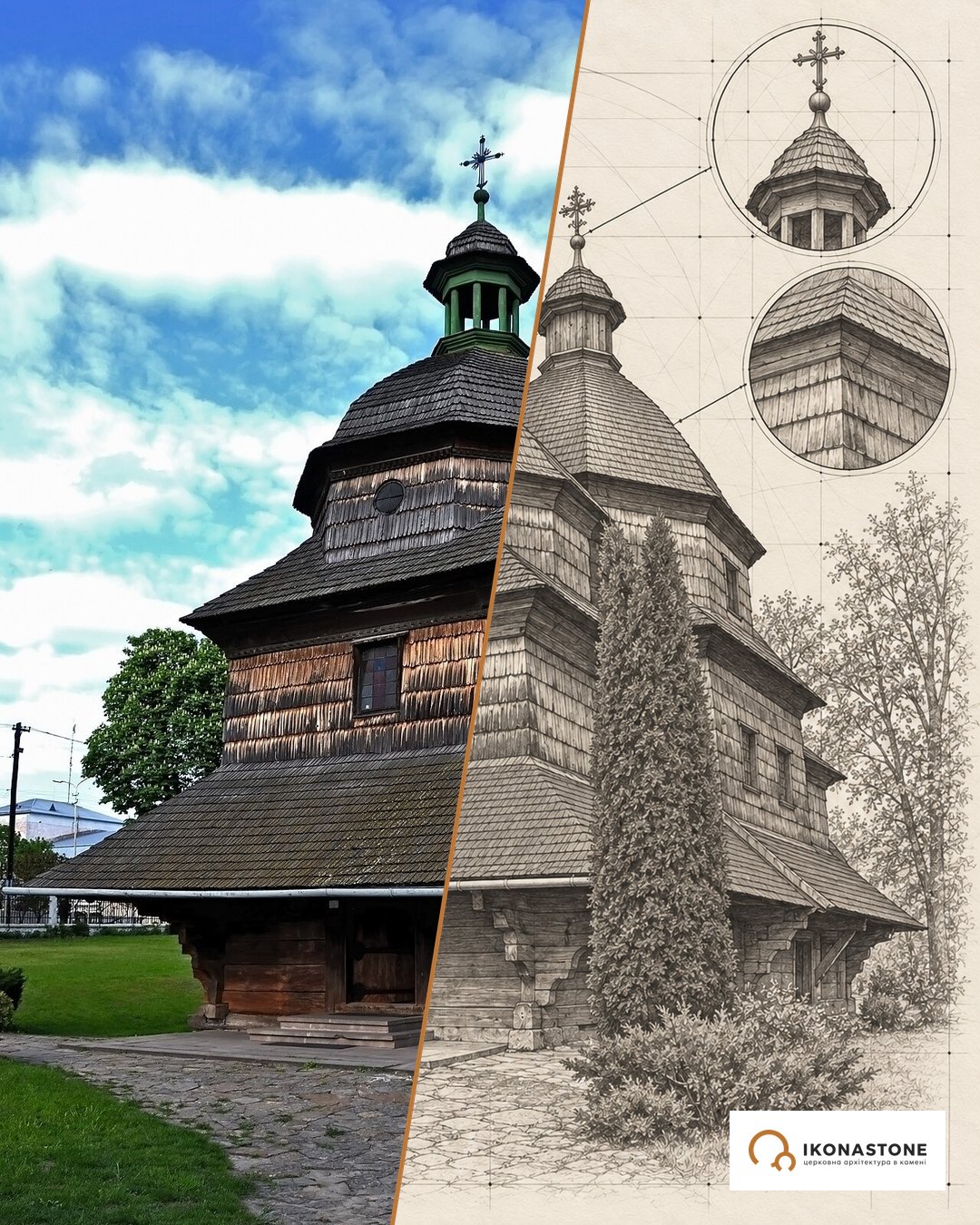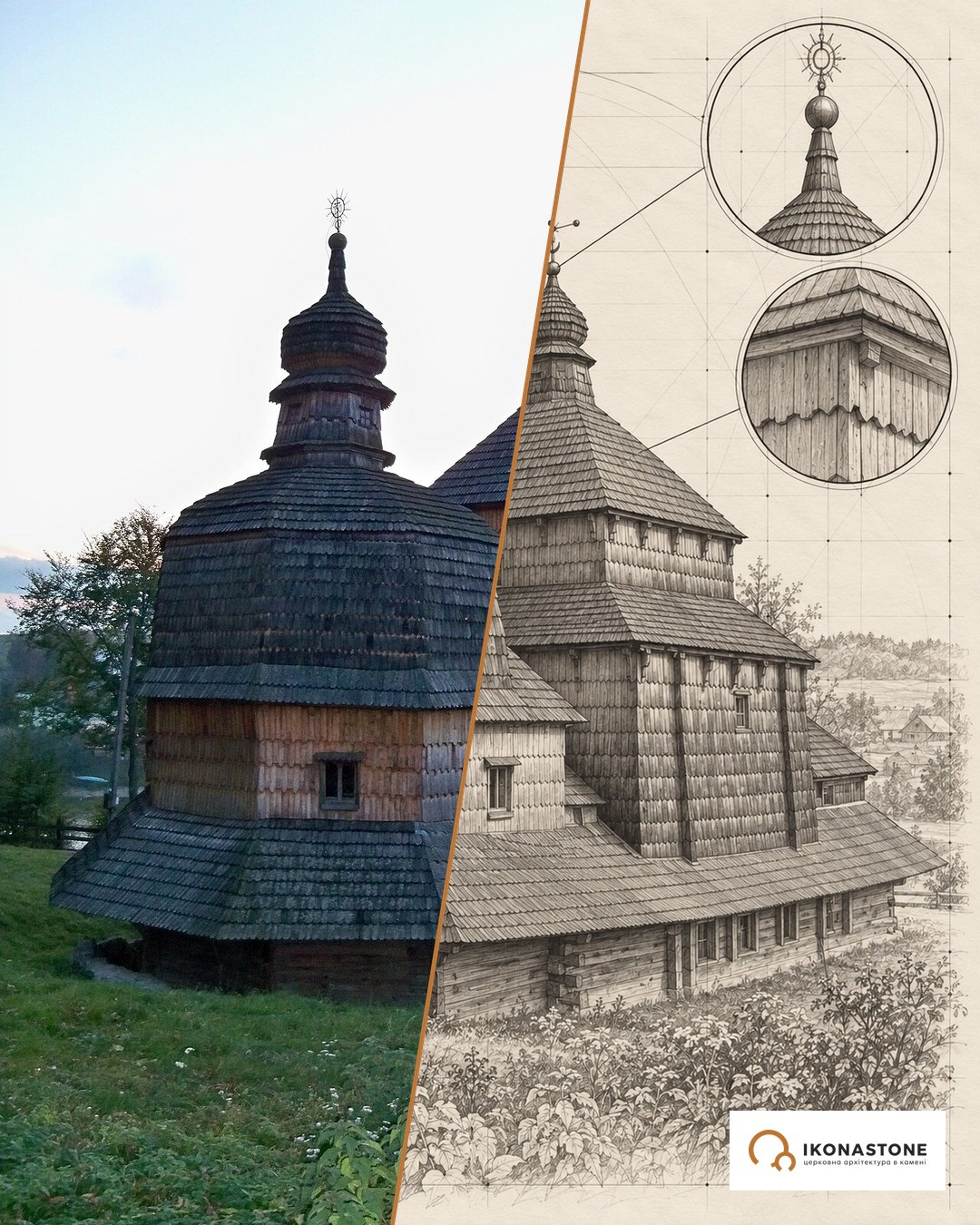
St George's Cathedral in Lviv: Rococo on a stone terrace
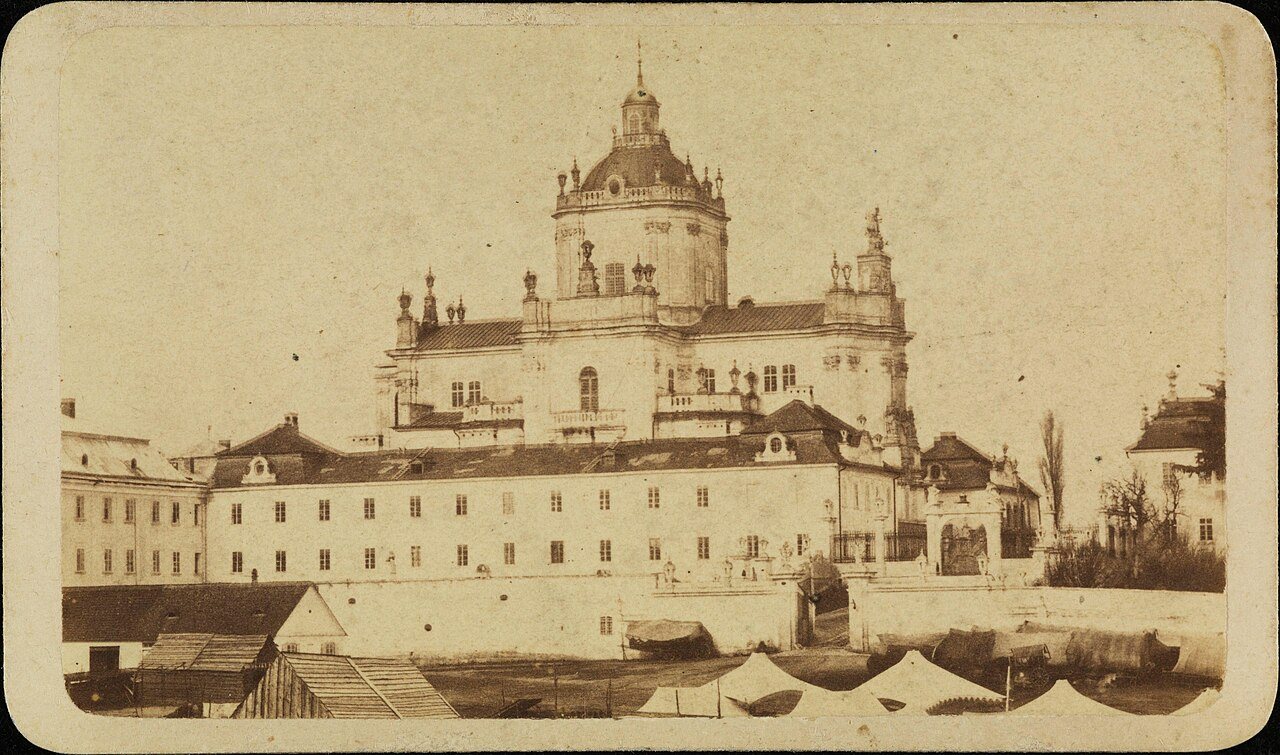
St George’s Cathedral can be seen from many points in old Lviv: it stands on a hill, on a terrace, and above its portal a horseman has been striking a dragon with his spear for more than two hundred years.
In brief
| Address | 5 St George’s Square, Lviv |
| Built | 1744–1764, decoration until 1772; architect Bernard Meretyn |
| Type | cross-shaped in plan, three-nave, four-pillar, with a central dome |
| Material | masonry; lanterns, balustrades and attics of carved stone |
| Status | monument of national importance; component of the UNESCO site “L’viv – the Ensemble of the Historic Centre” (1998; since 2023 on the List in Danger) |
| Church | Ukrainian Greek Catholic Church, cathedral of the Lviv Archeparchy |
History
A church stood on St George’s Hill long before the present one. According to tradition, at the end of the 13th century there was a wooden monastery here; from the middle of the 14th century, a masonry church. From that time a bell of 1341, considered the oldest in Ukraine, has been kept in the bell tower.
In 1744 the old church was taken down and construction of a new one began to a design by Bernard Meretyn. The construction was initiated by Metropolitan Atanasii Sheptytskyi and completed under Metropolitan Lev Sheptytskyi. After Meretyn’s death in 1759 the work was continued until 1764 by Fesinger — sources name either Sebastian or Klemens Fesinger; the decoration went on until 1772. Next to it rose the metropolitan’s palace, an enclosure wall with two gates and the chapter buildings.
The church became the episcopal see in 1539, and after the restoration of the Metropolitanate of Halych the cathedral became an archcathedral (1808 or 1817, depending on the source). In 1946, after the Soviet authorities liquidated the UGCC, it was handed over to the Orthodox; in 1990 it was returned to the Greek Catholics. Metropolitan Andrei Sheptytskyi, Patriarch Josyf Slipyj and other hierarchs of the Church are buried in the crypt.
Chronology
The numbers in square brackets are the numbers of sources in the list at the bottom of the page. The note "according to …" means that the fact is confirmed by only one source. The section "Legends" contains traditions and legends: they are recorded in the sources but not confirmed by documents.
The hill and the early churches
- Around 1280
On St George's Hill stood a wooden church of St George and a fortified monastery. According to church tradition, they were founded by Prince Lev Danylovych; the founder has not been established from documents. [1, 4, 8]
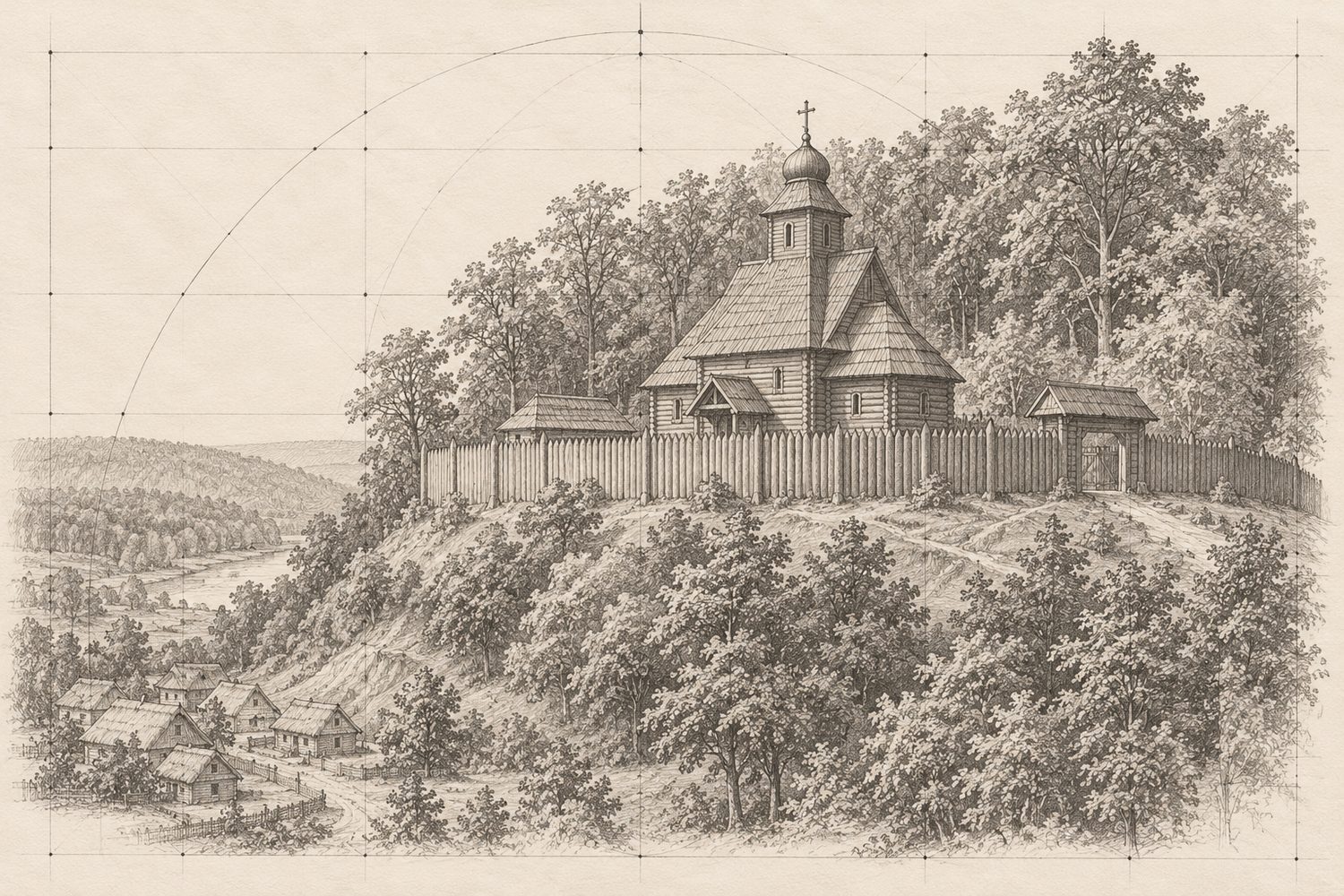
Around 1280: a wooden church on the hill. Illustration: IKONASTONE - 1340
King Casimir III, having seized Lviv, destroyed the wooden church and the monastery. [4, 8]
- 1341
A bell was cast for the church of St George; its inscription dates it to the year 6849 from the creation of the world and mentions Prince Dmytro and Hegumen Yevtymii. The bell is still in the cathedral's bell tower; RISU also gives the date 1349. [6, 7, 29, 30, 31]
- 1363
On the site of the wooden church, construction of a masonry church began. The sources name the architect as Doring or Doré; its completion is dated to 1437. The Encyclopedia of Ukraine describes the church as a Byzantine-type basilica. [1, 2, 4, 6]
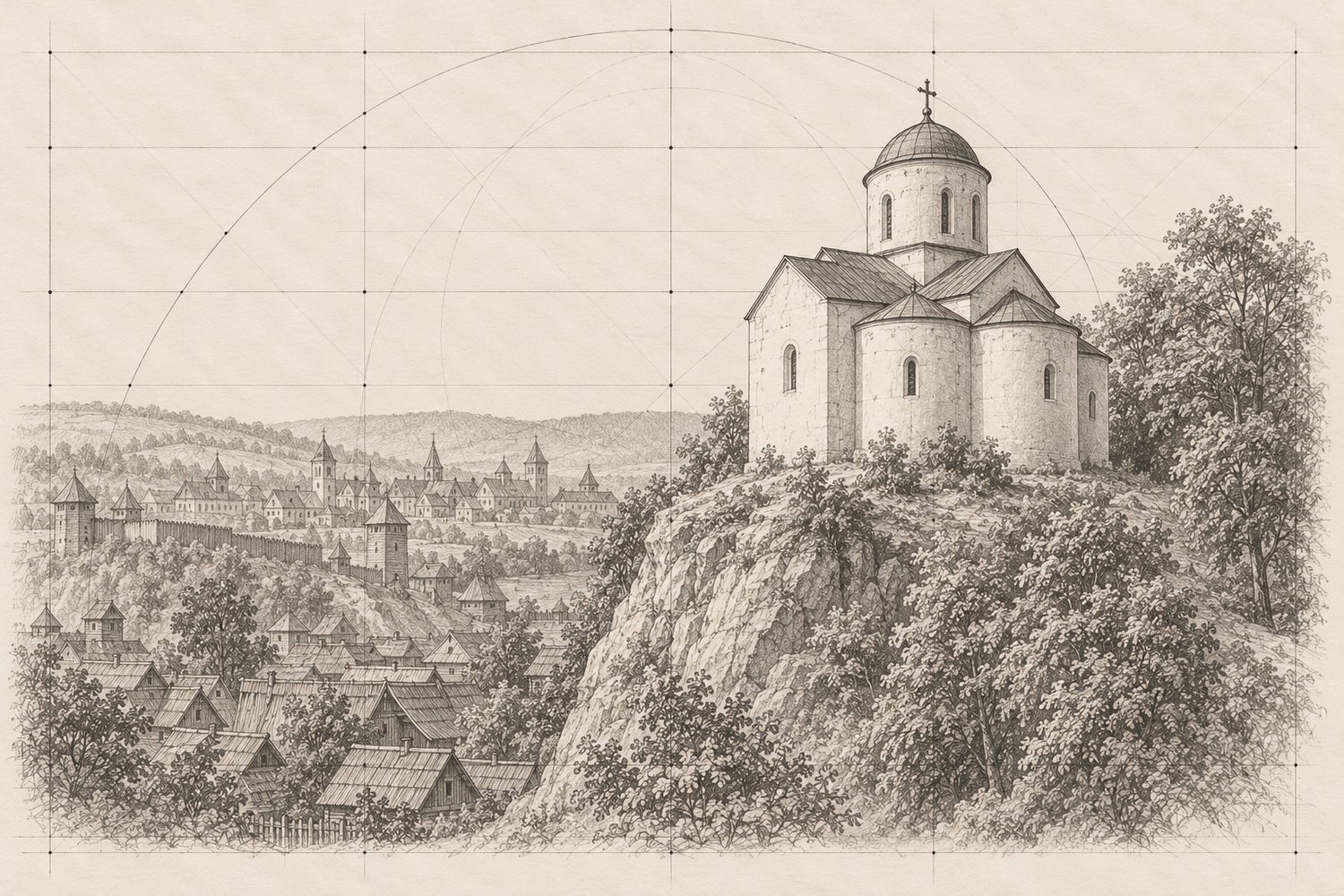
The masonry church of the 14th–15th centuries. Illustration: IKONASTONE - 1539
The church became the see of the bishops of Halych and Lviv; the eparchy was headed by the monastery's hegumen Makarii Tuchapskyi. [4, 7]
- 1663
In Terebovlia, before Easter, an icon of the Mother of God began to weep; this is attested in the town court book. [6, 25]
- 1673 or 1674
Bishop Josyf Shumlianskyi moved the Terebovlia icon to the cathedral of St George (1673 according to the UGCC map, 1674 according to R. Kosiv and the English-language Wikipedia). [4, 8, 25]
- 1700
In July Shumlianskyi proclaimed in the old cathedral the act of union of the Lviv Eparchy with the Holy See of Rome. In the same year the Chapel of the Intercession was built for the Terebovlia icon. [4, 8]
The new cathedral
- 1744
The old church was taken down and construction of the new cathedral began to a design by Bernard Meretyn. The initiator was Metropolitan Atanasii Sheptytskyi. The English-language Wikipedia dates the start of the work to 1746. [1, 2, 8, 29]
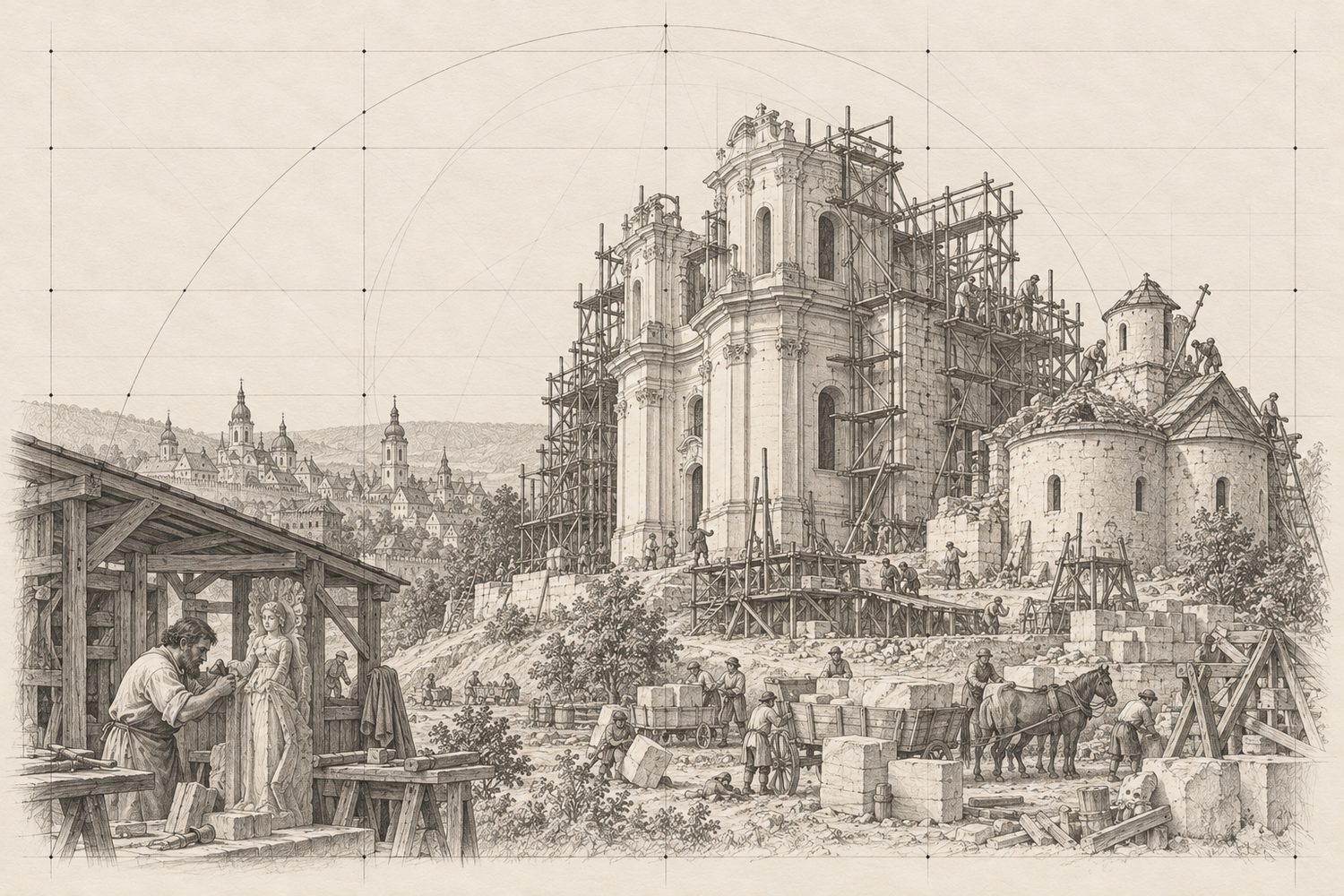
1744–1745: construction of the new cathedral. Illustration: IKONASTONE 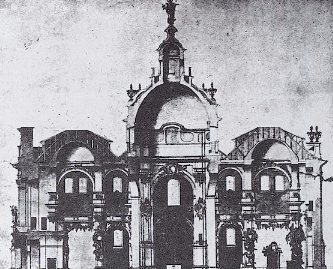
Design of the cathedral, around 1760. Bernard Meretyn. Wikimedia Commons, public domain - 1746
Atanasii Sheptytskyi died; construction was continued under Bishop Lev Sheptytskyi. According to RISU, 116,820 zlotys were allocated for it. [6, 8]
- 1759
On 3 or 4 January Meretyn died. The building was continued by Fesinger: according to the Encyclopedia of Ukraine (VUE), Sebastian; according to "To ye Lviv", Klemens Xavier (Sebastian, according to this source, worked on the interior). [1, 7, 9]
- 1759
Johann Georg Pinsel created the equestrian group "St George the Dragon-Slayer" on the attic of the main facade; the statues of Saints Athanasius and Leo on either side of the portal are also his. [1, 3]
- 1761–1762
The metropolitan's palace was built to a design by Klemens Fesinger (the UGCC map dates it to 1760–1762). [1, 3, 4]
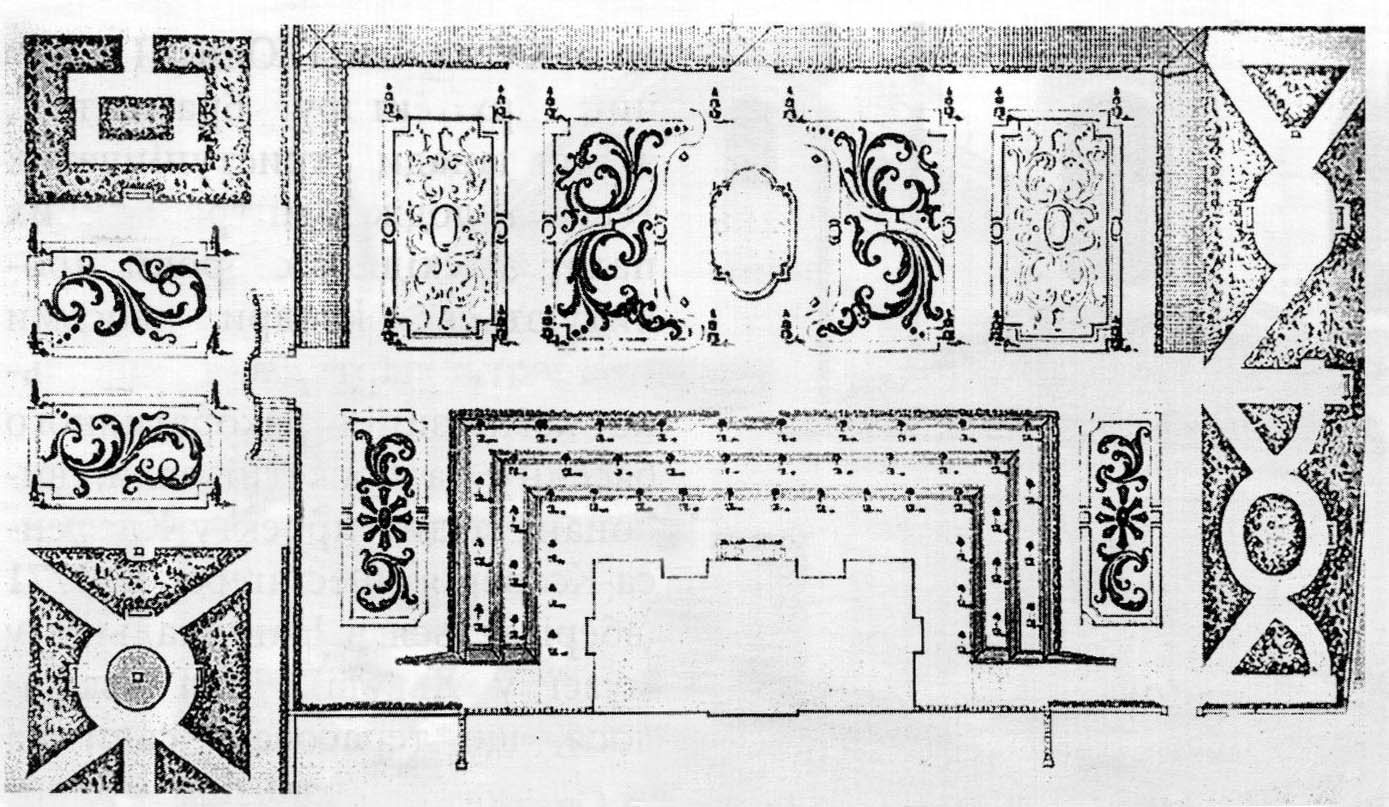
Design of the garden by the cathedral, 1771. Klemens Fesinger. Wikimedia Commons, public domain - 1759–1764
The main construction was completed. The sources give the completion date differently: 1759 (Encyclopedia of Ukraine), 1760 (UGCC map), 1761 (Lviv Interactive), 1762 (NV), 1764 (VUE, "To ye Lviv"). [1, 2, 3, 4, 7, 29]
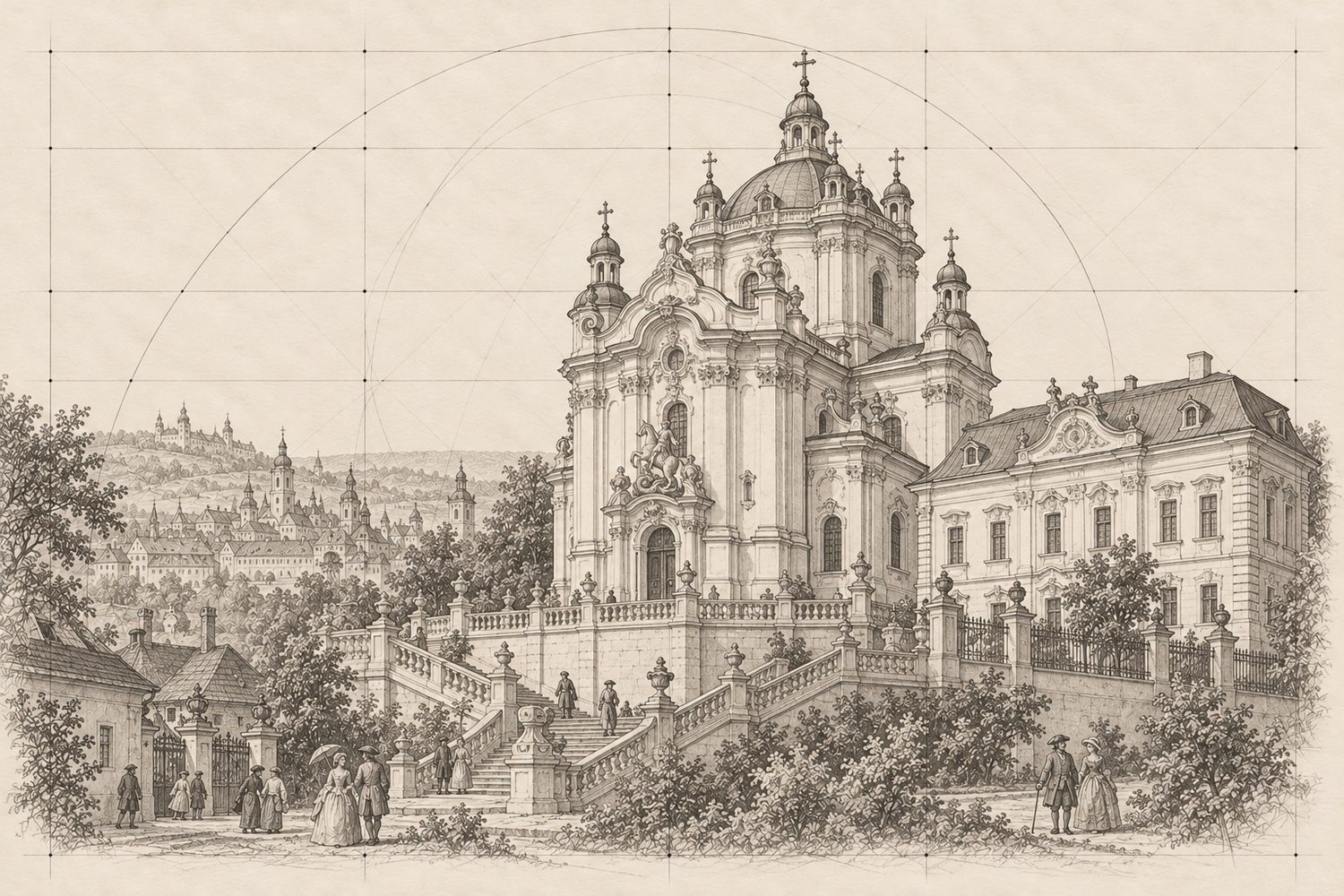
The completed cathedral, 1770s. Illustration: IKONASTONE - 1770–1781
Yurii Radyvylivskyi (1770–1771) and Luka Dolynskyi (1778–1781) painted icons for the cathedral. The decoration went on until 1772 according to VUE, until 1780 according to the UGCC map, and until 1790 according to the Encyclopedia of Ukraine. [1, 2, 3, 4]
Seat of the metropolitans
- 1808 or 1817
After the restoration of the Metropolitanate of Halych the cathedral became an archcathedral: in 1808 according to the UGCC map, in 1817 according to VUE and the Encyclopedia of Ukraine. From 1808 the metropolitans began to be buried in the crypt. [1, 2, 4, 7]
- 1826
Franz Xaver Mozart, the composer's son, performed his father's Requiem in the cathedral; a plaque on the cathedral wall recalls this. [6, 20]
- 1828–1829
A masonry bell tower was built at the corner of the chapter house (according to the UGCC map, by the architect Hajek); in 1865 it was reconstructed. [1, 4]
- 1836
On 14 October, on the feast day of the Terebovlia icon, Markiian Shashkevych delivered a sermon in the cathedral in Ukrainian. [4, 18]
- 1850–1911
The cathedral was repaired and restored several times (1850, 1866, 1905–1911; the next restoration was in 1933). The interior paintings of 1876, according to Lviv Interactive, were done by E.-R. Fabiianskyi. [3, 4]
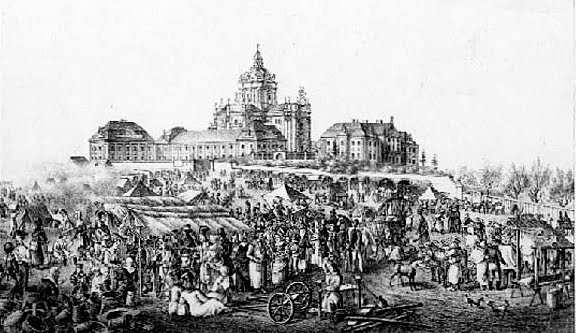
A fair by St George's Cathedral, 1846–1847. Karl Auer. Wikimedia Commons, public domain 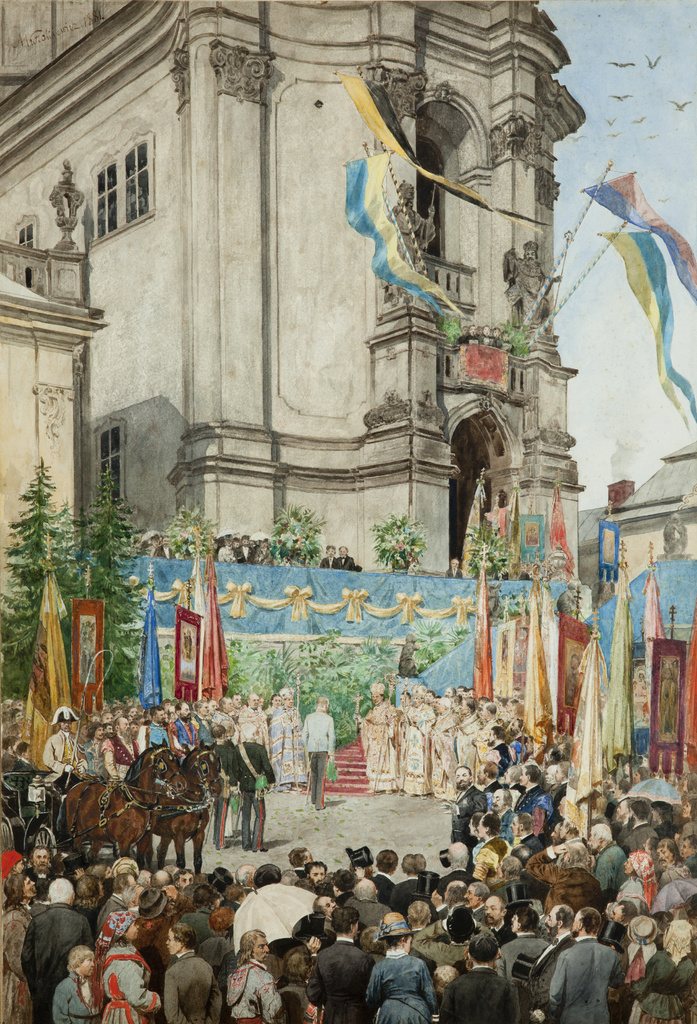
The reception of Emperor Franz Joseph in front of the cathedral, 1880. Antoni Kozakiewicz. Wikimedia Commons, public domain - 1900
Andrei Sheptytskyi became Metropolitan of Halych and Archbishop of Lviv; the cathedral was his see until 1944. [12, 26]
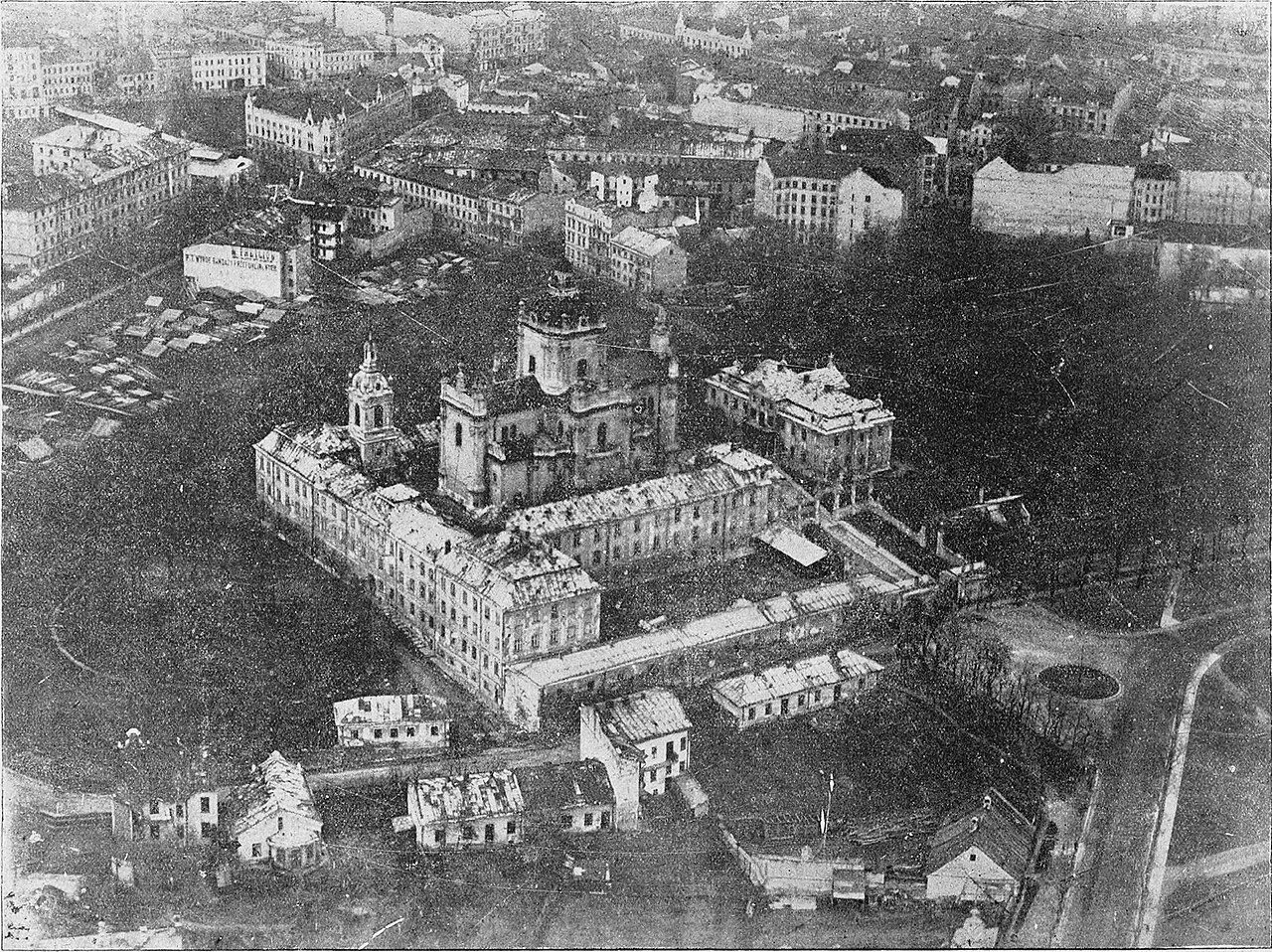
Aerial photograph of St George's Hill, 1921–1923. Wikimedia Commons, public domain - 1914
On 19 September the Russian military authorities arrested Metropolitan Sheptytskyi. According to ZAXID.NET, the plaque in honour of Shashkevych, put up on the cathedral in 1911, disappeared at the same time. [18, 26]
- 1939
The remains that Yaroslav Pasternak found in Halych and identified as those of Prince Yaroslav Osmomysl were hidden in the cathedral crypt (31 August according to RISU). The sources give the year of the find as 1937 or 1939. [6, 7, 28]
- 1944
On 1 November Andrei Sheptytskyi died; he was buried in the cathedral crypt. [12, 26]
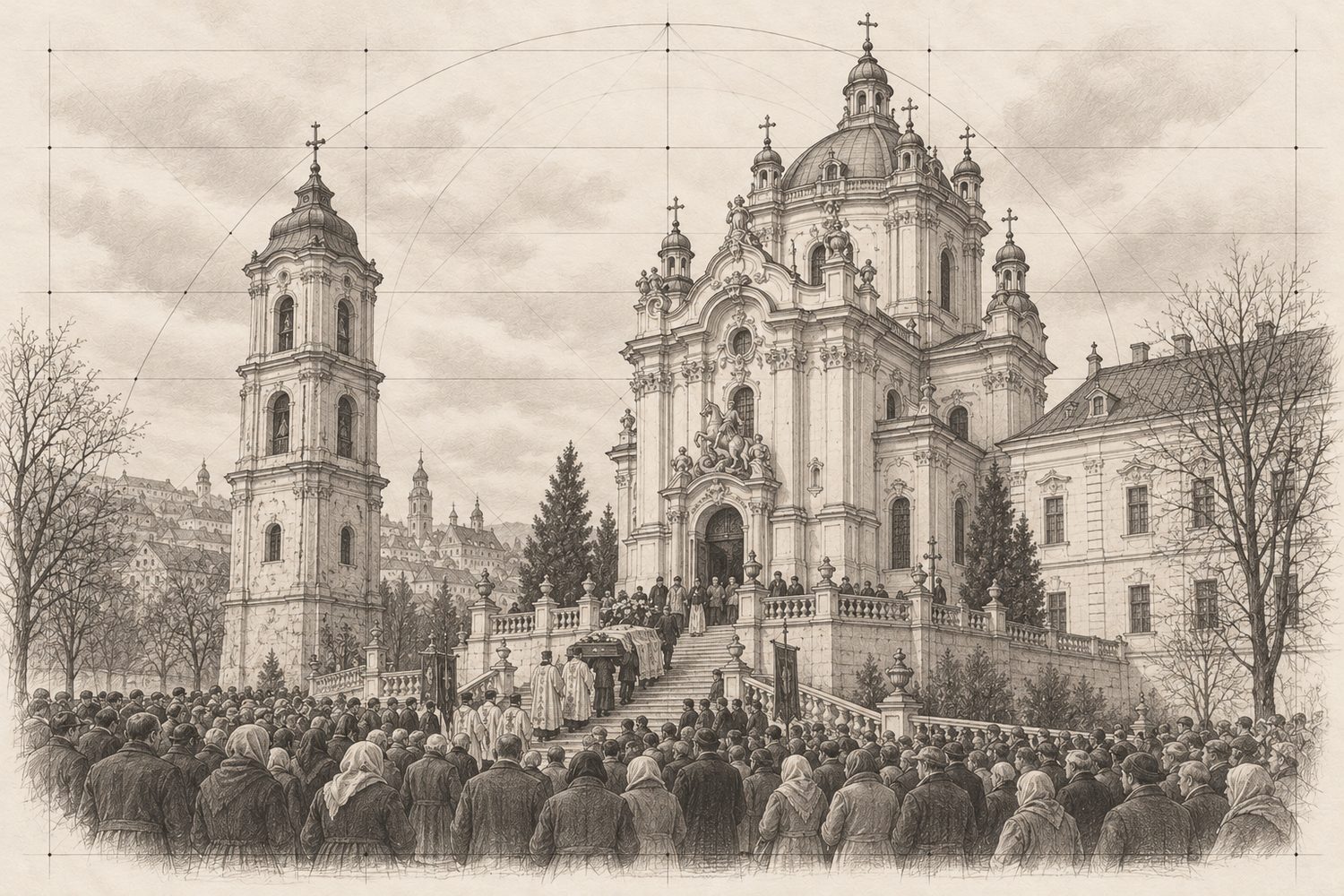
5 November 1944: the funeral of Metropolitan Andrei Sheptytskyi. Illustration: IKONASTONE
The ban
- 1945
On 11 April (in the night of 12 April) the NKVD surrounded St George's Hill; Metropolitan Josyf Slipyj and other UGCC bishops were arrested. [10, 11, 13]
- 1946
On 8–10 March the Lviv Synod (the pseudo-synod) was held in the cathedral, organised under the supervision of the NKGB without the participation of Greek Catholic bishops. The list included 216 priests and 19 laypeople; it was resolved to abolish the Union of Brest. [10, 11]
- 1946
On 10 March, on the porch of the cathedral, Metropolitan Ioann presented the participants with an icon of the Mother of God from the Kyiv Pechersk Lavra. The cathedral passed to the Russian Orthodox Church. [1, 4, 10]
- 1948
On 20 September Fr Havryil Kostelnyk, who had chaired the pseudo-synod, was killed in Lviv; the circumstances of the killing have not been established. [10, 11]
The return
- 1989
On 17 September a march of many thousands went through the streets of Lviv to the cathedral of St George, demanding the legalisation of the UGCC; the participants did not enter the cathedral courtyard. [5, 15]
- 1990
On 19 August the cathedral was returned to the UGCC; the first Greek Catholic Liturgy in it was celebrated by Volodymyr Sterniuk. According to the English-language Wikipedia, on 12 August the cathedral was occupied by activists of Rukh, and on 14 August the regional council recognised the right of the UGCC. [4, 5, 8, 27]
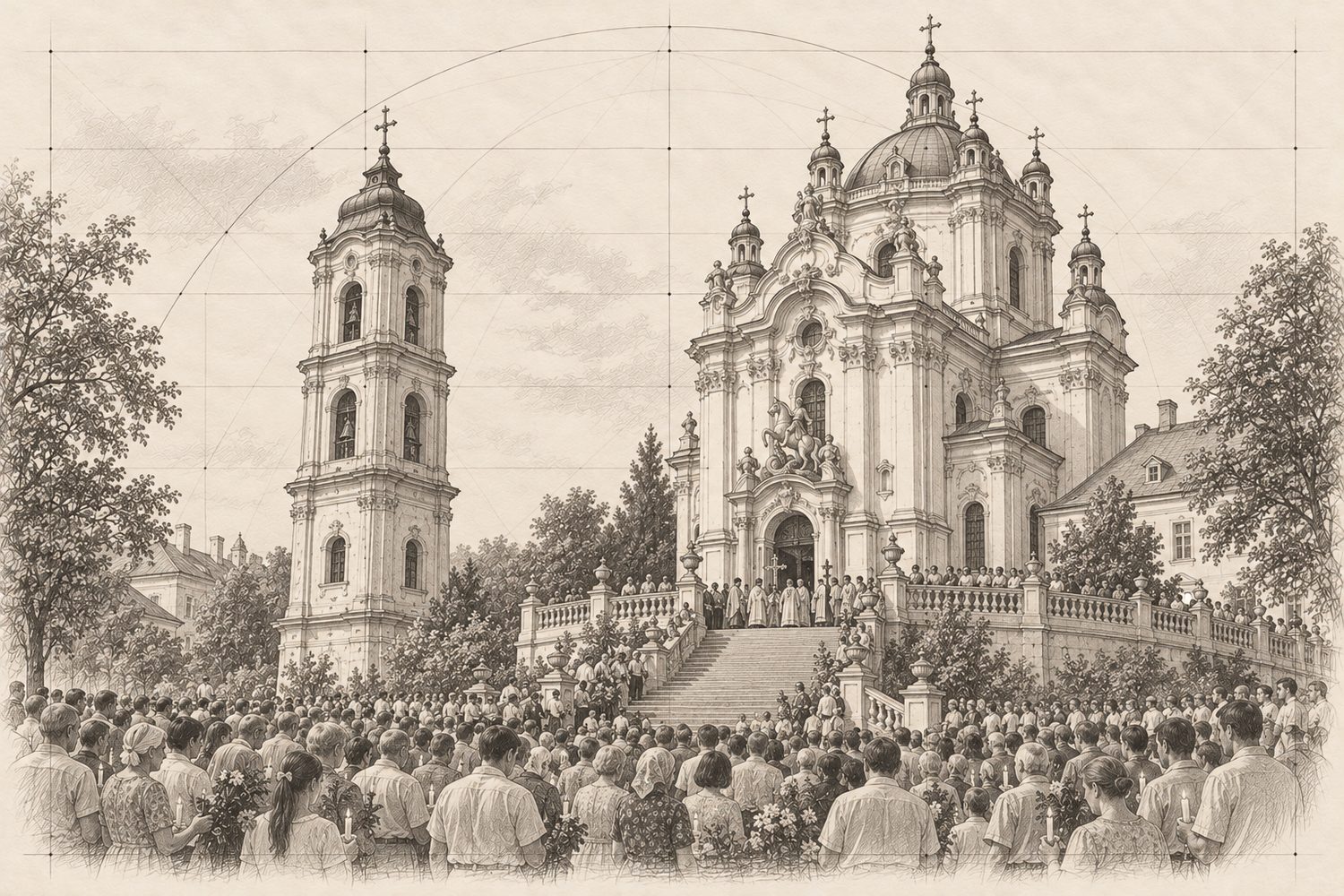
19 August 1990: the cathedral returns to the UGCC. Illustration: IKONASTONE - 1991
On 30 March the Head of the UGCC, Cardinal Myroslav Ivan Lubachivsky, arrived in Lviv from Rome (the UGCC map gives April). In the autumn, research on the crypt began. [4, 5, 6]
- 1992
On 29 August Patriarch Josyf Slipyj was reburied in the cathedral crypt, in accordance with his will. [4, 13]
- 1996
The cathedral was restored for the 400th anniversary of the Union of Brest. [4, 8]
- 1998
The cathedral ensemble, as part of the historic centre of Lviv, was inscribed on the UNESCO World Heritage List. [6, 24]
- 2001
In June, during his visit to Ukraine, Pope John Paul II stayed in the cathedral's metropolitan palace. According to the UGCC map, he prayed before the Terebovlia icon and crowned it with crowns. [4, 32, 33]
- 2005
On 21 August the seat of the Head of the UGCC was moved from Lviv to Kyiv; the cathedral remained the archcathedral of the Lviv Archeparchy. [4, 8]
- 2015
On 29 July a monument to Metropolitan Andrei Sheptytskyi was unveiled on the square in front of the cathedral. [19]
- 2021
On 11 October the restoration of the ensemble began: the courtyards, the bell tower, the metropolitan's palace (about UAH 15 million from the regional budget). According to Focus, in November 2023 a tender was announced for the continuation of the work. [21, 22]
- 2023
In September the historic centre of Lviv, together with the cathedral ensemble, was inscribed on the List of World Heritage in Danger because of the war. [23, 24]
- 2025
In March the Lower Metropolitan Gardens (2.3 ha on the slope behind the cathedral) were returned to the ownership of the Church; a grant from the Interreg NEXT Poland – Ukraine programme was allocated for their revitalisation. [16, 17]
Lost and restored
| What | It was | What happened | Where it is now |
|---|---|---|---|
| Wooden church and monastery | Around 1280 | Destroyed in 1340 | Not preserved [4, 8] |
| Masonry church of the 14th–15th centuries | 1363–1437, a Byzantine-type basilica (according to the Encyclopedia of Ukraine) | Taken down in 1744 for the new cathedral | Not preserved [1, 2, 4] |
| Bell of 1341 | Cast for the church of St George | Survived two churches | The cathedral bell tower; rung during services [7, 29, 30] |
| Terebovlia icon of the Mother of God | Terebovlia, 17th century | Moved in 1673 or 1674; in 1700, a separate chapel | The cathedral [4, 8, 25] |
| Icon from the Kyiv Pechersk Lavra | Kyiv Pechersk Lavra | Presented on 10.03.1946 at the pseudo-synod | The cathedral (according to RISU) [6, 10] |
| Plaque in honour of M. Shashkevych | Put up on the cathedral in 1911 | Disappeared in 1914 | Recreated in 2017 from an archival sketch (according to ZAXID.NET) [18] |
| Remains of Yaroslav Osmomysl | Halych, excavations by Y. Pasternak | Hidden in the crypt in 1939; found again in 1991–1992 | Reburied in the cathedral [6, 7, 28] |
| Body of Patriarch Josyf Slipyj | Died in Rome in 1984 | Transferred and reburied on 29.08.1992 | The cathedral crypt [4, 13] |
| Crypt | Burial vault of bishops and metropolitans | In Soviet times, a storeroom; in 1958 Archbishop Photius was buried there (according to RISU) | Studied in 1991–1992; buried there are Sembratovych, Sheptytskyi, Slipyj, Sterniuk, Lubachivsky [4, 6, 7] |
| Metropolitan Gardens | Three terraces, a stone enclosure; Fesinger’s design of 1771 | Neglected; relay towers on the lower terraces | The lower gardens returned to the Church in 2025 [16, 17] |
| Metropolitan’s palace | 1761–1762 | Restorations in 1885, 1922, 1999–2000 | Restoration since 2021 [1, 21] |
| Bell tower | 1828–1829 | Reconstruction in 1865 | Roof and facade repairs since 2021 [1, 21] |
| Bozzetto “St George the Dragon-Slayer” | Pinsel’s sketch for the facade group, mid-18th century | Restored | Andrey Sheptytsky National Museum [14] |
Architecture
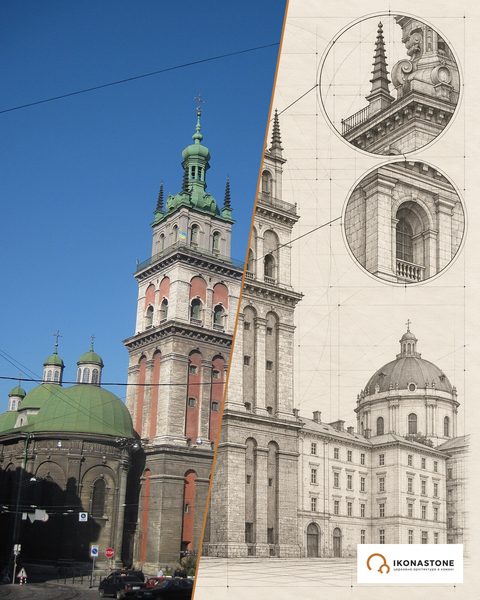
The cathedral has a cross-shaped plan: three naves, four pillars, a central dome on a lit drum; the central nave and the transept are raised. The walls are articulated by pilasters, with a cornice above them. But the main thing in this architecture is not the plan but the setting: the church is raised on a high terrace, and one has to climb up to it.
The drawings show the form, not exact dimensions.
The portal and attic: sculpture as the crown of the facade
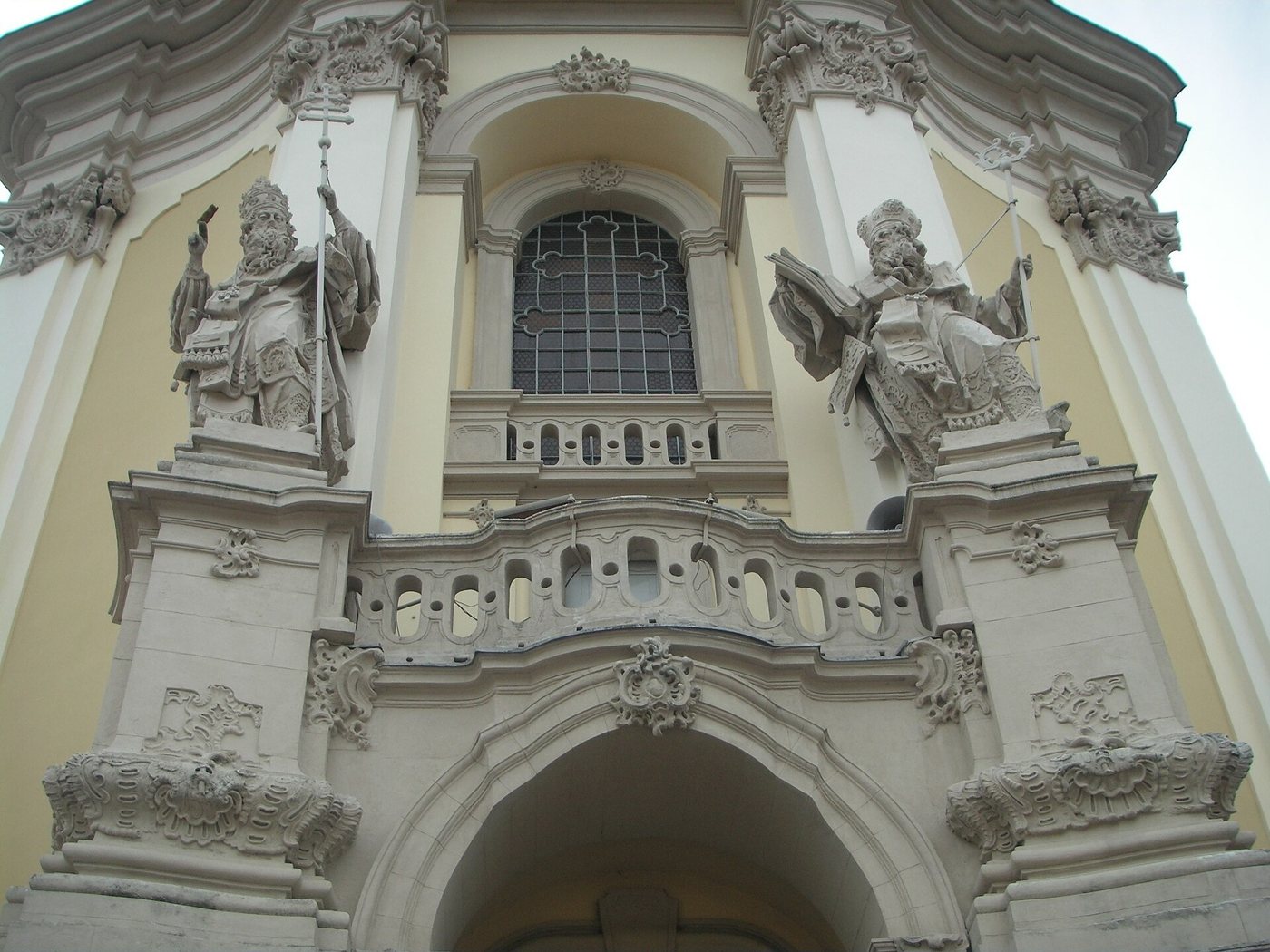
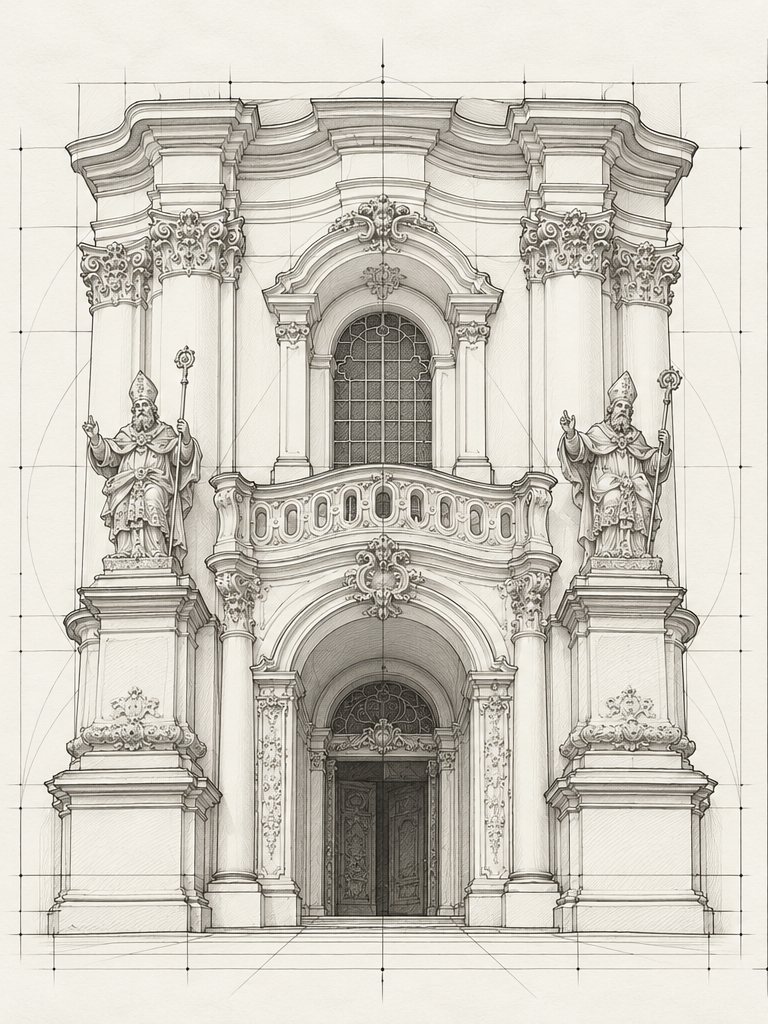
The main entrance is framed by two pylons joined by an arch. On them stand the figures of Saints Athanasius and Leo by Pinsel; these saints were chosen as the name-day patrons of the founding metropolitans Atanasii and Lev Sheptytskyi. Above the entrance is a balcony, and higher still a pyramidal attic crowned by the equestrian group “St George the Dragon-Slayer” (1759). The facade ends not with a cross or a dome but with movement.
The terrace and the double staircase
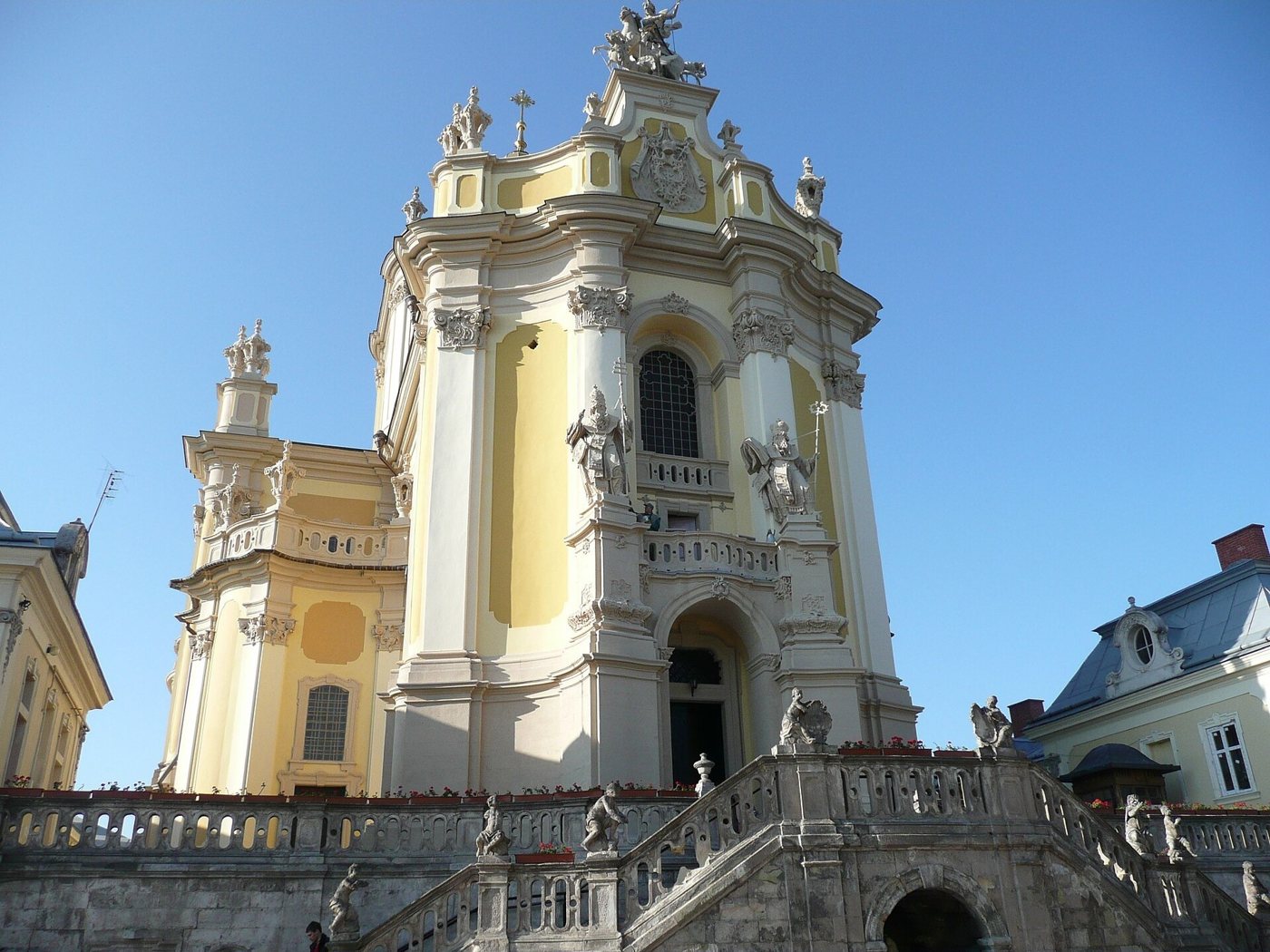
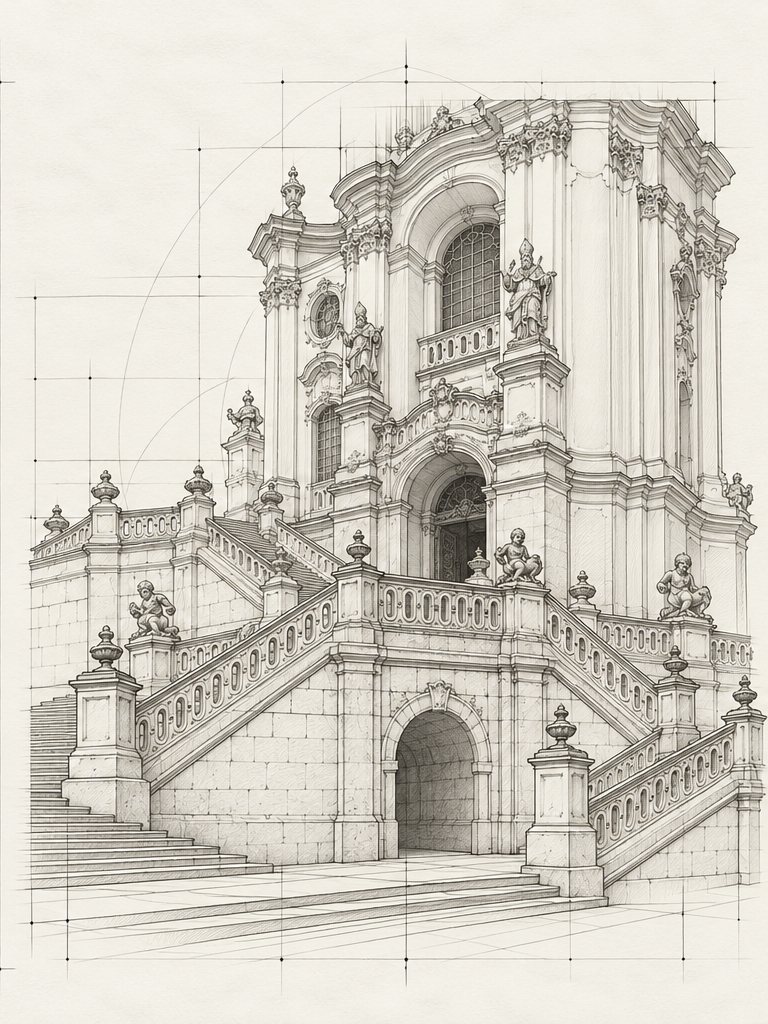
The terrace was formed by levelling the natural rocky platform of the hill. In front of the main entrance a double staircase leads up to it, with an openwork Rococo balustrade, vases and figures of winged genii. The staircase here is part of the facade: as a person climbs, they see the cathedral now on the left, now on the right, and only at the top face on.
Stone lanterns and balustrades
Several craftsmen worked on the lanterns, openwork balustrades and attics: sources name Petro Bilostotskyi and Onufrii Stefanskyi, as well as Mykhailo Filevych and Sebastian Stazhevskyi. This is a fine sculptural layer that, in the sun, makes the heavy masonry mass lighter.
Stone and material
The cathedral is of masonry; according to tradition and researchers’ data, its 14th–15th-century predecessor was also of stone. Stone works here on three levels: the rocky base of the hill, which became the terrace; the staircase with the balustrade by which one climbs to the church; and the carved decoration — lanterns, attics, the sculpture of the facade. The sources mostly do not specify the material of particular elements, so more detail will come after an on-site inspection.
Inside is a carved iconostasis; its local-tier icons, images of the prophets and feast icons were painted by Luka Dolynskyi. How to read the tiers of an iconostasis we explain in the article “Tiers of the iconostasis”, and pilasters and capitals in stone are covered on the page of the line “Columns, pilasters, capitals”.
Did you know
According to Radio Svoboda, Bernard Meretyn was the godfather of the son of Johann Georg Pinsel. [14]
In 1754 the Warsaw architect Pietro Ricco de Tiregai criticised the design, and the metropolitanate considered breaking the contract. Meretyn refuted the charges and took the critic to court. According to VUE. [9]
After Meretyn's death the debts for unfinished buildings passed to his family; his son and son-in-law ended up in a Lviv prison. According to VUE. [9]
According to RISU, this was the sum allocated for the construction after the death of Atanasii Sheptytskyi. [6]
In 1826 Franz Xaver Mozart performed his father's Requiem here; there is a plaque about it on the cathedral wall. [6, 20]
Fesinger drew up a survey plan of the old complex, on which one can see buildings that no longer existed. According to "To ye Lviv". [7]
The inscription on the bell of 1341 ends with the words "And it was written by Skora Yakiv". [7, 30]
Fesinger's garden design of 1771 divided the terrace into eight cross-shaped squares with a round pool; there was also a gazebo-grotto. According to ZAXID.NET. [16]
At the pseudo-synod of 1946 the vote was open, by show of hands, in the presence of NKGB officers and under film cameras; 400,000 roubles from the government fund were allocated for holding the assembly. According to VUE. [10]
According to the participants' testimony, there were noticeably fewer delegates at the pseudo-synod than the 216 on the list; the records were signed by 204 priests. According to VUE. [10]
During the crypt research of 1991–1992 an epitrachelion of Metropolitan Iov Boretskyi, dated 1623, was found. According to RISU. [6]
In June 2001 John Paul II stayed in the metropolitan's palace; in 2026 a commemorative plaque was unveiled there. [32, 33]
The icons for the cathedral were painted by Yurii Radyvylivskyi (1770–1771) and Luka Dolynskyi (1778–1781). According to Lviv Interactive. [3]
Legends
Prince Lev
According to tradition, the first wooden church on the hill was founded by Prince Lev Danylovych around 1280. This is given by the UGCC map and UNIAN; the Encyclopedia of Ukraine and the English-language Wikipedia do not name a founder. [4, 8, 34]
The monk Vasylko
According to a tradition recorded by Bartholomaeus Zimorowicz in "Triple Lviv", Vasylko, the uncle of Prince Lev, settled on the hill and became the first monk. Researchers dispute this: Vasylko Romanovych died in 1269; I. Krypiakevych suggested a confusion with Voishelk. [6, 34]
Vasylysk in the cave
According to tradition, a monk named Vasyl (Vasylysk) lived in a cave on the hill and atoned for his sins through prayer. Recorded by Zimorowicz in the 17th century; whether the cave was natural has not been established. [6, 7]
The Dragon's Pit
According to a tradition recorded by Martin Gruneweg at the end of the 16th century, a cave on St George's Hill was called the Dragon's Pit. Retold after RISU. [6]
The poisoning of the prince
According to the historian I. Mytsko, on 7 April 1340 the last Galician-Volhynian prince, Yurii II Boleslaw, was poisoned in the church of St George. Retold after "To ye Lviv"; not confirmed by documents. [7]
The hetman on the hill
According to tradition, Bohdan Khmelnytskyi stood by the cathedral: according to "To ye Lviv" he was quartered in the monastery in 1648, according to RISU he had a camp on the square in 1655. [6, 7]
The weeping icon
According to tradition, the Terebovlia icon weeps before a calamity; the first weeping, on Maundy Thursday 1663, is attested in documents. [6, 25]
Figures
- Lev Danylovych — prince; according to tradition, the founder of the first church and monastery.
- Makarii Tuchapskyi — hegumen, from 1539 the first bishop of the restored eparchy with its see at the church of St George.
- Josyf Shumlianskyi — bishop; moved the Terebovlia icon (1673/1674), proclaimed the union in 1700.
- Atanasii Sheptytskyi — metropolitan, initiator of the new cathedral (†1746).
- Lev Sheptytskyi — Bishop of Lviv from 1749 (metropolitan from 1778), under whom the construction was completed.
- Bernard Meretyn — author of the design, royal architect (†1759).
- Sebastian and Klemens Xavier Fesinger — continued the building after Meretyn; the palace, the altar, the garden.
- Johann Georg Pinsel — sculptor of the facade (the equestrian group “St George the Dragon-Slayer”, Saints Athanasius and Leo).
- Yurii Radyvylivskyi, Luka Dolynskyi — icon painters of the cathedral.
- Mykhailo Filevych, S. Stazhevskyi — carvers of the iconostasis and of the stone decoration.
- Bartholomaeus Zimorowicz — chronicler, author of “Triple Lviv”, who recorded the legends about the hill.
- Markiian Shashkevych — in 1836 delivered a sermon in the cathedral in Ukrainian.
- Andrei Sheptytskyi — metropolitan (1900–1944), buried in the crypt.
- Josyf Slipyj — metropolitan, later Patriarch; arrested in 1945, reburied in the crypt in 1992.
- Havryil Kostelnyk — head of the Initiative Group and chairman of the pseudo-synod of 1946.
- Volodymyr Sterniuk, Myroslav Ivan Lubachivsky — hierarchs who returned the cathedral to UGCC worship; buried in the crypt.
How to cite
IKONASTONE. St George's Cathedral in Lviv // Guide to the Churches of Ukraine. URL: https://ikonastone.com/en/guide/st-georges-cathedral-lviv/ (accessed DD.MM.YYYY).
FAQ
Where is St George's Cathedral located?
In Lviv, on St George's Hill, at 5 St George's Square. The cathedral ensemble is a separate component of the UNESCO World Heritage Site "L'viv – the Ensemble of the Historic Centre" (1998).
When was the cathedral built?
Construction began in 1744 to a design by Bernard Meretyn; after Meretyn's death (1759) the work was continued until 1764 by Fesinger (sources name either Sebastian or Klemens Fesinger), and the decoration went on until 1772.
Who made the sculptures on the facade?
Johann Georg Pinsel: the equestrian group "St George the Dragon-Slayer" on the attic (1759) and the figures of Saints Athanasius and Leo on either side of the portal.
Which church does the cathedral belong to?
The Ukrainian Greek Catholic Church. In 1946 the cathedral was handed over to the Orthodox, and in 1990 it was returned to the UGCC. Today it is the cathedral of the Lviv Archeparchy of the UGCC.
Sources
- ВУЕ. Собор Святого Юра у Львові
- Encyclopedia of Ukraine (CIUS). Saint George's Cathedral
- Lviv Interactive (Центр міської історії). І. Жук. Pl. Sv. Yura, 5 — St. Yuriy (St. George) Cathedral
- УГКЦ. Мапа. Архикатедральний собор Святого Юра (Львів)
- УГКЦ. Revival of the Church
- РІСУ. Н. Поліщук, Л. Губич. Собор св. Юра у Львові та давні легенди Святоюрської гори (2016)
- То є Львів. Архикафедральний собор святого Юра у Львові
- Wikipedia (en). St. George's Cathedral, Lviv
- ВУЕ. Меретин, Бернард
- ВУЕ. Львівський собор 1946
- Радіо Свобода. 75 років тому на псевдособорі у Львові Сталін ліквідував УГКЦ
- Радіо Свобода. Похорон митрополита Шептицького: документи
- Радіо Свобода. Йосиф Сліпий
- Радіо Свобода. Загадковий геній Пінзель (01.03.2007)
- Радіо Свобода. Про вихід УГКЦ з підпілля (1989–1990)
- ZAXID.NET. О. Шиян. Митрополичі сади у Львові (30.04.2025)
- ZAXID.NET. На ревіталізацію Митрополичих садів у Львові виділили європейський грант (29.04.2025)
- ZAXID.NET. У Львові на соборі Святого Юра встановили меморіальну таблицю Маркіяну Шашкевичу (29.07.2017)
- ZAXID.NET. На відкриття пам'ятника Андрею Шептицькому приїхали кільканадцять тисяч прочан (29.07.2015)
- ZAXID.NET. Галицькими стежками Моцарта-молодшого
- Суспільне. У Львові стартувала реставрація собору Святого Юра (11.10.2021)
- Фокус. У Львові вирішили реставрувати собор Святого Юра за понад 31 млн грн (21.11.2023)
- Українська правда. Життя. Два собори в Києві та центр Львова внесли до списку ЮНЕСКО, що перебуває під загрозою (15.09.2023)
- UNESCO. L'viv – the Ensemble of the Historic Centre
- Р. Косів. Чудотворні ікони Богородиці з Дитям Ісусом та їх репліки у творчості риботицьких майстрів. «Народознавчі зошити», 2017, № 6
- Освіта.ua. Андрей Шептицький: коротка біографія
- Wikipedia (en). Volodymyr Sterniuk
- Wikipedia (en). Yaroslav Osmomysl
- НВ. Собор Святого Юра (09.08.2018)
- ДУФЛУ. Свідок восьми століть: найстаріший дзвін Львова досі дзвонить
- Колокол святого Юра 6849 года: между Львовом, Плоцком, Петербургом и Теребовлей. Наукова бібліотека НБУВ
- Святий Престол. Програма апостольської подорожі Івана Павла II в Україну (23–27.06.2001)
- Razom. Where the Pope Spent the Night — There's Now a Plaque (2026)
- УНІАН. В. Прокаєва. Архітектурні легенди міста Лева (25.11.2011)
- Town
- Lviv
- Built
- 1744–1764
- Type
- cross-shaped, four-pillar, three-nave
- Material
- masonry; carved stone on the facade
- Research depth
- 37%