The Church of the Holy Spirit in Rohatyn: oak, three log frames and an iconostasis of 1650
There are wooden churches of which people say “old”, and there are those whose age scholars argue about. The Church of the Holy Spirit in Rohatyn is one of the latter: its dating is still written with a dash and a question mark.
In brief
| Address | 10 Roksolany Street, Rohatyn, Ivano-Frankivsk Oblast |
| Built | official date — 1598 (according to an inscription); other datings — first half of the 17th century |
| Type | three-frame single-domed wooden church of the Halych school, with an attached bell tower |
| Material | smoothly hewn oak beams, shingle roofs |
| Status | UNESCO World Heritage List (2013); monument of national importance |
| Owner | museum — a branch of the Museum of Arts of the Prykarpattia (since 1983) |
History
According to karpaty.rocks, the church (then under a different name — St George) is mentioned in archival records of 1481, 1562 and 1567. Whether it is the same building that stands now is an open question. The date 1598 was read on the north wall of the nave at the end of the 19th century, and it became the official one. However, some researchers place the construction in the first half of the 17th century, and in a 2017 Ukrinform publication the museum research associate Stepan Pushkar stated that the oak from which the church was built was felled in 1480; we did not find a published expert opinion. One thing is certain: the church is older than its iconostasis.
The iconostasis appeared in 1650 — at the expense and through the efforts of the Rohatyn brotherhood. Restorations followed: of the iconostasis in 1885 (the painter Yulian Makarevych), of the church in 1895, and in 1980–1982 under the architect Ivan Mohytych. On 6 August 1983 a museum was opened in the church. In 2013 the church with its bell tower was inscribed on the UNESCO World Heritage List.
Timeline
The numbers in square brackets are source numbers in the list at the bottom of the page. The label "according to …" means that a fact is confirmed by only one source. The "Legends" section contains tales and legends: they are recorded in sources but not confirmed by documents.
Rohatyn and early mentions
- 12th century
According to the Encyclopedia of Ukraine, Rohatyn is known from chronicles from the 12th century; it then belonged to the Principality of Galicia–Volhynia, according to the Encyclopedia of Ukraine. [11]
- 1415
Rohatyn, under Polish rule, received Magdeburg law, according to the Encyclopedia of Ukraine. [11]
- 1480
The museum research associate Stepan Pushkar told Ukrinform that the oak from which the church was built was felled in 1480; Obozrevatel writes about "the age of the wood, according to experts". No published expert opinion has been found, so the dating should be presented as Pushkar's words. [5, 12]
- 1481, 1562, 1567
According to karpaty.rocks, in these years the church (then under a different name — St George) is mentioned in archival records; whether it refers to the present structure is unknown. [15]
- Early 16th century
The UNESCO dossier dates the church to the early 16th century; Radio Svoboda (2009) names the 16th century. [2, 7]
- 1520
According to the Encyclopedia of Ukraine, in Rohatyn the Tatars seized a girl known as Roxelana. Ukrainian tradition calls her Nastia Lisovska, but the historian Volodymyr Hrabovetskyi considers this name a writers' invention of the 19th century. [5, 11]
- 1580s
An Orthodox brotherhood centre with stauropegial rights arose in Rohatyn, according to the Encyclopedia of Ukraine. The Encyclopedia of Ukraine does not directly call it the Holy Spirit one. [11]
The church and the brotherhood
- 1598
The date read on the north wall of the nave at the end of the 19th century by the parish priest Fr Ipolyt Dzerovych; it became the official one. Radio Svoboda (2009) writes that the church is "410 years old". [1, 6, 12, 14, 15]
- 1644–1645
The Encyclopedia of Ukraine dates the erection of the church to these years; Wikipedia also gives 1648. [1, 11]
- 1650
A five-tier iconostasis was built at the expense and through the efforts of the brotherhood. The Encyclopedia of Ukraine gives a wider date, 1647–1650. [1, 2, 9, 11, 12, 14]
- 1656
According to Wikipedia, the Bishop of Lviv Arsenii Zhelyborskyi granted a diploma to the brotherhood at the church. [1]
- 1760
According to Wikipedia, the visitor Fr Mykola Shadurskyi compiled the first full description of the church. [1]
Under Austria
- 1772
After the first partition of the Polish–Lithuanian Commonwealth, Rohatyn passed to Austria and became a district centre, according to the Encyclopedia of Ukraine. [11]
- 1800
According to Wikipedia, the Holy Spirit church became a daughter parish of the Church of the Nativity of the Mother of God. [1]
- 19th century
According to Wikipedia, a bell tower was added to the narthex, and above the central top an additional octagon with a signature turret and a tent roof appeared. Travels in Ukraine dates the bell tower to the 17th century — a discrepancy. [1, 14]
- 1885
The Lviv painter Yulian Makarevych restored the iconostasis; it was then shown at an archaeological and ethnographic exhibition in Lviv. [1, 14]
- 1895
According to Wikipedia, a restoration of the church under the Lviv architect M. Kovalchuk for 2,000 zloty allocated by the Galician Diet. [1]
- Early 20th century
According to Wikipedia, during the roof repair the shape of the nave's cupola and the roof over the altar were changed. [1]
The interwar and Soviet periods
- 1941
According to Wikipedia, repair works on the shingle roof (repeated after the war). [1]
- 1963
According to Wikipedia, the church was entered in the State Register of architectural monuments of national importance (resolution of the Council of Ministers of the Ukrainian SSR No. 970 of 24.08.1963, protection number 243). [1]
- 1980–1982
According to Wikipedia, a thorough restoration to the design and under the supervision of the architect Ivan Mohytych. [1]
- 6 August 1983
A department (now a branch) of the Ivano-Frankivsk Art Museum was opened in the church. [1, 15]
- Around 1986
The icon "Angel of Dominion" was taken from the church for restoration "40 years ago" (Ukrinform, 2026); the year is an estimate. [10]
Independent Ukraine
- 1999
According to Wikipedia, the shingle covering of the church and the bell tower was replaced. [1]
- 2004
According to Wikipedia, the church-museum became part of the Rohatyn Museum Complex (together with the art and local history museum and the estate of Mykola Uhryn-Bezhrishnyi). [1]
- 2006
According to Wikipedia, the Department of Tourism and Culture of the Ivano-Frankivsk Regional State Administration and the Lviv branch of the National Research Restoration Centre developed a three-stage project to preserve the church; surveys revealed two wood-boring beetles. [1]
- 2007
According to Wikipedia, the namisnyi icons of the iconostasis of 1650 were restored: "Christ Pantocrator", "Mother of God Hodegetria", the "Old Testament Trinity". [1]
- 2008
The Ministry of Architecture and Urban Planning allocated UAH 500,000; the shingle covering was replaced except for the domes, and the carving of the windows was recreated. From 27 October to 17 December the work was carried out by the cooperative "Zodchyi" from Kolomyia. [1, 6]
- Summer 2009
The church was included in the list of eight monuments of wooden sacred architecture proposed for the World Heritage List. [1, 7]
- 29 September 2009
The National Bank of Ukraine put into circulation a commemorative silver coin "The Church of the Holy Spirit in Rohatyn" (UAH 10, mintage 10,000; author Volodymyr Demianenko). [1, 16, 17]
- 21 June 2013
The 37th session of the World Heritage Committee (Cambodia) inscribed the church on the UNESCO list as part of the property "Wooden Tserkvas of the Carpathian Region in Poland and Ukraine" (16 churches; criteria iii and iv). The church is one of three preserved as museums (alongside Radruż and Drohobych). [1, 2, 3]
War and recovery
- 2022
Of the funds for monuments of national importance (about UAH 1.5 million per oblast), about UAH 1 million was spent in Rohatyn on replacing the shingle covering; restoration of the iconostasis was discussed. [8]
- 2022–2023
According to Suspilne, the iconostasis was dismantled because of martial law. [9]
- 1 October 2023
According to Suspilne, 11 icons (4 from the lower tier, 7 from the festal tier) were transferred to the Lviv branch of the restoration centre; the iconostasis has about 60 images, so the icons are sent in batches. [9]
- 21 May 2026
For International Museum Day an exhibition "Angel of Dominion. Return Home" opened in the church: the restored icon is being returned to the church; it was restored by Valerii Tverdokhlib, with funds from the Harmash family. [10]
Lost and restored
| What | It was | What happened | Where it is now |
|---|---|---|---|
| An earlier church | Probably an earlier structure on the hill | According to Zakhid.net, remains of an earlier one were found on the site of the present church; no details have been published | Unknown [13] |
| The original painting of the log frames | The oak frames were painted by folk painters | The later fate of the painting is not described in the sources | Not preserved in the sources described [1] |
| The form of the crowning | A nave with a four-sided top with two breaks | In the 19th century an octagon with a signature turret and a tent roof were added; in the early 20th century the nave’s cupola and the altar roof were changed | The present appearance is later [1] |
| Iconostasis of 1650 | Five-tier, in the nave | Unsuccessful restorations of the 19th–20th centuries; Makarevych in 1885; dismantling in wartime | Icons are being restored in batches [1, 9] |
| The icon “Angel of Dominion” | In the church | Taken out for restoration around 1986 | Returned to the church on 21.05.2026 [10] |
| Shingle roofs | Shingles of the 19th–20th centuries | Repair in 1941; replacement in 1999, 2008 (except the domes), 2022 | New covering [1, 6, 8] |
| Three windows | Windows of the nave | Replaced in 2008, recreating their former appearance | In place [1] |
| Oak beams | Walls of oak beams | Damage by wood-boring beetles; damaged fragments on the drainage elements replaced in 2008 | In place, treated with antiseptics [1] |
Architecture
The church is made of three log frames: a square central one, a five-sided altar frame and an elongated narthex. The central frame is square, the altar is five-walled, the narthex is elongated. The frames of different heights are united by a skirt roof. The entrance is in the south wall, which is rare in other regions.
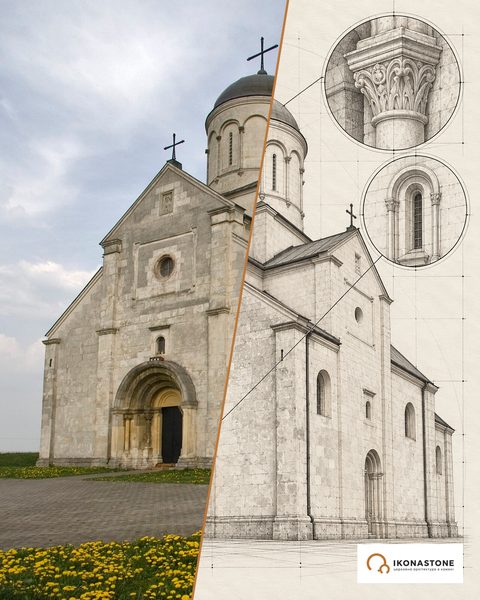
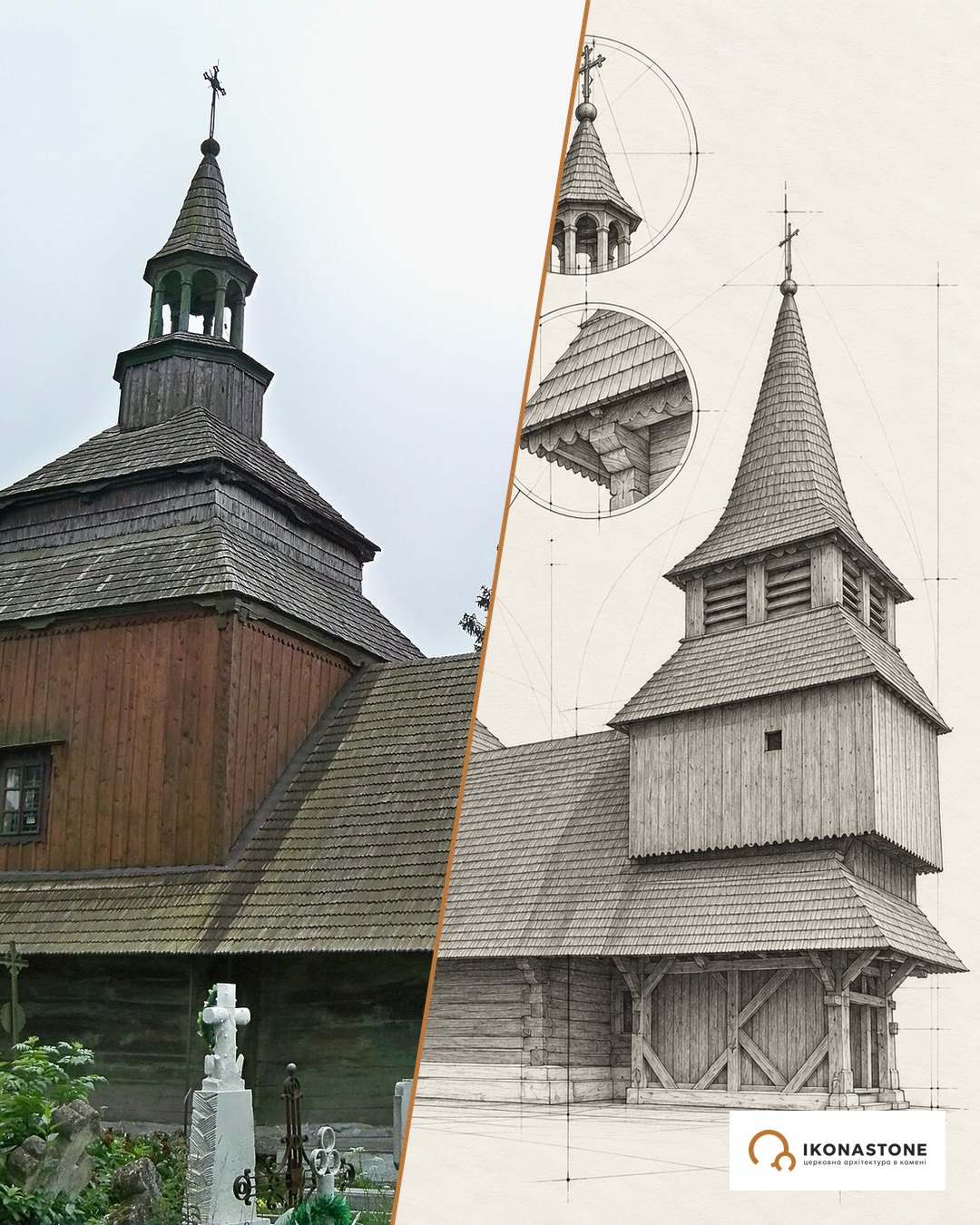
Below are two elements of the church: in a photo and in a drawing. The drawings show the form, not exact dimensions.
The top with a signature turret
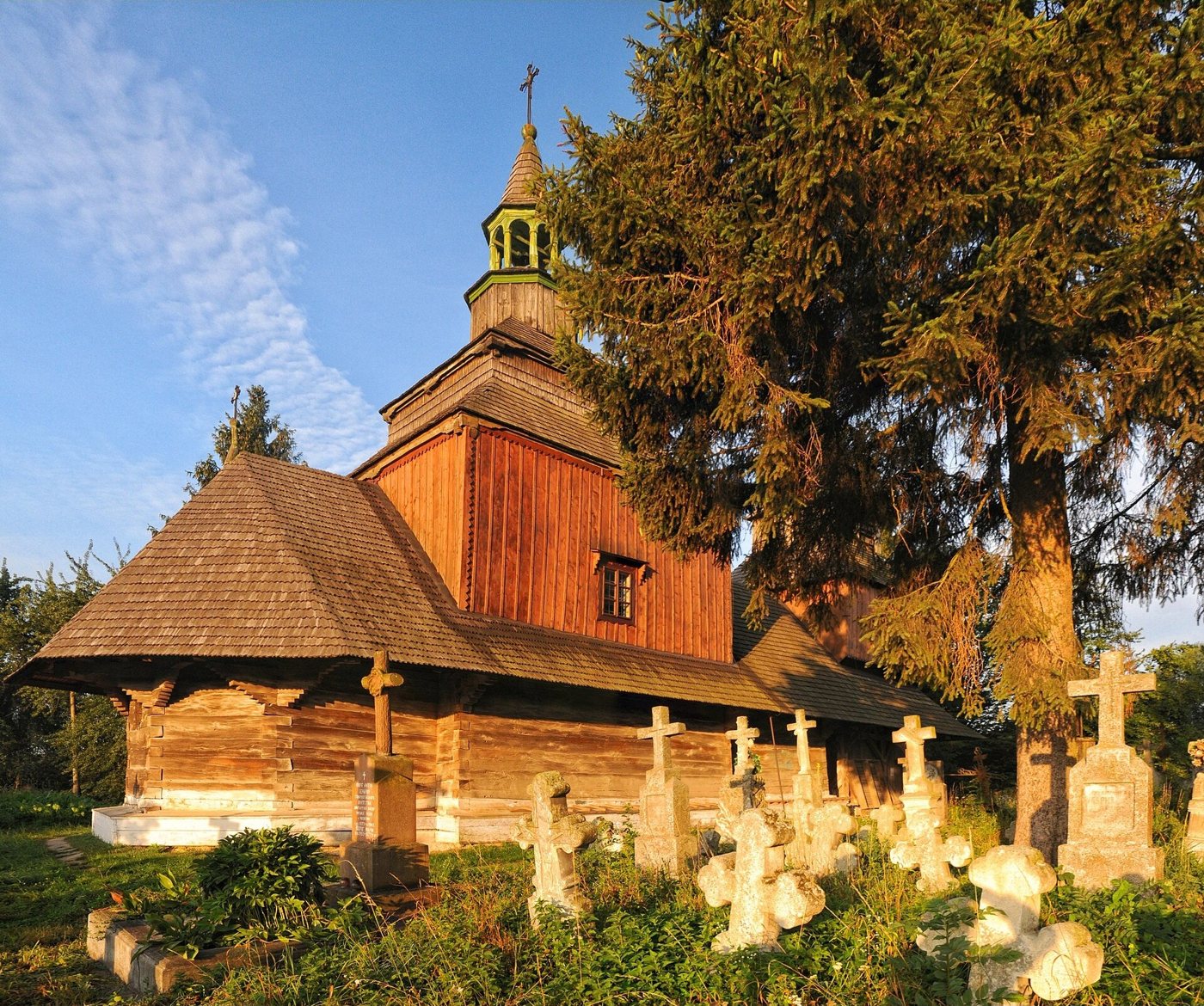
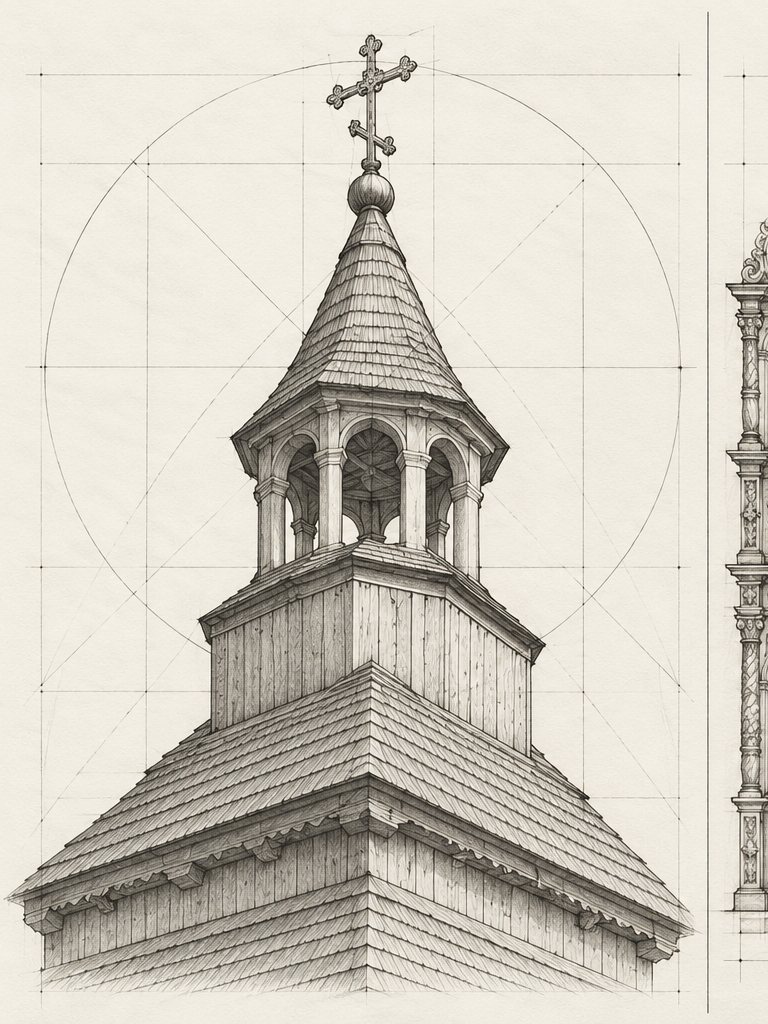
The central frame is the tallest, and it is crowned by a small signature turret under a tent roof. The present appearance of the top is later than the church itself: according to researchers, in the early 20th century, during a roof repair, the crowning of the nave and the roof over the altar were changed.
The iconostasis of 1650
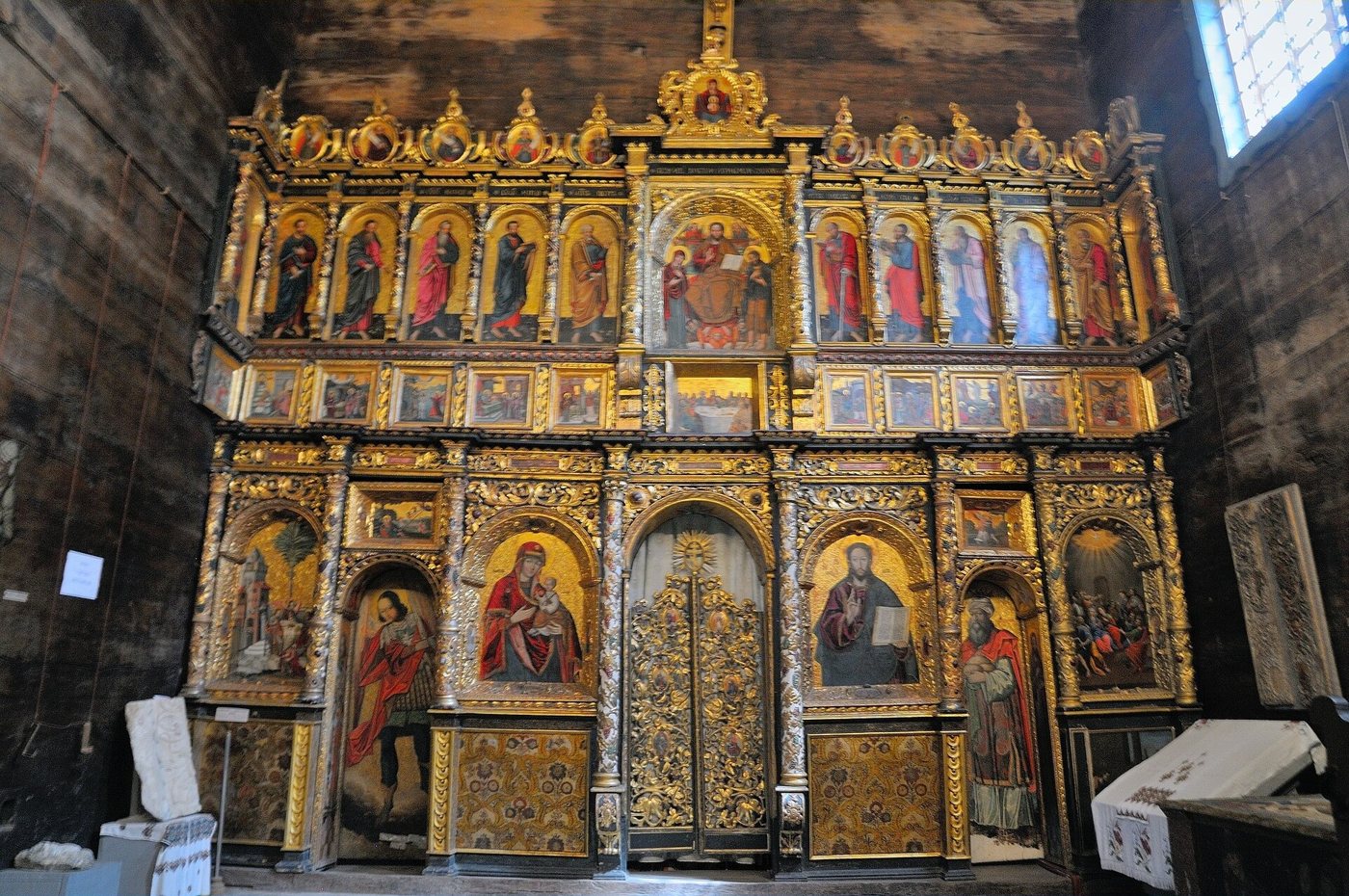
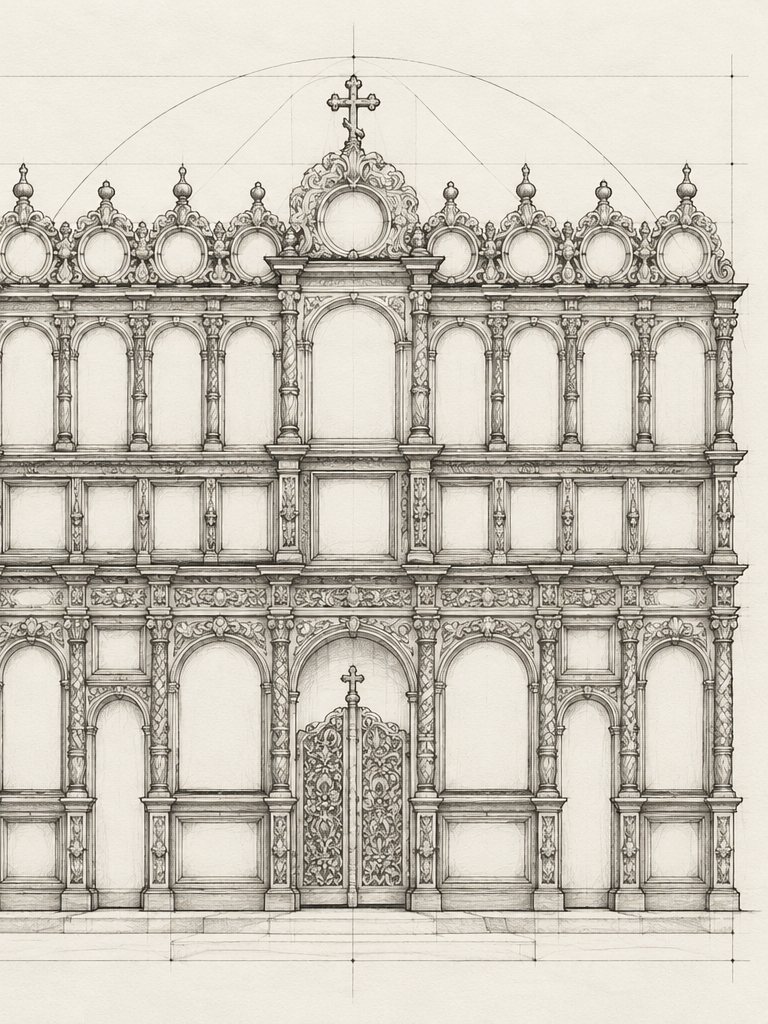
Five tiers: the predella, the namisnyi, the festal, the apostolic and the prophets’ tier. The carving is silvered, gilded and polychrome. Researchers connect the painting with the Lviv painting school of the late Renaissance; the names of the icon painters are unknown. On the deacon’s doors are the Archangel Michael and Melchizedek. How to read the tiers is explained in the article Tiers of the Iconostasis.
The bell tower
Square in plan, three-tiered, under a tent roof, it adjoins the west wall of the narthex. According to Wikipedia, the bell tower was added to the narthex in the 19th century; the tourist portal Travels in Ukraine dates it to the 17th century. The shingles on the church and the bell tower were replaced in 1999.
Wood and stone
The main material is oak. The beams are smoothly hewn, and the joints are without nails, on wooden pegs where needed.
Stone is not in view here, but the church could not do without it. It stands on an embanked hill above the Hnyla Lypa, and we did not find in the verified sources any information about the foundation of the bell tower. This is how a wooden building holds on to a stone base. The World Heritage property includes the old cemetery and a traditional wooden fence with a shingled gate (the UNESCO dossier).
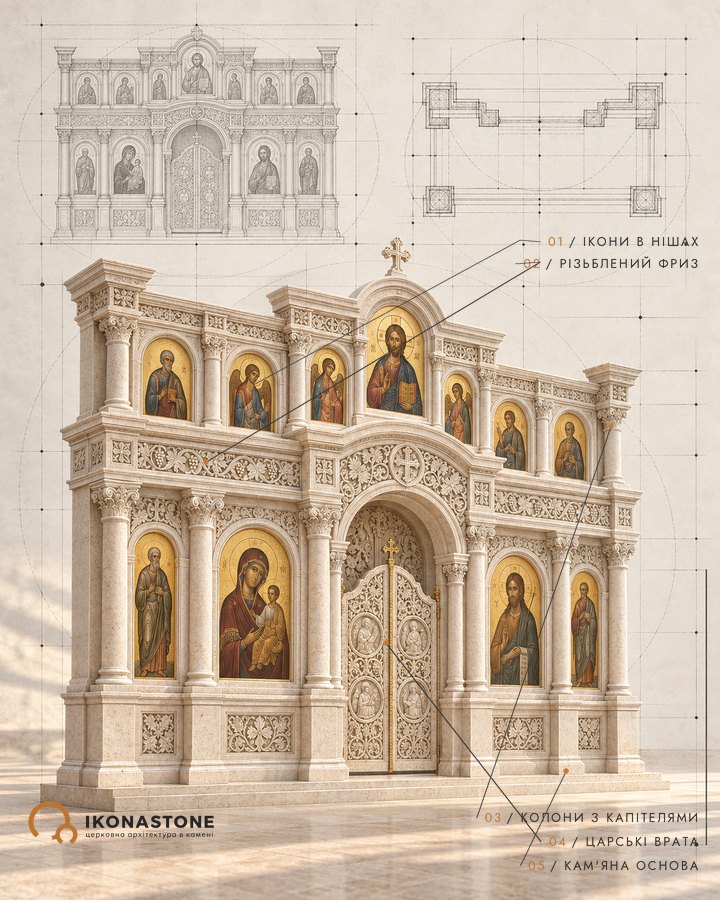
The iconostasis of Rohatyn is wooden, but the very logic of its tiers carries over into stone too. How this works is described in the article The Ukrainian Iconostasis and in the section iconostases.
Did you know
The survey of 2006 revealed two wood-borers: a red-legged woodworm beetle and a violet longhorn beetle, according to Wikipedia. [1]
The church was built without nails: where needed, the log frames are fastened with wooden pegs. [12, 15]
In the whole serial property only three churches are preserved as museums: Rohatyn, Radruż and Drohobych. [2, 3]
The central frame is covered with a four-sided top with two breaks. [1, 14]
According to the UNESCO dossier, the bell tower adjoins the narthex rather than standing separately. [2]
The World Heritage property (0.49 ha, buffer zone 1.47 ha) includes a wooden fence with a shingled gate and the old cemetery. [2]
The icon "Angel of Dominion" spent about 40 years outside the church. [10]
The iconostasis has about 60 icons; in 2023 only 11 were transferred. [9]
The silver coin of 2009 has a face value of UAH 10, a diameter of 38.6–39 mm and 31.1 g of pure silver. [16, 17]
The iconostasis restored in 1885 was shown at an archaeological and ethnographic exhibition in Lviv. [1, 14]
The iconostasis of 1650 is called one of the three oldest in Ukraine, according to Wikipedia and Travels in Ukraine. [1, 14]
Radio Svoboda (2009) writes that tourists are told that Roxelana's father served here, but the church is about a hundred years younger than that time. [6]
Legends
Roxelana's father
According to a legend, in the early 16th century Fr Havrylo Lisovskyi, the father of the future Roxelana, served here as a priest. Recorded in Wikipedia, Obozrevatel and Travels in Ukraine. Radio Svoboda (2009) considers this contentious, because the church, by its official date, is younger. Zakhid.net notes: it is unknown whether he served in this building or in an earlier one. [1, 6, 12, 13, 14]
Roxelana's prayers
According to a legend, Nastia Lisovska often came to pray in this church. [1, 9, 12]
A burial in the crypt
Stepan Pushkar does not rule out that Roxelana's father is buried in the crypt of the church. This is a hypothesis, not a fact. [5]
The fortress
Wikipedia notes that the church stands within the bounds of the former defensive fortifications. [1]
An underground passage
Travels in Ukraine reports an underground passage to the Church of the Nativity of the Mother of God; there is no confirmation in other sources. [14]
Figures
- Ipolyt Dzerovych — parish priest of the church at the end of the 19th century; read the inscription of 1598.
- Arsenii Zhelyborskyi — Bishop of Lviv; in 1656 granted a diploma to the brotherhood (according to Wikipedia).
- Mykola Shadurskyi — visitor, author of the first full description of the church in 1760.
- Yulian Makarevych — Lviv painter, restored the iconostasis in 1885.
- M. Kovalchuk — Lviv architect, supervised the restoration of 1895.
- Ivan Mohytych — architect of the restoration of 1980–1982.
- Havrylo Lisovskyi — according to legend, the father of Roxelana.
- Roxelana (Nastia Lisovska) — according to the Encyclopedia, seized by the Tatars in 1520; a historical figure, individual details are legend.
- Volodymyr Vuitsyk — a Lviv researcher who, according to karpaty.rocks, proposed 1598 as the year of foundation.
- Stepan Pushkar — museum research associate; gives the dating of the oak to 1480.
- Tetiana Petriv — head of the Rohatyn Museum Complex; initiator of the return of the icon “Angel of Dominion”.
- Valerii Tverdokhlib — restorer of the “Angel of Dominion”.
- Oksana Voitovych, Anastasiia Bodnar — restorers of the icons “Hodegetria” and “Christ Pantocrator” (2023).
- Taras Otkovych — head of the Lviv branch of the restoration centre (Suspilne 2023; Wikipedia gives the name Myroslav for 2006 — a discrepancy).
- Volodymyr Demianenko — author of the commemorative coin of 2009.
- Mykola Uhryn-Bezhrishnyi — public figure; his estate is part of the Museum Complex.
How to cite
IKONASTONE. The Church of the Holy Spirit in Rohatyn // Guide to the Churches of Ukraine. URL: https://ikonastone.com/en/guide/holy-spirit-church-rohatyn/ (accessed DD.MM.YYYY).
FAQ
Where is the Church of the Holy Spirit?
In the western part of Rohatyn in Ivano-Frankivsk Oblast, at 10 Roksolany Street, on a hill above the Hnyla Lypa river.
When was the church built?
The official date is 1598, according to an inscription on the north wall of the nave. Some researchers place the construction in the first half of the 17th century (the years 1644–1645 and 1648 are named), and according to a museum staff member quoted by Ukrinform (2017), the oak was felled in 1480; no published expert opinion exists. The question remains open.
Is the church on the UNESCO list?
Yes. On 21 June 2013 it was inscribed together with its bell tower on the World Heritage List as part of the property "Wooden Tserkvas of the Carpathian Region in Poland and Ukraine" (component number 1424-011).
Is the church used as a place of worship?
Since 6 August 1983 the church has worked as a museum — a branch of the Ivano-Frankivsk Regional Art Museum (now the Museum of Arts of the Prykarpattia). On the UNESCO list it is one of three churches preserved as museums.
Sources
- Wikipedia (uk). Church of the Holy Spirit (Rohatyn)
- UNESCO World Heritage Centre. Nomination/evaluation document (Rohatyn, Holy Spirit tserkva, pp. 229–237)
- UNESCO World Heritage Centre. Wooden Tserkvas of the Carpathian Region in Poland and Ukraine
- Wikipedia (en). Wooden Tserkvas of the Carpathian Region in Poland and Ukraine
- Ukrinform. Rohatyn. The city of the sun and Roxelana (2017)
- Radio Svoboda. The Church of the Holy Spirit in Rohatyn (21.09.2009)
- Radio Svoboda (28.12.2009)
- Suspilne Ivano-Frankivsk. A church from the UNESCO list is being repaired in the Frankivsk region (25.09.2022)
- Suspilne Lviv. Eleven icons from the Ivano-Frankivsk region are being restored in Lviv (01.10.2023)
- Ukrinform. The icon "Angel of Dominion" is being returned to the Holy Spirit Church (20.05.2026)
- Encyclopedia of Ukraine. Rohatyn
- Obozrevatel. A journey through Roxelana's homeland: what to see in Rohatyn
- Zakhid.net. Rohatyn: the city of Roxelana
- Travels in Ukraine. Holy Spirit Church, Rohatyn
- Karpaty.rocks. Museum-monument of wooden architecture and painting XVI–XIX centuries, Church of the Holy Spirit, Rohatyn
- Mint (web). The Church of the Holy Spirit in Rohatyn
- Pinbank. The Church of the Holy Spirit in Rohatyn (10 hryvnia coin)
- Town
- Rohatyn, Ivano-Frankivsk Oblast
- Built
- late 16th – first half of the 17th century (dating disputed)
- Type
- three-frame single-domed wooden church of the Halych type
- Material
- oak beams
- Research depth
- 24%