How Many Tiers an Iconostasis Has and What Each One Holds
There are things in a church that are read like a text. The iconostasis is perhaps the clearest example: it can be “read” from bottom to top, tier by tier, and each tier will be a separate sentence in a long narrative of salvation. Anyone who knows how to do this, even standing in an unfamiliar church, immediately understands where the Old Testament is, where the apostles are, and where the images are before which the community prays.
When the sanctuary screen holds only a single band of icons, the question “how many tiers” seems unnecessary. But when a new iconostasis is ordered, it becomes the first practical question: the number of tiers determines the height of the structure, the number of icons, the timescale, the cost and even whether there will be enough light in the apse. So it is worth understanding where the tiers came from, what each of them carries, and what can be left out without harm to the meaning.
In brief
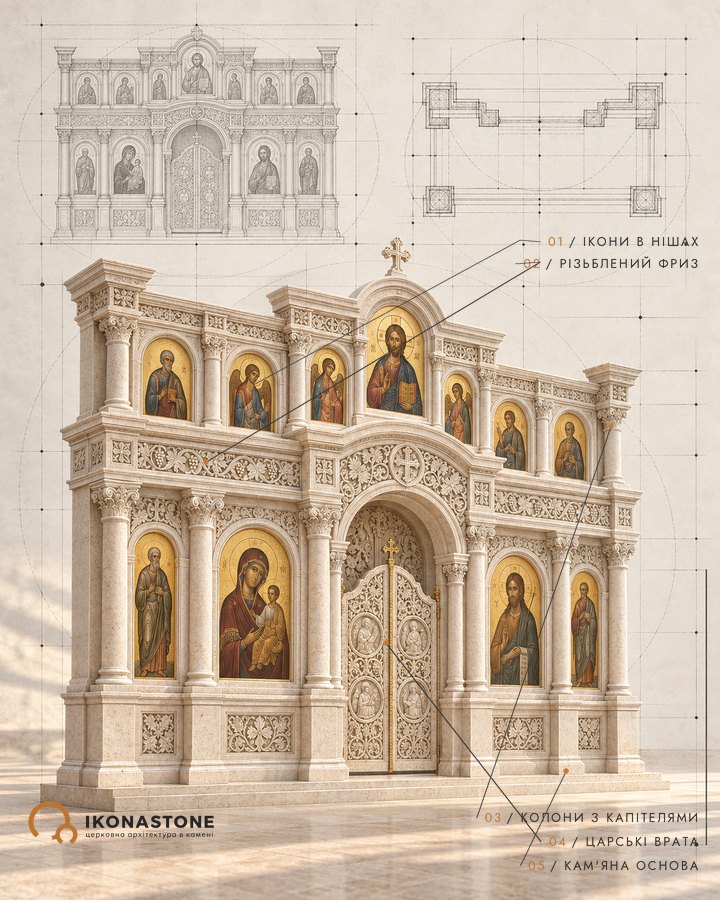
- A full Ukrainian iconostasis has four or five tiers, not counting the base and the crowning: the local tier, the festal tier, the Deesis (apostles’) tier, the prophets’ tier, and in the largest ones also the forefathers’ tier.
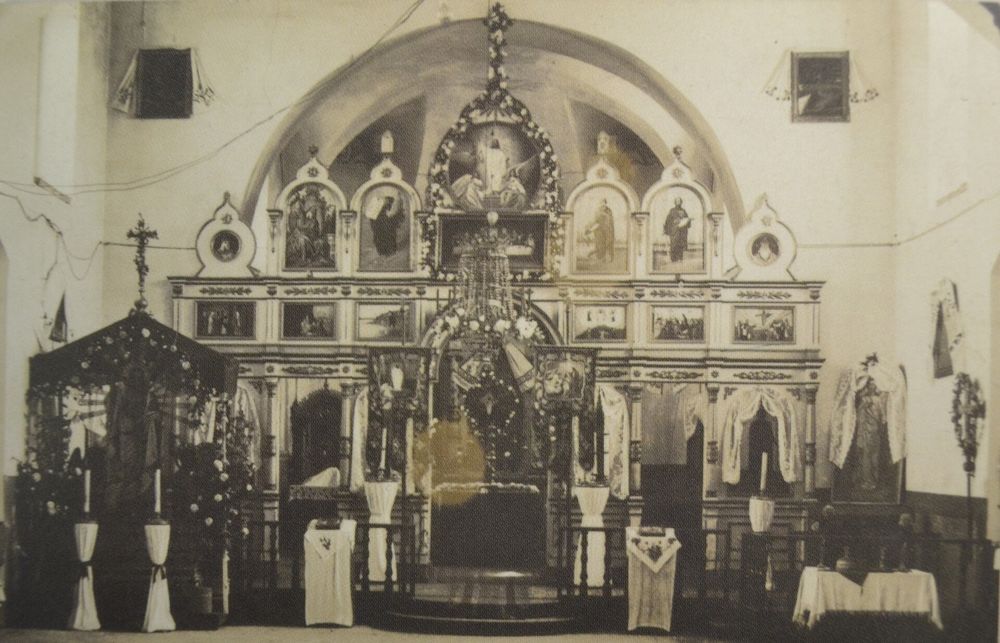
- There is no fixed number. The oldest Ukrainian iconostases were low, with two or three tiers; five and even six or seven tiers became usual in the 17th–18th centuries.
- The tiers run from bottom to top, from the images before which the community prays to the apostles, prophets and forefathers.
- The structure is crowned with a cross or a crucifix, often with attendant figures.
- In small churches the lower part is kept: the local tier with the royal doors, sometimes with one more tier above it.
- How many tiers your church can hold is decided by the height and width of the sanctuary screen, not by the wish to have it “like in a cathedral”.
Where did so many tiers come from?
Early sanctuary screens were low. The Encyclopedia of Ukraine describes the path like this: the oldest iconostases had two tiers, by the 14th–15th centuries a scheme of two or three tiers had become established, and in the 17th–18th centuries the iconostasis grew and became so elaborate that a fifth and even a sixth tier were added. The three-tier scheme at the turn of the 14th–15th centuries did not yet have a prophets’ tier: it was added later.
The prophets’ tier became a separate tier in the 17th century: in Ukrainian iconostases it crowns the Deesis-and-apostles tier. After the Synod of Zamość in 1720, closer to the middle of the 18th century, the number of tiers in the iconostases of the Uniate Church decreased and the structure changed. There has never been a single obligatory number of tiers.
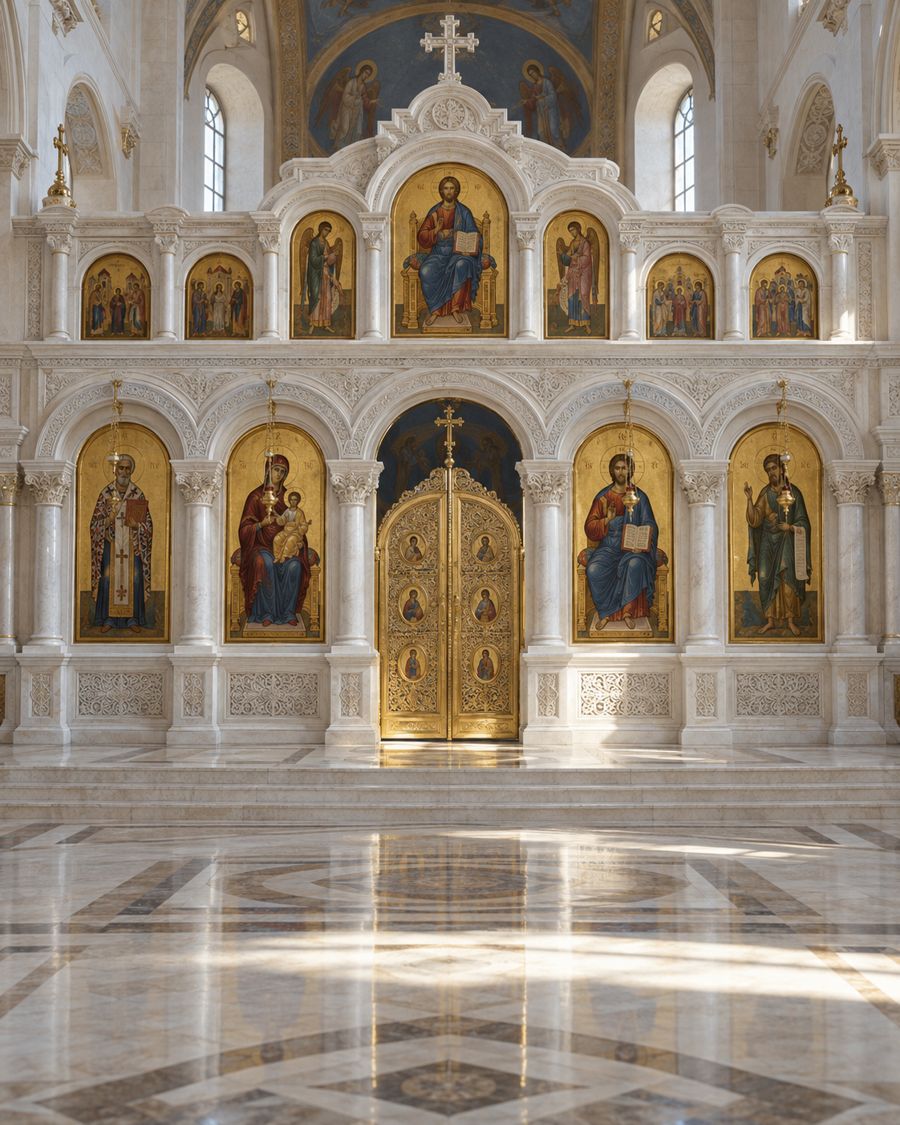
The local tier: what is to the left and right of the royal doors?
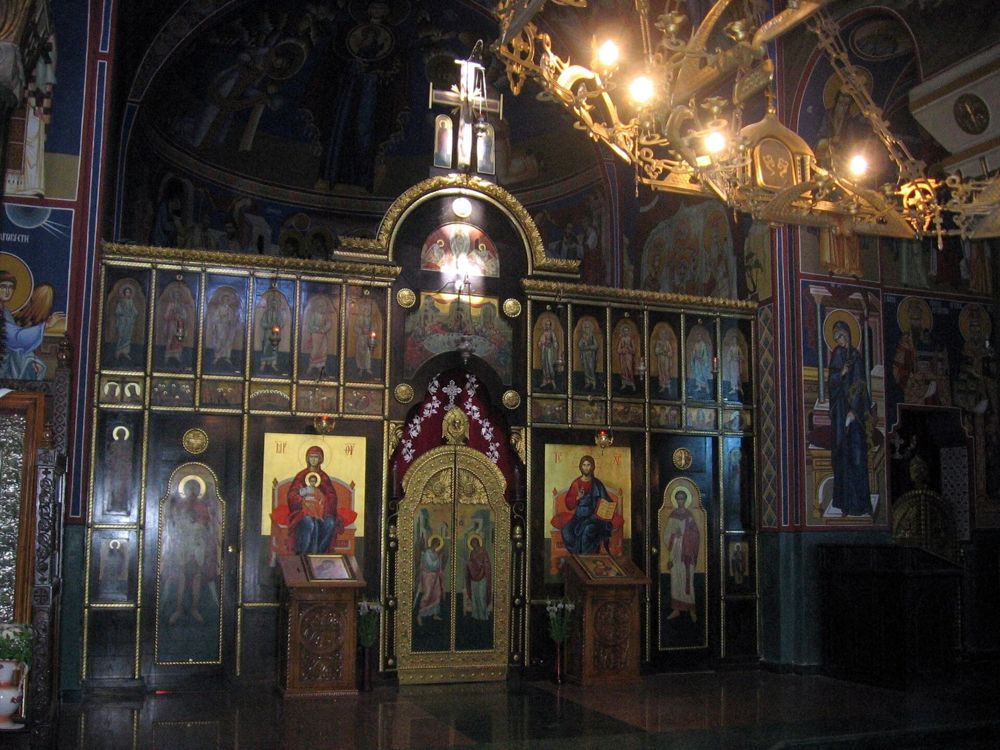
This is the lowest tier: the parishioner stands closest to it, and it is here that he looks for the image before which he prays.
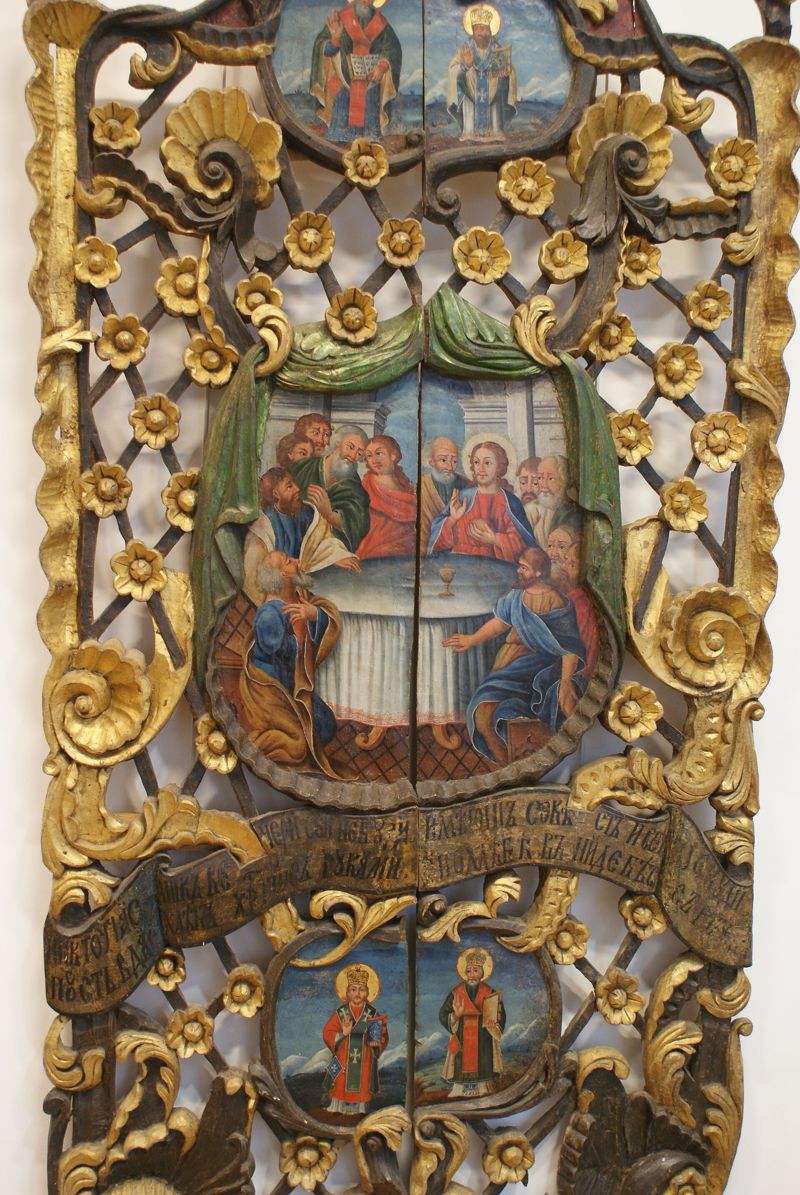
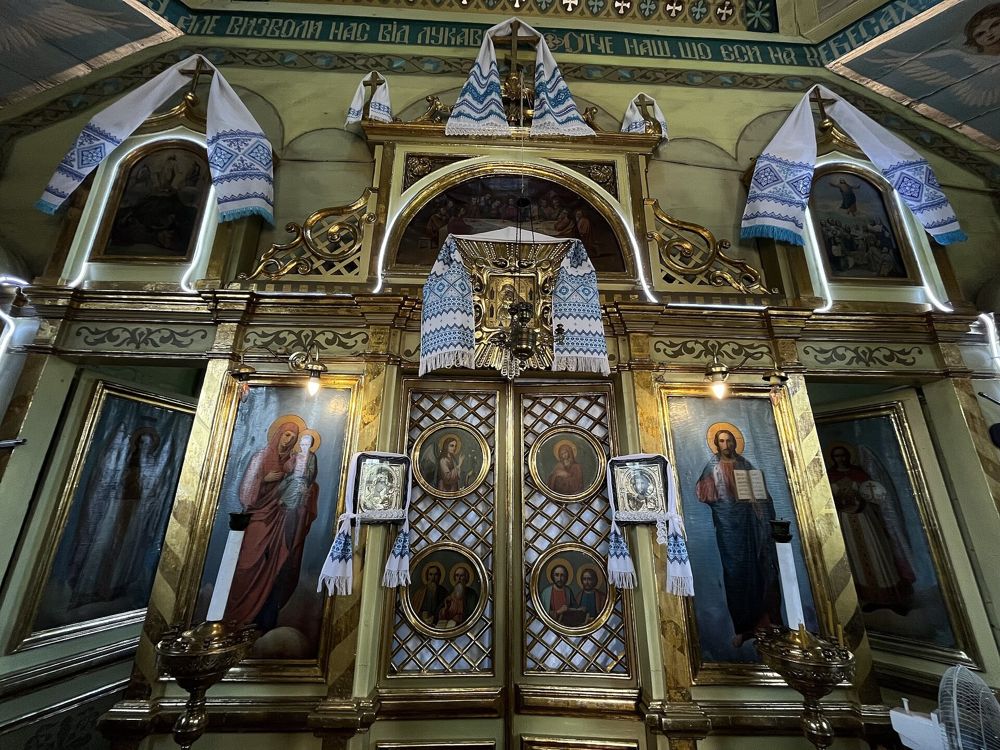
The core of the tier is the royal doors in the middle. They depict the Annunciation and the four evangelists, although the doors may also be simply latticed, without images. There is more about them in a separate article on the royal doors.
To the right of the doors (looking from the nave toward the sanctuary) stands the icon of Christ, to the left the icon of the Mother of God with Child. In descriptions these two icons are called the only ones that never change. Next come:
- the icon of the church’s dedication, that is, the image of the feast or saint in whose honour the church is consecrated;
- John the Forerunner or the patron of the parish on the right, St Nicholas most often on the left, beyond the deacons’ doors;
- other saints most venerated in the community.
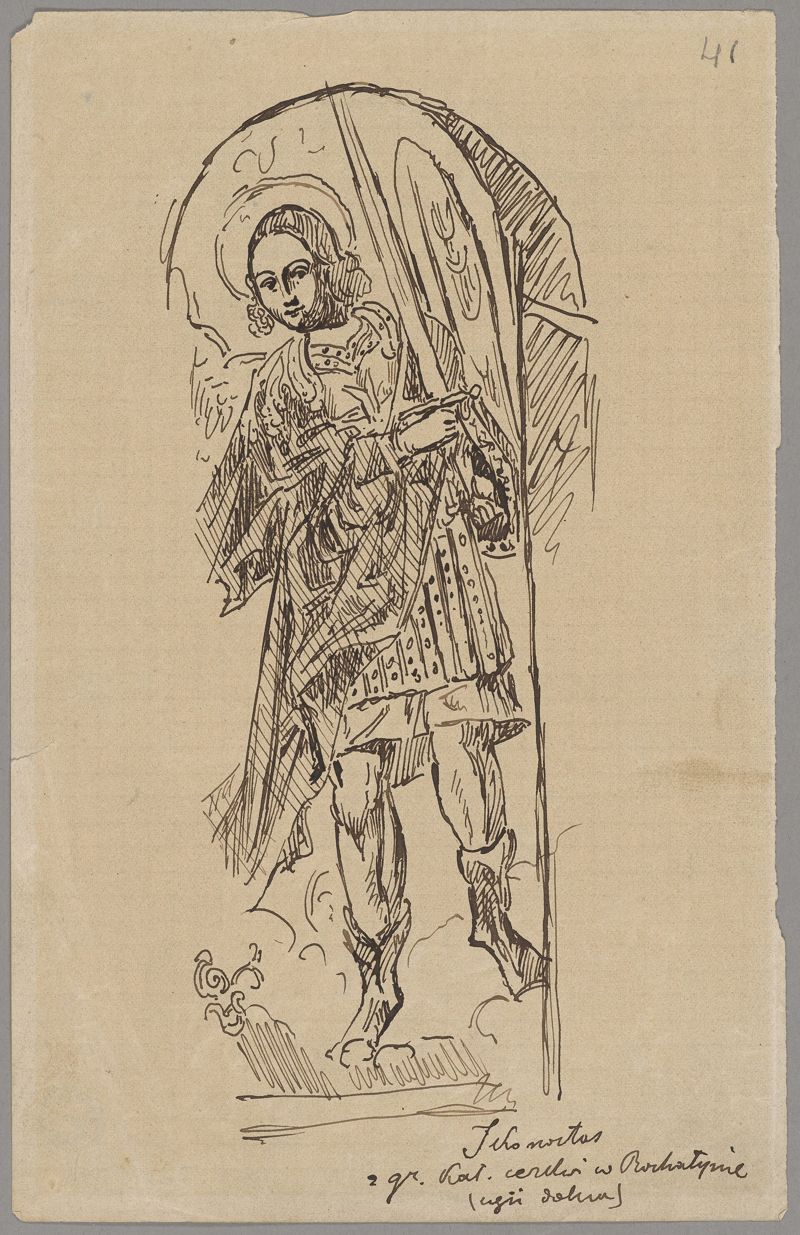
To the sides of the royal doors are the side doors, the deacons’ doors. They usually bear icons of the Archangels Michael and Gabriel, and in some places the Archdeacons Stephen and Lawrence. In the iconostasis from the Maniava Skete, Basil the Great and John Chrysostom stand on the jambs of the royal and deacons’ doors.
Above the royal doors the Last Supper is placed, and higher still there is often the image of the Mandylion (the Holy Face Not Made by Hands). In many old iconostases a base tier (predella) runs beneath the local tier: small compositions on Old and New Testament themes. For example, the five tiers of the Bohorodchany Iconostasis begin precisely with a tier of narrative predellas.
The festal tier: which feasts and in what order?
Above the local tier are placed the icons of the twelve great feasts: the cycle of feasts of Christ and of the Mother of God. The feasts are arranged along the tier in the order of the church year, and the centre of the tier is the Last Supper above the royal doors; this is the case, for example, in the Bohorodchany Iconostasis.
The festal tier is often supplemented by a cycle of Christ’s Passion, and in the Bohorodchany Iconostasis scenes of the Passion and of the Sundays of the Pentecostarion are placed in the local and base tiers. This band of icons reads as a calendar of the church year.
In the classic Ukrainian scheme the festal tier stands below the Deesis tier, but this is not a law of nature: in the Dormition Cathedral in Okhtyrka (1738) a large festal tier stood in place of the Deesis tier.
The Deesis, or apostles’ tier: why is Christ in the centre?
This is the principal tier of the iconostasis. In the centre is Christ enthroned, on either side the Mother of God and John the Forerunner, and then the apostles extend in both directions, twelve across the whole tier. In old monuments it had varying numbers of panels: in Slobozhanshchyna, in the Sumy Regiment, the tier consisted of 13 panels, while in the Kharkiv and Izium Regiments it had five, with the apostles depicted in groups of three.
This composition explains the two names. “Deesis” (Greek for “supplication”) refers to the central scene: the Mother of God and the Forerunner pray before Christ on behalf of humanity. “Apostles’ tier” emphasises the figures it contains. In many descriptions it is one and the same tier.
The prophets’ tier: who is there and what do they hold?
Above the Deesis tier stands the prophets’ tier. The prophets are depicted with scrolls on which are written words foretelling the coming of Christ. There are usually twelve of them, and in the centre there is most often the Mother of God of the Incarnation (the Sign) or God the Father. In Ukraine it became established as a separate tier in the 17th century, and in Galicia there was no strict order of the figures in it. The Rybotychi masters of the 1680s–1760s did not depict the Mother of God in the centre, and placed a crucifix above the central icon of the Deesis.
That is why the prophets’ tier stands above the apostles’ tier: prophecy precedes fulfilment, and we read it as if going back in time, upward.
The forefathers’ tier: is one more needed?
The highest and the rarest. It depicts the forefathers and patriarchs of the Old Testament: from Adam to Moses. The patriarchs are placed above the prophets, and the Encyclopedia of Ukraine speaks of patriarchs or scenes of Christ’s Passion above the prophets’ tier. Many churches do not have it, and this is not a defect: in the Ukrainian churches of Canada, iconostases as a rule do not exceed five tiers even in the largest cathedrals.
Compared with the prophets’ tier, the forefathers lie even deeper in the past: they are those whose story began before the Law. Such depth requires height. In a low church there is simply nowhere to put it.
The crowning: the crucifix with attendant figures
Above all this is placed a cross or an icon of the Crucifixion. In the classic scheme it has attendant figures: the Mother of God on one side of the Crucified and the Apostle John on the other. Sometimes the scene is supplemented with a carved dove or other elements: in the iconostasis from the Maniava Skete the crowning consists of an icon of the Mother of God of the Sign, a carved crucifix with attendant figures, and a carved pelican.
In more modest iconostases only Christ on the cross remains, without attendant figures, and sometimes even without the figure: simply a cross. This is not a mistake. If the screen does not reach the vault, a cross above the royal doors remains the customary finish.
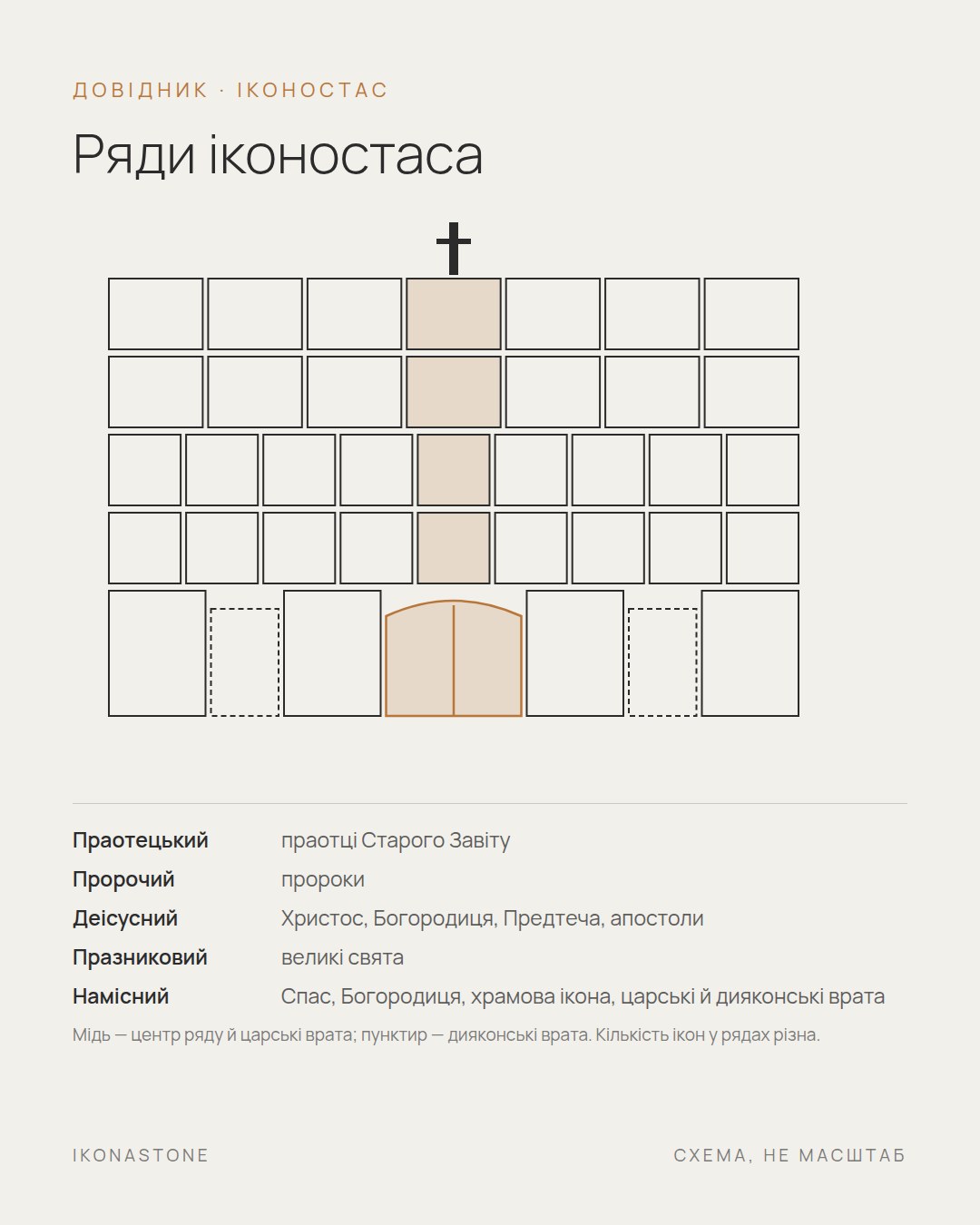
Table: tier, images, order
| Tier (bottom to top) | What is depicted | Order and centre |
|---|---|---|
| Base tier (predella), not in all | Small narrative scenes on Old and New Testament themes | Beneath the local tier |
| Local | Royal doors (Annunciation, evangelists); Christ, the Mother of God, the icon of the church’s dedication, venerated saints; icons on the deacons’ doors | Centre: the royal doors; Christ on the right, the Mother of God on the left |
| Festal | The twelve great feasts; often also the Passion cycle | The Last Supper above the royal doors; the feasts follow the order of the church year |
| Deesis (apostles’) | Christ enthroned, the Mother of God, the Forerunner, the apostles | Centre: Christ; figures symmetrical on either side |
| Prophets’ | Old Testament prophets with scrolls | Centre: the Mother of God of the Incarnation (the Sign) or God the Father; prophets symmetrical |
| Forefathers’, only in the largest | Forefathers and patriarchs, from Adam to Moses | Above the prophets’ tier; symmetrical about the centre |
| Crowning | A cross or crucifix, often with the Mother of God and John (attendant figures) | Above everything, on the axis of the royal doors |
The order in this table corresponds to the classic Ukrainian scheme. In some monuments there is no Deesis tier at all, as in the Okhtyrka cathedral.
How many tiers in small churches and in other variants?
Broadly speaking, the variations range from one to five or more tiers.
- One tier (local). The royal doors, the icons of Christ and the Mother of God, the icon of the church’s dedication. The minimum that preserves the essence of the iconostasis: in the literature on small churches these are “the two icons that never change”.
- Two tiers. One more is added to the local tier; the oldest Ukrainian iconostases were like this.
- Three tiers. Local, festal and Deesis, the scheme of the 14th–15th centuries.
- Four tiers. The prophets’ tier is added; according to the Encyclopedia of Ukraine, a full iconostasis has four to six tiers and more than fifty icons.
- Five or more. The forefathers’ and base tiers. In the Baroque era, five to seven tiers became common even in wooden village churches.
The upper tiers are omitted for reasons of taste or cost, or so as not to cover a significant icon in the apse.
What to decide before ordering
The number of tiers depends on three simple things: how much height you have, how much width, and what you want to be legible from a distance. The specific dimensions always depend on the architecture of the church and must be taken from measurements on site.
- Height from the floor to the vault or to the apse windows. It decides whether the upper tiers will fit. If a tier beneath the vault would be lost in shadow or would run into a cornice, it should not be installed “to complete the set”.
- Width of the sanctuary arch. It determines how many icons will fit in a tier. This is especially important for the Deesis and prophets’ tiers, since they are built out symmetrically from the centre.
- Legibility. The lower tiers are viewed from a few steps away, the upper ones from the other end of the nave. The upper icons must be large enough for their height, otherwise they will become a pattern.
- What is already in the apse. Windows, wall paintings, niches: the iconostasis should not cover them pointlessly.
- The community’s tradition. The composition of the upper tiers differs in detail from church to church, so the icon programme should be agreed with the rector.
- Budget and timescale. Each additional tier means additional icons and framework, and a full iconostasis, according to the Encyclopedia of Ukraine, numbers more than fifty icons. You can start with the lower tiers and add the upper ones later: a good structure allows for this.
- Crowning. Decide in advance whether it will be a cross or a crucifix with attendant figures: the height of the upper part depends on this.
A practical tip: start not with the desired number of tiers but with the measurements of the nave. It often turns out that three well-worked tiers and an expressive crowning give a better result than five cramped ones.
The IKONASTONE workshop works in stone, and for us the question of the number of tiers begins with the span and the load on the foundation. Catalogue of iconostases: /en/products/iconostases/. For the basics, see the articles “What Is an Iconostasis” and “The Ukrainian Iconostasis”.
FAQ
How many tiers should an iconostasis have?
There is no single binding number. A full Ukrainian iconostasis of the 17th–18th centuries had five or more tiers, the classic scheme of the 14th–15th centuries made do with two or three, and a small church may limit itself to a single local tier. The number of tiers depends on the period, the tradition and the size of the church.
What is in the local tier?
In the middle are the royal doors; to their right (looking from the nave) is the icon of Christ, to their left the icon of the Mother of God with Child. Next come the icon of the church's dedication, the saints most venerated in the community, and the icons on the deacons' doors.
How does the Deesis tier differ from the apostles' tier?
In many descriptions they are one and the same tier: Christ enthroned in the centre, the Mother of God and John the Forerunner on either side, then the apostles. The name "apostles' tier" emphasises the figures it contains, while "Deesis" (the Supplication) refers to the central composition.
What is the forefathers' tier and is it obligatory?
It is the tier of the forefathers and patriarchs of the Old Testament, for example from Adam to Moses. It stands above the prophets' tier, appears in the largest iconostases, and many churches do not have it.
What is placed at the top of the iconostasis?
A cross or a crucifix. Often this is a composition with the attendant figures: the Mother of God to the right of the Crucified and the Apostle John to the left. In more modest iconostases we see only Christ on the cross.
What determines the number of tiers in a particular church?
The height of the nave and the span up to the vault, the width of the sanctuary arch, what else is in the apse (windows, wall paintings), and the budget. The upper tiers are often omitted for reasons of taste or cost, or so as not to cover an icon or painting in the apse; the local tier is always present.
Sources
- "Iconostasis", Encyclopedia of Ukraine, vol. 2 (1989)
- Sterling Demchinsky. "The Iconostas in Ukrainian Churches", Ukrainian Churches in Canada website, 2010
- Roksolana Kosiv. "The Iconography of the Prophets' Tier in Iconostases by the Rybotychi Masters (1680s–1760s)", Mystetstvoznavchi Zapysky, issue 34, 2018, pp. 96–103
- Mariana Pelekh. "The Prophets' Tier of the Iconostasis of the Dormition Church in Lviv, Early 17th Century (the Hrybovychi Iconostasis)", Narodoznavchi Zoshyty, 2013, No. 1 (109)
- Taras Otkovych. "The Iconographic Programme and the Iconographic Origins of the Subjects of the Iconostasis from the Maniava Skete Monastery (the Bohorodchany Iconostasis), 1698–1705", Narodoznavchi Zoshyty, 2011, No. 6 (102)
- The Bohorodchany Iconostasis (Yov Kondzelevych, 1699–1705), Andrey Sheptytsky National Museum in Lviv, museum-digital
- Viacheslav Shulika. "The Iconostasis of Slobozhanshchyna in the 17th–18th Centuries: The Deesis Tier", First Taranushenko Readings, Kharkiv, 2023
- Ihor Kovalchuk. "Ukrainian Iconography in the 14th–18th Centuries" (section 3.3, pp. 91–108), uars.info
- Rostyslav Studnytskyi. "Iconostases of the Churches of the Halych Metropolis, Late 19th to First Third of the 20th Century: Architectonics, Iconography and Decorative Programme", Studia Ucrainica Varsoviensia