The Holy Trinity Church in Zhovkva: an iconostasis of the Zhovkva school
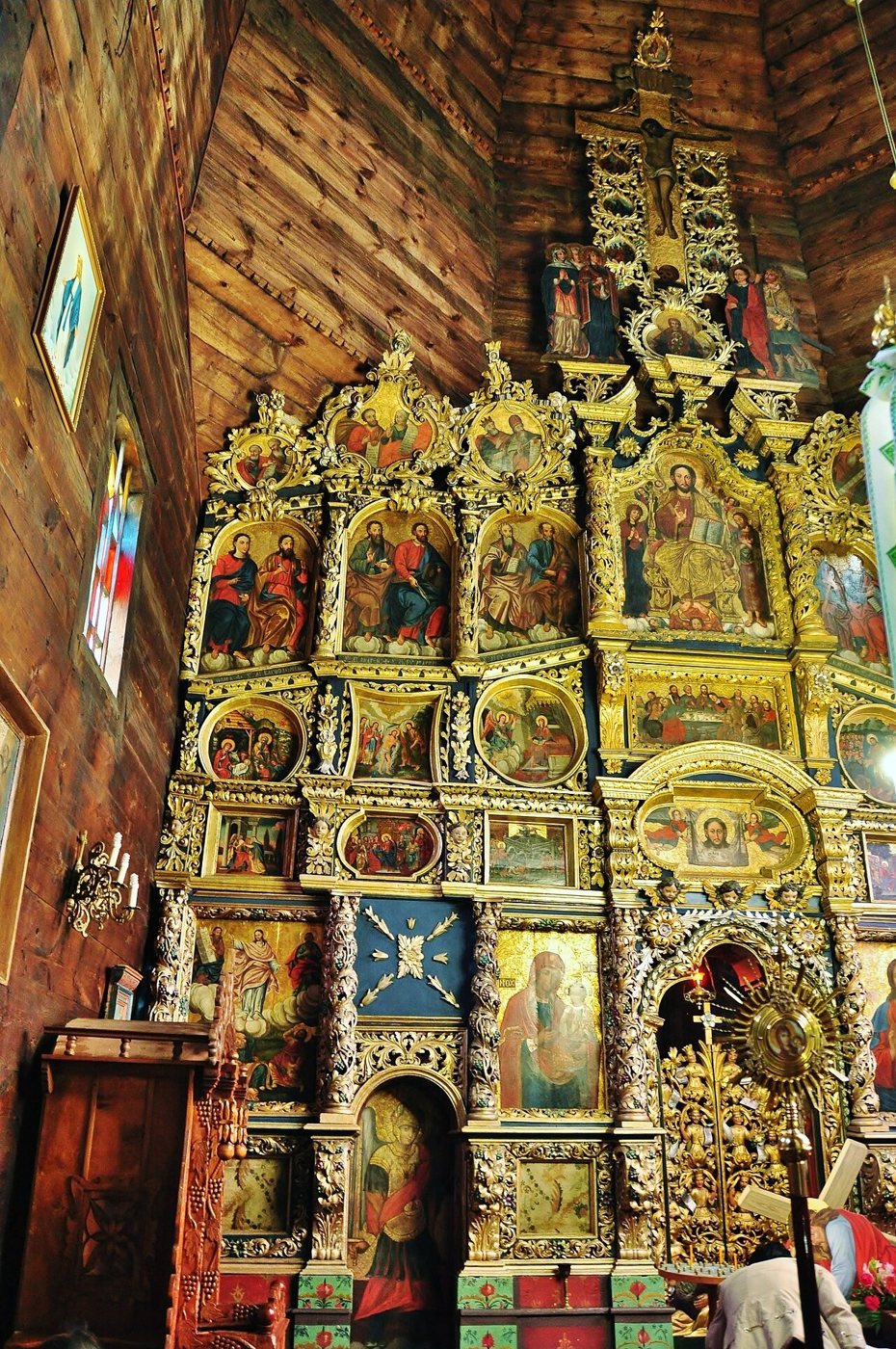
The iconostasis of this church was assembled from parts of different periods: beneath the faces of two icons, restorers found paintings from the second half of the 17th century — older than the building itself, which dates from 1720. Whose hands painted them is still being worked out.
In brief
| Address | Zhovkva, the former Lviv suburb, Lviv District, Lviv Oblast |
| Built | 1720 |
| Type | three-part, three-frame wooden church with three octagonal tops |
| Iconostasis | Baroque, Zhovkva school, about 50 icons |
| Denomination | UGCC |
| Status | UNESCO World Heritage Site since 2013 (no. 1424-016) |
History
Zhovkva is a castle town: Zhovkva Castle was the residence of King Jan III Sobieski, and its towers will come up again in this story. In the Lviv suburb, according to the Wooden Churches of the Carpathians route, a wooden church already stood in 1601. On 17 June 1717 it burned down together with the whole suburb.
The new Church of the Holy Trinity was built on the same plot in 1720. The parishioners raised the money; a donation, according to the Wooden Churches of the Carpathians route and ZAXID.NET (2019), was made by Prince Konstanty Władysław Sobieski, son of King Jan III (ZAXID.NET in 2023 names Jakub Sobieski). Plaques on the walls still mark the building as an architectural monument of 1720.
The iconostasis has its own, longer history. In Zhovkva at the end of the 17th and the beginning of the 18th century there worked a school of icon painting and carving headed by Ivan Rutkovych, at that time the leading one in Galicia. Rutkovych’s best-known iconostasis (1697–1699) comes from the Church of the Nativity of Christ in Zhovkva, not from the Holy Trinity (Encyclopedia of Ukraine, ZAXID.NET); the Wooden Churches of the Carpathians route links it to the earlier Trinity church, but other sources do not confirm this. The date of Rutkovych’s death is unknown. Research during the latest restoration showed that the icons of the Mother of God with the Child and of Christ the Teacher were first painted roughly in the second half of the 17th century, possibly by Rutkovych himself, and repainted in the first half of the 18th century by Vasyl Petranovych (according to ZAXID.NET).
Under Soviet rule the church housed a museum — according to ZAXID.NET, a museum of atheism and of local history — and because of this the building was looked after. After 1991 it was first handed to the Orthodox, and in 1993 it was returned to the Greek Catholics (according to the Wooden Churches of the Carpathians route). Today a UGCC community prays in it. The iconostasis, according to English Wikipedia, had already been restored in 1978–1979.
The icons themselves are the work of several hands. Sacred Art of the Lviv Region attributes the icons of Christ and the Mother of God of the 1720s to the Zhovkva master Vasyl Petranovych; ZAXID.NET mentions him alongside Rutkovych among the masters of the Zhovkva school. So the iconostasis we see is not the work of a single author but the joint labour of a workshop that lived in Zhovkva for several decades. On 21 June 2013 the church was inscribed on the UNESCO World Heritage List as part of the site “Wooden Tserkvas of the Carpathian Region in Poland and Ukraine”.
The longest restoration began in 2019. The work was then taken on by the State Historical and Architectural Reserve in Zhovkva; in 2020 the church was transferred to the balance of the Lviv National Art Gallery, and the work, according to Suspilne, stopped for two years for lack of funds. At the end of 2022 the Ministry of Culture allocated UAH 10.5 million (in the Ministry’s 2026 announcement — over UAH 9.2 million for 2022–2023). The iconostasis was dismantled and passed to the western branch of the National Scientific Research Restoration Centre; in January 2022 the restored iconostasis was shown at the Pinzel Museum in Lviv. On 16 June 2023 the iconostasis was returned to its place, and the whole restoration, according to ZAXID.NET, cost about UAH 12 million (according to the Ministry of Culture — about UAH 14 million). The shingle roof was redone, the structures reinforced, damaged beams replaced and the wall paintings restored. The Polish institute “Polonika” also took part in the work. While the restoration lasted, the parish prayed in a temporary plywood structure nearby. The church reopened to worshippers on 6 August 2026.
Timeline
Figures in square brackets are source numbers in the list at the bottom of the page. The phrase “according to …” means the fact is confirmed by one source only. The “Legends” section contains traditions and legends: they are recorded in the sources but not documented.
Before the present church
- 1601
According to the Wooden Churches of the Carpathians route, a wooden church already stood in Zhovkva's Lviv suburb. [9]
- 1697–1699
Ivan Rutkovych, who worked in Zhovkva from the 1680s to about 1708, made a large iconostasis for the Zhovkva Church of the Nativity of Christ (also known as the iconostasis from Nova Skvariava; now in the National Museum in Lviv). The Wooden Churches of the Carpathians route links this iconostasis to the earlier Trinity church, but other sources do not confirm this. [3, 8, 9, 25]
- 1717
The earlier wooden church burned down together with the suburb. According to the Wooden Churches of the Carpathians route, this happened on 17 June; LVIV.MEDIA gives the year as “1717/1719”. [7, 9, 21]
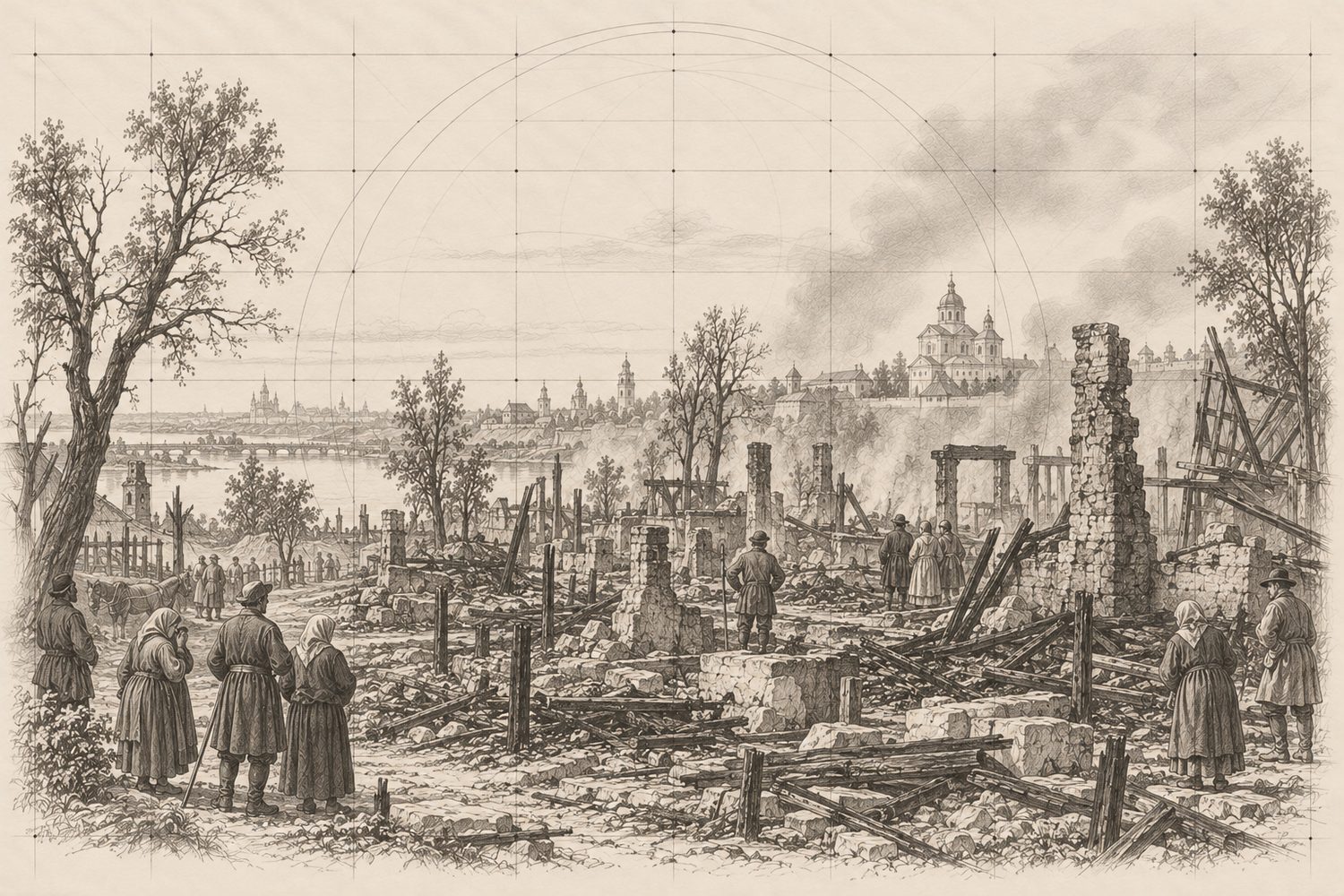
1717: after the fire. Illustration: IKONASTONE
The church of 1720 and the iconostasis
- 1720
On the same site a new three-frame church with three octagonal tops was built; the architect is unknown. The parishioners raised the money. According to the Wooden Churches of the Carpathians route and ZAXID.NET (2019), the donation was made by Prince Konstanty Władysław Sobieski; ZAXID.NET (2023) names Jakub Sobieski. [7, 9, 10, 12, 14, 21]
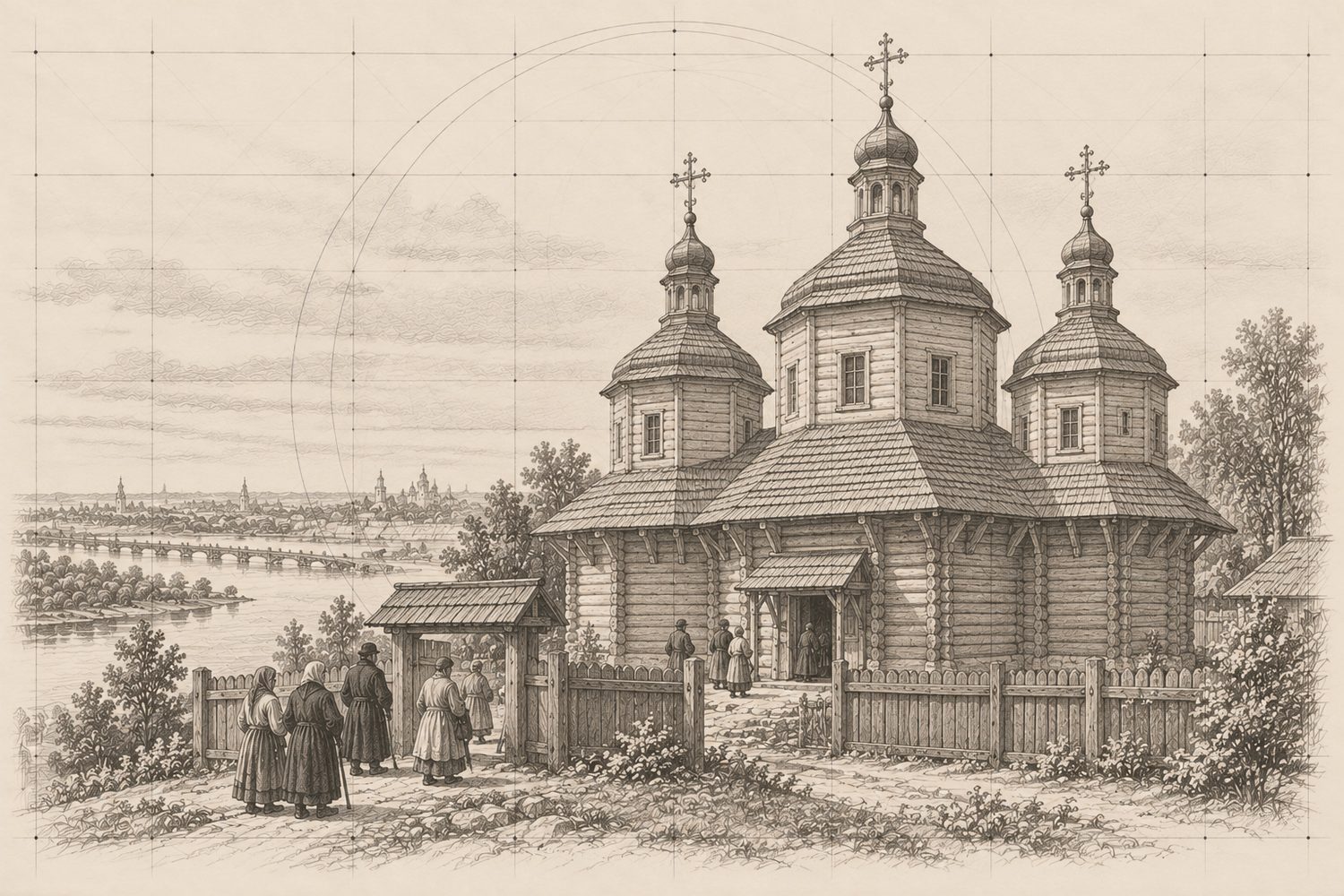
1720: the new church. Illustration: IKONASTONE - 1720s
The Zhovkva icon painter Vasyl Petranovych paints the icons of Christ and the Mother of God for the iconostasis. [4, 6, 10, 14]
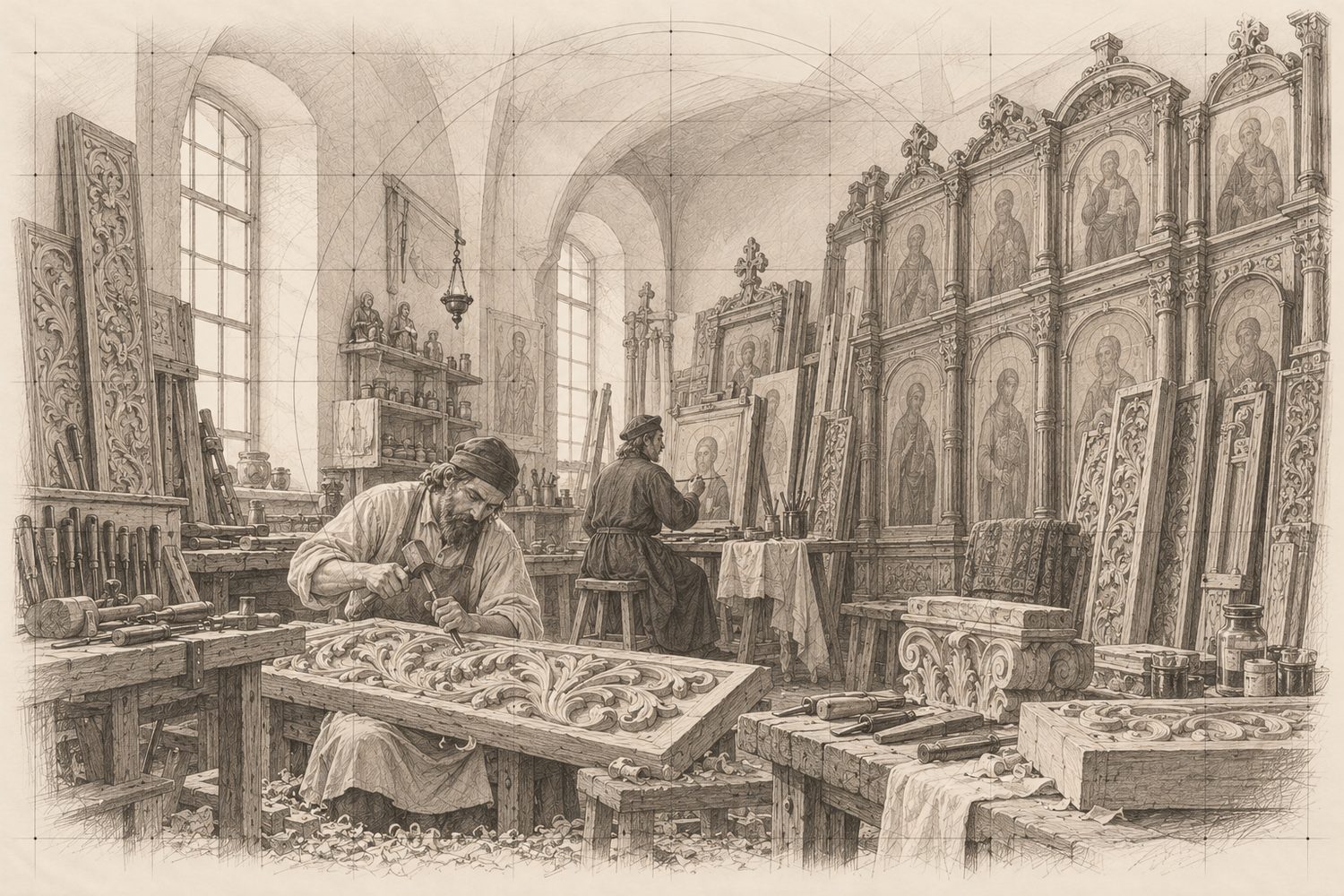
1720s: a workshop of the Zhovkva school. Illustration: IKONASTONE - First half of the 18th century
Petranovych repaints the icons of the Mother of God with the Child and of Christ the Teacher. The lower layer, in the restorers' conclusion, dates from the second half of the 17th century and may be Rutkovych's work. [14, 15]
- 1726
On 28 February Prince Konstanty Władysław Sobieski died in Zhovkva, where he had often stayed after 1709. [28, 29]
- 1727–1752
Petranovych served four times as vogt of Zhovkva (1727, 1731, 1736, 1739) and three times as burgomaster (1741, 1746, 1752), according to the Encyclopedia of Ukraine. [4]
- Before 1742
The carver Hnat (Ihnatii) Stobenskyi, together with Yu. Shymanovych, S. Putiatytskyi and V. Sokovych, carves the iconostasis of the Trinity church; other sources, too, name Stobenskyi as the author of the carving. [5, 7, 9, 10]
- Unknown date
The iconostasis was raised by 80 cm from its original level, according to ZAXID.NET (2019). [11]
- 19th century
A masonry sacristy is added to the church. A fragment of a window from the dismantled tower of Zhovkva Castle is built into it; according to the Wooden Churches of the Carpathians route, the white-stone portal and its framing come from the same place. [9, 13, 14]
- Soviet period
The church housed a museum; according to ZAXID.NET, a museum of atheism and of local history, so the building was looked after. The sources give no exact years. [9, 13]
19th–20th centuries
- 1978–1979
Restoration of the iconostasis. [7, 9]
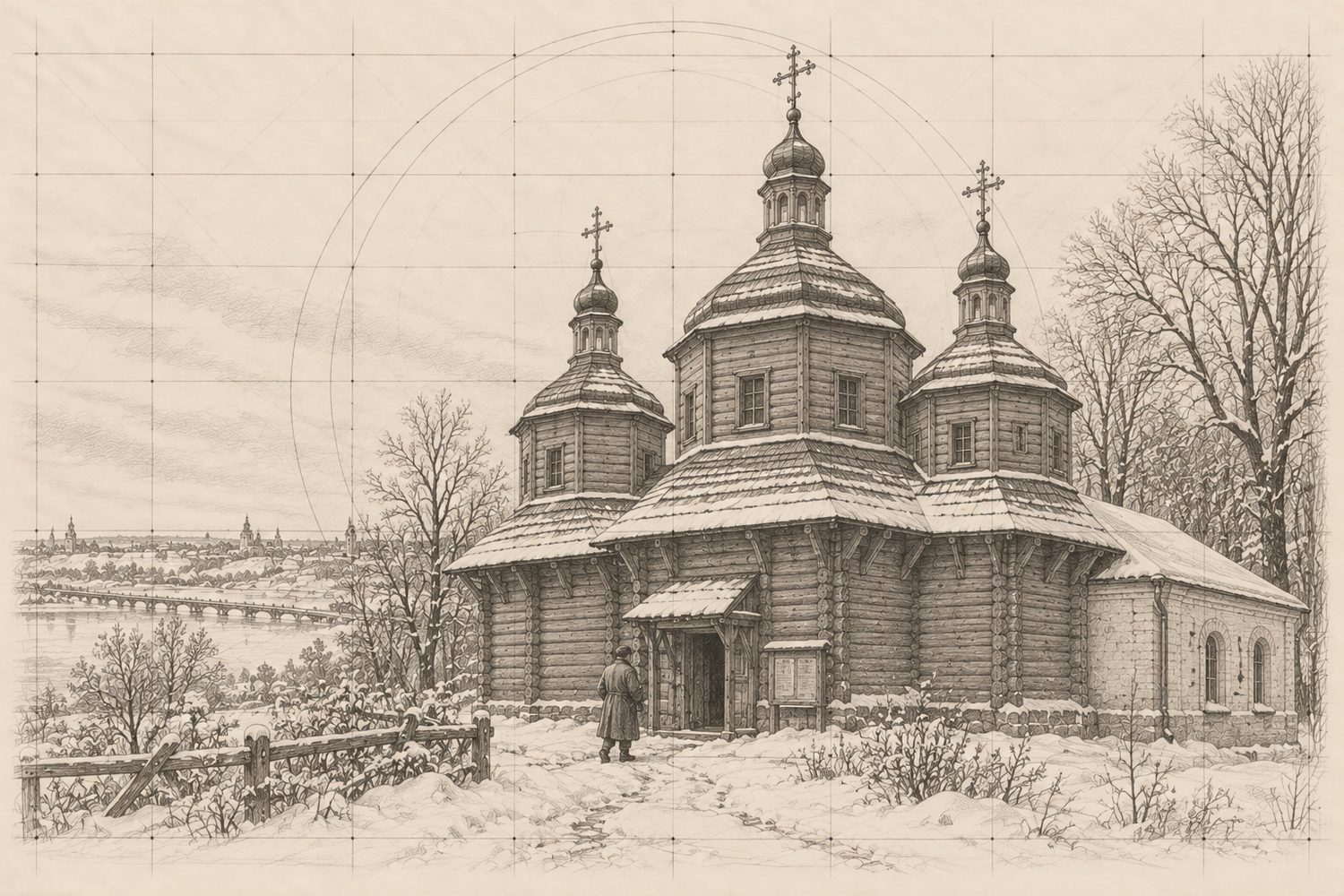
The 1970s. Illustration: IKONASTONE - Around 1989
The last re-shingling before 2019 (“30 years ago” according to ZAXID.NET in 2019). [12]
- 1991–1993
According to the Wooden Churches of the Carpathians route, after independence was declared the church was first handed to the Orthodox, and in 1993 it was returned to the Greek Catholics. Today the church belongs to the UGCC. [7, 9]
Restoration
- Around 2003
The tops were taken down; the roof was redone with the help of the regional and district councils, according to ZAXID.NET (2013). [13]
19th–20th centuries
- 2000s
The iconostasis is restored by specialists from Lviv: the Wooden Churches of the Carpathians route gives 2008–2009, ZAXID.NET (2013) “about 8 years ago”, with community expenses of up to 20,000 US dollars. [9, 13]
Restoration
- 21 June 2013
At the 37th session of the World Heritage Committee (Cambodia) the church was inscribed on the UNESCO List as part of the site “Wooden Tserkvas of the Carpathian Region in Poland and Ukraine” (16 churches chosen from 44); component number 1424-016, criteria (iii) and (iv). [1, 7, 24]
- 13 March 2019
The State Historical and Architectural Reserve in Zhovkva began the restoration: replacement of the lower beams, straightening of the building, which leaned to the south, a new floor, complete re-shingling. According to ZAXID.NET, the contractor was “Tsentr Kompleks”, with an expected annual sum of UAH 4.5–5 million. [11, 20, 22]
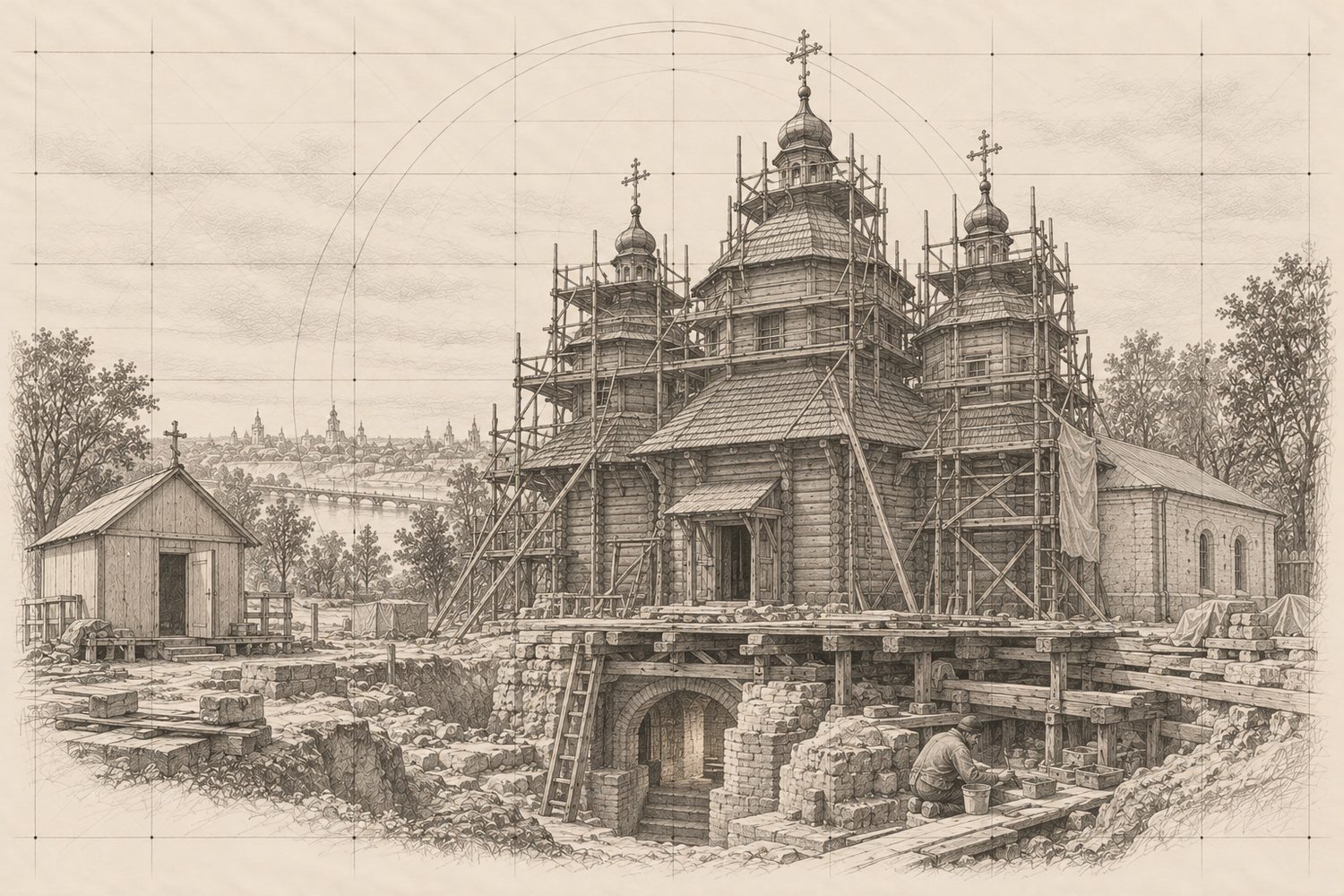
2019: restoration. Illustration: IKONASTONE - June 2019
Under the sanctuary floor an empty crypt with a brick vault was found (some of the brick is 18th-century), along with charred wood from the earlier church and a millstone with coins and metal hooks, and under the church — human remains, according to ZAXID.NET. [12]
- 2019–2020
The iconostasis is dismantled; it is restored by the Lviv branch of the National Scientific Research Restoration Centre of Ukraine. [11, 15, 22]
- 2020
The reserve in Zhovkva was liquidated; the church passed to the balance of the Lviv National Art Gallery named after B. Voznytskyi (the Zhovkva Castle museum-reserve). For lack of funds, the work stopped for two years. [16, 19, 20, 22]
- 23 January 2022
The restored iconostasis is shown at the Pinzel Museum in Lviv; 15 restorers worked on it for three years. [15, 30]
- July 2022
After the start of the full-scale war the work stopped; the World Monuments Fund (WMF) financed a temporary waterproof membrane over the exposed tops, according to Culture in Crisis. [17]
- End of 2022
The Ministry of Culture allocated UAH 10.5 million to complete the work; in the Ministry's 2026 announcement — over UAH 9.2 million for 2022–2023. [14, 16, 20, 22, 23]
- 27 February 2023
The exterior work was completed: the shingle roof was fully replaced, and beams and boards partly, according to Suspilne. [16]
- 16 June 2023
The iconostasis is installed in the church. [14, 19, 20]
- 2023–2024
A dispute between the city council and the gallery over the land around the church; the parish has prayed for five years in a temporary plywood structure in the yard, according to ZAXID.NET. [19]
- 2024
Conservation and restoration of the sanctuary wall paintings began (“The Sacrifice of Abraham”, “Moses Praying on Mount Sinai”); a contract worth UAH 661,000 was published on Prozorro on 2 August. [18, 22]
Reopening
- 18 May 2026
The Chair of the World Heritage Committee approved UNESCO International Assistance — 16,869 US dollars for restoring the paintings. In the UNESCO database the project is marked as “implemented with other funds”. [2]
- 6 August 2026
After the restoration the church reopened to worshippers; this was announced by Maksym Kozytskyi, head of the Lviv Oblast Military Administration. The cost of the restoration was about UAH 12 million (ZAXID.NET, LVIV.MEDIA) or about UAH 14 million (Ministry of Culture, Pragmatika); part of the work was financed by the Polish institute “Polonika”. [20, 21, 22, 23]
- 7 August 2026
A thanksgiving service marking the completion of the restoration, attended by First Deputy Minister of Culture Ivan Verbytskyi, Bishop Petro Loza of Sokal-Zhovkva and Mayor Oleh Volskyi, according to the Ministry of Culture. [22]
Lost and recreated
| What | What it was | What happened | Where it is now |
|---|---|---|---|
| Earlier wooden church | Stood in the Lviv suburb (according to [9] — from 1601) | Burned down in 1717 together with the suburb | Charred wood found in 2019 during excavations [7, 9, 12] |
| Iconostasis | Five tiers (according to [9, 11, 14]) or six tiers (according to [10]), about 50 icons | Raised by 80 cm; icons repainted; the structure changed over the centuries [27]; dismantled in 2019 | Restored in 2019–2020, installed in the church on 16.06.2023 [11, 14, 15, 22] |
| Icon of the Mother of God with the Child | Faces of the 17th century in the lower layer | Repainted five times, according to Suspilne | Restored, in the iconostasis [14, 15] |
| Icon of Christ the Teacher | Lower layer — second half of the 17th century | Repainted in the first half of the 18th century | Restored, in the iconostasis [14] |
| Shingle roof | Last replaced around 1989 | Fully replaced by February 2023 | New shingles by Carpathian craftsmen, impregnated with hot oil solution [12, 16] |
| Tops | Taken down around 2003 (according to [13]) | In 2022 — a temporary membrane over the exposed tops | Restored [13, 16, 17] |
| Lower beams | Damaged, the building leaned to the south | Beams replaced and building straightened from 2019 | Replaced [11, 16] |
| Crypt under the sanctuary | Unknown before 2019 | Discovered under the floor, empty | Under the church [12] |
| Window (and, according to [9], portal) of the sacristy | Tower of Zhovkva Castle | Moved to the masonry sacristy | The church’s sacristy [9, 13, 14] |
| Sanctuary wall paintings | “The Sacrifice of Abraham”, “Moses Praying on Mount Sinai” | Damp-damaged; conservation and restoration since 2024 | In the church [14, 18, 22] |
| Millstone, coins, metal hooks | In the middle of the church, under the floor | Found in 2019; purpose unknown | The sources do not say what became of the finds [12] |
| Temporary plywood chapel | Set up in the yard for the duration of the restoration | The parish prayed in it for about five years | Its fate after the 2026 reopening is not specified [19, 20] |
Architecture
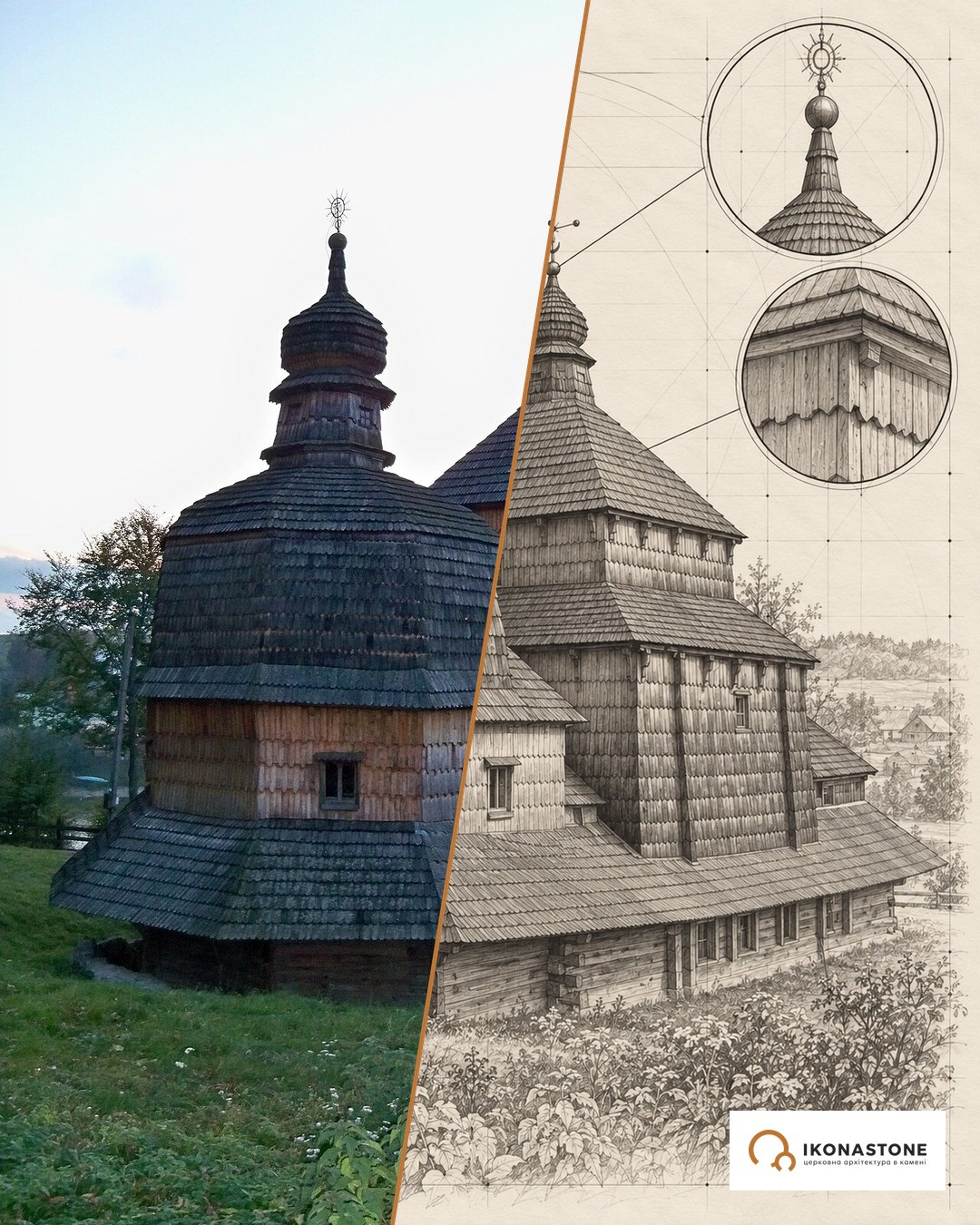
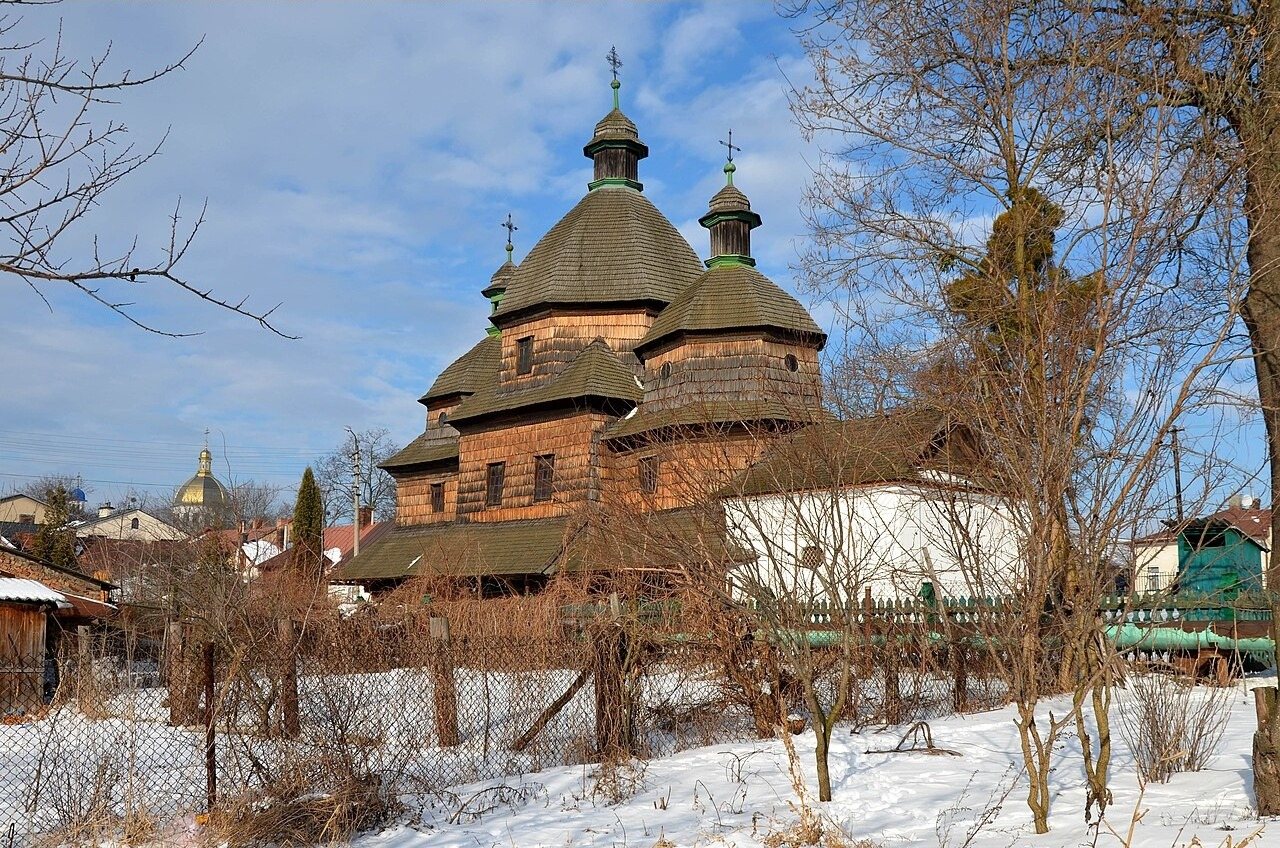
The church is three-part and three-frame: the babinets (narthex), the nave and the sanctuary stand on one axis from west to east, and each frame is crowned by an octagonal top. The one above the nave is the tallest. Sacred Art of the Lviv Region notes the refined proportions and the wide outer gallery, and the Wooden Churches of the Carpathians route notes the broad eaves around the church and the lanterns with wrought crosses on the tops. The first source calls the church one of the finest examples of wooden sacred architecture in the Lviv Region, the second one of the finest examples of the Volhynian style.
Only the sacristy is built of masonry. It holds the most unexpected feature for a wooden church: a stone portal and window framing.
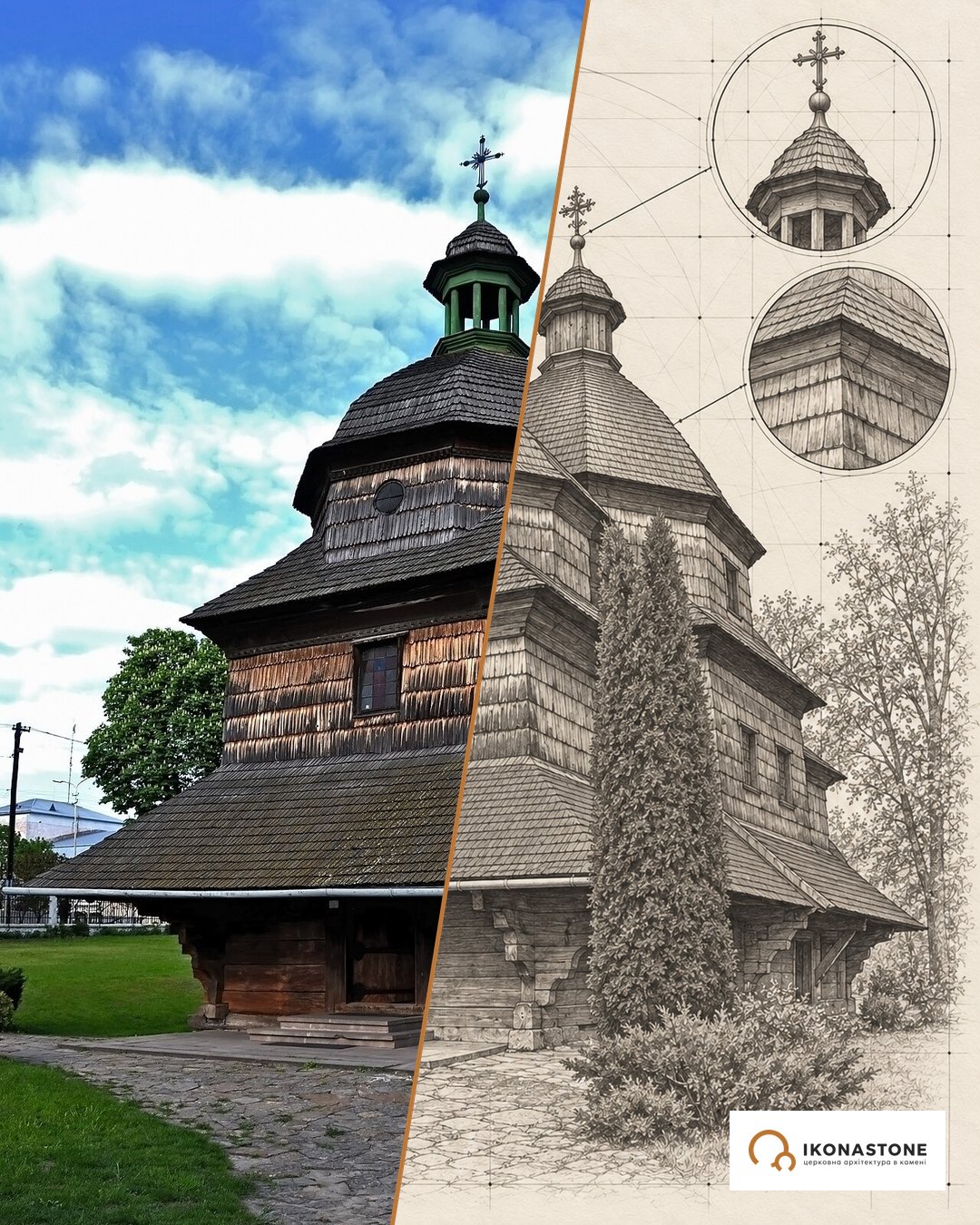
Below are two elements of the church, in a photo and in a drawing. The drawings show the form, not exact dimensions.
Three tops
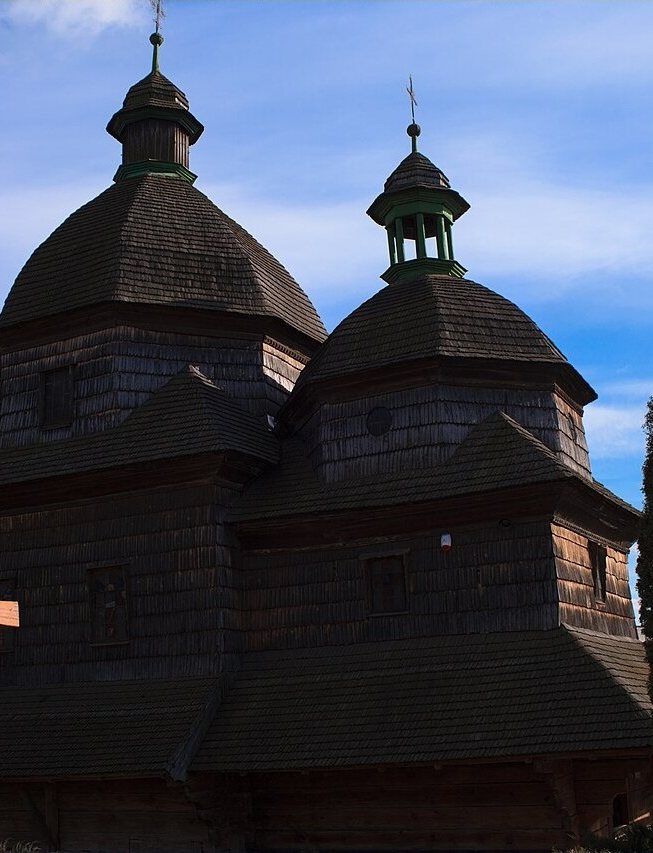
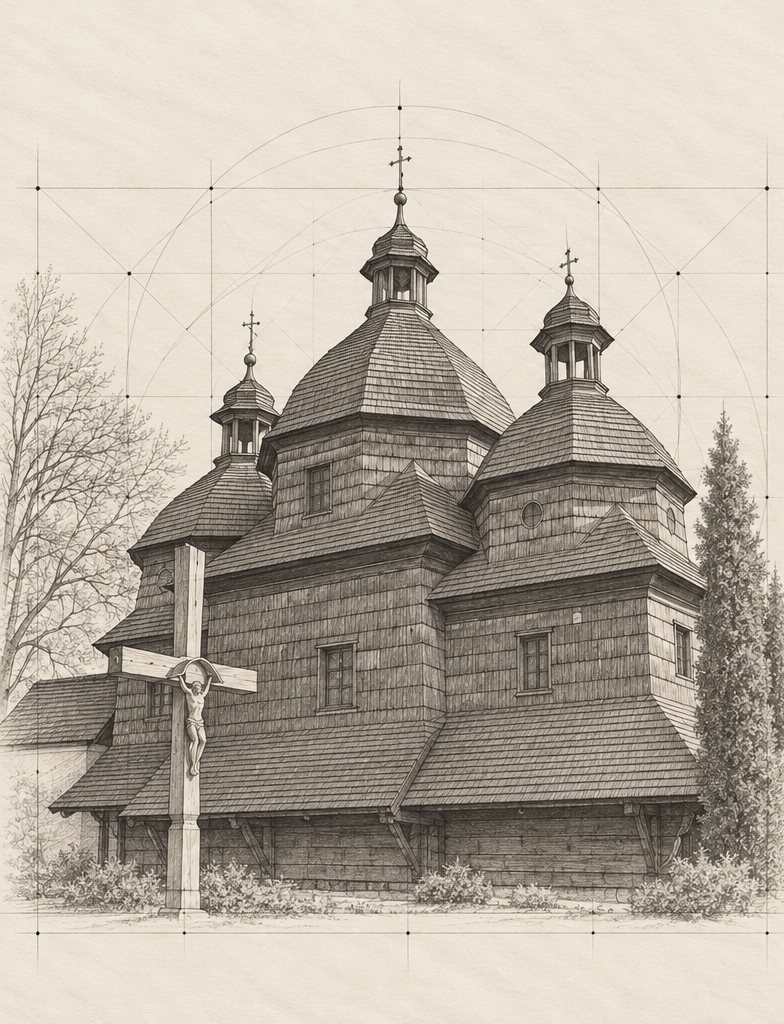
Three octagonal tops stand above the three log frames. The middle one, above the nave, dominates the side ones — and from any side the church reads as a stepped mountain with its peak in the middle.
The eaves-gallery
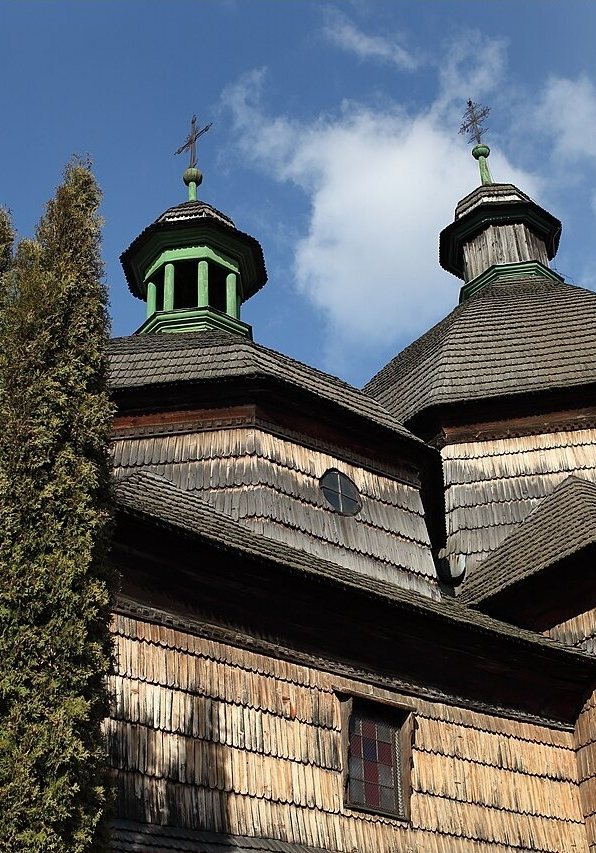
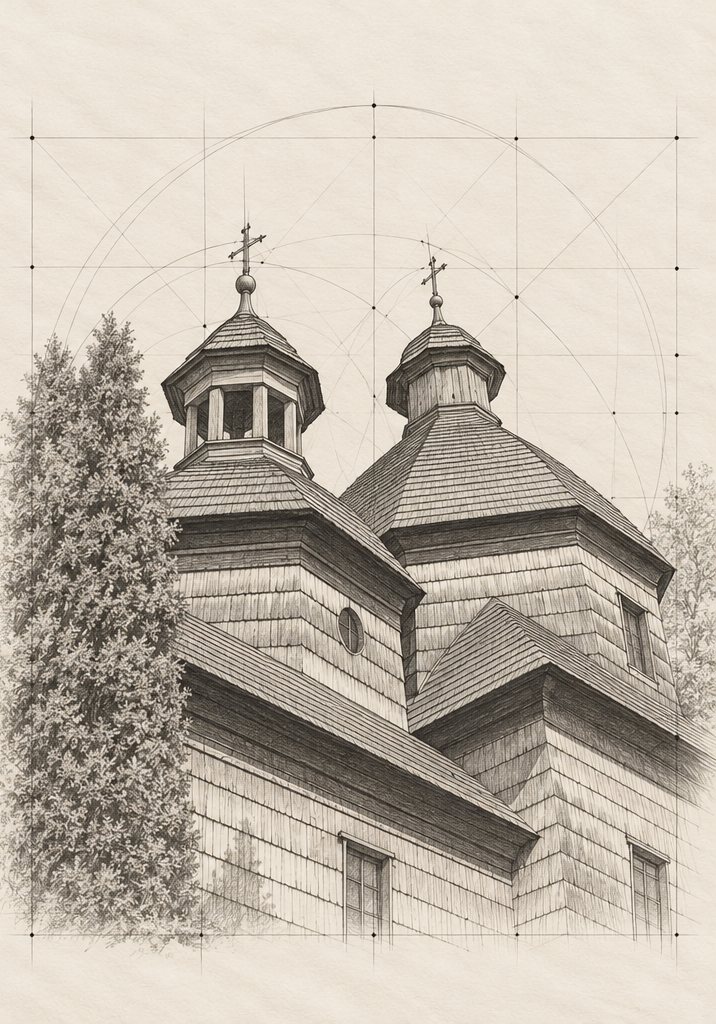
The wide eaves girdle the church and carry water away from the log frames. The horizontal band at the bottom balances the vertical of the three tops.
Details that are easy to miss
Stone from a royal castle. According to the Wooden Churches of the Carpathians route, the white-stone framing and the portal of the masonry sacristy are older than the church itself: they were brought from the centre of Zhovkva, where they adorned a tower of Zhovkva Castle. A wooden church in a townspeople’s suburb inherited a piece of the residence of a hetman and king.
A millstone in the middle of the church. During the 2019 excavations a millstone was found in the middle of the church; coins and metal hooks lay beside it. Its purpose is unknown. A similar millstone, according to Volodymyr Herych, was found in the church in Potelych.
A crypt under the sanctuary. Under the sanctuary floor the entrance to a crypt with a brick vault was found, partly of 18th-century brick. The crypt was empty. At the same time archaeologists for the first time found charred wood from the earlier church that burned down in 1717, and beneath the church — human burials. The fire with which the story of the present church began left a mark literally beneath its feet. The restorers planned to recreate the crypt’s ventilation window.
The church was to be lifted with jacks. The lower beams were damaged, so the building, according to ZAXID.NET in 2019, was to be raised with jacks in order to replace the bottom beam. The previous shingles, according to the same source, had been replaced thirty years earlier. A wooden church lives in cycles of repair, and each one is a small operation on an open heart.
An icon painter behind the gate. Ivan Rutkovych, according to the Wooden Churches of the Carpathians route, lived with his wife Eva in a house right behind the church gate. According to the same route, he also worked on restorations in Zhovkva Castle, where he saw the royal collection of European painting; the authors of the route explain by this the combination of a Western pictorial manner with the Byzantine canon in his icons.
Five tiers or six. The sources disagree even on how many tiers the iconostasis has: the Wooden Churches of the Carpathians route and ZAXID.NET write of five, Sacred Art of the Lviv Region of six. When the church is closed, the iconostasis, according to the Wooden Churches of the Carpathians route, can be seen through the glass in the door, and you can count for yourself.
Photo gallery
Stone and material
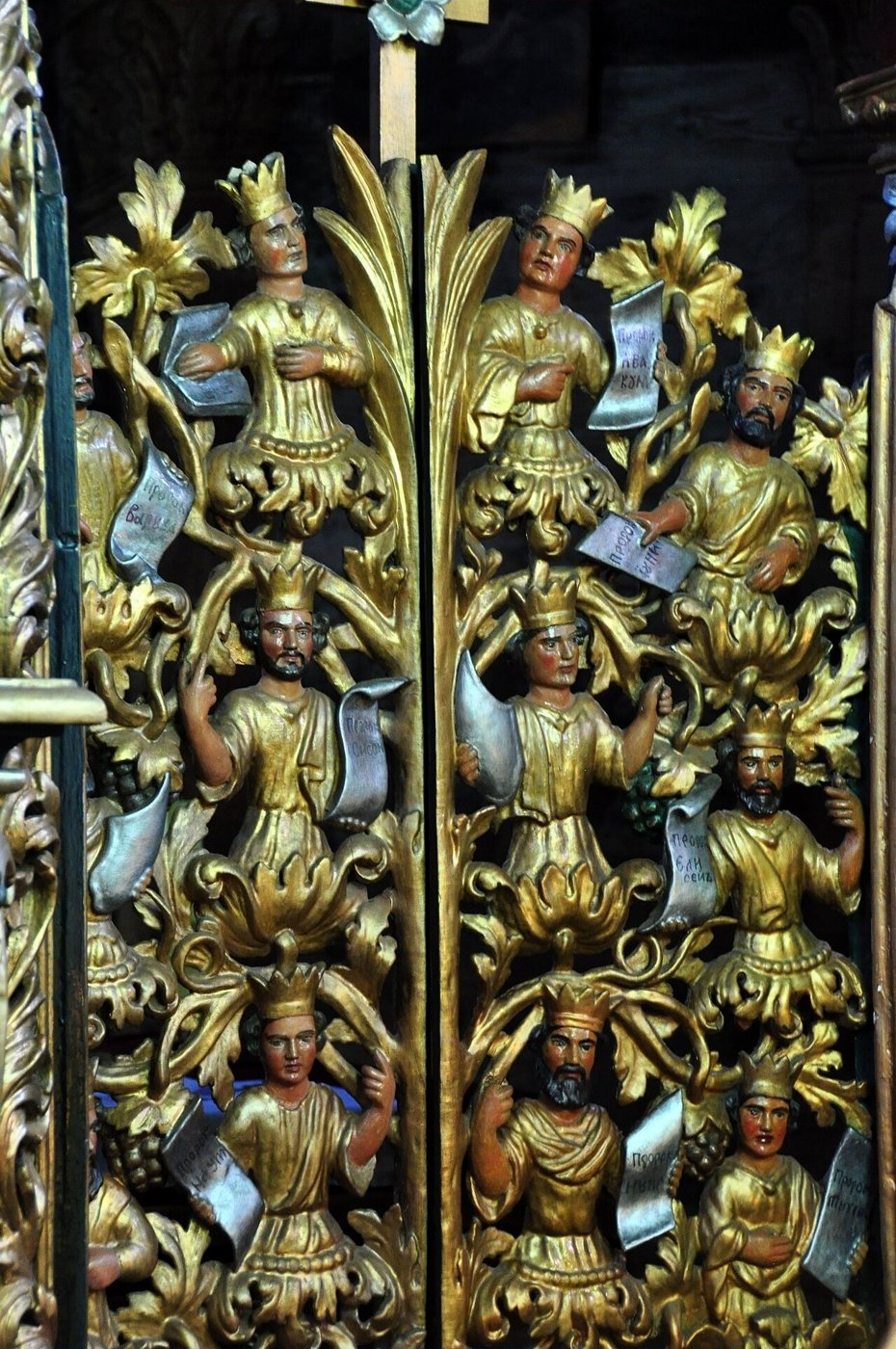
The church is built of wooden log frames and covered with shingles; only the sacristy is masonry. The iconostasis is carved from limewood — openwork carving with acanthus motifs, icons in gilded frames. Sacred Art of the Lviv Region cautiously attributes the carving to the Zhovkva master Hnat (Ihnatii) Stobenskyi. Linden is a customary choice of carvers for such work: soft, uniform, without sharp growth rings, it holds fine openwork and does not argue with the chisel. In stone the same role is played by a fine-grained material: the more complex the ornament, the calmer the grain should be.
The most interesting stone here is borrowed. The white-stone portal and framing, moved from the castle tower, have lived a second life in a new context. Stone endures such moves well: a carved block can be taken down, transported and set up again, if its joints and fixings were thought out with respect for the next master. So the dismountability of a detail is also part of its durability.
On how the altar screen is built, see the articles “The Ukrainian Iconostasis” and “The Royal Doors”, as well as the section iconostases. Another wooden church of the Lviv Region from the same UNESCO list is St George’s Church in Drohobych.
Did you know
The best-known Zhovkva iconostasis by Ivan Rutkovych (1697–1699) comes from the Church of the Nativity of Christ, not from the Holy Trinity; the Encyclopedia of Ukraine calls it the finest Ukrainian iconostasis. [3, 8, 25, 26]
At an unknown date the iconostasis was raised by 80 cm from its original level; during the restoration they decided where to place it, according to ZAXID.NET. [11]
Before the 2019 restoration the building leaned to the south, and the parish priest Fr Vasyl Batiuk said that because of this the iconostasis was being squeezed. [11]
X-ray examination during the restoration showed that two icons were first painted in the second half of the 17th century — earlier than the church was built. [14, 15]
Vasyl Petranovych, the author of the icons of Christ and the Mother of God, was four times vogt and three times burgomaster of Zhovkva, according to the Encyclopedia of Ukraine. [4]
The son of the carver Hnat Stobenskyi, Ivan, helped his father in Zhovkva and in 1746 moved to Kyiv, where he worked on rebuilding the bell tower of St Sophia Cathedral, according to the Encyclopedia of Ukraine. [5]
A fragment of a window from the dismantled tower of Zhovkva Castle is built into the masonry sacristy. [13, 14]
As of 2013 the church was not allowed to be heated, although the heating main ran nearby, so in winter there were fewer parishioners, according to ZAXID.NET. [13]
Around 2009 a thief who had already been tried seven times for thefts from churches climbed into the church through the sacristy window; he fell, was injured and took nothing, according to ZAXID.NET. [13]
The millstone found in the middle of the church in 2019 has a counterpart: a similar one was found in the church in Potelych. [12]
When the church is closed, the iconostasis, according to the Wooden Churches of the Carpathians route, can be seen through the glass in the door. [9]
For the UNESCO nomination, 16 of 44 historic wooden churches on both sides of the border were chosen — eight each in Ukraine and Poland. [24]
There are four wooden churches from the UNESCO list in the Lviv Region: in Zhovkva, Drohobych, Potelych and Matkiv. [1, 23]
UNESCO approved International Assistance of 16,869 US dollars for the paintings on 18.05.2026, but in the database the project is marked as implemented with other funds. [2]
Legends
The icon painter behind the gate
According to a tradition recorded on the Wooden Churches of the Carpathians route, Ivan Rutkovych and his wife Eva lived in a house right behind the church gate. There is no other confirmation. [9]
An iconostasis older than the church
According to a tradition set out on the Wooden Churches of the Carpathians route, the new church partly inherited the iconostasis of the earlier one, and its top tier barely fits inside. Restorers do indeed date certain icons and parts to the 17th century [14, 15], but the iconostasis of 1697–1699 that the route links with the Trinity church belonged to the Church of the Nativity of Christ. [3, 8, 9]
Stone from the royal tower
According to a tradition recorded on the Wooden Churches of the Carpathians route, the white-stone portal and window framing of the sacristy are older than the church: they were brought from the town centre, where they adorned a tower of Zhovkva Castle. ZAXID.NET confirms this for the sacristy window. [9, 13, 14]
Key figures
- Jan III Sobieski — king, owner of Zhovkva; according to the Wooden Churches of the Carpathians route, Rutkovych worked in his castle.
- Konstanty Władysław Sobieski (1680–1726) — prince, according to [9, 12] the donor of the church in 1720; died in Zhovkva.
- Jakub Sobieski — prince, named as the donor by ZAXID.NET (2023).
- Ivan Rutkovych (c. 1650s – after 1708) — icon painter, a leading figure of the Zhovkva school; the iconostasis is associated with his school.
- Vasyl Petranovych (c. 1680 – 1759) — icon painter, author of the icons of Christ and the Mother of God (1720s), vogt and burgomaster of Zhovkva.
- Hnat (Ihnatii) Stobenskyi (d. 1742) — carver, author of the iconostasis carving.
- Yurii Shymanovych, Stepan Putiatytskyi, V. Sokovych — carvers who worked on the iconostasis together with Stobenskyi.
- Ivan Stobenskyi (d. after 1775) — son of Hnat, carver; in Kyiv from 1746.
- Fr Vasyl Batiuk — parish priest of the church from at least the mid-2000s until 2024.
- Volodymyr Herych — research fellow of the reserve in Zhovkva, participant in the 2019 restoration.
- Taras Otkovych — head of the Lviv branch of the National Scientific Research Restoration Centre, which restored the iconostasis.
- Myroslava Biletska-Zvarych — restorer, researcher of the lower layers of the icon of the Mother of God.
- Taras Vozniak — director general of the Lviv National Art Gallery, the church’s balance holder.
- Oleh Volskyi — mayor of Zhovkva.
- Petro Loza — UGCC Bishop of Sokal-Zhovkva.
- Maksym Kozytskyi — head of the Lviv Oblast Military Administration, announced the reopening of the church on 6 August 2026.
How to cite
IKONASTONE. The Holy Trinity Church (Zhovkva) // Guide to the Churches of Ukraine. URL: https://ikonastone.com/en/guide/holy-trinity-church-zhovkva/ (accessed DD.MM.YYYY).
FAQ
When was the Holy Trinity Church in Zhovkva built?
In 1720, on the site of an earlier wooden church that burned down on 17 June 1717 together with Zhovkva's Lviv suburb. The parishioners raised the money; according to the Wooden Churches of the Carpathians route and ZAXID.NET (2019), Prince Konstanty Władysław Sobieski also contributed (ZAXID.NET in 2023 names Jakub Sobieski).
Who made the iconostasis?
The iconostasis belongs to the Zhovkva school of icon painting and carving associated with Ivan Rutkovych. The limewood carving is attributed to Ihnatii Stobenskyi; Sacred Art of the Lviv Region attributes the icons of Christ and the Mother of God to Vasyl Petranovych. The iconostasis holds about 50 icons.
Is the iconostasis really older than the church?
During the 2019–2020 restoration, X-ray examination showed that the icons of the Mother of God with the Child and of Christ the Teacher were first painted roughly in the second half of the 17th century (possibly by Ivan Rutkovych) and repainted in the first half of the 18th century by Vasyl Petranovych. The iconostasis of 1697–1699 that is often attributed to this church was in fact made by Rutkovych for the Zhovkva Church of the Nativity of Christ; it is now in the National Museum in Lviv.
What was found during the latest restoration?
Under the sanctuary floor — an empty crypt with a brick vault, partly of the 18th century; charred wood from the previous church; a millstone in the middle of the church, with coins and metal hooks next to it.
Can the church be visited?
Yes. After the restoration that began in 2019, the church reopened to worshippers on 6 August 2026. It belongs to a Ukrainian Greek Catholic (UGCC) community.
Sources
- UNESCO World Heritage Centre. Wooden Tserkvas of the Carpathian Region in Poland and Ukraine
- UNESCO World Heritage Centre. International Assistance № 3648: Conservation and restoration of the wall paintings, Holy Trinity Church in Zhovkva (2026)
- Encyclopedia of Ukraine. Rutkovych, Ivan
- Encyclopedia of Ukraine. Petranovych, Vasyl
- Encyclopedia of Ukraine. Stobensky, Hnat
- Encyclopedia of Ukraine. Zhovkva School of Artists
- Wikipedia (en). Holy Trinity Church, Zhovkva
- Wikipedia (en). Ivan Rutkovych
- Дерев'яні храми Карпат. Church of the Holy Trinity, Zhovkva
- Сакральне мистецтво Львівщини. Жовква, церква Святої Трійці
- ZAXID.NET. О. Шиян. У Жовкві почали реставрувати дерев'яну церкву XVIII ст. зі списку ЮНЕСКО (13.03.2019)
- ZAXID.NET. Під час реставрації жовківської дерев'яної церкви зі списку ЮНЕСКО натрапили на крипту (14.06.2019)
- ZAXID.NET. Б. Головко. Жовкві благодаті не уникнути (23.10.2013)
- ZAXID.NET. О. Шиян. У жовківську церкву ЮНЕСКО повернули відреставрований іконостас (16.06.2023)
- Суспільне Львів. У Львові експонують іконостас XVII століття: як його реставрували (23.01.2022)
- Суспільне. У Жовкві завершують реставрацію церкви-пам'ятки ЮНЕСКО (27.02.2023)
- Culture in Crisis / World Monuments Fund. Installing a Temporary Cover at the Holy Trinity Church in Zhovkva (2022)
- ZAXID.NET. У жовківській дерев'яній церкві зі списку ЮНЕСКО відреставрують стінопис (04.08.2024)
- ZAXID.NET. О. Шиян. Конфлікт довкола церкви Святої Трійці у Жовкві (08.08.2024)
- ZAXID.NET. Після шестирічної реставрації у Жовкві відкрили церкву Пресвятої Трійці (06.08.2026)
- LVIV.MEDIA. У Жовкві після шестирічної реставрації відкрили дерев'яну церкву-пам'ятку ЮНЕСКО (06.08.2026)
- Міністерство культури України. У Жовкві завершили комплексну реставрацію Церкви Пресвятої Трійці — об'єкта Всесвітньої спадщини ЮНЕСКО (07.08.2026)
- Pragmatika.media. У Жовкві завершили реставрацію дерев'яної церкви XVIII століття зі списку ЮНЕСКО (07.08.2026)
- Радіо Свобода. Дерев'яні церкви Карпат у списку ЮНЕСКО (21.06.2013)
- ZAXID.NET. Знаки і символи Жовкви
- Радіо Свобода. Про викрадення ікон з іконостаса Рутковича у Волиці-Деревлянській
- І. Зварич. Іконостас церкви Святої Трійці в Жовкві: конструкція XVII–XVIII ст. // Народознавчі зошити. 2025. № 3 (183)
- Museum of King Jan III's Palace at Wilanów. Sobieski Konstanty Władysław
- Wikipedia (en). Konstanty Władysław Sobieski
- ZAXID.NET. Ідеальна Жовква
- Town
- Zhovkva, Lviv Oblast
- Built
- 1720
- Type
- three-part, three-frame wooden church with three tops
- Material
- wooden log frames, shingles; masonry sacristy with a stone portal
- Research depth
- 30%