Stone altar table: what to decide before the drawing
There are things in a church that cannot be left to chance. The altar table (Holy Table) is the first of them.
First, what the sources say about it. The Law of God defines the altar table as a specially consecrated quadrangular table in the middle of the sanctuary. The Orthodox Church in America adds that it is a simple table of proportionate dimensions, often a perfect cube, and that it always stands free so that it can be walked around. Under one of our posts a reader remarked that canonically the altar table is square. The sources are more careful: quadrangular, often a cube.
The same goes for dimensions. We have not found any one table. In the commentary on the rite of consecration of a church we read that the height of the altar table is usually 1.2 metres, with length and width following the size of the sanctuary. That is, the altar table is measured by the sanctuary.
Material. In the Eastern tradition the altar table may be wooden or stone. The Roman Catholic rule is stricter: the table of a fixed altar must be of stone, and natural stone at that (Institutio Generalis Missalis Romani, no. 301). The conference of bishops may permit another worthy material, but that is how the rule reads.
Now to what concerns the stonemason directly.
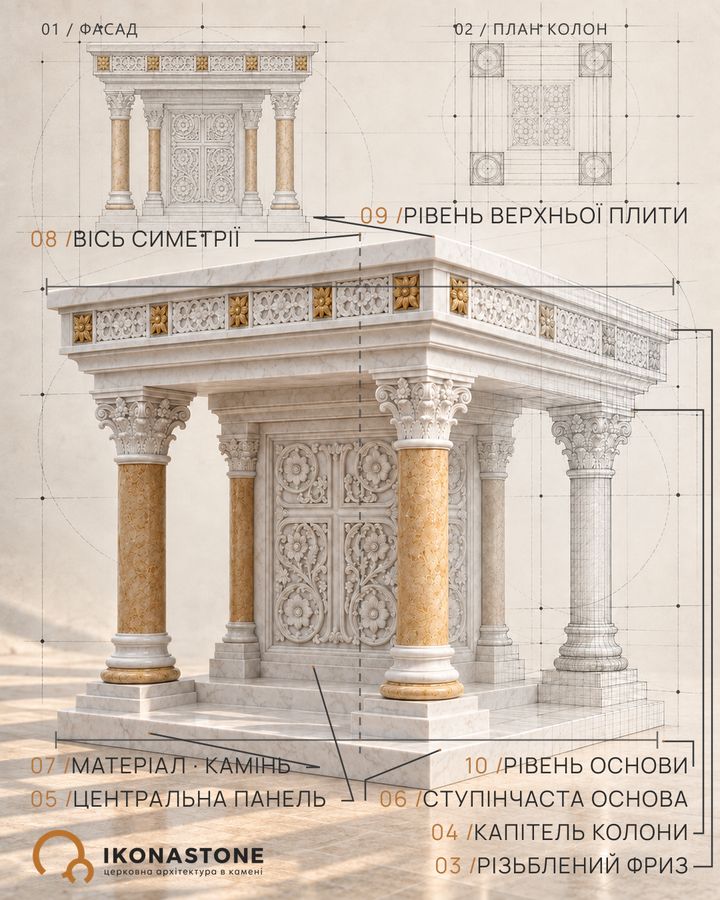
First, relics. According to the rite, a new altar table stands on four small pillars, and a fifth, in the middle on the east side, has a small box for the holy relics. In stone it is better to provide for such a place in the drawing, before cutting, than to add it afterwards.
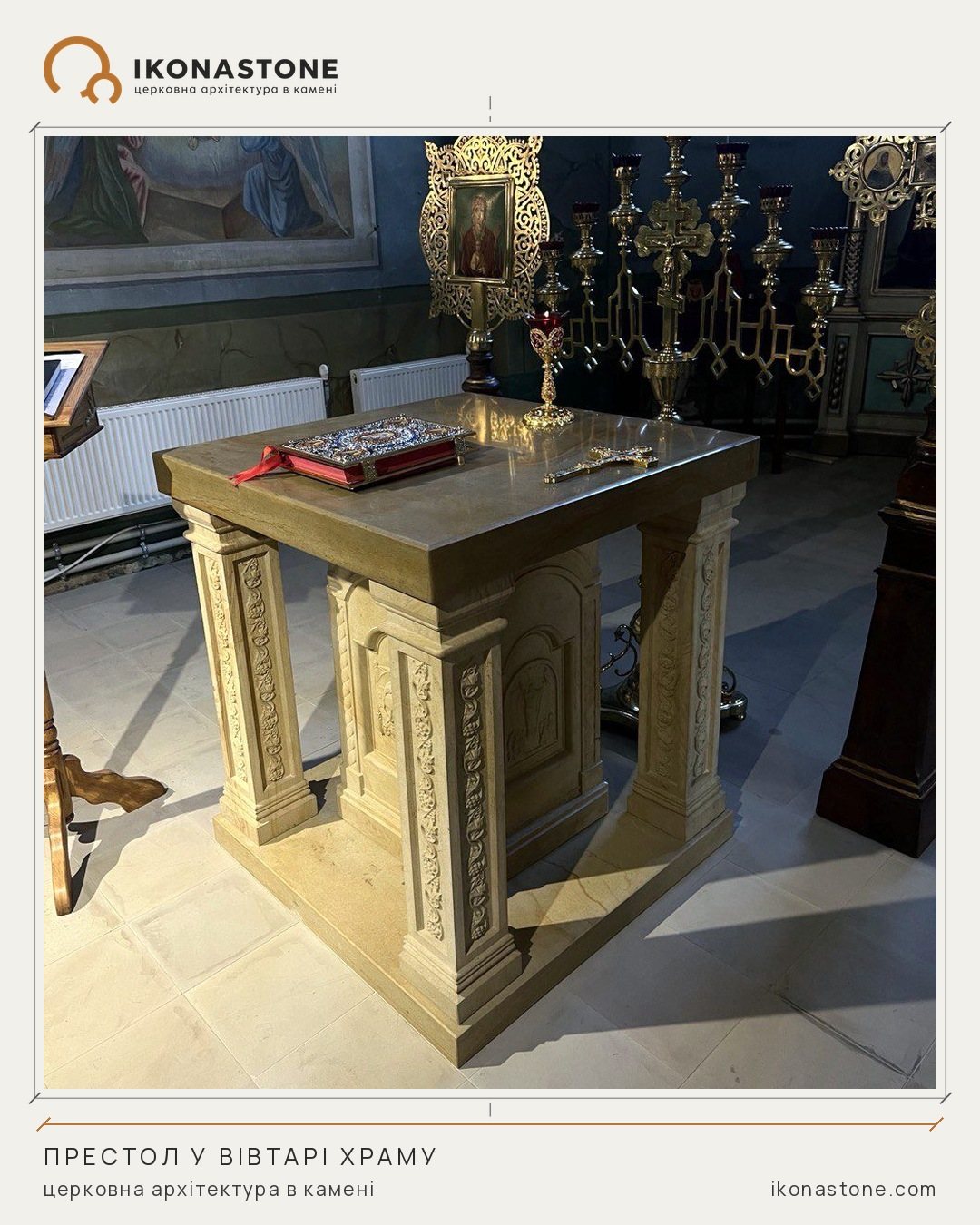
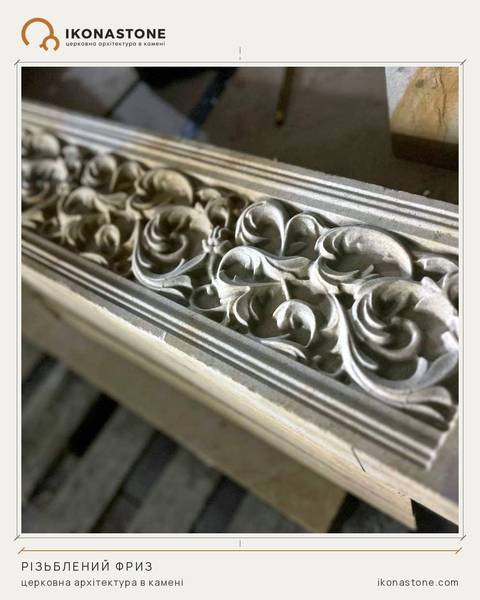
Second, the vesting. The altar table is vested in two coverings: the lower one white, of linen, and the upper one, the індитія (indytiia), of costlier fabric. If the cloths reach the floor, as one American parish describes, the carving on the supports beneath them cannot be seen. It can also be otherwise: the stone is left uncovered, as in the photograph for this article. It is worth asking the rector what is customary in your church before the decoration is even sketched.
Third, who decides. The great consecration of a church with its altar table is a sacred rite of the bishop. When he cannot be present himself, the church is consecrated by means of an antimension he has consecrated. Under the Statute of the Orthodox Church of Ukraine, the diocesan bishop blesses the building and repair of churches and sees to their exterior and interior appearance in accordance with church tradition. So before ordering a stone altar table, the rector would do well to consult the diocese. Only then do we take the photographs of the sanctuary and the dimensions and sit down to the drawing.
What to send the workshop before the first sketch
The drawing of an altar table starts not with ornament but with a few simple measurements. Here is what we ask the rector or the parish warden for:
- Photos of the sanctuary from three points: from the royal doors, and from the north and south sides. They show how much room is left to walk around the altar table.
- The width and depth of the sanctuary and the distance from the east wall to the iconostasis. The altar table stands in the centre, so these figures set its length and width.
- What already stands in the sanctuary: the high place, the table of oblation, steps, radiators.
- The route from the church doors to the sanctuary. A cubic metre of granite weighs about 2.7 tonnes, and even an altar table made of separate slabs has to be carried through the doors and the deacons’ doors. The width of the narrowest passage sometimes decides which parts the altar table will be assembled from.
- The floor. What it is made of and whether it can bear the point load of the supports. Sometimes the altar table needs a separate base.
These questions are not about beauty. But they are what decide whether the stone goes into place the first time.
What to read before talking to the craftsman
If you want to go deeper than a news post allows, the Guide has three articles on the subject: “Altar table and table of oblation” — what stands where in the sanctuary; “What is an altar table made of” — wood, marble, granite, sandstone; “The high place” — about what stands behind the altar table.
Stone is the most patient party in this story. It will wait until everyone has agreed.