What is an altar table made of: stone, wood or metal
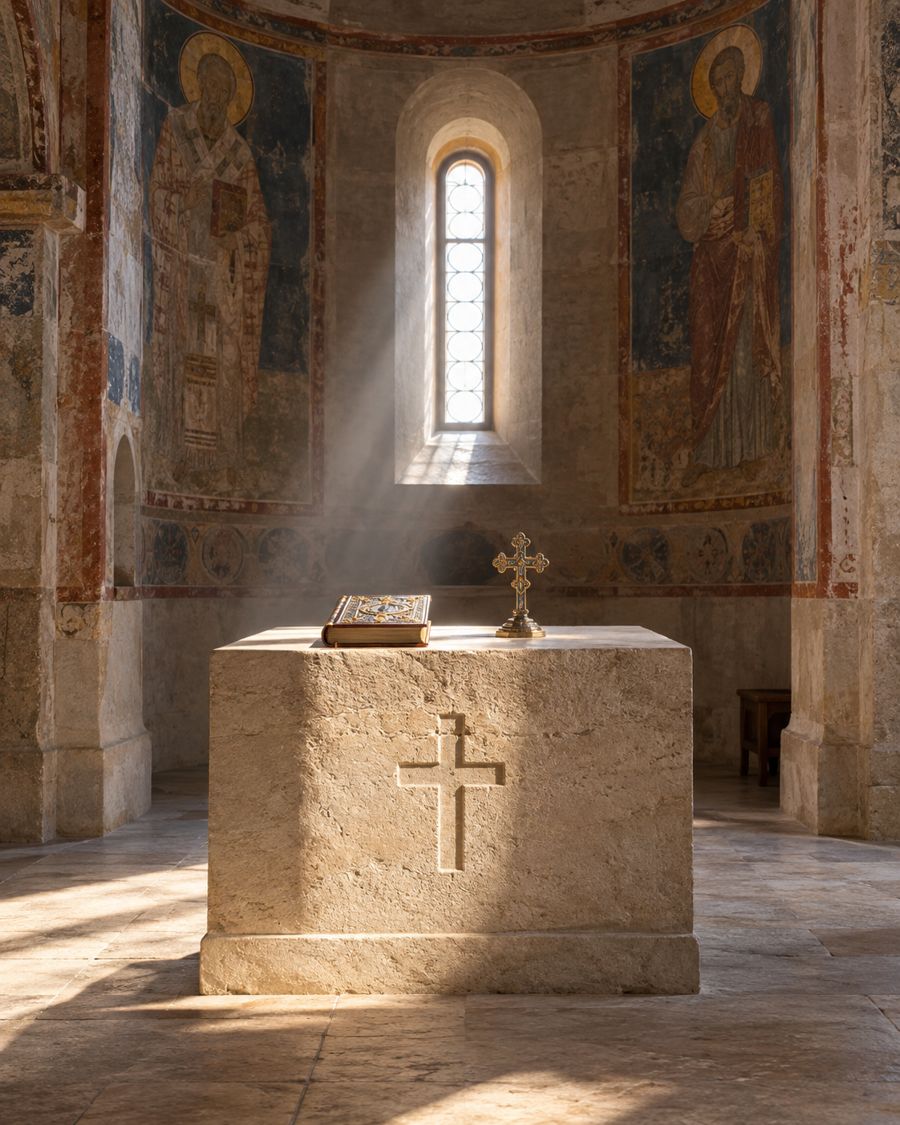
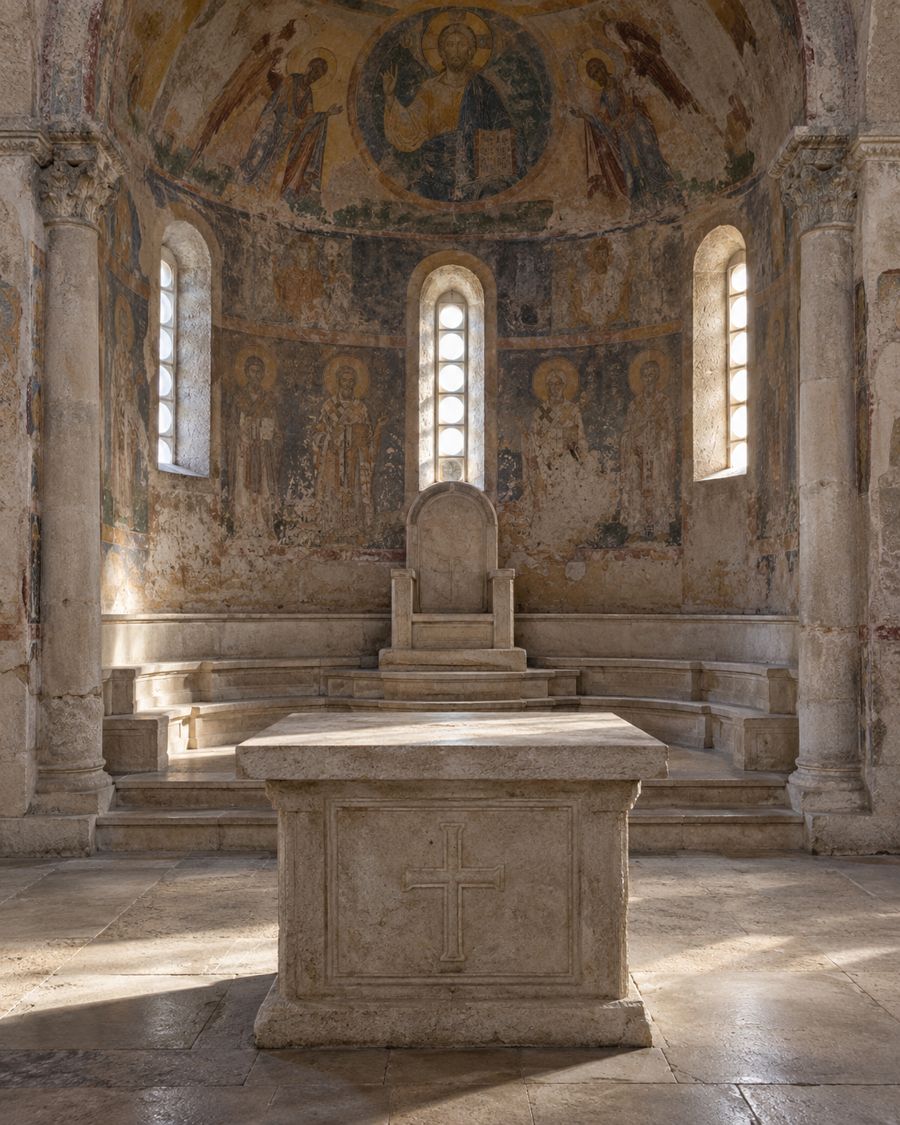
Tables come in many kinds. At one we eat, at another we write, at a third we argue. The altar table belongs to a different order: people walk around it, it is not used in the everyday sense, and yet it must be a real object, made of a real material with weight, temperature and smell.
The question “what should it be made of” seems technical. In fact it touches both theology and engineering. Stone recalls the tombs of the martyrs on which the Liturgy was once celebrated. Wood recalls the ordinary table around which the first community gathered. Each material brings its own memory into the sanctuary, and its own behaviour too: how it reacts to moisture, to candle soot, to temperature changes, and to the floor that has to bear it.
Below, the subject is set out without dogmatism. Where there is a norm, we say whose it is. Where there is practice, we say so.
In brief
- The earliest altar tables were wooden tables, similar to ordinary household ones. Stone ones appeared later, partly from the tombs of martyrs.
- In the Latin tradition the Code of Canon Law requires the table of a fixed altar to be of natural stone; an exception may be permitted by the conference of bishops.
- In the Eastern tradition the holy table may be of stone or of wood. Both materials are in use.
- Granite, marble, sandstone and limestone differ in porosity, hardness and sensitivity to cleaning. This determines where each stone is appropriate.
- The weight of a stone altar table cannot be estimated “by eye”. It requires a sketch, a chosen stone and a check of the floor by an engineer.
- In Orthodox practice the holy table is covered with vestments, so its form, proportions and material must work together with the fabric, not instead of it.
What did the first altar tables look like?
The first Christians gathered in homes, and the table for the Eucharist was a household table. The Catholic Encyclopedia states plainly that the earliest altars were wooden and “in form identical with ordinary domestic tables”. The frescoes show the same: in the Capella Greca of the Catacomb of Priscilla seven people are depicted seated on a semicircular couch before a table of just this form.
Stone enters this story where Christians gather by graves. In the Roman catacombs the commemorations of martyrs took place by their burials, and according to the Catholic Encyclopedia the earliest stone altars were precisely the tombs of martyrs. Historians debate how widespread such use of sarcophagi was, but the transfer of worship to the grave is visible in architecture: basilicas were built over burials, and the altar was placed above the tomb. Associated with this tradition is the confessio, a semicircular recess in front of the altar, known in particular in the Lateran Basilica.
From there the logic worked by itself. If martyrs are buried beneath the altar, relics can be placed in it even when there is no tomb nearby. A Council of Carthage in the early 5th century ordered local bishops, where possible, to overturn altars by roadsides and in fields that had been erected as memorials to martyrs where neither body nor relics were shown. And the Second Council of Nicaea in 787 required that every altar table contain relics. So stone came into the sanctuary largely out of the memory of burial.
What do West and East say about the material?
It is easy to oversimplify here, so let us look at each separately.
The Latin tradition. The first known legislation against wooden altars dates from 517: the Council of Epaone forbade the consecration of any altars other than stone ones. But this was a local council, and wooden altars remained in use for several more centuries; the Catholic Encyclopedia notes that from the 9th century onwards we find almost no traces of wooden altars in Latin Christianity. It also mentions an imperial decree forbidding the celebration of Mass other than on stone tables.
The current norm is set out in the Code of Canon Law (can. 1236): “according to the traditional practice of the Church, the table of a fixed altar is to be of stone, indeed of a single natural stone”, although “another worthy and solid material” may be used at the discretion of the conference of bishops. The base, that is the supports, may be of any material, and a movable altar may be made of any solid material suitable for liturgical use. Hence the Latin term altare fixum, a fixed altar, and the stone mensa, the tabletop.
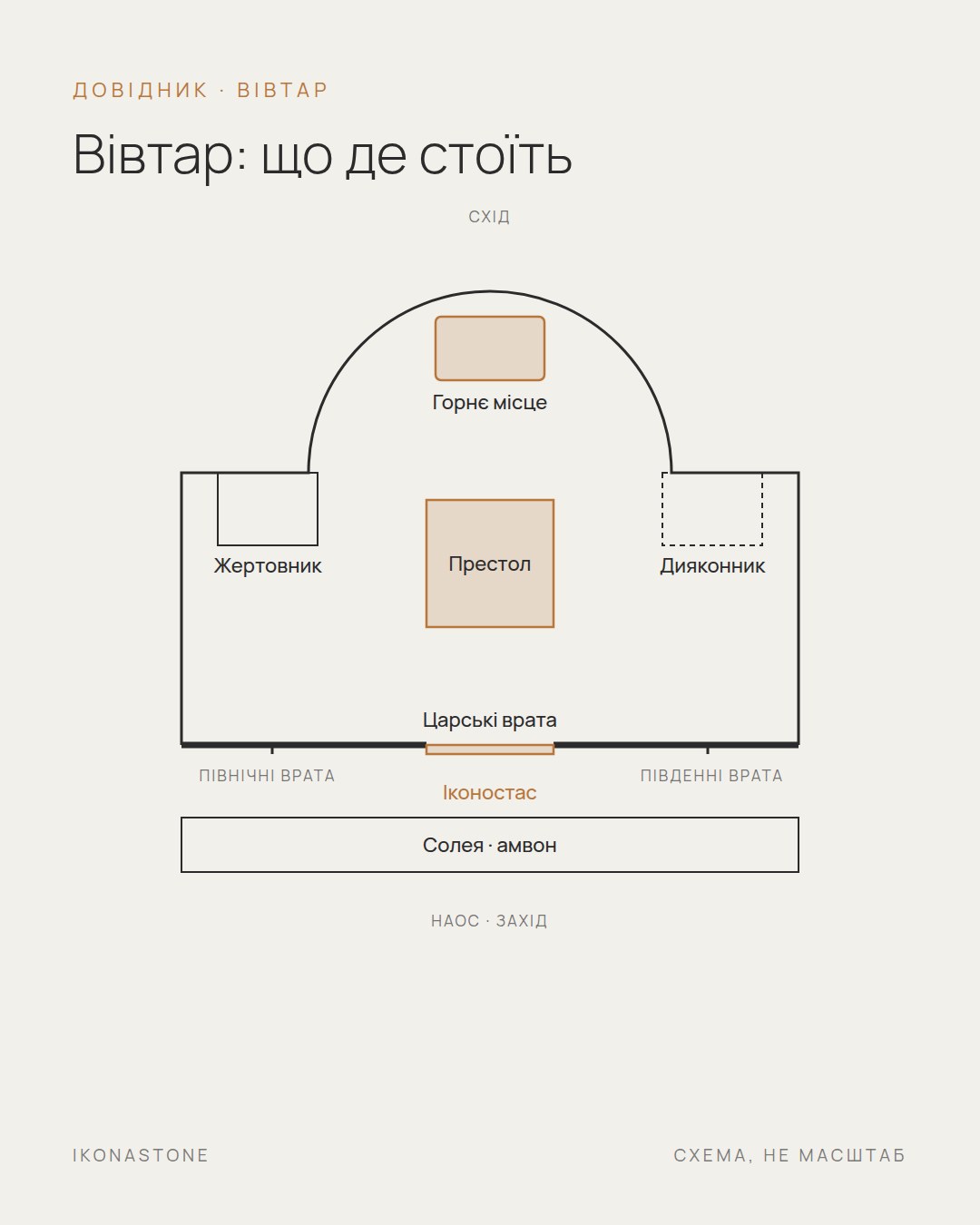
The Eastern tradition. Here the requirements for the material are broader. The Catholic Encyclopedia notes that the Greek Church admits wood, stone or metal. Orthodox reference works (including the Orthodox Church in America) describe the holy table as a table “of carved wood or stone” of simple, proportionate dimensions, often close to a cube and always free-standing so that it can be walked around. From the 4th century stone increasingly displaced wood in altars, yet according to the Orthodox Arts Journal wood remained acceptable both in the East and in the West. The same source quotes John Chrysostom as saying that stone, not wood, is the most fitting material for altars, but this is an opinion, not a canon.
There is one more feature of the East worth remembering: the antimension, a silk or linen cloth bearing an image of Christ in the tomb, with a particle of relics sewn into it and the bishop’s signature. In Byzantium bishops at first consecrated only boards or cloths and sent them out to new churches; the Orthodox Arts Journal quotes a Byzantine letter in which the consecrated altar takes the form of “a wooden board or a cloth”. The Eucharist is not celebrated without an antimension, so in the East the service depends on it no less than on the material of the table.
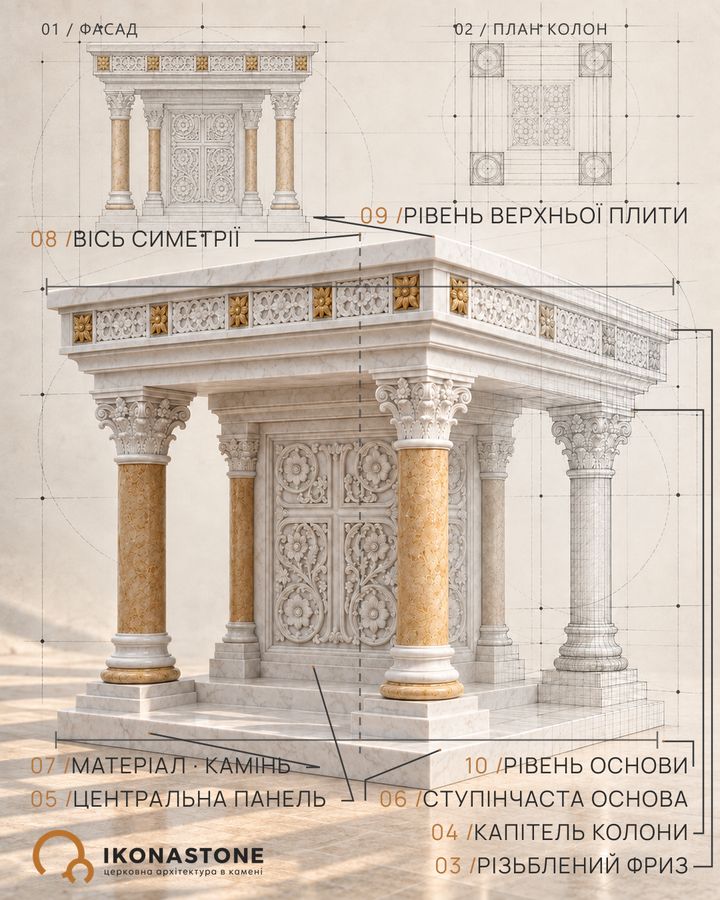
Ukrainian practice. A study of the wooden furnishings of Western Ukrainian churches describes the main altar table as a quadrangular table or a more complex structure with a ciborium above it, sometimes with closed sides widening towards the top, and in places with corner projections resembling risalits. The form of the altar table here is as varied as the material.
Which stones give an altar table a different character?
A stone is not just a colour. It has its own porosity, hardness and reaction to acids. Below are general properties, not recommendations; a specific project requires testing of the chosen slab.
| Material | What is known | What it means in a church |
|---|---|---|
| Granite | A dense, hard, massive rock; average density 2.65–2.75 g/cm³, compressive strength usually over 200 MPa; low primary permeability, resistant to acids | Withstands candles, wet cleaning and many years of use; it is hard, so carving takes more effort |
| Marble | Limestone in recrystallised form; takes a polish and carves well, but scratches and stains from coloured liquids, and reacts to acids (vinegar, some cleaning products) | Brings light and a striking pattern; needs careful cleaning without acidic products |
| Limestone | Mostly calcium carbonate; relatively soft (Mohs hardness 2–4), porosity varies, from 0.1% in dense stones; partly soluble in acids | Easier to work and warm in appearance, but requires careful selection of the stone and protection |
| Sandstone | Easily worked; durability depends on the cement and the type of grains: quartz stones hold up well, while loss of cement makes the stone friable | Pliable for carving, works in a “warm” interior; requires a specific stone with a known history of use |
| Wood | Lighter than stone, warm to the touch, needs protection from moisture, insects and temperature changes; “moves” over the years | Close to the early tables, convenient for demountable and small altar tables; requires a dry microclimate |
Stone has one more, non-technical property: coolness. It can be felt by the hand, especially in winter when the church is unheated. For some it is part of the stillness of prayer, for others an inconvenience, and such things are worth looking at in advance through the eyes of those who serve there every day.
And a last point about moisture. In an old church with walls that “breathe”, porous stone will behave differently than in a new heated one. Marble and limestone will show marks if cleaned with acids, while dense granite is easier to look after. Sandstone is valued for the softness of its line, but choosing it is always tied to a specific quarry.
How much does it weigh, and what about the floor?
A stone altar table is heavy, and this is not a flaw but a property. But exactly how heavy depends on four things: the dimensions, the stone, the thickness of the top, and whether the body is solid or hollow and clad. The difference between them can be considerable. So any figure “off the top of one’s head” would be made up.
The practical rule is this: the weight is calculated once there is a sketch and a chosen stone. It is then compared with the load-bearing capacity of the floor or slab at the spot where the altar table will stand. In old churches there may be a vault, a cellar or a cavity beneath the sanctuary; in new ones, a reinforced concrete slab designed for a certain load. The check is the job of a structural engineer, not of the craftsman or the client. The route by which the slab will be brought in also needs separate consideration: doors, steps, the passage to the sanctuary.
What lies over the stone?
The holy table in a church is rarely seen bare. In Orthodox practice it is covered with vestments: the Liturgical Arts Journal describes two coverings, an undercover of white linen and an outer one of rich brocade. The antimension, as already mentioned, lies on top. In the Western tradition the current General Instruction of the Roman Missal requires at least one white cloth on the altar during Mass, whereas before 1969 three were required.
For the choice of material this yields something simple. The outer fabric hides the top, but not the lower part or the sides. The form, the proportions, the carving, the profile and the way the altar table “stands” on the floor remain visible. The stone works as architecture, not as a covering. Fitting also needs separate thought: if the vestments are made to measure, the size of the top is determined already at the drawing stage.
Can materials be combined?
History knows various combinations. The Orthodox Arts Journal mentions that in the Roman Basilica of San Giovanni in Laterano a wooden altar (by tradition, from the 4th century) is enclosed within the stone high altar, and there is something similar in Santa Pudenziana. Early stone mensae could stand on one, four or five columns, and an example on Athos uses a column from a pagan temple. The Code of Canon Law explicitly distinguishes the table from the base: the base may be of any material.
So “a stone base with a wooden top”, or the reverse, is not an invention. But whether such a combination is acceptable for your church depends not on the construction but on the decision of the church authority of the tradition concerned. There is no general rule on mixed constructions. So the question is better raised before the sketch than after it.
What to decide before commissioning
- Tradition and blessing. Who makes the final decision on the material: the rector, the eparchial bishop, the design commission. Get the answer in writing.
- Material of the top and the base. One stone or different ones; a single slab or an assembled one; whether wood is permitted.
- Relics. A place for relics in the top or beneath it; who will provide them and at what point in the consecration they are placed.
- Dimensions and form. Height and width suited to the celebration of the services; whether it is free-standing; whether there is a ciborium above the altar table and how it is fixed.
- Floor and slab. A structural engineer’s report on the load at the installation point; the route for bringing in the slabs.
- Vestments. Size and number of sets; who sews them; whether openings or cut-outs for the supports are needed.
- Care. What it will be cleaned with, whether candles burn nearby, what the church’s microclimate is in winter and in summer.
- Style of the church. How the altar table relates to the iconostasis, the floor, the light and the wall paintings.
In place of a conclusion
This is not a choice with a “best” material. There is the material that suits the tradition of the church, its climate, its floor and the people who serve there. These are the questions to settle before the stone reaches the workbench. IKONASTONE designs and makes stone altar tables for a specific church space. For related topics, see the guide: the altar table and the table of oblation and the stone iconostasis.
FAQ
Must an altar table be made of stone?
It depends on the tradition. The Latin Code of Canon Law requires the table of a fixed altar to be of stone, and natural stone at that, although the conference of bishops may permit another worthy and solid material. In the Eastern tradition the holy table may be either stone or wood. The final decision rests with the church authority of the tradition concerned.
Why did the early Christians celebrate the Liturgy on the tombs of martyrs?
In the Roman catacombs the commemorations of martyrs took place by their tombs, and some of these tombs were later used as altars. This is also the origin of the custom of placing relics in or beneath the altar table. The Second Council of Nicaea (787) required that every altar table contain relics.
Which stone is best suited for an altar table?
There is no universal answer. Granite is the most resistant to moisture and cleaning; marble brings light and a striking pattern but fears acids and stains; sandstone and limestone are easier to carve and look warmer, yet require careful selection of the specific stone and protection. The choice depends on the church, the climate and the design.
How much does a stone altar table weigh, and will the floor bear it?
The weight depends on the dimensions, the stone and the construction: a monolithic slab and a hollow clad body can differ several times over. A figure can be given only after the sketch, and the load-bearing capacity of the floor must be confirmed by a structural engineer.
What covers the altar table over the stone?
In Orthodox practice the holy table is covered with vestments: a white undercover and an outer cover, usually of richer fabric. There are coverings in the Western tradition too, where at least one white cloth lies on the altar during the service. The stone does not disappear under the fabric: it is visible in the form, the proportions and the lower part.
Can a stone base be combined with a wooden top?
Structurally, yes, and history has seen various combinations of materials. But whether such a solution is acceptable for a particular church depends on the tradition and on the decision of the church authority. This is worth clarifying before the sketch.
Sources
- Catholic Encyclopedia: Altar (history of the Christian altar), New Advent
- Holy Tables with Reliquaries, a Short History, Orthodox Arts Journal
- Code of Canon Law, canons 1235–1238, Vatican
- Altar in the Catholic Church, Wikipedia
- Altar, Wikipedia
- The Altar Table, Orthodox Church in America
- The Elements of the Altar or Holy Table in the Byzantine Tradition, Liturgical Arts Journal
- Boliuk O. Wooden furnishings of the liturgical spaces of Western Ukrainian churches, Narodoznavchi Zoshyty, 2012, No. 3
- Granite, Wikipedia
- Marble, Wikipedia
- Limestone, Wikipedia
- Sandstone, Wikipedia