The royal doors: what they are, what is depicted on them, when they are opened
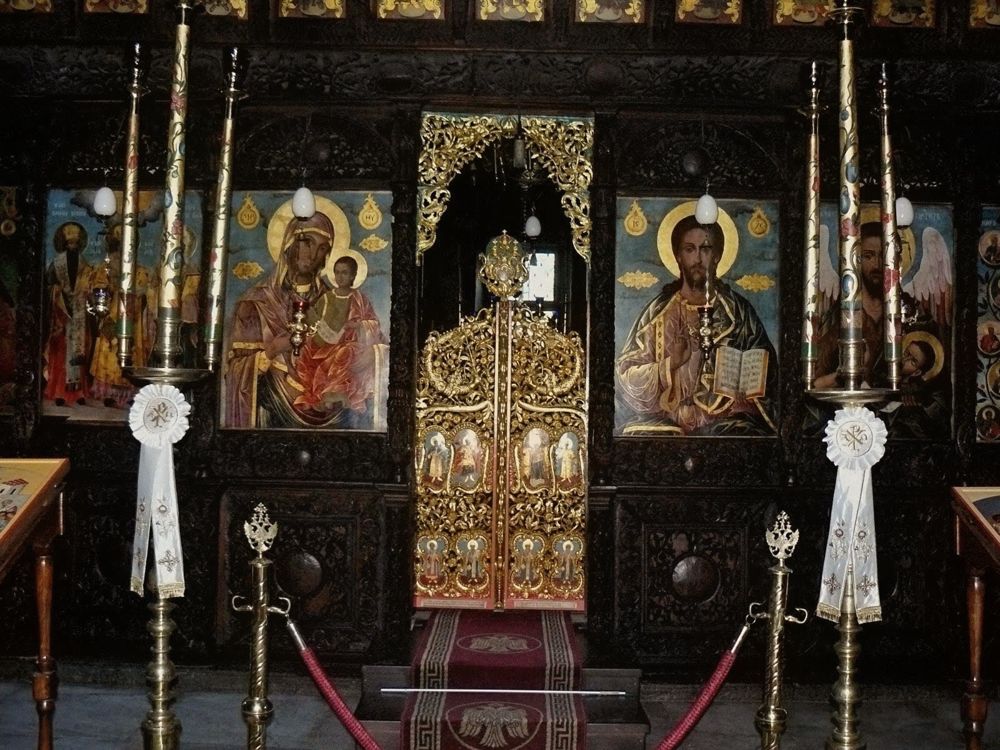
There is a place in a church where worship becomes, for a moment, movement. All the space around it is meant for standing and prayer, but here something happens: the leaves part, the curtain is drawn back, and a procession comes out from the depths of the sanctuary. This place is the royal doors, the central passage of the iconostasis.
It is easy to take them for carved, gilded doors, the most beautiful in the church. But the doors are not an ornament; they are a boundary, and almost everything about them is built around that boundary: what is written on it, who crosses it, when it is open and when it is shut. Let us take these things one by one.
In brief
- The royal doors are the central doors of the iconostasis between the nave and the sanctuary; they are also called the doors of Paradise.
- The name is linked to the Liturgy: through them Christ, the King of Glory, comes out in the Holy Gifts.
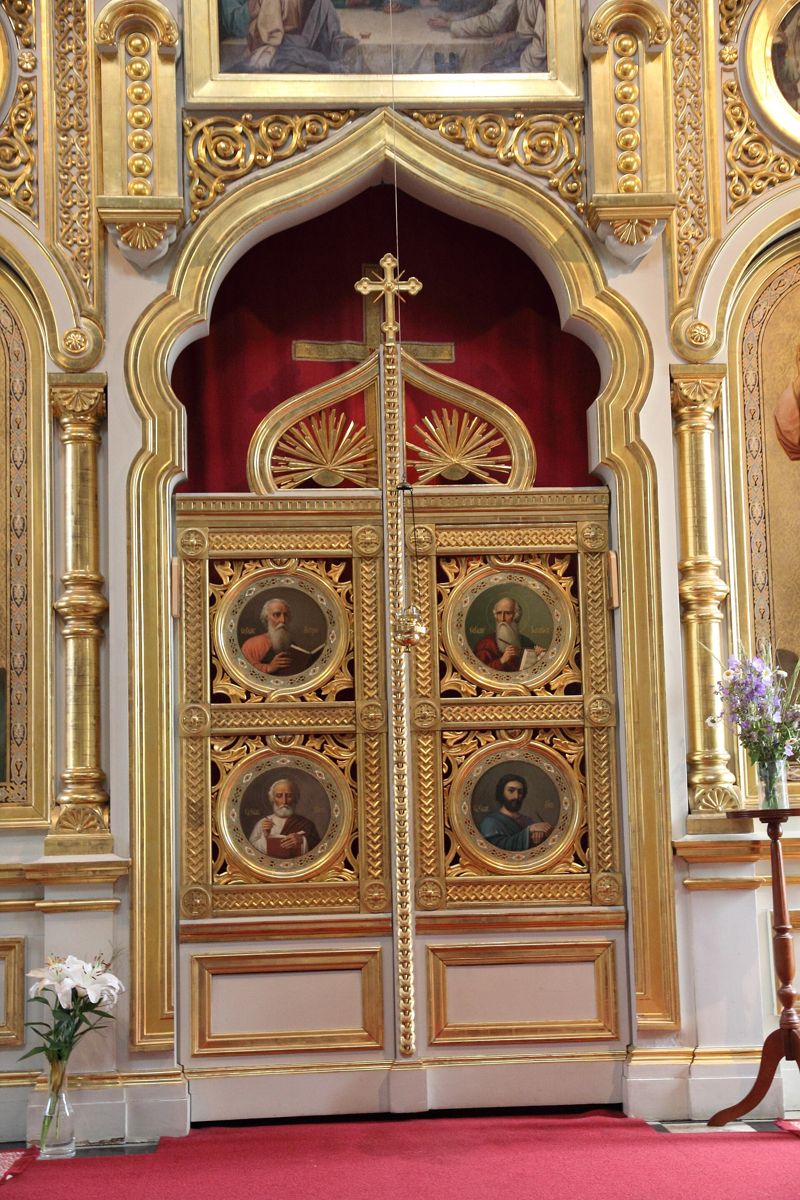
- The leaves most often bear the Annunciation and the four Evangelists; the Last Supper is usually above the doors.
- In the Orthodox tradition it is customary that only the clergy pass through them, and only at the moments prescribed by the service.
- They are opened at certain moments of the Liturgy; during Bright Week after Easter they stay open the whole time.
- The side deacons’ doors are usually decorated with images of archangels or holy deacons.
Why are the doors called royal?
The Liturgy itself gives the explanation. According to the content of the Divine Liturgy, Christ comes out through these doors in the Holy Gifts to give Communion to the faithful. That is why reference works state that the name is connected with the coming out of the King of Glory.
There is a second name as well — the doors of Paradise. It is a reminder that the passage symbolises the gates of Paradise, that is, of the Kingdom of Heaven. In this sense the iconostasis becomes not a wall but a threshold, and the royal doors its centre.
Historically, such doors have been known in Byzantine churches since the 7th century. According to the encyclopedic reference, they reached their highest flowering as a form of decorative and applied art in Ukraine in the 17th–18th centuries, in the Renaissance and Baroque styles.
What is depicted on the royal doors?
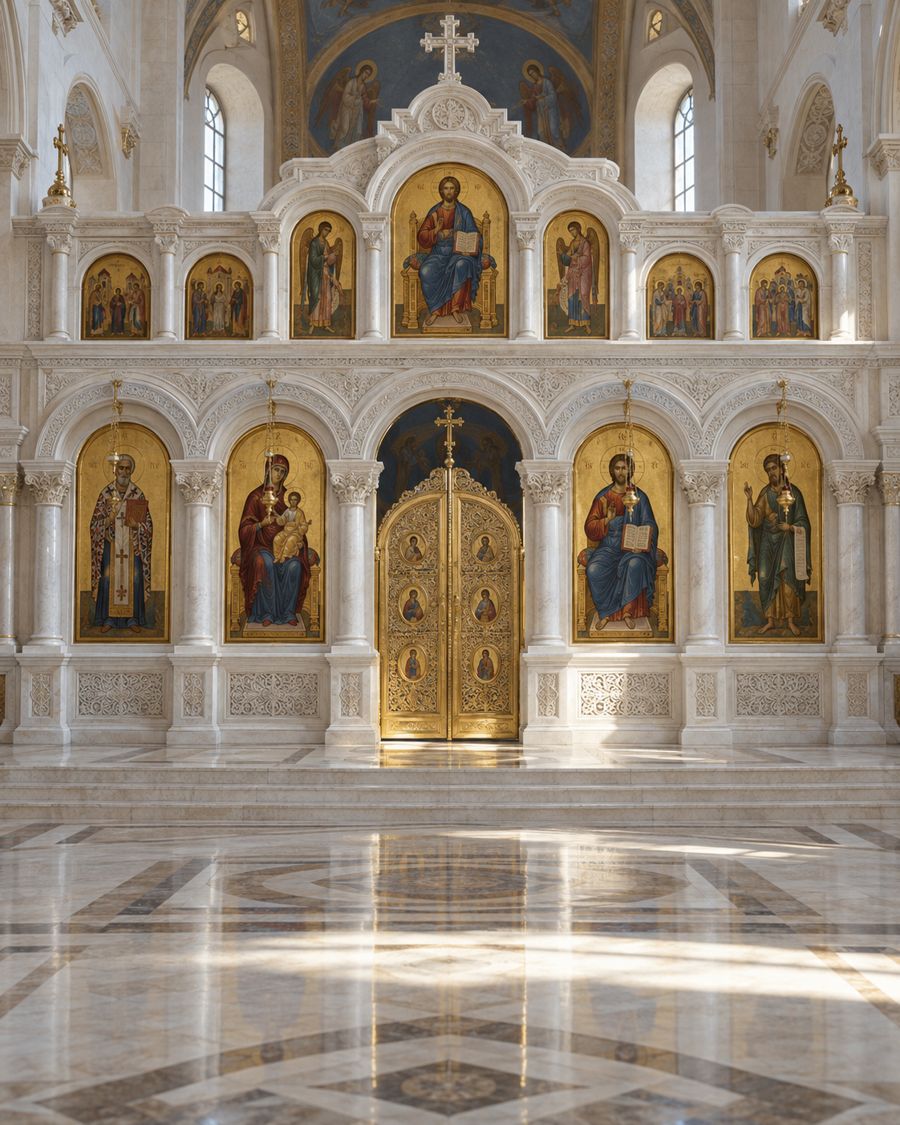
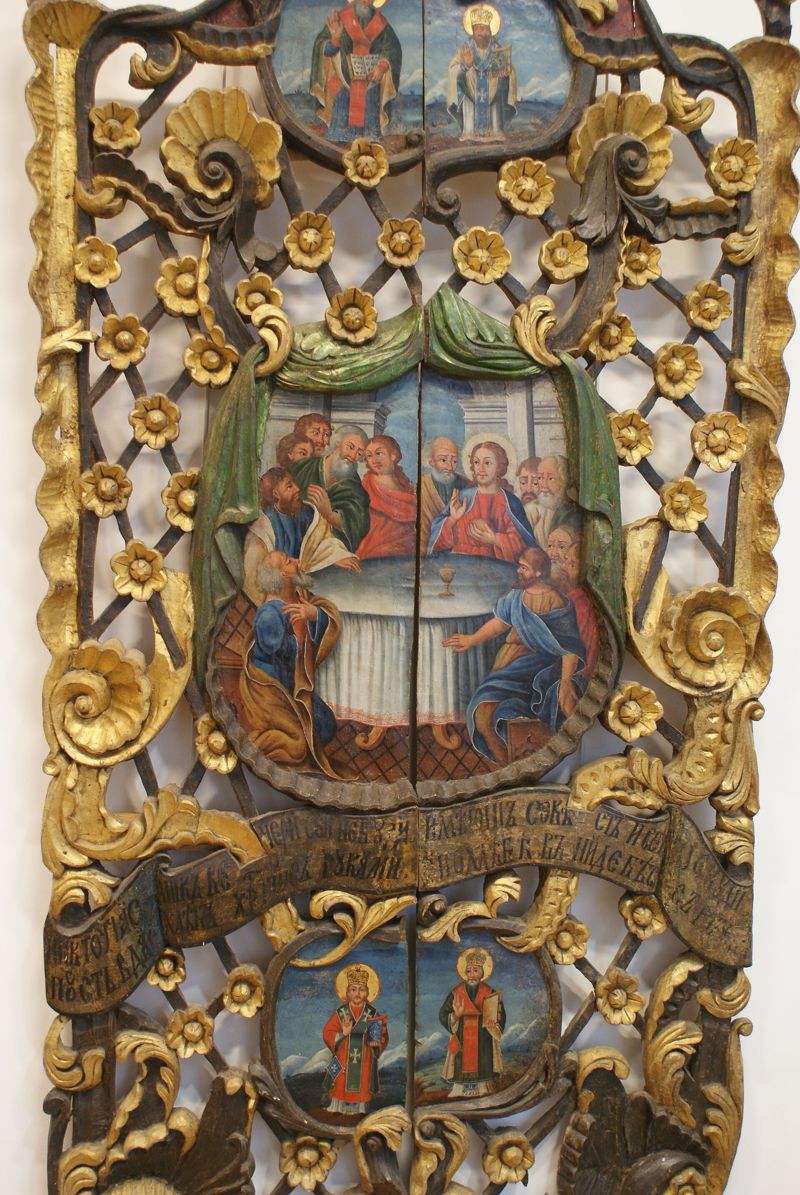
The classic scheme in the Ukrainian tradition is the Annunciation and the four Evangelists. Art-historical descriptions confirm this: “the scene of the Annunciation and the four Evangelists was depicted on the royal doors”. Above the doors, according to the same description, “the Last Supper is mostly also depicted”.
The Annunciation. It is usually divided between the leaves: the Archangel Gabriel on one, the Mother of God on the other. The meaning is clear: the Incarnation is the very beginning from which the way opens to the Communion celebrated behind the doors. The researcher Svitlana Olianina shows that in Ukrainian iconostases of the 17th–18th centuries the Annunciation was the central image of the doors. She connects its meaning with the theological understanding of the curtains of the Old Testament Tabernacle, which Christian tradition identifies with the flesh of Christ. In other words, doors bearing the Annunciation can be read as an image of God incarnate in the material world He created.
The four Evangelists. Matthew, Mark, Luke and John are the authors of the four Gospels, the good news of what followed the Annunciation. They are painted in medallions or border scenes, separately from the main scene. On carved Baroque doors the medallions are often framed by plant ornament and, together with the Annunciation, form a single composition.
The Last Supper. It is placed above the doors. The Supper is linked to the institution of the Eucharist, so combining this scene with the doors through which the Gifts are brought out is meaningful.
This scheme is the most common, but not the only one: the set of subjects could differ from church to church and from period to period.
Who passes through the royal doors?
In the Orthodox tradition it is customary that only the clergy pass through them — deacons, priests and bishops — and only at moments determined by the order of service. The faithful do not go through the royal doors, and bishops, priests and deacons use them only when the order of the service provides for it.
This is not so much a prohibition as the logic of the space. The doors are not an ordinary entrance: for everyday movement between the sanctuary and the church there are side doors. The royal doors are meant for those minutes when the very image of Christ in the Gifts enters the church or goes out of it.
When are the royal doors opened?
The general rule is this: the doors are opened at certain moments of the service. The detailed order depends on the particular Church, its typikon and the type of service, so it is best to follow the guidance of your own priest.
The moments most often named are the beginning of the Liturgy and the Communion of the faithful, when the Holy Gifts are brought out. Throughout Bright Week after Easter, according to the encyclopedic description, the doors stand open the whole time.
| Moment | State of the doors |
|---|---|
| Beginning of the Liturgy | opened |
| Communion of the faithful | open; the Gifts are brought out through them |
| Great Lent, many services | closed, curtain drawn |
| Bright Week (after Easter) | open throughout the week |
The table should be read as a general guide. Practice has varied across times and places, and the requirements for individual services differ.
What is the curtain for?
Behind the doors hangs a curtain — the katapetasma. The curtain recalls the veil over the holy place in the Old Testament temple. Depending on the service, it may be open or closed.
Its symbolism is described as follows. When the curtain is closed, in particular during many Lenten services, it recalls the expulsion of humankind from Paradise: the faithful lament their sins before the closed entrance to the Kingdom of Heaven. When it is opened together with the doors during the Easter service, it signifies the restoration of the lost communion with God and Christ’s victory over death.
The deacons’ doors: what is depicted on them?
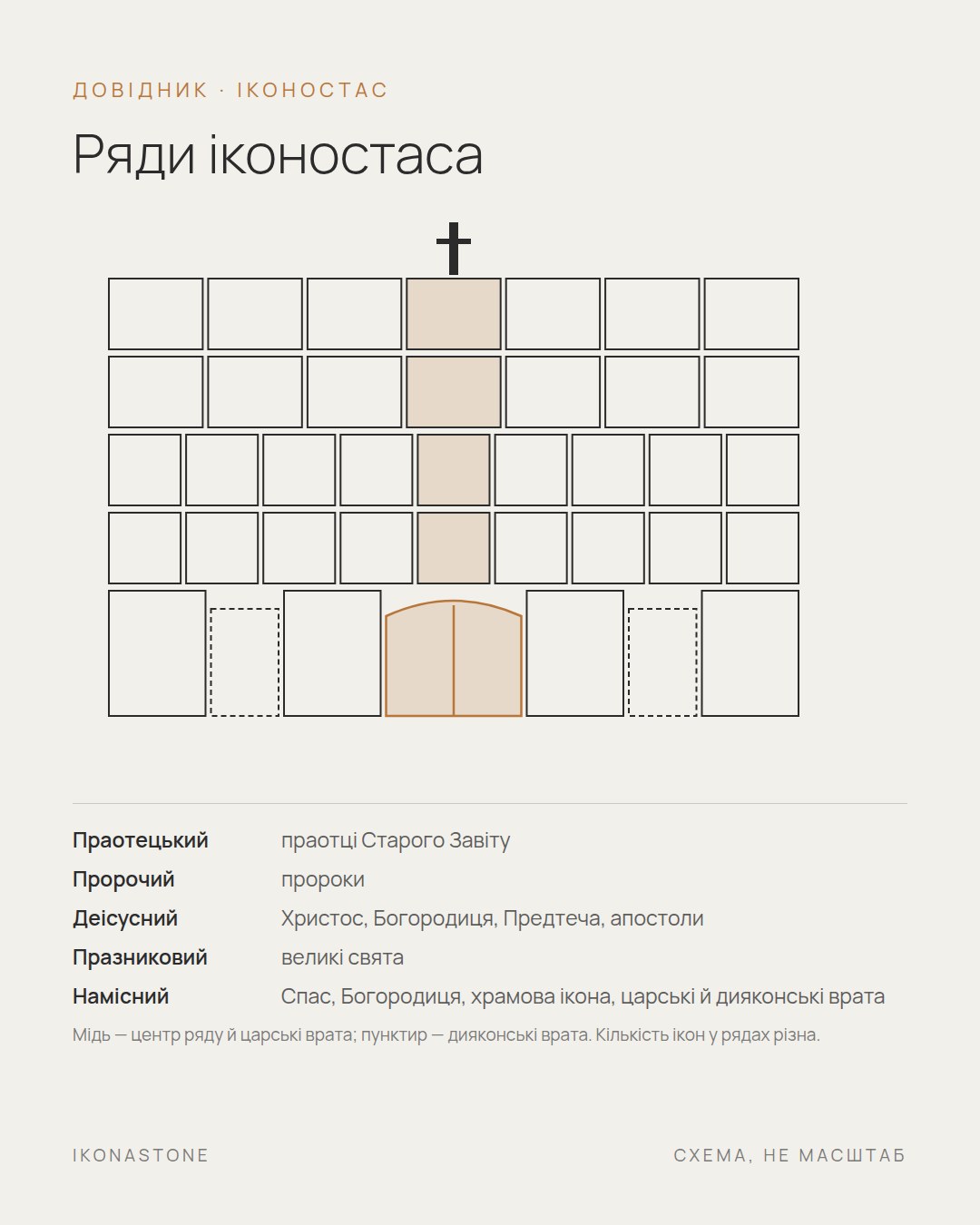
On both sides of the central doors are smaller side doors — the deacons’ doors, also called the angels’ doors. Deacons and candle-bearers use them more often than anyone else.
These doors most often depict the Archangels Michael and Gabriel. Sometimes holy deacons are painted on them — Stephen and Lawrence. The angels point to service, the deacons to the order of ministry, and both images suit the people who constantly pass through here.
Ukrainian carved Baroque doors as heritage objects
The flowering of royal doors in Ukraine falls in the 17th–18th centuries. A wooden base, high-relief carving, gold and silver turned the doors into a distinct form of art.
The collections of the Rivne Regional Museum of Local History hold royal doors from the late 18th — early 19th century: two wooden leaves with carving, oil painting, iron and gilding; on each leaf there are three border scenes within plant ornament: the Annunciation in the upper one, the four Evangelists in the others. The museum gives the dimensions of the leaves: 205×61.5×3.5 and 212×61.5×3.5 cm. This is an example of a specific object, not a norm: the dimensions of the doors always depend on the iconostasis.
The Novovolynsk Historical Museum holds doors from Adam Kysil’s church, dated to the first half of the 18th century. The wood carving is covered with gold and silver. The church was closed in 1960, the iconostasis destroyed in the 1990s, and the doors kept in a basement; in the early 2000s they were transferred to the museum, and as of 2022 they were under restoration.
In 2025 the Museum of Volyn Icons in Lutsk presented the exhibition “Artistic Wood in the Churches of Volyn. 17th–19th Centuries”, with 101 exhibits from villages and small towns of the region. Among them are well-preserved royal doors from the village of Krymne in the Stara Vyzhivka area.
Ukrainian doors have also interested scholars of symbolism. Olianina writes that the arrangement of the animals and the medallions with the Annunciation and the Evangelists follows the scheme of the World Tree. She links this formula to the 17th century and to inter-confessional polemics, and its decline in the 18th century to the disappearance of the factors that gave rise to it.
Why are these images placed this way?
If we look at the doors as a text, it has three themes. The Annunciation is the moment the Word becomes flesh. The Evangelists are the witnesses and narrators of what followed from it. The Last Supper above the doors is linked to the institution of the Eucharist, which is celebrated behind the doors. This selection of images is not obligatory in every church, but it explains why these particular subjects come together on the doors.
That is why the objects we see in museums need to be read together with their context: they are not separate carved panels but parts of a whole that once stood in a church and functioned in worship.
What to decide before commissioning
Royal doors are not commissioned separately from the iconostasis, because they are its axis.
- Proportions and dimensions. They cannot be taken from a catalogue: the height and width of the opening are agreed with the church’s architect and the priest, based on the dimensions of the sanctuary arch and the passage.
- The community’s liturgical practice. Is there a curtain, how is it fixed, do the doors need to open both ways — these are questions for the rector.
- Iconography. The Annunciation and the Evangelists, or holy hierarchs? What will be above the doors? This is the community’s decision, agreed with the priest and the artist.
- Material. Wood is the traditional choice; it is carved and gilded. Metal is less common. The material of the doors should match the rest of the iconostasis in weight and structure.
- The deacons’ doors. They are designed together with the central doors, in the same ornamental language.
- The language of ornament. Baroque, Byzantine or contemporary restraint — the style should suit the architecture of the church.
Conclusion
The royal doors are the place where architecture, theology and the order of service meet. The images on the leaves point to the Incarnation as recorded in the Gospels, the deacons’ doors to the people and angels who serve, and the curtain to loss and restoration. So the doors should be treated accordingly: not as a separate object, but as the centre of the whole iconostasis.
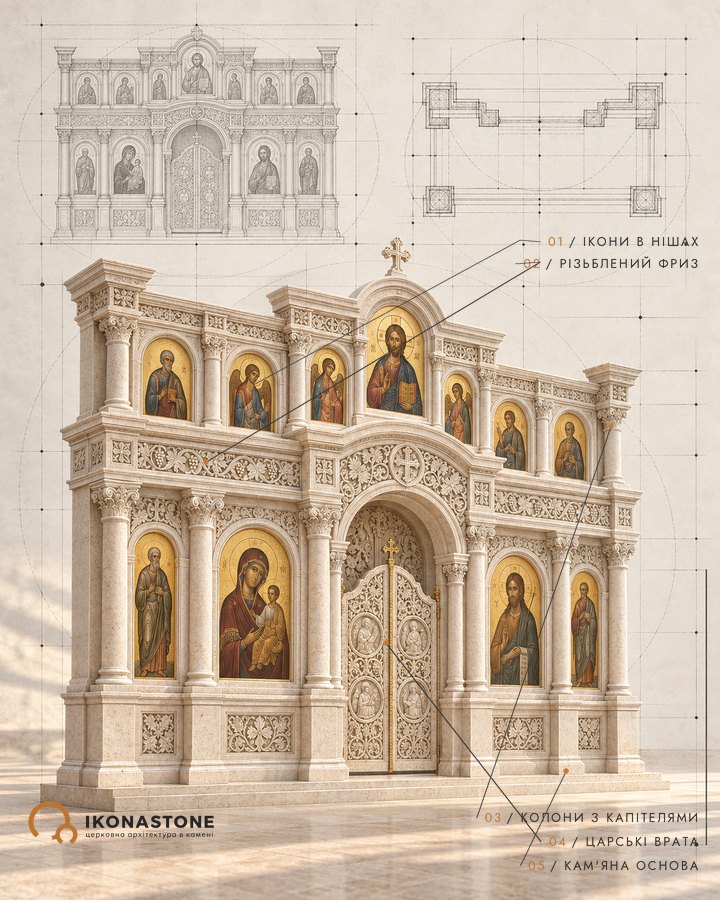
The IKONASTONE workshop in Lutsk works with iconostases, icon shrines and stone elements of church architecture; see the Iconostases section. For the structure and purpose of the whole screen, read the article What Is an Iconostasis, and for the Ukrainian tradition, The Ukrainian Iconostasis.
FAQ
Why are the doors called royal?
Because, according to the content of the Divine Liturgy, Christ — the King of Glory — comes out through them in the Holy Gifts. That is why they are also called the doors of Paradise: they represent the gates to the Kingdom of Heaven.
Who may pass through the royal doors?
In the Orthodox tradition it is customary that only the clergy do so, and only at the moments prescribed by the service. The faithful, and usually the ministers of lower orders as well, use the side entrances.
What is depicted on the royal doors?
Most often the Annunciation — the Archangel Gabriel and the Mother of God on the two leaves — and the four Evangelists. The Last Supper is usually placed above the doors.
When are the royal doors open?
At certain moments of the service: for example, at the beginning of the Liturgy and when the Holy Gifts are brought out for Communion. Throughout Bright Week after Easter the doors stay open the whole time. The detailed order is set by the typikon of the particular Church.
What is the curtain behind the doors for?
The curtain (katapetasma) recalls the veil over the holy place in the Old Testament temple. Closed, it symbolises the loss of Paradise; opened at Easter, the restoration of communion with God.
What materials are used for royal doors?
Most often wood — carved and gilded; metal doors are also found. The material is matched to the structure of the whole iconostasis.
Sources
- Royal doors — Great Ukrainian Encyclopedic Reference (VUE)
- Krypiakevych I. The iconostasis: its history and meaning, and how it is made // Patriiarkhat, 1993, No. 5 (269)
- Olianina S. The royal doors of Ukrainian iconostases of the 17th–18th centuries // Scientific Notes of NaUKMA, vol. 179, 2016
- What the curtain over the royal doors of the iconostasis symbolises — Immaculate Conception Parish of the UGCC, San Francisco
- Royal doors, late 18th — early 19th century, Rivne Regional Museum of Local History (museum-digital)
- Top 5 museum exhibits in Volyn: unique royal doors (Novovolynsk Historical Museum)
- An exhibition of carved works from Volyn churches opened in Lutsk (Museum of Volyn Icons)
- Deacons' doors — ikonostas.in.ua
- Royal doors — Wikipedia