Altar Table and Table of Oblation: How They Differ and Where They Stand
There are things in a church that cannot be accidental. Of these, the altar table is the most carefully guarded: the sanctuary is built around it, and the rest of the building around the sanctuary. Someone ordering furnishings for a new or restored church for the first time often sees in the sanctuary simply “two tables” and asks why there are two. The answer is simple in substance and far from simple in its consequences: these are two different places, with different purposes, rules of touch and forms.
They are worth explaining together. The altar table without the table of oblation gives no idea of how the liturgy is arranged, and the table of oblation without the altar table is just a side table. One stands in the centre, the other to the side, and behind this distance lies the whole order of the service: what is prepared separately and what is celebrated in the holiest place.
Below: where they stand, what lies on them, what they are made of, and what should be decided before ordering.
In brief
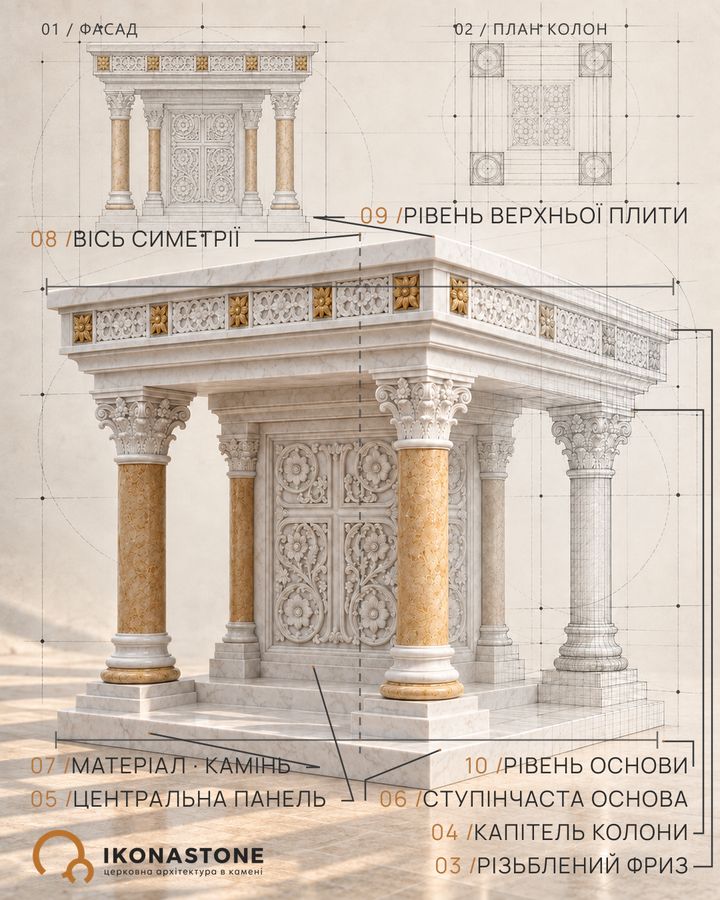
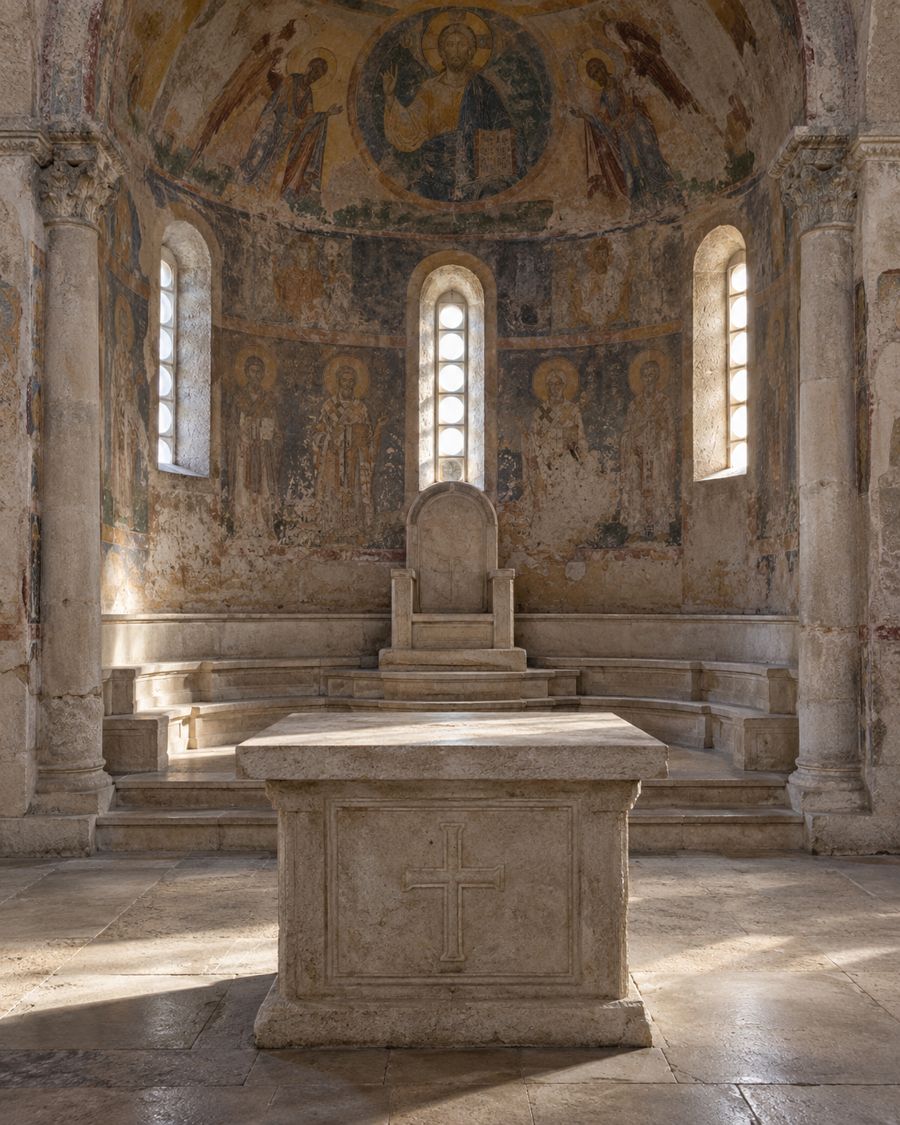
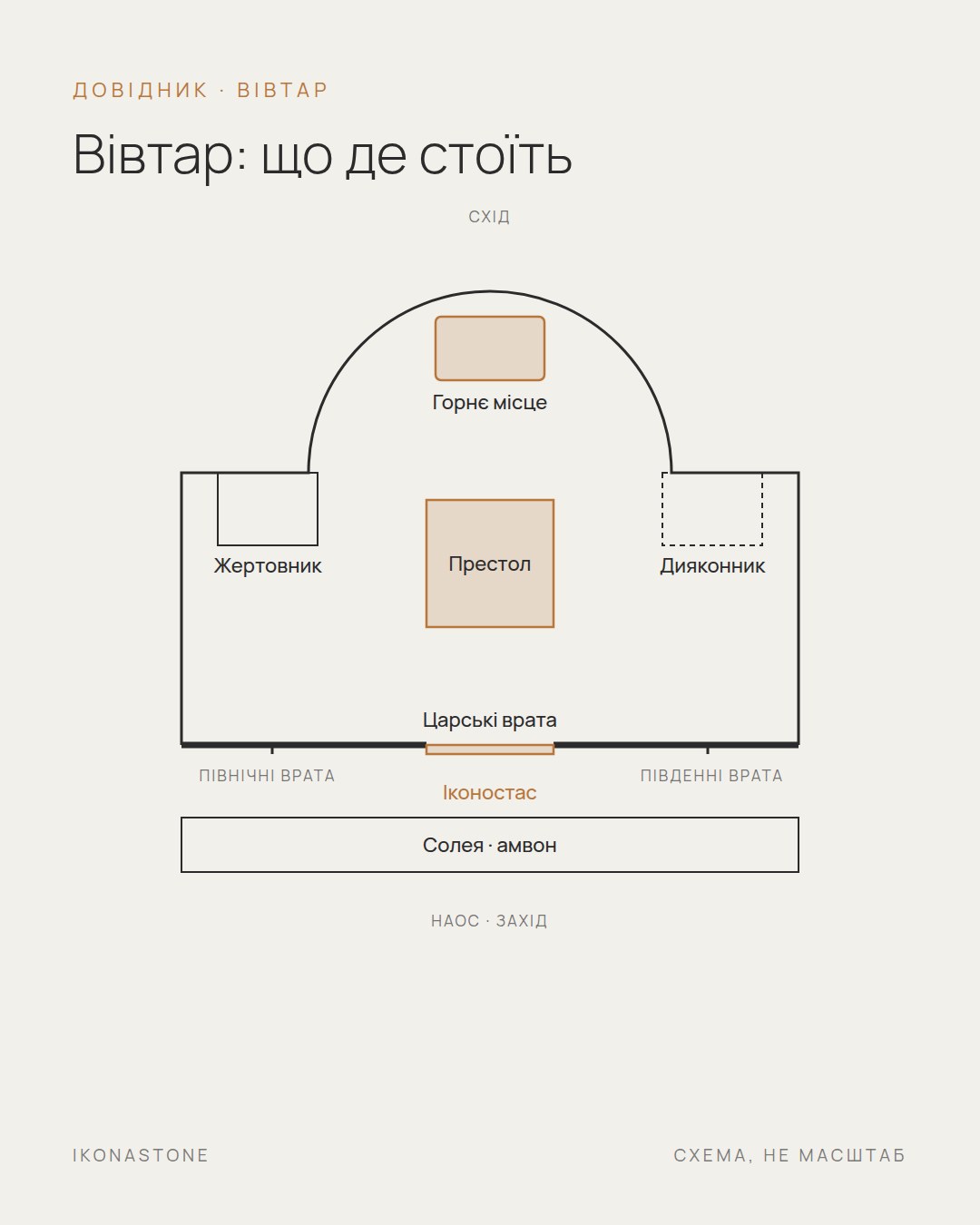
- The altar table stands in the middle of the sanctuary. The liturgy is celebrated on it, and the antimension, the Gospel Book, the cross and the tabernacle lie on it.
- The table of oblation stands in the northern part of the sanctuary, to the left of the altar table. On it the bread and wine are prepared for communion; this rite is called the proskomedia.
- The altar table is considered the holiest place in the church: it symbolises the throne of God, and in ancient times the altar itself was set over the relics of martyrs. Only the ordained touch it.
- The material of the altar table varies between traditions: Byzantine practice describes both stone and wood. The Greeks assumed stone; in Slavic practice wood was more common.
- There is no single binding measurement for its size. As a guide, the descriptions give a height of about one metre and a square form.
- Decisions on form, material, relics and vesting are made by the rector together with the diocesan authorities, not by the craftsman.
Where does the altar table stand and what lies on it?
The altar table stands in the middle of the sanctuary, behind the iconostasis. The Orthodox Church in America calls it the centre of the church building. When the royal doors are open, it can be seen from the nave.
It stands free, so that one can walk around it. Only in very small sanctuaries is it sometimes moved up against the back wall (according to an English-language overview). Behind it, according to the Orthodox Church in America’s description, a seven-branched candlestick is usually placed: this custom is connected with the Temple in Jerusalem.
On the altar table lie:
- the antimension: a cloth consecrated by a bishop, bearing an image of Christ laid in the tomb with the four evangelists in the corners; the liturgy is celebrated on it. The word means “instead of the table”;
- the Gospel Book: according to the Orthodox Church in America, it lies on the altar table permanently;
- the cross;
- the tabernacle: usually in the form of a small church; the communion gifts for the sick and dying are kept in it.
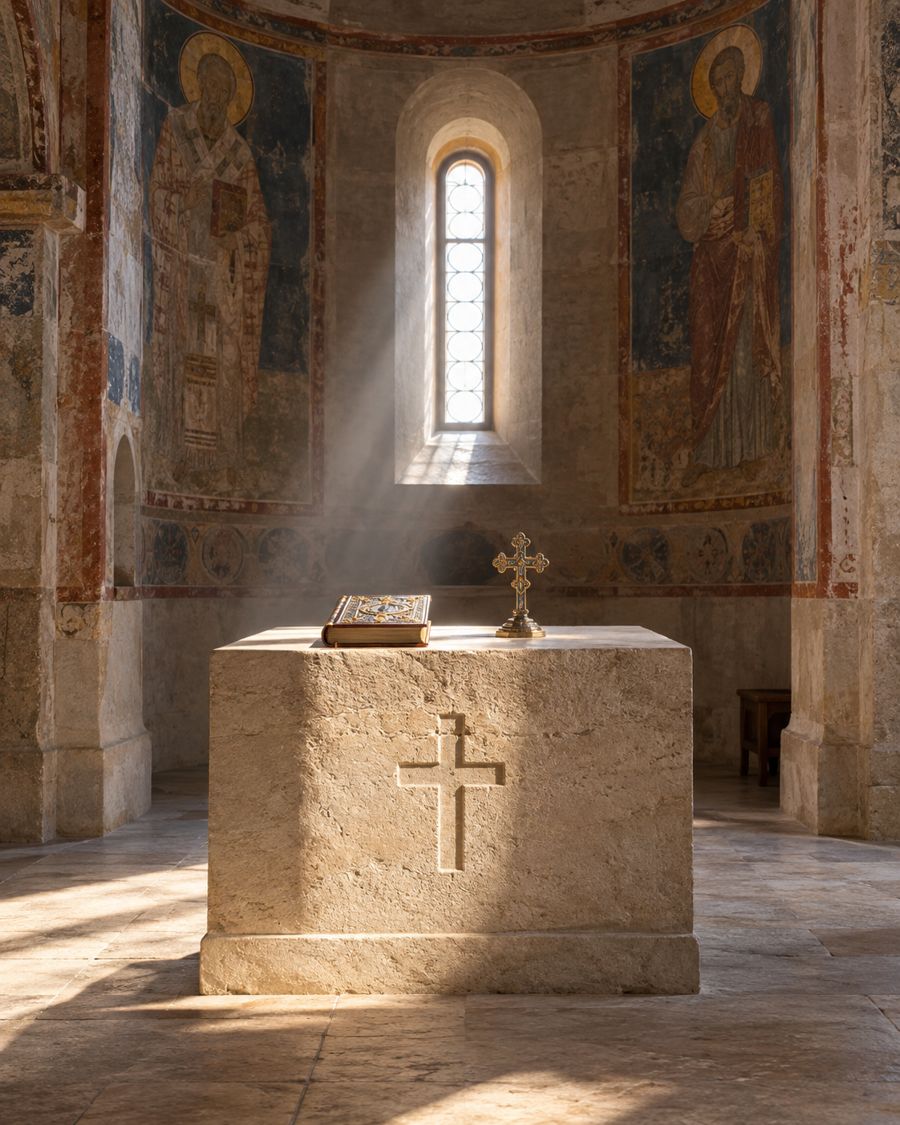
The antimension deserves a few words of its own. According to an article by Yurii Fedoriv, the eiliton is laid on the altar table, and the antimension is unfolded on it at the beginning of the Liturgy of the Faithful and folded at the end so that it ends up wrapped in the eiliton. And by Orthodox custom the liturgy is celebrated on the antimension even when the altar table is consecrated and contains relics.
Where does the table of oblation stand and what is it for?
The table of oblation is the second, smaller table. It stands in the northern part of the sanctuary, to the left of the altar table when looking east from the altar table. English-language descriptions also call it the table of offering (prothesis).
Here the gifts are prepared for the sacrament of communion. On the table of oblation lie the chalice, the diskos, the asterisk, the lance, the spoon, and a sponge or cloth. These are all the instruments of the proskomedia: the rite that precedes the liturgy. Here wine mixed with water is poured into the chalice, and at the end of the proskomedia the priest censes the table of oblation three times, as given in the order of the liturgy of the Orthodox Church of Ukraine.
The table of oblation is also vested on all sides, but, unlike the altar table, no relics are placed in it. According to an English-language description, it may be touched by ordained higher clergy and also by subdeacons.
Why is the altar table considered the holiest place?
In the Orthodox tradition the altar table is customarily seen as an image of the heavenly throne. The Orthodox Church in America calls it “the symbolic and mystical presence of the heavenly throne and the banquet table of the Kingdom of God”, and the liturgy the place of the “bloodless sacrifice”. Hence the rules of conduct.
An English-language overview of the Byzantine altar states that the altar table may be touched only by ordained higher clergy, that is, bishops, priests and deacons. OrthodoxWiki adds subdeacons. The lists in the sources differ, but the direction is the same: only the clergy touch the altar table. Nothing unconsecrated is placed on the altar table. According to the description, icons are first laid on it to be blessed, and only then sprinkled with holy water.
In the Greek Catholic tradition the order is similar. St Constantine Ukrainian Catholic Church (USA) states plainly that only the priest and his assistants are admitted to the sanctuary, and that the covering of the altar table, called there the “prepolie”, recalls the cloth in which the body of Christ was wrapped.
Why were altar tables set over relics in ancient times?
Here history and dogma meet in a single detail. Well-known descriptions say that in the early centuries the liturgy was celebrated on the tombs of martyrs, and from this came the custom of placing relics under or inside the altar table. Fedoriv’s articles and the catechism agree on this: altar tables were built of stone, and the relics of martyrs were kept beneath them, a practice going back to the catacombs.
Historians disagree about the catacombs. The English-language overview notes that some scholars believe the Eucharist was indeed celebrated among the tombs of the Roman catacombs on the sarcophagi of martyrs, while others deny this. But they agree on one thing: the custom of relics in the altar has early roots. The catechism refers to a canon of the Ecumenical Council of 787 (Nicaea II, canon 7): churches may not be consecrated without relics. And the Council in Trullo, dated to 691 or 692, forbade priests to celebrate the liturgy in prayer rooms of private houses without the bishop’s permission (canon 31). The antimension consecrated by the bishop, according to the same catechism, became the visible sign of such permission.
The present order is as follows. According to the description, relics are placed in the altar table during the consecration of the church by a bishop. If the bishop delegates the consecration to a priest, no relics are placed in the altar table: the bishop himself consecrates the antimension and sends it with the priest.
What is the altar table made of and what form does it have?
The traditions say different things about the material. That is exactly why it is better not to invent a single rule here.
- The Greeks, according to the description of consecration in Eastern Christianity, assumed the altar table to be of stone. Slavic practice assumed wood.
- The Catholic Encyclopedia notes that the top of a Greek altar table must be of wood, at least of a single board. In other words, stone is not required there, unlike in the Roman Rite.
- The Orthodox Church in America writes of carved wood or stone; OrthodoxWiki says “of wood or stone”.
- St Constantine Ukrainian Catholic Church has a main altar table of marble, an example of stone in the modern Greek Catholic tradition.
Form. The sources agree on the square: “so that each dimension is equal” (Catholic Encyclopedia), often “a perfect cube” (Orthodox Church in America).
Dimensions. Church and encyclopedic descriptions give no single binding figure, so these are only guides:
- a height of “about one metre” (English-language overview of the Byzantine altar);
- a cube with an edge of “about a metre or a cubit” (OrthodoxWiki).
Supports. OrthodoxWiki writes of one or four columns: one signifies Christ, four the evangelists. The English-language overview describes five supports: one at each corner and a central one, in which the relics lie.
How are the altar table and the table of oblation vested?
Vesting, briefly. The altar table is covered with two coverings. The lower one, according to the English-language overview, is a plain linen cloth tied with cords, which is never removed after consecration: it is the altar table’s “baptismal garment”. St Constantine Ukrainian Catholic Church connects such a white embroidered covering with the cloth in which the body of Christ was wrapped in the tomb. The upper one is a decorated fabric, often brocade, reaching to the floor, in the colour of the liturgical season. The Orthodox Church in America writes that the coloured vesting expresses the divine and heavenly character of the altar table.
The table of oblation is also vested on all sides. When not in use, the antimension is wrapped in the eiliton.
Table: altar table and table of oblation
| Feature | Altar table | Table of oblation |
|---|---|---|
| Location | In the middle of the sanctuary, free-standing | Northern part of the sanctuary, to the left of the altar table |
| Purpose | Celebration of the liturgy, the place of the mystery of the Eucharist | Proskomedia: preparation of the gifts |
| What lies on it | Antimension, Gospel Book, cross, tabernacle | Chalice, diskos, asterisk, lance, spoon, sponge or cloth |
| Form | Square (cube), four sides | A table smaller than the altar table |
| Material | Stone or wood, depending on the tradition | Stone or wood |
| Relics | Placed during consecration by a bishop | Not placed |
| Who touches it | Bishops, priests, deacons (in some descriptions also subdeacons) | Ordained higher clergy and subdeacons (according to an English-language description) |
What to decide before ordering
- Tradition and jurisdiction. The Orthodox Church of Ukraine, the Ukrainian Greek Catholic Church or another: this affects customs regarding the material, the vesting and the placement of the tabernacle. Ask the rector to confirm the requirements in writing.
- Material. Stone or wood, and if stone, which kind: solid or cladding. The bishop or the rector should say.
- Size. The guides from the descriptions are a height of about one metre and a square form, but derive the final figures from the plan of the sanctuary: the passages around the altar table, the distance to the high place and the iconostasis.
- Supports. One column, four legs or five supports. This determines where the relics will be.
- Relics. Who will consecrate the church: a bishop or an authorised priest. This determines whether to leave a cavity for relics in the altar table.
- Tabernacle. A separate object on the altar table or built in; what it looks like.
- Table of oblation. Separately from the altar table: size, height, shelf, vesting. It should match the altar table in style.
- Vesting. Fabrics, colours, whether a permanent cover is needed.
- Foundation and floor. A stone altar table is considerably heavy; the sanctuary floor and the platform should be calculated before installation.
Summary
The altar table and the table of oblation differ in location, purpose and rules of touch, but they stand in one sanctuary and serve one liturgy. IKONASTONE makes stone altar tables and tables of oblation to dimensions agreed with the rector; the catalogue can be found on the Altar Tables page. On the sanctuary itself, see the guide: What Is an Iconostasis and What Is an Altar Table Made Of.
FAQ
How does the altar table differ from the table of oblation?
The altar table stands in the middle of the sanctuary; the liturgy is celebrated on it, and the antimension, the Gospel Book, the cross and the tabernacle lie on it. The table of oblation stands in the northern part of the sanctuary, to the left of the altar table, and on it the gifts are prepared for communion (the proskomedia).
Where in the church does the table of oblation stand: on the right or on the left?
The table of oblation stands in the northern part of the sanctuary, that is, to the left of the altar table when facing east.
Who may touch the altar table?
In the Orthodox tradition only the ordained touch the altar table: bishops, priests and deacons. Some descriptions add subdeacons to this list. According to an English-language description, subdeacons may also touch the table of oblation.
Must the altar table always be made of stone?
No. According to descriptions of the Byzantine tradition, the Greeks assumed the altar table to be of stone, while in Slavic practice it was more often of wood. The material should be decided by the rector together with the diocesan authorities.
What is an antimension, and is there one on every altar table?
The antimension (Greek for "instead of the table") is a cloth consecrated by a bishop, bearing an image of the burial of Christ, into which a particle of relics is sewn. By Orthodox custom the liturgy is celebrated on the antimension even when the altar table itself is consecrated and contains relics.
What size should an altar table be?
Church and encyclopedic descriptions give no single binding measurement. As a guide they give a height of about one metre and a square or cubic form (a side of about a metre or a cubit). The final size is agreed with the priest and with the dimensions of the sanctuary.
Sources
- Orthodox Church in America. The Orthodox Faith, vol. II: Worship. The Church Building: Altar Table
- Altar (Holy Table) — Wikipedia, section on the Byzantine Rite and early Christian altars
- Consecration in Eastern Christianity — Wikipedia
- OrthodoxWiki. Altar table
- Catholic Encyclopedia. Altars (in the Greek Churches)
- Yu. Fedoriv. The Antimension: A Ritual Detail of the Ukrainian Church (Patriiarkhat, 1974)
- The Antimension: Instead of the Altar Table (catechism), genova.org.ua
- Celebrating the Divine Liturgy in Field Conditions (Orthodox Church of Ukraine)
- St. Constantine Ukrainian Catholic Church. Architecture