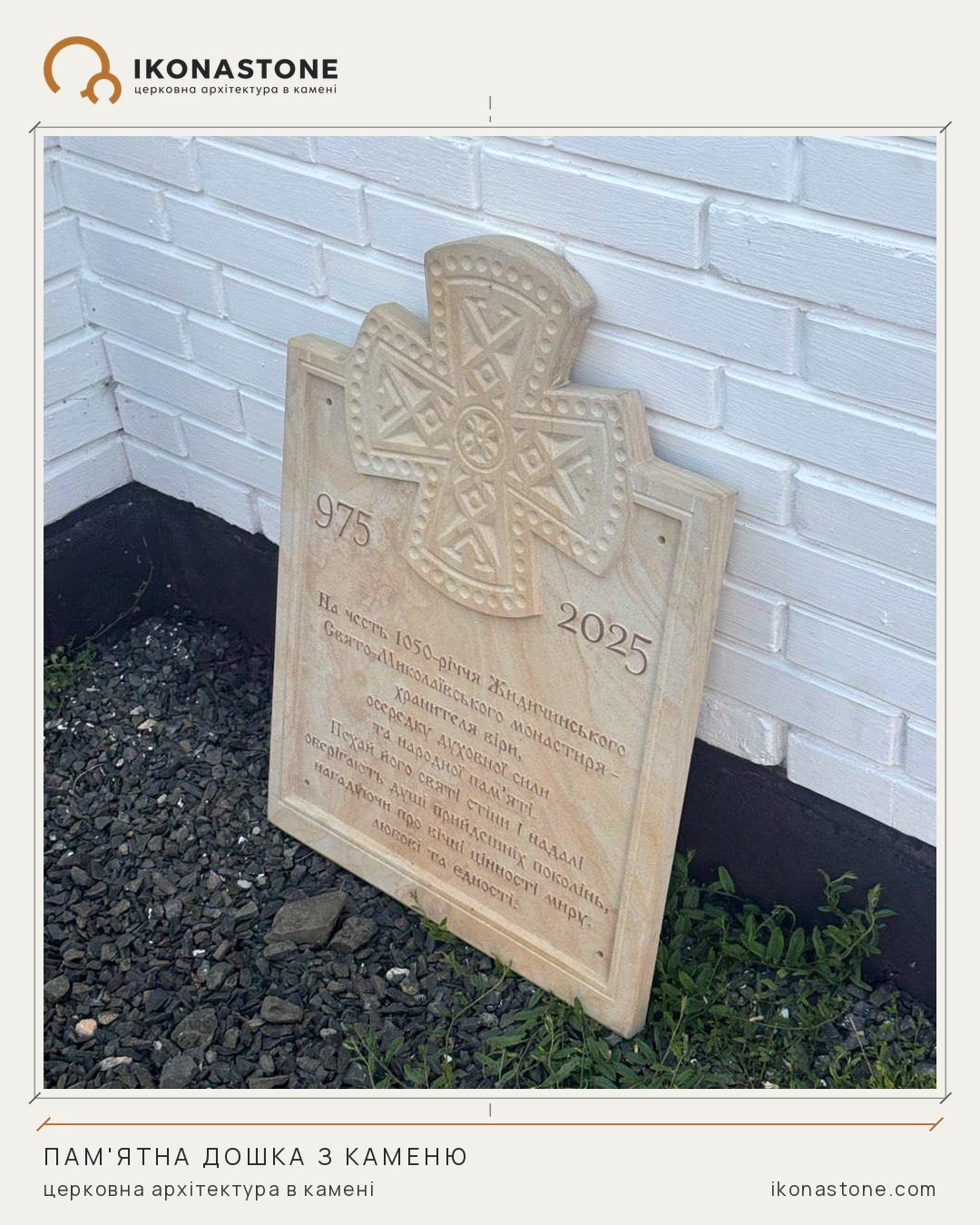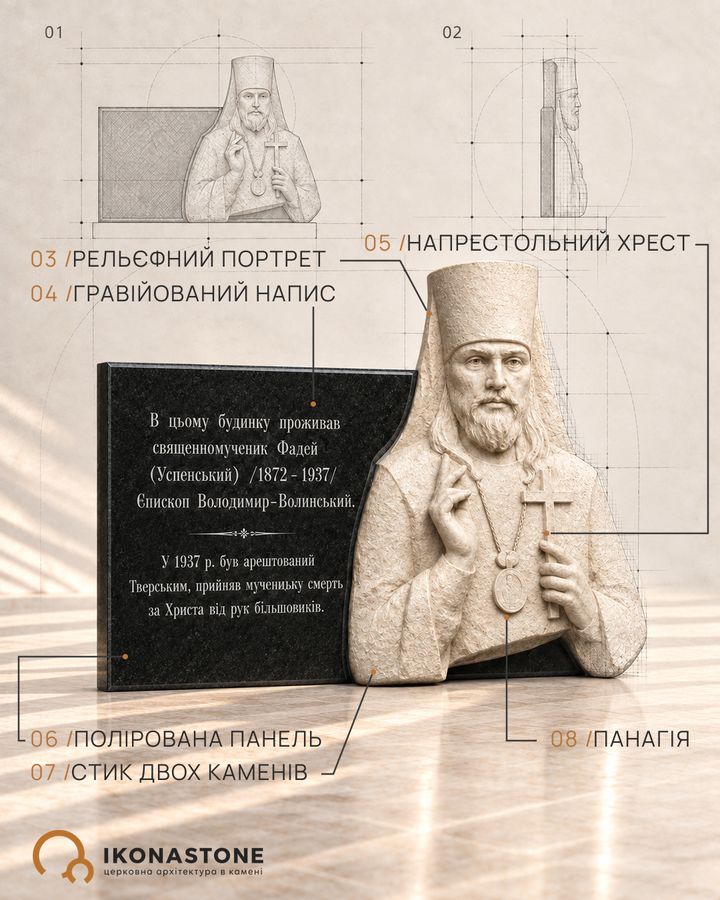
Commemorative plaque on a church: an inscription for a hundred years
A commemorative plaque is ordered once and read for centuries. If, of course, it can be read.
The first question is not the typeface or the stone but distance. In the sign industry there is a legibility index: how many feet of distance there are for each inch of capital-letter height. The American trade body United States Sign Council, in a 2006 handbook, gave an example with an index of thirty: a letter one inch high should be visible from thirty feet. In metric terms that is one centimetre of letter per 3.6 metres. But this is an averaged rule: the council itself warned that it may not be enough for a particular sign. Besides, it was derived for signs, not for stone. The sign-makers’ trade rule is three times stricter: one inch per ten feet, that is, one centimetre per 1.2 metres. We found no research specifically on carved stone, so we advise working by the stricter one. If the plaque will be read from five metres, the letters should be at least 4.2 centimetres high, preferably four and a half.
The second is shadow. The most common way of lettering memorials is a V-shaped cut, traditionally cut by hand, as Historic England writes in its guidance on war memorials. Such an inscription is read not by paint but by light: one face of the cut is lit, the other is in shadow. The Romans knew this well. The inscription on the base of Trajan’s Column was completed in 113, and it is still called perhaps the best-known example of Roman monumental lettering. It also makes an allowance for the viewer: the upper lines, farthest from the eye, are made larger than the lower ones.
The third is gold. Gold leaf, properly laid on a well-prepared surface, protects the stone beneath it well, according to the same guidance. But it does not last for ever: specialists at the British War Memorials Trust note that over time paint and gilding wear away and the inscription looks uneven. So the letters must read even without gold, by shadow alone. Gold is an addition to the cut, not a replacement for it.
The fourth is stone. We have already written about it: acid rain dissolves the calcite in marble and limestone. The US Geological Survey describes the consequences plainly: a rough surface, loss of material, loss of carved detail. Granite consists mostly of silicate minerals, which resist acid. For a plaque in the open air this is a weighty argument; under cover or inside a church the choice is wider.
And the fifth, the one remembered last. If the church is a heritage monument, the Law of Ukraine “On the Protection of Cultural Heritage” (Article 24) forbids making inscriptions and marks on it, on its territory and in its protection zone without the permission of the cultural heritage protection authority. So before fixing anything to the wall of a heritage monument, ask that authority. Cities may also have their own procedure for installing memorial plaques: in Lutsk the executive committee of the city council approved one in December 2024, in Kyiv the city council did so in March 2024. The Kyiv procedure, as summarised by the Shevchenkivskyi District Administration, recommends a height of 1.6–2 metres above the ground and forbids black granite and any other black material. Whether the local procedure applies to a plaque on a church specifically is best clarified with the executive committee of the city council before the stone reaches the machine.
For a commemorative plaque we need three things: the text, the place, and the distance from which it will be read. The rest we will calculate.