The Transfiguration Cathedral in Zhytomyr: a church that had to be started twice
The first Zhytomyr cathedral fell before it could become a cathedral: in 1853, when very little remained to be done, its bell tower collapsed.
In brief
| Address | 14 Peremohy Square, Zhytomyr |
| Built | 1866–1874; first attempt from 1851 |
| Architects | K. K. Rochau, E. Gibert, V. G. Shalamov |
| Type | cruciform in plan, three-aisled, five-domed, with a bell tower at the west front |
| Material | brick; finishes in granite and labradorite from the Zhytomyr region |
| Height | 50–53 m (cathedral), about 59.6 m (bell tower), according to various sources |
| Status | cathedral of the Zhytomyr eparchy |
The story in plain words
A short account, about a 4-minute read. The full chronology, with all dates, disputes and sources, is below in the "Chronology" section.
An old church on the market square (1770s to 1840)
The Transfiguration church in Zhytomyr is older than today’s cathedral. In the 1770s a stone church for Greek Catholics began to rise on Torhovytsia. A Basilian church had stood on the same spot before.
In 1793 Volhynia passed to the Russian Empire, and in 1796 this church was consecrated as an Orthodox one. It became the city cathedral. In 1804 Zhytomyr was made a provincial centre. On 1 October 1840 the bishop’s seat was moved here (the cathedral’s website gives 1841). A big city needed a big cathedral.
The cathedral that fell (1844-1858)
The first design was drawn up in St Petersburg in 1844. Building began around 1851, on the site of the old church. The new church was meant to be spacious and brick-built, with a tall bell tower.
In 1853, when the work was almost finished, the bell tower collapsed and wrecked a large part of the cathedral. Accounts differ on the cause: bricks that were too weak and mistakes in the calculations. In 1858 a temporary wooden church was consecrated next to the ruins. The ruins themselves were cleared in 1864 (another source says 1865).
The new cathedral (1866-1874)
The new cathedral was laid down in 1866, a little to the south of the old one. To avoid repeating the mistakes, experienced builders were invited. Some sources say they had worked on St Isaac’s Cathedral in St Petersburg, others that they had built the Cathedral of Christ the Saviour in Moscow.
K. K. Rohau, E. Zhybert and V. H. Shalamov worked on the design. By another account the original idea belonged to Baron von Mikvits, and the others refined it. The building took eight years and cost about 337 thousand roubles.
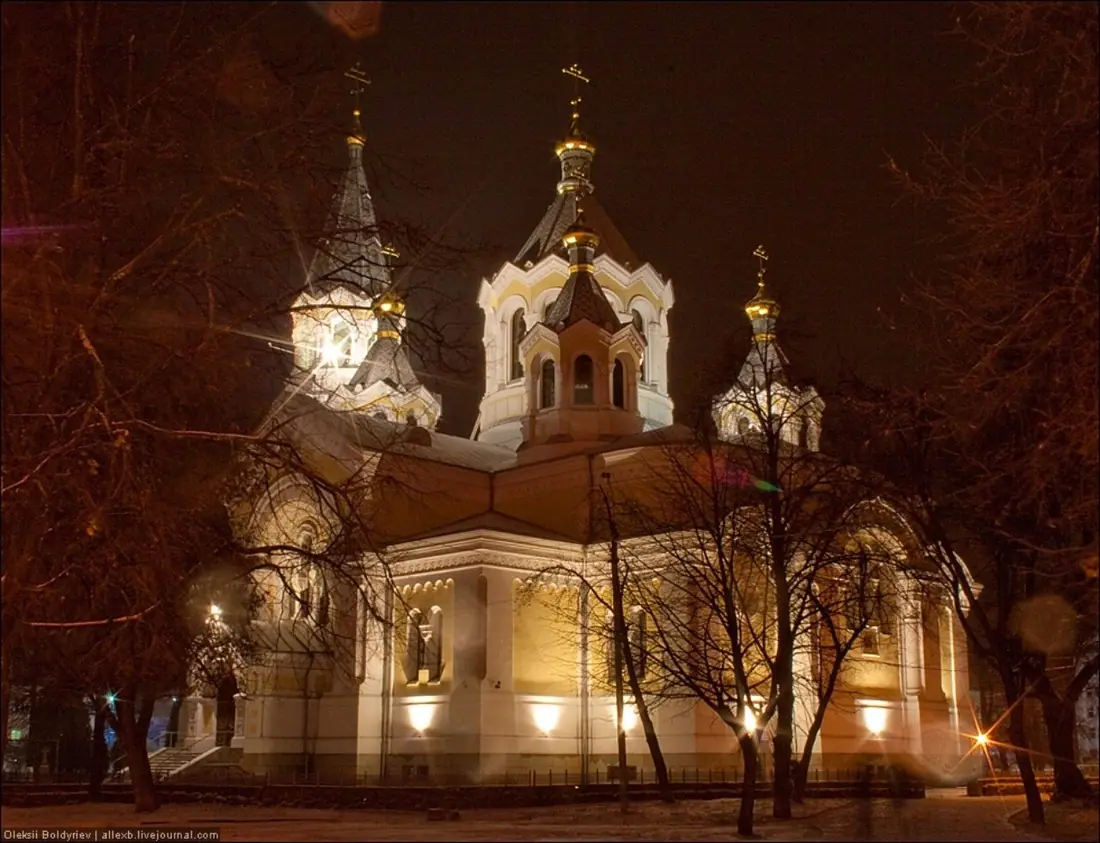
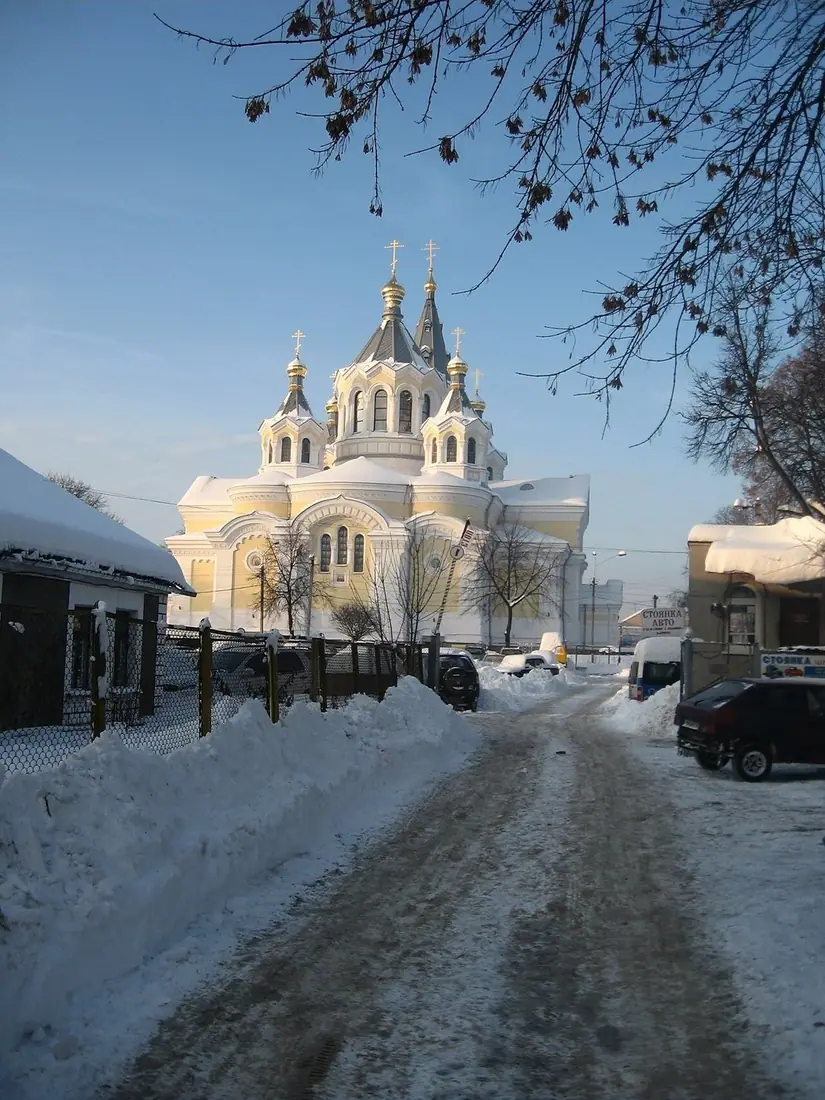
On 30 August 1874 Archbishop Agafangel consecrated the main altar. The cathedral came out cross-shaped, with three naves and five domes, and a tall bell tower rose by the west front. The walls were finished with granite and labradorite from the Zhytomyr region.
Inside stood a carved oak iconostasis made to Shalamov’s sketches. The craftsman M. Murashko built it. The walls were painted in oils, and the icons and wall paintings were the work of the academician Vasyliev. The main treasure was considered to be the ancient icon of St Basil the Great.
The Soviet years (1930-1941)
In 1930 the bells were thrown down from the bell tower. The biggest weighed about 8.2 tonnes. By the city’s general plan the cathedral was to be demolished and a House of the Red Army built in its place, but the plan was never carried out.
Sources give the closing date differently: 1931 or 1932. At first a museum was planned, but in the end a warehouse was set up. In 1932 the iconostasis was destroyed. From 1933 the building housed the state archive. In 1936 the ancient icon of St Basil vanished without a trace. Meanwhile the faithful secretly moved the remains of the bishops out of the vaults.
Services resumed in 1941, during the German occupation. They have not been interrupted since.
Today (1991 to 2025)
In 1991 the cathedral was returned to the Zhytomyr diocese. In 1993 the remains of the bishops were found and reburied in the cathedral. A warm church of St Anastasia was fitted out in the semi-basement. Today it is the working cathedral of the Zhytomyr diocese.
The land under the cathedral is a story of its own. The city council gave it to the cathedral for permanent use, and in 2023 the mayor reported that the transfer documents themselves had not been found.
Glossary
| Word | What it means |
|---|---|
| Uniate, Greek Catholic | A church that prays in the Eastern rite but recognises the authority of the Pope |
| Basilians | A Greek Catholic monastic order |
| See (kafedra) | The bishop’s seat; “moving the see” means moving his residence to another city |
| Diocese | A church region governed by a bishop |
| Cathedral | The main church of a diocese, where the bishop presides |
| Iconostasis | A wall of icons between the altar and the rest of the church |
| Side chapel (prydil) | A small altar to the side of the main one |
| Crypt | An underground space beneath a church where people are buried |
| Labradorite | A dark stone with a bluish shimmer |
| Hierarch | A bishop or archbishop |
Chronology
The numbers in square brackets are the numbers of the sources in the list at the bottom of the page. The note “according to …” means that the fact is confirmed by one source only. The section “Legends” contains traditions and legends: they are recorded in the sources but not documented.
Background: the site and the see
- 1770s
On Torhovytsia, where a Basilian church had stood (destroyed as early as 1771, according to Tumanyk), construction began on a stone Uniate Church of the Transfiguration of the Lord. According to the cathedral's website; Tumanyk writes only of the destroyed Basilian church, not of a new church. [1, 2, 13]
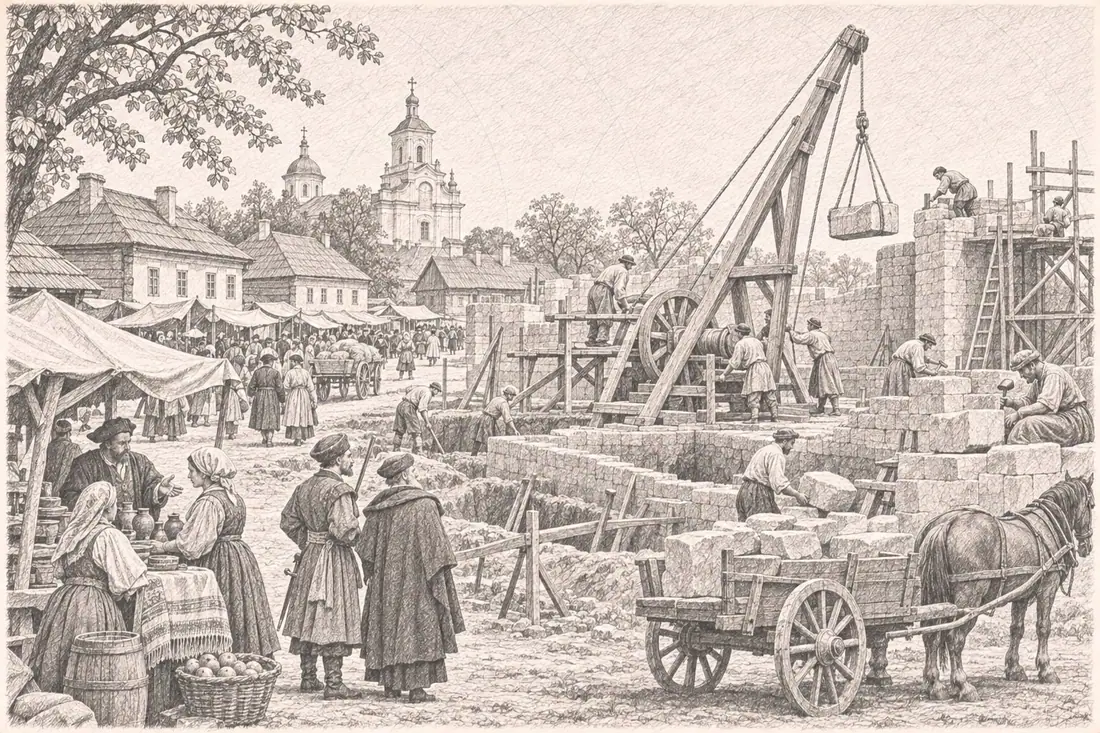
1770s: start of the church's construction at the market (conjectural reconstruction). Illustration: IKONASTONE - 1793
After the Second Partition of Poland, Volhynia and Zhytomyr passed to the Russian Empire. According to the Encyclopedia of Ukraine. [11]
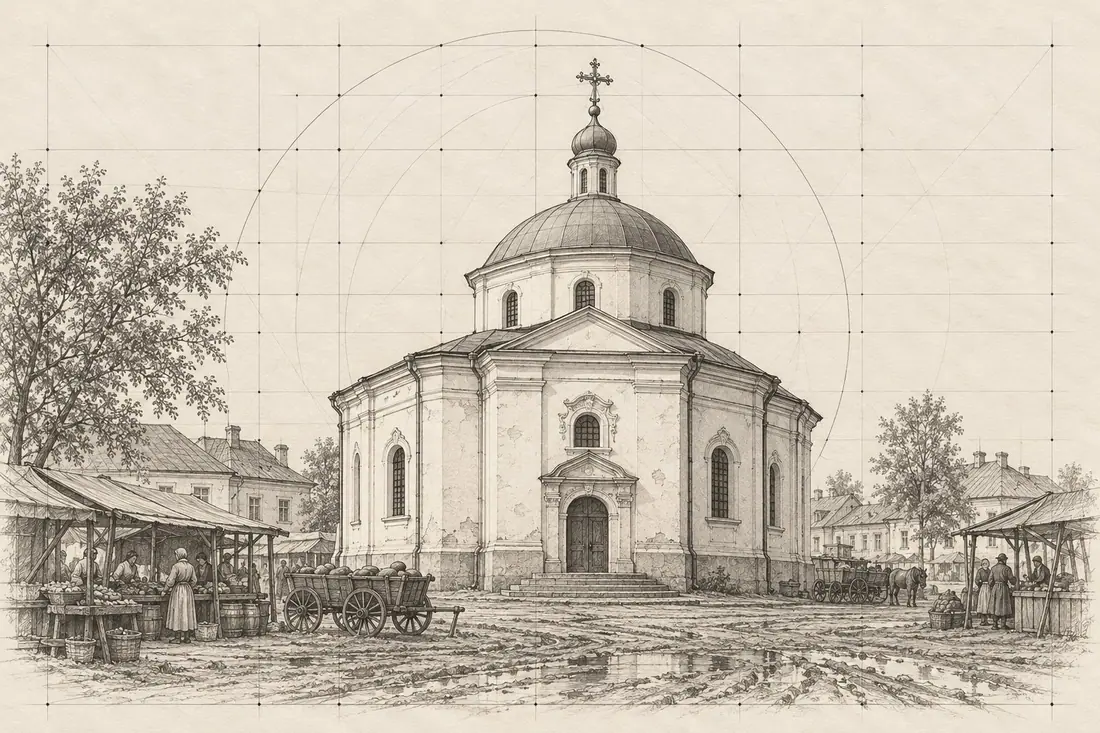
1790s: the first masonry church. Illustration: IKONASTONE - 1796
The former Uniate church was consecrated as an Orthodox one; it became the city cathedral. According to the cathedral's website. [1, 13]
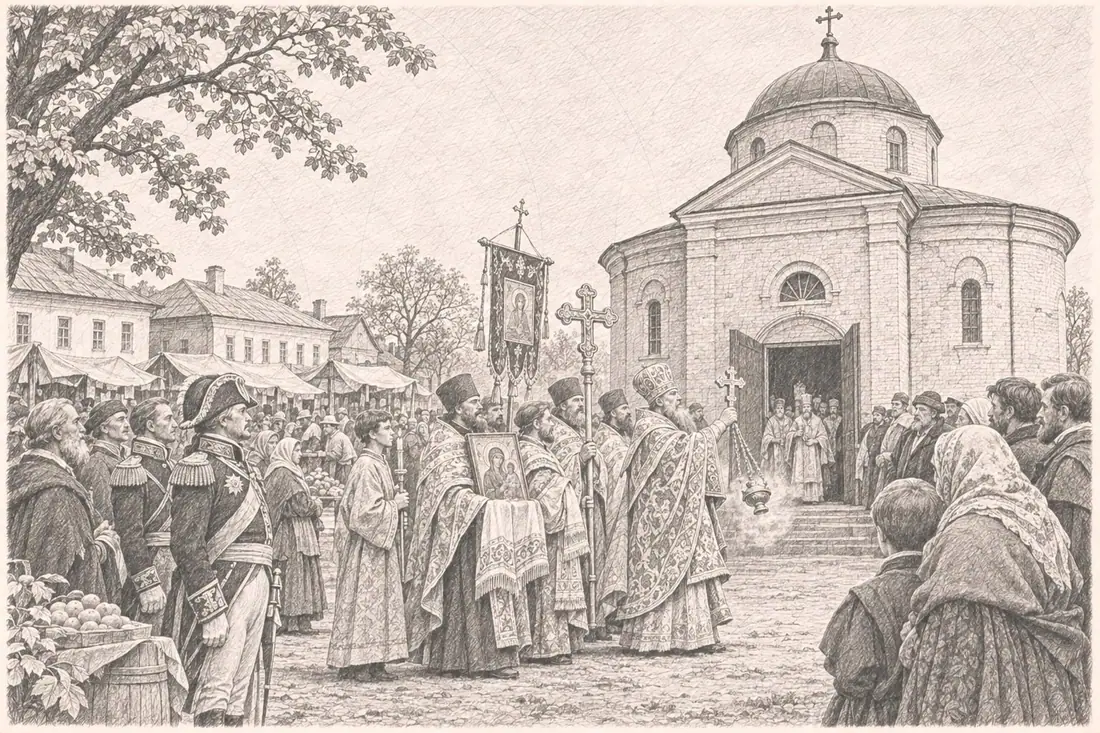
1796: re-consecration as an Orthodox church (conjectural reconstruction). Illustration: IKONASTONE - 1797
The governor's headquarters was established in Zhytomyr. According to the VUE. [12]
- 1804
On 24 June (26 June according to some sources) Zhytomyr became the centre of Volhynia Governorate and the see of the eparchy. [7, 11, 12, 13]
- 1821
Alexander I promised to think about a worthy cathedral in Zhytomyr, but this had no practical consequences. According to Tumanyk. [2]
- 1840
On 1 October the episcopal see was moved to Zhytomyr (the cathedral's website gives 1841). Earlier it had been in Ostroh, Annopil and the Pochaiv Lavra, and the cathedral at first occupied an old wooden building of a post station. [1, 2, 7, 13]
The first construction and the collapse
- 1844
A design was drawn up in St Petersburg that provided for using the walls of the old church; the author is not named. [1, 2, 7, 8]
- 1851
Construction began on Torhovytsia. [1, 2, 3, 5, 6, 7, 8, 10]
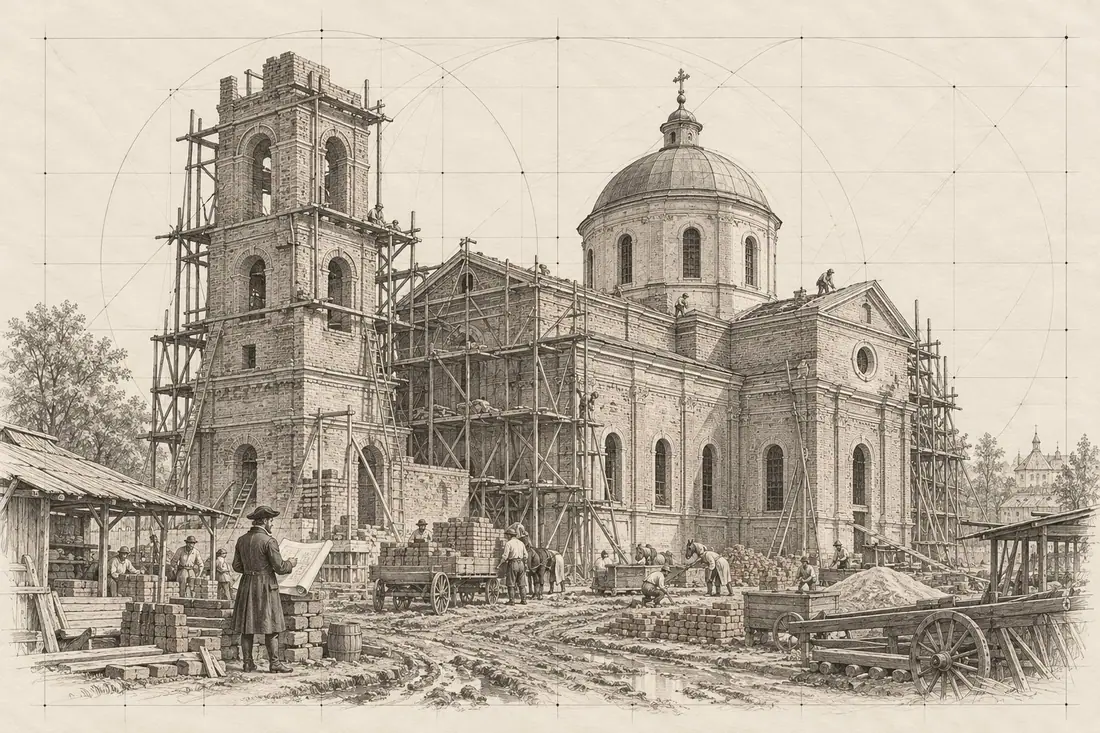
1851–1852: the first construction of the cathedral. Illustration: IKONASTONE - 1853
The almost finished cathedral collapsed: the bell tower fell and destroyed a significant part of the church. The causes given by the sources are errors in the calculations and weak local brick. [1, 2, 3, 6, 7, 8, 10]
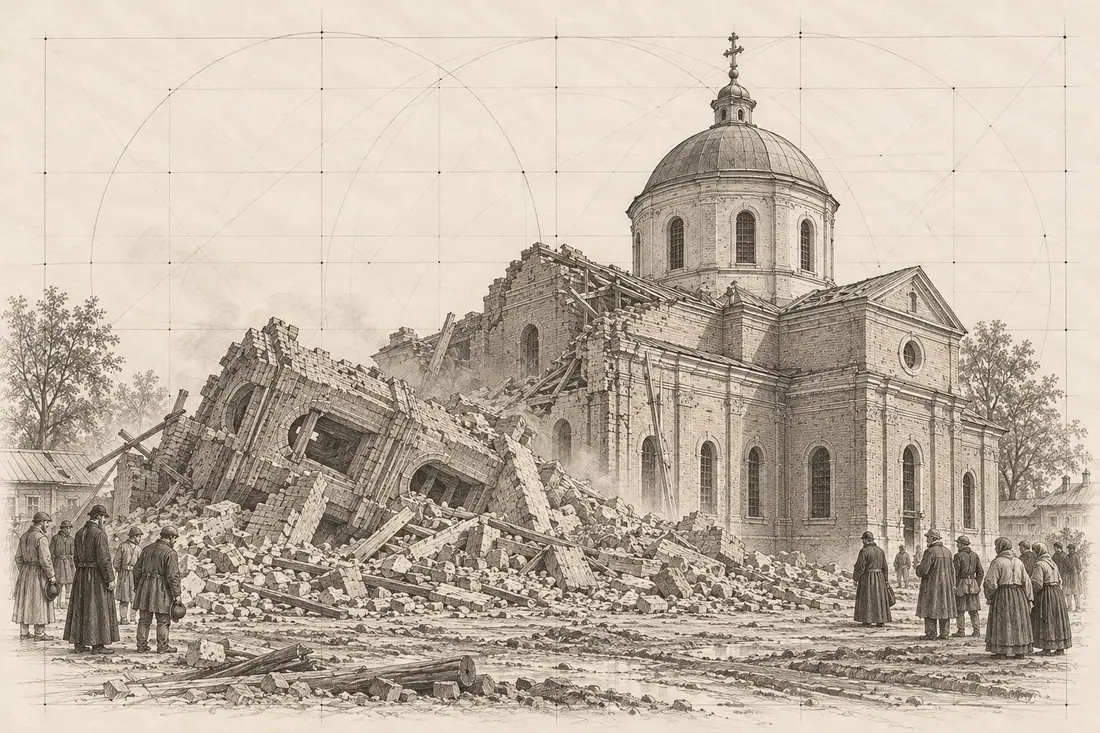
1853: after the collapse of the bell tower. Illustration: IKONASTONE - 1858
A temporary wooden church stood by the ruins: according to the cathedral's website, a Transfiguration church; according to Tumanyk and Kiev Tour, a church of St Alexander Nevsky (Hilarion's). [1, 2, 7]
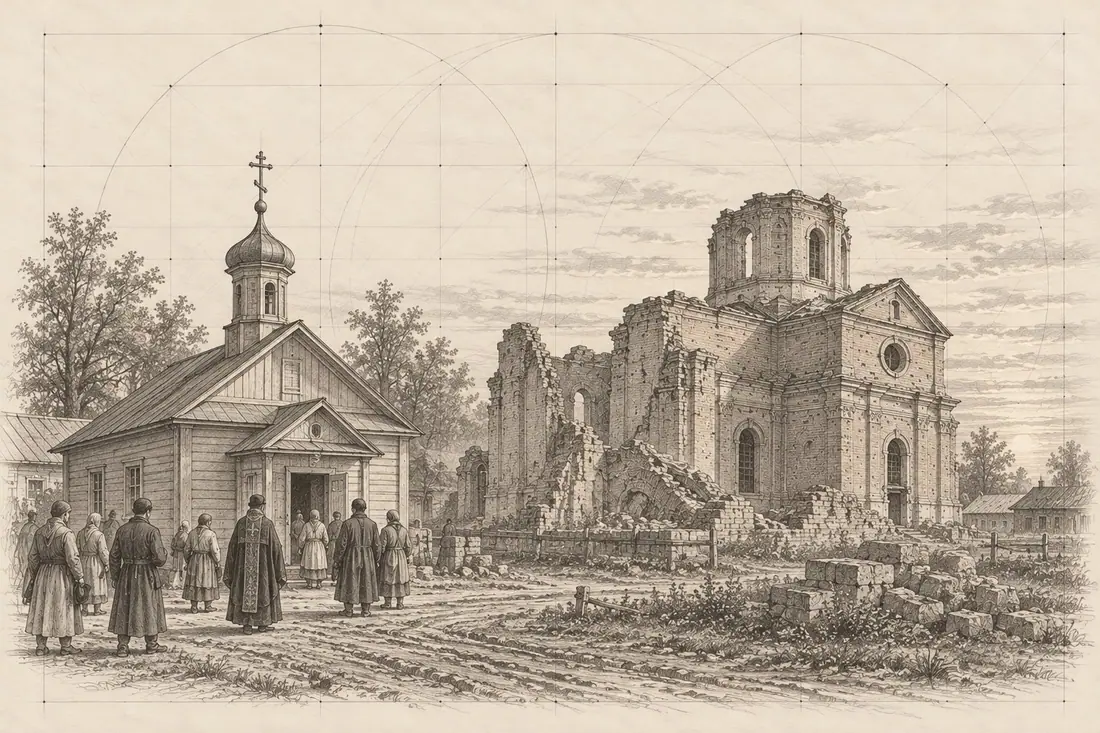
1858: the temporary church. Illustration: IKONASTONE - 1861
Beside the cathedral, on Cathedral Square, stood a chapel commemorating the abolition of serfdom (19 February 1861). According to Telegraf. [21]
- 1864
The ruins of the first cathedral were dismantled (the cathedral's website gives 1865). [1, 3, 13]
The new cathedral
- 1866
The new cathedral was founded slightly south of the previous one. Construction was supervised by a special commission; according to Tumanyk, it was headed by the engineer-colonel Ottobald Glaser. [2, 6, 7]
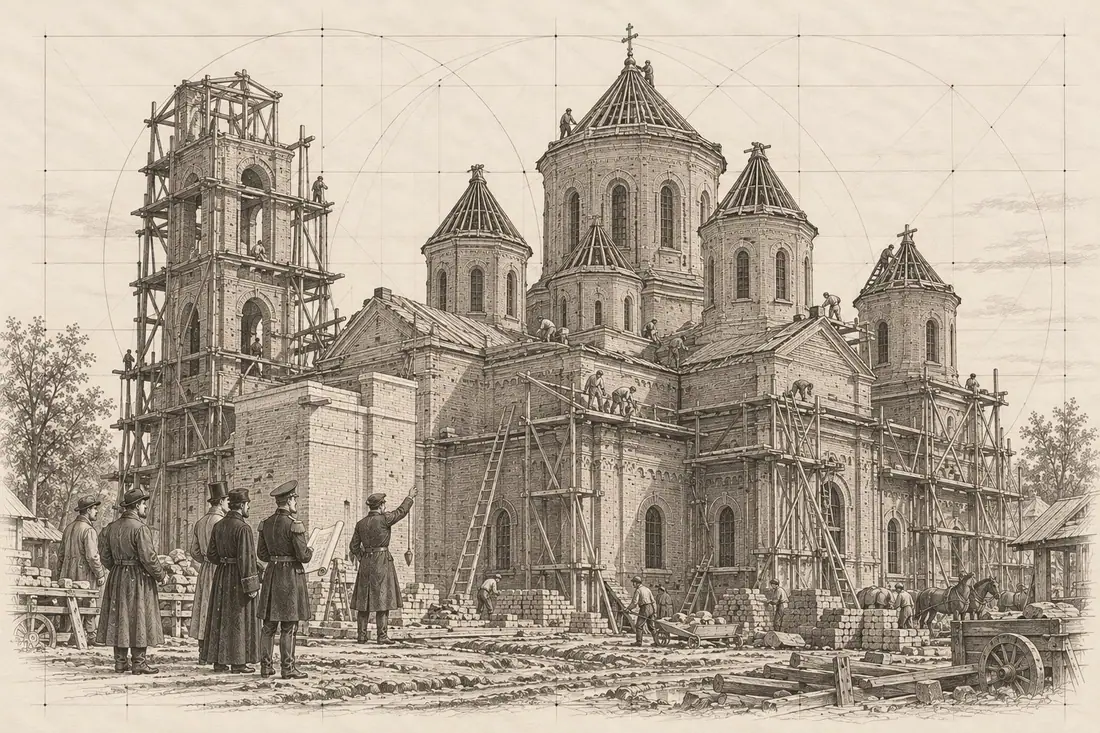
1866–1872: building the new cathedral. Illustration: IKONASTONE - 1866–1874
The design was prepared by K. Rahau (Rochau), E. Gibert and V. Shalamov; the cathedral's website names Baron von Mikwitz as the author of the original concept, with Karl Majewski, Gibert and Rochau refining it. [1, 2, 3, 7]
- 1866–1874
The chief contractor was the Zhytomyr first-guild merchant Kypriian (Kupriian) Liashkov; according to Tumanyk and Zhytomyr Day, after the work was completed he received personal nobility and the post of city mayor. [2, 6]
- 1871
The Volhynia governorate administration decided to close the neighbouring shops and create a city park around the cathedral; it was laid out in 1886. According to Kiev Tour. [7]
- 1874
On 30 August Archbishop Agathangel (Solovyov) of Volhynia consecrated the main altar of the three-altar cathedral. According to sobory.ru, the right side chapel was consecrated the next day, and the left one on 1 September (by Bishop Justin of Ostroh). [2, 3, 7]
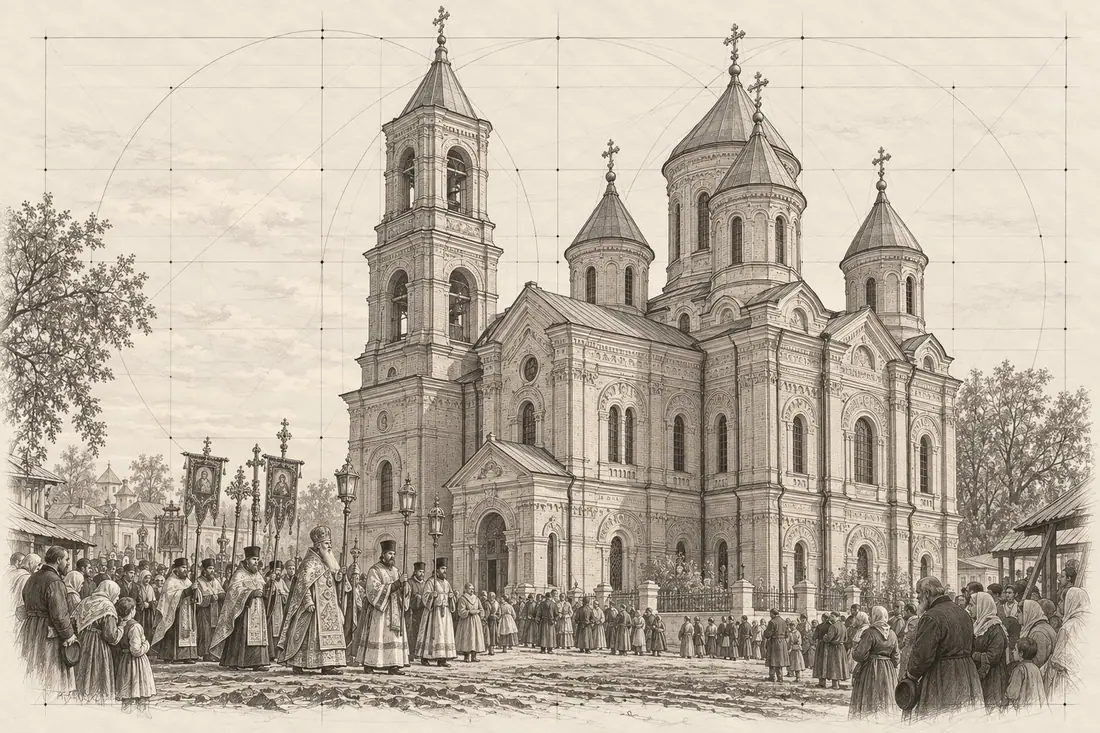
1874: the consecration of the cathedral. Illustration: IKONASTONE - 1874
The construction cost 336,865 roubles, not counting icons and furnishings. [2, 6, 7]
Imperial heyday
- 1876
On 8 March Archbishop Agathangel died in Zhytomyr; he is buried in the cathedral. [2, 14]
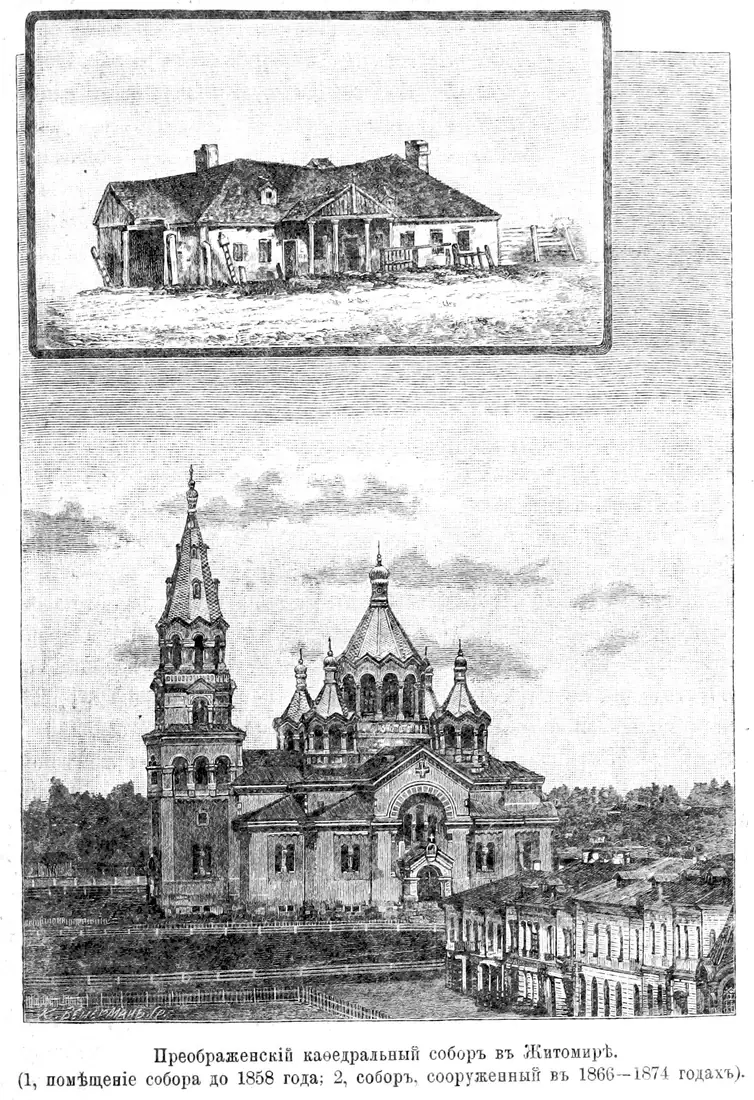
The Transfiguration Cathedral in Zhytomyr: the building before 1858 and the cathedral of 1866–1874, 19th-century engraving. Wikimedia Commons, public domain - 1885
Archbishop Tikhon (Pokrovsky) died; according to the cathedral's website and Tumanyk, he is buried in the crypt. [1, 2]
- 1888
According to a 1888 description, the cathedral's main bell weighed 515 poods 8 pounds (about 8.4 t). According to sobory.ru. [3]
- 1902
On 13 April Archbishop Modest (Strelbitsky) died; according to the cathedral's website and Tumanyk he is buried in the crypt, according to Azbyka — in the Pochaiv Lavra. [1, 2, 15]
- 1902–1903
According to the cathedral's website, Archbishop Anthony (Khrapovitsky) arranged in the lower church a side chapel of St Anastasia the Roman and moved her head there; according to Zhytomyr Day, the lower church opened in 1903. Azbyka and Zhytomyr Day link the arrival of the head with Archbishop Modest (1860s), which does not agree with the years of his ministry. [1, 6, 16]
The Soviet period and the war
- 1930
Under the general plan of Zhytomyr the cathedral was to be demolished and a Red Army House built in its place; the war prevented the plan from being carried out. According to sobory.ru, that same year the bells were thrown down from the bell tower and handed in as scrap, the largest weighing 8.2 t (Zhytomyr Day dates this to 1931). [2, 3, 6, 7]
- 1931
The cathedral was closed to services (sobory.ru gives 1932). A museum was planned, but a warehouse was set up; the crypts were desecrated, and believers secretly moved the remains of the hierarchs. [1, 2, 3, 6]
- 1932
The iconostasis and the icon case were destroyed. According to the cathedral's website and sobory.ru. [1, 3]
- 1933
The building was handed over to a state archive. [1, 2]
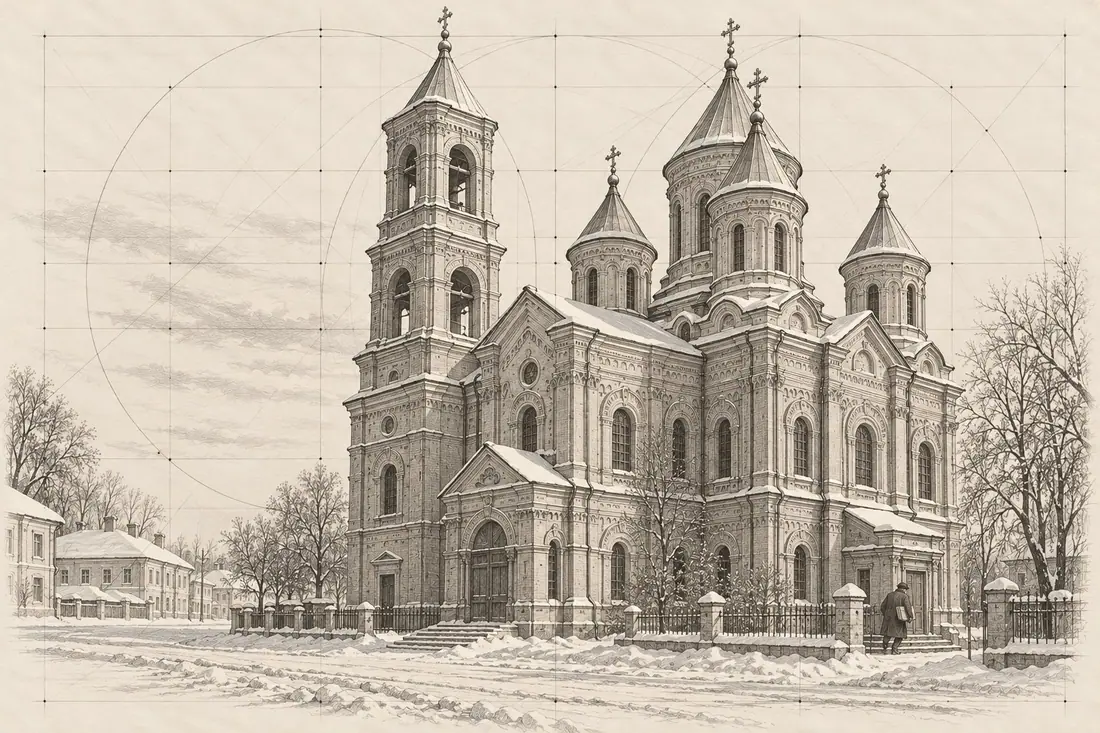
1933: the cathedral turned into an archive. Illustration: IKONASTONE - 1936
The ancient icon of St Basil the Great vanished without trace. According to Via Regia. [5]
- 1941
Under the German occupation services resumed and have not been interrupted since. [1, 2, 6, 18]
- 1988
A monument marking the 1000th anniversary of the Baptism of Rus was erected beside the church. According to the cathedral's website. [1]
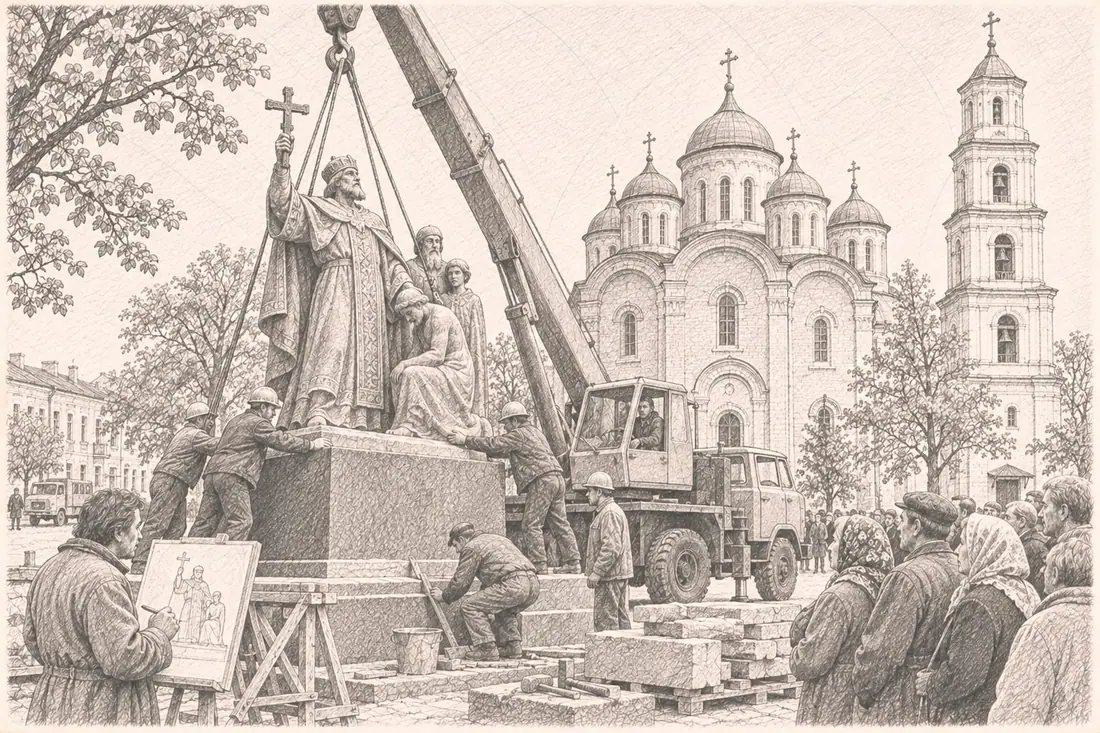
1988: the monument to the 1000th anniversary of the Baptism (conjectural reconstruction). Illustration: IKONASTONE
Recent history
- 1991
The cathedral, whose basement level had until then served as a warehouse, was handed over to the Zhytomyr eparchy. [6, 13]
- 1993
The remains of the hierarchs were found and reburied in the cathedral. On 22 June of the same year the eparchy was renamed the Zhytomyr and Novohrad-Volynskyi eparchy (according to Tumanyk). [1, 2, 13]
- 2011–2018
The city council granted the cathedral permanent use of the land plot at 14 Peremohy Square. According to Suspilne (2023). [17]
- 2023
In April the city council studied the archives; the mayor reported that no documents on the transfer of the plot to the cathedral had been found. [18, 19]
- 2025
On 13 April (Palm Sunday) a liturgy was held in the cathedral, led by Metropolitan Nikodim of Zhytomyr and Novohrad-Volynskyi; the UOC eparchy presents the cathedral as a functioning one. [20]
Lost and recreated
| What | What there was | What happened | Where it is now |
|---|---|---|---|
| The ancient church on Torhovytsia | A Basilian church, then an 18th-century Uniate church | Destroyed (1771) or rebuilt; fragments were to be incorporated into the new cathedral (1844 design) | Not preserved; the cathedral occupies the site [1, 2, 8, 13] |
| The first cathedral | Construction 1851–1853 | Almost finished, it collapsed in 1853 | Ruins dismantled in 1864; the new one built slightly to the south [2, 3, 6, 7] |
| The first bell tower | Part of the cathedral in 1851–1853 | Fell in 1853 | A new bell tower, about 60 m, four-tier (three-tier according to Tumanyk) [2, 6, 9, 10] |
| The temporary wooden church | 1840–1858 / 1858 | Existed until the new cathedral was completed | Not preserved [1, 2, 7] |
| The iconostasis | Oak, to Shalamov’s sketches, craftsman Murashko | Destroyed in 1932 | A different iconostasis is in use now [1, 3] |
| The bells | Before the revolution the main one was 515 poods 8 pounds | According to sobory.ru, thrown down in 1930, the largest 8.2 t | Main bell 500 poods (Via Regia; Zhytomyr Day — 8 t); Turpravda writes of a new 750 kg bell [3, 5, 6, 9] |
| The icon of St Basil the Great | Chief shrine; according to tradition brought by Volodymyr (an image from St Basil’s Church in Ovruch) | Vanished without trace in 1936 | Lost [3, 5] |
| The head of St Anastasia the Roman | Lower church, side chapel | Disappeared under Soviet rule; according to Azbyka it reappeared in 1941 and vanished again | Whereabouts unknown [1, 16] |
| Burials of the hierarchs | Crypt (Agathangel, Tikhon; according to the website, Modest as well) | In 1931 the crypts were desecrated and the remains hidden | Found and reburied in 1993 [1, 2, 13] |
| Services | 1874–1931 | Interrupted by the closure | Resumed in 1941, without interruption [1, 2, 6] |
| The space around the cathedral | Shops on Torhovytsia | In 1871 it was decided to close them; the park was laid out in 1886 | Cathedral Square and the public garden [7, 21] |
Architecture
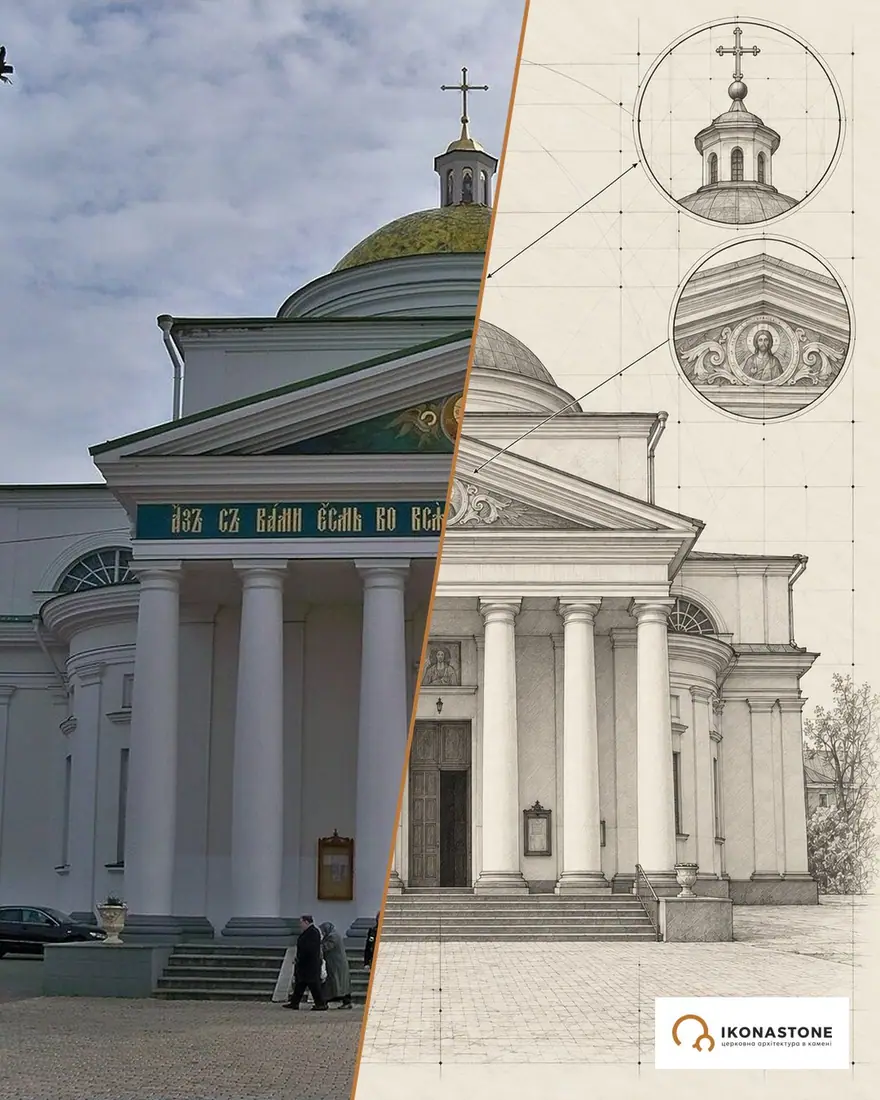
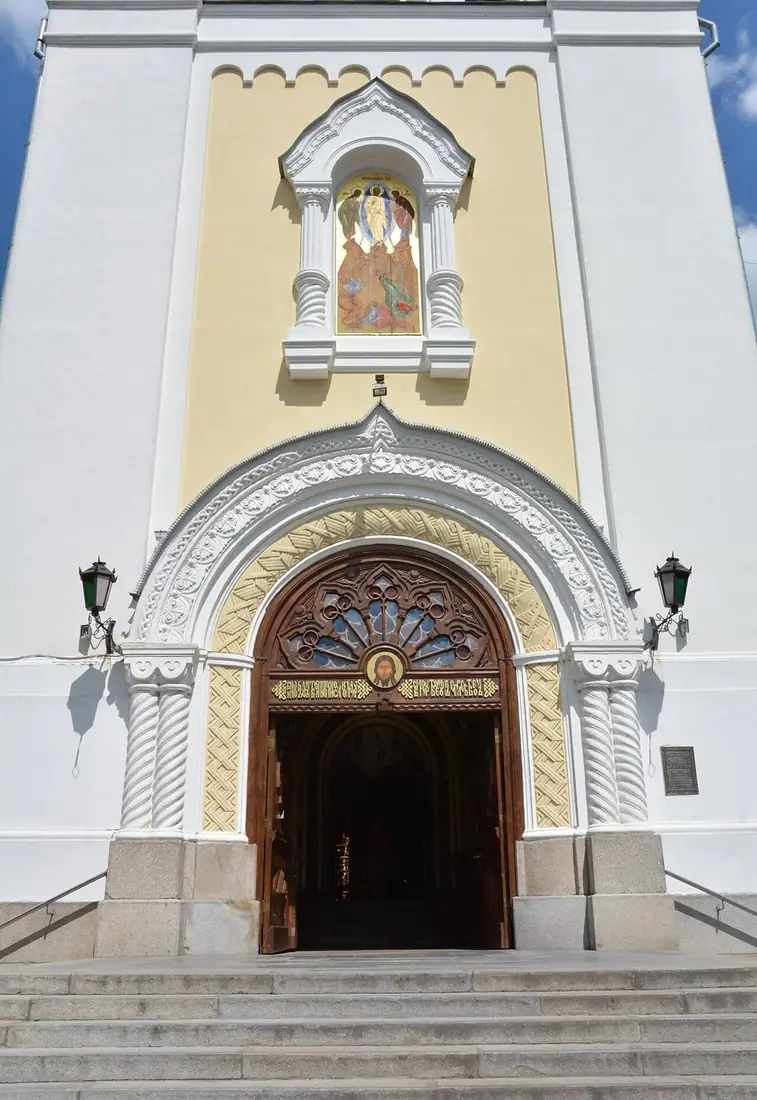
The style of the cathedral is Russian-Byzantine in an eclectic interpretation; Via Regia and travels.in.ua also see in it motifs of 11th–12th-century Old Rus architecture. In plan the church is cruciform and three-aisled. Five domes with tented tops rise above it. A four-tier bell tower adjoins the west front — the very part whose collapse in 1853 halted the first building.
The spherical domes and lacy patterns of the facades, according to Discover Ukraine, make the heavy structure look lighter. Travels.in.ua calls the cathedral a symbol of Zhytomyr and one of the largest Orthodox churches in Ukraine. The sources give different heights: 50 or 53 metres for the cathedral, about 59.6 metres for the bell tower.
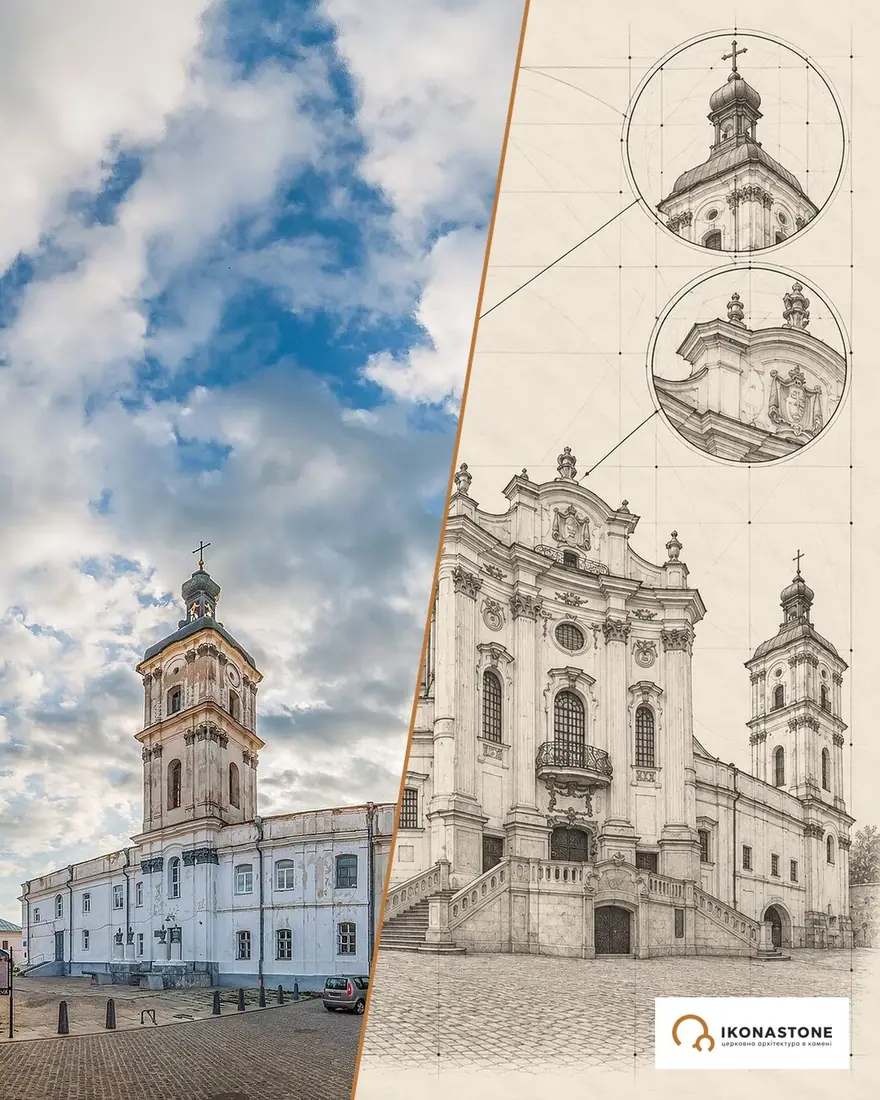
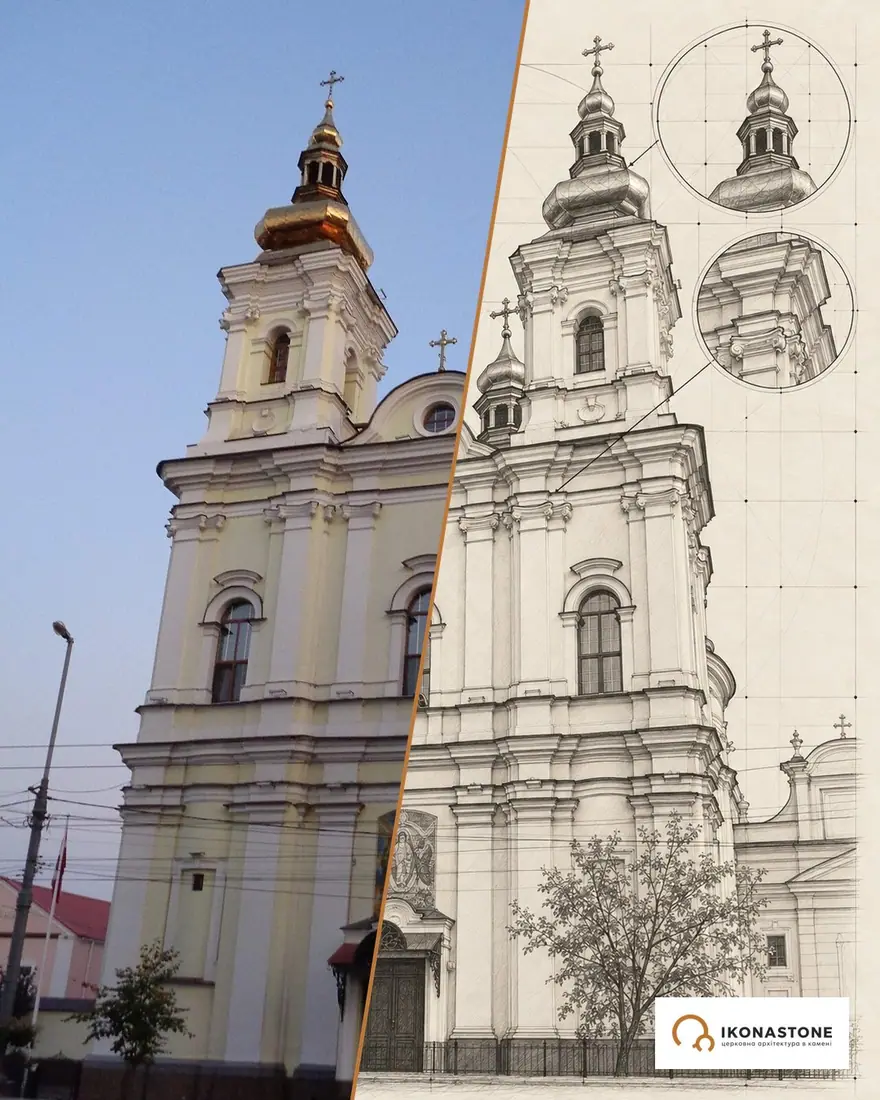
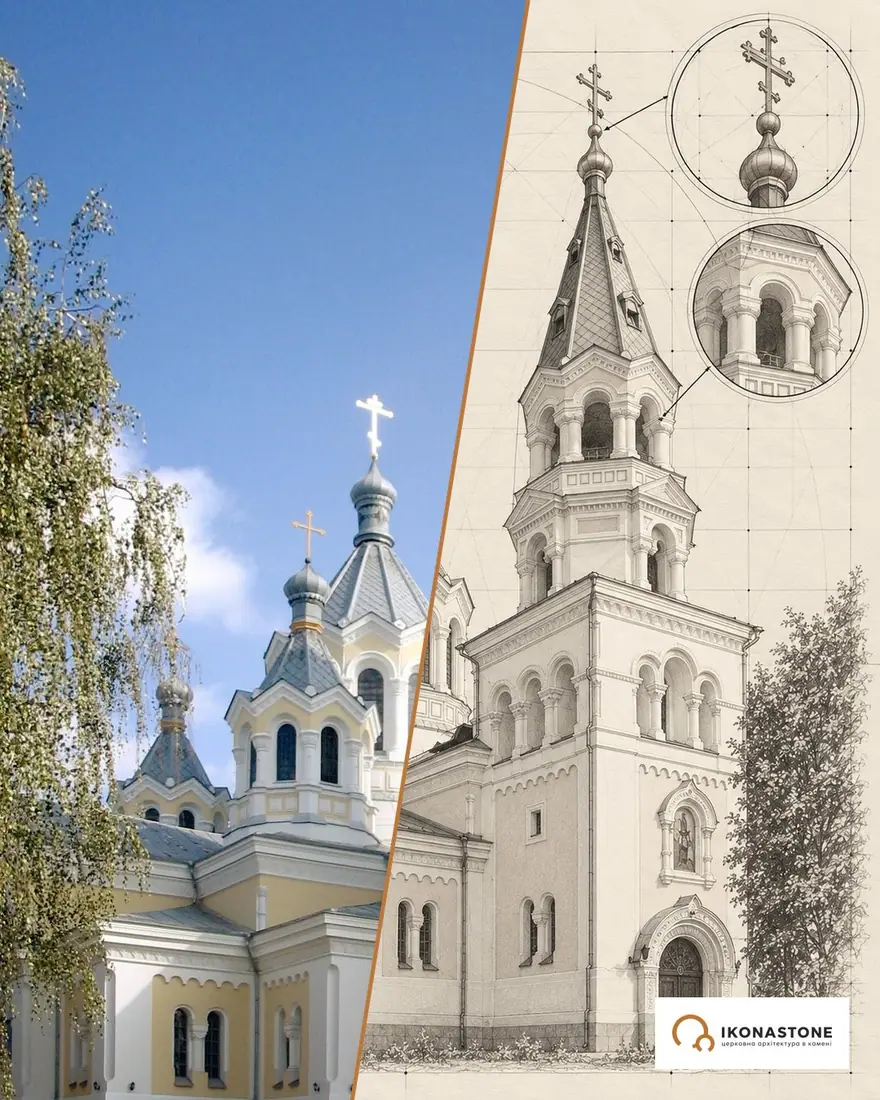
Below are two elements of the church, shown in a photograph and in a drawing. The drawings show form, not exact dimensions.
The bell tower
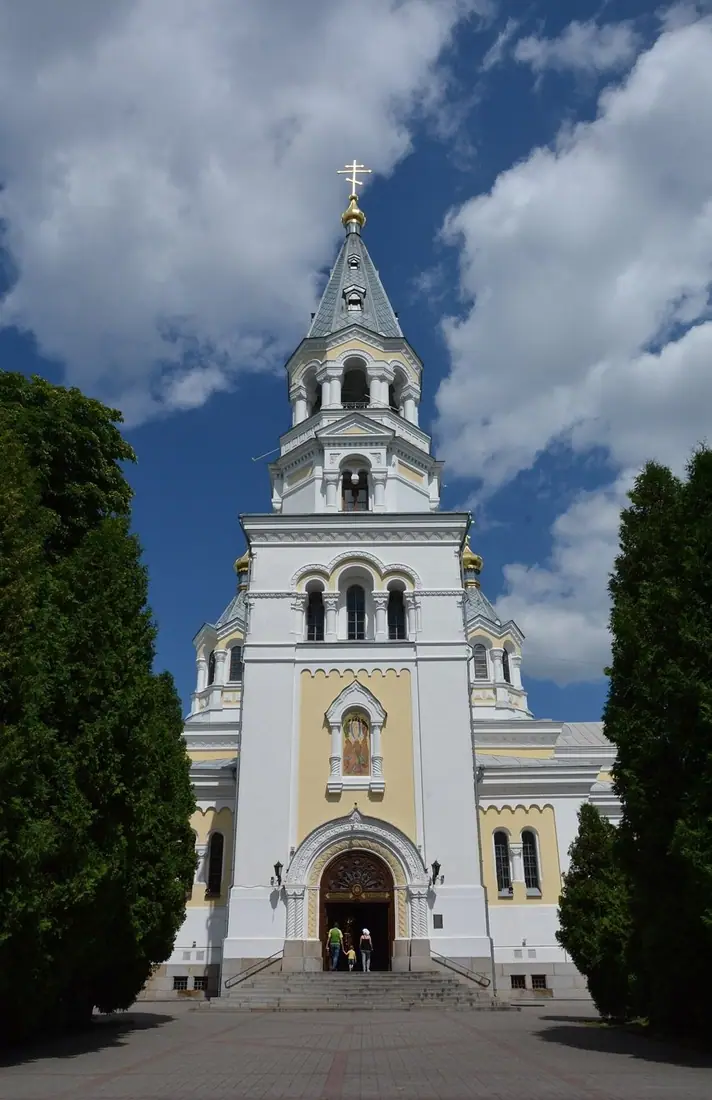
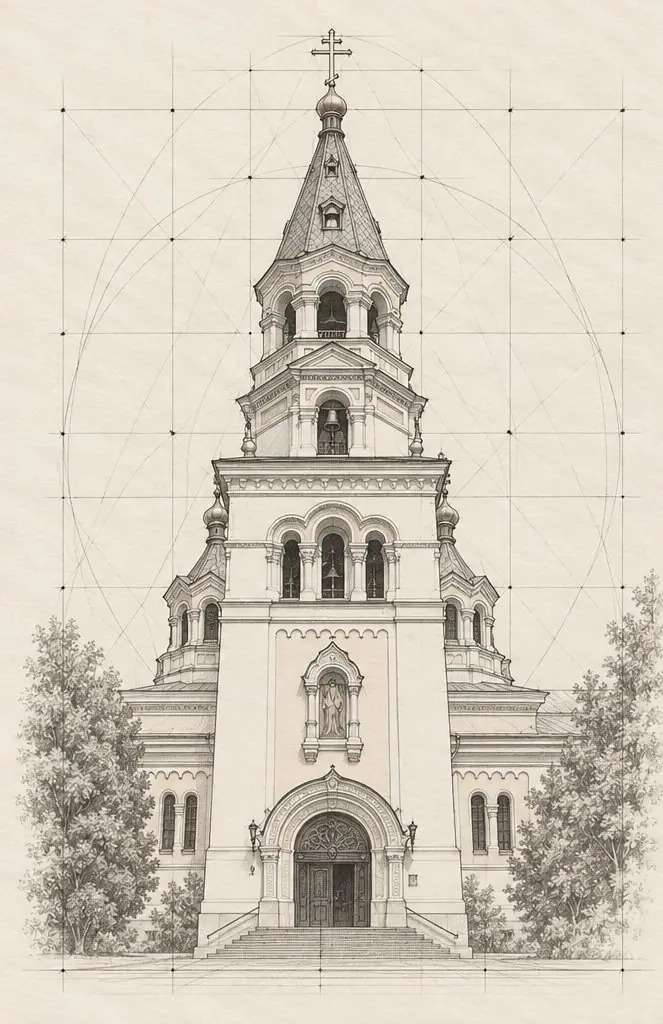
The four-tier bell tower adjoins the west front and, according to sobory.ru, reaches about 59.6 metres — higher than the cathedral itself. After the collapse of 1853 it was this part that became the builders’ main test.
Domes with tented tops
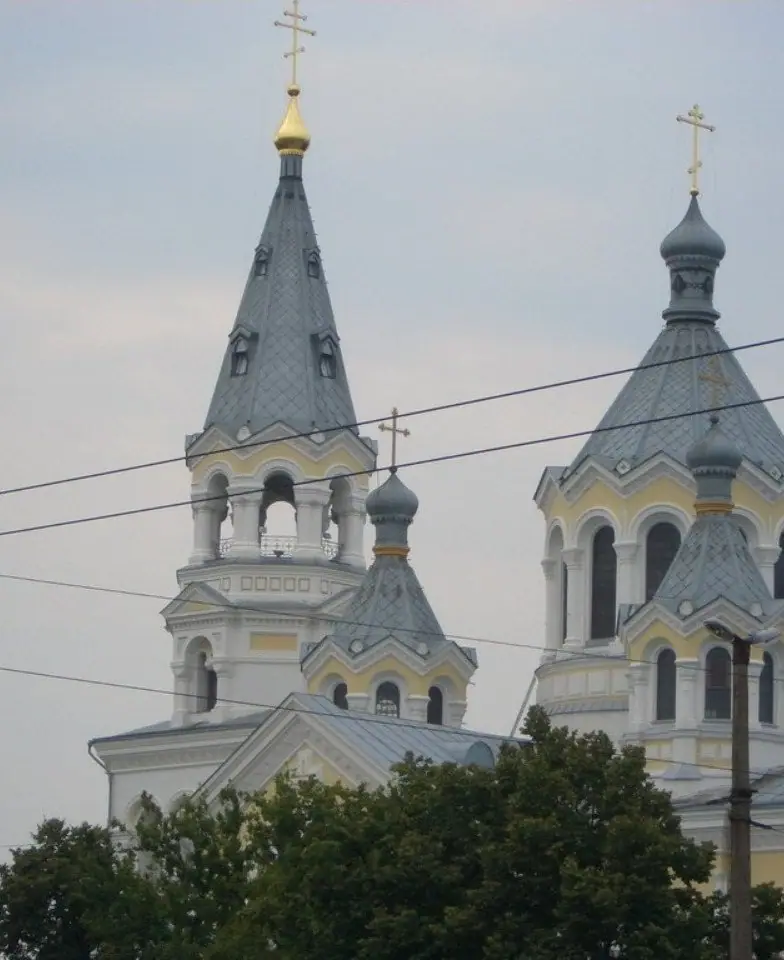
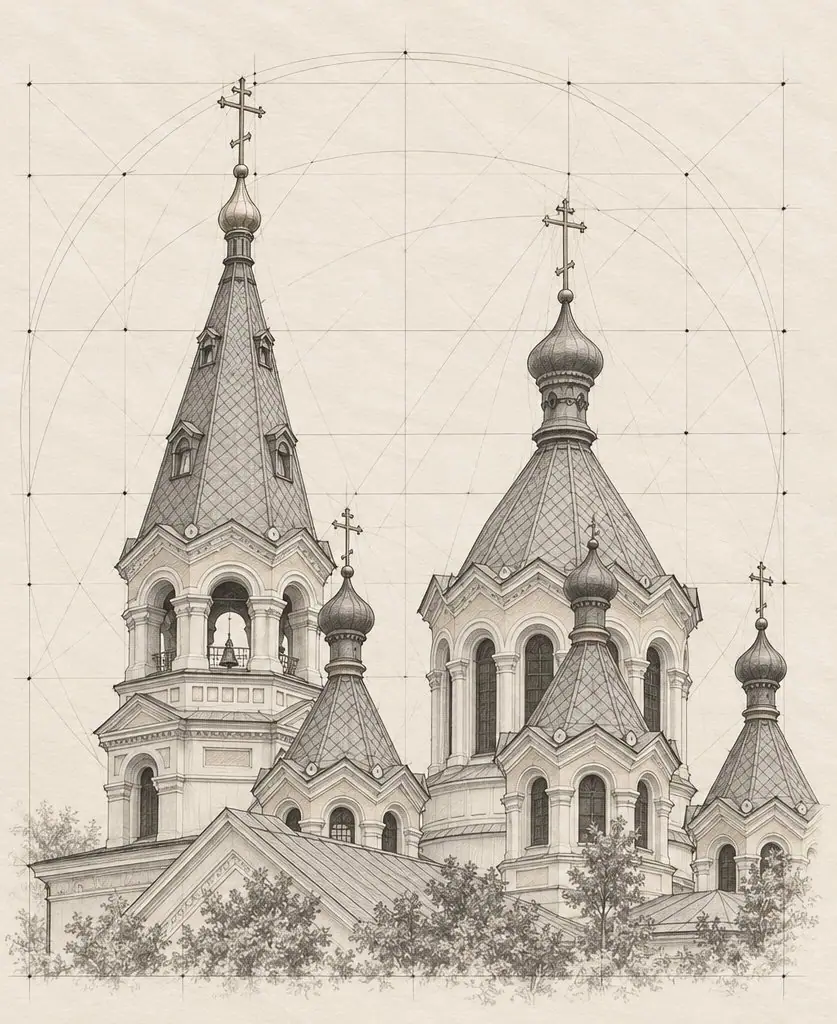
Five domes stand above the cruciform three-aisled plan and have tented tops. They add sharpness to the silhouette, while the spherical forms of the domes, according to Discover Ukraine, together with the lacy decoration of the facades lighten the massive volume.
Details that are easy to miss
The contractor who became a nobleman. Zhytomyr-day.com writes that the chief contractor of the building, the merchant Kupriian Liashkov, received nobility after the work was completed and became city mayor. The same is written in A. Tumanyk’s article in the Bulletin of TDABU (2019), but both texts probably rely on a common source, so we have seen no documentary confirmation.
The mistake was corrected by people from great building projects. After the collapse, according to Discover Ukraine, specialists who had worked on St Isaac’s Cathedral were invited to the site; the cathedral’s website mentions the builders of the Cathedral of Christ the Saviour. This is a rare case where a church’s history directly preserved the memory of an engineering failure and of how it was remedied.
A bell heard twenty kilometres away. In 1930 the old bells were thrown down from the bell tower and sent for scrap; the largest, according to sobory.ru, weighed about 8.2 tonnes. Now, according to Via Regia, the cathedral’s main bell weighs 500 poods — about eight tonnes — and can be heard twenty kilometres away; Turpravda, by contrast, writes that the new main bell weighs 750 kg and that the original, of over 8 tonnes, was taken down. The bell tower, because of whose collapse the whole design was once reworked, has a voice again, although the weight of the new bell differs between sources.
The icon brought by Volodymyr is a tradition. According to tradition, the icon of St Basil the Great was brought from Byzantium by Prince Volodymyr after his baptism. According to Via Regia, it vanished without trace in 1936; sobory.ru mentions that the iconostasis and the icon case in which it was kept were destroyed when the church was closed. Both versions agree on one thing: the icon is no more.
A church beneath a church. A warm Church of St Anastasia has been arranged in the semi-basement of the cathedral. According to the cathedral’s website, the side chapel of the Holy Martyr Anastasia the Roman was arranged in 1902–1903 by Archbishop Anthony (Khrapovitsky); her head was kept here and disappeared under Soviet rule. According to sobory.ru, particles of relics are now kept in the cathedral, among them those of St Theodore of Ostroh.
Zero on the city map. According to the cathedral’s website, the south-western corner of the 60-metre bell tower serves as the zero point of coordinates for the city maps of Zhytomyr. The vertical that once fell has become the point of reference.
The crypt the faithful protected. According to the cathedral’s website and A. Tumanyk’s article, Archbishops Agathangel, Tikhon and Modest were buried in the crypt; according to Azbyka (azbyka.ru), Modest is buried in the Pochaiv Lavra. When in the early 1930s the church was turned into a warehouse, the tombs were ransacked and the faithful secretly moved the remains to a safe place. In 1993 they were found and reburied in the cathedral.
Photo gallery
Stone and material
The walls of the cathedral are built of brick — and it was the brick, as Discover Ukraine explains, that failed the first building. The second building remembered this lesson. The finishes, however, are made of granites and labradorites from the Zhytomyr region. This is a rare case where a provincial cathedral was clothed in stone quarried literally underfoot: the Zhytomyr land is known precisely for these rocks.
Labradorite has a particular property — iridescence: at a certain angle of light, blue and green flashes ignite on its dark surface. In a church this means that the stone changes together with the person moving through the space, and together with the light from the windows or candles. Granite beside it works as a calm background, without any flashes. The pair is chosen precisely: one stone speaks, the other holds the pause. The carved oak iconostasis, of which the sources write, adds a third voice to this conversation — a warm material amid the cold.
Stone has one inconvenient trait: it remembers mistakes well. The Zhytomyr cathedral is a story of how a mistake in material or structure costs decades. That is why in a church the question of stone is best settled before it reaches the machine — from columns and capitals to the floor. The possibilities of stone sanctuary furnishings are discussed in the article “Stone iconostasis”.
Another church in the Zhytomyr region where local stone can be seen in the masonry itself is St Basil’s Church in Ovruch. And how granite was worked a thousand years before Zhytomyr can be seen in Saint Sophia Cathedral in Kyiv.
Did you know
The second cathedral cost 336,865 roubles over eight years (1866–1874), not counting icons and furnishings. [2, 6, 7]
The new cathedral was placed slightly south of the ruined first one. [6, 7]
So as not to repeat the mistakes, specialists who had worked on St Isaac's Cathedral in St Petersburg were brought to the site; the cathedral's website instead names the builders of the Cathedral of Christ the Saviour in Moscow. [1, 3, 10]
The cathedral has three altars: the Transfiguration, St Prince Volodymyr and St Alexander Nevsky; below — the Anastasia one. [3, 7]
Until 1840 the episcopal see was in Ostroh, Annopil and Pochaiv, and in Zhytomyr it was at first housed in the wooden building of a post station. [2, 7]
As early as 1821 Alexander I said he would think about a worthy cathedral in Zhytomyr; this had no practical consequences. According to Tumanyk. [2]
In 1871 the governorate administration decided to close the surrounding shops and create a park; it was laid out in 1886. According to Kiev Tour. [7]
According to the cathedral's website, the south-western corner of the bell tower serves as the zero point of coordinates for the city maps of Zhytomyr. [1]
According to a 1888 description, the cathedral's main bell weighed 515 poods 8 pounds, that is, about 8.4 t. According to sobory.ru. [3]
Some texts call the architect Shalamov Varlam; Tumanyk and sobory.ru write Volodymyr Hryhorovych. [2, 3, 6]
Tumanyk describes the bell tower as three-tier with a faceted tent roof, other sources as four-tier and about 60 m high. [2, 6, 9, 10]
Beside the cathedral stood a chapel commemorating the abolition of serfdom. According to Telegraf. [21]
The VUE preserves photographs of the city, among them a picture with the cathedral dated 31 December 1941. [12]
On the sobory.ru page the year of construction is given as “between 1857 and 1874”; the ESU and VUE give 1866–1874. [4, 11, 12]
According to sobory.ru, a reliquary with particles of the relics of Theodore of Ostroh, Julianna Olshanska and Macarius of Ovruch is kept near the right choir. [3]
Legends
The icon from Prince Volodymyr
According to tradition, the ancient icon of St Basil the Great was brought from Byzantium by Prince Volodymyr after his baptism; sobory.ru adds that the image came from St Basil's Church in Ovruch. Via Regia presents this as fact; the icon vanished in 1936. [3, 5]
The contractor who became mayor
The merchant Kypriian Liashkov, according to Tumanyk and Zhytomyr Day, received nobility and the post of city mayor for the successful completion of the building. Both texts probably have a common source. [2, 6]
The head of Anastasia
According to tradition, the head of St Anastasia the Roman was a gift from Patriarch Hieronymus (Hierotheus) of Antioch; according to Azbyka, it was brought by Archbishop Modest of Volhynia. [6, 16]
The shrine that reappeared
According to a tradition of the faithful cited by Azbyka, the head of Anastasia vanished in the Soviet years, reappeared in 1941 and vanished again. [16]
The remains in a hiding place
According to the cathedral's website, when the crypts were ransacked in 1931, believers secretly moved the remains of the hierarchs elsewhere; in 1993 they were found and reburied. [1]
A bell heard twenty kilometres away
According to Via Regia, the cathedral's bells can be heard at a distance of up to 20 km. [5]
Figures
- Agathangel (Solovyov) — Archbishop of Volhynia and Zhytomyr, consecrated the cathedral on 30.08.1874; died 8.03.1876, buried in it.
- Karl Karlovych Rahau (Rochau) — academician of architecture, principal author of the design of the second cathedral; a pupil of K. Thon.
- Ernest Ivanovych Gibert — professor of architecture, co-author of the design, supervised the work as author.
- Volodymyr Hryhorovych Shalamov — co-author of the design, author of the iconostasis sketches.
- Baron von Mikwitz — according to the cathedral’s website, author of the original concept.
- Karl Majewski — according to the cathedral’s website, refined the drawings.
- Ottobald Glaser — engineer-colonel, head of the commission of 1866 (according to Tumanyk).
- Kypriian (Kupriian) Liashkov — first-guild merchant, chief contractor.
- Mykhailo Vasilyev — professor of historical painting, author of the icons and wall paintings (in sobory.ru — “F. Vasilyev”).
- Mykola (A.) Murashko — the craftsman who made the oak iconostasis.
- Tikhon (Pokrovsky) — Archbishop of Volhynia, died 1885, buried in the crypt.
- Modest (Strelbitsky) — Archbishop of Volhynia from 1889, died 13.04.1902; the place of burial is disputed.
- Anthony (Khrapovitsky) — archbishop; according to the cathedral’s website, arranged the side chapel of St Anastasia (1902–1903).
- Alexander I — in 1804 made Zhytomyr a provincial centre; in 1821 promised to think about the cathedral.
- Justin — Bishop of Ostroh, according to sobory.ru consecrated the left side chapel on 1.09.1874.
How to cite
IKONASTONE. The Transfiguration Cathedral in Zhytomyr // Guide to the Churches of Ukraine. URL: https://ikonastone.com/en/guide/transfiguration-cathedral-zhytomyr/ (accessed DD.MM.YYYY).
Not sure what the piece is called? Walk through the church from sanctuary to churchyard →
Would you like to give something to a church? What to give a church →
Want to remember loved ones or a fallen parishioner? Remembrance at a church →
FAQ
When was the Transfiguration Cathedral in Zhytomyr built?
Construction of the first cathedral began around 1851, but in 1853, shortly before completion, the bell tower collapsed and damaged the church. The ruins were dismantled in 1864 (according to the cathedral's website, in 1865–1866), and the present cathedral was built in 1866–1874; the dates vary somewhat between sources.
Who was the architect of the cathedral?
According to sobory.ru, the new design was prepared by K. K. Rochau, E. Gibert and V. G. Shalamov; travels.in.ua names Karl Rochau as the architect. The cathedral's website names Baron von Mikwitz as the author of the design, with Karl Majewski, Ernest Gibert and Karl Rochau refining the drawings; Shalamov drew the sketches for the iconostases.
What stone was used in the cathedral?
The walls are built of brick, while the finishes are made of granites and labradorites from the Zhytomyr region — the local stone for which this area is known.
How tall is the cathedral?
Sources differ: 50 or 53 metres for the cathedral, and about 59.6 metres for the bell tower according to sobory.ru.
What happened to the cathedral under Soviet rule?
According to sobory.ru, in 1930 the bells were thrown down from the bell tower; the largest weighed about 8.2 tonnes. The cathedral was closed in 1931 or 1932 (sources differ), and the iconostasis and icon case were destroyed. Services resumed in 1941.
Sources 21
- Спасо-Преображенський кафедральний собор: Історія (сайт собору)
- А. Г. Туманик. Архітектура та історія створення Спасо-Преображенського кафедрального собору в Житомирі // Вісник ТДАБУ, т. 21, № 1, 2019, с. 74–84
- Sobory.ru. Кафедральный собор Спаса Преображения, Житомир (стаття на сторінці об'єкта)
- Sobory.ru: фото-сторінка собору («Год постройки: между 1857 и 1874»)
- Via Regia Ukraine: Transfiguration Cathedral
- Zhytomyr Day: Спасо-Преображенський собор — історія, архітектура та факти
- Ukraine Kyiv Tour: Transfiguration Cathedral, Zhytomyr
- Religiana: Transfiguration Cathedral, Zhytomyr
- Turpravda: Spaso-Preobrazhensky Cathedral, Zhytomyr
- Discover Ukraine: Cathedral of the Holy Transfiguration, Zhytomyr
- Encyclopedia of Ukraine. Zhytomyr
- Житомир — Велика українська енциклопедія (ВУЕ)
- Преображенський собор Житомира (zabytki.in.ua)
- Azbyka. Архиепископ Агафангел (Соловьев)
- Azbyka. Модест (Стрельбицкий), еп. Волынский и Житомирский
- Azbyka. Свято-Анастасиевский женский монастырь (Житомир)
- Суспільне Житомир. У Житомирі в постійному користуванні релігійних громад УПЦ перебуває вісім земельних ділянок (10.05.2023)
- Житомир.info (10.04.2023)
- Малин Медіа. У Житомирі почали вивчати архіви, щоб встановити власників храмів УПЦ МП (17.04.2023)
- Житомирська єпархія УПЦ. Вербна неділя. Літургія у Житомирському Спасо-Преображенському кафедральному соборі (13.04.2025)
- Телеграф. Яким був Житомир 120 років тому
- Town
- Zhytomyr, Zhytomyr Oblast
- Built
- 1866–1874 (first attempt from 1851, collapse in 1853)
- Type
- cruciform three-aisled five-domed church with a four-tier bell tower
- Material
- brick; finishes in Zhytomyr granite and labradorite
- Research depth
- 29%