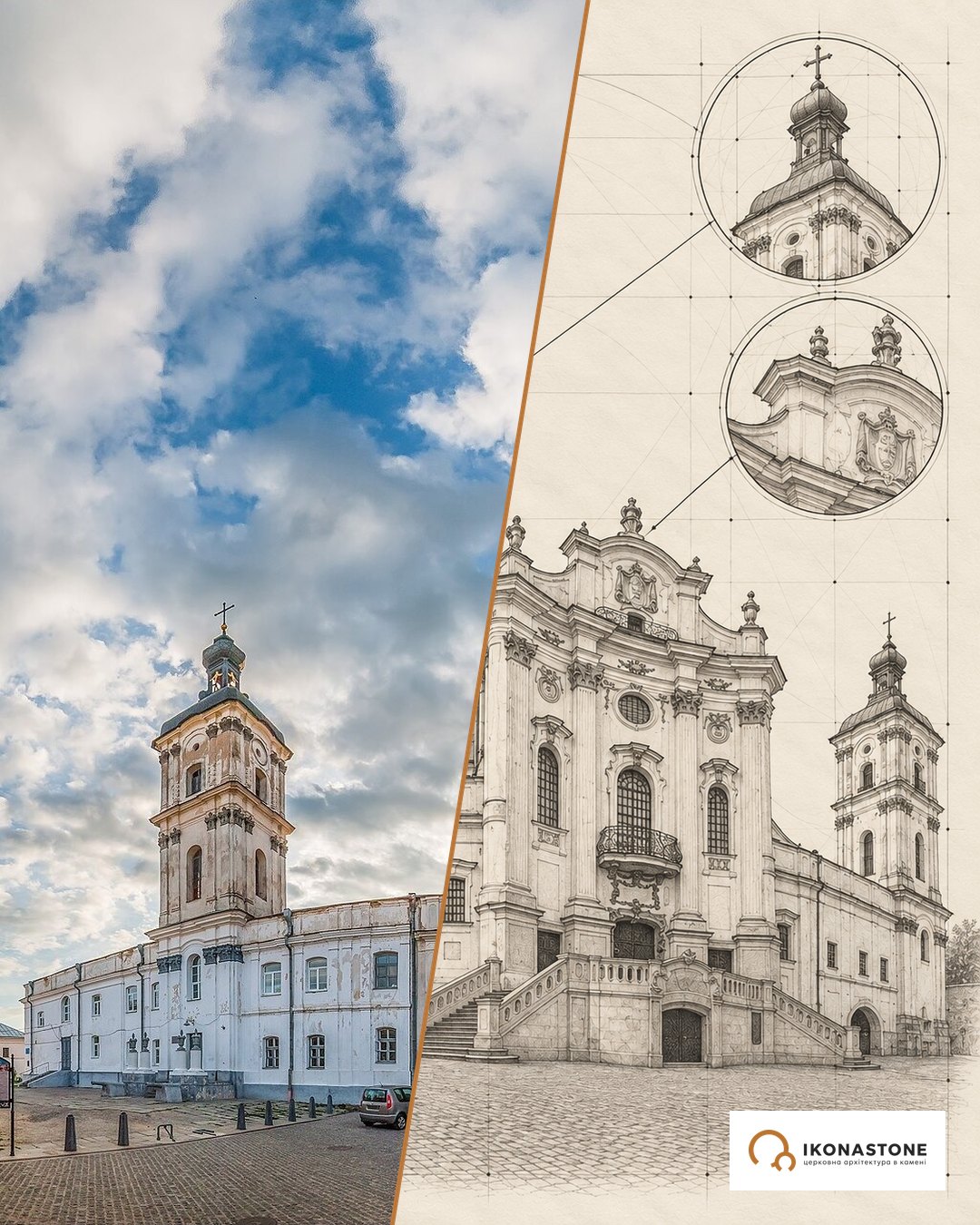
The Transfiguration Cathedral in Vinnytsia: Catholic church, rubber store and organ hall
Beneath this cathedral lie its founders, who were moved into a separate basement room and walled up to make space for a lower church. Above them, over two and a half centuries, the building has been a Catholic church, a cathedral, a warehouse, a sports hall and a concert hall.
In brief
| Address | 23 Soborna Street, Vinnytsia, Vinnytsia Oblast |
| Built | 1750–1758 (other sources: 1758–1779); consecrated 4 March 1761 |
| Architect | Paolo Fontana |
| Type | Latin-cross church with a short transept, two towers on the main facade and a dome |
| Material | masonry, plaster |
| Status | architectural monument of national importance (“Dominican Church of the Annunciation of the Blessed Virgin Mary”); cathedral of the OCU |
History
The Dominicans appeared in Vinnytsia in the first third of the 17th century. According to Suspilne, in 1624 the stolnik Stefan Czerlenkowski founded a wooden Church of the Annunciation and a friary; Wikipedia dates the foundation to 1630. Twice in the 17th and 18th centuries the friary was destroyed by wars.
The masonry church was built in the mid-18th century at the expense of Michał Grocholski, a land judge of Bracław, and his wife Anna née Radzimińska. The design is attributed to Paolo Fontana, an architect of Italian origin. The sources give the construction dates differently: VITA speaks of 1750–1758, English Wikipedia of work starting in 1758 and finishing in 1779. The consecration is known precisely: on 4 March 1761 the church was consecrated by Antoni Erazm Wołłowicz, Bishop of Lutsk. A founders’ crypt was made beneath the church, and the Grocholski family found their resting place here.
The friary never grew rich: at the beginning of the 19th century, according to Suspilne, only five friars remained. After the defeat of the uprising of 1830–1831 the friary was dissolved by a decree of Nicholas I of 19 July 1832. In 1832 the church passed to the Orthodox, and on 25 March 1833 it was consecrated as the Transfiguration Cathedral. In 1855 a lower, heated church of Sts Cosmas and Damian was arranged in the crypt; according to Wikipedia, the founders’ remains were moved into a separate basement room and walled up. Emperor Nicholas I, who visited the cathedral with his sons in 1847, signed a renovation project the following year, but work did not begin until 1860; the church was reconsecrated on 27 November 1866.
Here the 20th century unfolded like a badly edited film. In May 1916 Nicholas II visited the cathedral. In 1920 Symon Petliura was welcomed here, and later Józef Piłsudski. In the early 1920s the Bolsheviks confiscated its valuables, including a silver tabernacle given by the last emperor. In 1930 the church was taken over as a rubber warehouse; during the war years it was returned and remained a cathedral until 1962. Khrushchev’s anti-religious campaign closed it a second time (Suspilne gives 1960), and the building was given to the Dynamo sports society as a gym. In the 1980s a hall for organ and chamber music opened here, where, according to Suspilne, Sviatoslav Richter played.
In 1990 the building was handed over to an Orthodox community. Parishioners led by Metropolitan Agafangel, without waiting for the city to find the organ a new home, dismantled it and carried it outside; Suspilne calls this one of the saddest episodes in the cathedral’s history. The organ eventually ended up in the Capuchin church opposite. On 16 December 2018 the parish joined the OCU; Vinnitsa.info calls it the first cathedral in Ukraine to join the new church after the Tomos.
Architecture
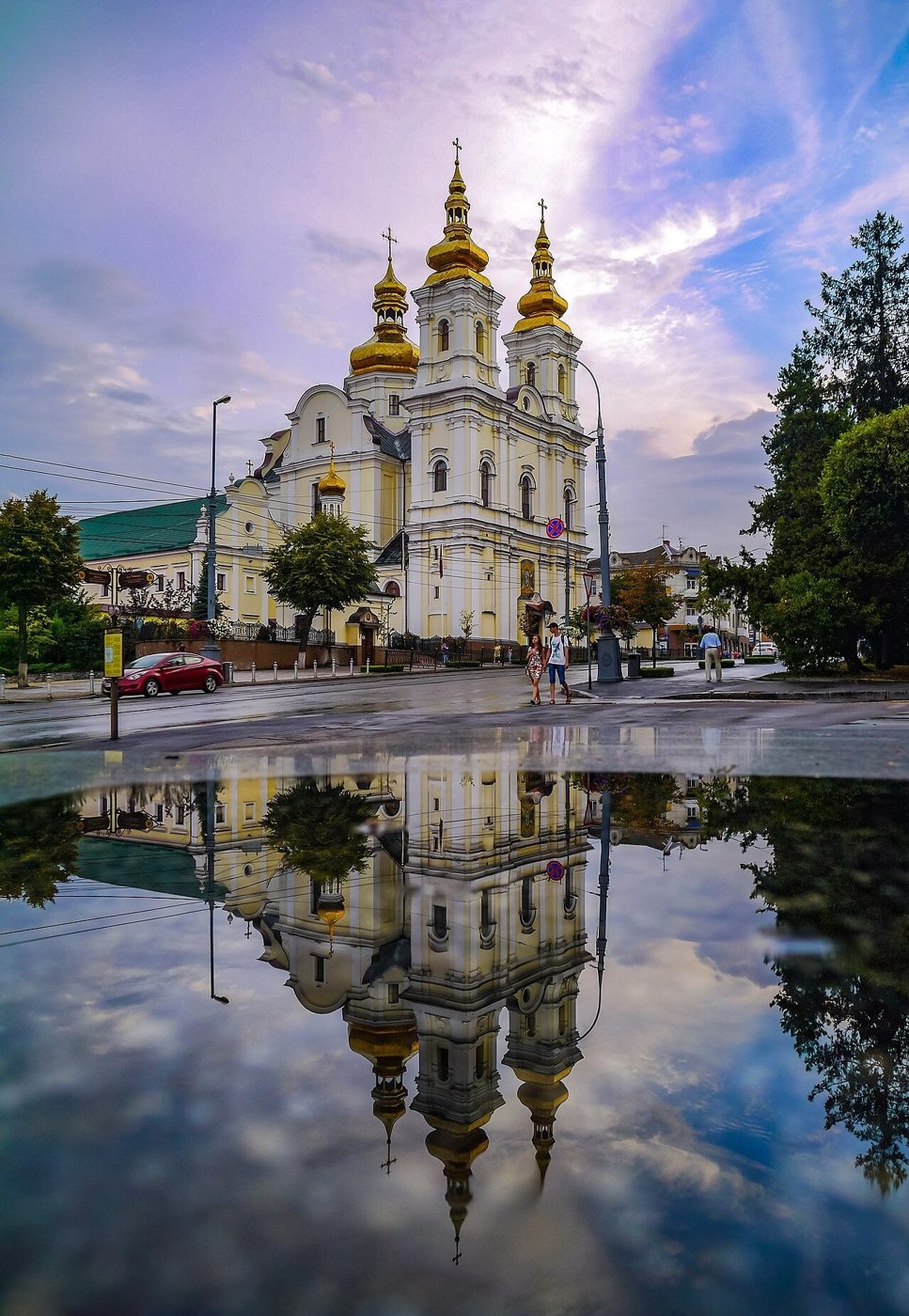
According to Vinnitsa.info, the plan is a Latin cross with a very short transept. The cross is set into a U-shaped range of cells, and together they form an inner courtyard, an atrium. A description from old visitations quoted by VITA records dimensions of 42 by 26 ells and a wall height of 16 ells. The facade faced the main street; on either side of the central part stood two unfinished towers, one of which held the bells; the towers had triangular roofs with iron crosses. The gable above the entrance bore the Grocholski coat of arms, Syrokomla. The dome was sheathed in white English sheet metal, and a bronze sanctus bell hung beneath the iron cross. The roofs of the side chapels were covered with shingles, and the floor, according to this description, was laid with square bricks; Suspilne, by contrast, mentions a stone floor.
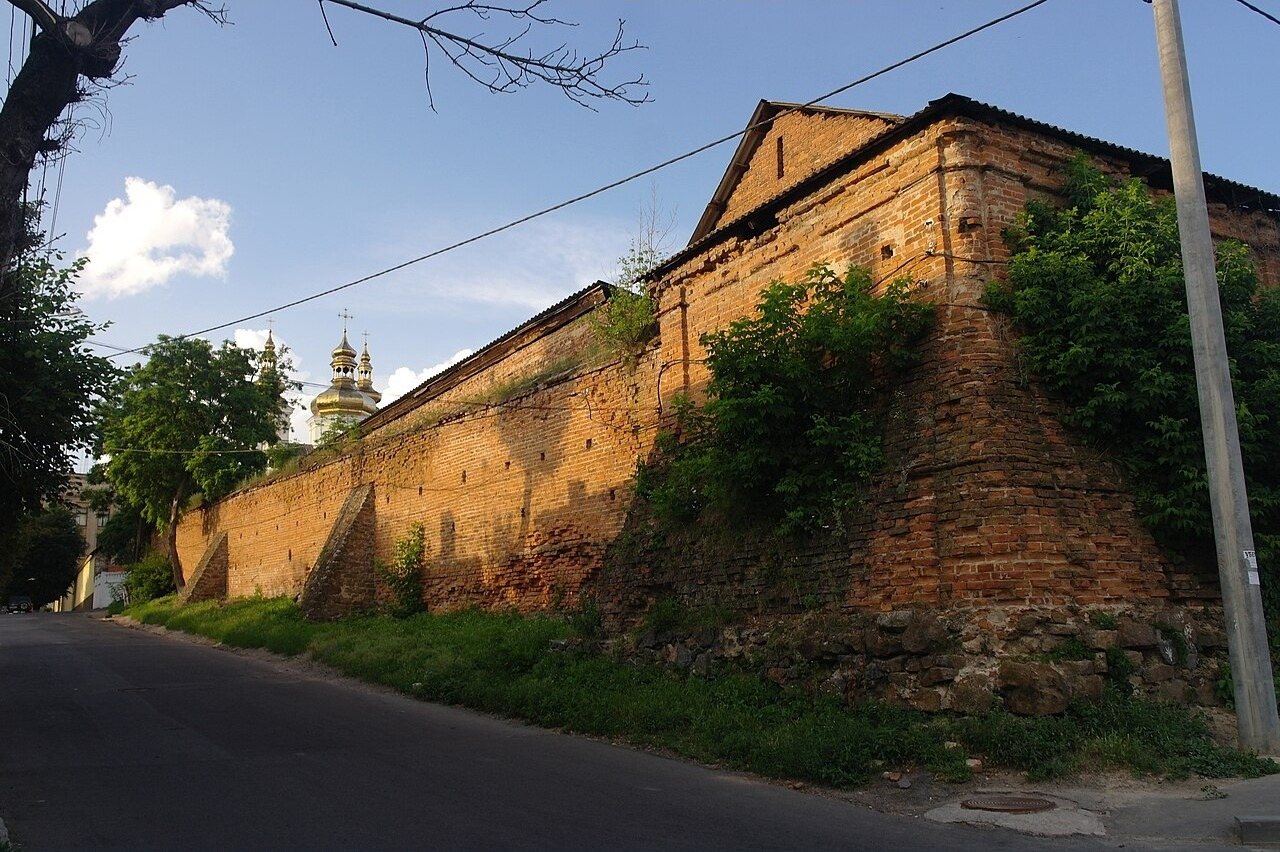
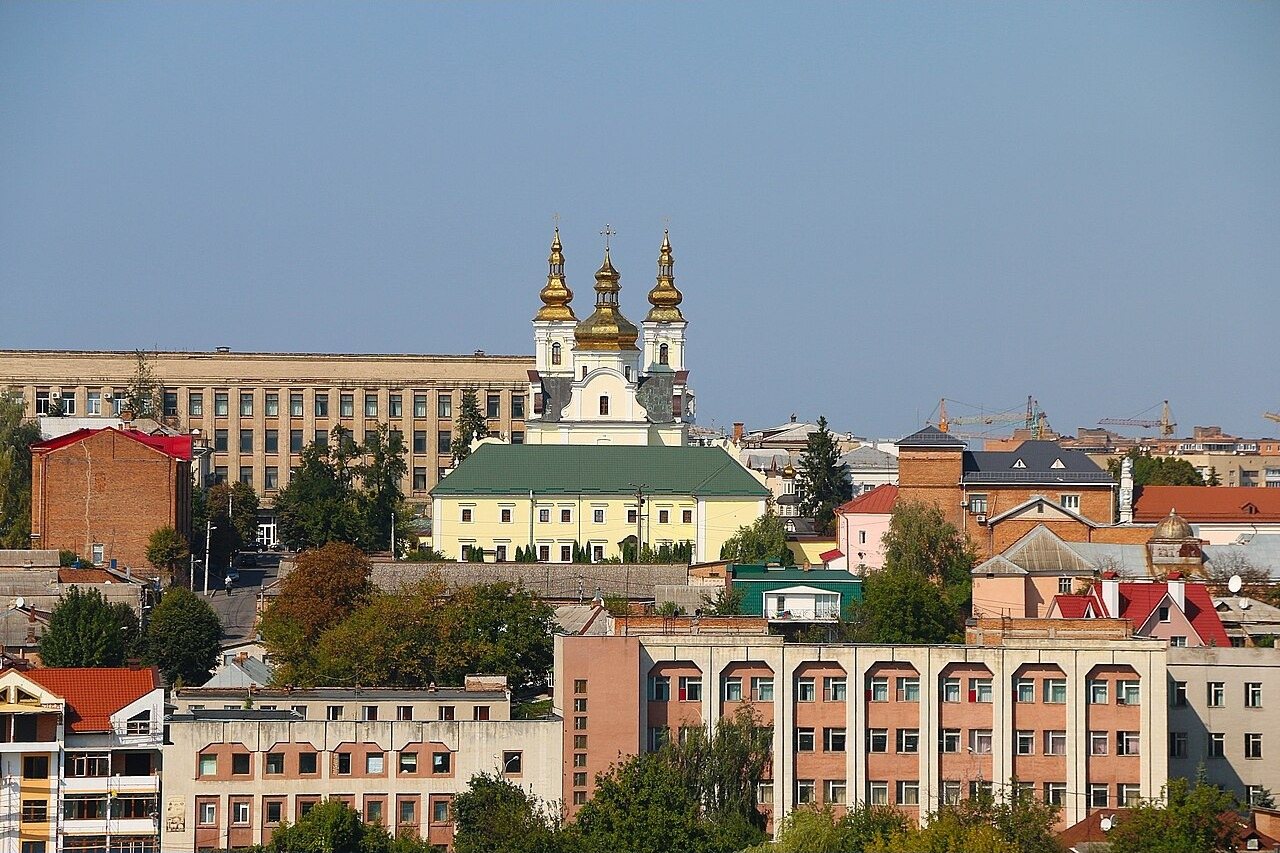
The cathedral is part of the Mury — the name now used for two fortified monastic complexes, the Jesuit and the Dominican. According to the eparchy, the ensemble of the church, cells, tower and wall is an architectural and urban-planning monument of national importance.
The proximity of the Jesuits shaped the church’s fate. According to the Encyclopedia of Modern Ukraine, after a fire in 1778 the Jesuit church was closed, and in 1786 the Dominican church received parish status. The name Mury itself referred only to the Jesuit complex until the 1920s; the Dominican one was added to it in the 20th century, when both friaries had long since lost their friars.
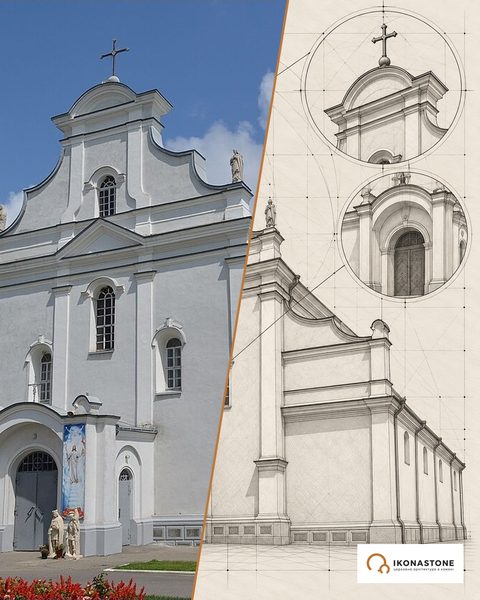
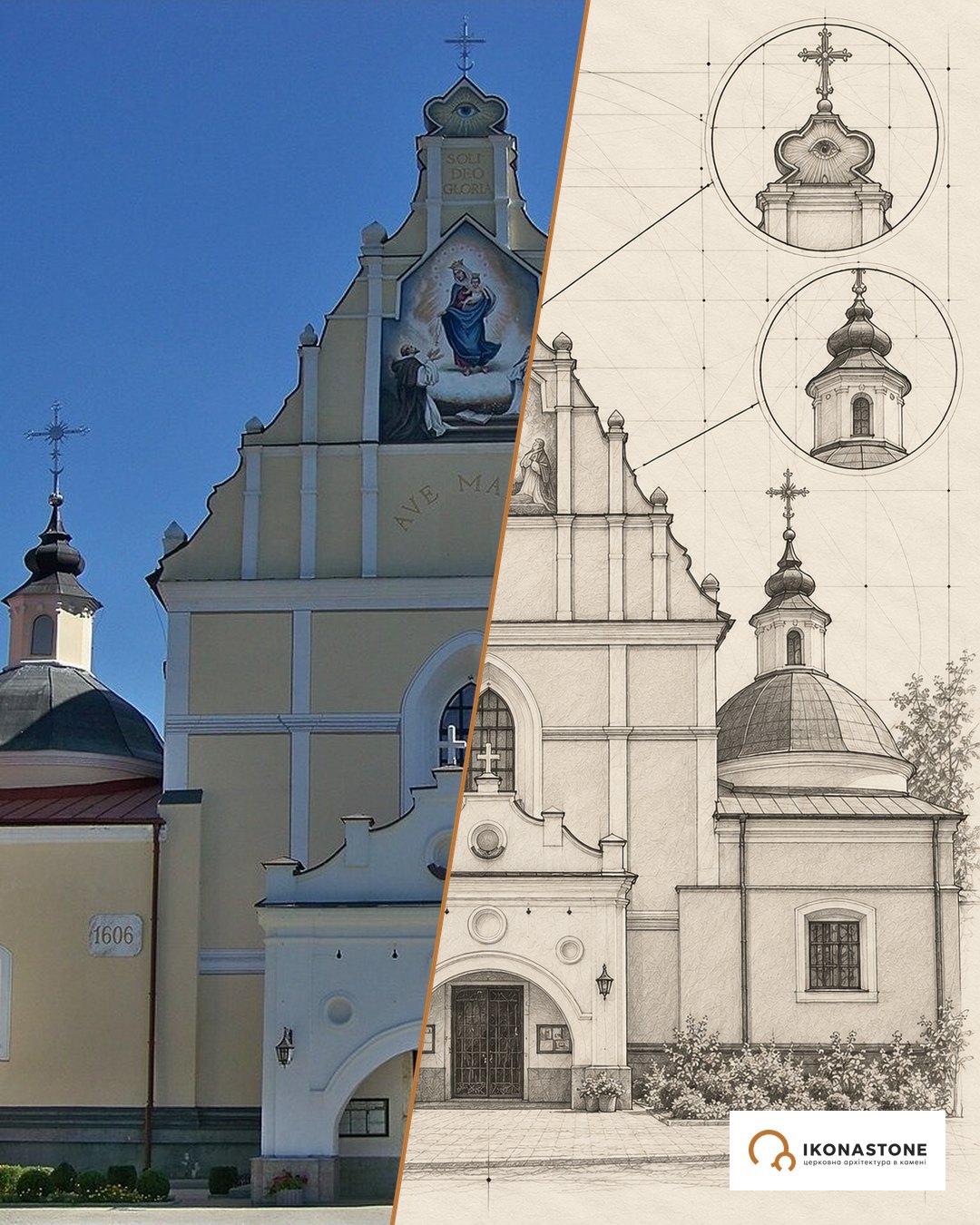
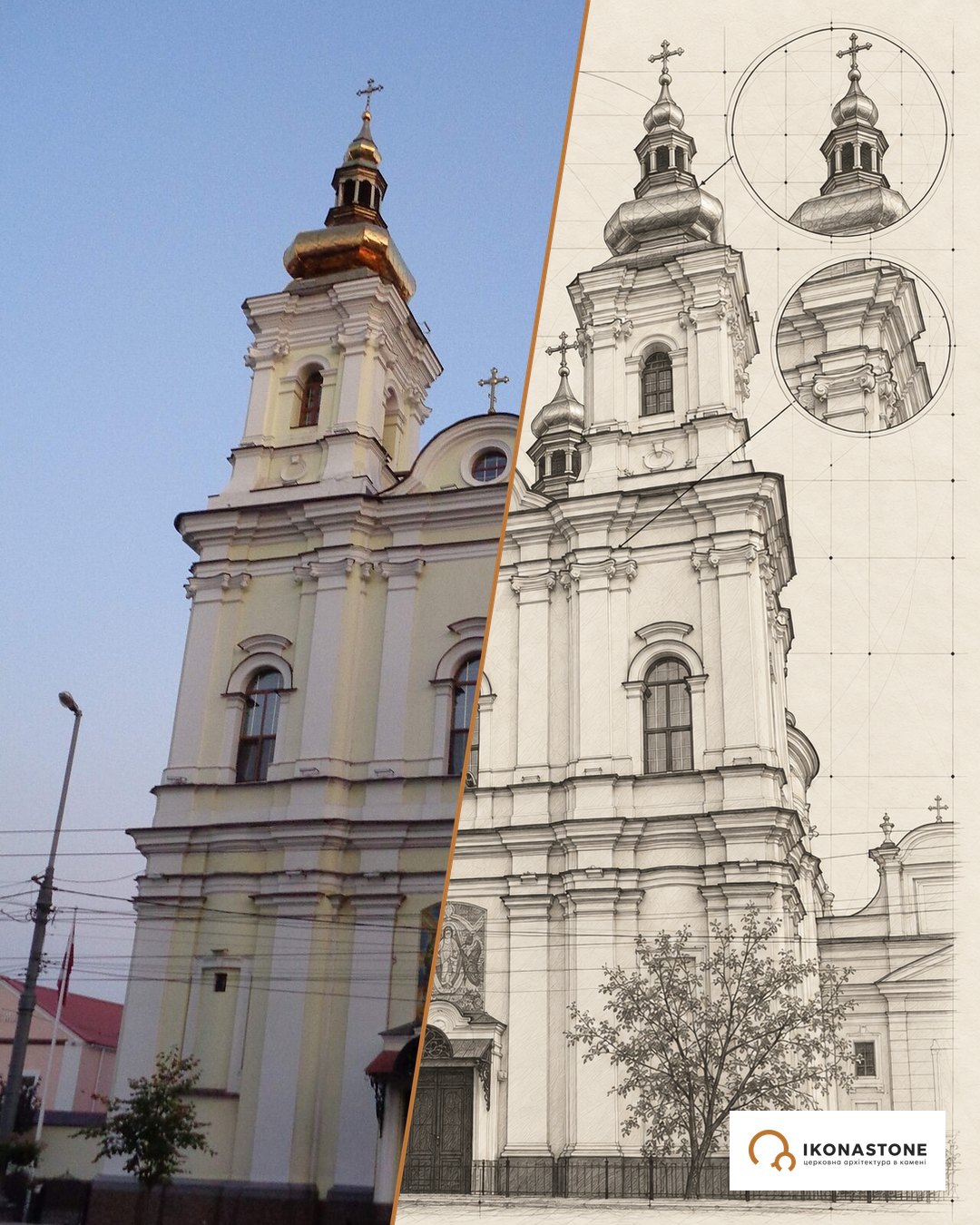
Below are two elements of the church: in a photo and in a drawing. The drawings show the form, not exact dimensions.
The main facade with towers
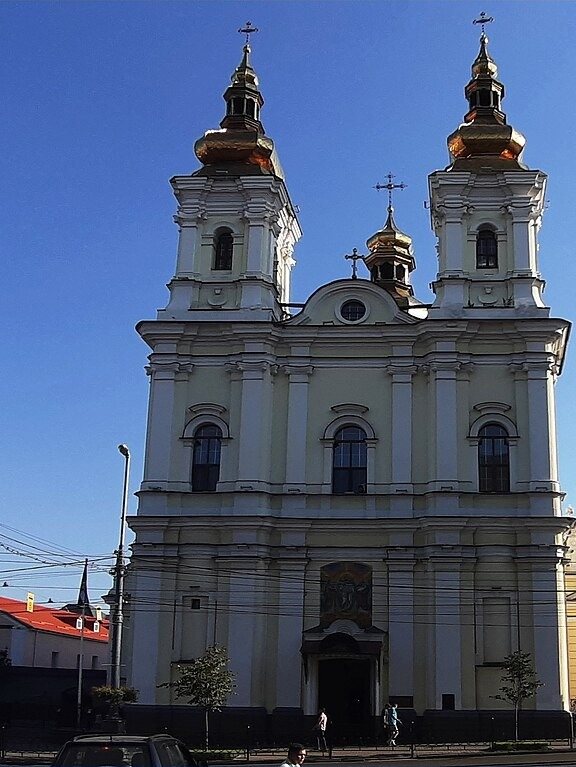
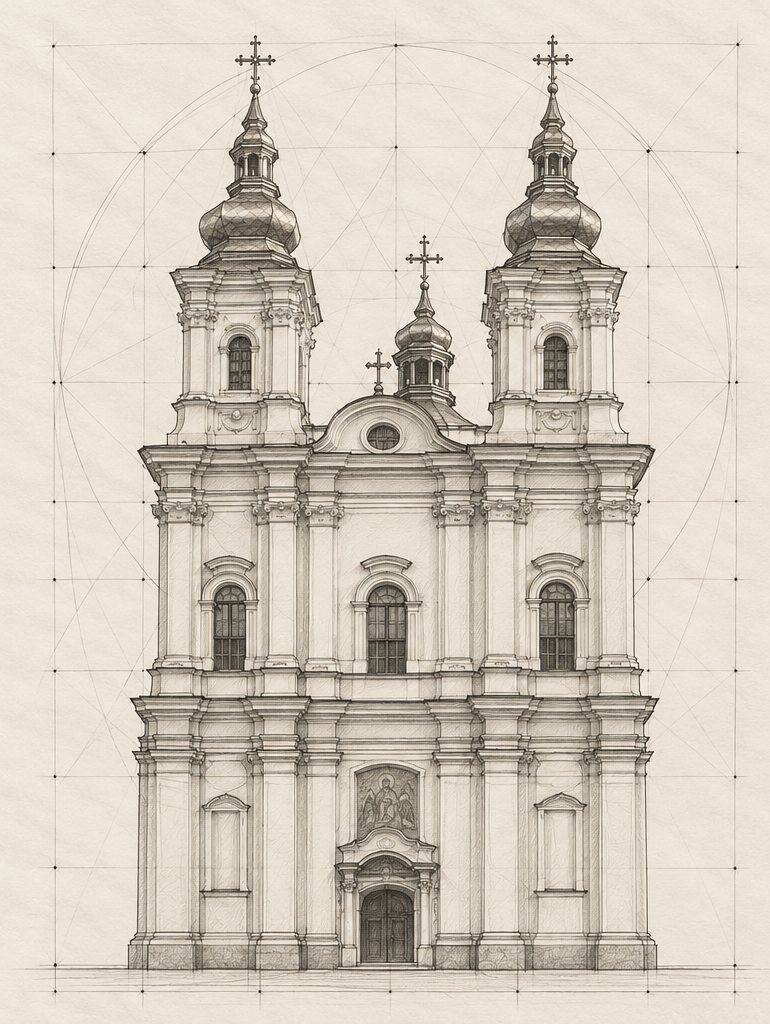
The two towers flanking the central part are a legacy of the Catholic period, when the facade addressed the main street. From the very beginning the towers were unfinished and had simple triangular roofs. The twin-tower facade reveals the cathedral’s Latin ancestry better than any document.
The dome over the crossing
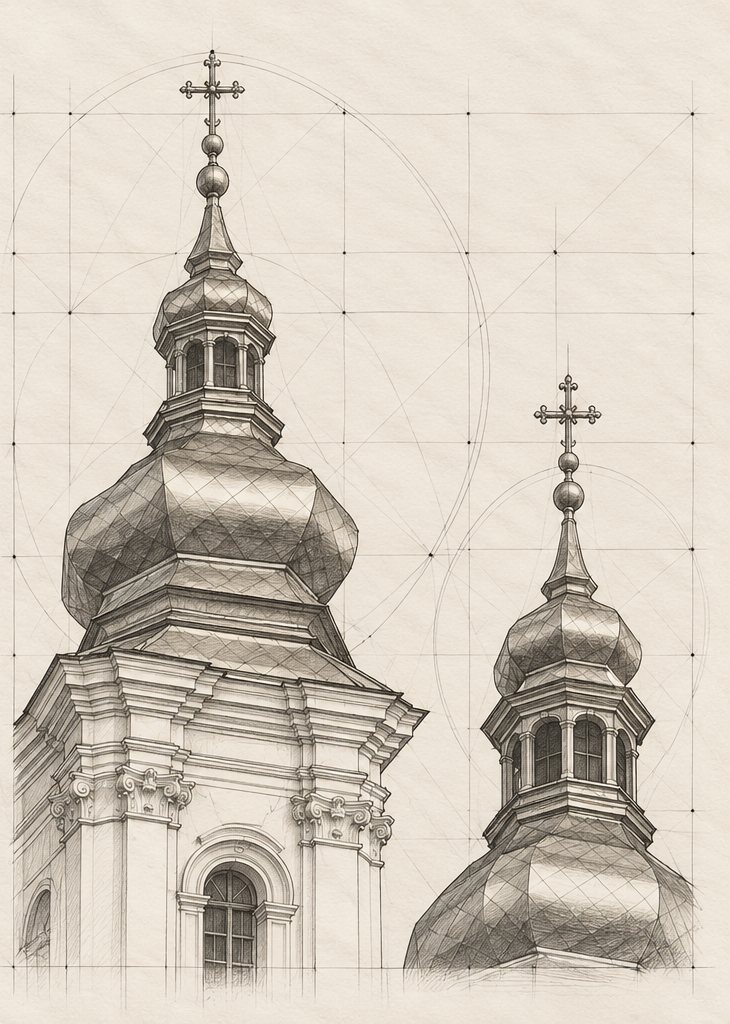
In the 18th century the dome was covered with white sheet metal. According to the eparchy, the gilded domes appeared only during the reconstruction of the 1990s and had never been here before. The gold is the latest layer on the old building, and the most visible.
Details that are easy to miss
Masons frightened by sounds — a legend. Vinnitsa.info relates that in 1758 construction was led by a German architect and the work was done by masters from elsewhere: the local masons had refused, supposedly frightened by strange sounds. What exactly the masons heard, the story does not say.
A coronation in the Catholic church. In 1826, while the building was still a friary church, the coronation of Nicholas I was solemnly celebrated here, according to Vinnitsa.info. Six years later, according to VITA, the same emperor signed the decree dissolving the friary.
Murals under oil paint. The walls and vaults of the church were painted al fresco. According to Vinnitsa.info, when the building was a sports hall the frescoes were painted over with oil paint; in 1983 18th-century murals were found under later layers. Several fragments are kept in the art museum.
Kotsiubynsky’s baptism. The writer Mykhailo Kotsiubynsky was baptised and married in the cathedral. The surgeon Nikolai Pirogov, who lived in nearby Vyshnia, often came here, according to Suspilne.
White ribbons and the Kazan icon. One of the cathedral’s main relics is the Kazan Icon of the Mother of God. According to a story told by Vinnitsa.info, it was noticed while the church was being cleared: a man saw something like a cobweb veil, and beneath it the image. The icon was stolen from the lower church and returned to the eparchy about two weeks later. By local tradition, newlyweds pray here for a happy marriage and tie white ribbons.
Archaeologists underfoot. Excavations by an expedition of the Vinnytsia Regional Museum of Local History led by Olha Manihda are under way on the site of the complex. The Mury have not yet told everything they remember.
Photo gallery
Stone and material
The cathedral is a masonry building finished with plaster; as early as 1814 the church was plastered and whitewashed. Stone works here underground — in the crypt and foundations — while above ground the form is held by plaster, cornices and white walls. The sources describe the church floor differently — square bricks or stone; it carried oak pews (their number also varies between sources), and there was a ten-stop organ with three bellows, finished, like the oak pulpit, in green lacquer.
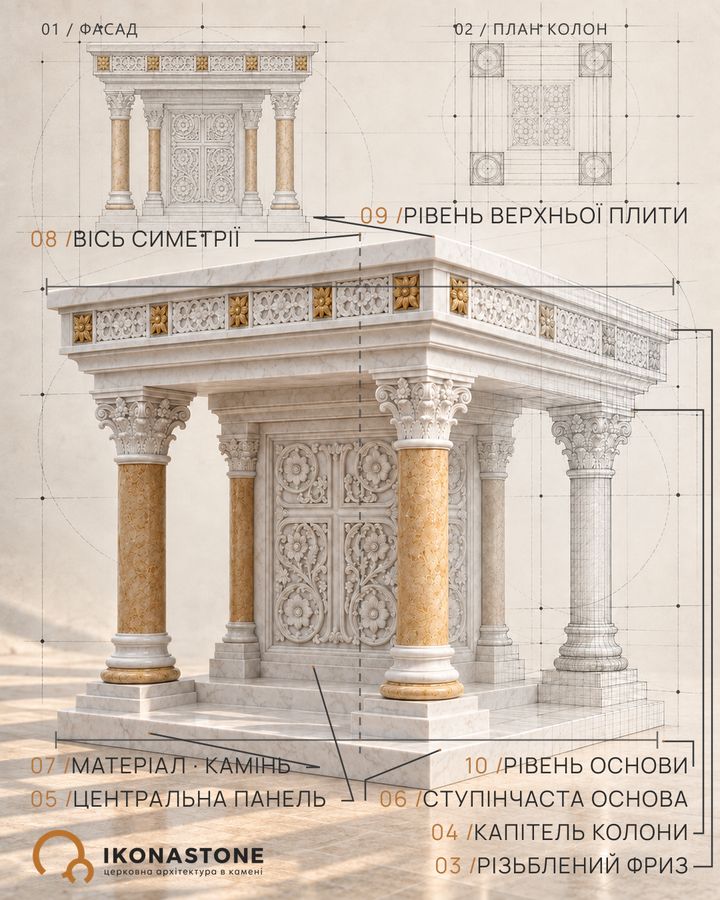
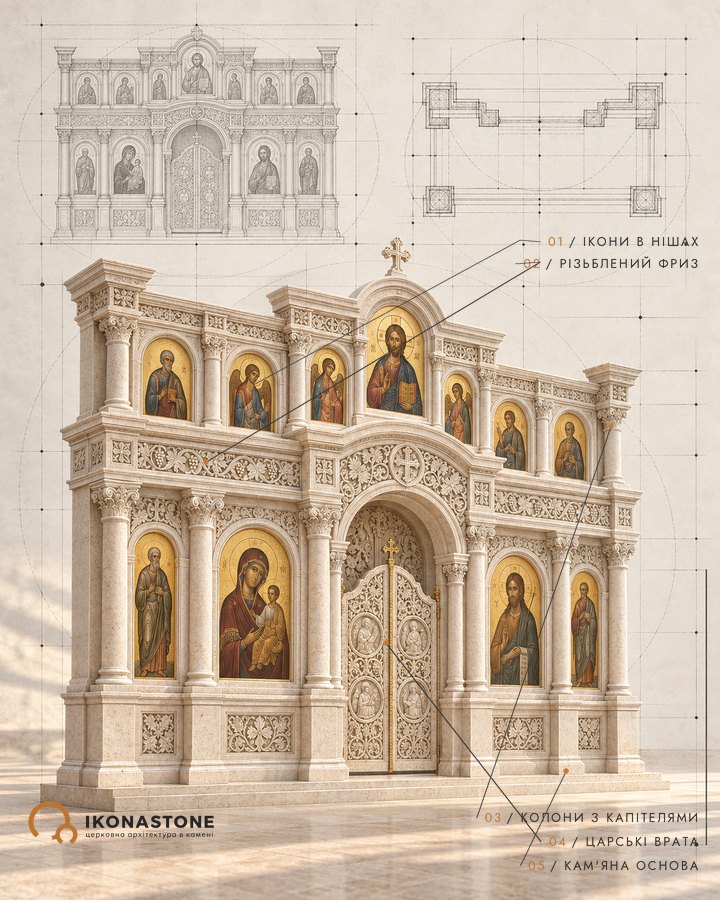
The church had seven altars: the high altar and six in the chapels. After 1833 the entire sanctuary had to be rethought for a different rite — a case in which the architecture stays while the liturgical logic changes completely. That is exactly when it matters most to understand where the altar table should stand and how it relates to the axis of the church; more on this in the article altar table and table of oblation.
Another Podillia church built for the Latin rite is St Florian’s Church in Sharhorod.
FAQ
Who built the cathedral, and when?
The masonry church for the Dominicans was built at the expense of Michał Grocholski, a land judge of Bracław, to a design by Paolo Fontana. The dates in the sources differ: construction in 1750–1758 (VITA) or in 1758–1779 (English Wikipedia). On 4 March 1761 the church was consecrated by Antoni Erazm Wołłowicz, Bishop of Lutsk.
How did the Catholic church become an Orthodox cathedral?
After the defeat of the Polish uprising of 1830–1831 the Dominican friary was dissolved. In 1832 the church was handed over to the Orthodox clergy, and on 25 March 1833 it was consecrated as the Transfiguration Cathedral.
What happened to the cathedral under Soviet rule?
In 1930 the church was taken from the community and made into a rubber warehouse; during the war it was returned to the Church. In 1962 (1960 according to Suspilne) it was closed a second time and turned into a Dynamo sports hall, and in the 1980s it housed a hall for organ and chamber music.
What are the Mury?
This is the name used in Vinnytsia for two 17th–18th-century monastic complexes in the city centre — the Jesuit and the Dominican. Until the 1920s the name applied only to the Jesuit one. The Dominican ensemble — the cathedral, cells, tower and wall — is a monument of national importance.
Which church does the cathedral belong to now?
On 16 December 2018 the parish, together with Metropolitan Simeon, joined the Orthodox Church of Ukraine. Today it is the cathedral of the Vinnytsia and Bar Eparchy of the OCU.
Sources
- Суспільне Вінниця: Був складом гуми, спортзалом та залом органної музики (2025)
- Вінницька єпархія ПЦУ: Спасо-Преображенський кафедральний собор
- Wikipedia: Transfiguration Cathedral, Vinnytsia
- VITA: Спасо-Преображенський собор у Вінниці — історія храму
- Vinnitsa.info: Костел, церква, рибний склад і спортзал — історія собору в центрі Вінниці
- Енциклопедія сучасної України: Мури
- Travels.in.ua: Спасо-Преображенський кафедральний собор
- Town
- Vinnytsia, Vinnytsia Oblast
- Built
- 1750–1758 (other sources: 1758–1779); consecrated 1761; Orthodox cathedral since 1833
- Type
- Latin-cross church with two towers on the main facade and a dome
- Material
- masonry, plaster
- Research depth
- 16%