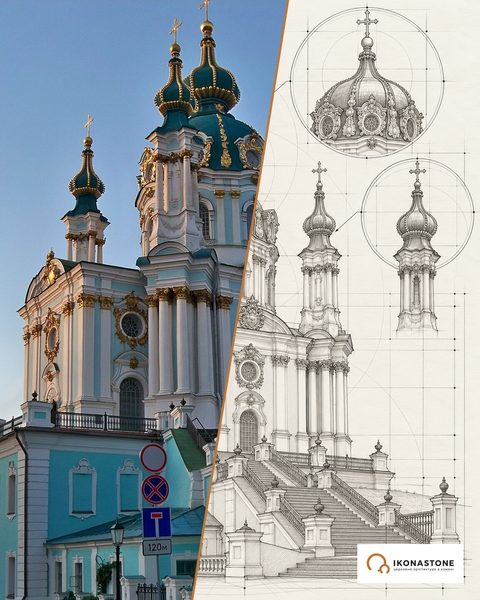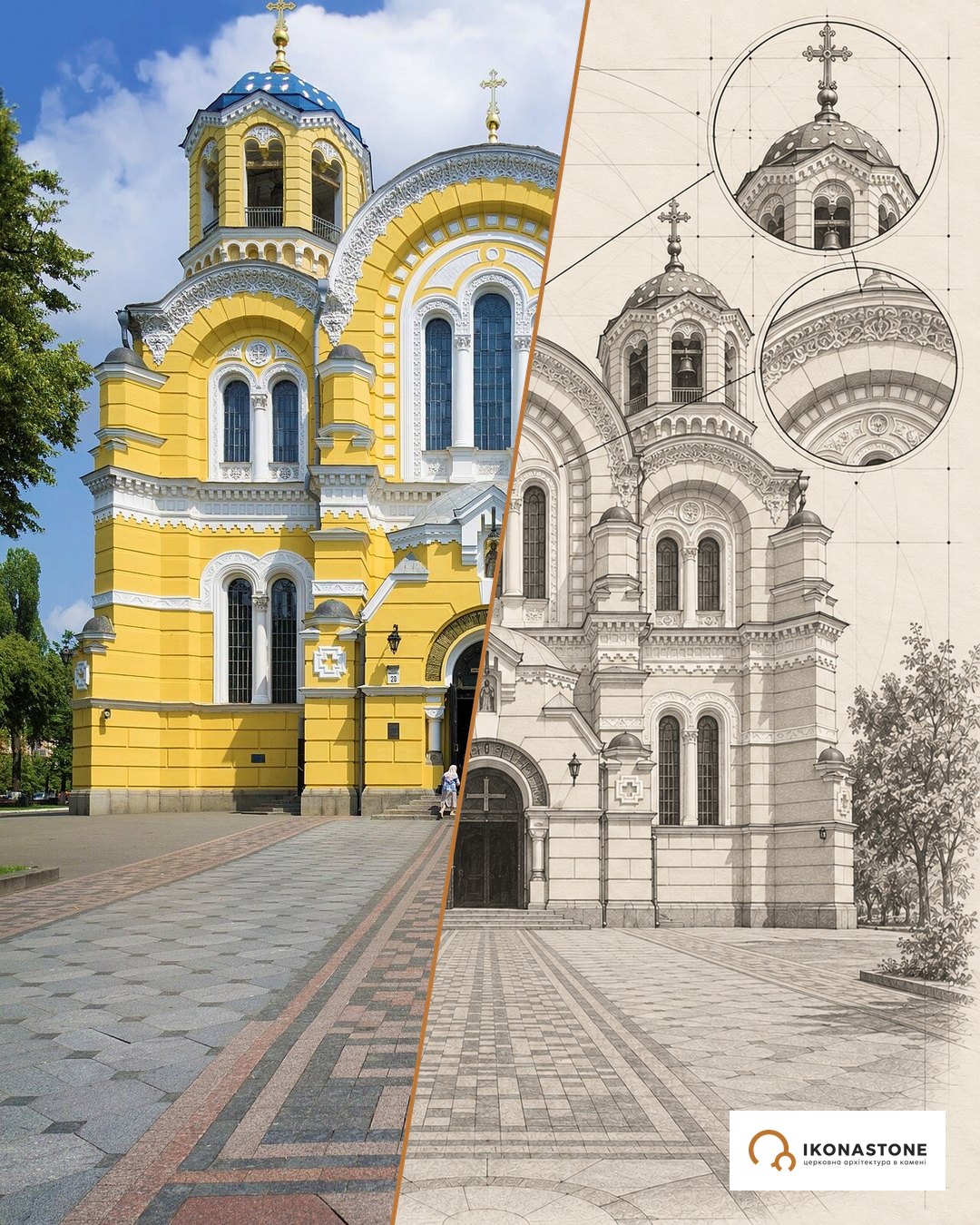
Saint Sophia Cathedral in Kyiv: 11th-century granite, quartzite and plinthos
Saint Sophia Cathedral has stood in Kyiv for almost a thousand years, and for most of that time it has not been seen as it was conceived. Beneath the Baroque whiteness of its walls lies ancient masonry of stone and thin brick that once was never plastered.
In brief
| Address | 24 Volodymyrska Street, Kyiv |
| Built | first half of the 11th century; foundation date 1011 or 1037 (versions differ) |
| Type | five-nave cross-in-square church, originally with 13 domes and two tiers of galleries |
| Material | mixed masonry: granite, pink quartzite, plinthos brick on a pink lime mortar |
| Status | UNESCO World Heritage Site (1990; since 2023 on the List in Danger) |
| Owner | National Conservation Area “Sophia of Kyiv”, museum |
History
The cathedral’s date of birth is still in question. The chronicle links it to Yaroslav the Wise and the year 1037 — after the victory over the Pechenegs beneath the walls of Kyiv. A study of the graffiti on the walls gave some scholars grounds to speak of 1011 and Prince Volodymyr; on this dating, UNESCO added the cathedral’s millennium to its calendar of anniversaries. Either way, the cathedral became the main church of the capital of Rus’ and a princely burial place: Yaroslav the Wise is buried here.
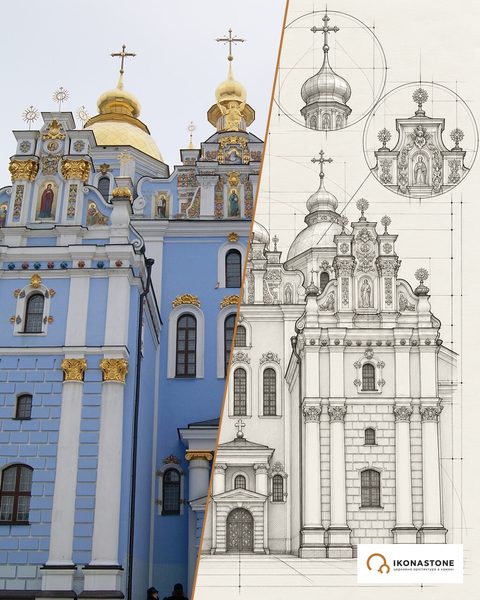
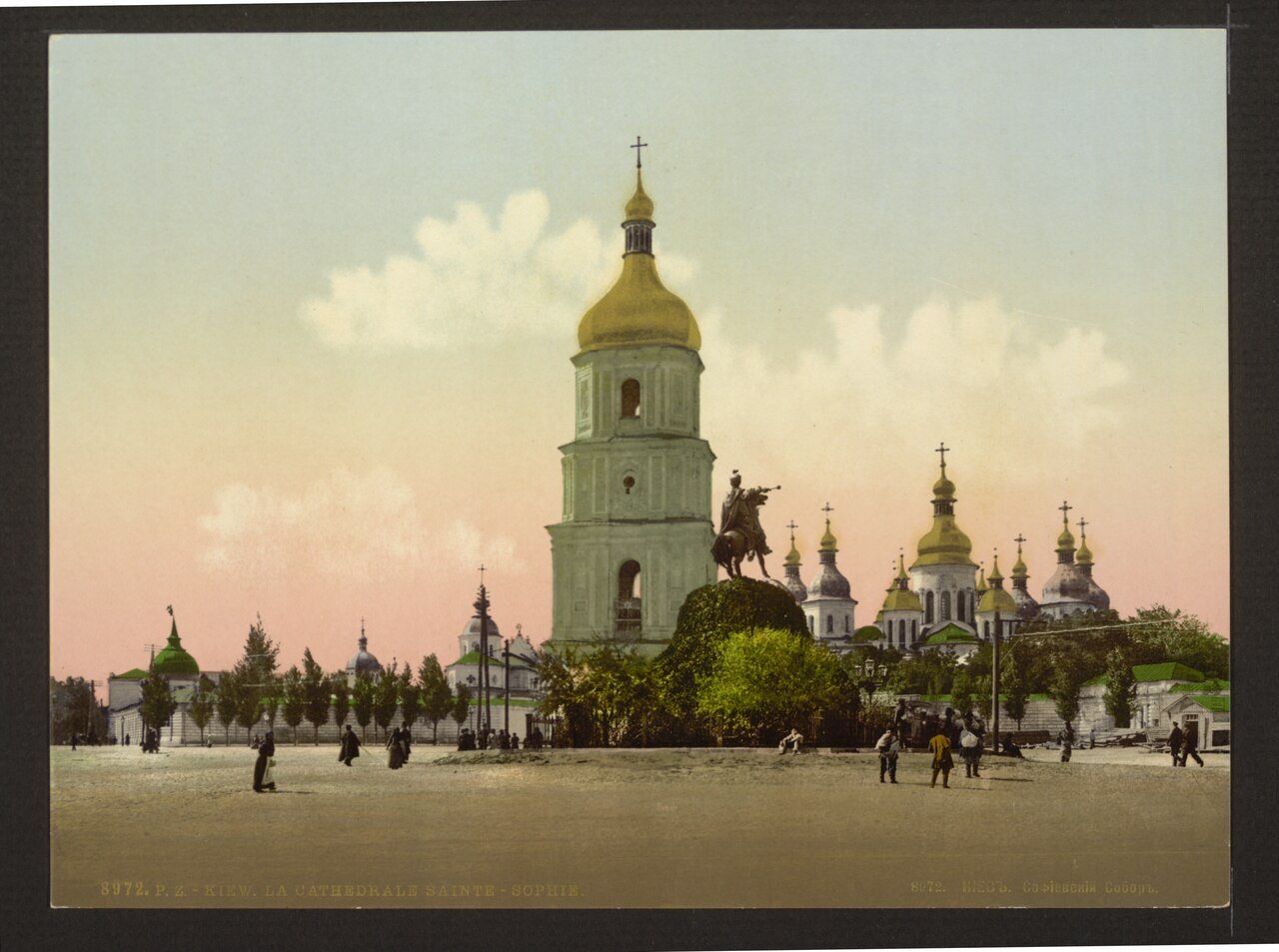
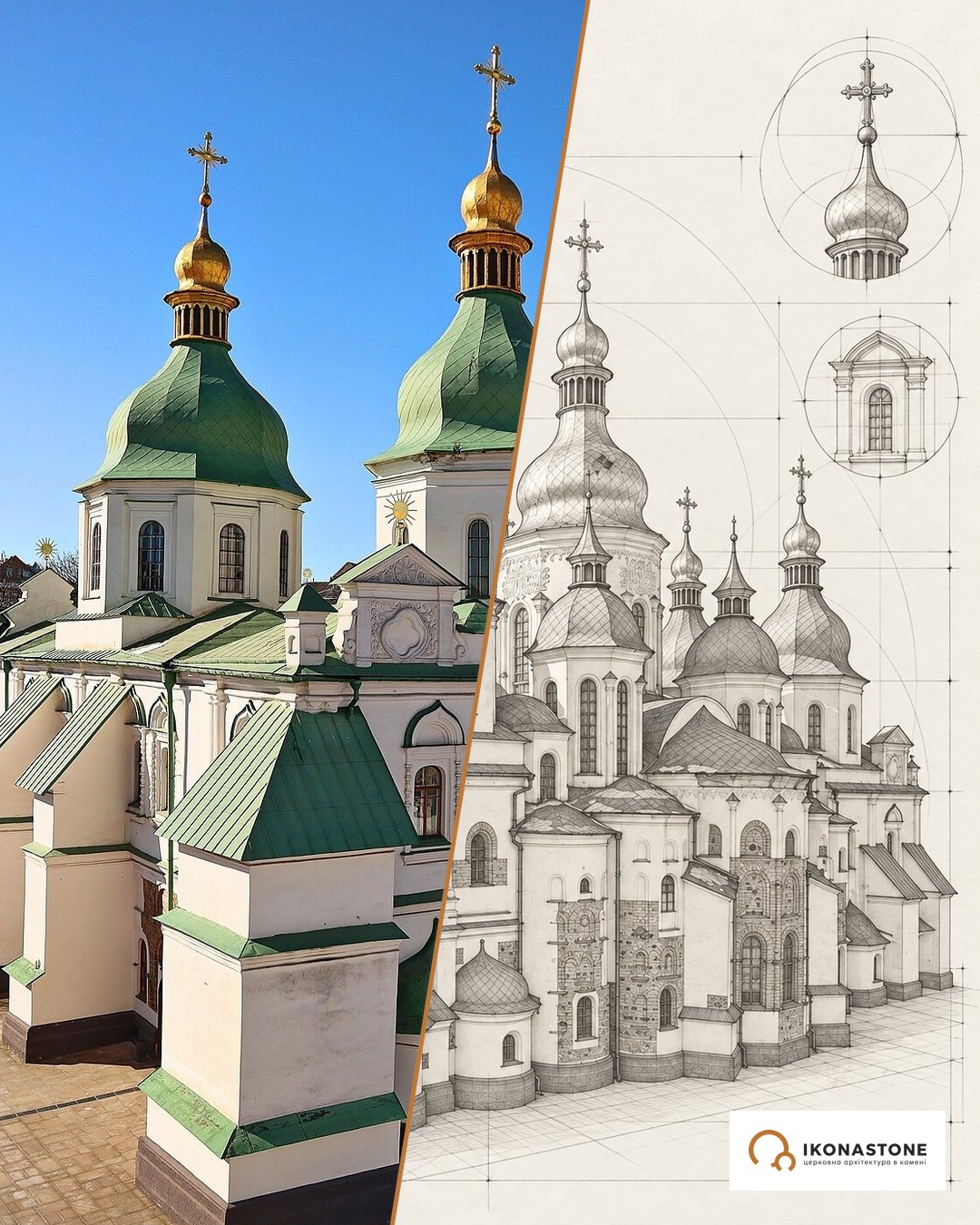
Sophia received a second life in the 17th–18th centuries. Restoration began under Metropolitan Petro Mohyla, and in 1690–1707, with the support of Hetman Ivan Mazepa, the church was built up: the galleries were raised to a second storey, and new pear-shaped domes appeared. It was then that the cathedral acquired the features of Ukrainian Baroque by which we know it.
In 1934 the cathedral became a museum. In 1990, together with the Kyiv-Pechersk Lavra, it was inscribed on the UNESCO World Heritage List, and in 2023 on the List of World Heritage in Danger. On 10 June 2025 the blast wave from a Russian attack damaged the cornice of the central apse on the east facade.
Timeline
The numbers in square brackets are source numbers in the list at the bottom of the page. The label "according to …" means that a fact is confirmed by only one source. The "Legends" section contains tales and legends: they are recorded in sources but not confirmed by documents.
The princely era
- 1011–1018
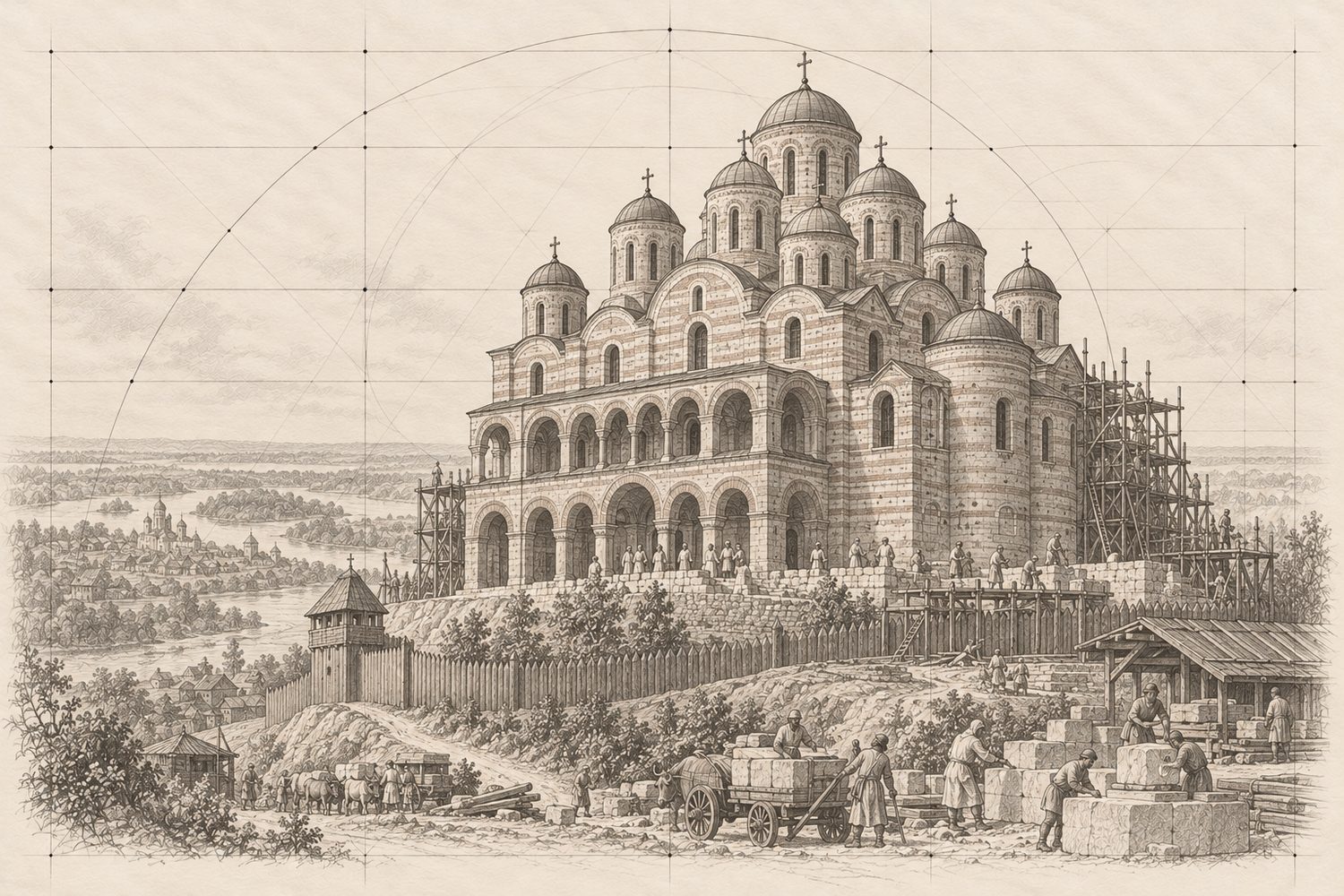
According to the dating by Nadiia Nikitenko, the cathedral was founded under Prince Volodymyr the Great on Sunday, 4 November 1011, and consecrated under Yaroslav on Sunday, 11 May 1018. She relies on the dated graffiti of 1018–1022, the testimony of Thietmar of Merseburg and Hilarion's "Sermon on Law and Grace"; this date is also supported by V. Korniienko. [8, 11, 13]
The 11th-century cathedral. Illustration: IKONASTONE - 1017
The Novgorod First Chronicle links the start of Yaroslav's construction of Sophia to this year; the historian Oleksii Tolochko defends this date. In 2010 H. Ivakin, O. Tolochko, T. Bobrovskyi and other scholars publicly objected to the 1011 dating. [12, 14]
- 1036–1037
According to the Primary Chronicle, in 1036 Yaroslav defeated the Pechenegs at the place "where Saint Sophia now stands", and in 1037 he founded the "great city", the church of Saint Sophia and the Golden Gate. The Encyclopedia of Ukraine dates the construction to 1037–1044; N. Nikitenko regards the chronicle entry as a summing-up of Yaroslav's building works. [2, 10, 13, 20]
- 1054
On 20 February Yaroslav the Wise died in Vyshhorod; he was buried in a marble sarcophagus in the cathedral. A record of the prince's death has survived among the graffiti on the walls of the church. [1, 9, 22]
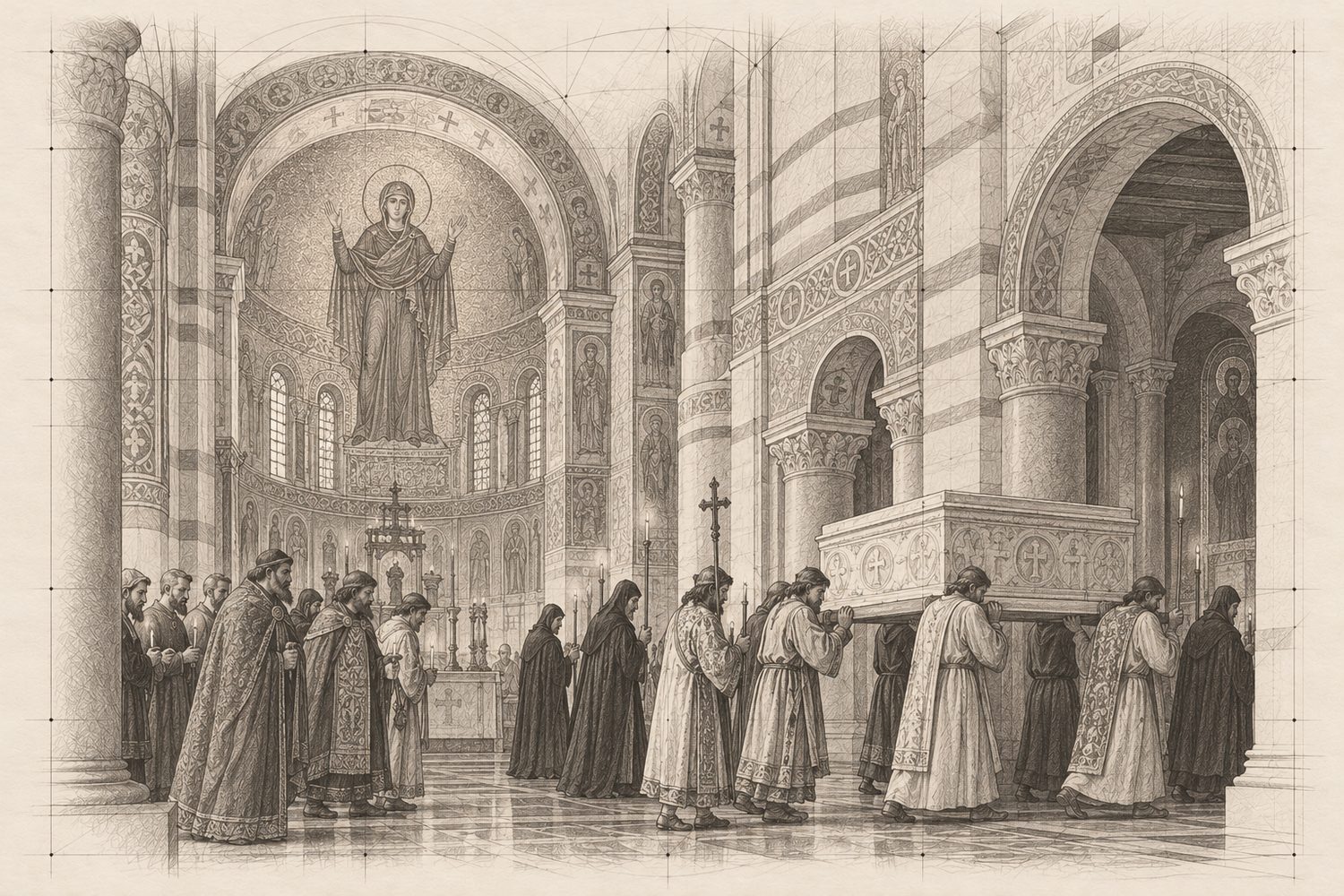
The year 1054: the burial of Yaroslav the Wise. Illustration: IKONASTONE - 1093
A graffito mentions the sarcophagus of Vsevolod Yaroslavych, who was buried in the cathedral. According to the English-language Wikipedia, Volodymyr Monomakh (d. 1125) and Viacheslav Volodymyrovych (d. 1154) were also buried here; their tombs have not survived. [1, 9]
- Late 11th century
An outer gallery-ambulatory and a narthex with two stair towers were added to the original church. According to the Encyclopedia of Ukraine. [2]
- 1169
Troops sent by Prince Andrei Bogoliubsky plundered Kyiv and the cathedral. [1, 2]
- 1240
After the Mongols took Kyiv, the cathedral was plundered but not destroyed. [1, 10]
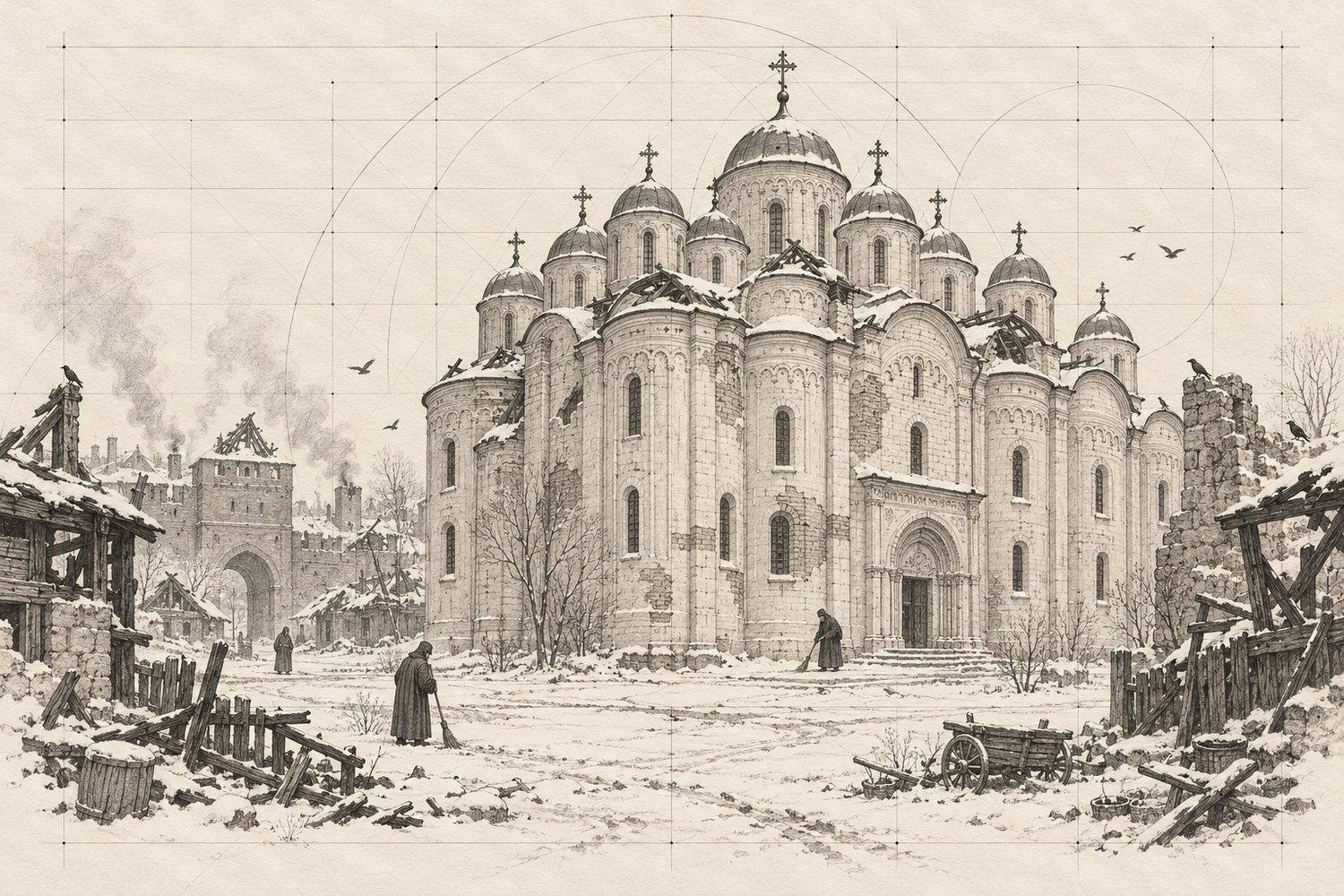
Winter of 1240: the cathedral withstood. Illustration: IKONASTONE - 1280s
Metropolitan Kirill II was buried in the cathedral; this is the earliest known burial of a metropolitan in the church. According to the English-language Wikipedia. [1]
Decline and return
- 1497–1577
The cathedral stood neglected; in 1577 Bohush Hulkevych-Hlibovytskyi repaired it at his own expense. [1, 10]
- 1596 / 1610–1633
After the Union of Brest, the cathedral passed to the Uniate Church. The English-language Wikipedia ties the transfer to 1596, while the Encyclopedia of Ukraine dates the Uniate period to 1610–1633. [1, 2]
- 1633
Metropolitan Petro Mohyla returned the cathedral to the Orthodox Metropolis of Kyiv, founded a monastery beside it and began its rebuilding with the participation of the Italian architect Ottavio Mancini. [1, 2, 10]
- 1651
The Dutch artist Abraham van Westerfeld sketched the cathedral with its half-ruined western part and wooden bell tower. These are the earliest detailed depictions of the church. [1, 48]
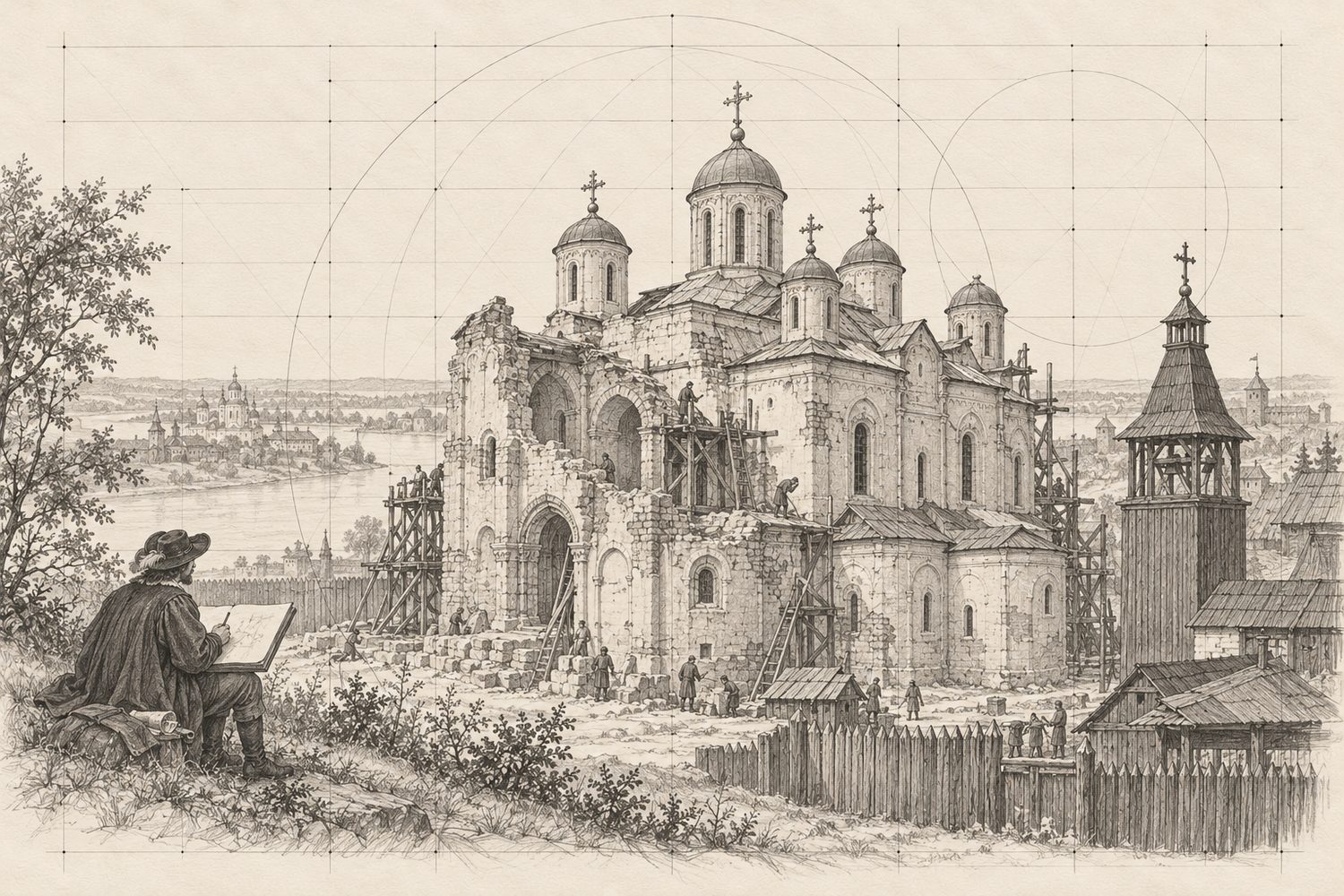
The year 1651: the cathedral after its decline. Illustration: IKONASTONE 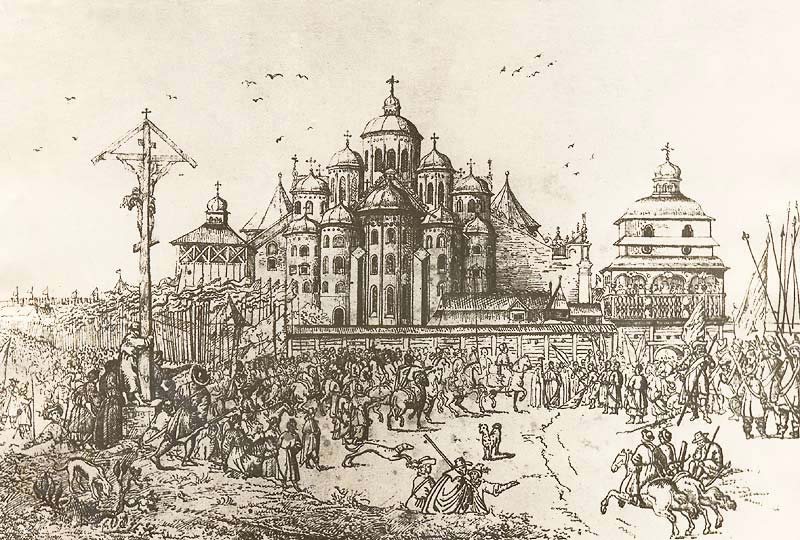
Saint Sophia Cathedral, 1651. Drawing attributed to A. van Westerfeld. Wikimedia Commons, public domain
Ukrainian Baroque
- 1690–1707
At the expense of Hetman Ivan Mazepa, under Metropolitan Varlaam Yasynskyi, the galleries were built up with a second storey and the domes received Baroque pear-shaped tops, the central one gilded. The cathedral took on its present appearance; the sources give different numbers for the new domes (four or six). [1, 2]
- 1699–1706
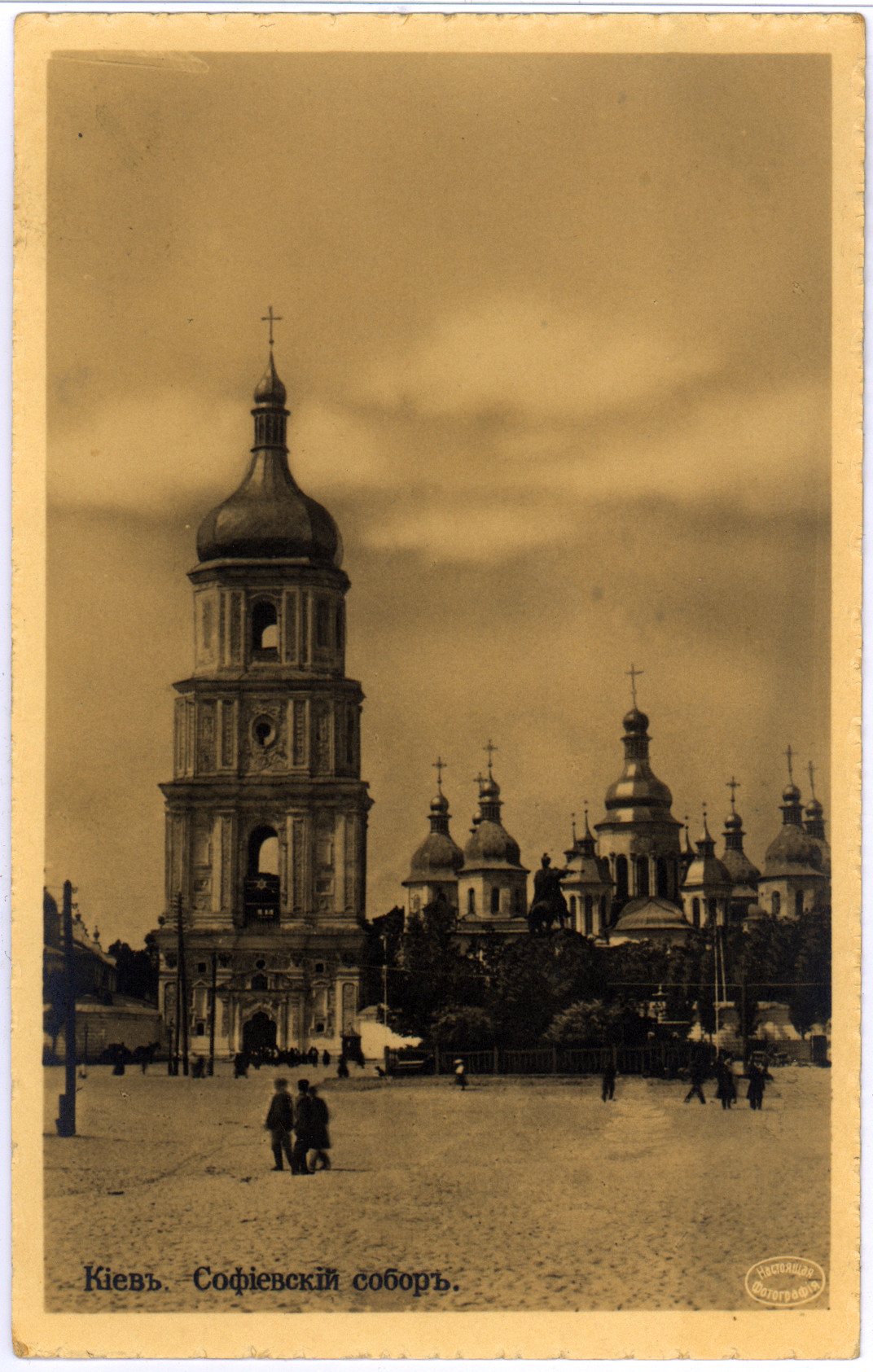
At Mazepa's expense a masonry three-tier bell tower was built. In 1705 the Kyivan master Afanasii Petrovych cast a bell for it, known as "Mazepa". [3, 6, 10, 29]
- 1722–1767
Masonry monastery buildings rose around the cathedral: a refectory ("Warm Sophia", 1722–1730), the metropolitan's house (1722–1748) and a bursa, or seminary dormitory (1763–1767). [1, 3]
- 1744–1748
After damage to the bell tower, the architect Johann Gottfried Schädel rebuilt its upper tiers; in 1746–1748 he also built the gate of Metropolitan Rafail Zaborovskyi. [1, 3, 6]
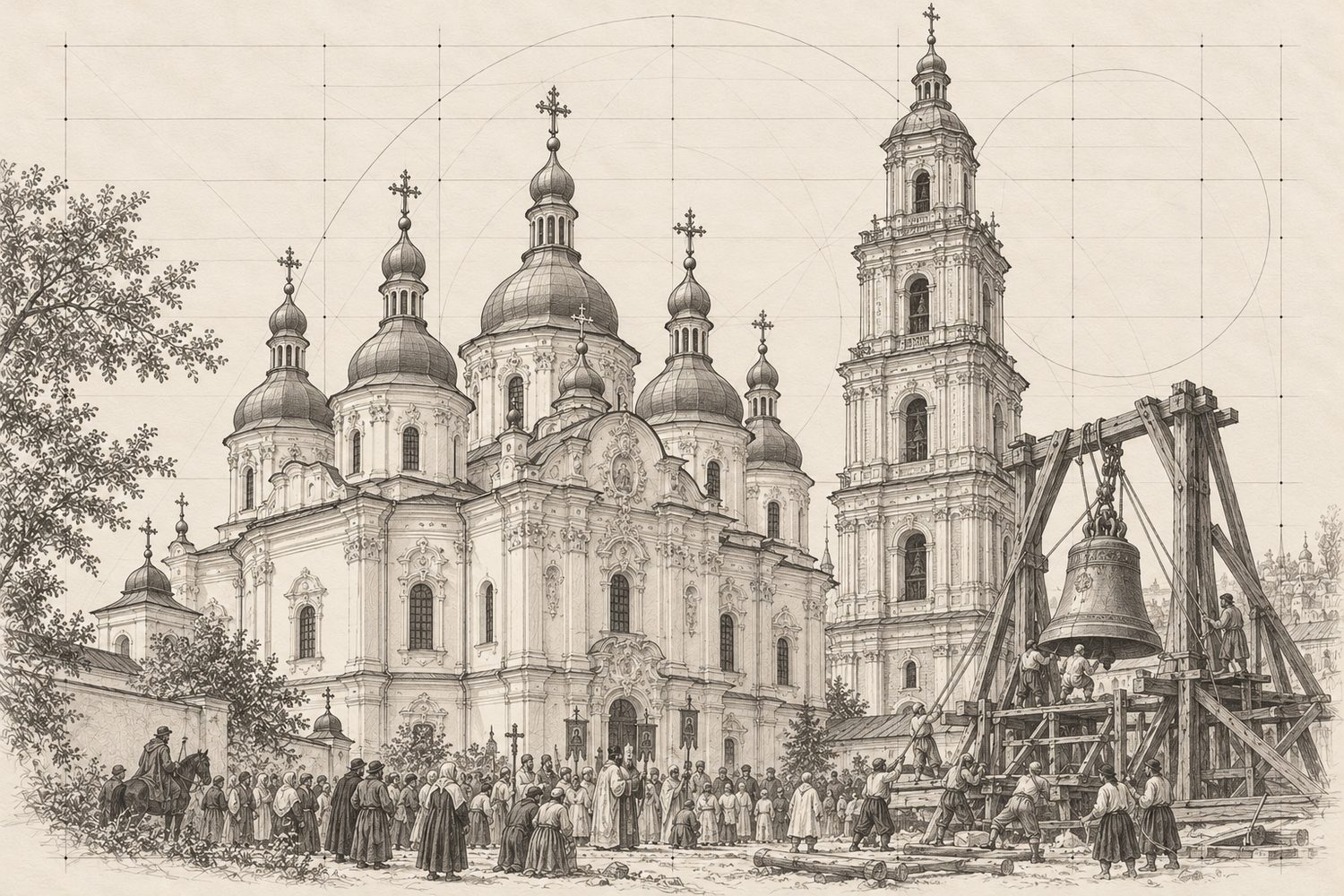
Around 1750: the Baroque cathedral. Illustration: IKONASTONE - 1747–1754
Under Metropolitan Rafail Zaborovskyi a carved, gilded three-tier iconostasis was installed; only its lower tier has survived. [1, 2]
From restorations to the conservation area
- 1843–1853
During a restoration led by Fedir Solntsev, the 11th-century frescoes were uncovered, but they were renewed in oil paint. [1, 16]
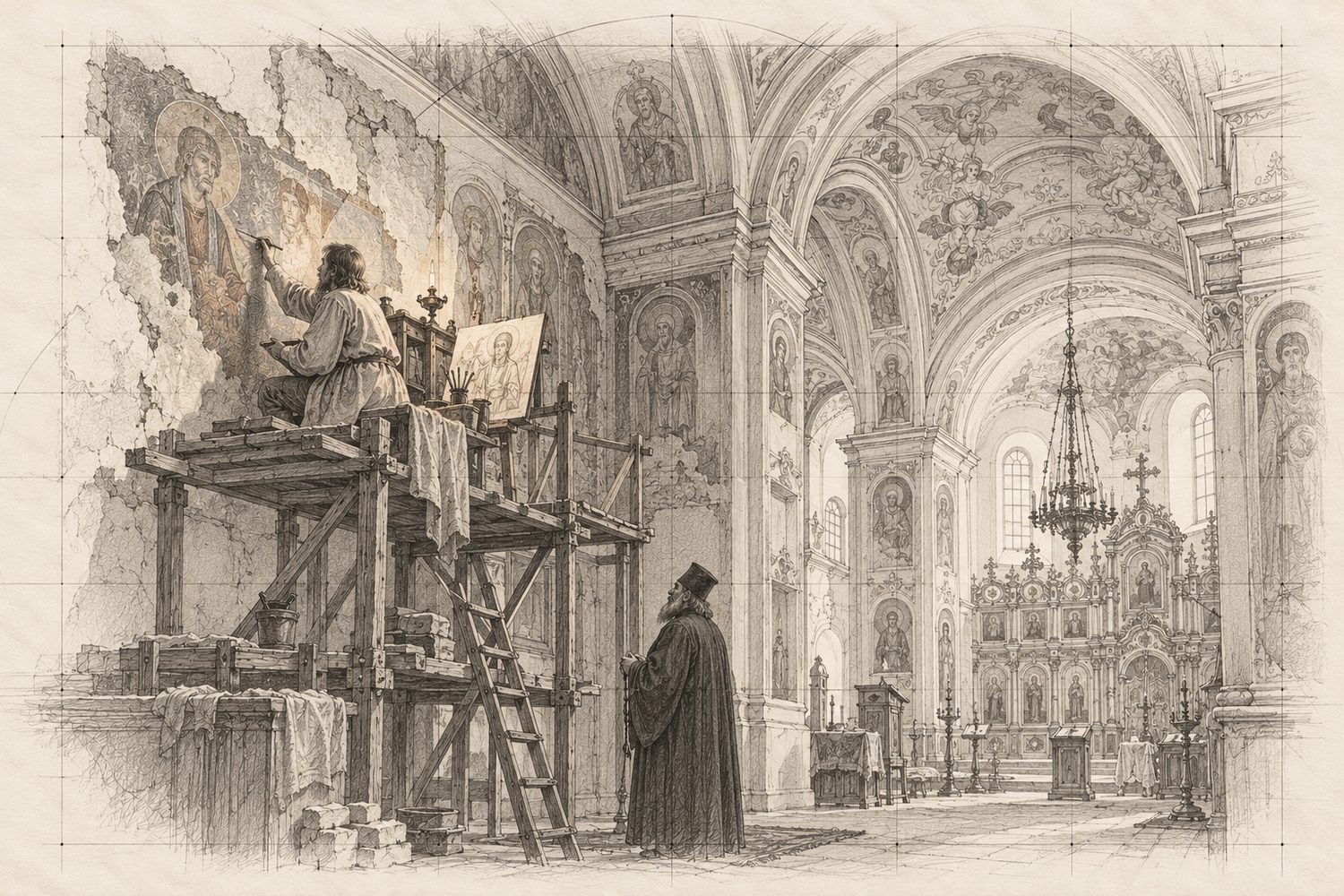
The 1840s: uncovering the frescoes. Illustration: IKONASTONE 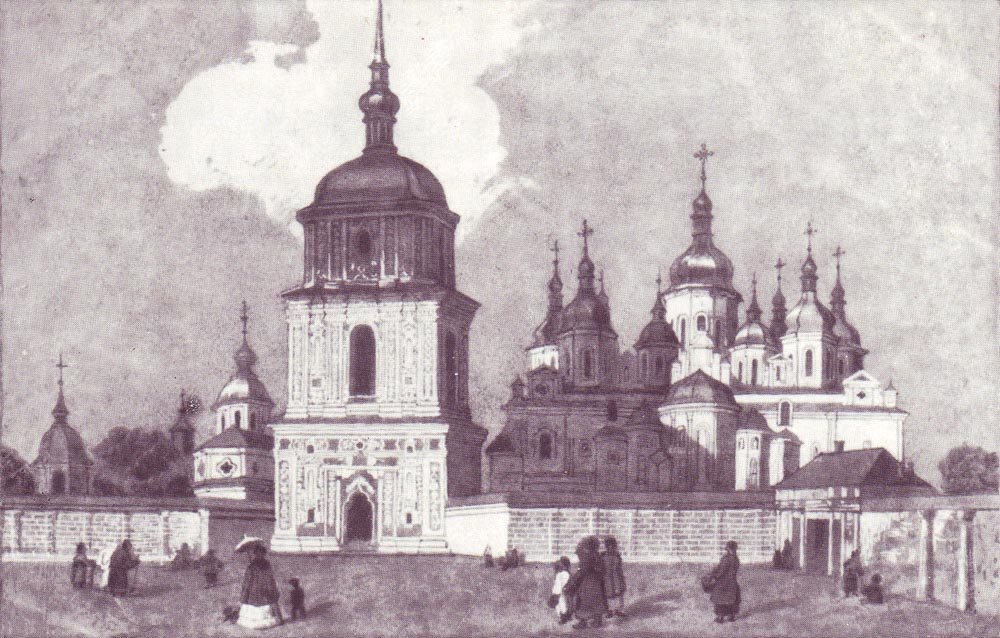
The Sophia Monastery. Watercolour by M. Sazhin, 1840s. Wikimedia Commons, public domain - 1851–1852
The bell tower was raised by a fourth tier to a design by the diocesan architect Pavel Sparro. In its article on the cathedral, the Encyclopedia of Ukraine assigns the fourth tier to the rebuilding of 1744–1752. [2, 3, 6, 10]
- 1884
Mikhail Vrubel recreated in oil paint the lost figures of three of the four archangels in the main dome; one remained of the original mosaic. According to the English-language Wikipedia, the study of the mosaics was begun at that time by Adrian Prakhov. [1, 17, 18]
- 1919
On 22 January the Act of Union of the UNR and the ZUNR was solemnly proclaimed on Sophia Square beside the cathedral. [46]
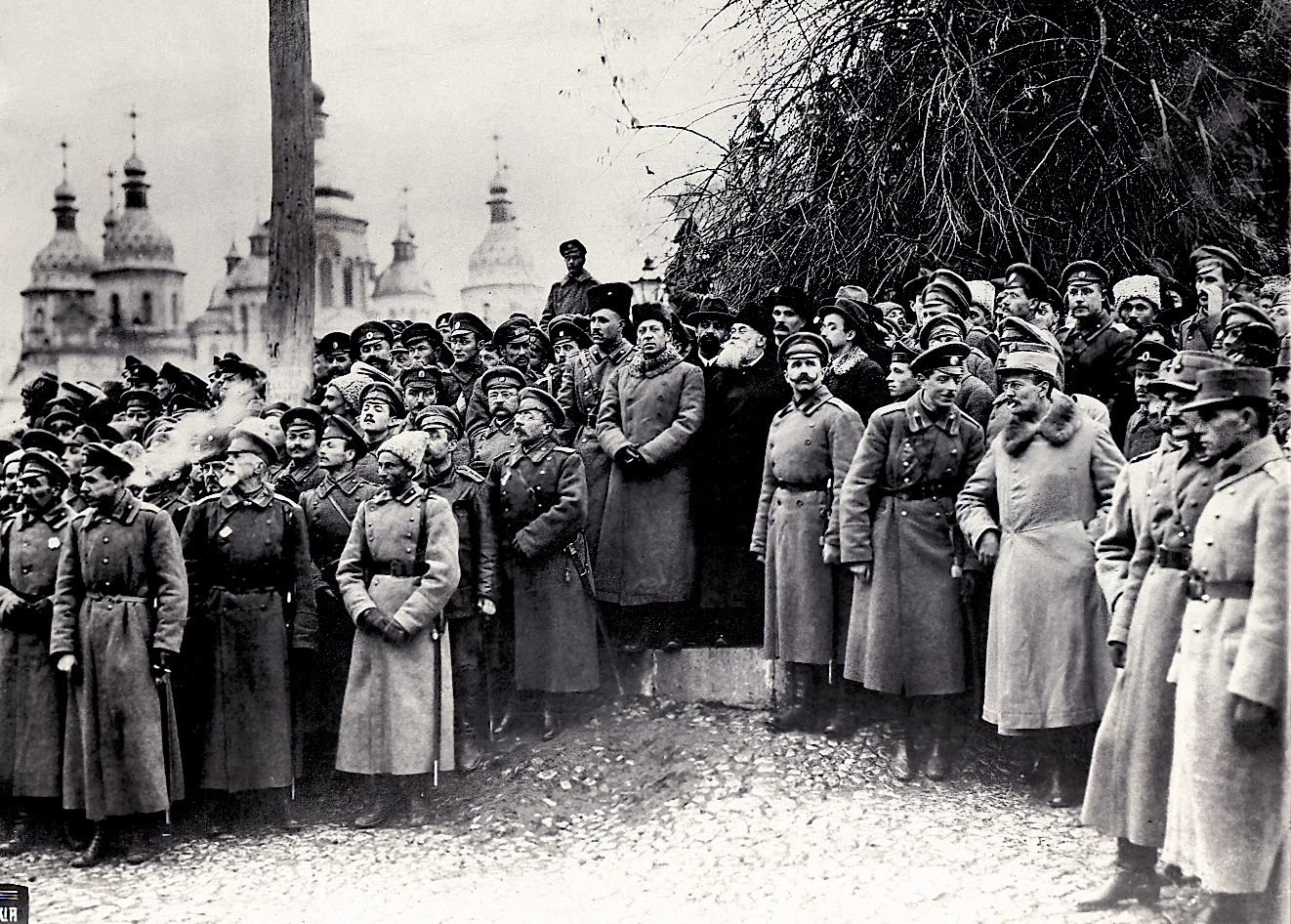
Delegates of the Third All-Ukrainian Military Congress by Sophia, November 1917. Wikimedia Commons, public domain 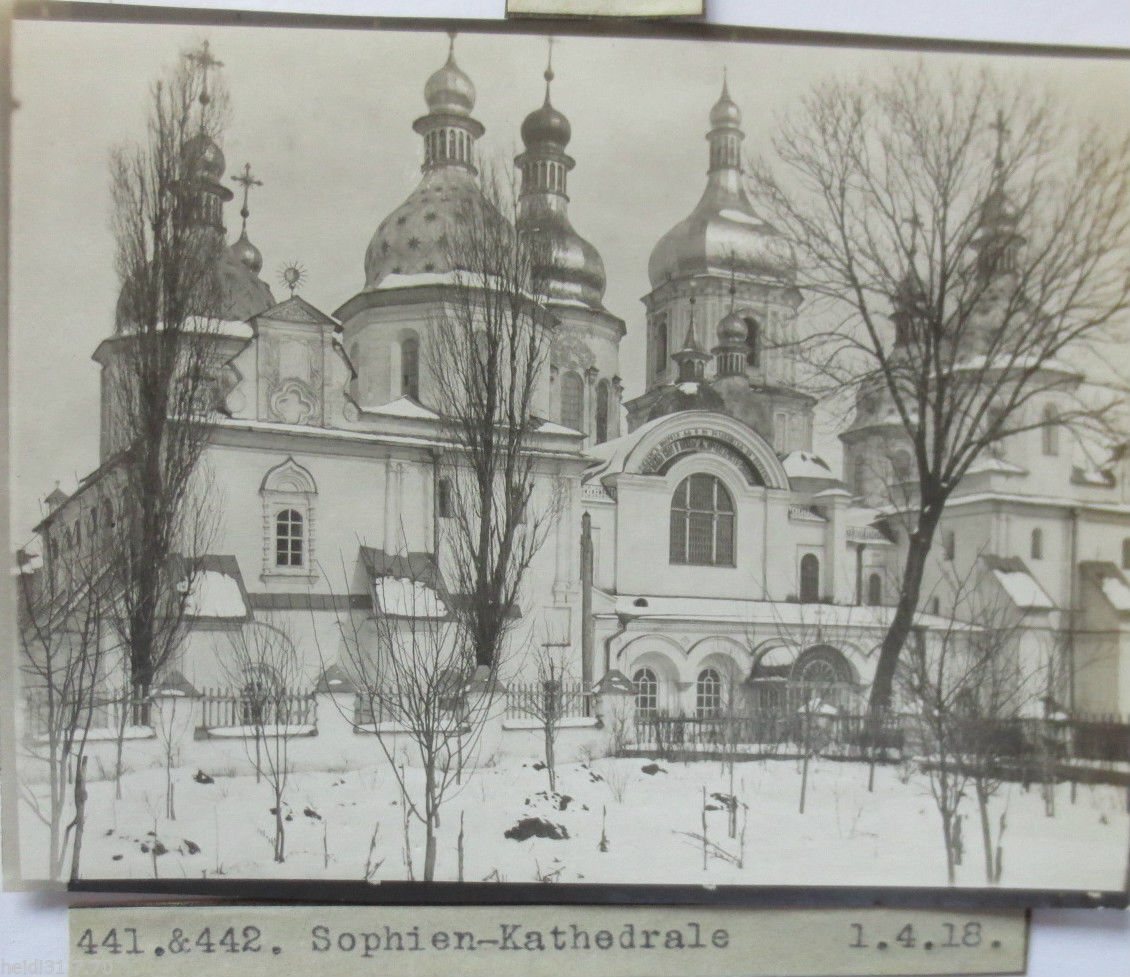
Saint Sophia Cathedral, 1918. Photo by an unknown German soldier. Wikimedia Commons, public domain - 1921
In October the All-Ukrainian Orthodox Church Council in Saint Sophia Cathedral consecrated Vasyl Lypkivskyi as Metropolitan of Kyiv and All Ukraine; the cathedral became the seat of the UAOC. [1, 45]
- 1930
After the UAOC's forced self-dissolution, the bell tower was closed to worship. Nineteen of its twenty bells were taken down; only "Mazepa" remained. [6, 7, 29]
- 1934
After the capital was moved to Kyiv, the historic centre fell within the zone of the government-quarter project. In the same year the authorities created the "Sophia Museum" conservation area; services were stopped and some valuables were confiscated. Visitors began to be admitted in the spring of 1935. [1, 2, 3, 7, 21]
- 1936–1937
The archaeologist Teodosii Movchanivskyi studied the crypt with the burials of metropolitans. In 1937 he opened the tomb of Rafail Zaborovskyi and, according to the Ministry of Culture, returned the relics to the crypt and walled it up; "Telegraf" dates the opening of the crypt to 1936. Movchanivskyi was shot in 1938. [21, 27, 28]
- 1939
The remains from Yaroslav's sarcophagus — a male and a female skeleton — were sent to Leningrad for study; according to the records, they were returned to the conservation area in 1940. The sources date an earlier opening of the sarcophagus differently: 1932 or 1936. [22, 23]
- 1941
In September, during the Red Army's retreat, the cathedral was mined; the explosion did not happen. According to the English-language Wikipedia, citing the conservation area's director O. Povstenko, German sappers averted the detonation. [1, 10]
Independence and war
- 1987, 1994
In 1987 the conservation area received the European Gold Medal for the preservation of historic monuments from the Hamburg Foundation; in 1994 it received national status. [3, 7]
- 1990
The cathedral with its adjoining monastery buildings was inscribed on the UNESCO World Heritage List together with the Kyiv-Pechersk Lavra. [1, 4, 10]
- 1995
On 18 July the authorities did not allow Patriarch Volodymyr (Romaniuk) of the UOC-KP to be buried on the grounds of Sophia; a special police unit dispersed the funeral procession. The patriarch was buried near the entrance to the conservation area. [32, 33]
- 1997–2003
The bell tower was restored over a long period; on 27 June 2003 it was opened to visitors for the first time in several decades. In the same year the World Heritage Committee expressed concern about the cathedral's condition because of construction nearby. [5, 6]
- 2009–2011
The UNESCO General Conference at its 35th session (October 2009) added the cathedral's 1000th anniversary to the calendar of anniversaries for 2011; a decree of the President of Ukraine of 11 June 2010 provided for its observance. [8, 14, 15]
- 2009
In September Yaroslav's sarcophagus was opened again: it held only a female skeleton. The prince's remains have still not been found. [22, 23, 24, 25]
- 2018
On 15 December the Unification Council was held in the cathedral and elected Metropolitan Epiphanius primate of the Orthodox Church of Ukraine; on 3 February 2019 he was enthroned here as well. [34, 35, 36]
- 2022
In late May the Ministry of Culture reported that the relics of Metropolitan Rafail Zaborovskyi, long thought destroyed in the Soviet era, had been found in the cathedral crypt. [27, 28]
- 2023
On 15 September the World Heritage Committee, at its extended 45th session in Riyadh, added the property "Kyiv: Saint-Sophia Cathedral and Related Monastic Buildings, Kyiv-Pechersk Lavra" to the List of World Heritage in Danger. [4, 37]
- 2023–2024
On 20 December 2023 restored crosses began to be returned to the domes; the central cross was returned on 12 July 2024. The restoration of the crosses was paid for by donors. [38, 39, 40]
- 2025
On 10 June the blast wave from a Russian strike on Kyiv damaged the plastered cornice of the central apse on the cathedral's east facade. [41, 42, 51]
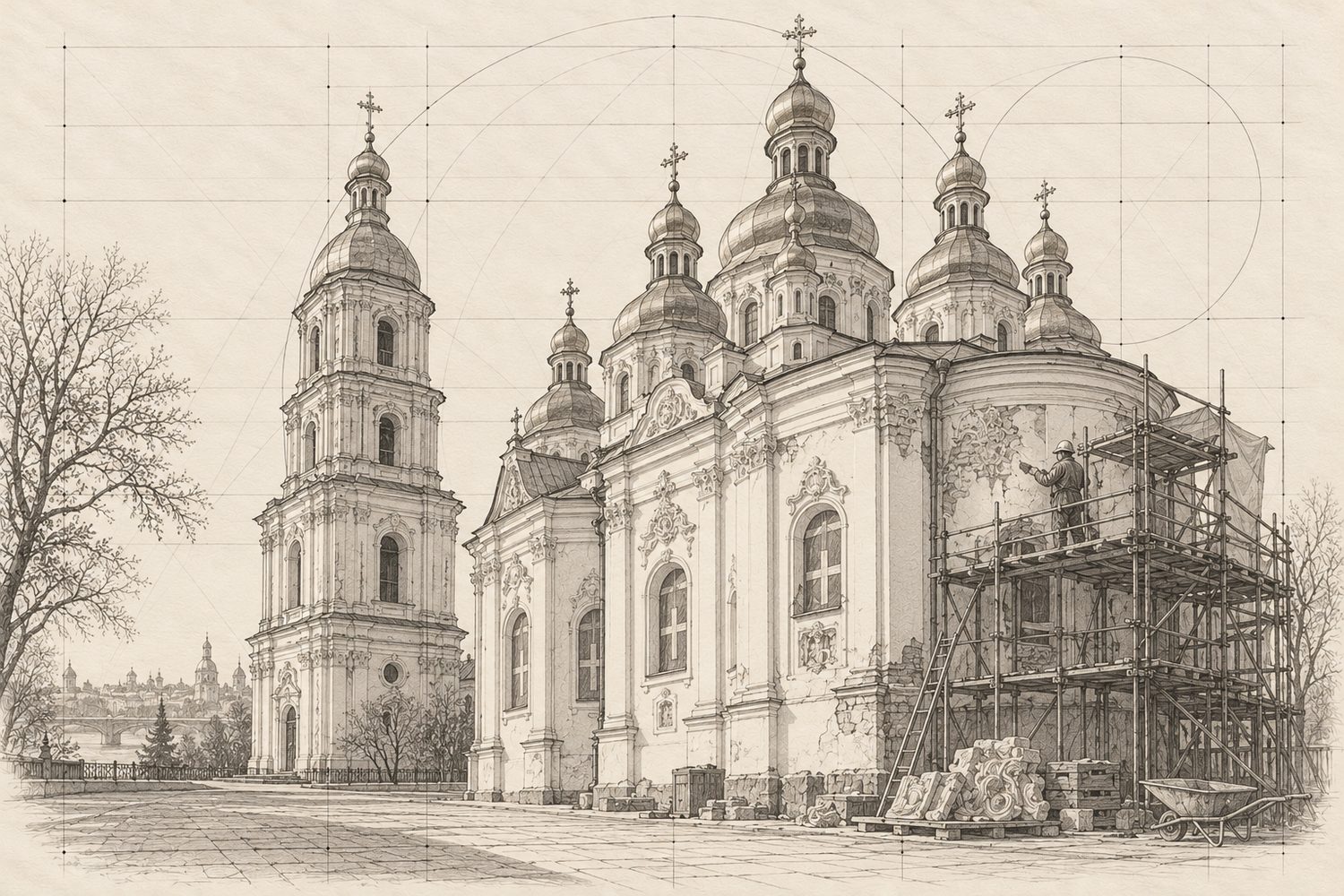
The year 2025: inspecting the damage. Illustration: IKONASTONE - 2026
On 17–20 February a UNESCO monitoring mission inspected Saint Sophia Cathedral and the Lavra; the cathedral's condition is to be assessed by ICOMOS. According to "Hlavcom". [43, 44]
Lost and restored
| What | It was | What happened | Where it is now |
|---|---|---|---|
| Mosaics | About 260 m², 11th century, gold ground | At the turn of the 17th–18th centuries the walls were plastered and whitewashed; in 1884 M. Vrubel recreated three archangels in oil in the dome | In the cathedral; the Orans in the apse is about 6 m tall [1, 17, 18] |
| 11th-century frescoes | About 3,000 m² | Plastered over in the 18th century; in 1843–1853 uncovered and renewed in oil under the direction of F. Solntsev | In the cathedral [1, 16, 17] |
| Princely group portrait | A fresco on the walls of the central nave | Partly lost during rebuilding; who is depicted — the family of Volodymyr or of Yaroslav — is debated | Fragments in the cathedral; the overall appearance is known from Westerfeld’s 1651 drawing [1, 31, 48] |
| Original domes | 13 domes, a pyramidal silhouette | In 1690–1707 they received Baroque tops and new domes were added | Baroque domes [1, 2, 10] |
| Iconostasis | Three tiers, 1747–1754 | The upper tiers were lost | The lower tier has survived [1, 2] |
| Bells | 20 bells on the bell tower | In the 1930s 19 were taken down and thrown from the bell tower | “Mazepa” (1705, about 2 t) on the second tier [6, 29] |
| Relics of Rafail Zaborovskyi | The cathedral crypt | Taken out and returned by T. Movchanivskyi in 1937; thought destroyed | Found in the crypt in 2022 [27, 28] |
| Remains of Yaroslav the Wise | A marble sarcophagus | Sent to Leningrad in 1939, returned in 1940; in 2009 the sarcophagus held only a female skeleton | Not found [22, 23, 24] |
| Yaroslav’s library | Books that, according to the chronicle, Yaroslav collected and placed in Sophia | Fate unknown | Not found [1, 20] |
| Zaborovskyi Gate | 1746–1748, architect J. G. Schädel | Walled up in the 1920s | Restored after the Second World War (according to the English-language Wikipedia) [1] |
| Crosses on the domes | Gilded crosses | In January 2022 a storm tore one cross off; in 2023–2024 the crosses were restored | On the domes; the central one was returned on 12.07.2024 [38, 39, 40] |
| Cornice of the central apse | East facade | Damaged by a blast wave on 10.06.2025 | Awaiting restoration [41, 42] |
Architecture
The original church had five naves and thirteen domes — one central dome and twelve smaller ones around it. The volume rose from the edges to the middle like a pyramid: open galleries, behind them the lower domes, and above everything the central one. After the Baroque rebuilding the silhouette changed, but the ancient structure inside has survived.
The central dome: the Pantocrator and the light
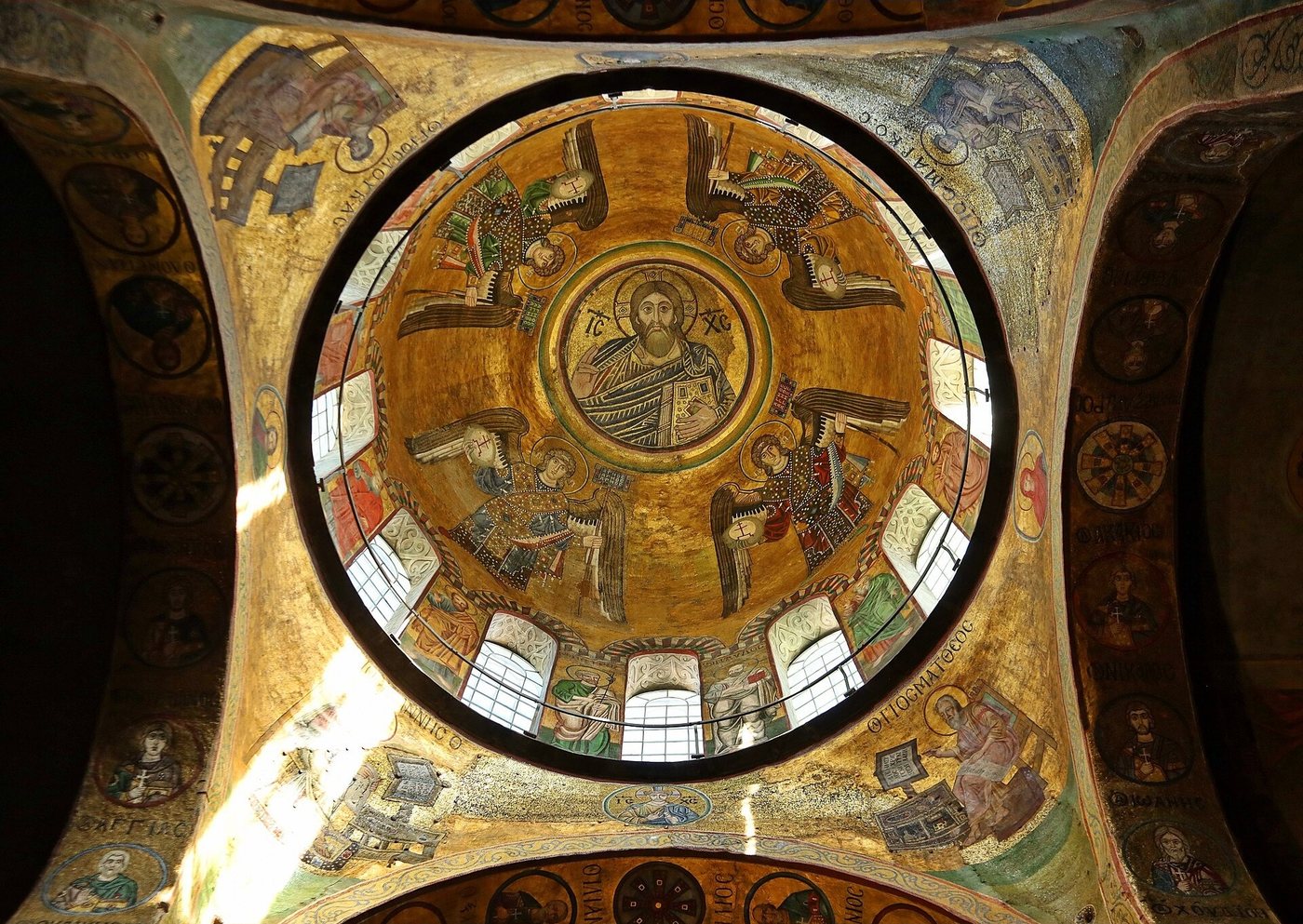
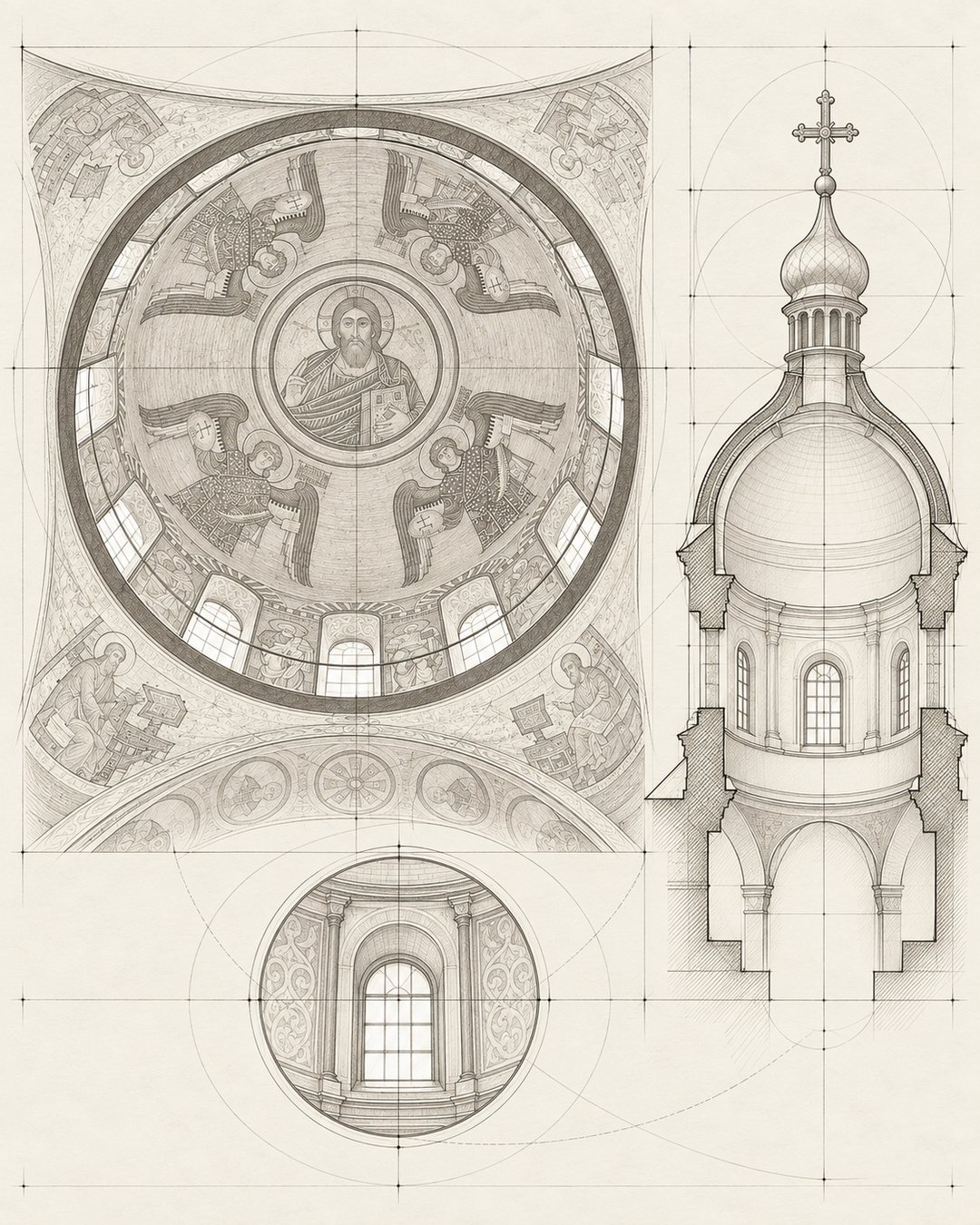
At the zenith of the central dome is a mosaic of Christ Pantocrator. Light from the windows of the drum falls straight onto the centre of the church, and the gold ground of the mosaics reflects it downward.
The apse and the Orans
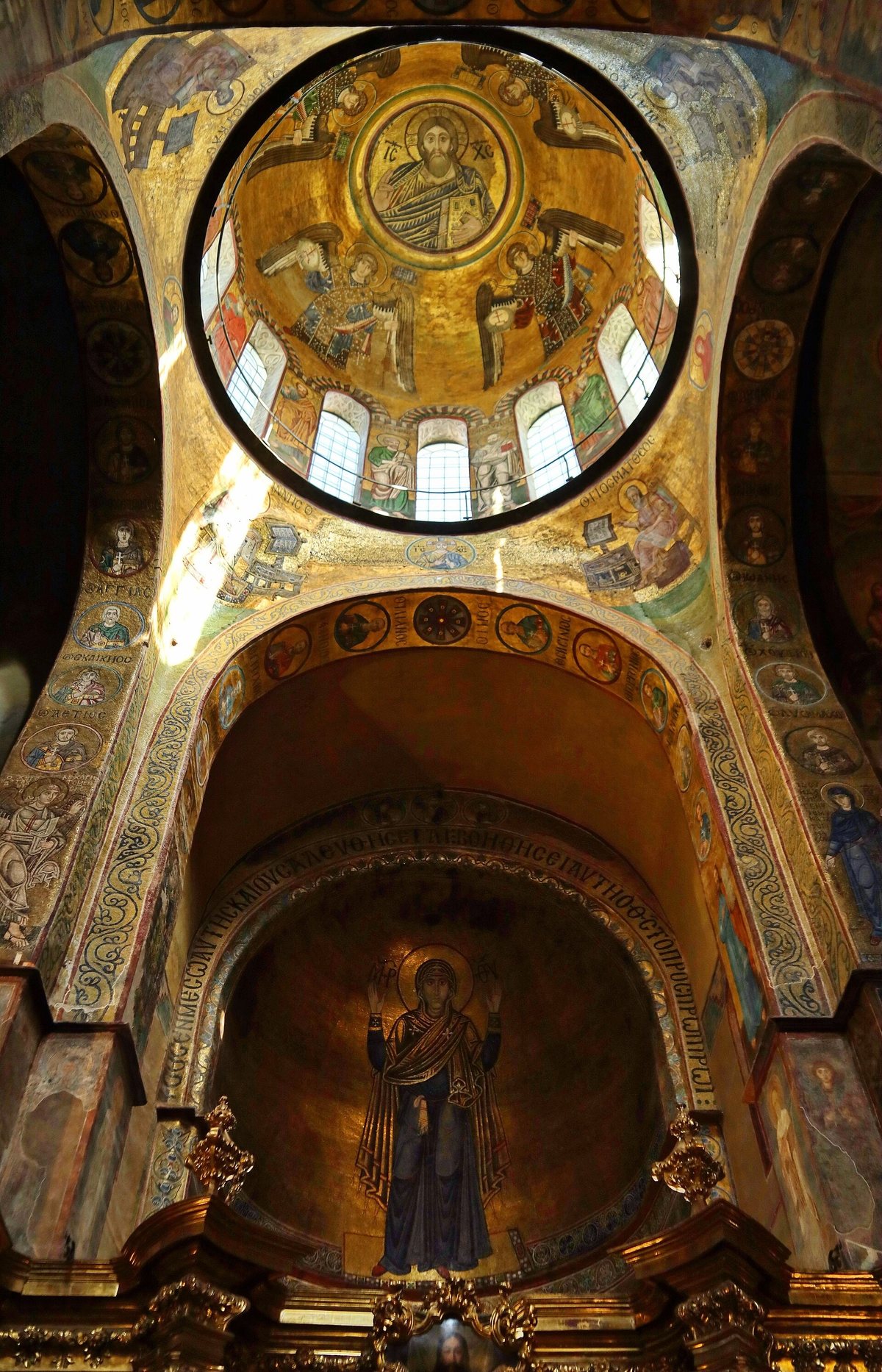
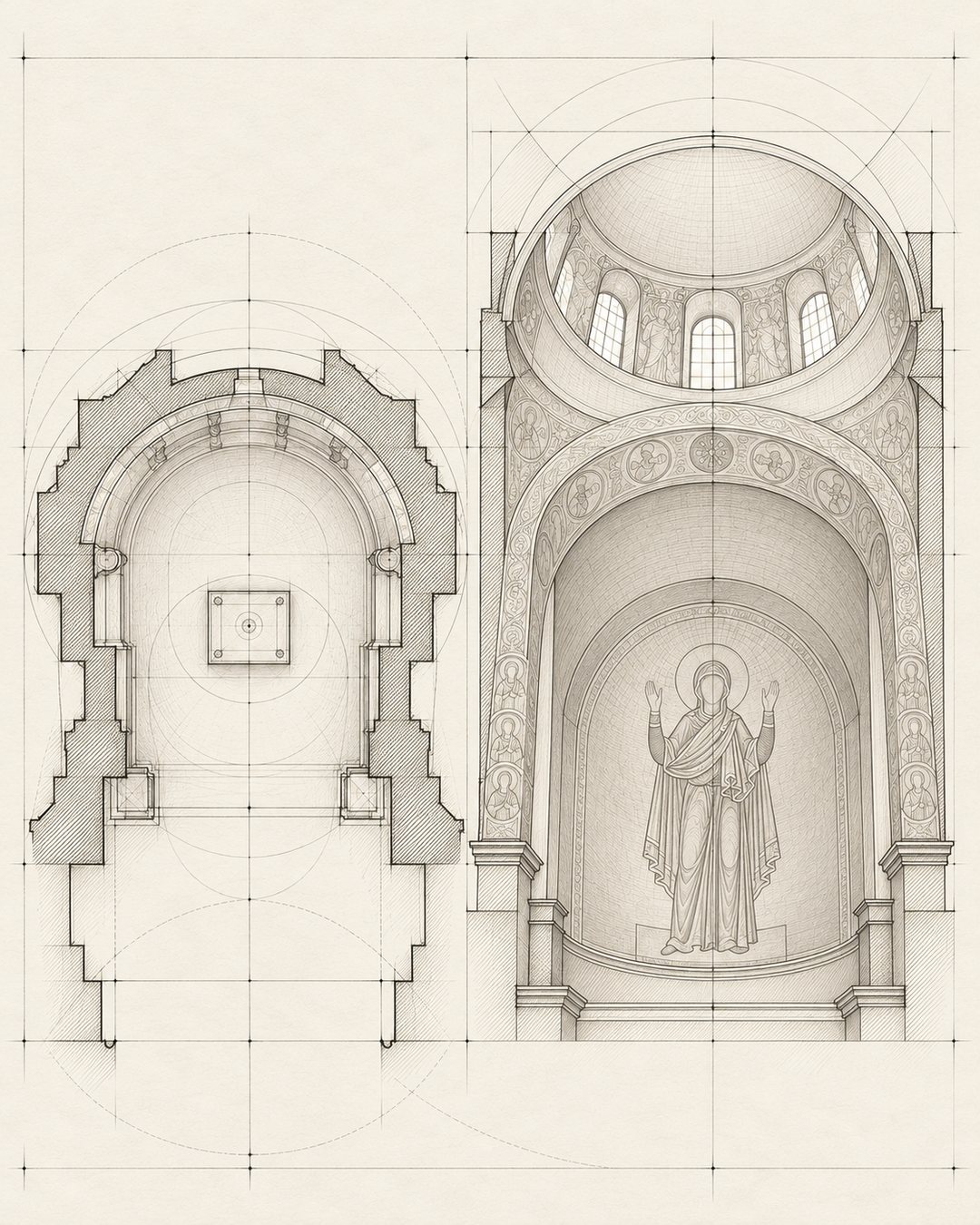
In the main apse is the Virgin Orans, more than five metres tall. She is called the “Indestructible Wall”. In all, about 260 m² of mosaics and about 3,000 m² of 11th-century frescoes have survived in the cathedral — one of the largest ensembles of that time to have come down to us.
The bell tower
Apart from the cathedral stands a bell tower 76 metres tall. It was built after the fire of 1697 (completed in 1706) and later built up further: in the 19th century it received another tier and a pear-shaped dome. Above the low ancient cathedral, it is the tallest vertical of the ensemble.
Stone and material
The cathedral is built in a technique researchers call mixed masonry. Courses of granite and pink quartzite alternate with courses of plinthos, and everything is held together by a pink lime mortar — in Rus’-era building it was usually prepared with an admixture of crushed brick, known as tsemianka. Originally the facades were not plastered: the wall itself was the decoration, striped and warm in the sun.
Where Byzantine models had marble, the Kyivan builders used local material. Instead of marble columns — cross-shaped brick piers. Instead of marble slabs — Ovruch pyrophyllite slate and ceramic tiles.
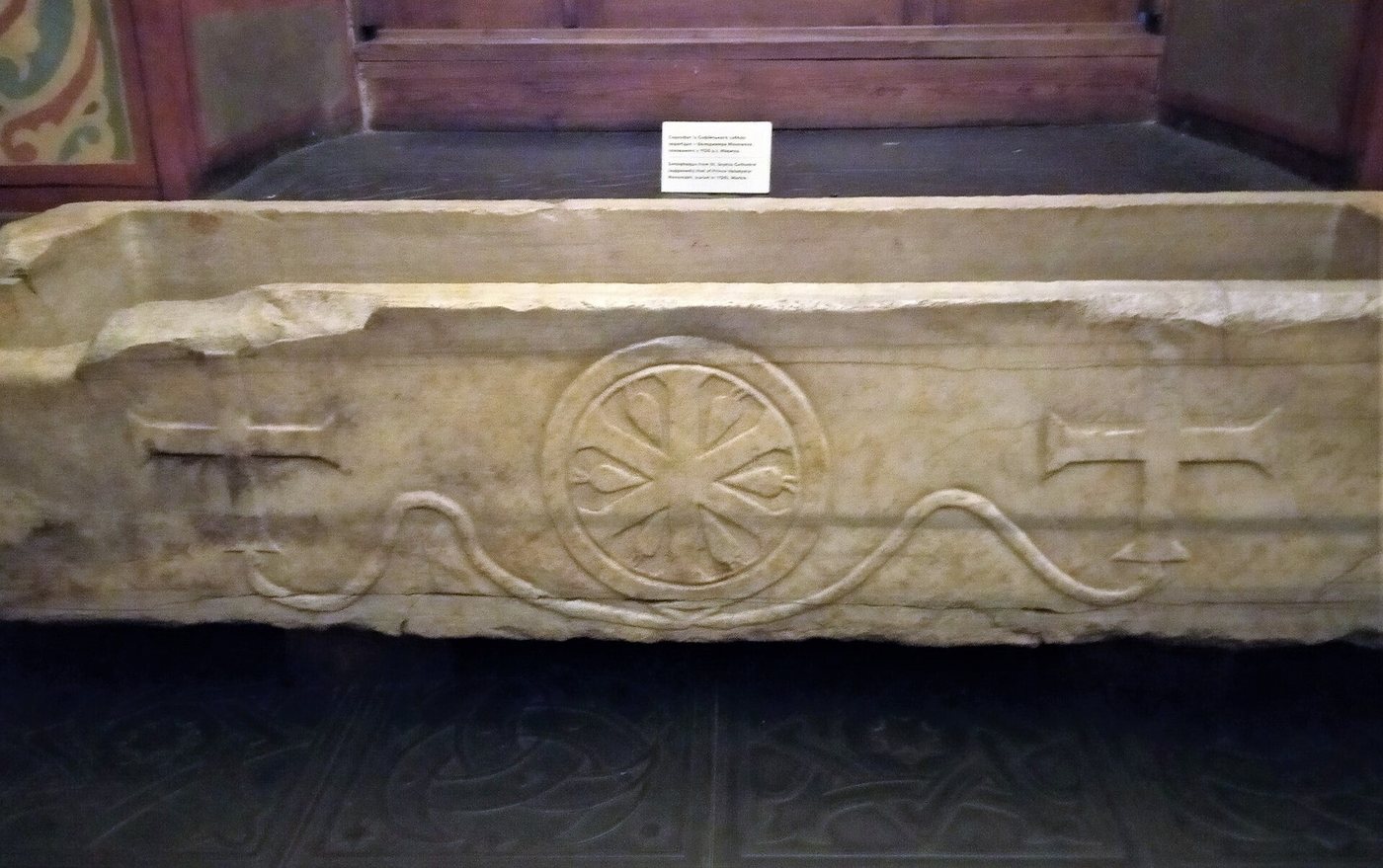
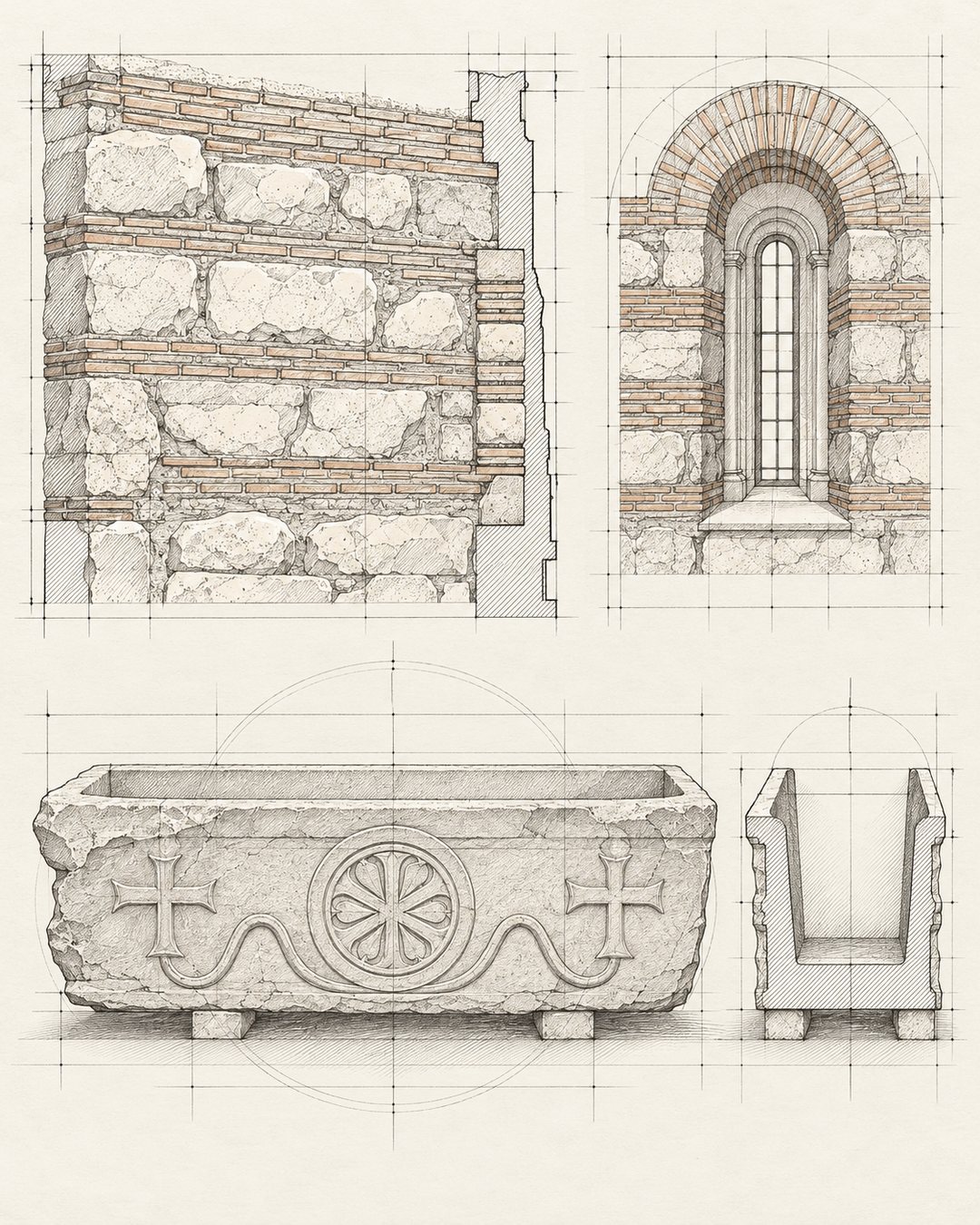
There is genuine marble in the cathedral, and it stands in the north gallery: the sarcophagus of Yaroslav the Wise. The marble chest in which the prince was buried is a reminder that stone in a church is not only support but also memory.
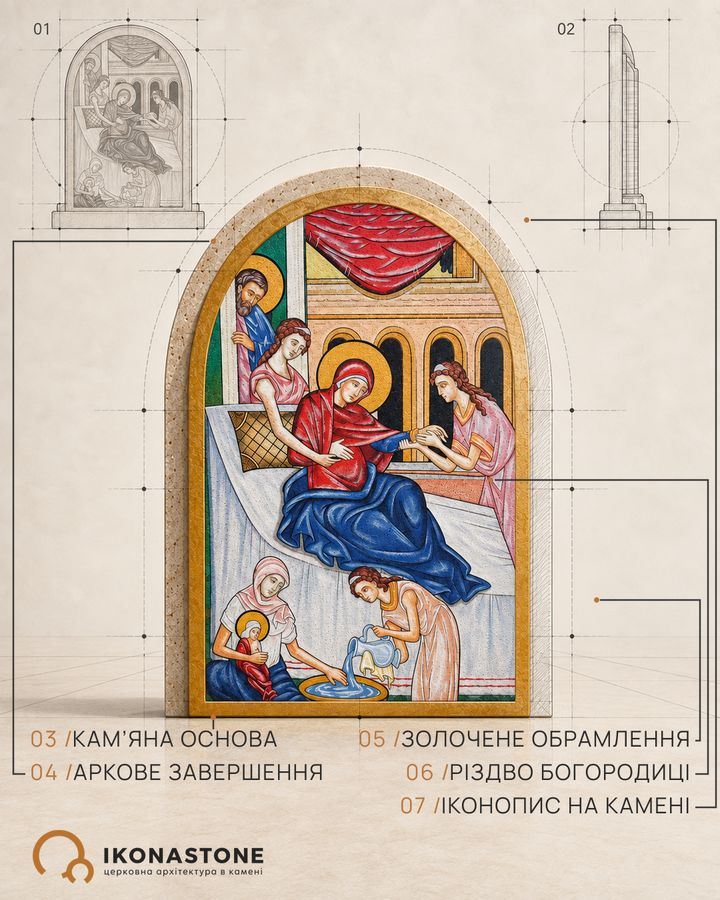
Mosaic is stone too, only broken down into cubes of smalt. How we transfer an image onto stone today is shown in the section icons on stone. And another Rus’-era church built of plinthos is described in the article “The Dormition Cathedral in Volodymyr”.
Did you know
More than 7,000 graffiti of the 11th–18th centuries have been found on the walls of the cathedral: prayers, commemorations, drawings. Among them are records of the birth of Vsevolod (1032) and the death of Yaroslav (1054). [1, 9, 31]
A fresco in the south tower shows a court orchestra of eleven people; the instruments include an organ. It is the only known depiction of an organ in the art of Kyivan Rus'. Alongside are scenes of the Constantinople hippodrome. [1, 30]
The mosaics are laid in smalt of roughly 177 shades; according to researchers' estimates, about eight masters worked on them, whose names we do not know. [1, 17]
"Mazepa" weighs about two tonnes and has a diameter of 1.55 m. Of the twenty bells of the Sophia bell tower, only this one survived the 1930s. [6, 29]
In 1634 an inscription appeared in the cathedral naming 1011 as the start of construction. It was destroyed in 1953, but pre-war photographs survive. According to N. Nikitenko. [11]
In the 1660s Bishop Methodius (Fylymonovych) bought brick for repairs and recast a bell; in his petition of 1666/1667 Yaroslav's sarcophagus is mentioned in the chapel of Saint George. According to S. Bahro. [47]
The art historian L. Skop believes that Yaroslav's sarcophagus was carved in the mid-12th century, probably by a master from the Thessalonian milieu; its back wall was never finished. According to her article. [26]
The name "Robert Willer" is scratched in Latin letters on the lid of Yaroslav's sarcophagus. According to LB.ua. [31]
In 1885 Mykhailo Zubrytskyi recorded in the village of Mshanets a carol about the building of Sophia; Ivan Franko published it in 1889. According to the English-language Wikipedia. [1]
Oleksandr Dovzhenko, according to NV, objected to installing a 70-metre monument to Lenin nearby, because the 76-metre Sophia bell tower would have overshadowed it. [49]
In January 2022 a storm tore off one of the cathedral's crosses; a new cross was installed in November 2022. According to Suspilne. [38]
During the restoration of 2020–2021, beneath a Soviet greenish-beige layer on the vaults of the central nave, paintings of the 18th–19th centuries on a gold ground came to light. According to LB.ua. [31]
In 2026, 28 vibration sensors (20 and 8) were installed on the cathedral and bell tower at UNESCO's expense; general monitoring of the condition of the structures, soils and groundwater has run for about 20 years. According to "Hlavcom". [44]
Legends
The hiding place of the library
According to legend, during one of the attacks the monks hid the most valuable books of Yaroslav's library in an underground passage that has never been found. Recorded in the English-language Wikipedia; the library itself is known from the chronicle under the year 1037. [1, 20]
The battle on the site of the cathedral
According to the chronicle account, the Pechenegs "clashed on that hill where Saint Sophia Cathedral now stands", and Yaroslav defeated them only towards evening. In places this story is presented as the reason for founding the church. [20]
The rescue by France
According to legend, in the 1930s Sophia was saved by a letter from Romain Rolland to Stalin or by an offer from the French government to fund the restoration, since the church is linked with Anne of Kyiv, Queen of France. Recorded in "Telegraf"; no documents are cited. [21]
The "Indestructible Wall"
According to popular tradition, the Orans in the apse is the Virgin protectress of Kyiv, who defends the city; hence her name, the "Indestructible Wall". Recorded in the Encyclopedia of Ukraine and by Radio Svoboda. [2, 50]
The remains in America
According to a tale passed on by the linguist Petro Odarchenko, during the German occupation Yaroslav's bones were given to a German major, who took them to Warsaw and handed them to Father Palladii, who supposedly carried them on to the USA. In 2017 American agents searched a church in New York but found nothing. Recorded in "Telegraf". [22]
The incorrupt relics
According to legend, the body of Metropolitan Rafail Zaborovskyi remained incorrupt after his death and was displayed in the crypt for veneration, until in the mid-19th century the entrance was closed with cast-iron slabs. Recorded in "Ukrainska Pravda. Zhyttia". [27]
Figures
- Volodymyr the Great — according to N. Nikitenko, the founder of the cathedral (1011).
- Yaroslav the Wise — the prince with whom the chronicle links the construction; buried in the cathedral (1054).
- Vsevolod Yaroslavych — Yaroslav’s son, buried in the cathedral (1093).
- Petro Mohyla — metropolitan who in 1633 returned the cathedral to the Orthodox and founded the monastery.
- Ottavio Mancini — the Italian architect of the Mohyla-era rebuilding.
- Ivan Mazepa — hetman, patron of the Baroque rebuilding and of the bell tower.
- Rafail Zaborovskyi — metropolitan, commissioner of the iconostasis and the gate; his relics were found in 2022.
- Johann Gottfried Schädel — architect of the rebuilding of the bell tower and of the Zaborovskyi Gate.
- Fedir Solntsev — artist under whose direction the frescoes were uncovered in 1843–1853.
- Mikhail Vrubel — in 1884 recreated three archangels in the dome.
- Vasyl Lypkivskyi — UAOC metropolitan, consecrated in the cathedral in 1921.
- Teodosii Movchanivskyi — archaeologist, researcher of the crypt; preserved the relics of Zaborovskyi; shot in 1938.
- Patriarch Volodymyr (Romaniuk) — primate of the UOC-KP, buried near the entrance to the grounds of Sophia (1995).
- Nadiia Nikitenko — researcher at the conservation area, author of the 1011–1018 dating.
- Oleksii Tolochko — historian, proponent of the 1017 date.
- Nelia Kukovalska — director general of the conservation area, initiator of the search for Yaroslav’s remains.
How to cite
IKONASTONE. Saint Sophia Cathedral in Kyiv // Guide to the Churches of Ukraine. URL: https://ikonastone.com/en/guide/saint-sophia-cathedral-kyiv/ (accessed DD.MM.YYYY).
FAQ
Where is Saint Sophia Cathedral located?
In the centre of Kyiv, at 24 Volodymyrska Street, in Shevchenkivskyi District. The cathedral is part of the National Conservation Area "Sophia of Kyiv".
When was the cathedral built?
In the first half of the 11th century. The Primary Chronicle links its foundation to the year 1037 and to Yaroslav the Wise; according to the dating by N. Nikitenko, supported by the state, the cathedral was founded in 1011, under Volodymyr the Great. Its 1000th anniversary was marked in 2011.
What is the cathedral built of?
The walls are laid in a mixed-masonry technique: courses of granite and pink quartzite alternate with courses of plinthos — thin Rus'-era brick — on a pink lime mortar. Originally the facades were not plastered.
Is the cathedral a working church?
The cathedral is a museum within the National Conservation Area "Sophia of Kyiv" (it has had museum status since 1934). Services are held here occasionally, by agreement with the conservation area; several churches lay claim to it.
Sources
- Wikipedia (en). Saint Sophia Cathedral, Kyiv
- Encyclopedia of Ukraine (CIUS). Saint Sophia Cathedral
- Encyclopedia of Ukraine (CIUS). Saint Sophia Museum
- UNESCO World Heritage Centre. Kyiv and L'viv sites inscribed on the List of World Heritage in Danger (15.09.2023)
- UNESCO World Heritage Centre. State of conservation 2003: Kyiv: Saint-Sophia Cathedral
- Wikipedia (en). Bell Tower of Saint Sophia Cathedral
- Wikipedia (en). National Reserve "Sophia of Kyiv"
- Енциклопедія сучасної України. Нікітенко Надія Миколаївна
- Енциклопедія сучасної України. Графіті
- WorldHistory.org (укр.). Софія Київська
- Н. Нікітенко. Стаття про датування Софії Київської. «Світогляд», 2010, № 2
- О. Толочко. Стаття про датування Софії Київської. «Світогляд», 2010, № 2
- Радіо Свобода. Софія Київська та її вік (2009)
- LB.ua. Дискусія про вік Софійського собору триває (18.06.2010)
- LB.ua. Указ про відзначення дня заснування Софії Київської (12.06.2010)
- Osvita.ua. Видатний археолог і реставратор Федір Солнцев
- Osvita.ua. Софійський собор як видатний витвір мистецтва
- Національний художній музей України. Київ Врубеля (каталог)
- Osvita.ua. Софія Київська як головний храм держави
- Osvita.ua. Розгром Ярославом печенігів. Літописна оповідь
- Телеграф. Чому Сталін не знищив Софію Київську (15.01.2025)
- Телеграф. У саркофагу залишився лише скелет жінки (20.02.2025)
- УНІАН. З «Софії» пропали останки Ярослава Мудрого (12.04.2010)
- LB.ua. Зовнішність Ярослава Мудрого знову відтворять (17.10.2009)
- Українська правда. Життя. Шукайте жінку: з саркофагу Ярослава Мудрого зник один кістяк (17.09.2009)
- Л. Скоп. Саркофаг Ярослава Мудрого
- Українська правда. Життя. У Софії Київській знайшли мощі митрополита Заборовського (30.05.2022)
- Тексти.org.ua. У Софії Київській знайшли мощі митрополита Рафаїла Заборовського (31.05.2022)
- Радіо Свобода. Дзвін «Мазепа» на Софійській дзвіниці
- Телеграф. Про що розповідають фрески Софійського собору (05.03.2025)
- LB.ua. Портрети дітей Володимира та англійське графіті (05.02.2022)
- Главком. Кривавий вівторок. 30 років тому влада перетворила на побоїще похорон патріарха Володимира (2025)
- Радіо Свобода. Похорон патріарха Володимира
- Радіо Свобода. Об'єднавчий собор: як проходило голосування (15.12.2018)
- Еспресо. У Святій Софії інтронізували предстоятеля ПЦУ Епіфанія (03.02.2019)
- Zaxid.net. Об'єднавчий собор обрав голову Православної церкви в Україні (15.12.2018)
- Кабінет Міністрів України. Об'єкти у Києві та Львові внесли до Списку всесвітньої спадщини, що перебуває під загрозою (15.09.2023)
- Суспільне. Софія Київська зустріла Різдво з оновленими хрестами (12.2023)
- The Page. На куполи Софійського собору повернули відреставровані хрести (21.12.2023)
- Суспільне Київ. На центральний купол Софії Київської повертають останній відреставрований хрест (12.07.2024)
- Кабінет Міністрів України / МЗС. Коментар щодо пошкодження собору святої Софії (10.06.2025)
- Радіо Свобода. Софійський собор пошкоджено (10.06.2025)
- Главком. Місія ЮНЕСКО обстежила пошкодження Софії Київської та Лаври (25.02.2026)
- Главком. Як вберегти Софію Київську від російських атак (22.06.2026)
- Osvita.ua. Київський всеукраїнський церковний собор
- Інтерфакс-Україна. День Соборності
- С. Багро. Реставрація Софії Київської єпископом Мефодієм. «Byzantinoucrainica», 2022
- Є. Архипова. «Український історичний журнал», 2010, № 5
- НВ. Спасти Софію (12.01.2018)
- Радіо Свобода. Київська Русь і Богородиця
- АрміяInform. У Києві ворожим обстрілом пошкоджено Софійський собор (10.06.2025)
- Town
- Kyiv
- Built
- 11th century (1011 or 1037)
- Type
- five-nave cross-in-square church, originally with 13 domes
- Material
- granite, pink quartzite, plinthos brick
- Research depth
- 42%