St Volodymyr's Cathedral in Kyiv: a church painted by artists
This cathedral was conceived with thirteen domes and built with seven — and even so, cracks in the arches halted work for nine years. What people come here for appeared only later: eleven years of brushwork on plaster.
In brief
| Address | Kyiv, 20 Taras Shevchenko Boulevard |
| Built | 1862–1882; paintings 1885–1896 |
| Consecrated | 20 August (1 September) 1896 |
| Architects | I. Shtrom, P. Sparro, A. Beretti; completed by R. Bernhard, K. Mayevsky, V. Nikolayev |
| Type | three-aisled, six-pillared, three-apsed church, seven domes |
| Height | about 49 m to the cross of the main dome (according to English Wikipedia) |
| Status | architectural monument of national importance; cathedral of the OCU |
History
Fundraising for a cathedral in honour of Prince Volodymyr began in 1852; according to Osvita.ua, the first contribution was 7,000 roubles from Metropolitan Filaret. English Wikipedia links the idea to the 900th anniversary of the baptism of Rus’. By 1859 the fund had reached 100,000 roubles.
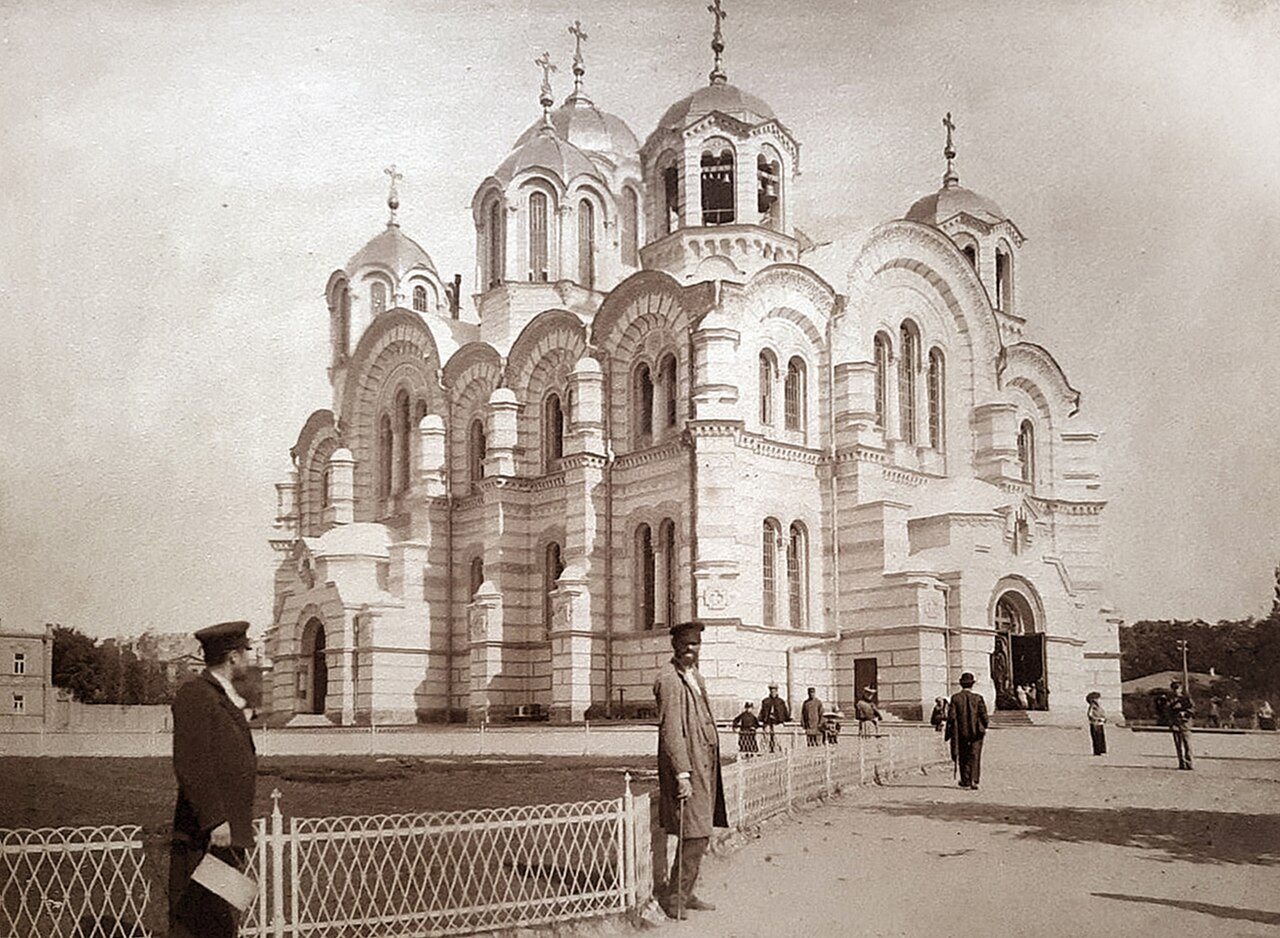
The first design, in a Byzantine spirit, was drawn up by the St Petersburg architect Ivan Shtrom. He imagined a church with thirteen domes. Pavel Sparro, to fit the budget, kept seven. The foundation was laid on 15 (27) July 1862, the feast day of Prince Volodymyr. Alexander Beretti, who reworked the design, enlarged the linear dimensions of the building by about one and a half times.
It was this enlargement that took its toll. In the autumn of 1864 some of the arches could not bear the weight of the upper tier and spread apart. Beretti blamed the contractors and masons, and the domes were made smaller, but in 1866 the cracks spread. Shtrom himself was sent from St Petersburg to investigate, Beretti was removed, and the walls were secured against collapse with metal structures. The unfinished building stood for nine years.
In 1875 Emperor Alexander II got things moving again: having seen the unfinished building in Kyiv, he secured additional funds. Rudolf Bernhard calculated the reinforcement, the walls were propped up with buttresses, and from 1875–1876 construction was led by the 28-year-old diocesan architect Volodymyr Nikolayev, a pupil of Bernhard. By 1882 the cathedral was practically finished.
Then began what St Volodymyr’s Cathedral is known for. In 1885 Adrian Prakhov became head of the decoration — an art historian who had earlier uncovered the 12th-century frescoes in St Cyril’s Church. He gathered artists from different schools, and over eleven years they painted more than three thousand square metres. The cathedral was consecrated on 20 August (1 September) 1896 in the presence of Metropolitan Ioanniky and Nicholas II.
The work was divided among the artists the way plots are divided among work crews. Viktor Vasnetsov took the main nave and the altar: the Mother of God with the Child in the apse, Christ Pantocrator in the dome, “The Baptism of Volodymyr” and “The Baptism of the Kyivans”, the figures of Princes Volodymyr and Olga, and Nestor the Chronicler. According to Osvita.ua, he alone painted about two thousand square metres. Mikhail Nesterov painted Saints Cyril and Methodius, St Barbara, “The Nativity”, “The Theophany” and “The Resurrection”. Wilhelm Kotarbiński and the Svedomsky brothers shared the days of creation and Gospel scenes — “The Transfiguration”, “The Ascension”, “The Entry into Jerusalem”. Mykola Pymonenko and Serhii Kostenko also painted in the cathedral; according to Eurofest, Kostenko painted the seraphim. Pupils of Mykola Murashko’s Kyiv Drawing School worked here too.
The painting programme reads like a book: the Old Testament — the days of creation, Adam and Eve, the prophets; then the earthly life of Christ and the apostles; and finally the holy bishops of the Universal Church and the Church of Rus’. The painting was criticised for “excessive boldness”, money was short, but in eleven years the walls were finally filled.
In 1929 worship was banned, the bells were removed in December, and the cathedral was turned into a museum of anti-religious propaganda. In the 1930s it housed an archive and a book depository. Demolition was proposed more than once, but it never came to that. Worship was restored under the German occupation, and in 1943–1944 the cathedral became a cathedra church. In 1946–1952 (according to the Great Ukrainian Encyclopedia, until 1956) the paintings were restored under the direction of the artist L. Kalenychenko. After 1991 two churches laid claim to it; the church went to the Kyiv Patriarchate. On 22 October 1995 the enthronement of Patriarch Filaret (Denysenko), the cathedral’s rector since 1960, took place here. After the unification council of 2018 the church belongs to the OCU. Filaret died on 20 March 2026; on 22 March he was buried in the cathedral, as he had willed. Since 1 May 2026 the cathedral has followed the Revised Julian calendar.
Timeline
The numbers in square brackets are source numbers in the list at the bottom of the page. The note “according to …” means that the fact is confirmed by only one source. The “Legends” section contains traditions and legends: they are recorded in the sources but not documented.
Conception and construction
- 1852
Filaret (Amfiteatrov), Metropolitan of Kyiv, proposed building a cathedral in Kyiv in honour of Prince Volodymyr; the money was raised through donations. [2, 4, 17]
- 1853
Emperor Nicholas I approved the plan and chose the site for the church. According to the cathedral's website, a building committee was formed in August. [2, 3]
- 1853–1859
The Crimean War and a shortage of funds delayed the start of work. By 1859 the fund had reached about 100,000 roubles. [2, 4, 8]
- 1860
Pavel Sparro reworked Ivan Shtrom's design to fit the budget: of the thirteen domes, seven remained. [1, 2, 4]
- 1862
Alexander Beretti reworked the design once more and enlarged the linear dimensions of the building by about one and a half times. [1, 2, 4]
- 1862
On 15 (27) July, the feast day of Prince Volodymyr, Metropolitan Arseny (Moskvin) laid the first stone. [2, 3, 9]
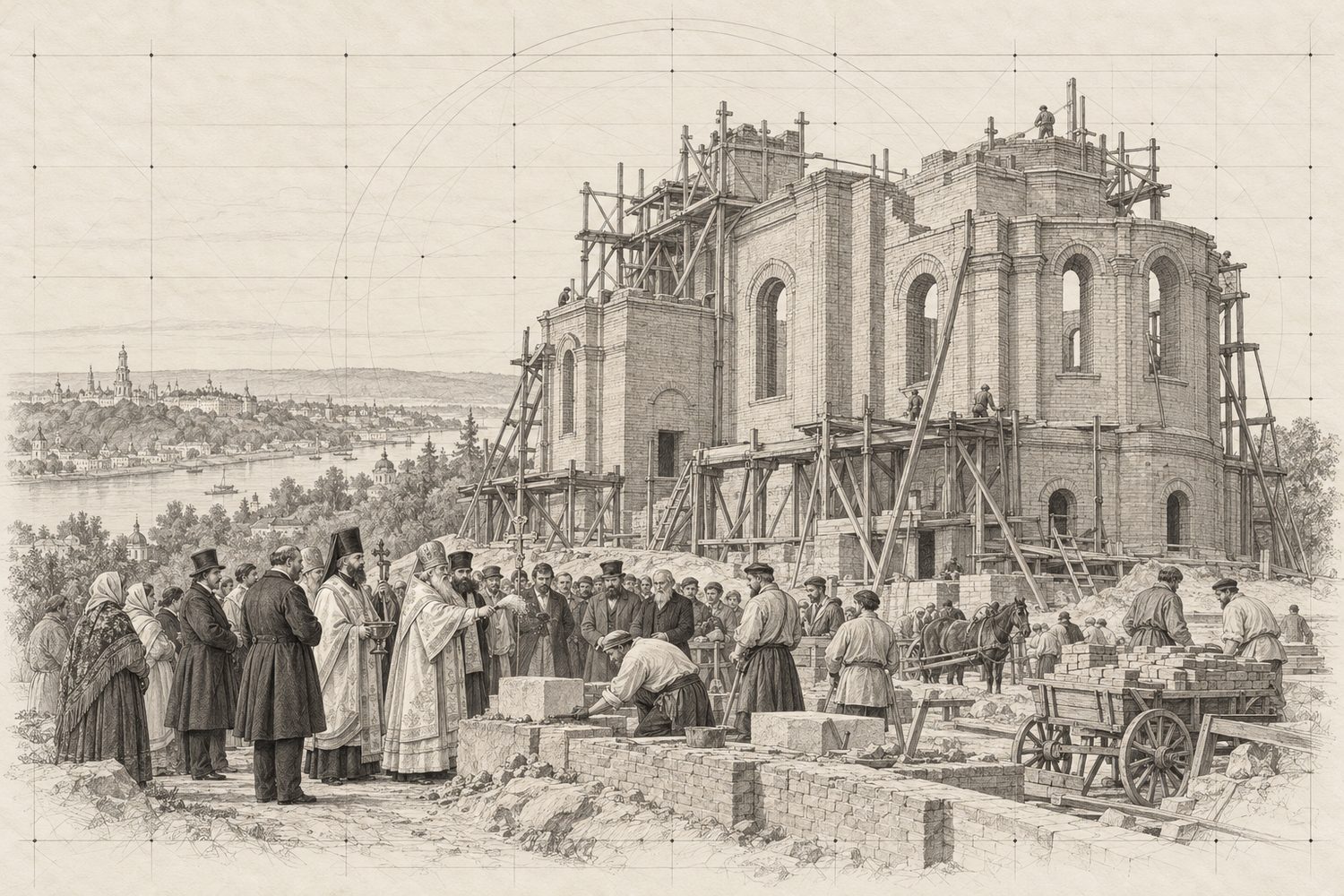
1862: the laying of the foundation. Illustration: IKONASTONE - 1864
Some of the arches could not bear the weight of the upper tier and spread apart. [4, 6, 36]
- 1866
The cracks spread and construction was stopped; Beretti was removed from the project. The unfinished building stood for about nine years. [2, 4, 6]
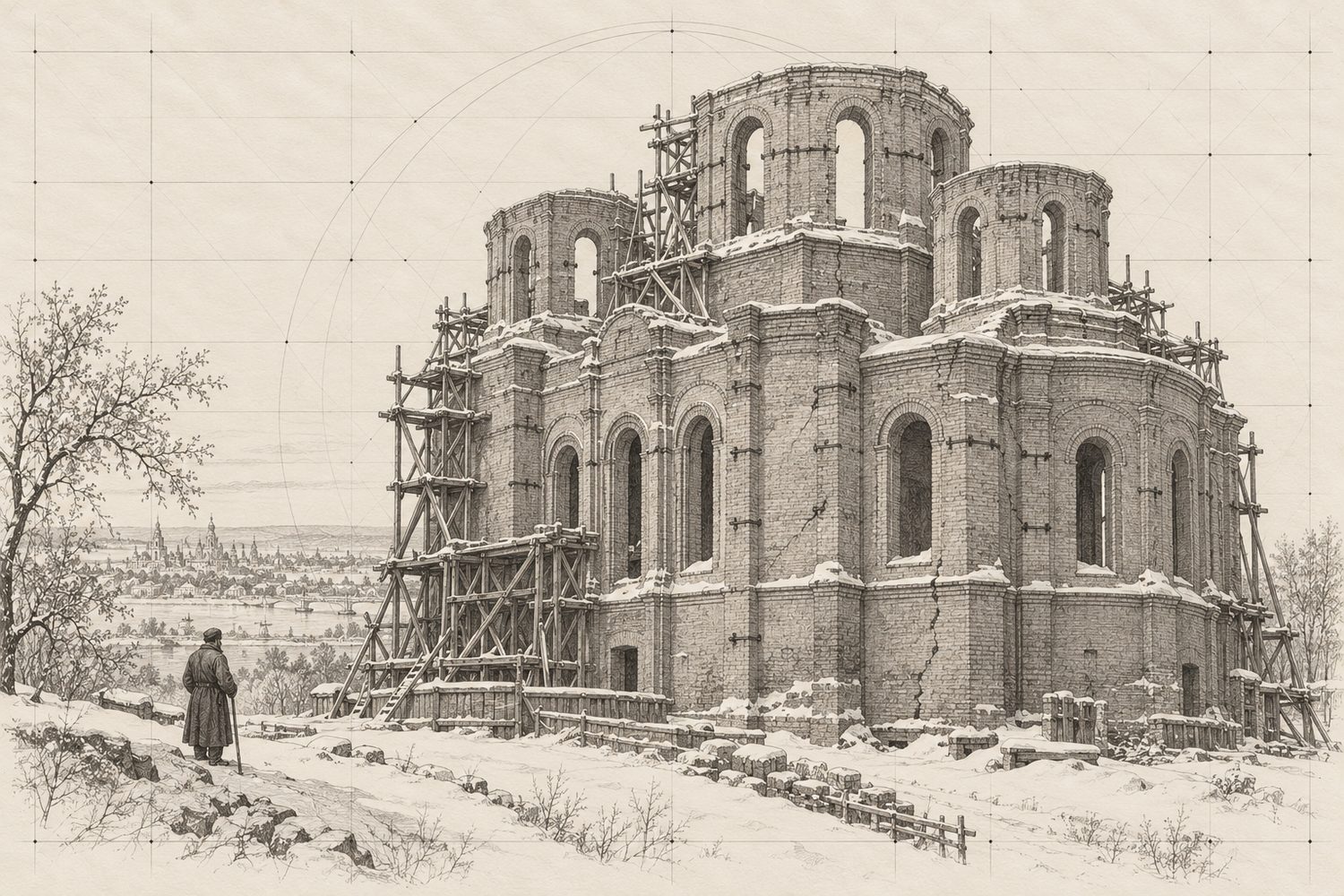
Around 1870: the unfinished building stands for years. Illustration: IKONASTONE - 1875
Emperor Alexander II secured funds to continue the work. Rudolf Bernhard calculated the reinforcement, and the walls were propped up with buttresses. [2, 4]
- 1875–1876
The diocesan architect Volodymyr Nikolayev became head of construction (Great Ukrainian Encyclopedia: 1875; cathedral website: June 1876). [2, 3]
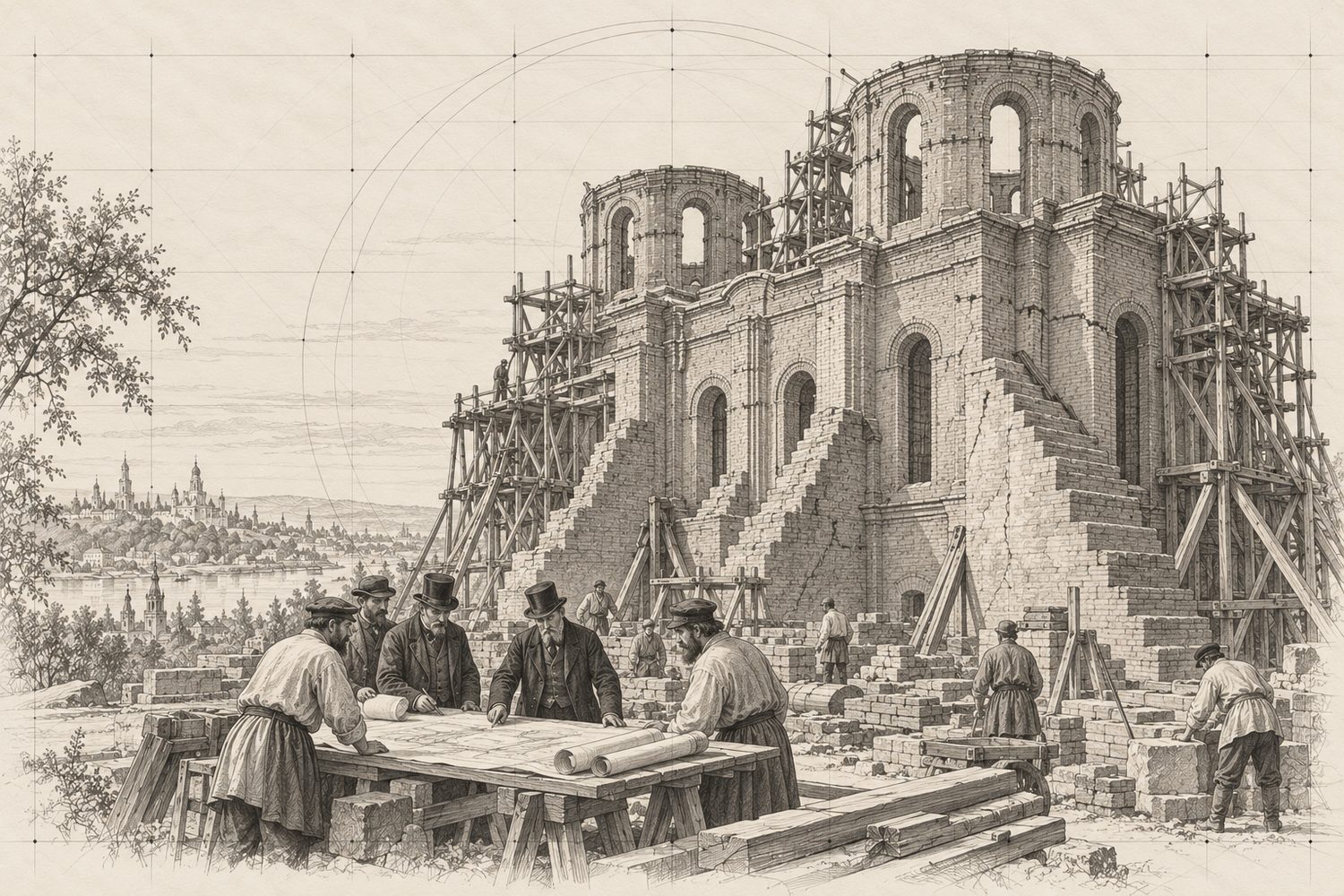
1875–1876: buttresses save the walls. Illustration: IKONASTONE - 1882
Construction was completed. According to Dzerkalo Tyzhnia, the strength of the vaults was tested with sandbags weighing 640 tonnes. [1, 2, 6]
Paintings and consecration
- 1885
The art historian Adrian Prakhov became head of the decoration. According to D. Stepovyk, a contract was concluded with Viktor Vasnetsov in April. [1, 2, 7]
- 1885–1896
The cathedral was painted by V. Vasnetsov, M. Nesterov, V. Kotarbiński, the brothers P. and O. Svedomsky, M. Pymonenko, S. Kostenko, V. Zamyraylo and others; Vasnetsov was given the main nave and the apse. [1, 2, 7]
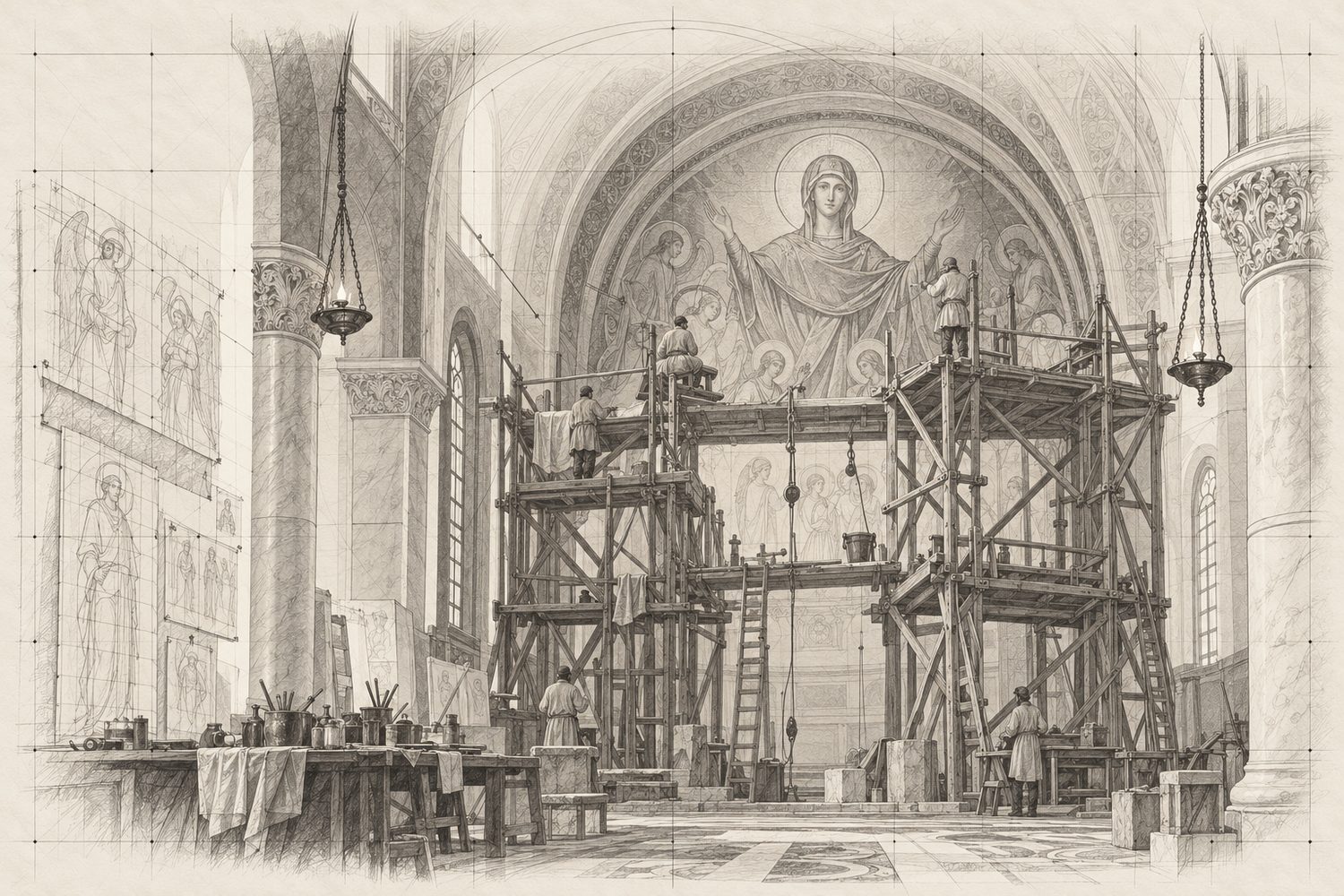
1880s–1890s: the painting of the cathedral. Illustration: IKONASTONE 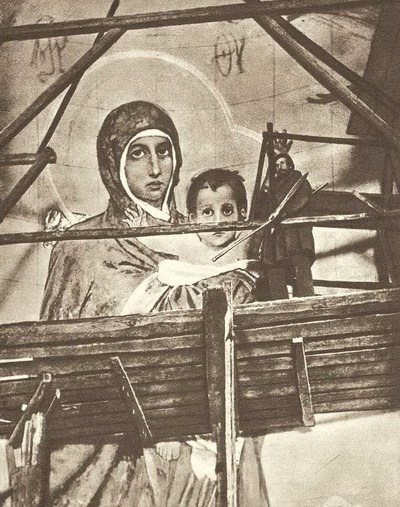
Viktor Vasnetsov at work in the cathedral, 1880s. Wikimedia Commons, public domain - 1885–1896
The sketch for the painting that Mikhail Vrubel submitted to the building committee was not approved; Vrubel executed part of the ornaments of the south aisle. [1, 2, 6]
- 1896
On 20 August (1 September) Metropolitan Ioanniky (Rudnyev) consecrated the cathedral in the presence of Emperor Nicholas II. [2, 3, 5]
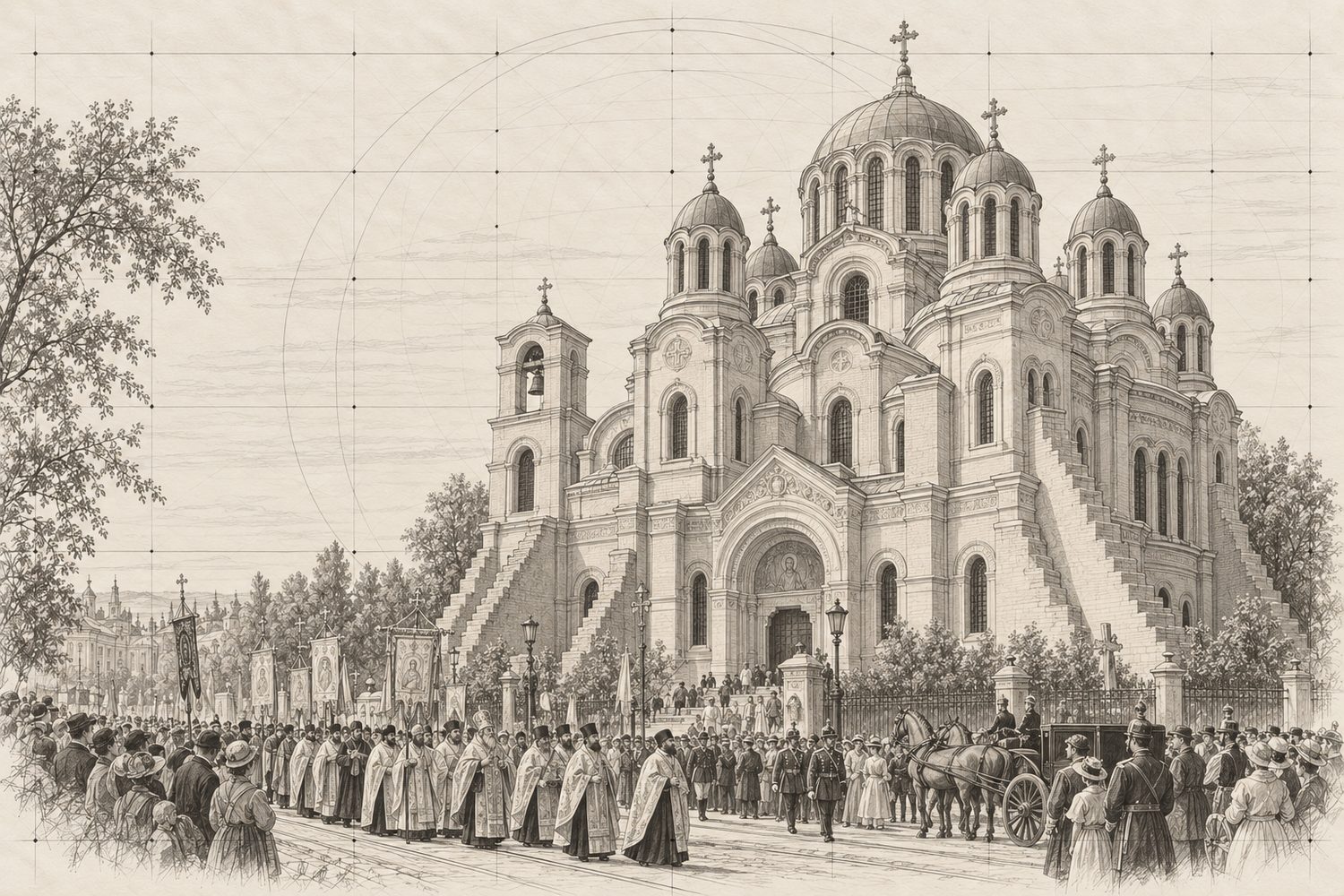
20 August 1896: the consecration. Illustration: IKONASTONE - 1897
Olena Prakhova embroidered a Plashchanytsia (Epitaphios) for the cathedral after a canvas by Vasnetsov (the year is from UAHistory); today the Epitaphios is in the Kyiv Pechersk Lavra. [15, 16]
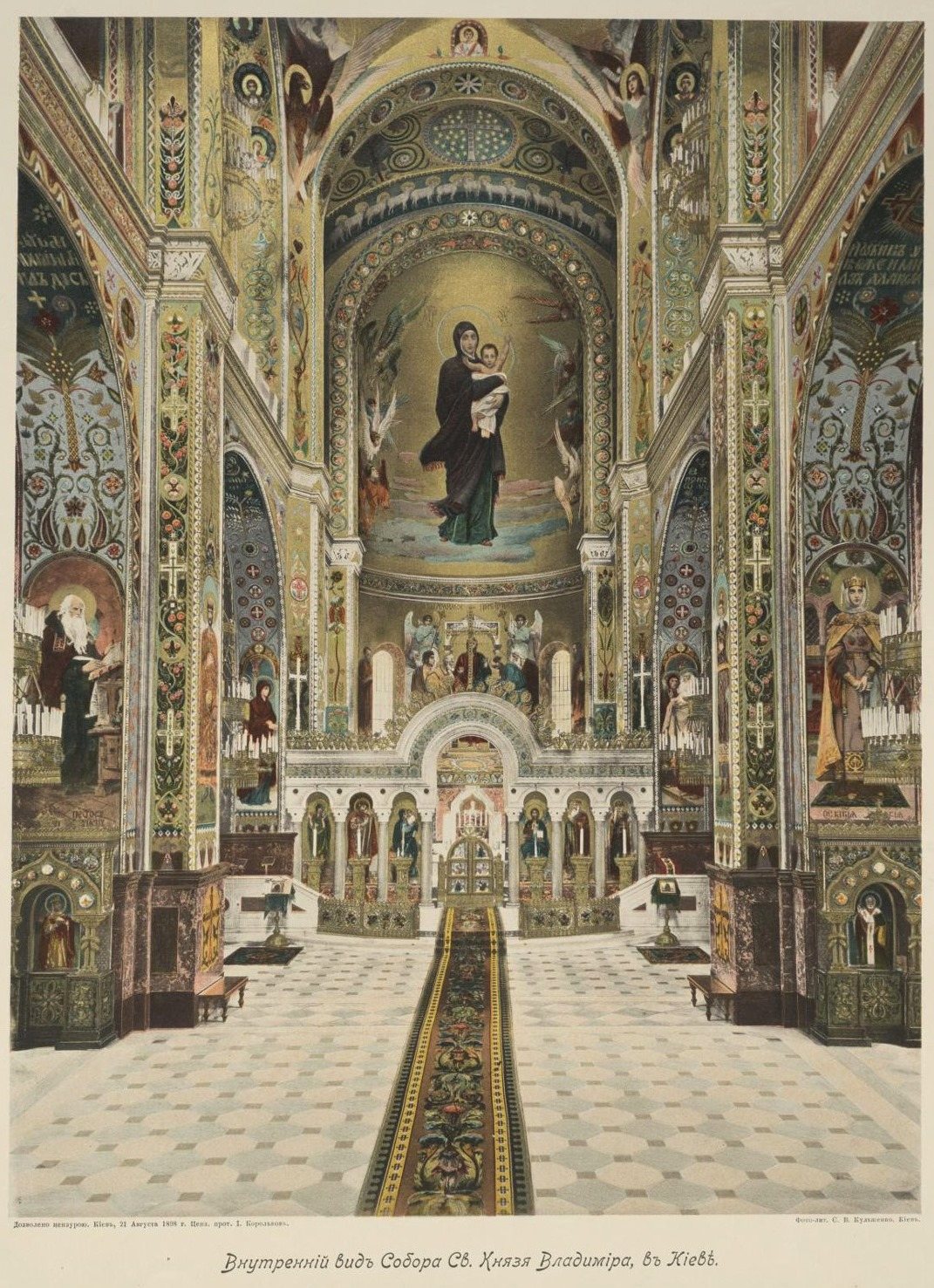
The cathedral interior. Lithograph by S. Kulzhenko, 1898. Wikimedia Commons, public domain 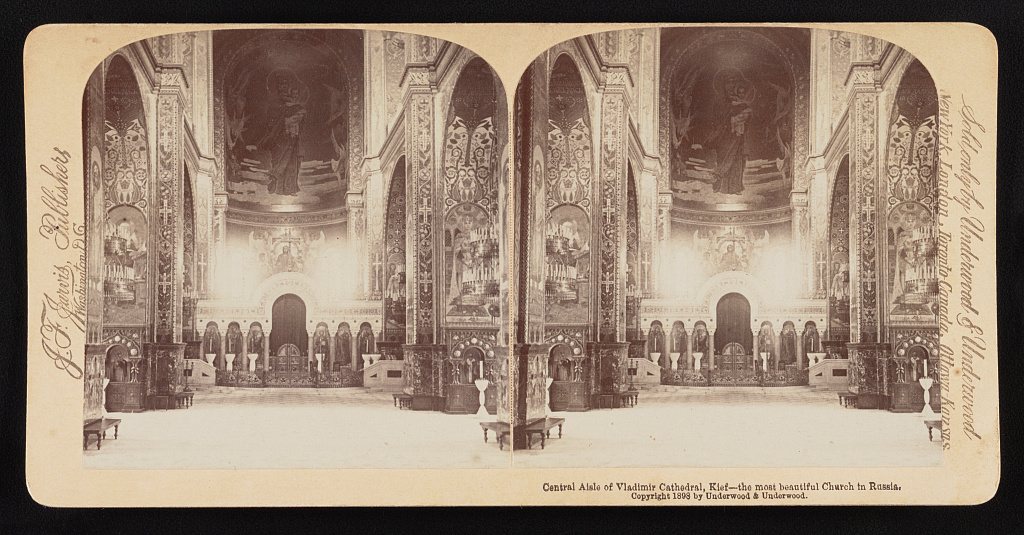
The central nave, stereo card, 1898. Wikimedia Commons, public domain - 1913
According to the cathedral's website, Patriarch Gregory IV of Antioch served here on 30 May and 1 June. [3]
The Soviet years and the war
- 1917
According to the cathedral's website, on 19 March a memorial service for Taras Shevchenko was held in the cathedral, followed by a demonstration and a rally for Ukraine's independence. [3]
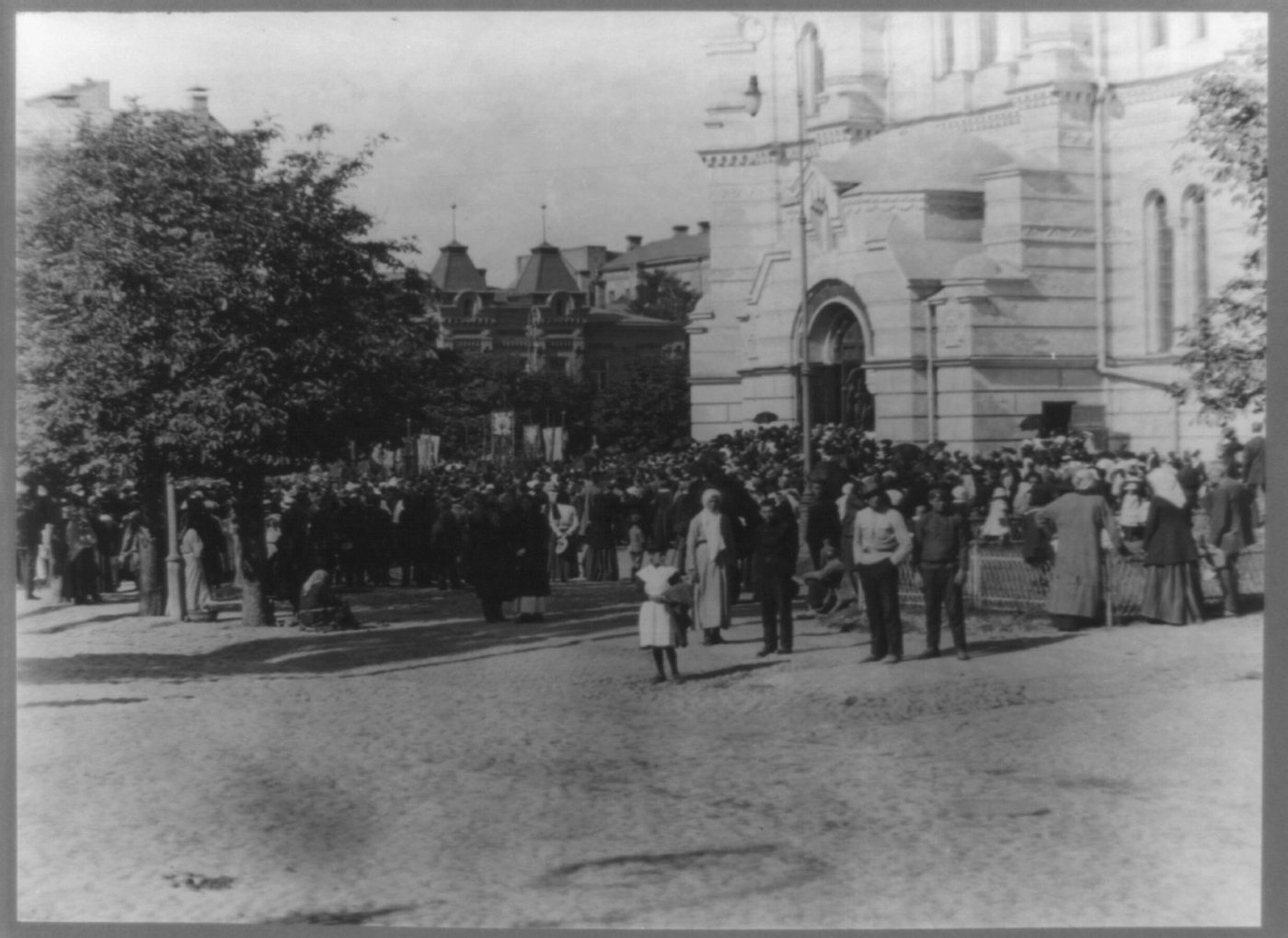
A service in front of the cathedral, 1918. Wikimedia Commons, public domain - 1929
Worship was banned; the All-Ukrainian Central Executive Committee decided to turn the cathedral into a museum of anti-religious propaganda. In December the bells were removed to be melted down. [2, 3]
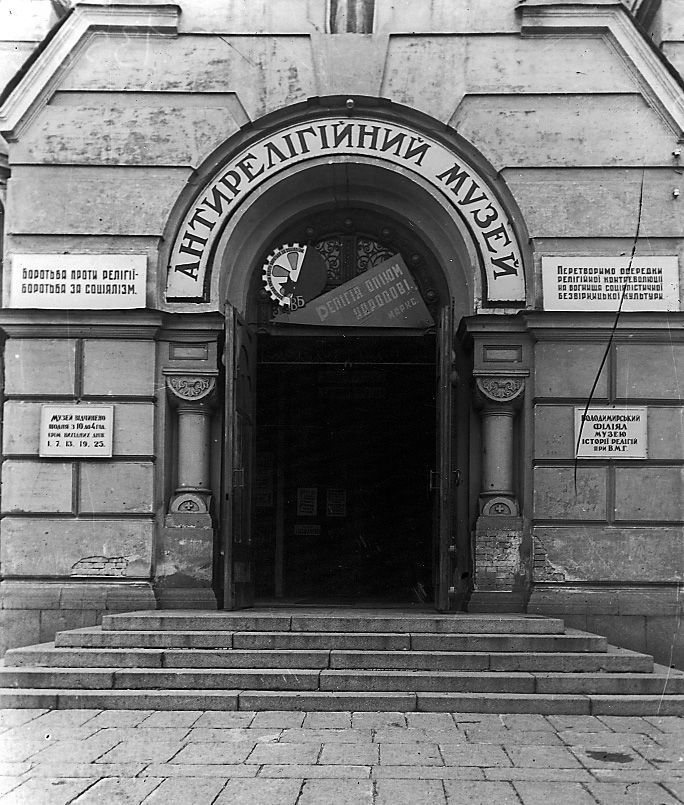
The cathedral as an anti-religious museum, late 1920s. Wikimedia Commons, public domain 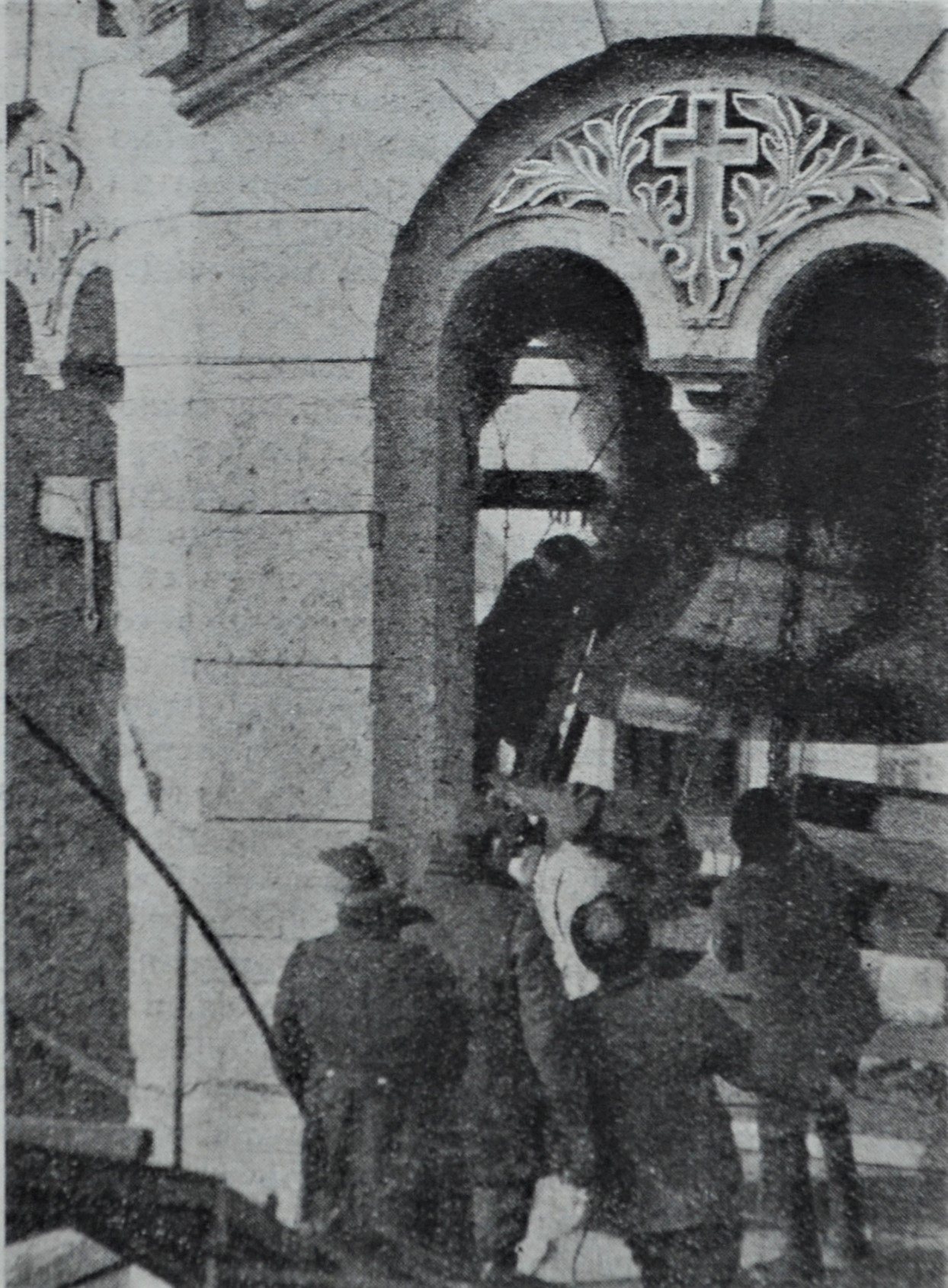
The removal of the five-tonne bell, 1930. Wikimedia Commons, public domain - 1930
According to Dzerkalo Tyzhnia, an anti-religious museum was opened in the cathedral; the church became a branch of the Lavra historical and cultural reserve. Later it housed an archive and a book depository. [2, 6, 18]
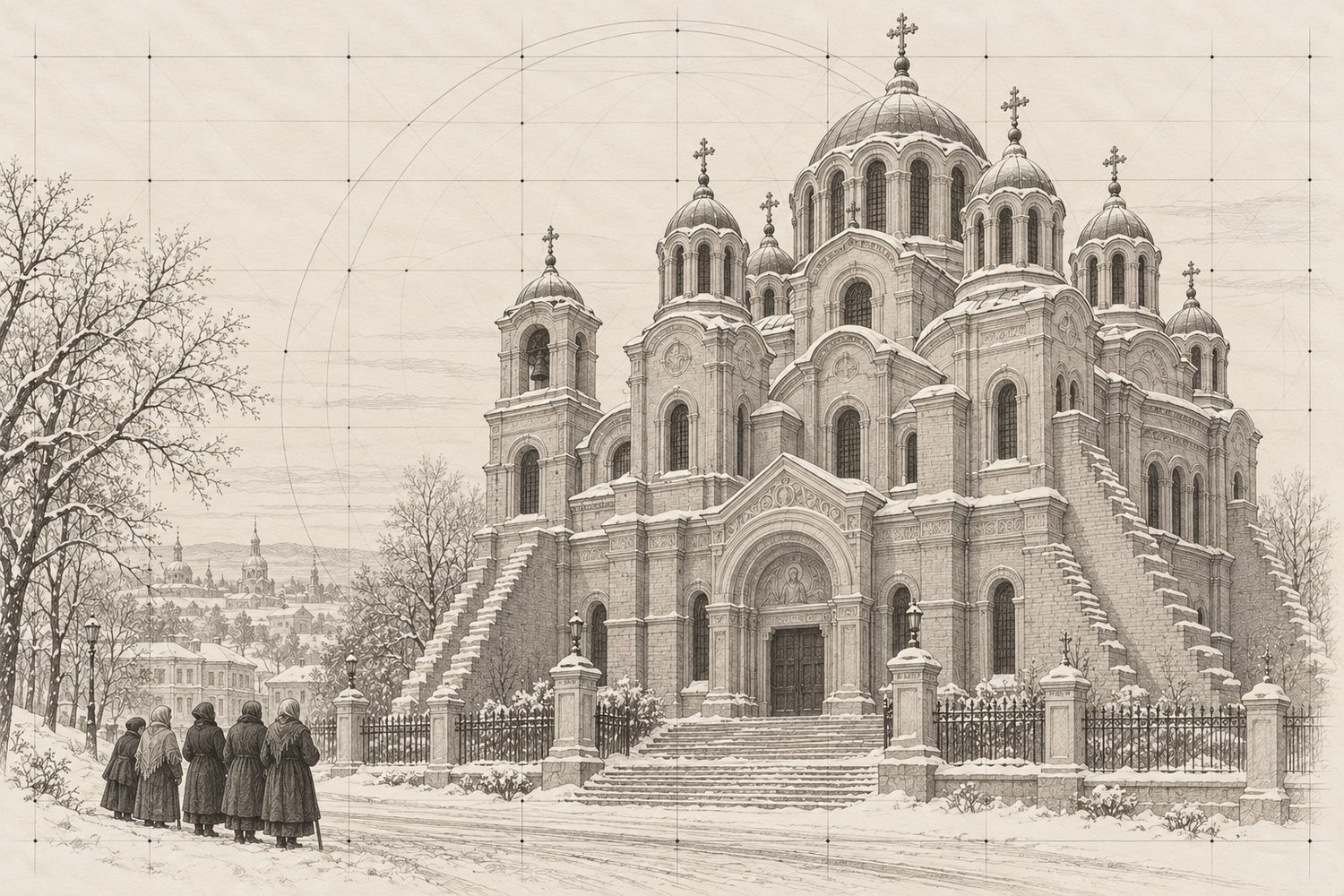
1930: the church is closed. Illustration: IKONASTONE - 1934–1937
The demolition did not take place. According to the cathedral's website, in 1934 the church was put on the “Postyshev list for destruction”; according to Dzerkalo Tyzhnia, its demolition was proposed in 1936. [3, 6]
- 1941–1943
Worship was restored in the cathedral under the German occupation. [2, 6]
- 1943–1944
The cathedral became the cathedra church of the Metropolitan of Kyiv (Great Ukrainian Encyclopedia: 1943; cathedral website and Dzerkalo Tyzhnia: 1944). [2, 3, 6]
The cathedral church
- 1946–1952
Restorers under the direction of the artist L. Kalenychenko restored the paintings (Great Ukrainian Encyclopedia: until 1956). [1, 2, 6]
- 1947
According to two publications, the relics of the Hieromartyr Macarius, Metropolitan of Kyiv, were brought to the cathedral. [19, 20]
- 1960
Filaret (Denysenko) became rector of the cathedral. [21, 22]
- 1961
In January the relics of the Great Martyr Barbara were brought to the cathedral from St Andrew's Church. According to the Lavra, they were moved at night and without ceremony. [10, 11, 12, 13]
- After 1966
According to the Lavra, the relics of St Barbara were placed beside the relics of St Macarius. [11]
Modern times
- 1992
The cathedral became the cathedra church of the Ukrainian Orthodox Church of the Kyiv Patriarchate. [2, 8]
- 1995
On 22 October Filaret was elected primate of the UOC-KP; the enthronement took place in this cathedral. [3, 21, 22]
- 2018
On 28 July a procession of the cross set out from the cathedral for the 1030th anniversary of the baptism of Rus'-Ukraine; according to the police, about 65,000 people took part in the prayer service. According to Interfax-Ukraine. [33]
- 2018
On 15 December the unification council created the Orthodox Church of Ukraine; on 29 December Metropolitan Epifaniy announced that Filaret would continue to serve in St Volodymyr's Cathedral. [8, 27, 34]
- 2019
On 20 June Filaret convened in the cathedral an assembly that he called a “local council” of the UOC-KP; on 24 June the Synod of the OCU declared its decisions invalid. [28, 29]
- 2019
In December the Synod of the OCU granted Filaret the lifelong right to serve in the cathedral. According to Interfax-Ukraine. [28]
- 2022
The National Bank put into circulation a commemorative 5 hryvnia coin showing the main façade of the cathedral (the “Architectural Monuments of Ukraine” series). According to Ukrainska Pravda. [32]
- 2026
On 20 March Honorary Patriarch Filaret died in his 98th year. [21, 22, 23]
- 2026
On 22 March, after the farewell in St Michael's Golden-Domed Cathedral, Filaret was buried in St Volodymyr's Cathedral, as he had willed. [23, 24, 25, 26]
- 2026
On 20 April the cathedral announced its transition to the Revised Julian calendar; the first services under it were the all-night vigil on 30 April and the liturgy on 1 May for the feast of the Hieromartyr Macarius. [30, 31]
Lost and restored
| What | What it was | What happened | Where it is now |
|---|---|---|---|
| Bells | The bells of the two bell towers | Removed in December 1929 to be melted down | The originals are lost [2, 3] |
| Worship | From 1896 | 1929 — banned, museum; restored under the occupation of 1941–1943 | A working cathedral of the OCU [2, 3, 6] |
| Paintings | Oil painting on plaster, 1885–1896 | Needed restoration after the years of closure | Restored in 1946–1952 (Great Ukrainian Encyclopedia: until 1956) under the direction of L. Kalenychenko [1, 2, 6] |
| Relics of St Barbara | St Michael’s Golden-Domed Monastery, from the 12th century | After the monastery was demolished — St Andrew’s Church (Great Ukrainian Encyclopedia: from 1935; the Lavra: from 1944–1945) | Since January 1961 — St Volodymyr’s Cathedral [10, 11, 12, 13] |
| Relics of St Macarius | — | Brought to the cathedral in 1947 (according to two publications) | St Volodymyr’s Cathedral [11, 19, 20] |
| Vasnetsov’s sketches | About 400 sketches and cartoons | Preserved outside the cathedral | Mostly the Tretyakov Gallery, Moscow; according to Dzerkalo Tyzhnia [6] |
| Vrubel’s sketch | Submitted to the building committee | Not approved | The Kyiv Museum of Russian Art (according to the Encyclopedia of Modern Ukraine, 2006) [1, 6] |
| O. Prakhova’s Epitaphios | Embroidered for the cathedral after a canvas by Vasnetsov | No longer in the cathedral | Kyiv Pechersk Lavra [15, 16] |
| Bronze doors of the narthex | After sketches by Prakhov; figure models by R. Bach and H. Saleman | Survived | The cathedral [1, 2] |
| Marble iconostases | Single-tier, of Carrara marble | Survived | The cathedral [7, 8] |
| The cathedral as a building | A brick church of 1862–1882 | Demolition was proposed in 1934–1937; it was not demolished | Architectural monument of national importance [2, 3, 6] |
Architecture
The Encyclopedia of Modern Ukraine defines the style as Neo-Russian with Byzantine elements; the KNMC and English Wikipedia call it Neo-Byzantine. The plan has three aisles, six pillars and three apses. The seven domes are arranged as follows: a central one above the crossing, four around it, and two more above the bell towers of the west front. The façades, windows and domes have arched tops, and stepped buttresses stand at the corners. The height to the cross of the main dome, according to English Wikipedia, is about 49 metres.
Above the portals are mosaics of the holy princes, made in a St Petersburg mosaic workshop. The bronze doors of the narthex with reliefs were made to sketches by Prakhov; the sculptors were R. Bach and H. Saleman. On the blue background of the doors are relief figures of Princess Olga and Prince Volodymyr: the first saints a person sees before even crossing the threshold.
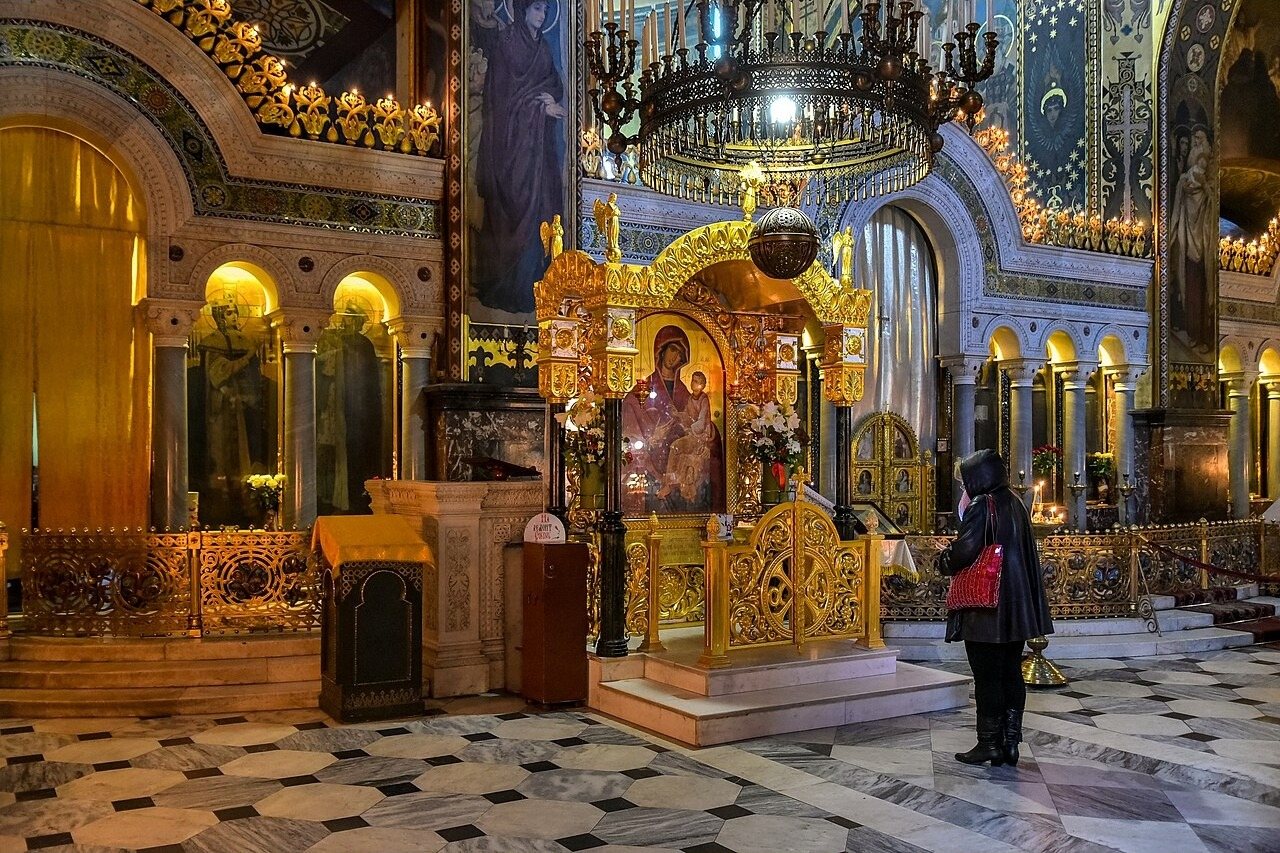
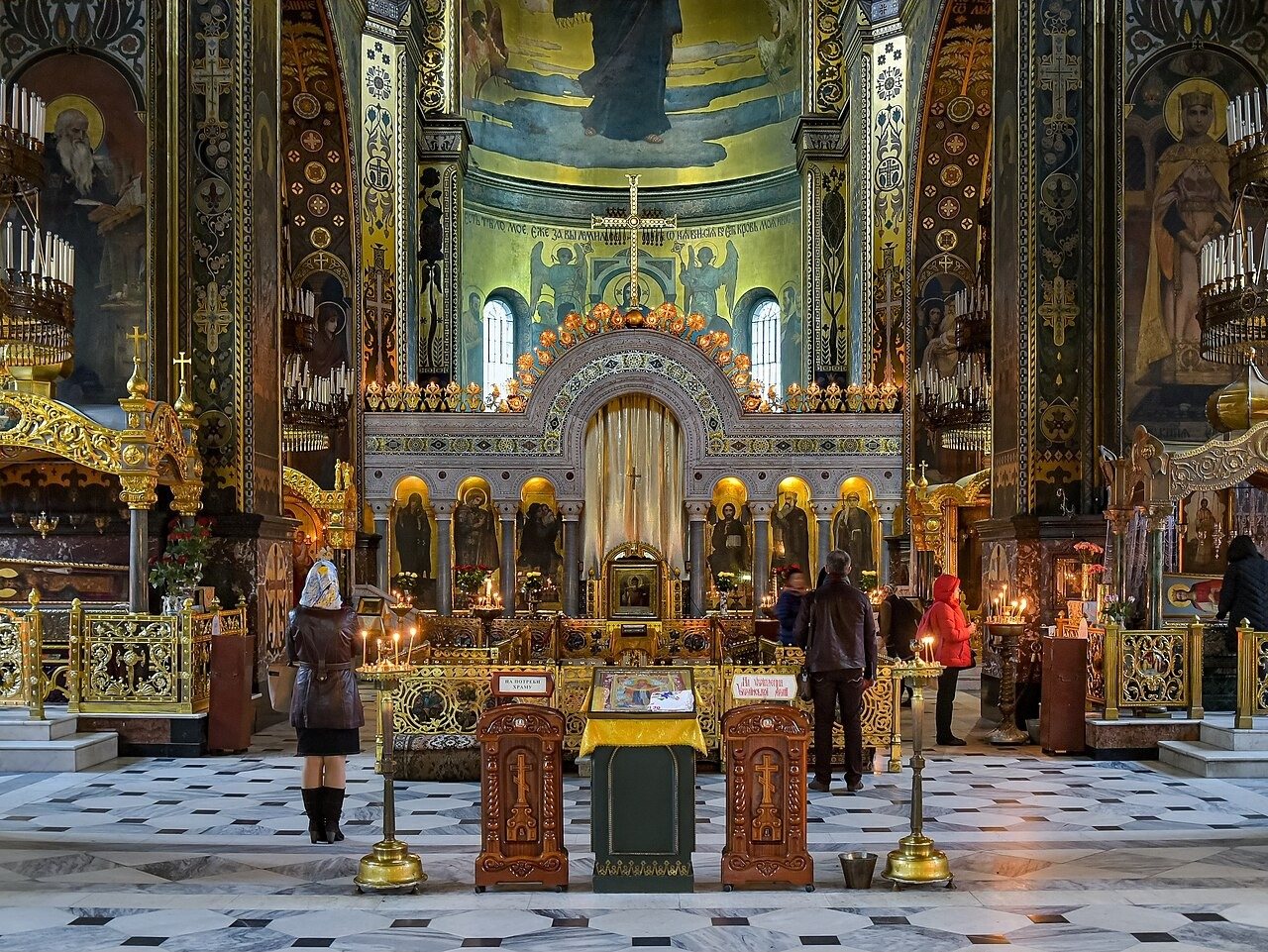
Inside, the space is held by six pillars that divide the church into three aisles, with side galleries above them. The Evangelists are on the pendentives under the central dome. The painting covers walls, pillars and vaults continuously, so the architecture here is perceived above all through colour: the articulation of the walls almost disappears under the ornament.
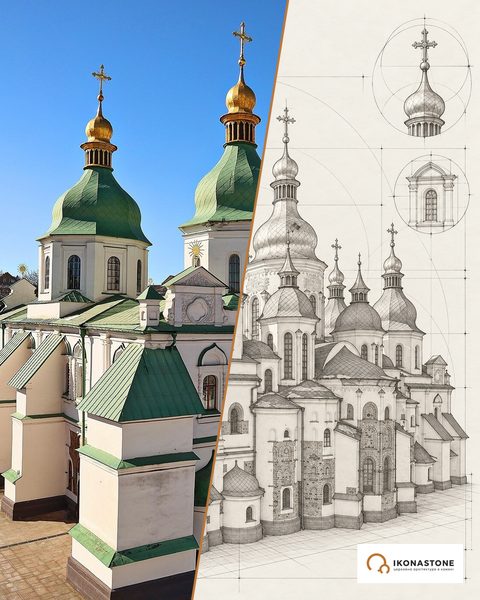
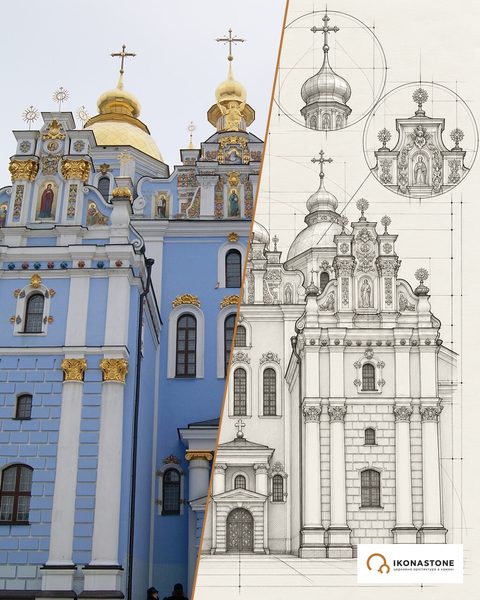
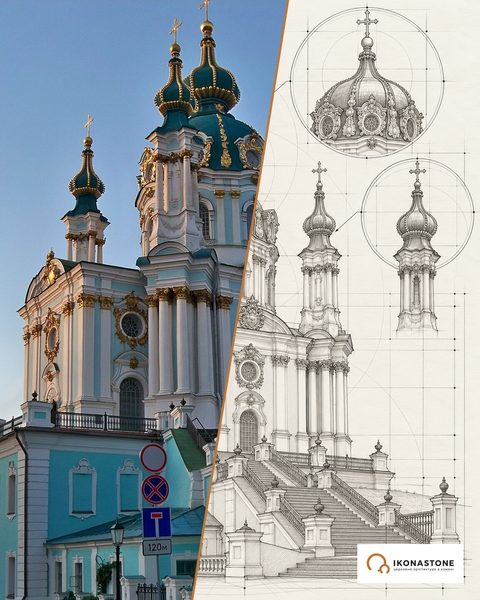
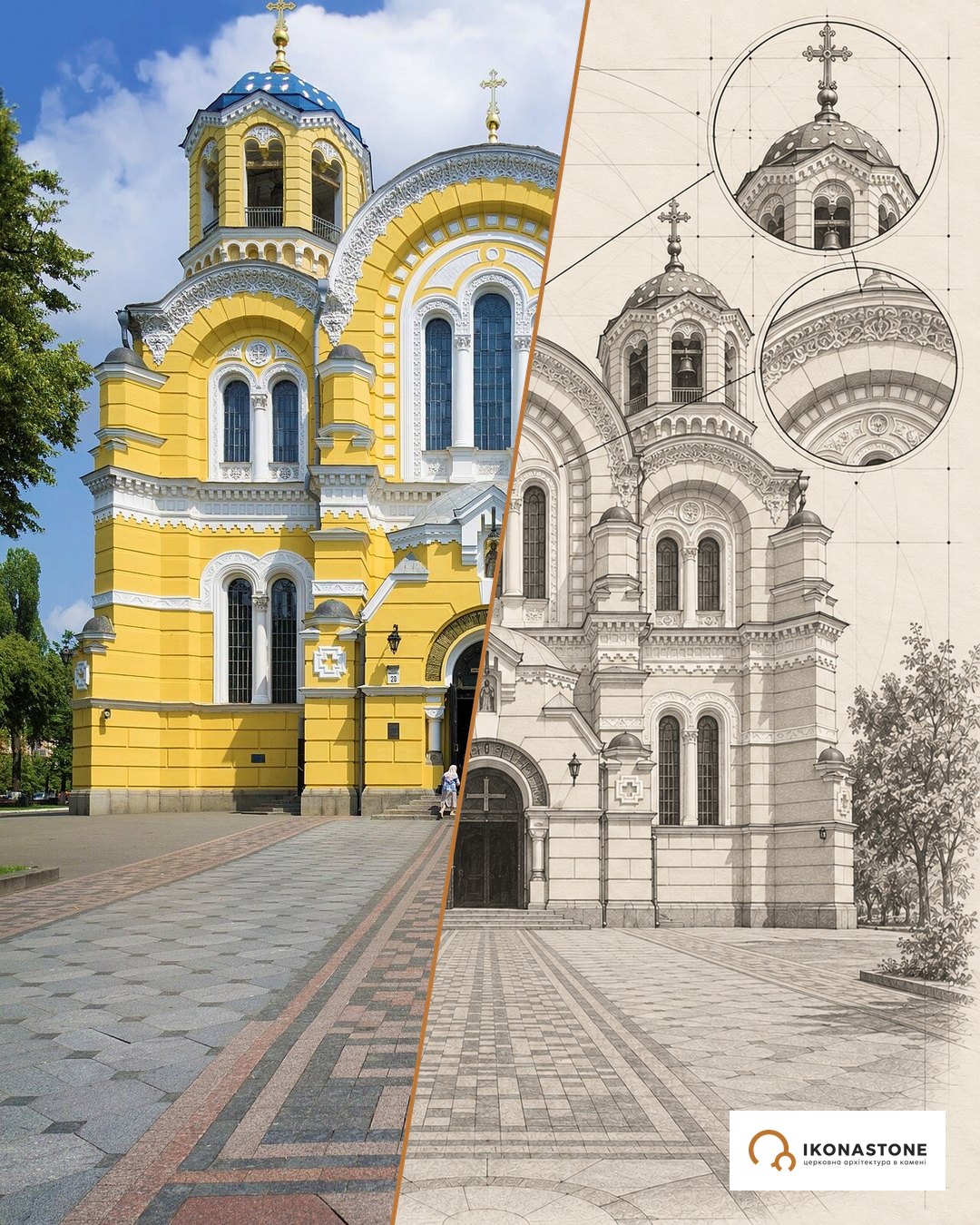
Below are two elements of the church: in a photo and in a drawing. The drawings show the form, not exact dimensions.
Domes
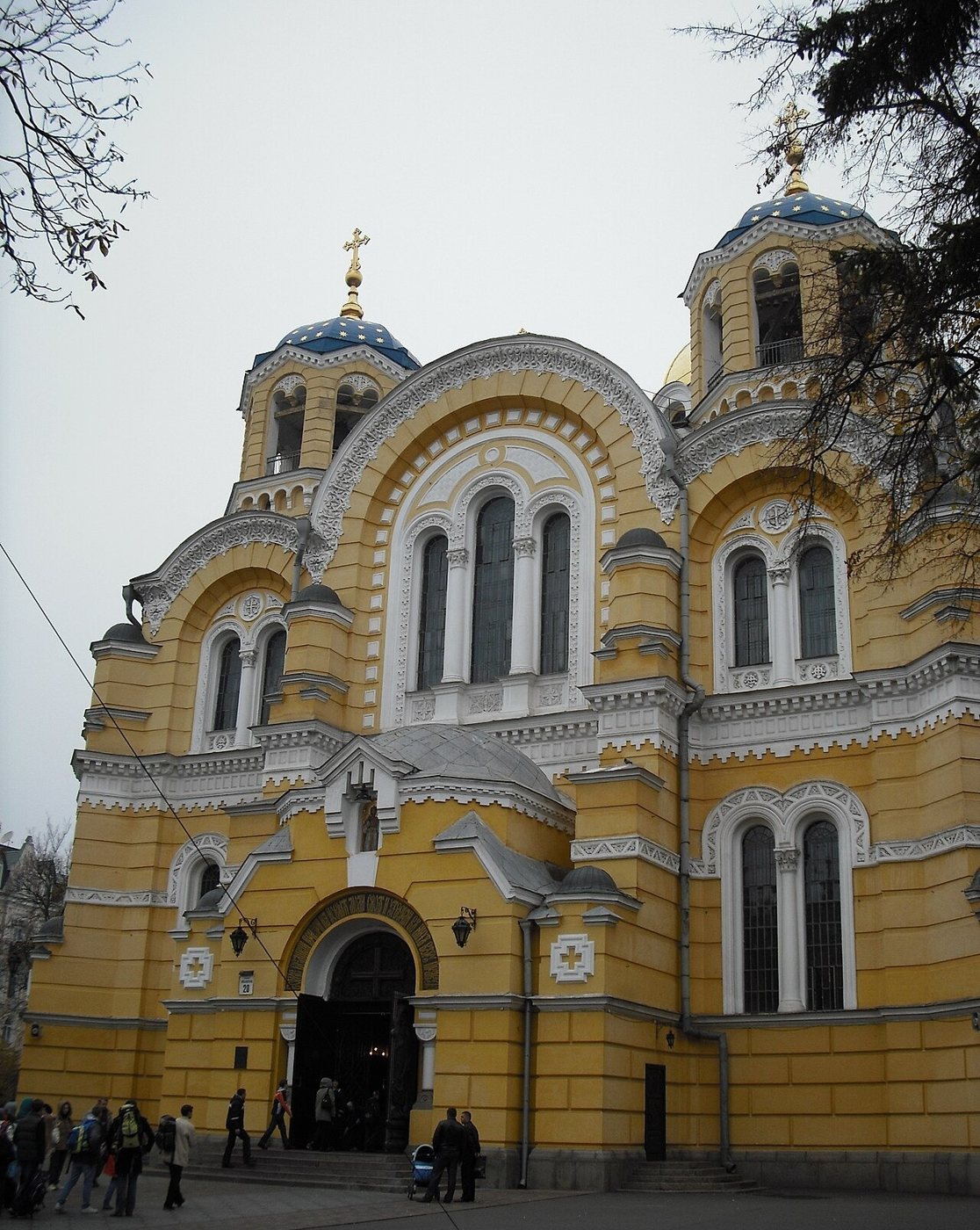
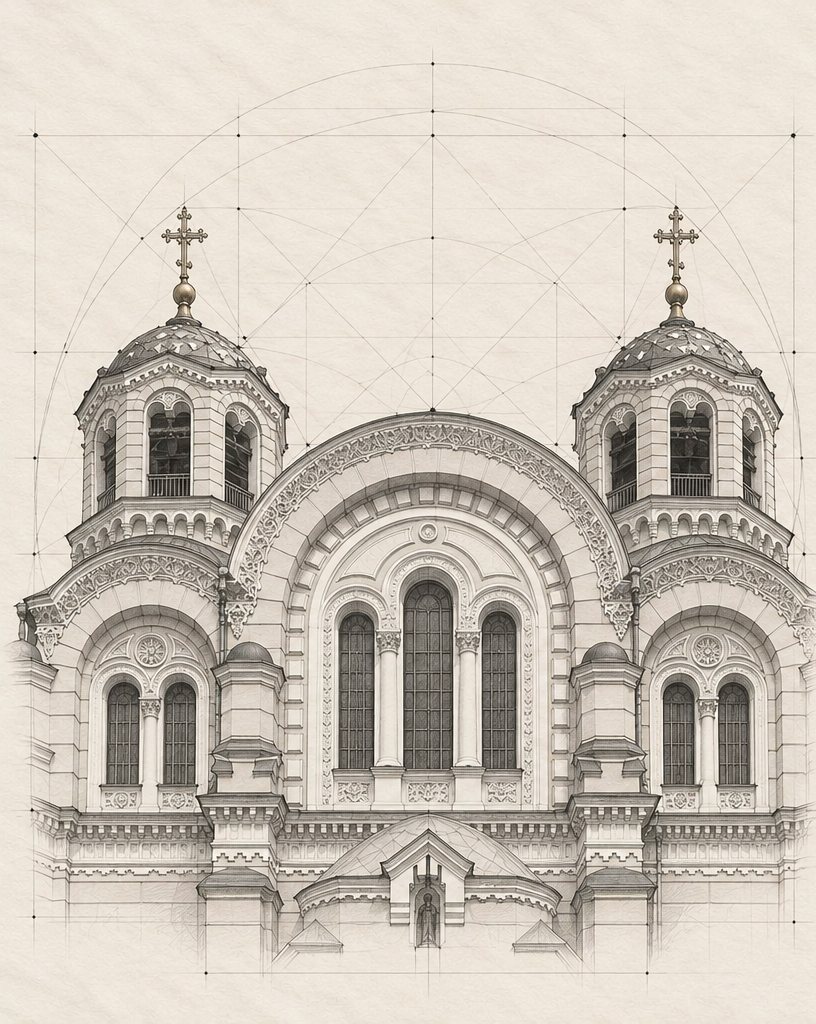
Seven domes are a compromise between the thirteen on Shtrom’s drawing and the budget. The drums are pierced with arched windows; after the 1864 accident they were made smaller than planned.
The west front with towers
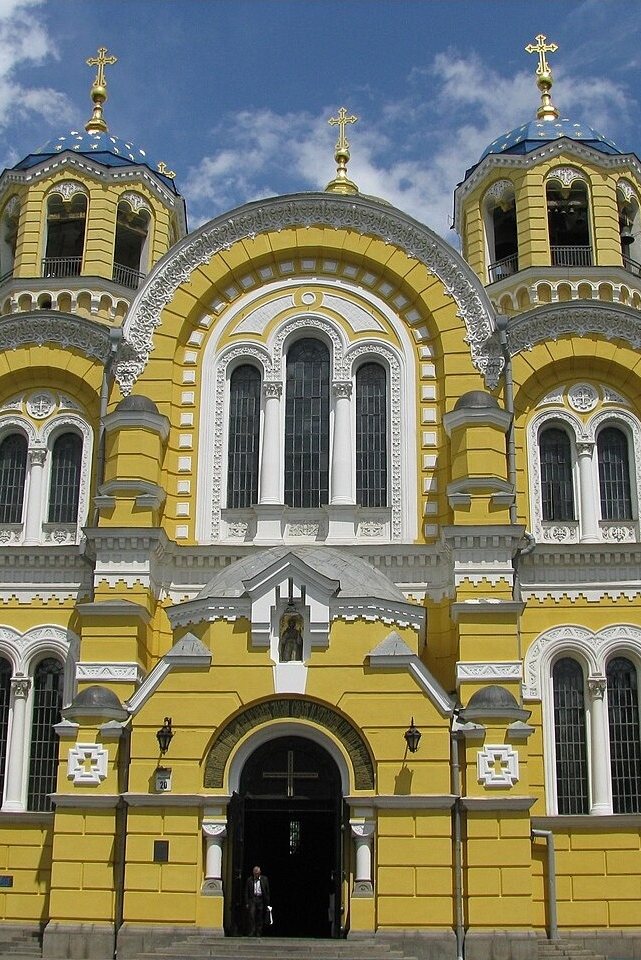
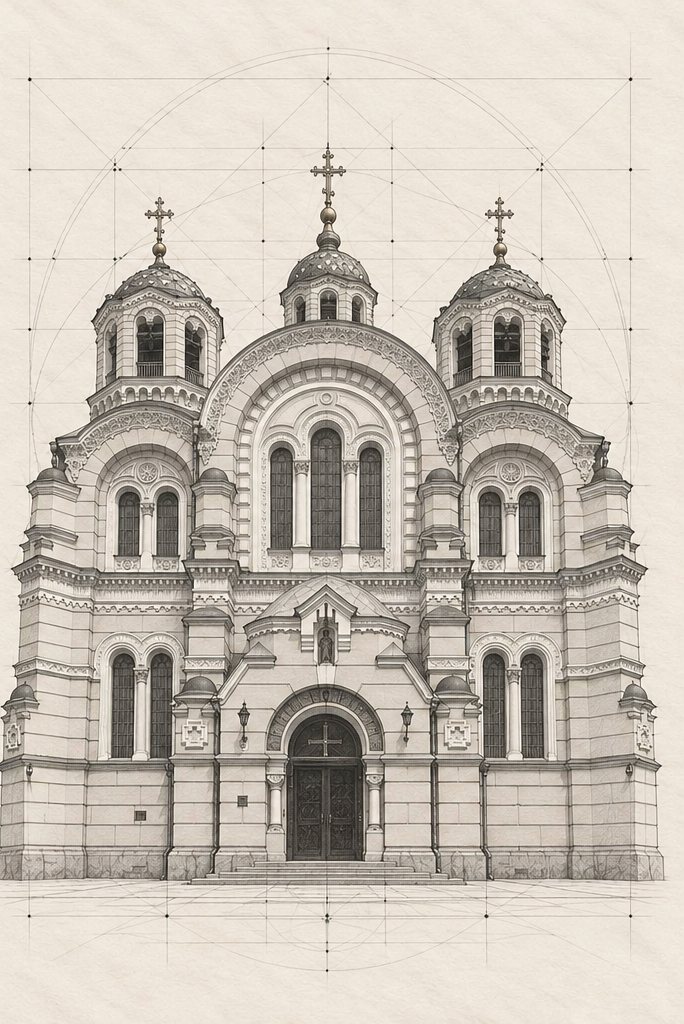
Two bell towers frame the main entrance and carry two of the seven domes. Above the portal are mosaic figures of the princes; below are the bronze doors.
Details that are easy to miss
The buttresses are a trace of the accident. The stepped supports on the façades are not just a stylistic device. They were added after 1875, when the church was being saved from the cracks of 1864–1866. The building tells its own story — you just need to know where to look.
A million bricks from the Lavra. According to English Wikipedia, the Kyiv Pechersk Lavra produced a million bricks for the cathedral. The monastery brickworks became one of the suppliers of the largest Kyiv construction project of its time.
Vrubel’s sketches were not approved. Mikhail Vrubel made sketches of paintings for the cathedral, but they were not accepted. He was left with part of the ornament of the south aisle. The sketches, according to the Encyclopedia of Modern Ukraine (2006), are kept in the Kyiv Museum of Russian Art.
St Barbara with a Kyiv face. According to a tradition cited by UAHistory and LB.ua, the model for Mikhail Nesterov’s image of St Barbara was Olena Prakhova, the daughter of the head of the works. Nesterov was in love with her, but, according to UAHistory, her parents did not approve of the match. The tradition is all the more striking because the relics of St Barbara herself rest nearby, in the cathedral.
Relics that outlived their monastery. According to church tradition, the relics of the Great Martyr Barbara were brought from Constantinople at the beginning of the 12th century by the Byzantine princess Barbara, wife of the Kyivan Prince Sviatopolk Iziaslavych. For eight centuries they lay in St Michael’s Golden-Domed Monastery. After its destruction in the 1930s the relics changed places several times (according to the Great Ukrainian Encyclopedia, from 1935 they were in St Andrew’s Church), and in January 1961 they were brought here. According to the Lavra, they were moved at night and without ceremony, when the authorities were closing St Andrew’s Church. Most pilgrims come on the saint’s feast day. Since the cathedral switched to the Revised Julian calendar in 2026, it is 4 December; before, it was 17 December.
Losses you cannot see. The painting we see today is also the restoration of 1946–1952 (according to the Great Ukrainian Encyclopedia, until 1956): without it, part of the oil painting might not have survived to our time.
The inscriptions have an author too. The inscriptions in the paintings, according to Eurofest, were made by Viktor Zamyraylo, whom the Encyclopedia of Modern Ukraine lists among the Ukrainian artists of the cathedral. On the walls people often look at the scenes and do not notice the lettering.
Photo gallery
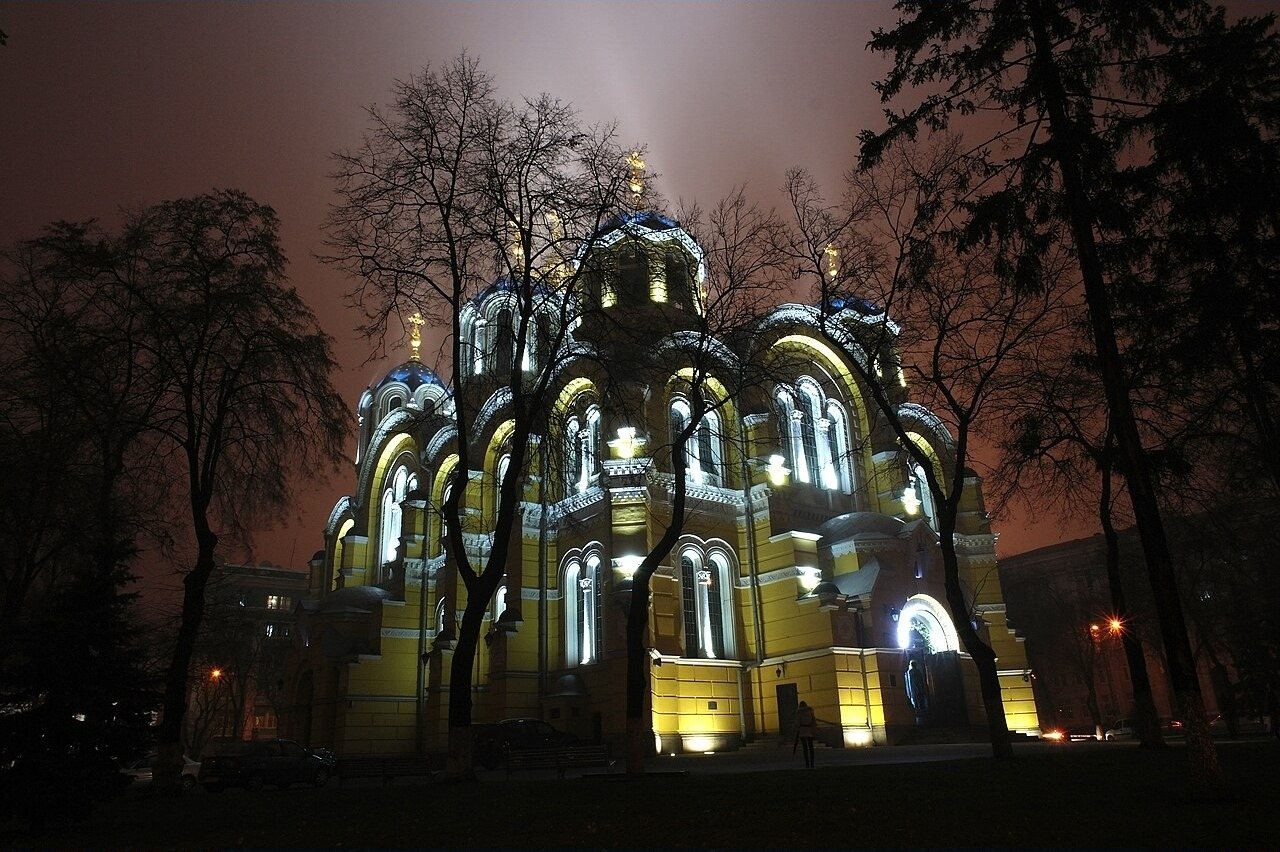
Stone and material
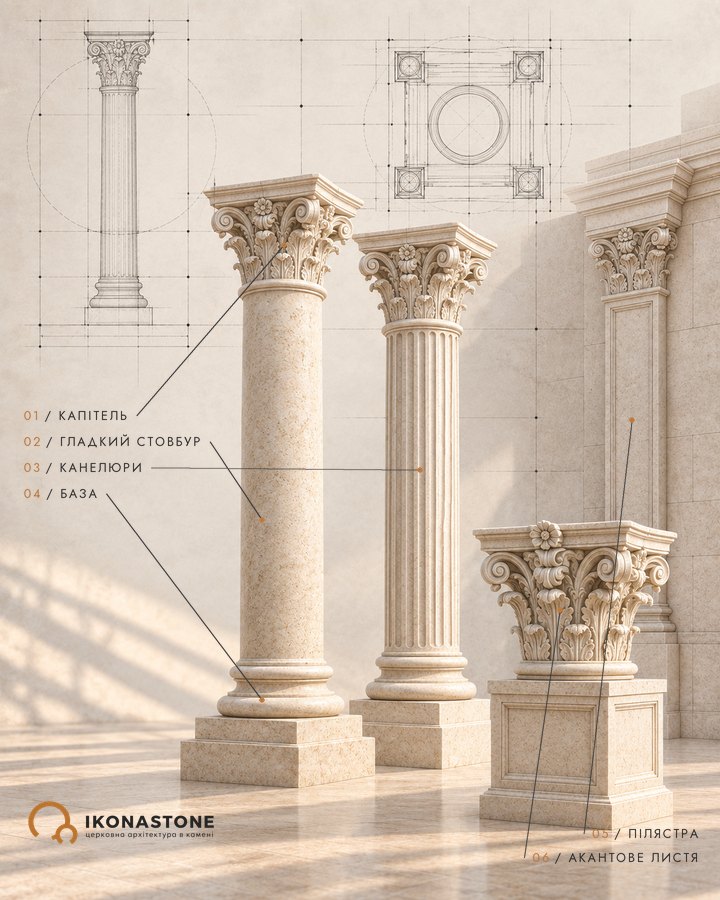
The cathedral is built of brick: outside, its language is arches, buttresses and mosaics above the portals. The interior speaks another language: the altar pillars, according to the Encyclopedia of Modern Ukraine, are carved from Carrara marble, while English Wikipedia writes that the iconostasis is carved from white Carrara marble. The interior mosaics were made by Venetian masters, the façade ones by a St Petersburg workshop. The paintings were done in oil on plaster.
The cathedral’s own accident explains it best. Enlarging a drawing by one and a half times is easy; making an arch carry the increased weight is a different task altogether. It is the same in stonework: a piece that looked good at 1:10 scale has to be calculated again at full size, because weight grows faster than size.
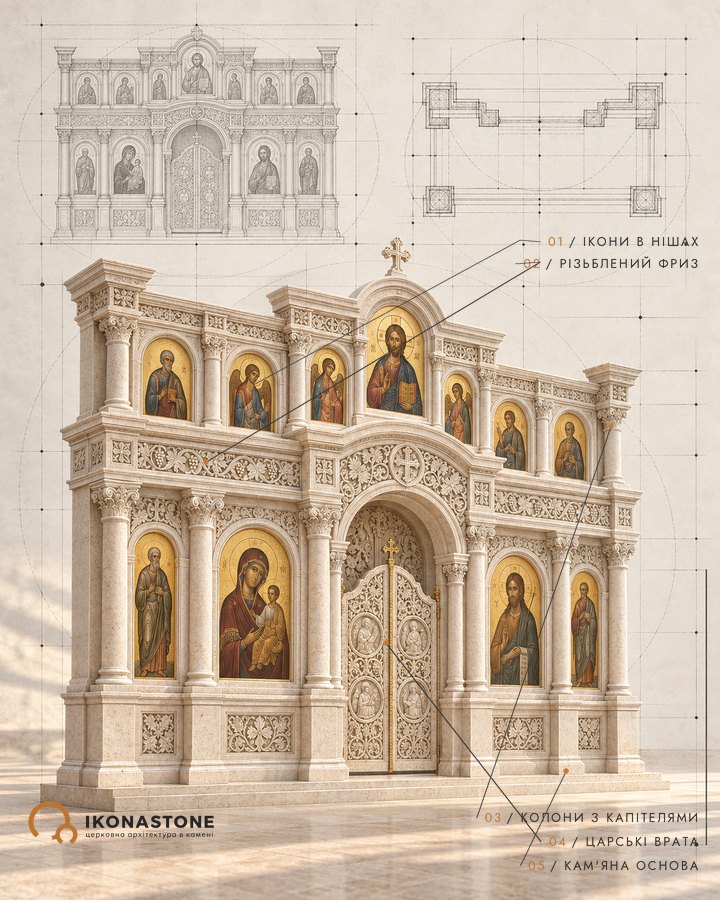
How the altar screen is arranged, and how marble differs from wood in this role, is covered in the articles “What is an iconostasis” and “The stone iconostasis”, and in the iconostases section. Where the relics of St Barbara came from — St Michael’s Golden-Domed Cathedral; where Prakhov uncovered the 12th-century frescoes — St Cyril’s Church.
Did you know
The cathedral has not one but five single-tier marble iconostases. According to D. Stepovyk, it was the single-tier design that made it possible to use heavy Carrara marble. [7, 17]
Multicoloured marble for the decoration was brought from Italy, France, Belgium and Spain; the church silver was supplied by the Khlebnikov firm. According to Telegraf. [17]
Before the cathedral was decorated, the strength of the vaults was tested with sandbags with a total weight of 640 tonnes. According to Dzerkalo Tyzhnia. [6]
Vasnetsov made about 400 sketches and cartoons for the cathedral; most are now in the Tretyakov Gallery. According to Dzerkalo Tyzhnia. [6]
Mikhail Nesterov painted 16 icons for the screens in front of the altar. According to the Great Ukrainian Encyclopedia. [2]
According to D. Stepovyk, Adrian Prakhov posed for the Apostle James, and the priest Petro Lebedyntsev for John the Theologian. [7]
While the cathedral was being built and painted, the Kyiv see saw six metropolitans, from Filaret (Amfiteatrov) to Ioanniky (Rudnyev). According to D. Stepovyk. [7]
According to the Great Ukrainian Encyclopedia, the mosaic work for the cathedral was carried out by Oleksandr Frolov; among the artists the encyclopedia also names Stefan Yaremych. [2]
The relics of St Barbara were brought to the cathedral in 1961 at night and without ceremony, so as not to attract attention, when the authorities were closing St Andrew's Church. According to the Lavra. [11]
Filaret (Denysenko) became rector of the cathedral in 1960; in 1995 his enthronement as patriarch took place here, and in 2026 he was buried in the cathedral. [21, 22, 23]
In 2022 the NBU issued a 5 hryvnia coin: the obverse shows the main façade of the cathedral, the reverse the ornament of the arch of a side door and the years 1862–1882. According to Ukrainska Pravda. [32]
The cathedral switched to the Revised Julian calendar only in 2026, almost three years after the OCU (September 2023). [30, 31]
Legends
Barbara with the face of Olena Prakhova
According to tradition, the model for Nesterov's St Barbara was Olena Prakhova, the daughter of the head of the works; Nesterov was in love with her, but, according to UAHistory, her parents did not approve of the match. Recorded by UAHistory and LB.ua. [15, 16]
The pose of Christ
According to tradition, Vasnetsov was given the pose of the infant Christ in the arms of the Mother of God in the apse by his small son. Recorded by Dzerkalo Tyzhnia. [6]
The relics were brought by a princess
According to tradition, the relics of the Great Martyr Barbara were brought from Constantinople by the Byzantine princess Barbara when she married Prince Sviatopolk Iziaslavych. The Lavra notes that the sources differ on who brought them. [11, 14]
Protector against sudden death
According to tradition, St Barbara protects against sudden illness and sudden death. Recorded by Radio Svoboda. [14]
“We will not pray to Lyolya Prakhova”
According to a tradition cited by D. Stepovyk, when Vrubel gave the Mother of God the features of Prakhov's wife in St Cyril's Church, some of the faithful said just that. The tradition concerns St Cyril's Church, but it explains Prakhov's caution with models in St Volodymyr's Cathedral. [7]
The fate of Beretti
According to tradition, the dismissed architect Alexander Beretti was ruined and died in a psychiatric hospital in 1895. Recorded by Dzerkalo Tyzhnia; not confirmed in other sources. [6]
“I will be there on Sunday”
According to Metropolitan Epifaniy, in hospital Filaret told the priests that he would certainly be in St Volodymyr's Cathedral the following Sunday. The burial took place on Sunday, 22 March 2026. Recorded by Glavkom. [35]
Key figures
- Filaret (Amfiteatrov) — Metropolitan of Kyiv, initiator of the construction (1852).
- Nicholas I — approved the plan and chose the site (1853).
- Ivan Shtrom — author of the original design with thirteen domes.
- Pavel Sparro — in 1860 simplified the design to seven domes.
- Alexander Beretti — in 1862 reworked and enlarged the design; removed after the accident of 1866.
- Rudolf Bernhard — author of the reinforcement calculations (1875).
- Alexander II — in 1875 secured funds for completion.
- Volodymyr Nikolayev — diocesan architect, completed the construction in 1882.
- Adrian Prakhov — art historian, head of the decoration in 1885–1896.
- Viktor Vasnetsov — author of the paintings of the main nave and the apse.
- Mikhail Nesterov — author of the icons for the iconostases and of the image of St Barbara.
- Mikhail Vrubel — author of the ornaments of the south aisle; his sketch was not approved.
- Wilhelm Kotarbiński, Pavel and Alexander Svedomsky — authors of Old Testament and Gospel scenes.
- Olena Prakhova — embroidered the Epitaphios after Vasnetsov; according to tradition, the model for St Barbara.
- Ioanniky (Rudnyev) — metropolitan, consecrated the cathedral in 1896.
- L. Kalenychenko — head of the restoration of the paintings in 1946–1952.
- Filaret (Denysenko) — rector from 1960, patriarch of the UOC-KP from 1995, buried in the cathedral on 22.03.2026.
How to cite
IKONASTONE. St Volodymyr's Cathedral (Kyiv) // Guide to the Churches of Ukraine. URL: https://ikonastone.com/en/guide/st-volodymyrs-cathedral-kyiv/ (accessed DD.MM.YYYY).
FAQ
Who painted St Volodymyr's Cathedral?
The paintings of 1885–1896 were made under the general direction of Adrian Prakhov. Viktor Vasnetsov painted the main nave and the altar apse; Mikhail Nesterov, Wilhelm Kotarbiński, Pavel and Alexander Svedomsky, Mykola Pymonenko, Serhii Kostenko and Viktor Zamyraylo also worked here. Mikhail Vrubel executed part of the ornament.
Why did the cathedral take so long to build?
After the foundation was laid in 1862, the arches began to spread under the weight of the upper tier; in 1866 the cracks grew, and work was stopped. Construction resumed in 1875, the walls were propped up with buttresses, and the church was practically finished in 1882. The painting went on for another eleven years.
Which relics are kept in the cathedral?
The relics of the Great Martyr Barbara and of the Hieromartyr Macarius, Metropolitan of Kyiv. From the 12th century the relics of St Barbara were kept in St Michael's Golden-Domed Monastery. After the monastery was closed and demolished (1934–1937), they changed places several times in Kyiv; they lay longest in St Andrew's Church. They were moved to St Volodymyr's Cathedral in January 1961.
How many domes does the cathedral have?
Seven. Ivan Shtrom's original design had thirteen, but Pavel Sparro kept seven to stay within the budget. Two of them stand above the bell towers of the west front.
Who does the cathedral belong to now?
The Orthodox Church of Ukraine. Before the unification council of 2018 it was the main church of the Kyiv Patriarchate. Patriarch Filaret (Denysenko) served here, and he was buried here on 22 March 2026.
Sources
- Енциклопедія сучасної України. О. Саган. Володимирський собор у Києві (2006)
- Велика українська енциклопедія. Володимирський собор у Києві
- Володимирський кафедральний патріарший собор. Історія храму
- Освіта.ua. Володимирський собор у Києві: історичні етапи зведення, теми зображень
- КНМЦ Київ. Володимирський собор
- Дзеркало тижня. Храм выдающихся творений
- Д. Степовик. Науковий вісник Національного музею історії України
- Wikipedia (en). St Volodymyr's Cathedral
- Eurofest. Володимирський собор — серце духовної спадщини Києва
- Велика українська енциклопедія. Варвара
- Києво-Печерська лавра. Свята великомучениця Варвара — покровителька київської землі
- Андріївська церква. Свята Варвара: духовна спадщина та мощі в Києві
- Big Kyiv. Її мощі спочивають у Києві
- Радіо Свобода. Про мощі св. Варвари (17.12.2008)
- UAHistory. Чотири покоління киян дав рід Прахових
- LB.ua. Прахови, Стешенки, Ханенки: сімейні вулиці Києва. Частина 2 (21.06.2026)
- Telegraf. Що спільного в київського храму з італійськими соборами (19.06.2025)
- Енциклопедія сучасної України. Києво-Печерський історико-культурний заповідник
- Праці Київської православної богословської академії. Стаття про свщмч. Макарія, митрополита Київського
- UOCC. Hieromartyr Macarius, Metropolitan of Kyiv
- РІСУ. Patriarch Filaret passes away (20.03.2026)
- Інтерфакс-Україна. Помер патріарх Філарет (20.03.2026)
- Інтерфакс-Україна. Про поховання патріарха Філарета (березень 2026)
- Главком. Стало відоме місце поховання Патріарха Філарета
- Главком. Україна попрощалася з Патріархом Філаретом. Церемонія поховання
- Kyiv Post. Програма похорону Патріарха Філарета (березень 2026)
- Радіо Свобода. Філарет продовжить служити у Володимирському соборі (29.12.2018)
- Інтерфакс-Україна. Філарет анонсував форум «На захист Київського патріархату» (13.12.2019)
- Слово і Діло. У Володимирському соборі почався «помісний собор» Філарета (20.06.2019)
- Захід.нет. Володимирський собор у Києві перейде на новоюліанський календар (20.04.2026)
- Главком. Володимирський собор у Києві переходить на новоюліанський календар: дата першої служби
- Українська правда. Життя. НБУ випустив пам'ятну монету з Володимирським собором (15.09.2022)
- Інтерфакс-Україна. Хресна хода до Володимирської гірки (28.07.2018)
- Wikipedia (en). Filaret Denysenko
- Главком. Епіфаній розказав про останнє пророцтво Патріарха Філарета
- В. Чорний. Володимирський собор (презентація, НУБіП)
- Town
- Kyiv
- Built
- 1862–1882; paintings 1885–1896; consecrated 1896
- Type
- three-aisled, six-pillared, three-apsed church with seven domes
- Material
- brick; marble, mosaic, oil painting on plaster
- Research depth
- 38%