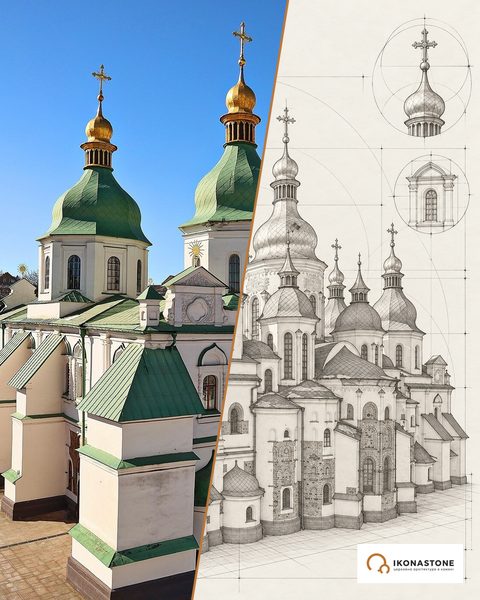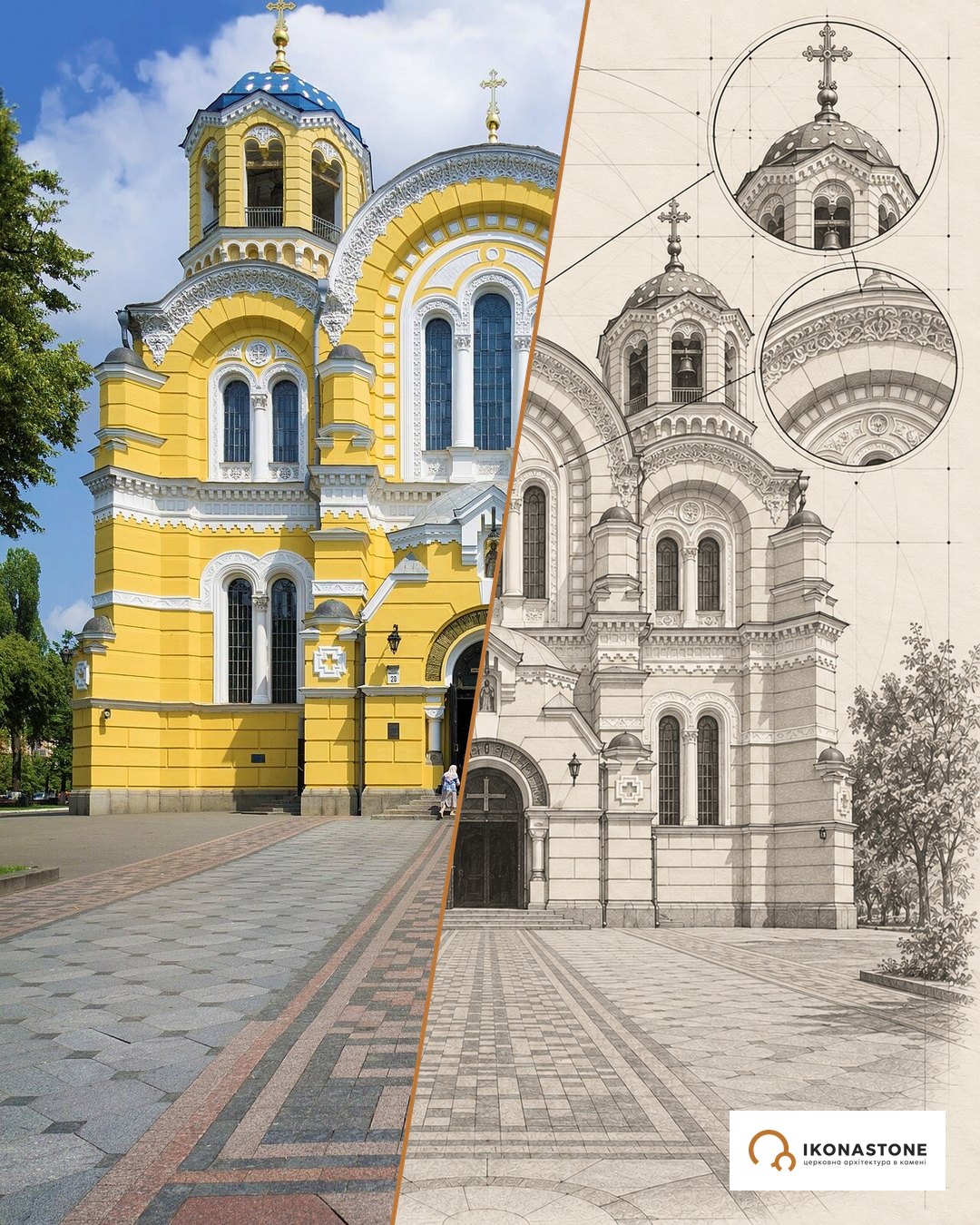
St Andrew's Church in Kyiv: Baroque on an unstable slope
St Andrew’s Church stands where Kyiv drops away to Podil. From here it can be seen from the river, and all its life the church itself has been fighting the hill it stands on.
In brief
| Address | 23 Andriivskyi Descent, Kyiv |
| Built | site consecrated in 1744, main volume completed in 1751, church consecrated in 1767 |
| Type | cross-shaped, five-domed church (a central dome and four decorative towers) on a stylobate |
| Material | brick, stone foundation, cast-iron decoration, wooden gilded iconostasis |
| Status | architectural monument of national importance, part of the National Conservation Area “Sophia of Kyiv” |
| Church | since 2018 in free use by the Ecumenical Patriarchate (Law No. 2598-VIII) |
History
The site for the church was consecrated on 9 September 1744 in the presence of Empress Elizabeth. The design was created in St Petersburg by the court architect Bartolomeo Rastrelli (who never came to Kyiv), and construction was led by the Moscow architect Ivan Michurin. The church was consecrated on 19 August 1767, the feast day of St Andrew Stratelates, by Arseniy Mohylyansky, Metropolitan of Kyiv.
The site was difficult from the very beginning. The complex terrain, springs and groundwater of the hill forced the builders to set the church on a massive stylobate resting on stone foundations. The slope had to be reinforced later as well. There is no bell tower in the church; according to a widespread legend, a bell might wake the water under the hill, but this is not documented.
The church was repaired more than once (1771, 1785–1786, 1825–1828, 1949–1954). In 1974–1987 it was fully restored from copies of Rastrelli’s original drawings discovered in the Vienna Albertina. Since 1968 the church has been a museum within the “Sophia of Kyiv” conservation area. The latest, 11-year restoration was completed on 13 December 2020 with a liturgy, and from 15 December the church has been open to visitors; in 2022 the restoration won the European Heritage Award.
Chronology
The numbers in square brackets are the numbers of the sources in the list at the bottom of the page. The note “according to …” means that the fact is confirmed by only one source. The “Legends” section contains traditions and legends: they are recorded in the sources but not documented.
The place: legend and earlier churches
- Antiquity (according to the chronicle legend)
According to the “Tale of Bygone Years”, the Apostle Andrew the First-Called climbed one of the hills above the Dnipro, blessed it, set up a cross and foretold that a great city with many churches would rise there. This is a legend, not a documented event; the hill that was linked with this story in the 18th century became the site of the present church. According to the Great Ukrainian Encyclopedia. [1]
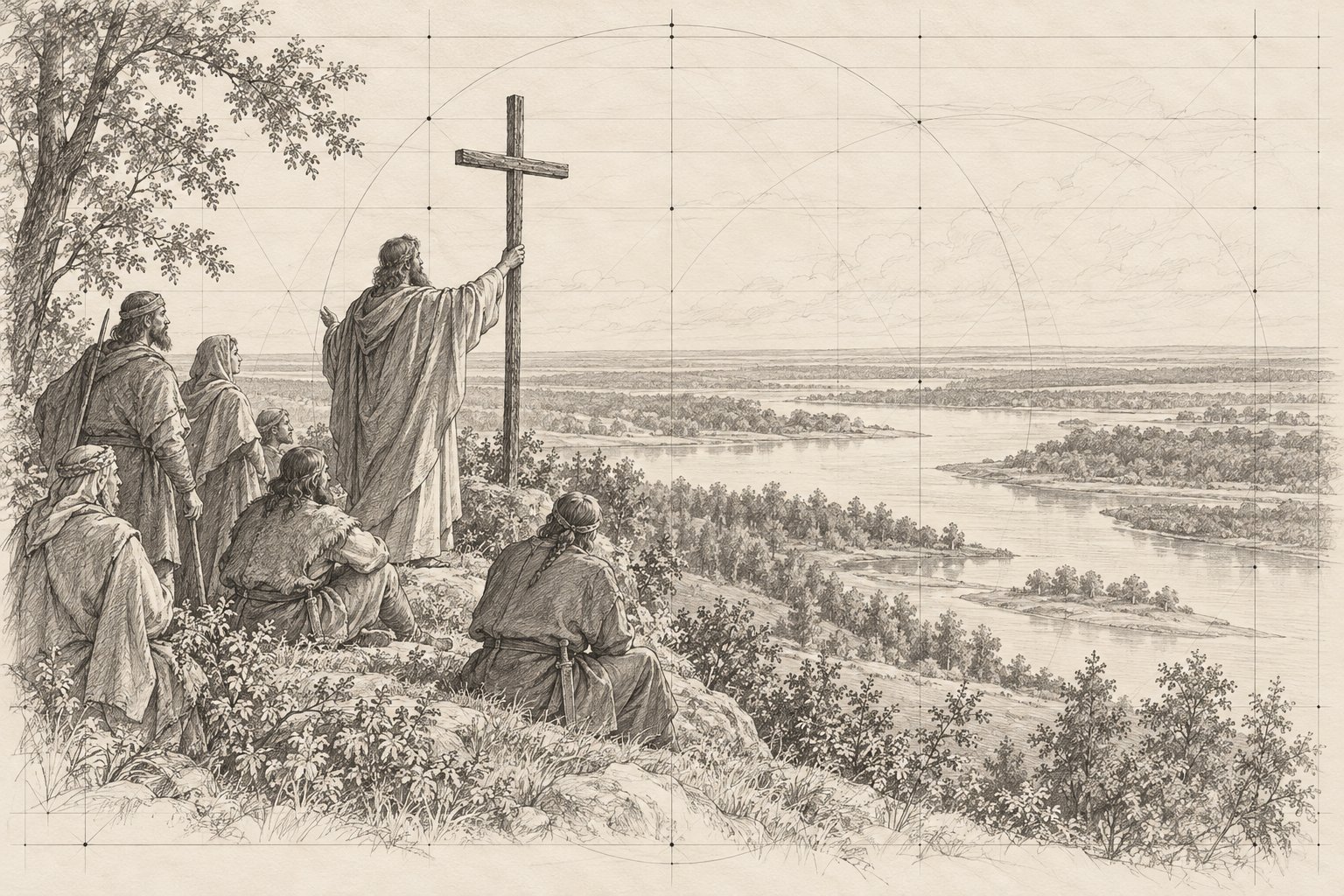
According to the chronicle legend: a cross on the hills of Kyiv. Illustration: IKONASTONE - 1086
The Prince of Kyiv Vsevolod Yaroslavich, baptised Andrew, built a church of St Andrew at the so-called Yanchyn Convent. It has not survived to our time. According to the Great Ukrainian Encyclopedia. [1]
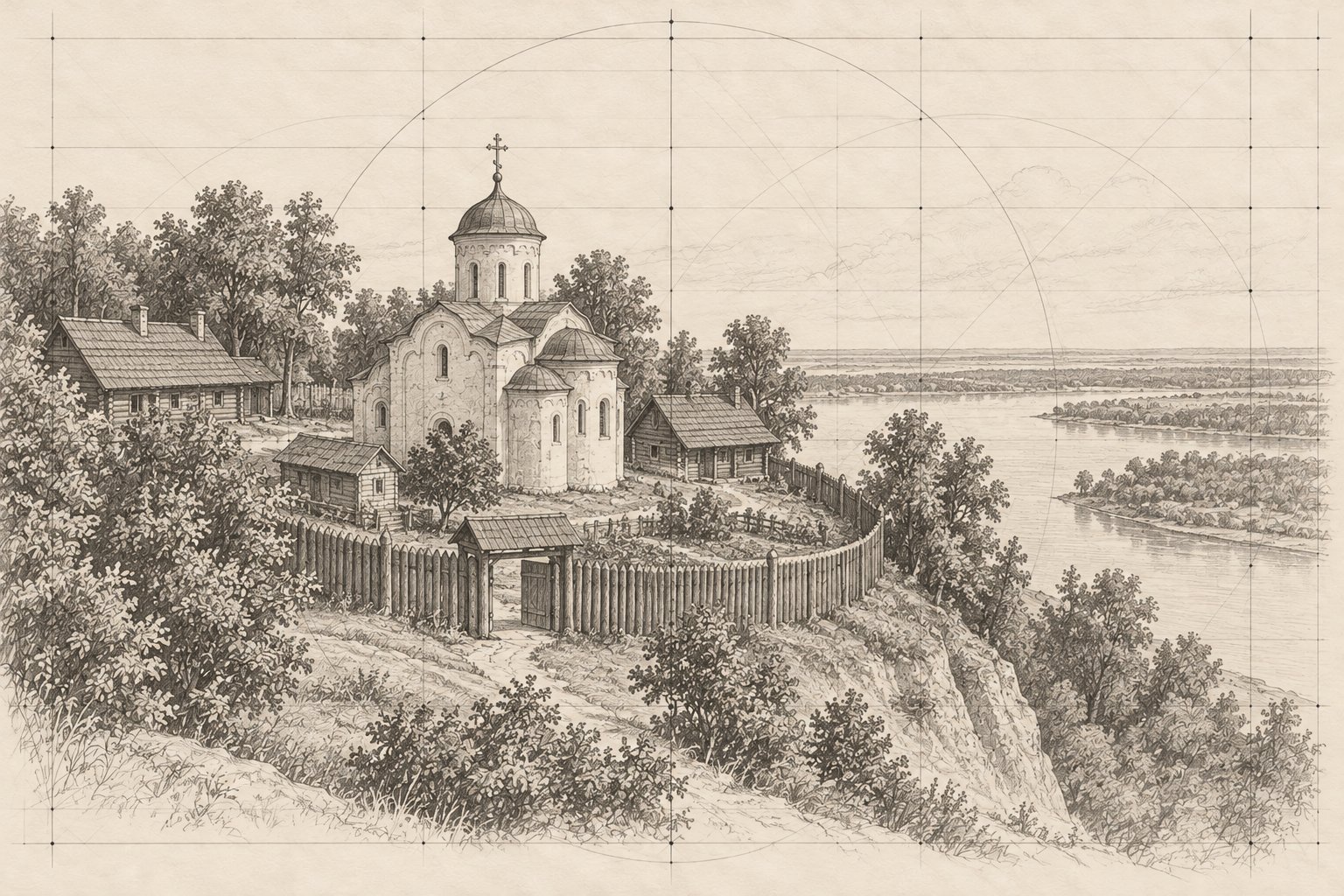
1086: the early church of St Andrew (conjectural reconstruction). Illustration: IKONASTONE - Before the 18th century
On the site of the present church, according to the Ukrainian Wikipedia, stood a Church of the Exaltation of the Cross (1215) and later a wooden one, which burned down. Given only on the authority of Wikipedia, without independent confirmation. [2]
Construction
- 9 September 1744
The site for the new church was consecrated in the presence of Empress Elizabeth Petrovna, who initiated the construction. The year 1744 is also confirmed by other sources; the exact day is according to the Great Ukrainian Encyclopedia. [1, 3, 5]
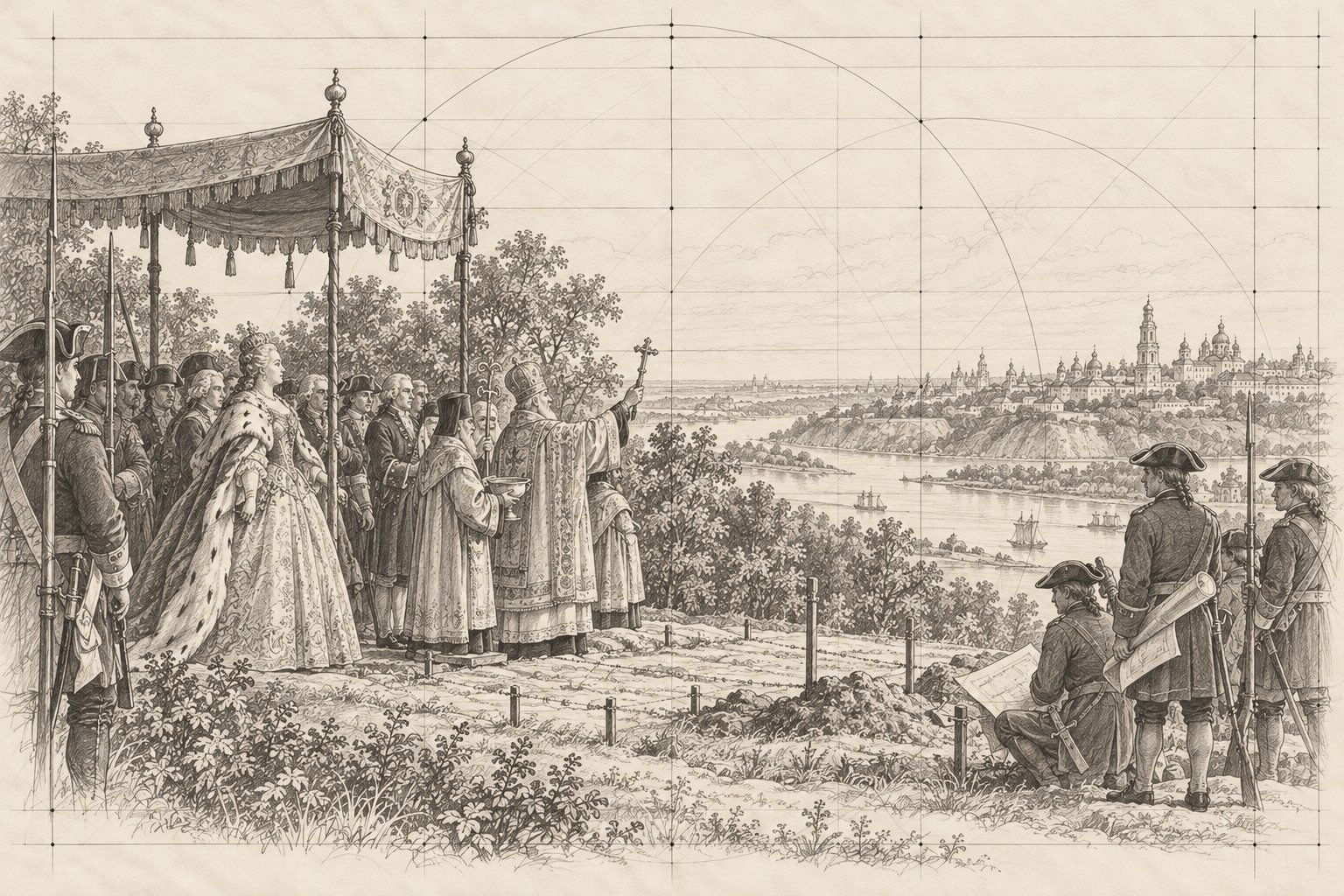
9 September 1744: consecration of the site. Illustration: IKONASTONE - 1744–1748
The design was prepared in St Petersburg by the chief architect Bartolomeo Francesco Rastrelli; he never came to Kyiv. To carry out the concept, the architect Ivan Michurin was sent from Moscow. Construction was supervised by the St Petersburg court Chancellery of Buildings. [1, 2, 7]
- 1747 or 1749
Start of active building work: 1749 is given by Mind.ua and Osvita.ua, 1747 by Glavcom and the Encyclopedia of Ukraine. The complex terrain, springs and groundwater forced the builders to set the church on a massive two-storey stylobate with stone foundations. [5, 6, 7, 8, 1]
- 1750
Two million bricks were delivered to the building site; according to archival reports, the bricks cost about 1,200 rubles. [3, 5]
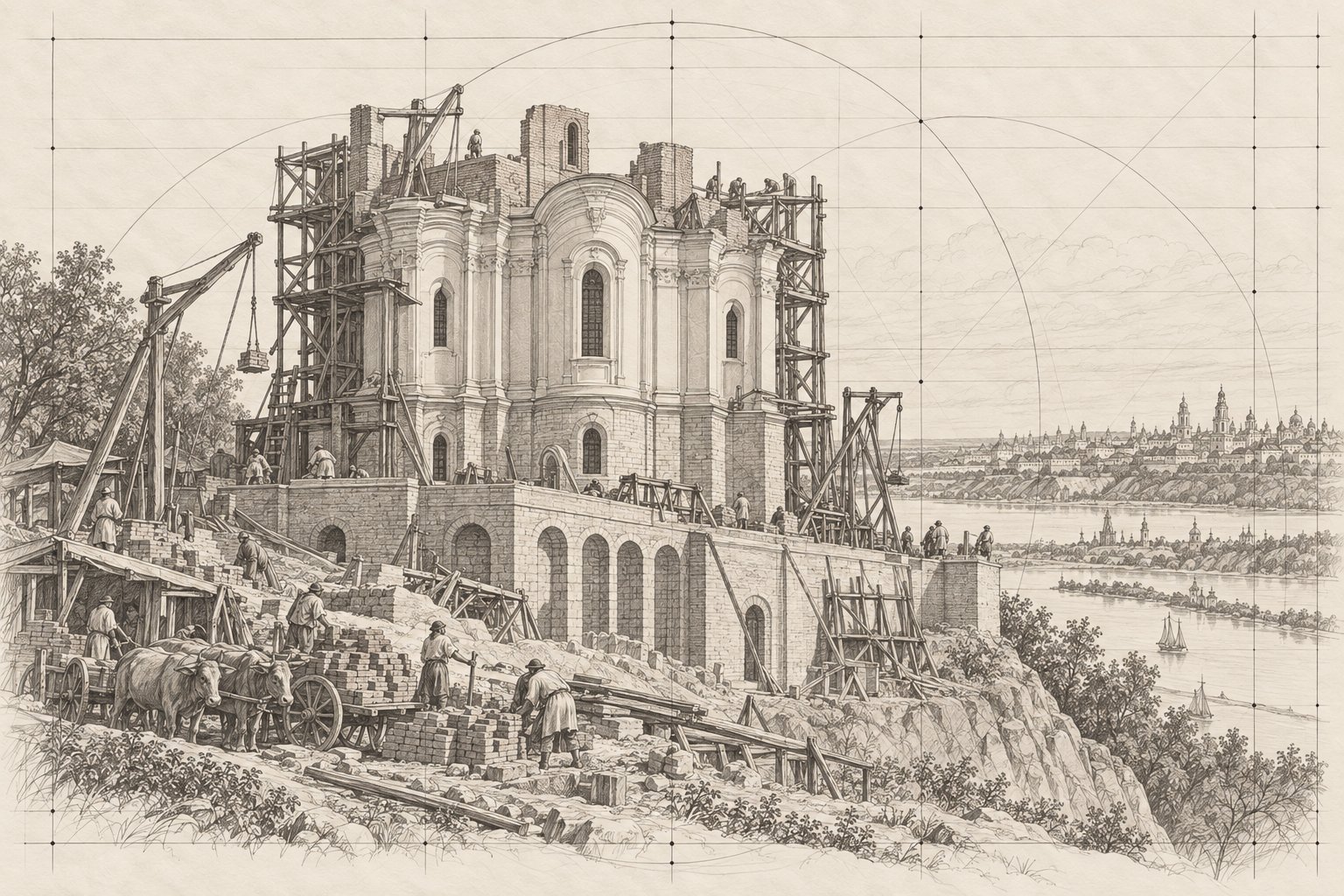
Around 1750: the church under construction. Illustration: IKONASTONE - 1751–1753
The building was largely completed in 1751; in 1752–1753 the interior finishing and painting continued. The empress's visit, for which the church was meant to be finished, was cancelled after a plot against her was uncovered, and the finishing slowed down. According to the Great Ukrainian Encyclopedia. [1]
- 1751–1752
The St Petersburg “painting team” of the Chancellery of Buildings, led by Ivan Vyshnyakov, painted 39 images for the front side of the iconostasis. Among the painters was Oleksiy Antropov; the back of the iconostasis was painted by Ivan Romensky and Ivan Chaikovsky. [1, 2]
- December 1752
The Chancellery announced a tender for the carving in the interior; five craftsmen were selected, who carried out the work for roughly 1,120 rubles. According to Mind.ua. [5]
- 1754
Antropov painted the altar image “The Last Supper”. [1, 2]
- 19 August 1767
The church was consecrated on the feast day of the holy warrior-martyr Andrew Stratelates. It was consecrated by Arseniy Mohylyansky, Metropolitan of Kyiv: his name appears in the 1767 inscription on the base of the altar table. The consecration took place 23 years after the founding, and construction lasted almost a quarter of a century. [1, 3, 5, 6, 18]
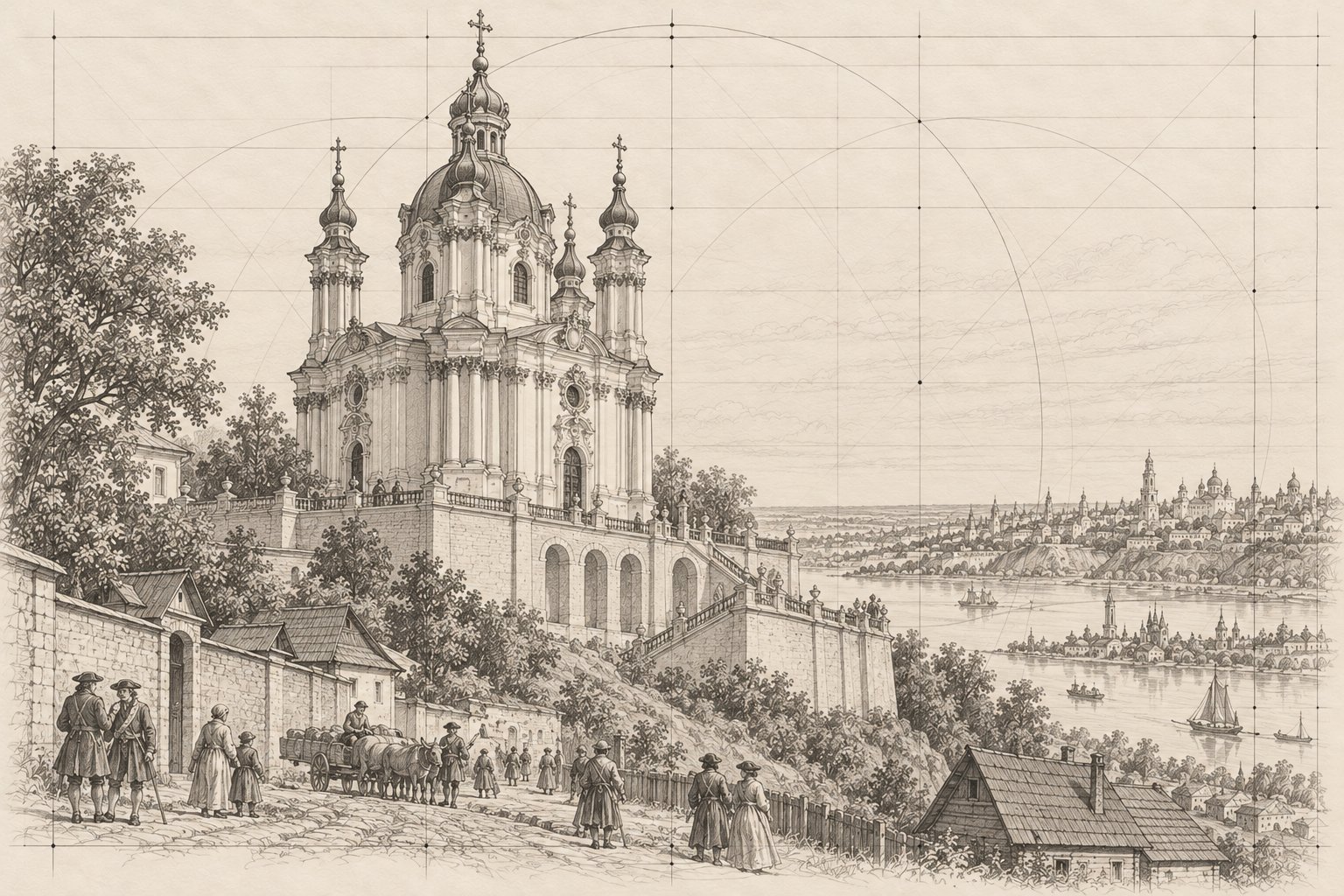
1767: the completed church. Illustration: IKONASTONE
Under the city's care: 18th–19th centuries
- 1768
The church was handed over to the Kyiv Magistrate and later to the Kyiv City Duma. According to the Ukrainian Wikipedia. [2]
- 1771, 1785–1786, 1825–1828
Routine and major repairs of the building. During the repairs of 1785–1786 the roof of the main volume was changed from dark green glazed tiles to sheet metal (according to Wikipedia). [1, 2]
- 1852
The English photographer Roger Fenton took a photograph of St Andrew's Church from Podil, one of the early views of Kyiv. According to the image caption in the Great Ukrainian Encyclopedia. [1]
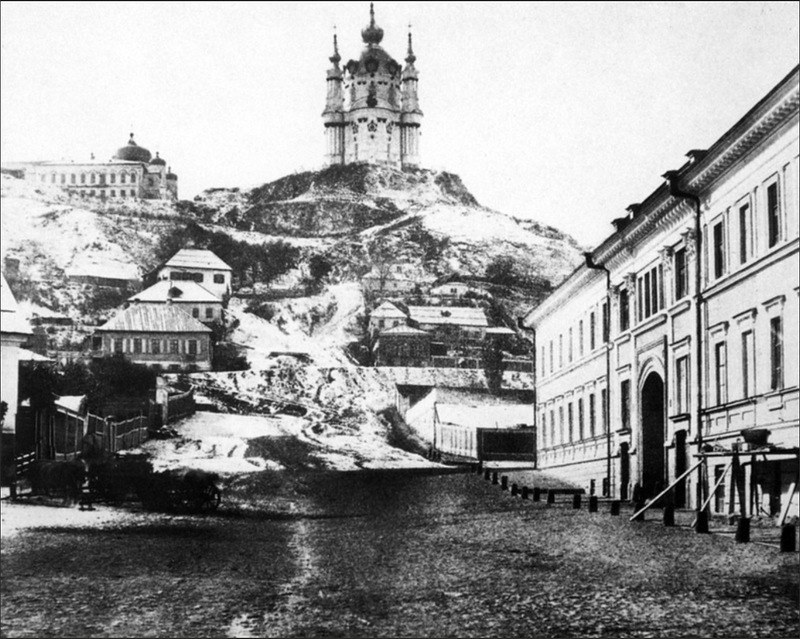
St Andrew's Church, photograph by Roger Fenton, 1852. Wikimedia Commons, public domain - 22 or 24 April 1892
Lightning pierced the roof and scorched the gilding of the domes, and the church reader nearly died from the electrical discharge. The sources disagree on the date: 22 April in Telegraf, 24 April in “The City: History, Culture, Society”. In all, lightning struck the church three times. [3, 4]
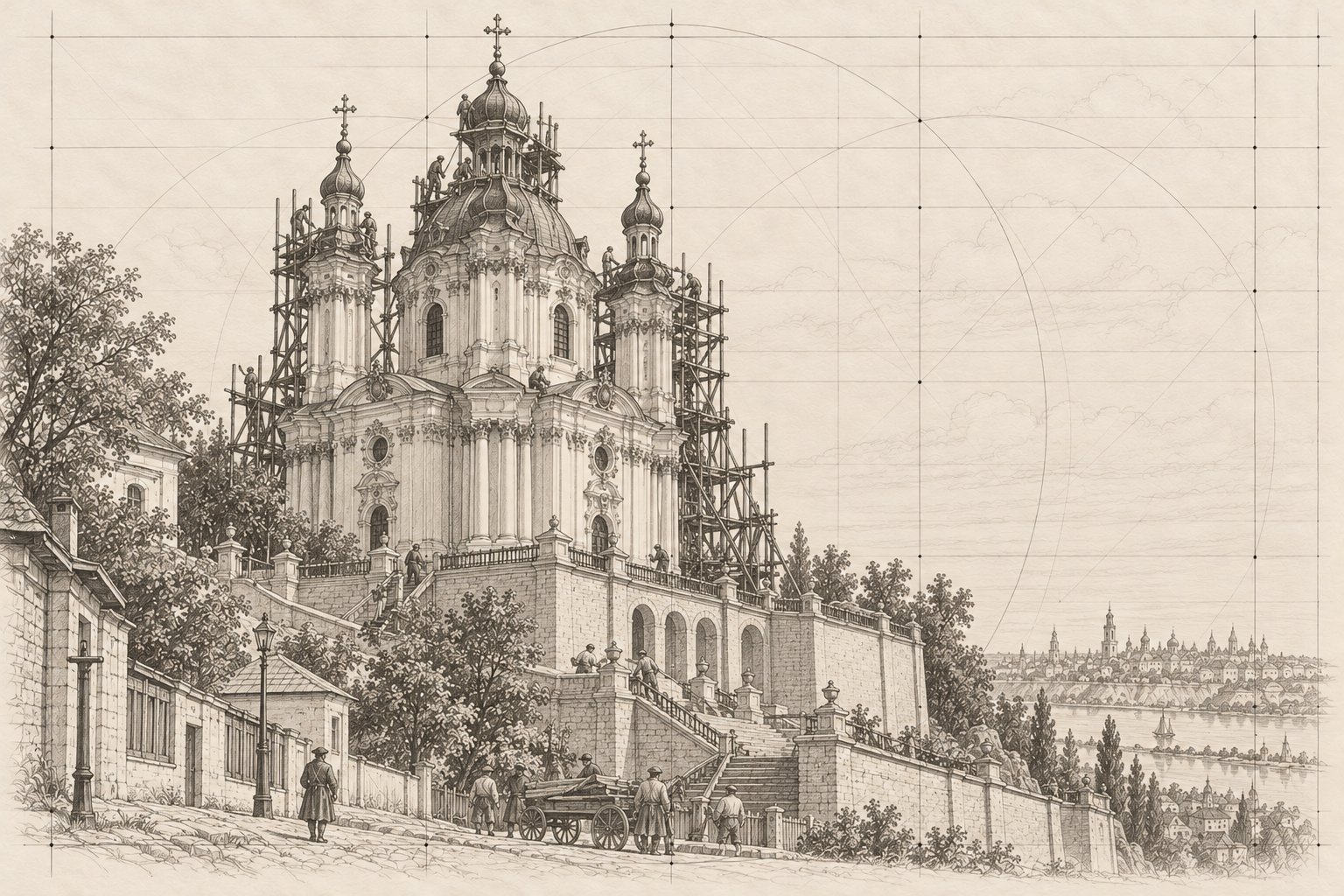
April 1892: repairs after a lightning strike. Illustration: IKONASTONE - 1867
For the centenary of the consecration, two paintings were presented to the church: “The Preaching of the Apostle Andrew” by Paton Boryspolets (1847) and a copy of “Prince Volodymyr Choosing a Faith” by Johann Eggink. They were presented on 19 August. According to the Great Ukrainian Encyclopedia. [1]
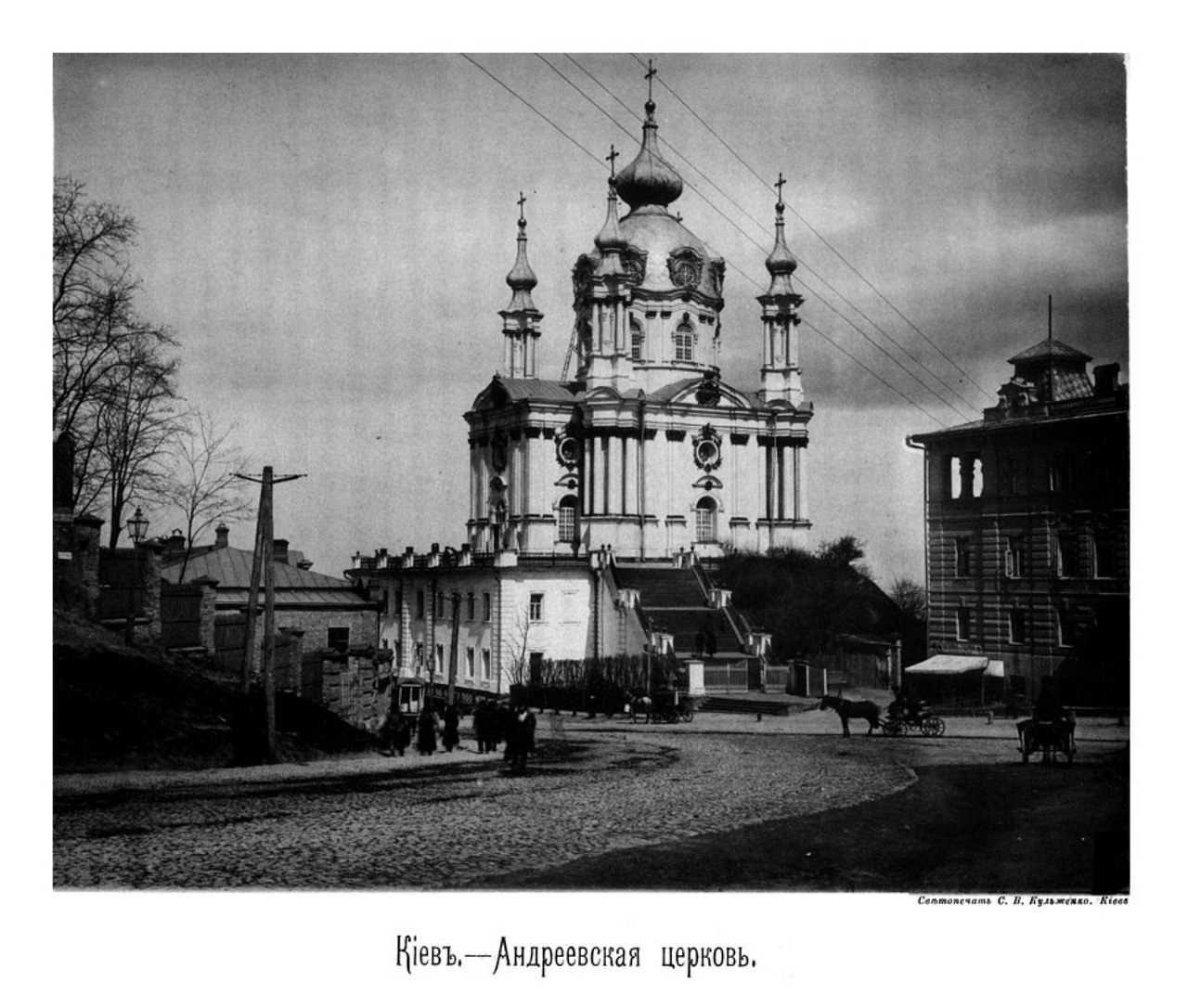
St Andrew's Church, phototype of 1888. Wikimedia Commons, public domain - 1896–1918
The rector was Archpriest Fedir Titov (1864–1935), a historian and professor at the Kyiv Theological Academy; he emigrated in 1918. According to the Great Ukrainian Encyclopedia. [1]
The Soviet period: closure and museum
- 1918–1925
The church was handed over to a parish of the Ukrainian Autocephalous Orthodox Church; services in Ukrainian were held here by Vasyl Lypkivsky (later Metropolitan of the UAOC), N. Sharaivsky, P. Tarnavsky and Deacon O. Durdukivsky. In autumn 1925 the Soviet authorities transferred it to the Renovationist Church. According to the Great Ukrainian Encyclopedia. [1]
- 1932–1936
According to the Ukrainian Wikipedia, in 1932 a decision of the Soviet government ended services in the church, and in 1935 it became part of the All-Ukrainian Museum Town. The Great Ukrainian Encyclopedia dates the start of its museum status to 1936. [1, 2]
- 7 March 1939
By a resolution of the Council of People's Commissars the church was included, as a branch, in the Sophia State Architectural and Historical Museum-Reserve. [1, 2]
- 1941–1943
Under the German occupation, UAOC services were again held in the church. [1, 2]
- 14 May 1942
In the lower church (the stylobate), the future Patriarch Mstyslav (Stepan Skrypnyk) was consecrated Bishop of Pereiaslav. [1, 2, 16, 17]
- 1949–1954
Repairs to the roof, the masonry and the porch; a single-storey annex was built next to the south wall of the stylobate. [1, 2]
- 1961
The church was again closed to worship. According to the Ukrainian Wikipedia. [2]
- 10 July 1962
The church was transferred to the balance of the State Construction Committee of the Ukrainian SSR; on 10 January 1968 it passed to the State Architectural and Historical Reserve “Sophia Museum”. [1, 2]
- 10 September 1968
St Andrew's Church opened to mass visits as a museum branch of the reserve. [1, 2]
- 1974–1987
Full restoration based on copies of Rastrelli's original drawings discovered in the graphic collection of the Vienna museum Albertina. The authors' team: the architect Valentyna Korneieva, the art historian M. Dehtiarov, and the engineers B. Levandovska and A. Rozhkov. [1, 2]
Independence: services and a new restoration
- 1990–1992
Patriarch Mstyslav officiated in the church during his time in Ukraine. According to the Ukrainian Wikipedia. [2]
- 1998
A memorial plaque to Patriarch Mstyslav with a bas-relief portrait, by the sculptor Vasyl Shchur, was installed on the façade of the stylobate. [1, 2]
- 9 August 2001
The Cabinet of Ministers allowed the UAOC to hold services in the church on the days of the Twelve Great Feasts, of special commemoration of the dead, on anniversaries and memorial dates, and on notable state and church occasions. [1]
- 2002
The church was included in the catalogue “1000 Wonders of the World. Masterpieces of Humanity on Five Continents” (Germany). [1]
- 2009–2020
The restoration lasted 11 years. Before Euro 2012 the slope on which the church stands was reinforced. [1, 2]
- 30 August 2017
By a resolution of the Cabinet of Ministers the church was added to the list of cultural heritage monuments of national importance in Kyiv. [1]
- 18 October 2018
The Verkhovna Rada passed a law transferring St Andrew's Church into free permanent use by the Ecumenical Patriarchate for services, rites and processions. The church remained state property, a museum within the “Sophia of Kyiv” conservation area. The law came into force by 10 November 2018 (No. 2598-VIII, according to Ukrinform). [1, 2, 9, 14]
- 28 November and 13 December 2018
The Cabinet of Ministers transferred the church to the Representation of the Court of the Ecumenical Patriarchate, and on the feast of the Apostle Andrew the first hierarchical liturgy of the stauropegion took place. According to the Ukrainian Wikipedia. [2]
- 13 December 2020
A solemn liturgy marked the completion of the 11-year restoration; it was led by the representative of the Ecumenical Patriarch, Metropolitan Emmanuel of France. From 15 December the church has been open to all who wish to visit. [1, 2, 15, 22]
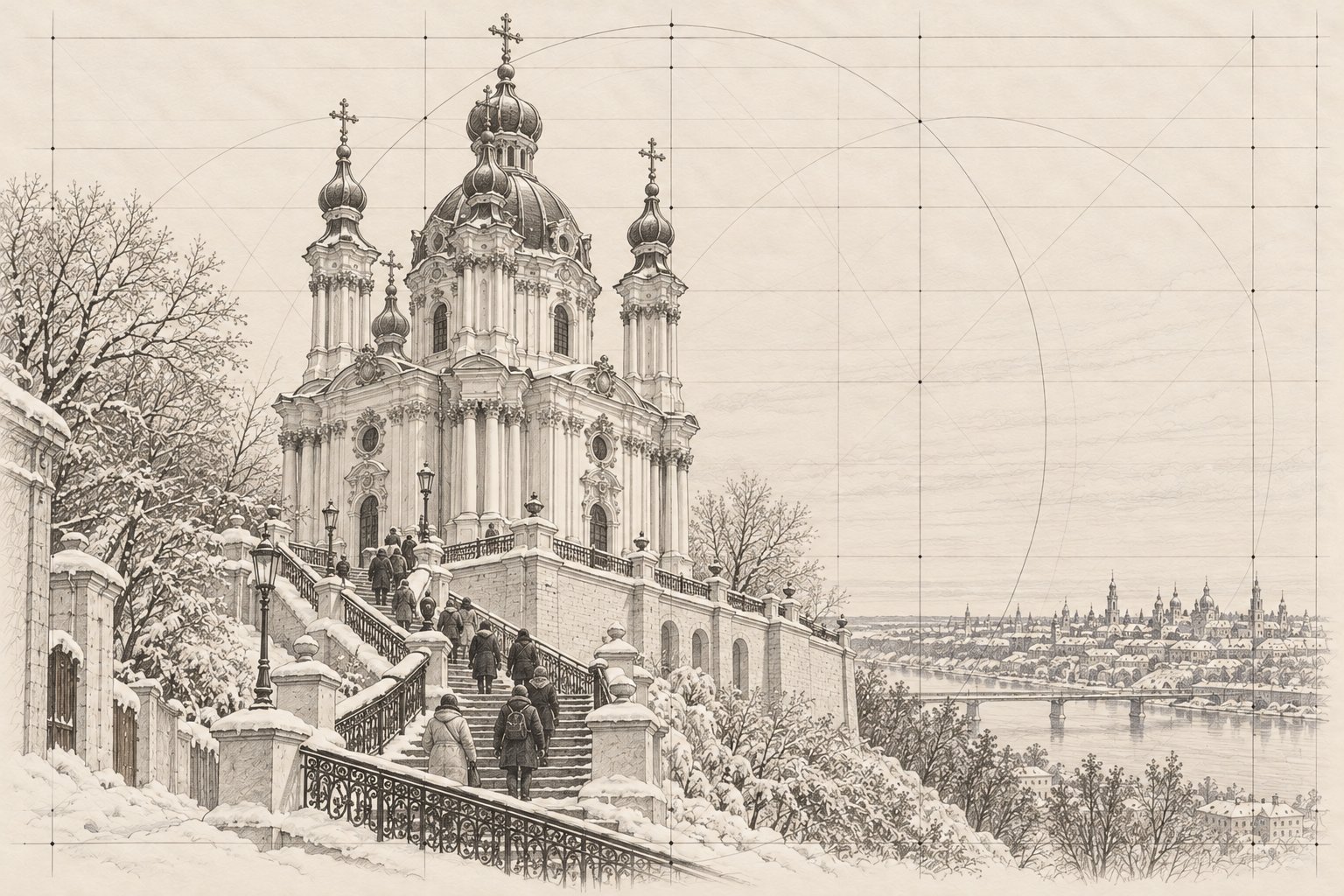
December 2020: the opening after the restoration. Illustration: IKONASTONE
Today
- 2022
The restoration of the church won the European Heritage Award (European Heritage Awards / Europa Nostra Awards). The award was presented in Prague: according to the Cabinet's report on the plaque, on 25 September 2022 [10], whereas the EU Neighbours East announcement gave the ceremony as 26 September [13]; the winners were announced on 30 June [11, 12]. A commemorative plaque was installed on the church on 12 December 2022. [10]
- Today
The rector (since 2 February 2019, according to Wikipedia) is Michael (Anishchenko), titular Bishop of Komana, Exarch of the Ecumenical Patriarch in Kyiv. The church remains a museum within the “Sophia of Kyiv” conservation area; the liturgies are led by representatives of the Ecumenical Patriarchate. [1, 2]
Lost and recreated
| What | What it was | What happened | Where it is now |
|---|---|---|---|
| Church of St Andrew at the Yanchyn Convent | 1086, founded by Prince Vsevolod Yaroslavich | Did not survive | Only in mentions in the chronicle and encyclopedias [1] |
| Church of the Exaltation of the Cross and the wooden church | Early 17th – late 17th century (according to Wikipedia) | The wooden church burned down | Did not survive [2] |
| Roof of the main volume | Dark green glazed tiles | Replaced with sheet metal during the repairs of 1785–1786 | The roof was changed again later [2] |
| Rastrelli’s original drawings | 1740s–1750s | The original drawings have not survived in Kyiv | Copies were found in the Albertina (Vienna); the 1974–1987 restoration was based on them [1, 2] |
| Iconostasis | Early 1750s, from Rastrelli’s sketches and templates | Preserved | In the church; one of the two Rastrelli iconostases surviving in the world [1] |
| UAOC services | 1918–1925 | Transferred to the Renovationist Church in 1925; services stopped in 1932 or later | Resumed in 1941–1943; since 2018 the Ecumenical Patriarchate has officiated [1, 2] |
| Slope of St Andrew’s Hill | Foundation of made ground and springs | Cracks, need for reinforcement | Reinforced before Euro 2012 and during the 2009–2020 restoration [1, 2] |
Architecture
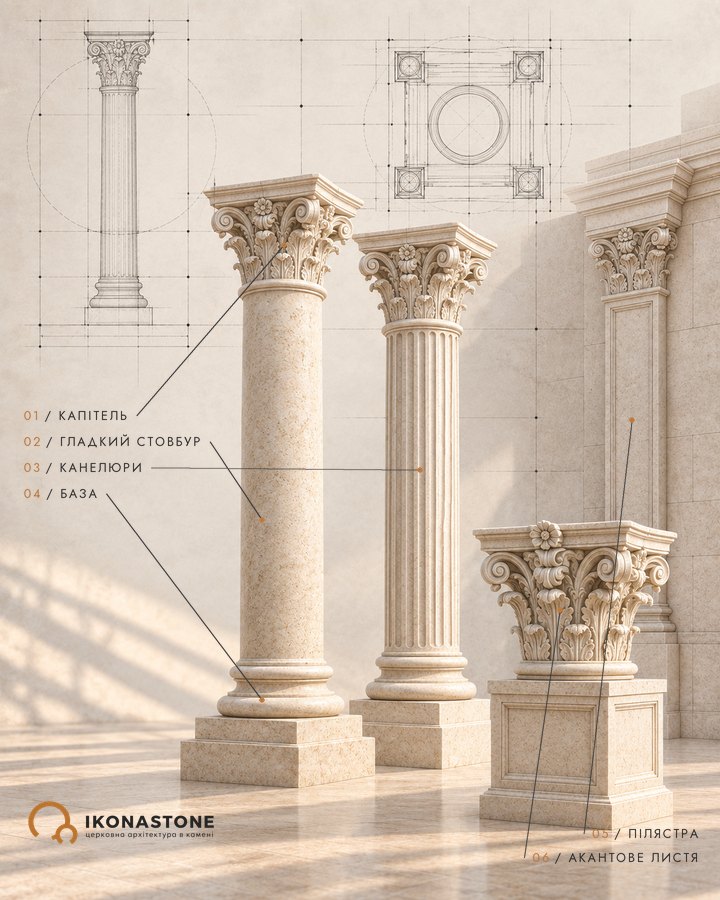
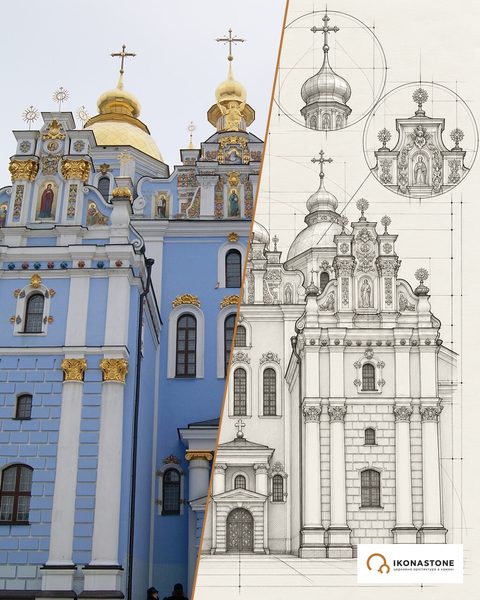
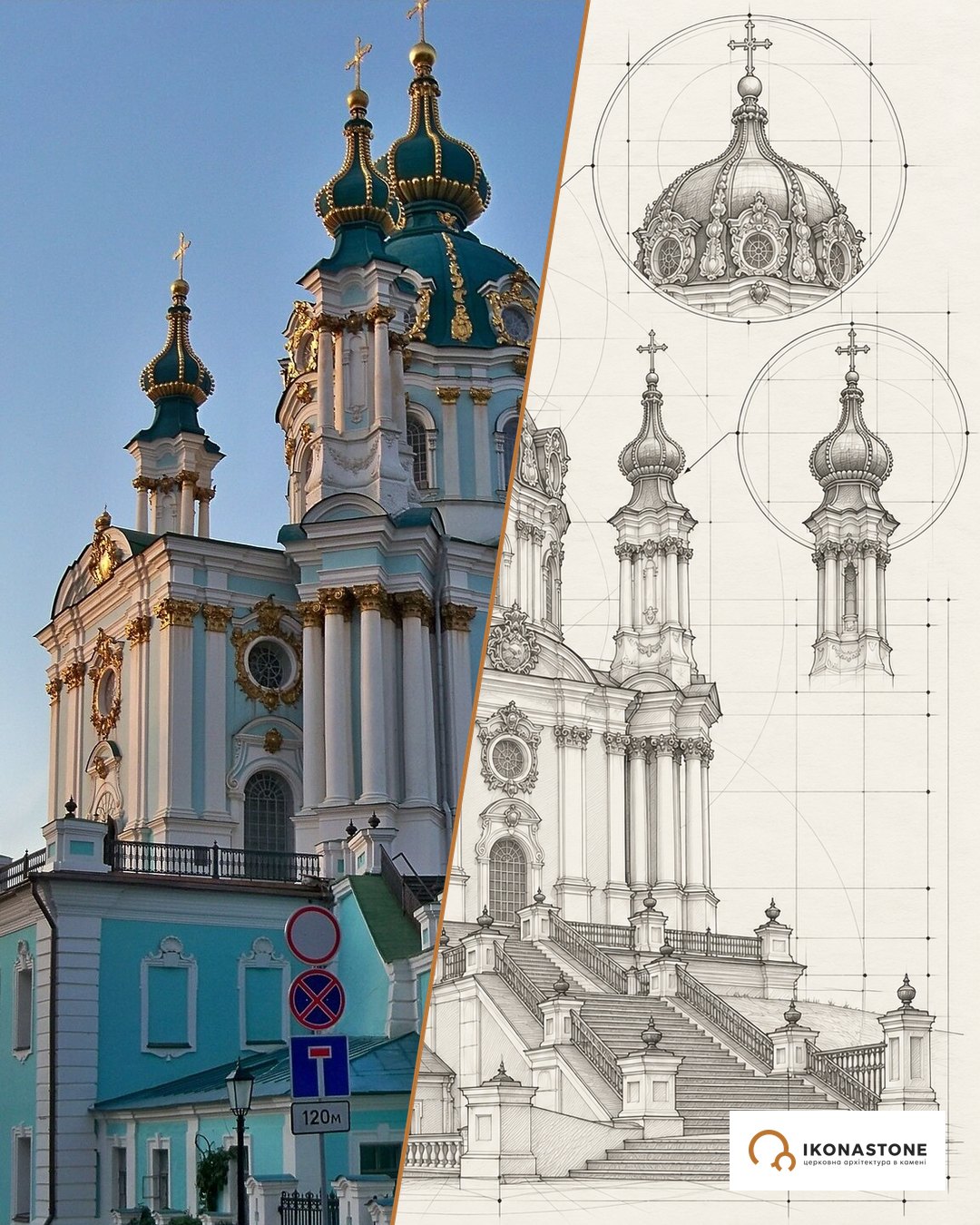
The church is cross-shaped in plan and five-domed: a central dome on a drum and four decorative towers on supporting pylon-buttresses. The façades are held by a rhythm of columns and pilasters of the Corinthian and Ionic orders, and the windows and doors are framed with stucco. According to the Great Ukrainian Encyclopedia, the church is 31.7 m long, 20.4 m wide and 60 m high from the terrace including the cross; the Ukrainian Wikipedia gives 44 m without the cross, and Osvita.ua gives 47 m. The heights differ, probably because of different reference points (estimate).
The drawings show the form, not exact dimensions.
The stylobate: a house under the church
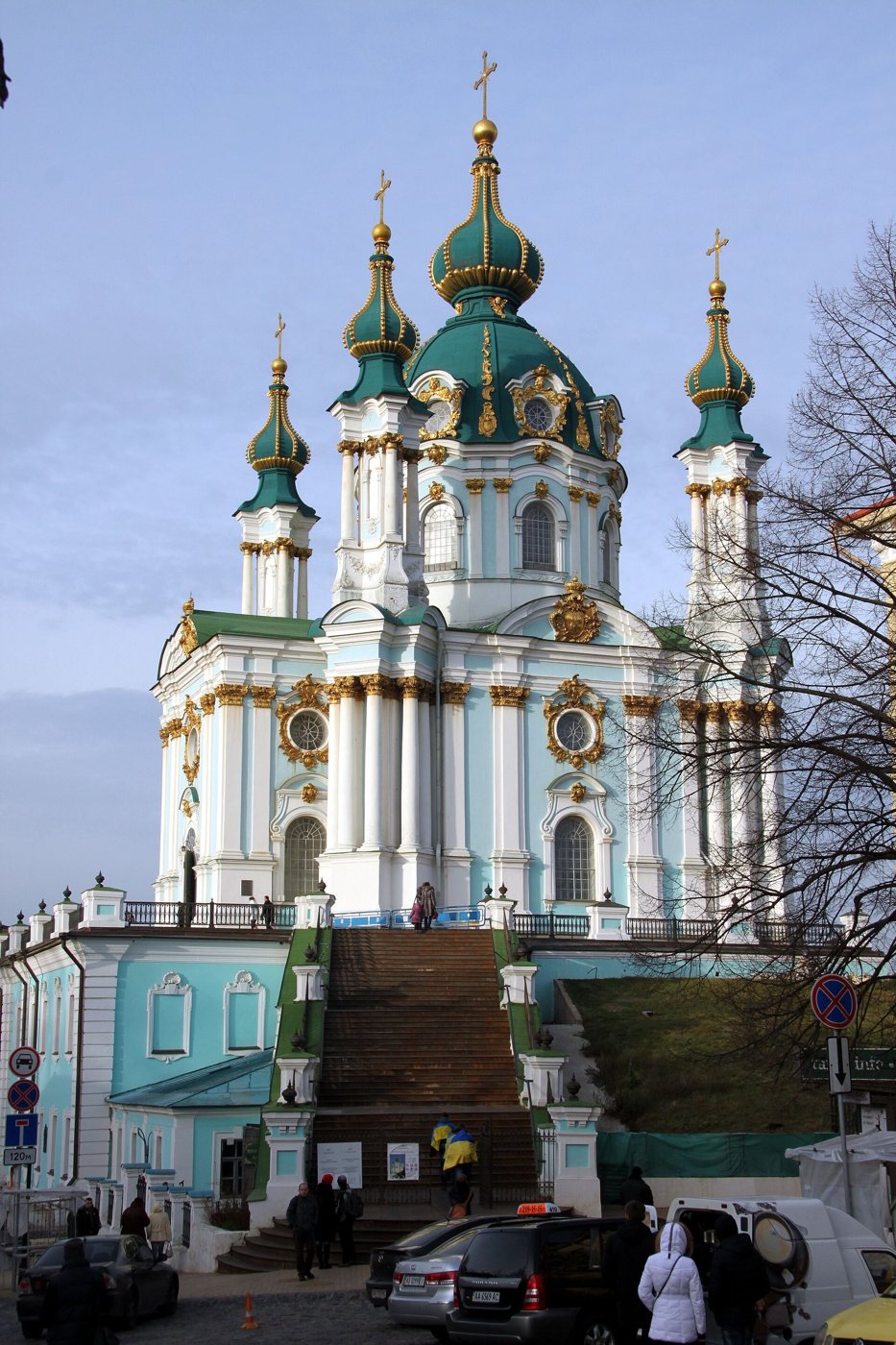
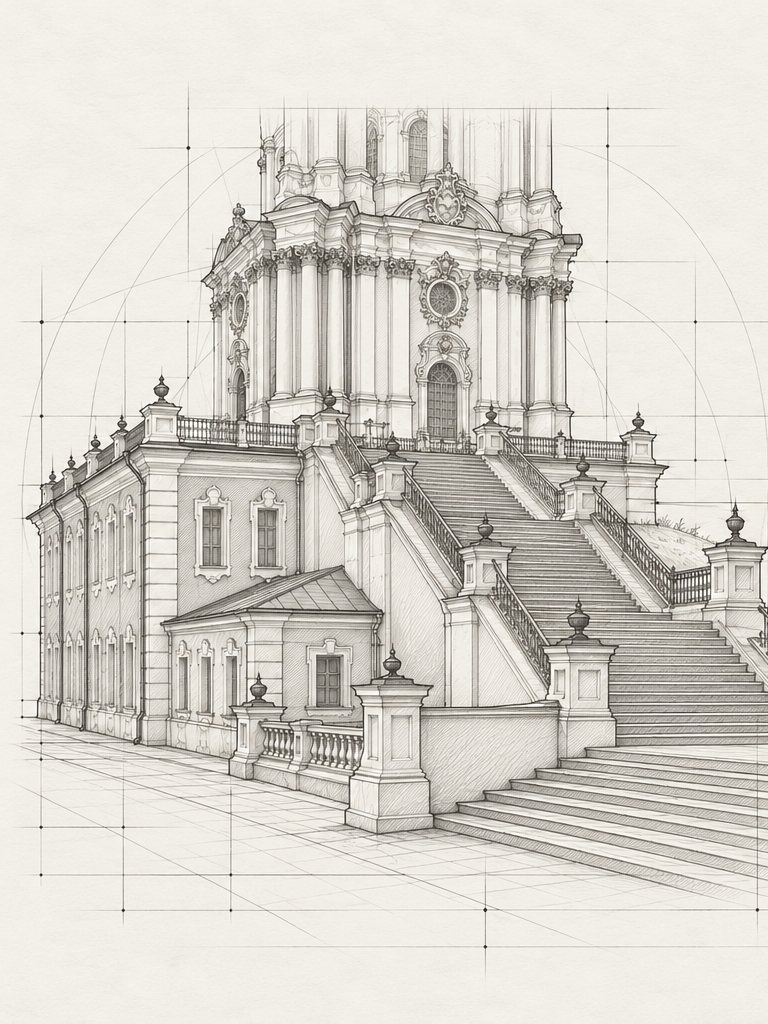
The church does not stand on the ground; it stands on a building. The two-storey stylobate has eight rooms on each floor, and its walls are the foundation of the church. This solution raises the church higher above Podil and at the same time transfers its weight onto a massive stone-and-brick base.
Dome and towers: a silhouette for the river
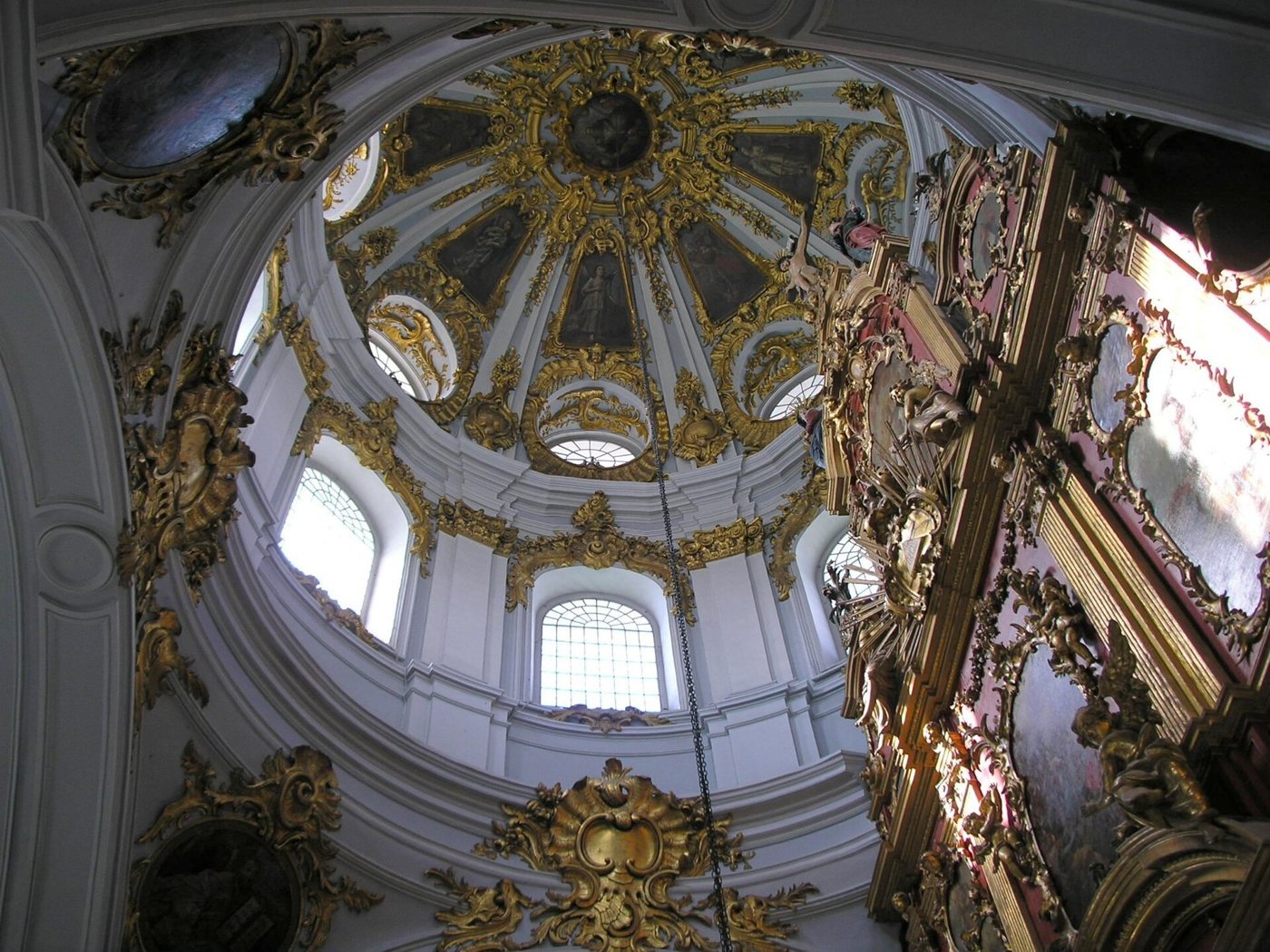
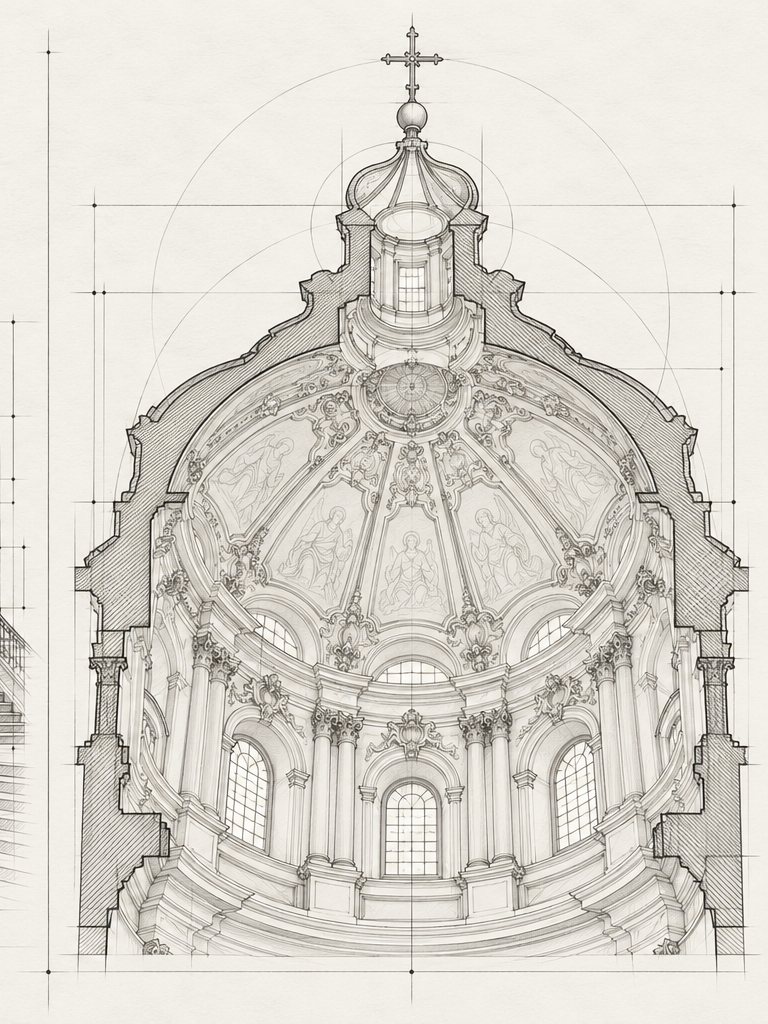
The central dome on a high drum with windows lets light into the church. Four decorative towers crown the supporting pylon-buttresses on the diagonal axes and, together with the central dome, form the five-domed silhouette; the church has no bell tower.
Cast-iron steps: the way up from the street
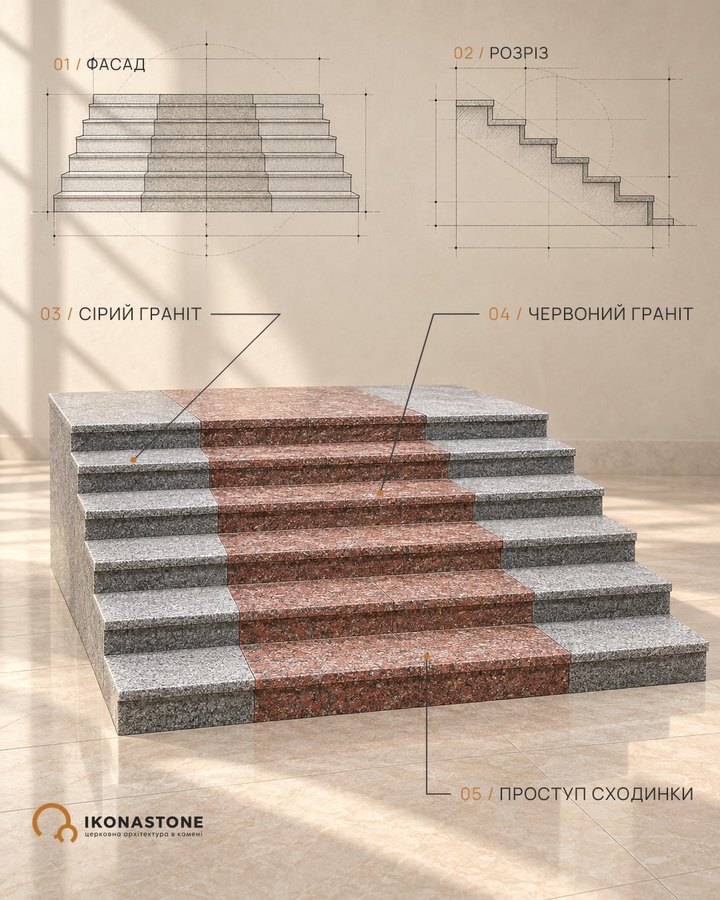
Steep cast-iron steps lead to the church from the street. Cast-iron steps with three landings lead up to the pentagonal terrace on which the church stands; the capitals of the columns and pilasters are also cast in iron and gilded (Great Ukrainian Encyclopedia).
Stone and materials
The church and the stylobate are built of brick on stone foundations (Great Ukrainian Encyclopedia); in 1750, 2 million bricks were delivered to the site (Mind.ua). The stone is hidden below: the whole mass of the stylobate and the church rests on the foundations.
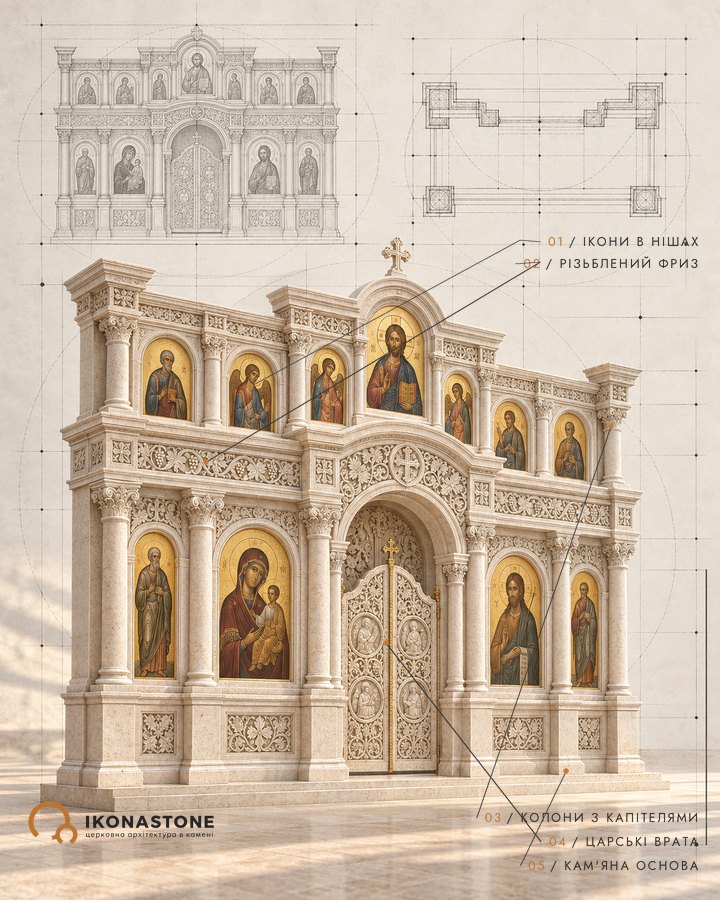
The iconostasis was made from Rastrelli’s sketches and templates in the early 1750s: the frame was made in Kyiv, the carving in St Petersburg. The 39 images of the front side were painted in 1751–1752 by a St Petersburg team led by Ivan Vyshnyakov, with Oleksiy Antropov among the painters; the back was painted by Ivan Romensky and Ivan Chaikovsky. According to the Great Ukrainian Encyclopedia, it is one of the two Rastrelli iconostases surviving in the world. For how an iconostasis is divided into tiers, see the article “Tiers of the iconostasis”.
Steps up to a church on a slope are an engineering task in their own right: they carry people and water, frost and time. We design such church steps for a specific building.
Did you know
The architect prepared the design in St Petersburg and never came to Kyiv; the construction was led by Ivan Michurin from Moscow. [1, 2, 7]
According to the Great Ukrainian Encyclopedia, St Andrew's Church keeps a Rastrelli iconostasis, one of two surviving in the world. [1]
The empress was due to attend the consecration in spring 1753, but the visit was cancelled after a plot against her was uncovered; the finishing of the church slowed down, and it was consecrated only in 1767. [1]
The church was consecrated on 19 August, the feast day of the warrior-martyr Andrew Stratelates, and not of the Apostle Andrew the First-Called, to whom the church is dedicated. [1]
The 1767 inscription on the base of the altar table names Arseniy Mohylyansky, Metropolitan of Kyiv. [3]
In 1750, 2 million bricks were brought to the site; a thousand cost about 60 kopecks, and all the bricks together 1,200 rubles. According to archival reports. [5]
In the 1840s a Kyiv ascetic, Ivan Rastorguiev, nicknamed “the Barefoot” (died 1849), lived at the church, receiving pilgrims and the disabled and helping them. [1]
The future Patriarch Mstyslav (Skrypnyk) was consecrated bishop in the lower church on 14 May 1942. [1, 2, 16, 17]
St Andrew's Church holds 68 oil paintings on canvas and one image on plaster on the western vault. [1]
In April 1892 a lightning strike pierced the roof and nearly killed the church reader; in all, lightning struck the church three times. [3, 4]
The two-storey stylobate, which serves as the foundation, has eight rooms on each floor. [2]
In 2002 the church was included in the German catalogue “1000 Wonders of the World”. [1]
In Valerian Pidmohylny's “A Little Drama”, Marta breaks off her relationship with Slavenko here; in the film “Behind Two Hares”, the failed wedding of Holokhvastov and Pronia Prokopivna takes place near the church. According to the Ukrainian Wikipedia. [2]
Legends
The apostle's cross
According to the legend from the “Tale of Bygone Years”, the Apostle Andrew the First-Called climbed a hill above the Dnipro, blessed it, set up a cross and foretold that a great city with many churches would stand here. [1]
The sea under the hill
According to a widespread legend, water sleeps under the hill and the first bell would wake it, which is why the church has no bell tower. There is no documentary confirmation of this; what has been verified is only that the church, its towers and the stylobate were built without a bell tower and that the hill has springs and groundwater. [1]
A cartload of wool
According to legend, a powerful spring wells up under the hill; as soon as dew appears, a cartload of wool is driven into the spring, because otherwise the water would flood the whole world. Recorded in the Reading Kyiv guide; according to the same guide, Ivan Nechui-Levytsky mentioned the legend of the spring. This is a legend, not documented. [19]
The shrine of Perun
According to legend, a shrine of Perun stood on the site of the church, and later a Church of the Exaltation of the Cross rose there. Recorded in the publication “Svitohliad” (2018) as a legend; there is no archaeological confirmation in the sources checked. [20]
Leonardo in the iconostasis
According to pre-Soviet guidebooks, one of the icons of the iconostasis was created by Leonardo da Vinci; museum staff refute this and name Oleksiy Antropov as the author of “The Last Supper” (which agrees with the Great Ukrainian Encyclopedia). [1, 21]
People
- Andrew the First-Called: apostle who, according to the chronicle legend, set up a cross on the hill.
- Vsevolod Yaroslavich (Andrew): Prince of Kyiv who in 1086 founded the church of St Andrew at the Yanchyn Convent.
- Elizabeth Petrovna: empress, initiator of the construction; in 1744 she was present at the consecration of the site.
- Bartolomeo Francesco Rastrelli: author of the design and of the sketches for the iconostasis; never came to Kyiv.
- Ivan Michurin: Moscow architect who directed the construction in Kyiv.
- Ivan Vyshnyakov: painter, head of the St Petersburg team that painted the icons of the front side of the iconostasis.
- Oleksiy Antropov: painter; “The Last Supper” (1754), “The Dormition of the Mother of God”, “The Annunciation”, the image of Andrew on the vault.
- Ivan Romensky, Ivan Chaikovsky: Ukrainian painters who painted the back of the iconostasis.
- Yosyp Domash, Andriy Karlovsky: carvers of the iconostasis.
- Arseniy Mohylyansky: Metropolitan of Kyiv, consecrated the church on 19 August 1767.
- Paton Boryspolets: painter, author of “The Preaching of the Apostle Andrew” (1847), presented to the church in 1867.
- Fedir Titov: archpriest, rector 1896–1918.
- Vasyl Lypkivsky: archpriest, later Metropolitan of the UAOC, officiated in the church after 1918.
- Mstyslav (Stepan Skrypnyk): consecrated bishop on 14 May 1942; Patriarch of the UAOC.
- Valentyna Korneieva: architect-restorer, author of the 1974–1987 restoration project.
- Ivan Rastorguiev (“the Barefoot”): ascetic who lived in the stylobate in the 1840s.
- Michael (Anishchenko): Bishop of Komana, rector since 2019.
How to cite
IKONASTONE. St Andrew's Church in Kyiv // Guide to Churches of Ukraine. URL: https://ikonastone.com/en/guide/st-andrews-church-kyiv/ (accessed DD.MM.YYYY).
FAQ
Where is St Andrew's Church located?
In Kyiv, on St Andrew's Hill above Podil, at 23 Andriivskyi Descent. The church is part of the National Conservation Area “Sophia of Kyiv”.
When was the church built?
The site for the church was consecrated in 1744 in the presence of Empress Elizabeth. The design by Bartolomeo Rastrelli was carried out by the Moscow architect Ivan Michurin; the building was largely completed in 1751, and on 19 August 1767 it was consecrated by Arseniy Mohylyansky, Metropolitan of Kyiv.
What is the church built of?
The walls are brick, the foundation is stone. The church stands on a two-storey building, the stylobate, whose walls serve as its foundation. Much of the decoration is cast in iron, and the steps from the street are cast iron too.
Who holds services in the church now?
By Law No. 2598-VIII of 18 October 2018 the church was transferred for free use to the Ecumenical Patriarchate for the activities of its stauropegion. The church remains a monument within the conservation area “Sophia of Kyiv”; on weekdays since the 2020 restoration it operates as a museum.
Sources
- Нетудихаткін І. А. Андріївська церква // Велика українська енциклопедія
- Вікіпедія (uk). Андріївська церква (Київ)
- «Місто: історія, культура, суспільство» (2021). Стаття про Андріївську церкву
- Телеграф. Андріївську церкву у Києві тричі рятували від руйнування (25.04.2025)
- Mind.ua. І. Нетудихаткін. Андріївська церква у Києві: скільки коштувало будівництво (18.08.2017)
- Главком. Андріївська церква відзначає 257 років з дня освячення (19.08.2024)
- Освіта.ua. Архітектура та культурне значення Андріївської церкви в Києві
- Encyclopedia of Ukraine. Saint Andrew's Church
- Укрінформ. Набув чинності закон про передачу Андріївської церкви Вселенському патріархату (10.11.2018)
- Кабінет Міністрів України. МКІП: на Андріївській церкві встановили табличку — відзнаку переможця європейської премії за реставрацію
- Інтерфакс-Україна. Премія Europa Nostra для Андріївської церкви (30.06.2022)
- Кабінет Міністрів України. Україна отримала премії Європейського Союзу в галузі культурної спадщини
- EU Neighbours East. Two projects from Ukraine win this year's European Heritage Awards / Europa Nostra Awards
- Еспресо. Андріївська церква офіційно перейшла до Константинополя (10.11.2018)
- LB.ua. У Києві сьогодні офіційно відкривають відреставровану Андріївську церкву (12.12.2020)
- Радіо Свобода. Про патріарха Мстислава
- Ukrinform. Nine facts about Kyiv church to be used by Ecumenical Patriarch (18.10.2018)
- Еспресо. Перлина бароко над Подолом: як 273 роки тому звели Андріївську церкву
- Reading Kyiv. St Andrew's Church
- А. Івченко. Фотокарта православних храмів України. «Світогляд», 2018, № 4
- Главком. Стало відомо, коли відкриють для відвідувачів Андріївську церкву (11.03.2019)
- LB.ua. У відреставрованій Андріївській церкві відбулося перше богослужіння (13.12.2020)
- Town
- Kyiv
- Built
- founded 1744, consecrated 1767
- Type
- cross-shaped in plan, five-domed (a central dome and four decorative towers)
- Material
- brick, stone foundation, cast iron
- Research depth
- 33%