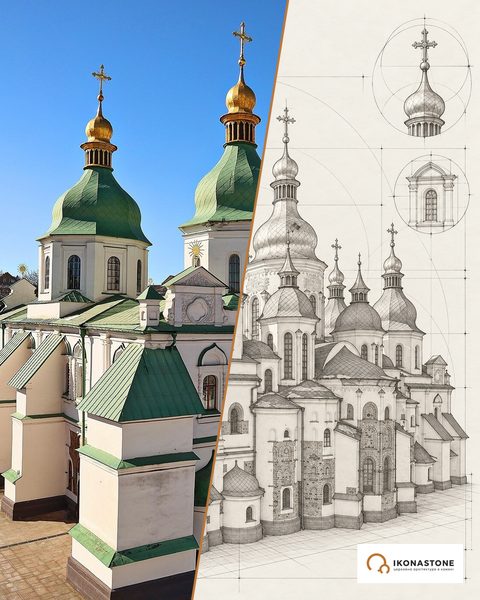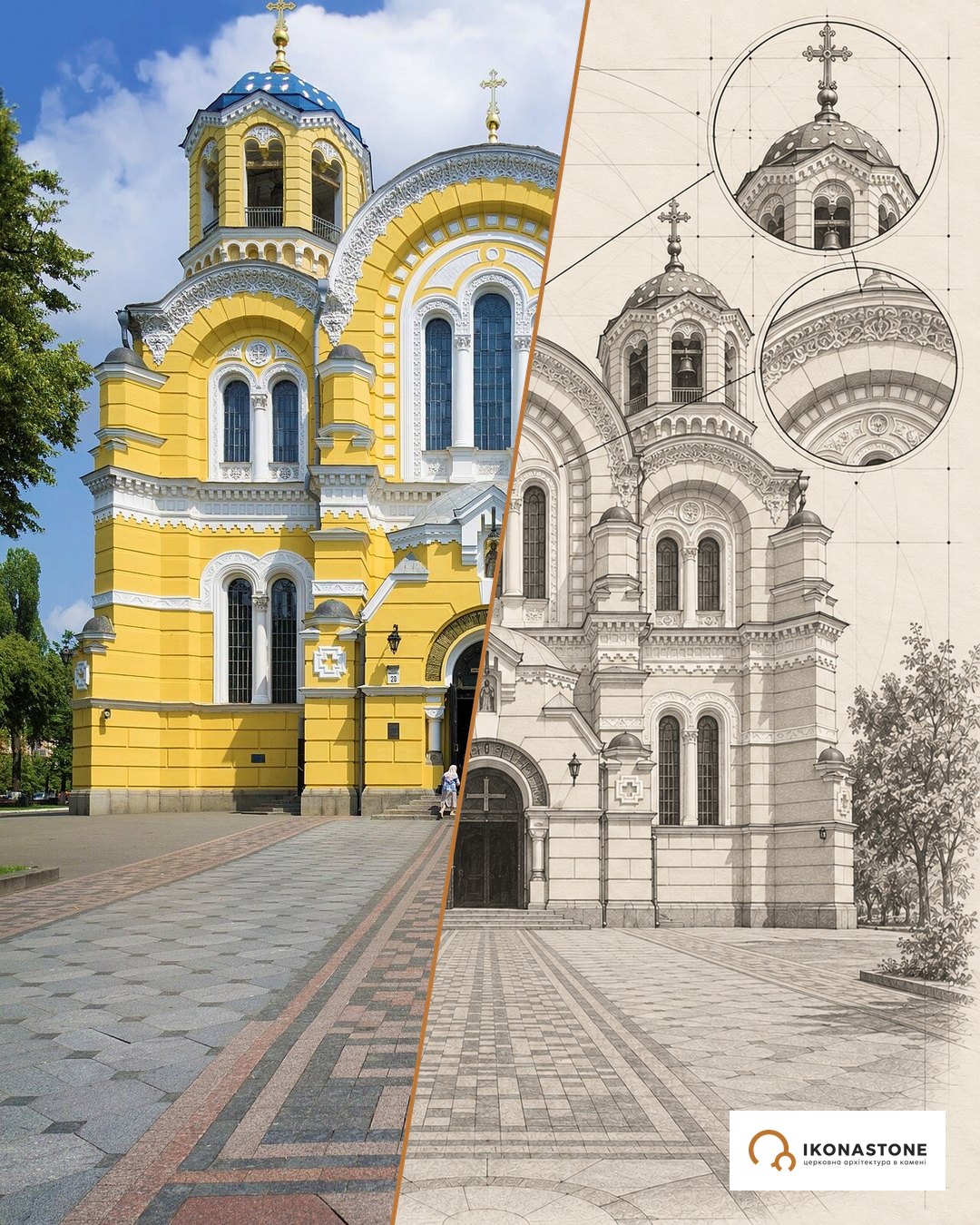
St Michael's Golden-Domed Cathedral: a church rebuilt from its foundations
The St Michael’s Cathedral we see today is younger than most of its visitors. But it stands on foundations laid in 1108 — and it is these stones that remember what it once was.
In brief
| Address | 8 Trokhsviatytelska Street, Kyiv |
| Built | 1108–1113, Prince Sviatopolk Iziaslavych; destroyed in the 1930s; recreated 1997–2000 |
| Type | six-pillar cross-in-square church; from the 18th century, seven-domed, in the Ukrainian Baroque style |
| Material | ancient foundations — stone and plinthos; recreated walls and vaults — brick |
| Status | recreated building; the monastery ensemble retains the refectory with the Church of St John the Theologian of 1713–1715 |
| Church | Orthodox Church of Ukraine (its seat since December 2018) |
History
Prince Sviatopolk Iziaslavych, baptised Mykhail, founded the cathedral on 11 July 1108 next to the older St Demetrius Monastery. It was built after the pattern of the Dormition Cathedral of the Pechersk Monastery: six pillars, three naves, three apses. In 1113 the prince was buried in the church he had built. The dome was covered with gilding — hence “Golden-Domed”.
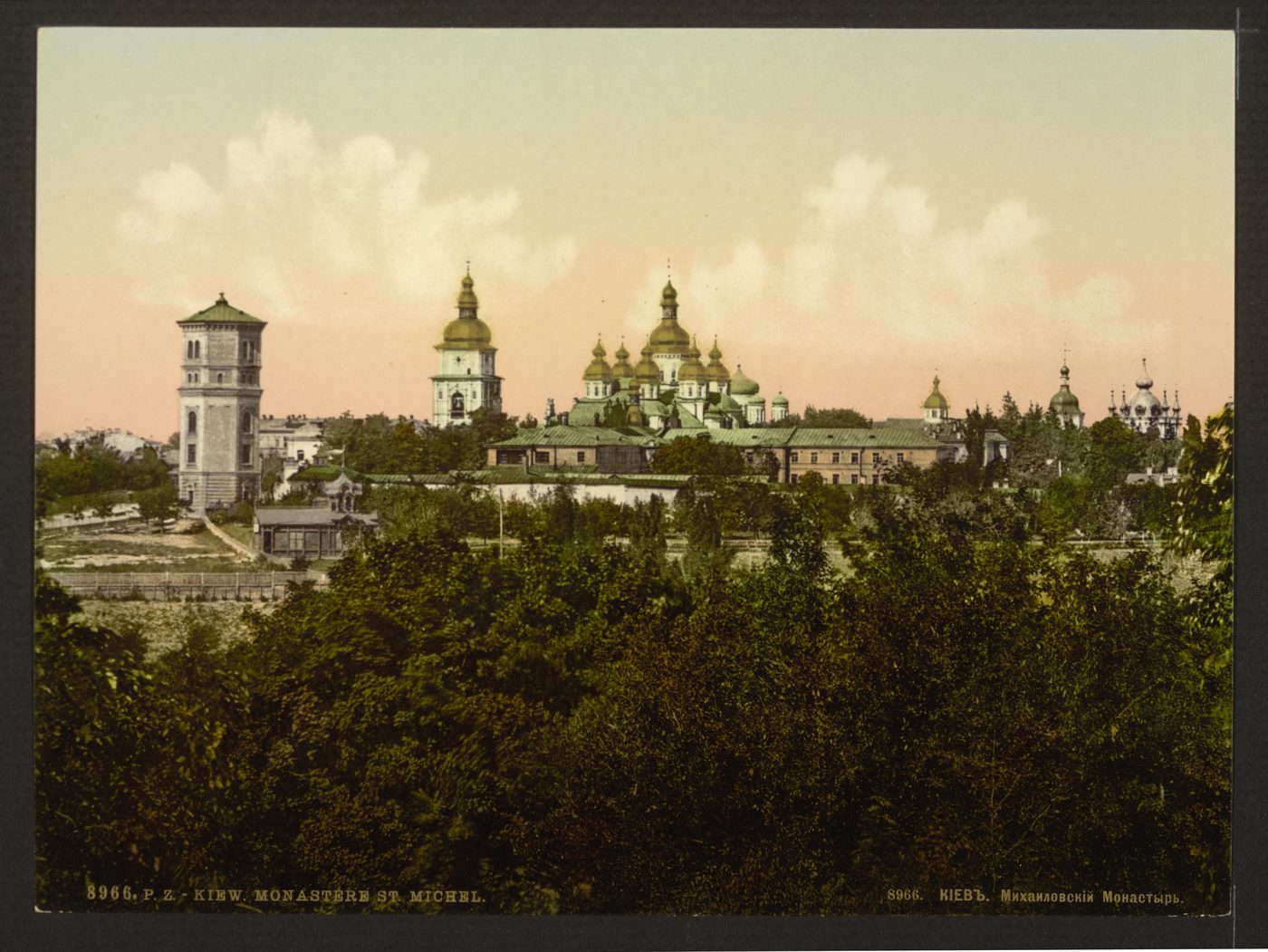
The cathedral survived the sack of 1240. In 1620 the monastery became the residence of the restored Orthodox metropolis. In the 18th century the church was enlarged with side chapels and rebuilt in the Baroque style; in 1746–1754 it became seven-domed. At the same time the refectory with the Church of St John the Theologian (1713–1715) and the bell tower (1716–1719; according to other data, by 1720) appeared nearby.
In 1934 the removal of the mosaics and frescoes began, and in spring 1935 the gilding was stripped from the domes. The destruction came in stages: in 1934–1936 the bell tower and other buildings were taken down, in spring 1935 the domes were removed and the iconostasis destroyed, and on 14 August 1937 the walls of the cathedral were blown up. That is why different sources give different years. By a decree of 9 December 1995 the rebuilding was declared a state priority. The cathedral was opened on 30 May 1999, the interior work was completed in 2000, and on 28 May 2000 it was consecrated.
Timeline
The numbers in square brackets are source numbers from the list at the bottom of the page. The mark "according to …" means that a fact is confirmed by only one source. The "Legends" section holds traditions and legends: they are recorded in the sources but not confirmed by documents.
The princely era
- 1050s
Prince Iziaslav Yaroslavych founded the Monastery of St Demetrius of Thessalonica in the upper city of Kyiv. St Michael's Cathedral was later built on its grounds. [1, 2, 4]
- 1108
On 11 July Prince Sviatopolk Iziaslavych (baptised Mykhail) laid the foundation of the stone cathedral of the Archangel Michael. [3, 12, 14, 17]
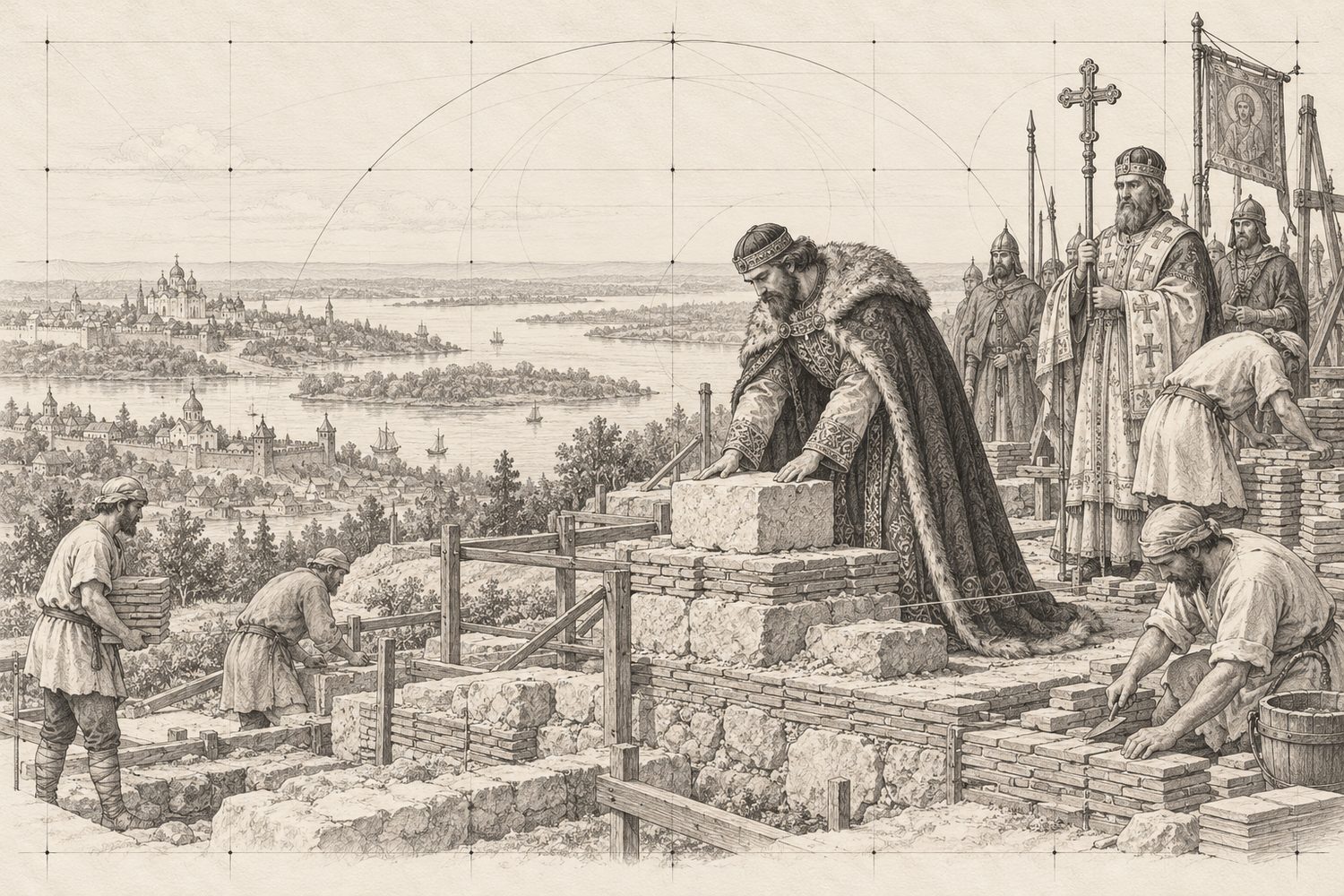
1108: the foundation of the cathedral. Illustration: IKONASTONE - 1108
According to tradition, Sviatopolk's wife, the Byzantine princess Barbara, brought the relics of the Great Martyr Barbara to Kyiv. They became the monastery's chief shrine. [1, 4, 12, 16, 30]
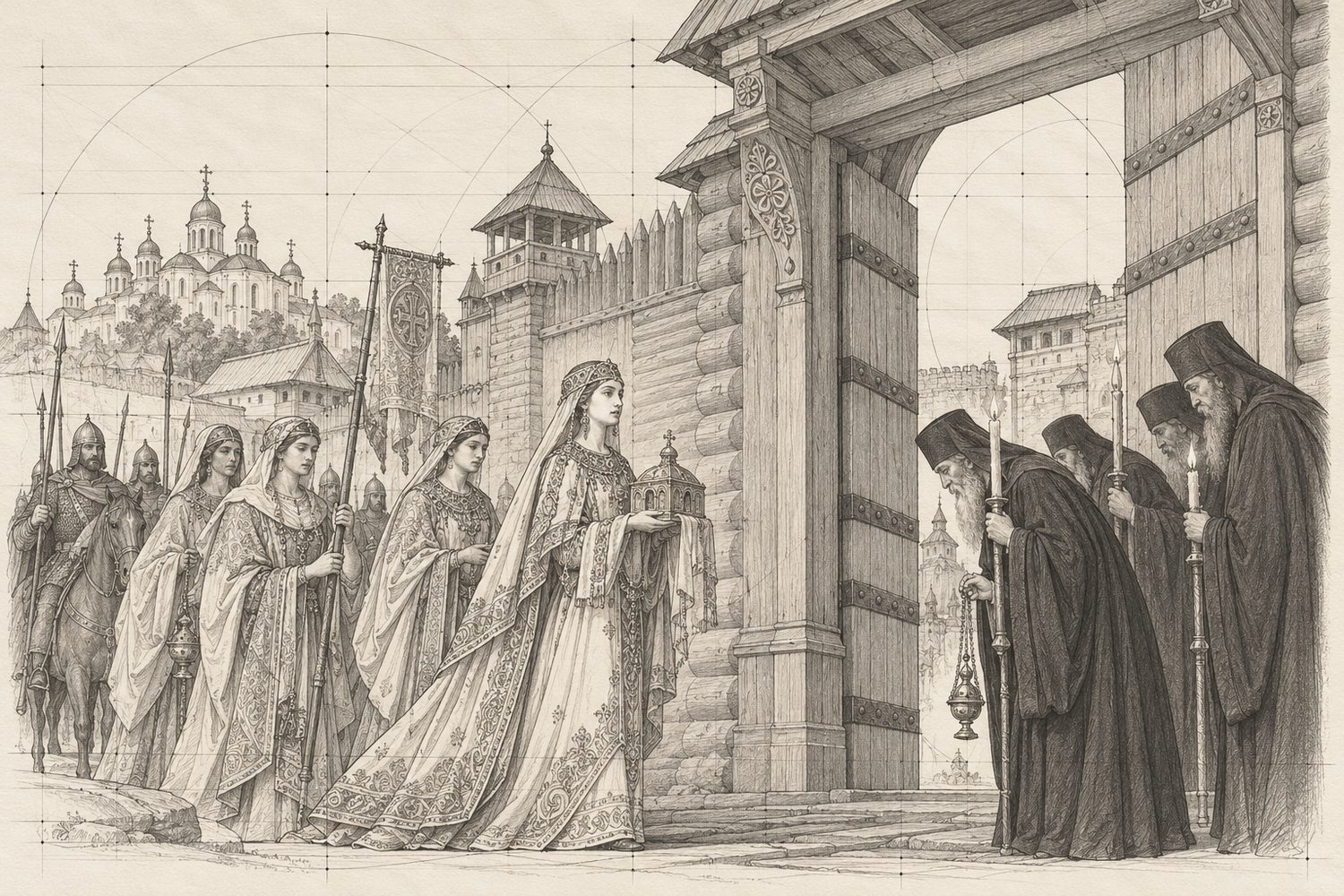
The princess Barbara brings the relics — as tradition tells it. Illustration: IKONASTONE - 1113
Sviatopolk was buried in the cathedral he had built. O. Shapiro, going by the chronicle reckoning, gives April 1114. [1, 5]
- Around 1128
The monastery probably came under the administration of the Kyiv Pechersk Monastery. [1, 2]
- 1240
During the Mongol invasion the monastery was plundered and ruined; the stone cathedral held out. [1, 2, 12, 17]
Golden-Domed: from revival to the Baroque
- Before 1496
The monastery was revived; soon the name "Golden-Domed" became attached to it. [1, 2]
- 1594
The envoy Erich Lassota described the cathedral and the relics of St Barbara in his diary. This is the earliest known description of the church's furnishings. [1, 5]
- 1620
Hegumen Yov Boretskyi was consecrated Metropolitan of Kyiv; the monastery became the residence of the restored Orthodox metropolis. [1, 2, 4, 17, 27]
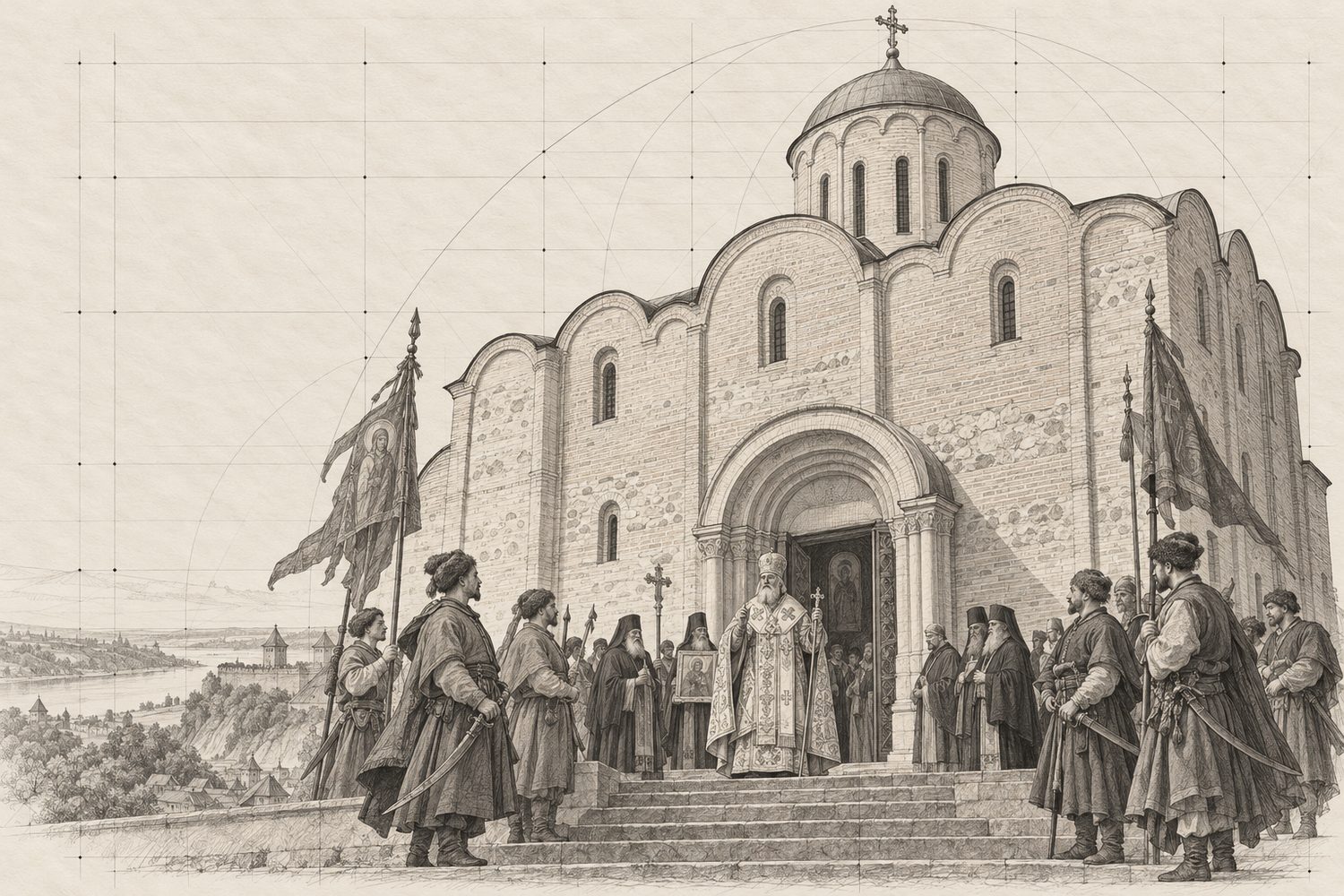
1620: Yov Boretskyi, Metropolitan of Kyiv. Illustration: IKONASTONE - 1631
Metropolitan Yov Boretskyi died; he was buried in the monastery, as was Metropolitan Isaia Kopynskyi (†1640) later. According to the Encyclopedia of Ukraine. [2, 27, 28]
- Late 17th – early 18th century
Hetman Ivan Mazepa donated a silver reliquary for the relics of St Barbara (according to [1], in 1701). [1, 3, 5, 16]
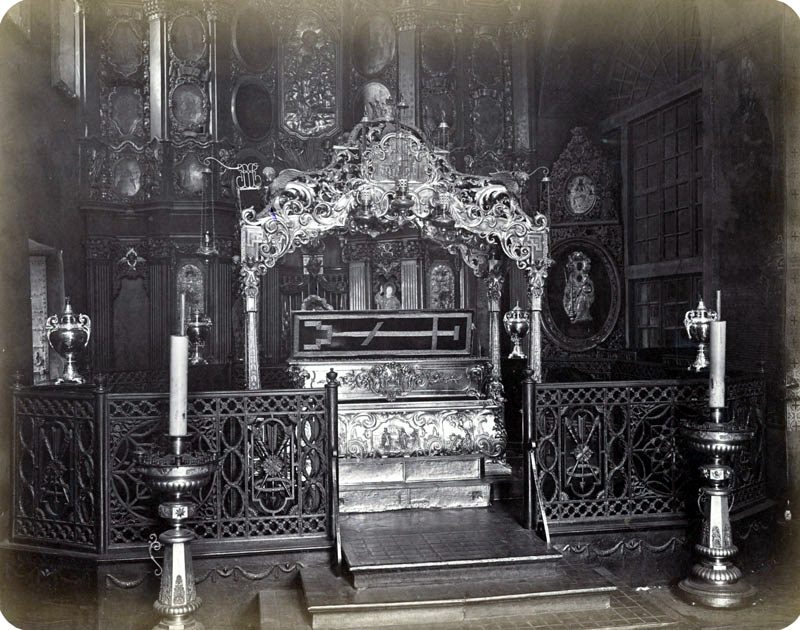
The reliquary of St Barbara in the cathedral, 1872. Wikimedia Commons, public domain - 1716–1720
A three-tier masonry bell tower was built (in various sources 1716–1719 or 1719). [1, 3, 5, 12, 14]
- 1746–1754
The cathedral was rebuilt in the Baroque style; it became seven-domed. [1, 2, 5]
- 1851
The Swede Carl Peter Mazer made drawings of the interior; a century and a half later the Chapel of St Barbara was recreated from them. [1, 5]
- 1880s
The archaeologist Adrian Prakhov uncovered the 12th-century mosaics and frescoes beneath later oil painting. [1, 17]
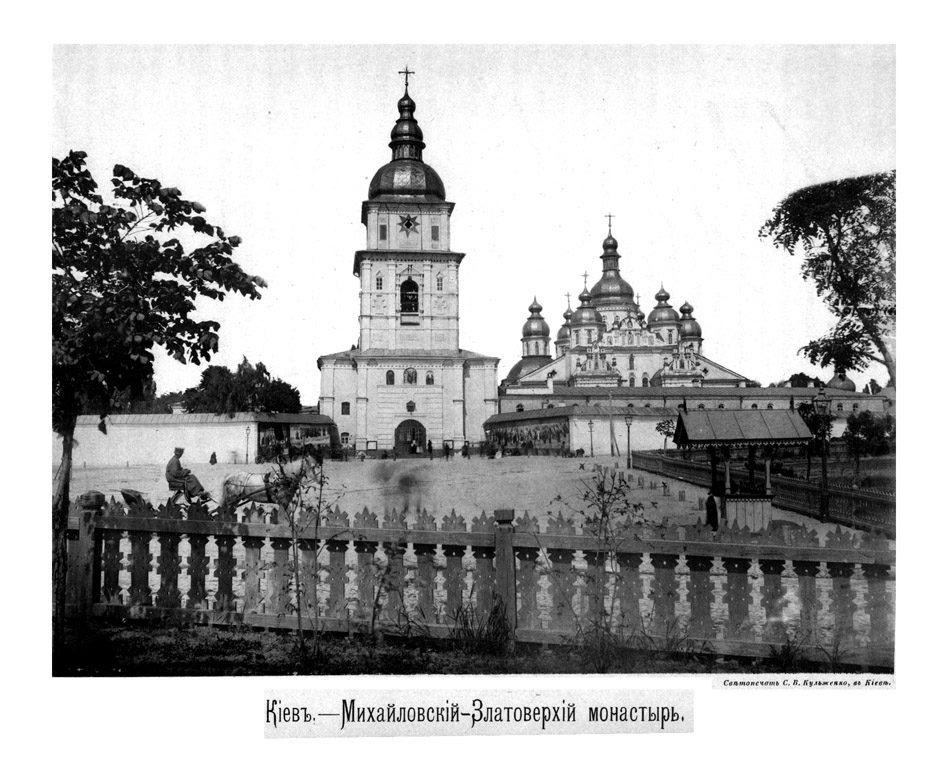
The monastery in 1888. Published by S. Kulzhenko. Wikimedia Commons, public domain 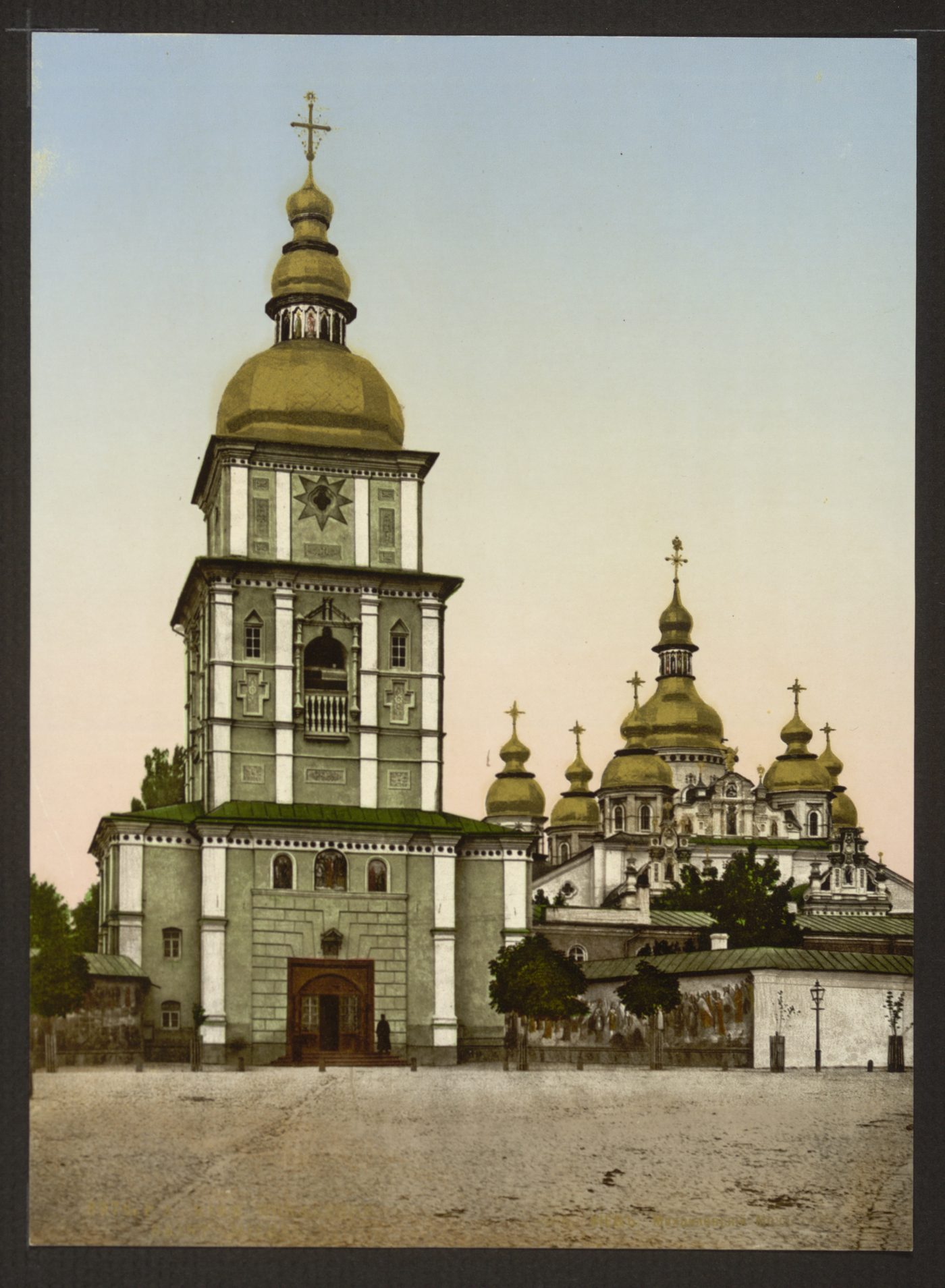
The bell tower and the cathedral, 1890–1900. Photochrom by Detroit Publishing Co., Library of Congress. Wikimedia Commons, public domain
Destruction
- 1919–1922
The Soviet authorities confiscated valuables and occupied the monastery's premises (1919), and in 1922 closed the monastery. [1, 12]
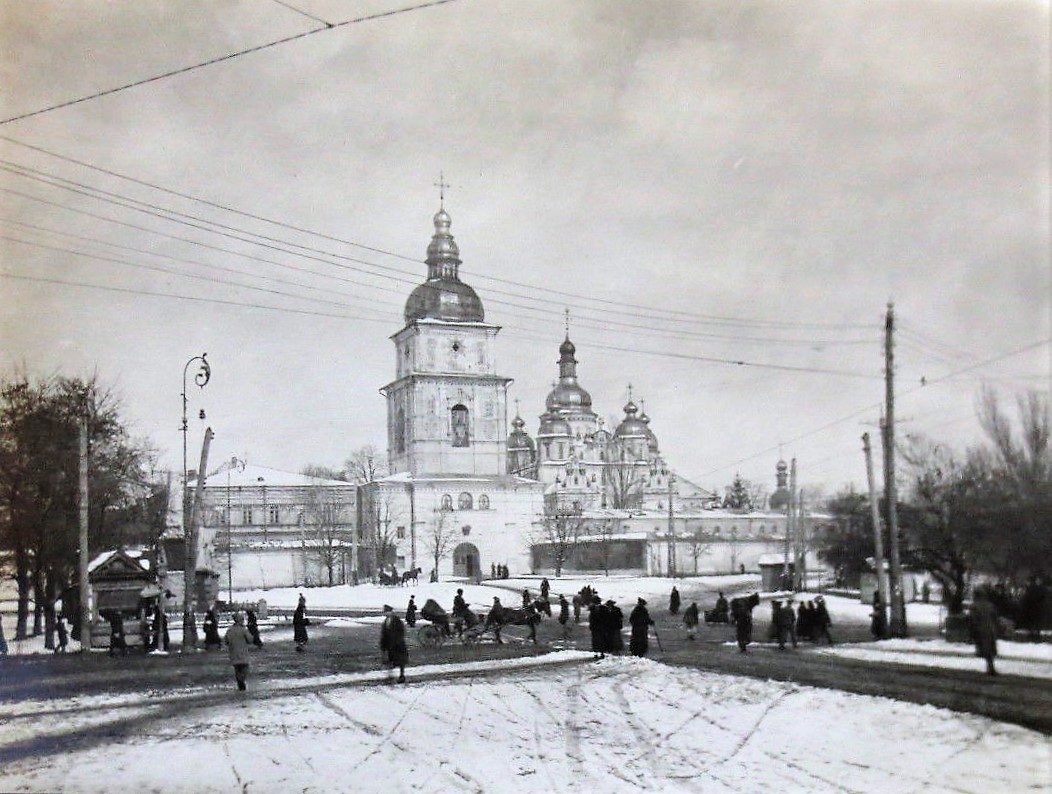
St Michael's Square, 1918. Wikimedia Commons, public domain 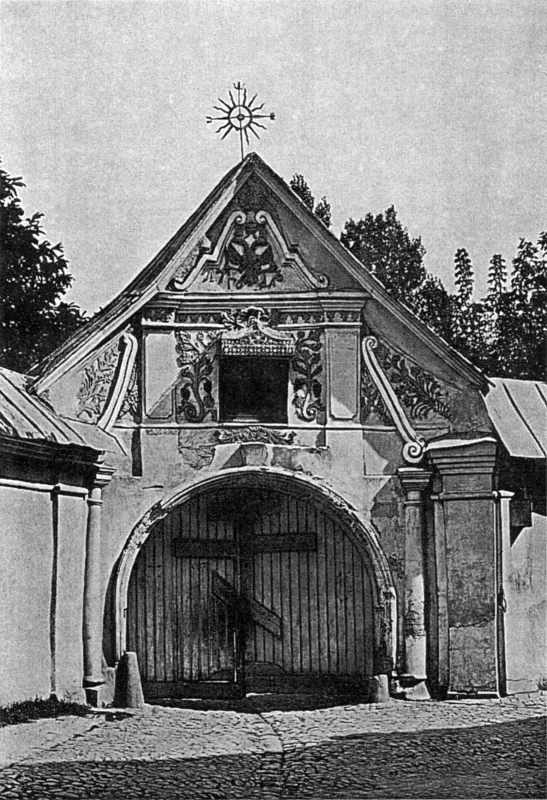
The Economic Gate of the monastery, 1923. Photo from the book by H. Lukomskyi. Wikimedia Commons, public domain - 1934
After the decision to move the capital of the Ukrainian SSR from Kharkiv to Kyiv (January), the monastery's site was chosen for a government centre and a design competition was announced. [1, 11, 17]
- 1934
A resolution of the Politburo of the Central Committee of the CP(b)U of 11 April 1934 ordered the mosaics to be removed; the commission included V. Balytskyi, M. Popov and V. Zatonskyi. Some publications date the decision to demolish to February 1934; the sources do not cite a primary document on the demolition. [3, 6, 10, 17]
- 1934
An expert review with the participation of F. Movchanivskyi and V. Honcharov pronounced the cathedral a monument mainly of the 17th–18th centuries, "without historical value". The art historians F. Ernst, M. Makarenko and S. Taranushenko were arrested. [1, 3]
- 1934
From 26 June a team led by Professor Volodymyr Frolov of the Leningrad Academy of Arts removed the mosaics and part of the frescoes. [1, 3, 6]
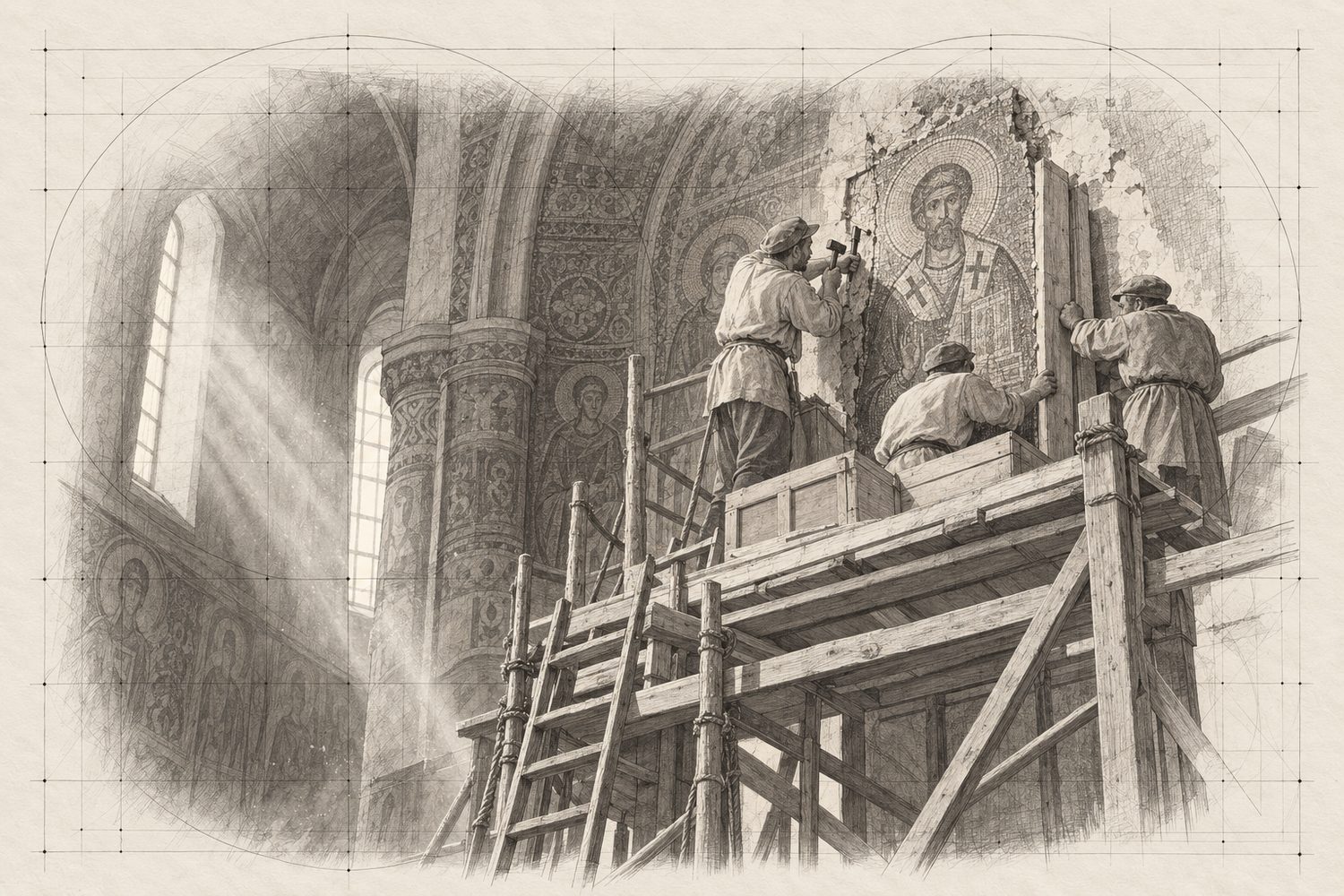
1934: the removal of the mosaics. Illustration: IKONASTONE - 1934–1936
The bell tower, the monastery's other buildings and the 12th-century Church of St Basil (the Church of the Three Hierarchs) were taken down. [3, 10, 12]
- 1935
In spring the gilded copper was stripped from the domes and the Baroque iconostasis was destroyed. [1, 3]
- 1937
On 14 August the walls of the cathedral were blown up. [1, 4, 10, 11, 17]
- 1938
The mosaic "Demetrius of Thessalonica", frescoes and a slate slab were sent to Moscow for an exhibition marking the 750th anniversary of "The Tale of Igor's Campaign"; they were never returned. [6, 8, 11, 17]
- 1943–1947
The occupiers took frescoes and mosaics from the cathedral out of Kyiv. In 1947 only part was returned to Kyiv; the rest was handed to museums of the RSFSR. [6, 8, 14]
Recreation
- 1970s
The plan to build a Lenin museum on the cathedral's site was abandoned after appeals from scholars and artists; the refectory was restored in 1976–1981. [1, 17]
- 1992–1995
Excavations by the Institute of Archaeology of the National Academy of Sciences of Ukraine (V. Kharlamov, H. Ivakin) uncovered more than 300 burials. [1, 7]
- 1995
On 9 December a presidential decree recognised the rebuilding of the monastery as a nationwide priority. [3, 4, 12]
- 1997
On 24 May the site was consecrated and a capsule was laid; the recreation of the cathedral began. [1, 2, 7]
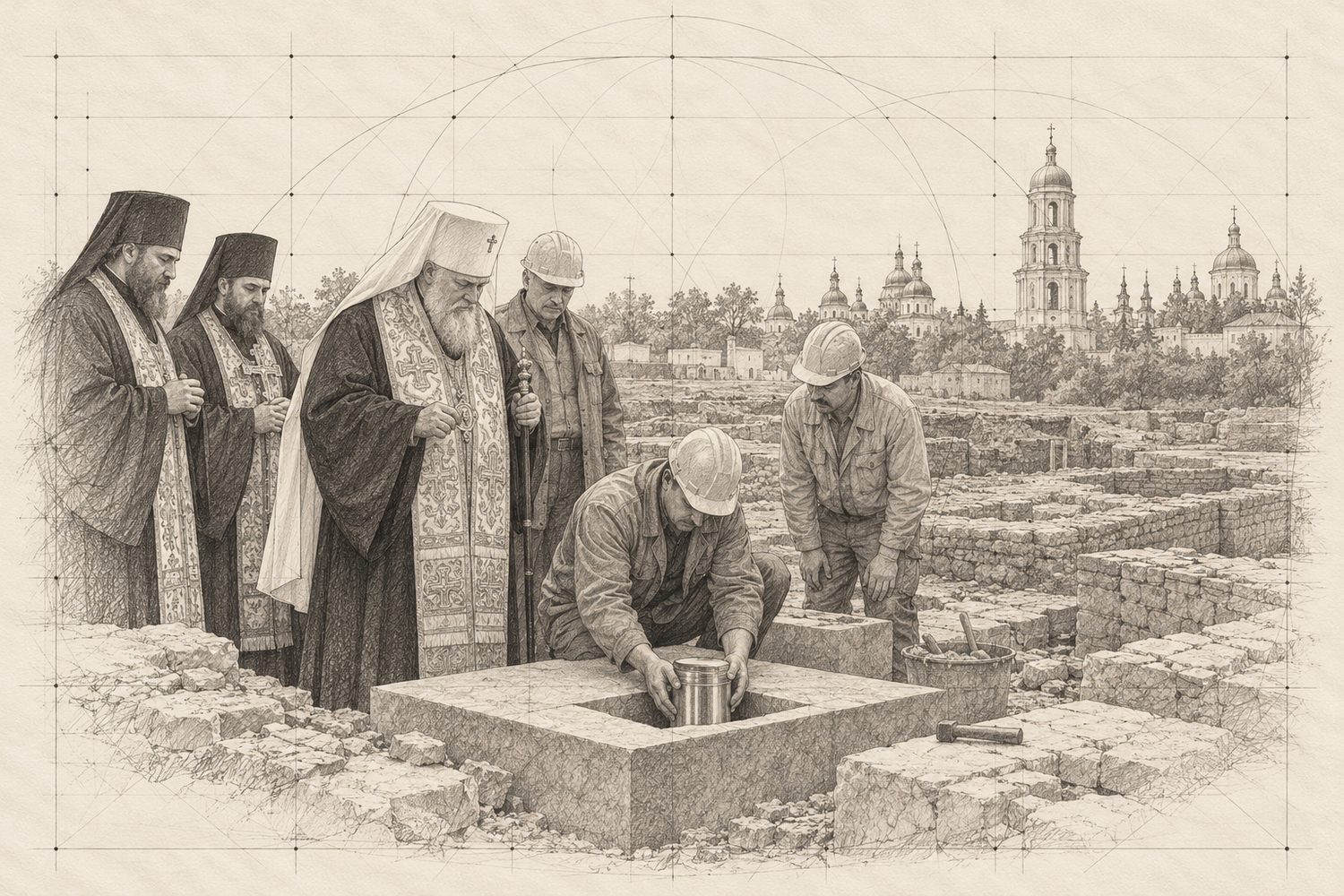
24 May 1997: the consecration of the site and the capsule. Illustration: IKONASTONE - 1998
On 30 May the bells of the recreated bell tower rang for the first time. [1, 20, 21]
- 1999
On 30 May the recreated cathedral was opened. The same year the Church of the Three Hierarchs was consecrated in the bell tower. [1, 2, 7]
- 2000
On 28 May, Kyiv Day, the cathedral was consecrated. Some sources place the consecration in 1999. [1, 7, 22]
- 2001, 2004
The Hermitage gave Ukraine 4 and later 7 more fragments of 12th-century frescoes — 11 in all. [8, 10, 13, 14]
Modern times
- 2013
On the night of 30 November, after the students were dispersed on the Maidan, the monastery gave shelter to protesters. [4, 10]
- 2013
On the night of 11 December, during the attempt to clear the Maidan, the monastery's bells rang the alarm for several hours; the ringer was Ivan Sydor. [4, 11, 25]
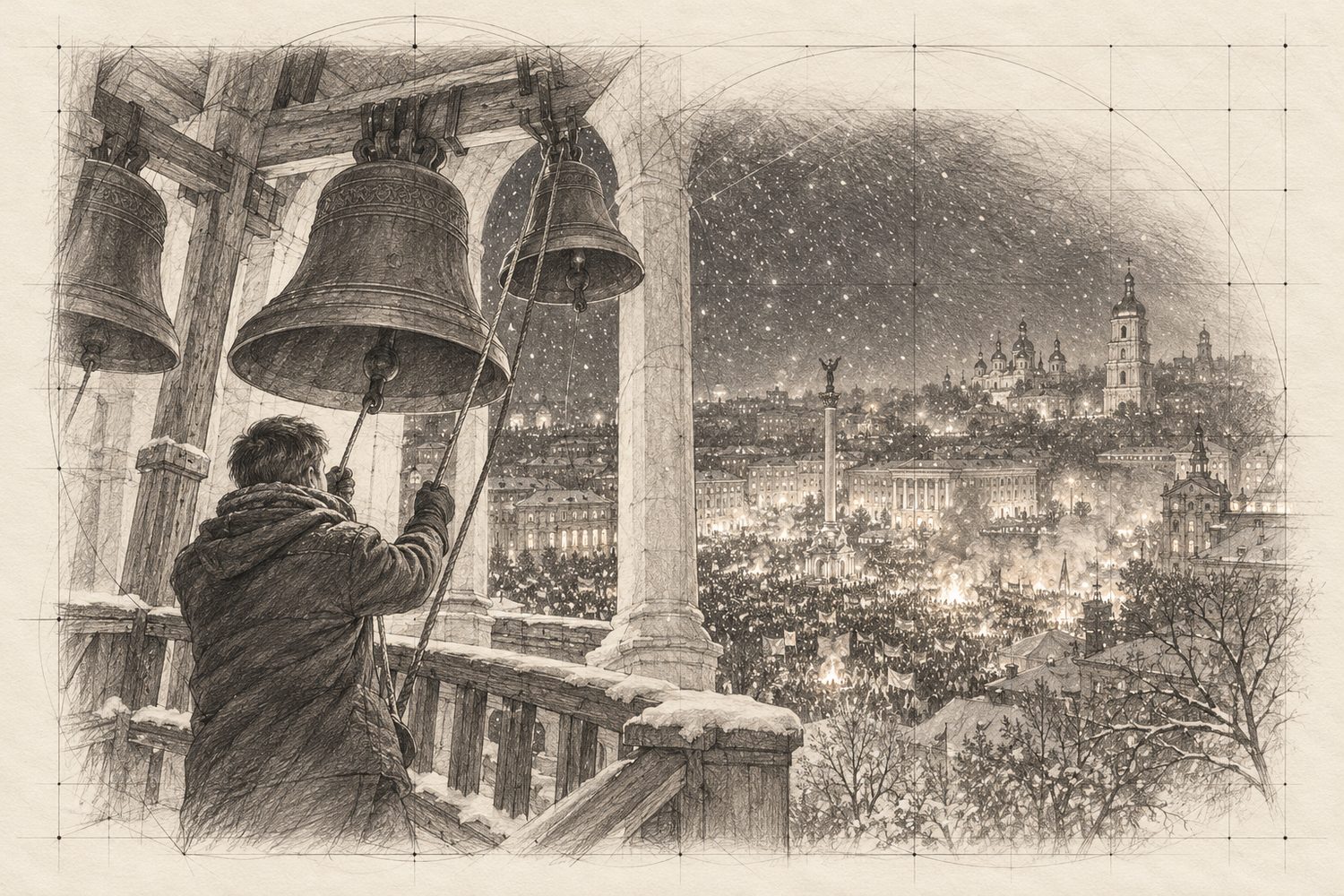
The night of 11 December 2013. Illustration: IKONASTONE - 2014
In January–February the monastery treated the wounded. On 26 January a memorial service for Mykhailo Zhyznevskyi was held in the cathedral. [1, 4, 26]
- 2015
On the monastery wall, work began on the Wall of Remembrance of those who died for Ukraine. [19]
- 2018
On 15 December the monastery became the seat of the Orthodox Church of Ukraine. [1]
- 2022
Since May the National Military History Museum has displayed destroyed Russian military equipment on St Michael's Square. [18]
- 2025
The monastery's bell-ringing tradition was added to the National List of Intangible Cultural Heritage. [1, 20, 21]
Lost and recreated
| What | What it was | What happened | Where it is now |
|---|---|---|---|
| Mosaic “The Eucharist” | Apse of the cathedral, 12th century | Removed in 1934 by Frolov’s team | Saint Sophia Cathedral, Kyiv; in the recreated cathedral, a modern copy [6, 9, 12, 15] |
| Mosaic “Demetrius of Thessalonica” | Pillar of the cathedral, 12th century | Sent to Moscow in 1938 for an exhibition, not returned | Tretyakov Gallery, Moscow [8, 11, 17] |
| Mosaics “Archdeacon Stephen”, “Apostle Thaddaeus” | 12th century | Removed in 1934; shown at the Metropolitan Museum in 1997 (according to Ukrinform) | Kyiv [4, 6, 9] |
| 12th-century frescoes | Walls of the cathedral | Partly taken out by the occupiers in 1943, later handed to Russian museums | 11 fragments returned in 2001–2004; the rest are in museums in Russia [6, 8, 14] |
| Works from the cathedral outside Ukraine | — | Negotiations on their return stalled after 2004 | At least 26 12th-century originals in museums in Moscow, St Petersburg and Novgorod [8, 14] |
| Slate reliefs | Two 11th-century slabs depicting holy horsemen | Exhibited in 1937; one was sent to Moscow in 1938 | One is in the Tretyakov Gallery; the sources do not specify where the other is [8, 10, 29] |
| Baroque iconostasis | Gift of Hetman I. Skoropadskyi | Destroyed in spring 1935 | Lost; the cathedral has a new iconostasis [2, 3] |
| Silver reliquary of St Barbara | Gift of Hetman I. Mazepa | According to [3], melted down in 1935; according to [5], moved to St Andrew’s Church, later to St Volodymyr’s Cathedral | The fate of the original is described differently in the sources |
| Relics of St Barbara | St Michael’s Cathedral, since the 12th century | After the monastery was demolished — St Andrew’s Church (per the Great Ukrainian Encyclopedia, from 1935); in January 1961 moved to St Volodymyr’s Cathedral | St Volodymyr’s Cathedral, Kyiv [1, 4, 16, 31] |
| Gilded domes | Gilded copper | Stripped in spring 1935 | Recreated [1, 3] |
| Bell tower | 1716–1720, three tiers | Taken down in 1934–1936 | Recreated in 1997–1998; height over 48 m [12, 20, 23] |
| Cathedral | 12th century, rebuilt 1746–1754 | Blown up on 14.08.1937 | Recreated in 1997–1999 from photographs of 1934 and the surveys of I. Morhylevskyi [1, 4, 11] |
| Church of St Basil (the Church of the Three Hierarchs) | 12th century, next to the monastery | Taken down in 1934–1935 | Not recreated [3, 10] |
Architecture
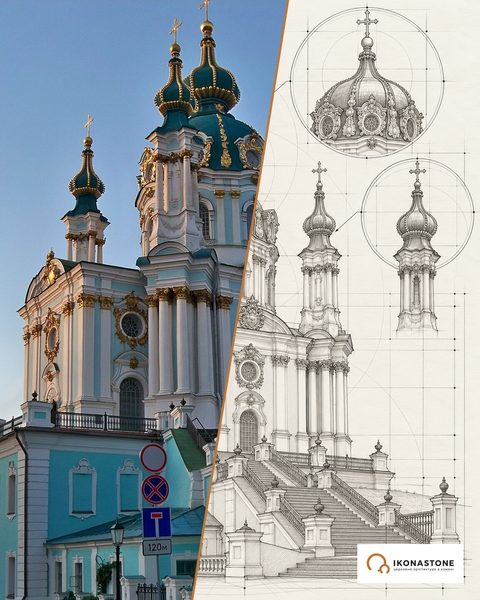
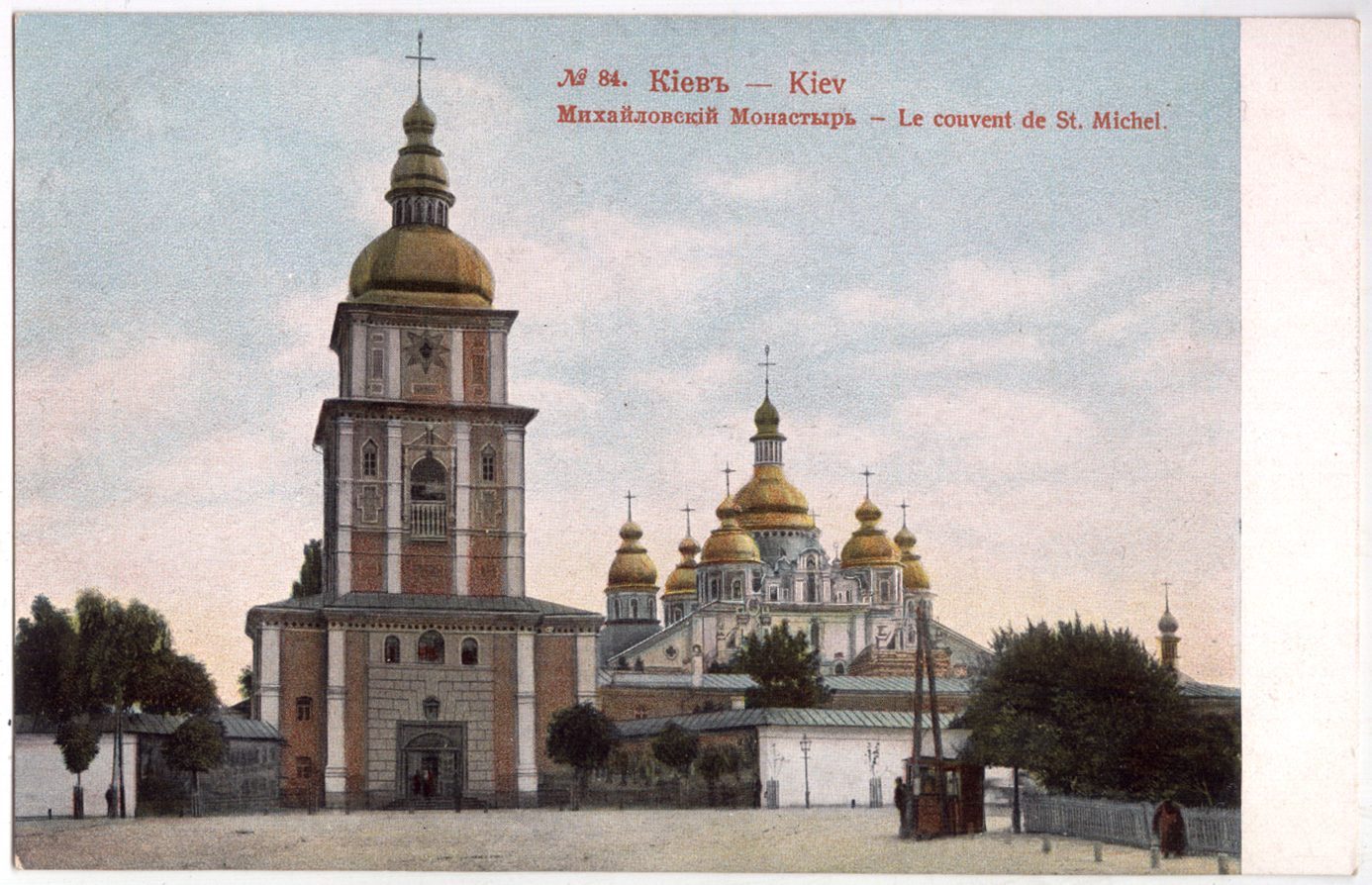
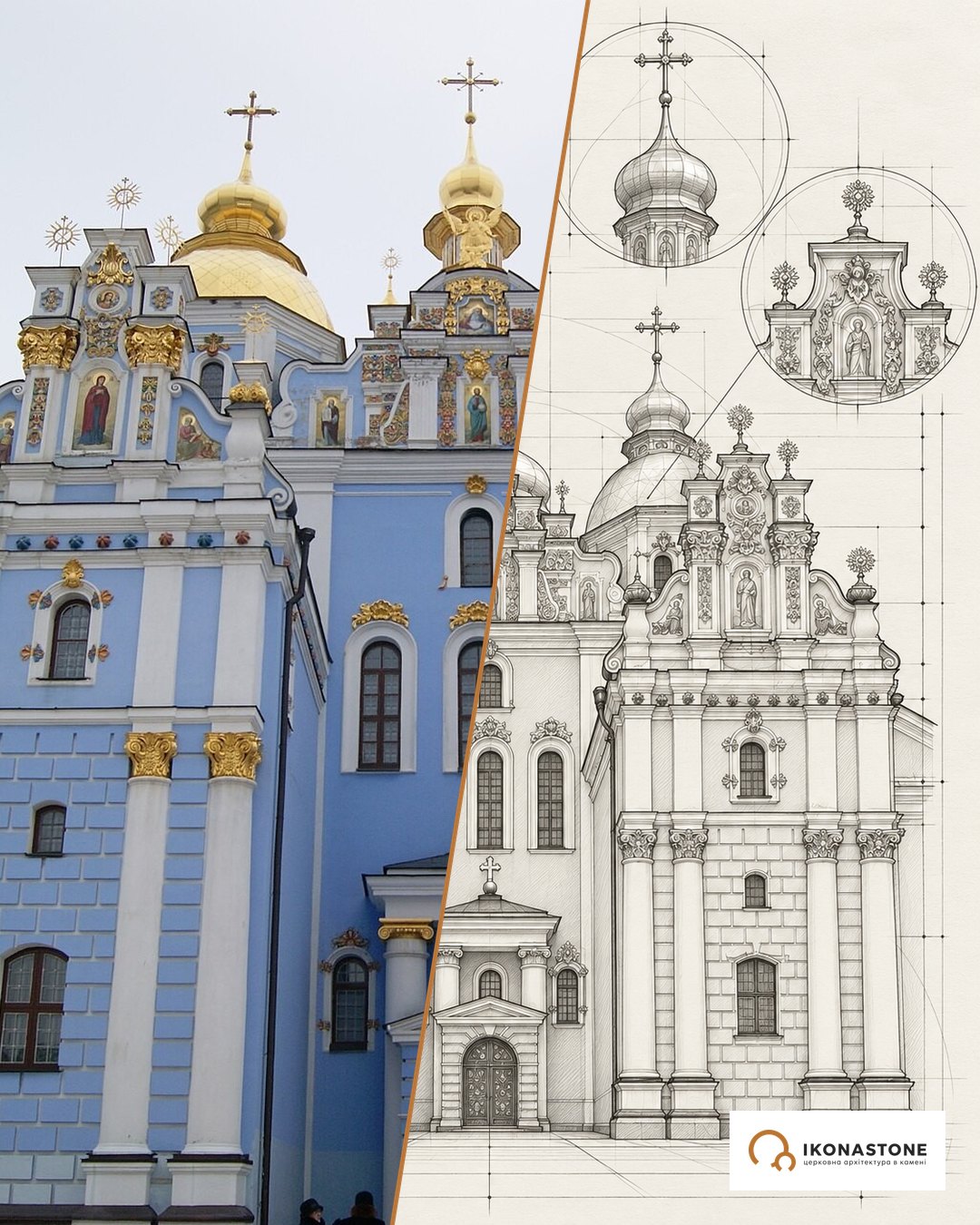
What was recreated is not the original 12th-century church but its 18th-century Baroque image — with blue walls, white decoration and seven gilded domes. The new cathedral was set on the site of the old one, and part of the old masonry became part of its crypt.
The drawings show the form, not exact dimensions.
The domes
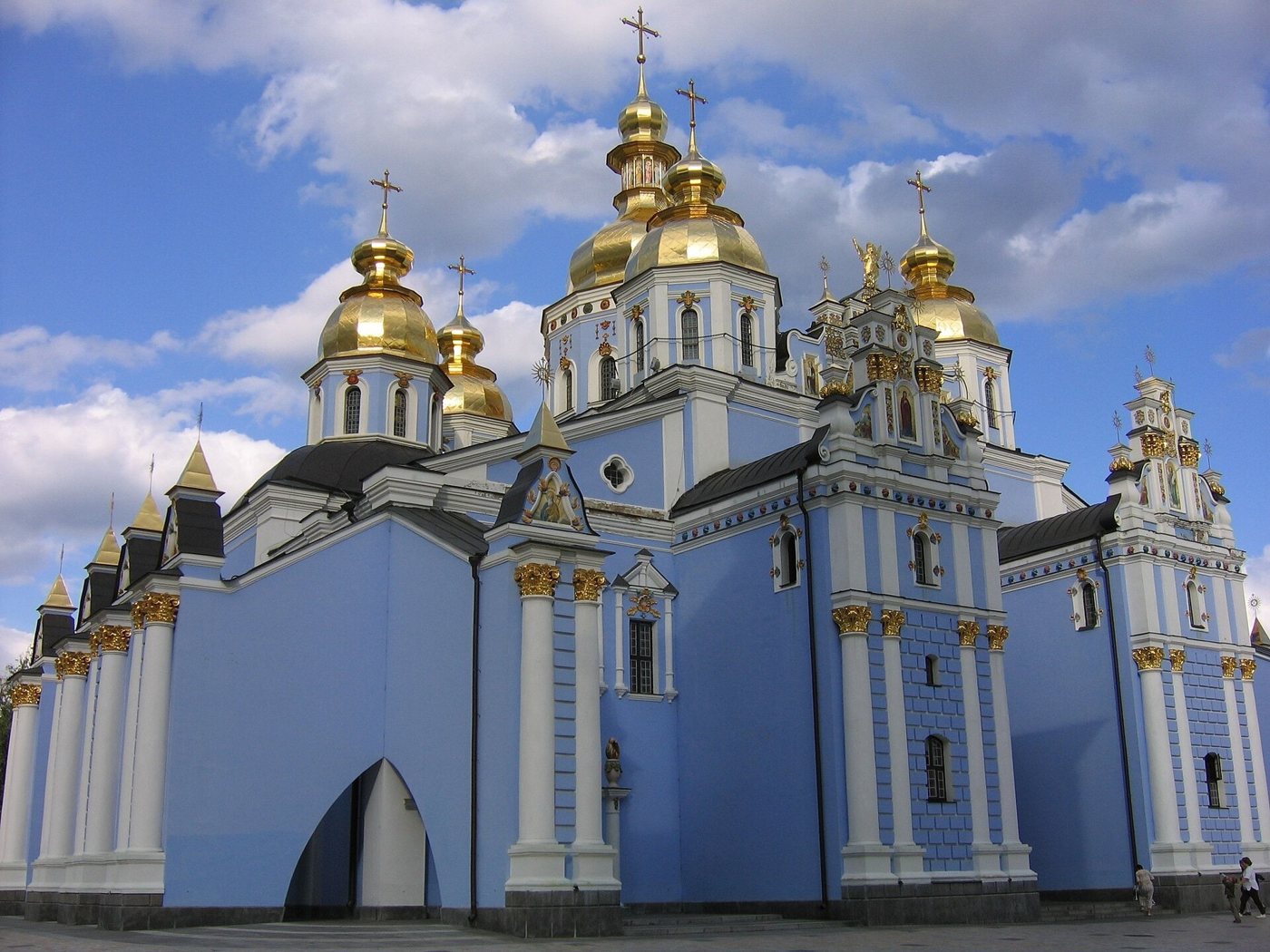
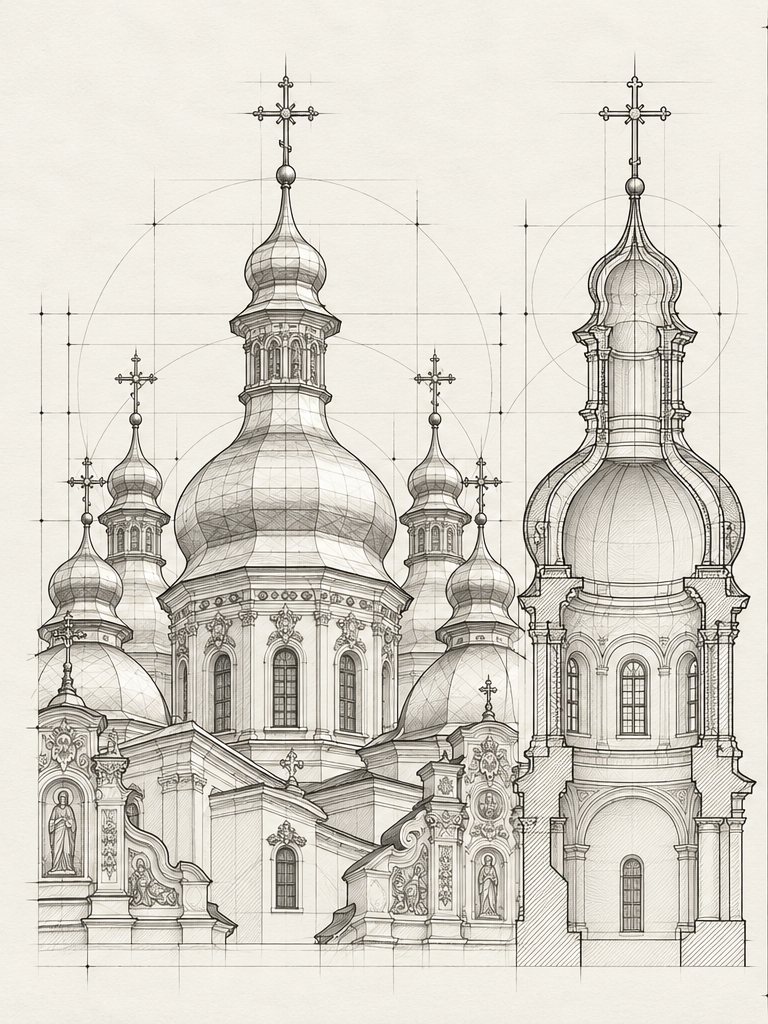
The seven domes are the result of the rebuilding: according to researchers, the central crown was divided into several, and the church acquired the silhouette characteristic of Ukrainian Baroque.
The mosaics: a divided heritage
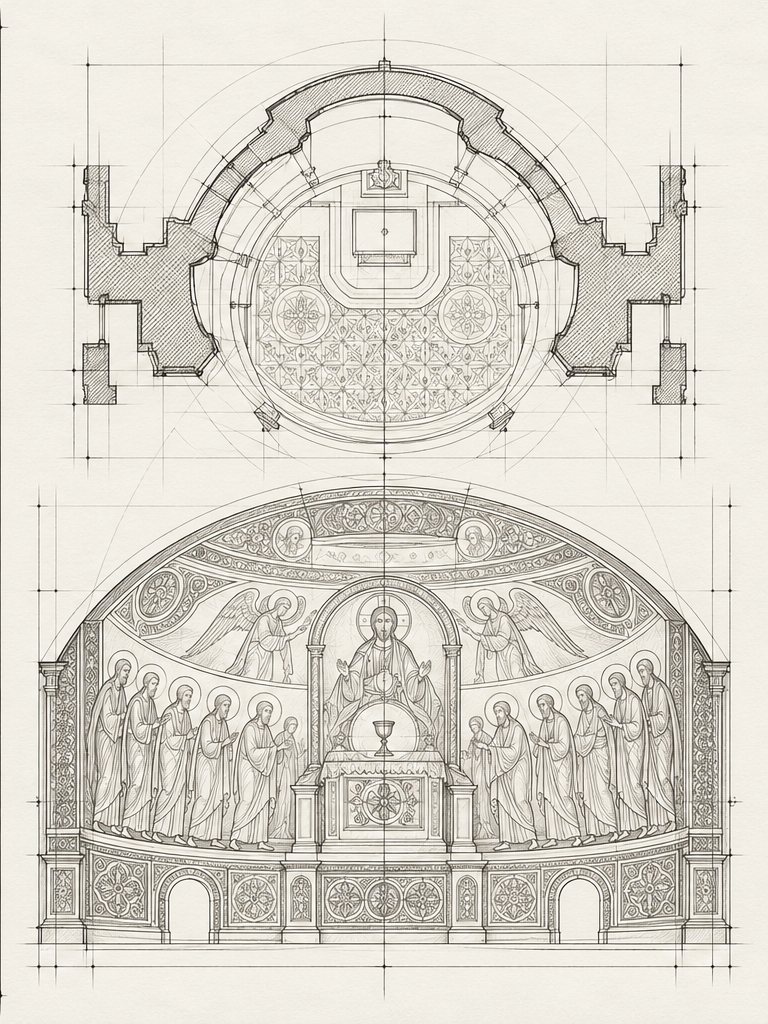
The ancient 12th-century mosaics outlived the cathedral but were scattered among different cities. The “Eucharist” was moved to the choir galleries of Saint Sophia Cathedral in Kyiv. “Demetrius of Thessalonica” was taken to Moscow in 1938 “for temporary safekeeping”; as of 2015 it remained in the Tretyakov Gallery. Some of the frescoes were taken away by the Nazis; of these, Ukraine has got back only eleven, and the rest are in Russia. Details are in the table “Lost and recreated”.
The iconostasis
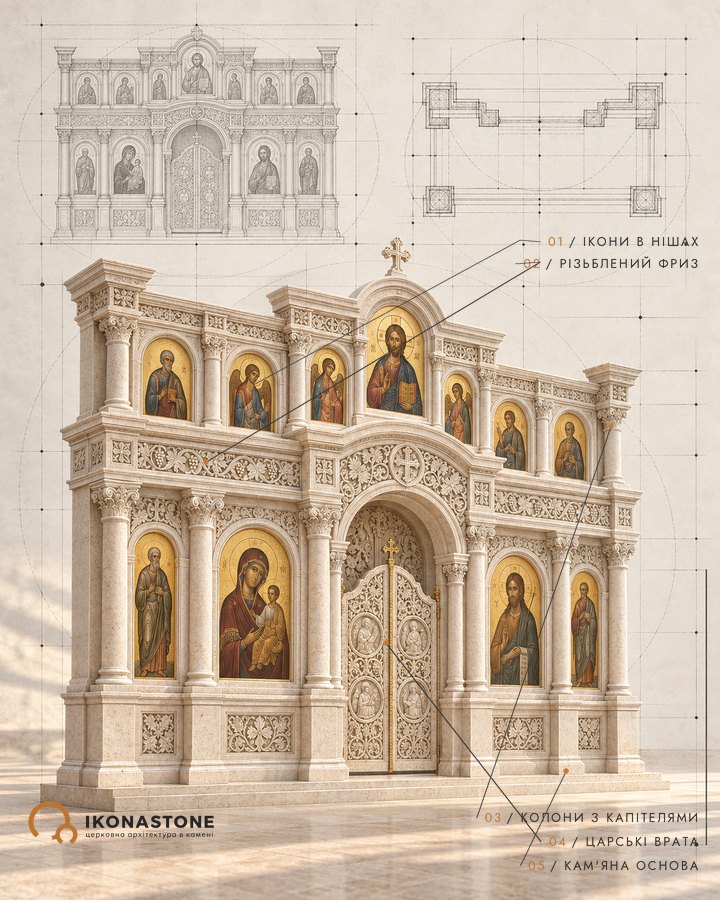
In 1718 Hetman Ivan Skoropadskyi gave the cathedral a five-tier wooden gilded iconostasis. It was destroyed together with the church. How the tiers of such an iconostasis are put together is explained in the article “Tiers of the iconostasis”.
Stone and material
The ancient cathedral was built in the mixed-masonry technique: stone and plinthos on a lime mortar with crushed brick (tsemianka). Most of this masonry survived where explosives and pickaxes did not reach — in the ground. The foundations of the cathedral and the bell tower, part of the wall and old steps survived the demolition; they can be seen today, and they have become part of the crypt of the recreated church.
The new cathedral is laid of brick, and the foundations for the load of the modern building were made of concrete. So two times meet in one building: below, 12th-century stone; above it, walls of the late 20th century.
Here stone also speaks of the present. On the outer wall of the monastery facing St Michael’s Square is the Wall of Remembrance of those who died for Ukraine. How we work with such signs is shown in the section memorial plaques.
Did you know
Eleven fragments of frescoes were returned from the Hermitage (4 in 2001 and 7 in 2004). The figure of "18 works" found in reference books is not confirmed by the negotiation documents. [8, 13, 14]
Until Prakhov's excavations, the 12th-century mosaics were hidden beneath later oil painting. [1, 17]
The art historian Mykola Makarenko was the only member of the commission who refused to sign the act of demolition of the cathedral; he was later repressed. [4, 10, 17]
The recreation became possible thanks to the surveys by Ipolit Morhylevskyi and the photographs of 1934. [4, 7, 11]
The government centre for the sake of which the cathedral was demolished was never built. All that is left of the plan is the building that now houses the Ministry of Foreign Affairs. [3, 10, 12]
According to the historian D. Klochko, the mosaics were lent to Moscow in 1938 for an exhibition "for three months". [11]
In the 19th century more than a hundred thousand pilgrims came to the relics of St Barbara every year. [1, 16]
Silver "rings of St Barbara" were blessed beside the relics; Hetman Mazepa is mentioned among their owners. [16, 24]
The Chapel of St Barbara was recreated from the drawings of the Swede Carl Peter Mazer, made in the first half of the 19th century. [1, 5]
The excavations of 1992–1995 uncovered more than 300 burials. [1, 7]
The recreated bell tower, taller than 48 m, was built in about six months. [20, 23]
The composers Kyrylo Stetsenko and Yakiv Yatsynevych studied or taught at the monastery's singing school. [1, 2]
Legends
The golden dome
According to tradition, the dome of St Michael's Cathedral was the first to be gilded in Rus', and the only one in Kyiv; hence the name "Golden-Domed". Recorded in the English-language Wikipedia (as probable) and in Gazeta.ua. [1, 12]
The princess Barbara
According to tradition, the relics of the Great Martyr Barbara were brought from Constantinople by the Byzantine princess Barbara when she came to marry Prince Sviatopolk. Recorded by Radio Svoboda ("according to an Orthodox legend") and other outlets. [16, 30]
The relics under the steps
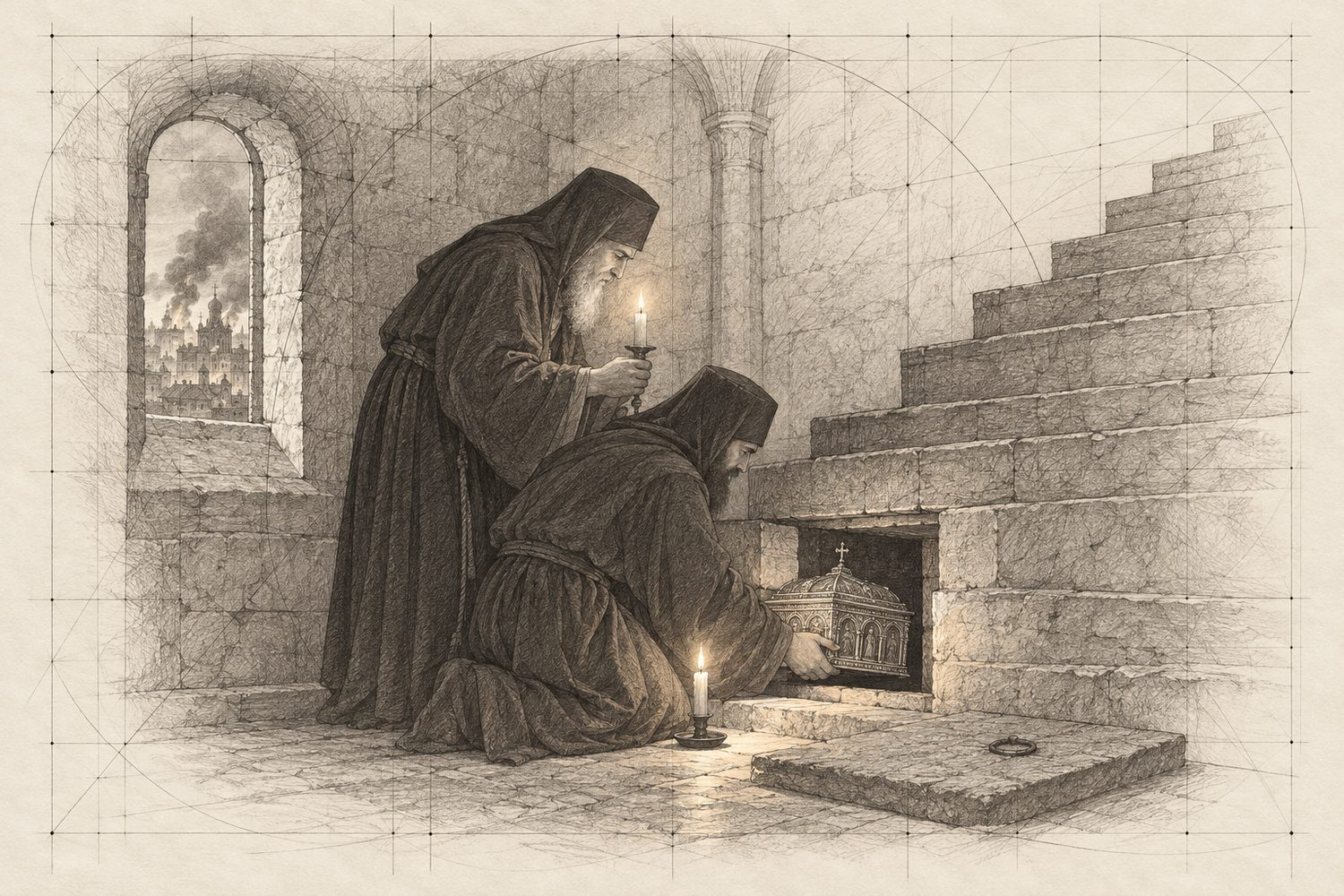
According to a tradition recorded by St Demetrius of Rostov (Tuptalo), in 1240 the relics of St Barbara were hidden from Batu's warriors under the steps of a stone pillar and later displayed in the church again. Retold after O. Shapiro. [5]
Seventeen miracles
According to tradition, Hegumen Feodosii Sofonovych recorded seventeen miracles at the relics of St Barbara. Retold after O. Shapiro. [5]
The well
According to tradition, pilgrims considered the water of St Barbara's well on the monastery grounds to be healing. Retold after O. Shapiro. [5]
The bright bird
According to the Nikon Chronicle, in 1109 a bright bird sat above the church for six days; witnesses took it for an angel, who later appeared to Sviatopolk before his victory over the Cumans at the Saltnytsia. Retold after O. Shapiro. [5]
The plague
According to tradition, Governor-General D. Golitsyn, saved during the plague of 1710–1711, rebuilt the Chapel of St Barbara and set a carved canopy over the reliquary. Retold after O. Shapiro. [5]
The alarm of 2013
According to tradition, in December 2013 the bells of St Michael's rang the alarm for the first time since Batu's invasion of 1240. So write Ukrinform and Espreso; this has not been verified by documents. [4, 10]
Figures
- Iziaslav Yaroslavych — founder of the Monastery of St Demetrius (1050s).
- Sviatopolk Iziaslavych (Mykhail) — founder of the cathedral in 1108, buried in it.
- Barbara — Sviatopolk’s wife, daughter of the Byzantine emperor Alexios I Komnenos; according to tradition, she brought the relics of St Barbara.
- Yov Boretskyi — hegumen, from 1620 Metropolitan of Kyiv.
- Ivan Mazepa, Ivan Skoropadskyi — hetmans and benefactors (the reliquary of St Barbara, the iconostasis).
- Carl Peter Mazer — Swedish artist, author of 19th-century drawings of the interior.
- Adrian Prakhov — scholar who uncovered the 12th-century mosaics and frescoes.
- Volodymyr Frolov — leader of the team that removed the mosaics in 1934.
- Mykola Makarenko — art historian who refused to sign the act of demolition.
- Ipolit Morhylevskyi — author of the surveys of the cathedral in the 1930s.
- Yurii Losytskyi — chief architect of the recreation.
- Viktor Kharlamov, Hlib Ivakin — leaders of the 1992–1995 excavations.
- Oles Honchar — initiator of the public fund for the rebuilding.
- Patriarch Filaret — consecrated the recreated cathedral.
- Ivan Sydor — rang the alarm on the night of 11 December 2013.
- Mykhailo Zhyznevskyi — participant in the Revolution of Dignity; a memorial service for him was held in the cathedral on 26.01.2014.
How to cite
IKONASTONE. St Michael's Golden-Domed Cathedral // Guide to the Churches of Ukraine. URL: https://ikonastone.com/en/guide/st-michaels-golden-domed-cathedral-kyiv/ (accessed DD.MM.YYYY).
FAQ
Where is St Michael's Golden-Domed Cathedral located?
In the centre of Kyiv, at 8 Trokhsviatytelska Street, above St Michael's Square. The cathedral is the main church of St Michael's Golden-Domed Monastery.
When was the cathedral built?
It was founded on 11 July 1108 by Prince Sviatopolk Iziaslavych; construction is usually dated to 1108–1113. In the 1930s the cathedral was destroyed; it was recreated in 1997–2000: it was opened on 30 May 1999 and consecrated on 28 May 2000.
Why is the cathedral called "Golden-Domed"?
Its dome was gilded — according to researchers, probably the first in Rus'. Hence the name, which outlived the original church itself.
Who does the monastery belong to now?
St Michael's Golden-Domed Monastery belongs to the Orthodox Church of Ukraine; since December 2018 it has been the seat of that church.
Sources
- Wikipedia (en). St. Michael's Golden-Domed Monastery
- Encyclopedia of Ukraine (CIUS). Saint Michael's Golden-Domed Monastery
- Освіта.ua. Михайлівський Золотоверхий монастир в Києві та його відбудова
- Укрінформ. М. Сорока. Українська твердиня віри і незламності (14.12.2025)
- О. Шапіро. «Світогляд», 2021, № 1 (87)
- О. Шапіро. «Світогляд», 2021, № 2 (88)
- О. Шапіро. «Світогляд», 2021, № 4 (90)
- С. Кот. Архівні документи як фактор ідентифікації і повернення втрачених культурних цінностей (на прикладі мозаїк і фресок Михайлівського Золотоверхого собору). «Архіви України», 2018
- Ю. Коренюк. Мозаїки Михайлівського Золотоверхого собору. Каталог. К., 2013
- Еспресо. Т. Яворська. Батий, більшовики і «беркутівці»… (08.11.2025)
- Українська правда. Життя. «Культурний обмін»: як росіяни підірвали Михайлівський собор… (27.11.2022)
- Gazeta.ua. Михайлівський монастир руйнував Батий і більшовики (02.12.2013)
- Gazeta.ua. Фрески з найбільшого київського собору вивезли в Ермітаж (17.10.2018)
- Радіо Свобода. 11 фресок повернулися до Михайлівського собору (16.07.2008)
- Радіо Свобода. Презентація відреставрованих мозаїк (10.07.2013)
- Радіо Свобода. Про мощі св. Варвари (17.12.2008)
- RISU. St. Michael's Golden-Domed Church in Kyiv marks 900 years (02.07.2008)
- Українська правда. Життя. Техніка на Михайлівській площі (22.05.2022)
- Кабінет Міністрів України. Про Стіну пам'яті (27.02.2015)
- Sud.ua. Звонарство Михайлівського монастиря визнали культурною спадщиною (2025)
- Liga Life. St. Michael's bell ringing is officially recognized as an intangible heritage of Ukraine (15.05.2025)
- Главком. Митрополит Епіфаній. Михайлівський Золотоверхий собор став точкою відліку нової історії України (26.05.2024)
- RFE/RL. Матеріал про відбудову монастиря та дзвіниці
- Дзеркало тижня. Скандал вокруг торговли кольцами святой Варвары
- Дзеркало тижня. Один в поле воин — один в небе Бог
- Ahram Online. Thousands mourn slain Kiev protester (26.01.2014)
- Encyclopedia of Ukraine. Boretsky, Yov
- Encyclopedia of Ukraine. Kopynsky, Isaia
- Encyclopedia of Ukraine. Sculpture
- Current Time. Про мощі св. Варвари
- Wikipedia (en). St Volodymyr's Cathedral
- Town
- Kyiv
- Built
- 1108–1113; rebuilt 1997–2000
- Type
- six-pillar cross-in-square church, Baroque, with seven domes
- Material
- stone and plinthos (ancient foundations), brick
- Research depth
- 39%