The Church of the Nativity of the Theotokos in Nyzhnii Verbizh: five tops built on an outlaw legend
The legend says the church was built with outlaw gold. The document says something more modest: the founder received the “For Merit” medal from the emperor. Between these two versions stands the church itself — five tops of a kind almost nobody else built in Prykarpattia.
In brief
| Address | Nyzhnii Verbizh village, Kolomyia District, Ivano-Frankivsk Oblast |
| Built | 1788–1808 (dates of the donor inscription); a start in 1756 is the local historians’ version |
| Founder | Hryhorii Semeniuk |
| Type | centrally planned, cross-shaped, five-domed wooden church |
| Material | log frames; roofing of embossed zinc sheet, partly shingles |
| Status | UNESCO World Heritage site (2013); monument of national importance No. 090024-N; a church of the Orthodox Church of Ukraine |
History
According to the local historians Mykhailo Lasiichuk and Ivan Ludchak, construction began in 1756. The craftsmen were brought from the mountains, and the community hauled the timber from Kniazhdvir. The donor inscription above the portal names Hryhorii Semeniuk “and the other stewards” and contains two dates, 1788 and 1808. The second is regarded as the year of final completion and consecration.
In 1812 the “Gazeta Lwowska” reported that the emperor had awarded Hryhorii Semeniuk the gold “For Merit” medal. He died in 1822 — so says his epitaph, which calls him the “benefactor and steward” of the church. The founder is buried next to the church. The epitaph names him “Hryhorii Semeniuk Melnyk” and gives his age as 114; in local legends the builder is called just that — Hryhor Melnyk. A fifth-generation relative, Hanna Lasiichuk, adds twelve sons to the story.
There is, all the same, a documented link with Dovbush in the village, but it leads to another man. In 1742 Mykhailo Maliarchuk, married to the daughter of the Verbizh miller, appeared before a court in Stanyslaviv for ties with the opryshky of Oleksa Dovbush. The researcher Nadiia Babii suggests that Maliarchuk’s Podillia origins and his training as a painter may have influenced the choice of the building type. This is an assumption, not an established fact.
According to the measurements and archival research of the Polish scholar Włodzimierz Witkowski, the domes were covered with sheet metal in the 1930s, and the rest of the church and the bell tower in 1990; at the same time the lower log frames were painted with oil paint. Dating this to “the 1900s” in older descriptions is merely a guess. In 1991 the church was entered in the state register of monuments. On 21 June 2013, at the 37th session of the World Heritage Committee, the church became part of the property “Wooden Tserkvas of the Carpathian Region in Poland and Ukraine”. In 2012 it was entered in the register as a monument of national importance (on 10 October, according to W. Witkowski; some sources give 2018). On 7 September 2023 UNESCO granted the church provisional enhanced protection. As Suspilne explains, this status allows the authorities of the 87 states party to the 1999 Second Protocol to prosecute or extradite suspected offenders.
Next to the church stands the priest’s house, which keeps embroidery more than seventy years old; the family plans to hold workshops here. And nearby, according to the Kolomyia district administration’s website, the community is building a new stone church. The same website quotes Volodymyr Herych, director of the reserve in Zhovkva and head of the working group on the UNESCO nomination: many priests dream of a large new church and would readily take down a small old one, although “you won’t build anything better out of modern brick or metal-plastic”.
Timeline
The numbers in square brackets are source numbers in the list at the bottom of the page. The label “according to …” means that a fact is confirmed by only one source. The “Legends” section contains tales and legends: they are recorded in sources but not confirmed by documents.
I. The village and the old church
- 1375
On 9 December Prince Władysław of Opole granted Verbizh in fief to Vashko Teptiukovych, according to W. Witkowski; English-language reference works give 1377 as the first mention. [1, 15]
- 1416
On 26 October, in Niepołomice, King Władysław Jagiełło confirmed this grant, according to W. Witkowski. [1]
- 1443
The year that Soviet and Ukrainian publications give as the first mention of the village; English-language reference works connect it with the division into Nyzhnii and Verkhnii Verbizh. [1, 15]
- 1732
According to local tradition, Hryhorii Semeniuk settled in the village: he went to work for the miller, married his daughter and took a second surname — Melnyk (“miller”). [1, 5]
- 1742
Mykhailo Maliarchuk, married to the daughter of the Verbizh miller, appeared before the town court in Stanyslaviv for ties with the band of Oleksa Dovbush. At the trial he said that he came from Rudka “from beyond Kamianets” and had studied painting in Verbizh for a year. [1, 2]
- 1743
On 21 May, according to the inscription on the bell tower, the wooden bell tower was erected. It is older than the present church. [1, 7]
- 1745
A bell was cast which, according to W. Witkowski, was donated by Hryhorii Melnyk (Semeniuk); the bell has survived. [1]
II. Building the five-domed church
- 1756
According to the local historians Mykhailo Lasiichuk and Ivan Ludchak, construction began: the founder brought 24 craftsmen from the mountains, and the community of Kniazhdvir hauled the timber. W. Witkowski considers such a long construction period unlikely. [1, 2, 4]
- 1788
The donor inscription gives the date 3 May 1788 and names the founder Hryhorii Semeniuk “and the other stewards”. [1, 2, 4]
- 1808
The second date of the same inscription; it is regarded as the year of final completion and consecration. According to W. Witkowski, the consecration of 1808 is recorded in the Greek Catholic schematisms. [1, 2, 4, 7]
- 1809–1810
The “Gazeta Lwowska” (1812, No. 8) wrote that in these years the miller Semeniuk built the parish church “as a carpenter, with his own hands”, according to W. Witkowski. [1]
- 1811
The old church of Nyzhnii Verbizh, according to W. Witkowski, was sold and moved to Sheparivtsi near Kolomyia as the Church of St Anne. [1]
- 1812
The “Gazeta Lwowska” reported that Emperor Francis II (as Emperor of Austria, Francis I) had awarded Semeniuk the small gold “For Merit” medal. Radio Svoboda in 2009 dated the medal to 1810. [1, 8, 15]
- 1822
Hryhorii Semeniuk died. The gravestone next to the church calls him the “benefactor and steward of this church” and gives his age as 114. [1, 2, 5]
III. The Greek Catholic parish
- 1832
The schematism counts 730 Greek Catholics in Nyzhnii Verbizh, according to W. Witkowski. [1]
- 1846
In neighbouring Kniazhdvir a five-frame church was built whose plan is compared with that of Verbizh; it has not survived. [1]
- 1861
A church was built in Verkhnii Verbizh, according to W. Witkowski. [1]
- 1900
A parish house was built next to the bell tower, according to W. Witkowski. [1]
- 1920s
The church was entered in the list of monuments of the Stanisławów Voivodeship, according to W. Witkowski. [1]
- 1930s
The domes were covered with sheet metal, and at the same time a plastered masonry fence and concrete steps appeared — according to an archival photo cited by W. Witkowski. [1]
IV. From the war to the national register
- 1939–1945
During the Second World War some of the bells were taken away to be melted down, according to Suspilne. [20]
- 1980s
According to Suspilne (2023), the rector Fr Vasyl Vepruk has led the parish for about 40 years. The available sources contain no other information about the church in the Soviet decades (1946–1989). [1, 21]
- 1990
The church and the bell tower above the pent roof were clad in embossed sheet metal, and the lower log frames were painted with oil paint. [1, 5, 6, 7]
- 1991
On 18 June, by decision No. 112 of the regional executive committee, the church was entered in the register as a monument of local importance (No. 825); the bell tower was not included in the register. [1, 2]
- 1995
M. Lasiichuk and I. Ludchak published the book “Nyzhnii Verbizh: Essays and Materials on History and Ethnography” — the source of the 1756 version. [1, 2]
- About 2003
During repairs, two lost bells were found under the floor (“about 20 years ago”, according to Suspilne in 2023). [20]
- 2008
250–300 m south of the old church, the community began building a large brick church. [1, 2]
- 2009
In July Radio Svoboda reported that the church had impressed the Polish experts most of all, but “is not even a national monument, there is no documentation at all”. In September it reported that UNESCO’s first remark was “authenticity has not been preserved” because of the sheet metal. [8, 9]
- 2009
In August the regional State Scientific Restoration Administration drew up a monument passport for the church. [1, 2]
- 2011
On 7–8 July a team from Lodz University of Technology led by W. Witkowski carried out measurements of the church. [1]
- 2012
Nadiia Babii published an article disputing the “Hutsul” type of the church. [2, 3]
- 2012
On 10 October, according to W. Witkowski, the church was entered in the State Register as a monument of national importance (No. 090024-N); the Ukrainian Wikipedia gives 2018. [1, 2]
V. World heritage and wartime
- 2013
On 21 June, at the 37th session of the World Heritage Committee (Cambodia), the church became part of the serial property “Wooden Tserkvas of the Carpathian Region in Poland and Ukraine” as one of two churches of the Hutsul type. [1, 2, 11, 17]
- 2013
On 10 July the measurement documentation of the Lodz team was handed over to the parish, according to W. Witkowski. [1]
- 2019
The community received UAH 100,000 for a scientific survey of the church, according to Suspilne. [22]
- 2022
In July the village council announced a procurement of design documentation for the restoration, but the tender was cancelled; in September the regional authorities said they were preparing the documentation and planned to replace the sheet metal. [14, 23]
- 2023
On 7 September, at an extraordinary meeting of the Committee for the Protection of Cultural Property in the Event of Armed Conflict, the church was granted provisional enhanced protection among 20 Ukrainian sites. [12, 13, 20]
- 2023
On 8 September the church for the first time celebrated its patronal feast of the Nativity of the Theotokos according to the new calendar (previously on 21 September). [1, 21]
- 2023
The head of the community, Yaroslav Miakushchak, said that the design for restoring the authentic appearance (UAH 350,000) had been made before the full-scale invasion, and that the repair was estimated at UAH 16.8 million, according to Suspilne. [18, 20]
- 2025
The church operates as a parish of the Orthodox Church of Ukraine (previously the UOC of the Kyiv Patriarchate); a lay brotherhood at the parish organises pilgrimages and fundraisers for soldiers and displaced people. [1, 7, 17, 19]
Lost and restored
| What | Was | What happened | Where it is now |
|---|---|---|---|
| The old church | The village’s previous church | In 1811 sold and moved to Sheparivtsi as the Church of St Anne | Has not survived: the present church in Sheparivtsi dates from 1864 or 1876 [1] |
| Shingles of the domes | Shingled tent roofs of the five tops | 1930s — sheet metal | Under sheet metal [1] |
| Shingles of the roofs and walls above the pent roof | Shingles | 1990 — embossed sheet metal | Under sheet metal; a replacement design exists, work has not begun [1, 7, 18, 20] |
| Exposed log frames of the lower tier | Unpainted wood | 1990 — oil paint | Dark red with white accents [1, 6] |
| Original painting | According to legend, by the local painter Ivan Voroniuk | In 2009 the interior was called “destroyed” | The present 20th-century oil painting probably repeats old motifs [1, 7, 10] |
| Bell of 1745 | A gift of H. Semeniuk | — | Has survived, according to W. Witkowski [1] |
| Other bells | In the bell tower | Some were taken away to be melted down during the Second World War | Two were found under the floor around 2003, according to Suspilne [20] |
| Bell tower | Log structure of 1743, three tiers, a gallery | 1990 — clad in sheet metal; 1991 — not entered in the register | Stands next to the church [1, 7] |
| Iconostasis | Three-tier gilded Baroque, early 19th century | — | In place [2, 5, 7] |
| Side altars | Baroque, with gilded Corinthian columns | — | In the side towers [2, 7] |
| Original support system | Tower log frames without props | Beams, struts and steel tie rods were added | Holds up the tops; W. Witkowski considers the system a later addition [1] |
| Five-frame church in Kniazhdvir | 1846, the closest analogue in the region | Has not survived | Known from a plan published by V. Sichynskyi (1940) [1] |
Architecture
The church is centrally planned and cross-shaped, with five domes: one over the crossing and four more around it. The plan is formed by two intersecting rectangles: the longitudinal arm measures 19.622 metres, the transverse one 16.432 metres. All four arms have faceted ends.
The structure has three tiers. The two lower tiers are log frames; the upper one consists of octagonal towers with tent-shaped domes, lanterns and openwork crosses. The central tower is slightly taller. The height of the towers with their domes is 11.5 metres. The walls of the frames and towers taper upwards. The main entrance is on the south side. Nadiia Babii explains the faceted corners and the upward tapering of the volumes by the influence of the Baroque. She also believes that the founder’s role deserves separate study. Rectangular annexes adjoin the church.
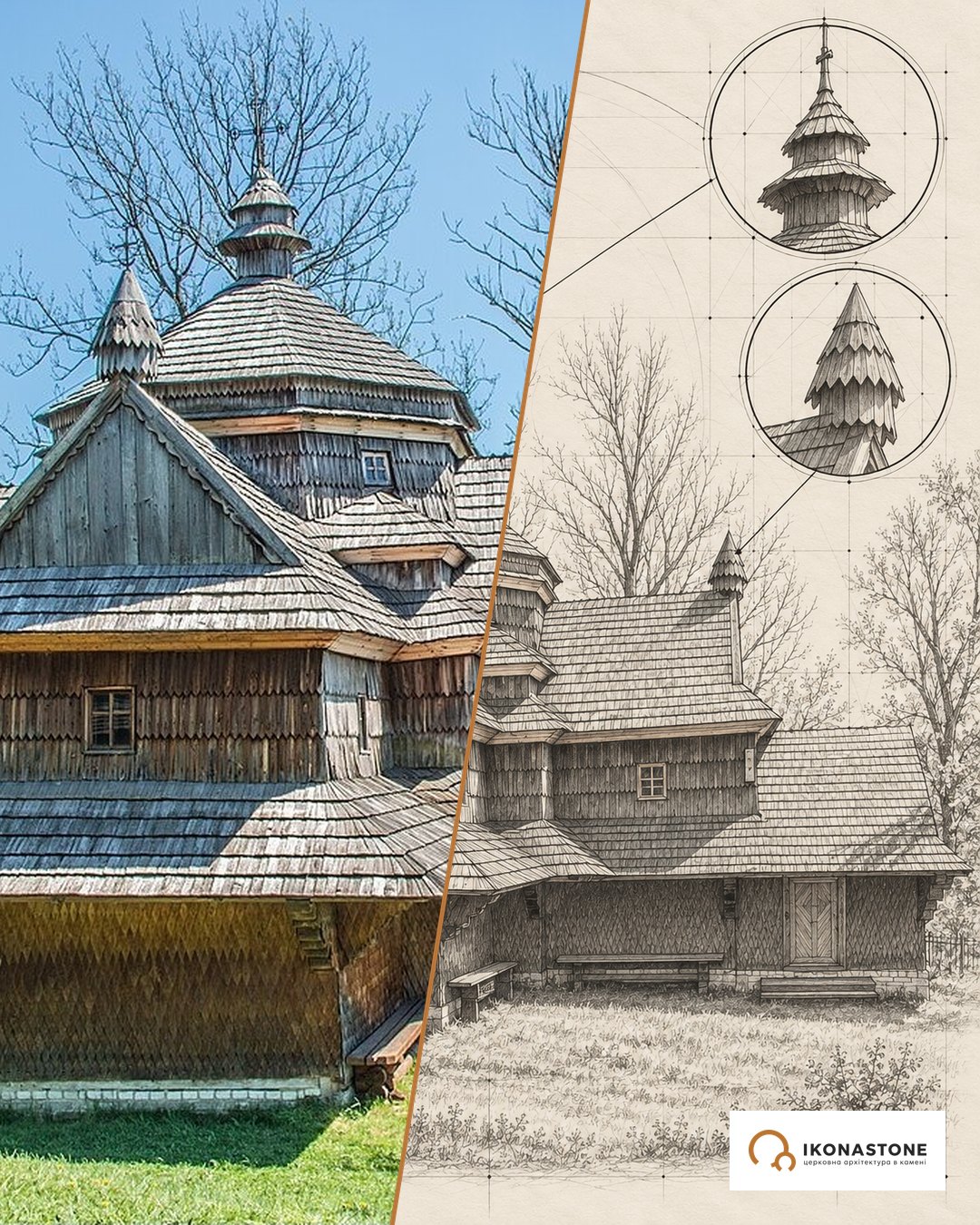
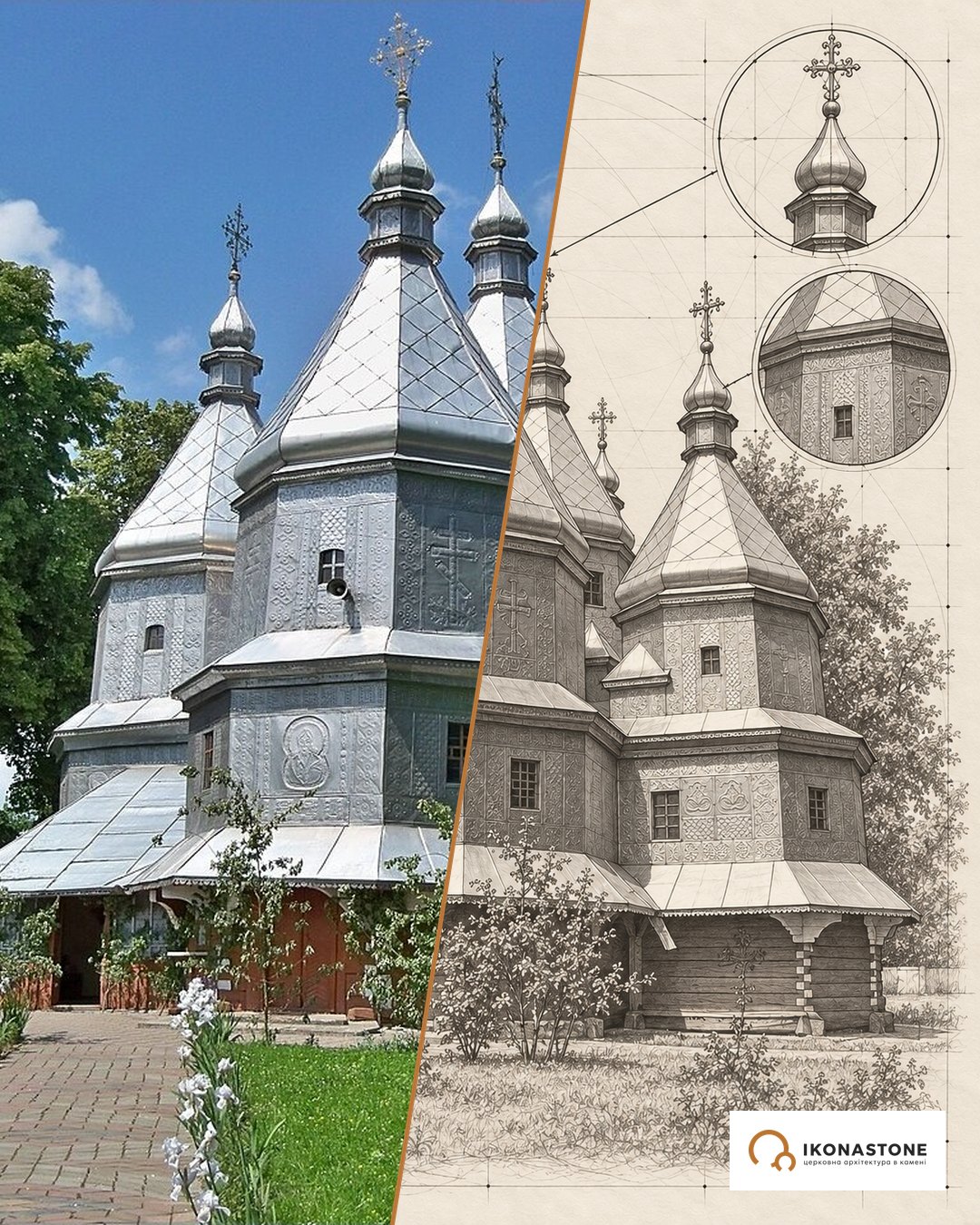
Below are two elements of the church: in a photo and in a drawing. The drawings show the form, not exact dimensions.
Tops with lanterns
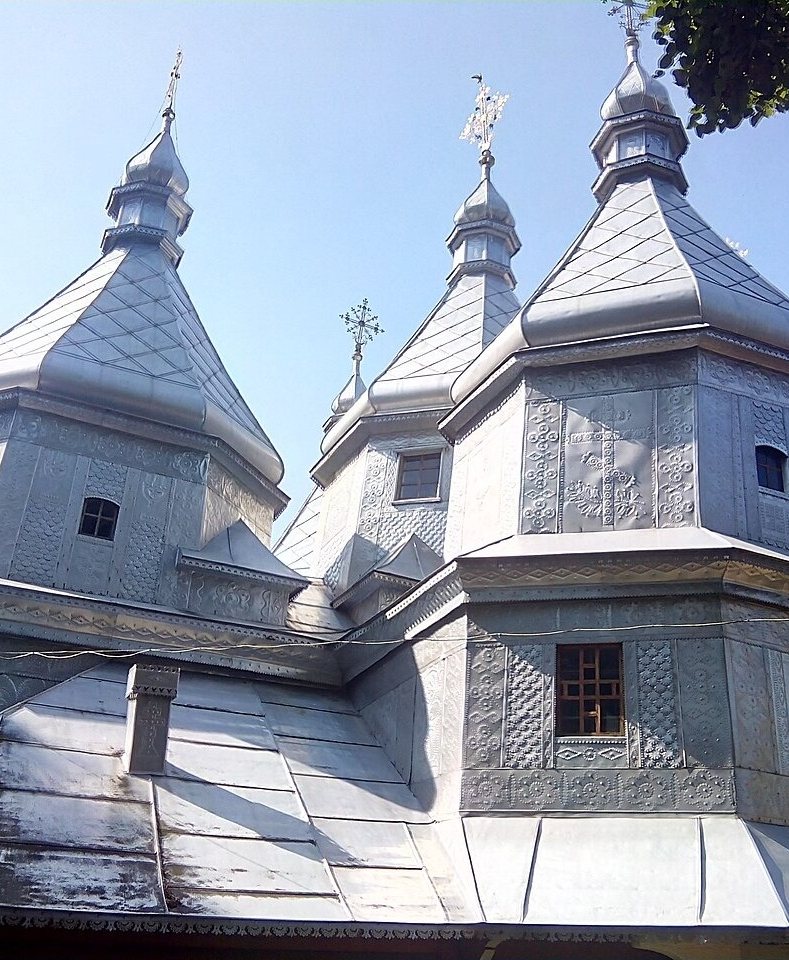
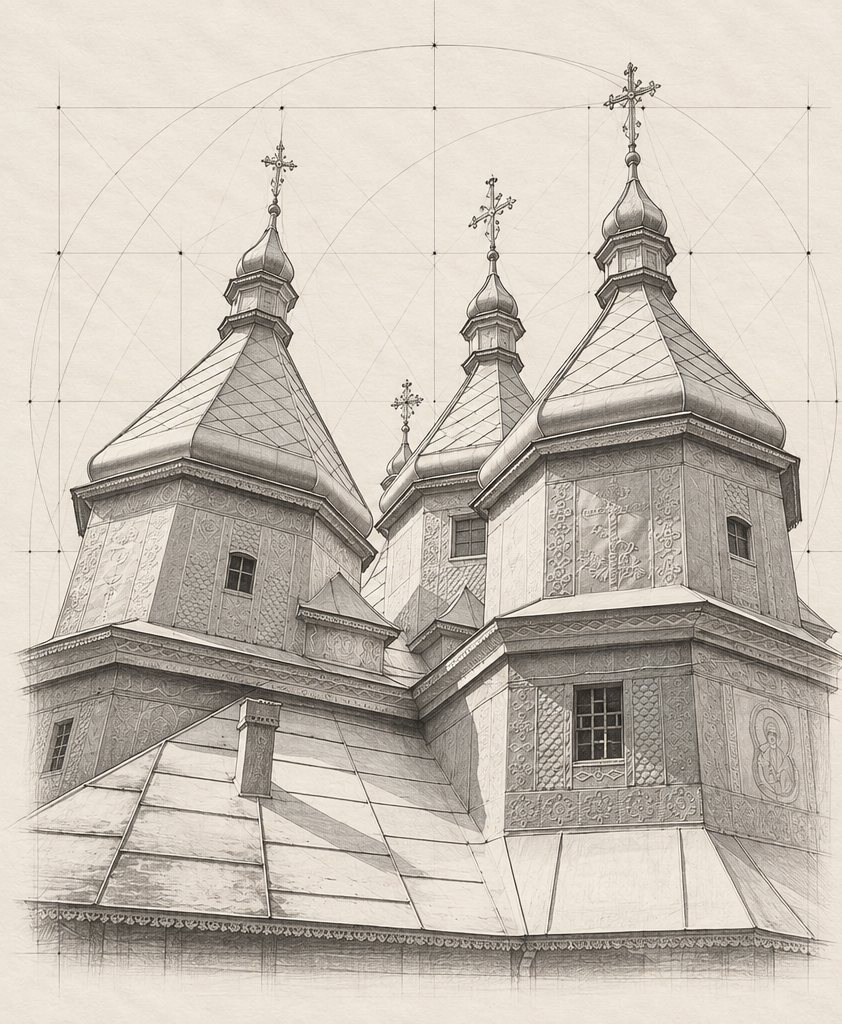
Each top is an octagon with a tent-shaped dome, a lantern and an openwork cross. The middle one is slightly taller than the side ones. Inside, the domes are hollow, and, according to Suspilne, this is why the sermon can be heard from any corner of the church.
The bell tower
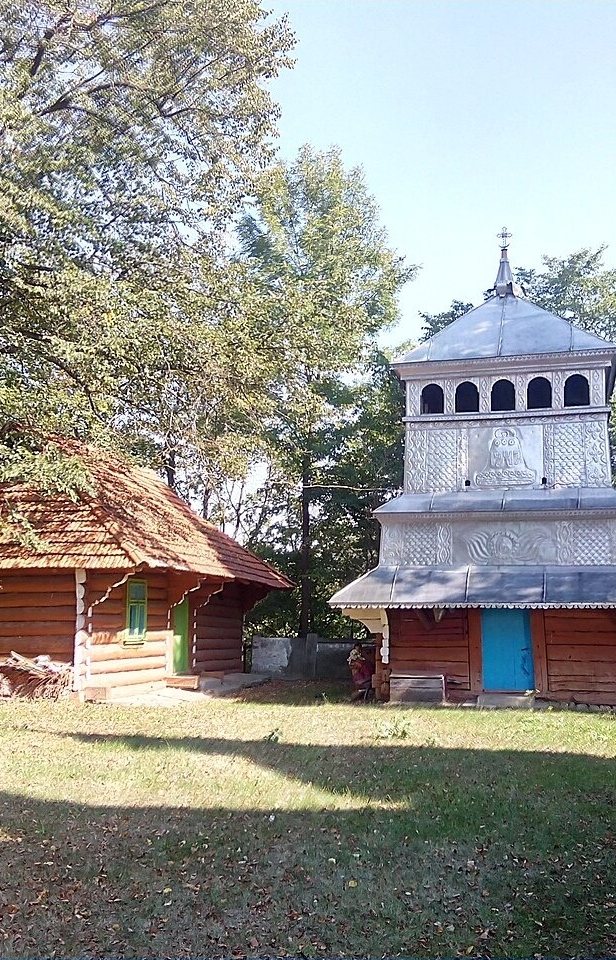
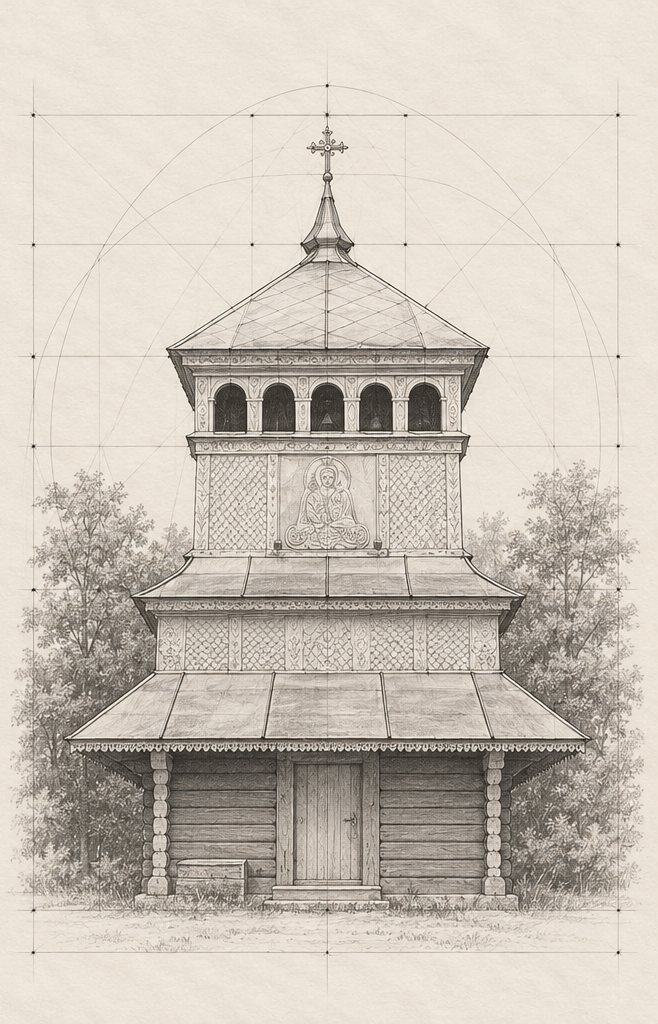
The bell tower is four-sided, three-tiered and log-built, with an openwork gallery and a four-sided tent roof. Next to the five verticals of the church, it keeps closer to the ground.
Details that are easy to miss
Not Hutsul — according to one version. Traditionally, and in the UNESCO nomination as well, the church is classed as the Hutsul type. The researcher Nadiia Babii argues that it repeats the forms of churches in Podillia and Slobozhanshchyna, and that the closest match to its plan is the Church of the Nativity of the Theotokos in Khodoriv, 1768. The regional tourism portal adds that there are almost no five-domed churches in the Ivano-Frankivsk region.
Gold in the bells — a legend. In the family version, an old opryshok on his deathbed revealed a treasure to the young Semeniuk — more than twenty cartloads of gold — and asked him to build a church with this “blood” money. The silver in the bells, people in the village say, also comes from the treasure. During the Second World War some of the bells were taken away to be melted down, and about twenty years ago, during repairs, two lost bells were found under the floor.
Altars “in the Latin manner”. Besides the three-tier gilded Baroque iconostasis, the side towers contain wooden altars “in the Latin manner” with gilded Corinthian columns.
Sheet metal as the compromise of the century. On most of the church the shingles were replaced with sheet metal: the domes in the 1930s, the rest in 1990. The head of the community explains that this was done at the time to many churches in Prykarpattia, but sheet metal loses its protective qualities over time, and UNESCO expects the original appearance to be restored. A design costing UAH 350,000 was made before the full-scale invasion; the repair itself is estimated at UAH 16.8 million.
“Without a single nail”. That is how people in the village speak of the church, and Suspilne writes the same; it is a familiar formula for Carpathian log churches. The sources contain no technical survey that would confirm it. Radio Svoboda wrote in 2009 that there was no documentation on the church at all and that the original interior had been destroyed. The present wall painting is modern, in oil.
What to look for. The first tier is painted dark red with small white accents by the windows and on the side frames. An image of the Most Holy Theotokos survives above the central entrance. And above the portal is the donor inscription with two dates, with which the whole documented history of the church begins.
Photo gallery
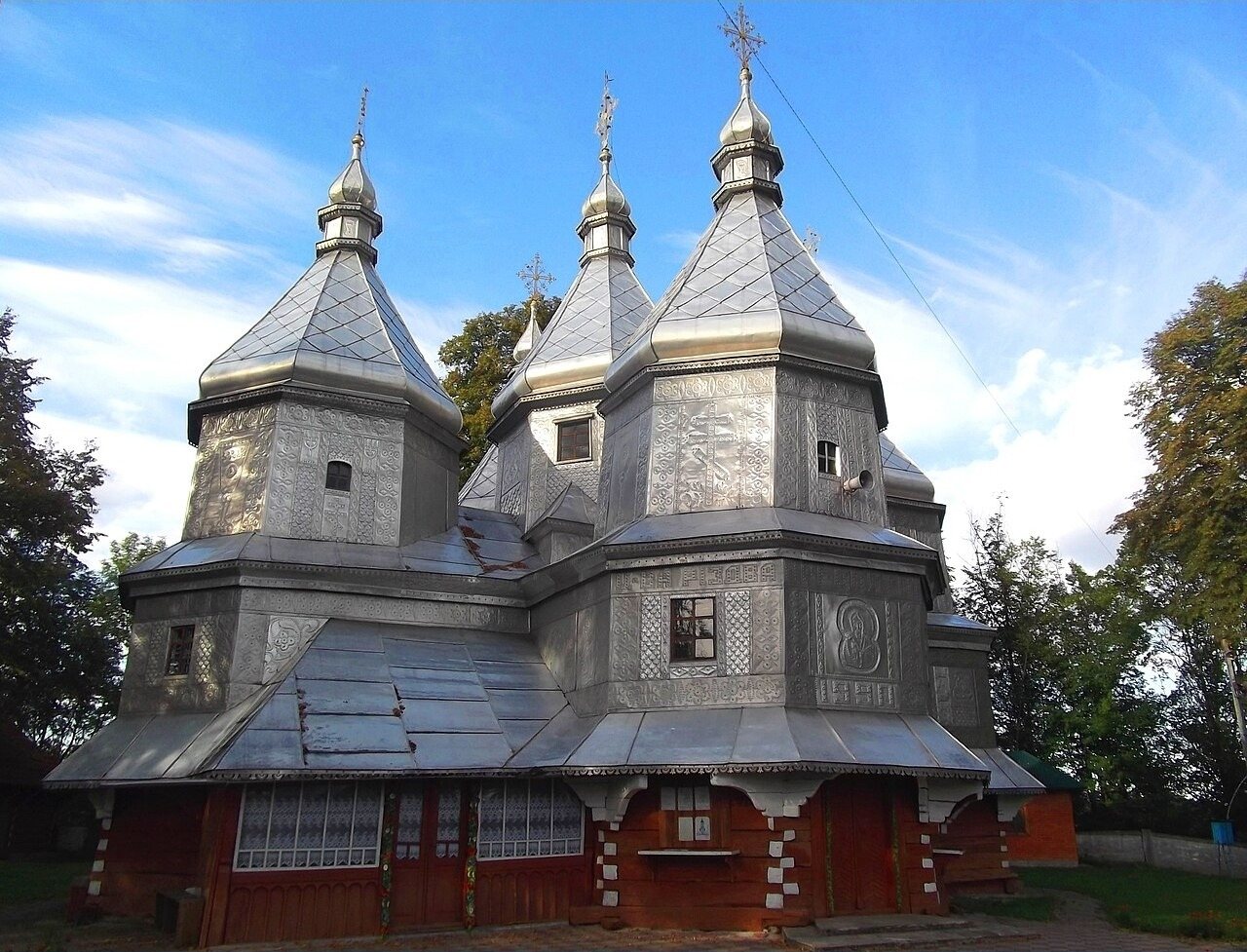
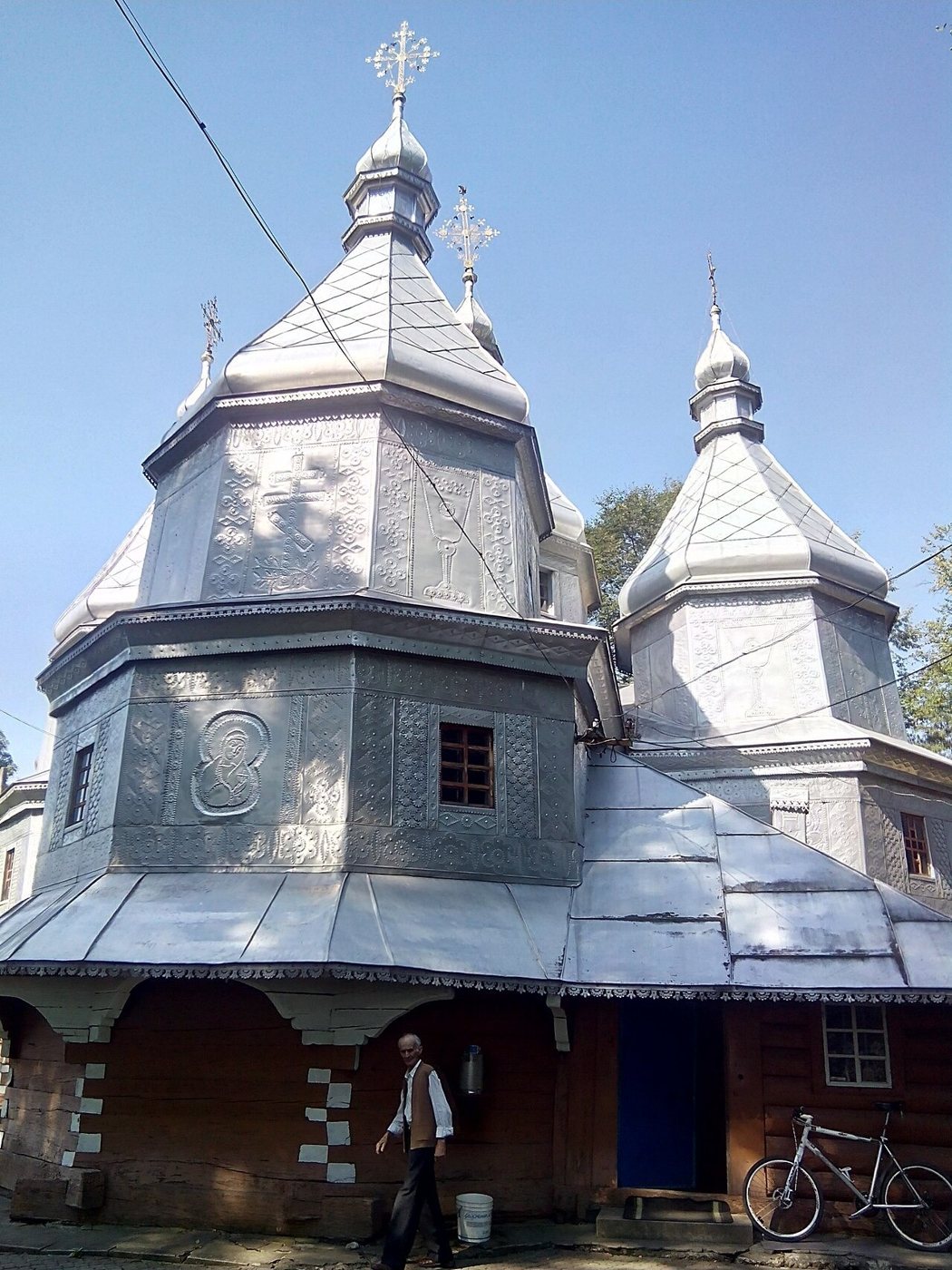
Stone and material
The church is log-built: the walls are made of horizontally laid logs joined at the corners. All the Carpathian churches on the UNESCO list share one scheme — wooden log frames on wooden sill beams, and the sills on a stone foundation. The stone is invisible here, yet it is what keeps the wood above the damp ground.
The roof is the most painful point. Sheet metal protected it from leaks but changed the silhouette and texture of the tops: instead of scaly shingles that darken and turn silvery with the years, there is an even metallic sheen. A material chosen “for the ages” often turns out to be a temporary solution. And the temporary, as any craftsman knows, lasts the longest.
The Baroque altars with Corinthian columns are a reminder that the classical orders travel between materials more easily than it seems — from stone to wood and back; more on this in the section columns, pilasters, capitals. How a tiered iconostasis is arranged is explained in the article tiers of the iconostasis. Another multi-domed wooden church is the Holy Trinity Cathedral in Samar, and another Carpathian church on the UNESCO list is St George’s Church in Drohobych.
Did you know
The bell tower was built on 21 May 1743, 13 years before the earliest date given for the start of the church’s construction. [1, 7]
The bell donated by Semeniuk was cast in 1745 — the same year Oleksa Dovbush was killed; according to W. Witkowski, it has survived. [1]
In 1811 the village’s previous church was sold and re-erected in Sheparivtsi as the Church of St Anne, according to W. Witkowski. [1]
A newspaper of 1812 wrote that Semeniuk built the church “with his own hands as a carpenter”, while according to his gravestone he would then have been over a hundred years old; W. Witkowski puts a “sic!” next to this. [1]
The medal of 1812 could only have been granted by Emperor Francis II (I): Ferdinand I came to the throne in 1835, although many descriptions of the church mistakenly name him. [1, 4, 15]
The earliest known mention of Verbizh is a princely grant of 9 December 1375, not 1443 as accepted in reference works, according to W. Witkowski. [1]
In 1832 the parish numbered 730 Greek Catholics. [1]
Beneath the tops there is a system of beams, struts and steel tie rods that helps the log frames carry the towers. [1]
At the turn of the 1980s and 1990s sheet metal was brought into Galicia by barter — in exchange for potatoes and other produce, according to a travel publication. [5]
The 2011 measurements showed that some parts of the church have deviated from their original verticals and horizontals. [1]
In 1991 only the church was entered in the register; the bell tower of 1743 did not receive protected status at that time. [1]
All five domes are hollow inside, and, according to the head of the community, the sermon can be heard from any corner of the church. [20]
An old cemetery with carved 19th-century crosses survives next to the church. [17]
On 8 September 2023 the church for the first time celebrated its patronal feast according to the new calendar; before that, on 21 September. [1, 21]
Legends
Dovbush at the church fair
According to a legend recorded by Stanisław Vincenz, one of Dovbush’s men ran off with the treasure and later met the leader at a church fair in Verbizh and showed him the church built with that money. Retold after W. Witkowski. [1]
“Here is the treasure”
According to legend, the founder was the band’s treasurer; his former comrades found him and tortured him with hot tar, and he led them to the church. Retold after W. Witkowski. [1, 4]
The old Hutsul’s treasure
According to Roman Semeniuk’s family legend, the treasure was revealed to the founder by an old Hutsul; Suspilne, in the family version, speaks of “more than 20 cartloads of gold”. The money could be spent only on a church. [1, 20]
Silver in the bell
According to legend, Semeniuk poured the opryshky’s silver coins straight into the molten bronze of the bell; Suspilne also writes about silver in the bells. [1, 20]
A monastery on the hill
According to legend, on the hill where the church stands there was a monastery (hence the name of the locality, Chernyche), which was destroyed by the Tatars. [1, 6]
Atonement
According to legend, Semeniuk, a former opryshok of Dovbush’s band, built the church to atone for his sins. [4, 6, 16]
The long-lived master
The founder’s age — 114 years — is recorded on his gravestone; the twelve sons were mentioned to Suspilne by Hanna Lasiichuk, a fifth-generation relative. [1, 20]
“Without a single nail”
That is what people in the village say about the church, and Suspilne writes the same; the sources contain no technical survey that would confirm it. [20]
Figures
- Władysław of Opole — prince who granted Verbizh in fief in 1375.
- Vashko Teptiukovych — the first known owner of the village (1375).
- Władysław Jagiełło — King of Poland who confirmed the grant in 1416.
- Oleksa Dovbush — leader of the opryshky (†1745), whose name the legend links with the money for the church.
- Mykhailo Maliarchuk — son-in-law of the Verbizh miller, trained as a painter; tried in 1742 for ties with Dovbush. N. Babii suggests he influenced the form of the church; W. Witkowski sees no evidence of his part in the building.
- Hryhorii Semeniuk (Melnyk) — miller, carpenter, founder and steward of the church, donor of the 1745 bell; died in 1822 and is buried next to the church.
- Francis II (I) — emperor who awarded Semeniuk the small gold “For Merit” medal in 1812.
- Ivan Voroniuk — local painter to whom legend attributes the old painting.
- Roman Semeniuk — descendant of the founder who passed on the family version of the legend.
- Hanna Lasiichuk — fifth-generation relative of the founder, Suspilne’s narrator (2023).
- Stanisław Vincenz — writer who recorded the legend of Dovbush at the church fair.
- Mykhailo Lasiichuk, Ivan Ludchak — local historians, authors of the 1995 essay collection.
- Nadiia Babii — researcher, author of the 2012 article on the typology of the church.
- Włodzimierz Witkowski — Polish architect, leader of the 2011 measurements, author of the most detailed article on the church.
- Volodymyr Herych — director of the reserve in Zhovkva, head of the working group on the UNESCO nomination.
- Fr Vasyl Vepruk — rector of the parish for about 40 years, according to Suspilne (as of 2023).
- Yaroslav Miakushchak — head of the Nyzhnii Verbizh community.
How to cite
IKONASTONE. The Church of the Nativity of the Most Holy Theotokos in Nyzhnii Verbizh // Guide to the Churches of Ukraine. URL: https://ikonastone.com/en/guide/nativity-of-the-theotokos-church-nyzhnii-verbizh/ (accessed DD.MM.YYYY).
FAQ
When was the church in Nyzhnii Verbizh built?
According to the local historians Mykhailo Lasiichuk and Ivan Ludchak, construction began in 1756. The donor inscription above the portal contains two dates, 1788 and 1808. The second is regarded as the year of final completion and consecration.
Is it true that the church was built with Dovbush’s money?
That is a legend. According to it, the founder Hryhorii Semeniuk was an opryshok (outlaw) and treasurer of Oleksa Dovbush’s band, and built the church to atone for his sins. Documents call Semeniuk the “benefactor and steward” of the church. Documentary evidence links another villager to Dovbush — Mykhailo Maliarchuk, who was tried in 1742 for ties with the opryshky.
When was the church added to the UNESCO list?
On 21 June 2013, at the 37th session of the World Heritage Committee, as part of the property “Wooden Tserkvas of the Carpathian Region in Poland and Ukraine”. On 7 September 2023 UNESCO granted the church provisional enhanced protection.
Why is the church covered with sheet metal?
The domes were covered with sheet metal in the 1930s, and the rest of the church in 1990, when sheet metal was brought into Galicia even by barter. The head of the community explains that UNESCO expects the original appearance to be restored. A design for bringing back the shingles has already been made, but the repair, estimated at UAH 16.8 million, lacks funding.
Is it really a Hutsul church?
It is traditionally called Hutsul, and UNESCO presents it that way. The researcher Nadiia Babii thinks otherwise: in her observation, the church repeats the forms of churches in Podillia and Slobozhanshchyna, and the closest match to its plan is the Church of the Nativity of the Theotokos in Khodoriv, 1768.
Sources
- Witkowski W. Wierbiąż Niżny – huculska(?) cerkiew na Liście UNESCO // Ochrona Zabytków. 2014. № 1
- Вікіпедія (укр.). Церква Різдва Пресвятої Богородиці (Нижній Вербіж) (виклад статті Н. Бабій)
- Бабій Н. П. Церква Різдва Богородиці (1756–1808 рр.) у селі Нижній Вербіж: питання типології пам'ятки // Вісник НАКККіМ. 2012. № 3. С. 167–171
- Karpaty.rocks. Church of the Nativity of the Blessed Virgin Mary, Nyzhnyi Verbizh
- Ukraine-kiev-tour.com. Nyzhniy Verbizh: wooden church of the Nativity of the Blessed Virgin Mary
- Дерев'яні храми Карпат (ekarpaty.com). Founded in 1756–1808
- Narodowy Instytut Dziedzictwa. Skarby drewnianej architektury sakralnej: Niżny Werbiż
- Радіо Свобода. Г. Терещук. Чи спроможне ЮНЕСКО зупинити руйнацію дерев'яних церков в Україні (08.07.2009)
- Радіо Свобода. Г. Добош. Про шанси гуцульських церков на список ЮНЕСКО (21.09.2009)
- Радіо Свобода. Г. Терещук. Дерев'яні церкви на шляху до ЮНЕСКО (2009)
- UNESCO World Heritage Centre. Wooden Tserkvas of the Carpathian Region in Poland and Ukraine
- Міністерство культури та інформаційної політики України. UNESCO has inscribed 20 cultural heritage sites of Ukraine on the List of Cultural Property under Provisional Enhanced Protection (08.09.2023)
- РІСУ. UNESCO adds 20 cultural heritage sites in Ukraine to the list of protected cultural values (08.09.2023)
- Суспільне Івано-Франківськ. На Івано-Франківщині ремонтують церкву зі списку об'єктів Всесвітньої спадщини ЮНЕСКО (25.09.2022)
- Wikipedia (en). Nyzhnii Verbizh
- TravelsInUA. Nativity of Holy Virgin Church, Nyzhnii Verbizh
- Нижньовербізька сільська рада. Стратегія розвитку територіальної громади
- Нижньовербізька сільська рада. Звіт з виконання плану заходів Стратегії розвитку громади
- GCatholic. Church of the Nativity of the Blessed Virgin Mary, Nyzhnii Verbizh
- Суспільне Івано-Франківськ. Побудована за опришківські скарби: історія церкви Різдва Пресвятої Богородиці в селі Нижній Вербіж (13.09.2023)
- Суспільне Івано-Франківськ. На Франківщині у церкві Різдва Пресвятої Богородиці вперше відзначили храмове свято за новим календарем (08.09.2023)
- Суспільне Івано-Франківськ. На Прикарпатті руйнуються церкви, які внесені до списку об'єктів Всесвітньої спадщини ЮНЕСКО (30.08.2020)
- Prozorro. Закупівля UA-2022-07-14-006961-a: розроблення проєктної документації «Реставрація пам'ятки архітектури національного значення» (Нижньовербізька сільрада, 2022)
- Town
- Nyzhnii Verbizh village, Kolomyia District, Ivano-Frankivsk Oblast
- Built
- 1756–1808 (the donor inscription bears the dates 1788 and 1808)
- Type
- centrally planned, cross-shaped, five-domed wooden church
- Material
- log frames; roofing of embossed sheet metal, partly shingles
- Research depth
- 27%