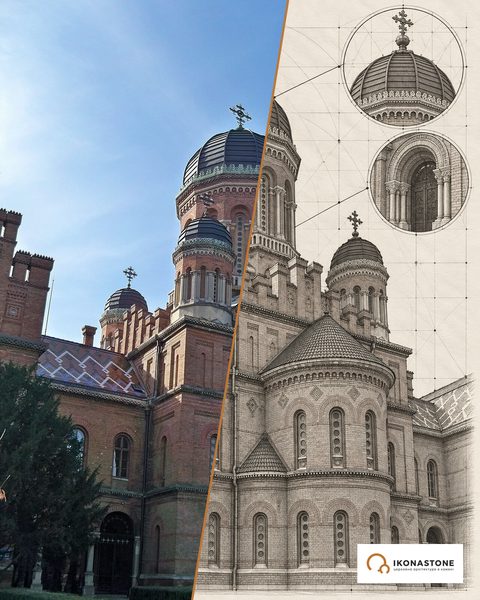
The Struk Church in Yasinia: a Hutsul cross of five log frames
The Hutsuls set this church out as a cross not only on paper but in wood: five log frames joined so that the church is a cross in plan. And above it is a single top, as if the whole building holds one thought.
In brief
| Address | Yasinia, Rakhiv District, Zakarpattia Oblast |
| Built | 1824 (date on the door frame) |
| Bell tower | 1813; moved here in 1895 |
| Type | Hutsul cruciform church of five log frames, a single octagonal top |
| Material | wooden log frames, shingle cladding on walls and roofs |
| Status | monument of national importance; UNESCO World Heritage site since 2013 |
History
Yasinia lies in the east of Zakarpattia, in Hutsul country. The Church of the Ascension of the Lord stands on a slope above the Chorna Tysa, on the southern outskirts of the settlement, at its entrance; the way to it leads over a suspension footbridge.
The church’s second name is the Struk Church. Legend links it to a local shepherd, Ivan Struk, who built a chapel on this hill; the Carpathian Biosphere Reserve calls Struk the founder of the settlement and writes that people regard the hill with the church as sacred. The Wooden Churches of the Carpathians route specifies that the church of 1824 was built exactly on the site of the Struk chapel. Struk is also linked to the name of the settlement itself. The legend cited by Outdoor Ukraine goes like this: a sudden snowfall caught the shepherd in the mountains, and Struk lost his flock in an ash thicket. In spring he found the sheep alive, and with lambs besides. In honour of this, so the story goes, the settlement was founded and named after the ash trees — Yasinia. The tourist website Eurofest tells it differently: it was the shepherd himself who survived under the branches of a giant ash. Both versions are folklore, and that is how they should be read.
The church keeps its building date to itself: a composition of three crosses and the year — 1824 — are carved on the door frame. The researchers Ivan and Dmytro Pop (1971) dated the church to the end of the 18th century. Several sources say it was built without a single nail; this is a common claim about wooden churches, and it has not been verified by documents.
The bell tower is older than the church. It was built in 1813 next to another church, and when that one burned down, the bell tower was, according to local tradition, moved to the Struk Church in 1895. In wooden architecture this is quite normal: a log structure can be taken apart round by round and reassembled.
The church survived the Czechoslovak period, Carpatho-Ukraine, the Hungarian occupation and Soviet rule. On 15 March 1939 it appeared on the first postage stamp of Carpatho-Ukraine (3 korunas, inscribed “1. Sojm 2.III.1939”). Under Soviet rule the church was registered as an architectural monument of the Ukrainian SSR (according to English Wikipedia, number 201), and in 2018 it was entered in the State Register of Immovable Monuments of Ukraine. On 21 June 2013, at the 37th session of the World Heritage Committee in Phnom Penh, the church, together with seven other Ukrainian and eight Polish churches, was inscribed on the UNESCO World Heritage List. Two churches from Zakarpattia were included — this one and St Michael’s in Uzhok. Tomasz Sopko, chief specialist for cultural heritage protection at the Zakarpattia Regional State Administration, told Radio Svoboda at the time that the Struk Church was in fairly good condition, unlike the one in Uzhok, which needed restoration.
Next to the church are an old cemetery and the bell tower; together they form a small ensemble on the slope.
The scale of this distinction is easier to feel in numbers. According to English Wikipedia, more than two thousand wooden sacred buildings survive in Ukraine, over 120 of them in Zakarpattia. Out of all this variety, only eight Ukrainian churches made it onto the World Heritage List, and only two from Zakarpattia.
Today the church is in use. According to the Wooden Churches of the Carpathians route, Orthodox and Greek Catholic communities hold services in it in turn.
Chronology
The numbers in square brackets are source numbers in the list at the bottom of the page. The note “according to …” means that the fact is confirmed by only one source. The section “Legends and tales” contains traditions and legends: they are recorded in the sources but not confirmed by documents.
Yasinia and the church
- 1535 or 1555
First written mention of the settlement of Yasinia (Hung. Kőrösmező). English Wikipedia gives 1535, ua-travels gives 1555. [13, 16]
- After 1583
According to ua-travels, the settlement, which belonged to the Hungarian Drugeth family, passed to the Károlyi family. [13]
- 16th c. (hypothesis)
Some authors believe that a church already stood on this site in the 16th century; no documentary confirmation is given. [6, 7, 8]
- 1813
A two-tier bell tower of spruce beams was built; “ANNO DOMINI 1813” is carved on the upper door frame. It stood next to another church. According to trip-impressions, construction lasted from 1811 to 1813. [4, 5, 11, 13]
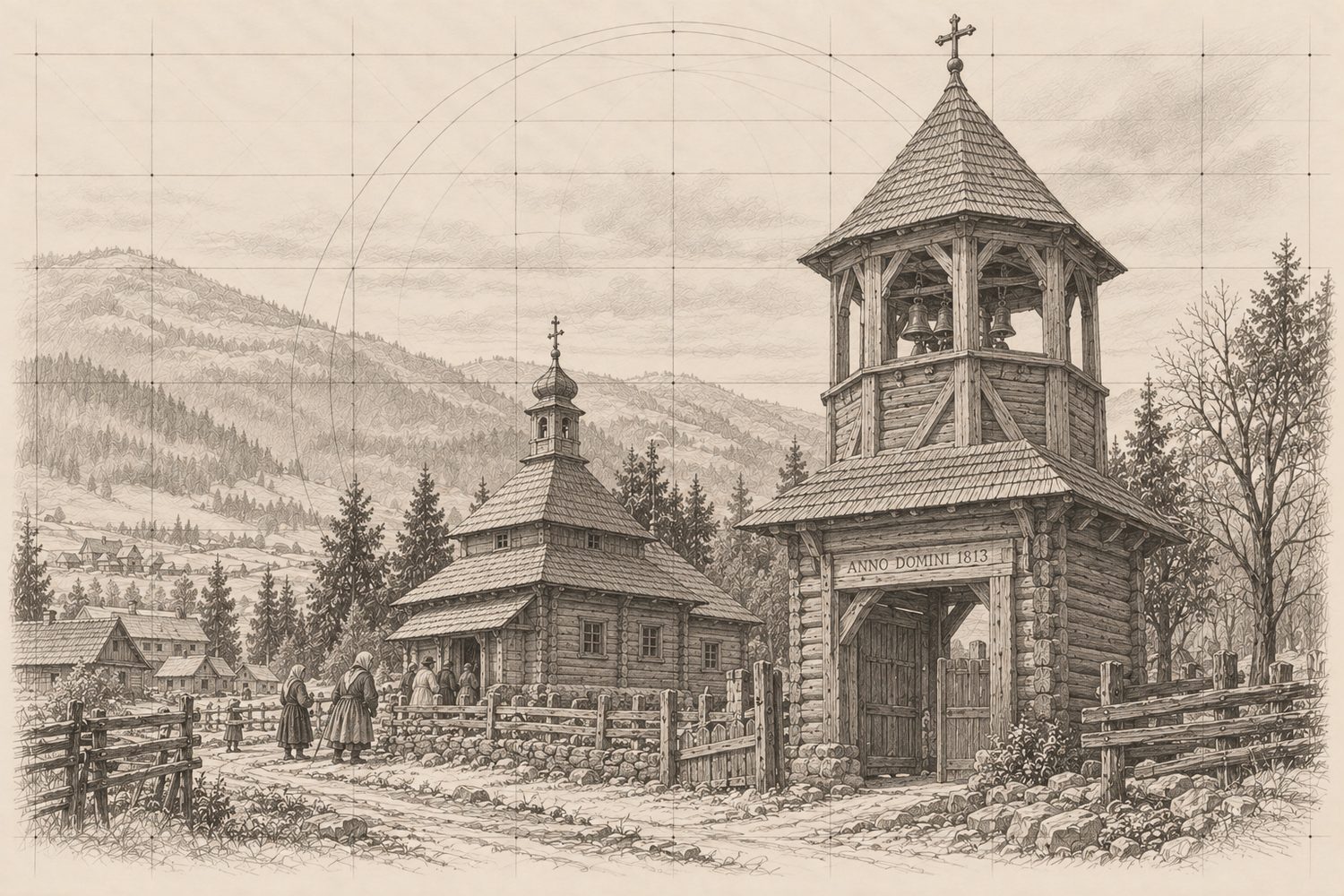
1813: the bell tower. Illustration: IKONASTONE - 1824
The present cruciform Church of the Ascension of the Lord, of five log frames, was built; the year is carved on the door frame. According to tradition, it arose on the site of the Struk chapel. [4, 9, 10, 14]
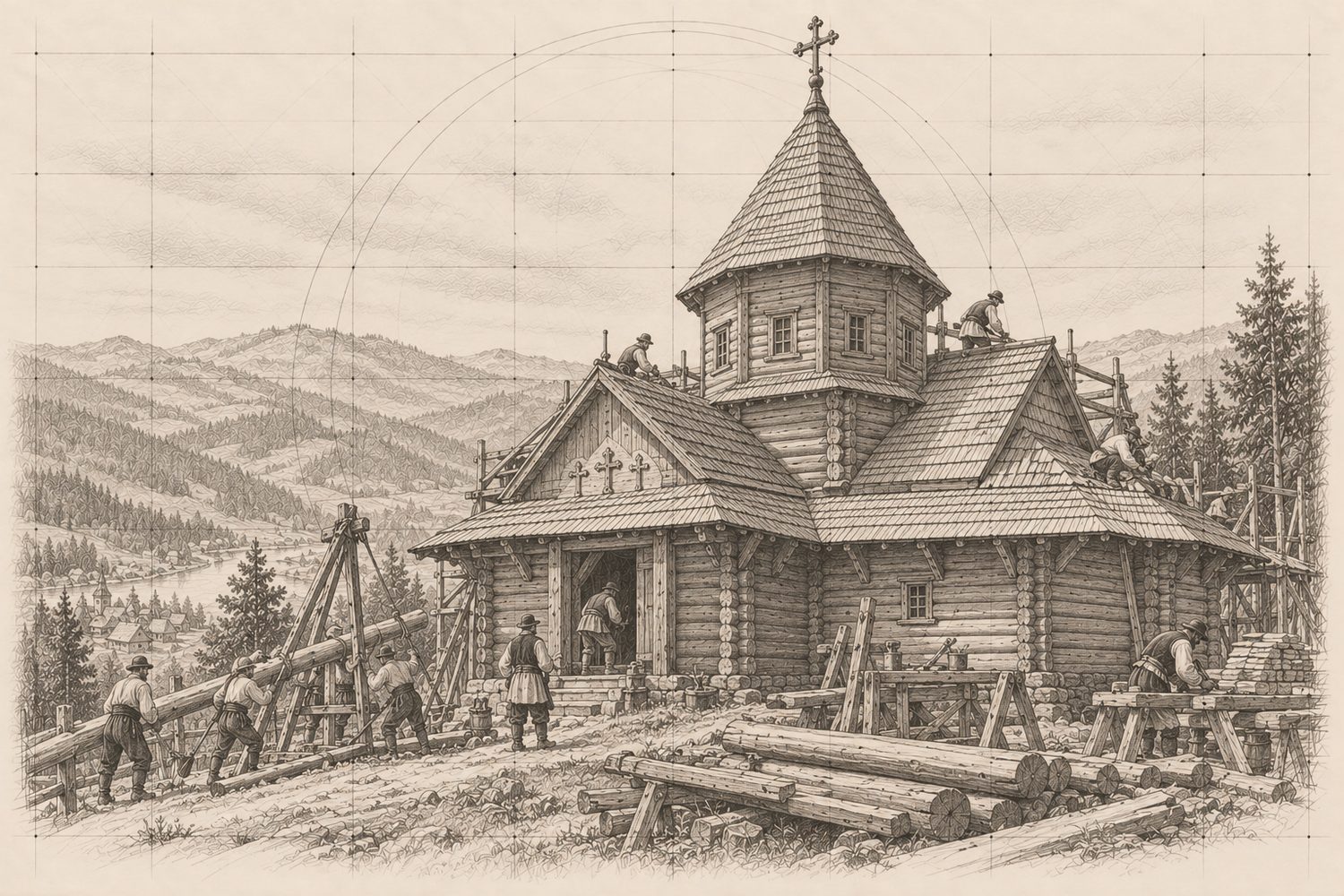
1824: building the church. Illustration: IKONASTONE - 1894
Renewal of the church. An inscription on the door frame records that Vasyl Popadiuk gave funds for the altar table, and that Hryts and Petro Pavliuchok and Yura Spliashchuk carried out the foundations, door frames and other work. [4, 6, 7]
- 1895
According to local tradition, the bell tower of 1813 was moved to the Struk Church from the northern part of the village, where a church had burned down. [4, 5, 9, 13]
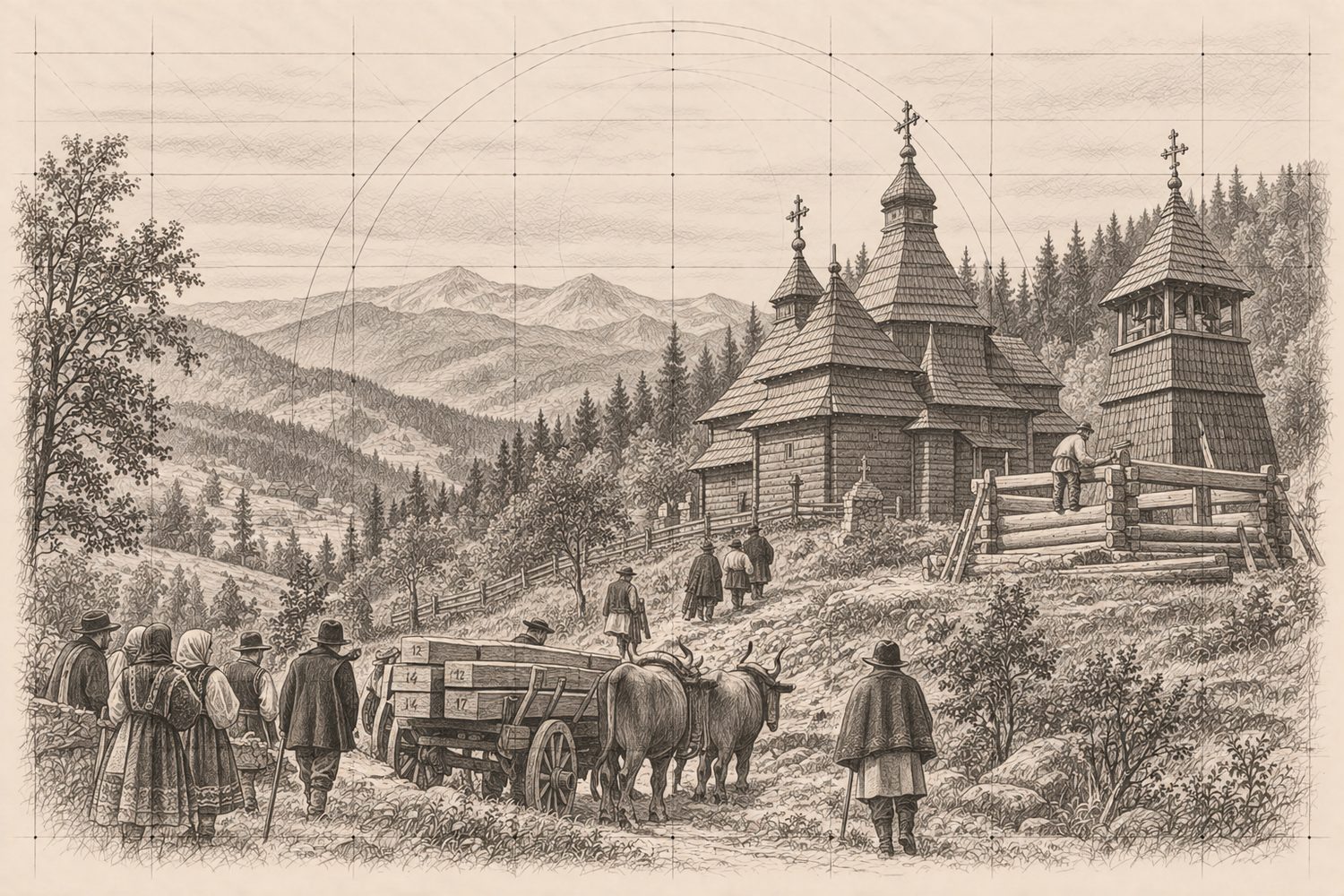
1895: the bell tower is moved to the Struk church. Illustration: IKONASTONE
The 20th century
- 8 January 1919
Yasinia became the centre of the Hutsul Republic; it was headed by Stepan Klochurak. [12, 17]
- 11 June 1919
Romanian troops occupied the territory of the republic. [16, 17]
- 1930s
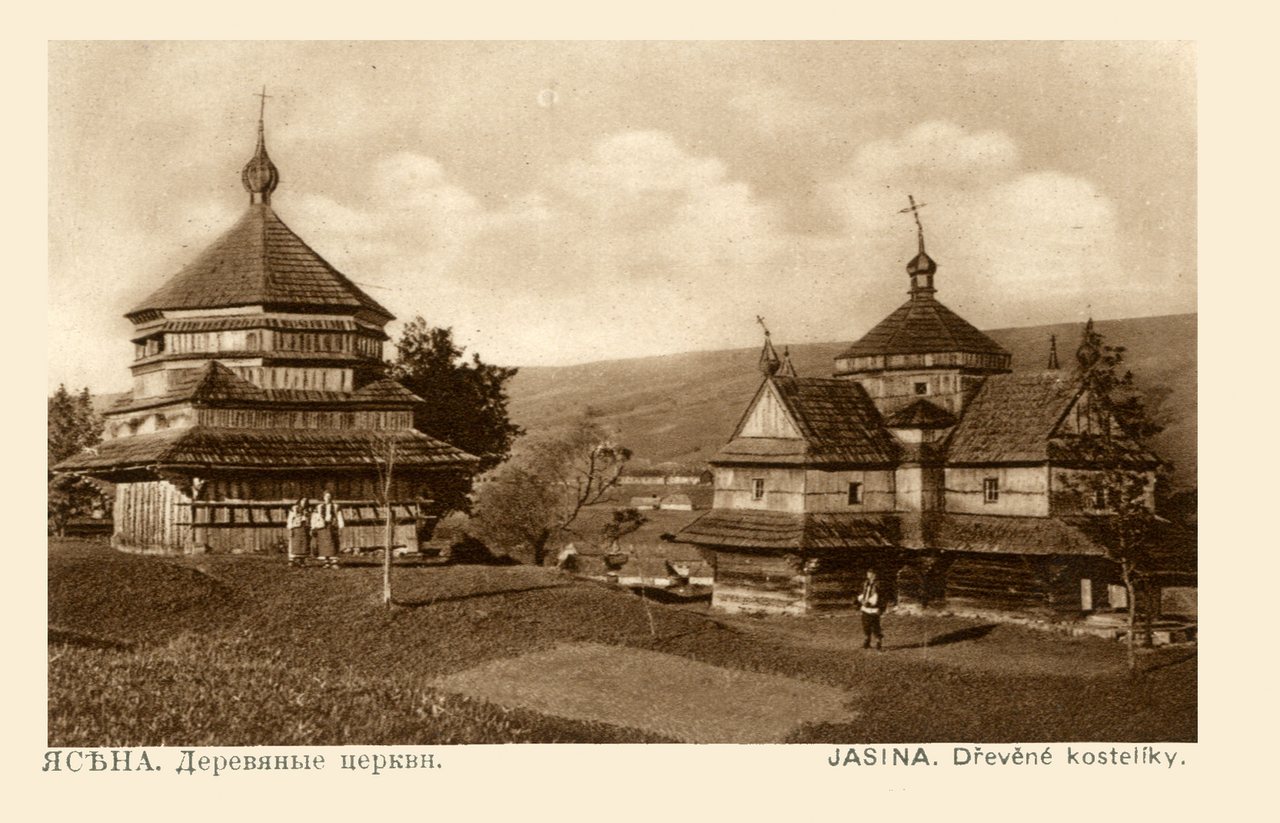
Yasinia was part of Czechoslovakia; the Struk Church became a symbol of the region and was printed on postcards and in photo albums. [5, 6]
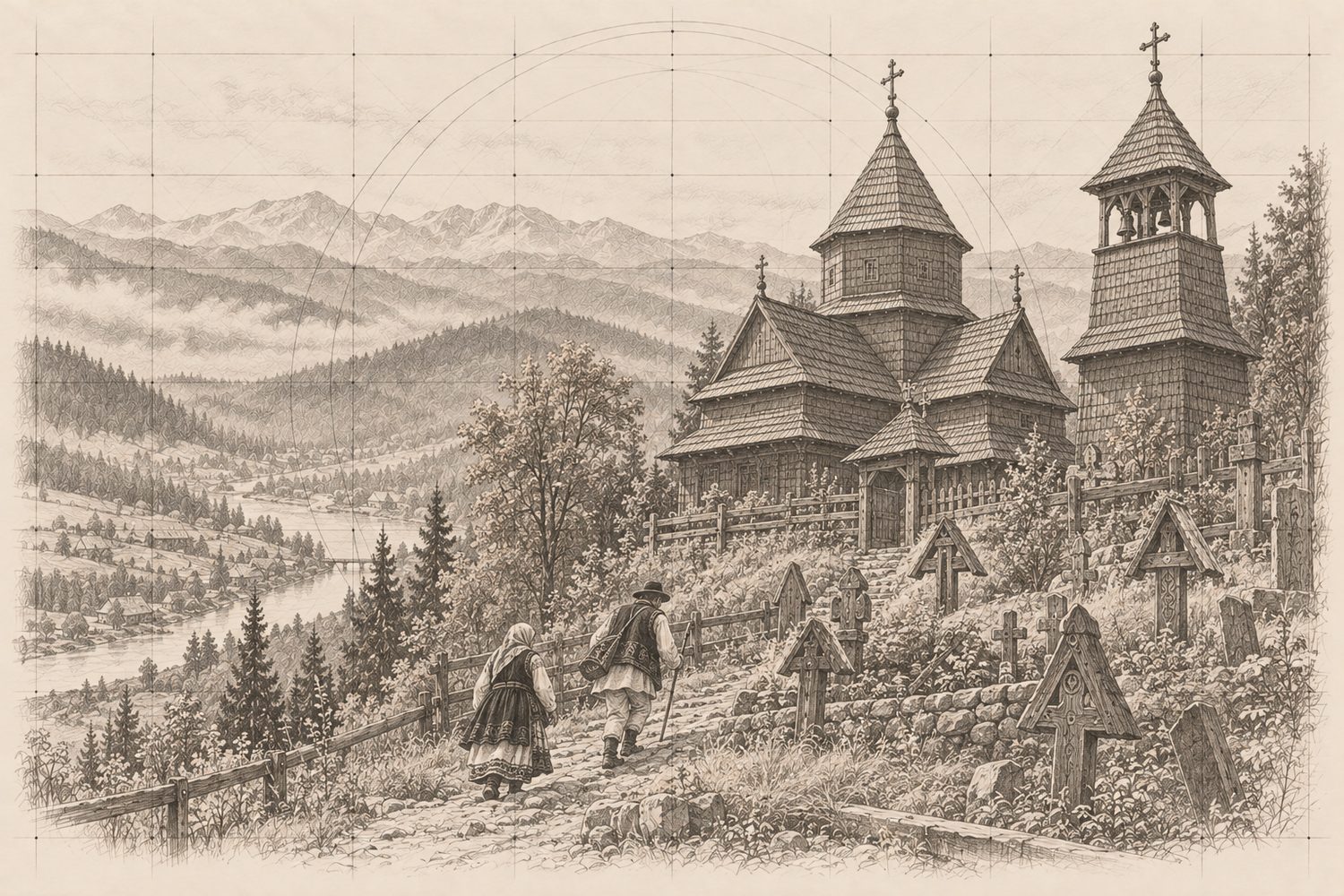
The 1930s. Illustration: IKONASTONE - 15 March 1939
On the day Carpatho-Ukraine proclaimed its independence, its first postage stamp was issued, showing the church: 3 korunas, inscribed “1. Sojm 2.III.1939”. The stamp had been prepared as a Czechoslovak regional issue, and was put into circulation by decree of the President of Carpatho-Ukraine. [4, 16, 22]
- March 1939
According to UPNS, the stamp was on sale in Carpatho-Ukraine for no more than 27 hours, until Hungarian troops entered Khust. [22]
- Soviet period
The church was registered as an architectural monument; according to English Wikipedia, protection number 201. [11, 14]
- 1971
Restoration of the monument to a design by the architects B. Ya. Kindzelskyi and I. R. Mohytych. [4, 5, 6, 7]
- 1971
Ivan and Dmytro Pop, in their book, dated the present church to the end of the 18th century and noted several icons of the 17th century. [4, 6]
Independence and UNESCO
- 1994
A wooden annex was added to the western log frame. [4, 6]
- 1994
According to Tourinform, go-to.rest and ua-travels, the church was handed over to the local Greek Catholic community. [7, 8, 13]
- October 1995
The Greek Catholic community was revived; since then services have been held in turn with the Orthodox. [4, 5, 6]
- February 2006
The old shingle roofing was replaced with new; the work was done by the master Mykhailo Parashchyk and his assistants. [4, 5, 6]
- 2010
According to UNIAN, the Yasinia church became one of eight Ukrainian candidates for the World Heritage List. [21]
- January 2012
According to Radio Svoboda, Poland and Ukraine were preparing parallel nominations for the World Heritage Centre — eight churches each. [20]
- February 2012
Vasyl Slobodian, a researcher of sacred architecture, called for churches to be restored together with their surroundings in an authentic form, and for the plastic that destroys wood to be removed. [21]
- 21 June 2013
At the 37th session of the World Heritage Committee in Phnom Penh, 16 wooden churches of the Carpathian region of Poland and Ukraine, among them the one in Yasinia, were inscribed on the List; criteria iii and iv. [1, 2, 3, 18]
- July 2013
According to Radio Svoboda, Tomasz Sopko of the Zakarpattia Regional State Administration assessed the condition of the Yasinia church as fairly good; that year more than UAH 2 million was allocated from the regional budget for heritage protection, including repairs in Yasinia and Uzhok. [19]
- 2018
The church was entered in the State Register of Immovable Monuments of Ukraine as a monument of national importance (according to English Wikipedia, No. 070040). [11, 14]
Lost and recreated
| What | What it was | What happened | Where it is now |
|---|---|---|---|
| The Struk chapel | According to tradition, on the hill, built by Ivan Struk | Not documented; the church was built on its site in 1824 | Has not survived [4, 9] |
| Church in the northern part of the village | Stood there together with the bell tower of 1813 | According to tradition, burned down before 1895 | Has not survived [4, 5, 13] |
| Bell tower | Two-tier, spruce, 1813, beside another church | Moved to the Struk Church in 1895 | Beside the church, slightly above it; about 11 m high [4, 7, 10] |
| Iconostasis | Carved; the dating varies: time of construction [4, 9, 14], 18th-century Baroque [6], 19th century [7, 8] | Icons repainted or replaced | In the church [4, 7, 9] |
| 17th-century icons | According to I. and D. Pop, several in the church | Condition not described in more recent sources | According to derev.org.ua and sobory.ru, in the church [4, 6] |
| Banner with St Stephen | 19th century | Preserved | According to Tourinform, in the church [7] |
| Shingle roofing | Old shingles | Replaced in February 2006 | New roofing; according to trip-impressions, a stock of shingles is kept in the yard [4, 5, 11] |
| Western log frame | Part of the original five-frame core | In 1994 a wooden annex was added to it | The annex exists [4, 6] |
| Inscription of 1894 | Names of the donor and the renewal masters | Preserved | On the door frame [4, 7] |
| Carpatho-Ukraine stamp | Print run 900,000, of which 300,000 for Carpatho-Ukraine | Issued 15.03.1939, in circulation in the region for about a day | Collections; according to UPNS [22] |
| Protection status | Architectural monument of the Ukrainian SSR (No. 201) | 2013 — UNESCO World Heritage; 2018 — State Register | Monument of national importance [3, 14, 15] |
Architecture
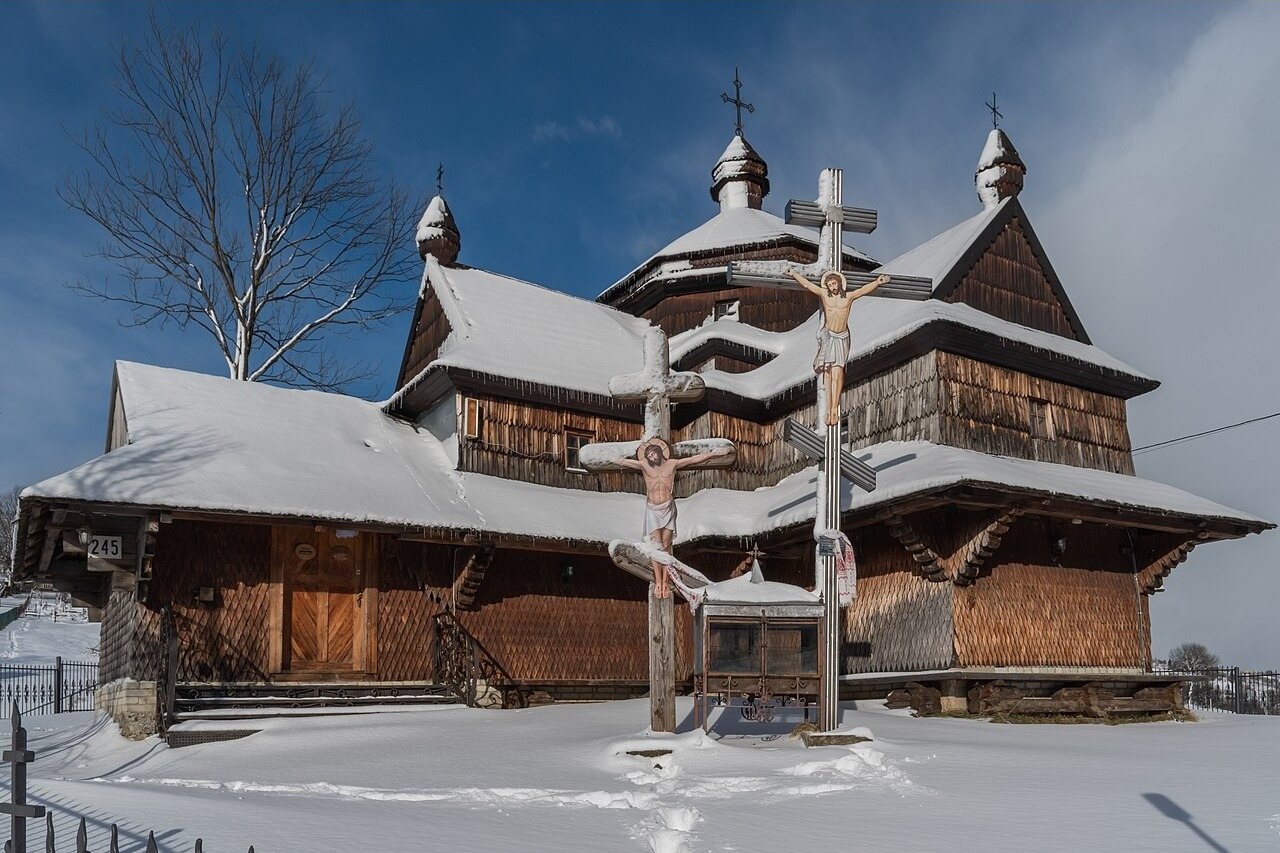
The Struk Church is a classic Hutsul church. Its basis is a cruciform plan of five log frames: a central square and four arms around it. An octagonal top rises above the centre; according to Karpaty.rocks, the building has three tiers, which make it look more massive and heavier. The walls and roofs are almost entirely covered with shingles, and because of this the church is perceived as one continuous wooden sculpture rather than a set of walls and roofs.
The Wooden Churches of the Carpathians route and the Carpathian Biosphere Reserve call it one of the best-preserved and most accomplished churches of the Hutsul region.
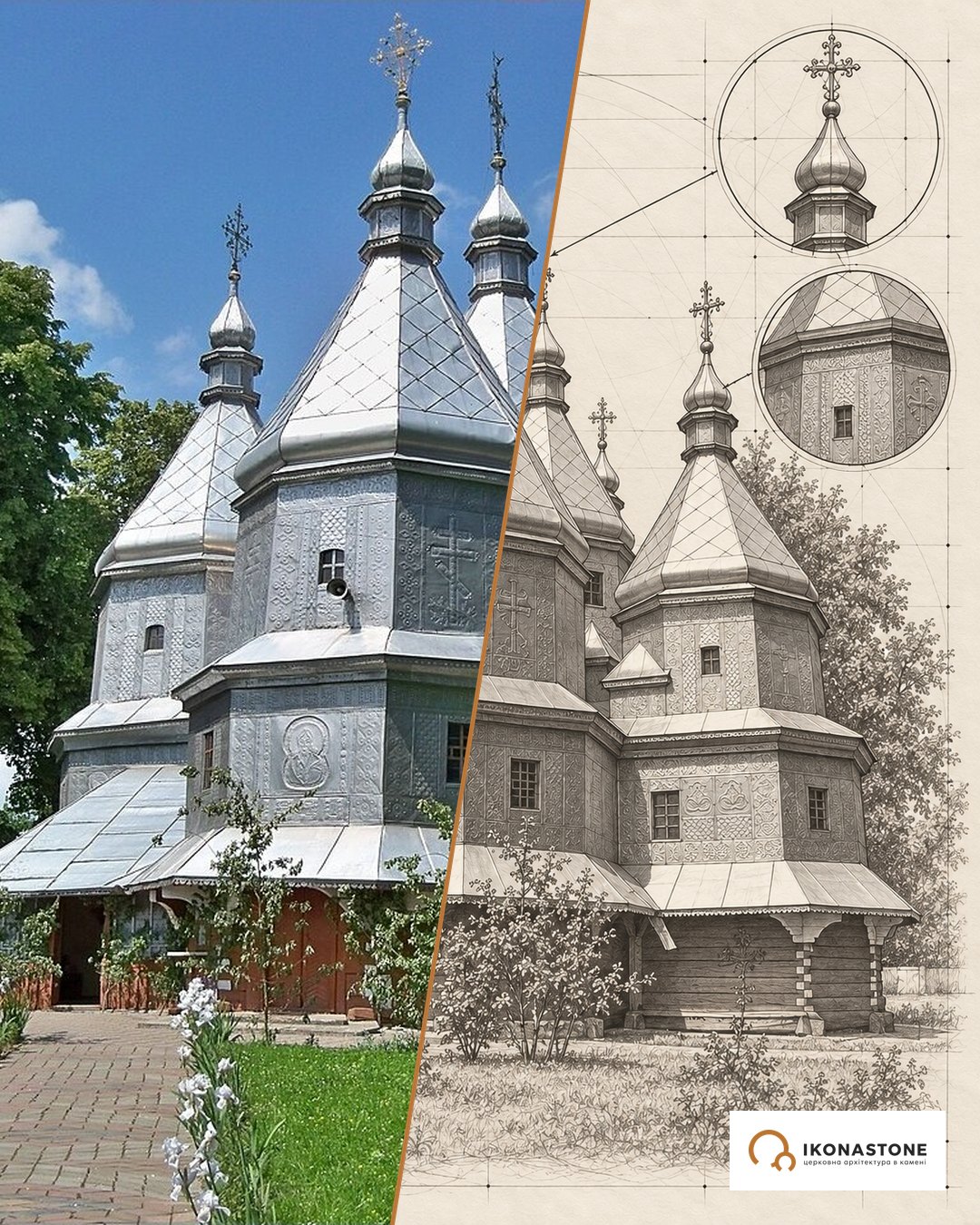
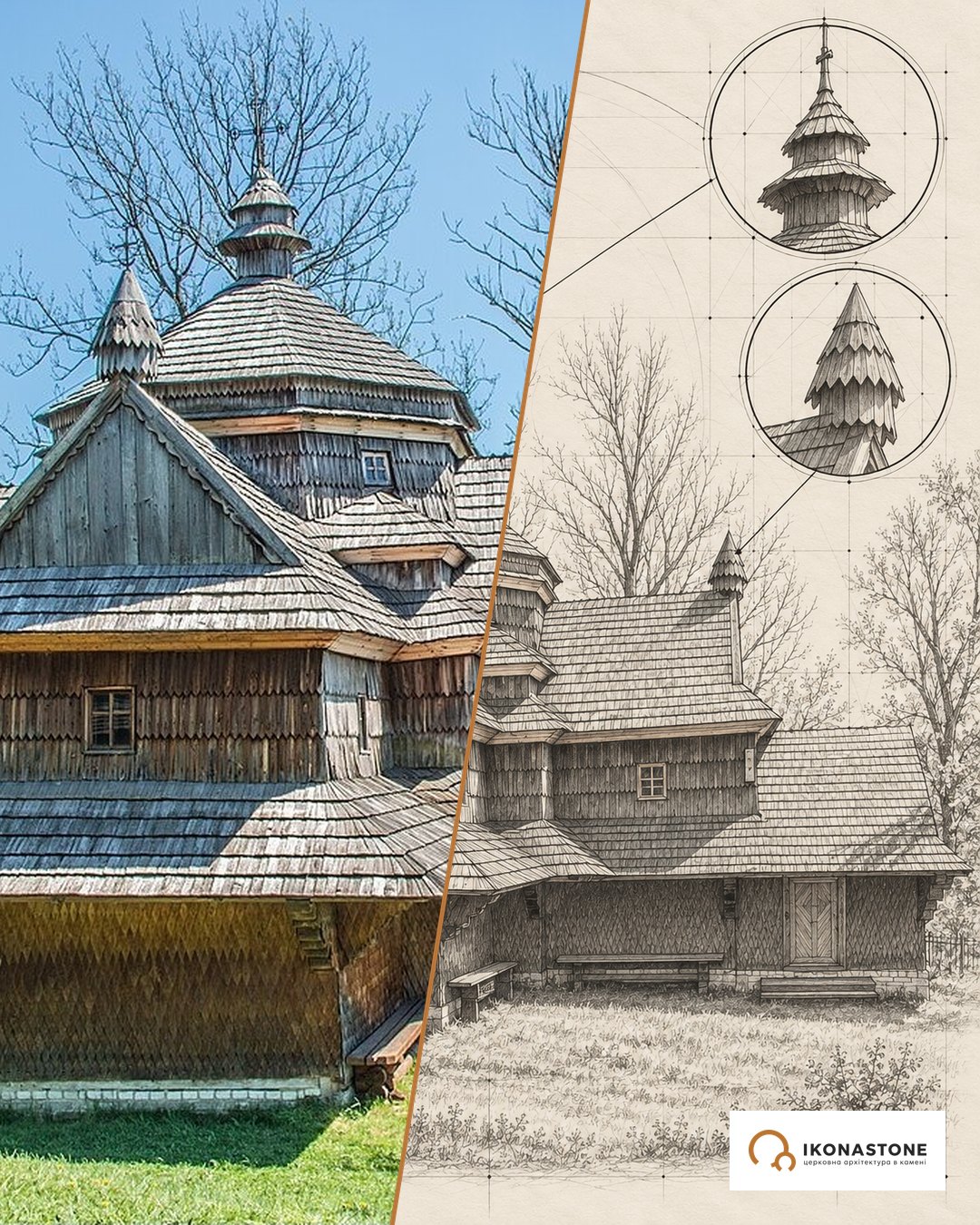
Below are two elements of the church: in a photo and in a drawing. The drawings show the form, not exact dimensions.
The octagonal top
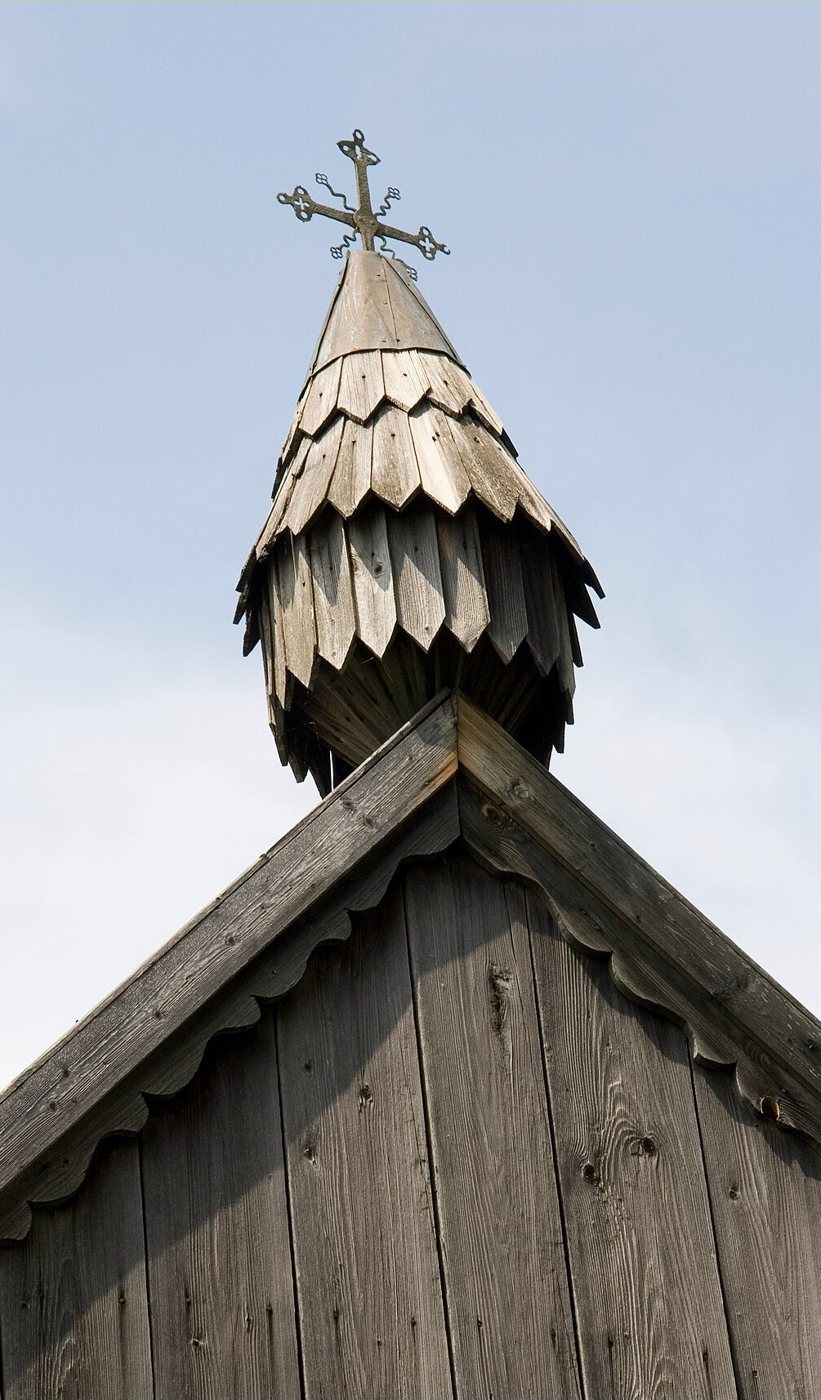
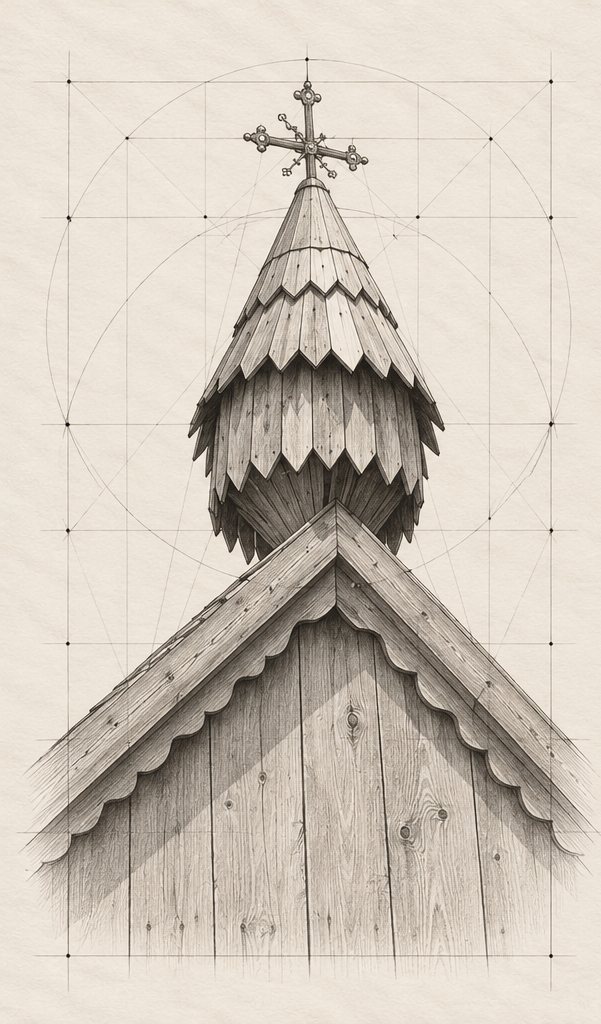
The single octagonal top stands above the central frame, at the crossing. The four arms of the cross are lower and act as a pedestal for it.
The bell tower
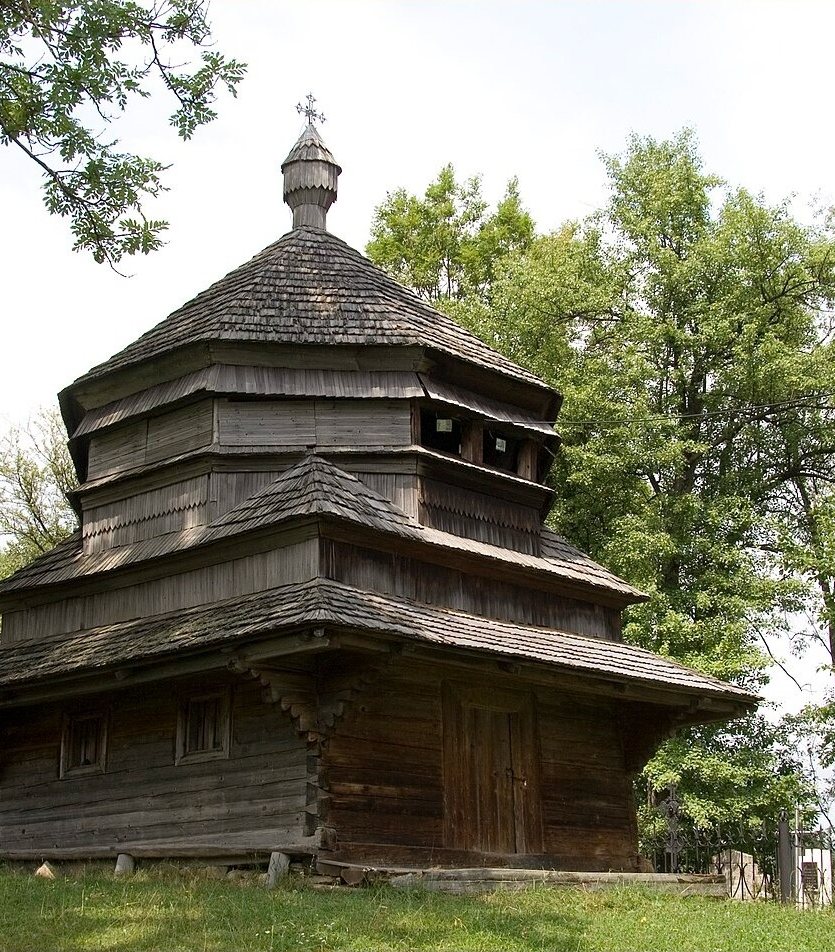
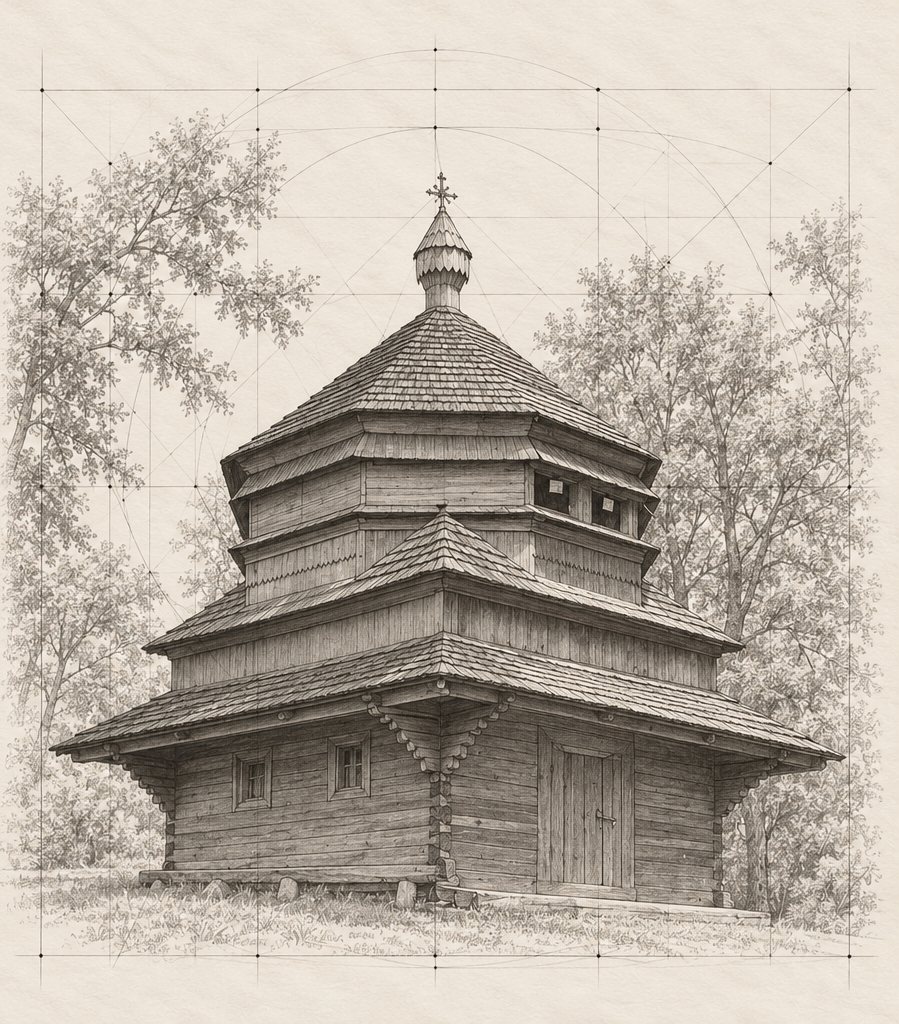
The bell tower, about 11 metres high according to Karpaty.rocks, is eleven years older than the church and has stood here since 1895.
Details that are easy to miss
The date on the door frame. Look for it by the entrance: three crosses and the year of construction, 1824, are carved on the door frame. It is at once the builders’ signature and the shortest chronicle of the church.
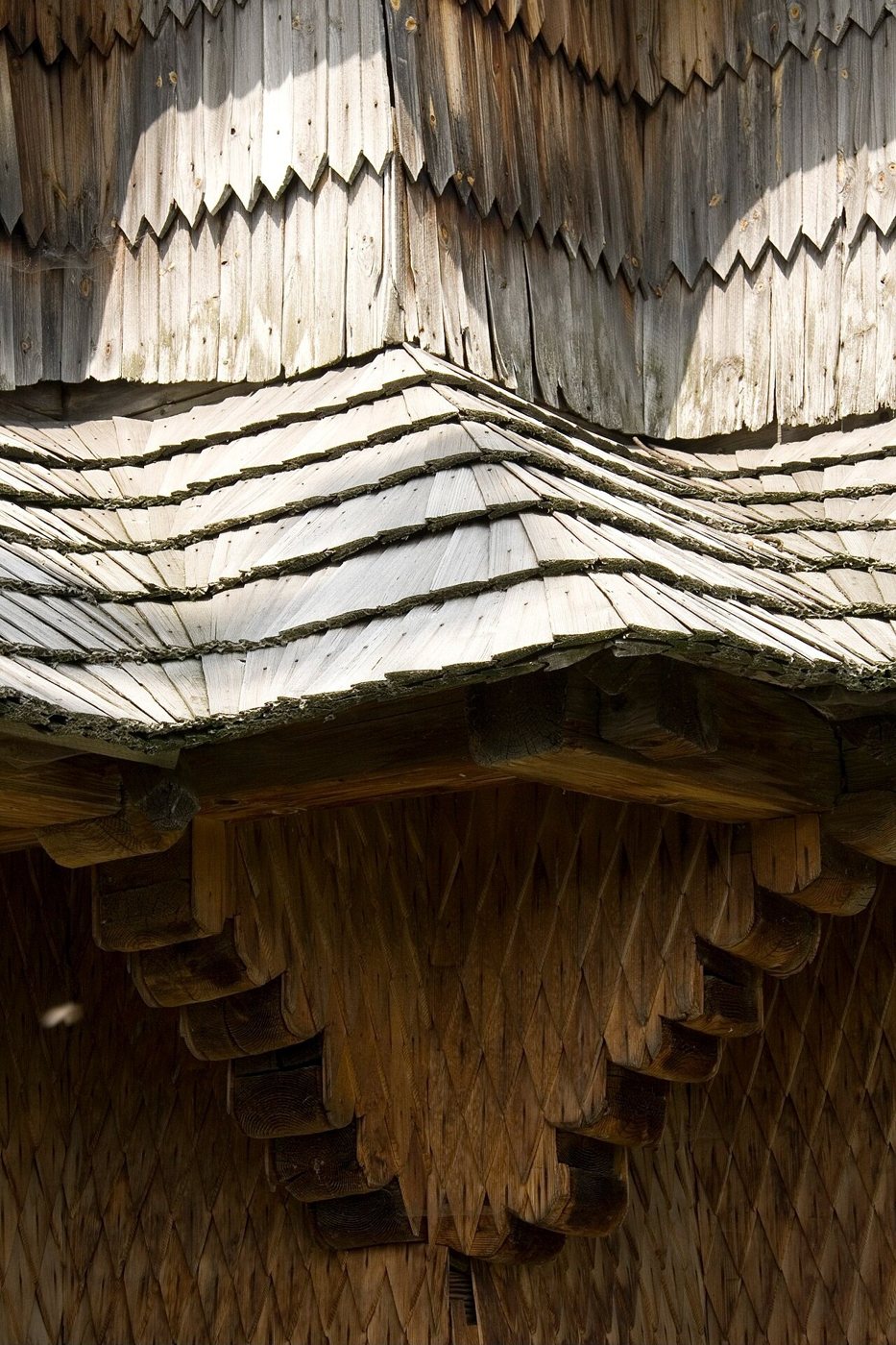
Shingles from the base to the cross. Look closely at the walls: here shingles cover not only the roofs, but almost all the vertical surfaces of the log frames. This blurs the boundary between wall and roof, and the church looks as if it were carved from a single material. Each shingle is a separate small piece that can be replaced without dismantling its neighbours.
A resettled bell tower. The bell tower was put up in 1813 next to another church and, according to local tradition, moved here in 1895, after that church burned down. In other words, the oldest structure of the ensemble is a guest that has settled in.
A church on a stamp. On 15 March 1939 the church appeared on the first postage stamp of Carpatho-Ukraine (3 korunas, inscribed “1. Sojm 2.III.1939”). The stamp was prepared as a Czechoslovak issue and put into circulation by decree of the President of Carpatho-Ukraine. In the 1930s the church had already appeared on postcards and in photo albums. Long before UNESCO, the church was already the region’s calling card.
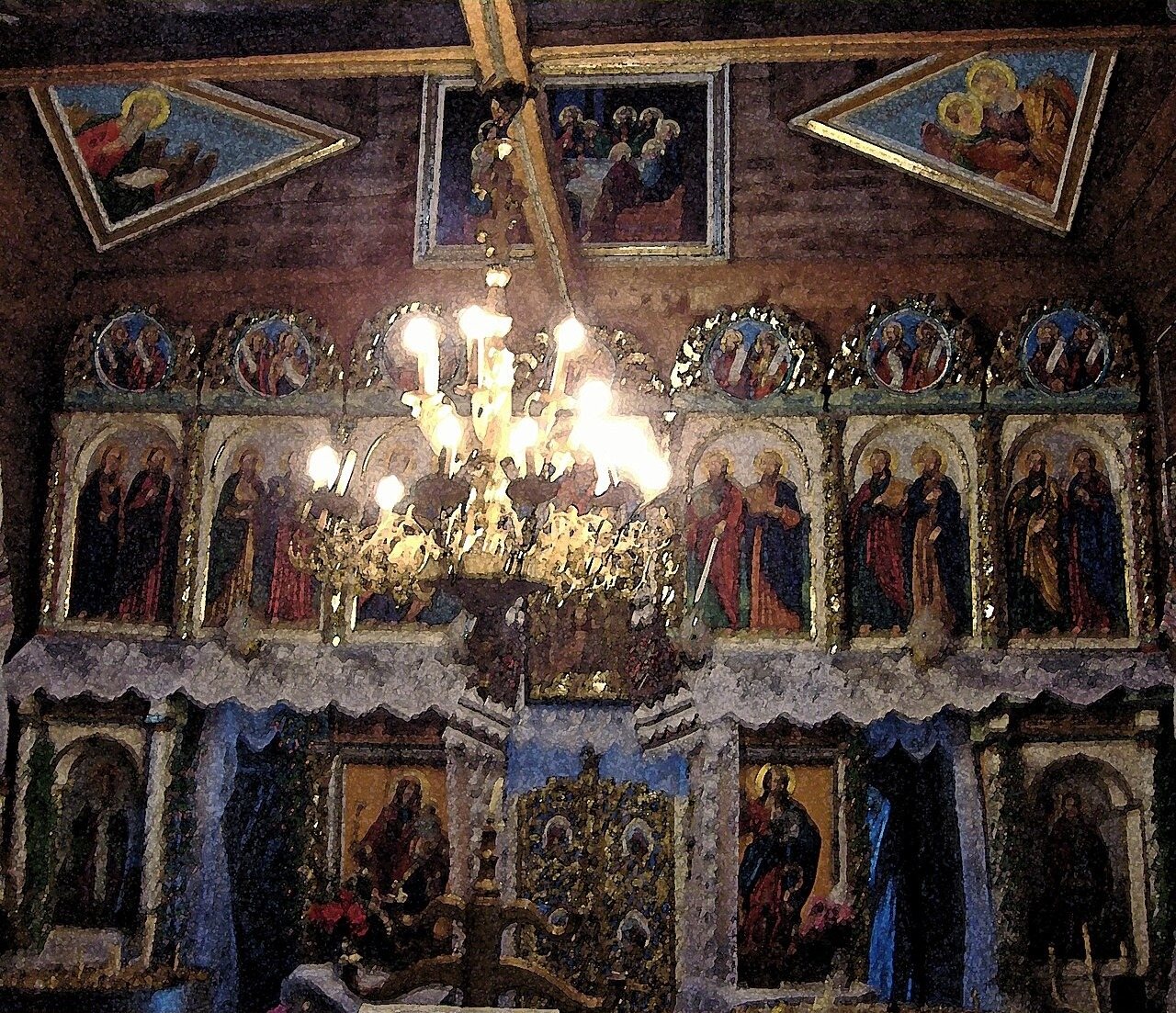
An iconostasis with two dates. The sources disagree about the iconostasis. The Wooden Churches of the Carpathians route and English Wikipedia say that the carved iconostasis dates from the time of construction; according to the route, its icons have been replaced. The Carpathian Biosphere Reserve dates the iconostasis to the end of the 18th century and mentions 17th-century icons and 19th-century banners.
Two communities under one top. Orthodox and Greek Catholics take turns holding services in the church. For a church built on the site of a shepherd’s chapel, this is perhaps the best continuation of its story.
A flock in an ash thicket. The legend of Ivan Struk is a shepherd’s one: a flock lost in the snow and found alive in spring (in the Outdoor Ukraine version), or a shepherd who sat out a blizzard under an ash tree (according to Eurofest). For a mountain region where the flock was the breadwinner, such a founding story is natural; there is no historical confirmation of it.
A “Nobel Prize” for a church. The researcher Mykhailo Syrokhman, commenting to Radio Svoboda on the 2013 UNESCO listing, called it a “Nobel Prize” for the Struk and St Michael’s churches.
Photo gallery
Stone and material
The church is entirely wooden: log frames, shingles on the walls and roofs, a wooden top. There is no stone here — and that, too, is a choice. A Hutsul church rests on the mountain, and its shingle shell works like scales: small elements are easy to replace one at a time without touching the whole.
There is a lesson in this for a stonemason too. A large monolith is impressive, but a complex form is often more reliably assembled from parts, with the joints thought out so that each piece can one day be replaced. The shingle scales of the Struk Church are two hundred years of proof that a small module can also be durable. Proportion matters too: a cruciform plan of five log frames distributes the mass evenly around the centre, and the single top gets a calm, symmetrical support from four sides. In a stone piece — an altar table or an icon case — the same logic holds: a symmetrical base allows the vertical to be bolder. And the chapel with which this story began is a reminder that a great church often grows out of a small structure; for modern chapels, see the products section.
How crosses like those carved on the door frame differ is covered in the article “Forms of the cross”. The second church from Zakarpattia on the UNESCO list is St Michael’s Church in Uzhok; another Hutsul church of the same property is the Church of the Nativity of the Theotokos in Nyzhnii Verbizh.
Did you know
The inscription of 1894 preserved the names not of the builders of 1824 but of those who renewed the church: Hryts and Petro Pavliuchok, Yura Spliashchuk (“Spashchuk” in sobory.ru) and the donor of the altar table, Vasyl Popadiuk. [4, 6, 7]
The church is shown on the first stamp of Carpatho-Ukraine; according to UPNS, its design almost repeats the Czechoslovak 60-haler stamp of 1928. [16, 22]
The stamp bears “2.III.1939” — the date for which it was prepared; it was issued on 15 March 1939. [4, 22]
According to derev.org.ua, the shingles and the work in 2006 cost UAH 12,000. [4]
The church stands on the southern outskirts of Yasinia, on a slope above the Chorna Tysa; the settlement stretches along the highway for about 20 km, so the distance “from the centre” varies in the sources, from 1 to 3 km. [4, 6, 7, 8]
The way to the church starts from the suspension bridge over the Chorna Tysa; according to go-to.rest, it is about 270 m on foot. [8, 11]
In 2013 Radio Svoboda called the bell tower one of the most accomplished monuments of folk architecture in Zakarpattia. [19]
In the UNESCO nomination the Yasinia church, together with the church in Nyzhnii Verbizh, represents the Hutsul type of wooden church. [1, 2]
According to English Wikipedia, the Yasinia component of the UNESCO property (1424-015) covers 0.13 ha. [15]
In 2013 Radio Svoboda dated the church “1813–1824”, combining the year of the bell tower with the year of the church. [18]
According to trip-impressions, a large batch of shingle boards is kept in the church yard for future repairs. [11]
According to ua-travels, the local dialect name of the settlement is “Yesinye”. [13]
Yasinia also has the Church of Sts Peter and Paul (1814) and the brick Church of the Protection of the Mother of God (1903), according to trip-impressions; the Transfiguration Church mentioned by karpaty.rocks stands in neighbouring Lazeshchyna. [10, 12]
Legends and tales
The flock in the ash thicket
According to legend, the shepherd Ivan Struk did not manage to drive his flock over the mountains before winter and left the sheep in an ash thicket; in spring he found them alive, with lambs besides, and built a chapel here. Recorded on derev.org.ua, in Karpatskyi obiektyv and on trip-impressions. [4, 5, 11]
Wolves and ash logs
According to legend, on Svydivets Struk fenced the flock off from wolves with ash logs; the sheep overwintered gnawing the bark. Recorded by Tourinform and go-to.rest. [7, 8]
A chapel on a stump
According to legend, Struk felled the ash under which the flock had overwintered and built a chapel on the stump. Recorded on go-to.rest. [8]
Where Struk came from
According to one legend, Struk was from the village of Zelene; according to another record, he drove his flock from the Dniester region over the Yablunytsia (Tatar) Pass. The versions do not agree with each other. Recorded on derev.org.ua, ua-travels and trip-impressions. [4, 11, 13]
The bell tower from the burned church
According to legend, in 1895 the bell tower was moved from the northern part of the village, where a church had burned down. Recorded on derev.org.ua, in Karpatskyi obiektyv and on sobory.ru. [4, 5, 6]
Without a single nail
According to a widespread tradition, the church was built without a single nail. Recorded on the Wooden Churches of the Carpathians route; not verified by documents. [9]
People
- Ivan Struk — a shepherd whom legend regards as the builder of the chapel and founder of the settlement; not historically attested.
- Vasyl Popadiuk — donor of the altar table, 1894.
- Hryts Pavliuchok and Petro Pavliuchok — masters of the church’s renewal in 1894.
- Yura Spliashchuk (Spashchuk) — master of the church’s renewal in 1894.
- B. Ya. Kindzelskyi — architect of the 1971 restoration.
- I. R. Mohytych — architect of the 1971 restoration.
- Ivan Pop and Dmytro Pop — researchers of wooden architecture in Zakarpattia; in 1971 they dated the church to the end of the 18th century.
- Mykhailo Parashchyk — the master who replaced the shingle roofing in February 2006.
- Mykhailo Syrokhman — art historian, author of the book “Fifty-Five Wooden Churches of Zakarpattia” (2008); called the UNESCO inscription a “Nobel Prize” for the churches of Yasinia and Uzhok.
- Tomasz Sopko — chief heritage protection specialist of the Zakarpattia Regional State Administration (2013).
- Vasyl Slobodian — researcher of sacred architecture, member of the joint expert commission on the nomination (2012).
- Yurii Kopynets — author of the article on the church in Karpatskyi obiektyv (2020).
- Stepan Klochurak — head of the Hutsul Republic (1919); his monument stands in Yasinia in front of the museum.
- Dmytro Klympush — organiser of the Hutsul Republic, according to trip-impressions.
How to cite
IKONASTONE. Church of the Ascension (Struk Church) in Yasinia // Guide to the Churches of Ukraine. URL: https://ikonastone.com/en/guide/ascension-church-yasinia/ (accessed DD.MM.YYYY).
FAQ
Why is it called the Struk Church?
According to legend, the name is linked to a local shepherd, Ivan Struk, who built a chapel on this spot. The church of 1824 was built on the site of that Struk chapel.
When was the church built?
In 1824. The date, together with a composition of three crosses, is carved on the door frame. The bell tower is older: it was built in 1813 next to another church and moved here in 1895.
How is the church laid out?
It is a Hutsul church on a cruciform plan: five log frames form a cross, and an octagonal top rises above the central one. The walls and roofs are almost entirely covered with shingles.
Is the church in use?
Yes. According to the Wooden Churches of the Carpathians route, Orthodox and Greek Catholic communities hold services in it in turn.
When was the church added to the UNESCO list?
In June 2013, as part of the property “Wooden Tserkvas of the Carpathian Region in Poland and Ukraine”. Two churches from Zakarpattia were included — the Struk Church in Yasinia and St Michael's in Uzhok.
Sources
- UNESCO World Heritage Centre. Wooden Tserkvas of the Carpathian Region in Poland and Ukraine (1424)
- UNESCO World Heritage Committee. Decision 37 COM 8B.37
- UNESCO World Heritage Centre. Новина від 21.06.2013 про внесення двох нових об'єктів
- Derev.org.ua. Струківська церква (Вознесіння Господнього), Ясіня
- Ю. Копинець. Церква Вознесіння Господнього (Струківська) у Ясінях. «Карпатський об'єктив» (02.08.2020)
- Sobory.ru. Церковь Вознесения Господня, Ясиня
- Турінформ Закарпаття. Струківська церква — спадщина ЮНЕСКО у Ясіня
- Go-to.rest. Струківська церква, Ясіня
- Дерев'яні храми Карпат (маршрут). Church of the Ascension (Strukivska), Yasinia
- Karpaty.rocks. Strukivska (Ascension) Church, Yasinia
- Trip-impressions. Ясіня. Струківська церква Вознесіння Господнього (2022)
- Trip-impressions. Ясіня. Історичний, туристичний, культурний центр Закарпаття (2022)
- Ua-travels (LiveJournal). Ясіня. Особливо храм Вознесіння
- Wikipedia (en). Church of the Ascension, Yasinia
- Wikipedia (en). Wooden Tserkvas of the Carpathian Region in Poland and Ukraine
- Wikipedia (en). Yasinia
- Wikipedia (en). Hutsul Republic
- Радіо Свобода. Дерев'яні церкви Карпат внесено до списку ЮНЕСКО (21.06.2013)
- Радіо Свобода. Н. Петрів. Дерев'яні церкви Закарпаття після ЮНЕСКО (02.07.2013)
- Радіо Свобода. Ю. Савицький. Українсько-польська заявка на дерев'яні церкви (11.01.2012)
- УНІАН. Як зберегти дерев'яні церкви Карпат (13.02.2012)
- Ukrainian Philatelic & Numismatic Society. Carpatho-Ukraine stamps
- Town
- Yasinia, Zakarpattia Oblast
- Built
- 1824; bell tower 1813
- Type
- Hutsul cruciform church of five log frames with a single octagonal top
- Material
- wooden log frames, shingles
- Research depth
- 28%