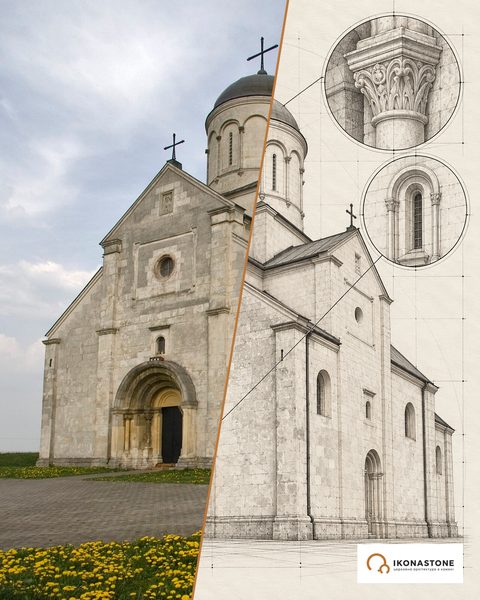
The Exaltation of the Cross Cathedral of the Maniava Skete: a church rebuilt after its model
The most precious thing of this cathedral has lived elsewhere for more than a century: its iconostasis passed through Bohorodchany, Kraków, Vienna and Warsaw before settling in Lviv.
In brief
| Address | 16 Skytova St, Maniava village, Ivano-Frankivsk Oblast |
| Churches on the site | 1612 (first wooden one), 1619, 1681 (on a stone foundation) |
| Fate of the old church | 1785 — the skete was closed; 1793 — the church was sold and moved to Nadvirna (VUE and ESU date the move to 1785); 1914 — burned down |
| Reconstruction | 2002, designed by the architect-restorer I. Mohytych |
| Type | wooden cruciform single-domed church of the Hutsul type |
| Status | main church of the Maniava Exaltation of the Cross Monastery of the Orthodox Church of Ukraine |
History
The Maniava Skete stands on a small mountain plateau among the forests of the Carpathians. Tradition dates the beginnings of monastic life here to the 13th century: the monks Ioanykii and Pakhomii, who left Kyiv after 1240, supposedly founded an Exaltation of the Cross monastery nearby, later destroyed. This story is not confirmed by documents.
The documented history begins in the early 17th century. The skete was founded by Iov Kniahynytskyi, a former monk of Mount Athos; VUE and Wikipedia write of the first community in 1606; Radio Svoboda gives 1608 as the year of the first written evidence of the community, and ESU and Radio Svoboda place the first cell in 1611. Articles on Iov also disagree about who was the first hegumen: Iov or his nephew Theodosius. Ivan Vyshenskyi and Zakhariia Kopystenskyi are also named among the founders. In 1612 the first wooden church was built in honour of the Exaltation of the Precious Cross, and in 1619 a larger one. VUE writes that it was built after the model of the cathedral of the Mezhyhiria Transfiguration Monastery; according to Wooden Churches of Ukraine (Derevʼiani khramy Ukrainy), only the plan and the Baroque cupolas were shared with the Mezhyhiria church.
In 1620 (according to Wikipedia, 1621) the Patriarchate of Constantinople granted the skete stauropegial status, and in 1628 the Kyiv Council made it the chief monastery for the Ruthenian, Belz and Podolian voivodeships — more than five hundred monasteries. There were schools of icon painting and part singing and a large library. At its height about two hundred monks lived in the skete. The complex consisted of cells and churches, the main one being the Exaltation of the Cross.
In 1652, during a plague epidemic, Hieromonk Filaret, according to tradition, saw the Mother of God in a dream. In memory of this vision, as Wikipedia writes, an icon known as the Maniava Hegumenia was painted.
During the Polish–Ottoman war of 1673–1676 the skete was destroyed; ESU gives the year 1676. In 1681 a new wooden cruciform church was built on a stone foundation; Architectural Monuments (Pamʼiatky arkhitektury), as quoted by Wooden Churches of Ukraine, gives its material as yew and cedar. In 1698–1705 Iov Kondzelevych’s workshop painted the interior and made the iconostasis.
In 1785 the Austrian authorities closed the skete: on 1 July by decree of Emperor Joseph II (so write the English Wikipedia and the article in the Lviv Polytechnic Bulletin), in September according to ESU. The library was taken away — its books, according to VUE, are now partly in Vienna and partly in Lviv — and the property was sold or removed. The iconostasis was bought by the Holy Trinity Church in Bohorodchany, and the Exaltation of the Cross Church itself was dismantled and moved to Nadvirna. There it burned down during the First World War, in 1914.
In 1972–1980 the skete’s defensive buildings were restored, and in 1980–1998 a museum of history and architecture operated here. In 1993, according to ESU, periodic services resumed, and in 1998 the monastery was revived. In 2002, according to VUE, the Exaltation of the Cross Church was reconstructed after the model of the burned one; the design was by the architect-restorer I. Mohytych.
Timeline
The numbers in square brackets are the numbers of sources in the list at the bottom of the page. The note “according to …” means that the fact is confirmed by only one source. The “Legends” section contains traditions and legends: they are recorded in the sources but not confirmed by documents.
Tradition and beginnings
- 13th c. (according to tradition)
The monks Pakhomii and Ioanykii, who left Kyiv after the Mongol invasion (1240), found in the Carpathian forest a spring beneath a large rock with a grotto, whose water was likened to that of the Kyiv Caves. This is not confirmed by documents. [11, 14, 17]
- c. 1550
Ivan Kniahynytskyi, the future Iov of Maniava, was born in Tysmenytsia; he studied at the Univ monastery school and in Ostroh, twice visited Mount Athos, where he took monastic vows with the name Ezekiel. [4, 10]
- 1606
Iov Kniahynytskyi formed the first monastic community near Maniava; VUE and Wikipedia name Ivan Vyshenskyi and Zakhariia Kopystenskyi as co-founders (no documentary confirmation of their participation has been found). [1, 3, 13, 19, 28]
- 1608
The year of the first written evidence of the community; Radio Svoboda, Zabytki and Discover.ua call it the year of foundation. The skete marked its 400th anniversary on 7 July 2008. [12, 14, 22, 29]
- 1611
The first wooden cell was built; a number of sources regard this very year as the year the skete was founded. [1, 2, 9, 10, 15]
Foundation and flourishing
- 1612
The first wooden church was built and consecrated on the feast of the Exaltation of the Precious Cross (13 September, according to the Lviv Polytechnic Bulletin). [1, 2, 7, 15, 29]
- 1618
About forty monks lived in the skete, according to the English Wikipedia. [3]
- 1619
From April the building of a larger Church of the Exaltation of the Precious Cross began; its founder was Maria Mohylianka, daughter of the Moldavian hospodar Jeremiah Movilă. VUE writes that the church was built after the model of the cathedral of the Mezhyhiria monastery. [1, 14, 17, 18]
- 1620
Patriarch Timothy II of Constantinople granted the skete stauropegial status (1621 according to the English Wikipedia and Etnosvit). [1, 2, 3, 10, 14, 17]
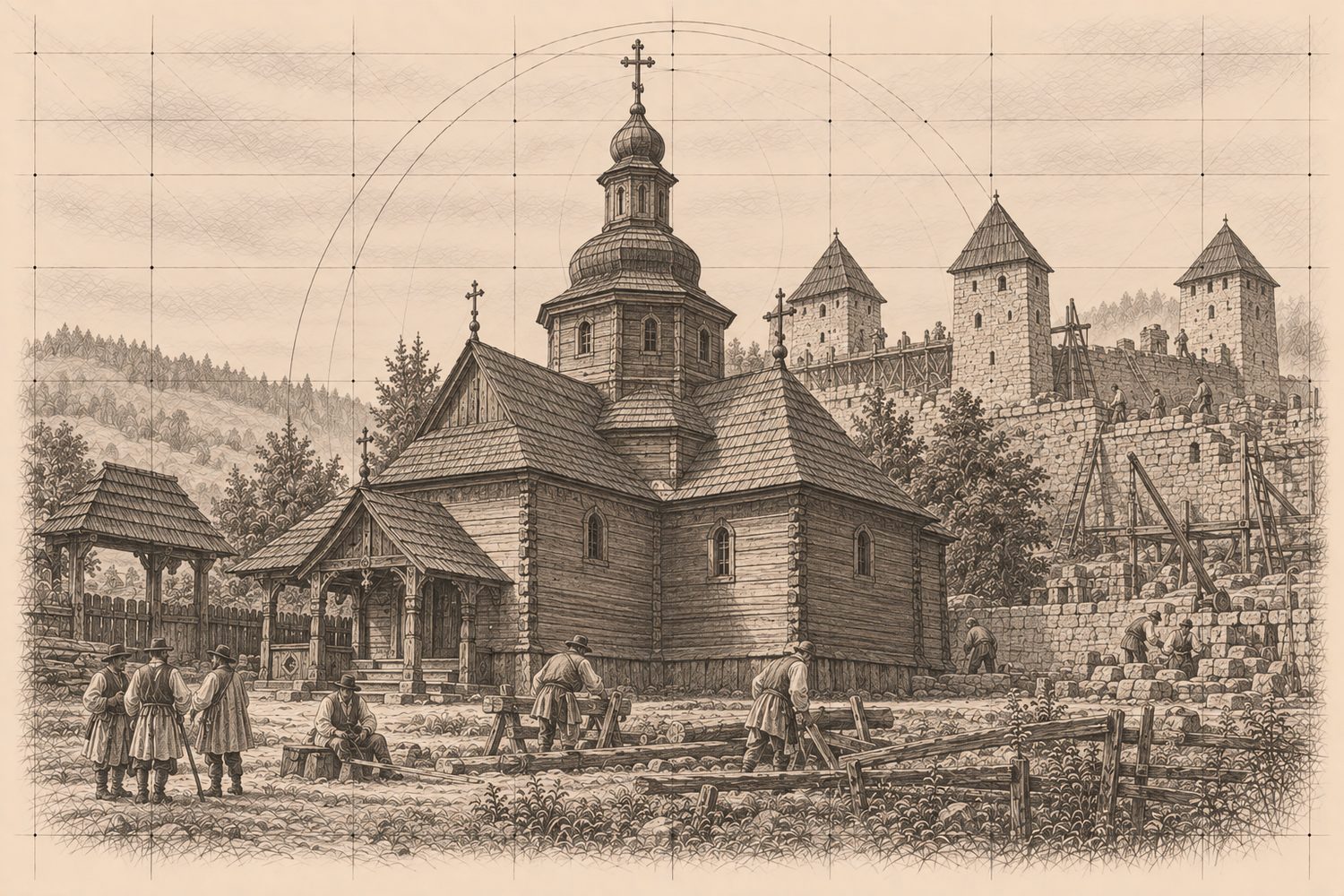
1620s: the wooden church and the skete walls. Illustration: IKONASTONE - Before 1621
The skete was enclosed by a stone wall with three defensive towers. [10, 17]
- 30 December 1621
Iov Kniahynytskyi died. According to the English Wikipedia, he was canonized in 1994 (UOC-MP) and on 15 July 2004 (UOC-KP). [4, 10]
- 1628
According to the English Wikipedia, the Kyiv Church Council recognized the skete as the “protos” for the monasteries of the Ruthenian, Belz and Podolian voivodeships; the number of subordinate monasteries is given as 556 (VUE dates this figure to 1686). [1, 3, 27]
- 22 December 1652
During the plague, Hieromonk Filaret, according to the English Wikipedia, saw the Mother of God in a dream; the memory of this is preserved by an icon kept in the skete. [3, 18]
- 1664
Hetman Ivan Vyhovskyi died; in his will he asked to be buried in the skete, but his burial place has not been established. [2, 12, 14]
Destruction and rebuilding
- 1673–1676
During the Polish–Ottoman war a Turkish-Tatar detachment of Ibrahim Sheitan seized and burned the skete; according to the Bulletin article, this happened after the enemy cut off the water supply. [1, 8, 12]
- 1680–1681
The monk Sylvestr (according to the Bulletin, not from the Maniava brotherhood) built the third wooden church on a stone foundation, of yew and cedar; in 1680 the Muscovite tsar Feodor Alekseyevich gave funds, vestments and books. [1, 2, 7, 12]
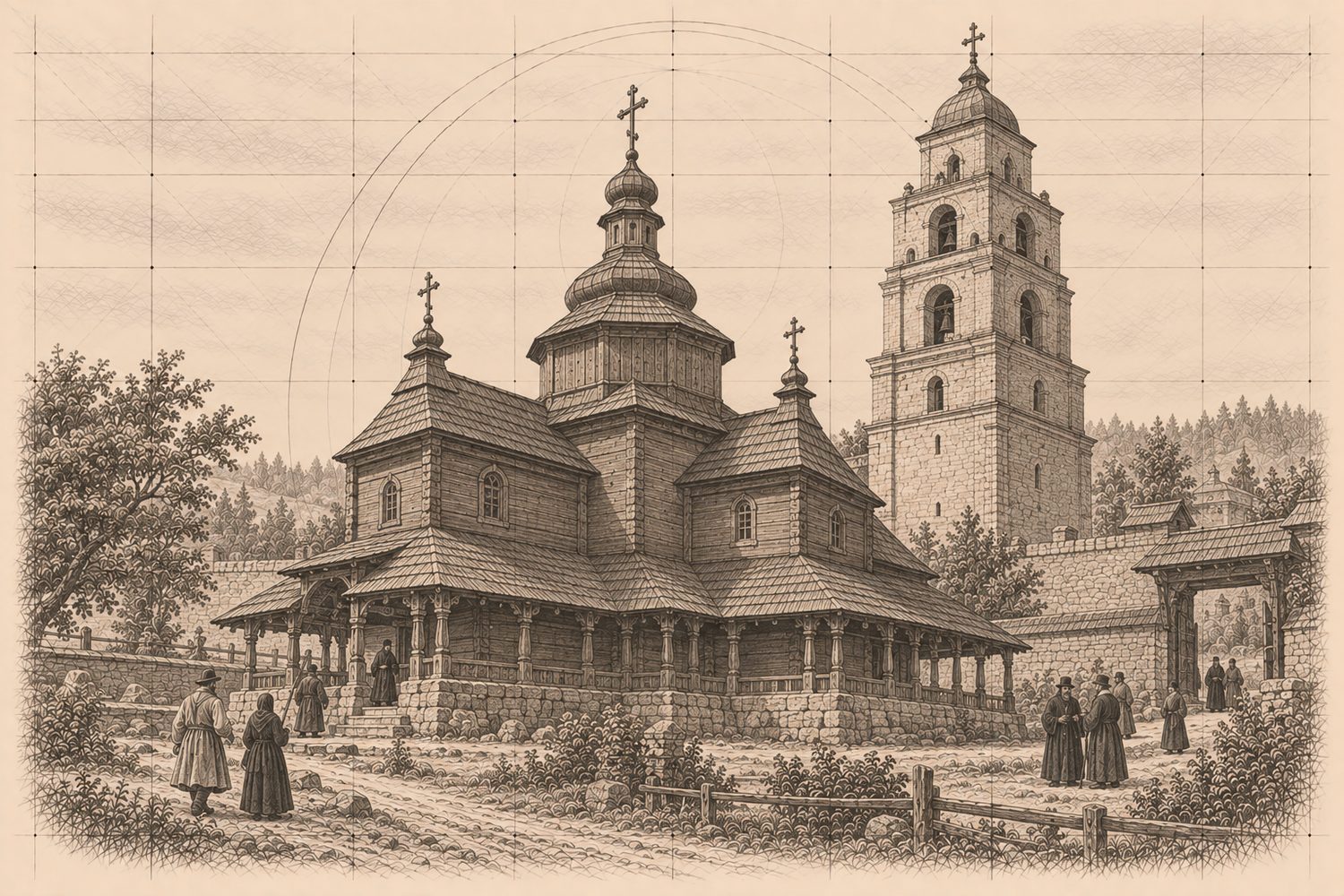
1681: the cathedral rebuilt. Illustration: IKONASTONE - 1698–1705
Iov Kondzelevych's workshop painted the interior of the church and made the iconostasis known as the Bohorodchany iconostasis (the National Museum in Lviv gives 1699–1705). [1, 2, 5, 6, 24]
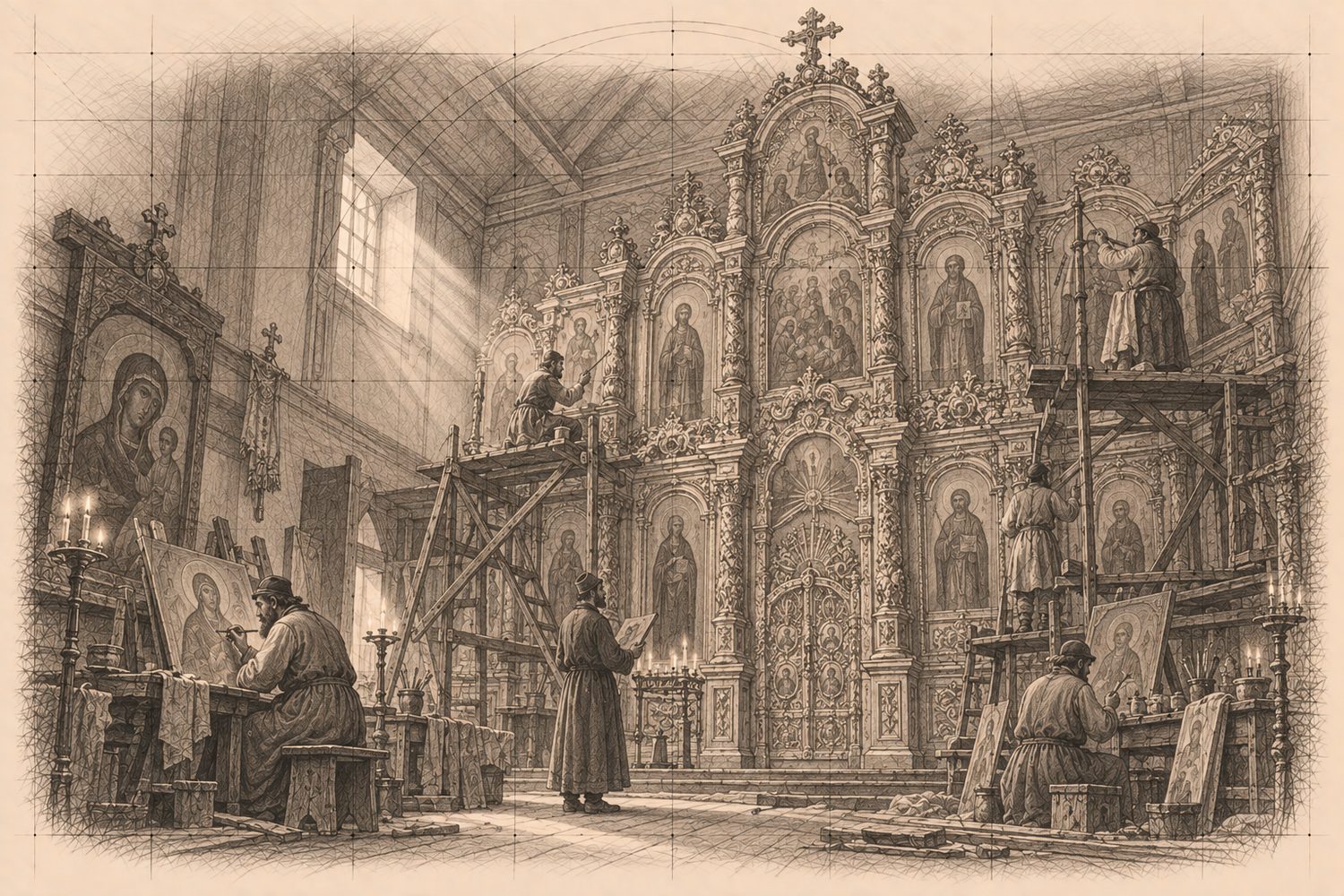
1698–1705: Yov Kondzelevych's workshop paints the iconostasis. Illustration: IKONASTONE - 1700
A difficult period begins: the skete loses its privileges and part of its subordinate monasteries, and the brotherhood shrinks to about thirty monks, according to Karpaty.rocks. [15]
- 1724
The Tatars, according to Zabytki, plundered the monastery. [14]
- 1781
The skete was repaired, according to the English Wikipedia. [3]
- 1785
The Austrian authorities closed the skete: on 1 July by decree of Joseph II (English Wikipedia, Bulletin), in September (ESU). The monks dispersed to Kyiv and Bukovyna, and the library was divided between Vienna and Lviv. [1, 2, 3, 7]
- 1785
Kondzelevych's iconostasis was transferred to the Holy Trinity Church in Bohorodchany (sold for 60 zlotys, according to the Bulletin); since then it has been called the Bohorodchany iconostasis. [1, 2, 5, 6, 7]
- 1793
According to the Lviv Polytechnic Bulletin and Karpaty.rocks, the Exaltation of the Cross Church was sold for 200 zlotys to Nadvirna and rebuilt there; VUE and ESU date the move to 1785. [1, 2, 7, 16]
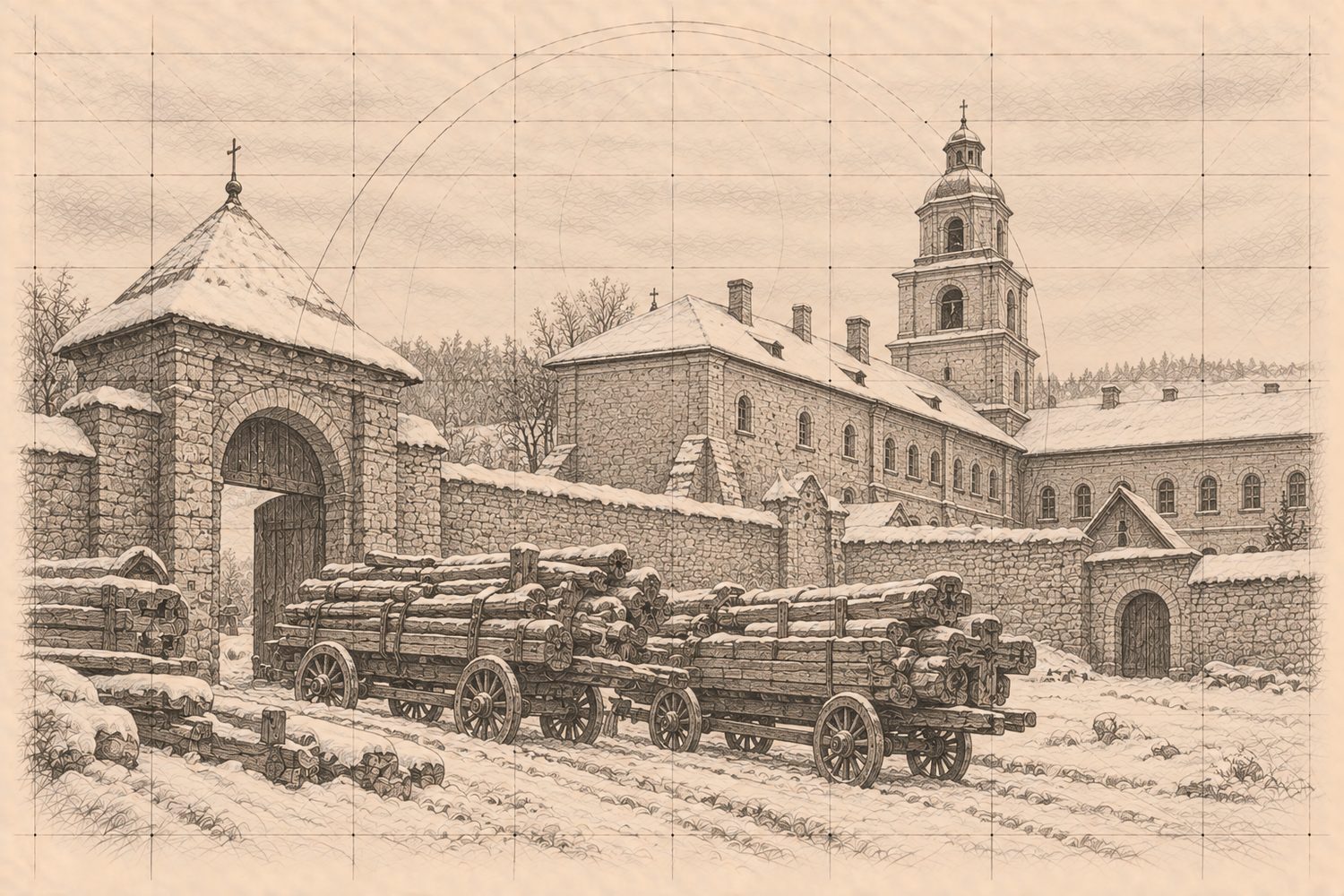
Late 18th century: the cathedral is dismantled and taken away. Illustration: IKONASTONE
Ruin, war and research
- 1848, 1887
Ivan Vahylevych published a historical study of the skete (1848); “The History of the Maniava Skete” by Yu. Tsilevych came out in Lviv (1887). According to ESU. [2]
- 1905, 1911
The monument conservators Z. Hendel and P. Skobelskyi warned of the danger of the wall's corner section collapsing (1905); T. Moklowski made measurements and a site plan: the perimeter consisted of fragments of walls and four towers (1911). According to the Bulletin article. [8]
- 1914
The Exaltation of the Cross Church, moved to Nadvirna, burned down during the First World War. [1, 2, 7, 16]
- 1916
Austrian troops dismantled the Bohorodchany iconostasis and took it to Kraków, then to Vienna. [1, 6, 7, 25]
- 1920–1924
The iconostasis ended up in a museum in Warsaw; in 1923 (ESU, Bulletin) or 1924 (VUE, National Museum) it was transferred to the National Museum in Lviv at the request of Metropolitan Andrey Sheptytsky. [1, 2, 5, 6, 7, 25]
- 1930
Graduates of the Lviv Academic Gymnasium, on a journey through Galicia, photographed the ruins of the skete. The photographs are kept by the Center for Urban History (the Lesia Krypiakevych collection). [23]
- 1935–1936
The archaeologist Yaroslav Pasternak uncovered the foundations of the Exaltation of the Cross Church (a stone foundation, two brick crypts) and underground chambers. [7, 8]
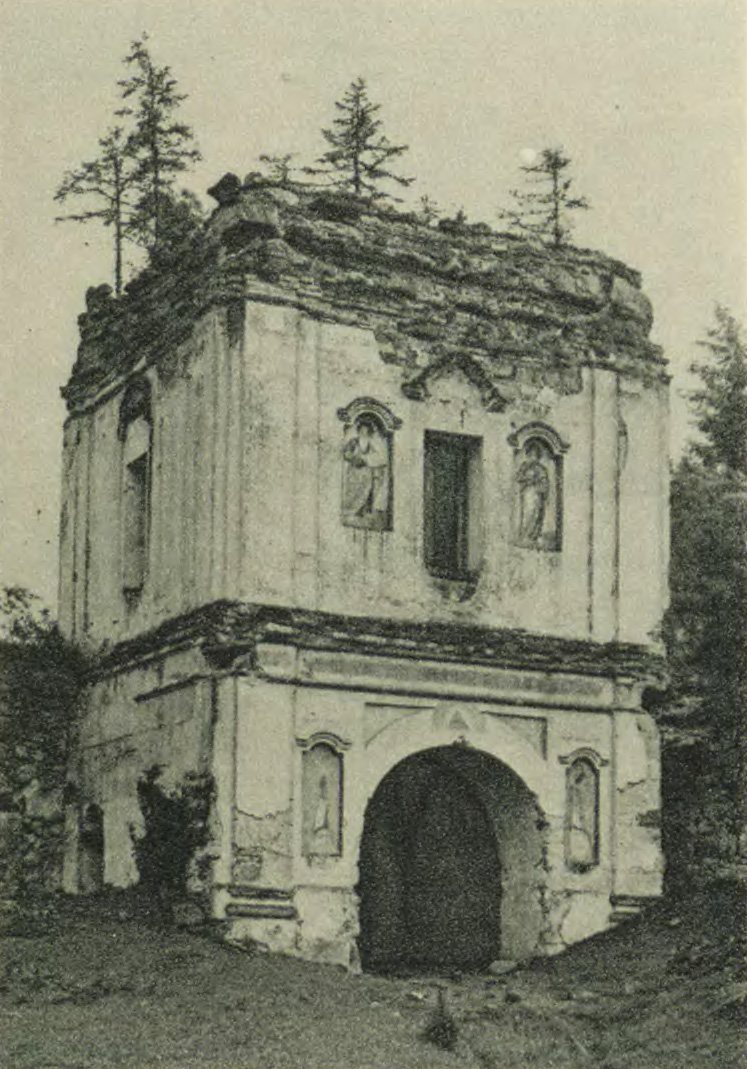
Ruins of the Maniava Skete. Illustration from F. A. Ossendowski's book “Hutsulshchyna”, 1936. Wikimedia Commons, public domain 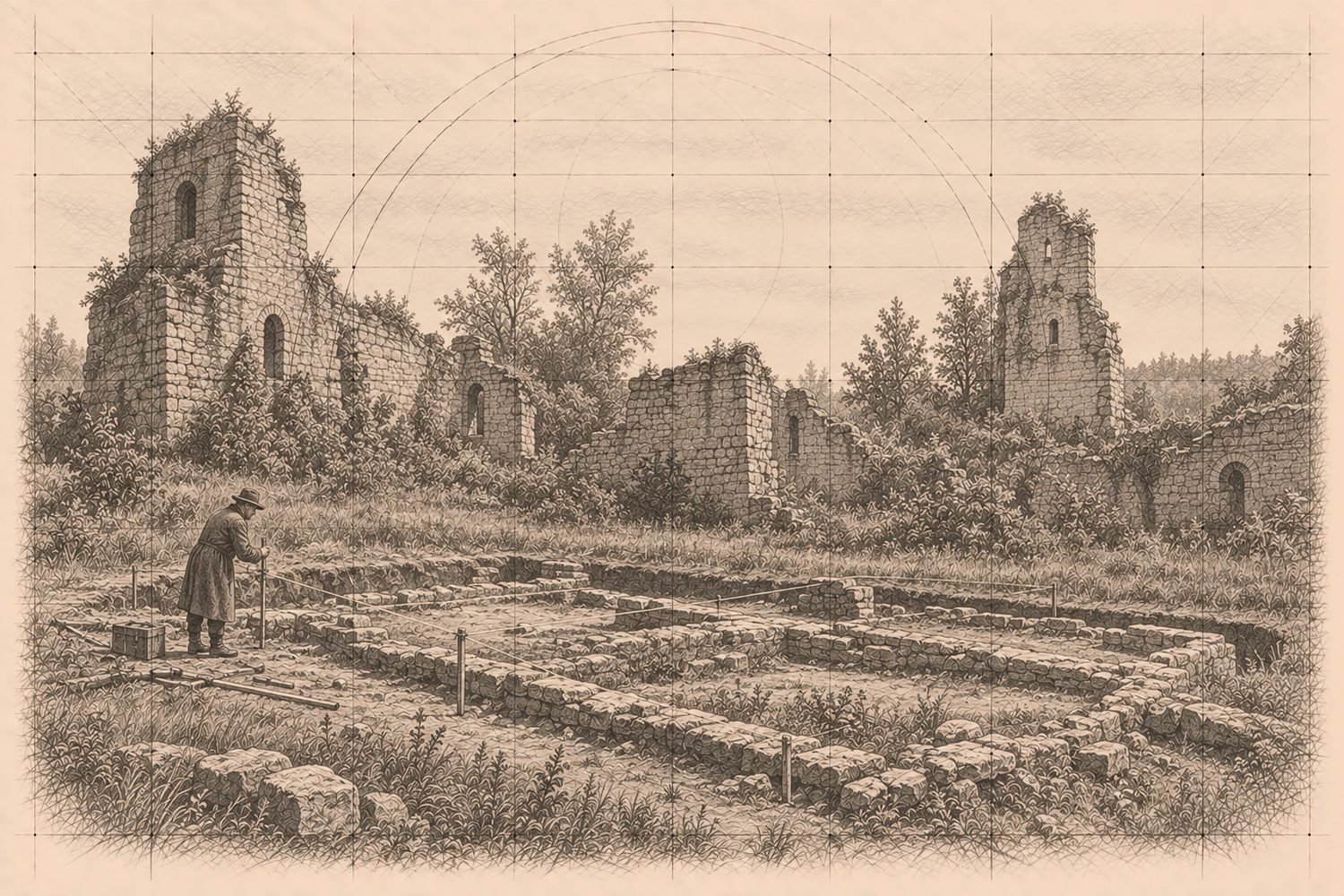
1935–1936: Yaroslav Pasternak's excavations. Illustration: IKONASTONE
Museum and revival
- 1972–1980
Restoration of the skete's defensive buildings to a design by I. Mohytych: the towers, walls, refectory and cells were restored. [1, 8, 9]
- 1980
A museum of history and architecture opened (until 1998 a branch of the Ivano-Frankivsk Regional Museum). [1, 14, 20, 21]
- February 1986
Because the chimneys lacked fire-proof collars, the northern wooden cells caught fire; in 1988 a flood of the Baters stream inundated the foundations of the refectory and four cells. According to Hutsuliak. [9]
- 28 May 1998
The skete was handed over to the Ivano-Frankivsk eparchy of the UOC-KP (now the OCU) and a men's monastery was opened; the complete transfer was on 30 November 1999, according to Pro Ruskavets. [1, 18, 21]
- 2002
The wooden Exaltation of the Cross Church was reconstructed after the model of the one burned in 1914; the design was by the architect-restorer Ivan Mohytych; a new iconostasis was installed after the model of the original. [1, 7, 19]
- 20 October 2002
According to Pro Ruskavets, the church was consecrated by six hierarchs, and more than 30,000 faithful gathered. [18]
- Christmas 2002, 12 January 2003
President Leonid Kuchma visited the monastery and, according to Pro Ruskavets, took the rebuilding under his patronage. [18]
- 2003
Ioann (Vasyl Hryniuk), the first hegumen of the revived monastery, died and was buried on the territory of the skete (according to the English Wikipedia); on 25 June the icon of the Mother of God Hodegetria “Deliverer from Evil” was brought to the skete (according to Pro Ruskavets). [3, 18]
- 2008
The skete marked the 400th anniversary of the written evidence of the community. [12]
- 2010–2014
The Carpathian archaeological expedition led by M. Kuhutiak studied the skete; in 2011 the foundation of a hexagonal wooden tower was found beyond the Baters stream. [8]
- 2011–2014
According to Zabytki, the Church of the Annunciation was built in 2011; according to Pro Ruskavets, on 15 December 2013 Metropolitan Ioasaf consecrated a new refectory, and in June 2014 a wooden chapel for summer services was built. [14, 18]
- December 2020
The National Museum in Lviv, together with the NGO “My Future Heritage”, made a 3D model of the Bohorodchany iconostasis (about 40,000 photographs, about two months of scanning). [24, 26]
- 12 May 2026
According to Ukrinform, a mountain stream is washing away the soil beneath the walls of the skete; almost UAH 12 million has been allocated from the regional budget for bank reinforcement, and design work is under way. [28]
Lost and recreated
| What | What it was | What happened | Where it is now |
|---|---|---|---|
| Exaltation Church of 1612 | The first wooden church of the skete | Replaced by a larger church from 1619 | Not preserved [1, 7, 15] |
| Exaltation Church of 1619 | A larger wooden church, founded by Maria Mohylianka | Burned in 1676 | Not preserved; became the model for Hutsul cruciform churches [1, 7, 8, 14] |
| Exaltation Church of 1681 | Wooden, on a stone foundation, of yew and cedar | Dismantled and moved to Nadvirna in 1785–1793, burned in 1914 | Recreated in 2002 on the site of the skete [1, 2, 7, 16] |
| The Bohorodchany iconostasis | Created 1698–1705 by Iov Kondzelevych | 1785 — to Bohorodchany; 1916 — taken to Kraków and Vienna; then Warsaw | National Museum in Lviv named after Sheptytsky (since 1923/1924) [1, 5, 6, 25] |
| The skete’s library | A large library of early printed books | Taken away after 1785 | Partly in Vienna, partly in Lviv [1, 12] |
| Gravestone of Iov and Theodosius, the ambo | Exaltation of the Cross Church | Transferred to the church in the village of Markiv | Place of keeping needs clarification, according to the Bulletin [7] |
| Walls and towers of the skete | A wall with three towers before 1621 | Fell into decay after 1785; restored 1972–1980 | Preserved and restored [1, 8, 10] |
| The Treasury tower | Four tiers, 22.7 m high (according to Zabytki) | Restoration of the 1970s | Preserved [8, 14] |
| The gate bell tower | According to Zabytki, first half of the 17th c., funded by Morozenko | Restored in the 1970s–1980s | Preserved [8, 14] |
| The refectory | The oldest building of the skete | Flooded by the Baters stream in 1988 | Preserved, restored [8, 9] |
| Northern wooden cells | Cells | February 1986 — fire | Restored [9] |
| The spring beneath the Blessed Stone | Near the skete, healing according to tradition | Did not flow for almost three centuries, resumed after the monastery’s revival (according to tradition) | Flowing [11] |
| Tomb of Hetman Vyhovskyi | A probable burial vault beneath the cathedral | Burial place not established | Unknown [12, 14] |
Architecture
The Exaltation of the Cross Church belonged to the Hutsul type: cruciform in plan, single-domed, surrounded by a pent roof (opasannia) around its perimeter. Wooden Churches of Ukraine describes it as having three faceted arms and proportions traditional for the Hutsul region, and notes that the 1619 church became the model for Hutsul cruciform churches. The reconstructed cathedral repeats this type.
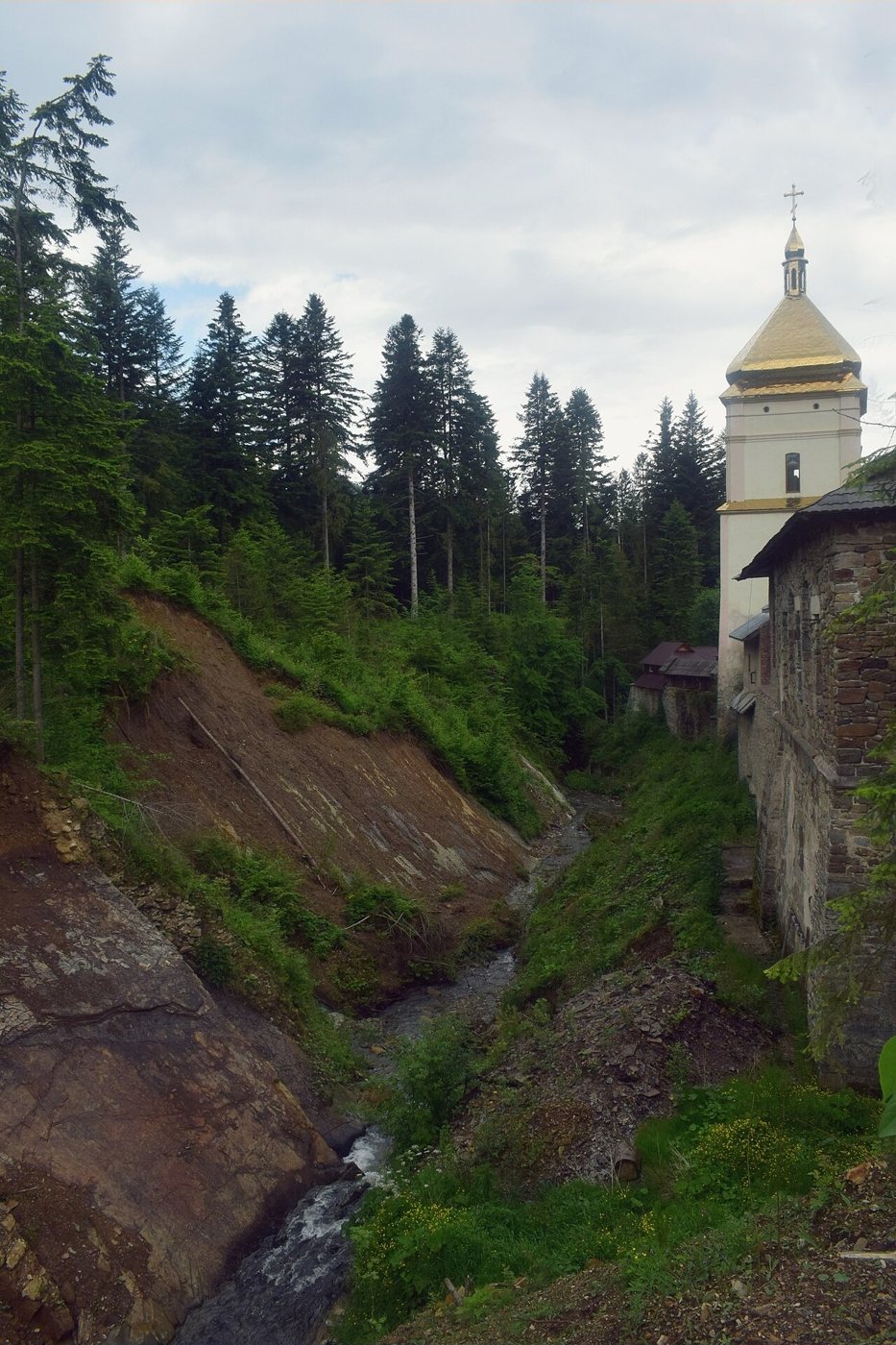
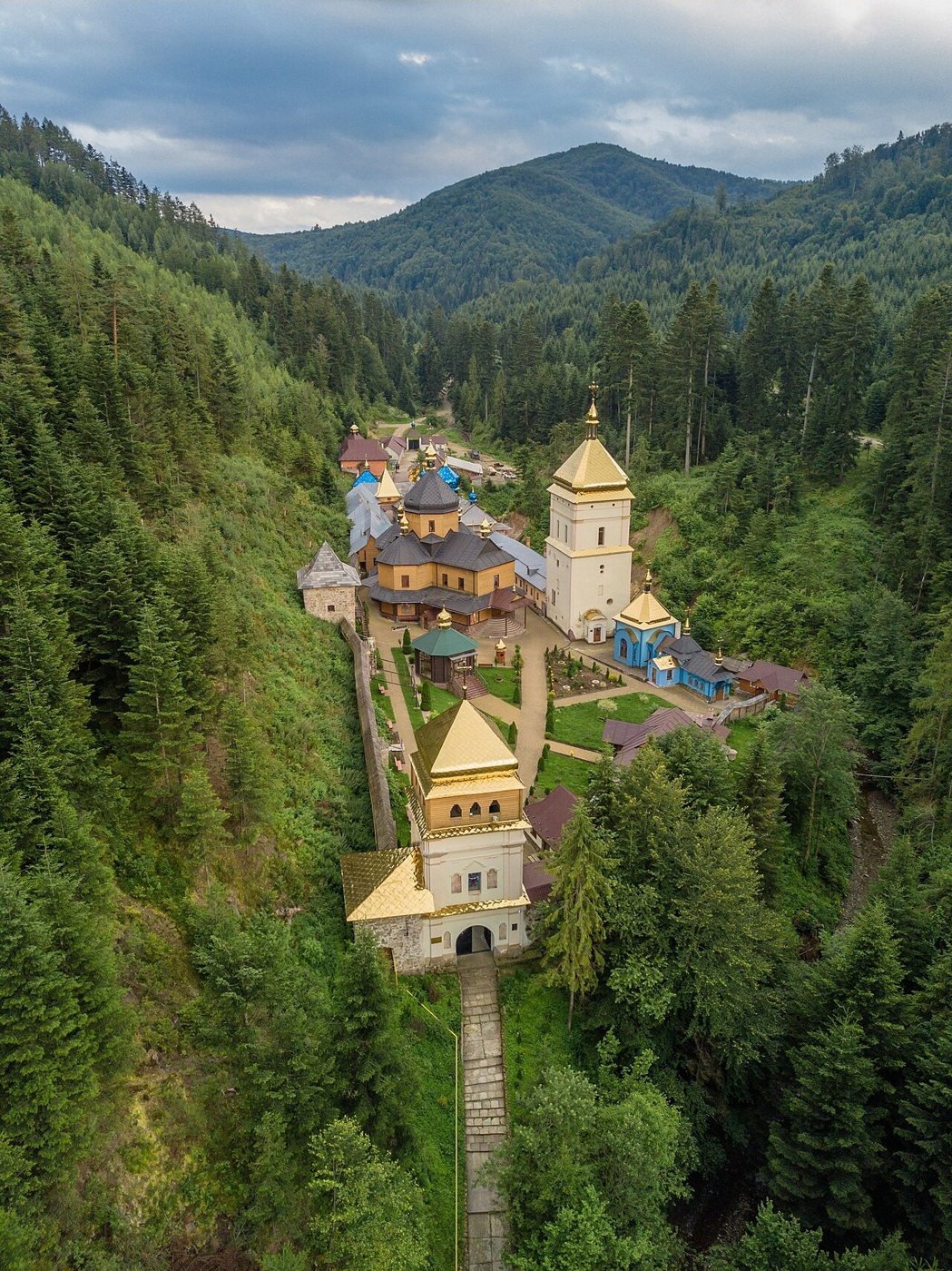
Around it is the stone defensive part of the 17th century. The ensemble is enclosed by a wall with towers: a three-tier entrance bell tower in the north-west, a two-tier tower with a tent roof in the middle of the north-east wall, and the four-tier High Tower, or Treasury, in the middle of the south-east wall. Zabytki gives the height of the Treasury as 22.7 metres. In the south-east part is a two-storey refectory. The dating of the entrance bell tower varies: Zabytki assigns it to the first half of the 17th century and writes that it was funded by the Korsun colonel Stanislav-Nestor Morozenko (died 1649), while Wooden Churches of Ukraine dates the tower to 1681–1684. By the south wall of the northern courtyard stands the stone Church of Sts Borys and Hlib, which Zabytki dates to 1620.
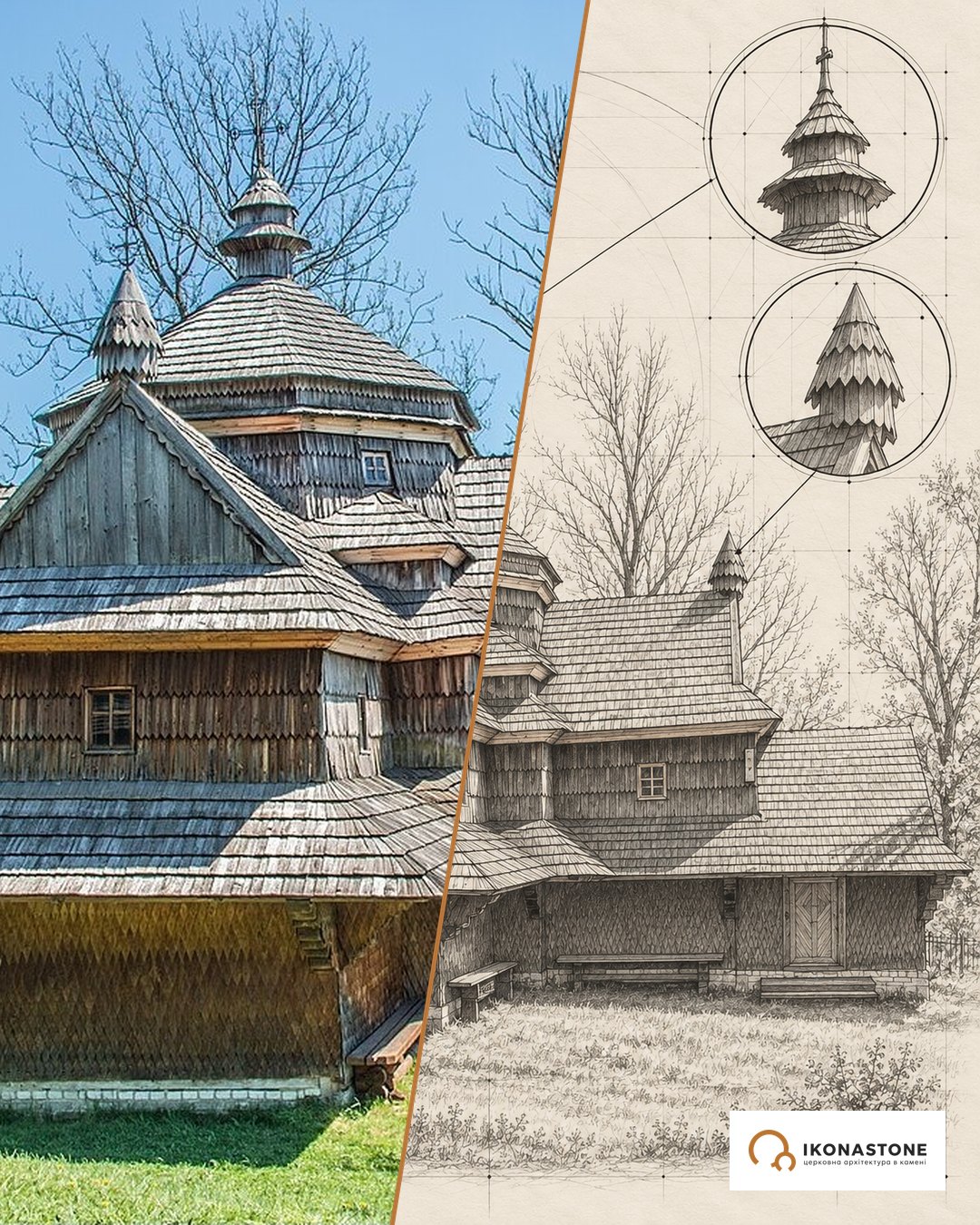
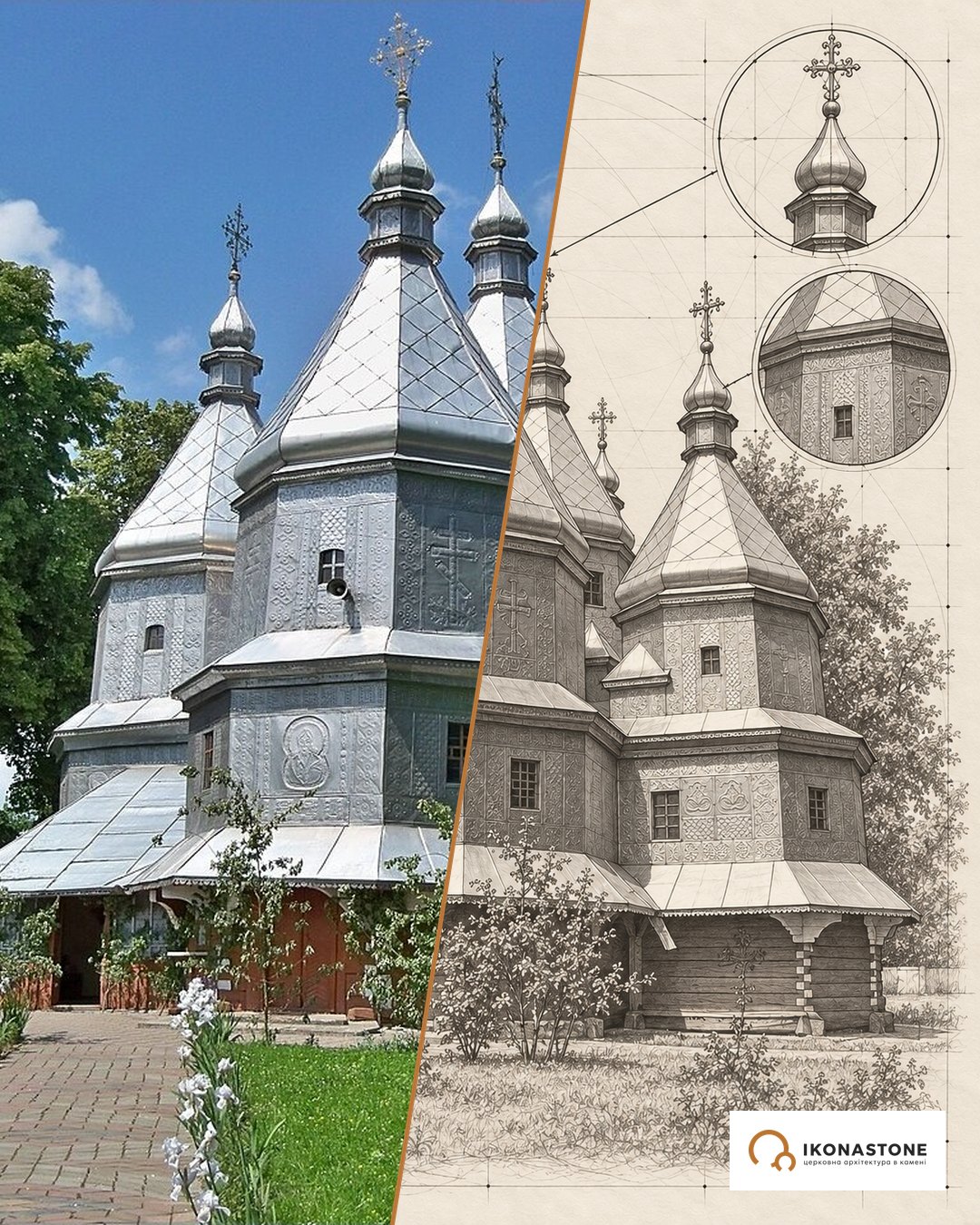
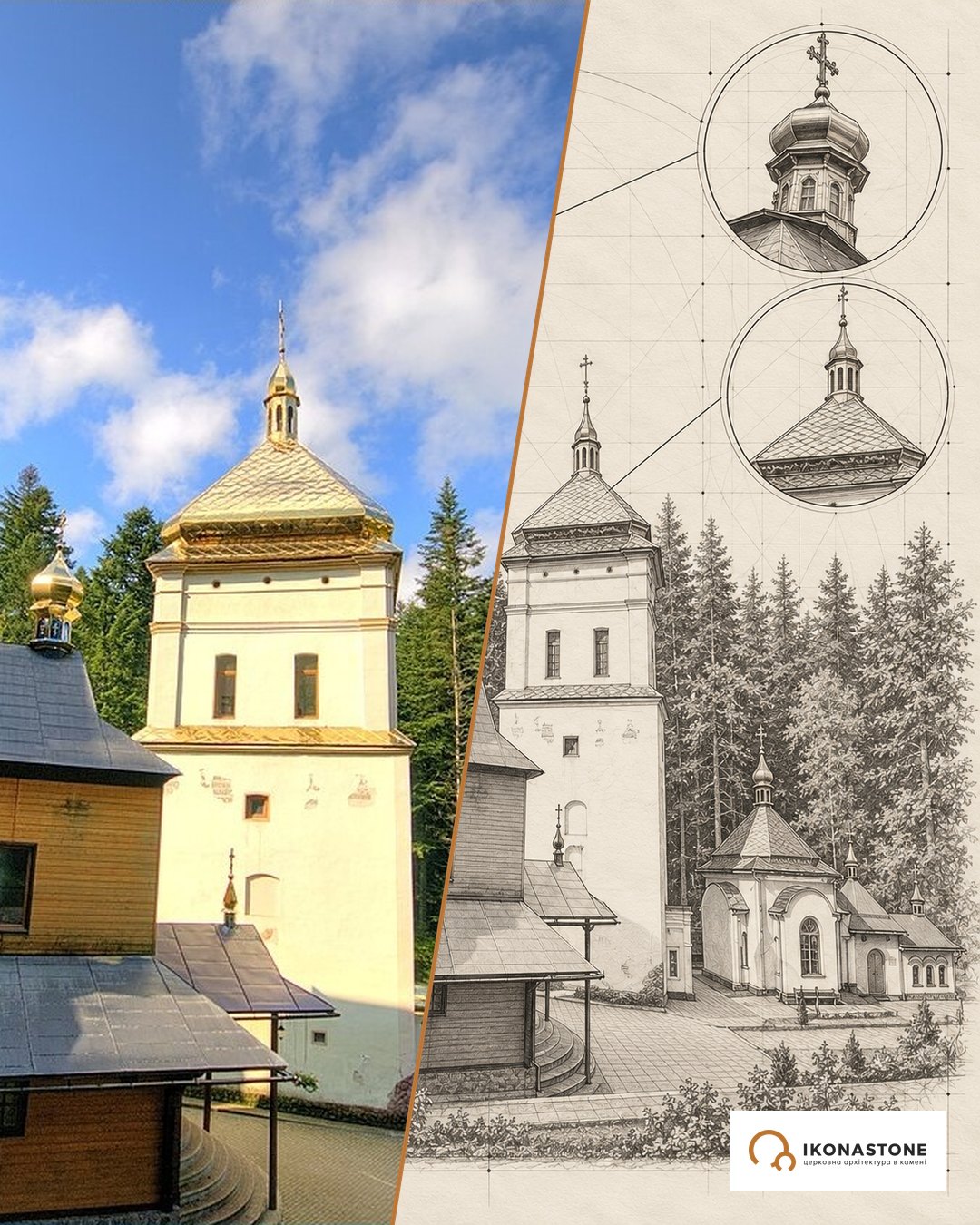
Below are two elements of the church: in a photo and in a drawing. The drawings show the form, not exact dimensions.
The top of the cathedral
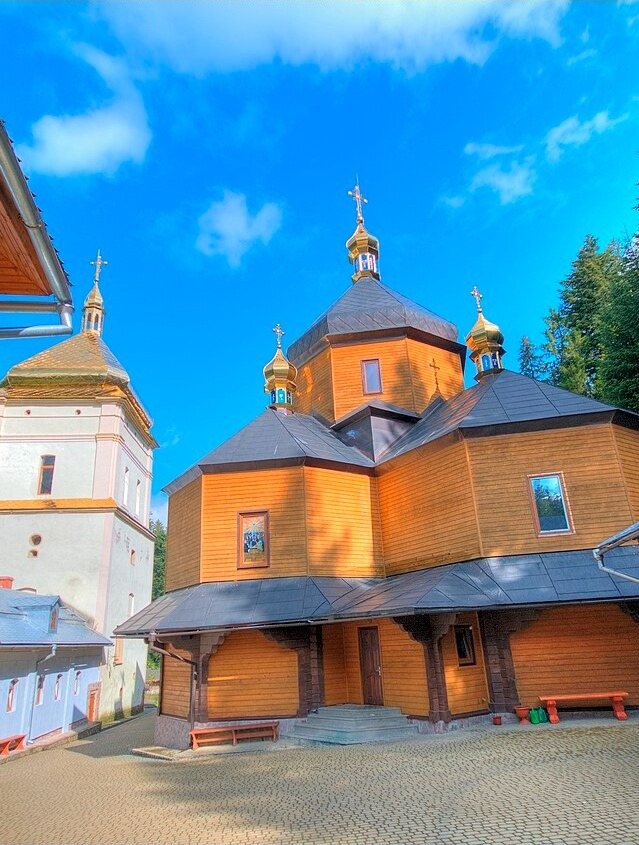
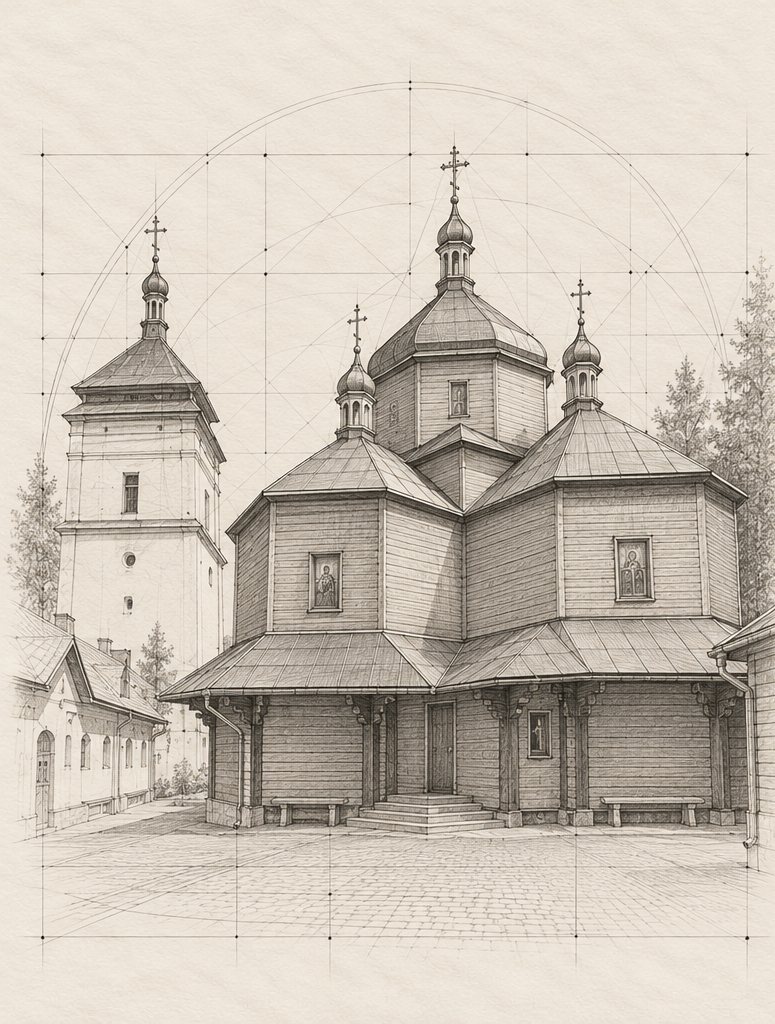
A single-domed Hutsul church gathers its whole vertical into one central top over the crossing. The Baroque cupola is what, according to Wooden Churches of Ukraine, linked the Maniava church to the one at Mezhyhiria.
Faceted arms
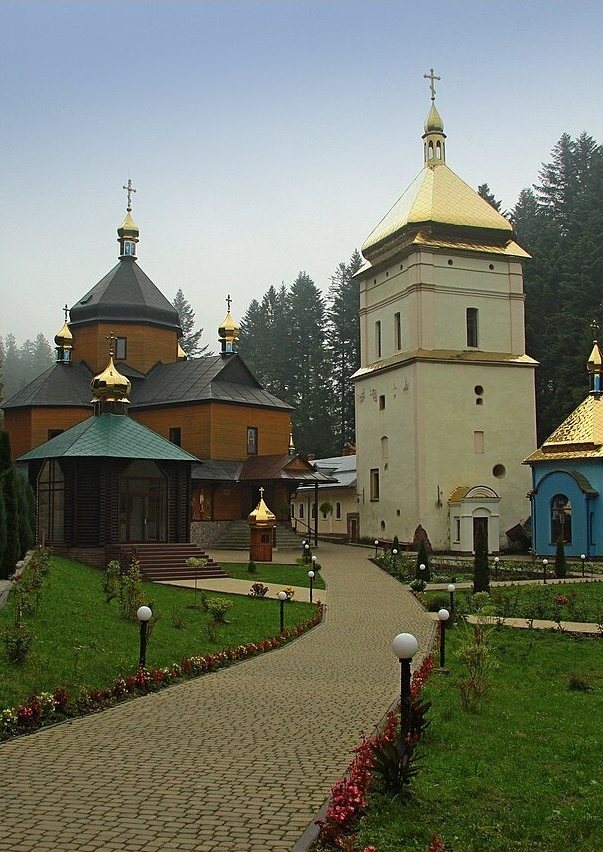
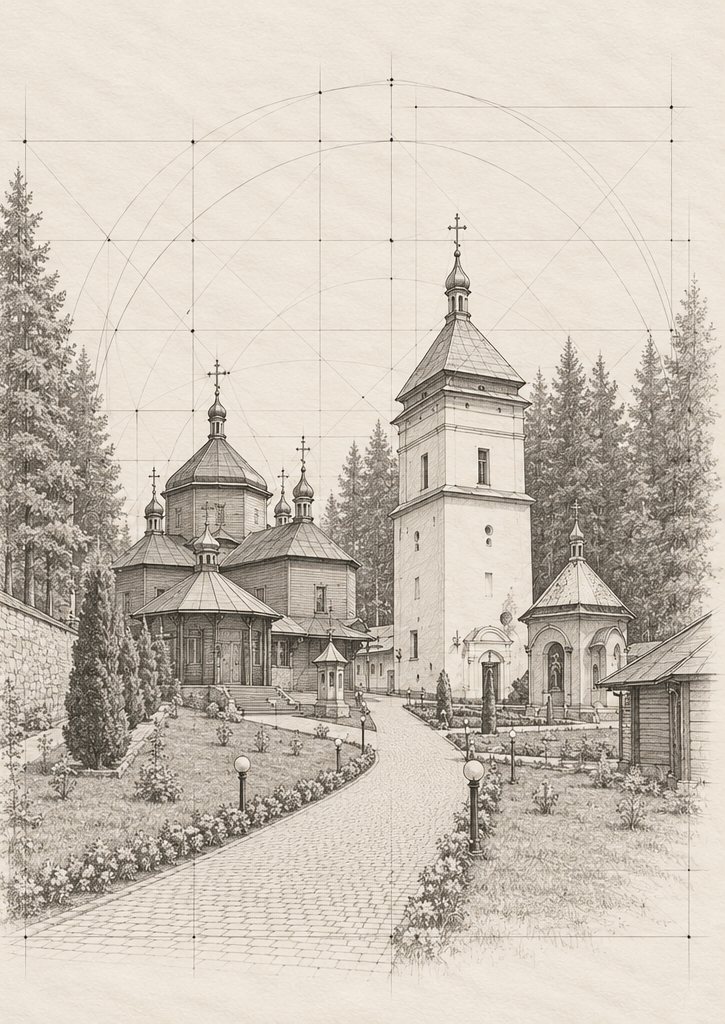
The arms of the cross are not rectangular but faceted. It is this detail that makes the plan Hutsul rather than simply cruciform.
Details that are easy to miss
The wanderings of the iconostasis. After its sale in 1785 the iconostasis stood in Bohorodchany. During the First World War, according to VUE, it was evacuated via Kraków and Vienna, in 1920 it ended up in Warsaw, and in 1924 it was transferred to the National Museum in Lviv; Wooden Churches of Ukraine gives 1923. It is still there — the best-known work of Iov Kondzelevych.
A church that no longer exists but became a model. The 1619 church has not survived, yet, according to Wooden Churches of Ukraine, it was the one that set the model for Hutsul cruciform churches. In a sense, the 2002 reconstruction returned the model to where it came from.
The Treasury tower. The tallest structure of the skete is not the church but a four-tier tower with loopholes. In a land reached by Tatar raids, the wall was not a symbol of separation from the world but a refuge: according to Zabytki, local people also took shelter behind it.
The lost grave of a hetman. According to ESU, Hetman Ivan Vyhovskyi was among those who asked to be buried in the skete; according to Radio Svoboda, he is buried in a vault beneath the cathedral, but the grave has not been found. Tradition adds that his wife lies beside him; Zabytki names her Olena Stetkevych, Karpaty.rocks — Olha.
The Blessed Stone. About a kilometre from the skete (Karpaty.rocks gives distances from 820 metres to 1.2 kilometres) lies a large rock about 10 by 3 metres with a natural niche about 4 metres wide, 1.5 metres high and 2 metres deep. According to Wikipedia, the first hermit monks settled here as early as the 13th century; it is from this niche, tradition says, that Maniava begins.
The spring that fell silent. Wikipedia recounts the belief that the spring under the Blessed Stone stopped flowing when the skete was closed and resumed when the monks returned. It is a legend, but it is the one pilgrims tell most often.
A thread to Univ. Iov Kniahynytskyi, the founder of the skete, according to Ukraina Inkognita, studied at the Univ monastery. The two great Galician monasteries are linked by more than geography.
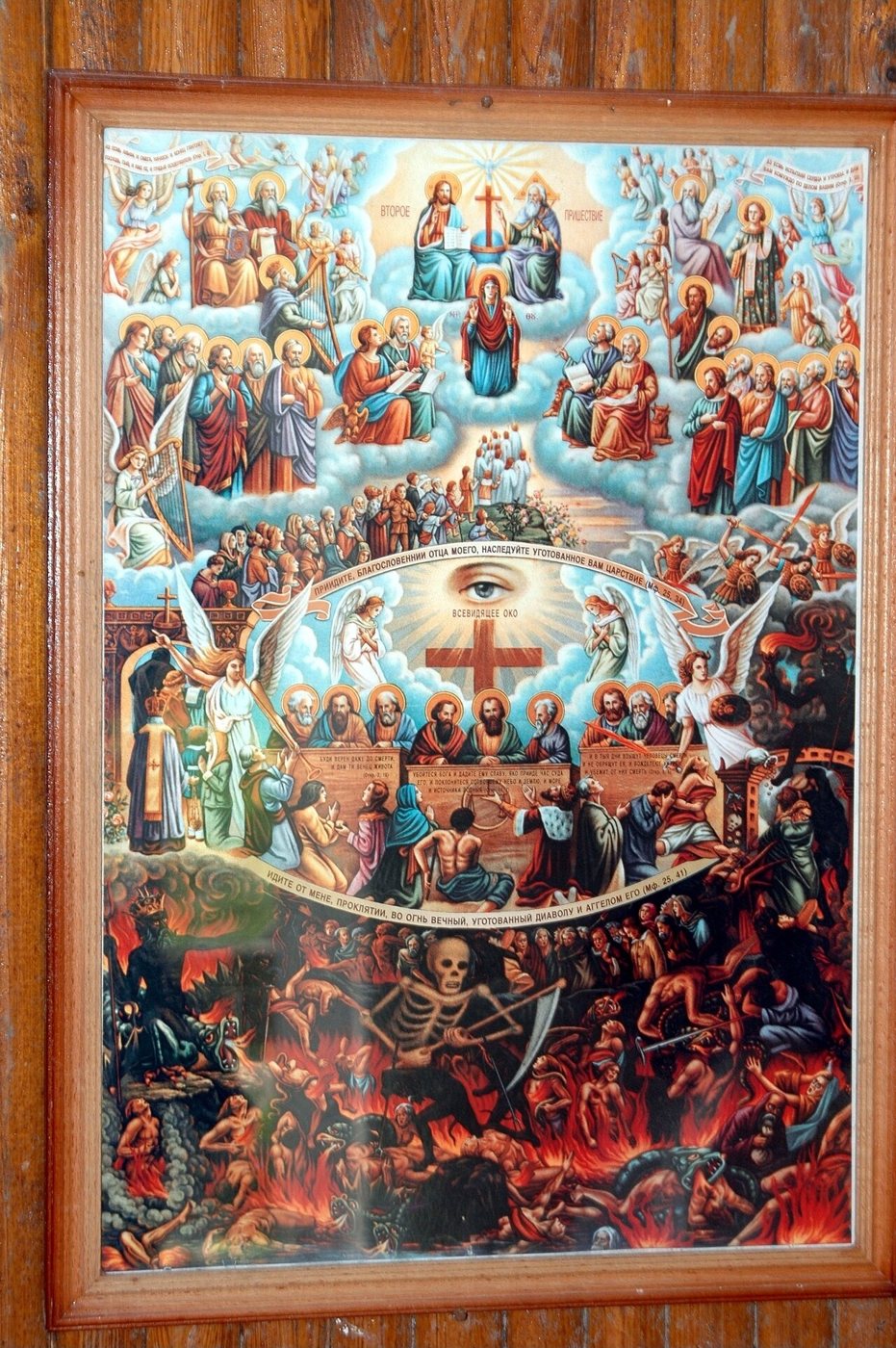
Photo gallery
Stone and material
The cathedral is wooden, like all its predecessors. The 1681 church was set on a stone foundation, and Architectural Monuments gives its timber as yew and cedar. Stone in Maniava means the walls, towers and refectory: the 17th-century defensive perimeter that survived both the closure of the skete and the dismantling of the church. The wood was moved, sold and burned; the stone stayed in place and waited.
Rebuilding a church after a model is work in which the hardest thing is not to invent anything superfluous. Every craftsman who restores a lost detail knows the same: a copy is honest when it repeats the logic, not just the outline. Especially when it comes to an iconostasis, where every tier has its own place and its own meaning.
How an iconostasis is arranged and what is in each of its tiers is explained in the articles “How many tiers does an iconostasis have” and “The Ukrainian iconostasis”. Another 17th-century iconostasis that has lived a difficult life is kept in the Church of the Holy Spirit in Rohatyn.
Did you know
The skete was called the “second Athos” because of the strict rule of St Basil the Great and the founders' Athonite past. [11, 29]
About nine years passed from the beginning of the skete (1611) to the patriarchal charter; stauropegy helped it remain Orthodox amid a Uniate environment. [2, 10]
Kondzelevych's iconostasis visited Bohorodchany (1785–1916), Kraków, Vienna, Warsaw and Lviv; Sheptytsky, according to zaxid.net, bought it back. [6, 25, 30]
The iconostasis in Lviv was scanned from about 40,000 photographs and scanner data; the museum will install a reduced 3D copy for blind visitors. [24, 26]
Excavations of the 1930s revealed beneath the Exaltation of the Cross Church a stone foundation and two brick crypts. [7]
T. Moklowski's measurements of 1911 recorded four towers and a refectory, all with loopholes. [8]
According to the Bulletin article, in 1676 the skete fell only after the enemy cut off the water supply. [8]
Iov Kniahynytskyi managed to complete a stone wall with three defensive towers. [10]
The stream near the skete that inundated the refectory's foundations in 1988 is called Baters (now Skytets). [8, 9, 15]
Vyhovskyi's will about burial in the skete survives, as does a letter from his wife to Hegumen Dorofei asking to be buried beside him. [12]
According to Tur365, the wonder-working icon of the Maniava Mother of God was painted on Athos in 1788; it is kept in the cathedral. [19]
In 2026 a mountain stream began washing away the soil beneath the walls of the skete; Ukrinform quotes the head of the regional council on “real signs” of the wall sagging. [28]
Legends
The cave and the water from the Lavra
The monks Pakhomii and Ioanykii, who left Kyiv after the Mongol invasion, carried water from the Lavra well and sought a place where it would have the same power. They found a spring in the Carpathians beneath a rock with a grotto. Recorded on the sites Etnosvit, Radio Svoboda and Zabytki. [11, 14, 17]
Flight from the Tatars
According to another tradition, monks fleeing the Crimean Tatars stopped by the rock and tasted the flavour of Athonite water in the spring. Recorded on Karpaty.rocks. [15]
Danylo of Halych
According to tradition, Prince Danylo of Halych valued the monastery, but it did not protect the first shrine from a Tatar attack. Recorded according to Zabytki. [14]
The spring that fell silent
According to tradition, the water beneath the Blessed Stone did not flow for almost three centuries while the skete was closed, and appeared again after the monastery's revival. Recorded on Radio Svoboda and in the English Wikipedia. [3, 11]
The vision of Filaret
According to tradition, on 22 December 1652, during the plague, Hieromonk Filaret saw the Mother of God in a dream, and she promised that the pestilence would cease. Recorded in the English Wikipedia. [3]
The elder in black
According to tradition, after the closure people saw an elder in a black cassock among the ruins. Recorded on the Pro Ruskavets site. [18]
Morozenko
According to tradition, the Korsun colonel Morozenko accepted Orthodoxy in the skete and donated a share of the ransom from the siege of Lviv, with which the gate bell tower was supposedly built. Recorded in ZN.UA; Zabytki link the tower-bell tower with his funds. [13, 14]
No rain on the patronal feast
According to the author of ZN.UA, locals do not remember rain ever falling over the skete on St John's day (the patronal feast). [13]
The hetman at rest
According to tradition, Ivan Vyhovskyi and his wife (Olena Stetkevych according to Zabytki; Olha according to Karpaty.rocks) lie in the skete, but the grave has not been found. [14, 15]
Figures
- Iov Kniahynytskyi (of Maniava) (c. 1550–1621) — founder of the skete, an Athonite monk; he painted the first church. [4, 10]
- Theodosius (d. 1629) — Iov’s nephew and assistant, hegumen of the skete. [4, 27]
- Ivan Vyshenskyi — a polemical writer, named among the founders in VUE. [1, 3]
- Zakhariia Kopystenskyi — a church figure, named among the founders in VUE. [1, 3]
- Maria Mohylianka (1591–1638) — daughter of the Moldavian hospodar Jeremiah Movilă, founder of the church of 1619. [14, 18]
- Timothy II — Patriarch of Constantinople, granted stauropegy. [2, 18]
- Filaret — a hieromonk, witness of the vision of 1652. [3]
- Ivan Vyhovskyi (1608–1664) — hetman; in his will he asked to be buried in the skete. [12, 14]
- Stanislav-Nestor Morozenko (d. 1649) — Korsun colonel; according to Zabytki, the gate tower was built with his funds. [14]
- Petro Liakhovych — an official of the local salt works, a patron of the skete (according to ZN.UA). [13]
- Sylvestr — a monk who built the third church in 1681. [7]
- Feodor Alekseyevich — Muscovite tsar, sent funds and books in 1680. [7]
- Iov Kondzelevych (1667–c. 1740) — icon painter, author of the iconostasis of 1698–1705. [5, 6]
- Ivan Vahylevych — author of the historical study of 1848. [2]
- Yaroslav Pasternak — archaeologist, excavations of 1935–1936. [7, 8]
- Ivan Mohytych — architect-restorer, author of the restoration design of the 1970s–80s and the reconstruction of 2002. [1, 8]
- Andrey Sheptytsky — metropolitan, at whose request the iconostasis was transferred to Lviv. [6, 25]
- Ioann (Vasyl Hryniuk) — first hegumen of the revived monastery, d. 2003. [3]
- Mykhailo Kuhutiak — head of the Carpathian archaeological expedition of 2010–2014. [8]
How to cite
IKONASTONE. The Exaltation of the Cross Cathedral of the Maniava Skete // Guide to the Churches of Ukraine. URL: https://ikonastone.com/en/guide/exaltation-of-the-cross-cathedral-maniava-skete/ (accessed DD.MM.YYYY).
FAQ
How old is the cathedral of the Maniava Skete?
The present wooden Exaltation of the Cross Cathedral was reconstructed in 2002 after the model of the church that burned down in Nadvirna in 1914. Earlier churches on this site were built in 1612, 1619 and 1681.
Why did the old cathedral end up in Nadvirna?
In 1785 the Austrian authorities closed the skete. Its property was sold off, and the Exaltation of the Cross Church was dismantled and moved to Nadvirna. There it burned down during the First World War.
What is the Bohorodchany iconostasis?
It is the iconostasis of the skete's Exaltation of the Cross Church, created in 1698–1705 by a workshop led by Iov Kondzelevych. In 1785 it was sold to the Holy Trinity Church in Bohorodchany, hence its name. Today it is kept in the National Museum in Lviv.
Who founded the Maniava Skete?
The skete was founded by Iov Kniahynytskyi, a former monk of Mount Athos. VUE and Wikipedia date the first community to 1606, Radio Svoboda gives 1608 (the first written evidence), and ESU places the first cell in 1611. Ivan Vyshenskyi is also named among the founders. Tradition traces the beginnings of monastic life here as far back as the 13th century.
What is the Blessed Stone?
It is a large rock about 10 by 3 metres with a natural niche where hermit monks lived, about a kilometre from the skete. A spring flows from beneath it, and its water is considered healing.
Sources
- ВУЕ. Скит Манявський
- Encyclopedia of Ukraine. Maniava Hermitage
- Wikipedia (en). Manyava Skete
- Wikipedia (en). Job of Manyava
- Encyclopedia of Ukraine. Kondzelevych, Yov
- Національний музей у Львові ім. Андрея Шептицького. Богородчанський іконостас (museum-digital)
- Вісник НУ «Львівська політехніка» (2021), стаття про Хрестовоздвиженську церкву Манявського скиту
- Вісник НУ «Львівська політехніка» (2023), архітектурна стаття про Манявський скит
- Гуцуляк. Стаття про Манявський скит (НУНГ)
- Радіо Свобода. Йов Княгиницький
- Радіо Свобода. Манявський скит, Блаженний камінь
- Радіо Свобода. Манявський скит: 400 років, поховання Виговського (07.07.2008)
- ZN.UA. М. Фарбота. Монастир, якого вже не існує (01.08.2008)
- Забытки. Манявський скит
- Karpaty.rocks. Manyavsky Skete
- Karpaty.rocks. Church of the Exaltation of the Holy Cross, Nadvirna
- Етносвіт. Манявський скит
- Про Руськавець. Скит Манявський
- Tur365. Манявський скит
- Ukraine Trek. Manyavsky Holy Cross Exaltation Monastery
- Pilgrim (cbcpilgrim.ekarpaty.com). Манявський скит
- Discover.ua. Манявський скит
- Urban Media Archive (Центр міської історії). Руїни Манявського скиту, 1930, ID 5174
- Zaxid.net. «Відчуваємо себе першопрохідцями у Львові» (05.12.2020)
- Zaxid.net. Про Національний музей у Львові та Богородчанський іконостас
- Zaxid.net. Львівська галерея мистецтв виклала у вільний доступ частину оцифрованої колекції
- Wikipedia (en). Theodosius of Manyava
- Укрінформ. Манявський скит на Прикарпатті під загрозою через підмивання ґрунту під стінами (12.05.2026)
- Plandiy. Манявський скит у Карпатах, відомий як другий Афон ПЦУ
- Народознавчі зошити (2011, № 6). Богородчанський іконостас Йова Кондзелевича
- Town
- Maniava village, Ivano-Frankivsk District, Ivano-Frankivsk Oblast
- Built
- first church 1612; new church 1619; rebuilt 1681; reconstructed 2002
- Type
- wooden cruciform single-domed church of the Hutsul type with faceted arms
- Material
- timber on a stone foundation; walls and towers of the skete in stone
- Research depth
- 33%