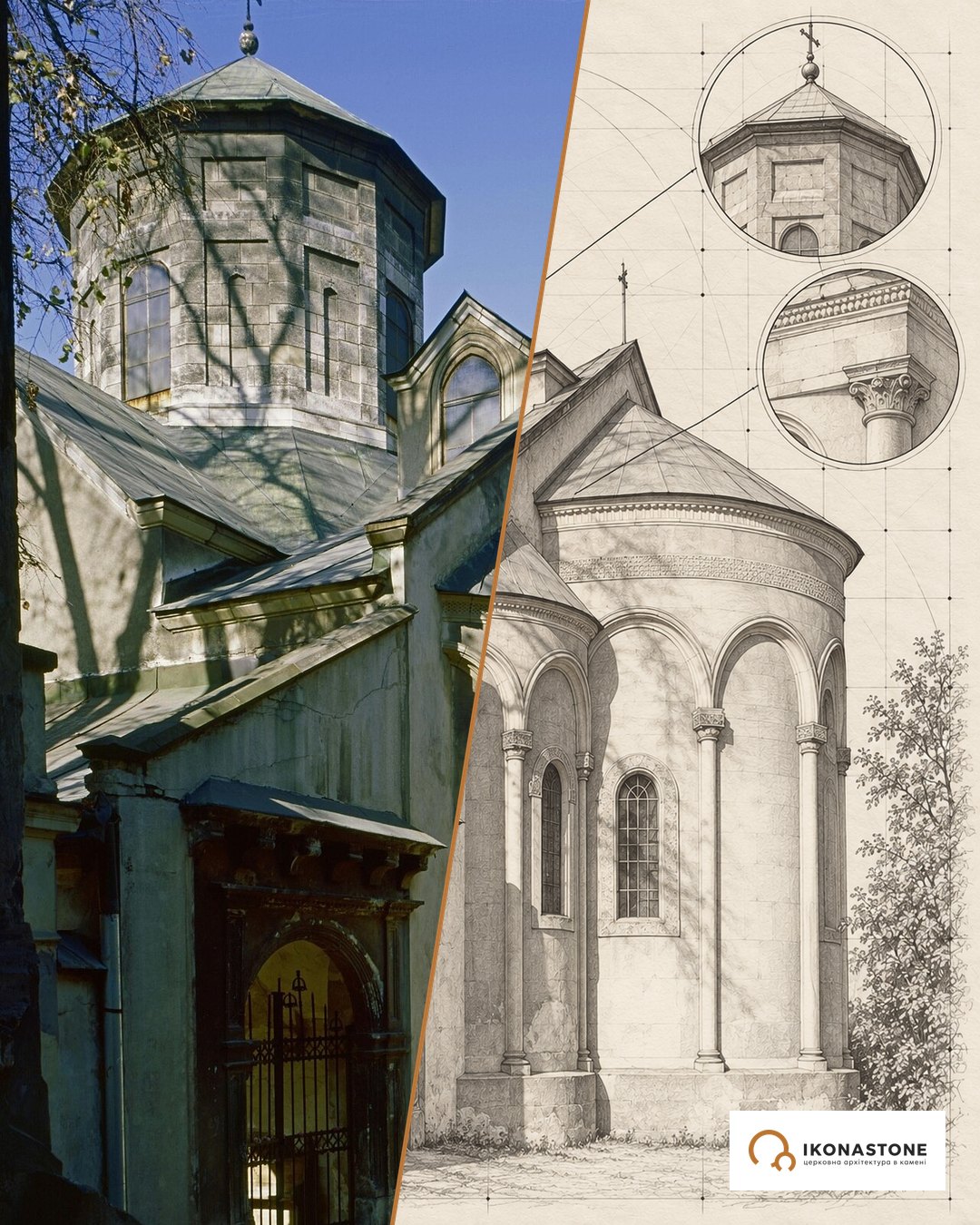
The Dormition Church of the Univ Lavra: a fortress church above a healing spring
Beneath the western walls of this monastery a spring still flows, and above it stands a church with loopholes cut into its frieze: prayer and vigilance here shared a single wall.
In brief
| Address | Univ village, Lviv District, Lviv Oblast |
| Built | c. 1550–1570 (VUE: 1570); rebuilt 1741 |
| Founder | Oleksandr Vanko Lahodovskyi (died 1574) |
| Type | single-nave fortified church with a semicircular apse, bell tower by the porch |
| Style | transition from Late Gothic to Early Renaissance; Baroque west gable |
| Status | architectural monument of national importance; one of the two lavras of the UGCC (alongside the Holy Ivan Lavra in Lviv) |
History
The monastery in Univ is older than its church. Archaeologists date its beginnings to the late 13th century, and the first written mention is a charter of King Władysław II Jagiełło of 1395. The monastery was patronised by princes of the Gediminid line, and in 1542 King Sigismund I the Old confirmed the status of the Univ archimandrite’s seat. In 1549 the monastery was burned by the Tatars.
What follows is a story told in Univ as a legend. The nobleman Oleksandr Vanko Lahodovskyi suffered from pain in his legs; according to one version, he broke his leg falling from his horse while hunting. In a dream the Mother of God appeared to him and told him to look for a spring to the east of his estates. He found it near the ruins of the monastery, bathed and recovered, and in the ashes came upon an undamaged icon of the Mother of God. In gratitude Lahodovskyi built a masonry Church of the Dormition over the spring and restored the monastery. VUE dates the church to 1570; other sources speak of construction in 1549–1574 or 1550–1570. Holos Ukrainy also recounts a folk etymology of the village name — from “hunia”, the outer garment the knight took off to bathe in the spring.
The monastery reached its height under the archimandrites Varlaam and Atanasii Sheptytskyi in the 17th–18th centuries, when it became Greek Catholic. In 1741 Atanasii rebuilt the church, and it took on its present appearance. According to VUE, a printing house operated here in 1648–1765. In 1790 the Austrian authorities dissolved the monastery, and the church became a parish church. From 1818 Metropolitan Mykhailo Levytskyi, a cardinal from 1856, lived here: under him the moats were filled in, the ramparts levelled and some of the towers dismantled, but, as Ukraina Inkognita writes, it was his residence that saved the complex from ruin.
Metropolitan Andrei Sheptytskyi revived monastic life here and handed the monastery over to the Studites; the Studites received the Univ residence in 1919, and, according to Radio Svoboda, the monastery received the status of a lavra on 24 November 1926. The metropolitan’s brother, Klymentii Sheptytskyi, became its hegumen. During the Second World War, according to Wikipedia and Holos Ukrainy, Jews were hidden in the lavra. After the war the Soviet authorities closed the monastery and the monks were arrested or deported; among those arrested was the hegumen Klymentii Sheptytskyi, whom Pope John Paul II beatified in 2001. The buildings housed a concentration camp for Catholic clergy, then a home for the elderly and a psychoneurological care home. The monks returned in 1989–1991, and in 1992–2004 the complex was restored. In 1998 a Museum of Sacred Art opened at the lavra, and in 2008 the monastery received stauropegial status. According to Radio Svoboda (2024), about thirty monks live here, and the lavra is the largest pilgrimage centre in Galicia: pilgrims walk here to the icon and the spring on the third Sunday of May, when the feast of the Univ icon has been celebrated since 2004, and on the Dormition of the Mother of God (until 2023 on 28 August; since the UGCC switched to the Revised Julian calendar, the feast falls on 15 August).
Above the monastery rises Monks’ Hill (Chernecha Hora). The UGCC map writes that the old monastery stood there, two hundred metres from the present one, where the monks’ cemetery is now. In the cemetery one can see the foundation of an old church, crosses and 17th-century tombstones, and according to Karpaty.info also the ramparts of a hillfort known as Volodymyr’s Town.
Timeline
The numbers in square brackets are source numbers from the list at the bottom of the page. The note "according to …" means that the fact is confirmed by a single source only. The "Legends" section contains legends and traditions: they are recorded in the sources but not documented.
The princely era and the beginnings of the monastery
- 11th–12th c.
A monastic settlement existed on Monks' Hill above the present village. Excavations by the Lviv expedition (1998–2005) revealed on the summit and the western slope of the hill the remains of two medieval monastic complexes of the princely era; the hillfort was surrounded by an outer rampart about 2.5 km long. [1, 15]
- Late 13th c.
The monastery arises at the foot of the hill, on the site of the present monastery: this is how modern archaeological research dates it. Euromaidan Press calls the 13th century only probable, while ESU writes of the 14th century. [2, 3, 10]
- Around 1400
According to Wikipedia, Karpatium and the TravelsInUA guide, the original Orthodox monastery was founded by Prince Fedir Liubartovych. ESU does not name the founder. [1, 10, 25]
- 1395
The first written mention of Univ: a charter of the Polish king Władysław II Jagiełło, issued in Hlyniany, mentions the "widely known" Univ monastery. [3, 10]
- 1542
On 30 July King Sigismund I the Old confirmed the special status of the monastery: the right to elect its own archimandrite and a ban on the bishop of Lviv interfering in its property. Univ became an archimandrite's seat. [3, 10]
Lahodovskyi and the masonry monastery
- 1549
The Tatars destroyed and burned the monastery together with the Church of the Dormition. Wikipedia dates the Tatar raid to 1548. [1, 10, 25]
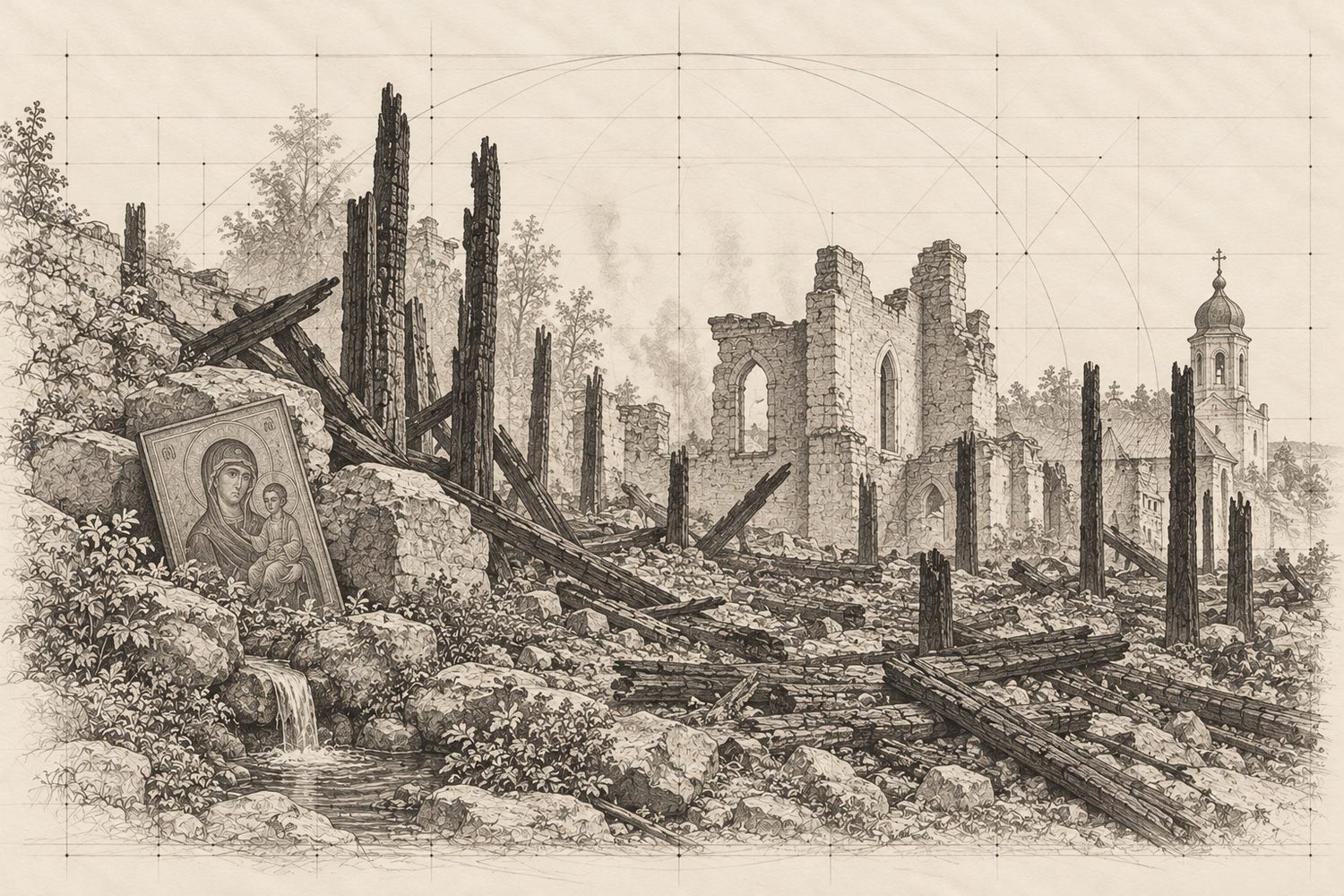
1549: the monastery after the raid. Illustration: IKONASTONE - Mid-16th c.
The nobleman Oleksandr Vanko Lahodovskyi, patron of the monastery until his death in 1574, rebuilds it and erects a masonry fortified Church of the Dormition over the healing spring. The sources give the exact date of the church differently: Wikipedia says 1548, others "mid-16th century"; VUE, according to the present article, says 1570. [1, 24, 25, 27]
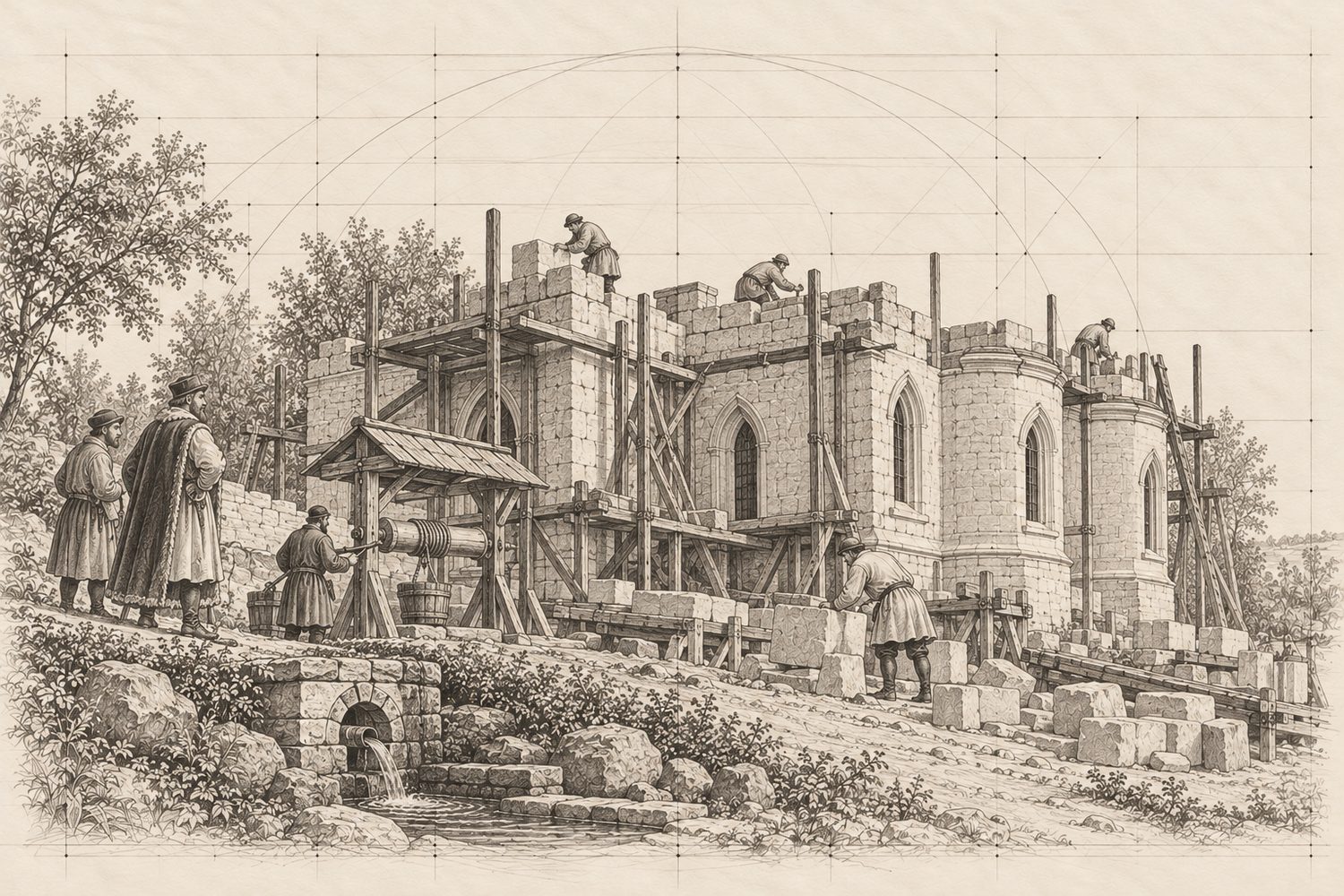
Mid-16th century: the masonry church is founded. Illustration: IKONASTONE - 1601
Yezekyil (in the schema Iov) Kniahynytskyi, who had just returned from Mount Athos and begun reforms, is invited to Univ. According to the journal Visnyk. [4]
- 1606
Archimandrite Isaiah tries to set up a printing house; according to Visnyk, Ivan Vyshenskyi was probably invited to work in it. Euromaidan Press writes that in 1606 Vyshenskyi lived in the monastery. The monastery has a library and a small printing house. [1, 3, 4]
- 1630s
A two-tier bell tower is built next to the church. [1]
- 1646–1648
According to ESU, the printer Andrii Skulskyi worked here from 1646; Euromaidan Press dates the start of printing to 1648. [2, 3]
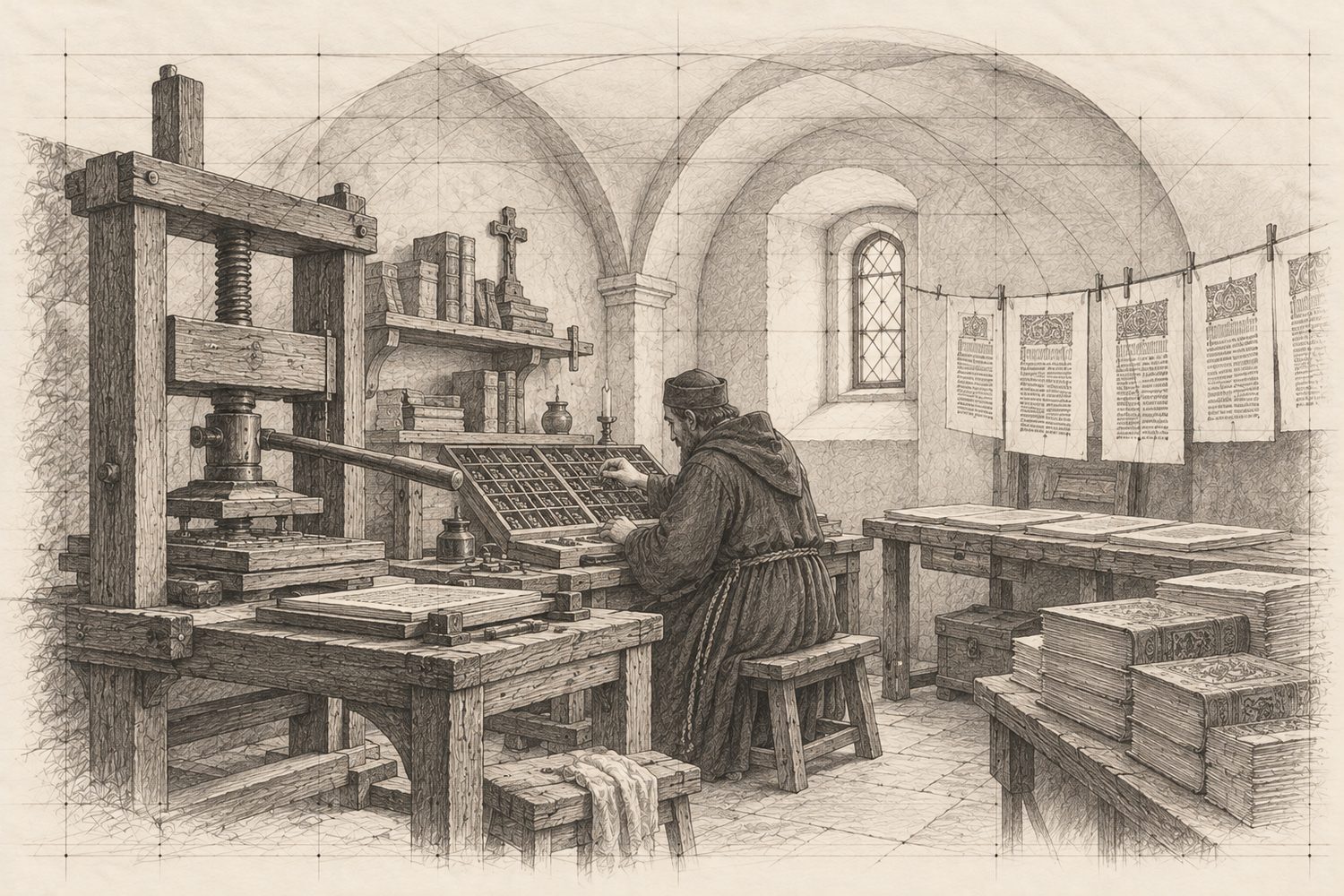
17th century: the monastery printing house. Illustration: IKONASTONE
The golden age of the Sheptytskyis
- 1668
Archimandrite Varlaam Sheptytskyi restores the printing house and rebuilds the monastery; according to Visnyk, the first book of the restored printing house appeared the following year. [1, 4, 6]
- 1711
A council of monastery superiors was held in Univ on the initiative of Varlaam Sheptytskyi. According to Euromaidan Press. [3]
- 1715–1746
Atanasii Sheptytskyi is archimandrite (from 1713 according to Visnyk); in 1729 he becomes Metropolitan of Kyiv, and Univ remains his main residence. Under Atanasii the church and monastery were rebuilt and the printing house restored. [4, 6]
- 1730
A new iconostasis is installed in the church. According to Visnyk; VUE, according to the present article, gives 1731. [4]
- 1732–1747
The printing house issues the "Sobranie prypadkov" (1732) and service books (1733, 1740, 1747). In all it published more than 60 books. [2, 6]
- 1735–1773
The music chapel of Atanasii Sheptytskyi is active: first mentioned in 1735; in December 1738 Bishop Yurii Blazhovskyi of Mukachevo was consecrated in the monastery, and eight instrumentalists and five singers performed at the celebrations. According to Kuzminskyi and Moroz. [16]
- 1741
According to VUE, Atanasii rebuilt the church: the west facade received a Baroque gable with the Sheptytskyi coat of arms, and the walls received buttresses. [26]
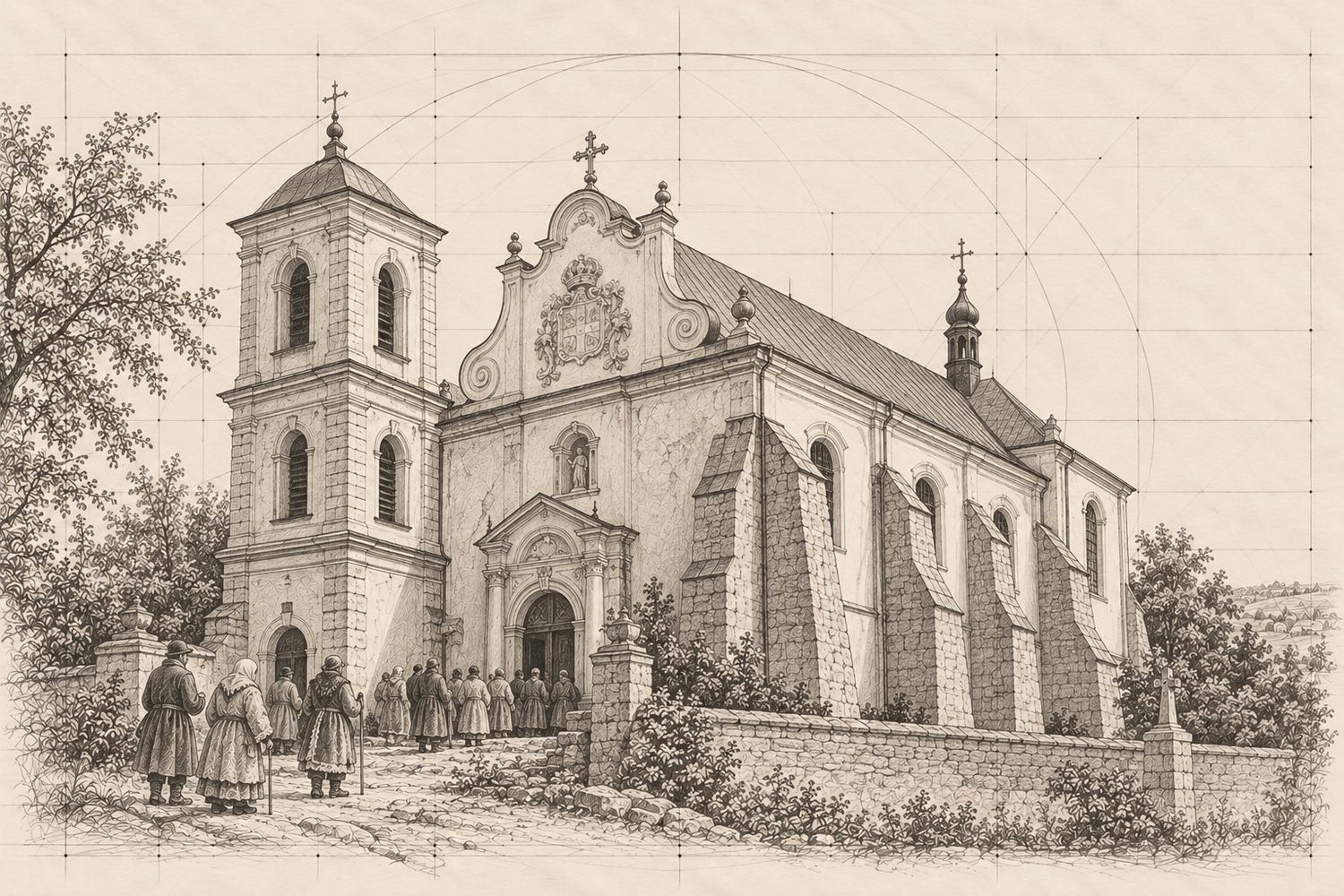
After 1741: the Baroque rebuilding. Illustration: IKONASTONE
Closure, the metropolitan's residence and the Studite revival
- 1790
The Austrian authorities close the monastery. The library is dispersed (at that time 108 early printed books and 20 manuscripts, according to Yasinovskyi). [1, 3, 4, 5]
- 1818
The estate is finally transferred to Metropolitan Mykhailo Levytskyi, who sets up a summer residence here and later settles in Univ. According to VUE, under him the moats were filled in, the ramparts levelled and some of the towers dismantled. [3, 4, 26]
- 1820s
The metropolitan's palace (summer palace) is built. [1, 27]
- 14 January 1858
Metropolitan and Cardinal Mykhailo Levytskyi dies in Univ (a cardinal from 1856). [1, 3, 22]
- 1919
The Univ residence of the Galician metropolitans is handed over to the Studite monks, who had lost the Sknyliv lavra during the war years. Here they opened an icon-painting school and a bookbindery. [2, 4, 6, 7, 20]
- 1926
Klymentii Sheptytskyi, the metropolitan's brother, becomes hegumen; according to Radio Svoboda, on 24 November 1926 the metropolitan granted the monastery the status of a lavra. [6, 7]
- 1935–1936
Studite icon painters decorated the church and the monastery walls with murals. According to Visnyk. [4]
- 1935–1939
The lavra publishes the journals "Yasna put" (1935–1939) and "Promynchyk sontsia liubovy"; a printing house has been operating since 1935. [2, 6]
War, camp, care home and revival
- 1939–1944
Soviet, then German occupation. At the beginning of 1944 the lavra had 23 hieromonks, 7 hierodeacons and 76 monks. According to Visnyk. [4]
- 1942–1944
The monks hid Jewish children. Among the pupils of the shelter were, in particular, Adam Rotfeld and (according to LB.ua) Oded Amarant; at the school the teacher Mykola Diuk hid five Jews from January 1943 to July 1944, among them the future Nobel laureate Roald Hoffmann. [1, 12, 21]
- 1946
After the liquidation of the UGCC, the Soviet authorities set up in the lavra a concentration camp for Greek Catholic clergy and monastics; the church was closed. [6, 11, 20]
- 5 June 1947
The monastery was searched and Archimandrite Klymentii Sheptytskyi (78 years old) was arrested. According to TSN, a special board of the MGB sentenced him in 1948 to 8 years, while Euromaidan Press writes of 25 years. He died on 1 May 1951 in Vladimir prison. [3, 7, 8, 9]
- 1947 – 1989
The buildings house a home for the elderly, then a psychoneurological care home for women; the church was turned into a club, and the 18th-century iconostasis was painted over. [3, 7, 13]
- 1989–1993
The Church came out of the underground (1989); the Studites returned openly (1989–1991). On Christmas Eve 1991 the first liturgy was held, and the bells rang for the first time in half a century. The care home was closed in 1992–1993; according to Hegumen Sevastiian Dmytrukh, it housed 350 patients. [4, 6, 7, 20]
- 1998
The Museum of Sacred Art is opened (seven halls; renewed and expanded in 2011). [17]
- 2001
Pope John Paul II beatified Klymentii Sheptytskyi (in 1996 he was recognised as Righteous Among the Nations). [8, 9]
- 2003
The village regained its historical name, Univ. [2, 3, 21]
- 2004
Patriarch Lubomyr Husar, at the monks' request, established the feast of the Univ icon on the third Sunday of May. [18]
- 2005
A memorial plaque was unveiled in Univ in gratitude to the Sheptytskyi brothers for saving Jews; Adam Rotfeld, then Poland's foreign minister, was present. [12, 28]
- 4 May 2008
Patriarch Lubomyr (Husar) declared the monastery stauropegial, that is, directly subordinate to the Patriarch of the UGCC. According to Byzantine Catholic World. [19]
- 2022
The lavra sheltered 50 displaced people (RISU, October 2022); later Radio Svoboda speaks of hundreds of people. [13, 14]
- 2024
Hieromonk Makarii (Dutka) set a Ukrainian bench-press record (193 kg) and, instead of congratulations, asked for money for drones for the army. [13, 14]
Lost and restored
| What | What it was | What happened | Where it is now |
|---|---|---|---|
| The wonder-working Univ icon of the Mother of God | The church’s icon, “the heart of the lavra”; Atanasii Sheptytskyi crowned it after becoming metropolitan [4] | The original has not survived | The main shrine of the lavra is a copy of the icon [25] |
| Iconostasis | A new iconostasis of 1730 (1731 according to VUE) | Painted over in Soviet times [7] | Fragments of iconostases, the rows of apostles and prophets, are in the lavra museum [17] |
| Church murals | Murals of 1935–1936 by Studite icon painters | Whitewashed in Soviet times (according to VUE) | Not recreated [4, 26] |
| Library | 1790: 108 early printed books and 20 manuscripts | Dispersed after the closure; destroyed in Soviet times | Being rebuilt: in 2007, 1,133 books (272 early printed books, 40 manuscripts) [5] |
| Printing house | More than 60 publications in the 17th–18th centuries | Decline after 1770; closed in 1790 | Its publications are preserved in collections [2, 5, 6] |
| Ramparts and moats | A rampart, a water moat, walls with four corner towers | Filled in and levelled under Levytskyi, some of the towers dismantled (according to VUE) | Two towers survive near the west wall (according to VUE) [24, 25, 26] |
| Lahodovskyi’s tomb | A Renaissance tomb in the lavra | Moved to Olesko Castle | The original is in Olesko Castle; a copy is in the lavra [1, 24, 25] |
| Wooden Church of the Ascension | A parish church on the monastery grounds from 1722 | Dismantled in 1790 | A new masonry Church of the Ascension was consecrated in 2007 (architect Taras Stakhiv) [11] |
| Monastic community | 1944: 106 monks of various ranks | Arrested, deported; the monastery closed | Returned in 1989–1991; now about 30 monks [4, 13] |
| The church as a place of worship | A liturgical space | A club in Soviet times | Returned in 1989–1991 [3, 4, 7] |
| Museum collections | Personal belongings of the Sheptytskyis | Confiscated in 1946–1947 | Museum of Sacred Art (1998; renewed exhibition since 2011) [17] |
Architecture
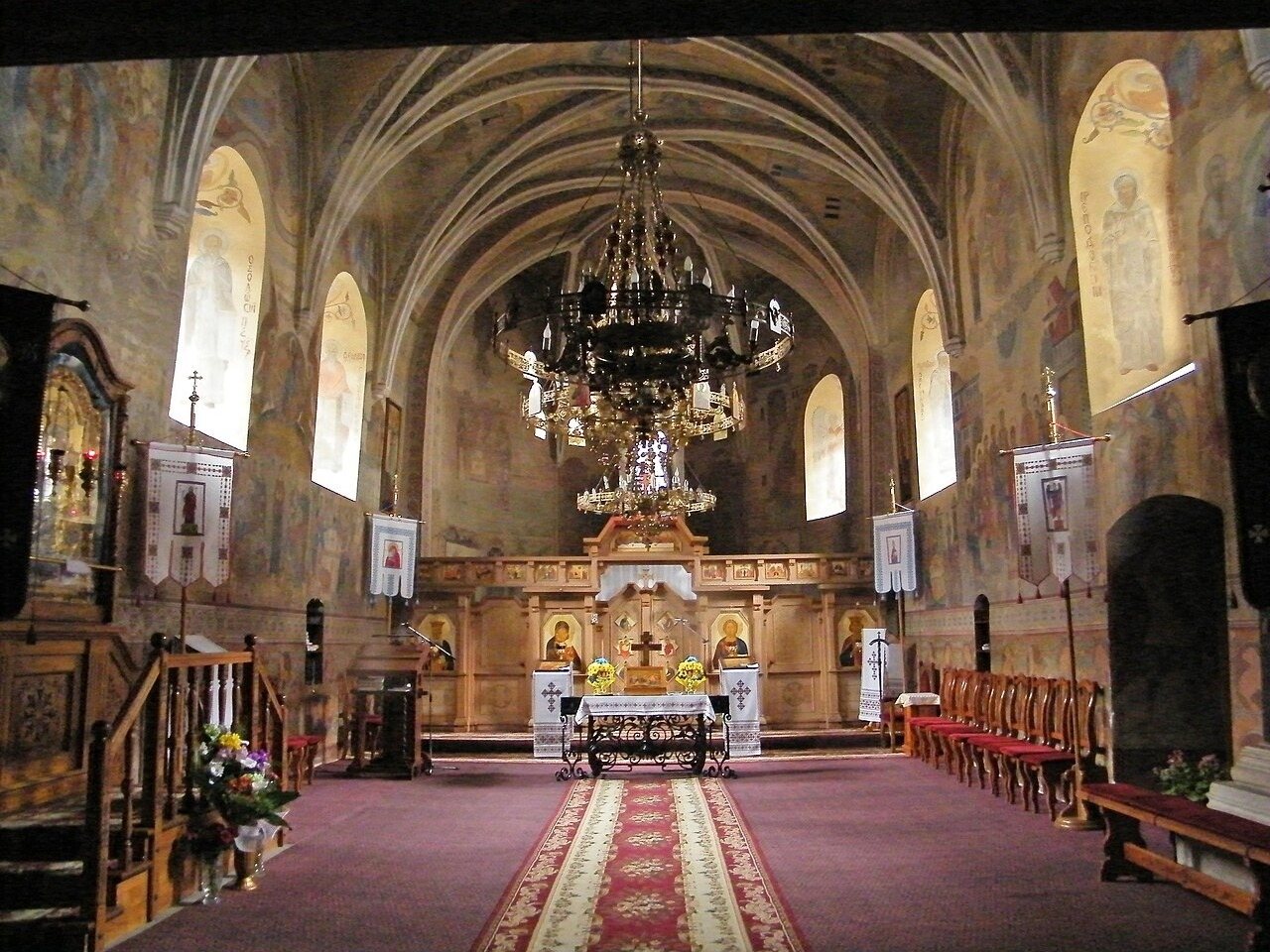
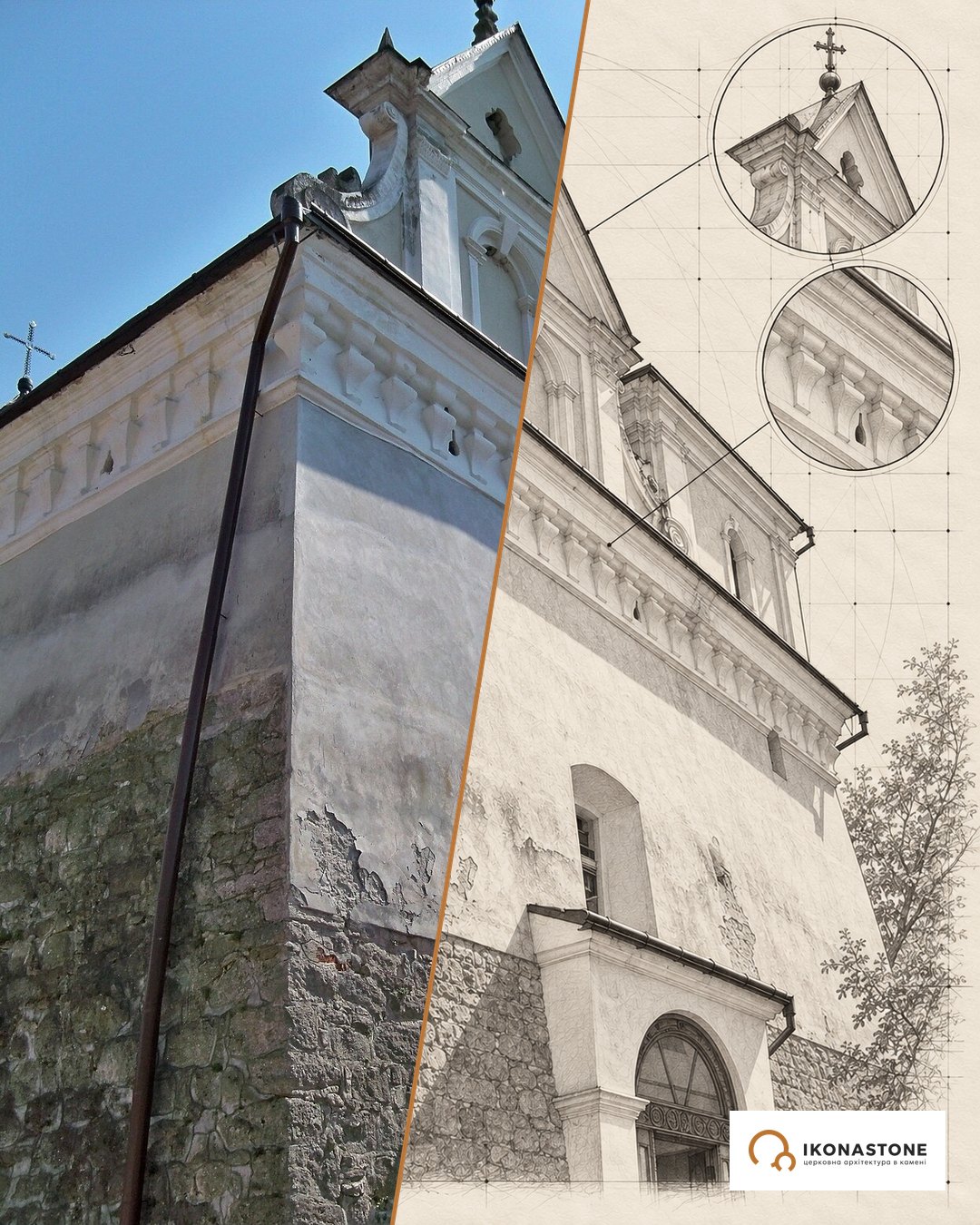
The church stands in the middle of the monastery courtyard. It has a single nave with a semicircular sanctuary apse and belongs to the transitional style between Late Gothic and Early Renaissance. The vaults are divided by Late Gothic ribs. VUE calls the church a rare example of an incastellated church, that is, one adapted for defence: the structure of the vaults allowed a defensive gallery to be set up above them, and keyhole-shaped loopholes for hand firearms are cut into the crowning corbel frieze all around.
A two-tier bell tower, square in plan, is attached to the south facade of the porch; according to KruhoLviv, the date “1638” was found on it. After the 1741 rebuilding the west facade received a Baroque gable with the Sheptytskyi coat of arms carved in stone, and the walls received buttresses.
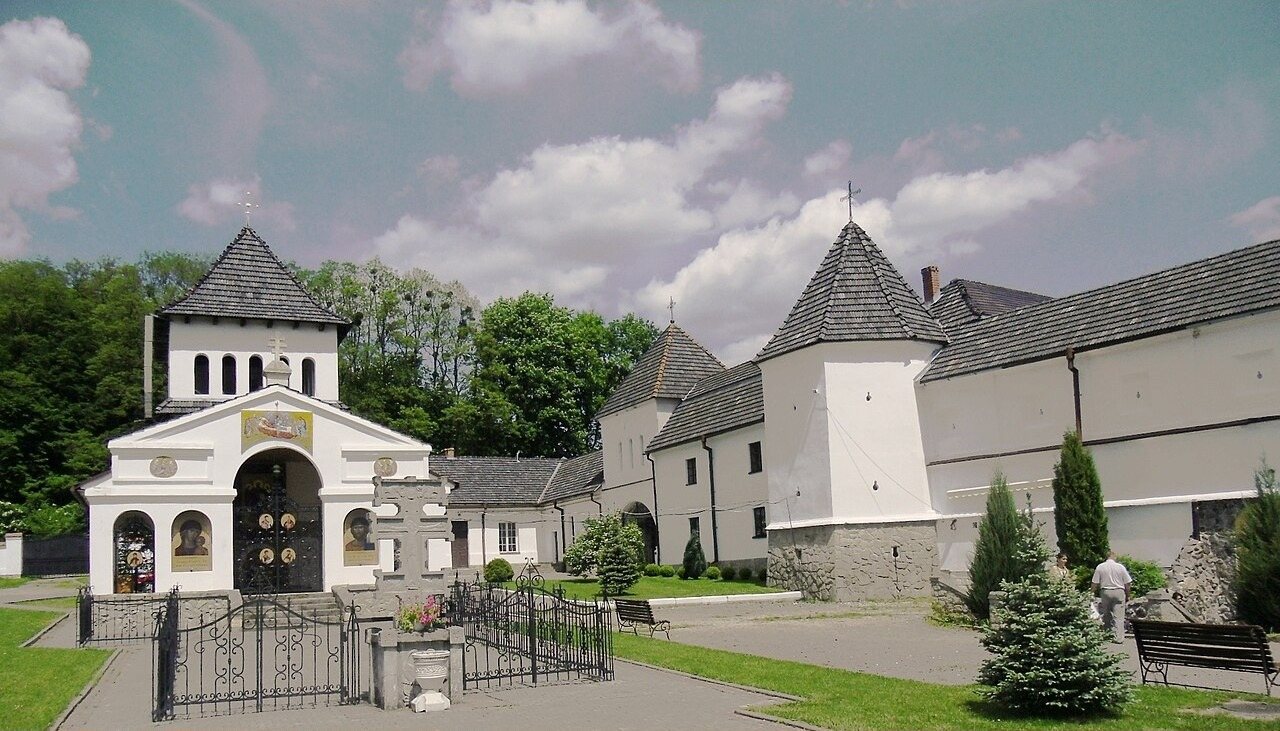
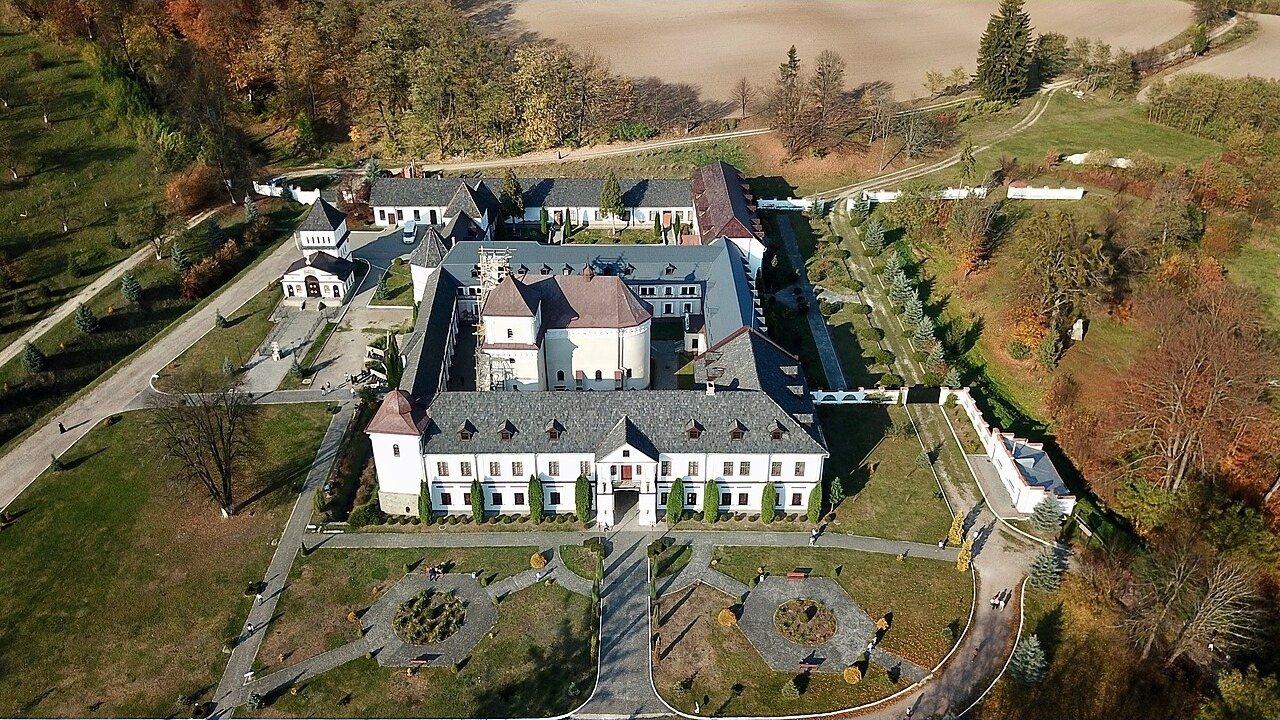
The monastery has a square masonry perimeter with fortress walls and loopholes. Originally four towers stood at the corners and a fifth over the eastern entrance gate; the rest, according to VUE, were dismantled in the early 19th century. Two survive, flanking the west wall; in the north-western one keyhole loopholes can be seen on three levels.
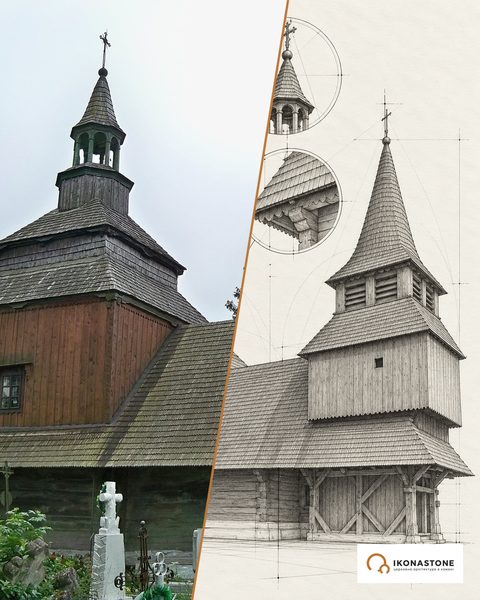
Below are two elements of the church: in a photo and in a drawing. The drawings show the form, not exact dimensions.
The crowning frieze with loopholes
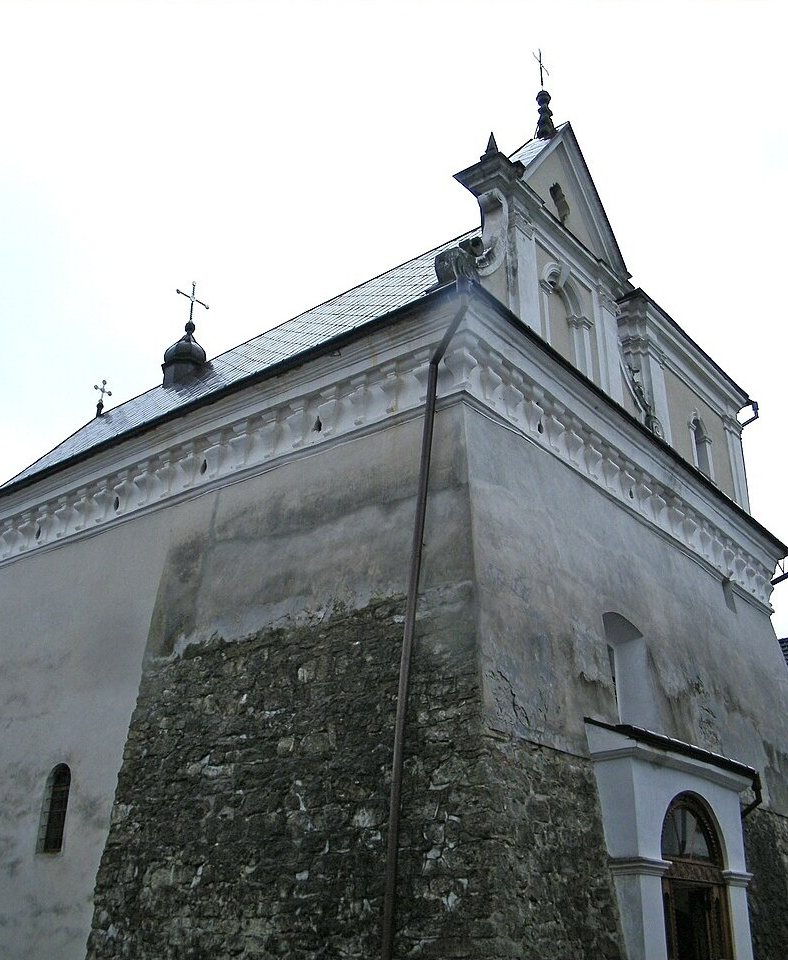
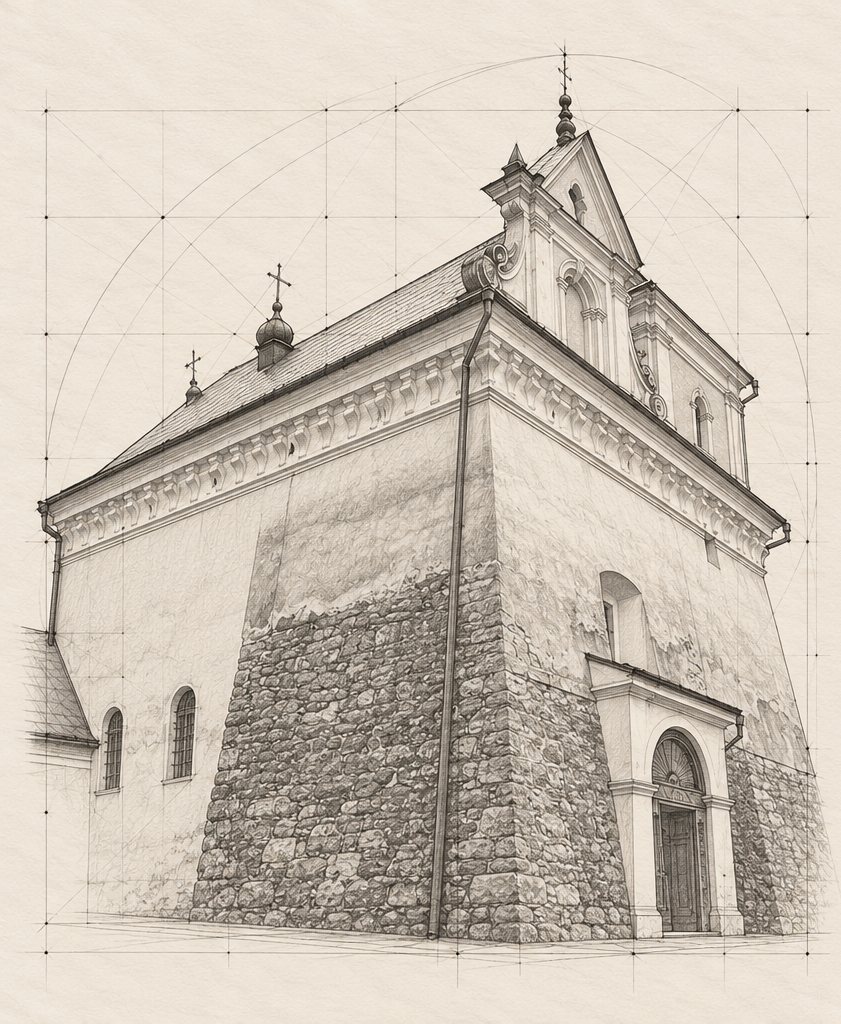
The loopholes are shaped like keyholes and run around the perimeter just under the roof. From below they look almost like ornament — until you remember why they were made.
The bell tower
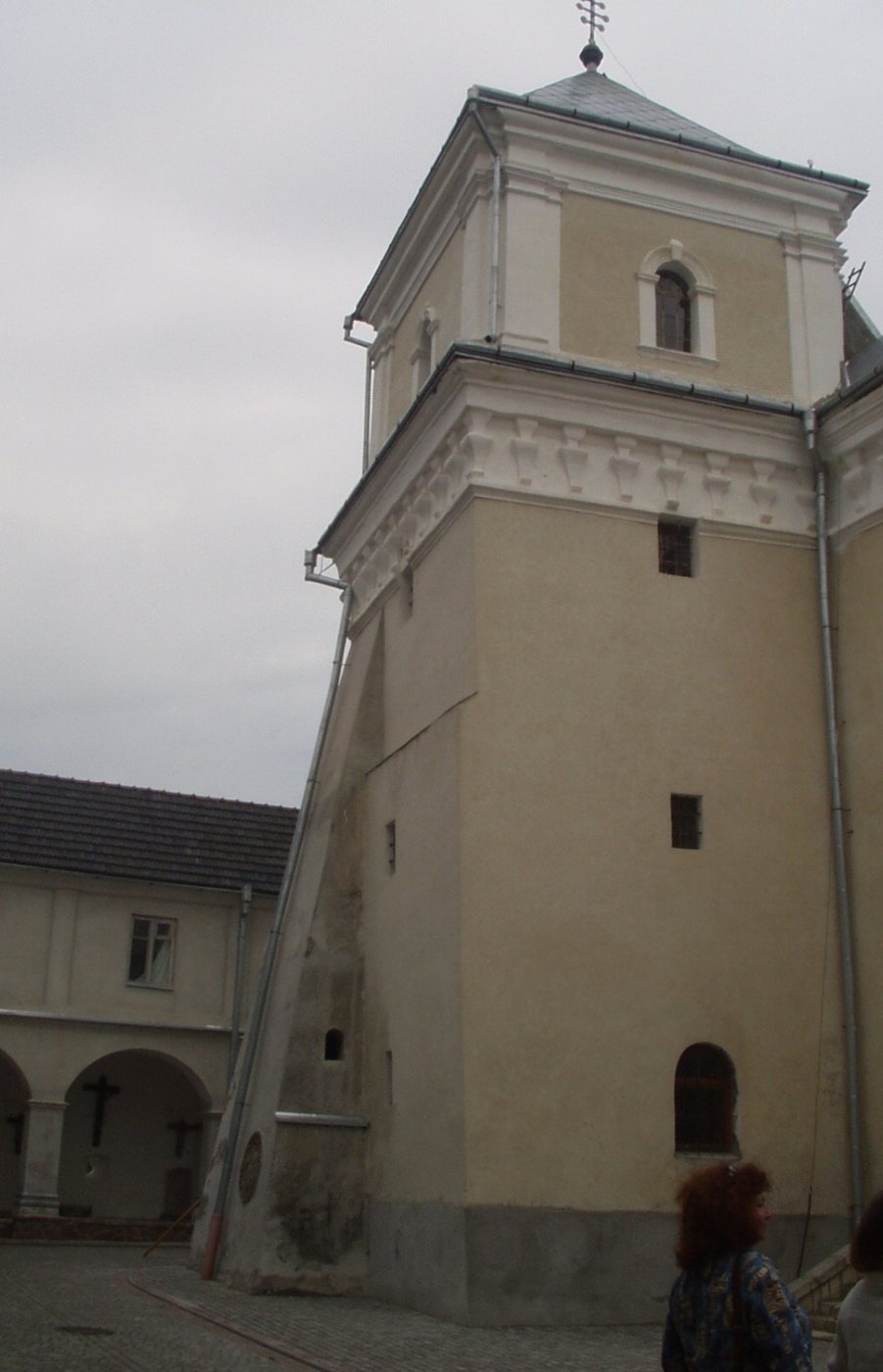
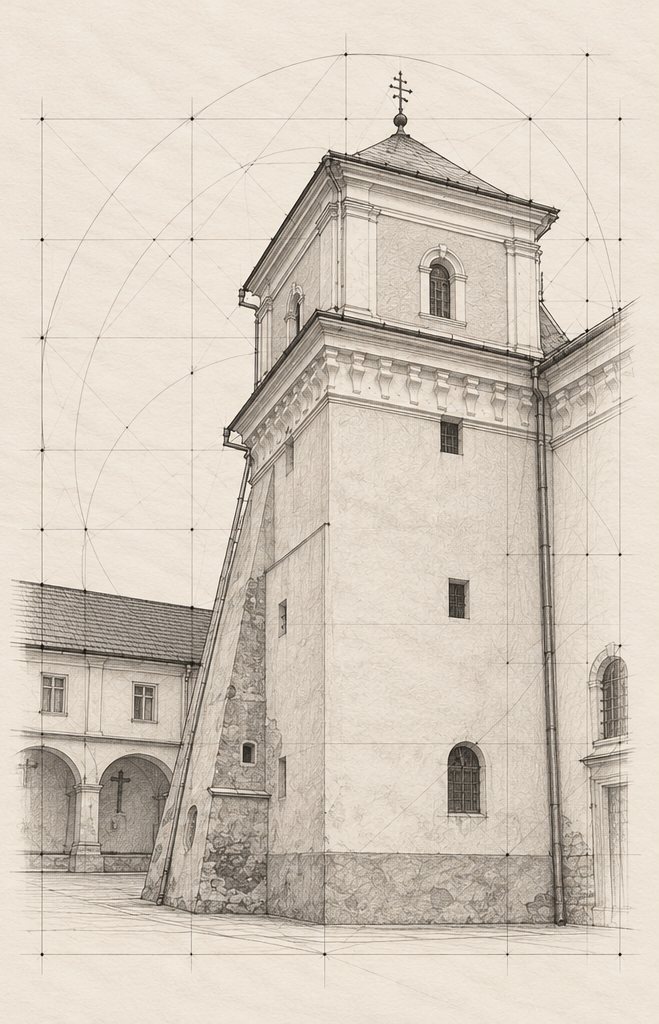
The tower is built against the porch and has a stern, almost fortress-like look. The new bell tower-chapel in the outer courtyard appeared only after 1991.
Details that are easy to miss
Keys hidden from the attacker. In 1631 Stanisław Baratynski tried to seize the monastery. The attacks were repelled, and the monks, as Ukraina Inkognita writes, hid the keys to the church.
A cannon underground. In 2002, during earthworks, the remains of the entrance gate, a cannon and about fifty stone cannonballs were found. The defensive character of the monastery is not a metaphor here but an archaeological find.
A tomb in two places. Lahodovskyi’s Renaissance tomb with a sculpted portrait originally stood in the church. The original is now in Olesko Castle, and in the monastery gallery there is a copy, which is considered one of the finest examples of Galician Renaissance sculpture.
An icon in a cover that outlived the original. The original Univ icon has not survived, and two old copies, according to the UGCC map, disappeared after the lavra was closed. What survived is the 18th-century cover (oklad). It now adorns a copy painted by Hieromonk Yuvenalii Mokrytskyi from old engravings and photographs; it was brought to the lavra in 1995.
A printing house for a hundred years. The Univ printing house, which according to VUE operated in 1648–1765, published more than sixty titles according to the UGCC map. For a monastery in the Holohory hills this was no less significant than its walls: the books travelled much farther than cannonballs ever flew.
Fires in the church. In Soviet times, according to VUE, tombs and burials were desecrated, including that of Cardinal Levytskyi, and several times fires were lit in the church to burn liturgical books. The 18th-century iconostasis (1730 according to Visnyk, 1731 according to VUE) was painted over, and the murals of 1935–1936, according to VUE, were whitewashed.
A reformer from Athos. According to Visnyk, in 1601 Yezekyil (in the schema Iov) Kniahynytskyi, who had just returned from Mount Athos and begun reforms, was invited to Univ; he later founded the Maniava Skete. Ivan Vyshenskyi, according to Euromaidan Press, lived in this monastery in 1606.
Photo gallery
Stone and material
The church and walls are of masonry; on the west gable is the Sheptytskyi coat of arms carved in stone. After the 18th-century rebuilding the walls were strengthened with buttresses. The sources give no dry statistics about the stone, but they do give archaeology: the stone cannonballs found in 2002 are also part of the history of this monastery’s material.
The rib vault is the most honest part of Late Gothic: the rib shows where the load goes and hides nothing. The carved coat of arms on the gable works differently — it carries nothing, yet explains everything. A well-designed church has room for both. The same is true of stone sculpture: a relief on a facade should be planned together with the wall, not after it.
Other churches that knew how to defend themselves are the Intercession Church in Sutkivtsi and the Dormition Church in Zymne. What stands in place of a lost iconostasis is explained in the article “What is an iconostasis”.
Did you know
The centre of the present village is still called "Kapelivka" — probably after the settlement of the musicians of the monastery chapel of the 18th century; they lived on monastery land outside the walls and were not monks. [16]
In 1946–2003 the village was called Mizhhiria, so Soviet documents about the "Mizhhiria hospital" or "care home" refer to the monastery. [2, 3, 21]
Among those saved in Univ was the future Nobel laureate in chemistry Roald Hoffmann: the teacher Mykola Diuk hid him and his family in the attic of the school annex from January 1943 to July 1944. [12, 21]
The memorial plaque on the monastery wall was unveiled in 2005; Adam Rotfeld, then Poland's foreign minister, hid as a child in the monastery shelter. [12, 28]
The Univ Lavra is not the only lavra of the UGCC: in Lviv there is also the Holy Ivan Lavra, founded in 1927. [7, 30]
The museum keeps a collection of antimensia covering about 300 years of Church history in the region; in 2007 the library held 1,133 books. [5, 17]
The altar Gospel printed in Kyiv in 1707 was acquired in 1712 and bound until 1741; in Soviet years it was hidden by Ksenia Chaban and the Lesitskyi family. [5]
On Christmas Eve 1991 the bells of the lavra rang for the first time in half a century. [20]
In December 1738 Bishop Yurii Blazhovskyi of Mukachevo was consecrated in the monastery. [16]
According to TSN, in January 1946 (17 January) a hideout was found in the monastery; later this became one of the charges against Klymentii Sheptytskyi. [8]
The powerlifter monk Makarii (Dutka) set a Ukrainian bench-press record (193 kg) and, instead of congratulations, asked for money for drones. [13, 14]
The Univ hillfort on Monks' Hill covered about 20 hectares; the outer rampart with a moat stretched for roughly 2.5 km. [15]
Legends
Lahodovskyi's spring
According to legend, the nobleman Oleksandr Vanko Lahodovskyi fell ill in his legs, and in a dream the Mother of God told him to find a spring; he bathed among the ashes, recovered and in gratitude rebuilt the monastery. Recorded on Karpatium and in a travel blog. [10, 24]
The icon in the ashes
According to legend, the wonder-working image of the Mother of God appeared in the ashes of the monastery destroyed by the Tatars. Recorded on Karpatium. [10]
The hunia
According to a local legend, the village's name comes from the hunia, the garment of Lahodovskyi, which he took off before bathing in the spring. Recorded on Karpatium (which also gives etymologies from the Univets river and from "unia", the union). [10]
Volodymyr's Town
Local residents call the ancient hillfort on Monks' Hill the town of Volodymyr; R. Berest suggests a link with Volodymyr's campaign against the White Croats (992–993), but this is a hypothesis. [15]
Barefoot pilgrims
According to a travel blog, pilgrims still walk barefoot through the water in the spring's pool, considering it healing. [24]
The storm and the seals
According to the account of Brother Lavrentii (Kuzyk), recorded by LB.ua, after the NKVD sealed the books, a Jew invented a story about a storm so that the monks would avoid arrest. [12]
People
- Fedir Liubartovych — according to Wikipedia and Karpatium, the first patron and founder of the Orthodox monastery (c. 1400).
- Władysław II Jagiełło — king; the first written mention of Univ (1395).
- Sigismund I the Old — king; in 1542 confirmed the privileges and the status of the archimandrite’s seat.
- Oleksandr Vanko Lahodovskyi — nobleman, patron, founder of the masonry church (died 1574).
- Iov (Yezekyil) Kniahynytskyi — hieromonk, reformer; according to Visnyk, invited to Univ in 1601; later active at the Maniava Skete.
- Ivan Vyshenskyi — polemicist writer; according to Euromaidan Press, lived in Univ in 1606.
- Varlaam Sheptytskyi — archimandrite, restored the printing house and the monastery (1668).
- Atanasii Sheptytskyi — archimandrite and metropolitan, rebuilt the church, founded the chapel.
- Mykhailo Levytskyi — metropolitan and cardinal, made Univ a residence, died here in 1858.
- Antin Petrushevych — historian, Levytskyi’s secretary, compiler of his library.
- Andrei Sheptytskyi — metropolitan, reviver of Studite monasticism, handed Univ over to the Studites.
- Klymentii Sheptytskyi — hegumen and archimandrite, Righteous Among the Nations (1996), blessed (2001).
- Herman Budzinskyi — superior, in 1941 urged his fellow villagers not to raise a hand against Jews.
- Mykola Diuk — teacher who hid five Jews in 1943–1944.
- Sevastiian Dmytrukh — hegumen, led the restoration of the lavra after 1990.
- Makarii (Dutka) — hieromonk, volunteer and powerlifter.
How to cite
IKONASTONE. The Dormition Church of the Univ Lavra // Guide to the Churches of Ukraine. URL: https://ikonastone.com/en/guide/dormition-church-univ-lavra/ (accessed DD.MM.YYYY).
FAQ
Who built the Dormition Church in Univ?
The church was built by the nobleman Oleksandr Vanko Lahodovskyi, patron of the monastery until his death in 1574, after the Tatars burned the monastery in 1549. VUE dates the church to 1570; other sources speak of construction in 1549–1574 or 1550–1570.
What legend is connected with the lavra?
According to legend, Lahodovskyi suffered from pain in his legs, and in a dream the Mother of God told him to look for a spring. He found it near the ruins of the monastery, bathed, was healed, and in the ashes came upon an undamaged icon of the Mother of God. In gratitude he rebuilt the monastery.
Why is the church called fortified?
Keyhole-shaped loopholes for hand firearms are cut into the crowning corbel frieze around the church, and the structure of the vaults allowed a defensive gallery to be set up above them. The monastery was surrounded by walls with corner towers, a rampart and a moat.
What happened to the lavra under Soviet rule?
The monastery was closed and the monks were arrested or deported. The buildings housed a concentration camp for Catholic clergy, a home for the elderly and a psychoneurological care home. The 18th-century iconostasis (1730 according to Visnyk, 1731 according to VUE) was painted over and the church was turned into a club; the murals of 1935–1936 were, according to VUE, whitewashed. The Studite monks returned in 1989–1991.
Where is Lahodovskyi's tomb?
The Renaissance tomb with a sculpted portrait originally stood in the church. The original is kept in Olesko Castle, and a copy is displayed in the monastery gallery.
Sources
- Wikipedia (en). Univ Lavra
- Encyclopedia of Ukraine (CIUS). Univ
- Euromaidan Press. Historical and Spiritual Univ Monastery (20.06.2016)
- «ВІСНИК» № 208 (грудень 2018). Святоуспенська Унівська Лавра
- Ю. Ясіновський. Бібліотека Унівської лаври: історія, руїна, відновлення. «Україна: культурна спадщина, національна свідомість, державність», № 15, 2006–2007
- О. Терещук. Пресові видання Свято-Успенської Унівської лаври студійського уставу… 2019
- Радіо Свобода. Інтерв'ю з ігуменом Севастіяном Дмитруком про лавру
- ТСН. Архімандрит Климентій, обвинувачений за віру
- Zaxid.net. Климентій Шептицький: граф, юрист, священномученик
- Karpatium. Село Унів
- Zaxid.net. В Уневі освятили новозбудований храм (19.05.2007)
- LB.ua. Як українські монахи-студити євреїв рятували (11.10.2019)
- Радіо Свобода. Монах, спорт, молитва, церква, війна
- РІСУ. Унівська лавра (добірка новин)
- Р. Берест. Дослідження оборонних укріплень Унівського городища. «Матеріали і дослідження з археології Прикарпаття і Волині», вип. 11, 2007
- І. Кузьмінський, В. Мороз. Історія музичної капели при Унівському монастирі у XVIII ст. Slavica Slovaca, 56, 2021
- Karpaty.info. Museum of Sacred Art (Univ)
- УГКЦ. Унівська чудотворна ікона в Римі (06.05.2011)
- Byzantine Catholic World. Univ monastery becomes subject to Greek-Catholic Patriarch (07.05.2008)
- Wikipedia (en). Ukrainian Studite Monks
- Myshtetl. Univ
- Wikipedia (en). Michael Levytsky
- Wikipedia (en). Ivan Vyshenskyi
- Travelfeed (блог @yetaras). My second pilgrimage to the Univ monastery
- TravelsInUA. Univ Holy Dormition Lavra
- ВУЕ. Унівська Свято-Успенська лавра (процитовано в поточній статті, напряму не відкрито)
- Pilgrim.ekarpaty. Svyato-Uspenska Univska Lavra
- Радіо Свобода. Ротфельд про Шептицького (10.11.2010)
- Львівська національна галерея мистецтв ім. Б. Возницького. Панорамний вигляд на комплекс Унівської лаври (1960-ті?)
- Українська правда. Життя. Музей і церква: приречені на співпрацю (16.09.2016)
- Town
- Univ village, Lviv District, Lviv Oblast
- Built
- c. 1550–1570 (VUE: 1570); rebuilt 1741
- Type
- single-nave fortified church with a semicircular apse and a bell tower
- Material
- masonry; stone coat of arms of the Sheptytskyi family on the west gable
- Research depth
- 31%