The Armenian Cathedral in Lviv: a dome of clay pots and a Judas turned into a shadow
The dome of this cathedral was built of empty clay pots — and it has survived six and a half centuries, several fires and a Soviet storehouse.
In brief
| Address | 7/13 Virmenska St, Lviv |
| Built | 1363–1370, master builder Doring |
| Rebuildings | 1437 (arcade), 1630 (western nave), 1723–1726 (Baroque); restoration 1908–1927 |
| Type | cross-in-square, three aisles, three apses, four piers, single dome |
| Material | white dressed stone (walls 1.4 m thick), brick; dome of ceramic pots |
| Status | monument of national importance; within the UNESCO site “L’viv – the Ensemble of the Historic Centre” |
History
The Armenian community appeared in Lviv almost together with the city itself, and within a century it had become one of the wealthiest. It was given a plot one block from the Market Square. Here, in 1363–1370, the Cathedral of the Dormition of the Virgin Mary was built. The construction was funded by the merchants Yakiv of Caffa (today’s Feodosiia) and Panos of Haisarats, and the church was built by the master builder Doring; various sources also render his name as Dore or Dorkhe. Wikipedia writes that the model for the cathedral was the cathedral of the old Armenian capital, Ani; the Great Ukrainian Encyclopedia (VUE) finds features in common with the Surb Astvatsatsin church in Odzun.
In the 15th century side apses were added to the cathedral, and in 1437 an open arcaded gallery was built on three sides. Only the southern part survived, in a Renaissance reworking after the fire of 1527. In 1571 a gate bell tower rose on the Virmenska Street side: VUE names Petro Krasovskyi as its architect and Andrii of Caffa as its founder.
In 1630 Archbishop Mikołaj Torosowicz concluded a union with Rome, and the cathedral became the seat of the Armenian Catholic archdiocese. At the same time the architect A. Kelar replaced the western gallery with a broad hall-nave that lengthened the church. Around 1670 the northern gallery was converted into a sacristy. VUE mentions fires in 1676 and 1778; To Ye Lviv links the Baroque appearance of the interior to a fire in 1712 (lviv-online does the same); the fire of 1778 affected the whole of Virmenska Street. The most thorough Baroque rebuilding took place in 1723–1726.
In 1908–1927 the cathedral was restored under the architect F. Mączyński: many later 17th–18th-century layers were removed, the facade facing Krakivska Street was rebuilt, and the cathedral received a new main entrance. At that time the mosaics and stained glass of Józef Mehoffer appeared, and in the late 1920s the murals of Jan Henryk Rosen.
In 1945 the Soviet authorities abolished the Armenian Catholic archdiocese, its administrator Dionizy Kajetanowicz was arrested, and most of Lviv’s Armenians left for Poland. In 1946 Kajetanowicz was sentenced to ten years in camps, and he died on 18 November 1954 in the Abez camp; Wikipedia adds that the Soviet authorities also arrested three other priests. The archdiocese itself formally still exists, but its see has been vacant since 1938: the cathedral has outlived its own diocese. The cathedral was closed and turned into a museum storehouse. In 2000 it was handed over to the Armenian Apostolic Church, and in 2003 Catholicos Karekin II consecrated it as a cathedral; the sources give the date of the consecration differently — 18 May (RISU, Wikipedia) or 19 May (Movna); a newspaper article of 23 May 2003 writes of a consecration “last weekend”. On 25 June 2001 Pope John Paul II prayed here. Rosen’s murals have been under restoration since 2008, funded by the Polish Ministry of Culture and Polonika; Sophia of Kyiv reports that the restoration of the polychrome murals was completed in 2019.
Timeline
The figures in square brackets are the numbers of the sources in the list at the bottom of the page. The note “according to …” means that the fact is confirmed by only one source. The section “Legends” contains traditions and legends: they are recorded in the sources but not confirmed by documents.
The Armenian community and the medieval cathedral
- 13th c.
A wooden Armenian church stood on the site of the future cathedral. [7, 16]
- 1363–1370
The stone Cathedral of the Dormition of the Virgin Mary is built by the master builder Doring (also Dore, Dorkhe) at the expense of the Armenian merchants Yakiv of Caffa (now Feodosiia) and Panos of Haisarats. A Polish reference dates the oldest part to 1356–1363, and ZAXID.NET gives the overall limits as 1356–1370. [1, 3, 4, 7, 16]
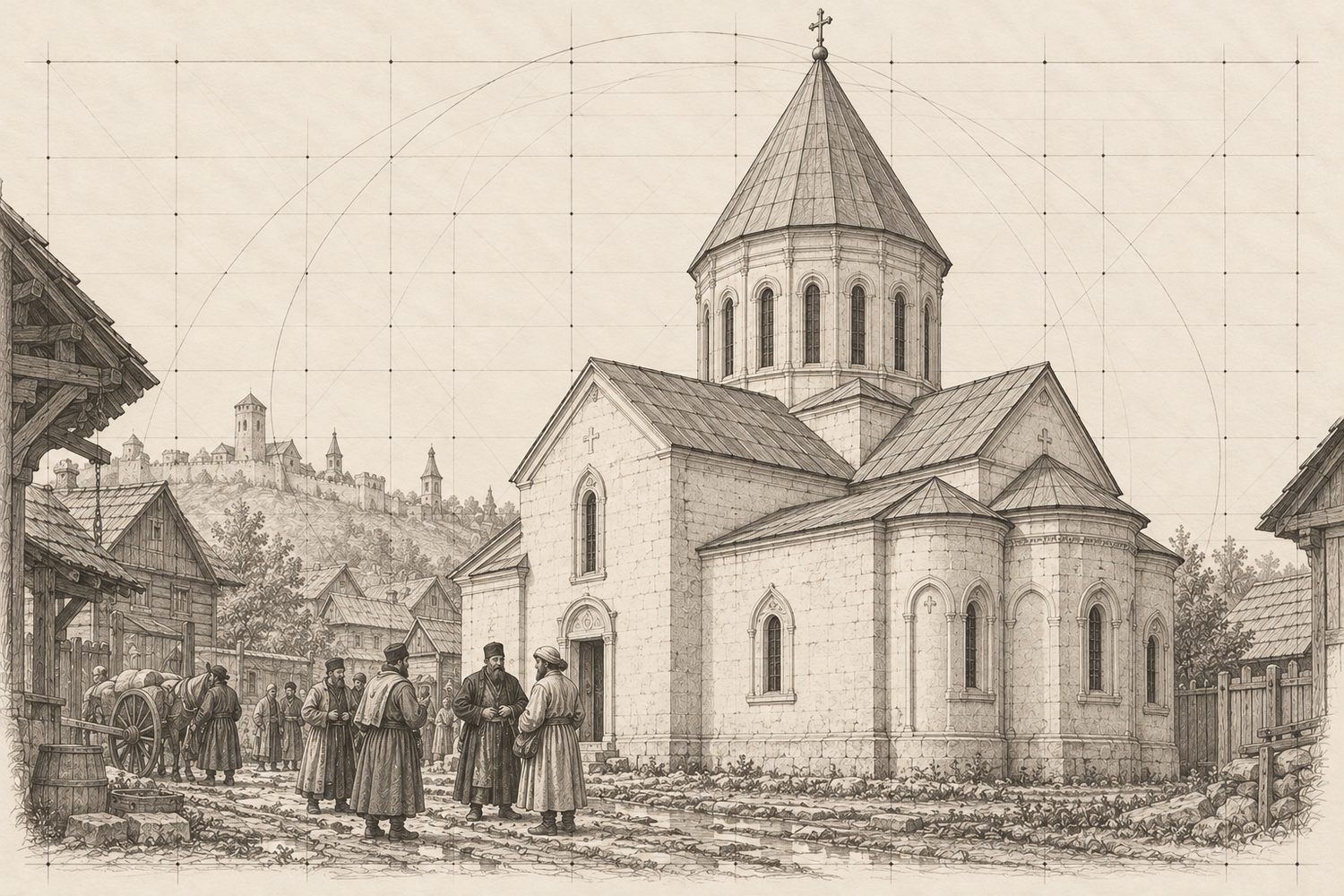
Around 1370: the medieval cathedral. Illustration: IKONASTONE - 1364
According to VUE, the cathedral becomes the seat of the Armenian archbishopric; the Encyclopedia of Modern Ukraine links 1367 with the right of religious self-government granted to the Armenians by Casimir the Great. The sources give the exact year of the see’s status differently. [1, 15]
- 15th c.
Side apses are added to the cathedral. [1]
- 1437
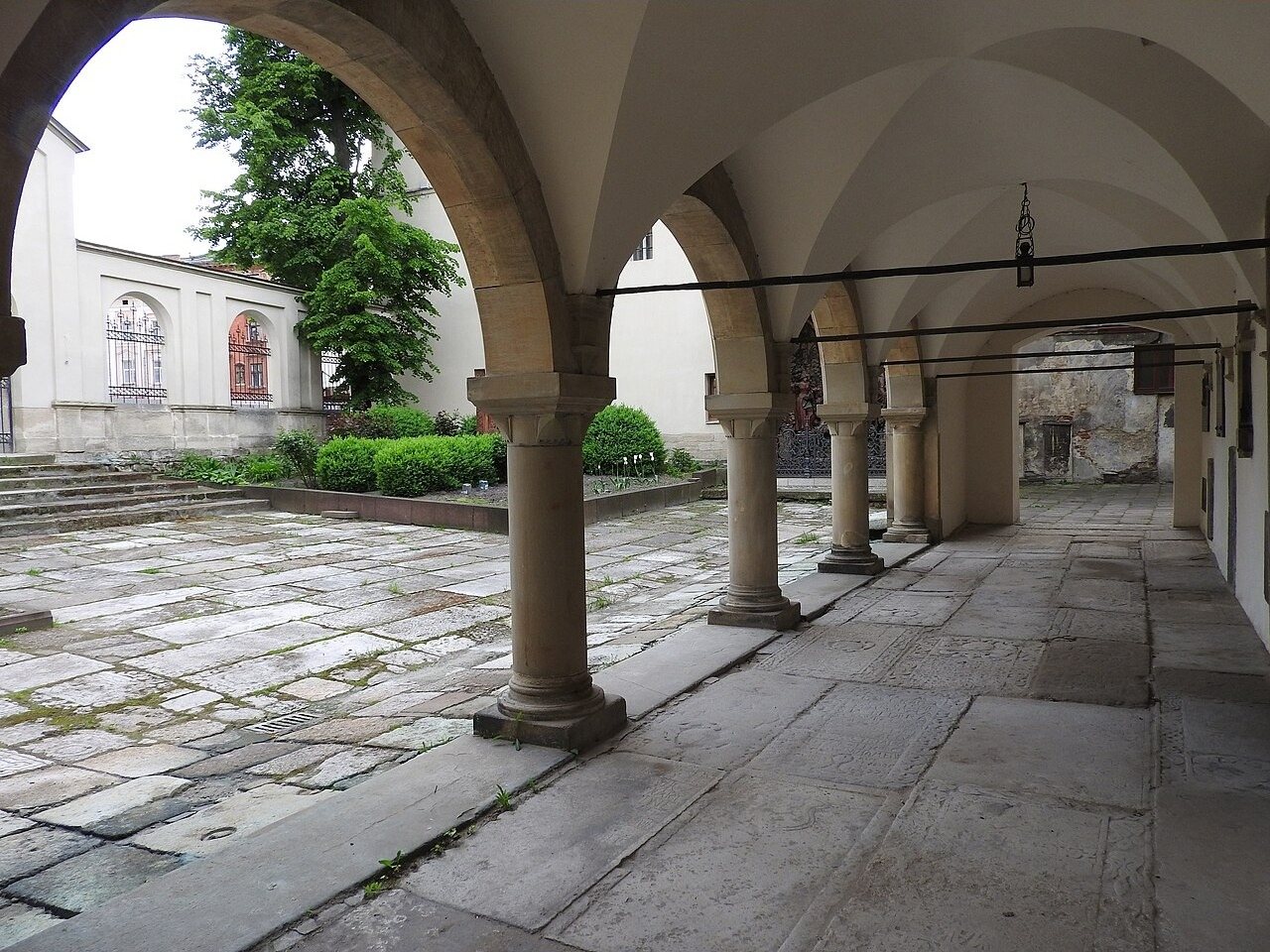
An open arcaded gallery is built on three sides of the cathedral. Only the southern one survived, in a Renaissance reworking after 1527; the northern one was rebuilt as a sacristy. [1, 2, 3]
- 1527
A citywide fire damaged the cathedral. [2, 3]
- 1570–1571
The architect Petro Krasovskyi builds a three-tier gate bell tower at the expense of Andrii of Caffa, on the site of an earlier one destroyed by fire; the date 1570 is preserved on the Renaissance portal of the first tier. [1, 6, 7, 16]
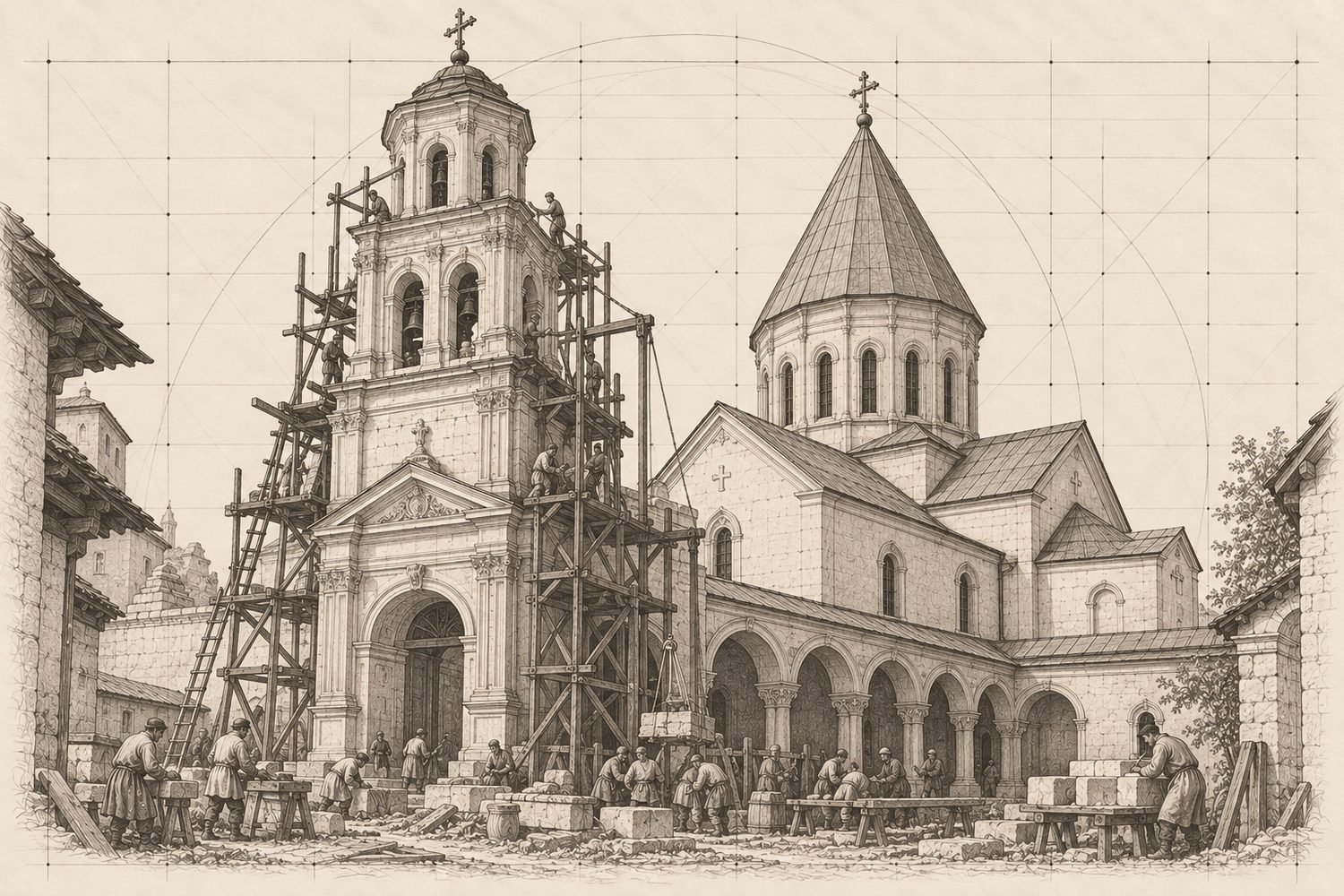
1570–1571: building the bell tower. Illustration: IKONASTONE
The union, fires and the Baroque rebuilding
- 1630
Archbishop Mikołaj Torosowicz accepts the union with Rome (according to ZAXID.NET, in the Carmelite church near the Krakow Gate); the cathedral becomes the seat of the Armenian Catholic archdiocese. [3, 8]
- 1630
In place of the western gallery, the architect A. Kelar adds a hall-nave that lengthens the church. [1, 2, 3]
- 1640
The Brotherhood of St Gregory the Illuminator founds an Armenian bank at the cathedral — according to Wikipedia, the first financial institution in Lviv; it operated until 1939. ZAXID.NET confirms the year of the brotherhood. [8, 27]
- 1670
The northern gallery is rebuilt as a sacristy. [1]
- 1676
According to VUE, a fire changed the appearance of the cathedral and the bell tower. [1]
- 1682
A convent of Armenian Benedictine nuns is founded nearby. [4, 6]
- 1712
According to lviv-online, after a fire the interior acquired its Baroque character. [4]
- 1723–1726
The most thorough Baroque rebuilding of the cathedral; according to Movna, the 1723 reconstruction was financed by Khrystofor Avhustynovych. [1, 6]
- 1726
A stone column with St Christopher, named in honour of its founder, is erected in the east courtyard. [1, 6, 13]
- 1778
A fire engulfs Virmenska Street as far as the Dominican monastery; according to VUE, the buildings were rebuilt afterwards, and in 1802 the complex was extended. [1, 7]
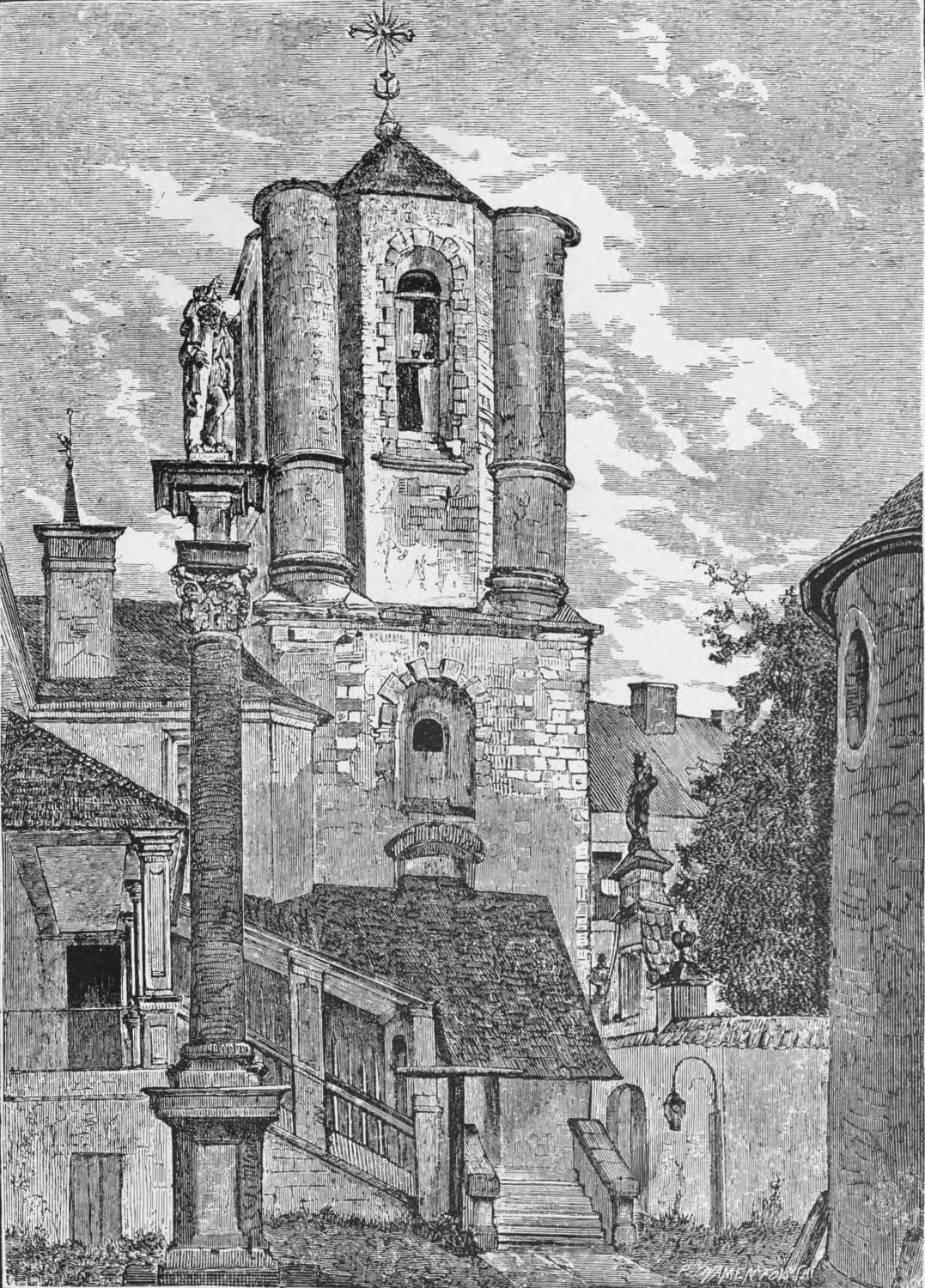
The Armenian church in Lviv. Drawing by Jan Matejko, 1872. Wikimedia Commons, public domain
The restoration of Józef Teodorowicz
- 1902
Józef Teodorowicz is consecrated archbishop in this cathedral; according to Skhidnyi svit, the consecration was performed by Andrey Sheptytsky together with Jan Puzyna and Józef Bilczewski. [21, 24]
- 1905
A committee rejects Władysław Galicki’s restoration project as too bold. [24]
- 1906–1907
Józef Mehoffer receives the commission for the interior decoration (1906) and produces the first concept (1907). [17, 24]
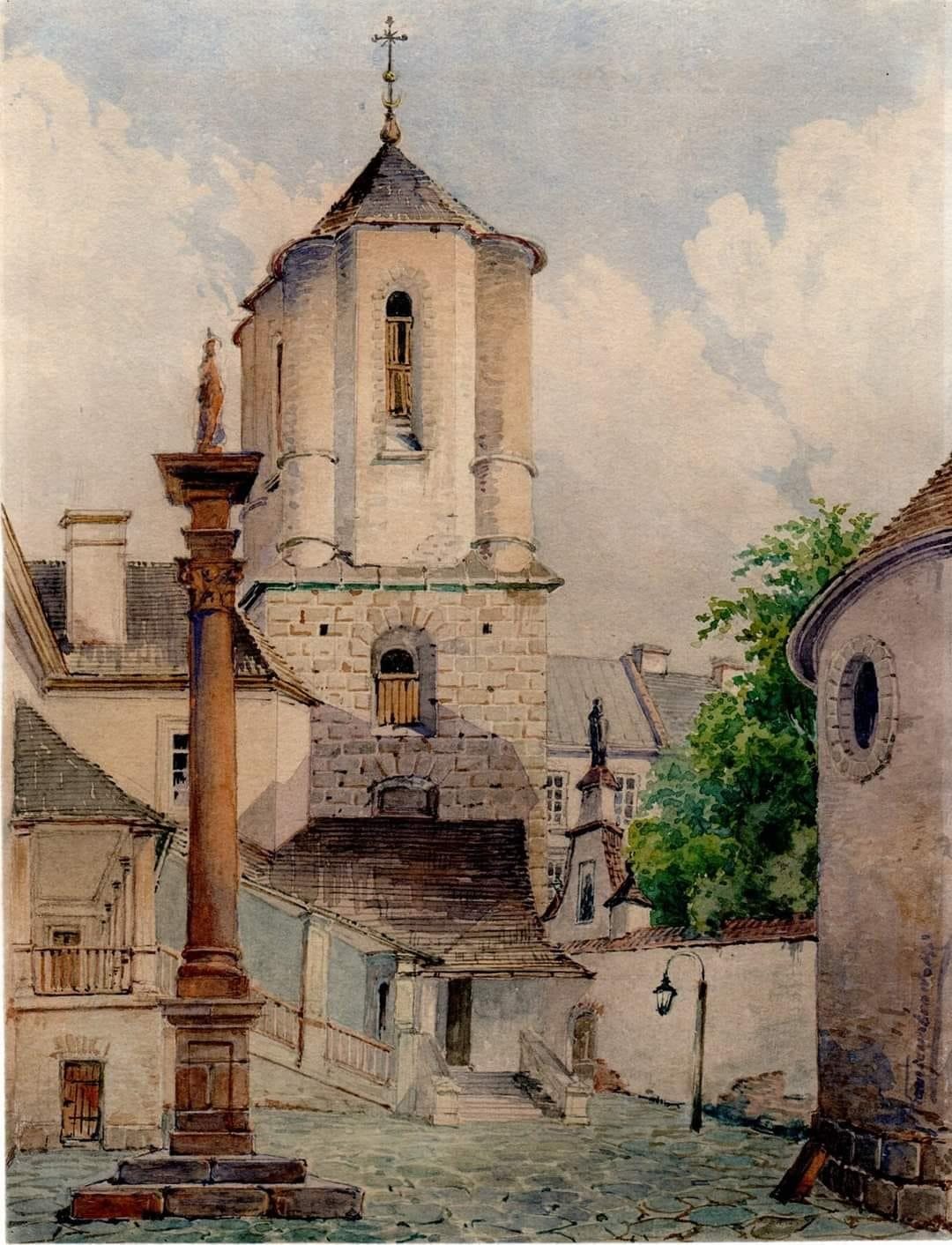
The bell tower of the Armenian Cathedral and the column of St Christopher. Watercolour by Alfred Kamienobrodzki, early 20th c. Wikimedia Commons, public domain 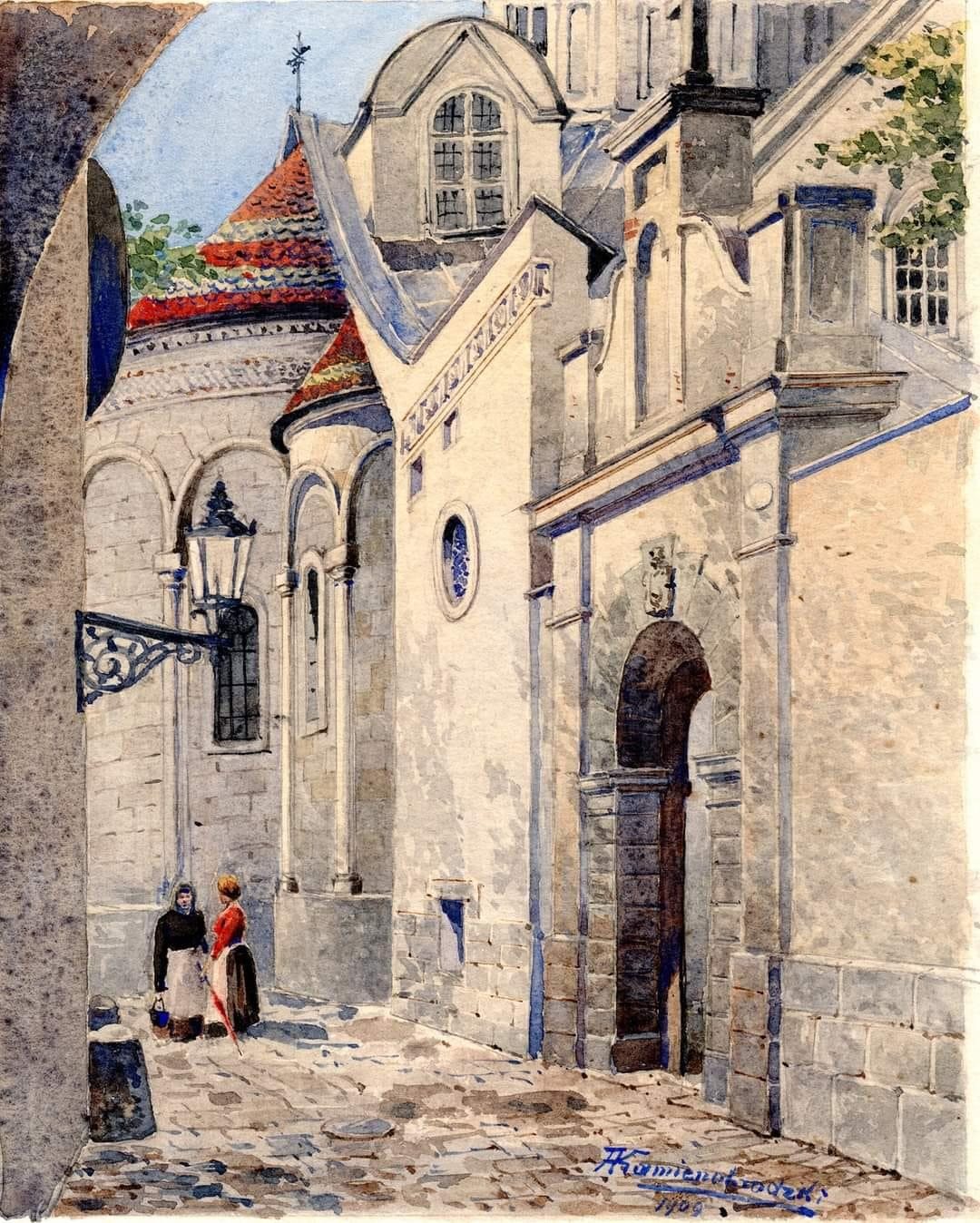
Virmenskyi Lane. Watercolour by Alfred Kamienobrodzki, 1909. Wikimedia Commons, public domain - 1908–1910
According to a project by Franciszek Mączyński, two adjacent houses are demolished and the western part with a new entrance is built; the First World War prevented the completion of the work. [1, 24]
- 1912–1913
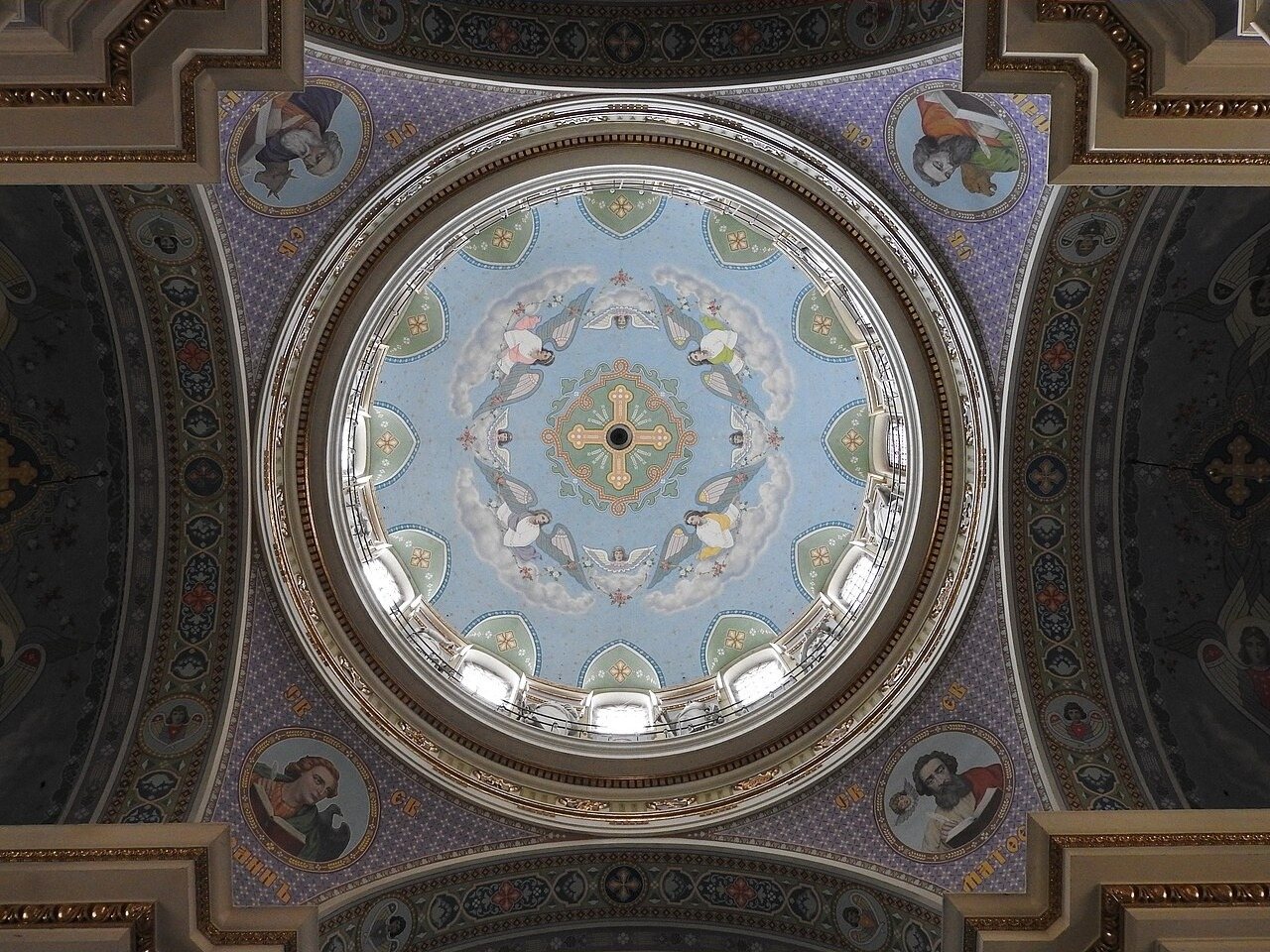
The Italian workshop of Angelo Ganese assembles the mosaic in the dome from Venetian glass to Mehoffer’s design; the area is more than 150 m². Installed in 1913. [17, 24]
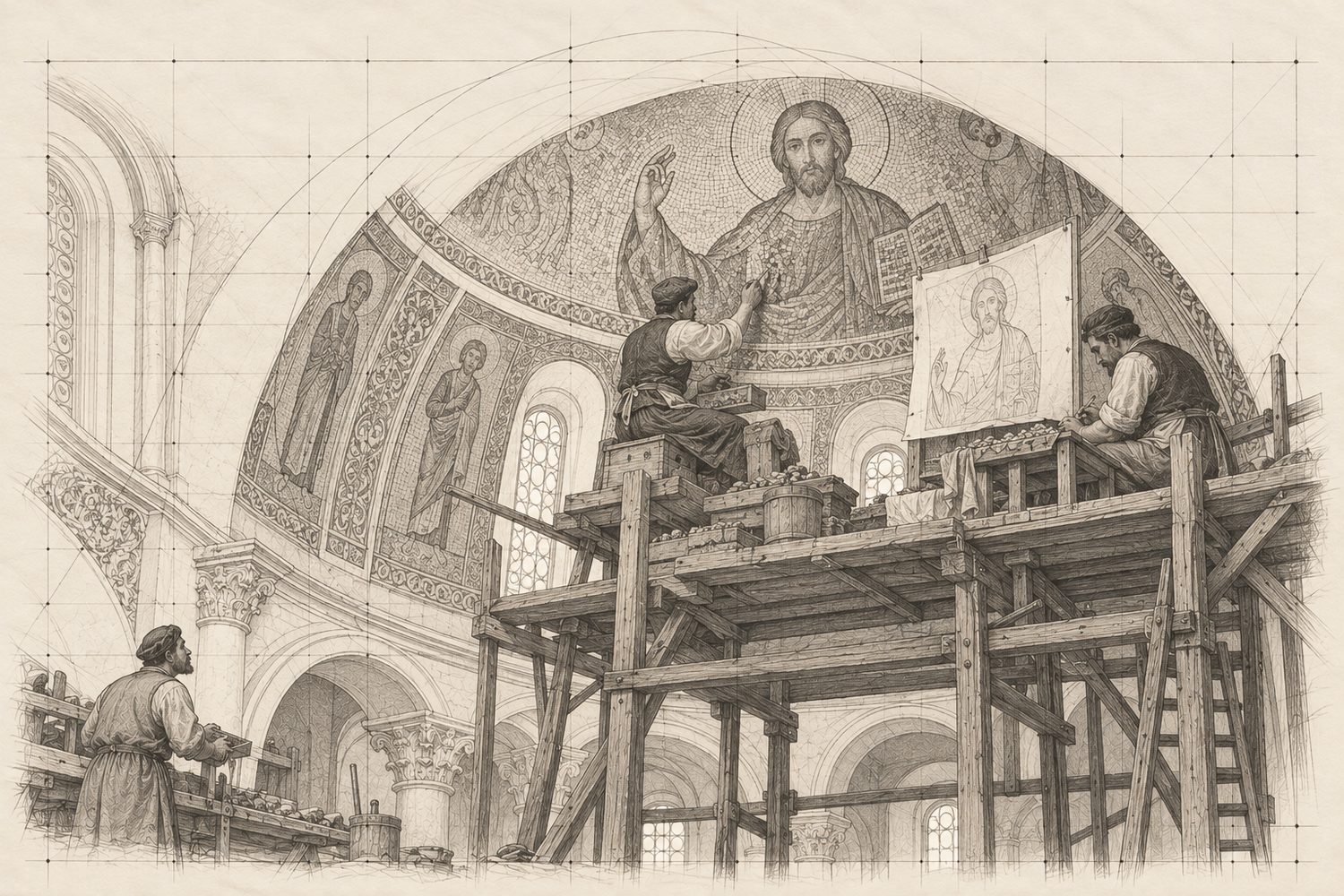
1912–1913: the dome mosaic. Illustration: IKONASTONE - 1925
The conservator Bohdan Janusz uncovers the original frescoes under the plaster. [6]
- 1925–1928
Jan Henryk Rosen paints the cathedral: “The Institution of the Eucharist” (“The Last Supper”), “The Crucifixion”, “The Funeral of St Odilon” (1925–1927). [6, 19, 30]
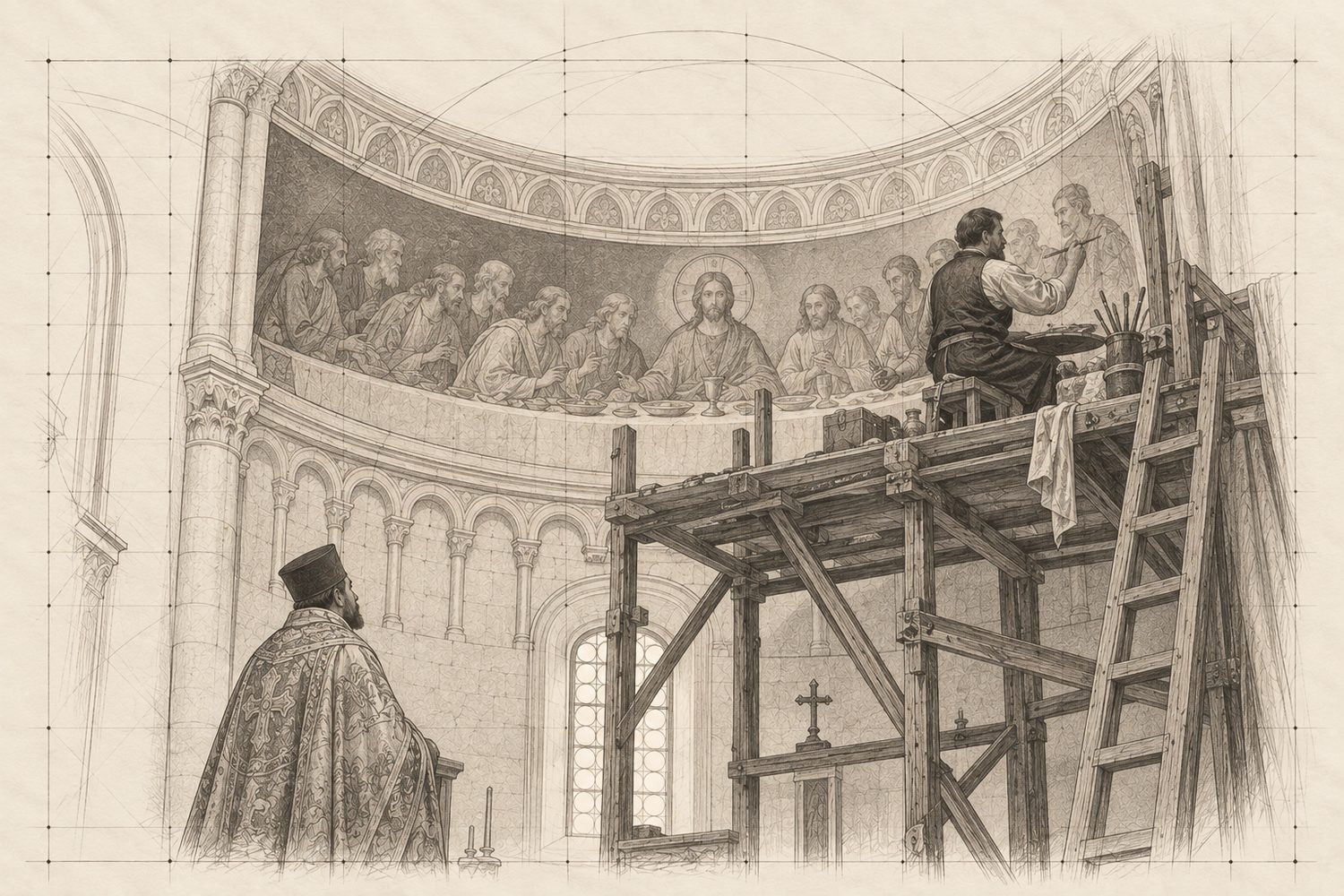
1925–1928: Jan Henryk Rosen's murals. Illustration: IKONASTONE - 1927
End of the 1908–1927 restoration stage, during which much of the 17th–18th-century layers was removed. [1]
- 1928
The Warsaw workshop of Białkowski makes the stained-glass window “St Paul” from Rosen’s cartoon. [18]
- 1932
Archbishop Teodorowicz opens a permanent exhibition of Armenian culture at the cathedral, which became the Armenian Museum. [21, 24]
- 1938
Archbishop Teodorowicz dies; the see remains vacant. [22, 24]
War, abolition and the storehouse
- 1943
The Gestapo arrests the vicar Dionizy Kajetanowicz for issuing Christian baptismal certificates to Jews; he was released after a bribe of 120,000 zlotys, and Metropolitan Sheptytsky pressed for his release. [21, 22]
- 1945
The Soviet authorities abolish the Armenian Catholic archdiocese; most Armenians leave for Poland. [2, 3, 22]
- 27 November 1945
Kajetanowicz is arrested for refusing to convert to the Orthodox Church. [23]
- 8–9 March 1946
He is sentenced to ten years in camps. The sources disagree on the day: 8 March [22] and 9 March [23]. [22, 23]
- 1946–1953
The church is closed to worshippers (from 1946); it houses a storehouse of the Lviv Picture Gallery, and from 1953 a Lenin museum. [3, 4, 6]
- 18 November 1954
Dionizy Kajetanowicz dies in the Abez camp (Komi); his burial place is unknown. Rehabilitated on 10.08.1994, according to Cyclowiki. [22, 23]
- 1960s
According to the Encyclopedia of Ukraine, the cathedral serves as a repository for icons from churches of the region. [14]
Return and revival
- 1991
An Armenian religious community is registered in Lviv; the structure of the diocese is restored. [15]
- 1997
The Ukrainian Diocese of the Armenian Apostolic Church receives canonical recognition. [15]
- January 2000
The cathedral is handed over to the Armenian Apostolic Church. [3, 4, 30]
- 6 January 2001
The first service in the revived church, according to RISU. [3]
- 2001
Boxes with fragments of Rosen’s stained glass are found in the cellars; they are inventoried and conserved by Anatolii Chobitko. [18]
- 25 June 2001
Pope John Paul II visits the cathedral; according to VUE, he prayed in it. [1, 26]
- 18 May 2003
Catholicos of All Armenians Karekin II consecrates the cathedral. Movna gives 19 May; Dzerkalo tyzhnia (article of 23 May) writes of a consecration “last weekend”. [2, 3, 6, 25]
- 2006–2009
The community decides on a restoration (2006); Rosen’s murals have been under restoration since 2008; Poland finances the work. [28, 29, 30]
- 2010
Restoration of the facade, windows, four gates and the bell tower (contractor “Stela”); UAH 1.5 million from the city budget. [9]
- 15 September 2013
For the 650th anniversary of the see, the wooden altar “Golgotha” is solemnly opened after its 2010–2013 restoration. [10, 11]
- 2015–2017
The failing collector under the courtyard is replaced and the column of St Christopher restored (2015–2016, the group of Andrzej Kazberuk); on 12 May 2017 the renewed courtyard is opened. [12, 13]
- 2018–2021
Restoration of “The Last Supper” (2018), Mehoffer’s mosaic (2019) and the stained-glass window “St Paul” (from July 2021). [17, 20]
- 2019
According to Sophia of Kyiv, the restoration of the polychrome murals is completed; an exhibition about the cathedral and its creators is shown in Wilanów (Warsaw). [28, 29, 30]
- March 2022
Because of the full-scale invasion, the medieval wooden sculpture of Christ is taken from the altar to a safe place. [31, 32]
- 25 March – 26 April 2026
An exhibition about the cathedral and its creators is held in Kyiv, in the Bread Galleries (Khlibni Halereï) of Sophia of Kyiv. [28]
Lost and recreated
| What | What it was | What happened | Where it is now |
|---|---|---|---|
| Wooden church | 13th c., on the site of the cathedral | Replaced by the stone cathedral in 1363–1370 | Not preserved [7, 16] |
| Original bell tower | 14th c., on the site of the present one | Destroyed by fire | Replaced by the bell tower of 1571 [7, 16] |
| Open arcaded gallery | 1437, on three sides of the cathedral | Reworked after the fire of 1527; the northern one rebuilt as a sacristy | Only the southern arcade survives [1, 2, 3] |
| Western gallery | Before 1630 | Replaced in 1630 by a hall-nave (A. Kelar) | Not preserved; the nave exists [1] |
| Layers of the 17th–18th c. | Baroque rebuildings | Much of them removed during the 1908–1927 restoration | Baroque forms preserved on the exterior [1] |
| Rosen’s stained glass (1928) | Windows of the sanctuary | Considered lost | Boxes with fragments found in 2001; “St Paul” under restoration since 2021 [18, 20] |
| Bank at the cathedral | 1640, in the chapter house | Operated until 1939 | The building is part of the complex [4, 27] |
| Skevra (Lviv) Gospel | Late 12th c.; source of Mehoffer’s ornaments | Taken out of Lviv | Present whereabouts not verified [24] |
| Armenian Museum | 1932, at the cathedral | The fate of the collection after 1945 is not described in the sources | Unknown [21, 24] |
| Wooden altar “Golgotha” | 18th c. (other sources: 17th–18th c.), courtyard | Needed restoration | Restored in 2010–2013 [7, 10, 11] |
| Column of St Christopher | 1726, east courtyard | Needed restoration | Restored in 2015–2016 [13] |
| Sculpture of Christ | Altar composition | Taken to a safe place in March 2022 | In storage; its return is not described in the sources [31, 32] |
Architecture
The cathedral was built in the tradition of Armenian sacred architecture, but its plan is a cross-in-square familiar from the Byzantine world: three aisles, three apses, four piers, one dome. The central aisle is wide, the side aisles narrow. The central aisle and the transept rise above the side parts and end in triangular gables.
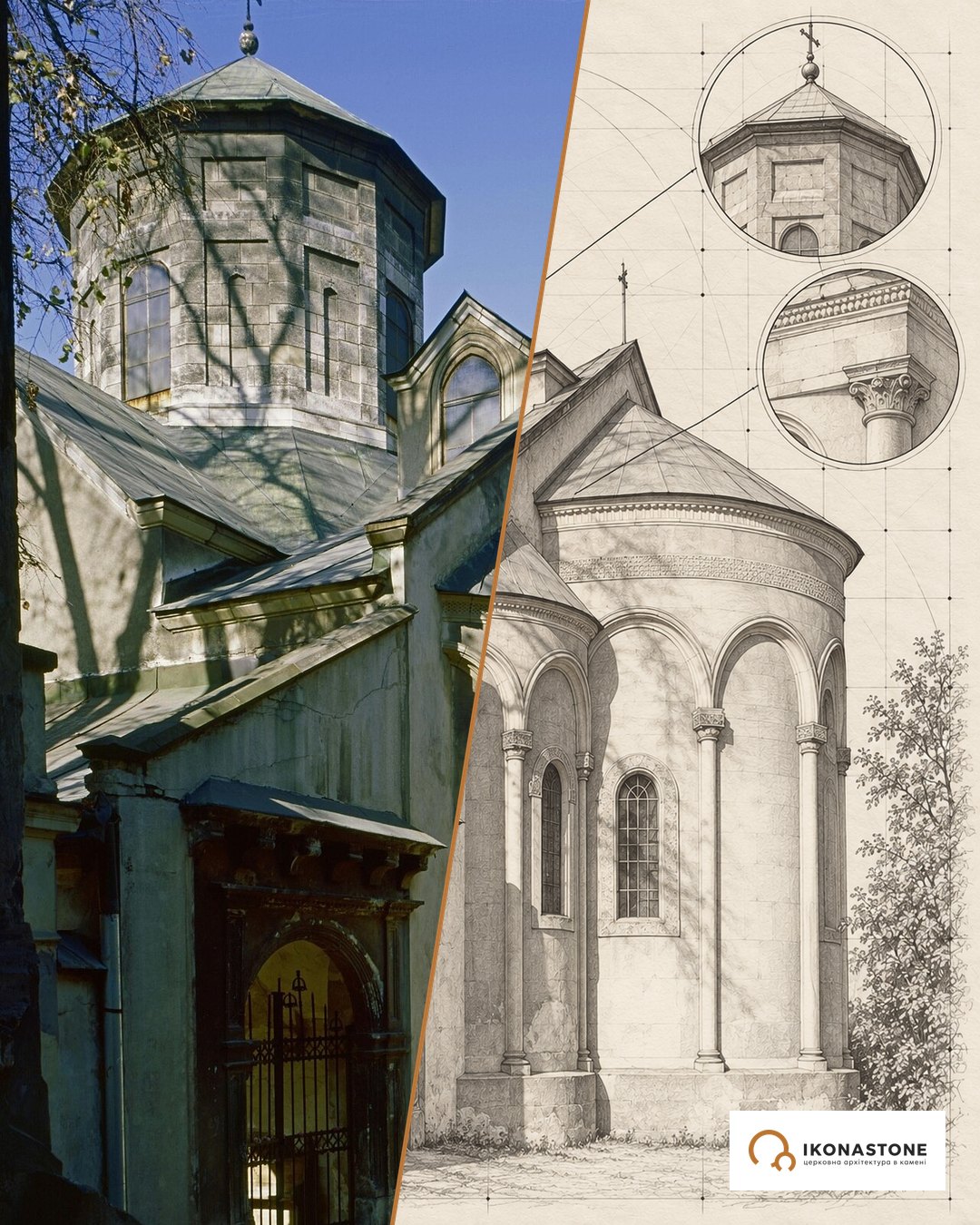
Above the crossing stands a twelve-sided light drum, and on it a ribbed dome under a tented roof. The walls of white dressed stone are 1.4 metres thick. During the restoration of the early 20th century the apses were decorated with applied arches and ornaments borrowed from early Armenian architecture.
The cathedral does not stand alone. Around it are the bell tower, the archbishops’ palace, the chapter house with the Armenian bank founded in 1640, and three enclosed courtyards. Between them are gates, fences and sculptures by T. Dykas: “Christ Carrying the Cross” (1889) in the south courtyard and the “Mother of God” (1881) in the north one. To the north of the cathedral stood a small convent of Armenian Benedictine nuns, and in the central courtyard a wooden Golgotha chapel of the 18th century.
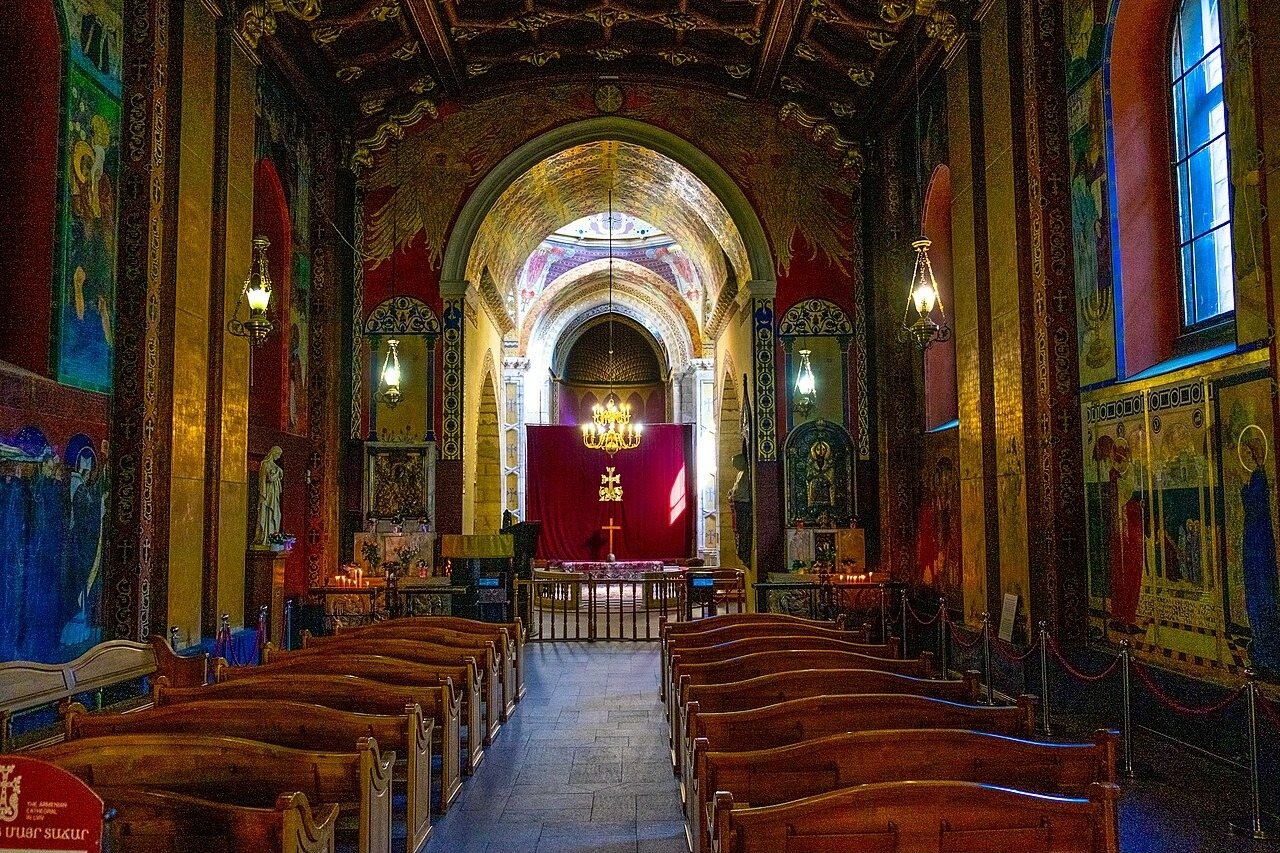
Inside, above the nave, is a carved wooden ceiling, which To Ye Lviv dates to the 17th century; it was restored in 1925, and at the same time old frescoes were uncovered under the plaster in the window niches. Wikipedia also mentions two venerated icons — of St Gregory the Illuminator and of the Mother of God — which were brought here from Yazlivets in the 17th century.
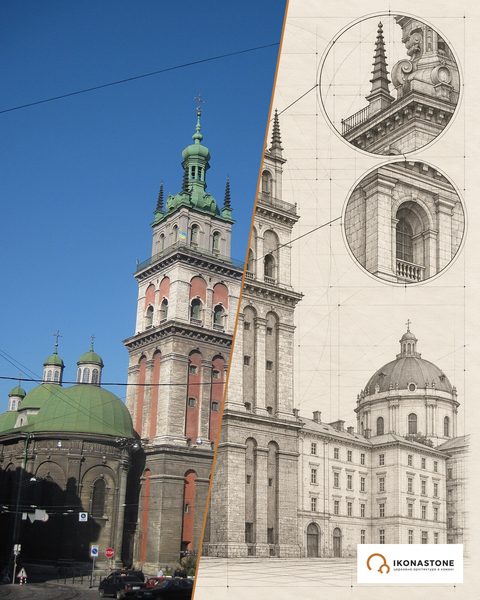
Below are two elements of the church: in a photograph and in a drawing. The drawings show the form, not exact dimensions.
Drum and dome
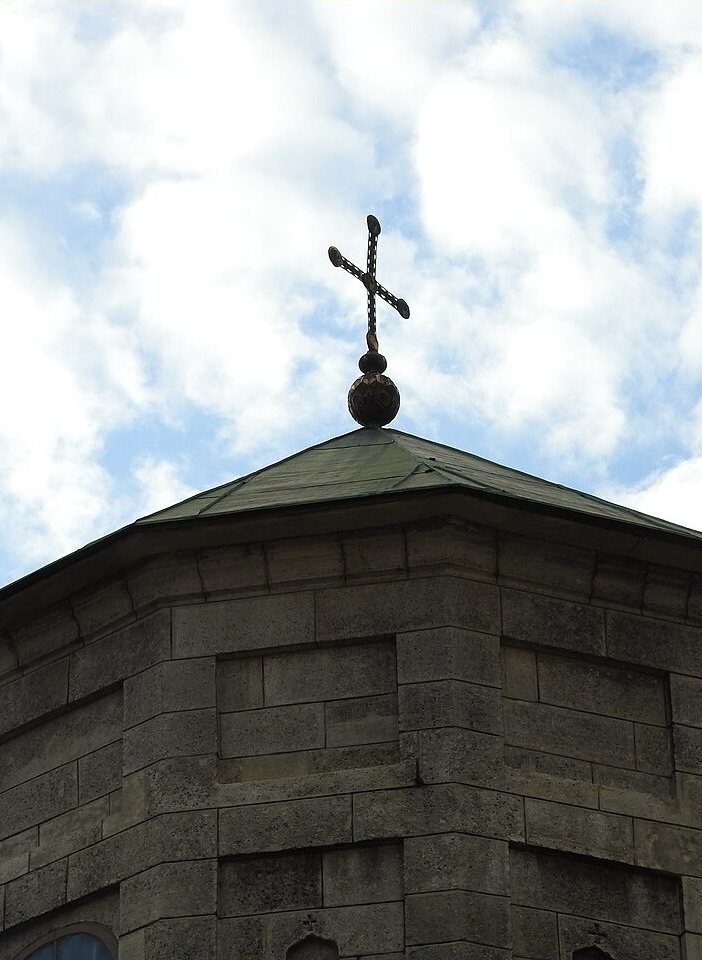
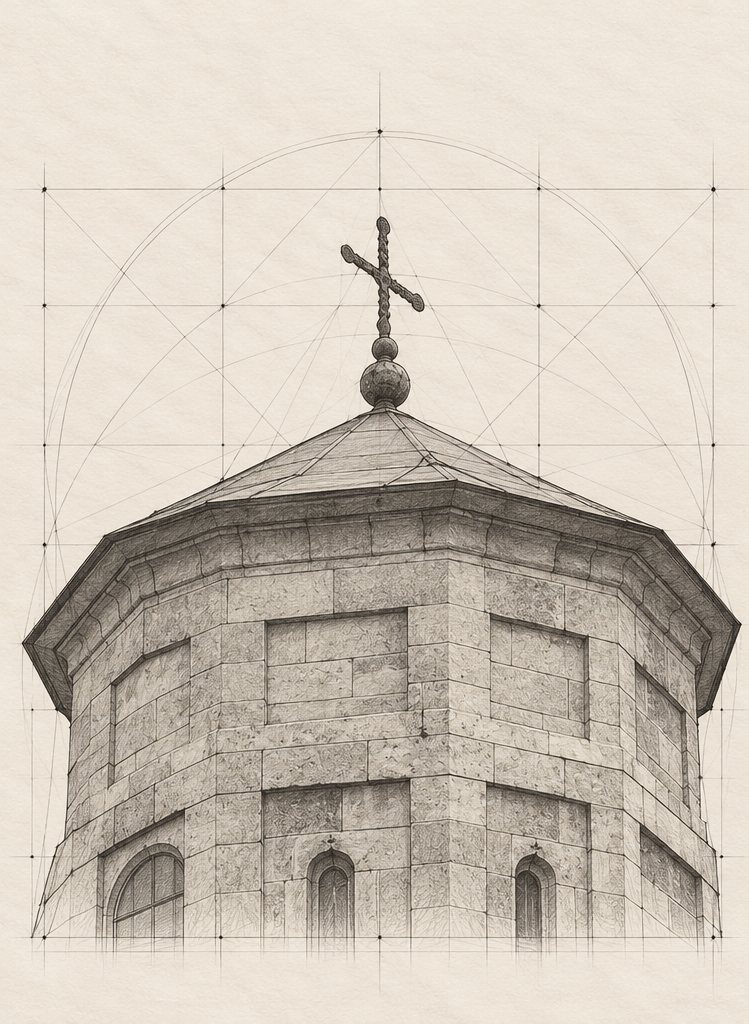
From outside the dome is hidden under a tented roof, so the Armenian form is seen above all in the faces of the drum. Inside, beneath that roof, is Mehoffer’s mosaic.
Bell tower
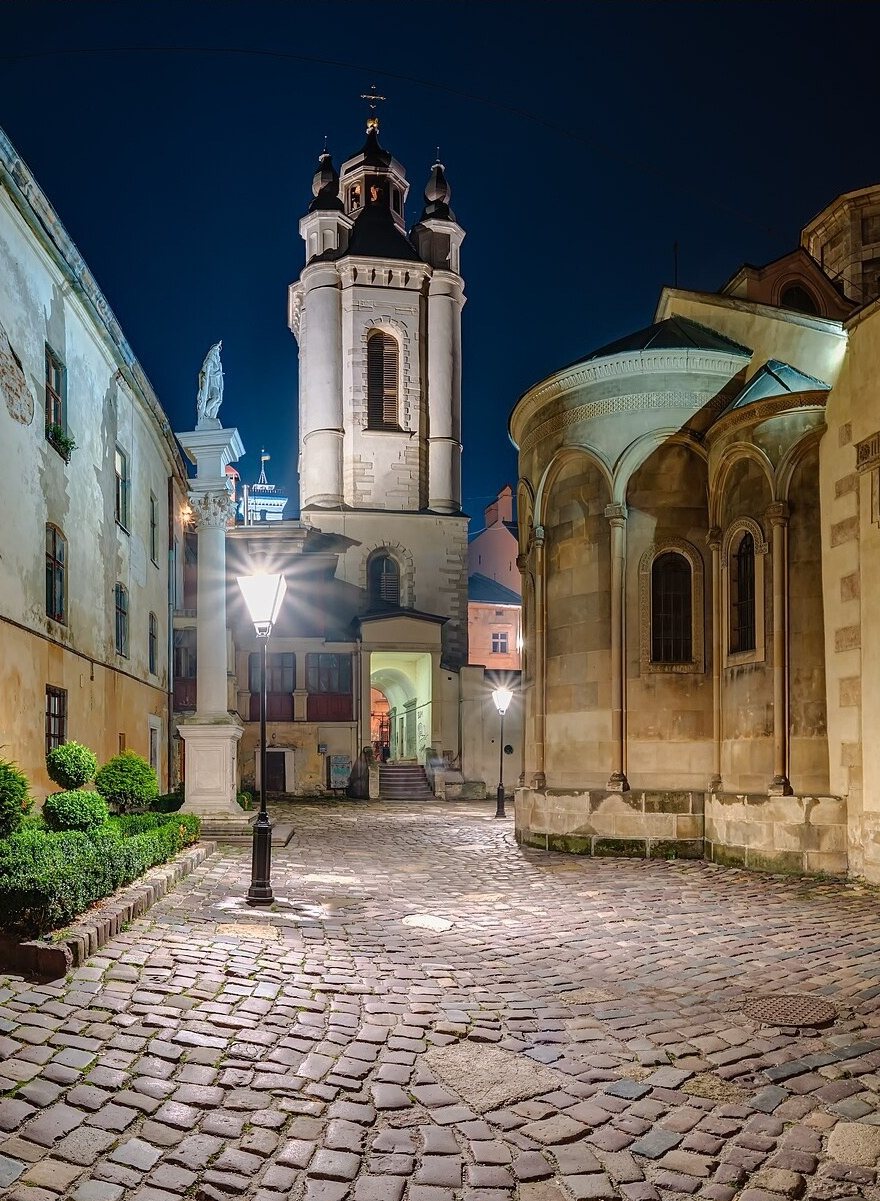
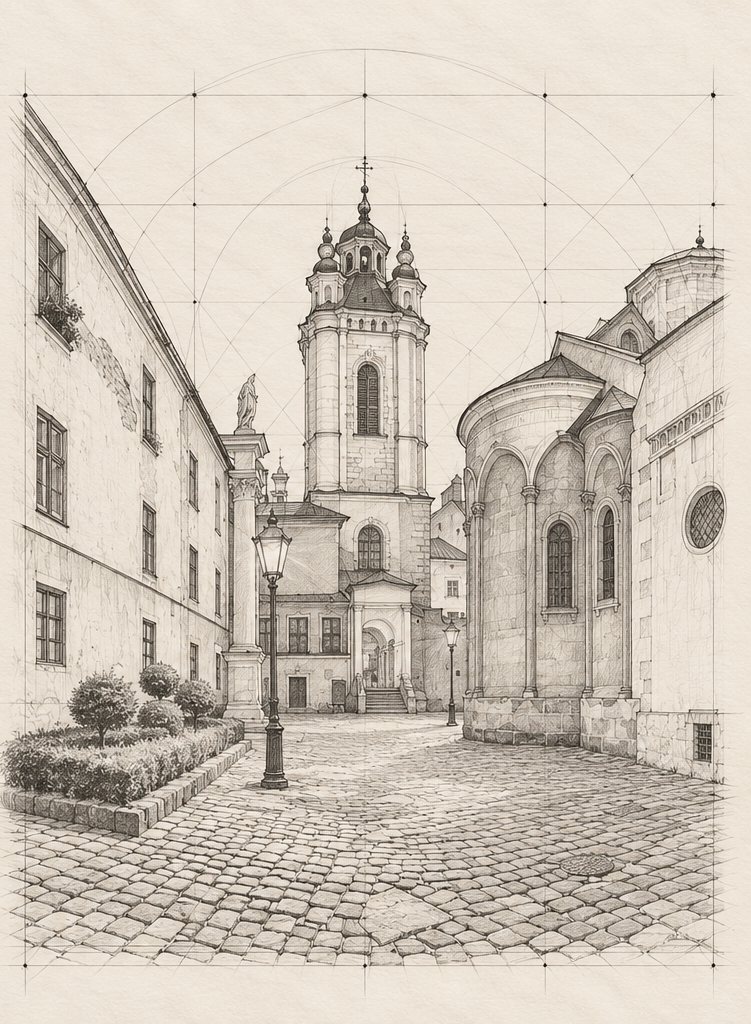
The bell tower has three tiers: the two lower ones are square, the upper one octagonal, with round corner turrets under onion-shaped cupolas. The fires of 1676 and 1778 damaged it, according to VUE. In the first tier a Renaissance portal with the date 1570 is preserved.
Details that are easy to miss
A dome of pots. According to VUE, the dome is built of hollow ceramic pots. Empty ceramics are lighter than brick and put less load on the drum — a medieval way of lightening a vault, which cannot be seen from outside at all.
A Judas without a face. In Rosen’s “Last Supper” all the participants in the centre of the altar are standing. The artist placed Judas in the right corner facing the wall: only a hand is visible, so, as Lviv Art Routes writes, he has effectively turned into a shadow.
Two hundred and fifty contemporaries. According to the same source, Rosen painted more than 250 faces of his contemporaries and acquaintances into the murals, and in the “Crucifixion” on the south wall three Lviv Catholic archbishops. The best-known scene is the “Funeral of St Odilon” on the north wall: the body is carried by three monks, who are interpreted as the past, the present and the future.
Khachkars and old frescoes. On the piers and walls are carved khachkars, the oldest from the 14th–15th centuries. In the window reveals, according to VUE, two frescoes of the late 14th – early 15th century have survived.
The column of St Christopher. In the east courtyard stands a Corinthian stone column of 1726, dedicated to St Christopher and founded by Khrystofor Avhustynovych. In the corner of the same courtyard, according to Zabytki, gravestones from the convent that once stood on the territory of the complex are stacked.
A Soviet storehouse. After 1945 the cathedral became a storehouse of the Lviv Picture Gallery, and according to To Ye Lviv, from 1953 it belonged to the Lenin Museum. Wikipedia adds that confiscated sacred art was kept here. A church that had itself been the treasury of a community became, for half a century, a pantry for other people’s holy objects.
Photo gallery
Stone and material
The walls of the cathedral are laid of white dressed stone 1.4 metres thick, and all the buildings of the complex are built of stone and brick. The dome is of hollow ceramic pots. The khachkars are carved in stone and set into the piers, and in the convent courtyard there are two 16th-century limestone reliefs. The mosaic in the dome, according to Polonika, is assembled from small squares of Venetian glass.
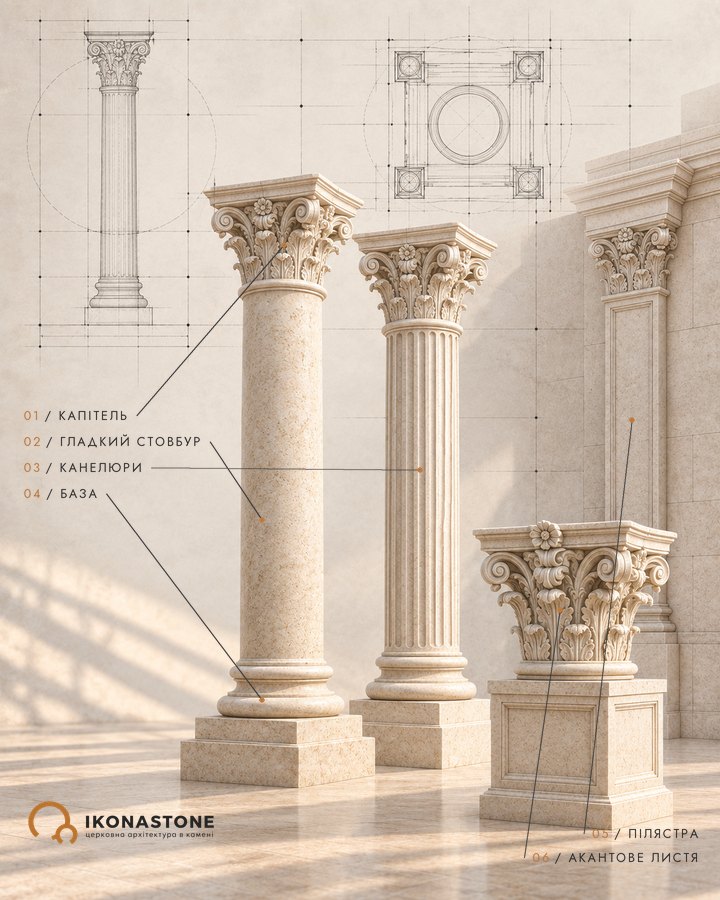
This cathedral shows something rare: here stone not only carries loads but also remembers. A khachkar set into a pier is at once a structural element and the signature of a community that wanted its cross to stand precisely here and nowhere else. Decisions about where stone becomes a sign are best made already at the stage of columns and capitals.
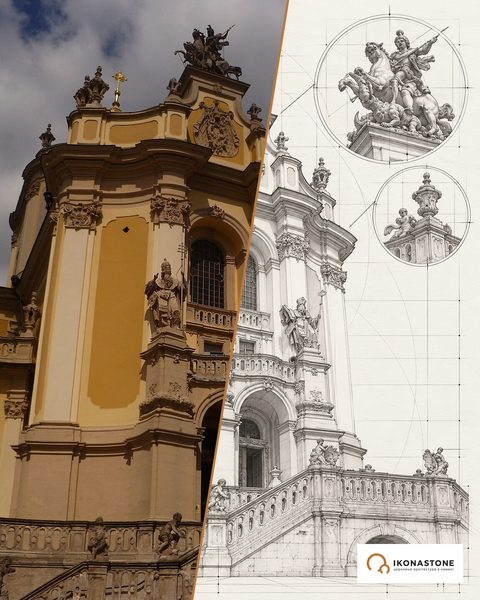
Another Lviv tradition in stone is shown by the Dormition Church in Lviv, and a Baroque counterpoint by St George’s Cathedral. How to read the different forms of the cross is explained in the article “Forms of the cross”.
Did you know
The rector Dionizy Kajetanowicz issued Christian baptismal certificates to Jews; in 1943 the Gestapo arrested him, and he was freed only by a bribe of 120,000 zlotys. [21]
According to VUE, the dome of the cathedral is built of hollow ceramic pots. [1]
The mosaic in the dome was assembled from Venetian glass in the workshop of Angelo Ganese; Mehoffer’s 1907 concept changed substantially before its realisation in 1913. [17, 24]
Mehoffer took ornaments from Armenian miniatures, including the Skevra Gospel (1198 or 1199); a codex close in origin is kept in the Mekhitarist library in Venice. [24]
The stained-glass window “St Paul” (1928) was thought lost; fragments were found in the cellars after the cathedral was returned to the community, and because its glass was not airtight it let rain in and wetted the murals. [18, 20]
The Armenian bank at the cathedral operated from 1640 to 1939 and, according to Wikipedia, was the first financial institution in Lviv. [27]
Jan Henryk Rosen grew up in Paris and Lausanne, received no formal art education and was secretary to Ignacy Jan Paderewski. [29]
Frescoes of the 15th century survive in the sanctuary; VUE mentions two frescoes of the late 14th – early 15th century in the window reveals. [1, 8]
Carved cross-stones, khachkars, are set into the central piers; the oldest are dated to the 14th–15th c. [1]
In 2016 the old collector was flooding the cellars of the cathedral; fragments of gravestones were found under the asphalt of the courtyard. The entrance to the restored cellars is from the bell tower. [12, 13]
Before the visit of John Paul II in 2001, the Armenian community and the city authorities hurriedly improved the condition of the cathedral. [26]
The miraculous icons of St Gregory the Illuminator and of the Mother of God were, according to Wikipedia, brought from Yazlivets in the 17th c.; thanks to the icon of Gregory, an Armenian brotherhood was founded in Lviv in 1640. [2, 8]
In 1932 Archbishop Teodorowicz opened a permanent exhibition of Armenian culture at the cathedral; the Armenian Museum grew out of it. [21, 24]
Legends
The model: Ani
According to tradition, the cathedral was built on the model of the cathedral in Ani, the old capital of Armenia. It is recorded in Wikipedia, RISU and Radio Svoboda; VUE, by contrast, sees features in common with the Surb Astvatsatsin church in Odzun, and ZAXID.NET sees the influence of the Armenian architecture of Crimea. [1, 2, 3, 5, 8]
Faces of contemporaries
According to RISU, in one of Rosen’s frescoes St Benedict is depicted with the face of Metropolitan Andrey Sheptytsky. [26]
Three monks
According to tradition, in the “Funeral of St Odilon” the three monks carrying the body embody the past, the present and the future; Stanisław Machniewicz reads them as three degrees of religious initiation. [19]
The praise of the dead
Polonika writes that St Odilon established All Souls’ Day, and that translucent figures accompany him out of gratitude; the inscription on the bier is the beginning of a poem by Kazimiera Iłłakowiczówna: “O holy Odilon, patron of the souls of the dead, we, a crowd of the dead, follow your coffin”. Historically, Odilo of Cluny introduced the Commemoration of All the Faithful Departed. [19]
Miraculous icons
According to Wikipedia, the icons of St Gregory the Illuminator and of the Mother of God are considered miraculous; they were brought from Yazlivets in the 17th c. [2]
Key figures
- Yakiv of Caffa, Panos of Haisarats (Panos Abrahamovych) — merchant founders of the cathedral (1363–1370).
- Doring (Dore, Dorkhe) — the master builder; his origin is not established in the sources.
- Petro Krasovskyi — architect of the bell tower of 1571.
- Andrii of Caffa — founder of the bell tower.
- Mikołaj Torosowicz — the archbishop who accepted the union with Rome in 1630.
- Khrystofor Avhustynovych — patron of the 1723 reconstruction; the column of St Christopher (1726) was erected in his honour.
- Tomasz Dykas — sculptor, author of the sculptures in the cathedral’s courtyards.
- Józef Teodorowicz (1864–1938) — archbishop, initiator of the restoration of 1902–1938.
- Franciszek Mączyński — architect of the restoration and of the western part.
- Józef Mehoffer — author of the design of the mosaic in the dome.
- Jan Henryk Rosen (1891–1982) — author of the murals and stained glass.
- Bohdan Janusz — the conservator who uncovered the original frescoes in 1925.
- Dionizy Kajetanowicz (1878–1954) — rector and administrator of the archdiocese, author of a guidebook, a victim of Soviet repression.
- Karekin II — Catholicos of All Armenians, who consecrated the cathedral in 2003.
- Andrzej Kazberuk — Polish restorer of the “Golgotha” altar and the column of St Christopher.
- Anatolii Chobitko, Maria Shumska-Barvinok — restorers of Rosen’s stained glass.
How to cite
IKONASTONE. The Armenian Cathedral of the Dormition of the Mother of God (Lviv) // Guide to Churches of Ukraine. URL: https://ikonastone.com/en/guide/armenian-cathedral-lviv/ (accessed DD.MM.YYYY).
FAQ
When was the Armenian Cathedral built?
In 1363–1370. It was built by the master builder Doring at the expense of the Armenian merchants Yakiv of Caffa and Panos of Haisarats. Later the cathedral was extended several times: an arcaded gallery in 1437, a western nave in 1630 and a Baroque rebuilding in 1723–1726.
Who painted the cathedral?
The murals and ornaments were painted in the late 1920s by the Warsaw artist Jan Henryk Rosen. The mosaic in the dome was made to a design by the Kraków artist Józef Mehoffer. Both worked in the cathedral during the restoration of the first third of the 20th century.
What are the khachkars on the piers of the cathedral?
They are carved stone crosses characteristic of Armenian culture. In the Lviv cathedral they are set into the piers and walls; the oldest are dated to the 14th–15th centuries.
Which church does the cathedral belong to now?
Since 2000 it has been the cathedral of the Ukrainian Diocese of the Armenian Apostolic Church. In 2003 it was consecrated by the Catholicos of All Armenians, Karekin II. Until 1945 the cathedral was the seat of the Armenian Catholic archdiocese.
What is worth seeing in the courtyards?
In the east courtyard stands a Corinthian stone column of St Christopher from 1726, and old tombstones are stacked in its corner. In the central courtyard there is an 18th-century wooden Golgotha chapel, and in the convent courtyard two 16th-century limestone reliefs.
Sources
- ВУЕ. В. Вечерський. Вірменський собор у Львові
- Wikipedia (en). Armenian Cathedral of Lviv
- RISU. Armenian Cathedral of Lviv (20.01.2011)
- Lviv-online. Вірменська церква (Львів)
- Радіо Свобода. Г. Терещук. Вірменський собор у Львові (08.2008)
- М. Мовна. Один штрих до сакральної спадщини Львова: путівник Діонізія Каєтановича Вірменським кафедральним собором (2023)
- ZAXID.NET. Дім смерті та кам'яниця пір року: історія вулиці Вірменської
- ZAXID.NET. Невідомі місця і пам'ятки з історії вірмен Львова
- ZAXID.NET. У Львові на 98% відреставровано Вірменську церкву (06.12.2010)
- ZAXID.NET. Сьогодні у Львові урочисто відкрили вівтар «Голгофа» (15.09.2013)
- Радіо Свобода. Вівтар «Голгофа» (07.2010)
- ZAXID.NET. Пам'ятка під загрозою (13.04.2016)
- ZAXID.NET. Презентували подвір'я Вірменського собору (12.05.2017)
- Encyclopedia of Ukraine (CIUS). С. Яніві. Armenian Cathedral in Lviv (2004)
- Енциклопедія сучасної України. Вірменська апостольська церква в Україні
- dzieje.pl. Katedra ormiańska we Lwowie
- Polonika. Lwów — katedra ormiańska
- Polonika. Witraż Jana Henryka Rosena «Święty Paweł»
- Polonika. The Funeral of St. Odilon
- Суспільне Львів. У Львові відреставрують вітраж із Вірменського собору (11.07.2021)
- Східний світ. Стаття про Діонізія Каєтановича та вірмен Львова
- Cyclowiki. Дионисий Каетанович
- University of Notre Dame. Biography of Father Dionizy Kajetanowicz
- J. Wolańska. Lehahayer (Akademia Ignatianum, 2010)
- Дзеркало тижня. Довгий шлях до храму (23.05.2003)
- RISU. Armenians in Lviv to Greet Holy Father (25.06.2001)
- Wikipedia (en). Banks in Lviv
- Національний заповідник «Софія Київська». Вірменський кафедральний собор у Львові та його творці (2026)
- Міжнародний центр культури, Краків. Katedra ormiańska
- Rzeczpospolita. Katedra ormiańska we Lwowie po konserwacji (05.10.2019)
- Українська правда. У Львові «евакуювали» Христа з Вірменського собору (05.03.2022)
- ACI Africa. Statue of Christ removed from a cathedral in Ukraine for safekeeping (07.03.2022)
- Urban Media Archive. Листівка «Львів. Вірменський собор», Ян Пельц, 1909
- Urban Media Archive. Вірменський собор, Ян Пельц, 1908–1909
- Urban Media Archive. Вірменський собор, Адам Ленкевич, 1938–1939
- Wikimedia Commons (дзеркало). File:Lwów - Katedra Ormiańska 01.JPG
- Town
- Lviv, Lviv Oblast
- Built
- 1363–1370; rebuildings in 1437, 1630, 1723–1726; restoration 1908–1927
- Type
- cross-in-square, three-aisled, four-pier, single-domed church
- Material
- white dressed stone, brick; dome of hollow ceramic pots
- Research depth
- 37%