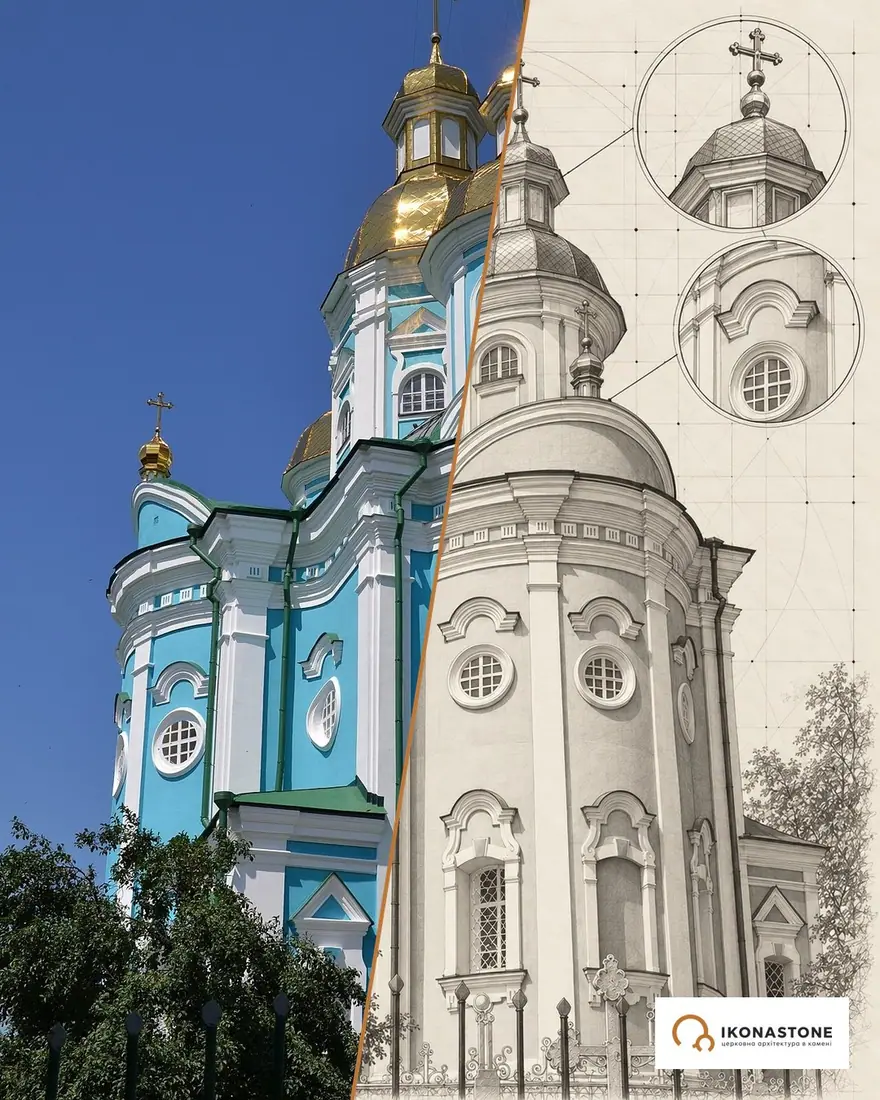
The Transfiguration Cathedral of the Mhar Monastery: Hetman Baroque above the Sula
A former Patriarch of Constantinople was buried here seated, in full vestments — according to Greek custom, far from Greece, above the quiet Sula.
In brief
| Address | Mhar village, near Lubny, Poltava Oblast |
| Built | 1682–1694, according to other sources from 1692 |
| Architect | Johann Baptist (according to the English Wikipedia, Johann Baptist Sauer), with M. Tomashevskyi and A. Pyriatynskyi |
| Founders | Hetmans Ivan Samoilovych and Ivan Mazepa |
| Type | cruciform three-aisled six-pier church with basilican features; once seven domes, now five |
| Style | Ukrainian Baroque |
| Status | active monastery for men; the buildings were taken under state protection in 1963 (according to the ESU) |
The story in plain words
A short account, about a 6-minute read. The full chronology, with all dates, disputes and sources, is below in the "Timeline" section.
A monastery on the Sula (1619-1663)
Mhar Monastery stands on the Sula river, near Lubny. Most sources say it was founded in 1619, and some say 1624. The founder is named as Isaia Kopynsky. The money came from Princess Raina Vyshnevetska, a cousin of Petro Mohyla. According to tradition, angels pointed out the place for the monastery.
The monastery held protective charters from nearly all the hetmans. The first church was wooden and was laid down in 1628.
In 1654 the former Ecumenical Patriarch Athanasius III Patellaros died in Mhar. Abbot Petronii and the brothers buried him in the Greek manner: seated, in full vestments. Later Athanasius was venerated as a saint and became the patron of the monastery.
In 1663 Yurii Khmelnytsky, son of Hetman Bohdan, came to the monastery. Here he took monastic vows under the name Gedeon.
The hetmans’ cathedral (1682-1700)
The brick Transfiguration Cathedral was built under Hetmans Ivan Samoilovych and Ivan Mazepa. Samoilovych began the building, and Mazepa finished it in 1692. Sources date the work differently: some name 1682-1694, others the early 1680s, and others 1692.
The design was drawn by Johann Baptist from Vilnius. M. Tomashevsky and A. Pyriatynsky helped him. The model was the Trinity-Illinsky Cathedral in Chernihiv. The cathedral came out cross-shaped, with three naves and seven domes.
The first iconostasis was carved by the master Stepan Mutianytsia. It was finished in 1685-1689.
Fires and rebuilding (1728-1844)
In the 18th century the cathedral changed. In 1728 the central dome collapsed, and in 1729 it was rebuilt. In 1736 a great fire destroyed the wooden buildings and damaged the cathedral. The first iconostasis burned too.
In 1754 the rebuilt cathedral was consecrated. Now there were five domes instead of seven. Some sources link this with the rebuilding, others with the fire. Around the middle of the century stucco covered the facades. Mazepa’s original idea was much more restrained.
In 1762-1765 a new iconostasis almost 17 metres tall appeared. It was made by the carver Sysoi Shalmatov, and the icons were painted by Ivan Kosachynsky.
The monastery lived a restless political life. Abbot V. Zahorovsky argued for uniting the Left and Right Bank under one hetman. In 1733 he was arrested and taken off to Muscovy. According to the Encyclopedia of Ukraine, there is evidence that the monks supported Mazepa’s uprising. In 1737-1748 the monastery was led by Ioasaf Horlenko.
Work on the bell tower began in 1785, but it was only finished in 1844.
Revolution and closure (1908-1943)
In 1908 sixty-one monks and novices lived in the monastery. In 1919 the Bolsheviks led Abbot Ambrosii and the monks out of Lubny and shot them. Sources disagree on the number of dead: 16 monks, 17 or 19.
In 1922 a commissar came from Kharkiv with an order to take the silver reliquary with the relics of Patriarch Athanasius. Tens of thousands of people stood around the cathedral. But the harvest began and the people dispersed. The monks moved the relics into a wooden reliquary and handed over the silver one. The relics were taken to the Annunciation Cathedral in Kharkiv, where they remain to this day.
The monastery was closed: in 1923 by some sources, in 1926 by others. The bells were melted down. The buildings housed, in turn, an institution for the “children of enemies of the people”, a disciplinary battalion, a military unit and a pioneer camp. Shalmatov’s iconostasis was lost, and only one icon survived. During the German occupation services were held in the cathedral, and the monastery archive vanished in those years.
Revival (1963 to today)
On 24 August 1963 the monastery buildings were taken under state protection. But the real revival began in 1993, when the monastery was returned to the Church. It was headed by Abbot Pylyp (Osadchenko), now Metropolitan of Poltava and Myrhorod. The first community numbered about 20 people.
In 1995-2005 a project for recreating the iconostasis was worked out. From 2005 the parts of the new iconostasis have been made and installed in the cathedral. In 2008 the 17 monks shot in 1919 were added to the locally venerated saints. Today it is a working men’s monastery.
Glossary
| Word | What it means |
|---|---|
| Hetman | The leader of the Cossack state |
| Abbot (ihumen) | The head of a monastery |
| Namisnyk | The head of a monastery, appointed by a bishop |
| Relics | The remains of a holy person, venerated by believers |
| Reliquary (raka) | A chest in which relics are kept |
| Ecumenical Patriarch | The first in honour among Orthodox patriarchs, based in Constantinople |
| Iconostasis | A wall of icons between the altar and the rest of the church |
| Stucco | Ornaments made of plaster or mortar, modelled on the wall |
| Dome | The cupola of a church |
| Refectory | The room in a monastery where the monks eat |
Timeline
The numbers in square brackets are source numbers in the list at the bottom of the page. The note “according to …” means that the fact is confirmed by only one source. The “Legends” section contains traditions and legends: they are recorded in the sources but not documented.
Founding of the monastery and Hetman-era construction
- 13 or 18 January 1619
Princess Raina Vyshnevetska (née Mohyla), a cousin of Petro Mohyla, issued the foundation charter for the Mhar Monastery: according to [9] on 13 January, to Hegumen Isaia Kopynskyi; according to [6] on 18 January, in fulfilment of the will of her late husband Mykhailo Vyshnevetskyi. [5, 6, 9]
- 1619
Founding of the Mhar Transfiguration Monastery: Hegumen Isaia Kopynskyi, funds from Raina Vyshnevetska. According to the Great Ukrainian Encyclopedia (VUE), other sources give 1624. [1, 2, 3, 5]
- 1622
Isaia Kopynskyi organised a brotherhood at the monastery. According to the Encyclopedia of Modern Ukraine (ESU). [3]
- 1628
The first wooden Transfiguration church was laid down; in 1629 the refectory with the Annunciation church was completed (according to the ESU). [2, 3]
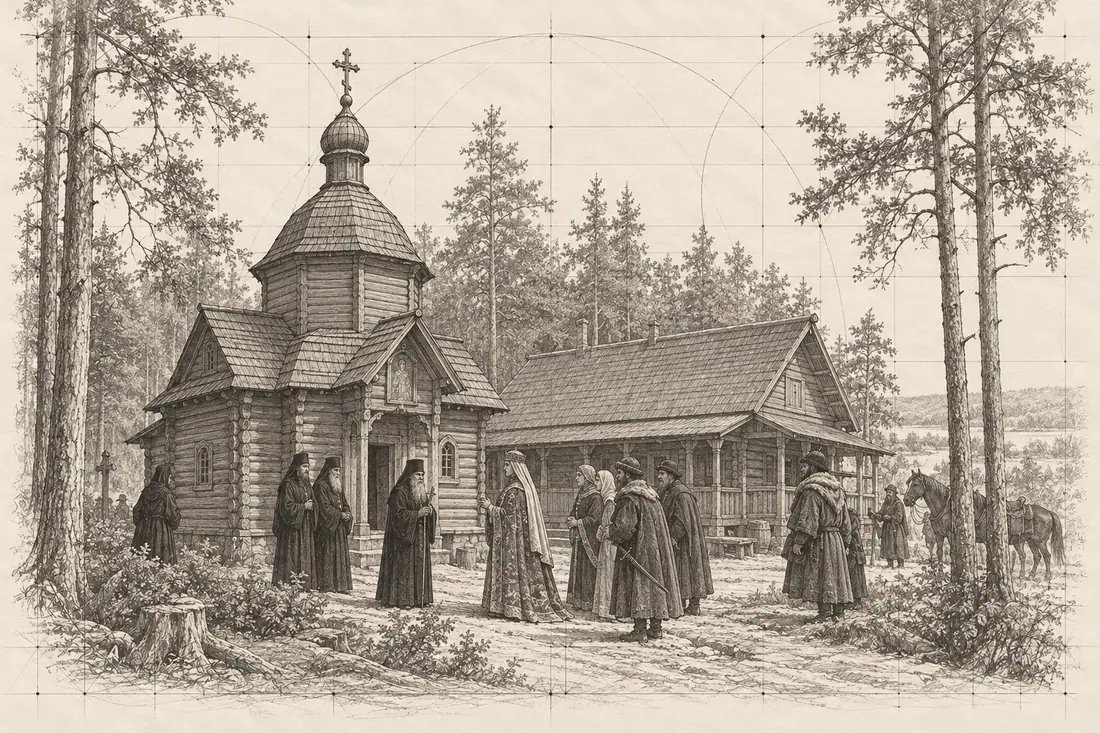
1628: the first wooden Transfiguration church. Illustration: IKONASTONE - 17 February 1646
Prince Yeremia Vyshnevetskyi confirmed the monastery's rights to the village of Mhar and exempted it from levies. [6, 9]
- February – 5 April 1654
The former Patriarch of Constantinople Athanasius III Patelaros, returning from Moscow, arrived in Mhar at the end of February and died there on 5 April (Old Style). He was buried seated, in full episcopal vestments, according to Greek custom, beneath the ambo in front of the royal doors; according to [16], under the guidance of Hegumen Petronii. [3, 5, 10, 16]
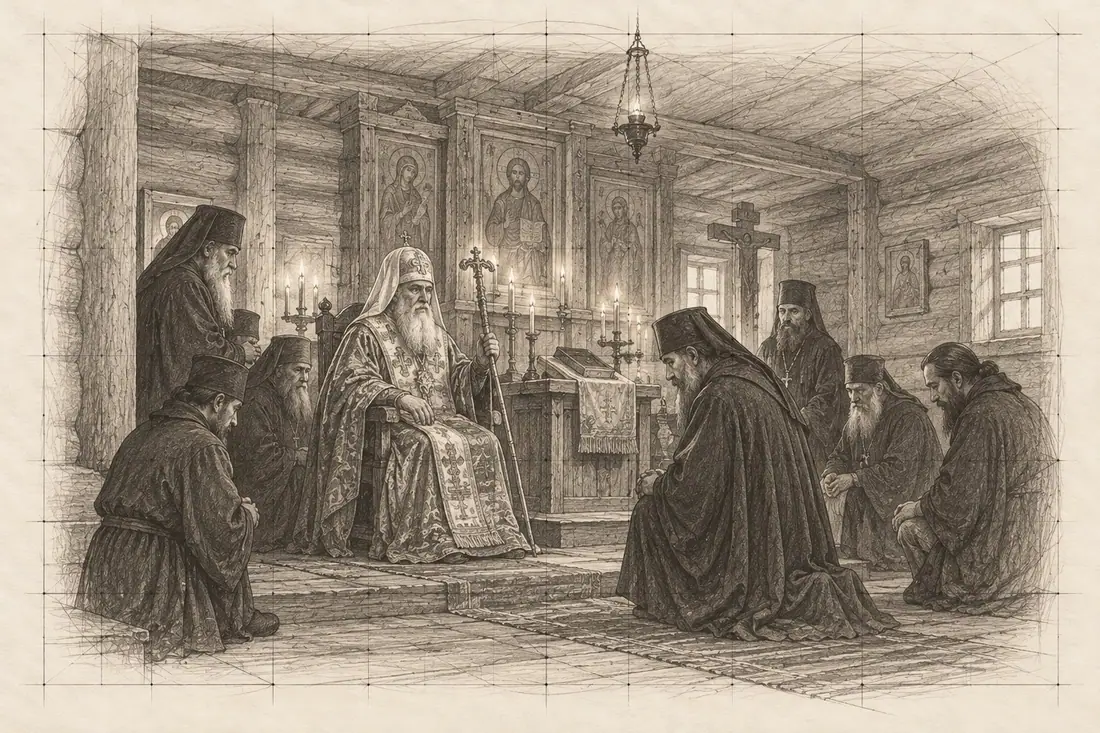
1654: the last days of Patriarch Athanasius in Mhar. Illustration: IKONASTONE - 1 February 1662
Eight years after his death, according to church tradition, the relics of Athanasius were found incorrupt; that same year he was venerated as a saint and became the patron of the monastery. [3, 5, 10, 16]
- 1663
Yurii Khmelnytskyi, son of Hetman Bohdan, took monastic vows at the monastery under the name Gedeon. [3, 5, 12]
- 26 July 1675
Metropolitan of Kyiv Joseph Neliubovych-Tukalskyi died in Chyhyryn; his relics were later moved to the Mhar Monastery (the ESU gives the year of death as 1676). [3, 19, 20]
- 1683–1684
Hetman Ivan Samoilovych, at the request of Hegumen Makarii, began building the masonry Transfiguration Cathedral; the architect was Ioann Baptist of Vilnius (according to the VUE, Johann Baptist Sauer), assisted by M. Tomashevskyi and A. Pyriatynskyi. The model was the Holy Trinity–Illinskyi Cathedral in Chernihiv. For the duration of the works the relics were moved to the small church of St George (according to RISU). [1, 2, 3, 5, 12]
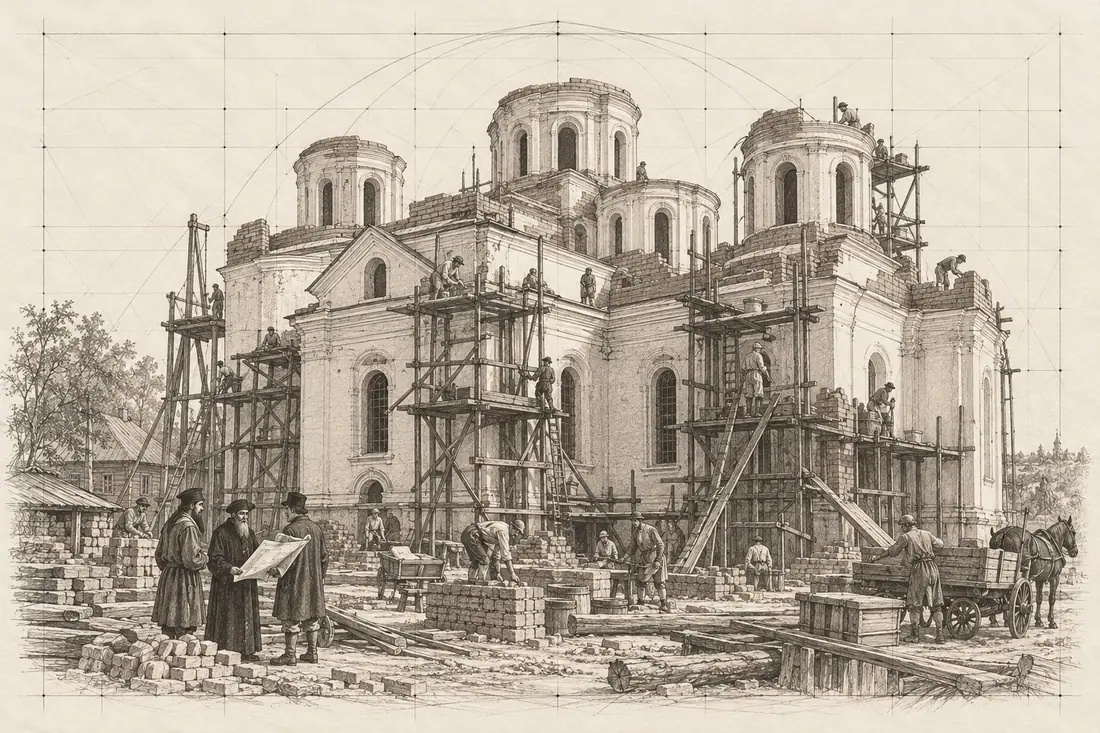
1684–1692: building the masonry cathedral. Illustration: IKONASTONE - 1685–1689
The carver Stepan Mutianytsia made the first iconostasis (the VUE dates it to 1689); it was painted and gilded by Yosyp Ivanovych, a resident of Lubny (according to pslava.info). [2, 7]
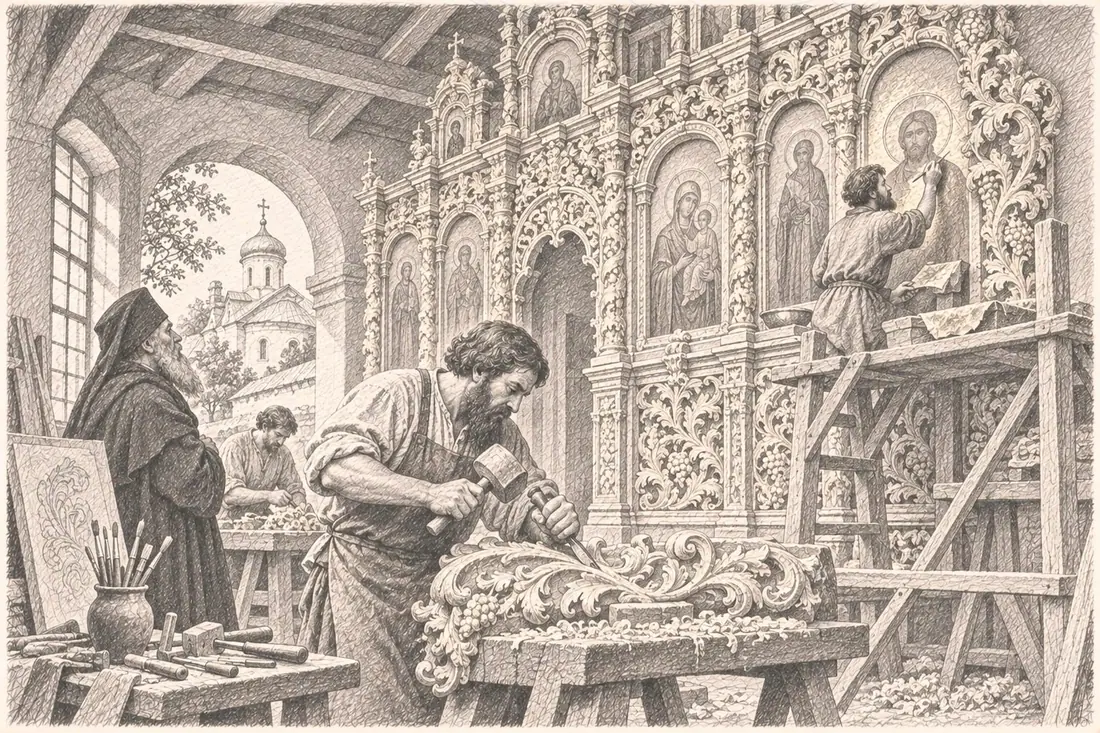
1685–1689: the first iconostasis (conjectural reconstruction). Illustration: IKONASTONE - 1687
After the fall of Samoilovych, Hetman Ivan Mazepa took over patronage of the cathedral's construction (according to the VUE); that same year he granted the monastery the villages of Luka, Khytsi, Mhar and Pisky (according to Yu. Mytsyk). [2, 17]
- 1688
According to the ESU, a stone gate with a wooden church of the Archangel Michael was built with funds from the colonels L. Svichka, M. Burokhovych and D. Apostol; the VUE dates this church to 1690. [2, 3]
- 1692
The cathedral was completed under Hetman Ivan Mazepa; according to RISU, Metropolitan of Kyiv Varlaam Yasynskyi consecrated the church and moved the relics of Athanasius “under the arch on the right side”. [3, 5, 23]
- 1695
A fire destroyed the refectory with the Annunciation church and the monks' cells. According to the ESU. [3]
- 1700
According to the VUE, the architect Sauer died; the finishing work was completed by the master Afanasii Pyriatynskyi. [2]
Baroque, fires and rebuilding
- 1728–1729
According to the VUE, the central dome of the cathedral collapsed; it was rebuilt the following year. [2]
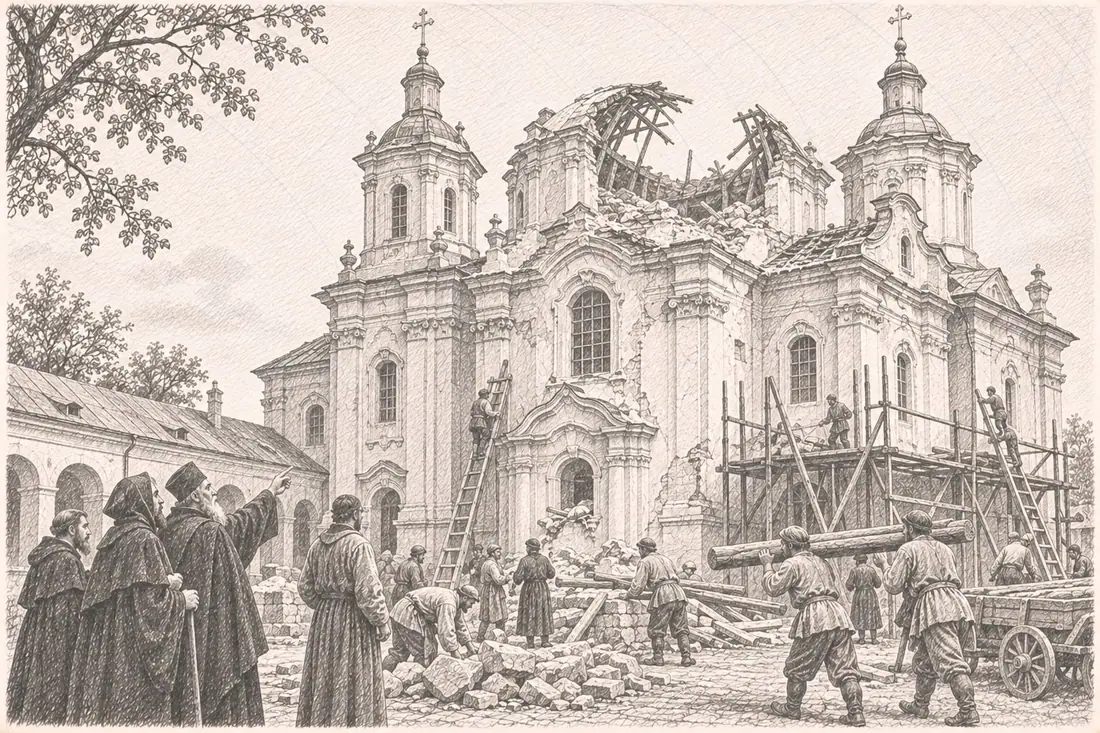
1728–1729: collapse of the central dome (conjectural reconstruction). Illustration: IKONASTONE - 1733
According to the Encyclopedia of Ukraine, Hegumen V. Zahorovskyi, who advocated uniting the Left and Right Banks under one hetman, was arrested and taken to Muscovy. [1]
- 1736
A great fire destroyed the wooden buildings and damaged the cathedral; Mutianytsia's first iconostasis burned. [2, 3, 7]
- 1737–1744
Ioasaf Horlenko became hegumen (1737–1748) and from 1744 the monastery's first archimandrite; according to the ESU, in 1737 the northern block of cells was built with funds from Prince Ludwig of Hesse. [1, 3]
- 1742
According to the ESU, Empress Elizabeth Petrovna allocated funds for the restoration of the monastery. [3]
- 1754
Metropolitan of Kyiv Tymofii Shcherbatskyi consecrated the rebuilt cathedral; during the rebuilding the number of domes became five instead of seven. [1, 2, 3]
- 1762–1765
The carver Sysoi Shalmatov (a native of Ostashkov, according to pslava.info) made a new iconostasis almost 17 m high; the icons were painted by Ivan Kosachynskyi. [2, 3, 7, 23]
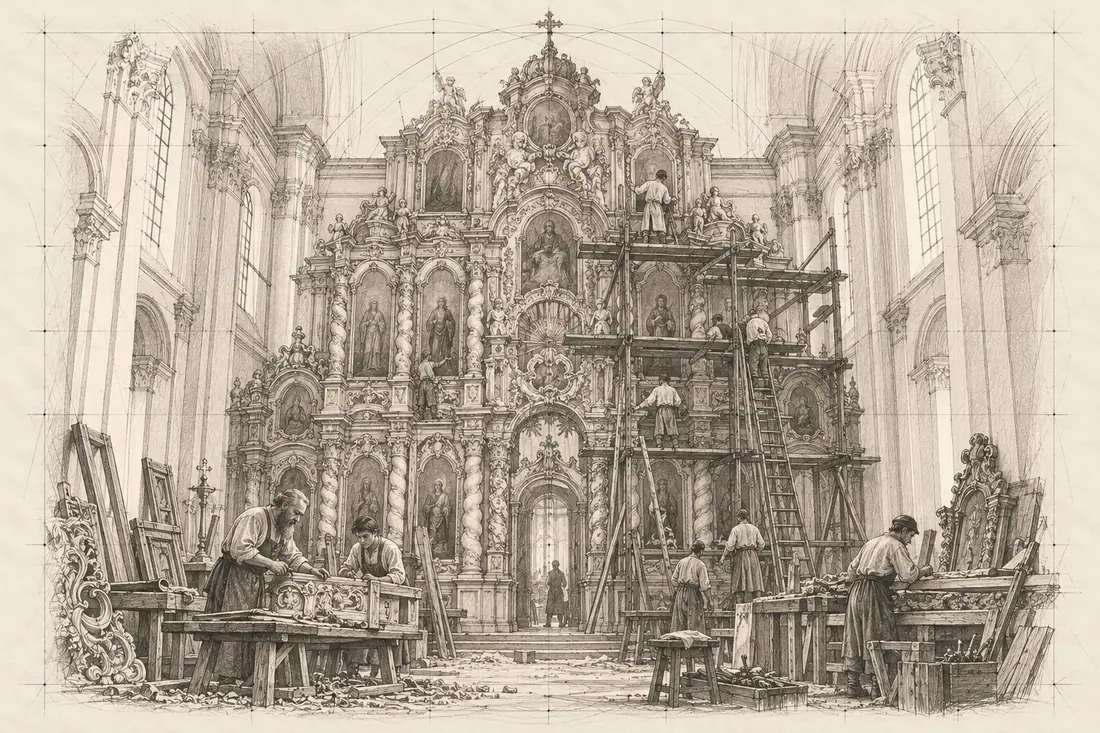
1762–1765: Sysoi Shalmatov carves the new iconostasis. Illustration: IKONASTONE - 1785–1844
Construction of the three-tier bell tower began in 1785 but was not completed; it was built in 1839–1844 (ESU: 1837–1844) in the Neoclassical style; according to the VUE, the design was by Anton Kartashevskyi, with the bell tower of the Exaltation of the Cross Monastery in Poltava as its model. [1, 2, 3, 14]
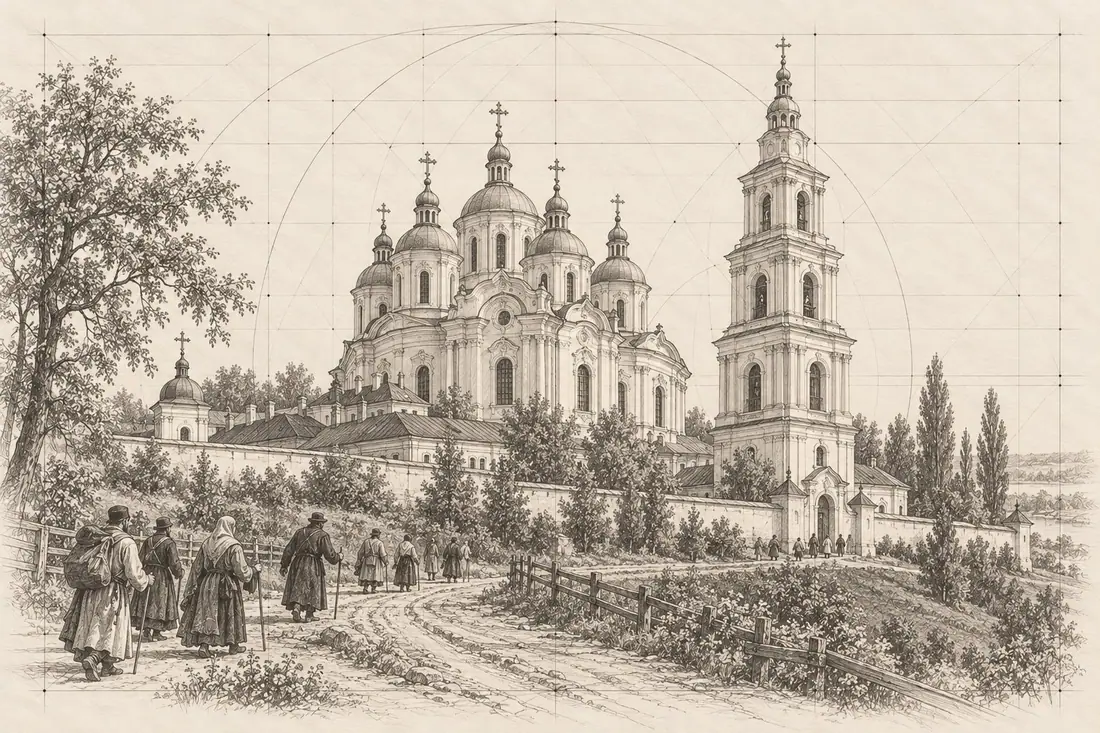
1844: the ensemble with the completed bell tower. Illustration: IKONASTONE - 1804
According to the Encyclopedia of Ukraine and pslava.info, the heated Annunciation church was built (the VUE places it at the end of the 19th century). [1, 2, 9]
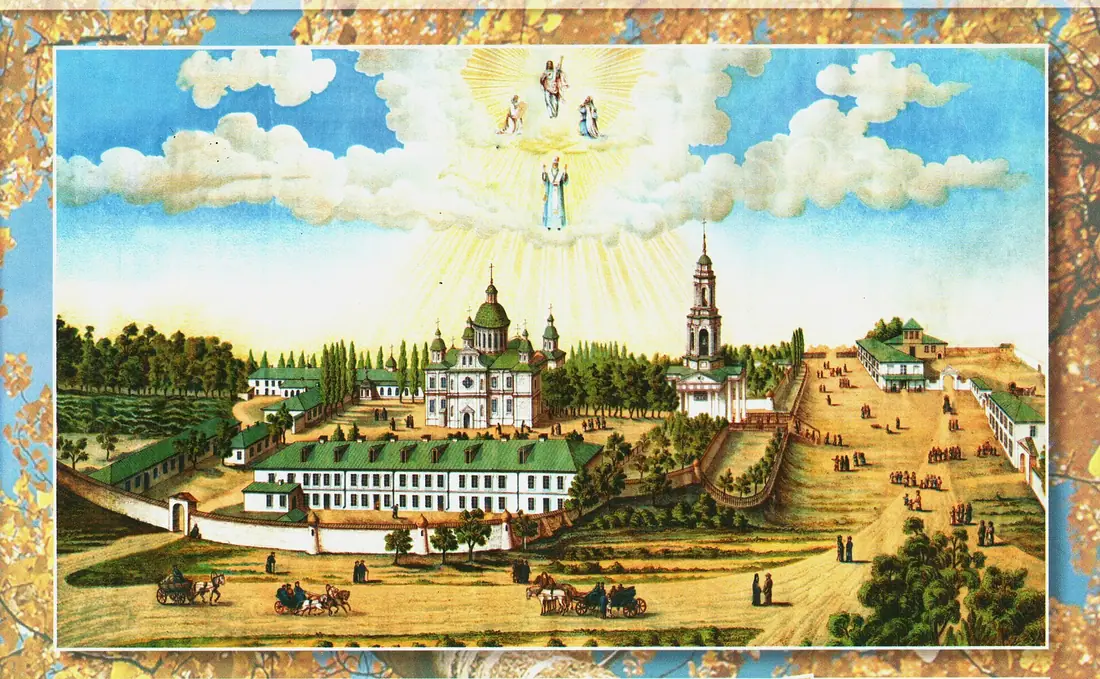
The Mhar Monastery, a colour lithograph of the late 19th century. Wikimedia Commons, public domain
The end of the empire and the closure
- 5–6 August 1919
In the night before 6 August (Old Style) the Bolsheviks led Hegumen Amvrosii and the monks out of Lubny and shot them on the Pyriatyn road, seven versts from the town: 17 people (the ESU says “16 of 24 monks”, pslava.info says 19 monks). [2, 3, 5, 8, 11]
- 1922
In Lubny the confiscation of church valuables began; People's Commissar Sereda in Kharkiv demanded the silver reliquary of Athanasius. Tens of thousands of people surrounded the cathedral, but the harvest began, the people dispersed, and the monks moved the relics into a wooden reliquary and handed over the silver one. [2, 5, 10, 16]
- 1923 or 1926
The monastery was closed (ESU: 1923; Encyclopedia of Ukraine: 1926). [1, 3]
- 1930s – 1986
Shalmatov's iconostasis was lost; only the icon “The Nativity of the Mother of God” (1765) survived, now in the National Art Museum. An institution for “children of enemies of the people” was set up in the buildings (according to pslava.info); from 1937 a disciplinary battalion, from 1945 a military unit, from 1986 a Young Pioneer camp (according to the ESU). [2, 3, 7, 8]
- 12 September 1941 – 19 September 1943
German occupation of Mhar; according to the ESU, services were held in the cathedral during the war. The monastery's archive disappeared in the war years (according to pslava.info). [3, 4, 8]
- 24 August 1963
By a resolution of the Council of Ministers of the Ukrainian SSR the monastery buildings were taken under protection. According to the ESU. [3]
Revival and recent history
- 12 August 1990
Not far from the monastery, on the outskirts of Lubny, the “Mound of Sorrow” was raised — a memorial to the victims of the Holodomor of 1932–1933. [22]
- 8–15 May 1993
The monastery was returned to the Church: on 8 May Hegumen Pylyp (Osadchenko) was appointed superior, and on 15 May, the feast day of Athanasius, the first liturgy was served. According to the ESU, the first community numbered about 20 people. [3, 5]
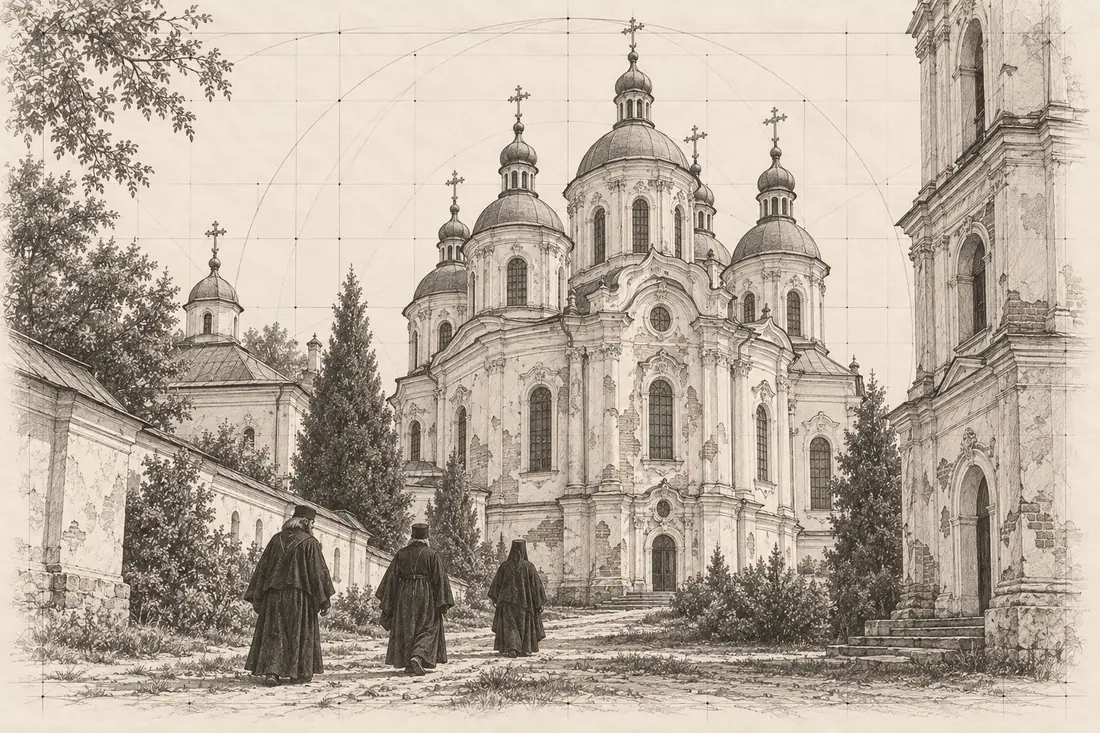
1993: the monks return to the monastery. Illustration: IKONASTONE - February 1994
According to RISU, the first monastic tonsure in decades took place. [5]
- 1995–2005
In 1995 the Ukrproektrestavratsiia institute (chief architect N. Kosenko) developed a preliminary design for recreating the iconostasis from iconographic and historical materials; in 1999 the government approved a programme for recreating monuments, and in 2005 parts of the iconostasis began to be made and gradually installed. [2, 7]
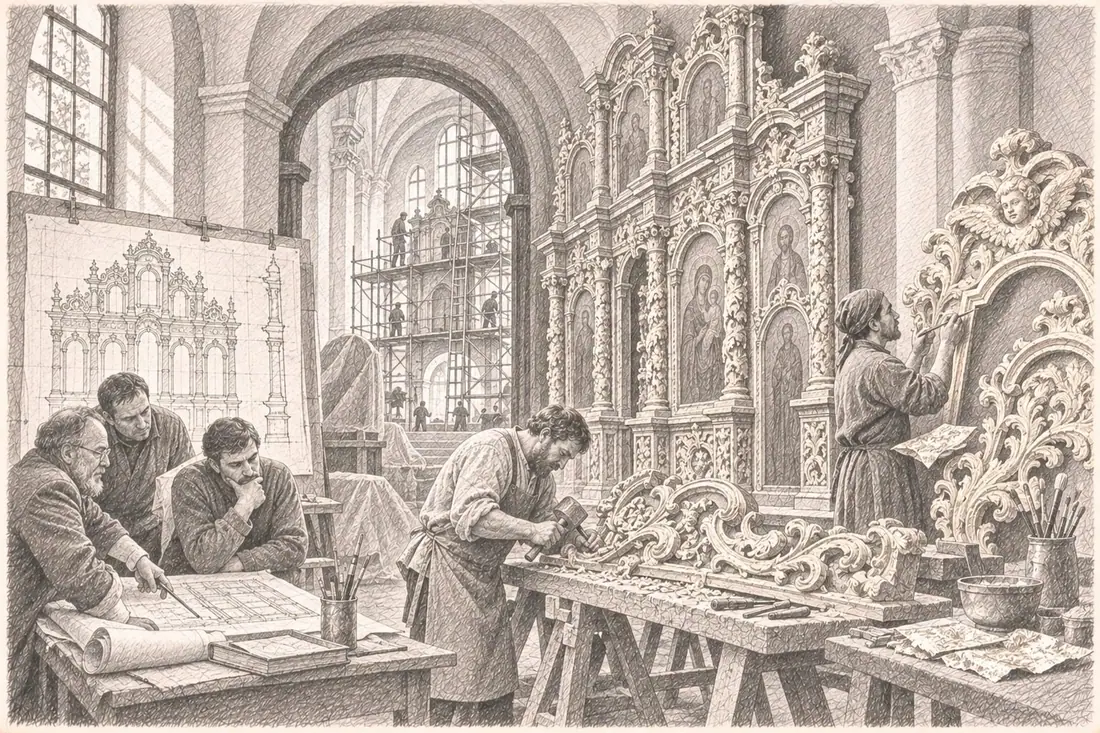
1995–2005: recreating the iconostasis (conjectural reconstruction). Illustration: IKONASTONE - 8 May 2008
The Synod of the UOC blessed the local glorification of the 17 martyrs shot in 1919 as the Martyrs of Mhar; their memory is observed on 24 July (6 August). [2, 11]
- 2012
The superior Pylyp (Osadchenko), now Metropolitan of Poltava and Myrhorod, became abbot. According to the ESU. [3]
- 5 December 2022
The Security Service of Ukraine carried out counterintelligence measures at the monastery; a resident monk said he had seen no confiscations. According to Suspilne. [13]
- 6 August 2026
On the patronal feast, the day of remembrance of the Martyrs of Mhar, the liturgy was led by Metropolitan Pylyp (Osadchenko); it was followed by a procession to the Annunciation Skete, the burial place of the martyrs. According to the SPZh. [15]
Lost and restored
| What | Was | What happened | Now |
|---|---|---|---|
| The first wooden Transfiguration church | 1628 | Dismantled under Samoilovych, replaced by the masonry cathedral of 1684–1692 | Does not survive [2, 3] |
| The first iconostasis by Stepan Mutianytsia | 1685–1689 | Burned in the fire of 1736 | Lost [2, 7] |
| The iconostasis of Sysoi Shalmatov | 1762–1765; four tiers, almost 17 m, royal doors of gilded copper | Did not survive; the icon “The Nativity of the Mother of God” (1765) was preserved | The icon is in the National Art Museum; the rest is lost [2, 7] |
| The present iconostasis | Design by Ukrproektrestavratsiia, 1995 | Made and installed in parts since 2005 | In the Transfiguration Cathedral [2, 7] |
| Two of the seven domes | The seven-domed cathedral of 1692 | During the rebuilding of 1754 the number of domes became five | Now a five-domed cathedral [1, 2] |
| The central dome | Original | Collapsed in 1728 (according to the VUE), rebuilt in 1729 | Rebuilt [2] |
| Paintings by Ivan Maksymovych | He directed the icon-painting workshops of Mhar (1679–1745) | His paintings in monasteries, including those of Mhar, have not survived | Lost [18] |
| The silver reliquary and relics of St Athanasius | Beneath the ambo (1654), from 1692 beneath the arch of the cathedral | In 1922 the silver reliquary was handed over, the relics were moved to Kharkiv | Relics — Annunciation Cathedral, Kharkiv (south side chapel) [3, 10, 16, 21] |
| Relics of Metropolitan Joseph Neliubovych-Tukalskyi | Moved from Chyhyryn | The exact place has not been established; a niche in the wall of the Transfiguration Cathedral is suggested | Somewhere in the monastery, the search continues [20] |
| The bells | In the bell tower | Melted down under Soviet rule (according to Telegraf) | Lost [12] |
| The cross and dome of the bell tower | Bell tower of 1839–1844 | In the 1970s a storm tore off the cross, and later a fire destroyed the dome (according to pslava.info) | The bell tower stands; the state of its top is not specified in the sources [8] |
| The cell blocks | 17th–18th centuries | Did not survive | Lost [9] |
| The monastery archive | 17th–18th centuries | Disappeared in the war years | Lost [8] |
| Burial place of the 17 martyrs of 1919 | Near the skete church | Venerated as saints since 2008 | Annunciation Skete [5, 15] |
Architecture
The Encyclopedia of Ukraine sees in the cathedral a combination of the traditional Ukrainian cruciform three-aisled church with the Western European basilica. The church has six piers and originally had seven domes — like the Holy Trinity Cathedral in Chernihiv, which Telegraf calls its model. Today there are five domes, and they are pear-shaped.
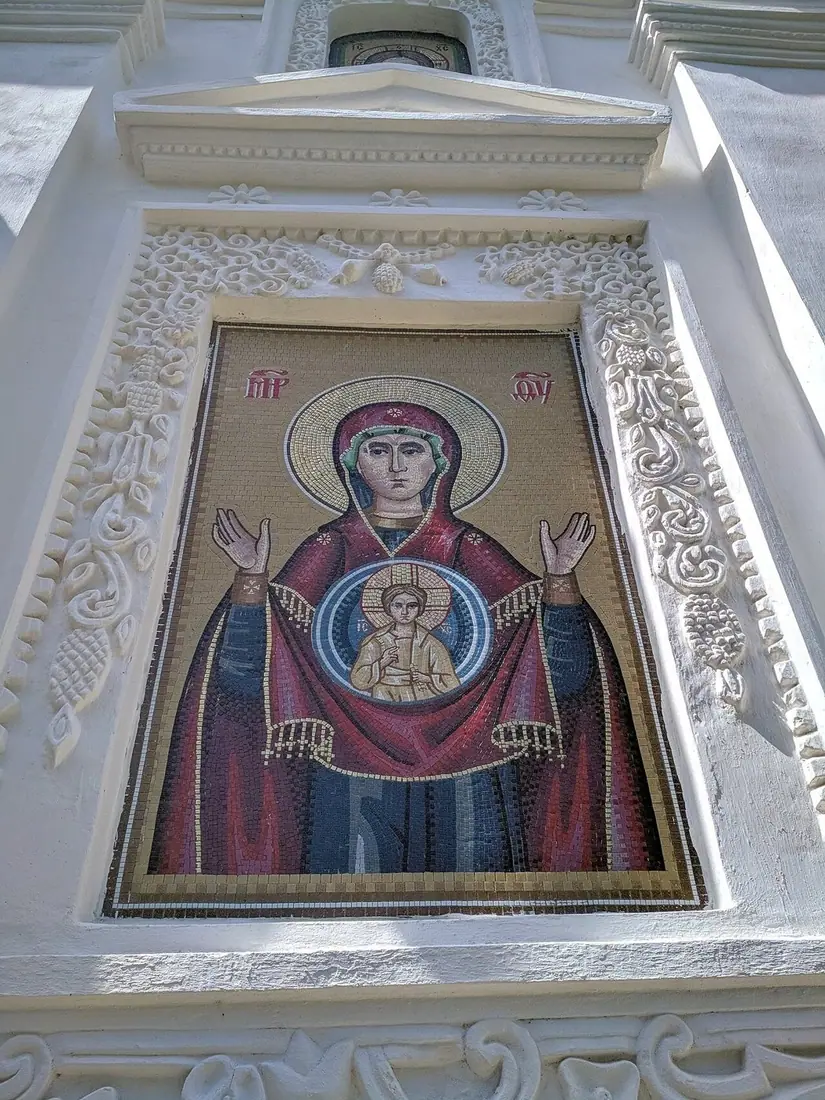
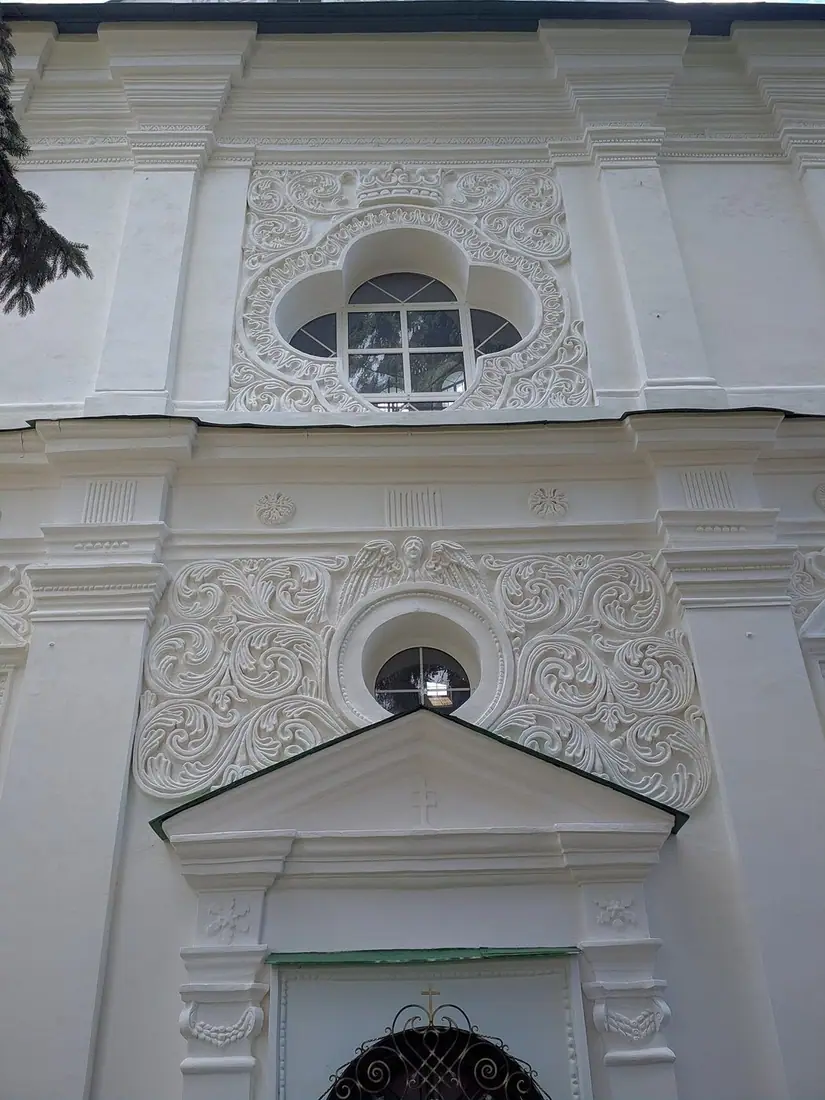
The face of the cathedral is defined by its decoration. The English Wikipedia lists the mosaic and stucco plant ornaments on the facades, round flower-shaped windows, curved upper parts of the facades, faceted walls and a predominantly white colour. The stucco was added in the second third of the 18th century; the original concept of Mazepa’s era was much more austere. The Encyclopedia of Ukraine considers the cathedral one of the finest examples of Ukrainian Baroque.
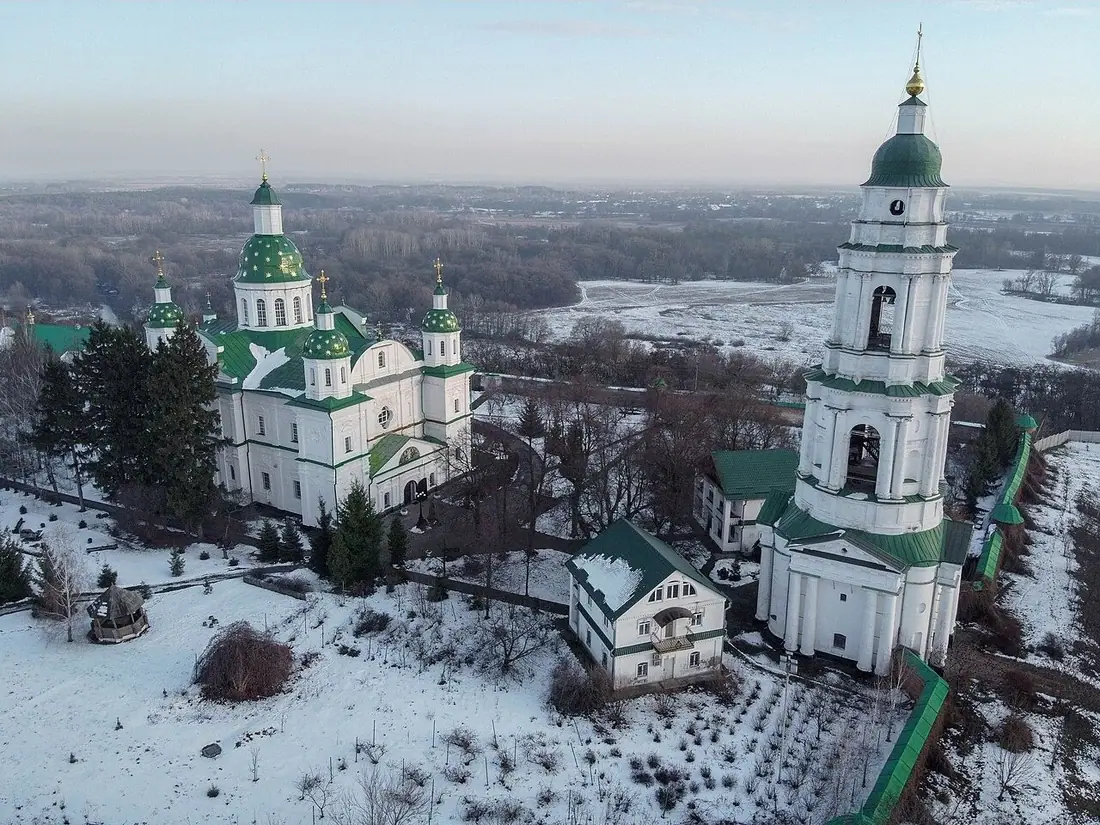
The cathedral stands at the centre of an ensemble that took shape over more than two centuries. The Encyclopedia of Ukraine lists the archimandrite’s house (1786), the bell tower completed in 1844, a guest house of the second half of the 19th century and the Annunciation Church in the pseudo-Byzantine style; Telegraf also mentions Neoclassical cell blocks and the single-domed St Athanasius Church. Buried in the monastery are Patriarch Seraphim II of Constantinople (died 1799) and the archbishops Amvrosii (died 1826) and Mefodii (died 1845); the relics of Metropolitan Joseph Neliubovych-Tukalskyi, who died in Chyhyryn in 1675, were later moved to Mhar, and the exact place of their rest is still being sought.
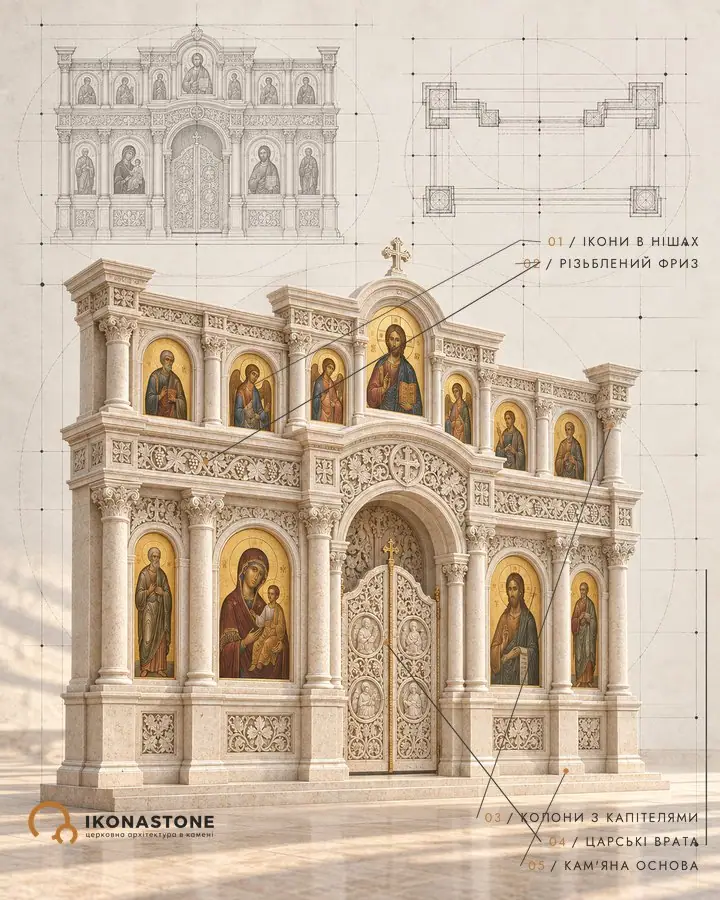
The iconostasis of Sysoi Shalmatov (1762–1765) has not survived: only the icon “The Nativity of the Mother of God” remains. In 1995 the Ukrproektrestavratsiia institute developed a design for its recreation from iconographic and historical materials, and since 2005 parts of the new iconostasis have been made and installed.
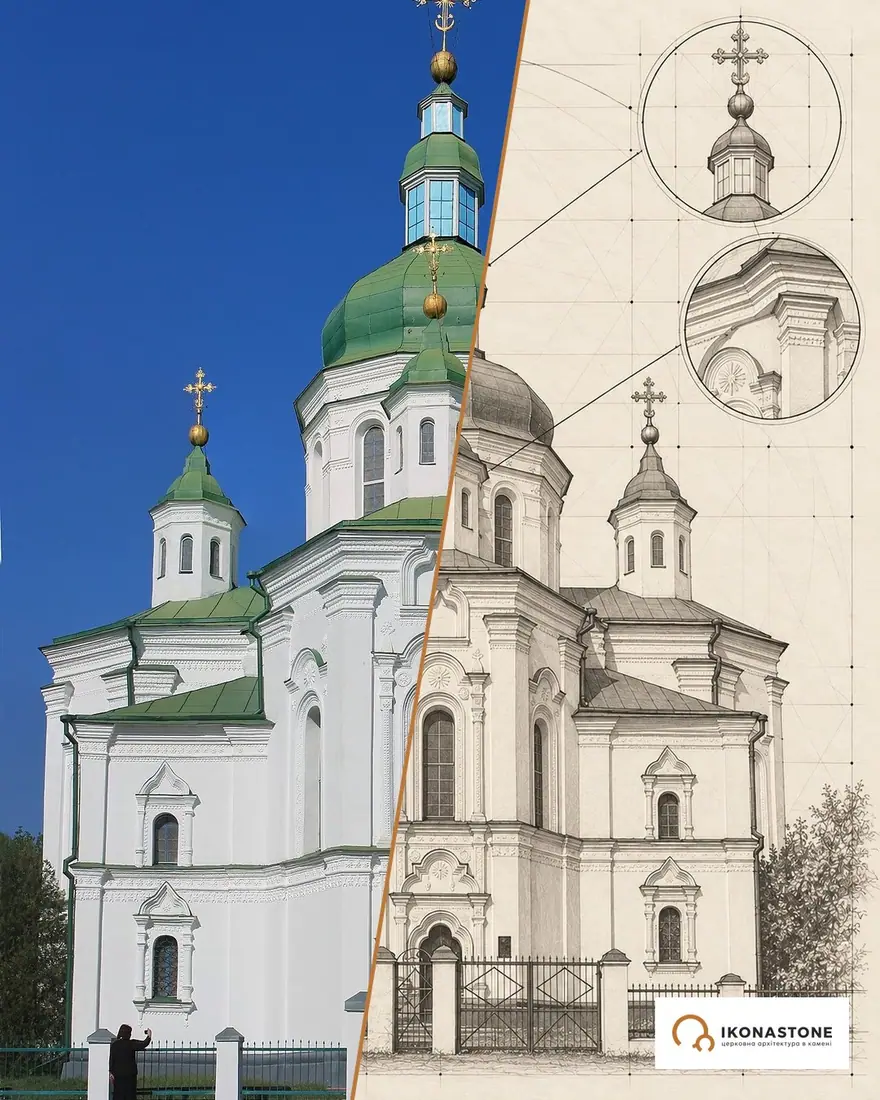
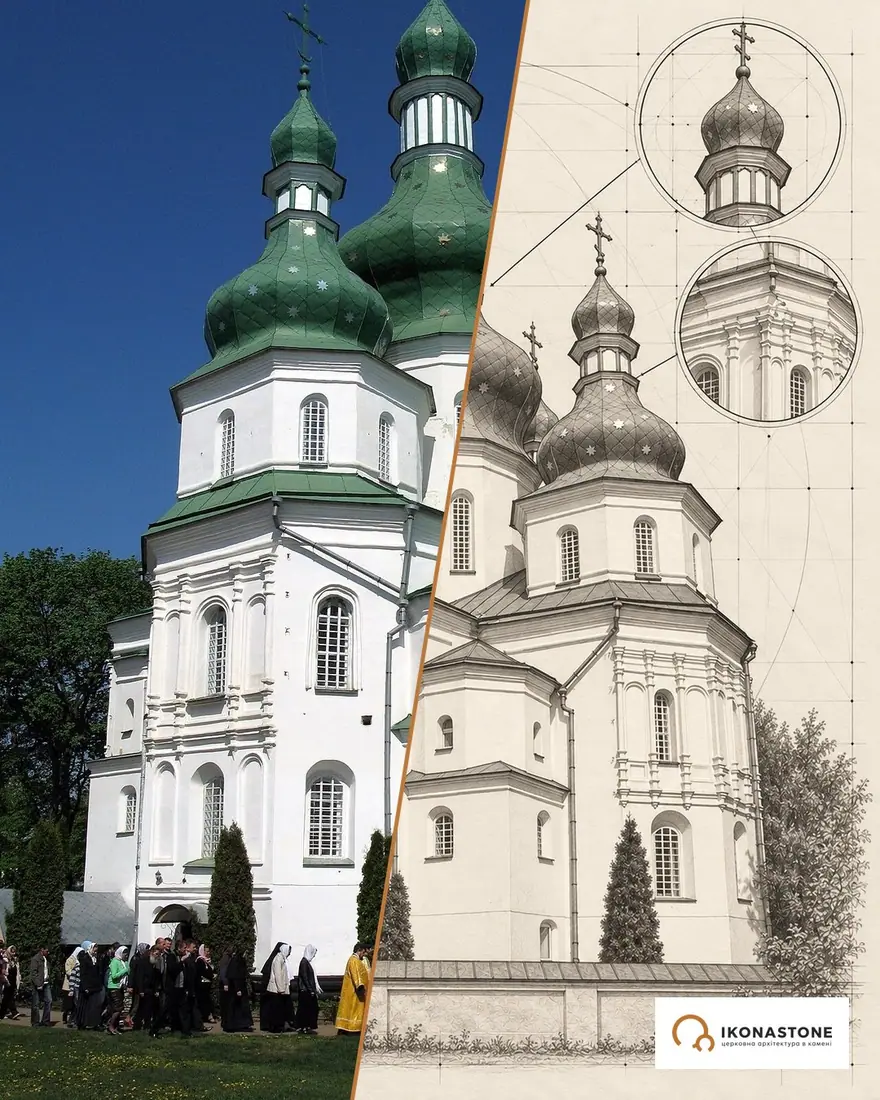
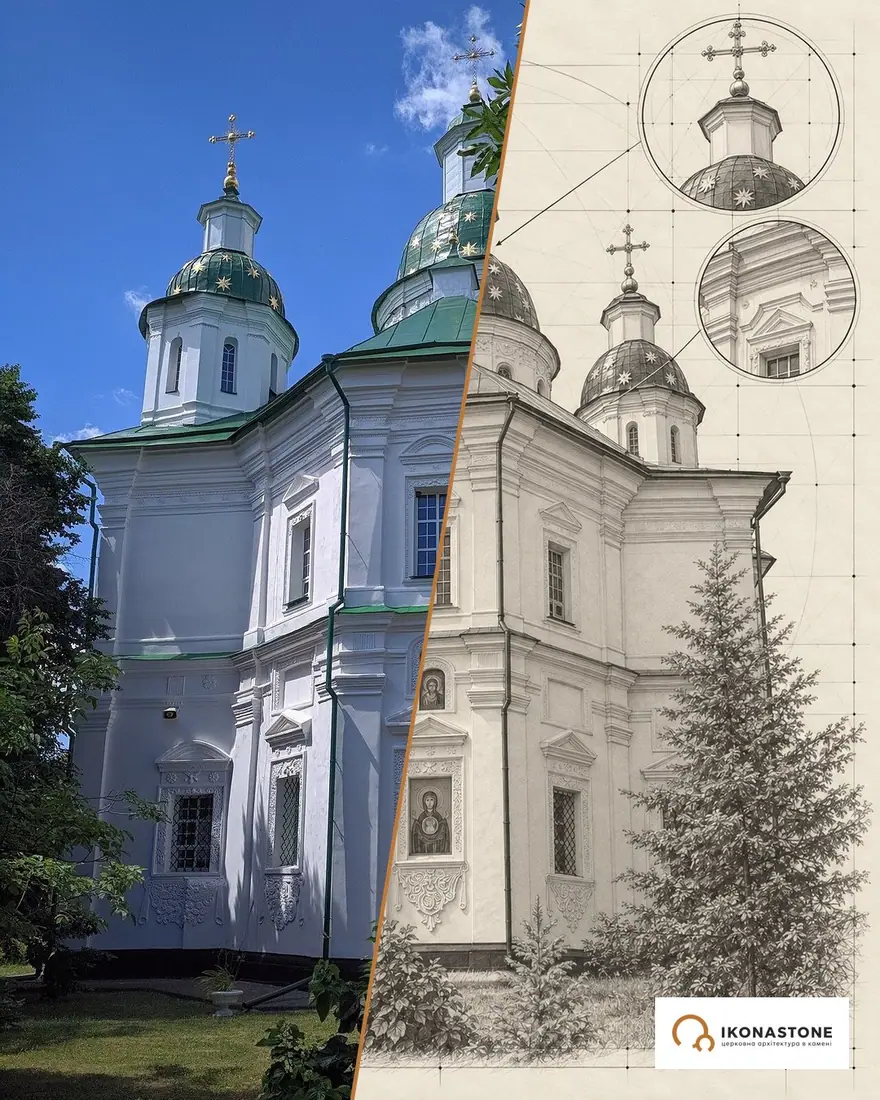
Below are two elements of the church: in a photo and in a drawing. The drawings show the form, not exact dimensions.
Pear-shaped domes
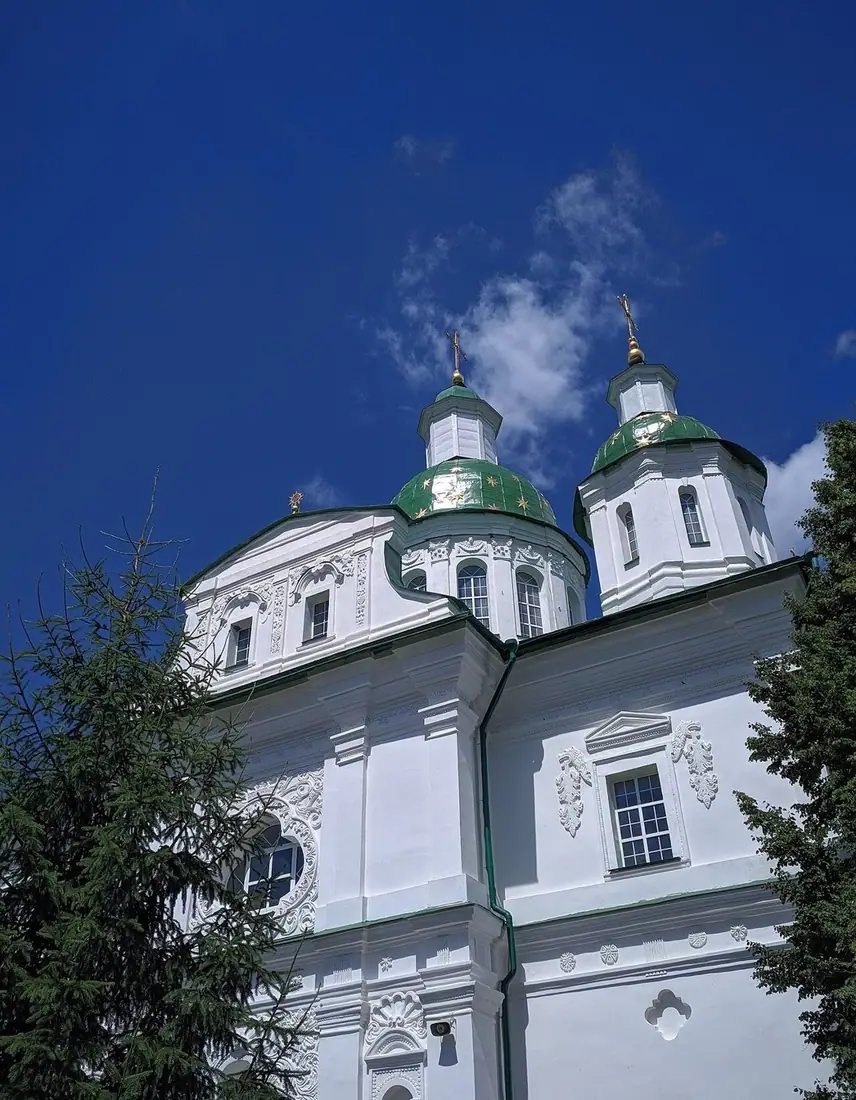
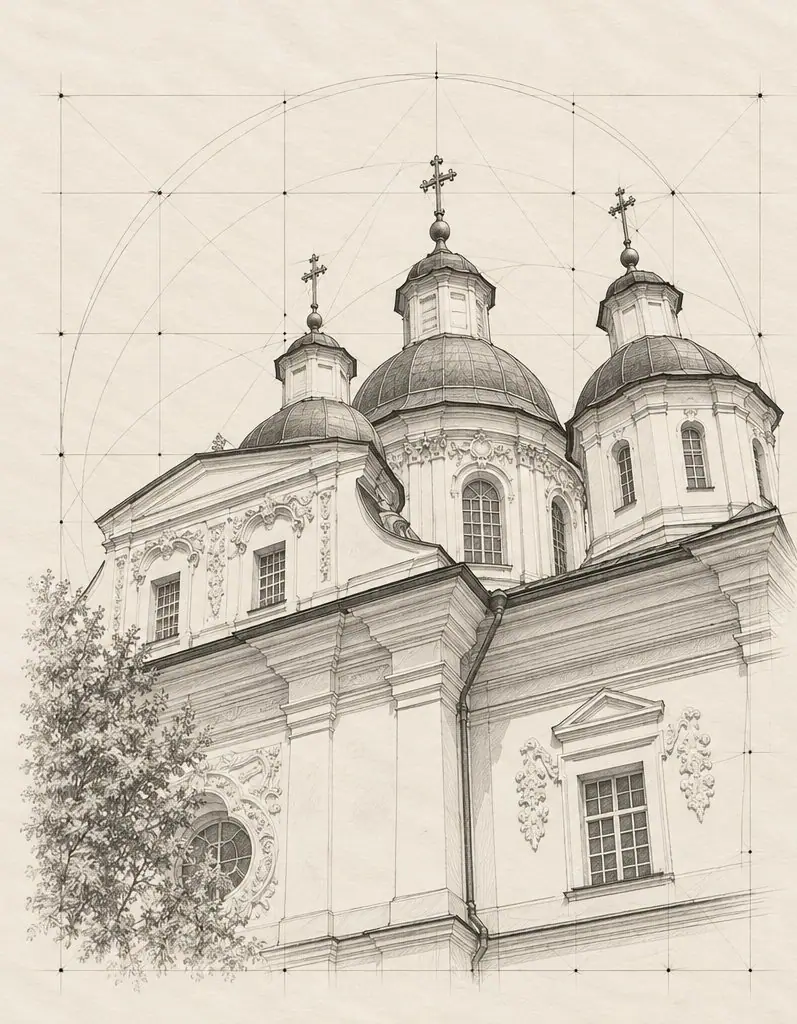
Of the seven domes of the original design, five remain. Their pear shape is one of the features of Ukrainian Baroque noted by the English Wikipedia.
The bell tower
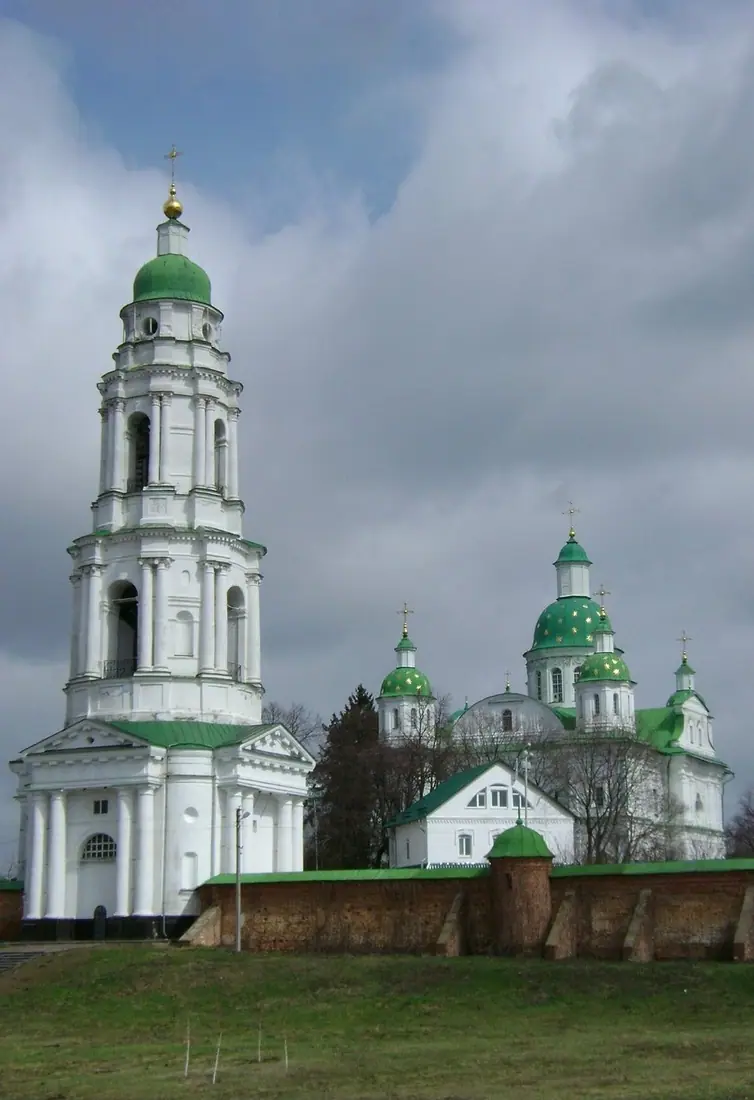
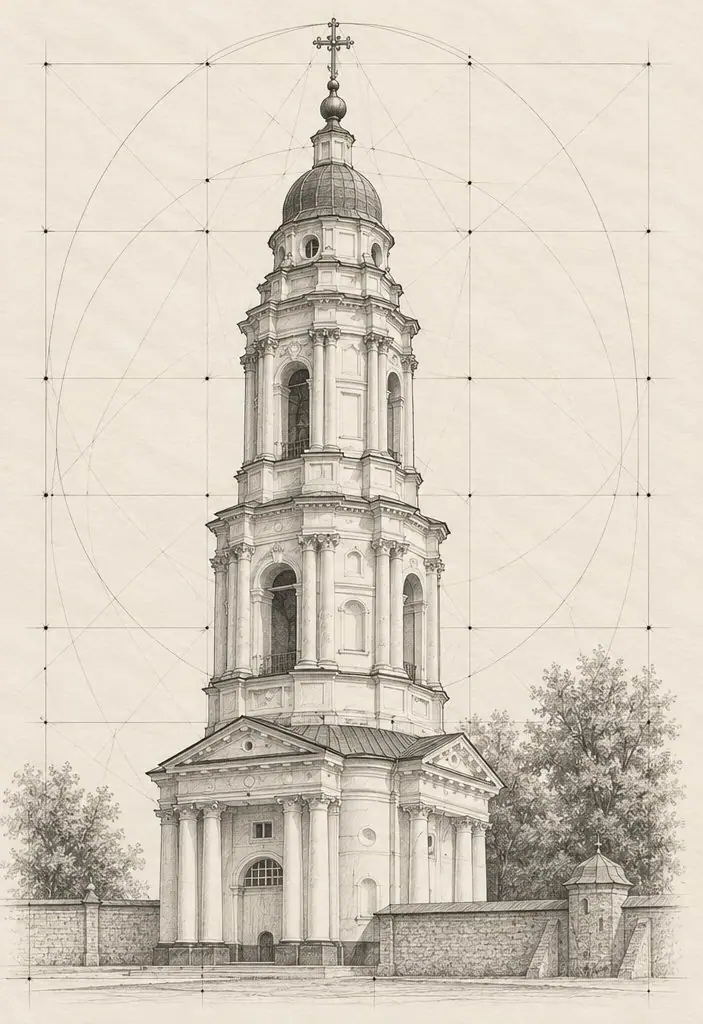
Construction of the free-standing three-tier bell tower began in 1785 but was not completed; it was built in 1839–1844 to a design by Anton Kartashevskyi (according to the VUE), modelled on the bell tower of the Exaltation of the Cross Monastery in Poltava. Its tiers have Doric, Ionic and Corinthian columns, and it is crowned by a hemispherical dome. According to Telegraf, the bell tower served as the main gate of the monastery.
Details that are easy to miss
The seated patriarch. Athanasius III Patelaros was buried according to Greek custom, seated, in full vestments. He is venerated as the Wonderworker of Lubny. In 1922, when the commissar demanded the silver reliquary, the monks managed to move the relics into a wooden one — and so the relics survived, although they ended up in Kharkiv.
The Hetman’s son in a monk’s habit. In 1663 Yurii Khmelnytskyi, the son of Bohdan, was tonsured in Mhar under the name Gedeon. The difficult fate of the son also passed through the monastery his father had patronised.
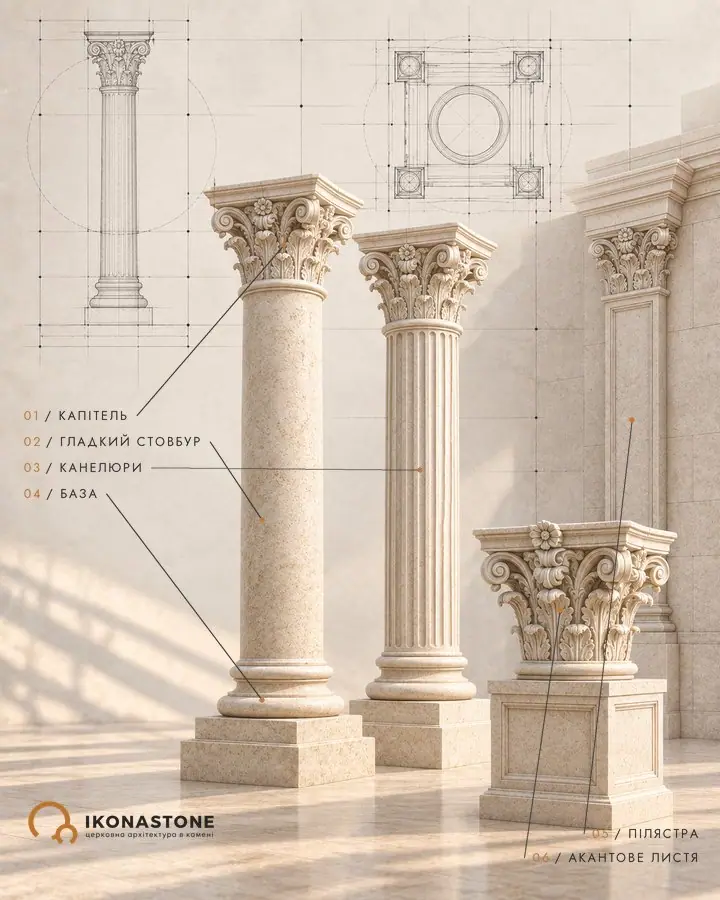
An order that rises upwards. The bell tower is a visual textbook of classical architecture: Doric columns below, Ionic above them, Corinthian at the top. From the most austere order to the richest, tier by tier. Construction began in 1785 but was completed only in 1839–1844, and the sequence of orders is kept from the first tier to the last.
Bullet marks. According to Telegraf, bullet marks can still be seen on the walls of the old churches — a memory of the times of persecution. On an August night in 1919, according to RISU, the Bolsheviks shot the superior and 16 monks.
Shevchenko and “The Twins”. According to Telegraf, Taras Shevchenko described the Mhar Monastery, together with the legend of the angels, in his novella “The Twins”, written in exile. So the monastery above the Sula entered literature from a very great distance.
The Mound of Sorrow. On 12 August 1990, not far from the monastery, on the outskirts of Lubny, the “Mound of Sorrow” was raised — a memorial to the victims of the Holodomor of 1932–1933 (according to the Encyclopedia of Modern Ukraine).
Photo gallery
Stone and material
The Mhar cathedral is a story of how decoration rewrites architecture. The concept of Mazepa’s era was restrained, but in the second third of the 18th century the facades were covered with stucco plant ornaments; together with the mosaic and the round flower-shaped windows, they define the cathedral’s face today. The white colour of the walls here is not a background but a material of the composition: every scroll reads against it. Stucco on a facade has a harder life than in an interior — under rain, frost and sun — which is why every restoration of it begins with measurements and samples of what has survived.
Recreating an iconostasis is a lesson of its own. Only one icon has survived, so the composition has to be rebuilt from iconographic and historical materials, while the depth of the carving, the depth of the shadow and the material are for the craftsmen to choose. The same applies to the columns of the bell tower: an order does not tolerate approximation, and the difference between an Ionic and a Corinthian capital can be seen even from the ground. Decisions like these — where to find a model and how to read an old photograph — should be built in at the design stage of an iconostasis.
The relics of Patriarch Athanasius now rest in the Annunciation Cathedral in Kharkiv. And what makes the iconostasis of Ukrainian churches special is explained in the article “Ukrainian iconostasis”.
Did you know
According to the VUE, Hetman Samoilovych warned that the model — the Holy Trinity–Illinskyi Cathedral in Chernihiv — was too large a structure “for the Mhar site”. [2]
The patriarch of Mhar is called Athanasius the Seated: he was buried seated, and today his relics in Kharkiv likewise rest on a throne in the south side chapel of the Annunciation Cathedral. [5, 16, 21]
The monastery was populated mostly by Zaporozhian Cossacks who came here at the end of their lives in search of peace; it held charters of protection from almost all the hetmans. [5, 8]
The Shalmatov iconostasis reached almost 17 m and was crowned by a sculptural group on the theme of the creation of the world; the royal doors were of red copper, gilded, with silver overlays. [2, 7]
According to pslava.info, the icons of the main tier were replaced in the 1830s; according to the VUE, the historian Mykola Kostomarov admired this iconostasis, noting that it had been renewed under Archimandrite Meletii (1826–1838). [2, 7]
“The Nativity of the Mother of God” (1765) was made from Shalmatov's sketches and restored in 1970; it is the only known fragment of the iconostasis. [2, 7]
In 1756 the monastery asked for the painter Hryhorii Semiarovych of the Kyiv cathedral painting workshop to be sent (the surname is spelled this way in pslava.info). [9]
Besides Athanasius, buried in Mhar are Patriarch Seraphim II of Constantinople (Anin, died 1799), Archbishop Amvrosii of Tobolsk (Kelembet, died 1826) and Archbishop Mefodii of Poltava (Pisniachevskyi, died 1845). According to the ESU. [3]
The relics of Metropolitan Joseph Neliubovych-Tukalskyi are “somewhere in the Mhar Monastery”: an expedition suggests they are walled up in a niche in the left wall of the Transfiguration Cathedral, opposite the resting place of Patriarch Athanasius. [20]
Some of the monks in 1919 survived by feigning death or by being wounded; among them were Hilarion, Isaakii and Feofil. On 23 October 1919 the bishop did not permit the martyrs' graves to be exhumed. According to Azbuka Viry. [11]
In 1922 people stood around the cathedral for several days, and when the harvest began they gradually dispersed; this gave the monks the chance to move the relics into a wooden reliquary. [2, 5]
The monastery was closed either in 1923 (ESU) or in 1926 (Encyclopedia of Ukraine); both dates appear in reference works. [1, 3]
Beside the monastery, since 1969, there has been a botanical nature monument, the “Mhar Dacha” (182 ha); the writer Oles Donchenko wrote the novella “The Forester's Wife” here. According to the ESU. [4]
Legends
The site shown by angels
According to legend, angels showed Princess Raina the site of the future monastery. Taras Shevchenko retold this story in his novella “The Twins”. Recorded by RISU and Telegraf. [5, 12]
“Here I will end my days”
According to legend, the ailing Patriarch Athanasius told Hegumen Petronii that he wished to end his life in Mhar. Recorded by the SPZh. [16]
An apparition and incorrupt relics
According to church tradition, eight years after his death Metropolitan Paisios (Ligarides) of Gaza told Hegumen Viktor about an apparition of Athanasius; the coffin was opened and the body was found incorrupt, although the clothing and the coffin had decayed. Recorded by RISU and in the life of the saint published by the UOCC. [5, 10, 16]
The relics must return
According to legend, the relics of Athanasius must sooner or later return to Mhar; Greek diplomats are said to have helped preserve them. Recorded by RISU. [5]
A Cossack old age
According to legend, Zaporozhian Cossacks came to Mhar at the end of their lives in search of peace. Recorded by RISU and pslava.info. [5, 8]
The restored icon
According to the life of the saint published by the UOCC, the icon of St Athanasius was “miraculously restored” and in 2010 was brought to Poltava. Presented as a church testimony, not independently verified. [10]
Key figures
- Raina Vyshnevetska (née Mohyla) — princess, founder of the monastery in 1619; cousin of Petro Mohyla.
- Isaia Kopynskyi — first hegumen, later Metropolitan of Kyiv.
- Athanasius III Patelaros — Patriarch of Constantinople, died in Mhar in 1654; venerated as the Wonderworker of Lubny.
- Yurii Khmelnytskyi (the monk Gedeon) — son of Hetman Bohdan; took monastic vows in 1663.
- Ivan Samoilovych — hetman, initiator of the cathedral’s construction (1683–1684).
- Ivan Mazepa — hetman, who completed the cathedral’s construction (1692).
- Ioann (Johann) Baptist, according to the VUE — Sauer — architect of the cathedral, from Vilnius.
- Mykhailo Tomashevskyi, Afanasii Pyriatynskyi — craftsmen who assisted the construction and completed the decoration.
- Varlaam Yasynskyi — Metropolitan of Kyiv, consecrated the cathedral in 1692 (according to RISU).
- Ivan Maksymovych — monk and icon painter, directed the icon-painting workshops of Mhar (1679–1745).
- Stepan Mutianytsia — carver of the first iconostasis (1685–1689).
- Sysoi Shalmatov — carver of the iconostasis of 1762–1765 (a native of Ostashkov, workshop in Kursk).
- Ivan Kosachynskyi — icon painter of Shalmatov’s iconostasis.
- Ioasaf Horlenko — hegumen from 1737, first archimandrite (1744).
- Tymofii Shcherbatskyi — Metropolitan of Kyiv, consecrated the rebuilt cathedral in 1754.
- Anton Kartashevskyi — author of the bell tower design (according to the VUE).
- Joseph Neliubovych-Tukalskyi — Metropolitan of Kyiv, died 1675; his relics are in Mhar.
- Amvrosii, the hegumen, and 16 monks — shot in 1919; glorified in 2008.
- Pylyp (Osadchenko) — superior from 1993, abbot from 2012, Metropolitan of Poltava and Myrhorod.
How to cite
IKONASTONE. The Transfiguration Cathedral of the Mhar Monastery // Guide to Churches of Ukraine. URL: https://ikonastone.com/en/guide/transfiguration-cathedral-mhar-monastery/ (accessed DD.MM.YYYY).
Not sure what the piece is called? Walk through the church from sanctuary to churchyard →
Would you like to give something to a church? What to give a church →
Want to remember loved ones or a fallen parishioner? Remembrance at a church →
FAQ
When was the Transfiguration Cathedral in Mhar built?
The Encyclopedia of Ukraine dates the construction to 1682–1694, the English Wikipedia to the 1680s; according to other sources, work on the masonry church began in 1692. The cathedral was rebuilt in the 18th century.
Who was the architect of the cathedral?
The Encyclopedia of Ukraine names Johann Baptist as the author of the design; the English Wikipedia calls him Johann Baptist Sauer of Vilnius. He was assisted by M. Tomashevskyi and A. Pyriatynskyi (according to the Encyclopedia of Ukraine). The funds came from Hetmans Ivan Samoilovych and Ivan Mazepa.
Why does the cathedral have five domes rather than seven?
The church originally had seven domes. According to the Great Ukrainian Encyclopedia, the central dome collapsed in 1728 (and was rebuilt in 1729), and during the rebuilding of 1754 the number of domes became five; the Encyclopedia of Ukraine also links this to the rebuilding of the mid-18th century, while Telegraf links it to an 18th-century fire.
Who is buried in the Mhar Monastery?
The former Ecumenical Patriarch Athanasius III Patelaros died and was buried here (1654); in 1922 his relics were taken to the Annunciation Cathedral in Kharkiv. Also buried in the monastery are Patriarch Seraphim II of Constantinople and two archbishops, and the relics of Metropolitan Joseph Neliubovych-Tukalskyi were brought here from Chyhyryn.
Is the monastery active today?
Yes. The Soviet authorities closed the monastery (in 1923 according to the ESU, in 1926 according to the Encyclopedia of Ukraine); it was returned to the Church in 1993.
Sources 23
- Encyclopedia of Ukraine (CIUS). Mhar Transfiguration Monastery
- Велика українська енциклопедія. Мгарський Спасо-Преображенський монастир
- Енциклопедія Сучасної України. Мгарський Спасо-Преображенський чоловічий монастир УПЦ МП
- Енциклопедія Сучасної України. Мгар Полтавської області
- РІСУ. Історія Мгарської обителі
- РІСУ. Ярема Вишневецький — ворог православ'я чи православний меценат
- Полтавіка (pslava.info). Іконостас Спасо-Преображенського собору (Н. Косенко та ін., 1996)
- Полтавіка (pslava.info). Л. Логвиненко. Дзвони над Сулою (2010)
- Полтавіка (pslava.info). Мгарський монастир
- UOCC. St. Athanasius, Patriarch of Constantinople, Wonderworker of Lubny
- Азбука віри. Мгарські преподобномученики
- Телеграф. Про цей монастир Шевченко писав у засланні (16.10.2025)
- Суспільне Полтава. У Мгарському монастирі УПЦ СБУ провело безпекові заходи (05.12.2022)
- Суспільне Полтава. Які пам'ятки українського бароко збереглися на Полтавщині
- Союз православних журналістів. Три архієреї очолили літургію в престольне свято Мгарського монастиря (06.08.2026)
- Союз православних журналістів. St. Athanasius the Seated — a Greek on the throne of Mhar Hill
- Ю. Мицик. П'ять невідомих документів гетьмана Івана Скоропадського // Київські історичні студії
- Encyclopedia of Ukraine. Maksymovych, Ivan
- Encyclopedia of Ukraine. Tukalsky-Neliubovych, Yosyf
- Тексти. Останній митрополит Йосип Тукальський загинув 1675 року
- РІСУ. Благовіщенський собор у Харкові
- Енциклопедія Сучасної України. Курган скорботи
- Sobory.ru. Мгарь. Собор Спаса Преображения
- Town
- Mhar village, near Lubny, Poltava Oblast
- Built
- 1682–1694, according to other sources from 1692; rebuilt in the 18th century
- Type
- cruciform three-aisled six-pier church with basilican features; originally seven-domed, now five-domed
- Material
- masonry, rendered; stucco decoration and mosaic on the facades
- Research depth
- 29%