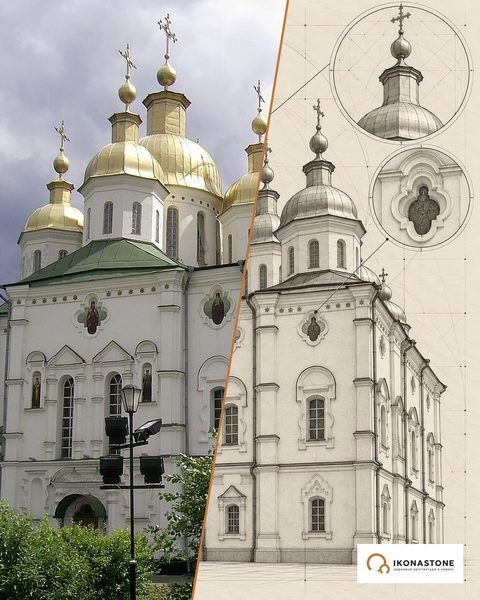
The Annunciation Cathedral in Kharkiv: a striped vertical above the Lopan
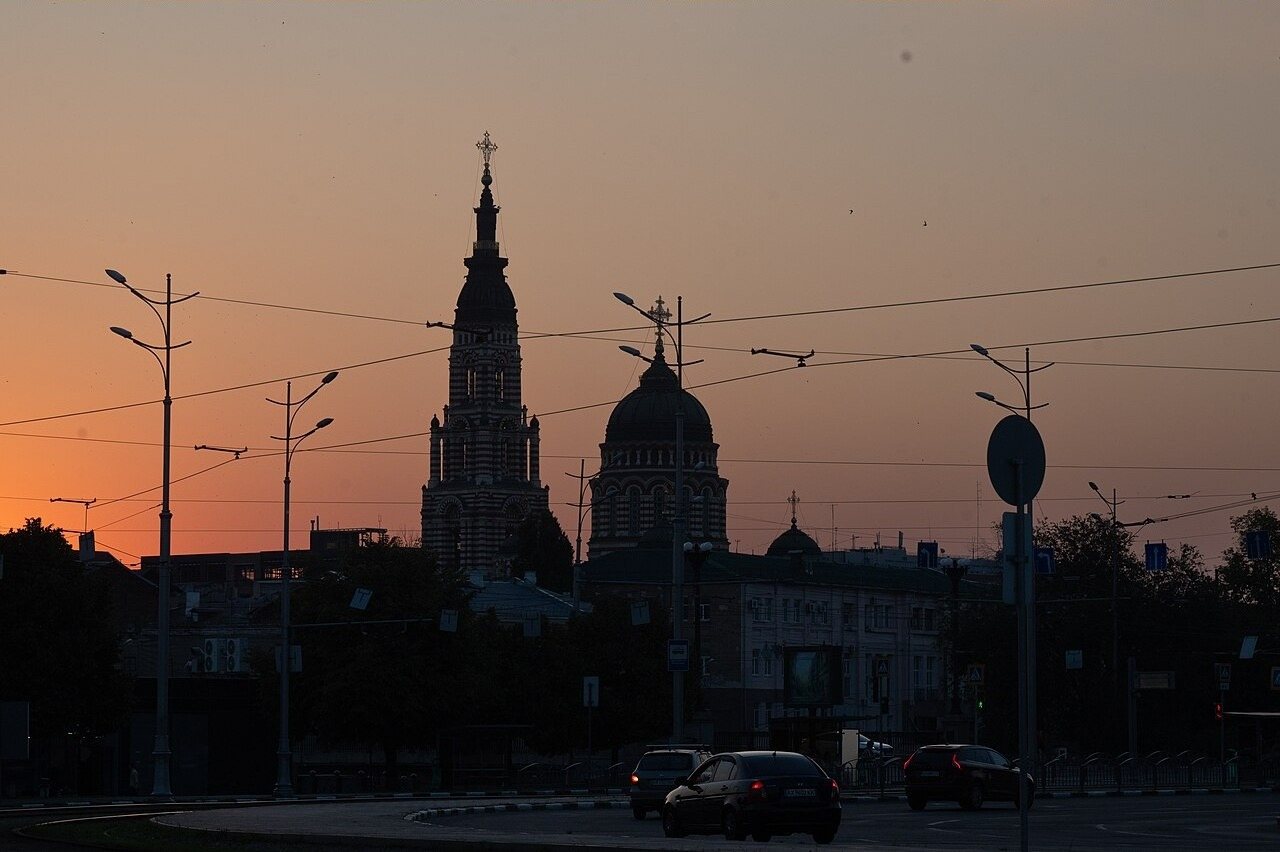
Red brick and white render alternate in bands on the facades, and the cathedral above the Lopan can be seen from afar, like a vertical drawn in two colours. The architect Mykhailo Lovtsov designed it for the parish he himself belonged to.
In brief
| Address | 12 Rizdviana Street, Kharkiv |
| Built | 1888–1901; foundation 2 October 1888, consecration 1901 |
| Architect | Mykhailo Lovtsov (1850–1907) |
| Type | five-domed church in the Byzantine style with a tall western bell tower |
| Dimensions | cross of the main dome over 60 m (other sources give a church height of 59 m); bell tower with cross about 80 m |
| Material | red brick alternating with white rendered bands |
| Status | cathedral of the Kharkiv eparchy since 1946 (now UOC MP); architectural monument of local importance |
History
On this site, in the Zalopan sloboda, a wooden Church of the Annunciation stood from around 1655, one of the first in Kharkiv. In 1738 it was destroyed by fire, and the parishioners quickly rebuilt it. According to Zabytky, that first wooden church had three tops and a separate bell tower, and its main treasure was an icon of the Kazan Mother of God in a gilded cover of 1776. In 1789 it was decided to build a masonry church to a design by P. Yaroslavskyi; it was consecrated five years later. From 1836 side chapels of St John the Warrior and the Great Martyr Barbara were added, as the parish grew along with the city.
In 1887 it was decided to build a new cathedral. The foundation ceremony took place on 2 October 1888. The design was by Mykhailo Lovtsov, later the chief architect of Kharkiv; according to the Zabytky guide the estimate was 400,000 roubles, and the money, according to Dorohovkaz, came mainly from merchants. The new church was built to the north of the old one, and while construction was under way services continued in the old church, which was dismantled once the work was finished. The cathedral was consecrated in 1901, on 13 October according to its website; the day before, St John of Kronstadt visited the church.
The church received the status of city cathedral in 1913–1914 (guides differ on the date). In 1923 the marble iconostasis was dismantled by decision of the Soviet authorities. There had been attempts to close the cathedral earlier, and, according to Dorohovkaz, the city’s Orthodox organisations resisted them. In the winter of 1930 the cathedral was nevertheless closed, and the building was used as a stable and a store for petroleum products. Services resumed in 1943, under German occupation; the English-language Wikipedia writes that the church was then used by the Ukrainian Autocephalous Orthodox Church. At the same time the relics of Saints Meletius and Athanasius were moved to the cathedral. Since 1946 it has been the cathedral of the Kharkiv eparchy.
In 1974 a hurricane tore the cross from the bell tower. On the evening of 2 June 1997, after welding work, the top of the bell-tower dome caught fire; two versions were considered, a breach of safety rules or arson, since threats had been made to the eparchy. The wind was blowing east, and the top could have collapsed onto the main body of the church, but it fell into the courtyard after striking the bell-tower cornice. In 1998 the bell tower was repaired, partly with funds from representatives of the city’s various confessions. On 23 January 2024 the cathedral was damaged in a Russian missile strike on Kharkiv: the architect Viktor Dvornikov of the NEMOlab initiative told Suspilne about damaged stained-glass windows of artistic and historical value and broken glazing in the dome drums. Repair is complicated by the fact that the existing scaffolding on the cathedral does not reach the broken windows, so work will have to be done directly on the domes.
Architecture
The cathedral is five-domed, in the Byzantine style. The cathedral’s website calls the western bell tower Gothic in style, an unexpected combination that makes the silhouette recognisable. The cross of the main dome rises over 60 m, and the bell tower with its cross reaches about 80 m; the English-language Wikipedia calls the cathedral one of the largest and tallest churches of the Russian Empire. The length, according to Dorohovkaz, is 71 m, and the width, according to Zabytky, 34 m. Different sources estimate its capacity at 4,000–5,000 people.
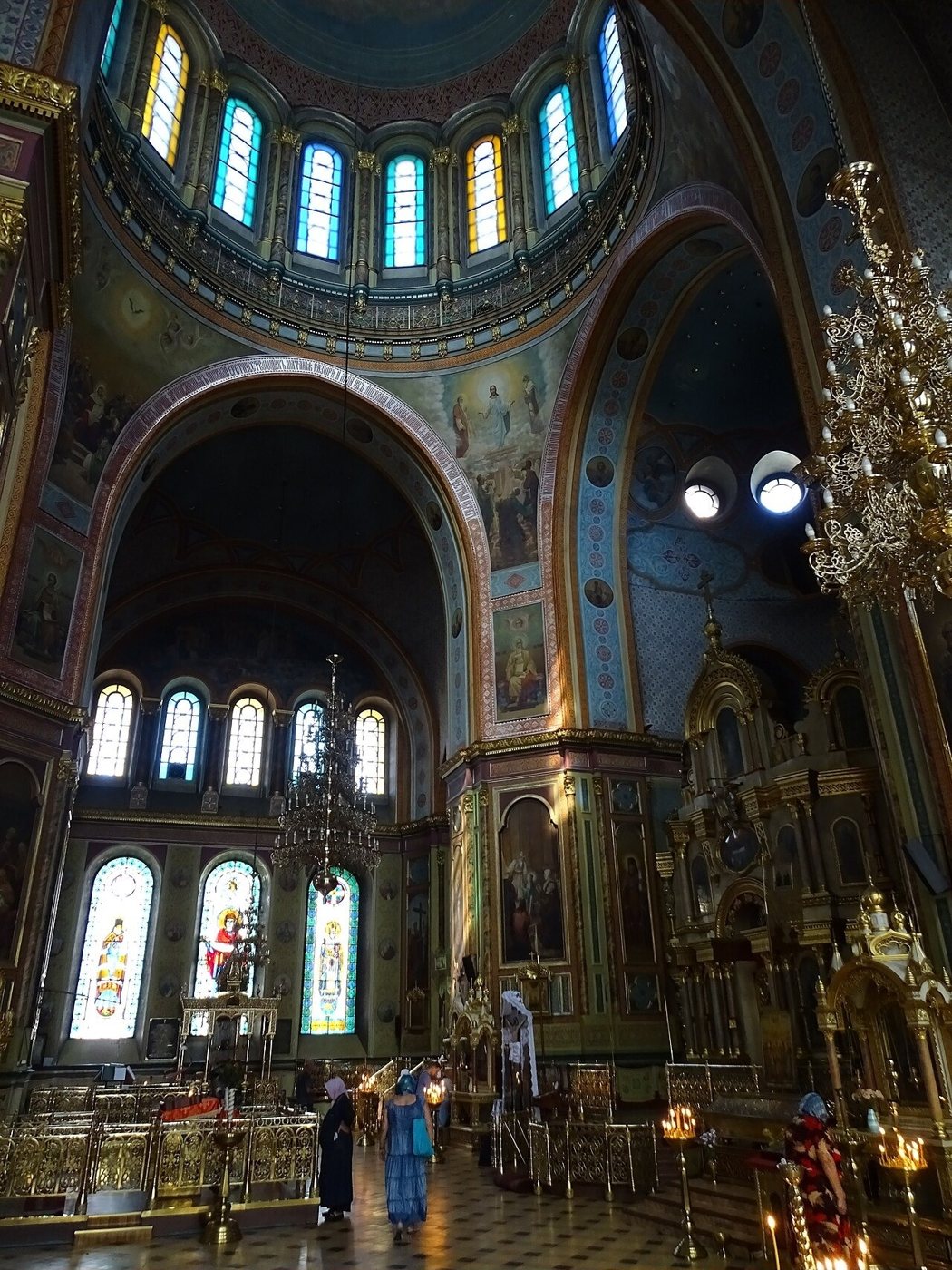
The central portal is framed by a massive arch on four columns. The interior paintings, according to Dorohovkaz, were made by Andrii Danylevskyi, Mykhailo Mykhailov and I. Sviatenko; the subjects were borrowed from St Volodymyr’s Cathedral in Kyiv and partly from the Cathedral of Christ the Saviour in Moscow.
In the lower, underground level of the cathedral are additional chapels: in 1915 the chapel of St Anthony the Roman was consecrated (in 1951 it was rededicated to the Protomartyr Stephen), and in 1978 the chapels of the Ozeriany Icon of the Mother of God and of St Meletius of Kharkiv.
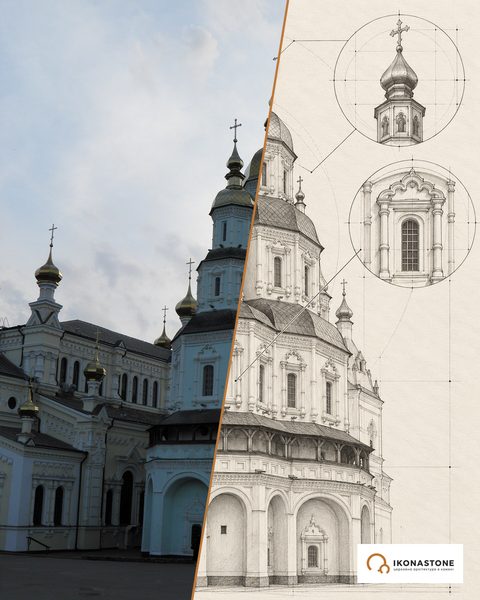
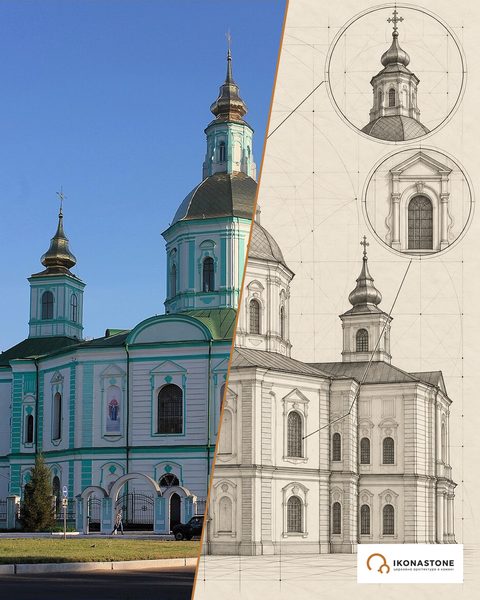
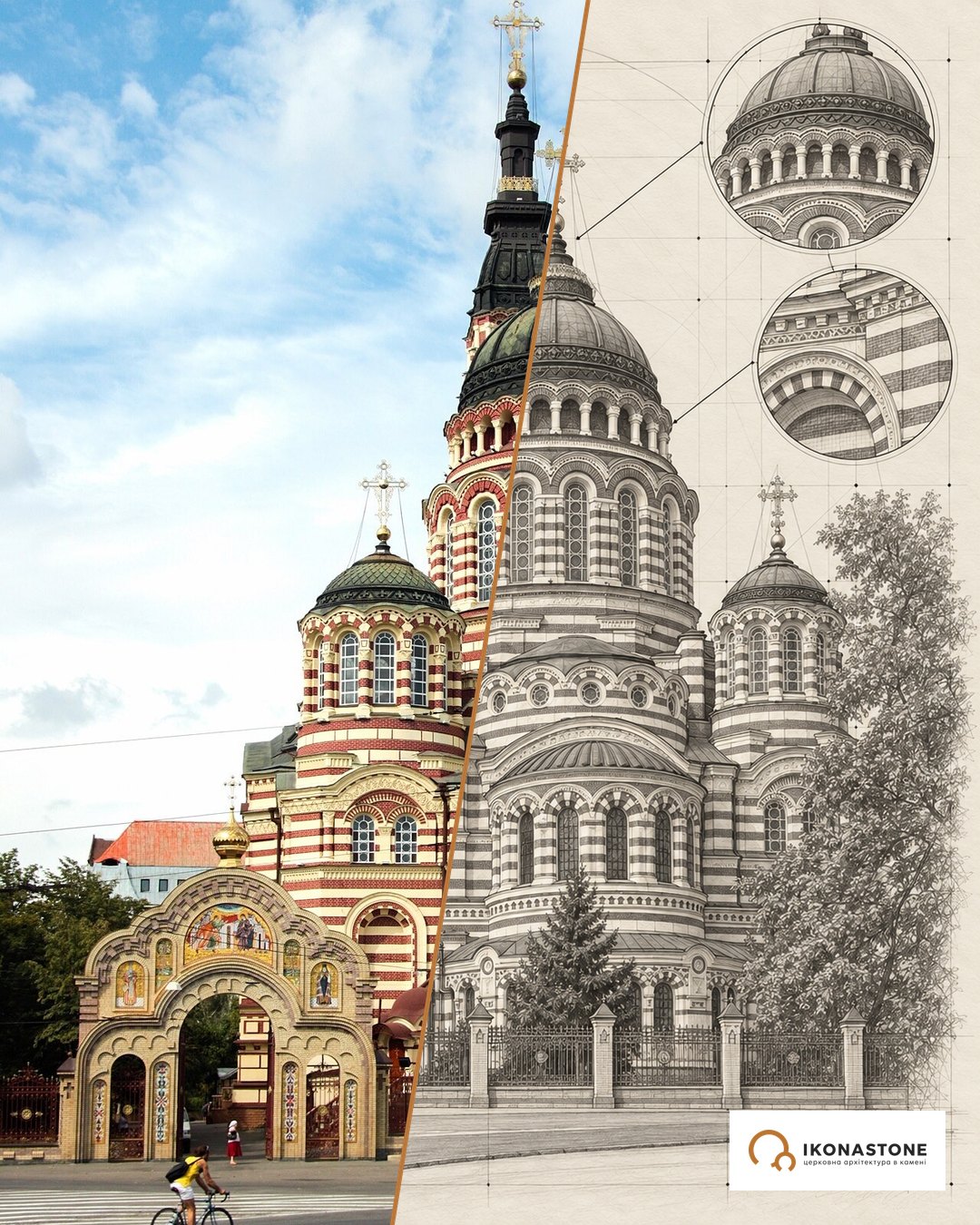
Below are two elements of the cathedral: in a photo and in a drawing. The drawings show the form, not exact dimensions.
The bell tower
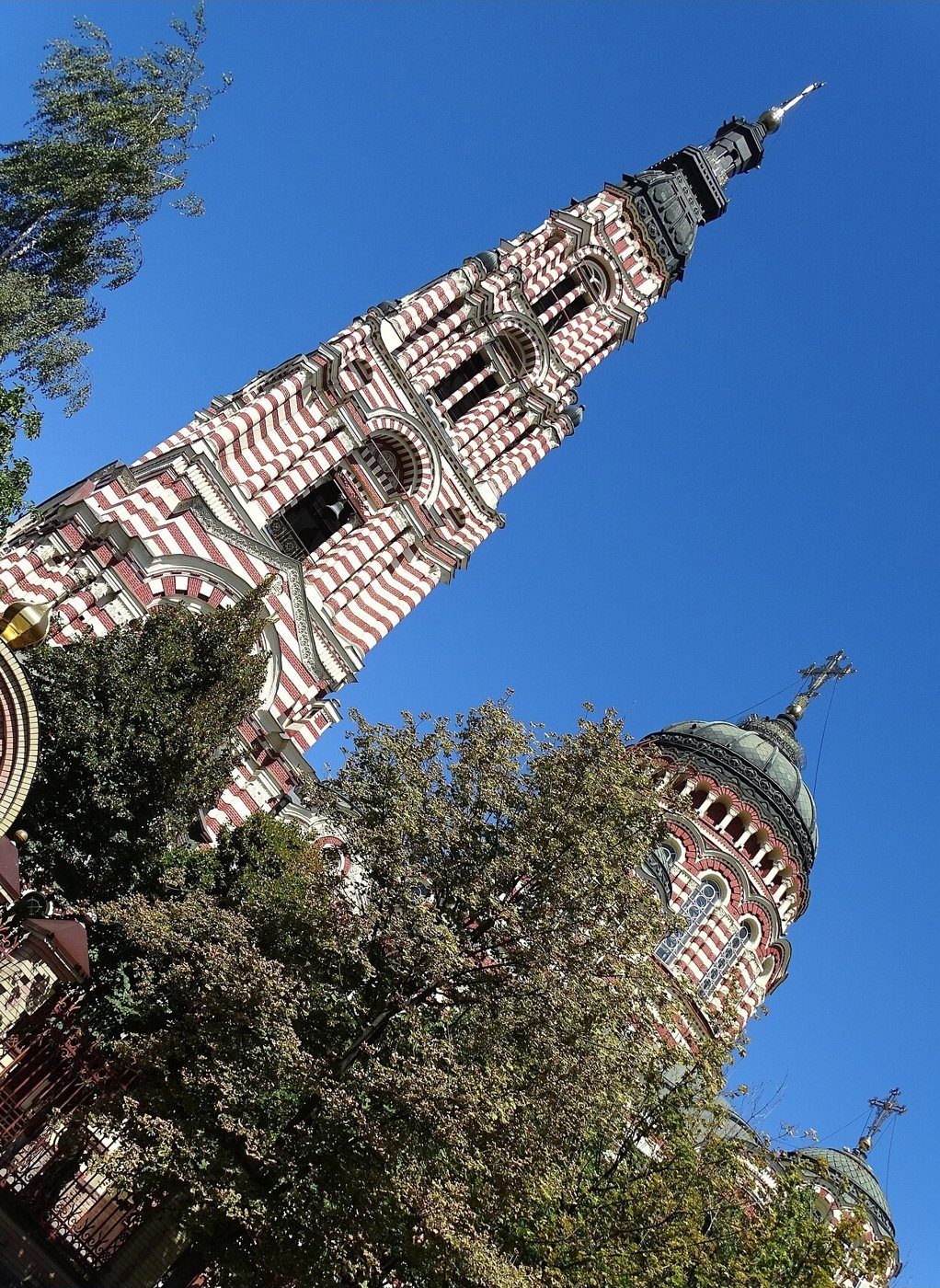
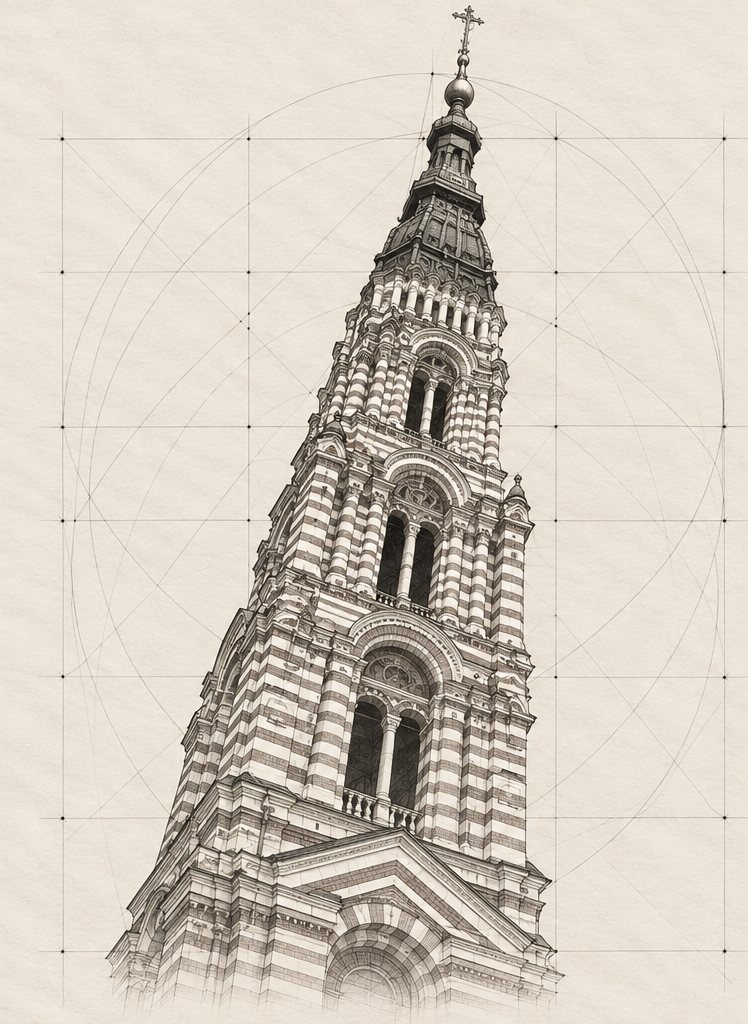
The bell tower, about 80 m high, stands to the west. Its top burned in 1997 and was restored in 1998.
The central dome
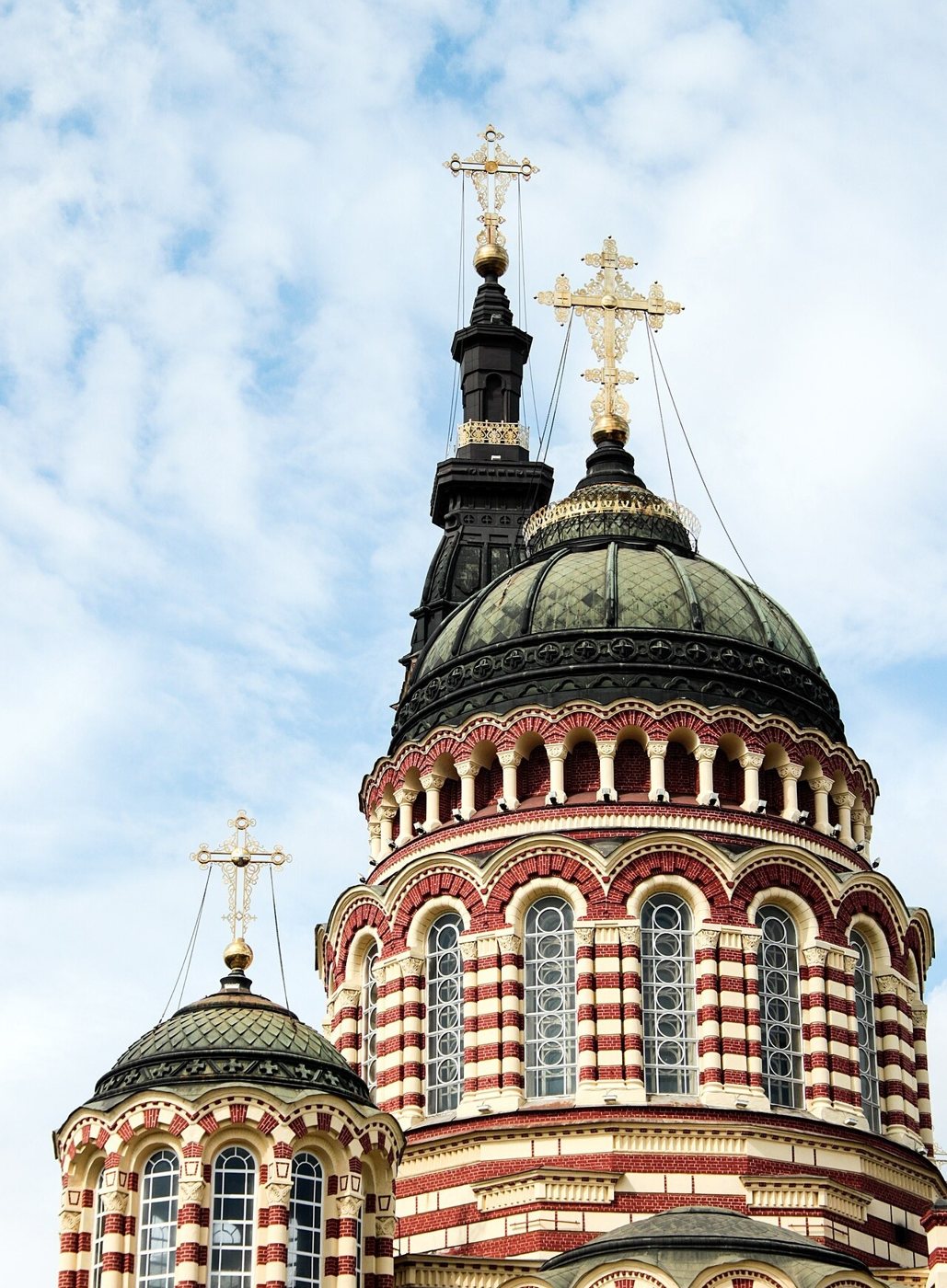
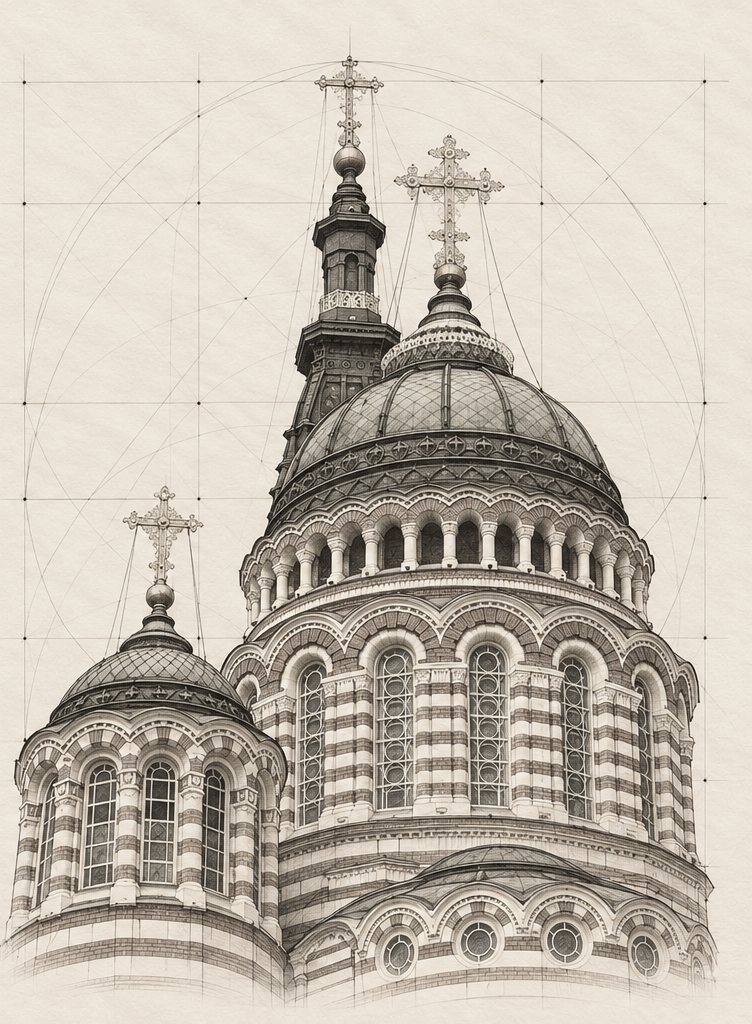
The main dome rises over the crossing on a windowed drum. It was the glazing of the dome drums that suffered in the strike of 23 January 2024.
Details that are easy to miss
A patriarch buried seated. St Athanasius III Patelarios, Patriarch of Constantinople, was buried in Lubny in a seated position, in full vestments. In 1922 the monks moved the relics into a wooden reliquary and handed the silver one over to the authorities. Later the relics were moved to the Kharkiv cathedral, where they rest to this day.
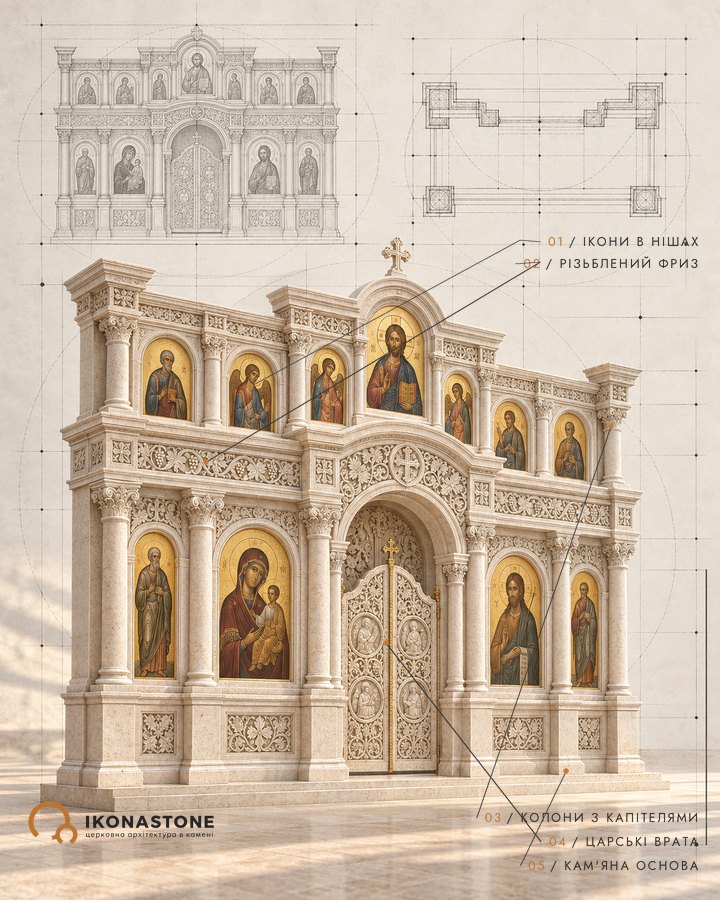
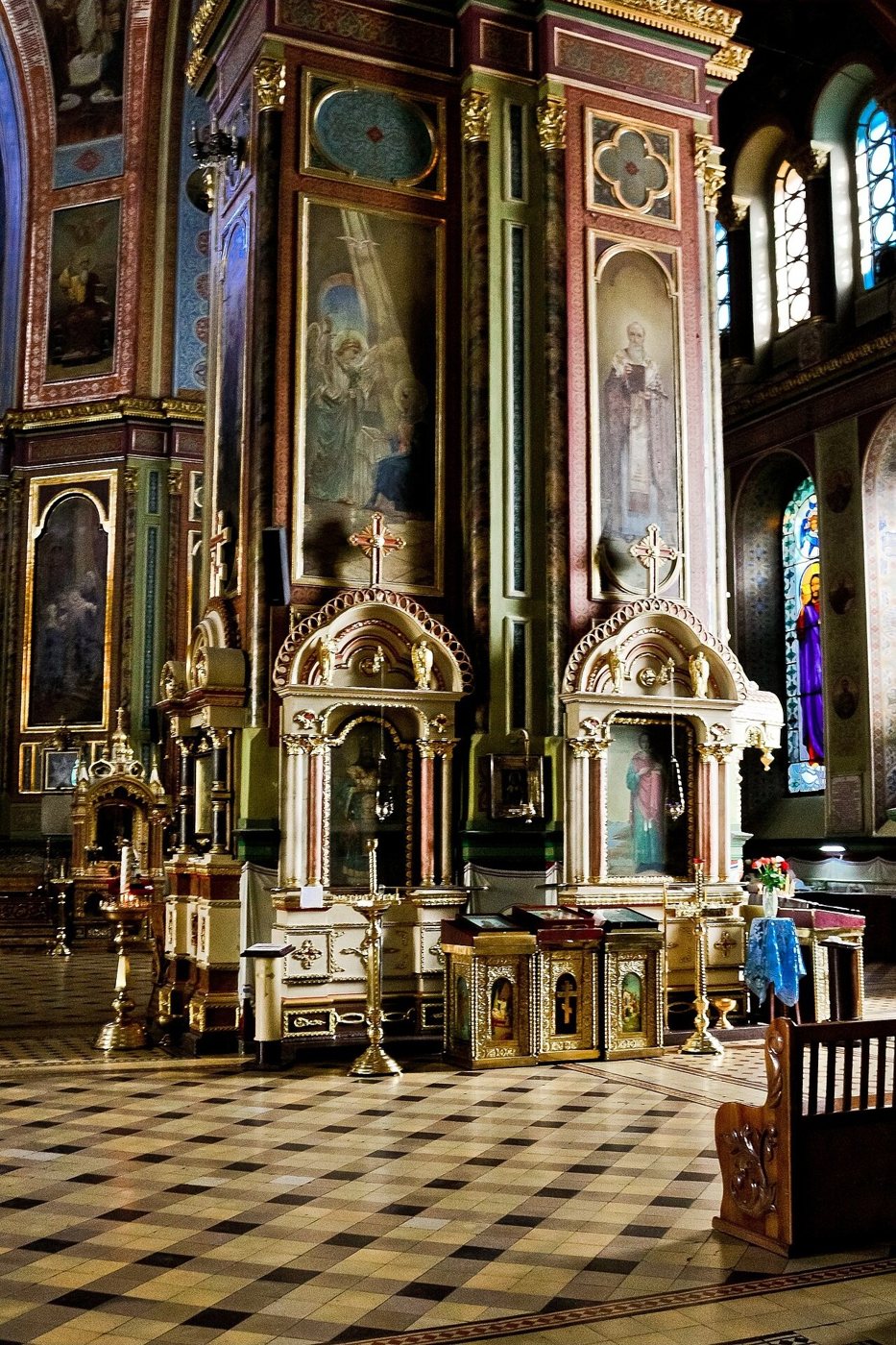
A stone iconostasis that is no longer there. The original iconostasis was marble; the English-language Wikipedia writes of Carrara marble, Dorohovkaz of white marble made by the Moscow craftsman Vasilii Orlov. In 1923 it was dismantled. What we see today is a post-war iconostasis finished to imitate marble.
Byzantium and Gothic on one axis. A five-domed church in the Byzantine spirit and a bell tower that the cathedral’s website calls Gothic: a combination that looks bold on paper but reads as a whole in the city skyline thanks to the shared striped masonry.
A fire that fell the right way. During the 1997 fire the wind carried the flames east, towards the main body of the church. The top of the bell-tower dome fell into the courtyard without damaging the main volume. The repair the following year was funded, among others, by representatives of Kharkiv’s various confessions.
A stable and a fuel store. In the 1930s horses were kept and petroleum products stored in the cathedral. By the simplest building standards, there could hardly be worse neighbours for paintings and render.
The architect-parishioner. Mykhailo Lovtsov designed the church not for an abstract client but for his own parish: the cathedral’s official website explicitly calls him a parishioner of the Annunciation Church. He later became the chief architect of Kharkiv, so the cathedral can be seen both as his professional calling card and as a personal undertaking.
Treasures of the lower church. Beneath the cathedral lies a separate world of chapels. Here the Ozeriany Icon of the Mother of God is venerated, and on 17 September 2011 Metropolitan Nikodim (Rusnak) was buried in the chapel of St Meletius.
The cathedral in miniature. In 2009 a three-tonne miniature copy of the cathedral made of white marble and bronze was installed on Architects’ Square, marking the 355th anniversary of the city and the 210th anniversary of the Kharkiv eparchy.
Photo gallery
Stone and material
The cathedral’s facades are built of red brick alternating with white rendered bands. This device produces the effect by which Kharkiv recognises its cathedral: a horizontal rhythm that restrains the enormous height and at the same time emphasises it.
The fate of the marble iconostasis is a story of stone outlasting human decisions. Dismantled in 1923, it gave way to a post-war imitation. And in 2009 Kharkiv commissioned a marble cathedral in miniature. When stone works in a church, it matters that it can be not only installed but also preserved; this question is best raised at the design stage of an iconostasis.
Another old church in the city is the Intercession Cathedral in Kharkiv. On stone sanctuary screens, read our articles the stone iconostasis and the Royal Doors.
FAQ
Who built the Annunciation Cathedral?
The cathedral was designed by the Kharkiv architect Mykhailo Lovtsov (1850–1907), a parishioner of this church. The foundation ceremony took place on 2 October 1888, and construction was funded mainly by merchants' donations. The church was consecrated in 1901; the cathedral's website gives the date as 13 October.
How tall are the cathedral and the bell tower?
According to the cathedral's website, the cross of the main dome is more than 60 m high, and the bell tower with its cross reaches about 80 m. Other guides give the height of the church as 59 m and its length as 71 m.
Has the marble iconostasis survived?
No. According to the cathedral's website, the original marble iconostasis was dismantled in 1923 by decision of the Soviet authorities. The present iconostasis, finished to imitate marble, was installed after the Second World War.
Whose relics are kept in the cathedral?
The cathedral holds the relics of St Athanasius III Patelarios, Patriarch of Constantinople, who was buried in Lubny seated, in full vestments, and of St Meletius of Kharkiv; according to the Zabytky guide, they were moved to the cathedral in 1943.
How was the cathedral damaged in the war?
As a result of the missile strike on Kharkiv on 23 January 2024, the cathedral, according to the architect Viktor Dvornikov of the NEMOlab initiative, was seriously damaged: the stained-glass windows and the glazing in the dome drums were affected, and probably the roof.
Sources
- Благовіщенський кафедральний собор (офіційний сайт): історія
- Забитки: Благовіщенський кафедральний собор Харкова
- Дороговказ: Благовіщенський собор у Харкові
- Wikipedia: Annunciation Cathedral, Kharkiv
- Суспільне: Близько 40 історичних будівель пошкоджені внаслідок ракетних ударів по Харкову 23 січня
- UOCC: St. Athanasius, Patriarch of Constantinople, Wonderworker of Lubny
- Town
- Kharkiv, Kharkiv Oblast
- Built
- 1888–1901
- Type
- five-domed church in the Byzantine style with a tall western bell tower
- Material
- red brick with white rendered bands
- Research depth
- 16%