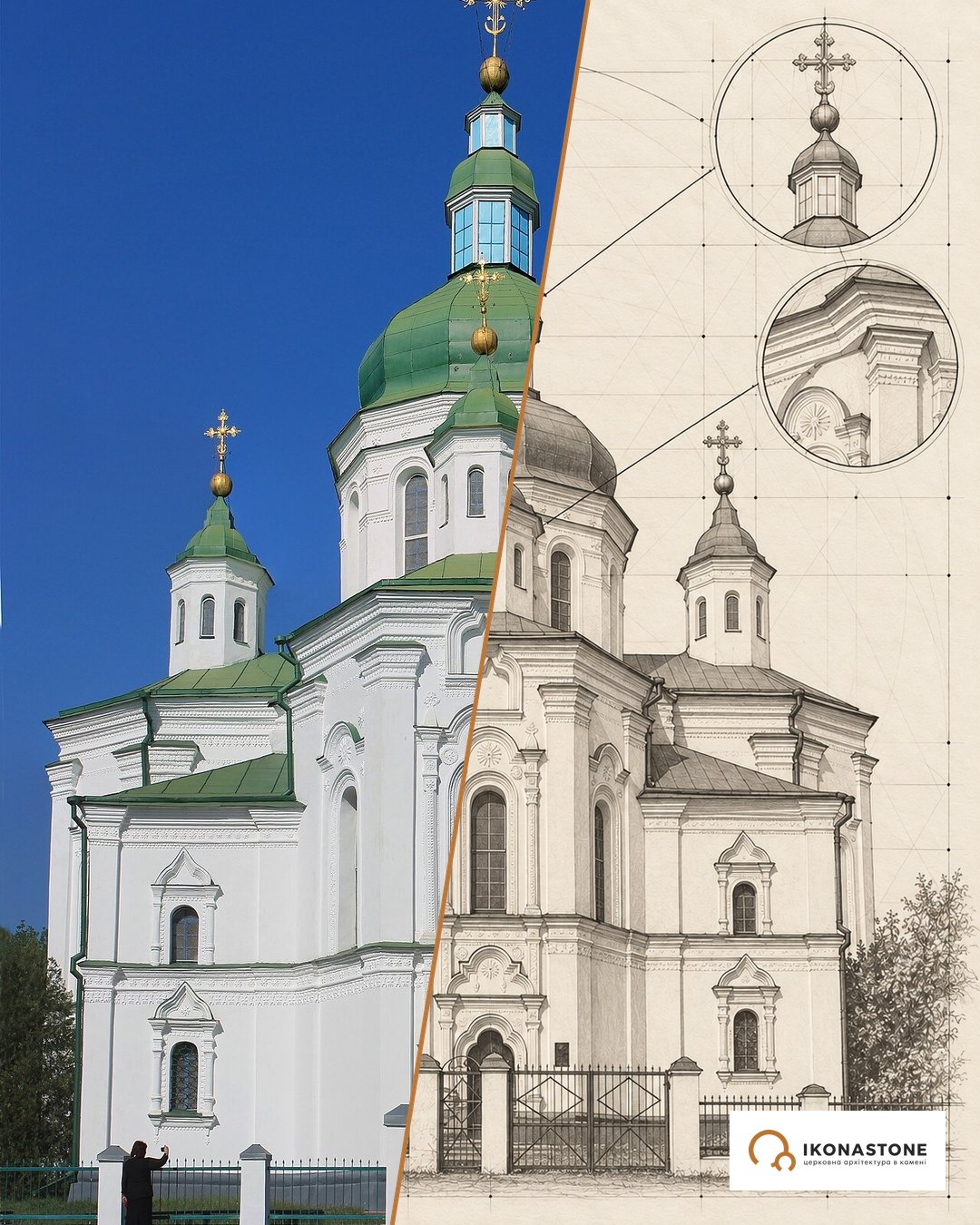
The Holy Trinity Cathedral in Hustynia: five domes above an island on the Udai
According to tradition, Hustynia took its name from the dense (Ukrainian: hustyi) forest that surrounded an island on the Udai. The forest has long since thinned, but the five tops of the Holy Trinity Cathedral still hold over the plain the same vertical accent for which they were raised.
In brief
| Address | Hustynia village, Pryluky District, Chernihiv Oblast, Hustynia Holy Trinity Monastery |
| Built | 1672–1676; according to the monastery, founded in 1674, consecrated in 1675 |
| Ktitor (benefactor) | Hetman Ivan Samoilovych |
| Type | cross-shaped, nine-part, five-domed masonry church |
| Material | brick, plaster |
| Status | monument of national importance; the main church of a convent |
History
Around 1600 the hieroschemamonk Yoasaf and his monks settled on an island among the floodplains of the Udai, on lands of the Vyshnevetskyi princes. According to the monastery’s Chronicle, in 1614, with the help of local laypeople, a wooden Church of the Holy Trinity was built here. Raina Mohylianka supported the expansion, and Isaia Kopynskyi, then head of the Near Caves of the Kyiv Pechersk Lavra and later metropolitan, built several buildings here. In 1620 Patriarch Theophanes of Jerusalem came here escorted by the Cossacks of Petro Sahaidachnyi. After the victories of Bohdan Khmelnytskyi, families of the Cossack officer class became the monastery’s patrons. The monastery is associated with the Hustynia Chronicle, one of the first works to give a broad overview of Ukrainian history. The surviving copy of 1670 was made in Hustynia by the hieromonk M. Losytskyi. The author of the text may have been Zakhariia Kopystenskyi, who worked in Kyiv in the 1620s. The chronicle runs to 1597: it tells of relations with Lithuania, Poland, Crimea and Turkey, of the Union of Brest and the rise of the Cossacks. Separately there is the Chronicle of the Hustynia Monastery for 1600–1641, a source on the history of the monastery itself.
The wooden monastery burned in 1625, 1636 and 1671. After the fire of 1636, Metropolitan Petro Mohyla in 1639 blessed the construction of a new wooden Holy Trinity Church, completed in 1644. Paul of Aleppo, who came here in 1654 with Patriarch Macarius of Antioch, described its iconostasis with admiration.
The fire of 1671 settled the matter in favour of brick. In 1672–1676, at the expense of Hetman Ivan Samoilovych, a five-domed masonry cathedral was built. The monastery chronicle gives more precise milestones: foundation in 1674, consecration in 1675. The church was consecrated by Lazar Baranovych, Archbishop of Chernihiv, who during those celebrations ordained Dymytrii Tuptalo — the future Saint Dimitry of Rostov — as a hieromonk. The monastery was further built up by Mazepa, who erected the Dormition Church in 1695, and by the Horlenko family of Pryluky colonels. At the end of the 17th century the monastery was surrounded by a rampart, a wall and a moat. By the end of the 18th century it was one of the richest monasteries of Left-Bank Ukraine.
In 1793, after secularisation, the monastery was closed. It was reopened in 1844. In 1845 Mykola Repnin, former Governor-General of Little Russia, was buried in the crypt of the Dormition Church. That same summer, on 28 June 1845, Taras Shevchenko visited Hustynia and made several watercolours. Repnin’s widow Varvara renovated the Dormition Church, and, reconsecrated as the Church of the Resurrection, it became the Repnin family vault. Later the son of the art historian Mykola Makarenko, who studied the monastery buildings in 1927, was buried in this vault.
In 1924 the Soviet authorities closed the monastery and set up a children’s commune in it. Later the buildings were taken over by a psychoneurological clinic, which operated here until 1991; a psychoneurological care home for women, according to the Ukrainian Wikipedia, closed only in the spring of 1993. In 1943–1959 a convent functioned on part of the grounds. By the early 1990s the ensemble lay in ruins. In 1993 the monastery was revived, and the Holy Trinity Cathedral was restored in 1995–1997.
Timeline
The numbers in square brackets are source numbers in the list at the bottom of the page. The label “according to …” means that a fact is confirmed by only one source. The “Legends” section contains tales and legends: they are recorded in sources but not confirmed by documents.
An island on the Udai: the wooden Holy Trinity churches
- About 1600
The monk Yoasaf and his disciples settled on an island among the floodplains of the Udai, on lands of the Vyshnevetskyi princes. According to the monastery and the Ukrainian Wikipedia, he came from Mount Athos and first lived at the Kyiv Pechersk Lavra; the Encyclopedia of Modern Ukraine calls him a hieromonk from the Lavra, while the English Wikipedia, citing the chronicle, writes of monks from the Mezhyhirskyi Monastery. [1, 3, 5, 9, 12]
- 1612
Prince Mykhailo Vyshnevetskyi permitted a monastery to be built on his estates; in 1615, according to the Ukrainian Wikipedia, he issued a charter for the island of Hustyn with its forests, meadows and arable land. [2, 3]
- 1614
A small wooden Church of the Most Holy Life-Giving Trinity was built; Yoasaf was elected abbot. [1, 3, 5, 9, 12]
- About 1615 – 1630s
According to the Ukrainian Wikipedia, Isaia Kopynskyi, then abbot of the Near Caves of the Kyiv Pechersk Lavra, effectively ran the monastery for about two decades. [3]
- 1620
Patriarch Theophanes of Jerusalem visited the monastery, escorted by the Cossacks of Hetman Petro Sahaidachnyi. [3, 5]
- 1625, 1636
Fires destroyed almost the entire monastery; after the second, the monks moved the monastery to a new site near the causeway across the Udai. [1, 3, 5]
- 1638
Part of the brethren, with Abbot Vasylii, fled to Putyvl, in the Muscovite state. [3, 5]
- 1639
Metropolitan Petro Mohyla appointed a new abbot (according to the Ukrainian Wikipedia, Illia Torskyi) and set up a cross on the site of the future large church. [1, 3, 5]
- 1641–1644
In 1641 a new Holy Trinity Church was founded (help came, among others, from the Moldavian hospodar Vasile Lupu); it was consecrated in 1644. [1, 3, 5, 12]
- 1648
Insurgents ravaged the monastery; Bohdan Khmelnytskyi took the monastery under his protection and confirmed its lands with universals. [2, 3, 5]
- 1654
Patriarch Macarius of Antioch and Archdeacon Paul of Aleppo stayed in Hustynia; Paul was especially impressed by the iconostasis of the Holy Trinity Church. [3, 5]
- 1670
The hieromonk Mykhailo Losytskyi copied in Hustynia the chronicle manuscript known as the Hustynia Chronicle. [16, 17]
- 1671
A fire destroyed the Holy Trinity Church, the bell tower and the cells; according to the Ukrainian Wikipedia, the Dormition refectory church and the Church of Sts Peter and Paul survived. [3, 12]
The masonry cathedral and the Hetmanate era
- 1672–1676
At the expense of Hetman Ivan Samoilovych the masonry five-domed Holy Trinity Cathedral was built. The years are given differently: 1672–1676 (Encyclopedia of Modern Ukraine, Telegraf), 1674–1676 (Ukrainian and English Wikipedia); according to the monastery, construction began in 1674. [1, 3, 4, 5, 10, 12, 21]
- 1675
On 23 May, the feast of the Descent of the Holy Spirit, the cathedral was consecrated by Lazar Baranovych, Archbishop of Chernihiv, who at the same time ordained Dymytrii (Tuptalo), the future Metropolitan of Rostov, as a hieromonk. [3, 12, 18, 19, 23]
- 1687–1697
The Pryluky colonel Lazar Horlenko was killed in 1687 during the Crimean campaign; according to Suspilne, ten years later his son Dmytro brought his remains home. [8]
- 1693–1708
At the expense of Colonel Dmytro Horlenko the masonry gate churches — of St Nicholas and of Sts Peter and Paul — were built, along with walls with gates and towers. [3, 5, 21]
- 1695
Hetman Ivan Mazepa built the masonry Dormition Church. [1, 3]
- 1734, 1754–1756
The walls were rebuilt; their length reached 558 m, according to the Ukrainian Wikipedia. [3]
- Mid-18th century
The monastery owned more than 3,000 desiatynas of land and more than 3,000 serf souls; in wealth it was second only to the Kyiv Pechersk Lavra. [2, 3, 11]
- 1786–1793
The Russian government secularised the monastery’s lands (1786), and in 1793 the monastery was closed. [1, 2, 3, 5]
Revival in the 19th century
- 1844
On 15 May, the feast of the Trinity, the monastery was solemnly reopened (the English Wikipedia gives 1843). [1, 2, 3, 5]
- After 1844
Under Archimandrite Varsonofii, according to O. Konyskyi (as retold in the Ukrainian Wikipedia), the portraits of Prince Vyshnevetskyi and Hetman Mazepa in the Holy Trinity Church were destroyed, the Horlenko vault was filled in, the icon covers bearing the coats of arms of the Horlenkos and Samoilovyches were melted down, and the old iconostases were replaced with ones from St Petersburg. [3]
- 1845
Prince Mykola Repnin, former Governor-General of Little Russia (died on 18 January in Yahotyn), was buried in Hustynia. His widow renovated the church over his remains; the Dormition refectory church, reconsecrated as the Church of the Resurrection, became the Repnin family vault; according to t-shevchenko.name, the restored church was consecrated on 12 November. [1, 3, 5, 13, 15, 22]
- 1845
On 28 June Taras Shevchenko visited Hustynia and made three drawings: the gate with the Church of St Nicholas, the Refectory Church and the Church of Sts Peter and Paul. [1, 3, 4, 7]
- 1846
Shevchenko drew in pencil the monastery’s chalice with the engraved date 1669 (Taras Shevchenko National Museum, inv. h-420). [14]
- Late 19th century
According to the Ukrainian Wikipedia, Archimandrite Nektarii restored the dam with five small bridges and laid out a park around the walls; the Hustynia icon was carried out of the Holy Trinity Cathedral to the fair. [3, 10, 12]
- 1900
Under Archimandrite Tykhon a side chapel of St Dimitry of Rostov was set up in the Church of Sts Peter and Paul, according to the monastery. [12]
The Soviet era
- 1920
The Pryluky department of public education set up a children’s colony in the monastery, according to the Ukrainian Wikipedia. [3]
- 1924
In March the monastery was closed and a children’s commune was housed here; according to the Ukrainian Wikipedia, the carved 17th-century iconostasis and old icons were chopped up for firewood. [1, 3, 5, 12]
- 1926
The art historian Stefan Taranushenko photographed the ensemble; among the photographs, according to Wikimedia Commons, is a portrait of Hetman Samoilovych in the cathedral. [24, 25]
- 1927 – 1930s
Mykola Makarenko studied the monastery buildings; when a decision was made to destroy Hustynia, he and like-minded people defended the ensemble. [3, 5, 6]
- 1943
During the German occupation, nuns of the closed Ladan Protection Monastery revived the monastery as a convent; it was headed by Abbess Yevstoliia. [3, 5, 9]
- 1959
On 12 July, the feast of Sts Peter and Paul, the nuns were driven out; some of the icons were taken to Pryluky, others to the church in the village of Riashky, which later burned down together with them. [3, 9, 10]
- 1940s – 1991
A psychoneurological clinic occupied the buildings. According to the Ukrainian Wikipedia, there were also a home for the elderly and disabled (until 1978) and a psychoneurological care home for women (1978 – spring 1993). [1, 3, 9, 12]
The fourth revival
- 1993
The monastery was restored as a convent; on 17 December the first Liturgy was served in the Church of the Resurrection. Abbess Vira (Taran) became its superior. [1, 2, 3, 12]
- 1995–1997
The domes and walls of the cathedral were repaired; according to the monastery, on 16 June 1997 the cathedral was consecrated by Antonii, Metropolitan of Chernihiv and Nizhyn. [3, 12]
- 2000
For the 400th anniversary of the monastery a new Hustynia icon of the Mother of God was painted. [3, 12]
- 2010, 2012–2013
The interior painting of the cathedral was completed (2010) and the domes were restored (2012–2013), according to the monastery. [12]
- 2021
In March local historians criticised the monastery because foam-plastic cladding of the walls had disfigured the cathedral, according to the Ukrainian Wikipedia. [3]
Lost and restored
| What | Was | What happened | Where it is now |
|---|---|---|---|
| The first Holy Trinity Church | Wooden, 1614 | According to the Ukrainian Wikipedia, moved to Ladan in 1624 | Its fate has not been traced [3] |
| Holy Trinity Church of 1641–1644 | The iconostasis described by Paul of Aleppo in 1654 | Burned down in 1671 | The masonry cathedral stands on its site [3, 5, 12] |
| Portrait of Hetman Samoilovych | Painting in the cathedral; photographed by Taranushenko in 1926 | Its fate in the 20th century is not described in the sources | According to the monastery, Vyshnevetskyi and Samoilovych are now depicted as benefactors at the entrance to the cathedral; Telegraf writes of a portrait “rediscovered among the paintings” [10, 12, 25] |
| Portraits of Prince Vyshnevetskyi and Hetman Mazepa | Holy Trinity Church | Destroyed under Archimandrite Varsonofii (after 1844), according to O. Konyskyi | Lost [3] |
| Icon covers with the coats of arms of the Horlenkos and Samoilovyches | Holy Trinity Church | Melted down in the 19th century | Lost [3] |
| Horlenko vault | Under the cathedral | Filled in in the 19th century | The Horlenko burial vault under the cathedral exists today [3, 12, 20] |
| Carved 17th-century iconostasis | The monastery churches | Chopped up for firewood after 1924 | Lost [3] |
| The monastery’s icons | The churches of Hustynia | In 1959 taken to Pryluky and the village of Riashky; the church in Riashky burned down | Some in Pryluky, some lost [3, 10] |
| Hustynia (Fair) icon | To the left of the royal doors of the cathedral | In 2000 a new image was painted after the old one | Holy Trinity Cathedral [3, 10, 12] |
| Defensive walls | Late 17th century, rebuilt in 1734 and 1754–1756 | Almost entirely lost | Being rebuilt [3] |
| Domes of the cathedral | Five domes | Decay in the Soviet period | Restored in 1995–1997 and 2012–2013 [3, 12] |
| Chalice of 1669 | The monastery sacristy | Drawn by Shevchenko in 1846 | The drawing is in the Taras Shevchenko National Museum [14] |
Architecture
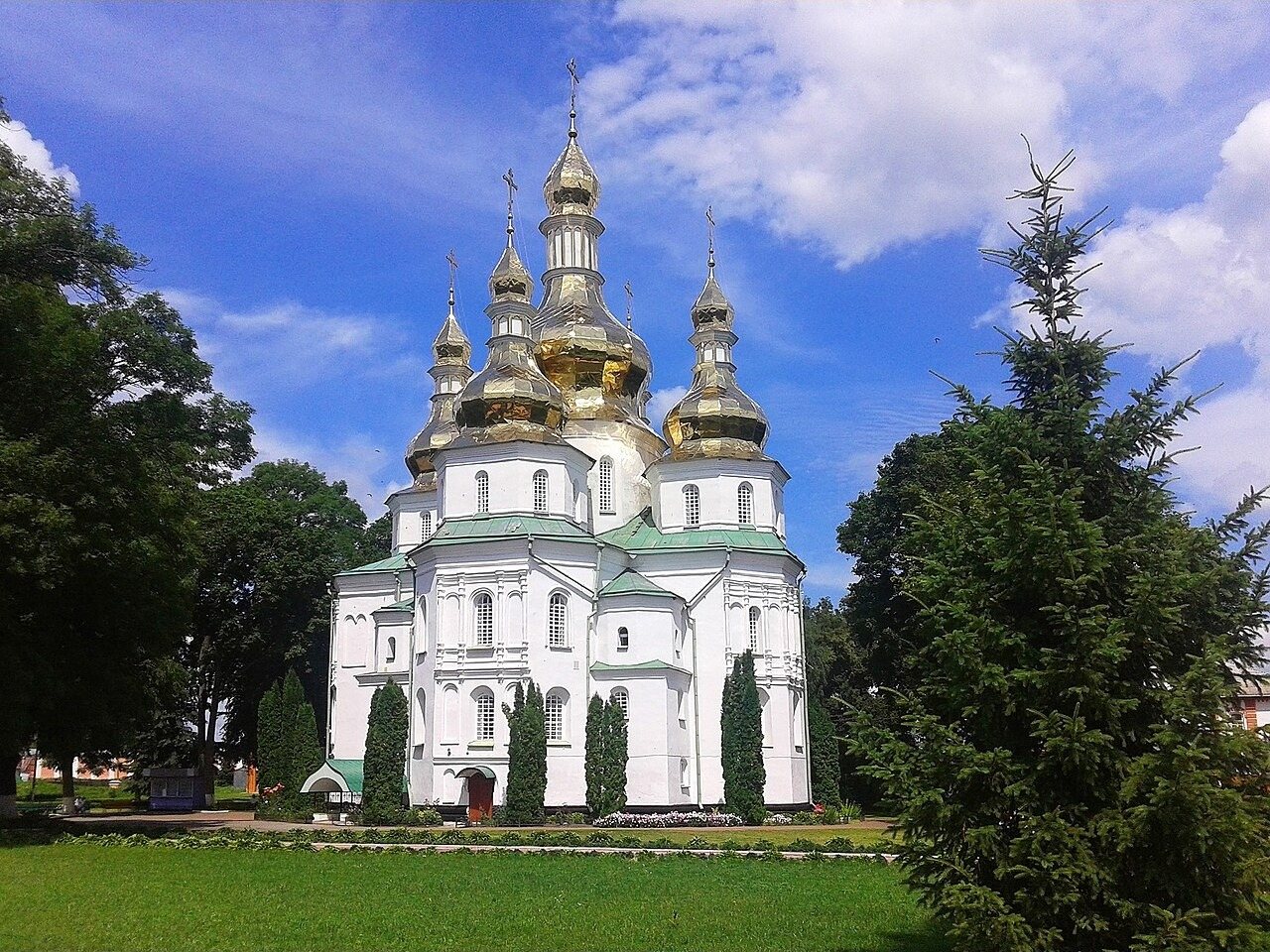
The Great Ukrainian Encyclopedia describes the cathedral as a cross-shaped, nine-part church. At the centre is a square under the main dome; four arms extend from it, and the corners between the arms are filled with two-storey rooms, rectangular in plan below and pentagonal above. Above the centre and four faceted side towers rise two-tiered pear-shaped domes on faceted drums with windows.
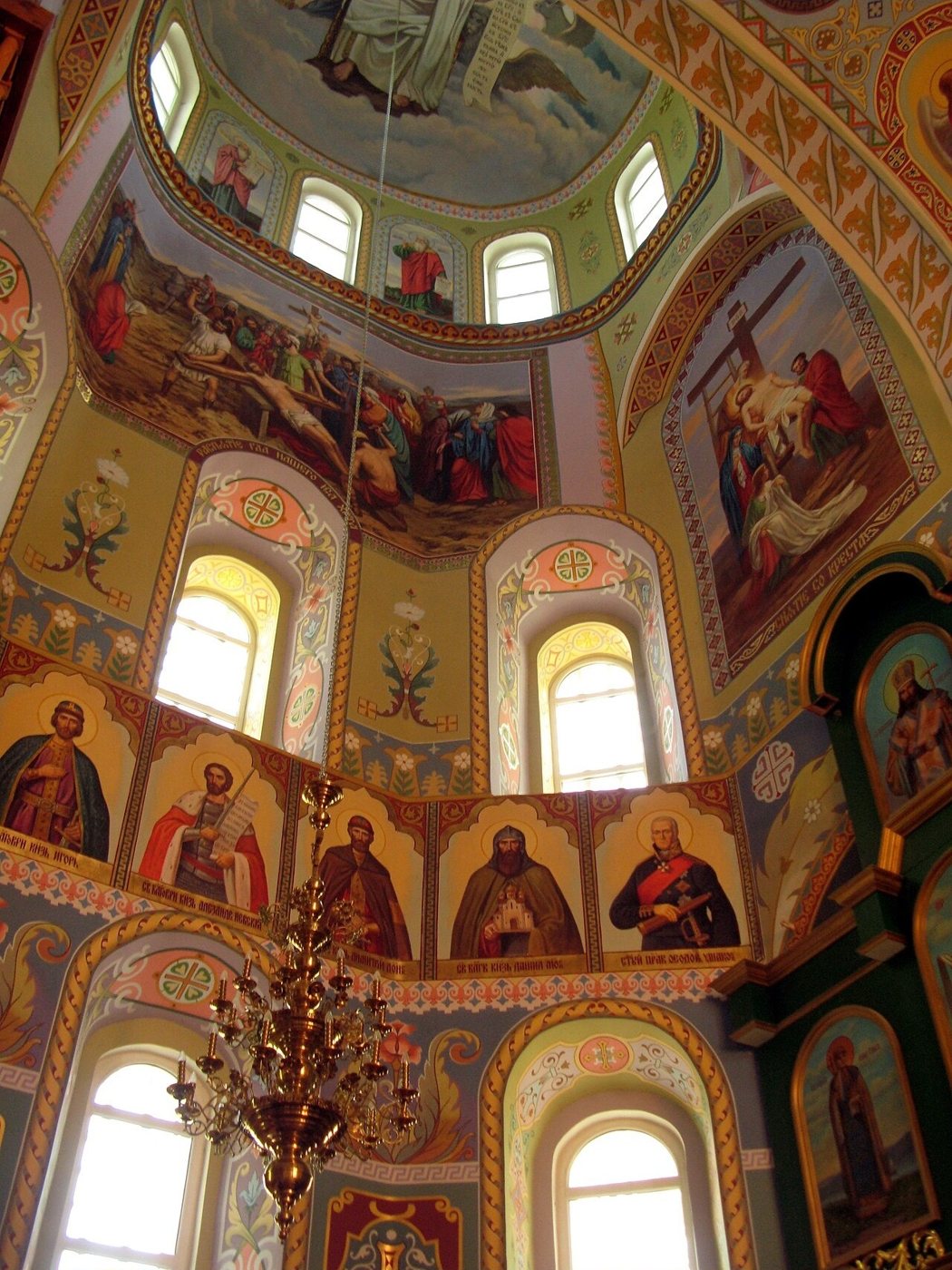
The facades are divided into tiers. Windows and niches in moulded surrounds run in rows; the tiers are marked by profiled string courses, which rest on colonnettes with bud-shaped capitals. The western facade with its portal is the most richly decorated. The interior is centralised: a tall space opens up beneath the five domes, and in the narthex (babinets) there are two-tier galleries, open to the church through large arches with balustrades.
The cathedral is the central building and the dominant feature of the ensemble, square in plan and surrounded by a rampart, a wall and a moat. Around it stand two gate churches, the abbot’s building with the Church of St Barbara, and the refectory with the Church of the Resurrection. Some churches of the ensemble were built after the cathedral: the Dormition Church in 1695 at Mazepa’s expense, the churches of St Nicholas and of Sts Peter and Paul in 1693–1708 at the expense of Dmytro Horlenko.
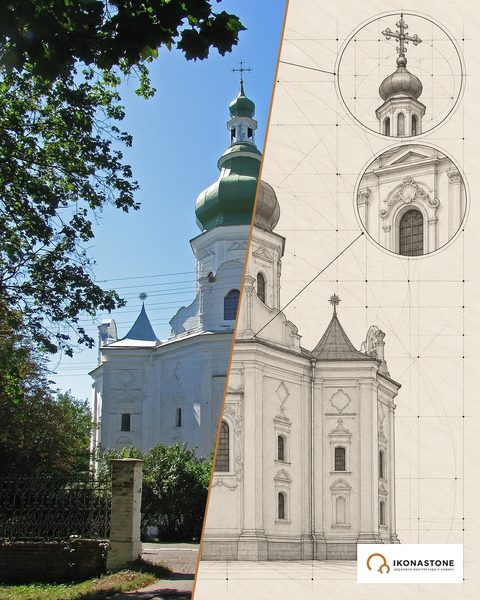
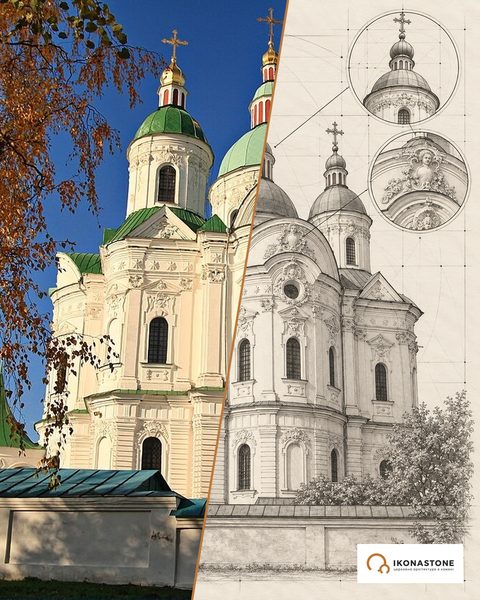
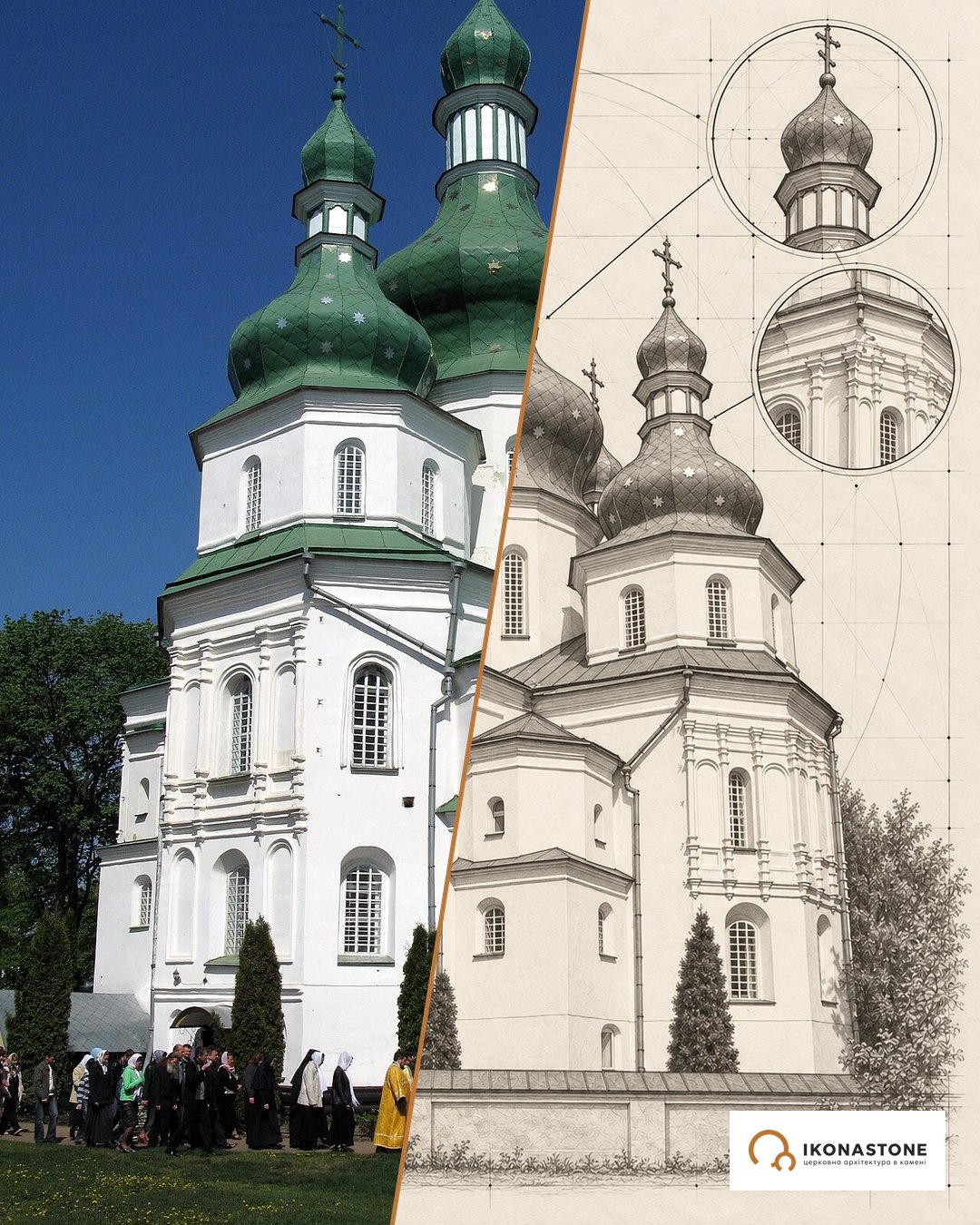
Below are two elements of the church: in a photo and in a drawing. The drawings show the form, not exact dimensions.
Five domes
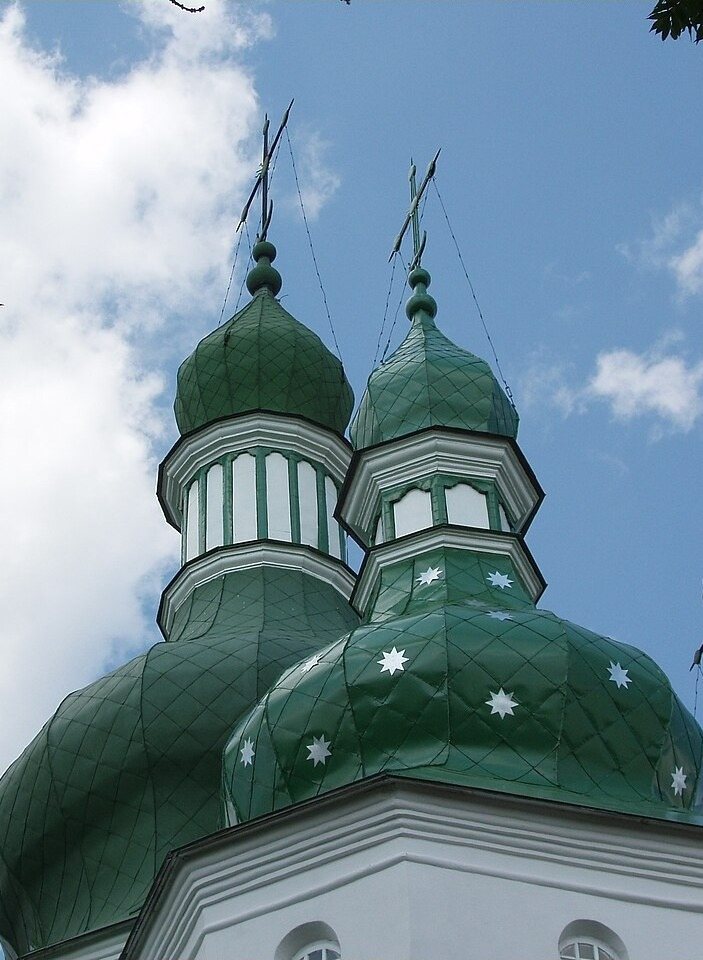
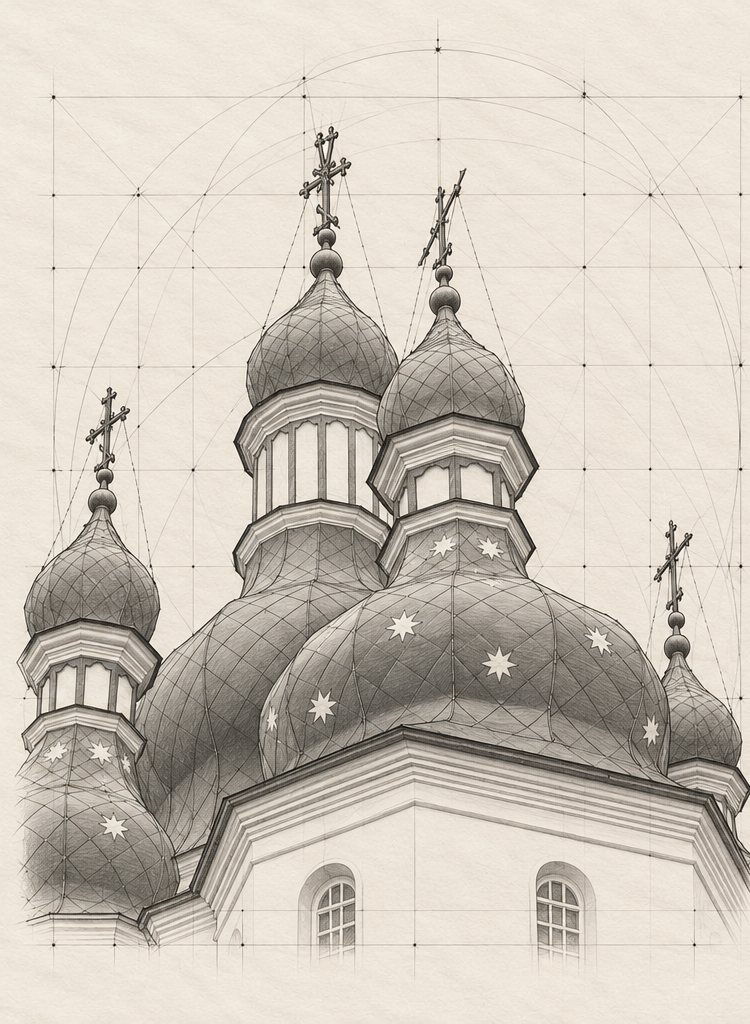
The central dome and the four side ones have a two-tiered pear shape and stand on faceted drums with windows. The side tops are placed not over the arms but on towers in the corners, so the silhouette is dense and gathered towards the centre.
The western facade with the portal
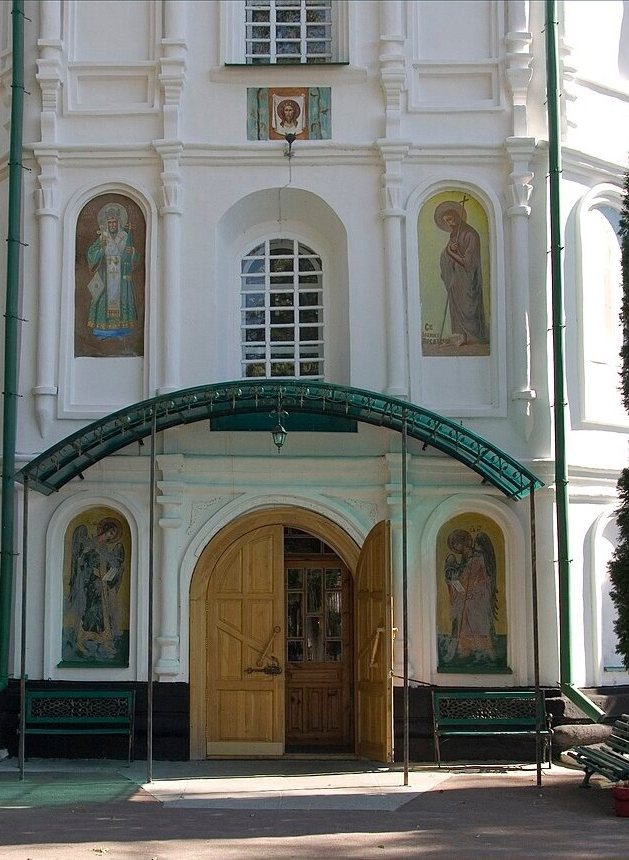
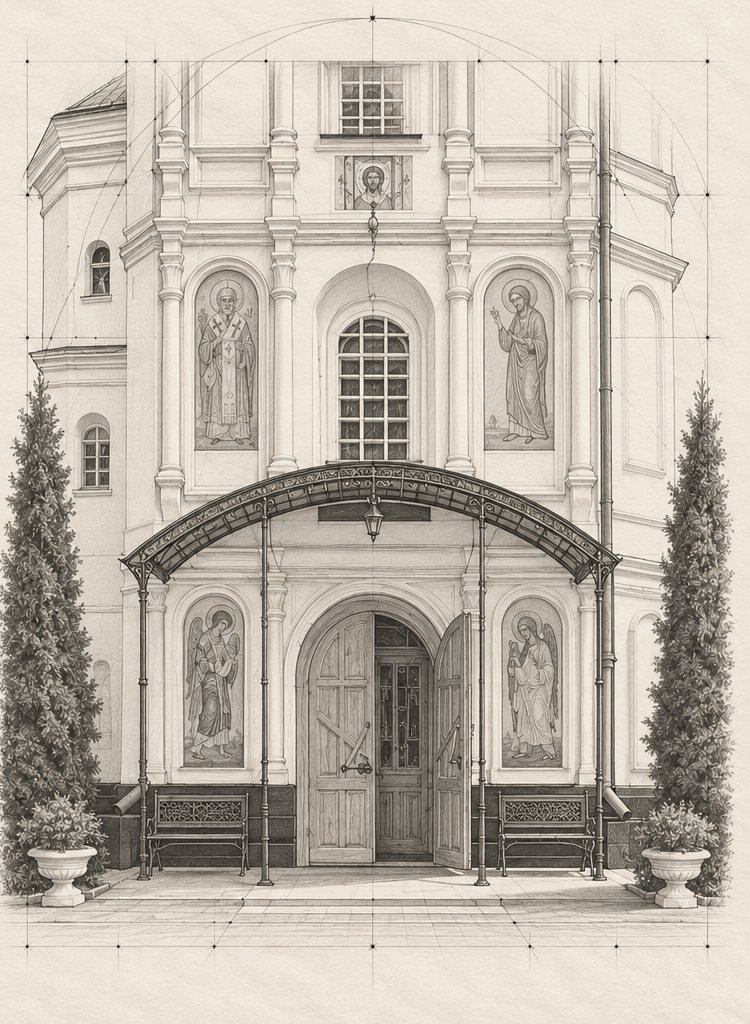
The western facade is the ceremonial one. Here are the richest window surrounds, tiered niches and the portal. Colonnettes with bud-shaped capitals carry the string courses, and the facade reads like a many-storeyed shelf, each level with its own rhythm.
Details that are easy to miss
A cathedral on the relics of three martyrs — a legend. A monastery legend cited by local historians tells of three children killed near the monastery: their bodies were found incorrupt in the snow and buried at the monastery. Later an infant appeared to the abbot in a dream, the graves were opened and the remains reburied. According to this legend, the altar of the Holy Trinity church stands above their graves.
A portrait of the hetman at the entrance. According to the monastery, Prince Vyshnevetskyi and Hetman Samoilovych are depicted facing each other at the entrance to the cathedral as benefactors of the monastery. Telegraf captions a photo of this portrait as “rediscovered among the paintings”; in 1926 it was photographed by the art historian Stefan Taranushenko. The sources do not specify whether this is the old painting or a re-creation.
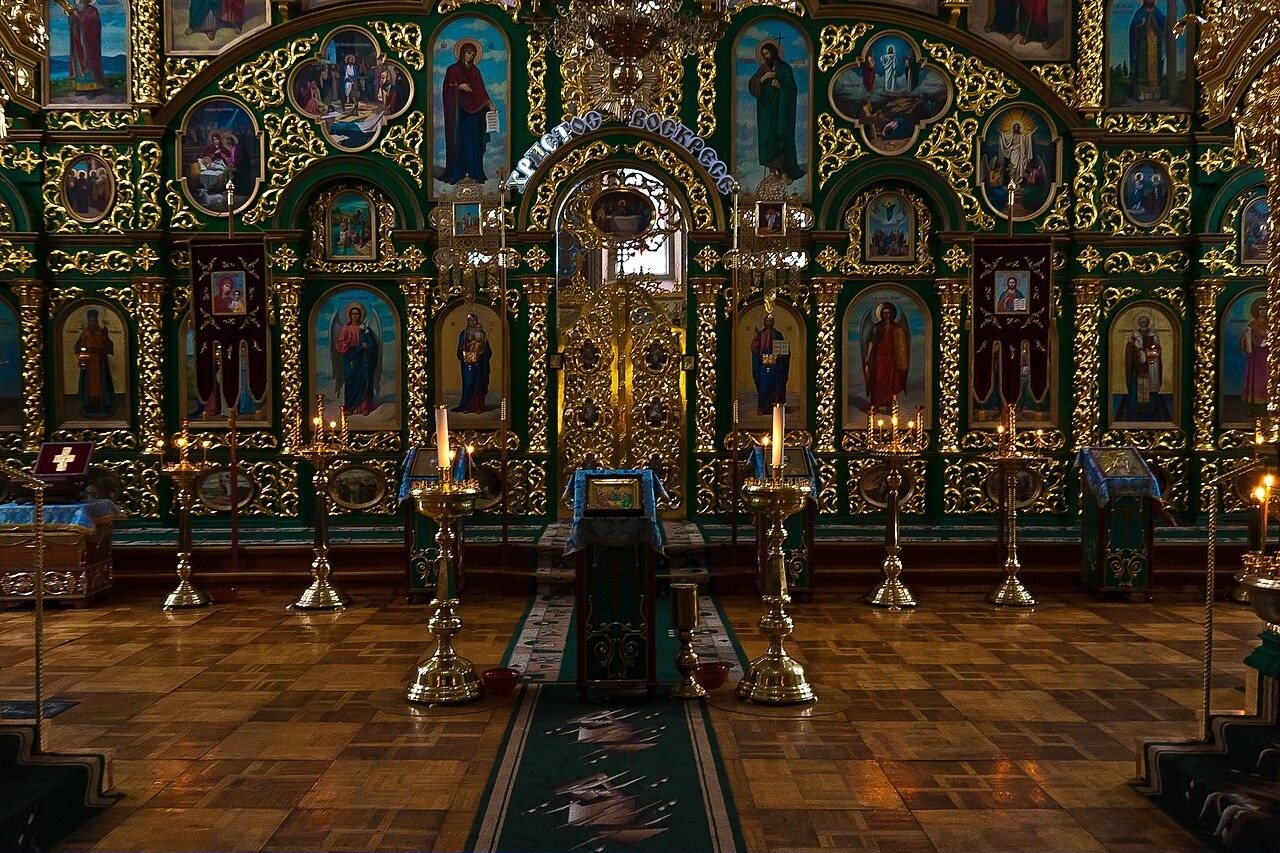
An iconostasis admired by a guest from Syria. In 1654 Paul of Aleppo described the iconostasis of the Holy Trinity Church with admiration. That iconostasis probably perished together with the wooden church in the fire of 1671. According to local historians, the old iconostasis of the monastery was chopped up for firewood in the 1920s, when a children’s colony was housed here, but the publication does not make clear whether this refers to the cathedral.
A crypt beneath the floor. The Pryluky colonel Lazar Horlenko was killed in 1687 during the Crimean campaign; according to Suspilne, ten years later his son Dmytro brought his remains home. Dmytro Horlenko himself was buried in 1731 in the family vault of the Hustynia Monastery. Local historians write of a family vault of the Horlenkos and Markovyches under the cathedral.
Shevchenko painted a ruin. On 28 June 1845 Shevchenko came to Hustynia when the monastery had only just been reopened after half a century of neglect. According to Suspilne, in his drawings he recorded the decline of the monastery after its closure.
Saved by scholarship. According to Suspilne, the monument was largely saved from destruction by the archaeologist and art historian Mykola Makarenko, who studied the monastery buildings in 1927.
Photo gallery
Stone and material
The cathedral is built of brick and plastered. Brick in Hustynia is not a stylistic choice but a lesson from experience: wooden churches here burned three times in half a century, and only after the fire of 1671 did the monastery switch to masonry. The plasticity of the facades comes not from expensive materials but from profiles: string courses, window surrounds, colonnettes with capitals, all worked in brick and plaster.
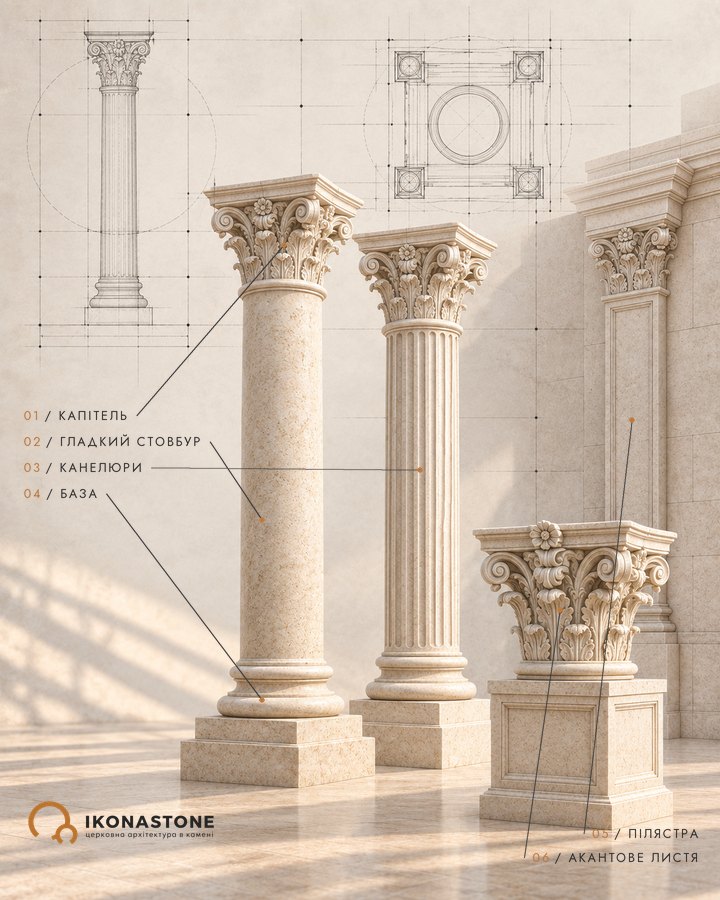
The colonnettes with bud-shaped capitals are not supports here but rhythm. They stand against the wall and carry only the horizontal of the string course, yet without them the facade would fall apart into separate windows. Solutions like this — where a detail works as a way of marking out space — are worth planning at the stage of columns and capitals.
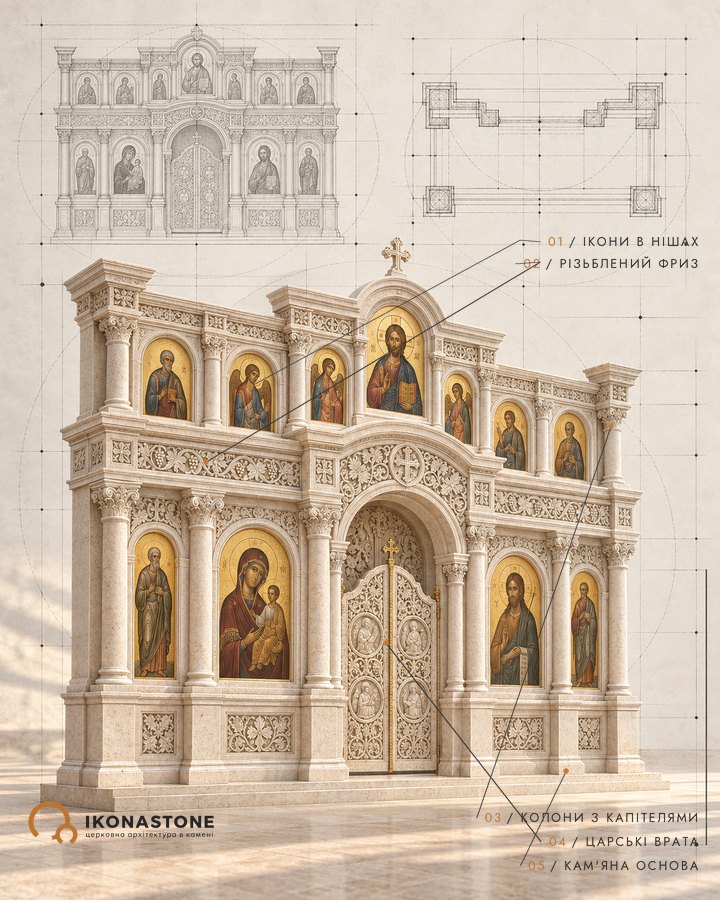
How sanctuary screens have changed since the time when Paul of Aleppo admired the Hustynia iconostasis is told in the article the Ukrainian iconostasis. Neighbours in period and region are the Nativity Cathedral in Kozelets and the Transfiguration Cathedral in Novhorod-Siverskyi.
Did you know
The cathedral was consecrated on 23 May 1675, the feast of the Descent of the Holy Spirit, and on the same day Lazar Baranovych ordained Dymytrii Tuptalo, the future Saint Dimitry of Rostov, as a hieromonk. [12, 18]
Construction of the cathedral continued until 1676 (according to other data, it began only in 1674), yet it was consecrated as early as 1675. [1, 3, 12]
In the mid-18th century Hustynia owned more than 3,000 desiatynas and more than 3,000 serf souls; only the Kyiv Pechersk Lavra was richer. [3, 11]
In the novella “The Musician” Shevchenko compared Hustynia to “Saint Clair Abbey”, according to the Ukrainian Wikipedia. [4]
O. Novytskyi dated Shevchenko’s watercolour with the Church of Sts Peter and Paul to 1843; N. Prokopenko proved it was 1845, in particular through a letter from V. Repnina of 10 January 1845. [13]
Besides the watercolours, Shevchenko drew in pencil the Hustynia chalice dated 1669. [14]
The Hustynia icon of the Mother of God was carried out of the cathedral and placed in a chapel in the middle of the fair; hence its second name, the “Fair” icon. According to the monastery, the feast of the icon is on 10 August, and the fair to which it is carried is on 28 August, New Style. [3, 10, 12]
Colonel Dmytro Horlenko, builder of the gate churches, was the grandfather of Saint Yoasaf of Bilhorod. [5, 8]
According to the monastery, Prince Vyshnevetskyi and Hetman Samoilovych are depicted facing each other at the entrance to the cathedral as benefactors, and in the gallery there is a portrait of one of the Horlenkos. [12]
The Psalter is read in the cathedral around the clock in commemoration of the monastery’s benefactors, according to the monastery. [12]
The monastery, founded for men, became a convent twice: in 1943 and in 1993. [1, 3, 5, 9]
Repnin’s daughter Varvara wrote to Shevchenko that her mother wished to renovate one of the Hustynia churches over the prince’s remains. [13]
The psychoneurological care home for women, according to the Ukrainian Wikipedia, closed only in the spring of 1993, and already on 17 December of that year the first Liturgy was served in the monastery. [3]
Legends
Three infants
According to legend, enemies killed three infants near the monastery; for three days and three nights the bodies lay in the snow, and neither beast nor frost touched them. In a dream the children told the abbot that they were praying for the monastery; the remains were reburied under the altar of the Holy Trinity church. Recorded in the monastery booklet (during the construction of the cathedral), in Dzerkalo Tyzhnia (about 1675) and in the Ukrainian Wikipedia (citing the Hustynia chronicle, 1640). [3, 9, 12]
Paradise on earth
According to legend, Yoasaf saw the site of the future monastery in a dream as a paradisal valley with an island and a river. Recorded in Dzerkalo Tyzhnia. [9]
On foot from Athos
According to legend, Yoasaf came to the Udai on foot from Mount Athos, covering about 2,000 km. Recorded in Telegraf. [11]
The dense forest
According to legend, the name Hustynia comes from the dense (oak) forest on the island. Recorded in Suspilne, Telegraf and the Ukrainian Wikipedia. [3, 4, 6, 10]
Cossacks who did not die
According to legend, old Cossacks came to Hustynia to become monks, expecting death soon, but lived on for a long time, telling of the healing air and the “living water” from underground springs. Recorded in Dzerkalo Tyzhnia and the Ukrainian Wikipedia. [3, 9]
A resort for Cossacks
According to legend, Cossacks took cures at the monastery springs, and the monks looked after them. Recorded in Telegraf. [11]
Templar crosses
According to legend, Templar crosses are carved on the tombstone of Prince Mykola Repnin. Recorded in Telegraf; the iconography of the tombstone has not been verified. [11]
Figures
- Yoasaf — founder and first abbot (about 1600; abbot from 1614).
- Isaia Kopynskyi — de facto head of the monastery in 1615–1630s, later Metropolitan of Kyiv.
- Mykhailo Vyshnevetskyi — landowner who permitted the monastery to be founded.
- Petro Mohyla — metropolitan who initiated the rebuilding in 1639.
- Paul of Aleppo — Syrian archdeacon, author of the 1654 description of Hustynia.
- Mykhailo Losytskyi — hieromonk, copyist of the Hustynia Chronicle (1670).
- Ivan Samoilovych — hetman, ktitor (benefactor) of the masonry Holy Trinity Cathedral.
- Lazar Baranovych — Archbishop of Chernihiv, consecrated the cathedral on 23.05.1675.
- Dymytrii (Tuptalo) — ordained a hieromonk in 1675; later Metropolitan of Rostov.
- Lazar and Dmytro Horlenko — Pryluky colonels; Dmytro built the walls and gate churches and was buried in 1731 in the monastery’s family vault.
- Ivan Mazepa — hetman, founder of the Dormition Church (1695).
- Archimandrite Varsonofii — superior after 1844; rebuilt the churches but, according to O. Konyskyi, destroyed the old portraits and icon covers.
- Mykola Repnin — Governor-General of Little Russia, buried in Hustynia in 1845; his widow renovated the burial church.
- Taras Shevchenko — author of three drawings of Hustynia (1845) and a drawing of the chalice (1846).
- Stefan Taranushenko — art historian who photographed the ensemble in 1926.
- Mykola Makarenko — art historian, researcher of the ensemble (1927), who defended it from destruction.
- Abbess Vira (Taran) — superior from 1993, led the restoration of the cathedral.
How to cite
IKONASTONE. The Holy Trinity Cathedral of the Hustynia Monastery // Guide to the Churches of Ukraine. URL: https://ikonastone.com/en/guide/holy-trinity-cathedral-hustynia/ (accessed DD.MM.YYYY).
FAQ
When and by whom was the Holy Trinity Cathedral in Hustynia built?
The masonry cathedral was built in 1672–1676 at the expense of Hetman Ivan Samoilovych, on the site of a wooden church that burned down in 1671. According to the monastery, the church was founded in 1674 and consecrated in 1675 by Lazar Baranovych, Archbishop of Chernihiv.
What is the plan of the cathedral?
According to the Great Ukrainian Encyclopedia, the plan is cross-shaped and nine-part: a central space, four arms and four two-storey rooms between the arms. Above the centre and four faceted side towers rise two-tiered pear-shaped domes.
What happened to the monastery under Soviet rule?
In 1924 the monastery was closed and a children’s commune was set up here. Later, right up to 1991, a psychoneurological clinic occupied the buildings. In 1943–1959 a convent operated on part of the grounds. The monastery was revived in 1993, and the Holy Trinity Cathedral was restored in 1995–1997.
Did Taras Shevchenko visit Hustynia?
Yes. On 28 June 1845 Shevchenko visited the monastery and made several watercolours (three, according to local historians). In his drawings he recorded the decline of the monastery after its closure.
Who is buried under the cathedral?
According to the monastery, the family burial vault of the Horlenkos, colonels of Pryluky, lies under the cathedral; Dmytro Horlenko was buried there in 1731.
Sources
- Енциклопедія сучасної України. Г. М. Горіла. Густинський Свято-Троїцький жіночий монастир
- Encyclopedia of Ukraine (CIUS). Hustynia Trinity Monastery
- Вікіпедія (uk). Густинський монастир
- Вікіпедія (uk). Густиня
- Wikipedia (en). Hustynia Monastery
- Суспільне. Розквіт, занепад та відродження Густинського монастиря (15.05.2022)
- Суспільне. Як Шевченко зобразив Чернігівщину
- Суспільне. Козацький рід Горленків з Прилук
- Дзеркало тижня. Б. Костюк. Тропинка в рай (11.04.2003)
- Телеграф. Тут можна побачити єдину в Україні Ярмаркову ікону… (17.10.2025)
- Телеграф. Тут був курорт для козаків… (06.03.2025)
- Густинський Свято-Троїцький монастир. Буклет (2015)
- Тарас Шевченко (t-shevchenko.name). In Gustynja. Peter and Paul Church (Album 1845, fol. 2 r.)
- Тарас Шевченко (t-shevchenko.name). Chalice of Gustynja monastery (1846)
- Encyclopedia of Ukraine. Repnin, Nikolai
- Encyclopedia of Ukraine. Hustynia Chronicle
- Wikipedia (en). Hustyn Chronicle
- Orthodox Church in America. Saint Demetrius (Dimitri), Metropolitan of Rostov
- Encyclopedia of Ukraine. Tuptalo, Dymytrii
- В. Половець. Горленко Дмитро Лазарович (1660–1731) // Сіверянський літопис. 2018. № 5 (анотація в репозитарії НАН України)
- Турправда. Густинський монастир
- Тонкости туризма. Густынский монастырь
- Репозитарій КНУБА. Стаття про монастирі Прилуччини (згадка про освячення 1675 р.)
- Соборы.ру. С. А. Таранушенко. Густиня, трапезна Воскресенська церква (фото 01.06.1926)
- Wikimedia Commons. Category:Trinity Cathedral, Hustynia Monastery
- Town
- Hustynia village, Pryluky District, Chernihiv Oblast
- Built
- 1672–1676 (according to other data, founded in 1674, consecrated in 1675)
- Type
- cross-shaped, nine-part, five-domed masonry church
- Material
- brick, plaster
- Research depth
- 28%