St Michael's Cathedral of the Vydubychi Monastery: a church at the edge of a cliff
The walls of this church remember Prince Vsevolod, and its sanctuary argued with the Dnipro for a long time — and once the Dnipro won: the eastern part of the cathedral, together with the retaining wall, went into the river.
In brief
| Address | Kyiv, Vydubychi Monastery, Vydubychi area on the right bank of the Dnipro |
| Built | c. 1070–1088 |
| Rebuilding | eastern part — 1766–1769, architect M. Yurasov |
| Type | 11th-century masonry church with a Baroque eastern part and a single dome |
| Material | Old Rus’ masonry; Baroque walls of the 18th century |
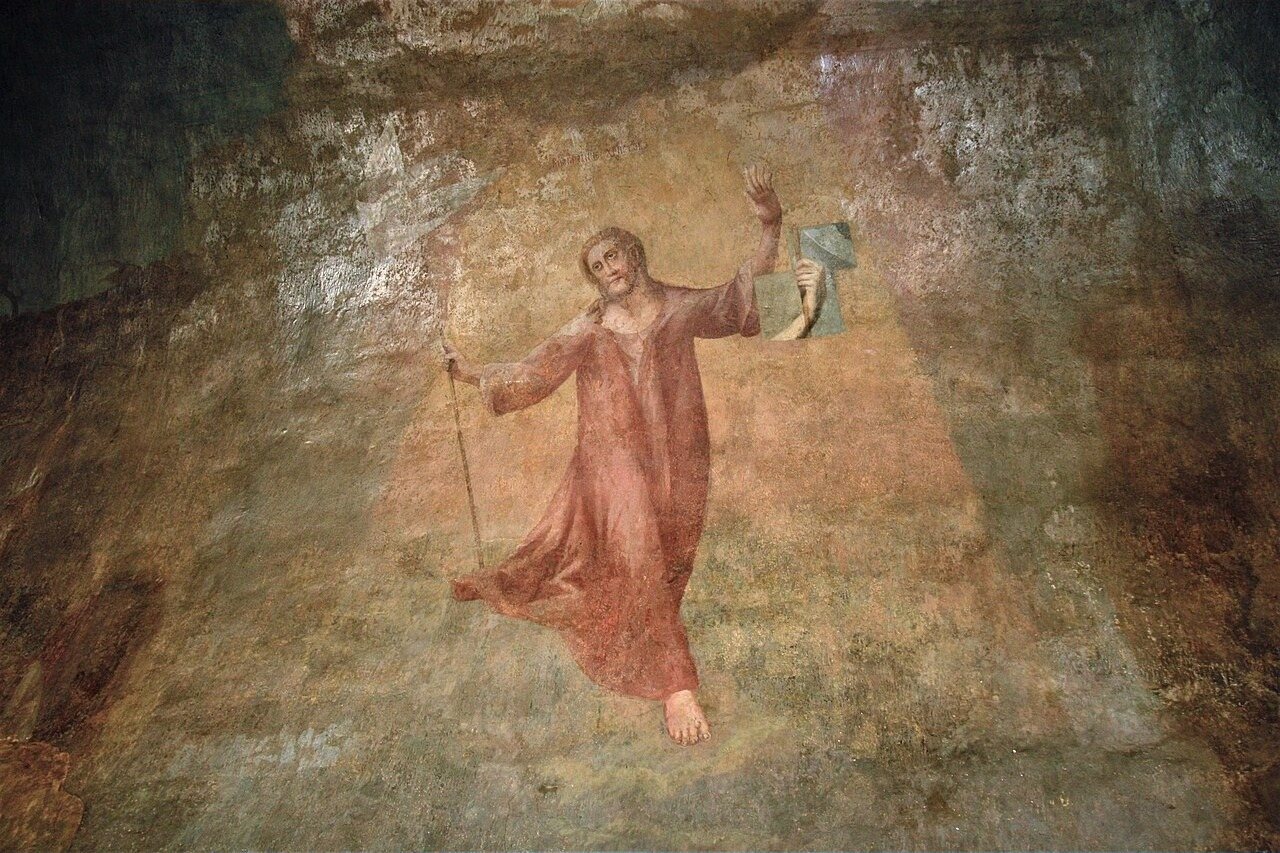
| Surviving | part of the old walls, 11th-century frescoes and graffiti |
History
The Vydubychi Monastery was founded by Prince Vsevolod Yaroslavych, son of Yaroslav the Wise; for a long time the community was simply called Vsevolod’s monastery. According to a legend cited by Discover.ua, the prince founded it in fulfilment of a vow after recovering from wounds received while hunting. The chronicle mentions the founding of the Church of St Michael in the monastery in 1070.
The area itself has an older legend. When Prince Volodymyr baptised Kyiv and ordered the wooden idols to be thrown into the Dnipro, the current, so the story goes, carried Perun ashore below the city. According to the legend first recorded by Feodosii Sofonovych in the 1660s–1670s, the idol “swam up” (vydybav) to the bank right here. The place where Perun “swam up” was called Vydybychi, and later Vydubychi. Another legend, cited by the Encyclopedia of Modern Ukraine (ESU), holds that the monastery arose on the site of an older Zvirynets cave monastery.
Radio Svoboda writes that the masonry church was built over almost twenty years in two stages: first a smaller church, while Vsevolod was still Prince of Pereiaslav, and after 1077, when he took the Kyivan throne, a narthex. The Encyclopedia of Ukraine writes that the church was completed in 1088; Radio Svoboda, citing the chronicle, dates the consecration to 1089. In 1096 the cathedral was burned by the Cumans.
According to Radio Svoboda, the Kyivan princes prayed in the church before campaigns. In its story about the cathedral the same outlet also mentions a princely helmet of the Old Rus’ period bearing an image of the Archangel Michael and a prayer addressed to him — the heavenly commander to whom the cathedral is dedicated.
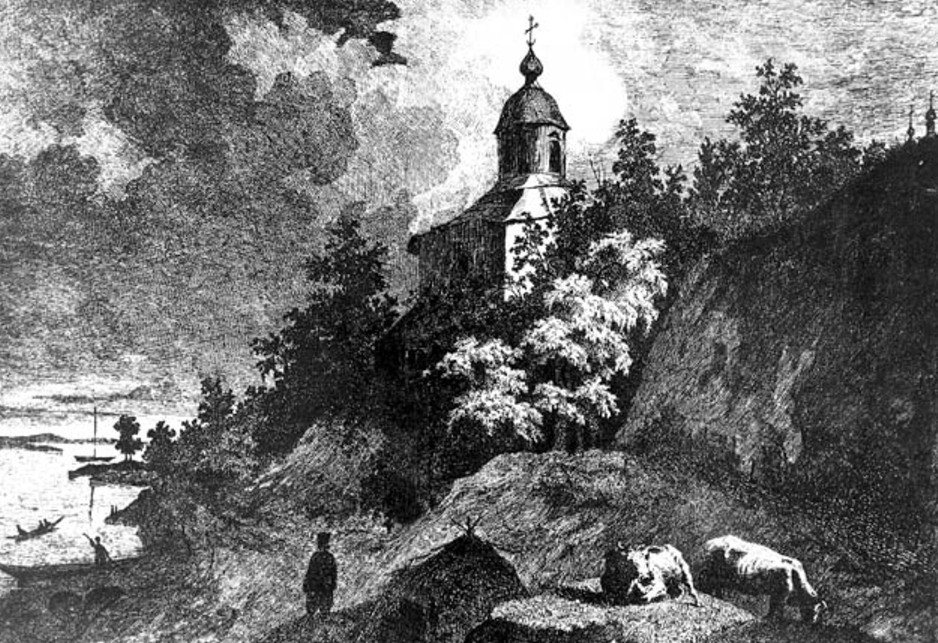
The church’s main enemy turned out to be not people but the river. The cathedral stood on a terrace above an old channel of the Dnipro; the water undercut the bank, and the church found itself at the edge of a cliff. In 1199–1200 Petro Myloneh, court architect of Prince Riuryk Rostyslavych, built a large retaining wall. The chronicler devoted a separate eulogy to this event — rare medieval attention to an engineering structure.
The wall stood for more than three centuries and then collapsed into the Dnipro together with the eastern part of the church. The Encyclopedia of Ukraine dates this to the 1580s, after a flood; the Free Ukrainian Encyclopedia (VUE) to 1593–1610. The latest limit is known from a document: on 14 March 1610 the Uniate archimandrite Antonii Hrekovych wrote that “the Vydubychi church too has fallen”. In 1632–1647 the monastery was restored under Metropolitan Petro Mohyla; according to the Encyclopedia of Ukraine, the lost eastern part was then rebuilt as a two-storey wooden structure; according to VUE, a wooden sanctuary had been added earlier, in 1610–1612, still under the Uniates. Radio Svoboda mentions that on the objects he donated to the monastery Mohyla left inscriptions cursing anyone who stole them.
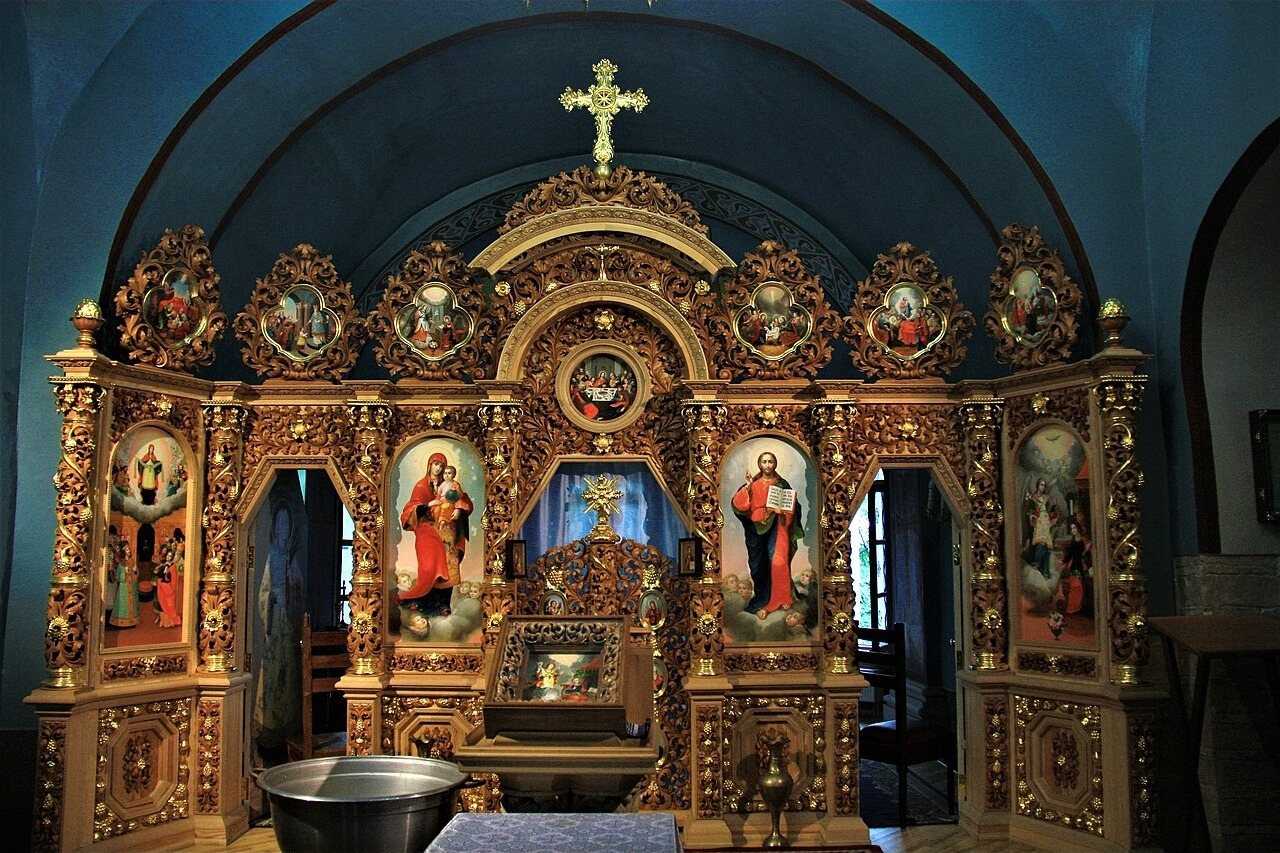
In 1760 the church was badly damaged by fire. According to Radio Svoboda, the main help in rebuilding came from the Zaporozhian Cossacks, among whom the monks collected donations at the Sich. In 1766–1769, under the direction of M. Yurasov (according to VUE, on the proposals of P. Nedilko; VUE gives 1766–1779 and completion of the rebuilding by 1781), the eastern part was rebuilt in masonry, and the church acquired a Baroque appearance with a single dome. Inside, it was divided into two floors with two chapels — the Miracle of the Archangel Michael and the Annunciation. The monastery library, according to a study in the Proceedings of the Kyiv Theological Academy, was kept in the church’s gallery.
The 20th century began with explosions. On 6 June 1918 ammunition detonated at the nearby Zvirynets powder depots; the blast wave damaged all the monastery buildings. Sources give different dates for the closure: Radio Svoboda names 1921, the monastery’s website 1924, ESU the late 1920s, VUE 1929; the study in the Proceedings of the Kyiv Theological Academy shows that in 1928 there were 31 people living in the monastery and that the churches remained in use until 1936. Later the Institute of Archaeology was housed here. According to RISU, this is what helped the ensemble survive the persecutions. In the 1960s–1980s (ESU — 1962–1982, VUE — 1969–1982) the buildings were restored under the direction of the architect R. Bykova. Monastic life resumed in 1992, and in 1996 (according to VUE, in 1997) the Cabinet of Ministers handed the monastery over to the Ukrainian Orthodox Church of the Kyiv Patriarchate. Hieromonk Mykhail told Radio Svoboda that at the first service the image of God the Father in the sanctuary was “renewed”, and then, with daily prayer, the paintings gradually grew lighter; this is the community’s account, and that is how it should be read.
The monastery cemetery is the resting place of the patrons Bohdan and Varvara Khanenko, the educator Kostiantyn Ushynsky and General Yakiv Handziuk. So people come to this 11th-century church also looking for the graves of figures from the 19th and 20th centuries.
Timeline
The figures in square brackets are the numbers of the sources in the list at the bottom of the page. The phrase “according to …” means that the fact is confirmed by only one source. The “Legends” section contains traditions and legends: they are recorded in the sources but not documented.
The princely monastery
- 1070
The chronicle under this year mentions the founding of the Church of St Michael in the monastery of Prince Vsevolod Yaroslavych, son of Yaroslav the Wise. For this reason the community was long called Vsevolod's monastery. [1, 4, 5, 11]
- 1070–1073
According to VUE, the first masonry church was built: three-aisled, single-domed, in the opus mixtum technique (courses of plinthos brick alternating with stone). Radio Svoboda also writes of two stages of construction, which lasted almost twenty years. [3, 4]
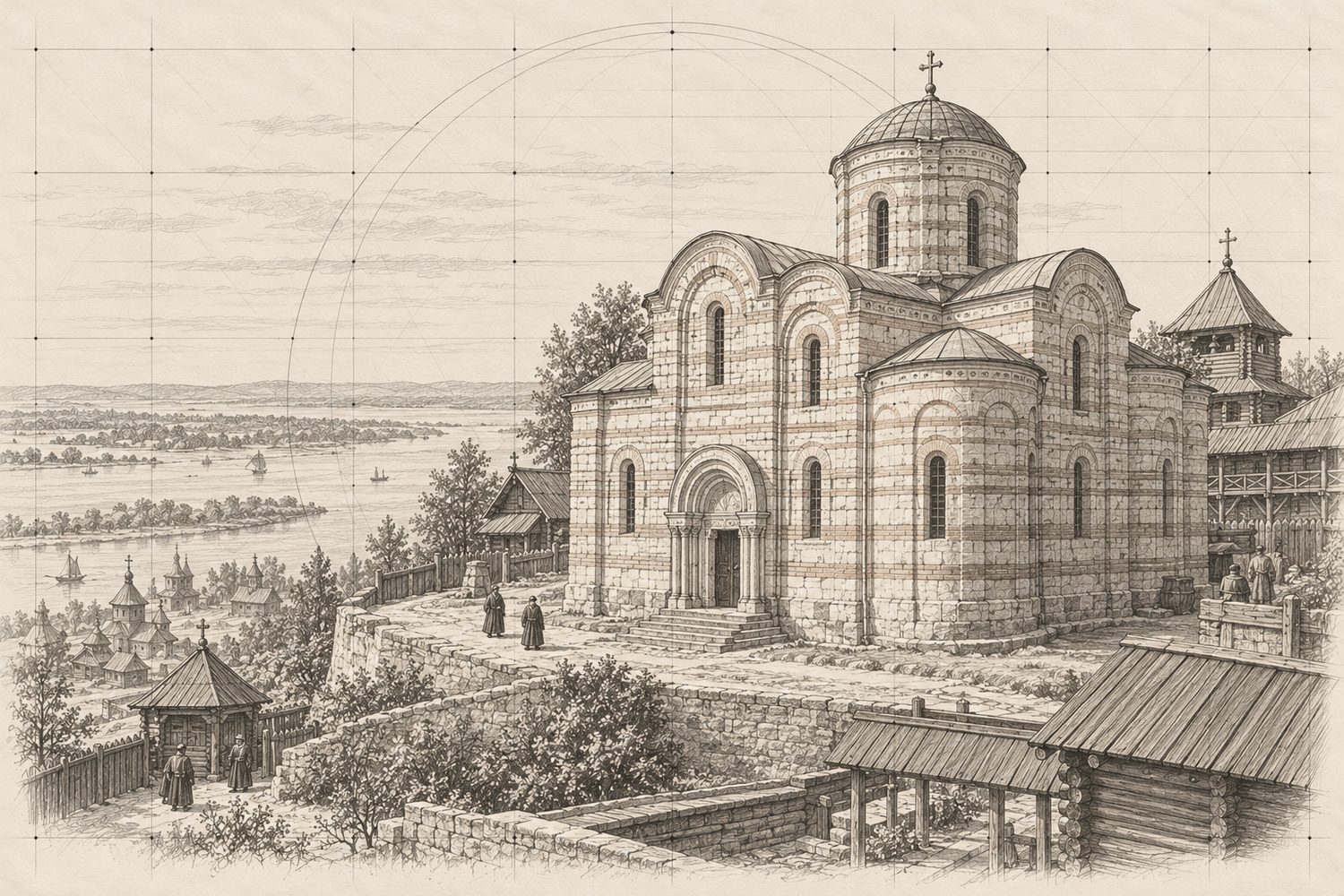
1070–1073: the first cathedral. Illustration: IKONASTONE - 1077–1088
After Vsevolod took the Kyivan throne in 1077, the church was enlarged: according to VUE, in 1080–1088 a narthex with a stair tower was added on the west. [3, 4]
- 1088
The church was consecrated; according to Ulianovsky, by Metropolitan John II. Radio Svoboda, citing the chronicle, gives 1089. [2, 3, 4, 5]
- 1094
According to the monastery's website, beside the Church of St Michael the princes Sviatopolk, Volodymyr Monomakh and Rostyslav made peace before a campaign against the Cumans. [12]
- 1096
The Cumans attacked Kyiv: according to ESU, they burned the cathedral; according to the Encyclopedia of Ukraine, they damaged the monastery. [1, 2]
- 1116
Sylvester, hegumen of the Vydubychi Monastery, completed one of the redactions of the Tale of Bygone Years. [1, 19]
- 1169
According to the monastery's website, during the march of Andrei Bogoliubsky's army on Kyiv about thirty monks who had hidden in the caves were buried alive there. [12]
- 1199
On 10 July, on the order of Prince Riuryk Rostyslavych, the court architect Petro Myloneh began building a stone retaining wall to the east of the cathedral so that the Dnipro would not undercut the slope. [1, 3, 9]
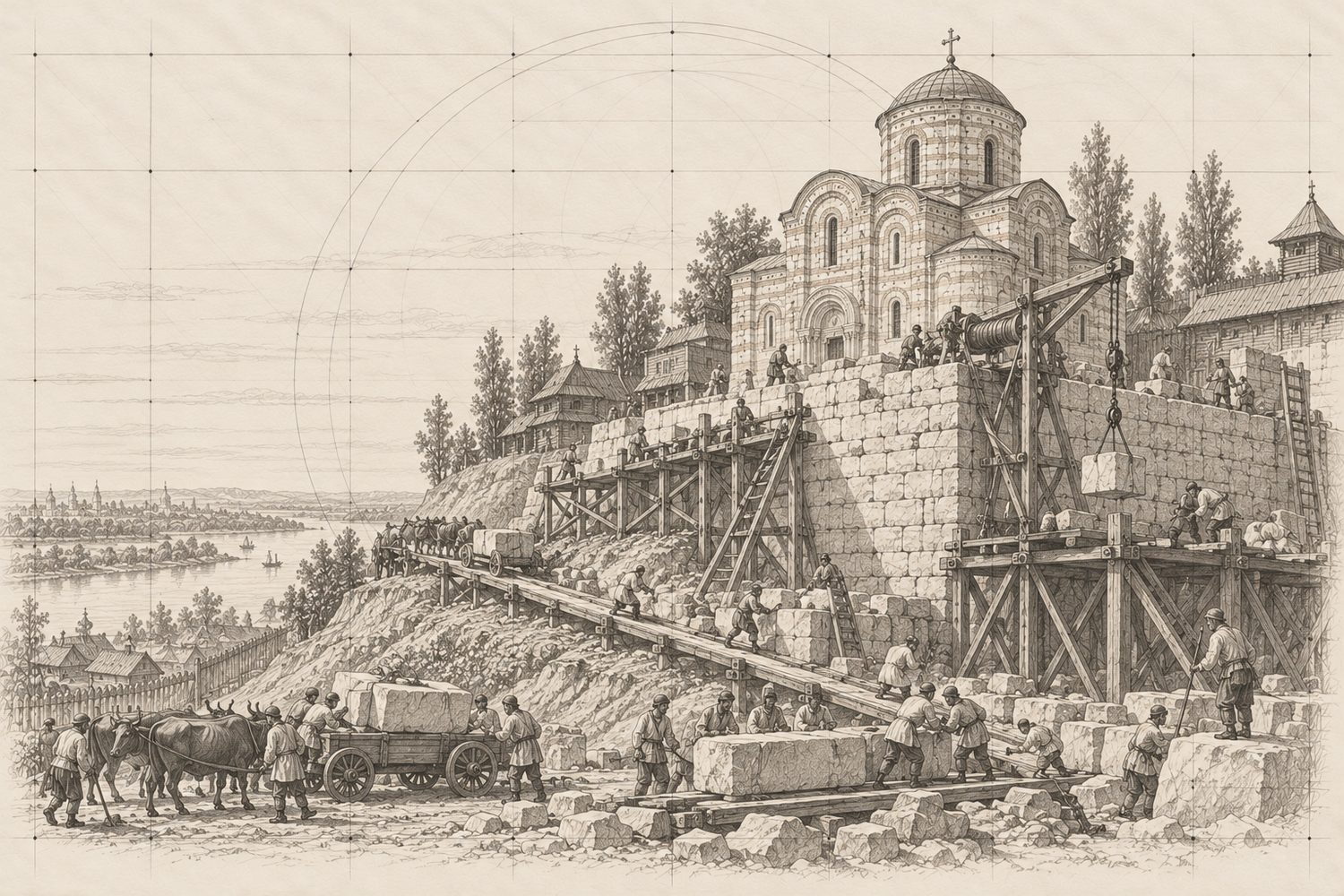
1199–1200: Petro Myloneh's wall. Illustration: IKONASTONE - 1200
On 24 September the wall was completed. The chronicler devoted a eulogy to the event and called the master a “craftsman” (khudozhnyk). [1, 9]
- 1240
The Mongol invasion laid waste to the monastery. The anonymous chronicler of the Vydubychi Monastery of the early 18th century gives 1234 and writes that the church stood desolate until 1470. [1, 2, 8]
- 1250
Prince Danylo of Halych visited the monastery together with his brother Vasylko. [5, 11]
- 1470
According to the anonymous chronicler, Prince Semen Olelkovych restored the church; he is buried in it. [8]
Collapse and return
- 1580s – 1610
Myloneh's retaining wall, which had stood for more than three centuries, collapsed into the Dnipro together with the eastern part of the cathedral. ESU writes “16th century”, the Encyclopedia of Ukraine the 1580s, after a flood, VUE 1593–1610. On 14 March 1610 Archimandrite Antonii Hrekovych already reported that “the church ... has fallen”. [1, 2, 3, 4, 7, 11]
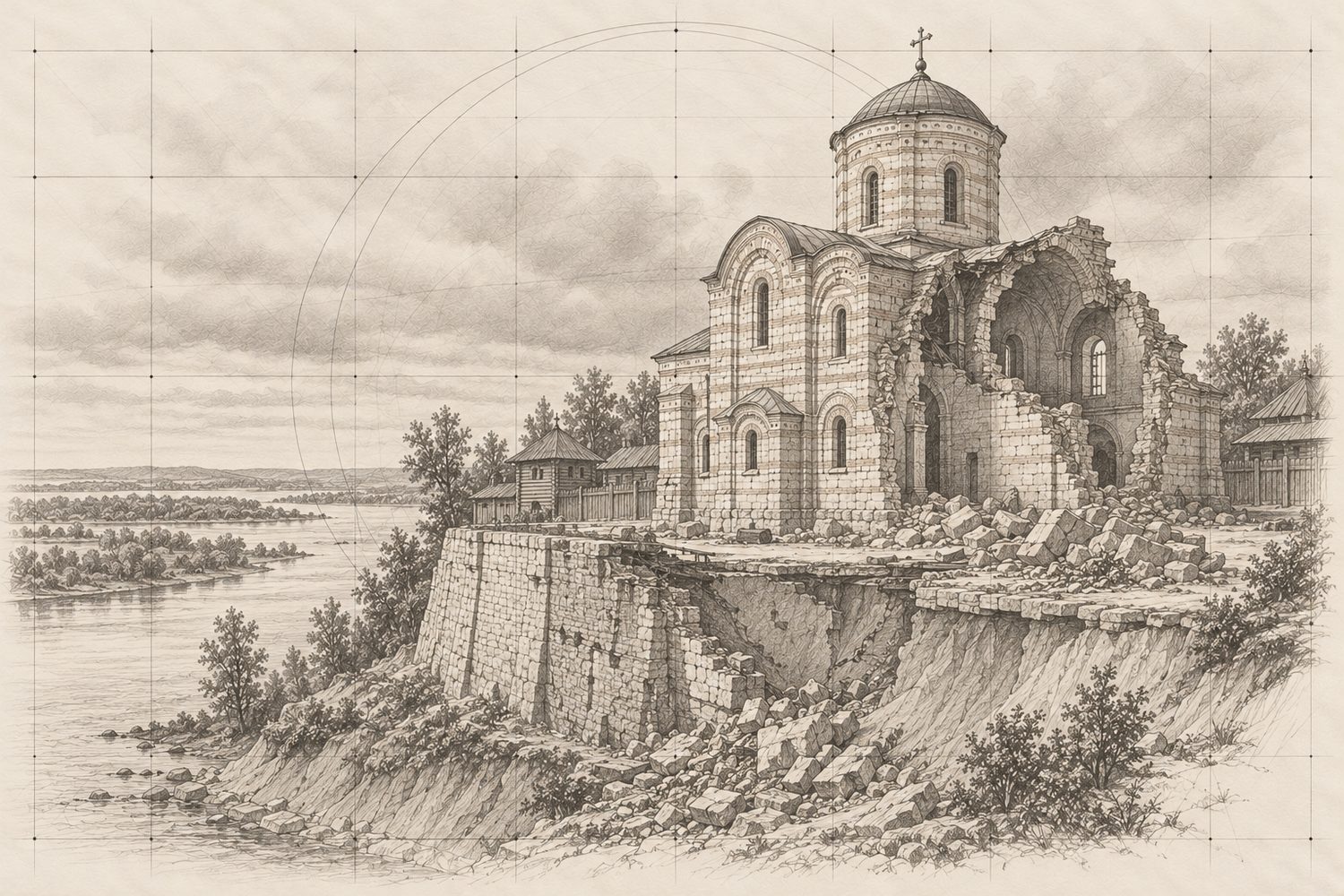
Late 16th century: the slope collapsed. Illustration: IKONASTONE - 1596
After the Union of Brest the monastery passed to the Uniates. [3, 7, 12]
- 1610–1612
A wooden sanctuary was added to the surviving western part so that services could resume. The Encyclopedia of Ukraine, by contrast, links the wooden two-storey addition with Metropolitan Petro Mohyla. [2, 3, 7]
- 1618
On 23–24 February Cossacks seized Archimandrite Antonii Hrekovych and drowned him in an ice hole on the Dnipro. [7, 8]
- 1635
The Uniates finally left the monastery; it returned to the Orthodox. Some sources give 1637, the year restoration work began under Petro Mohyla. [7, 8, 11, 12, 14]
The Cossack era and the Baroque
- 1637–1647
Metropolitan Petro Mohyla restored the monastery and began the rebuilding of Kyiv's holy places precisely with the Church of St Michael. In 1637 and 1642 he donated liturgical objects to the church, and in his will left 500 zlotys for its upkeep. [1, 4, 7]
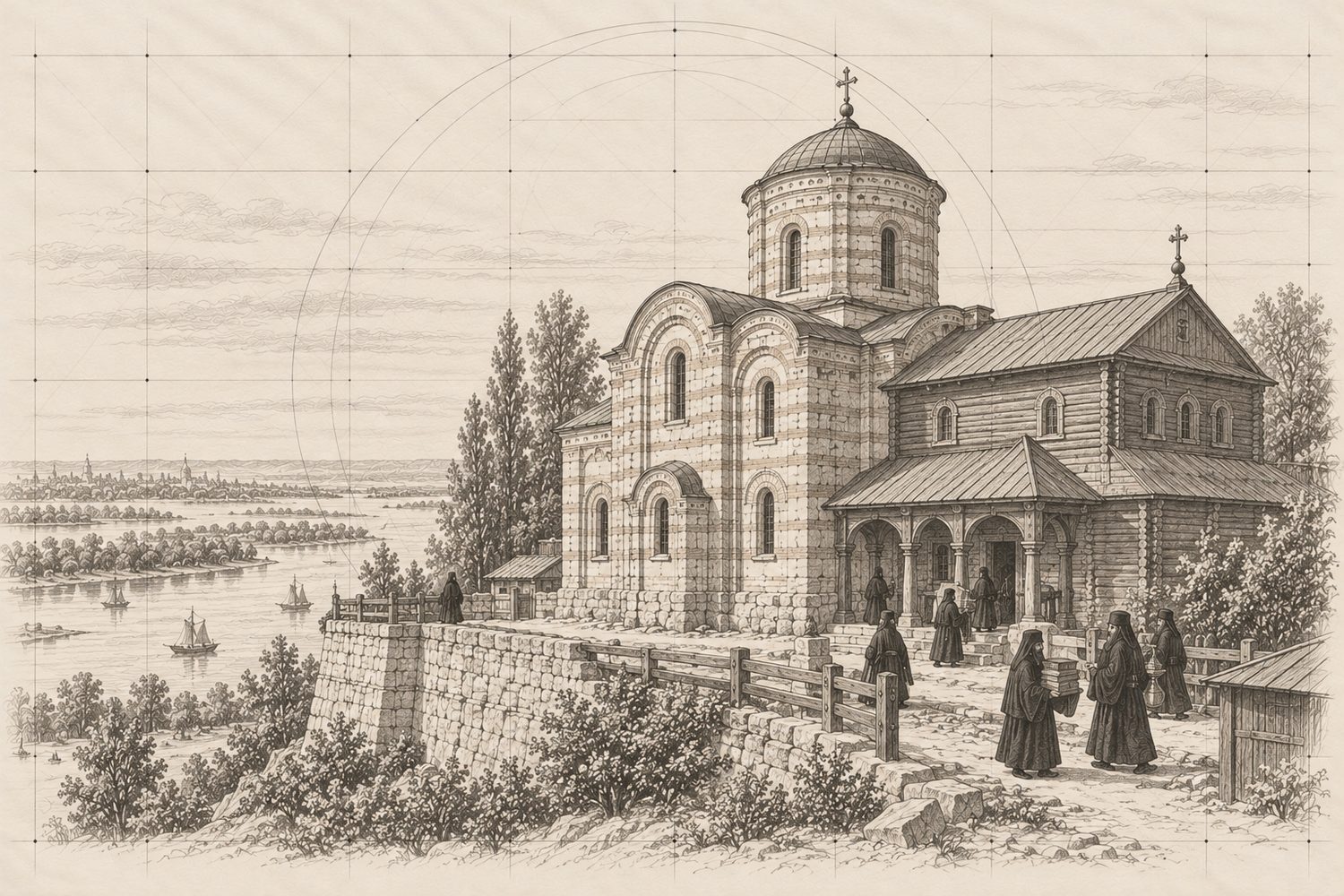
1630s–1640s: the wooden addition. Illustration: IKONASTONE - 1696–1701
At the expense of the Starodub colonel Mykhailo Myklashevsky, the five-domed St George's Cathedral and a refectory with the Church of the Saviour were built nearby. [1, 11, 14]
- 1727–1733
At the expense of Hetman Danylo Apostol a bell tower with the Church of the Prophet Daniel was built. The fourth tier was added later (the sources differ on the date: 1812 or 1827–1831). [11, 14]
- 1745
On 24 September Metropolitan Rafail Zaborovsky issued a travel letter to three monks so that they could collect donations for the Church of St Michael in the Hetmanate and at the Zaporozhian Sich. [4, 17]
- 1760
On 28 March a fire destroyed the wooden sanctuary addition and damaged the cathedral. The largest funds for the restoration came from the Zaporozhian Cossacks. [3, 4, 11]
- 1766–1769
Under the direction of M. Yurasov the eastern part was rebuilt in masonry; the church acquired Baroque forms and a single dome. VUE gives 1766–1779, mentions the proposals of P. Nedilko and writes that the rebuilding was completed by 1781. [1, 2, 3, 13]
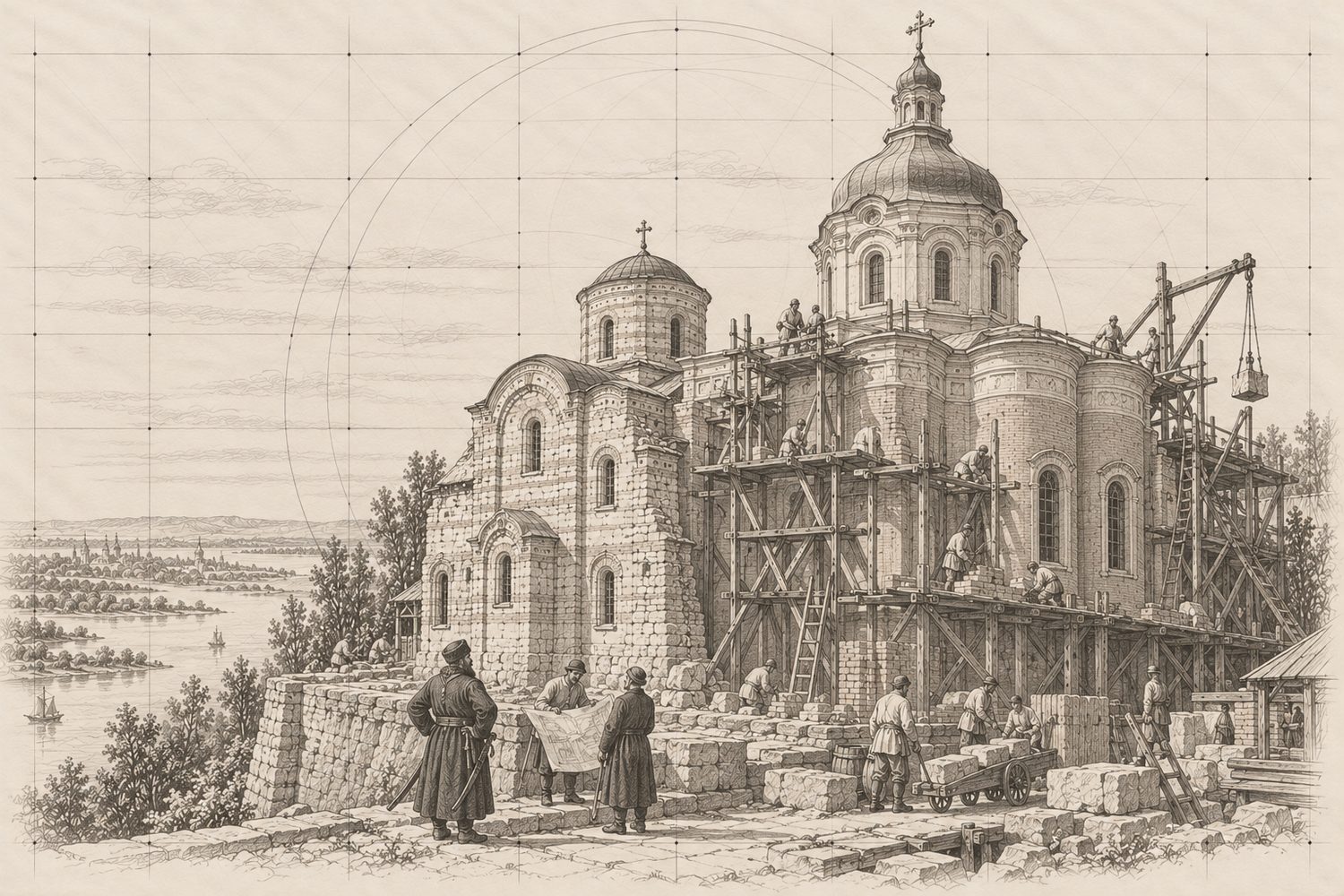
1766–1769: M. Yurasov's rebuilding. Illustration: IKONASTONE
Closure and restoration
- 1918
On 6 June the powder depots at Zvirynets exploded; all the monastery buildings were damaged, and the monk Patricius died of his wounds. St Michael's church suffered comparatively little, and plaster fell from the south wall, revealing an old image of an angel. [4, 6]
- 1919
The monastery was renamed a “labour commune”. On 19 July the brethren formed the Holy St George Community in order to preserve the churches. [4, 6]
- 1922
During the confiscation of church valuables, a silver-gilt reliquary with relics disappeared from St George's Cathedral. V. Didora found no document on its confiscation. [6]
- 1928
According to Didora, as of 7 July there were 31 people living in the monastery: 8 monks aged 35–50 and 23 over 50. [6]
- 1929
The monastery was closed (according to VUE; Didora — not earlier than 1929). Other sources give 1921 or 1924, ESU the late 1920s. The churches were handed to the UAOC community; services in them continued until 1936. [1, 3, 4, 6, 11, 12]
- 1936
The churches were closed. According to ESU and the monastery's website, the Baroque iconostases of the churches of St Michael and St George were burned in the courtyard. The act of 28 May 1936, by contrast, records the transfer of the property of the churches of St Michael and the Annunciation to the Darnytsia community, including a single-tier iconostasis of 5.31 × 3.10 m. [1, 6, 12]
- 1968
On 26 November a fire in St George's Church destroyed the book collections; the Encyclopedia of Ukraine writes of four fires in 1968–1969. [2, 3]
- 1960s–1980s
The buildings of the ensemble were restored under the direction of the architect R. Bykova (ESU — 1962–1982, Encyclopedia of Ukraine — 1967–1982, VUE — 1969–1982). [1, 2, 3]
- 1974–1981
During restoration, 11th-century fresco painting and 18th–19th-century paintings were discovered in the cathedral. [3, 10]
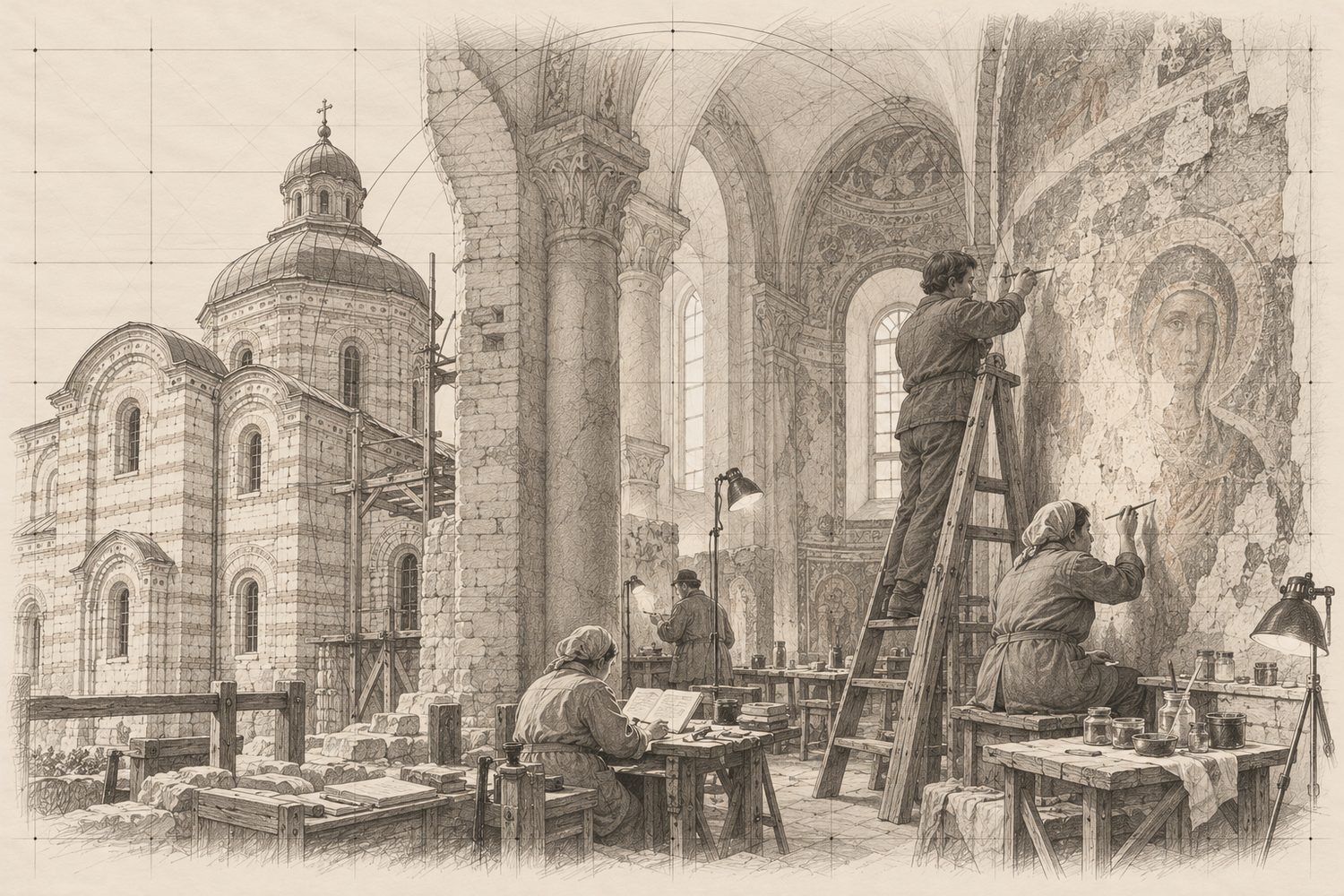
1974–1981: restoration. Illustration: IKONASTONE - 1975–1997
The monastery buildings were occupied by the Institute of Archaeology of the Academy of Sciences of the Ukrainian SSR. According to RISU, this helped the ensemble survive the anti-religious campaigns. [1, 3, 11, 13]
The revived monastery
- 1990
M. Strikhar discovered an 11th-century cave beneath the church's foundations; according to VUE, the cave complex lies at a depth of 4.5 m. [3, 5]
- 1992
Monastic life was restored; the first service took place in St Michael's church. [1, 4, 13]
- 1996
The Cabinet of Ministers handed the monastery over to the Ukrainian Orthodox Church of the Kyiv Patriarchate (according to VUE, in 1997). [1, 3, 13]
- 1998
The mosaic icon “The Miracle of St Michael” was created in an arched niche above the entrance (R. Krychenko, B. Lobanovsky). [1, 3]
- 2022
On 19 September, the feast of the Miracle of the Archangel Michael at Chonae, Metropolitan Epiphanius of Kyiv led the liturgy at the monastery. [15]
- 2025
On 8 February, according to the Kyiv City State Administration, smoke was reported on the ground floor of St Michael's church; the fire was put out and there were no casualties. [18]
Lost and recreated
| What | Was | What happened | Now |
|---|---|---|---|
| Eastern part of the 11th-century cathedral | Apses and vaults above the slope of the Dnipro | Collapsed together with Myloneh’s wall in the late 16th century, not later than 1610 | Foundations are known; on the site stands the Baroque masonry part of 1766–1769 [1, 2, 3, 7] |
| Myloneh’s retaining wall | 1199–1200, stone, east of the cathedral | Destroyed by the Dnipro more than three centuries later | Not preserved; in 1982 a memorial plaque to the architect was installed on the façade [1, 3, 9] |
| Wooden sanctuary | Addition of 1610–1612 to the surviving part | Burned on 28 March 1760 | Replaced by masonry in 1766–1769 [3, 7] |
| 11th-century floor | Dark pink slate slabs with smalt inlays | Only fragments found | Fragments [4] |
| 11th-century frescoes and graffiti | Interior of the church | Hidden under later plaster; the angel was revealed in 1918, the painting in 1974–1981 | Fragments in the church [3, 4, 6, 10] |
| Iconostasis of St Michael’s church | Baroque (according to ESU); according to the act of 1936, a single-tier wooden one, 5.31 × 3.10 m | According to ESU, burned in 1936; according to the act, handed to the Darnytsia community | Fate unknown [1, 6] |
| Silver reliquary with relics | St George’s Cathedral | Disappeared around 1922 | Unknown [6] |
| Bell of 1633 and Uniate property | The bell stayed in the monastery; the Uniates removed the books and the icon of Our Lady of Częstochowa in 1635 | The inventory was dispersed | Fate unknown [7] |
| Library in the gallery | After 1760, in the gallery of St Michael’s church | Moved to a new building in 1904 | Its later fate cannot be traced in the sources [6] |
| Library and archive in St George’s Church | Book collections | Fires of 1968–1969 | Lost [2, 3] |
| Monastery cemetery | Burials of the 19th and early 20th centuries | Destroyed in Soviet times | Individual gravestones restored [2, 16] |
| Grave of General Ya. Handziuk | Reburied under an oak cross in the summer of 1918 | In the 1920s the cross was cut down and the grave levelled | Gravestone restored after 1991 [14, 16] |
| Refectory with the Church of the Saviour | 1696–1701 | Fire on 1 November 2008 | Restored [3] |
| Mosaic above the entrance | No ancient one | — | 1998: “The Miracle of St Michael” (R. Krychenko, B. Lobanovsky) [1, 3] |
Architecture
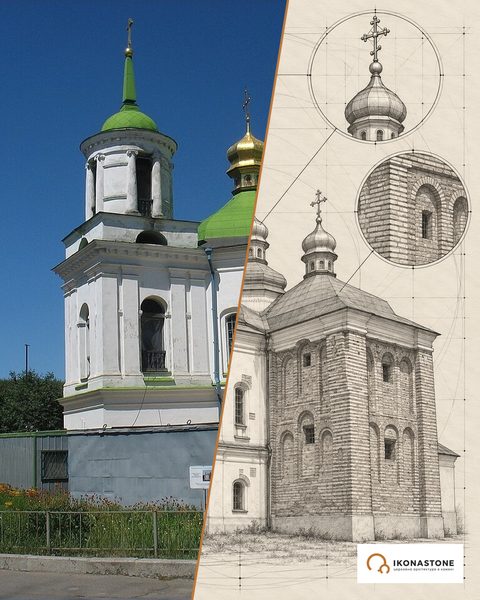
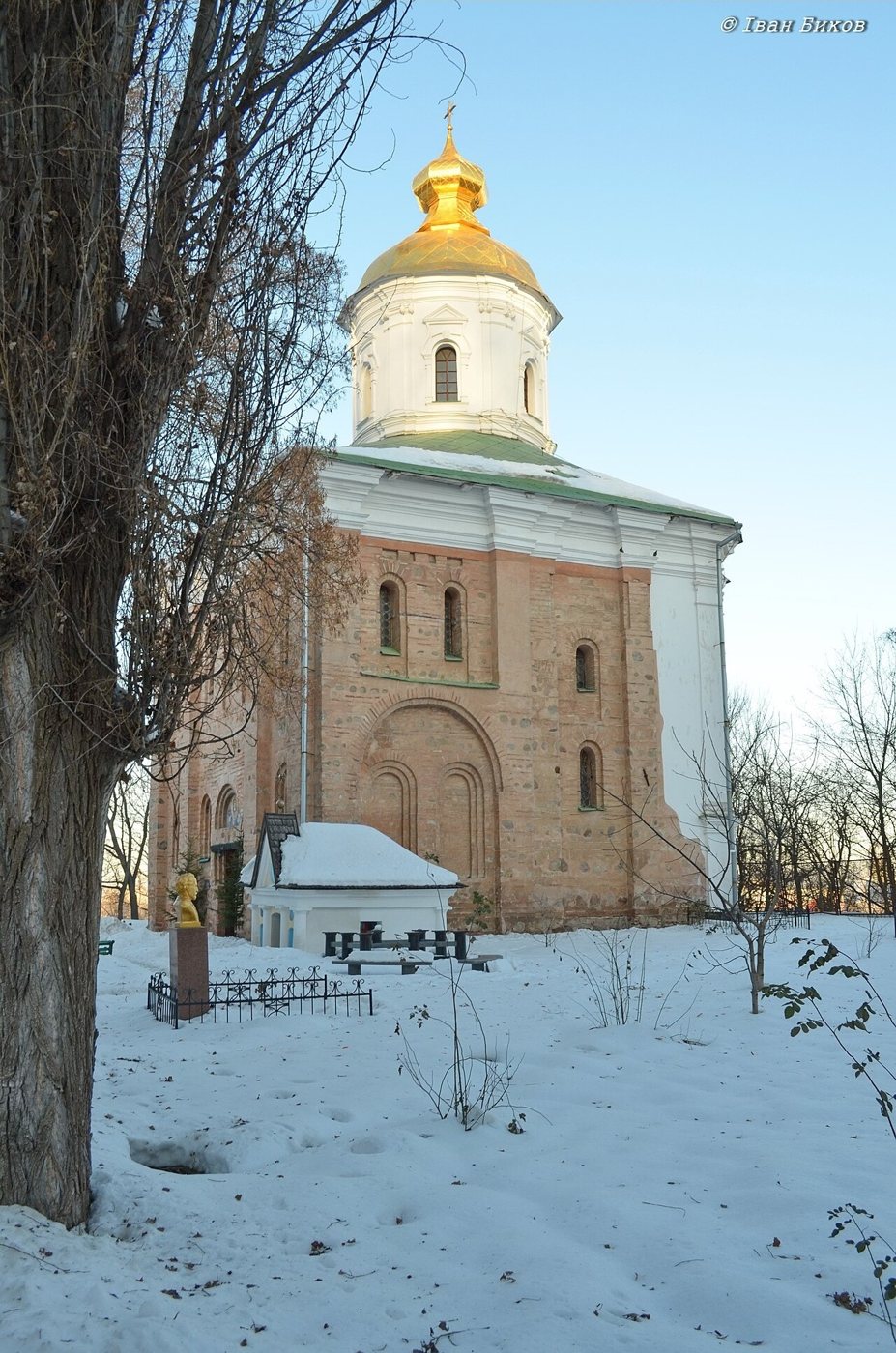
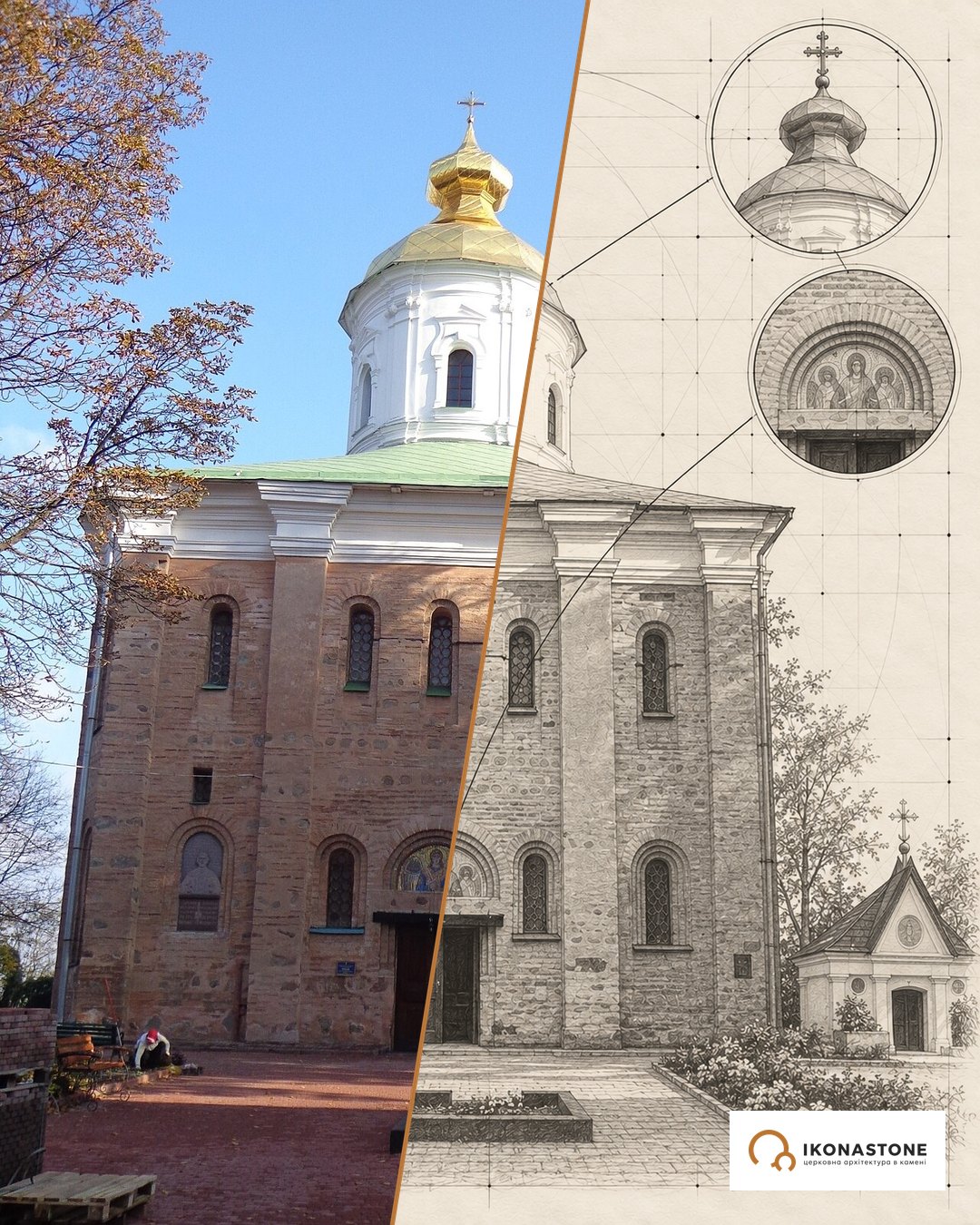
Today’s church is two eras joined in one building. The western part has kept its Old Rus’ walls of the 11th century; the eastern part is Baroque, built in masonry in 1766–1769 on the site of the one that went into the Dnipro. The church is crowned by a single dome. The sources are ambiguous about the original top, so we deliberately do not offer a reconstruction of it.
The cathedral is the oldest, but not the only building of the ensemble. Next to it stand the five-domed St George’s Cathedral of 1696–1701, built at the expense of the Starodub colonel M. Myklashevsky, the refectory with the Church of the Saviour from the same period, and the bell tower of 1727–1733, commissioned by Hetman Danylo Apostol; its fourth tier was added in 1829–1833 by the architect A. Melensky. Against the Baroque tops, the modest St Michael’s church is easy to take for a secondary building, although it is six centuries older than its neighbours.
Above the entrance, in an arched niche, the mosaic icon “The Miracle of St Michael” was created in 1998; its authors are R. Krychenko and B. Lobanovsky. Inside, according to Discover.ua, fragments of fresco painting, mosaic and 11th-century graffiti have survived.
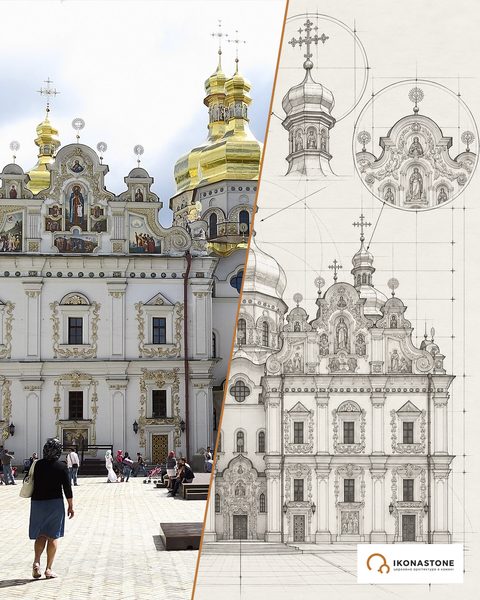
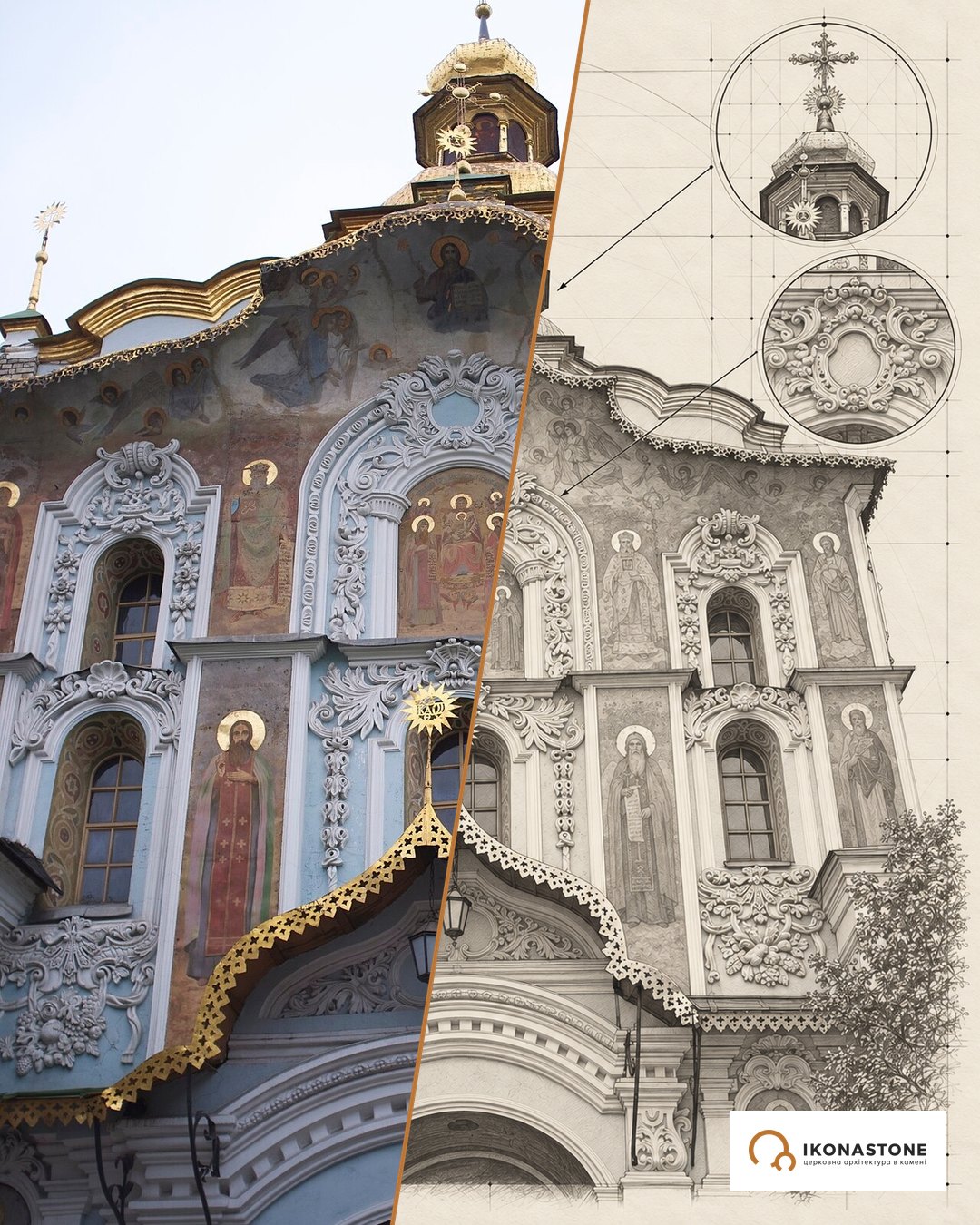
Below are two elements of the church: in a photo and in a drawing. The drawings show the form, not exact dimensions.
The dome
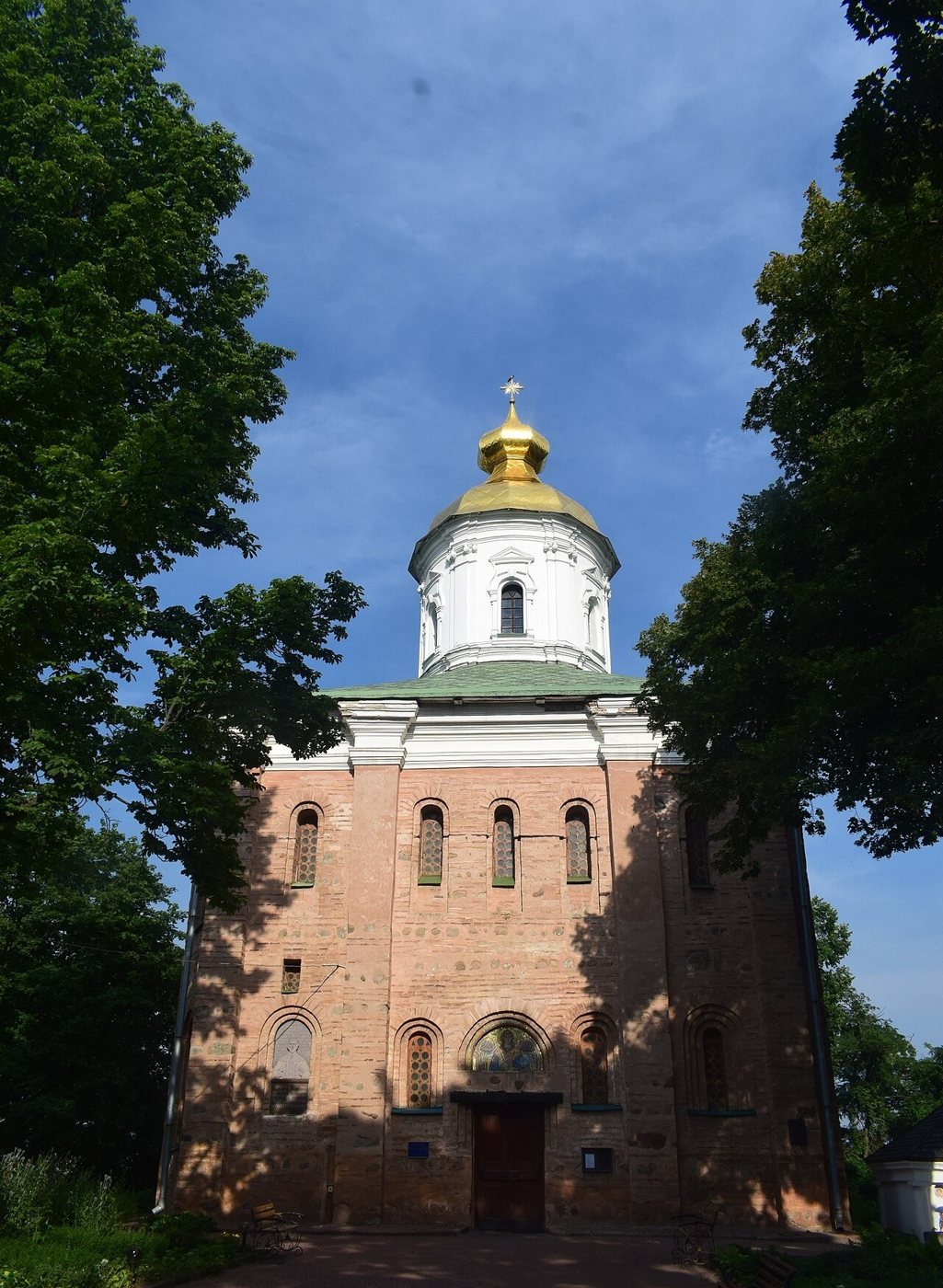
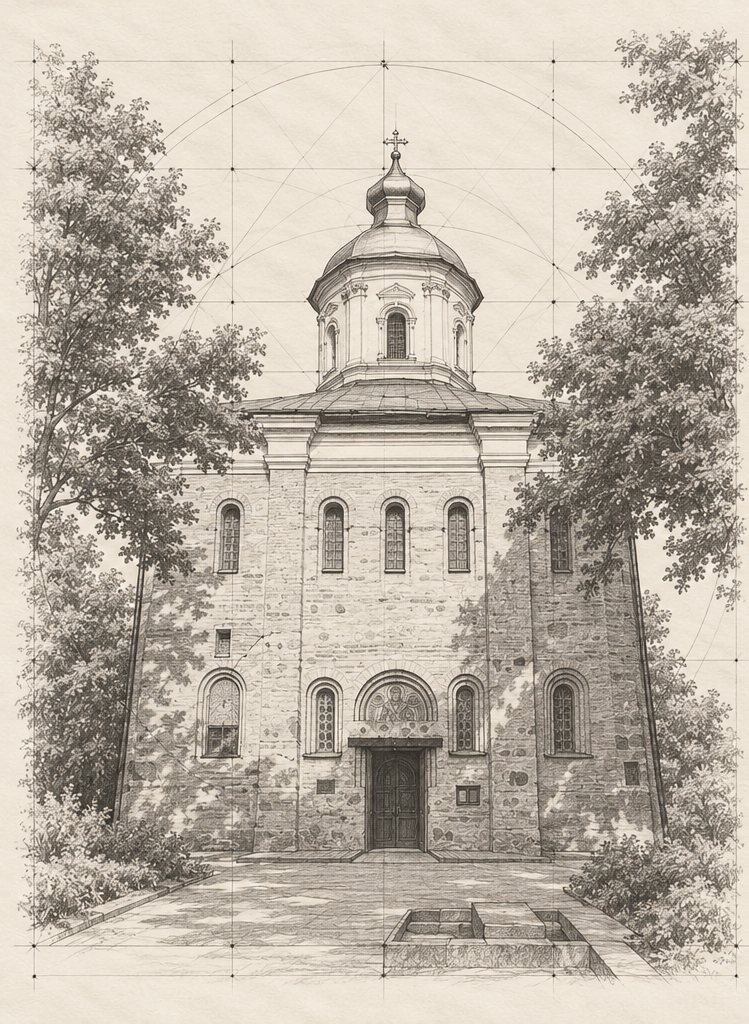
The single dome appeared during the rebuilding of 1766–1769 and stands above the Baroque part of the church. It is the most visible sign of the 18th century on the Old Rus’ body of the building.
The entrance with a mosaic
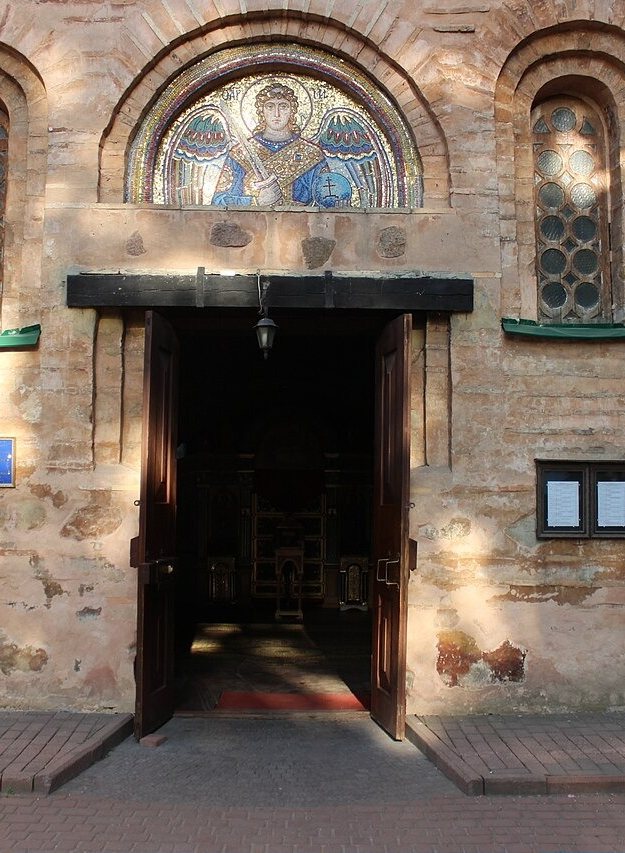
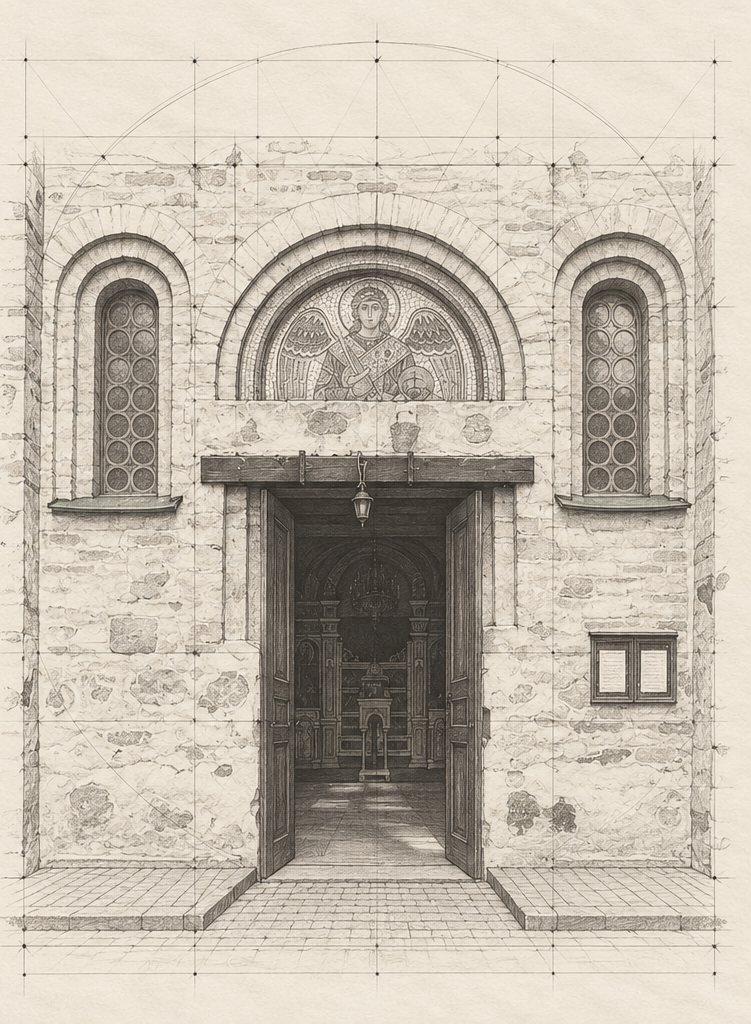
The arched niche above the entrance with the 1998 mosaic “The Miracle of St Michael” is the newest layer of the church. Behind it are the oldest walls.
Details that are easy to miss
A swallow’s nest in the wall. According to Radio Svoboda, a swallow’s nest has survived between the church’s main wall and the one added later. According to the same source, the builders worked the masonry around the nest because of a folk belief.
A “carpet” floor. Archaeologists found fragments of an old floor of dark pink slate slabs with smalt inlays. The historian Vasyl Ulianovsky, quoted by Radio Svoboda, described it as a multicoloured carpet.
An angel under the plaster. After the 1918 explosion the plaster fell away, and the face of an angel from the old painting appeared beneath it. The art historian Fedir Ernst, describing the damage, noted that the oldest church of the monastery had suffered comparatively lightly. The explosion that damaged the whole monastery revealed what had been hidden for centuries.
An iconostasis with two endings. ESU writes that in 1936 the Baroque iconostases of St Michael’s and St George’s cathedrals were hacked to pieces and burned. The author of a study in the Proceedings of the Kyiv Theological Academy doubts this version, which he traces to the work of T. Kilesso: he cites an act of 28 May 1936, published by V. Ulianovsky, on the transfer of the property of the churches of St Michael and the Annunciation to the Darnytsia community, including a single-tier wooden iconostasis measuring 5.31 × 3.10 m. Which fate is true remains an open question.
A chronicle was written here. In 1116 Sylvester, hegumen of the Vydubychi Monastery, produced one of the redactions of the Tale of Bygone Years. Texts we read as a source on Kyiv were partly born next to these walls.
The church is still at the edge. The cathedral stands right above the slope. In 2010, when an approach to a nearby bridge was being completed in haste, Kyiv City Council deputy Oleksandr Bryhynets, according to Gazeta.ua, warned of the threat of a landslide and of about 24 square metres of 11th-century paintings crumbling. The Dnipro is far away, but the slope has not gone anywhere.
Photo gallery
Stone and material
The old part of the cathedral is 11th-century Kyivan masonry; the eastern part is Baroque walling of the 18th century, set on the site of the collapse. The boundary between them shows as a change of architectural language: from the restrained surfaces of the princely era to the plasticity of the Baroque. A separate material layer is the floor of slabs with smalt inlays, of which fragments remain, and the 1998 mosaic above the entrance.
But the main building story of Vydubychi is not about the walls of the church, but about the wall beneath it. The chronicler considered Myloneh’s retaining wall worthy of a eulogy. That is the right instinct: a foundation nobody sees is often more complex than the façade everyone sees. The same is true of a stone floor or steps — their quality is decided in the layers beneath the slab, long before polishing. More on this in the steps and floors section.
Some researchers suppose that Petro Myloneh also worked in Ovruch, on the construction of St Basil’s Church. Another Kyiv church dedicated to the Archangel is St Michael’s Golden-Domed Cathedral.
Did you know
The church is dedicated not to the archangel himself but to an event: the Miracle of Michael at Chonae. Ulianovsky calls such a dedication rare in Rus'. The patronal feast is 19 September. [5, 15]
In 1070 the chronicle mentions both the founding of the church and the birth of Vsevolod's son Rostyslav. Ulianovsky does not think the dedication was chosen on his account. [5]
According to the chronicle, work on the retaining wall began on 10 July 1199 and ended on 24 September 1200. [9]
In the eulogy to Petro Myloneh the chronicler for the first time called a master a “craftsman” (khudozhnyk) and a “friend” of the prince. [9]
On 14 March 1610 the Uniate archimandrite Antonii Hrekovych wrote to the metropolitan: “The Vydubychi church too has fallen”, and proposed adding a wooden sanctuary. [7]
Between the main wall and the narthex the restorers found a swallow's nest: the early builders worked the masonry around it because of a folk belief. [4]
Archaeologists found an Old Rus' helmet with an image of the Archangel Michael and a prayer inscription for Prince Fedir. [4]
In 1745, before the fire, the monks obtained permission to collect donations in the Zaporozhian lands specifically for the Church of St Michael. [17]
In 1919, on the list of the “labour commune”, Bishop Nazarii appeared as the scribe Nazarii Blinov. [6]
The act of 1936 describes the iconostasis of St Michael's church as single-tier and wooden; 267 items were inventoried from the two churches at that time. [6]
A cave complex lies beneath the cathedral at a depth of 4.5 m; researchers regard it as the predecessor of the above-ground monastery. [3, 5]
The anatomist Volodymyr Betz is buried in the monastery cemetery; the giant pyramidal cells of the cerebral cortex are named after him. [14]
The historian Mykhailo Maksymovych believed that the church arose as early as the time of Volodymyr the Great; the chronicles do not confirm this. [4]
Legends
Perun, who “swam up”
According to legend, in 988 the idol of Perun thrown into the Dnipro was carried by the current to the bank right here; hence the name Vydubychi. It was first recorded by Feodosii Sofonovych in the 1660s–1670s; the legend is repeated in the “Synopsis” of 1680. Researchers also link the name to boats “swimming up” (vydybannia) over the horizon near the crossing. [5, 11]
The prince's vow
According to legend, Prince Vsevolod founded the monastery in fulfilment of a vow after recovering from wounds received while hunting. Recorded on Discover.ua. [10]
The Zvirynets predecessor
According to legend, a Zvirynets cave monastery had previously existed on this site. The legend is cited by ESU; Ulianovsky mentions the inscription “The Holy Monastery of the Miracle of St Michael”, which, according to O. Ertel, was in the cave. [1, 5]
The wall together with the sanctuary
According to legend, after a landslide part of the monastery wall fell into the river together with the sanctuary. Recorded by RISU. [13]
The miracle at Chonae
According to legend, when pagans directed mountain streams at the church at Chonae, the sacristan Archippus prayed to the archangel, who split the mountain and turned the water aside. The legend underlies the cathedral's dedication; it is given on the website of the Kyiv Metropolis of the OCU. [5, 15]
Thirty monks in the caves
According to legend, in 1169 about thirty monks hid in the caves at Zvirynets and were buried there. Recorded on the monastery's website. [12]
The image that was renewed
According to the community's account, at the first service in 1992 the image of God the Father in the sanctuary was “renewed”, and the other paintings gradually grew lighter. Recorded from a hieromonk by Radio Svoboda. [4]
Figures
- Vsevolod Yaroslavych — prince, son of Yaroslav the Wise; founder of the monastery and the church (1070). [1, 5]
- John II — Metropolitan of Kyiv; according to Ulianovsky, consecrated the church. [5]
- Sylvester — hegumen, author of the redaction of the Tale of Bygone Years of 1116. [1, 19]
- Riuryk Rostyslavych — prince, commissioner of the retaining wall of 1199–1200. [1, 9]
- Petro Myloneh — Riuryk’s court architect, builder of the wall. [1, 9]
- Danylo of Halych — visited the monastery in 1250. [5, 11]
- Semen Olelkovych — according to the anonymous chronicler, restored the church in 1470 and is buried in it. [8]
- Ipatii Potii, Yosyf Rutsky — Uniate metropolitans who held the monastery. [7]
- Antonii Hrekovych — Uniate archimandrite, resumed services in the ruined church; drowned in 1618. [7, 8]
- Petro Mohyla — metropolitan, restored the church after its return to the Orthodox. [1, 4, 7]
- Mykhailo Myklashevsky — Starodub colonel, founder of St George’s Cathedral. [11, 14]
- Danylo Apostol — hetman, founder of the bell tower. [11, 14]
- M. Yurasov, P. Nedilko — builders of the Baroque rebuilding of 1766–1769. [1, 3]
- Fedir Ernst — art historian, described the consequences of the explosion of 1918. [4]
- Raisa Bykova — architect of the ensemble’s restoration in the 1960s–1980s. [1, 3]
- Vasyl Ulianovsky — historian, researcher of the church’s dedication and publisher of the act of 1936. [5, 6]
- Yakiv Handziuk, Bohdan and Varvara Khanenko, Kostiantyn Ushynsky, Volodymyr Betz, Mykola Leliavsky — buried on the monastery grounds. [1, 14, 16]
How to cite
IKONASTONE. St Michael's Cathedral of the Vydubychi Monastery // Guide to Churches of Ukraine. URL: https://ikonastone.com/en/guide/st-michaels-cathedral-vydubychi-monastery/ (accessed DD.MM.YYYY).
FAQ
Who built St Michael's Cathedral in Vydubychi?
Prince Vsevolod Yaroslavych, son of Yaroslav the Wise. The chronicle mentions the founding of the Church of St Michael in his monastery in 1070; the church was built until about 1088.
Why has only part of the old church survived?
The cathedral stood above a slope undercut by the Dnipro. The retaining wall built by Petro Myloneh in 1199–1200 held for more than three centuries, but eventually collapsed, taking the eastern part of the church with it. The Encyclopedia of Modern Ukraine dates the collapse to the 16th century.
When did the church acquire its present appearance?
In 1766–1769, to a design by the architect M. Yurasov: the eastern part was rebuilt then, and the church took on Baroque features with a single dome.
What has survived from the 11th century?
The old walls of the western part, fragments of fresco painting and 11th-century graffiti.
Where does the name Vydubychi come from?
According to legend, when Prince Volodymyr ordered the idol of Perun to be thrown into the Dnipro, the current carried it ashore below Kyiv. The place where the idol “swam up” (vydybav) was named Vydubychi.
Sources
- Енциклопедія сучасної України. Т. Кілессо-Контан. Видубицький Свято-Михайлівський чоловічий монастир (2005)
- Encyclopedia of Ukraine (CIUS). Vydubychi Monastery
- Вільна українська енциклопедія. Видубицький монастир у Києві
- Радіо Свобода. Чудо-Михайлівська церква Видубицького монастиря
- В. Ульяновський. Присвята Михайлівської церкви Видубицького монастиря // Український історичний журнал, 2013, № 5
- В. Дідора. Свято-Михайлівський Видубицький монастир у 1917–1936 рр. // Труди Київської духовної академії
- КПБА. Видубицький Свято-Михайлівський чоловічий монастир в уніатський період своєї історії (1596–1635 рр.)
- Ю. Мицик, І. Тарасенко. Анонімний літописець Видубицького монастиря початку XVIII ст
- Ю. Асєєв. Мав «любов ненаситну о зданіях» // Дзеркало тижня
- Discover.ua. Видубицький монастир
- Україна Інкогніта. Видубицький монастир. Шедевр світового значення
- Сайт Свято-Михайлівського Видубицького монастиря. Історія
- РІСУ. A monastery surrounded by lilacs and chestnuts (30.05.2006)
- Wikipedia (en). Vydubychi Monastery
- Помісна.info (Київська митрополія ПЦУ). Престольне свято Київо-Михайлівського Видубицького монастиря (19.09.2022)
- Укрінформ. Яків Гандзюк. Генерал-прапороносець (30.01.2023)
- Ю. Мицик. Нові джерела з історії Свято-Михайлівського Видубицького монастиря XVII–XVIII ст. // Труди КДА, 2016, № 16
- Факти ICTV. У Києві у церкві Свято-Михайлівського Видубицького чоловічого монастиря вирувала пожежа (08.02.2025)
- Encyclopedia of Ukraine (CIUS). Sylvester
- Town
- Kyiv
- Built
- c. 1070–1088; eastern part rebuilt 1766–1769
- Type
- 11th-century masonry church with a Baroque eastern part and a single dome
- Material
- Old Rus' masonry of the 11th century, Baroque walls of the 18th century; 11th-century frescoes
- Research depth
- 31%