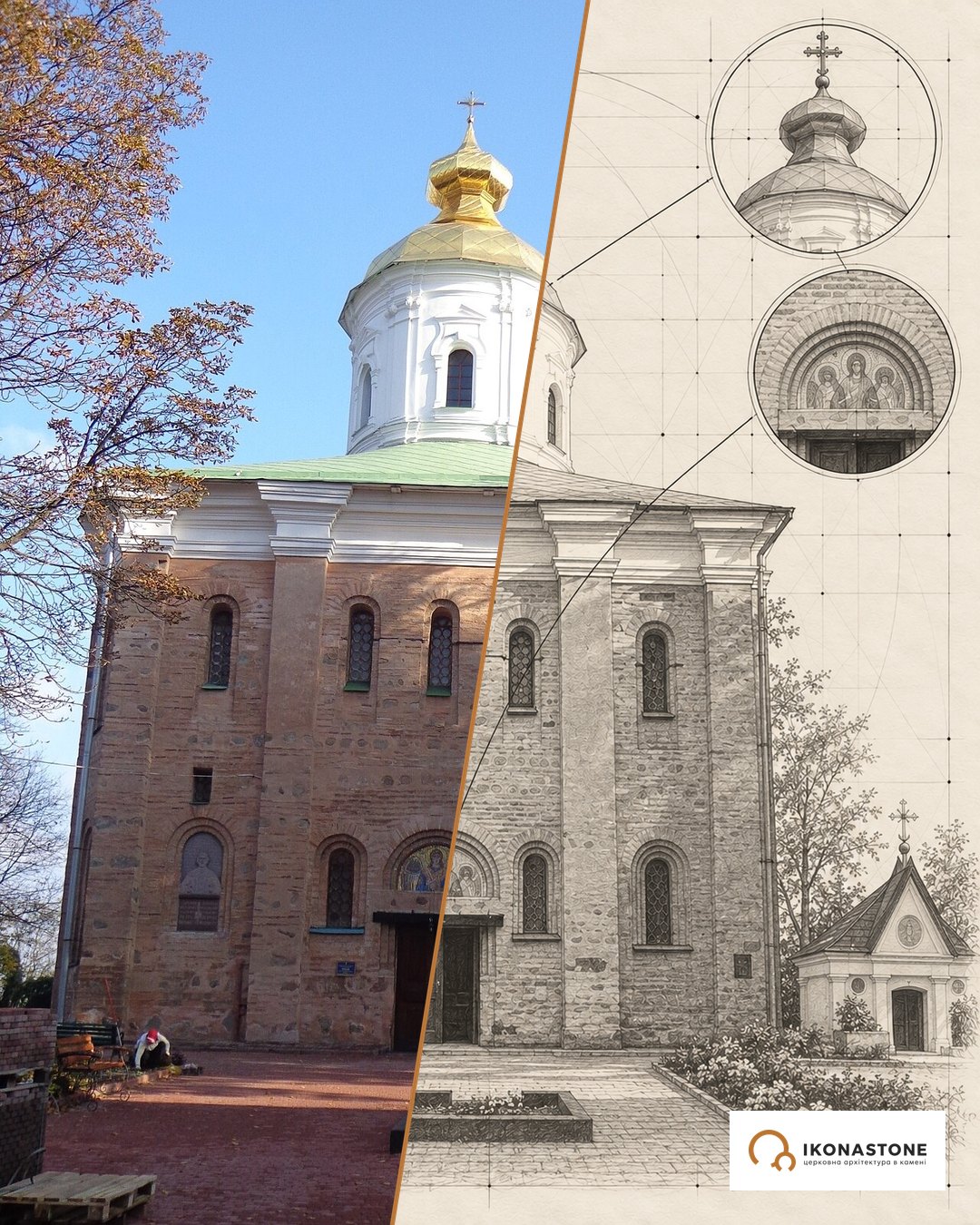
The Dormition Cathedral of the Kyiv-Pechersk Lavra: a church built three times
This cathedral was built three times: by the monks of the 11th century, by the Baroque of the 18th, and by the restorers of the late 20th. Between the second and the third time there was a ruin that stood for almost sixty years.
In brief
| Address | Kyiv, Pechersk, Upper Lavra |
| Built | 1073–1077 (according to other sources, 1078); blown up on 3 November 1941; rebuilt 1998–2000 |
| Type | six-pillar cross-in-square church; exterior in the Ukrainian Baroque style |
| Material | plinthos brick (recreated using the old technology), fragments of the ancient masonry |
| Status | part of a UNESCO World Heritage Site (1990; since 2023 on the List in Danger) |
| Management | National Kyiv-Pechersk Historical and Cultural Conservation Area (owned by the state); since 7.01.2023 the OCU has served here |
History
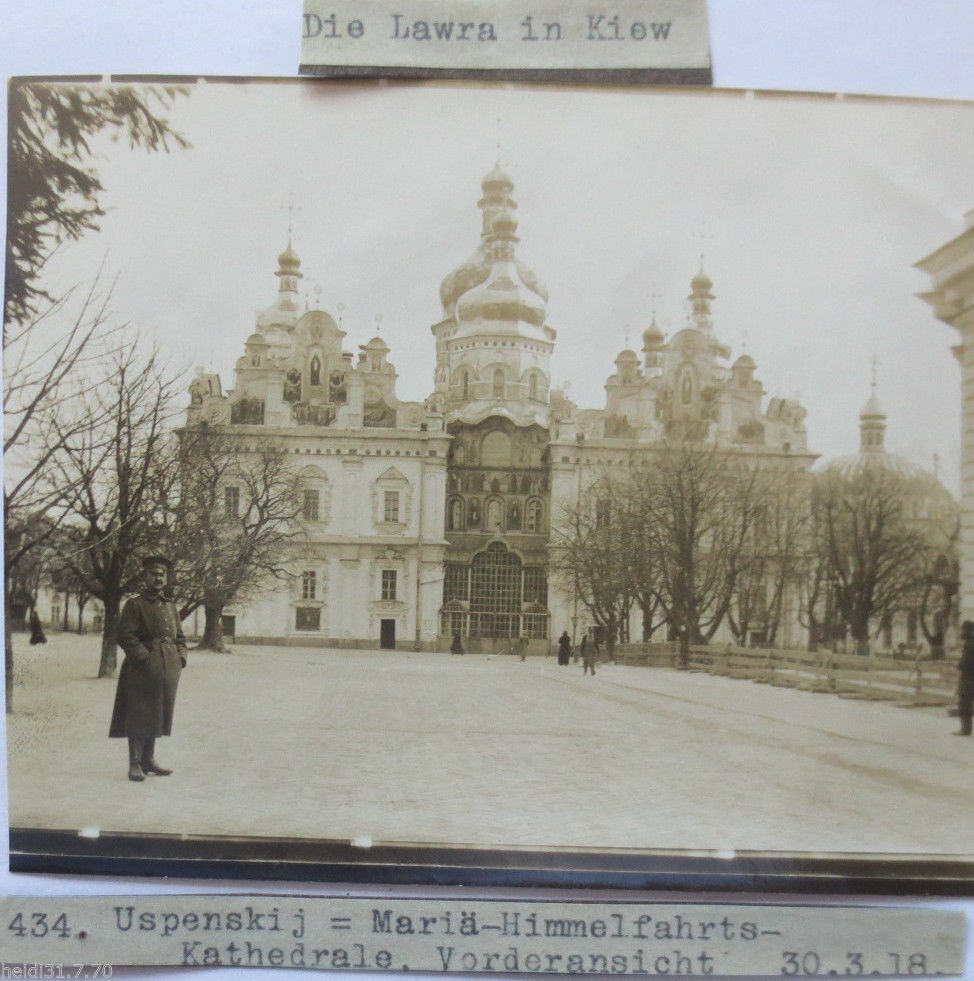
The cathedral was founded in 1073 on the initiative of Saint Theodosius of the Caves, at the expense of Prince Sviatoslav Yaroslavych; in 1077 (according to other sources, 1078) the main masonry was completed. The Kyiv-Pechersk Patericon relates that the builders came from Constantinople. According to the Patericon and researchers, the cathedral became a model for other princely churches.
Then came the earthquake of 1230, the sack of 1240, the raid of 1482. From as early as the 17th century the cathedral took on Baroque features: domes and decoration were added. After the great fire of 1718 it was restored in Baroque form — according to the sources, by 1729 (according to other sources, by 1731). That is how it was remembered.
On 3 November 1941, during the German occupation, the cathedral was blown up; the ESU calls the circumstances unexplained. Historians have several versions: Soviet saboteurs, the occupation authorities, or mining by Soviet units and detonation by the Germans. The details are in the timeline below. Only ruins remained of the church: fragments of the east wall, part of the baptistery, the altar of St John the Evangelist and two 11th-century pillars survived. On 9 December 1995 the President signed the decree “On Measures for the Recreation of Outstanding Monuments of History and Culture”, the list of which included the cathedral. Work continued in 1998–2000, and on 24 August 2000 the cathedral was consecrated.
On the night of 15 June 2026, during a massed attack, a Russian strike drone hit the sanctuary end of the cathedral — the side chapel of St Stephen — and a fire broke out on the roof. Reports put the area of the fire at 700 to 800 m². The sacred objects, old icons and the reliquary of St Stephen were evacuated in time; assessments of the damage to the interior differ in the first reports. Rescuers carried out emergency work on the roof; full restoration, according to the estimate of the conservation area’s management, may take about two years.
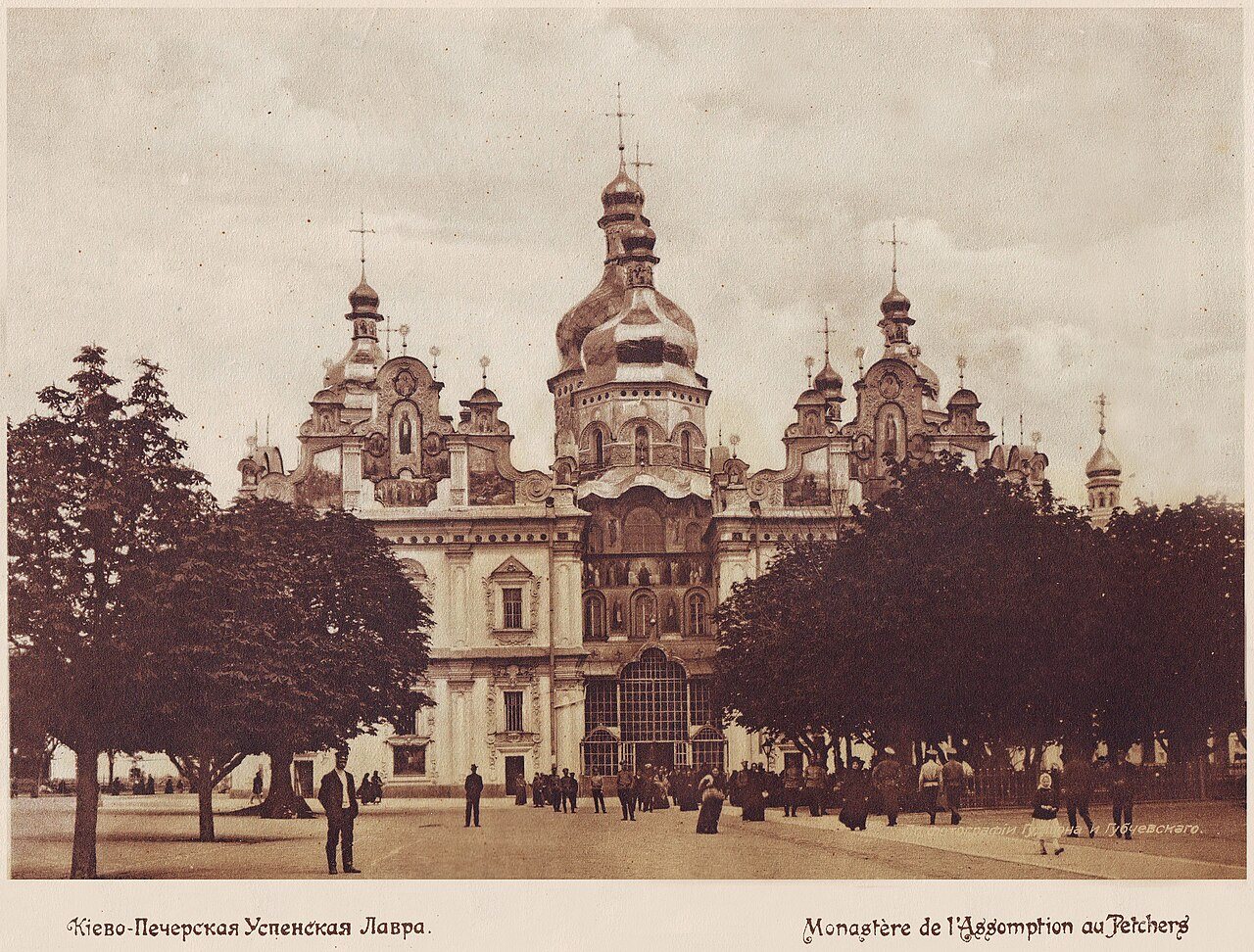
Timeline
The numbers in square brackets are the numbers of the sources in the list at the bottom of the page. The note "according to …" means that the fact is confirmed by only one source. The "Legends" section contains traditions and legends: they are recorded in the sources but not confirmed by documents.
The princely era
- 1051
Saint Antony settled in a cave on a hill above the Dnipro; this was the beginning of the monastic community from which the Kyiv-Pechersk Lavra grew. [4, 19]
- 1073
On 15 August, the feast of the Dormition, the masonry Great Church was founded on the initiative of Abbot Theodosius. The funds were provided by Prince Sviatoslav Yaroslavych; according to the Patericon, he himself began to dig the trench for the foundation. The size of the donation differs between sources: 100 gold hryvnias (according to the Patericon, as set out by Ye. Kabanets) or 1,000 hryvnias (the conservation area's website). After Theodosius's death (1074) construction continued under Abbot Stephen. [1, 2, 4, 6]
- 1077
The main masonry was completed. On the basis of the chronicles, Ye. Kabanets considers 11 July 1077 the most accurate date; the conservation area's website gives July 1077, the VUE gives 1075–1078. [1, 4, 6]
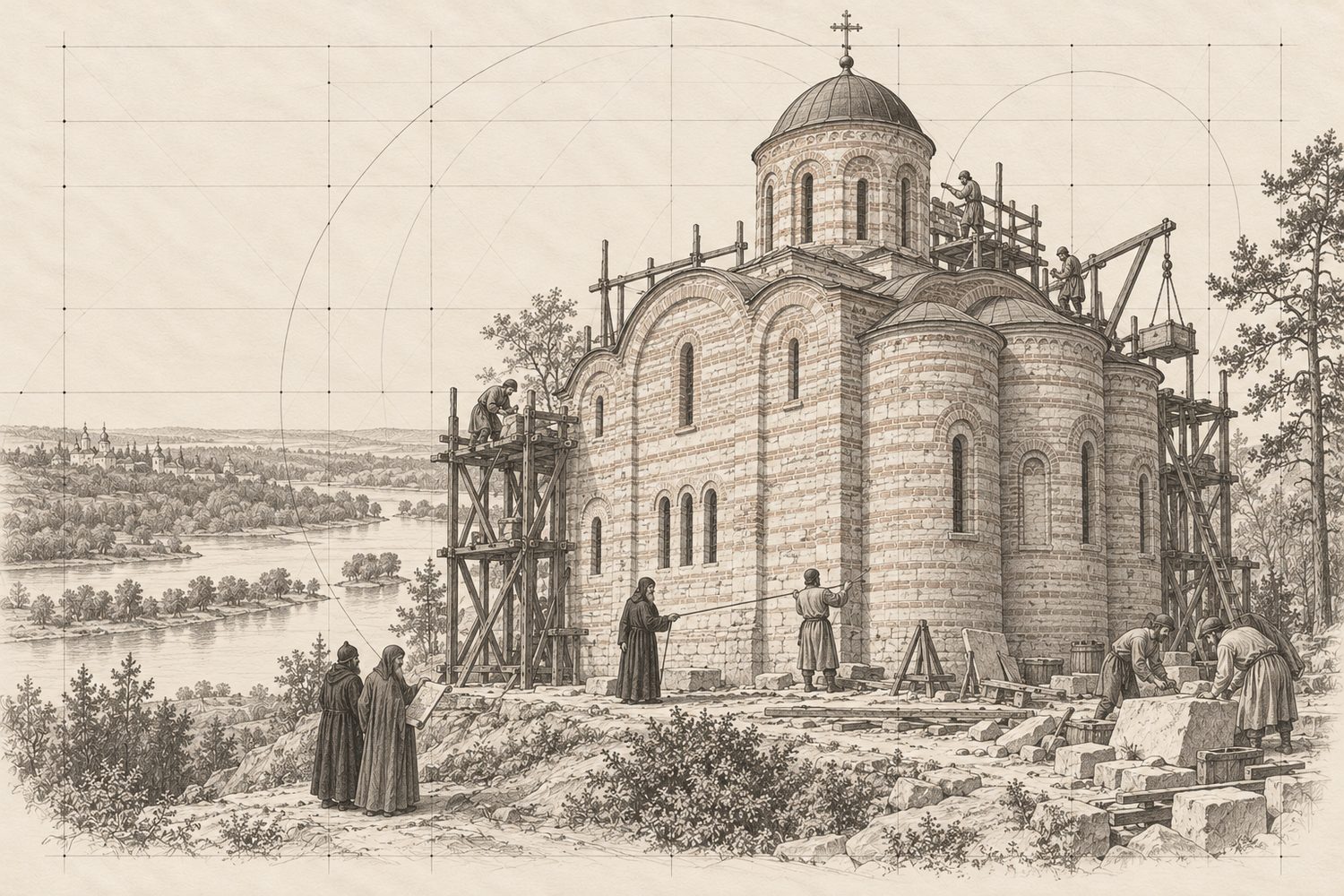
1077: the masonry is completed. Illustration: IKONASTONE - 1089
After more than ten years without consecration, the cathedral was decorated and consecrated. It was consecrated by Metropolitan John together with bishops, in the presence of Prince Vsevolod Yaroslavych. Ye. Kabanets explains the delay by the political struggle around the monastery rather than by a lack of funds. The exact day — 14 August — is given by M. Zharkikh. [1, 4, 5, 6]
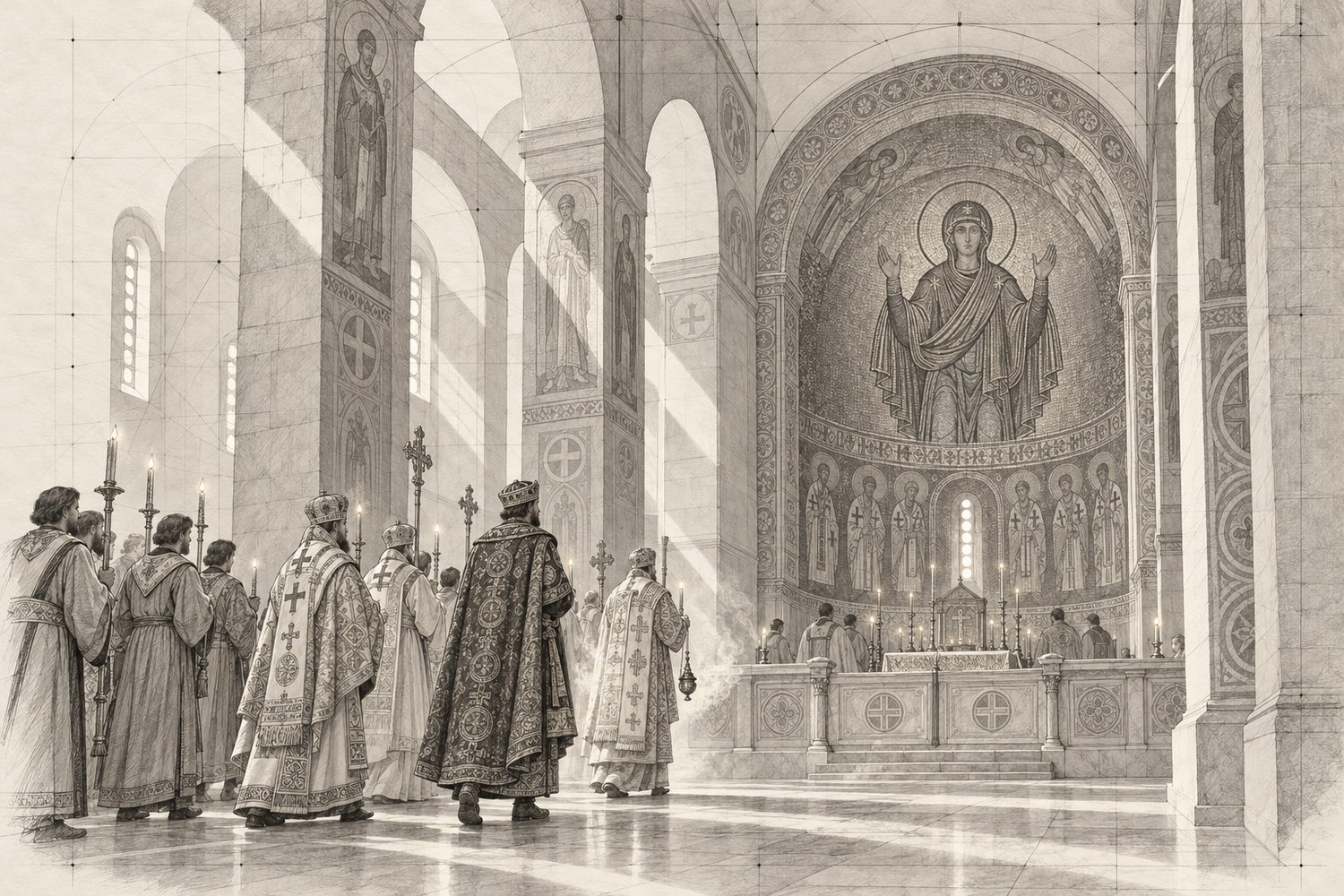
1089: the consecration of the cathedral. Illustration: IKONASTONE - 1091
The relics of Saint Theodosius of the Caves were moved from the cave to the cathedral. [1, 5]
- 1109
Princess Yevpraksiia Vsevolodivna was buried in a chapel attached to the cathedral. [5, 9]
- 1230
On 3 May an earthquake caused large cracks in the walls of the cathedral. Whether they were repaired before 1240 is unknown. [1, 5]
- 1240
The cathedral was damaged during the Mongol invasion. According to the Patericon, the relics of Theodosius were hidden "under the floor"; their location has still not been established (according to Antykvar). [1, 5, 9]
- Late 14th c.
Lithuanian princes, among them Volodymyr Olgerdovych, were buried in the cathedral; burials here continued until the 18th century. [5, 9]
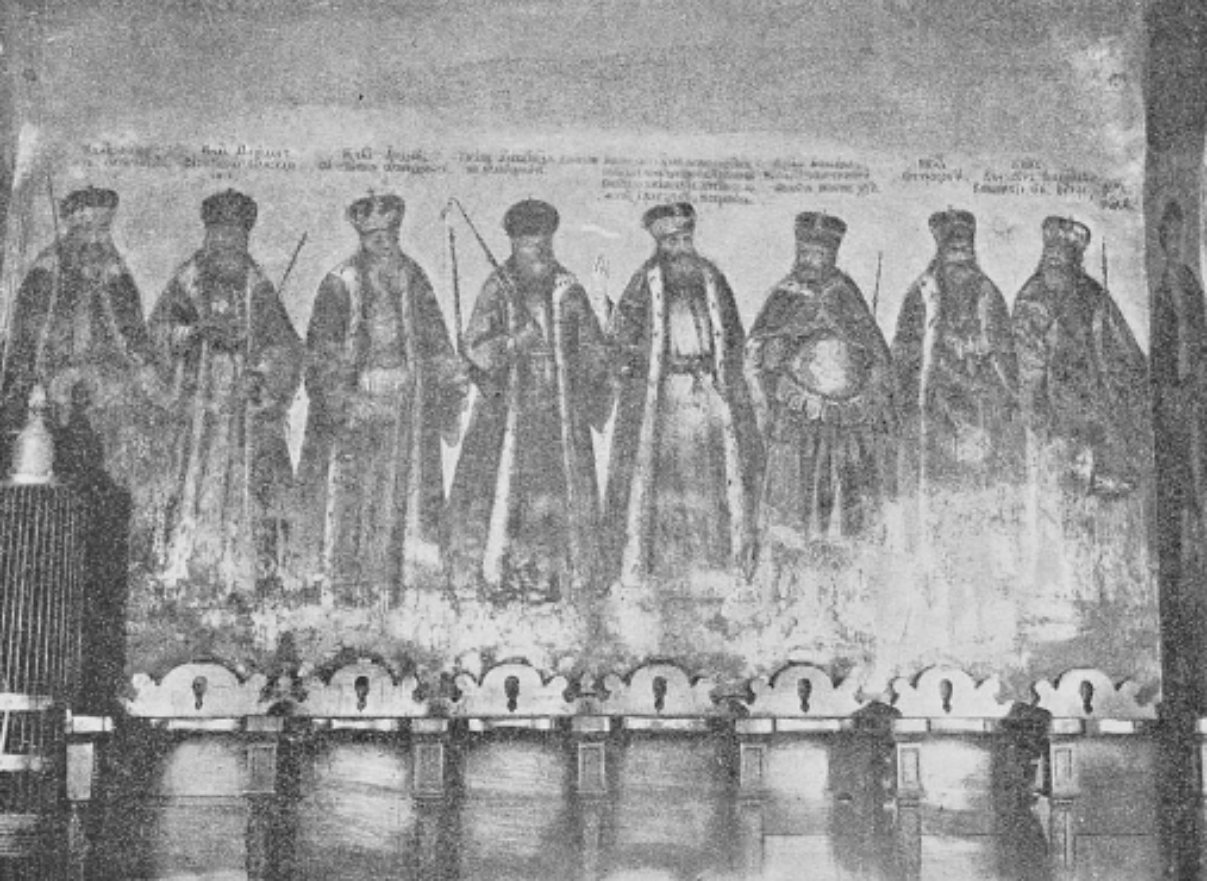
The founders' painting of the cathedral with princes of the Sanguszko, Ostrozkyi and Vyshnevetskyi families. Drawing by Irynarkh, 1843. Wikimedia Commons, public domain
The Lithuanian and Polish era
- 1416, 1482
The cathedral suffered during raids: in 1416 by Khan Edigey, in 1482 by the Crimean Khan Mengli I Giray. [10, 11]
- 1470
The Prince of Kyiv Semen Olelkovych financed a major repair of the cathedral. [1, 5]
- 1530
Prince Kostiantyn Ostrozkyi, Grand Hetman of Lithuania, was buried in the cathedral (1533 in some sources). In 1579 his son Vasyl-Kostiantyn set up a marble Renaissance tombstone over the grave. [5, 9]
The Ukrainian Baroque
- 1630s–1640s
Under Metropolitan Petro Mohyla the cathedral was restored; it became many-domed. Mohyla (d. 1647) was buried in the cathedral. [5, 11, 22]
- 1654
Paul of Aleppo, who accompanied the Patriarch of Antioch, recorded that the cathedral had nine domes. [5, 11]
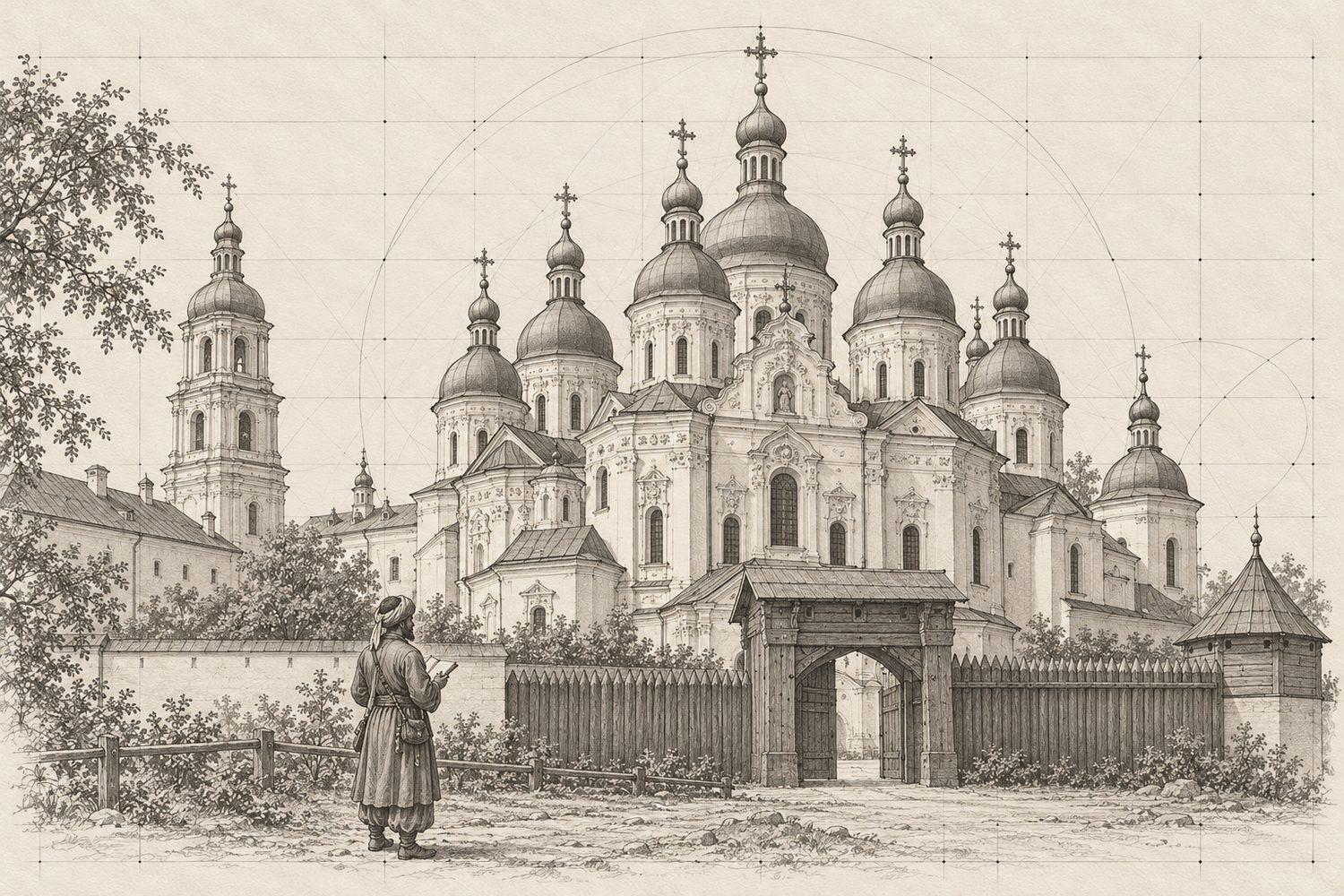
1654: Paul of Aleppo describes the cathedral. Illustration: IKONASTONE 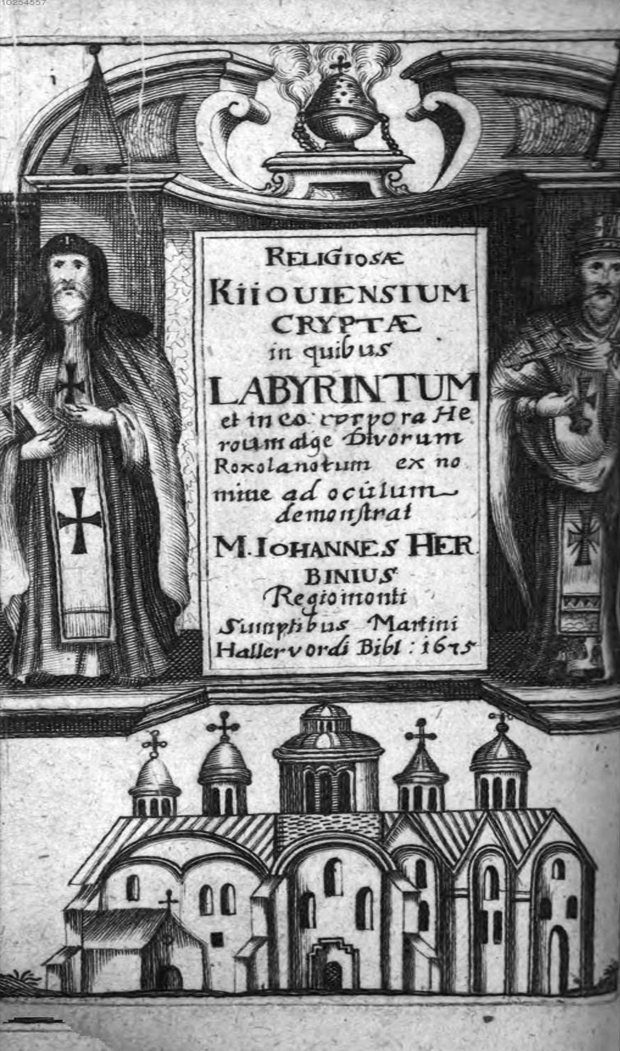
The title page of J. Herbinius's book on the caves of the Lavra, 1675. Wikimedia Commons, public domain - Late 1690s
Repair and decoration at the expense of Hetman Ivan Mazepa; the cathedral acquires Baroque features. [10, 30]
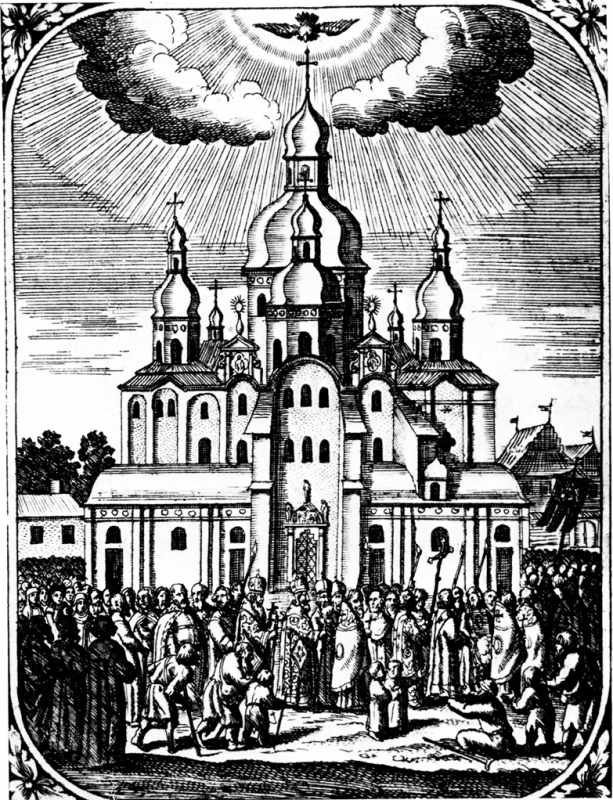
The Dormition Cathedral in an engraving by Leontii Tarasevych, 1702. Wikimedia Commons, public domain - 1718
On the night of 21–22 April a great fire in the Upper Lavra destroyed the decoration of the cathedral, the library and the archive; the walls survived. The cause of the fire has not been established in the documents. [1, 5, 10]
- 1722–1729
Rebuilding in Baroque form to a design by the architect F. Vasyliev under the direction of the master I. Kalandin; the cathedral received seven pear-shaped domes. According to M. Zharkikh, the work continued until 1731. [1, 5]
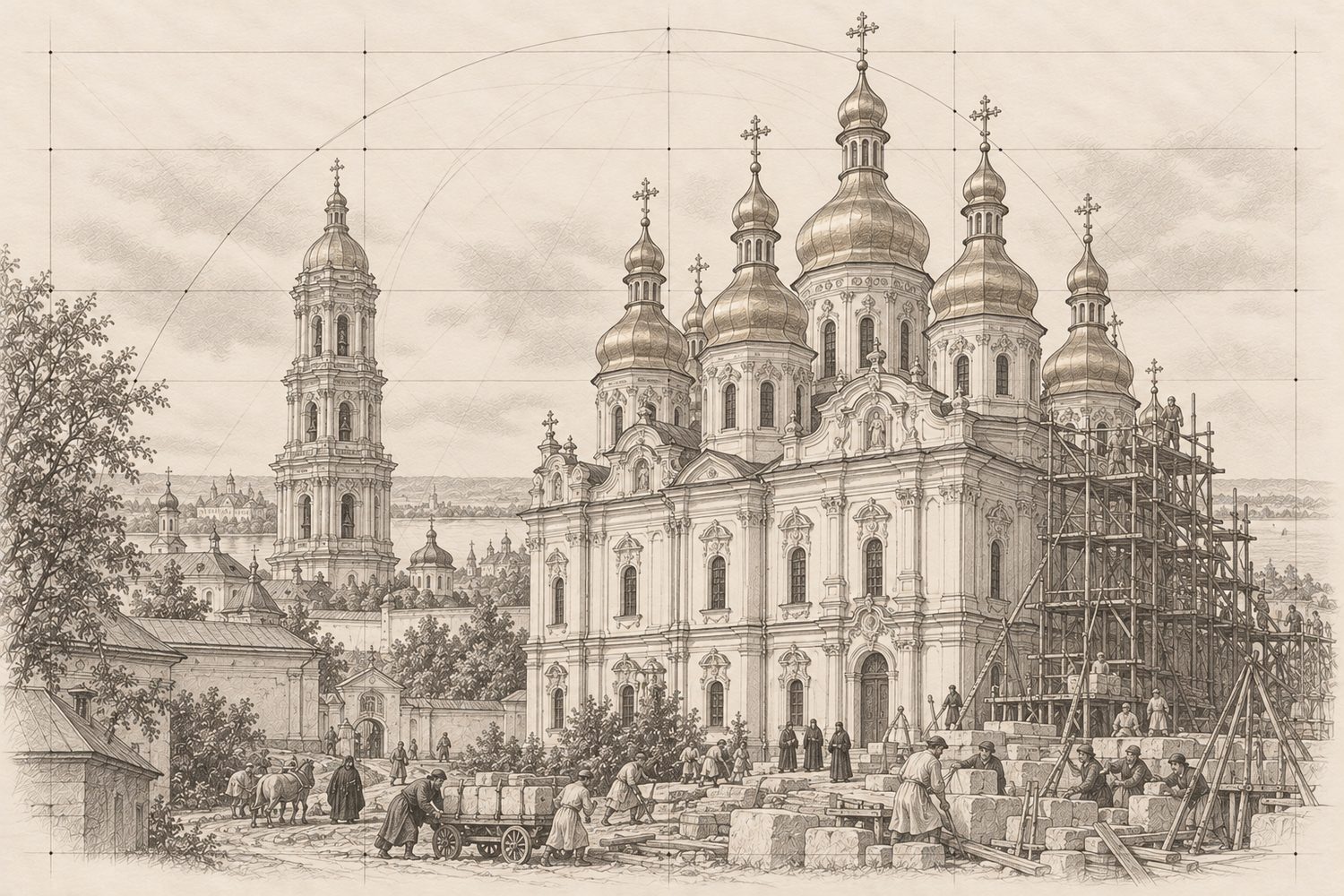
The 1720s: rebuilding after the fire of 1718. Illustration: IKONASTONE - 1729
The interior was painted by masters of the Lavra icon-painting workshop under the direction of Stefan Lubenskyi. [1, 10]
- 1767–1769
The facades were crowned with gables with stucco work on fresh plaster; Stepan Kovnir and Yosyp Bilynskyi worked on them. [1, 10]
- 1796
Field Marshal Petr Rumiantsev-Zadunaisky was buried in the cathedral. [4, 5]
- 1893–1896
The 18th-century paintings were chipped off and replaced with academic painting according to a programme approved by Emperor Alexander III on 14 May 1894. At the same time, in the cycle of repairs of 1880–1901, the upper tiers of the Baroque iconostasis were dismantled. [1, 5, 24]
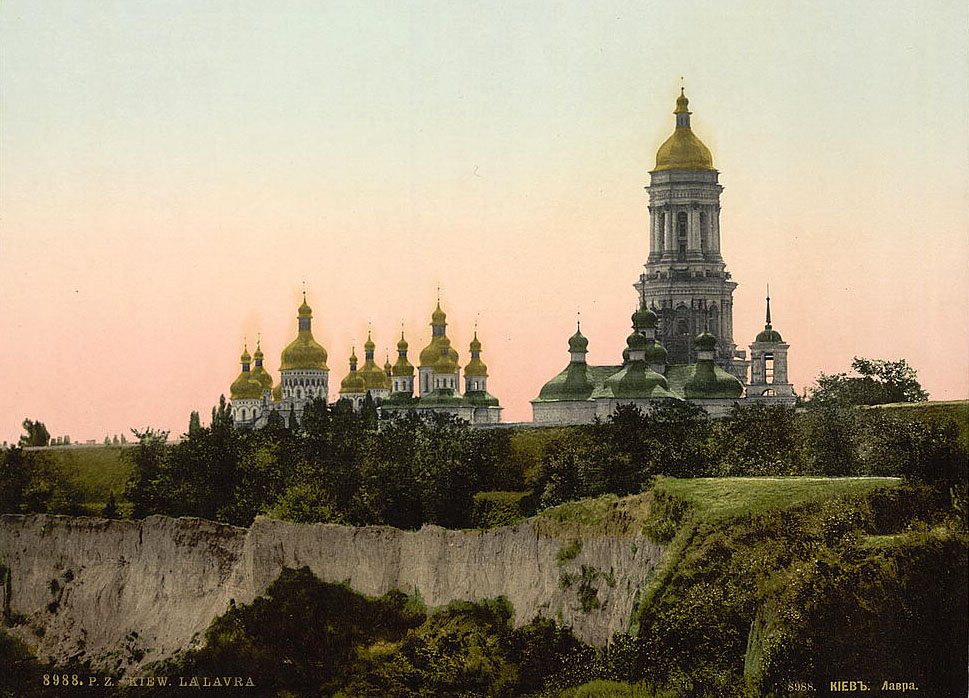
The Lavra above the slopes of the Dnipro, 1890–1905. Photochrom. Wikimedia Commons, public domain 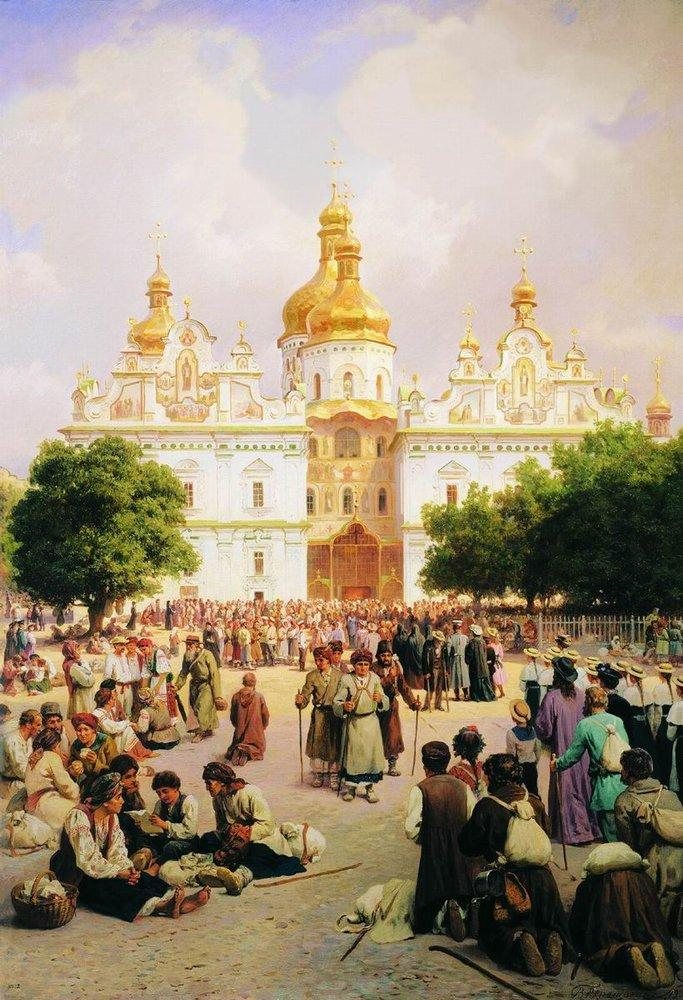
Pilgrims in front of the cathedral. Vasily Vereshchagin, 1905. Wikimedia Commons, public domain
Closure and ruin
- 1922
During the campaign to confiscate church valuables a large quantity of items made of precious metals was seized, including the silver riza (revetment) of the icon of the Dormition. [5, 23]
- 1926
By a resolution of the All-Ukrainian Central Executive Committee and the Council of People's Commissars of the Ukrainian SSR of 29 September the Lavra was turned into a conservation area — the All-Ukrainian Museum Town; the cathedral became part of it. According to the ESU. [3]
- 1929
The monastery was finally closed; the cathedral began to be used as a museum. In 1939, according to the ESU, it was assigned to the Central Anti-Religious Museum of the Ukrainian SSR. [1, 3, 5]
- 1941
Explosives were placed under the cathedral. According to the Encyclopedia of Ukraine this happened during the retreat of the Red Army on 16–17 September, according to the VUE the Soviet security services did it in August. Ye. Kabanets does not accept the version of Soviet mining. [1, 2, 7]
- 1941
On 3 November, during the German occupation, an explosion destroyed the cathedral. Fragments of the east wall, part of the baptistery, the altar of St John the Evangelist and two 11th-century pillars survived. The ESU writes that the cathedral was blown up "in unexplained circumstances". [3, 4, 8]
- 1941 (versions)
Historians assess responsibility for the explosion differently. Soviet historiography blamed the German occupiers; some publications blame Soviet saboteurs. Ye. Kabanets (2011) considers the involvement of the Nazi authorities proven. S. Kot (2011) writes of the responsibility of both regimes: the mines were laid by Soviet special units and set off by the Germans. The debate continues. [5, 7, 8, 13, 28, 29]
- 1941–1943
The occupiers carried out of the cathedral the silver Royal Doors, about 120 silver rizas, three silver sarcophagi and precious book bindings. [3, 4]
- 1945–1971
The ruins were cleared (1945–1947), studied and conserved (1962–1963 and later). The research was led by the architect Mykola Kholostenko. [1, 5, 26, 27]
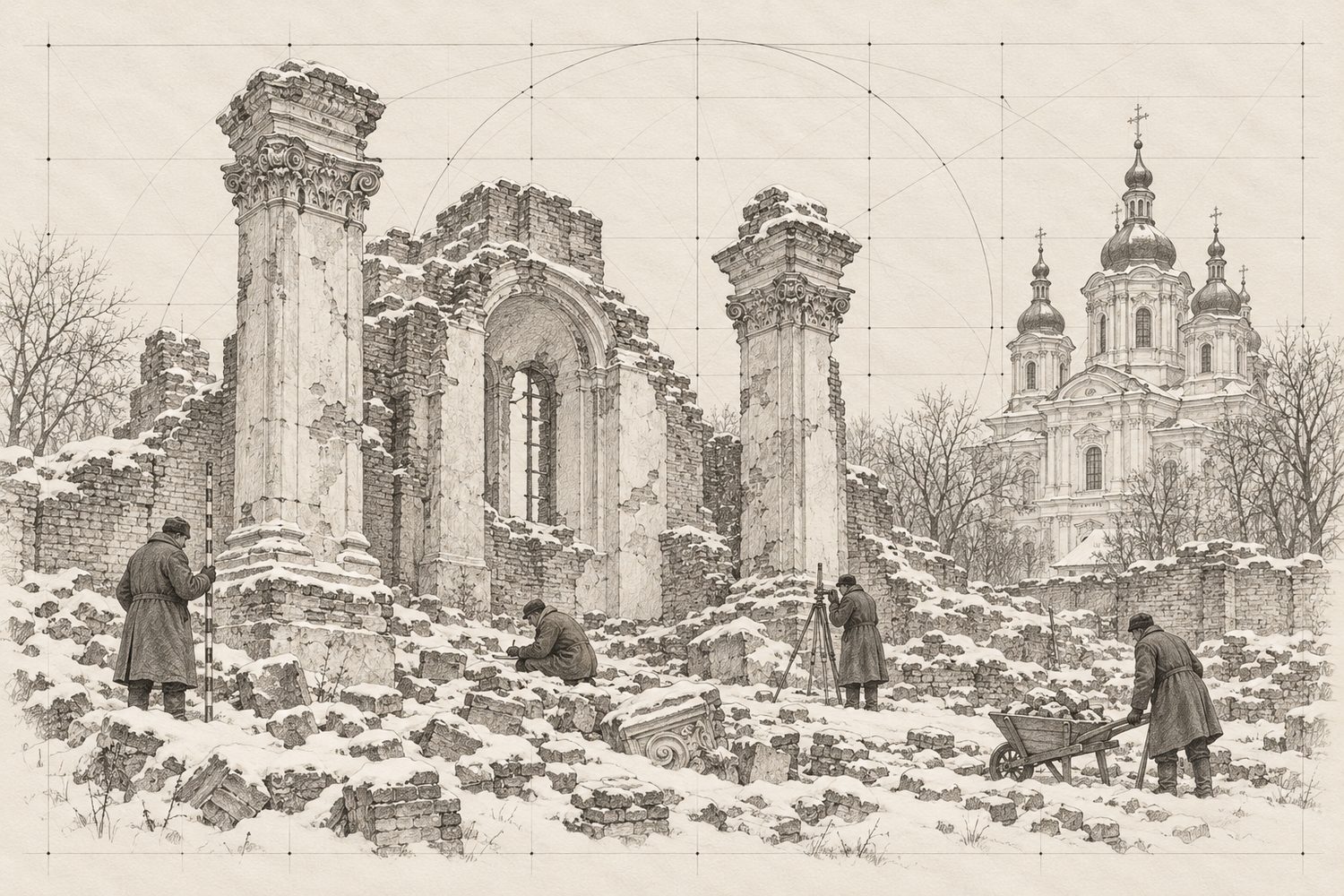
The ruins of the cathedral in the mid-1950s. Illustration: IKONASTONE
The rebuilding
- 1981, 1986
In 1981 a decision to rebuild was made; in 1986 a project to recreate the cathedral in its state of the second half of the 18th century was approved. [1, 5]
- 1995
On 9 December President Leonid Kuchma signed the decree "On Measures for the Recreation of Outstanding Monuments of History and Culture", on the basis of which the Dormition Cathedral and St Michael's Golden-Domed Cathedral were rebuilt. The conservation area's website gives the date as 9 November. [10, 31]
- 1998
Work began on laying the walls; on 21 November the first brick was laid (according to the VUE, by President L. Kuchma). [1, 2, 5]
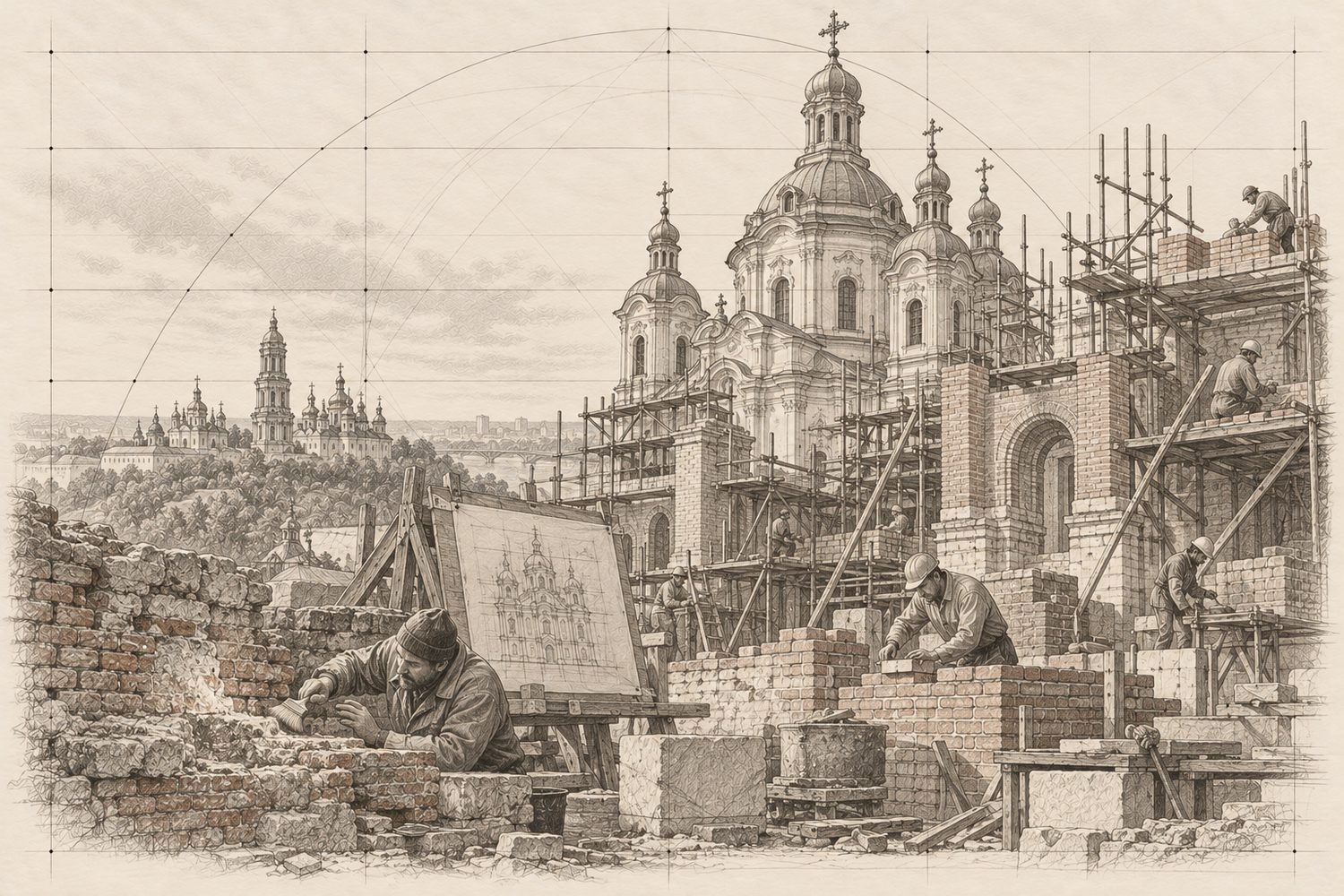
1998–1999: the recreation of the cathedral. Illustration: IKONASTONE - 2000
On 24 August, Independence Day, the rebuilt cathedral was consecrated by Metropolitan Volodymyr of Kyiv. The VUE gives the date as 28 August — the feast of the Dormition. The same year the decoration of the interior began, first of all the recreation of the iconostasis. [1, 2, 4, 5, 10]
Recent times
- 2023
On 5 January the Ministry of Culture announced the completion of the transfer of the Dormition Cathedral and the Refectory Church from the UOC (MP) to the use of the state. [13, 14]
- 2023
On 7 January the first Christmas Liturgy of the Orthodox Church of Ukraine was held in the cathedral; the address after it was delivered by Metropolitan Epiphanius. [14, 15]
- 2023
On 28 August an exhibition marking the 950th anniversary of the founding of the cathedral, "And the Great Church Arose on the Hills of Pechersk", opened in the Lavra. [17]
- 2023
On 15 September the UNESCO World Heritage Committee, at its session in Riyadh, inscribed the site "Kyiv: Saint-Sophia Cathedral and Related Monastic Buildings, Kyiv-Pechersk Lavra" on the List of World Heritage in Danger. [16]
- 2026
On the night of 15 June, during a massed attack on Kyiv, a Russian strike drone hit the sanctuary end of the St Stephen side chapel; a fire broke out on the roof. Monks, museum staff and police evacuated icons, the reliquary of St Stephen, silver and engravings of the 16th–18th centuries. The SBU identified the drone as a "Geran-2". [1, 18, 19]
- 2026
On 24 June the State Emergency Service reported the completion of emergency conservation work on the damaged roof. [20]
- 2026
On 14 July Minister of Culture Tetiana Berezhna named the funding required for conservation — UAH 26 million — and set the goal of finishing it before winter. The Director General of the conservation area, Maksym Ostapenko, estimates the damage at more than UAH 500 million and the restoration at about two years. [18, 21]
Lost and recreated
| What | What it was | What happened | Where it is now |
|---|---|---|---|
| 11th-century mosaics and frescoes | The apse and walls of the Great Church | Lost during rebuildings; the rest perished in 1941 | Smalti, stamped plinthos and fragments of slate slabs — in the conservation area’s collections (2023 exhibition) [5, 17] |
| Baroque paintings of 1729 | The work of the Lavra workshop under Stefan Lubenskyi | Chipped off in 1893–1896, replaced with academic painting | Decoration of the interior began in 2000 [1, 24] |
| 18th-century iconostasis | Five-tier Baroque | Upper tiers dismantled in 1880–1901; the rest perished in 1941 | A new five-tier one, of lime wood: 21 m high, 25 m wide, 96 icons (according to The Page — 93) by Lviv masters [10, 13] |
| Silver riza of the icon of the Dormition | The cathedral’s main sacred object | Confiscated in 1922 | Its fate is not traced in the sources [5, 23] |
| Silver Royal Doors, about 120 rizas, three sarcophagi | The cathedral’s sacristy | Carried off by the occupiers in 1941–1943 | Not returned [3, 4] |
| Tombstone of Kostiantyn Ostrozkyi | Marble, 1579 | Destroyed by the explosion of 1941 | Lost [5, 9] |
| Tombstone of P. Rumiantsev-Zadunaisky | A sculpted tombstone | Destroyed by the explosion of 1941 | Lost [4, 5] |
| Necropolis | More than 130 known individuals in and around the cathedral | Tombstones destroyed in 1941 | Petro Mohyla’s burial was found in 1982; the burial place has still not been restored [9, 22] |
| Relics of Theodosius of the Caves | In the cathedral from 1091 | Hidden before the Mongol invasion | Location unknown (according to Antykvar) [9] |
| Gables and stucco work | 1767–1769, S. Kovnir, Y. Bilynskyi | Lost in 1941 | Recreated in 1998–2000 [1, 10] |
| The cathedral | 11th century, Baroque rebuilding 1722–1731 | Blown up on 3.11.1941 | Rebuilt in 1998–2000 [1, 3, 4] |
| Ancient parts | Fragments of the east wall, part of the baptistery, the altar of St John the Evangelist, two 11th-century pillars | Survived the explosion | Incorporated into the new masonry; in 2026, according to the VUE, it was this eastern part that suffered most [1, 8] |
| Roof and St Stephen side chapel | Rebuilt in 1998–2000 | Drone strike and fire on 15.06.2026 (about 800 m², according to other sources 700 m²) | Emergency covering; conservation and restoration under way [18, 20, 21] |
Architecture
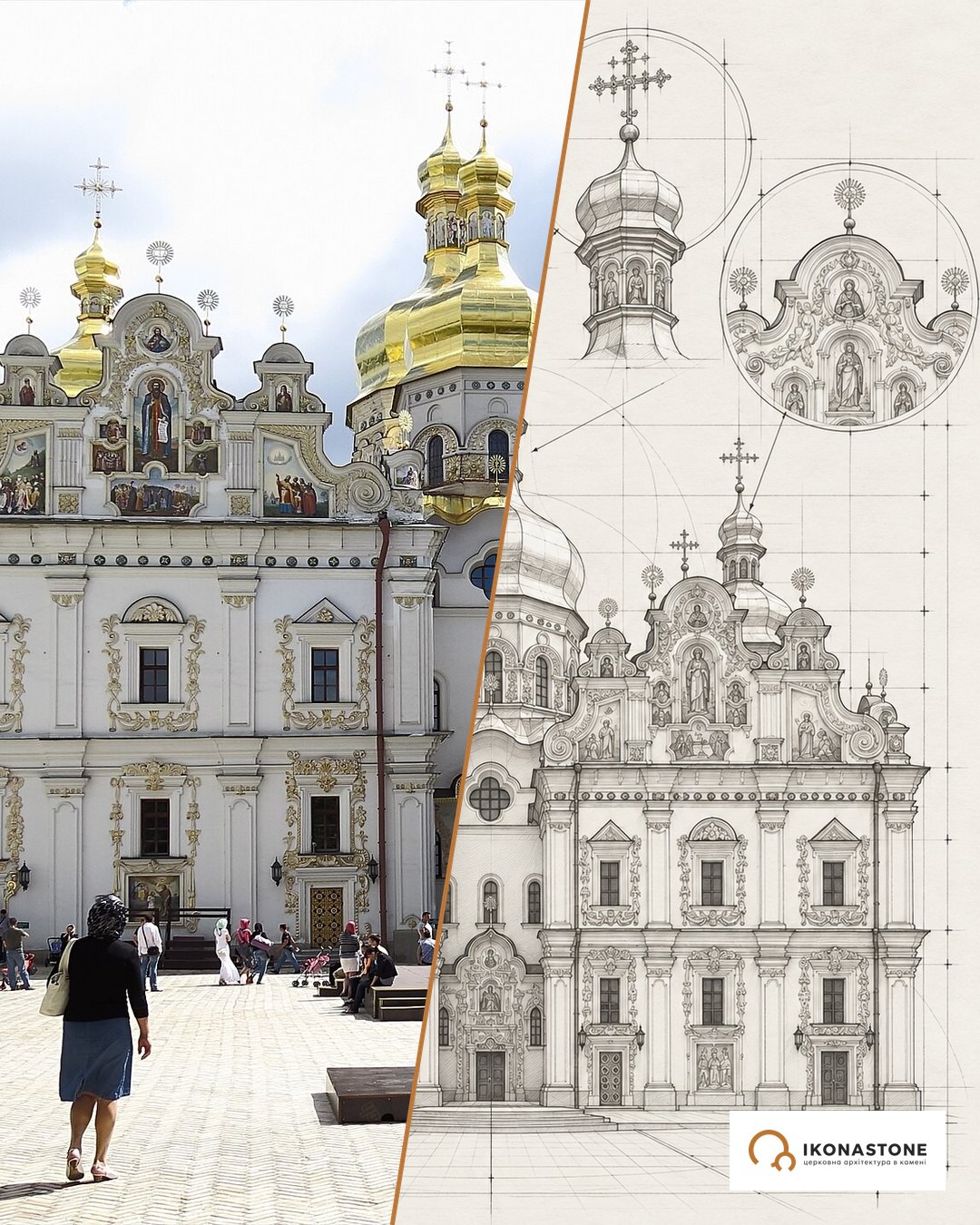
The ancient cathedral, according to most reconstructions, had a single dome on six cross-shaped pillars and three naves. The Baroque rebuilding added domes, gables and stucco work, and it is this 18th-century form that was recreated at the end of the 20th. The height of the rebuilt cathedral with the cross is 51.7 m.
The drawings show the form, not exact dimensions.
The domes
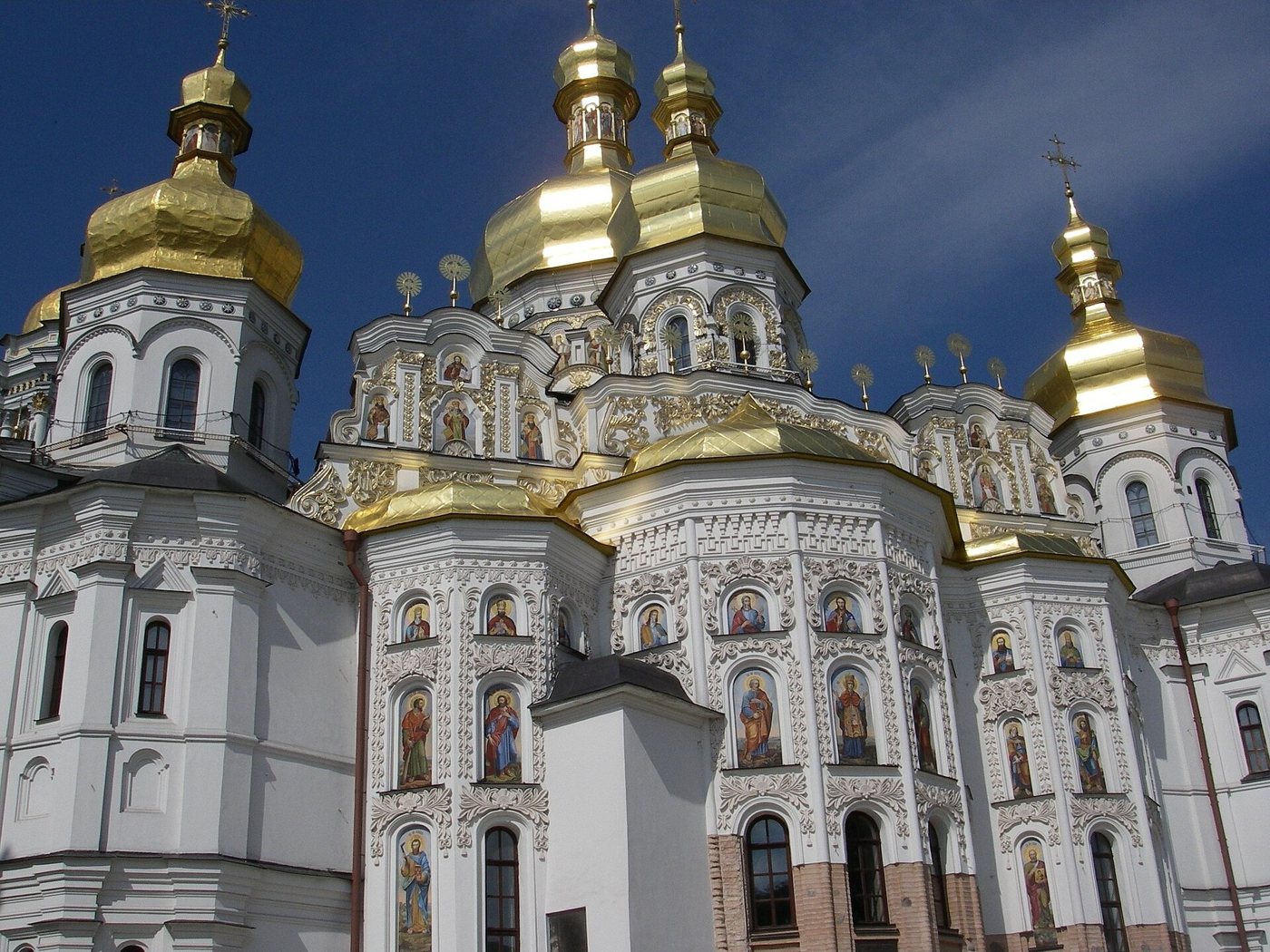
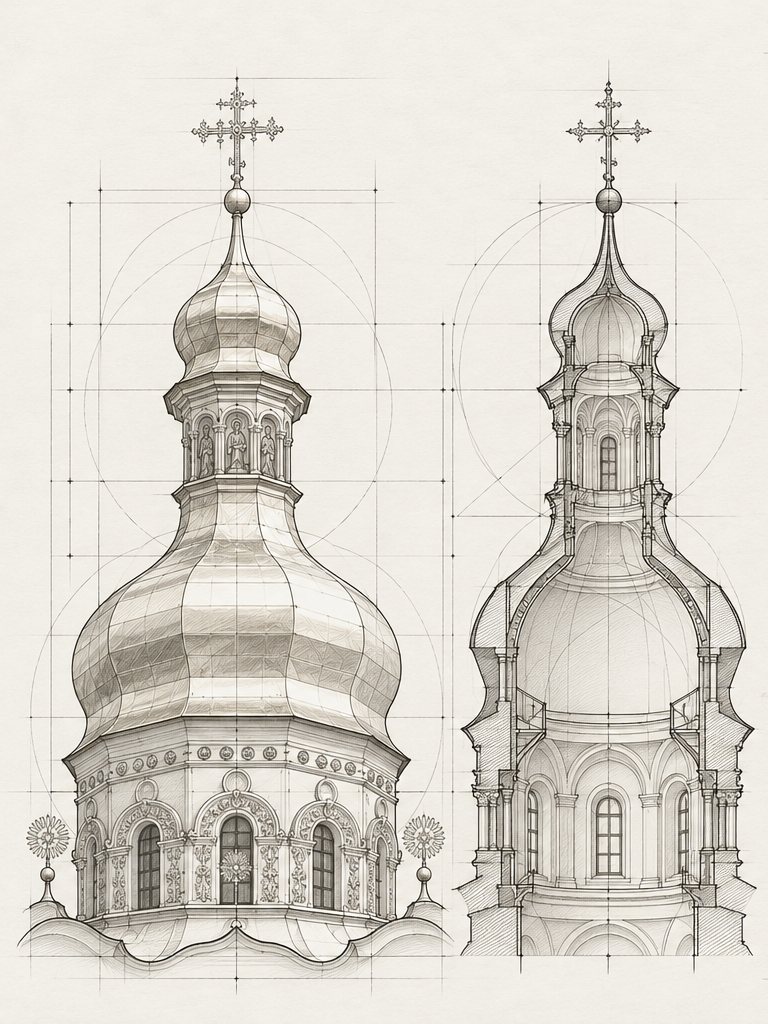
Gilded pear-shaped domes are the chief hallmark of Ukrainian Baroque. More than 8.5 kg of gold went into gilding the domes, crosses and ripidia during the rebuilding.
The facade: stucco and painting
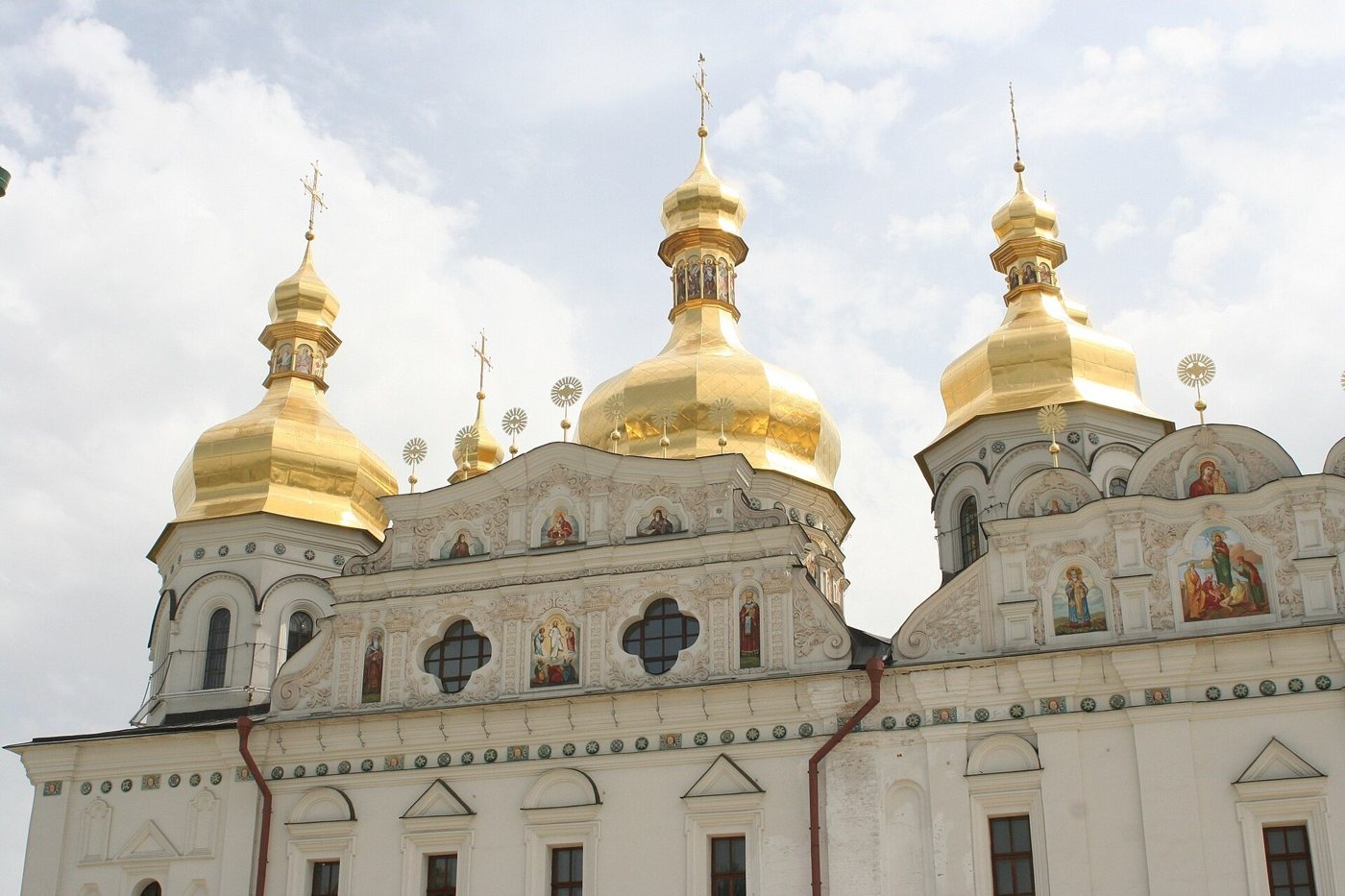
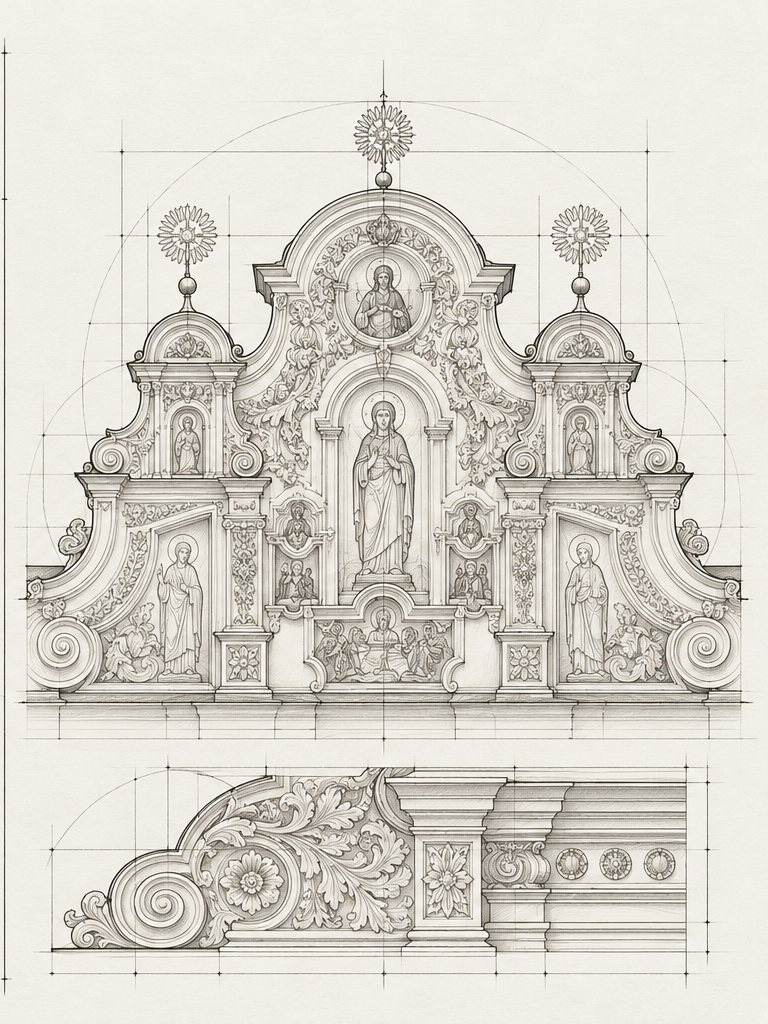
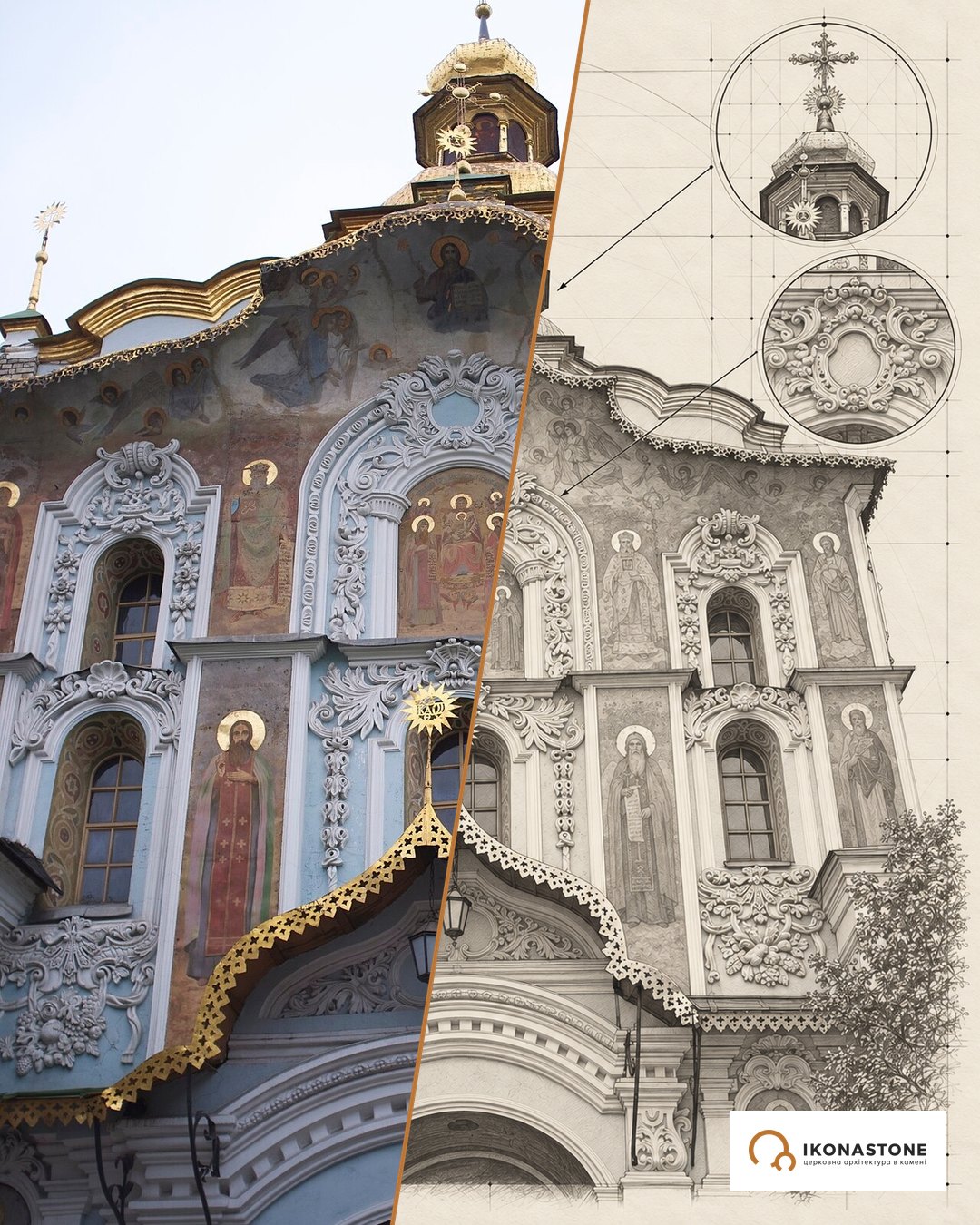
On the facades there are 186 painted compositions and 362 stucco rosettes with angels’ heads on the drums and cornices. The modelling of the wall works here as ornament: the shadow cast by a cornice matters no less than colour.
The iconostasis
The iconostasis was recreated in five tiers, of lime wood, with gilding. It is 21 m high and 25 m wide. How the tiers of such a wall of icons are arranged is explained in the article “Tiers of the iconostasis”, and the features of the Ukrainian type in the article “The Ukrainian iconostasis”.
Stone and material
The ancient walls, according to researchers’ descriptions, were laid of thin Byzantine brick — plinthos — and roughly dressed stone. In recreating the cathedral, the restorers did not use modern brick: the plinthos was made using the old technology, in Kyiv and Ivano-Frankivsk. The walls came out 120 to 170 centimetres thick.
The fragments of the ancient walls that survived the explosion were not taken apart but incorporated into the new masonry. So the cathedral recreated at the end of the 20th century literally stands on 11th-century stone and brick.
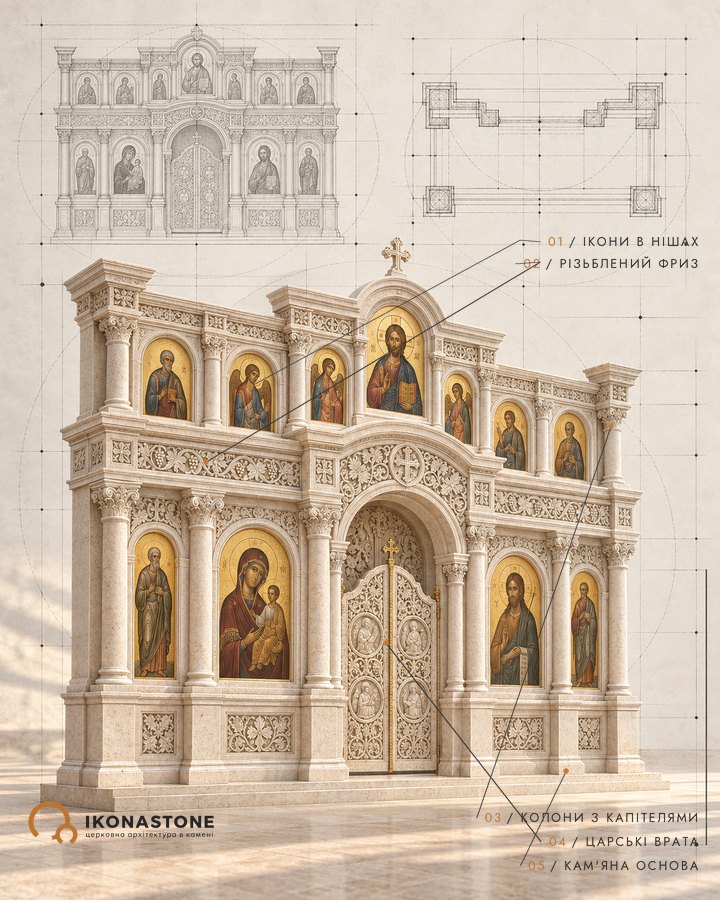
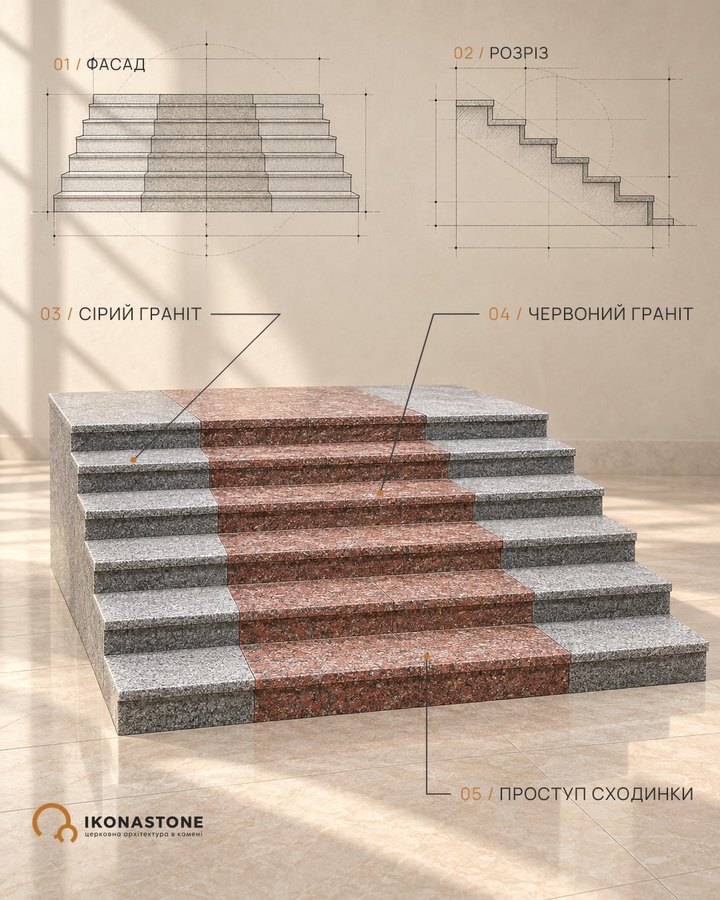
Stone in such a church is most often where it goes unnoticed: underfoot, in the steps and the plinth, which are the first to take moisture and load. This kind of work is covered in the section stone steps and floors.
Did you know
According to the Patericon, the measure of the cathedral was the golden belt of the Varangian Shimon — about 1.08 m: the church was 20 belts wide, 30 long and 50 high. [10, 12]
The founding in 1073, according to the chronicle, was blessed by Michael, Bishop of Yuriv: the metropolitan was then in Constantinople. According to Ye. Kabanets. [6]
The church, built in 1077, was consecrated only in 1089; until the consecration services could not be held in it. [4, 6]
The programme of the 1890s paintings was approved by Alexander III himself on 14 May 1894. [1, 5]
The moment of the explosion on 3 November 1941 was photographed by a German serviceman who, according to both researchers, knew the time of the operation. Kabanets and Kot use these frames as an argument for different conclusions. [7, 8]
More than 130 people buried in and around the cathedral are known; anthropological materials yield the remains of more than 200 people. According to Antykvar. [9]
Petro Mohyla's burial was found in 1982 during archaeological research, but the burial place has still not been restored; the conservation area wants to return the slab. [9, 22]
In 1952, near the south facade of the cathedral, a slate slab with the name of Archimandrite Yelysei Pletenetskyi was found. According to Antykvar. [9]
During the rebuilding in 1999 the tomb of Metropolitan Pavlo Koniuskevych (d. 1770), damaged by the explosion, was found. According to Antykvar. [9]
The new iconostasis is 21 m high and 25 m wide; 25 m is the width, not the height. [10, 13]
In addition to the 8.5 kg of gold for the domes, crosses and ripidia, 5 kg of gold leaf went into gilding the iconostasis. According to The Page. [13]
The 2023 exhibition showed acoustic pots (holosnyky) — ceramic resonators from the ancient walls — and 11th–12th-century plinthos with masters' marks. According to Kyiv Post. [17]
Legends
Shimon's vision
According to the legend recorded in the Kyiv-Pechersk Patericon, the Varangian Shimon, during a storm at sea, saw a church in the sky and heard a voice that named its dimensions in belts. Retold after St Dimitry of Rostov. [12]
The architects from Blachernae
According to the legend, four Greek architects in Constantinople received gold, relics and an icon from the Mother of God in the Church of Blachernae and set off for Kyiv to build a church. Recorded in the Patericon; retold by R. Malenkov. [11, 12]
Fire and dew
According to the legend, Antony prayed that dew would fall on all the ground except the site of the future church; fire from heaven dried the place, outlining the trench for the foundation. Recorded in the Patericon. [12]
The dove in the sanctuary
According to the legend, while the sanctuary was being decorated a white dove flew out of the image of the Mother of God, circled the church and returned. Recorded in the Patericon. [12]
The stone for the altar table
According to the legend, at the consecration in 1089 no slab could be found for the altar table, but one appeared by itself. Recorded in the Patericon. [12]
The incorrupt metropolitan
According to the legend, around 1830 Metropolitan Yevhenii Bolkhovitinov saw Pavlo Koniuskevych in a dream; the tomb was opened and the body proved to be incorrupt. Retold after Glavcom. [25]
The fire of 1718
According to a legend widespread in journalism, the fire of 1718 was caused by envoys of Peter I. The sources cite no documents that would confirm this; the VUE and M. Zharkikh do not name a cause. [1, 5, 25]
Key figures
- Antony of the Caves — founder of the cave monastic community (1051).
- Theodosius of the Caves — abbot, initiator of the construction of the cathedral; his relics were moved to the cathedral in 1091.
- Sviatoslav Yaroslavych — Grand Prince of Kyiv, founder of the cathedral.
- Stephen — abbot under whom construction continued.
- Shimon (Simon) — a Varangian nobleman; according to the Patericon, he gave the belt used as the measure of the cathedral.
- John — Metropolitan of Kyiv, consecrated the cathedral in 1089.
- Semen Olelkovych — Prince of Kyiv, restorer of the cathedral in 1470.
- Kostiantyn and Vasyl-Kostiantyn Ostrozkyi — the father is buried in the cathedral; the son set up his tombstone in 1579.
- Petro Mohyla — metropolitan, restorer of the cathedral, buried in it.
- Ivan Mazepa — hetman, patron of the repair of the late 1690s.
- Fedir Vasyliev, Ivan Kalandin — the author of the design and the master of the Baroque rebuilding after 1718.
- Stefan Lubenskyi — head of the 1729 painting.
- Stepan Kovnir, Yosyp Bilynskyi — the builder and the sculptor of the gables of 1767–1769.
- Mykola Kholostenko — architect and researcher of the ruins.
- Yevhen Kabanets, Serhii Kot — historians, authors of studies on the circumstances of the 1941 explosion.
- Metropolitan Volodymyr (Sabodan) — consecrated the rebuilt cathedral in 2000.
- Maksym Ostapenko — Director General of the conservation area in 2023–2026.
How to cite
IKONASTONE. The Dormition Cathedral of the Kyiv-Pechersk Lavra // Guide to the Churches of Ukraine. URL: https://ikonastone.com/en/guide/dormition-cathedral-kyiv-pechersk-lavra/ (accessed DD.MM.YYYY).
FAQ
Where is the Dormition Cathedral located?
In Kyiv, in Pechersk, on the grounds of the Upper Lavra. The cathedral is part of the National Kyiv-Pechersk Historical and Cultural Conservation Area.
When was the cathedral built?
First in 1073–1078, on the initiative of Saint Theodosius of the Caves, at the expense of Prince Sviatoslav Yaroslavych. On 3 November 1941 the cathedral was blown up; it was rebuilt in 1998–2000 and consecrated on 24 August 2000.
What is the rebuilt cathedral made of?
The walls, 120–170 cm thick, are laid of plinthos made using the old technology. Fragments of the ancient walls that survived the explosion were incorporated into the new masonry.
Who holds services in the cathedral now?
Until the end of 2022 the cathedral was leased by the UOC (Moscow Patriarchate); from 1 January 2023, after the agreements were terminated, the cathedral returned to state management. Since 7 January 2023 the Orthodox Church of Ukraine has held services here; the building is managed by the state conservation area. After the strike of 15 June 2026, emergency and restoration work is under way in the cathedral.
Sources
- ВУЕ. В. Вечерський. Успенський собор Києво-Печерської лаври
- Encyclopedia of Ukraine (CIUS). Dormition Cathedral of the Kyivan Cave Monastery
- Енциклопедія сучасної України. Л. Федорова. Києво-Печерський історико-культурний заповідник Національний
- Національний Києво-Печерський історико-культурний заповідник. Успенський собор
- М. Жарких. Успенський собор Києво-Печерської лаври
- Є. Кабанець. Про первісне освячення Успенського собору Києво-Печерського монастиря // Український історичний журнал. 1998. № 6
- Є. Кабанець. Руйнація Успенського собору Києво-Печерської лаври 3 листопада 1941 р. // Український історичний журнал. 2011. № 5
- С. Кот. Зруйнування Успенського собору Києво-Печерської лаври (3 листопада 1941 р.): версії // Український історичний журнал. 2011. № 6
- Л. Михайлина, С. Пивоваров. «У Печерському монастирі… з предками своїми». Некрополь Успенського собору // Антиквар
- Українська Інкогніта. Бароко в Україні. Успенський собор Києво-Печерської лаври
- Р. Маленков. Києво-Печерська лавра. Велика церква Успіння Пресвятої Богородиці
- Свт. Димитрій Ростовський. О создании церкви честного Успения Пресвятой Богородицы в Киево-Печерской обители // Жития святых
- The Page. Лавра у вогні: як росіяни вже нищили Успенський собор і що з ним було далі
- Радіо Свобода. Мінкультури про богослужіння ПЦУ в Лаврі (05–06.01.2023)
- Укрінформ. Митрополит Епіфаній. Христос народився! Славимо Його! (07.01.2023)
- UNESCO World Heritage Centre. Sites in Kyiv and Lviv added to the List of World Heritage in Danger (15.09.2023)
- Kyiv Post. У Києво-Печерській лаврі відкрилась виставка з нагоди 950-річчя Успенського собору (28.08.2023)
- LB.ua. Атака на Києво-Печерську лавру: як горів Успенський собор і що вдалося врятувати (15.06.2026)
- Радіо Свобода. Удар по Успенському собору Лаври: наслідки й реакції (червень 2026)
- Слово і діло. Атака РФ на Києво-Печерську лавру: як виглядає собор після термінового ремонту (24.06.2026)
- Інтерфакс-Україна. Заява Т. Бережної щодо консервації Успенського собору (14.07.2026)
- РІСУ. У лаврі хочуть відновити місце поховання Петра Могили — Остапенко
- А. Кізлова. Шати в соціальних взаєминах навколо Києво-Печерської ікони Успіння Богородиці (кінець XVIII ст. – 1922 р.) // Сторінки історії. 2017. Вип. 44
- М. Бардік. Барокові розписи Великої Печерської церкви // Вісник НАКККіМ. 2023. № 2
- Главком. І. Костенко, І. Халупа. 950 років Успенському собору Києво-Печерської лаври. 10 фактів (31.10.2023)
- О. Черняхівська. Дослідницька і видавнича діяльність Києво-Печерського історико-культурного заповідника (50–70-ті рр. XX ст.)
- Національний Києво-Печерський заповідник. Микола Холостенко (серія «Люди Успенського собору»)
- Meduza. A. Zolnikova. The last time the Dormition Cathedral was destroyed… (17.06.2026)
- І. Перешило. Радіо Свобода (12.11.2009)
- О. Шапіро // Світогляд. 2023. № 4 (102)
- Освіта.ua. Проблема відтворення втрачених національних святинь
- Town
- Kyiv
- Built
- 1073–1077; rebuilt 1998–2000
- Type
- six-pillar cross-in-square church, Baroque
- Material
- plinthos brick, stone (ancient fragments)
- Research depth
- 38%