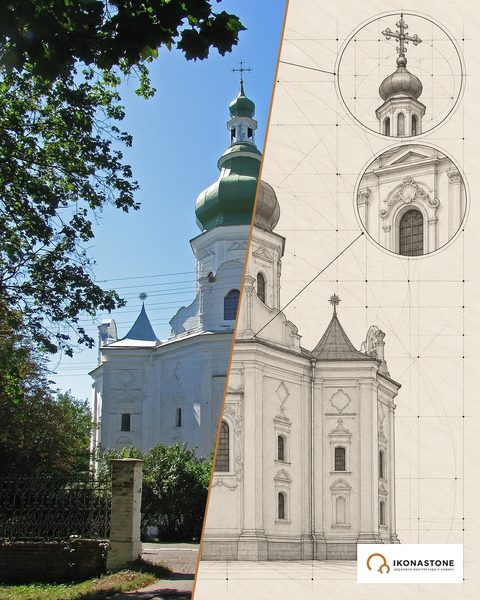
The Holy Trinity Church of the Motronynskyi Monastery: a church that had to be built twice
The nearly finished church was brought down by its own weight in the autumn of 1802, and the masons had to dismantle the ruin and start again. The church that stands in Kholodnyi Yar today is the second attempt, and it is the one that survived everything that came afterwards.
In brief
| Address | Motronynskyi Monastery, near Melnyky village, Cherkasy District, Cherkasy Oblast |
| Built | 1800–1804 (collapse and rebuilding 1802–1804); consecrated 17 October 1805 |
| Contractor | the master Artem Chemenko from the fortress of St Elisaveta (now Kropyvnytskyi) |
| Type | nine-part cruciform church; single-domed until 1889–1900, now five-domed |
| Material | brick; glazed polychrome tiles under the cornice |
| Status | architectural monument of national significance; church of a women’s monastery |
History
The beginnings of the monastery are lost in tradition. Tradition links its foundation with Princess Motrona (Motria), who supposedly gave the monastery lands, and places it in the 12th–13th century; the name Motria, as the compilers of landmarks.in.ua note, is not mentioned in the genealogies of the Old Rus’ princes. VUE is cautious: the legendary date of 1204 is not confirmed by documents, and no archaeological research had been carried out on the monastery grounds as of 2020. What is reliably known is that in the second half of the 16th century a skete with a chapel arose here, and in 1568 the monastery was first mentioned in documents.
What follows is a long period of patronage by hetmans and metropolitans. In 1648 Metropolitan Sylvestr Kossov built a wooden refectory church at his own expense, and in 1726 an oak cathedral Trinity church appeared. In the 18th century the monastery became one of the main Orthodox centres of the Right Bank. From 1753 it was headed by Hegumen Melkhysedek Znachko-Yavorskyi, a graduate of the Kyiv Academy, who had the Orthodox parishes of the Right Bank under his authority. It was here, according to the Encyclopedia of Ukraine, that the Koliivshchyna was prepared; Maksym Zalizniak lived at the monastery. After the uprising the monastery was plundered by punitive detachments, and in the 1770s it was restored.
In 1793 the monastery passed to the Kyiv eparchy, and this opened the way to a masonry cathedral. Construction began in 1800 (according to VUE in May, according to Ukraina Incognita in October) under a contract with the master Artem Chemenko. In October 1802 the nearly completed building collapsed; the ruins were dismantled and the church built anew by 1804. On 17 October 1805 the church was consecrated by Hegumen Antonii. In the 1820s–1830s a masonry refectory, abbot’s cells and other buildings appeared alongside.
In 1843 and 1845 the monastery was visited by Taras Shevchenko. His watercolour “Motryn Monastery” of 1845 later became a document for restorers, because it recorded the original appearance of the church. In 1889–1900 the church was rebuilt: the single-domed church was turned into a five-domed one. In 1911 the monastery became a women’s one; according to RISU, at the end of 1921 58 nuns lived in it.
The years of revolution brought the headquarters of the Kholodnyi Yar Army here, which resisted the Bolsheviks until 1922; the monastery bells, according to a publication by Yurii Melnyk reprinted by RISU, called the insurgents together from the surrounding villages. In 1921 the Soviet authorities took away the monastery lands, on 21 November 1929 the monastery was liquidated, and its property was handed over to the commune “Lenin’s Testament”. In the years of the Second World War the wooden Church of St John Chrysostom burned down. In 1965 work began in the Trinity Church to create a museum of the Koliivshchyna, and the architects S. Kilesso and Yu. Kyslychenko drew up a restoration project; in 1973 there was one more attempt — now for a museum of partisan glory. In 1991 a women’s monastery was revived here.
Timeline
The numbers in square brackets are source numbers in the list at the bottom of the page. The label "according to …" means that a fact is confirmed by only one source. The "Legends" section contains tales and legends: they are recorded in sources but not confirmed by documents.
Era 1. The hill-fort, tradition and the first mention
- 6th–4th century BC
On the site of the future monastery there was a Scythian hill-fort of over 200 ha; its ramparts have survived. [2, 9, 18]
- 1036 (according to tradition)
According to tradition, the voivode Myroslav was returning from a campaign against the Pechenegs, and his wife Motrona, taking his boats for enemy ones, ordered fire to be opened, and her husband died; she took the veil and founded the monastery. Not confirmed by documents. [9, 15, 16, 18, 20]
- 1198 (a version)
According to TravelsInUA, RISU and the Ukrainian Wikipedia, the Simeon Chronicle under 1198 mentions Bishop Pavlo of Pereiaslav, who supposedly founded a church of St John the Baptist. Wikipedia notes that this mention raises great doubts; VUE does not confirm the early dates by documents. [2, 5, 9, 15]
- 1568
The monastery was first mentioned in documents; its foundation (restoration) is linked with the Metropolitan of Kyiv Iona Protasevych. At first it was a skete with a chapel. [1, 2, 3, 4]
- 1620–1621
Hetman Petro Konashevych-Sahaidachnyi issued universals taking the monastery under protection; at that time the first wooden church was consecrated. [1, 9]
- 1648
Metropolitan Sylvestr (Kossov) gave the monastery an antimension; its superiors have since been called hegumens. According to VUE, he also built a wooden refectory church at his own expense. [1, 2, 4]
Era 2. Hegumens, Haidamaks and the wooden monastery
- 1677–1678
During the Turkish campaigns against Chyhyryn the monastery was probably destroyed completely (so ESU puts it). [1, 9]
- 1685
With the blessing of Metropolitan Hedeon (Sviatopolk-Chetvertynskyi) the revival of the monastery began; a wooden church was consecrated. [1, 9]
- 1717
The starosta of Chyhyryn Jan Jabłonowski helped to rebuild the monastery and confirmed its rights to the lands. [4, 9]
- 1717–1753
The hegumen (with interruptions) was Ihnatii (in the world Ustym Sakhnenko), a participant in the defence of Chyhyryn in 1678; RISU calls him a former sotnyk of Chyhyryn. [1, 4, 5]
- 1726 / 1727
The wooden cathedral Trinity church was built: VUE dates it to 1726 (oak) and its consecration to 21 June 1727 (Ukrainian Wikipedia; 1727 also ESU). [1, 2, 9, 13]
- 1753
Melkhysedek (Znachko-Yavorskyi) was appointed hegumen: according to ESU he was hegumen until 1768, according to VUE and RISU until 1777; his year of birth is 1716 (VUE) or 1720 (the ChDU Visnyk). [1, 2, 5, 10]
- 1766
According to VUE, on 23 July the Poles arrested Melkhysedek at the Sokyriany ferry crossing; he did not return to the monastery. [2]
- 1767
Maksym Zalizniak became a novice of the monastery (according to ESU). [1]
- 26 May 1768
The Koliivshchyna began from Kholodnyi Yar: at the monastery, according to Telegraf and the Ukrainian Wikipedia, the insurgents' weapons were blessed. Historians assess the role of the hegumen himself in preparing the uprising differently, and an article in the ChDU Visnyk states that he was not the organiser. [2, 9, 10, 21]
- 1770s
After the Koliivshchyna the monastery was plundered and partly destroyed (landmarks.in.ua writes of attacks by Polish and Russian punitive detachments), but rebuilt. [2, 4]
- 1793
The monastery passed to the Kyiv eparchy and became supernumerary; the Ukrainian Wikipedia gives 1795. [1, 2, 9]
Era 3. The masonry church and Shevchenko
- 1800
The masonry Trinity church was laid down on the site of the wooden one; the contractor was the master Artem Chemenko from the fortress of St Elisaveta (now Kropyvnytskyi). VUE gives May, while Ukraina Incognita, the Ukrainian Wikipedia and RISU give October (RISU, 8 October). [2, 3, 5, 9]
- October 1802
The nearly completed building collapsed; the ruins were dismantled. [2, 3, 9]
- 1804
The church was built anew. [2, 4, 9]
- 17 October 1805
The church was consecrated by Hegumen Antonii. [3, 4, 9]
- 1815–1817
According to ESU, the iconostasis was gilded in 1815, and in 1817 the domes and the cross of the Trinity Church were set up. [1]
- 1820 — 1830s
According to ESU, in 1820 a wooden refectory Church of St John Chrysostom with a bell tower was built; for the 1820s–1830s VUE mentions a new masonry refectory, abbot's cells and other buildings. [1, 2]
- 1843 and 1845
Taras Shevchenko visited the monastery (1843 according to VUE); the watercolour “Motryn Monastery” is dated April–October 1845. In the 20th century it became a source for restoration projects. [2, 9, 13]
- 1847
45 monks and novices lived at the monastery. [2, 9]
- May 1872
Mykola Kostomarov was shown round the monastery by Archimandrite Makarii; among what he was shown was a portrait of Maksym Zalizniak. [11]
- 1889–1900
Rebuilding: the single-domed church became five-domed, the Baroque crowning was replaced with a helmet-shaped one, and four decorative small domes were added. [2, 3, 9]
- 1905
H. Pavlutskyi made a plan and façade of the church (according to Ukraina Incognita). [3]
- 1911
The monastery turned from a men's into a women's one; the monks were transferred to other monasteries. [1, 2, 11, 22]
Era 4. Revolution, closure and ruin
- 1918–1919
After the revolution in Melnyky, at the request of the hegumenia, a self-defence detachment (22 Cossacks) was formed under the teacher Oleksa Chuchupak; the Kholodnyi Yar insurgent organisation began from it. [9, 12]
- 1919–1922
The monastery was a centre of the Kholodnyi Yar insurgent movement (the headquarters of the Kholodnyi Yar Army); the bells, in Yu. Melnyk's words, served for the quick gathering of fighters from the surrounding villages. [1, 6, 9]
- 1921
The Soviet authorities took away about 250 desyatinas of land; at the end of the year, according to RISU, 58 nuns lived at the monastery. [1, 2, 5, 22]
- 1923
The monastery was closed; the nuns formed a religious community that rented the Trinity and St John Chrysostom churches. The ChDU Visnyk dates the closure to about 1924. [4, 5, 9, 11, 16]
- 21 November 1929
By a resolution of the secretariat of the All-Ukrainian Central Executive Committee the monastery and the community were liquidated; the property was handed over to the agricultural commune “Lenin's Testament”. [1, 2, 22]
- 1943
The Germans destroyed the wooden Church of St John Chrysostom together with the people praying in it (so write landmarks.in.ua, the Ukrainian Wikipedia and the Kholodnyi Yar museum; VUE says only “burned down”). [2, 4, 9, 14]
- 1965
Work began on fitting out a museum of the Koliivshchyna in the Trinity Church; the restoration project was drawn up by the architects S. Kilesso and Yu. Kyslychenko (the Ukrainian Wikipedia dates the design documentation to 1968). [2, 9]
- 1973
A new attempt at restoration — for a museum of partisan glory; like the previous one, it was not carried through. [2, 9]
Era 5. Revival
- 1991
The monastery was restored as a women's monastery of the UOC (MP); according to MoreInfo, the Synod took the decision on 24 January. [1, 2, 16, 22]
- 1992
The first service was held in the restored Trinity Church (according to MoreInfo). [16]
- Late 1990s
A two-storey block of cells was built opposite the cathedral, and the grounds were enclosed with a wall with a gate (according to VUE). [2]
- 2004
28 nuns lived at the monastery. [8, 9]
- April 2017
A “Cossack Cross” was built on the grave of the sotnyk Ivan Kompaniiets on the monastery grounds (according to the Ukrainian Wikipedia). [9]
- 4 October 2023
Activists of “Decolonisation. Ukraine” appealed to the SBU over icons of Russian saints in the monastery church (at the time of publication it belonged to the UOC MP). [7]
Lost and restored
| What | What there was | What happened | Where it is now |
|---|---|---|---|
| The wooden Trinity church | 1726/1727 | Gave way to the masonry church of 1800–1805 | Not preserved [2, 9] |
| The first masonry church | 1800–1802 | In October 1802 the nearly finished building collapsed | Dismantled; on its site stands the church of 1804–1805 [2, 3, 9] |
| The Baroque crowning of the Trinity Church | 1805 | 1889–1900: replaced with a helmet-shaped one, four small domes added | Not preserved; now five domes [2, 3] |
| The wooden Church of St John Chrysostom with a refectory | 1820 (according to ESU) | Destroyed in 1943 (according to VUE, “burned down”) | Not rebuilt [1, 2, 4, 14] |
| The wooden gate bell tower | 1770s, oak | Not preserved (according to RISU) | Not rebuilt [5] |
| The monastery park and orchard | Up to 30,000 poods of fruit a season (according to ESU) | Destroyed after the war on the order of a collective-farm chairman (according to the Ukrainian Wikipedia) | Lost [1, 9] |
| The monastery lands | About 250 desyatinas | Taken away in 1921 | Lost [1, 2, 22] |
| The grave of the sotnyk Ivan Kompaniiets | On the monastery grounds | Levelled in Soviet times (so writes Yu. Melnyk, calling him Kolomiiets) | In 2017 a “Cossack Cross” was built over the grave (according to the Ukrainian Wikipedia) [6, 9, 19] |
| The Haidamak cauldron | Served to call Haidamak councils | Later used as a bell at the monastery (according to the Kholodnyi Yar museum) | National Museum of the History of Ukraine, Kyiv (one source) [14] |
| The portrait of Melkhysedek | An early original | The portrait from the monastery is a later copy (according to the ChDU Visnyk) | The copy is in the Cherkasy Art Museum, the original in the Kyiv Pechersk Lavra [11] |
| The monastery ensemble as a whole | 19th century | After the closure and the war most buildings were destroyed | As of 2020 only the Trinity Church survives [2, 9] |
Architecture
The church is nine-part and cruciform in plan: four piers with arches carry an octagonal drum, above which originally stood one dome with a break and a finial. The arms of the cross end in triangular pediments. The proportions are slender, the drum is high, the corners of the façades are rounded, and the walls are articulated by pilasters, cornices and horizontal string courses.
Stylistically the church stands on the border of epochs. It was built in the age of Classicism, but the nine-part cruciform plan is a direct legacy of Ukrainian Baroque; the authors of the “Ukraina Incognita. Baroque” project link this with the fact that the church appeared after the Synod’s ban of 1801 on churches in the “Little Russian style”. Similar churches, according to them, exist in the Sicheslav region.
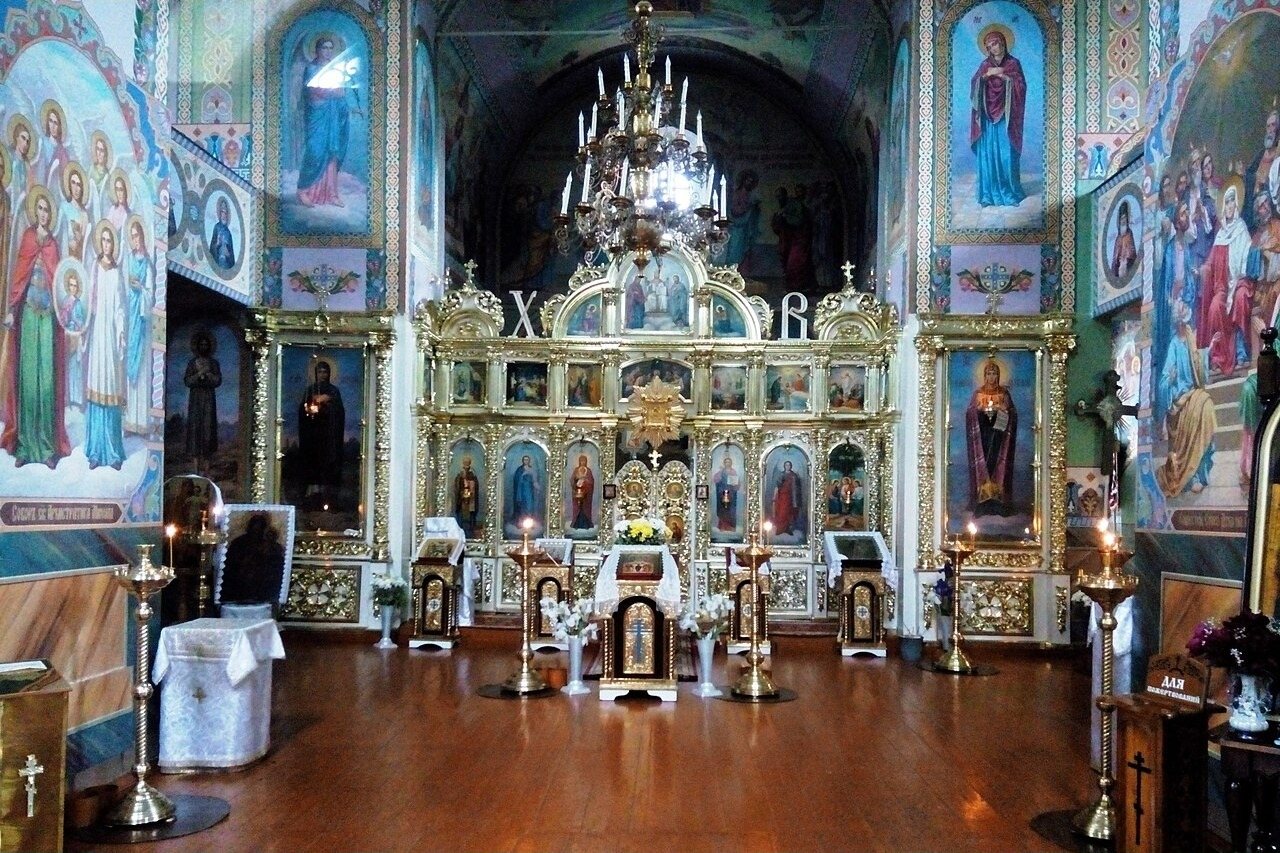
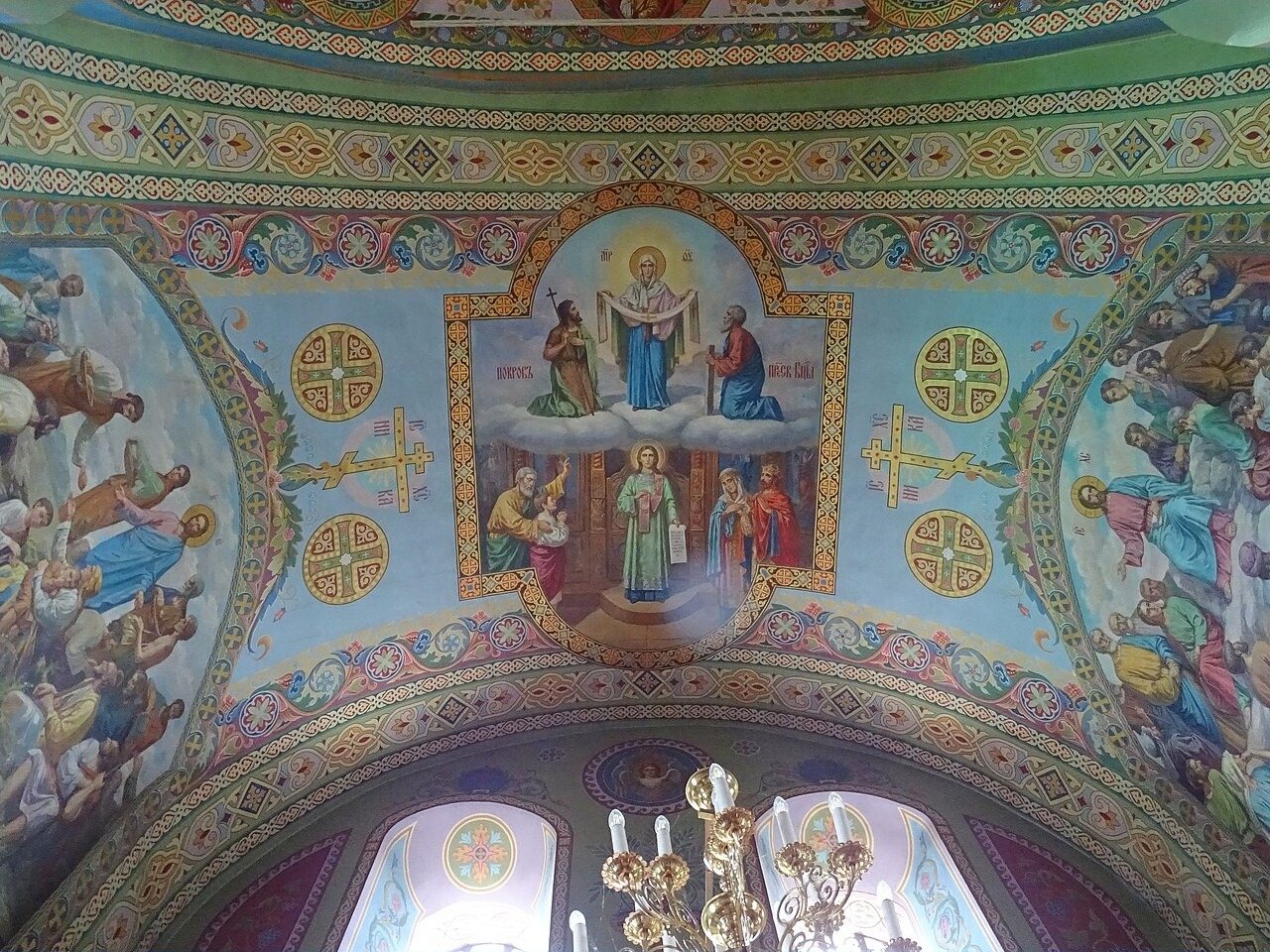
It is interesting how differently researchers read the church. VUE speaks of Classicism with features of Ukrainian Baroque, while the compilers of the landmarks.in.ua guide assign it to Romanticism with elements of eclecticism and note that the ascetic interior contrasts with the whimsical forms of the façades. Inside, everything rests on light: large arched windows flood the space evenly, without dramatic contrasts, and they create the sense of elevation that researchers write about.
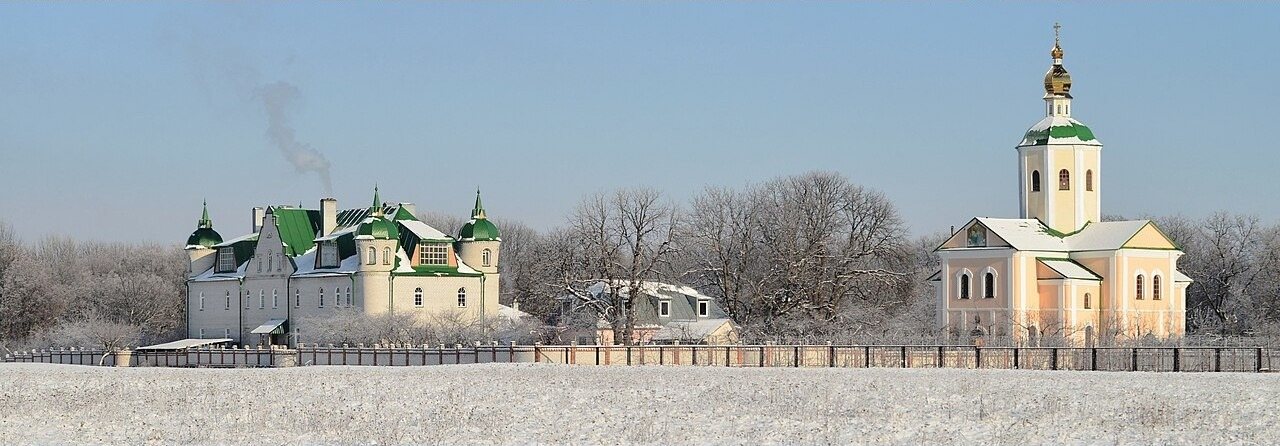
The reconstruction of 1889–1900 changed the silhouette: the Baroque crowning was replaced with a helmet-shaped one, and above the arms four decorative small domes were set on little turrets. In 1905 H. Pavlutskyi made a plan and façade of the church.
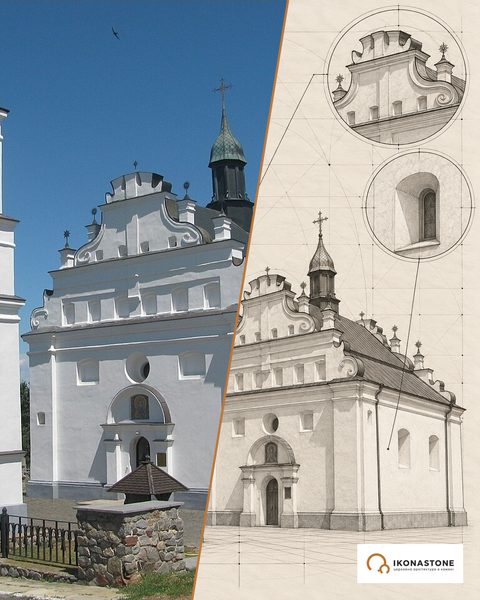
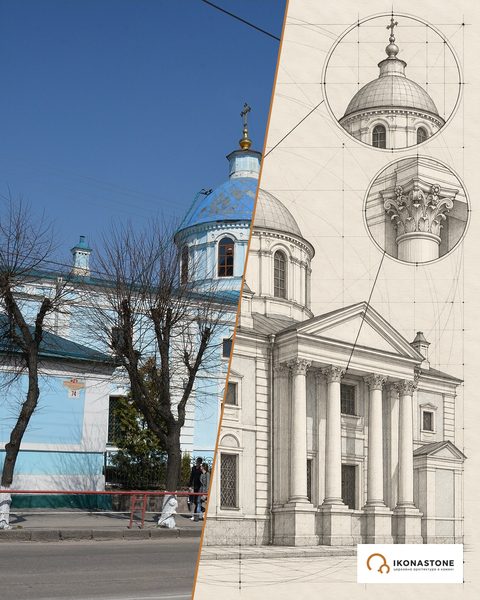
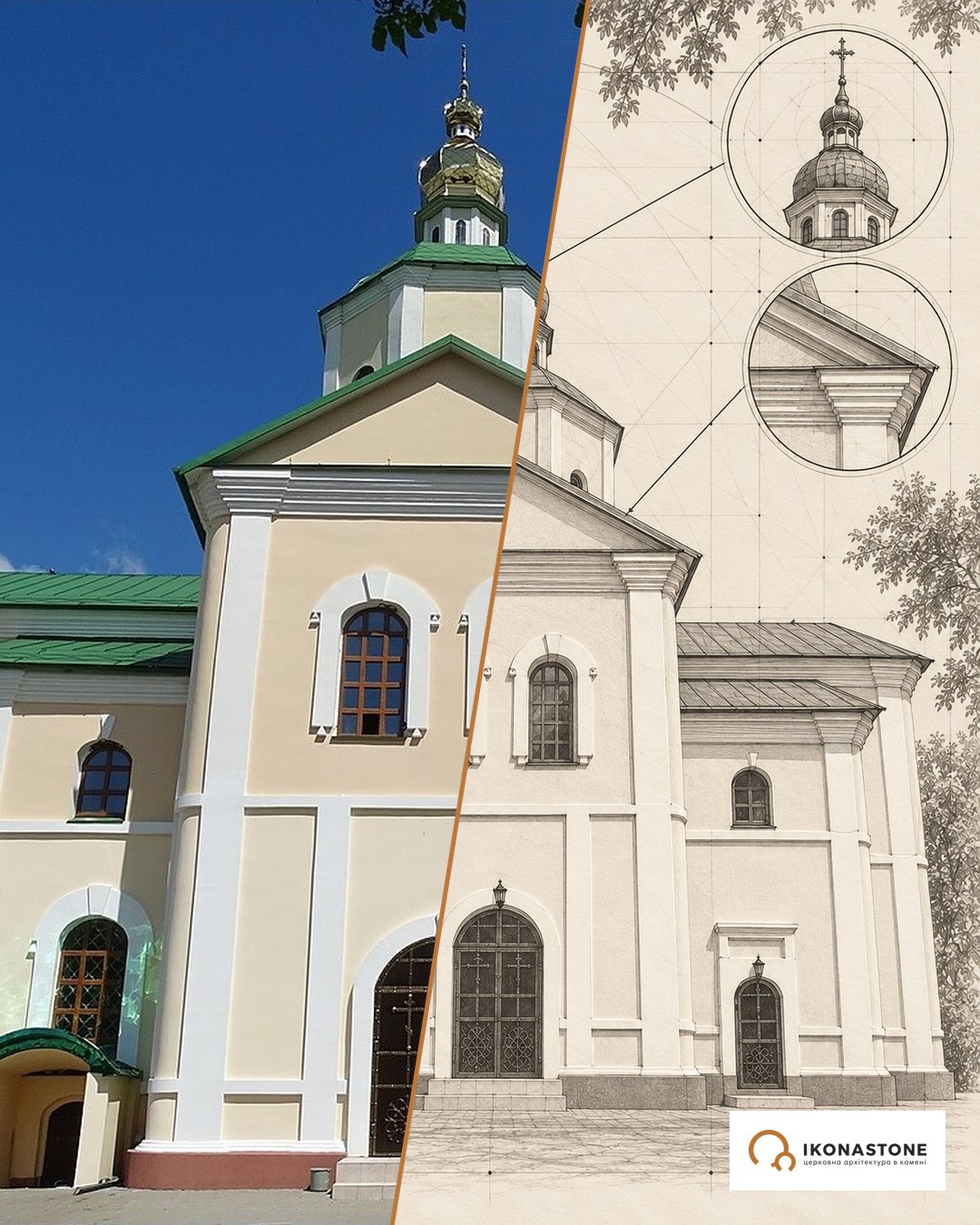
Below are two elements of the church, in a photograph and in a drawing. The drawings show the form, not exact dimensions.
The central dome with its drum
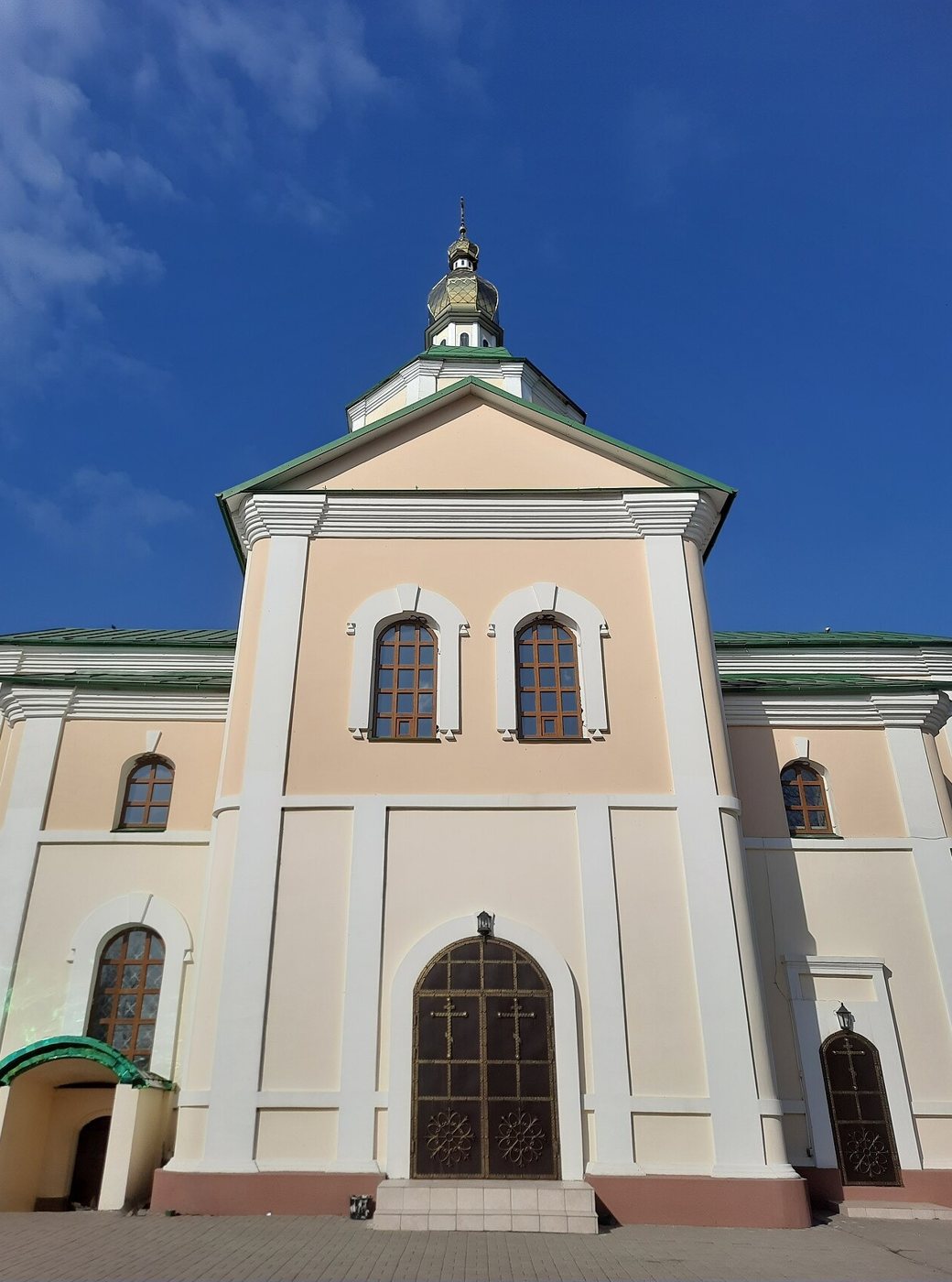
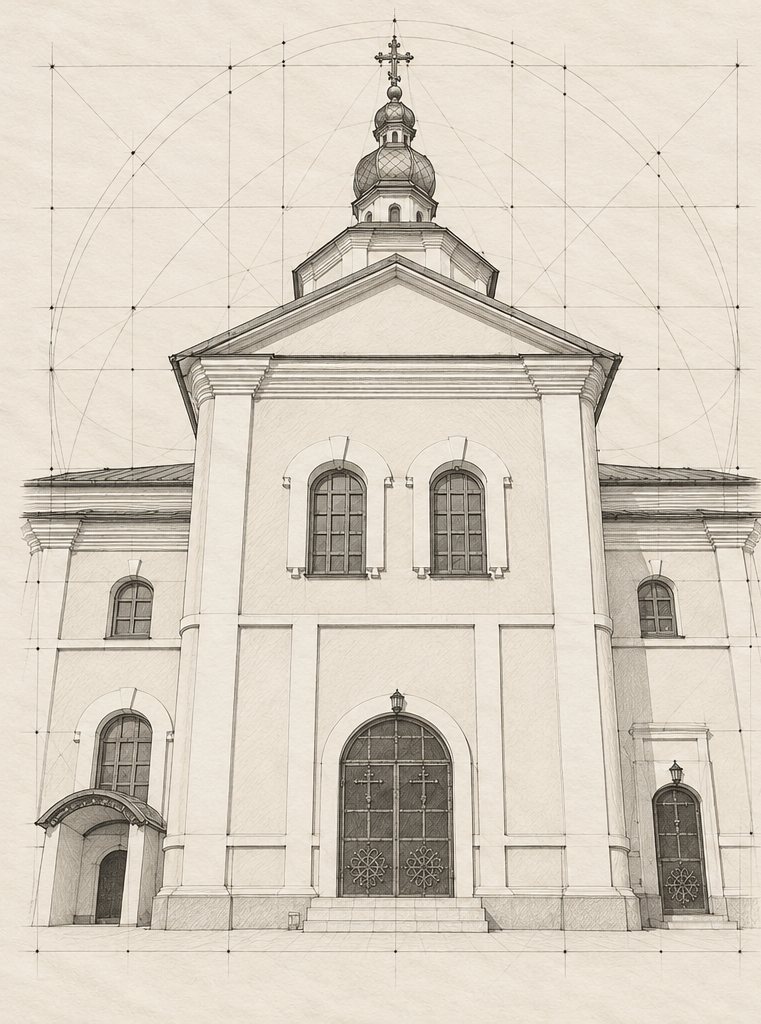
The tall octagonal drum rests on four piers in the crossing. The present helmet-shaped crowning is the result of the rebuilding of 1889–1900.
An arm with a triangular pediment
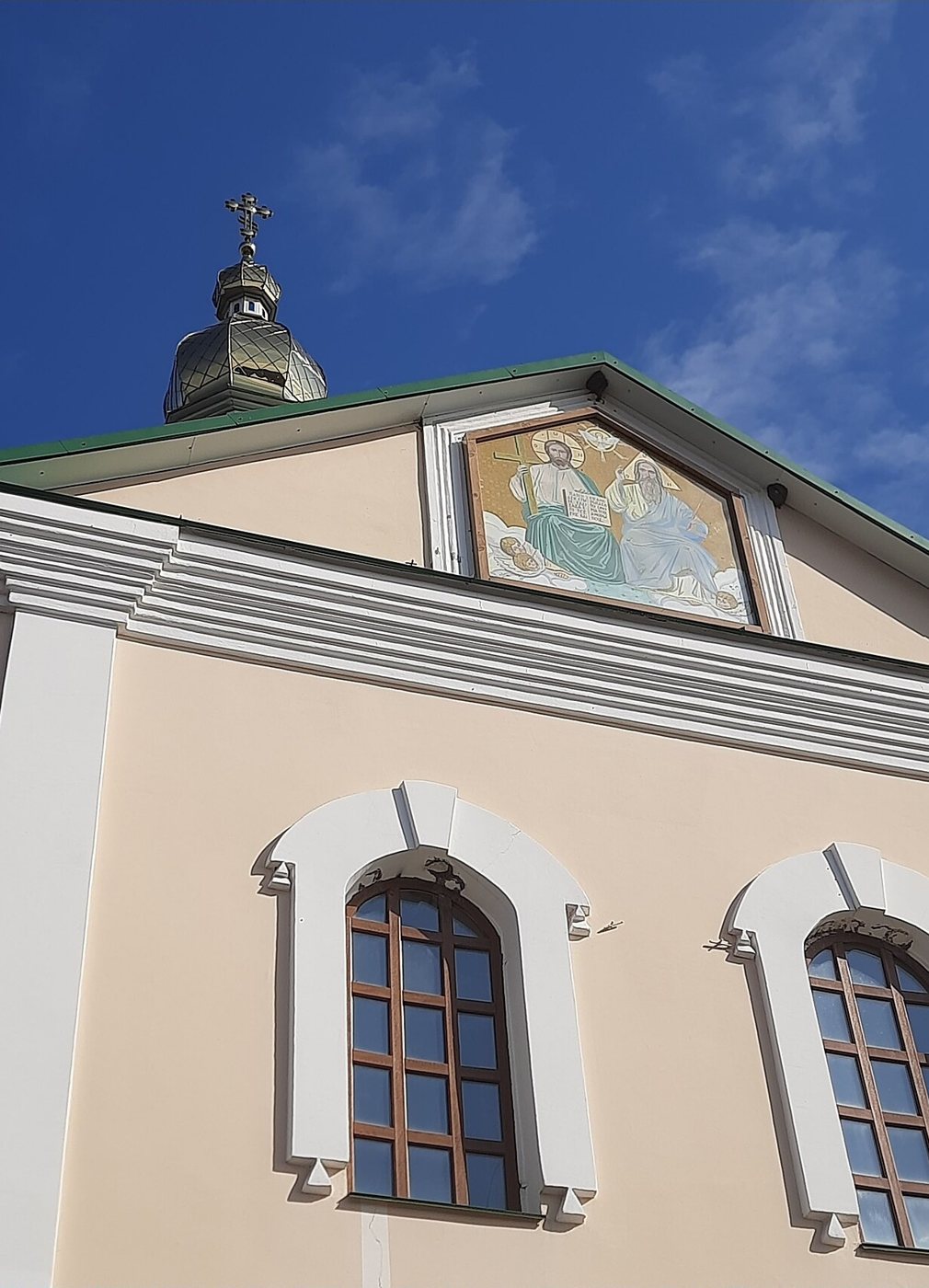
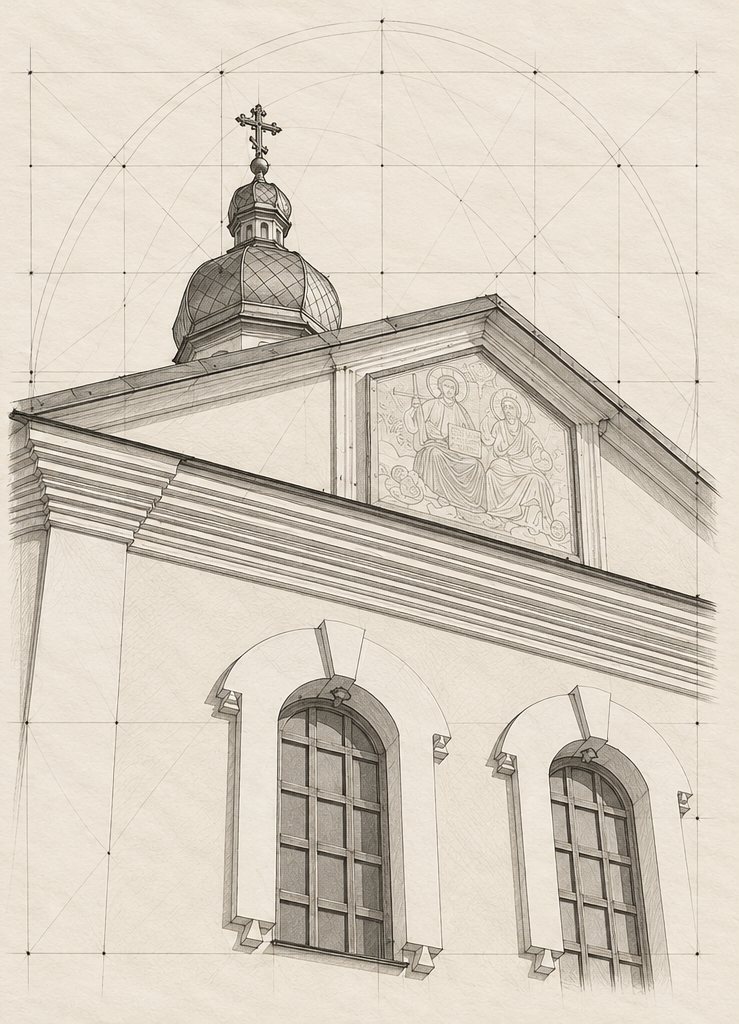
Each of the four arms of the cross ends in a triangular pediment, symmetrically articulated by pilaster strips. Above the arms are decorative small domes, added at the end of the 19th century.
Subtleties that are easy to miss
Tiles under the cornice. The restrained decor of the façades — smooth architraves, shallow niches — suddenly comes alive right under the cornice: there lies a band of identical glazed polychrome tiles. The detail is easy to miss if you look only at the domes.
A church that fell before its consecration. The collapse of 1802 is not a legend but a documented fact. The builders did not patch the ruin: it was dismantled and laid anew. So the walls we see are of 1802–1804, and the crowning is a rebuilding of the late 19th century.
Shevchenko as a restoration drawing. The watercolour “Motryn Monastery” of 1845 was used by researchers when designing the restoration of the church. A rare case when a poet’s drawing served as an architectural document.
Knives that perhaps never were. The tradition that Hegumen Melkhysedek blessed Haidamak knives entered literature thanks to the poem “Haidamaky”. VUE writes plainly: it is not confirmed by historical sources.
A grave that is not there. On the monastery grounds is buried the sotnyk of the Kholodnyi Yar insurgents Ivan Kompaniiets (in Yurii Melnyk’s publication, Kolomiiets). In Soviet times his grave was levelled with the ground and, according to the same publication of 2011, never restored.
A veteran hegumen. Among the hegumens of the monastery was Ihnatii (Ustym Sakhnenko) — according to landmarks.in.ua, a former Zaporozhian Cossack and participant in the defence of Chyhyryn in 1678. The monastery in the forest long remained a place where prayer and military memory lived side by side.
The spring of St Onuphrius. A spring wells up near the monastery. According to tradition, it was dug by the first ascetics of the monastery; pilgrims consider the water healing.
The museum that preserved the church. Of the old ensemble only the Trinity Church survived. The plans of 1965 and 1973 to make a museum in it — first of the Koliivshchyna, then of partisan glory — were not carried through, but of the whole old ensemble it was the Trinity Church that survived.
Photo gallery
Stone and material
The church is built of brick. The façades hold together by modelling: rounded corners, pilasters, a profiled cornice, thin bands. The only colour accent comes from ceramics — the glazed polychrome tiles under the cornice. In the interior light plays a large role: the numerous arched windows make the space elevated and at the same time ascetic.
The story of 1802 recalls something stonemasons know from the first year of the trade. A wall, like a block of stone, does not forgive haste: a wall that looked finished does not yet mean a structure that is already working. The builders of Motronyn had the courage to begin again. Such decisions about weight, supports and load are best taken before installation — just as for an iconostasis in stone.
Nearby, in the Chyhyryn region, stands another church of the Cossack era — the Church of the Prophet Elijah in Subotiv. On how the altar space is arranged, read the article on the altar table and the table of oblation, and on the tradition in the essay on the Ukrainian iconostasis.
Did you know
In October 1802 the church, which was nearly finished, collapsed; according to the Ukrainian Wikipedia, it had been wrongly designed. The new one was built in 1804. [2, 3, 9]
According to Ukraina Incognita, in 1801 the Synod forbade the building of churches in the “Little Russian style”, and the Trinity Church arose after that. [3]
H. Pavlutskyi in 1905 made a plan and façade of the church, so it is known what it was like before the changes. [3]
According to ESU, the monastery had such a large orchard that up to 30,000 poods of fruit were gathered in a season. [1]
The farm included mills, orchards and an apiary of 66 hives. [4]
The monastery stands on the ramparts of a Scythian hill-fort of over 200 ha. [2, 18]
Hegumen Ihnatii (Ustym Sakhnenko) took part in the defence of Chyhyryn in 1678, was taken prisoner by the Turks, and then took monastic vows. [4, 5]
According to “Svitohliad”, in childhood Taras Shevchenko went on pilgrimage to this monastery with his sisters. [13]
Until the early 19th century all the monastery's buildings were wooden; the Trinity Church was the first masonry one. [2]
Near the monastery the spring of St Onuphrius wells up and the Monastery (Haidamak) Pond lies. [5, 15]
At the end of 1921 58 nuns lived at the monastery (according to RISU). [5]
In 1847 45 monks and novices lived at the monastery. [2, 9]
The start of construction of the masonry church is dated both to May (VUE) and to October 1800 (Ukraina Incognita, Ukrainian Wikipedia, RISU). [2, 3, 5, 9]
Legends
Princess Motrona
According to tradition, the monastery was founded by Motrona, wife of the voivode Myroslav, after his death in 1036. Recorded in the Ukrainian Wikipedia, on MoreInfo, TravelsInUA, ArmyInform and Restplace. [9, 15, 16, 18, 20]
The sunken boat
According to tradition, Motrona ordered the boat with her husband's body to be sunk. Recorded on find-way.com.ua. [17]
The blessed knives
According to tradition, Hegumen Melkhysedek blessed Haidamak knives during the all-night vigil, supposedly sent by the empress. VUE stresses: this is not confirmed by historical sources; Shevchenko described the episode in the poem “Haidamaky”. [2]
Weapons from the empress
According to tradition, the weapons were sent to the insurgents by Catherine II. Recorded by RISU. [5]
Scythian gold
According to tradition, the monastery bought up gold from the Scythian burial mounds from diggers; find-way.com.ua notes that the truth of this is a question for historians. Recorded also in the Ukrainian Wikipedia. [9, 17]
The spring of Onuphrius
According to tradition, the spring was dug by the first ascetics; the water is healing. Recorded by RISU; TravelsInUA calls it miracle-working. [5, 15]
The Haidamak pond
According to tradition, the Haidamaks blessed their weapons at the pond near the monastery. Recorded on TravelsInUA. [15]
The bells of Kholodnyi Yar
According to Yu. Melnyk, the monastery bells once served for the quick mobilisation of warriors from the surrounding villages. [6]
Figures
- Motrona — the legendary founder (according to tradition, 1036).
- Iona Protasevych — Metropolitan of Kyiv, with whose name the foundation of 1568 is linked.
- Petro Konashevych-Sahaidachnyi — hetman, issued the universals of 1620–1621.
- Sylvestr (Kossov) — metropolitan; the antimension of 1648, the wooden refectory church.
- Hedeon (Sviatopolk-Chetvertynskyi) — metropolitan; the revival of 1685.
- Jan Jabłonowski — starosta of Chyhyryn, helped to rebuild the monastery in 1717.
- Ihnatii (Ustym Sakhnenko) — hegumen 1717–1753, participant in the defence of Chyhyryn in 1678.
- Melkhysedek Znachko-Yavorskyi — hegumen from 1753 (until 1768 according to ESU, until 1777 according to VUE).
- Maksym Zalizniak — novice of the monastery from 1767, one of the leaders of the Koliivshchyna.
- Artem Chemenko — master contractor of the masonry church of 1800–1804.
- Antonii — hegumen who consecrated the church on 17.10.1805.
- Taras Shevchenko — visited the monastery in 1845 (and in 1843 according to VUE), author of the watercolour “Motryn Monastery”.
- Mykola Kostomarov — visited the monastery in May 1872.
- Makarii — archimandrite who accompanied Kostomarov.
- H. Pavlutskyi — made a plan and façade of the church in 1905.
- Oleksa Chuchupak — teacher, headed the self-defence detachment in Melnyky (1918–1919).
- Serhii Kilesso, Yu. Kyslychenko — architects of the restoration project (1960s).
- Ivan Kompaniiets — sotnyk of the Kholodnyi Yar insurgents, buried on the monastery grounds (Kolomiiets in Yu. Melnyk).
How to cite
IKONASTONE. The Holy Trinity Church of the Motronynskyi Monastery // Guide to the Churches of Ukraine. URL: https://ikonastone.com/en/guide/holy-trinity-church-motronynskyi-monastery/ (accessed DD.MM.YYYY).
FAQ
When was the Holy Trinity Church built?
Construction of the masonry church began in 1800 (VUE gives May, Ukraina Incognita October). The nearly finished building collapsed in 1802, was dismantled and built anew by 1804. The church was consecrated on 17 October 1805.
Is it true that Haidamak knives were blessed at the monastery?
This is a legend. The Great Ukrainian Encyclopedia notes that the tradition of the blessing of knives by Hegumen Melkhysedek Znachko-Yavorskyi is not confirmed by historical sources. According to the Encyclopedia of Modern Ukraine, the Koliivshchyna of 1768 was prepared at the monastery, and Maksym Zalizniak lived in the community; historians assess the role of Hegumen Melkhysedek in these events differently.
Why does the church have five domes if it is described as single-domed?
Originally the church was single-domed. During the reconstruction of 1889–1900 it was turned into a five-domed one: the Baroque crowning was replaced with a helmet-shaped one and four decorative small domes were added above the arms.
What survives of the old monastery?
According to VUE as of 2020, only the masonry Holy Trinity Church survives of the old ensemble. The other buildings, including the wooden Church of St John Chrysostom, which burned down during the Second World War, are lost.
Is the monastery active today?
Yes. In 1991 a women's monastery of the Ukrainian Orthodox Church (Moscow Patriarchate) was revived here. In the late 1990s a block of cells was built and the grounds were enclosed with a wall.
Sources
- Encyclopedia of Modern Ukraine. Motronynskyi Holy Trinity Monastery (Yu. Marynovskyi)
- VUE (Great Ukrainian Encyclopedia). Motronynskyi Trinity Monastery
- Ukraina Incognita. Baroque: the Trinity Church of the Motronynskyi Monastery
- Architectural and natural monuments of Ukraine: Motronynskyi Monastery
- RISU. Motronynskyi Monastery — a not-forgotten Cossack-insurgent monastery
- RISU (en). What kind of people are the current owners of the shrine in the Kholodny Yar? (Yu. Melnyk, 10.11.2011)
- RISU. Activists demand that the SBU pay attention to icons of Russian saints in a monastery of the UOC MP (04.10.2023)
- Encyclopedia of Ukraine. Motronynskyi Trinity Monastery
- Wikipedia (uk). Holy Trinity Motronynskyi Convent
- Visnyk ChDU (history). Article on Melkhysedek Znachko-Yavorskyi
- Visnyk ChDU (history). Article on the portrait of Melkhysedek (Kostomarov 1872, 1911, 1924)
- Visnyk ChDU (history). Article on the Motronynskyi Monastery and the Kholodnyi Yar movement (Chuchupak)
- Svitohliad. Ivchenko, 2013, no. 6
- Kholodnyi Yar Museum (e-museum)
- TravelsInUA. Trinity Motronynsky monastery, Melnyky
- MoreInfo.ua. Motronyn monastery
- Find-Way. The Motronynskyi Monastery in Kholodnyi Yar
- ArmyInform. The secrets of Kholodnyi Yar (03.11.2021)
- ArmyInform. Traditional commemorations of heroes were held in Kholodnyi Yar (27.06.2022)
- Restplace. Holy Trinity Motronynskyi Convent
- Telegraf. How Kholodnyi Yar became a symbol of the unconquered Ukrainian spirit (06.12.2024)
- Wikipedia (en). Motronynskyi Monastery
- Town
- Melnyky village (Kholodnyi Yar), Cherkasy Oblast
- Built
- 1800–1804, consecrated 1805; rebuilt 1889–1900
- Type
- nine-part cruciform church, originally single-domed; Classicism with features of Ukrainian Baroque
- Material
- brick, glazed polychrome tiles under the cornice
- Research depth
- 27%