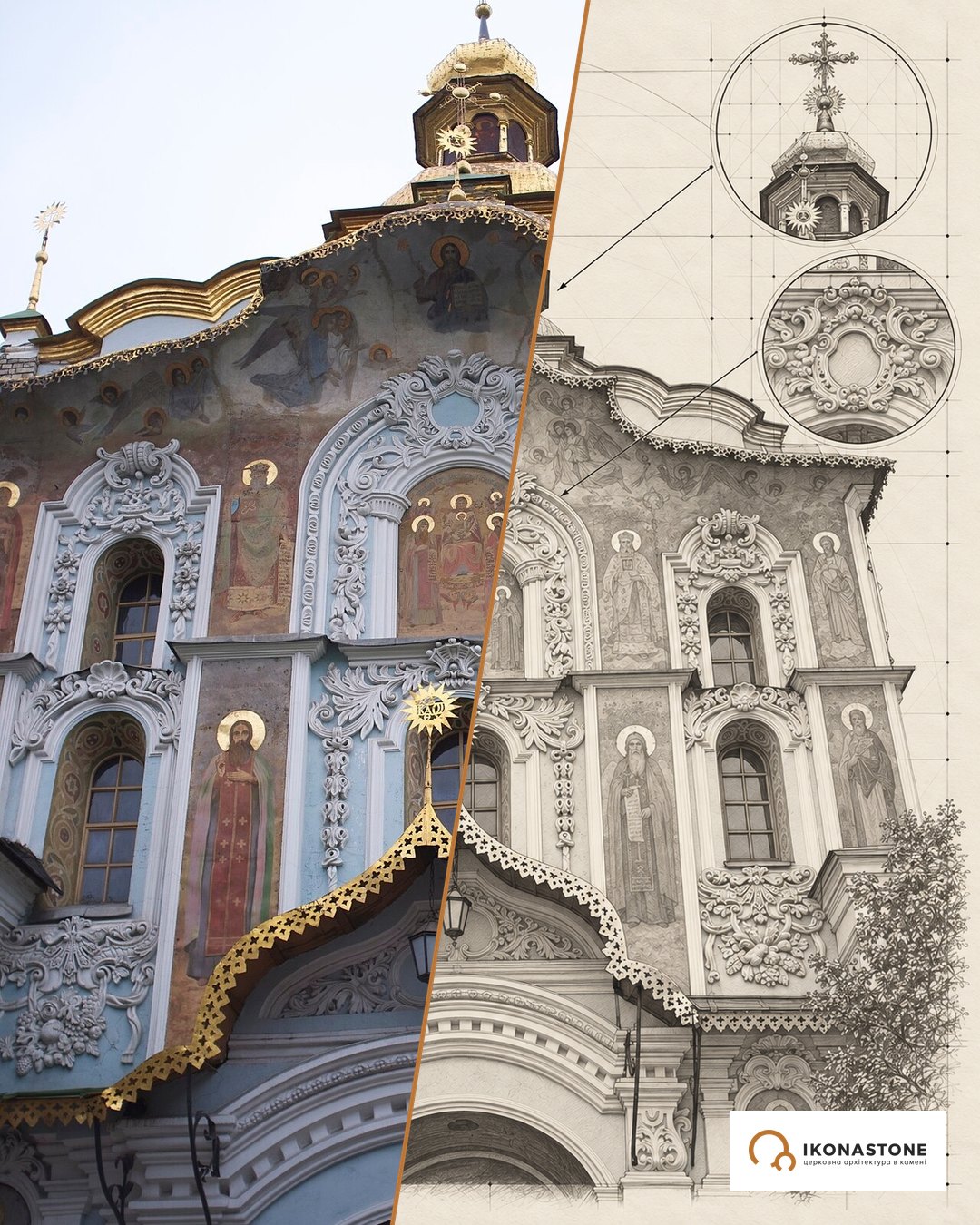
The Ascension Cathedral in Pereiaslav: Mazepa's church under a single cornice
Sometimes a church is saved not by the people who built it. A cathedral raised at Mazepa’s expense survived the Soviet decades because a canvas about a different war was hung inside it.
In brief
| Address | Hryhorii Skovoroda Street, Pereiaslav, Kyiv Oblast |
| Built | 1695–1700; consecrated on 1 June 1700 |
| Type | cruciform nine-part single-domed cathedral, Ukrainian Baroque |
| Material | brick on lime mortar, rendered and whitewashed |
| Status | architectural monument of national importance; part of the Pereiaslav reserve |
| Now | the diorama museum “The Battle for the Dnipro”, part of the Pereiaslav reserve |
History
In 1695, at the expense of Hetman Ivan Mazepa, construction of the masonry Ascension Cathedral began in Pereiaslav. It took five years to build; according to sobory.ru, the church was consecrated on 1 June 1700 in the presence of the hetman. According to other data, given by the English-language Wikipedia, the cathedral is dated 1704–1709, but most sources keep to 1695–1700. The hetman petitioned the tsar to restore the ancient see of Pereiaslav, and a year after the consecration a men’s monastery began to operate at the cathedral. According to the sources, Mazepa presented the church with the Peresopnytsia Gospel.
In 1748 a fire destroyed the monastery’s wooden buildings. The masonry cathedral survived; according to Wikipedia, it had received its moulded portals and the surrounds of the windows and drum even earlier, during a repair in the first third of the 18th century. In 1753–1757 a masonry collegium was built nearby, and in 1770–1776 a bell tower. In 1782 a small Church of St Barbara was added to the bell tower; it was destroyed during the Second World War. Several 18th-century bishops of Pereiaslav are buried in the cathedral. In 1766 the head of the martyr Danylo Kushnir of Mliiv was buried in the monastery, and on 4 August 1786 the relics of the Venerable Martyr Macarius of Kaniv were transferred here from St Michael’s Monastery; in 1942 they were taken to Cherkasy. In 1847 the see moved to Poltava, and the cathedral gradually lost its former standing.
The collegium building stands next to the cathedral. The school itself was founded in 1738 in a wooden building, and in 1753–1757 it received a single-storey masonry building at the expense of Bishop Ioann Kozlovych: four classrooms and three entrance halls under one roof. Since 1972 it has housed the Hryhorii Skovoroda Memorial Museum.
According to L. Nabok, services in the cathedral continued until 1934, after which the building was turned into a granary. The war badly damaged the ensemble, especially the bell tower: it was adapted as a water tower and used that way until 1986. The damaged buildings were restored in the 1950s and 1960s. In 1975 the diorama “The Battle for the Dnipro” opened in the cathedral — a canvas 28 metres long and 7 metres high. As Ukrainska Pravda wrote, it effectively became the cathedral’s “altar”.
Now the roles have been reversed. In 2021 the ensemble was inspected as being in critical condition, and the state of the building also threatens the canvas: the diorama saved the church, and now the church is destroying it. In 2021 a project for the restoration repair of the facades and roof made it into the selection of the state programme “Great Restoration”.
Timeline
The numbers in square brackets are source numbers in the list at the bottom of the page. The label “according to …” means that a fact is confirmed by only one source. The “Legends” section contains tales and legends: they are recorded in sources but not confirmed by documents.
The hetman’s foundation
- 1648
On 25 April a fire destroyed the wooden Church of the Ascension that stood on this site. According to M. Mytsyk and O. Tarasenko (as retold by V. Vovkodav). [1]
- 1688
On 13 May the relics of the Venerable Martyr Macarius of Kaniv were moved from Kaniv to Pereiaslav to protect them from a Turkish attack; from 1713 they rested in St Michael’s Monastery. [14, 15, 16]
- 1695
At the expense of Hetman Ivan Mazepa, construction of the masonry Ascension Cathedral began. [1, 5, 21, 22]
- 1695–1700
For building the cathedral and setting up the episcopal see, Mazepa gave, according to the register of the Bender commission, “more than 300,000 zlotys”. [1, 2, 25]
- 1700
According to sobory.ru, on 1 June the cathedral was consecrated with the hetman himself taking part. [2]
- 1700
On 30 September Mazepa issued a universal on restoring the Pereiaslav episcopal see; already on 1 September his universal had appointed Zakhariia (Kornylovych) to the see. According to the “Proceedings of the Kyiv Theological Academy”. [8]
- 1701
Mazepa granted the monastery at the cathedral a village with its lands: according to the “Proceedings of the KTA”, Mankivka (4 February), according to sobory.ru, “Matskovka” (4 January). At the end of the year, according to [8], the monastery also received the village of Soshnyky. [2, 8]
- 1701
Mazepa presented the cathedral with the Peresopnytsia Gospel; the donation inscription, according to P. Kraliuk, is dated 17 April 1701. [9, 10]
- 1701
On 27 August the hetman issued another universal in favour of the see, and on 1 October Zakhariia was consecrated Bishop of Pereiaslav. According to the “Proceedings of the KTA”. [8]
- 1702
The Pereiaslav see became a vicariate of the Kyiv Metropolis; a letter of appointment of 4 March 1702 placed it under the Metropolitan of Kyiv. [7, 8]
- First third of the 18th century
According to Wikipedia, during a repair the cathedral received portals and moulded surrounds for the windows and drum. [28]
The cathedral monastery
- 1738
Bishop Arsenii Berlo founded a collegium at the Ascension Monastery. [5, 6, 27]
- 1748
According to Wikipedia, a fire destroyed all the wooden buildings of the monastery; the masonry cathedral survived. [28]
- 1753–1757
Through the efforts of Bishop Ioann Kozlovych, the masonry collegium building was erected. [5, 6, 28]
- 1753–1754
Hryhorii Skovoroda taught poetics at the collegium. [5, 6, 27]
- 1757
On 27 July Hervasii Lintsevskyi, former head of the Beijing Ecclesiastical Mission, was consecrated Bishop of Pereiaslav and Boryspil. [12, 13]
- 1766
On 29 July Danylo Kushnir, churchwarden (ktitor) of Mliiv, was executed. In the autumn (according to his Life, at the end of September) Bishop Hervasii solemnly buried his head in the Ascension Monastery. [11, 12, 28]
- 1769
On 22 December Bishop Hervasii died; he was buried in the crypt under the left kliros of the Ascension Cathedral. [12, 13]
- 1770–1776
A masonry three-tier bell tower about 48 m high was built; according to V. Vovkodav, its builder was Bishop Iov Bazylevych. [1, 5, 21, 22]
- 1780–1782
The Church of St Barbara was added to the east side of the bell tower (Wikipedia gives 1782). [1, 28]
- 1785
With the abolition of the Pereiaslav eparchy the collegium was closed. [6, 27]
- 1786
On 4 August the relics of St Macarius of Kaniv were moved from St Michael’s to the Ascension Monastery. [1, 14, 15]
After the see
- 1799
The Little Russian–Pereiaslav eparchy was created with its centre in Pereiaslav; philosophy was taught at the collegium again; in 1808, according to the Encyclopedia of Ukraine, the collegium was turned into a theological seminary. [6, 26]
- 1830s
The archaeographer Osyp Bodianskyi discovered the Peresopnytsia Gospel in the library of the Pereiaslav seminary and published an article about it (in 1836 or 1838, according to different data). [10]
- 1845
In August Taras Shevchenko, staying with the physician A. Kozachkovskyi, painted the cathedral in watercolour. At the end of the year he described the Peresopnytsia Gospel and copied Mazepa’s donation inscription. [3, 4, 5, 10]
- 1847
According to “Azbuka palomnika”, the residence of the diocesan bishops was moved from Pereiaslav to Poltava. [26]
The Soviet decades
- 1927–1930
V. Zabolotnyi made drawings of the cathedral; they were lost during the Second World War. According to L. Nabok (as retold by V. Vovkodav). [1]
- 1934
Services were held in the cathedral until this year; then the building was turned into a granary. According to L. Nabok (as retold by V. Vovkodav). [1]
- 1937
The bell was thrown down from the bell tower. According to Kostiuk (as retold by V. Vovkodav). [1]
- 1942
The relics of St Macarius were taken from Pereiaslav to Cherkasy. [14, 15, 16]
- 1954–1964
Restoration of the buildings damaged in the war; according to Bilchenko, the cathedral’s wall paintings were destroyed at that time. [1, 28]
- 1972
The Hryhorii Skovoroda Memorial Museum opened in the collegium building (Wikipedia gives 1970). [6, 28]
- 1975
On 5 May the diorama museum “The Battle for the Dnipro in the Pereiaslav Area and the Creation of the Bukryn Bridgehead in Autumn 1943” opened in the cathedral (artists P. Maltsev and M. Prysiekin; canvas 28 × 7 m). [17, 21, 23, 24]
- Until 1986
According to Bilchenko (as retold by V. Vovkodav), the bell tower was used as a water tower. [1]
Independent Ukraine
- 2003
According to Glavcom, the city council decided to hand the cathedral over to a UOC-KP community, which had claimed it since the mid-1990s, on condition that the diorama be moved. The decision was not carried out. [17]
- 2010–2011
The Synod of the UOC (MP) announced the founding of monasteries in Pereiaslav and in 2011 “restored” the Ascension Monastery; the buildings were not handed over to the church. Protests against handing over the reserve’s premises continued in the town. [17, 18, 28]
- 2021
On 18 May the project “Restoration repair of the facades and roof of the Ascension Cathedral” took 62nd place among 109 sites in the “Great Restoration” selection. According to ProSlav. [19]
- 2021
On 18 June Minister of Culture O. Tkachenko inspected the ensemble in critical condition; the mayor V. Saulko asked for the bell tower to be transferred to the Ministry of Culture’s balance sheet, as the cathedral had been earlier. According to ProSlav. [20]
- 2022
On 20 November part of the relics of St Macarius was returned from Cherkasy to Pereiaslav — to the Holy Michael Monastery, not to the Ascension Cathedral. [15, 16]
Lost and restored
| What | Was | What happened | Where it is now |
|---|---|---|---|
| Wooden Church of the Ascension | Until 1648 | Burned on 25.04.1648 (according to Mytsyk and Tarasenko) | The masonry cathedral stands on its site [1] |
| Peresopnytsia Gospel | Mazepa’s gift to the cathedral, 1701 | Later ended up in the library of the Pereiaslav seminary, where Bodianskyi discovered it | Outside Pereiaslav; Ukrainian presidents take their oath on it [2, 9, 10] |
| Relics of St Macarius of Kaniv | In the Ascension Monastery from 1786 | Taken to Cherkasy in 1942 | Cherkasy; part returned to Pereiaslav in 2022, to the Holy Michael Monastery [14, 15, 16] |
| Head of the martyr Danylo Kushnir | Buried in 1766 in the Ascension Monastery | The place is described differently: “behind the left kliros” [11] or, according to legend, in a niche to the right of the entrance [1] | The place is not marked [1, 11] |
| The cathedral’s wall paintings | Work of Pereiaslav masters | Destroyed during the restoration of the 1950s–1960s (according to Bilchenko) | Lost [1] |
| Bishops’ burials | Crypt under the left kliros (Hervasii Lintsevskyi and others) | The cathedral was closed; from 1975, the diorama | Their condition is not described in the sources [13, 28] |
| Bell | Bell tower of 1770–1776 | Thrown down in 1937 | Lost [1] |
| Bell tower | Three tiers, about 48 m, gateway arch | Until 1986 — a water tower | Survives, in critical condition (2021) [1, 20, 21] |
| Church of St Barbara | 1780–1782, next to the bell tower | Destroyed during the Second World War | Not rebuilt [1, 28] |
| Building of the trading rows and bursa | Late 18th – early 19th century | Burned in 1916, dismantled | Not rebuilt [28] |
| V. Zabolotnyi’s drawings | 1927–1930 | Lost during the Second World War | Have not survived [1] |
| The cathedral as a church | Cathedral church, later a monastery church | Services until 1934; a granary; from 1975 the diorama | Diorama museum within the Pereiaslav reserve; not handed over to a church [1, 2, 17, 23] |
Architecture
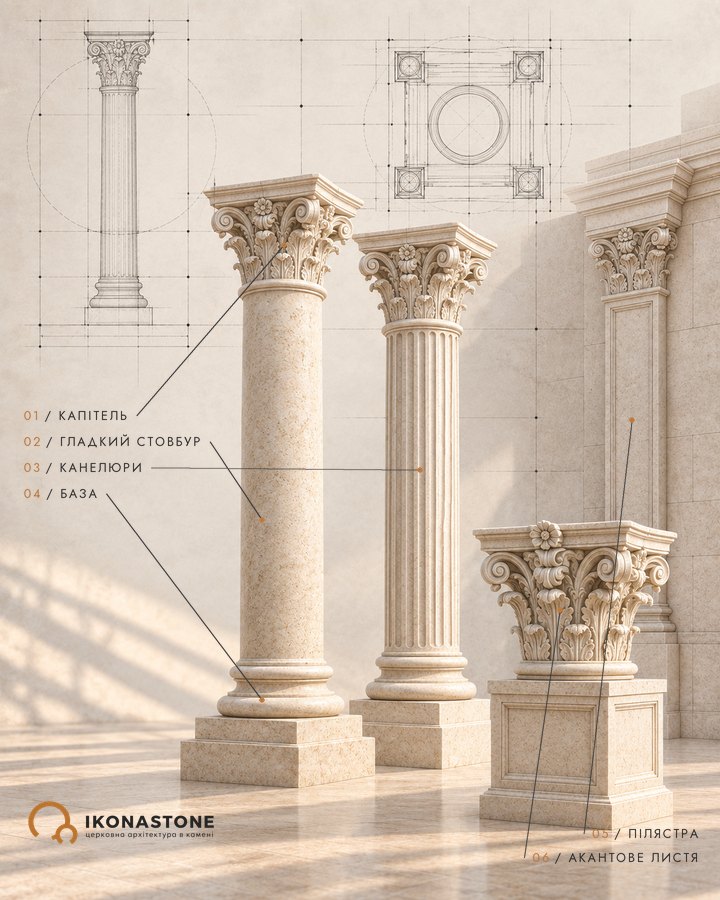
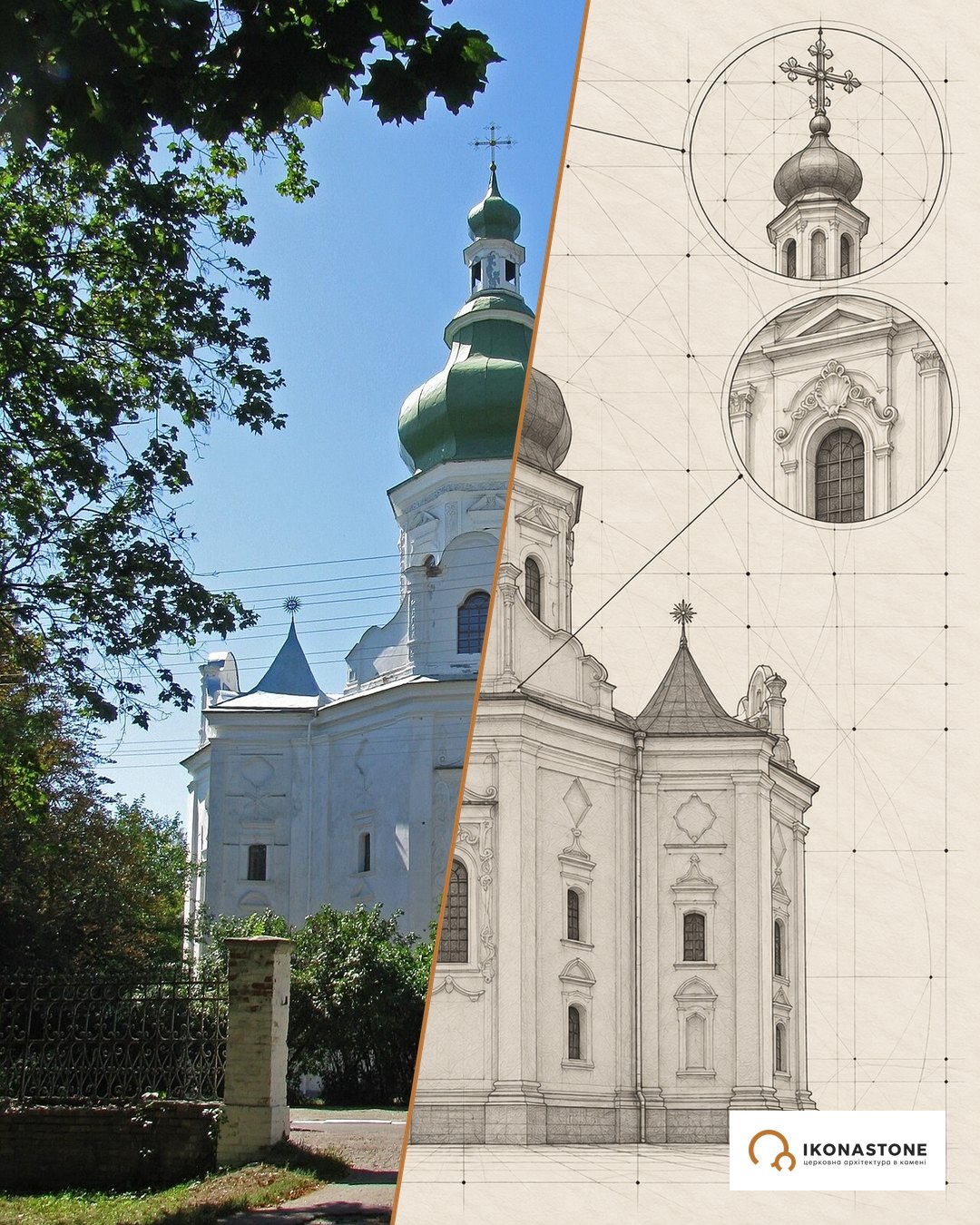
The cathedral is cruciform, nine-part and single-domed. All its parts are of equal height and brought under a single cornice, so the building reads as one dense volume. Above the crossing rises a two-tier Baroque crown on a tall octagonal drum. The walls are articulated by broken-forward pilasters; the portals, window surrounds and the drum are decorated with stucco.
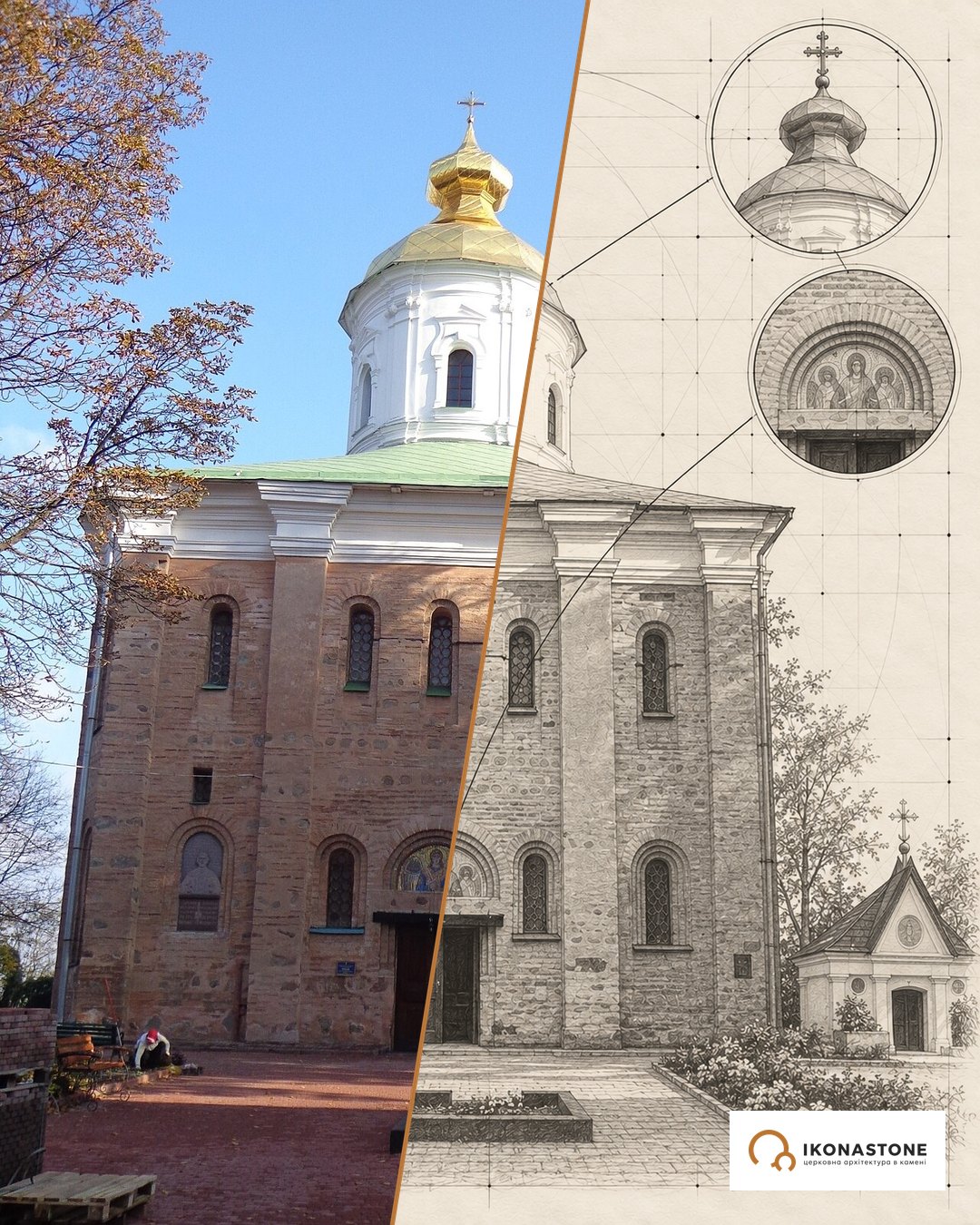
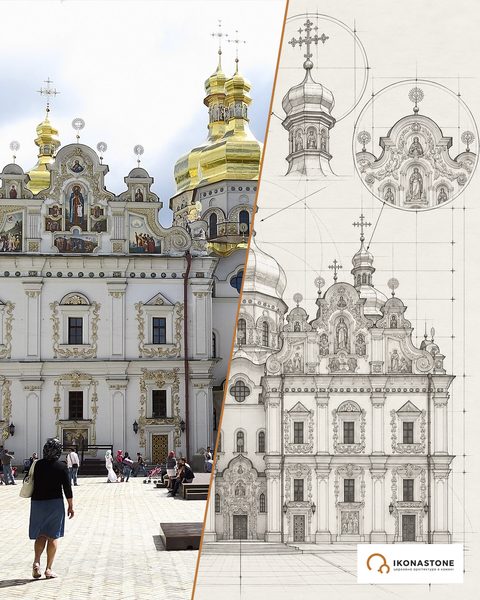
Below are two elements of the church: in a photo and in a drawing. The drawings show the form, not exact dimensions.
The dome on an octagonal drum
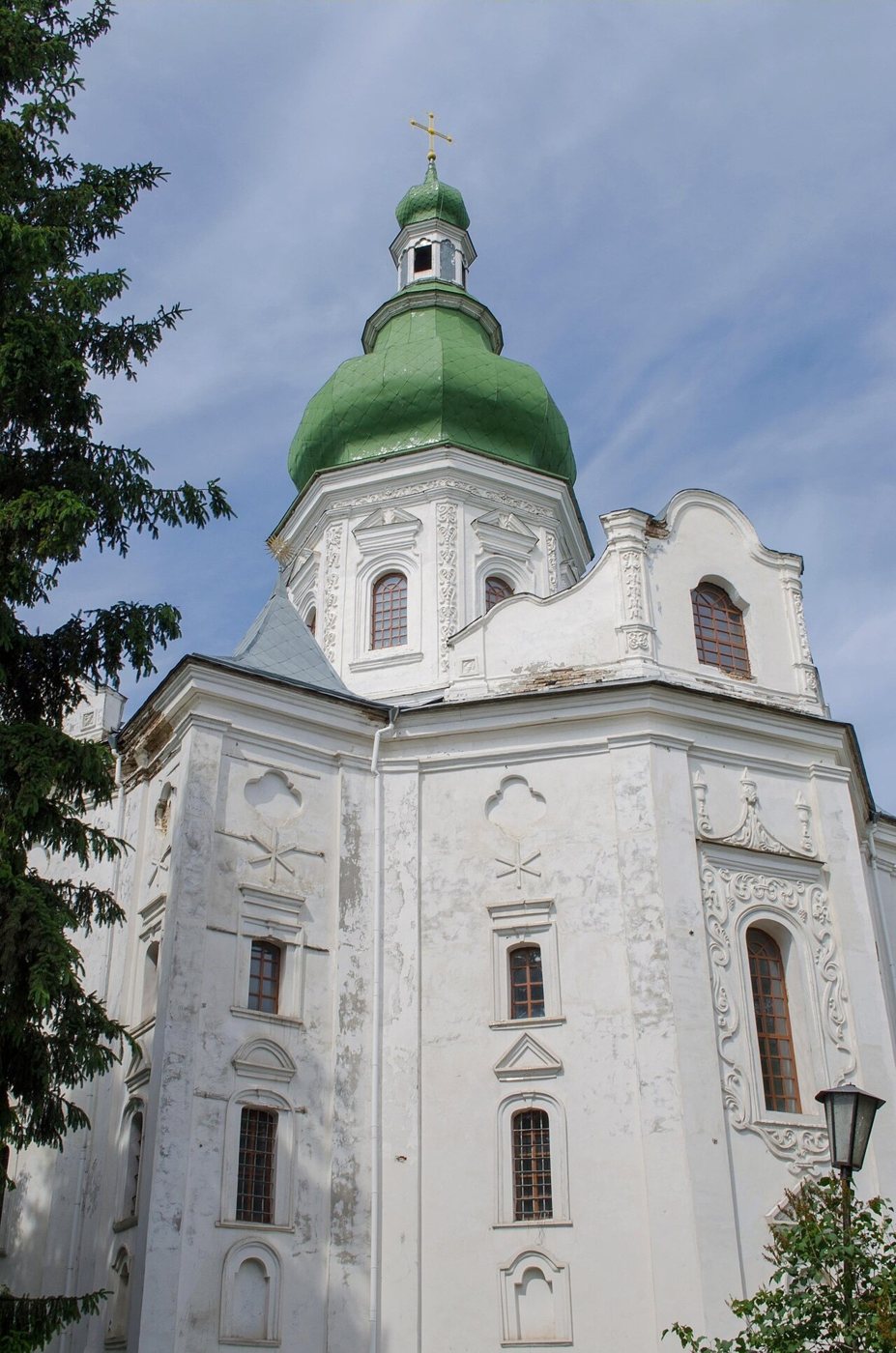
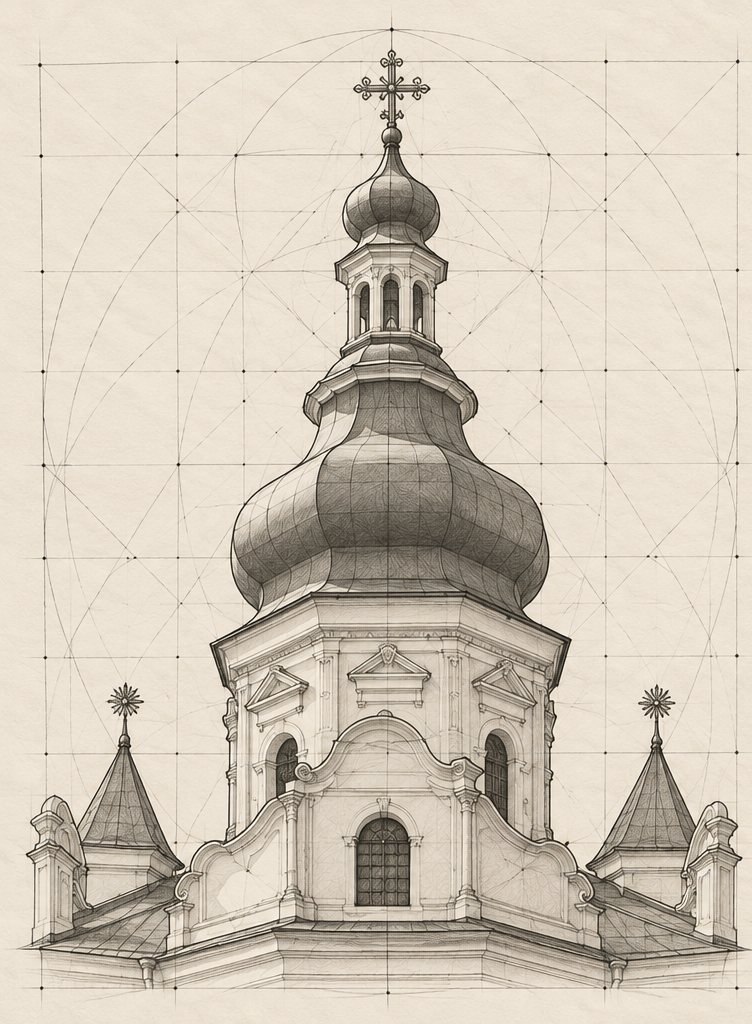
One dome for a nine-part plan is a restrained choice. The whole vertical is gathered in the centre: a tall faceted drum and a two-tier Baroque crown. Shevchenko, who painted the cathedral in watercolour in 1845, inscribed the sheet: “Built by Hetman Mazepa”.
The bell tower
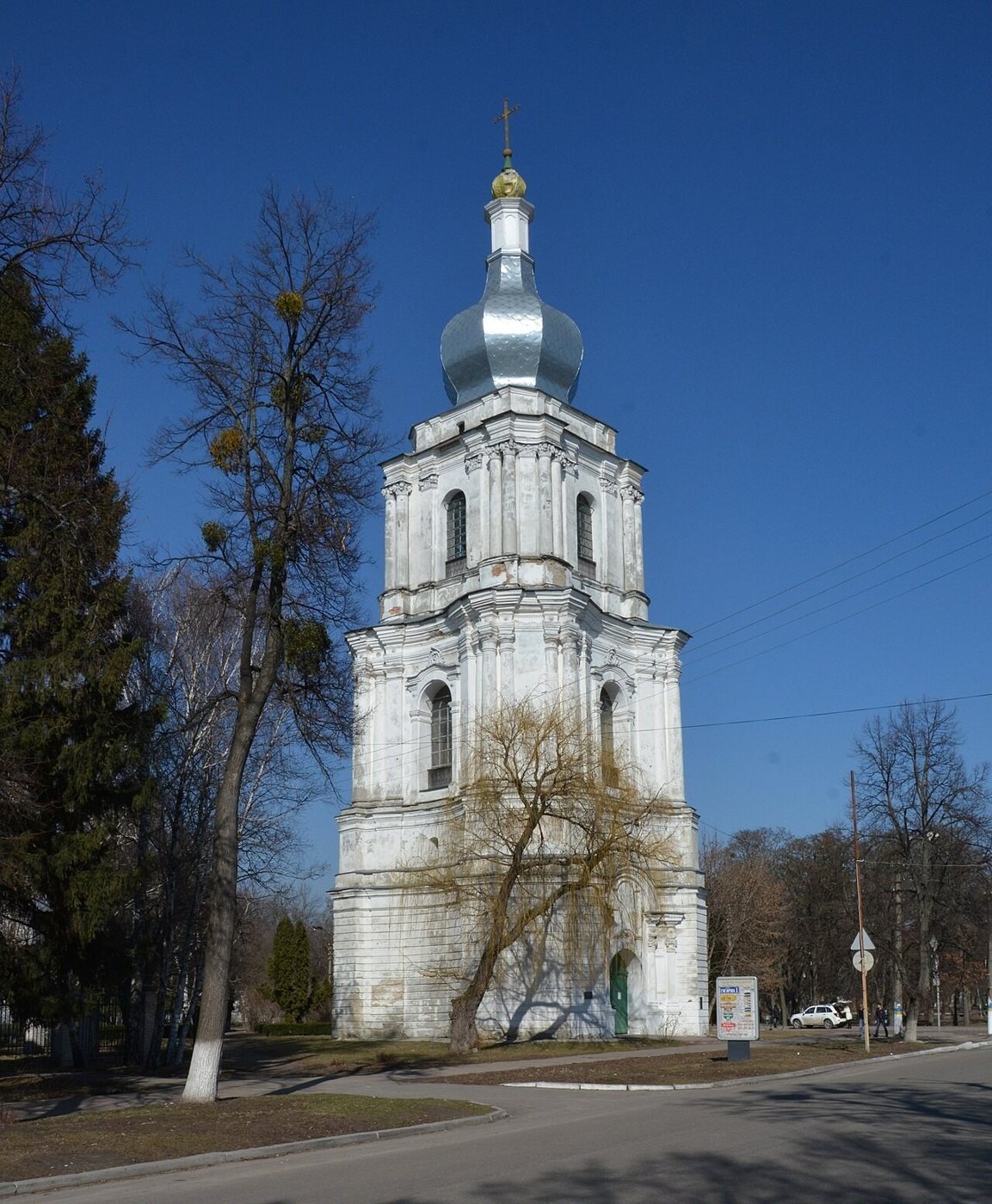
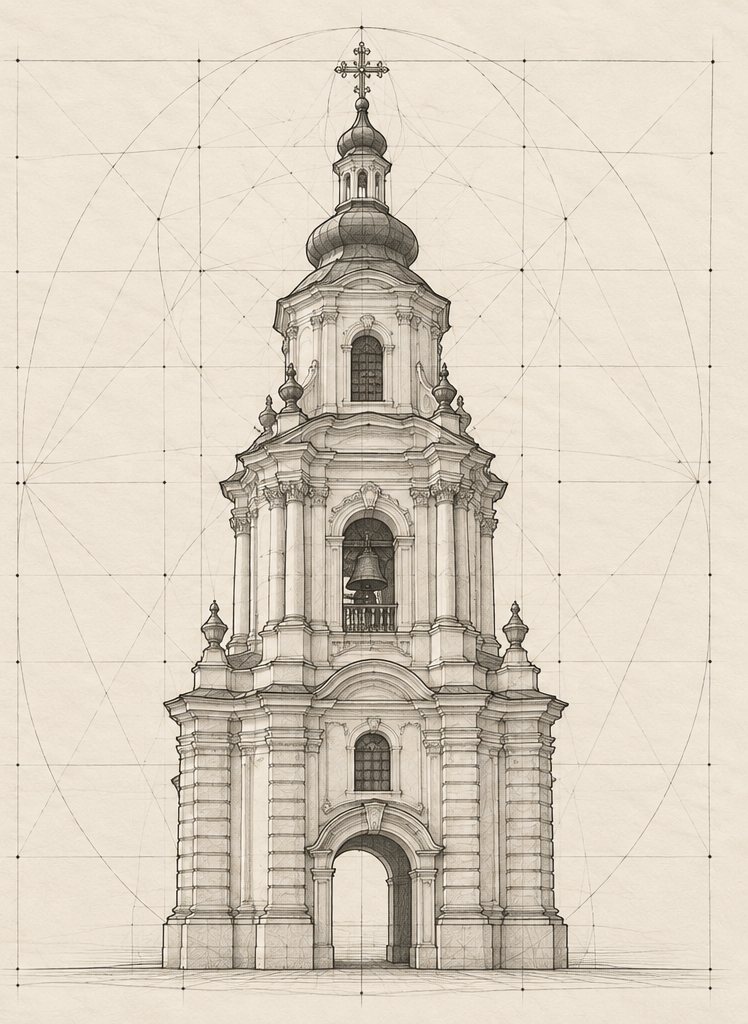
The bell tower has three tiers; in plan it is a square with concave sides, with a two-tier Baroque crown; in the first tier there is a gateway arch with a portal. The first tier is rusticated. The sources name the orders of the second and third tiers differently: the Great Ukrainian Encyclopedia (VUE) gives Tuscan and Composite, other descriptions Ionic and Corinthian. In either reading the orders rise from bottom to top, from heavier to lighter, as befits a classical vertical.
Stone and material
The cathedral, the bell tower and the collegium are built of brick on lime mortar, rendered and whitewashed. Here the white surface works like paper for the stucco: shadows from the cornices and pilasters draw the rhythm of the facade on it.
The greatest danger for such a building is not age but water. A leaking roof harms both the masonry and the canvas inside at the same time. Brick on lime withstands time well as long as moisture does not linger, so for the cathedral repairing the roof is a question not of beauty but of survival.
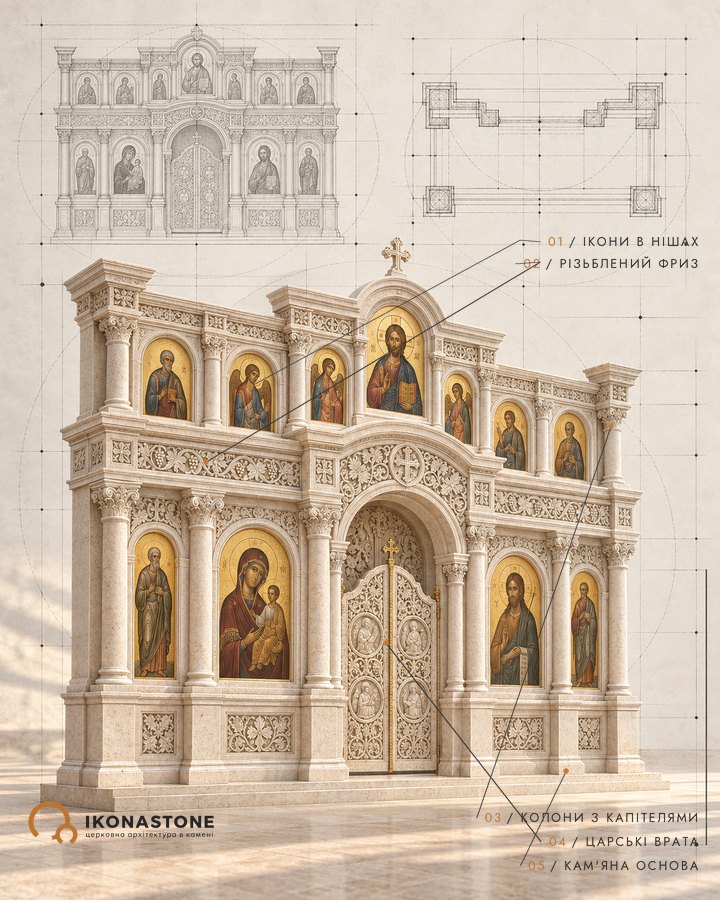
The axis of the space inside the cathedral was once closed by an iconostasis; we write separately about how iconostases are arranged. Another Left-Bank Baroque cathedral of the same period is the Holy Cross Exaltation Cathedral in Poltava.
Did you know
On the back of Shevchenko’s watercolour someone wrote in pencil, in Polish: “Kathedralna Cerkiew w Perejasławie fundacyi Jana Mazepy”. [3, 4]
In the novella “The Twins” Shevchenko called the cathedral’s architecture “half rococo, half Byzantine” and dated its construction to 1690. [4, 28]
Shevchenko captioned the watercolour “Built by Hetman Mazepa”, but the end of the inscription is read differently: “170” according to the UINP description or “17th c.” according to the edition of his works. [3, 4]
Before heading the Pereiaslav eparchy, Hervasii Lintsevskyi spent ten years (1745–1755) in Beijing as head of the ecclesiastical mission. [12, 13]
The solemn burial of Danylo Kushnir’s head, according to a reference article on Hervasii, became an openly anti-Polish demonstration; later the Polish government accused the bishop of complicity in the Koliivshchyna. [12]
The hetman’s mother, Mariia Mahdalyna, according to sobory.ru, gave the cathedral an epitrachelion embroidered with gold and silver. [2]
According to V. Vovkodav’s review, Pereiaslav masters made icons and iconostases, and the cathedral’s wall paintings were their work. [1]
According to V. Vovkodav’s review, the first printing house in Pereiaslav was opened precisely at the Ascension Monastery. [1]
The bursa of the Pereiaslav collegium was described by Vasyl Narizhnyi in his autobiographical novel “The Bursak” (1824). [6]
Hryhorii Skovoroda taught poetics at the collegium; his portrait still hangs in the halls of the building. [6, 27]
In the cathedral’s basement the names of Pereiaslav residents killed in the Second World War are commemorated on the walls. According to TravelsInUA. [21]
The bell tower, about 48 m high, has a gateway arch in its first tier. [21, 22, 28]
The earliest professional drawings of the cathedral were made in 1927–1930 by V. Zabolotnyi; they perished in the war. [1]
Legends
A niche to the right of the entrance
According to legend, the head of the martyr Danylo Kushnir was buried in one of the cathedral’s niches to the right of the main entrance. Recorded by N. Tkachenko, cited by V. Vovkodav. The Life compiled by Nikodim of Belgorod gives another place: “behind the left kliros”. [1, 11]
The chalice and the tavern
According to his Life, the Mliiv community entrusted Danylo Kushnir with hiding the chalice from the altar from the Uniate priest. Vasyl Hdyshynskyi slandered him, claiming that Kushnir took the chalice to the tavern and drank from it. Recorded in the “Lives” of Nikodim of Belgorod. [11]
Relics hidden from the Turks
According to church tradition, the relics of St Macarius were moved from Kaniv to Pereiaslav in 1688 to protect them from a Turkish attack. Later they rested in the Ascension Monastery. Recorded in hagiographic reference works and ProSlav. [14, 15, 16]
“Mazepa — 1690”
According to the story Shevchenko retells in “The Twins”, the cathedral was built by Mazepa in 1690; the documents give 1695–1700. [4, 5]
Figures
- Ivan Mazepa — hetman, founder of the cathedral and restorer of the Pereiaslav see; presented the Peresopnytsia Gospel to the cathedral (1701).
- Mariia Mahdalyna Mazepa — the hetman’s mother, a donor (according to sobory.ru).
- Zakhariia (Kornylovych) — first bishop of the restored see (consecrated on 1 October 1701).
- Arsenii Berlo — bishop, founder of the collegium (1738).
- Ioann Kozlovych — bishop, builder of the masonry collegium (1753–1757); according to Wikipedia, buried in the cathedral.
- Hryhorii Skovoroda — taught poetics at the collegium in 1753–1754.
- Hervasii Lintsevskyi — bishop (1757–1769), former head of the Beijing mission; buried the head of Danylo Kushnir and was himself buried under the left kliros of the cathedral.
- Danylo Kushnir — churchwarden of Mliiv, executed in 1766 for refusing to accept the Union; his head was buried in the Ascension Monastery.
- Iov Bazylevych — bishop; according to V. Vovkodav, builder of the bell tower (1770–1776); according to Wikipedia, buried in the cathedral.
- Kyryl Shumlianskyi, Nykodym Sribnytskyi — bishops of Pereiaslav buried in the cathedral (according to Wikipedia).
- Macarius of Kaniv — venerable martyr; his relics were kept in the Ascension Monastery from 1786 to 1942.
- Osyp Bodianskyi — archaeographer who discovered the Peresopnytsia Gospel in the Pereiaslav seminary.
- Taras Shevchenko — painted the cathedral in 1845 and described the Peresopnytsia Gospel.
- V. Zabolotnyi — author of drawings of the cathedral, 1927–1930.
- Petro Maltsev, Mykola Prysiekin — artists of the diorama “The Battle for the Dnipro” (1975).
How to cite
IKONASTONE. The Ascension Cathedral in Pereiaslav // Guide to the Churches of Ukraine. URL: https://ikonastone.com/en/guide/ascension-cathedral-pereiaslav/ (accessed DD.MM.YYYY).
FAQ
Who built the Ascension Cathedral?
The cathedral was built at the expense of Hetman Ivan Mazepa. The sources do not name the architect.
When was the cathedral built?
Construction began in 1695; according to sobory.ru, the church was consecrated on 1 June 1700. According to other data, cited by the English-language Wikipedia, the cathedral is dated 1704–1709.
What is in the cathedral now?
Since 1975 the cathedral has housed the diorama museum “The Battle for the Dnipro”. The cathedral is part of the Pereiaslav National Historical and Ethnographic Reserve. It has not been handed over to a church: the city council’s 2003 decision to transfer it to a UOC-KP community was not carried out, and the UOC (MP) monastery proclaimed in 2011 never received the buildings.
Where is the cathedral located?
In the centre of Pereiaslav, on Hryhorii Skovoroda Street, next to the collegium building, which now houses the Hryhorii Skovoroda Memorial Museum.
Sources
- В. Вовкодав. Огляд історіографії Вознесенського монастиря в Переяславі (2022), bibliotekanauki.pl
- Sobory.ru. Переяслав. Вознесенский собор
- Український інститут національної пам'яті. Т. Шевченко. «Вознесенський собор у Переяславі» (опис малюнка, 1845)
- Т. Шевченко. Ascension Cathedral in Pereyaslav (Album of 1845, fol. 5)
- Енциклопедія Сучасної України. Переяслав
- Encyclopedia of Ukraine (CIUS). Pereiaslav College
- Encyclopedia of Ukraine (CIUS). Pereiaslav eparchy
- Труди Київської духовної академії. Стаття про відновлення Переяславської кафедри доби Мазепи
- Радіо Свобода. Про Пересопницьке Євангеліє (22.09.2008)
- П. Кралюк. Шевченко і Пересопницьке Євангеліє, eprints НаУОА
- Никодим (Кононов), єп. Бєлгородський. Жизнеописания отечественных подвижников благочестия XVIII–XIX вв. Июль: Даниил Кушнир
- Гервасий (Линцевский) — довідкова стаття (dic.academic.ru)
- Православная богословская энциклопедия (за ред. А. Лопухіна), т. 4: Гервасий Линцевский
- Азбука веры. Преподобномученик Макарий Каневский, Переяславский
- ProSlav. Про повернення частини мощей св. Макарія до Переяслава (2022)
- Orthochristian. Relics of 18th-century ascetic solemnly transferred to Pereyaslav (2022)
- Главком. Музей ВОВ из-за монахов УПЦ МП рискует оказаться на улице (26.04.2011)
- Радіо Свобода. Про передачу приміщень заповідника «Переяслав» церкві (30.04.2011)
- ProSlav. Вознесенський собор відреставрують завдяки «Великому будівництву» (18.05.2021)
- ProSlav. Візит міністра культури О. Ткаченка до Переяслава (18.06.2021)
- TravelsInUA. Ascension Cathedral (Museum-diorama "Battle for the Dnipro"), Pereyaslav
- Discover.ua. Вознесенський монастир
- Київщина туристична. Музей-діорама «Битва за Дніпро»
- НУХТ. Стаття про музеї Переяслава (dspace.nuft.edu.ua)
- Церковная деятельность Ивана Мазепы — довідкова стаття (dic.academic.ru)
- Азбука паломника. Полтава
- Радіо Свобода. Нотатки з Переяслава (24.10.2001)
- Вікіпедія (uk). Вознесенський монастир (Переяслав)
- Wikimedia Commons. Category:Church of the Ascension, Pereiaslav
- Town
- Pereiaslav, Kyiv Oblast
- Built
- 1695–1700
- Type
- cruciform nine-part single-domed cathedral, Ukrainian Baroque
- Material
- brick on lime mortar, rendered and whitewashed
- Research depth
- 28%