Holy Trinity Cathedral of the Derman Monastery: a church behind the walls of the Ostrogski princes
Ukraina Incognita describes the Derman castle as small but strong: a pond, a marsh and a moat surrounded it on all sides, and the stone wall rose to seven metres.
In brief
| Address | Derman Druha village, Rivne District, Rivne Oblast |
| Built | founded in 1602 on the site of a wooden church |
| Rebuilding | 1849, Neoclassical decoration |
| Type | single-domed rectangular church with a narthex, 25 × 17 m |
| Material | masonry, rendered |
| Status | main church of the Holy Trinity Convent; the monastery lies within a stone wall with a gate tower |
The story in plain words
A short account, about a 4-minute read. The full chronology, with all dates, disputes and sources, is below in the "Chronology" section.
A monastery on the hills (until 1571)
Derman lies on the hills of the Mizoch Ridge, between Ostroh and Dubno. The first mention of the village is dated to 1322. The monastery already existed in 1499: then Prince Kostiantyn Ivanovych Ostrozkyi gave it a handwritten book of instructions. This is the first certain mention of the monastery.
Who founded the monastery is not known for certain. Some name Prince Vasyl Fedorovych Ostrozkyi, nicknamed the Fair, others Kostiantyn Ostrozkyi. There are no documents. The princes endowed the monastery with villages: Derman, Kunyn, Korshiv, Mizochok, Hlynske, and in 1512 Bilashiv as well. The villages supplied food, building materials and labour.
In 1571 the Trinity church was still a small wooden one, with a separate chapel of St Demetrius. The library held 40 secular books.
The prince’s charter and the press (1575–1608)
In 1575–1576 the monastery was managed by the printer Ivan Fedorov, invited by Vasyl-Kostiantyn Ostrozkyi. Then Fedorov moved to Ostroh.
On 9 June 1602 Prince Vasyl-Kostiantyn gave the monastery a charter. It turned the monastery into a communal one: the monks lived together. A school was opened, and even laypeople were allowed to study. Isaakii Boryskovych was appointed hegumen. That same year they began building a new, masonry church on the site of the wooden one.
The prince also founded a printing press in Derman. It was run by Dem’ian Nalyvaiko, brother of Severyn Nalyvaiko. On 12 April 1603 printing of the Octoechos began, and it came out in 1604. The last known edition was the “Letter of Meletius” of 1605, and that same year the press was returned to Ostroh. Only three Derman editions are known in all. The monks also translated theological works and added to the library.
Meletii Smotrytskyi and the Union (1625–1840)
The archimandrite of the monastery was Meletii Smotrytskyi, author of the famous “Slavonic Grammar”. The sources give the years of his rule differently: 1627–1631 or 1625–1633. Soon he secretly went over to the Union. For more than a century the monastery passed to the Basilians. The limits of this period also differ: from 1627 or 1628 to 1821 or 1840.
In 1630, after Smotrytskyi’s appointment, a peasant revolt broke out and was suppressed. Smotrytskyi died in Derman on 27 December 1633 and was buried in the Trinity church. Ukraina Inkognita writes that it was in the crypt.
The monastery stayed important to bookmen. Archimandrite Ianuarii, who headed it in 1713–1729, entered a Latin Qur’an into the monastery library. In 1791 more than 405 volumes were counted at the monastery.
Fire and a new look (1826–1920)
In 1826, or by other accounts 1828, a fire destroyed almost all the monastery’s buildings. The Trinity church was rebuilt in the spirit of classicism; the repair and reconstruction are dated to 1849. It has this look still: a single-domed rectangular church with a narthex. A fifth tier for bells was added to the gate tower-belfry.
Until 1920 a teachers’ seminary worked at the monastery. In 1918 a detachment under Anton Dovbenko plundered the monastery and the Lubomirski estate.
A convent and closure (1948–1991)
In 1949, or by other accounts 1948, the monastery became a convent: nuns were moved here from the Zymne monastery. In 1960 the monastery was closed. The nuns were moved to the Korets monastery, and a boarding school was set up in the buildings.
In the 1980s the public secured the removal of food warehouses from the church. A memorial plaque to Smotrytskyi was put up, and a museum of Borys Ten was set up in the entrance gate.
In 1991 the monastery was revived. Today it is the Holy Trinity Convent. It stands within a stone wall with a gate tower. In 1998 the belfry and the Trinity Cathedral were restored. Each year Derman holds the festival “Derman Lamp”, meant to revive the village as a cultural centre.
Glossary
| Word | What it means |
|---|---|
| Archimandrite | the head of a large monastery |
| Hegumen | the head of a monastery |
| Union | an alliance of part of the Orthodox with Rome: the Eastern rite stays, but the Pope’s authority is recognised |
| Basilians | a Greek Catholic monastic order |
| Lustration | an old survey of estates and property made by a state commission |
| Octoechos | a service book with hymns for an eight-week cycle |
| Classicism | a style of the 18th and early 19th century: plain forms, columns, symmetry |
| Communal monastery | one where the monks live together and hold everything in common |
| Gate tower | a tower above a gateway |
Timeline
The numbers in square brackets are source numbers from the list at the bottom of the page. The note “according to …” means that a fact is confirmed by only one source. The “Legends” section contains legends and traditions: they are recorded in the sources but not documented.
The Ostrogski monastery
- 15th c.
The founder of the monastery is said to be Prince Vasyl Fedorovych Ostrozkyi (the Handsome): so writes the Encyclopedia of Modern Ukraine, and Ilarion (Ohiienko) refers to the same. The Encyclopedia of Ukraine names Kostiantyn Ostrozkyi as the founder. There are no documents on the founder or the exact date. [1, 2, 12, 17, 23]
- 1499
Kostiantyn Ivanovych Ostrozkyi gave the monastery a manuscript book — the homilies of Patriarch Callistus. This is the first reliable mention of the monastery; some reference works give 1499 as the year of its founding. [1, 7, 17]
- 1507
Kostiantyn Ivanovych, together with his wife Tetiana and son Illia, presented gifts to the Church of the Holy Trinity: a gilded chalice, a diskos, a cross, a Gospel book and ten menaia on parchment. The hegumen at the time was Herasym, according to Bendiuk. [7]
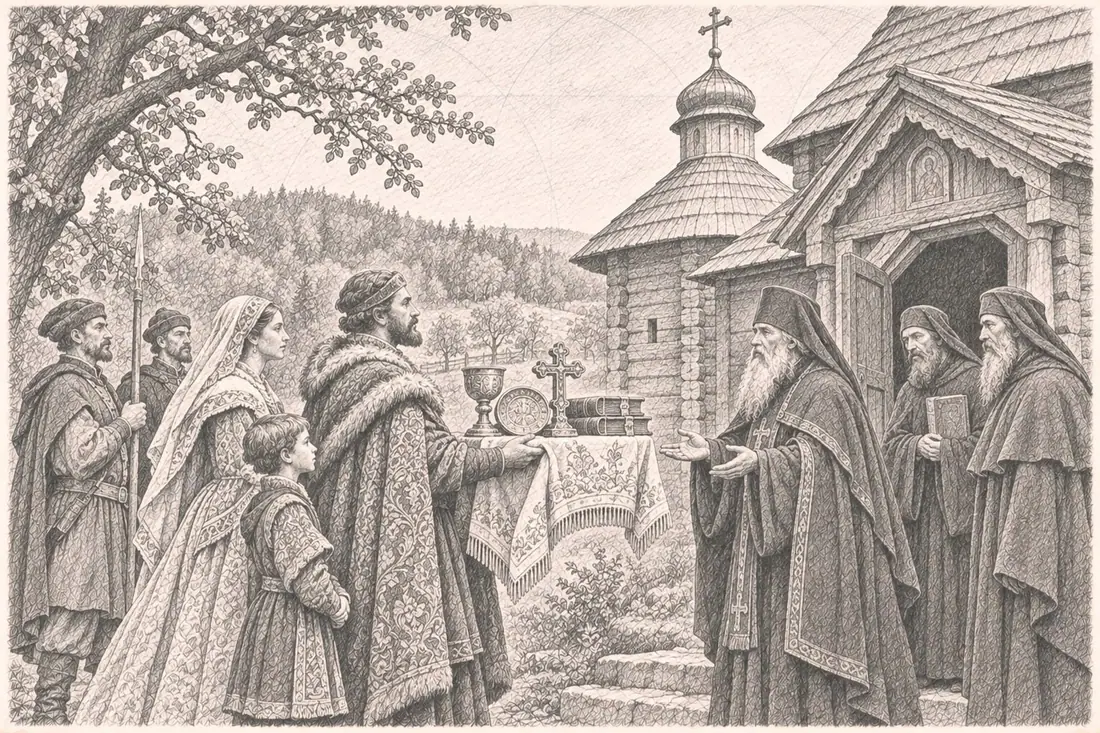
1507: princely gifts to the church (conjectural reconstruction). Illustration: IKONASTONE - 1512
The monastery received one more village, Bilashiv. Before that the Ostrogski princes had granted Derman, Kunyn, Korshiv, Mizochok and Hlynsk. [4]
- 1571
The inventory of the Ostroh starosty describes the Holy Trinity church as a small wooden one; beside it, a small wooden chapel of St Demetrius, and separately a bell tower with a large bell. The library held 40 secular books. [3, 9]
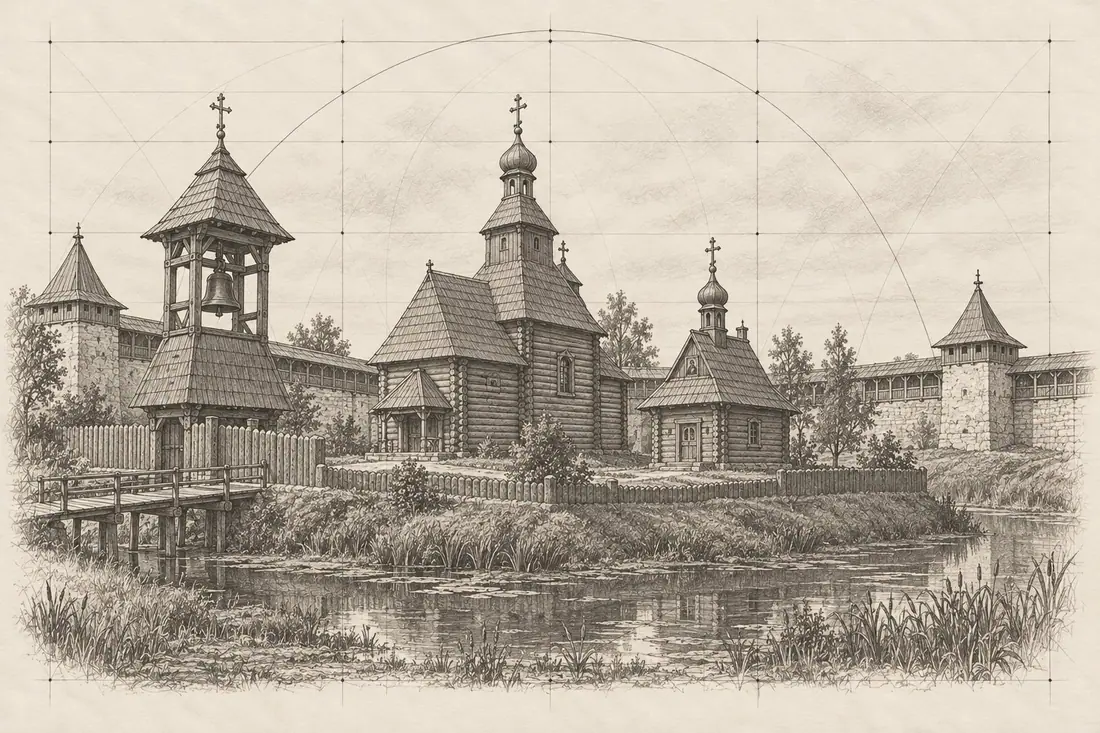
1571: the wooden monastery according to the inventory. Illustration: IKONASTONE - 1575–1576
The printer Ivan Fedorov, invited by Vasyl-Kostiantyn Ostrozkyi, was the steward of the monastery. Ilarion (Ohiienko) supposed that he may have begun the work of a new printing house here, but then moved to Ostroh. [1, 6]
- 1591–1601
The monastery was led by Archimandrite Gennadii (1590 being the year of his appointment), according to Mytsko. [6]
- 1599
A collection of aphorisms, the “Melissa”, was translated from Greek in Derman; the translator's name has not survived, and scholars suppose Cyprian. [6, 18]
The rule, the school and the printing house
- 9 June 1602
A charter of Prince Vasyl-Kostiantyn Ostrozkyi made the monastery a community of shared life and a centre of learning; laymen were also permitted to study. Isakii Boryskovych was appointed hegumen of Derman (according to Mytsko, he was then returning from the East and set about reorganising the monastery). [3, 6]
- 1602
From this year, according to V. Vuitsyk, the building of the Holy Trinity church in masonry began; zabytki.in.ua writes that the masonry church was founded in 1602 on the site of a wooden one. An entry in the memorial book says that the prince “built the church and the bell tower in masonry”. [3, 5, 24]
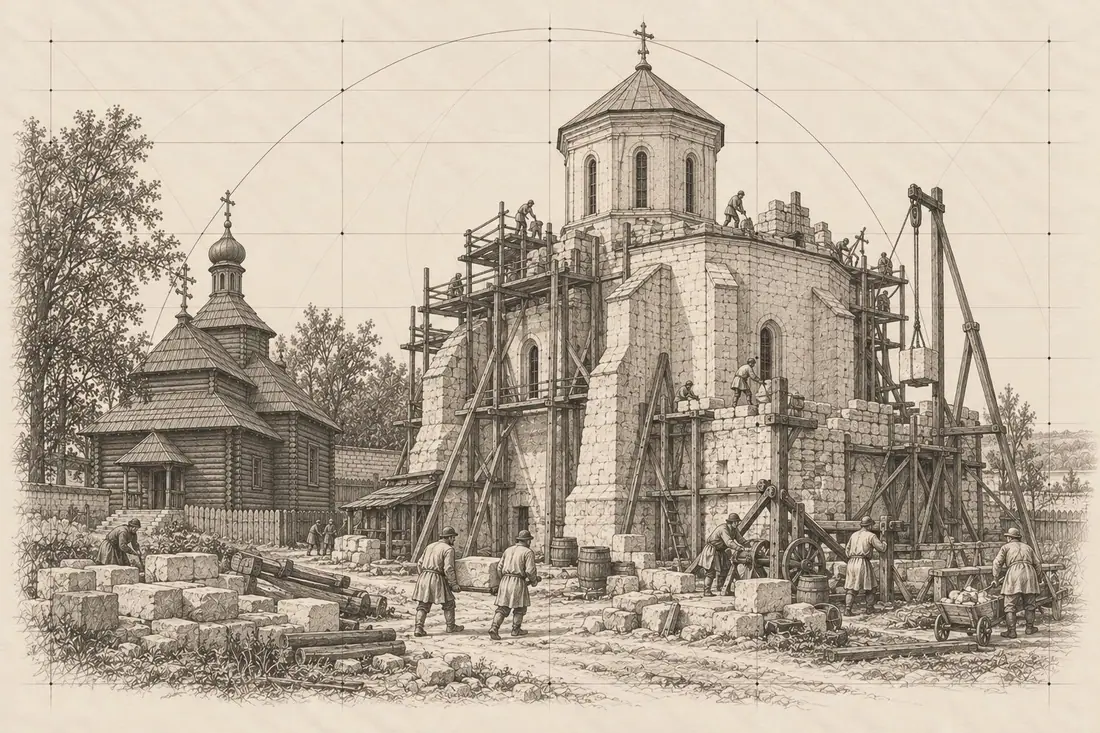
1602: the start of building the Holy Trinity church in masonry. Illustration: IKONASTONE - 12 April 1603
Printing of the “Oktoikhos” began at the Derman press; part of the equipment was brought from Ostroh. The press was run by the priest Demian Nalyvaiko. [6, 23]
- 2 December 1603
Oleksandr, son of Vasyl-Kostiantyn Ostrozkyi, died. His death occasioned the “Lament of the House of the Ostrogski Princes” (according to Lopatska, around January–February 1604, before the funeral on 23 February 1604). [3, 6]
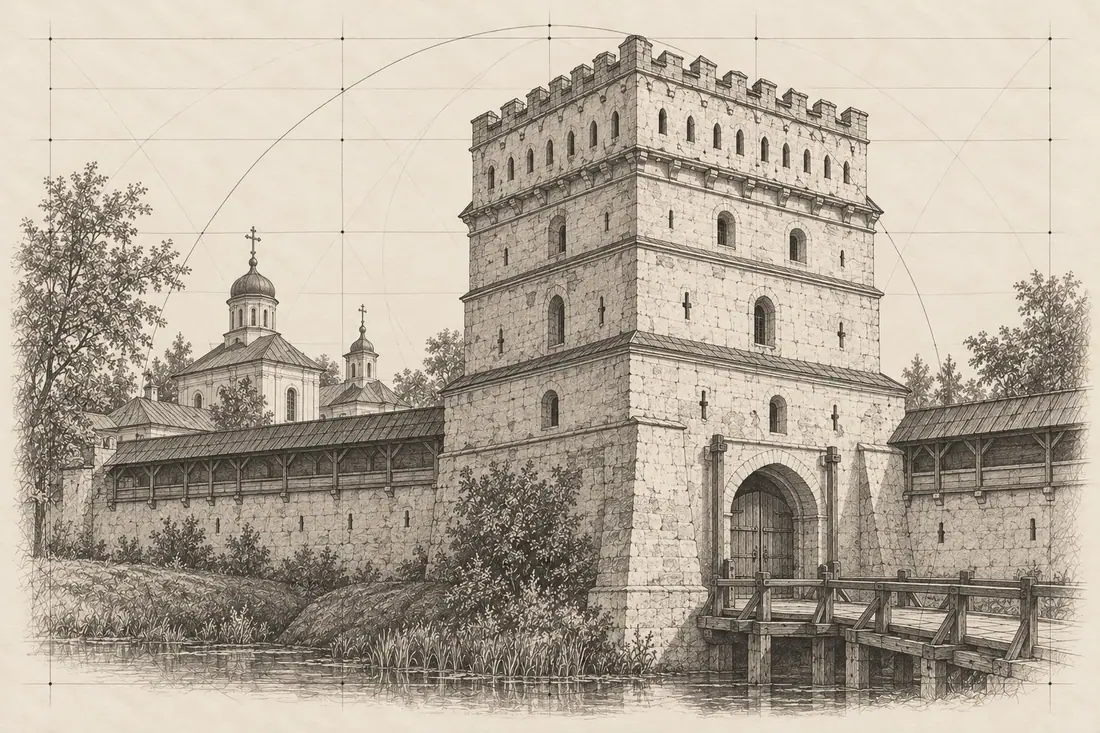
Early 17th century: the gate tower. Illustration: IKONASTONE - 1604
A wing with a cellar was added to the entrance tower; according to scholars, the printing house was located in it. A census counted 276 households in Derman and Bilashiv. [3, 4]
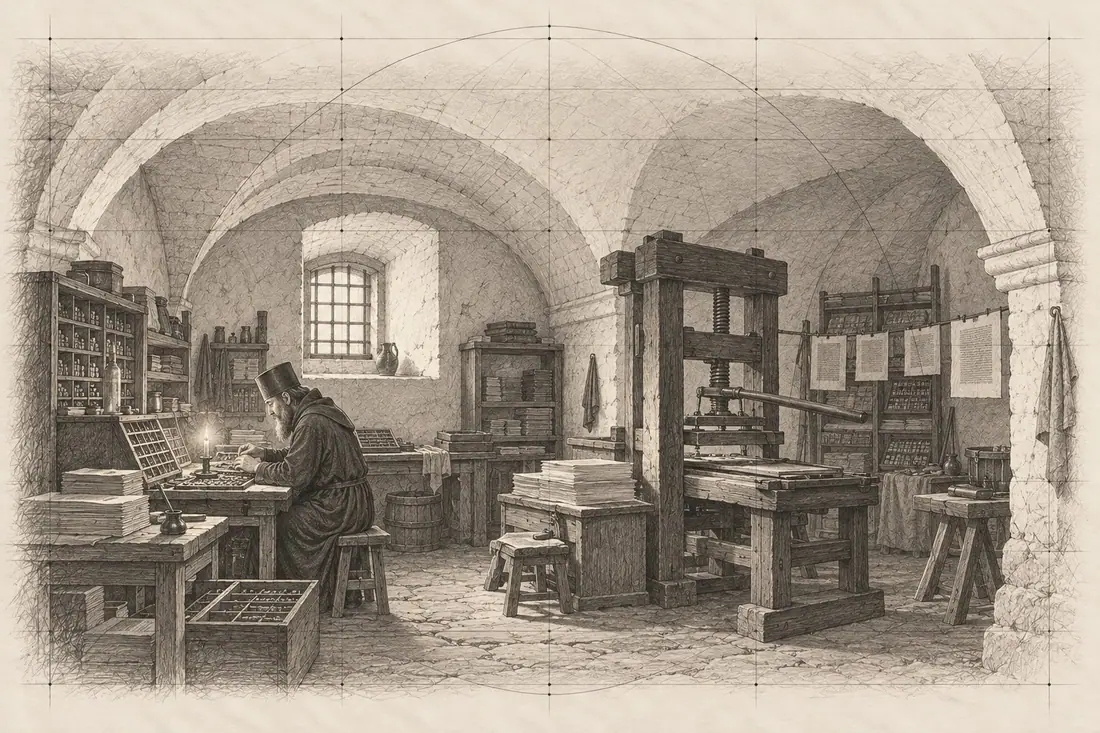
1604: the printing house under the wing of the gate tower. Illustration: IKONASTONE - 12 September 1604
The “Oktoikhos” was published. [3, 6]
- 6 February 1605
The “Letter of Meletius” (Pigas) to Hypatius Potii was published — the last known Derman edition. In the same year the printing house was returned to Ostroh. [2, 3, 6]
- February 1608
The prince issued a presentation to Isaiah Balaban with the instruction to “complete the building of the wall and bring everything to order”. The source speaks specifically of the wall. [3, 6]
- 1625
In June Archimandrite Yosyp Kurtsevych left for Russia with some of the Derman monks, according to Mytsko. [6]
Smotrytsky and the Union years
- 1627
Meletius Smotrytsky became head of the monastery (according to Mytsko, from June 1627). The years of his abbacy are given differently: 1627–1631 (Encyclopedia of Ukraine), 1625–1633 (English Wikipedia). Soon afterwards he secretly went over to the Union. [2, 6, 16]
- 1628
According to the Encyclopedia of Ukraine, the beginning of the Union (Basilian) period; its end is 1840. Encyclopedia of Modern Ukraine: 1627–1821; English Wikipedia: 1821. [2, 16, 23]
- 1630
A peasant uprising that broke out after Smotrytsky's appointment was suppressed; the leaders were hanged and the rest punished. According to Mytsko. [6]
- 27 December 1633
Meletius Smotrytsky died in Derman. According to Radio Svoboda, he was buried in the Holy Trinity church; Ukraina Incognita writes of the crypt of the Holy Trinity church. [6, 19, 25]
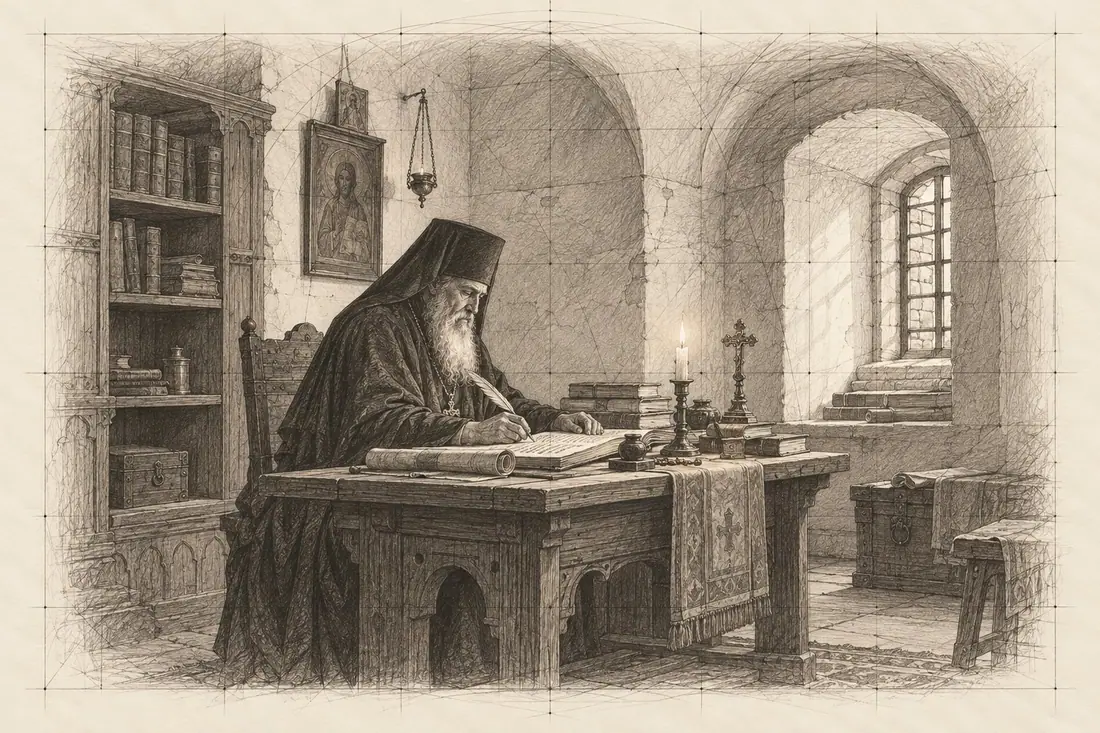
1633: the archimandrite's cell. Illustration: IKONASTONE - 1634
A letter of Metropolitan Josyf Rutskyi mentions the walls around the monastery, set up “long ago” by the Ostrogski princes. [5]
- 1713–1729
The archimandrite was Ianuarii (Ohurtsevych); he entered a Latin Quran into the monastery library. [8]
- 18 April 1791
An inventory was drawn up on the appointment of Archimandrite Yulian (Petrovych): over 405 volumes (another scholar gives at least 346). In 1786 nine residents lived in the archimandry. [8]
- 1789 and 1810
Derman was divided into a monastic and a manorial part; in 1810 a separate village Holy Trinity church was built in the manorial part — a different church, not the cathedral. According to Ukraina Incognita. [25]
The imperial and interwar years
- 1821 / 1840
The end of the Union period: 1821 (English Wikipedia, ESU) or 1840 (Encyclopedia of Ukraine). [2, 16, 23]
- 1826 (according to other sources, 1828)
A fire destroyed almost all of the monastery's buildings: the ESU dates it to 1826, two local-history materials to 1828. [23, 27, 28]
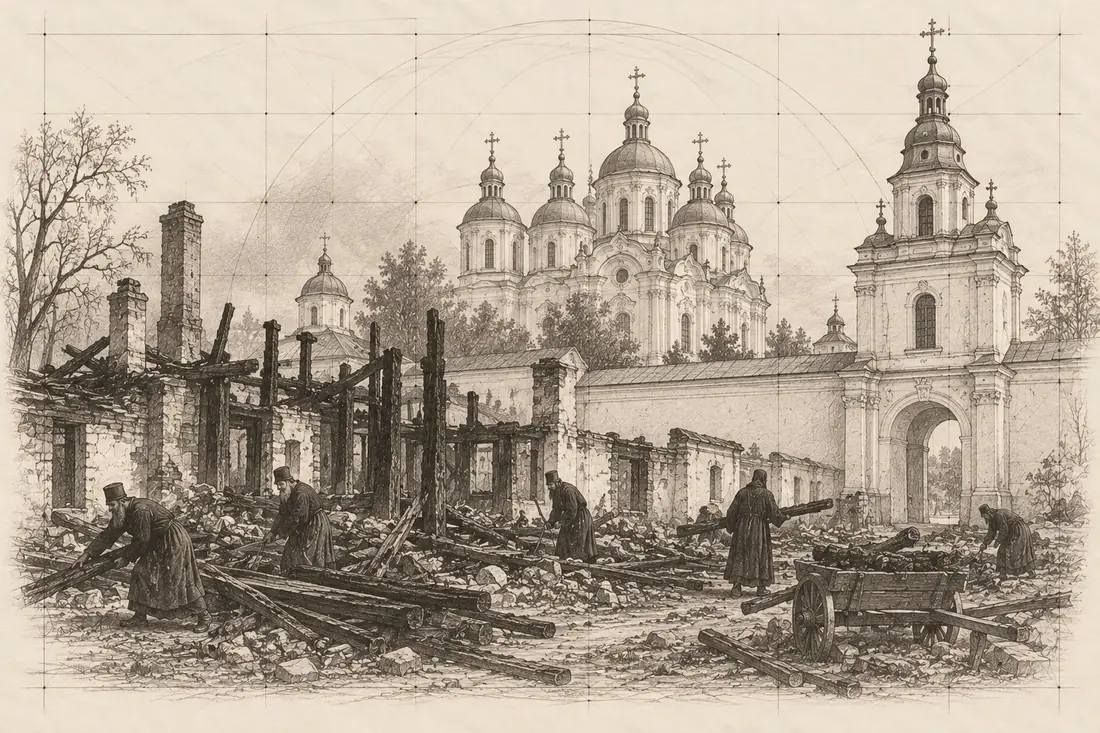
1826 (or 1828): after the fire. Illustration: IKONASTONE - 1840s
The Holy Trinity church was rebuilt in the Neoclassical style: Ukraina Incognita names 1849 (“repair works and rebuilding”), another source 1841–1849. [25, 27, 29]
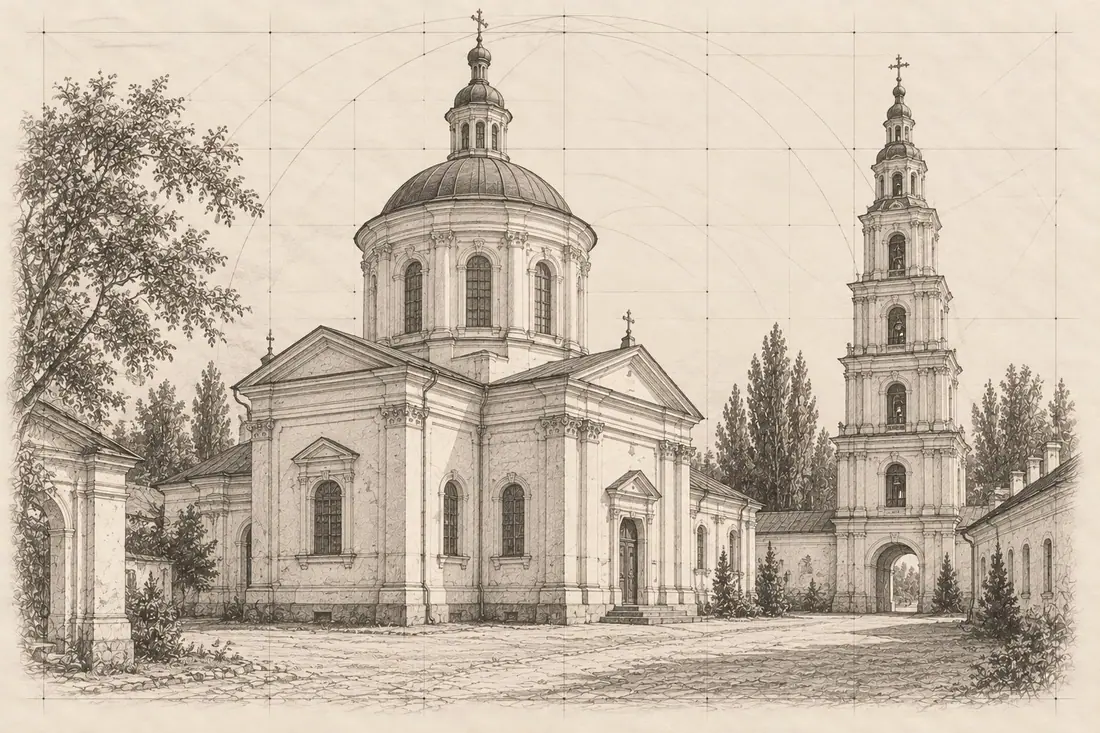
1840s: the cathedral after the rebuilding. Illustration: IKONASTONE - 1840s
A fifth tier for the bells was added to the gate bell tower (zabytki.in.ua gives the end of the 19th century). The fourth tier had 14 loopholes. [24, 25, 28, 29]
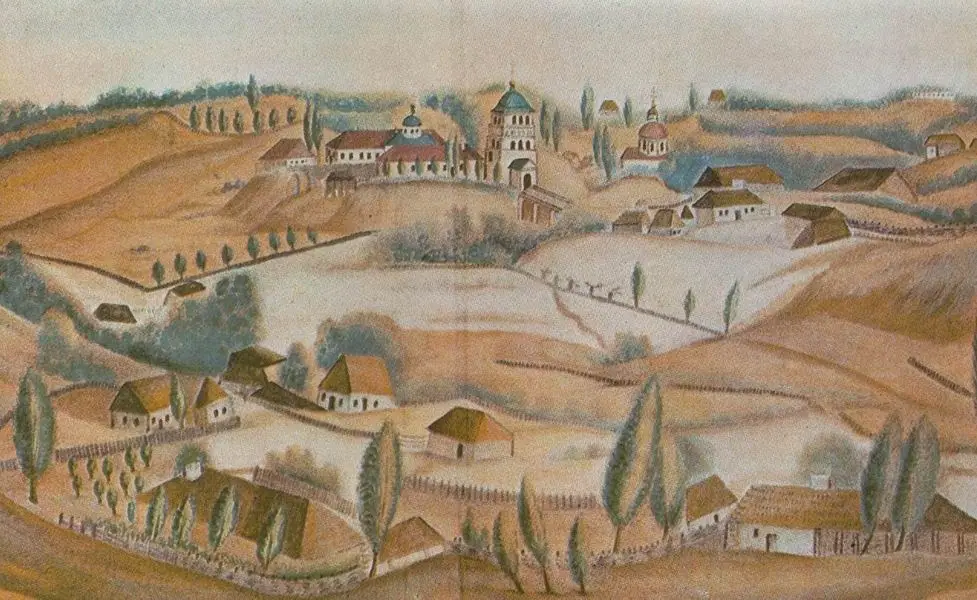
The Derman Monastery, a 19th-century drawing. Wikimedia Commons, public domain - 1886
Adrian Prakhov, during an expedition through Volhynia, photographed and described the Derman objects, including the Gospel book of 1507. [7, 13]
- Until 1920
A teachers' seminary operated in the monastery; in its place later came a diocesan girls' school, and later a private Ukrainian gymnasium. In 1914 sixteen monks lived in the monastery. [2, 16]
- Early 1918
The insurgent detachment of Anton Dovbenko plundered the monastery and the Lubomirski estate (according to English Wikipedia). [16]
War, closure and restoration
- May 1943
(About the village, not the cathedral.) German and police columns arrived in Derman: 75 residents of Zaluzhia Street were shot, and about 200 people were driven into the valley by the monastery and released by evening. [21]
- 1948 / 1949
The monastery became a convent: the ESU dates this to 1948, Ukraina Incognita to 1949, adding that nuns of the Zymne Monastery were transferred here. [23, 25]
- 1960
The monastery was closed, the nuns were moved to the Korets Monastery, and an eight-year boarding school was housed in the premises. [24, 25, 26]
- 1980s
According to Radio Svoboda, the public secured the removal of food warehouses from the church and put up a plaque to Smotrytsky; a museum of Borys Ten was set up in the entrance gate. [19]
- 1990–1991
The monastery was restored: the ESU gives 1990 and the blessing of Archbishop Irynei (Seredniy); according to zabytki.in.ua, on 30 November 1991 the complex was returned to the Church, and on 24 December 1991 the Synod opened the monastery. The Encyclopedia of Ukraine and Ukraina Incognita give 1991. [2, 23, 24, 25]
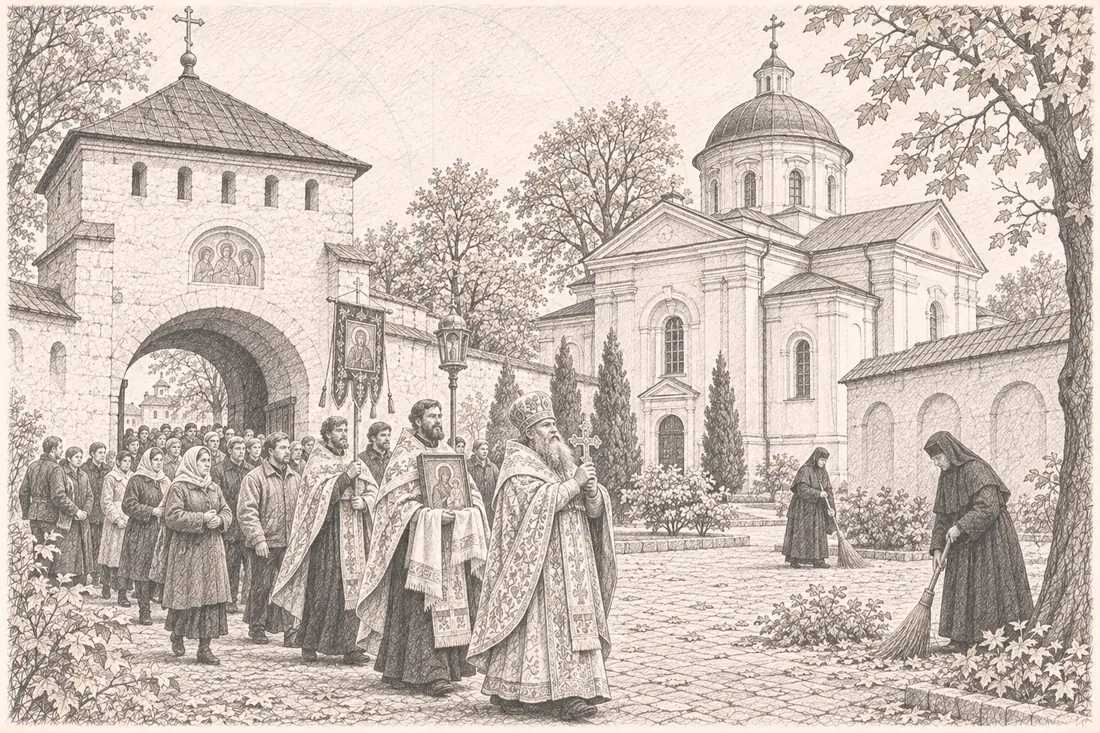
1990–1991: reviving the monastery (conjectural reconstruction). Illustration: IKONASTONE - Early 1990s
After the church was handed over to the monastery, the plaque to Smotrytsky was taken down and thrown away; activists found it and passed it to the Ulas Samchuk museum; the Ten museum was closed by the monks. According to a Radio Svoboda piece of 2007, the plaque was walled into the gate and destroyed “several years ago”. [19, 20]
- 1998
Restoration of the bell tower and the Holy Trinity Cathedral, according to zabytki.in.ua. [24]
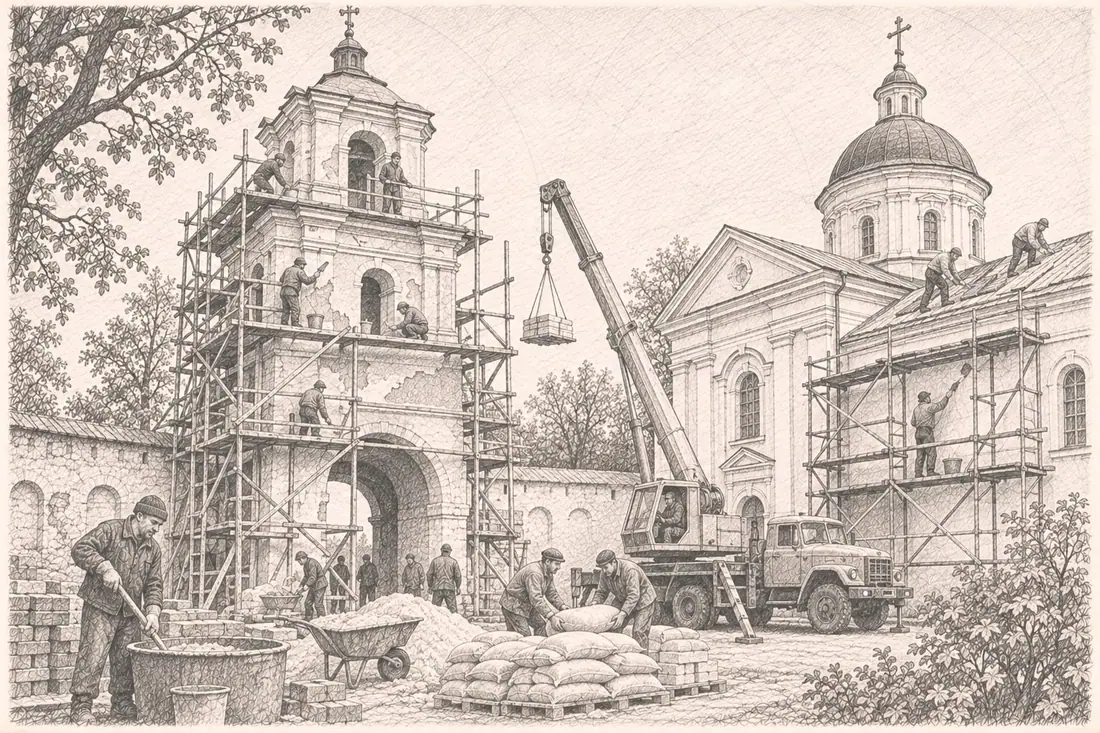
1998: restoring the belfry and cathedral (conjectural reconstruction). Illustration: IKONASTONE - 2006
Every year Derman holds the festival “Dermanskyi Svitylnyk” (“The Derman Lamp”), whose aim is to revive Derman as a cultural centre. [19]
Lost and recreated
| What | What there was | What happened | Where it is now |
|---|---|---|---|
| The wooden Holy Trinity church | Small, with a chapel of St Demetrius, 1571 | Replaced by a masonry church from 1602 | Not preserved [3, 24] |
| The Gospel book of 1507 | A gift of Kostiantyn Ivanovych with Tetiana and Illia | Fate unknown; Prakhov’s photographs of 1886 exist | Original unknown [7, 13] |
| The gifts of 1507 (chalice, cross, etc.) | Described in the deed of gift | According to scholars, evacuated to Kharkiv in the First World War | Later fate unknown [7] |
| The Derman printing house | 1603–1605, three editions | Returned to Ostroh in 1605 | Editions are in collections; where exactly has not been checked [3, 6] |
| The monastery archive | Documents from 1512 | Fires, and destruction of a large part by the Soviet authorities in the 1940s | Part is in Ostroh [9] |
| The Derman library | 40 secular books in 1571; over 405 volumes in 1791 | Dispersed; 60 copies handed over in 1909–10 to the Ostroh Brotherhood | The Latin Quran is in a museum in Ostroh [8, 9] |
| The memorial plaque to Smotrytsky | 1980s (1991 according to the ESU) | Taken down in the early 1990s | The Ulas Samchuk museum (according to Radio Svoboda 2006) [19, 20, 23] |
| The Borys Ten museum | Set up in the gate in the 1980s | Closed by the monks | Not preserved [19] |
| Smotrytsky’s grave | In the Holy Trinity church, 1633 | Rumoured to have been destroyed in the 1990s | Location not specified [25] |
| The printing-house wing | 1604, attached to the entrance tower | Not traced in the sources | Unknown [3] |
| The surrounding pond, marsh and moat | Surrounded the castle on all sides | Not preserved | The wall is now much lower than the former 7 m [25] |
Architecture
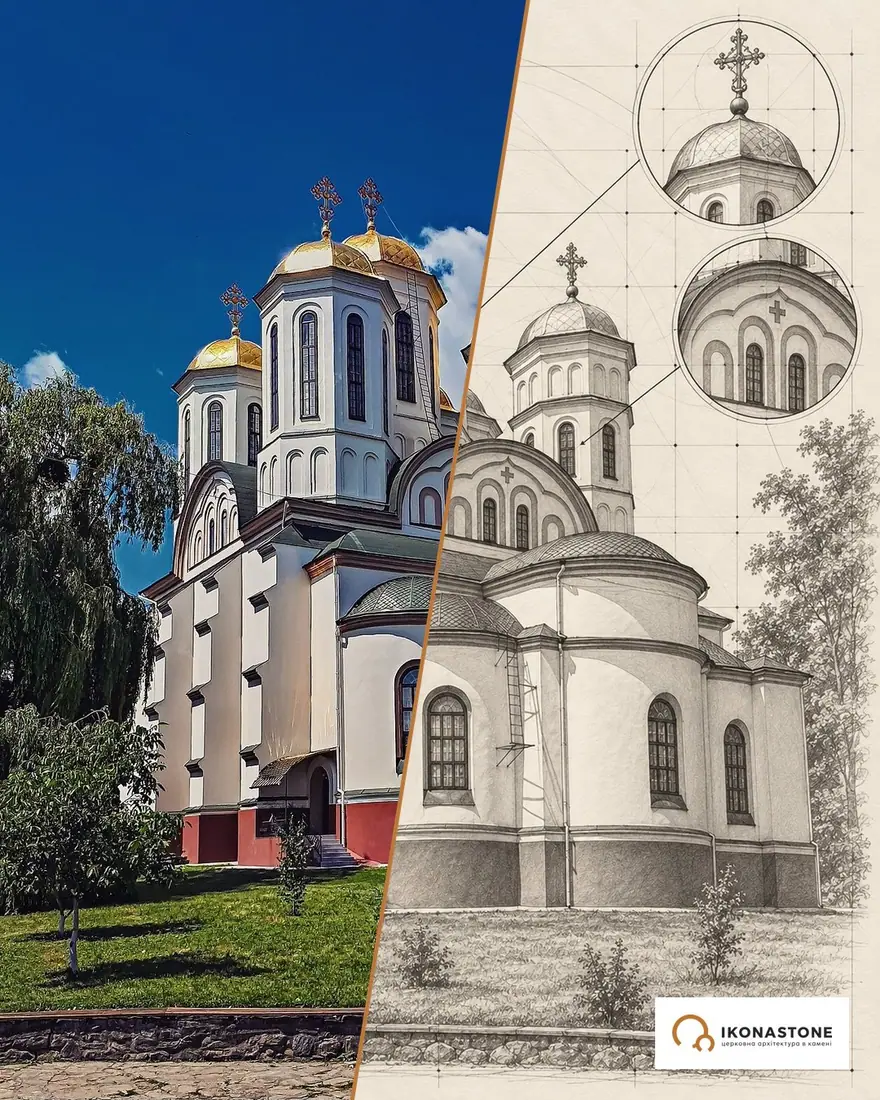
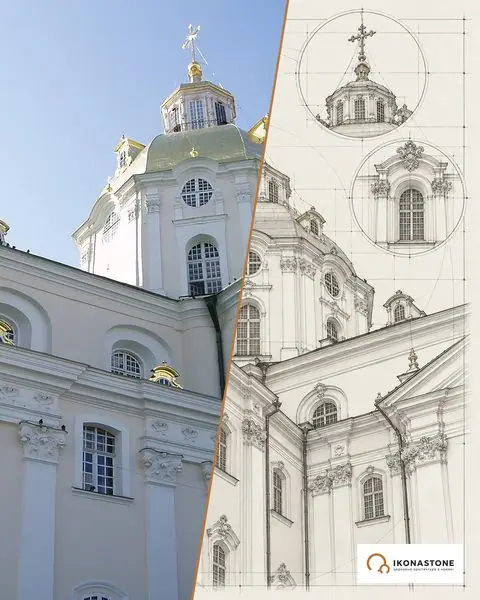
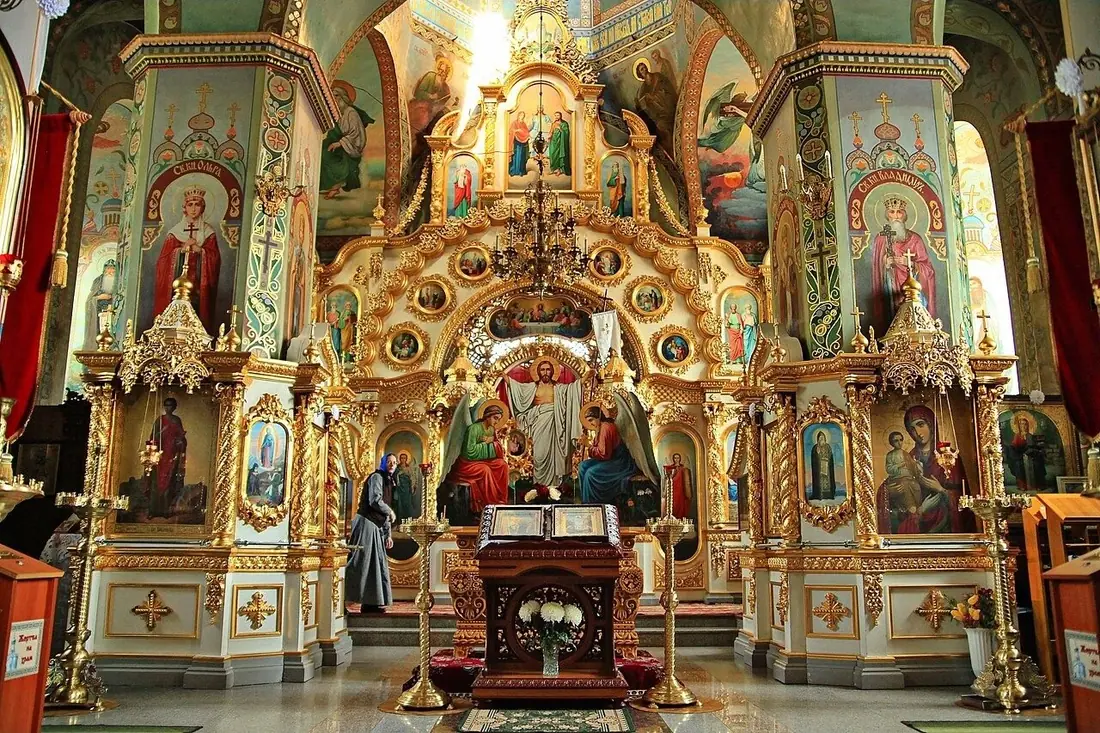
The cathedral stands inside a defensive perimeter that has the shape of an irregular polygon in plan. The church itself is single-domed, rectangular in plan, about 25 by 17 metres, with a narthex. Above the roof rises an octagonal drum with small windows. The facades are articulated by Tuscan pilasters, above which are the triangular pediments of the gabled roof, with a semicircular window in each pediment. Inside, the weight of the dome is carried by octagonal piers. Traces of mid-19th-century painting survive on the walls, and the iconostasis has been renewed with gilding. According to zabytki.in.ua, the bell tower and the Holy Trinity Cathedral were restored in 1998.
Today’s appearance is Neoclassical, but according to the scholars cited by Ukraina Incognita, the church received the basis of its volume as early as the 17th century. So behind the calm pilasters of the mid-19th century stand much older walls.
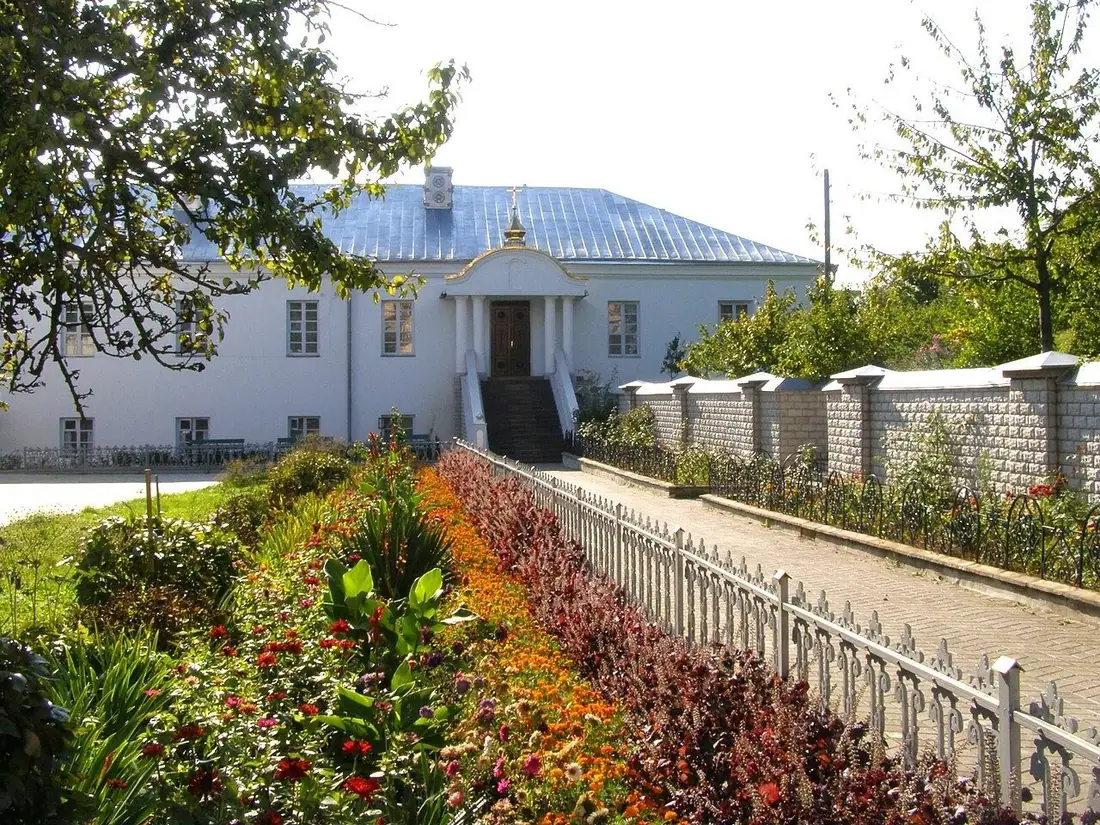
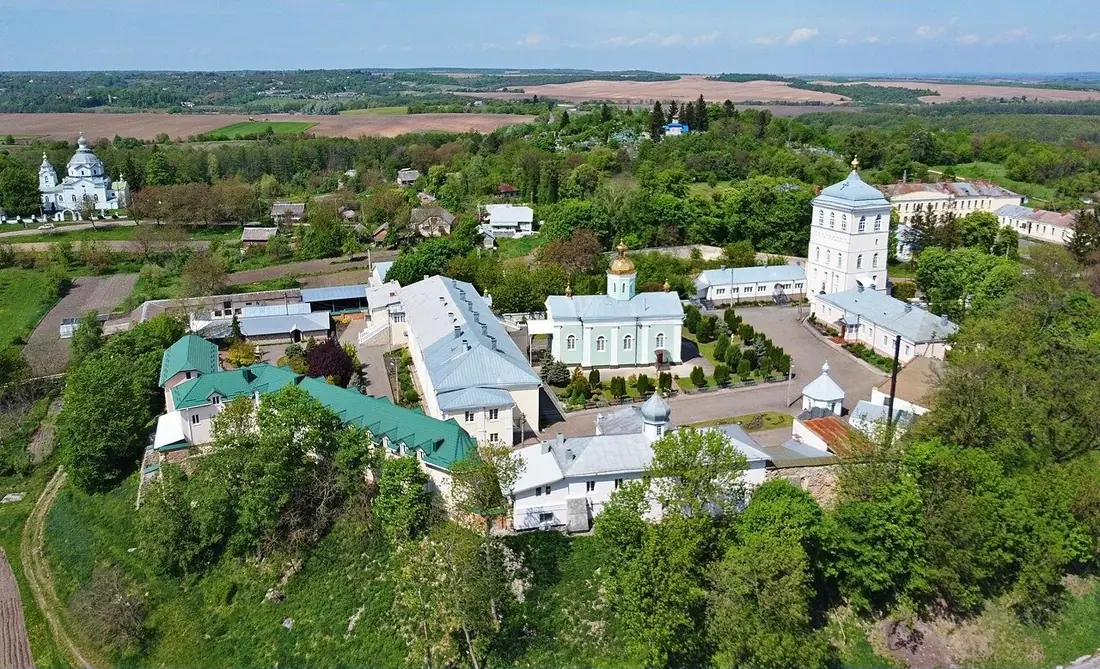
The cathedral is not the only building behind the walls. The south-western part of the perimeter is closed by a two-storey cell block with a high porch on Tuscan columns; it has been rebuilt and extended more than once, including in the Soviet years. Inside the perimeter there are also the church of the Kazan Icon of the Mother of God, a wing with a heated church and outbuildings. The ensemble was formed over centuries, and each age left its own layer in it.
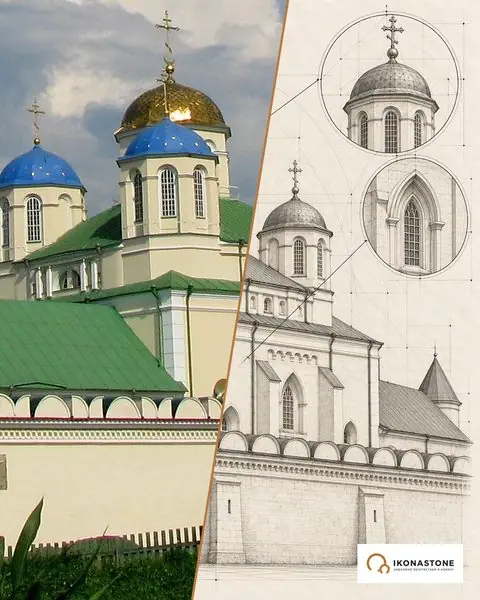
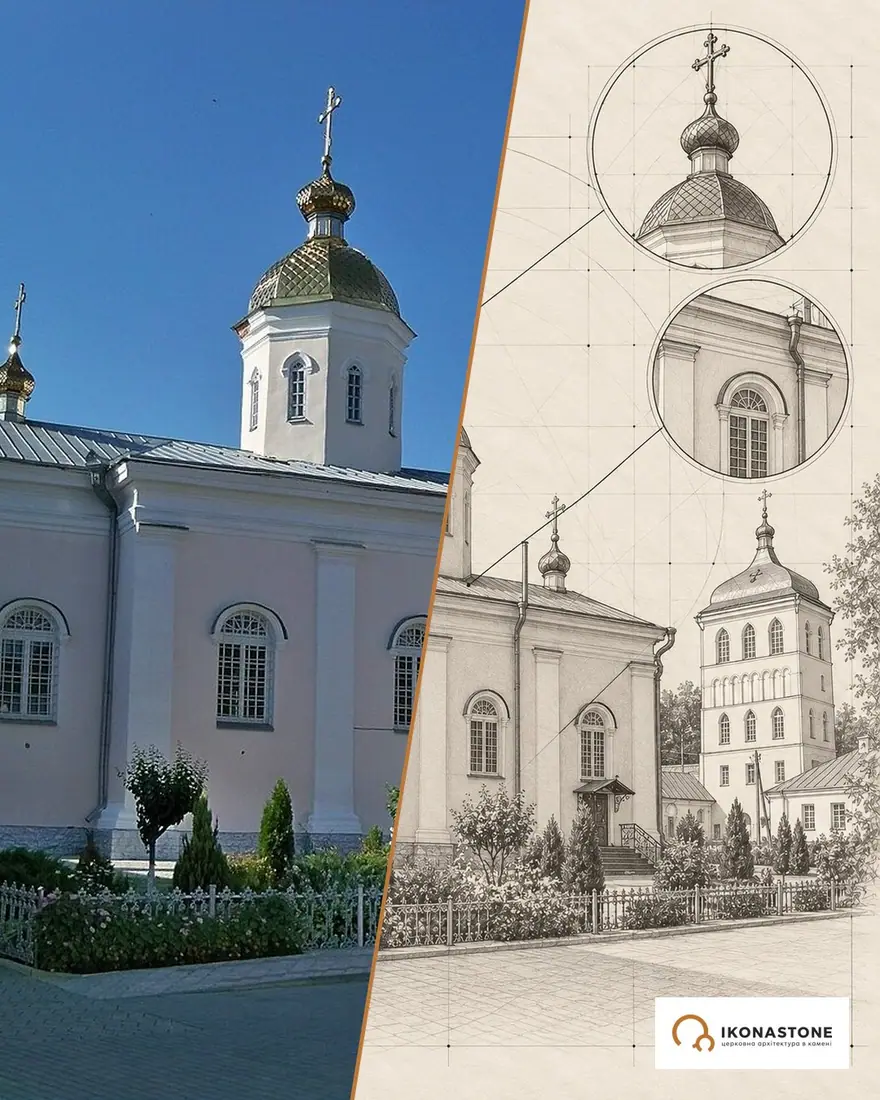
Below are two elements of the church, in a photograph and in a drawing. The drawings show form, not exact dimensions.
The gate bell tower
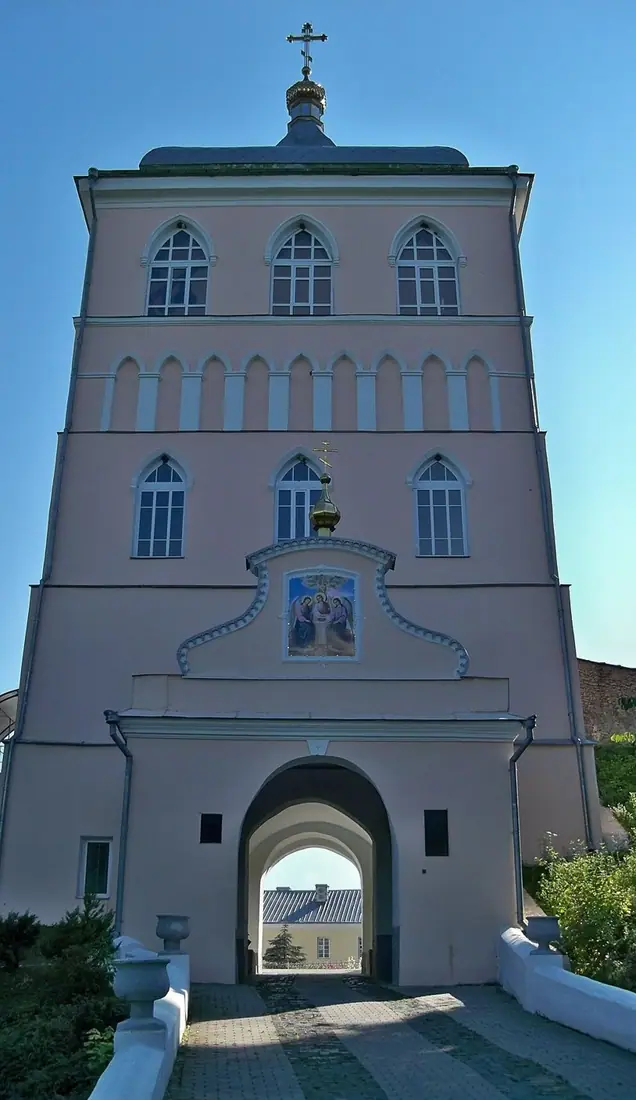
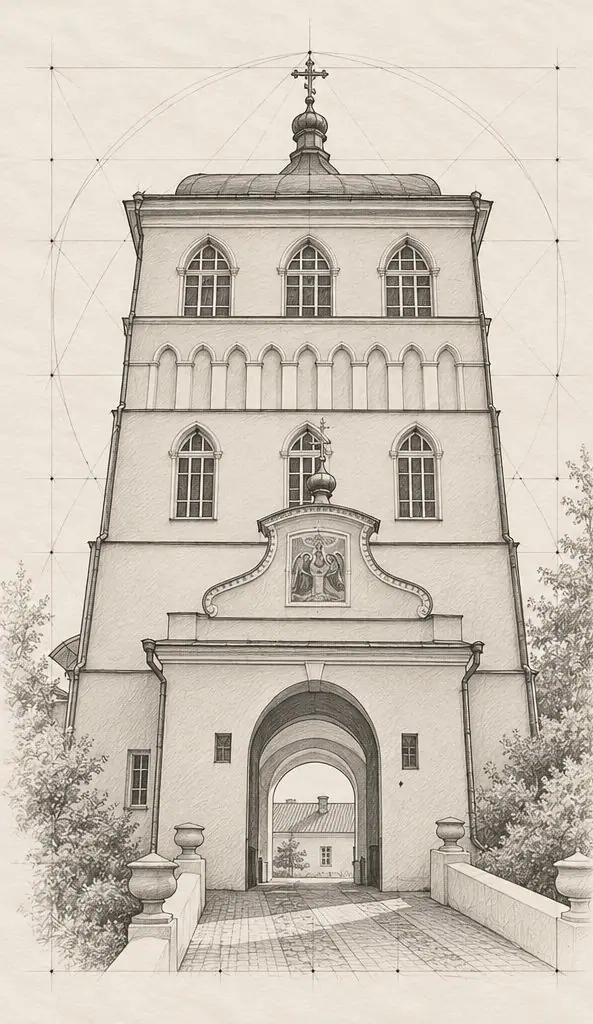
The oldest structure of the monastery. At first the tower had four tiers; the fifth, according to Ukraina Incognita, was added in the 1840s (zabytki.in.ua writes of the end of the 19th century). The first tier holds the gateway with the gates, and a volume with a Baroque pediment is attached to it. The fourth tier is decorated with a blind pointed arcade, and once had loopholes — Ukraina Incognita counts fourteen — and a crenellated parapet. The fifth tier has large pointed windows and a helmet-shaped roof with a gilded dome.
The drum and dome of the cathedral
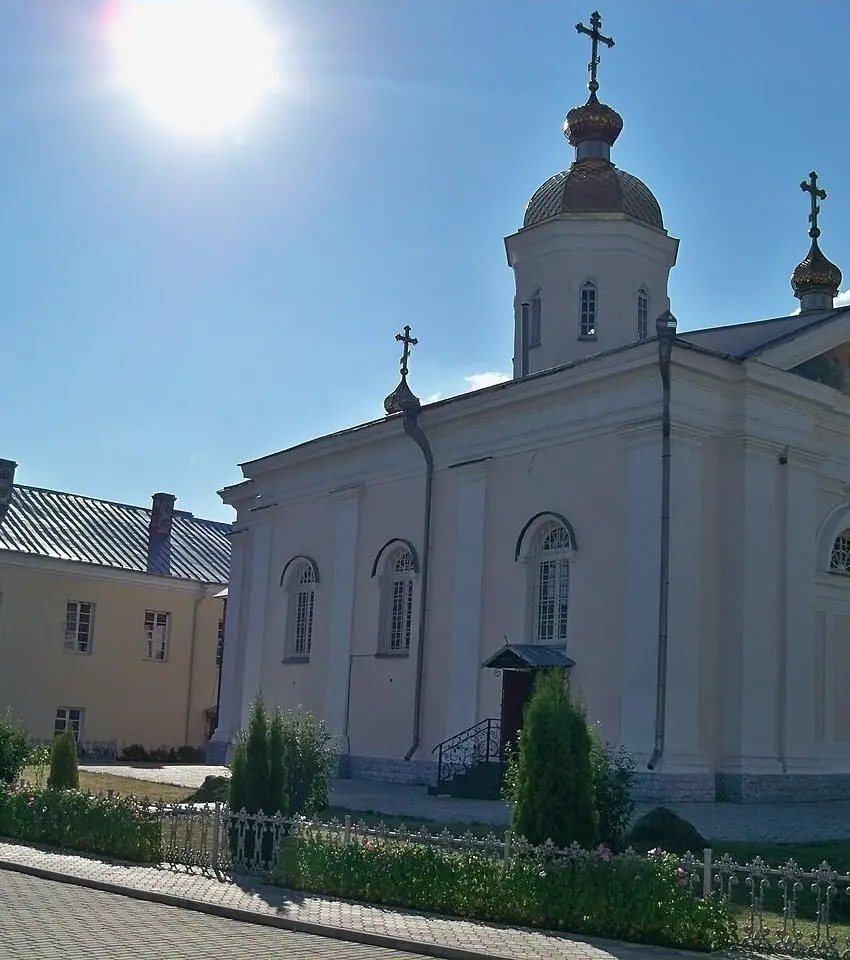
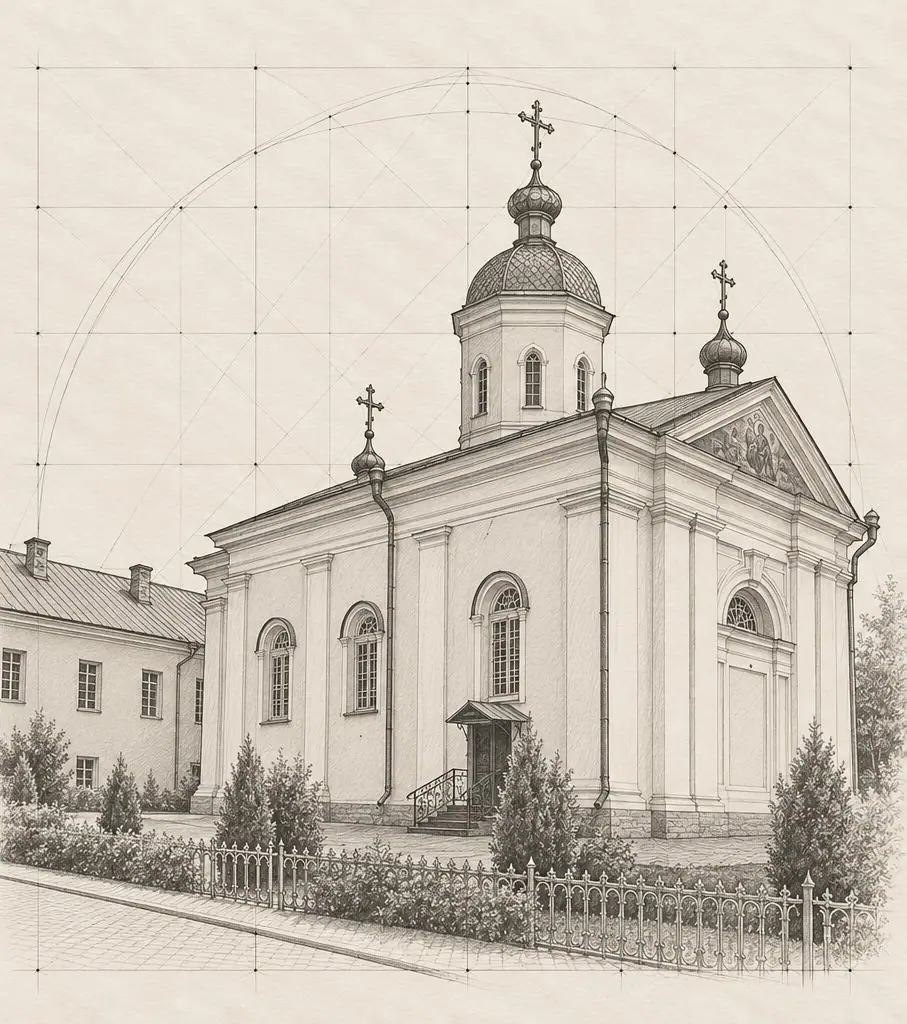
A single dome stands on an octagonal drum with small windows. Inside, it is answered by octagonal piers: the same geometry repeats from bottom to top.
Details that are easy to miss
A monastery behind water and a wall. The monastery register of the 16th century, according to zabytki.in.ua, mentions a stone wall with a wooden defensive gallery. Ukraina Incognita writes that a pond, a marsh and a moat filled from the pond surrounded the castle on all sides. Ukraina Incognita writes that the wall rose to seven metres; today it is much lower.
The tower is older than the cathedral. The gate tower and part of the wall, according to Ukraina Incognita, remain from the castle of Prince Vasyl Ostrozkyi of the first half of the 16th century. So one enters the church of 1602 through a gate that still saw the wooden church.
A grave that is no longer there. Meletius Smotrytsky was buried in the Holy Trinity church. Ukraina Incognita relays rumours that his grave was destroyed in the 1990s. Radio Svoboda also tells the fate of the memorial plaque: in the 1980s the public secured the removal of food warehouses from the church and put up a plaque (the ESU, however, dates the memorial plaque to Smotrytsky to 1991), and after the church was handed over to the monastery the plaque was taken down; later it was found and passed to the Ulas Samchuk museum.
Four versions of the name. According to a legend, Prince Vasyl Ostrozkyi founded a settlement on a hill where wolves nearly ate him, and it was called “Driman” (from “to doze”). Other versions derive the name from a Turkish voivode Derman buried here, from the folk “dery-mai”, or from the word “dernia” — the top layer of soil. Ukraina Incognita rejects the first version: the village is mentioned earlier than the prince appeared.
Two Holy Trinity churches in one village. In 1789 Derman was divided into a monastic and a manorial part, and in 1810 a separate village Holy Trinity church was built in the manorial part. So when asking the way to “the Holy Trinity”, it is worth specifying which one.
A printing house of three books. The Derman press worked briefly, in 1603–1605: three editions survive — the “Lament of the House of the Ostrogski Princes”, the “Oktoikhos” and the “Letter of Meletius” to Hypatius Potii. For the history of the book what matters is not the print run but the fact itself: a monastery behind its walls became a place where books were not only read but made.
Photo gallery
Stone and material
The walls of Derman are of stone, and it is they, together with the tower, that have survived every change of confession, the fire of the 1820s and the Soviet decades. The cathedral is of masonry and rendered; its Neoclassical dress — pilasters, pediments, the semicircular window — is executed in plaster over older walls. Inside, the load-bearing role is played by the octagonal piers rather than the walls: the dome rests on them.
Derman is a good lesson that a church’s decoration changes more often than its structure. A facade of 1849 can be rewritten, but a wall of the 16th century can no longer be relaid. So in a church with old masonry, any new stone finishing — from an altar table to an iconostasis — should be designed with these walls in mind, not against them. How a stone iconostasis combines with an ancient space is covered in the article “Stone iconostasis”.
A neighbouring monastery of the same age and the same defensive character is the Holy Trinity Church in Mezhyrich. And the nuns who came to Derman in 1949 moved here from the monastery where the Dormition Church in Zymne stands.
Did you know
The charter of 1602 permitted the teaching of secular persons as well. [3, 6]
The first edition of the Derman press was a funeral “Lament” on the death of the prince's son Oleksandr. [3, 6]
In the library of 1791 the section “Libri Machometis, Haeretici et Schismatici” had seven entries, among them a Latin Quran (Basel, 1550). [8]
The Derman centre was one of the richest in Volhynia; in 1604 Derman and Bilashiv counted 276 households, and in 1622 the monastery's holdings grew to 436 households. [4, 6]
Peasants could take their disputes to the monastery court: the punishments were a fine, an apology, extra work or prayers. [10, 11]
Ohiienko supposed that Ivan Fedorov may have begun creating a printing house already in Derman in 1575–1576. This is a hypothesis. [1]
The Derman relics of 1886 are known to us thanks to Prakhov's photographs. [7, 13]
The school was organised at the wish of the Alexandrian patriarchs Meletius Pigas and Cyril Lucaris. [6]
The Derman memorial book opens with the genealogies of the Ostrogski, Sluck, Solomerecki and Holszanski princes. [9, 14]
At first the tower had four tiers; the fifth was added in the 1840s (at the end of the 19th century according to zabytki.in.ua). [24, 25, 28, 29]
The fourth tier of the gate tower had 14 loopholes for all-round defence. [25, 28]
In a letter of 1634 Metropolitan Rutskyi mentions the monastery walls, set up long ago by the Ostrogski princes. [5]
Derman has one more Holy Trinity church, the village church of 1810 — it should not be confused with the monastery cathedral. [25]
Legends
Smotrytsky's grave
According to rumours recorded by Ukraina Incognita, Smotrytsky's grave in the Holy Trinity church was destroyed in the 1990s by monastery workers. There is no confirmation apart from this source. [25]
Driman
(A legend about the village, not the cathedral.) According to the legend, Prince Vasyl Ostrozkyi founded a settlement on a hill where wolves nearly ate him, and called it “Driman”; Ukraina Incognita rejects this version because Derman is mentioned from 1322. [25]
The Turkish voivode
(About the name of the village.) The name is derived from a Turkish voivode Derman buried here. [25]
Dery-mai and dernia
(About the name of the village.) Folk etymology: “dery-mai” or “dernia” — the top layer of soil. [25]
Batu's spring
(About the village, not the monastery.) According to the legend, Khan Batu drank water from a spring in Derman in 1241. [15]
Figures
- Vasyl Fedorovych Ostrozkyi — a prince, named as the monastery’s founder in the 15th century (according to the ESU and Ohiienko); according to Ukraina Incognita, he built the first castle in Derman.
- Kostiantyn Ivanovych Ostrozkyi — hetman; in 1499 and 1507 he gave the monastery a book and church furnishings.
- Vasyl-Kostiantyn Ostrozkyi — in 1602 he issued the charter and founded the school and the printing house.
- Isakii Boryskovych — hegumen from 1602.
- Ivan Fedorov — a printer, steward in 1575–1576.
- Demian Nalyvaiko — a priest, head of the printing house.
- Cyprian, Iov Kniahynytskyi, Iov Boretskyi — translators and teachers at the school (the participation of Antonii Hrekovych is only probable).
- Meletius Pigas, Cyril Lucaris — Alexandrian patriarchs at whose wish the school was organised.
- Isaiah Balaban — received the administration in 1608.
- Yosyp Kurtsevych — archimandrite, left for Russia in 1625.
- Meletius Smotrytsky — archimandrite, author of the “Grammar”, died 27.12.1633.
- Josyf Rutskyi — metropolitan, wrote about the monastery walls in 1634.
- Ianuarii (Ohurtsevych) — archimandrite 1713–1729.
- Yulian (Petrovych) — archimandrite; in 1791 an inventory of the library was drawn up.
- Adrian Prakhov — described the Derman monuments in 1886.
- Anton Dovbenko — commander of the detachment that plundered the monastery in 1918.
- Irynei (Seredniy) — Archbishop of Rivne and Ostroh, who according to the ESU blessed the restoration in 1990.
- Ulas Samchuk, Borys Ten — writers born in Derman (Samchuk on 20.02.1905, Ten on 09.12.1897). [22]
How to cite
IKONASTONE. Holy Trinity Cathedral of the Derman Monastery // Guide to the Churches of Ukraine. URL: https://ikonastone.com/en/guide/holy-trinity-cathedral-derman-monastery/ (accessed DD.MM.YYYY).
Not sure what the piece is called? Walk through the church from sanctuary to churchyard →
Would you like to give something to a church? What to give a church →
Want to remember loved ones or a fallen parishioner? Remembrance at a church →
FAQ
When was the Holy Trinity Cathedral in Derman built?
According to zabytki.in.ua, the masonry Holy Trinity church was founded in 1602 on the site of a wooden one mentioned in the inventory of 1571. The church acquired its present Neoclassical appearance during the repairs and rebuilding of 1849.
Who founded the Derman Monastery?
The monastery is associated with the Ostrogski princes: the Encyclopedia of Ukraine names Prince Kostiantyn Ostrozkyi as its founder, and in 1602 his son Vasyl-Kostiantyn gave the monastery a rule of communal life and a printing house. The exact founding date is unknown; the monastery already existed at the end of the 15th century.
What is the oldest part of the monastery?
The gate bell tower and part of the stone wall. They are linked to 16th-century defensive structures; Ukraina Incognita connects them with the castle of Prince Vasyl Ostrozkyi from the first half of the 16th century. The fifth tier of the tower was added later: according to some sources in the 1840s, according to others at the end of the 19th century.
Which well-known people are connected with Derman?
In 1575–1576 the printer Ivan Fedorov looked after the monastery's estates. In the early 17th century the printing house was headed by Demian Nalyvaiko. Meletius Smotrytsky was archimandrite here; he died in Derman in 1633 and was buried in the Holy Trinity church. The writers Ulas Samchuk and Borys Ten were born in Derman.
Is the monastery active today?
Yes. After its closure in 1960 it was restored in 1991 (according to the Encyclopedia of Modern Ukraine, in 1990) as a convent. A church of the Kazan Icon of the Mother of God also stands within its walls.
Sources 29
- Блізняк. Дерманська друкарня (аналіз праці І. Огієнка)
- Encyclopedia of Ukraine. Derman Monastery
- Лопацька Н. Дерманський монастир наприкінці XVI — у першій половині XVII ст. (статут, друкарня, будівництво)
- Лопацька Н. Управління й господарство Дерманського монастиря XVI–XVII ст
- Стаття про фундації й пожертви Дерманського монастиря (назву уточнити)
- Мицько І. Дерманський освітньо-культурний центр
- Бендюк. Дерманські вклади
- Альмес І. Книги Дерманського монастиря (інвентар 1791)
- Лопацька Н. Бібліотека й архів Дерманського монастиря
- Лопацька Н. Монастирський суд
- Лопацька Н. Дерманський монастир і селянство, 2023
- Бібліографічний покажчик «Дермань і Мізоч…»
- Передмова до збірника (Євангеліє 1507, Прахов)
- Наукові записки МЕГУ, 2021, ч. 4, с. 16–19 (Дерманський пом'яник)
- Романів А., Чернецька В. Тези (МЕГУ)
- Wikipedia (en). Derman Druha
- Travelsinua. Trinity Derman Monastery
- The Holy Trinity monastery of Derman' in Volhynia and Slavonic translation of the pseudo-Antonius' «Melissa» of 1599
- Радіо Свобода, 2006. Дермань
- Радіо Свобода, 2007 (430-річчя Смотрицького)
- Радіо Свобода, 2013 (трагедія Залужжя)
- Рівненська обласна рада. Видатні діячі (письменники)
- Енциклопедія сучасної України. Дерманський Свято-Троїцький жіночий монастир УПЦ МП
- Замки та храми України. Дерманський Троїцький монастир
- Україна Інкогніта. Дермань. Замок, монастир та немилозвучна назва
- Загребельна. Стаття про закриття монастирів на Рівненщині (згадка про Дерманський, 1960)
- Rivne-day. Дерманський монастир-фортеця. Цікаві факти
- Архітектурні та природні пам'ятки України. Дермань
- Подорожі Україною. Свято-Троїцький Дерманський жіночий монастир
- Town
- Derman Druha village, Rivne Oblast
- Built
- founded in 1602 on the site of a wooden church; present appearance after the rebuilding of 1849
- Type
- single-domed rectangular church with a narthex and an octagonal drum
- Material
- masonry, rendered; Neoclassical facade decoration
- Research depth
- 32%