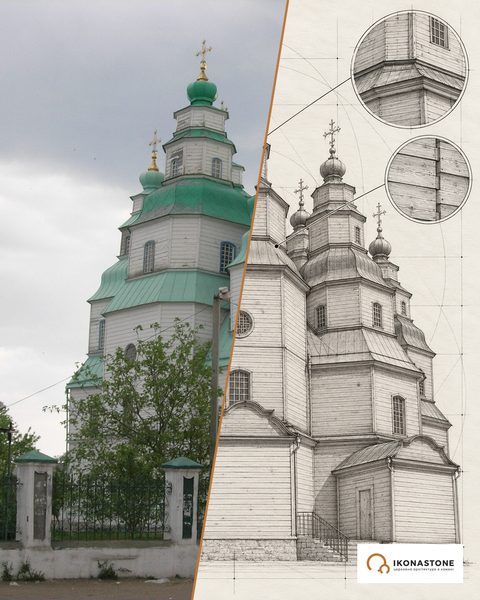
The Holy Cross Exaltation Cathedral in Poltava: seven domes above the Vorskla
The cathedral above the Vorskla was built under three hetmans and finished only after a battle that changed the history of the whole land. Seven domes, like seven attempts to see the work through to the end.
In brief
| Address | 2a Paisii Velychkovskyi Street, Poltava |
| Built | 1689–1709 (according to other data, completed around 1725); consecrated in 1756 |
| Type | three-aisled six-pier seven-domed cathedral, Ukrainian Baroque |
| Material | masonry, brick |
| Status | ensemble of architectural monuments of national importance |
| Now | convent of the Ukrainian Orthodox Church (Moscow Patriarchate), since 1990 |
History
The monastery was founded in 1650 on a high hill above the Vorskla floodplain. The initiative came from Kalistrat, hegumen of the Mhar Monastery, and the funds were given by the Poltava colonel Martyn Pushkar and other people of Poltava. At first all the buildings were wooden.
In 1689, at the expense of Hetman Ivan Samoilovych, construction of the masonry cathedral began; the cathedral of the Mhar Monastery near Lubny served as its model. After Samoilovych’s fall the construction was overseen by Hetman Ivan Mazepa and the Poltava colonel Ivan Iskra. In 1693 (according to other data, in 1695) the monastery was ravaged by the Crimean Tatars. In the spring of 1709, during the siege of Poltava, the Swedes seized the monastery and shelled the fortress from its ramparts. Charles XII stayed here; according to a widespread version, his headquarters were in the monastery.
After the Battle of Poltava the cathedral was completed by the Kochubeis: according to Ukraina Inkognita, the construction was supported by the General Judge Vasyl Kochubei, executed in 1708, and it was brought to completion by his son, the Poltava colonel Vasyl Vasylovych Kochubei. According to other data, construction ended around 1725. The cathedral was consecrated in 1756. In 1772 the master Sysoi Shalmatov carved for it a monumental four-tier iconostasis in the Rococo style. In 1786 the gate bell tower was built.
In 1923 the monastery was closed, and in 1933 most of its buildings were destroyed together with the iconostasis — Ukraina Inkognita mentions works by both Shalmatov and Vasyl Reklinskyi; an NKVD children’s labour colony was set up on the grounds. During the fighting for Poltava the ensemble suffered new destruction, and, according to the English-language Wikipedia, the cathedral lay in ruins until 1956. Conservation work was carried out in 1950–1953 and restoration in 1981–2000. According to the Great Ukrainian Encyclopedia (VUE), the monastery was closed once more in 1960. Since 1990 it has been a convent, and in 2010 the iconostasis was recreated in its original forms.
Architecture
The cathedral is a masonry building with three aisles, six piers and seven domes, with a cross-domed structure in its central core. It is 30 metres long, and the height to the top of the central dome is 28 metres. The church had four altars. The Mhar Monastery near Lubny served as the model for the cathedral, so these two ensembles are worth considering as a pair: a similar scheme, different decoration. The VUE sees in its architecture a combination of Western European Baroque, 12th-century churches of Rus’ and the 17th-century Ukrainian church tradition.
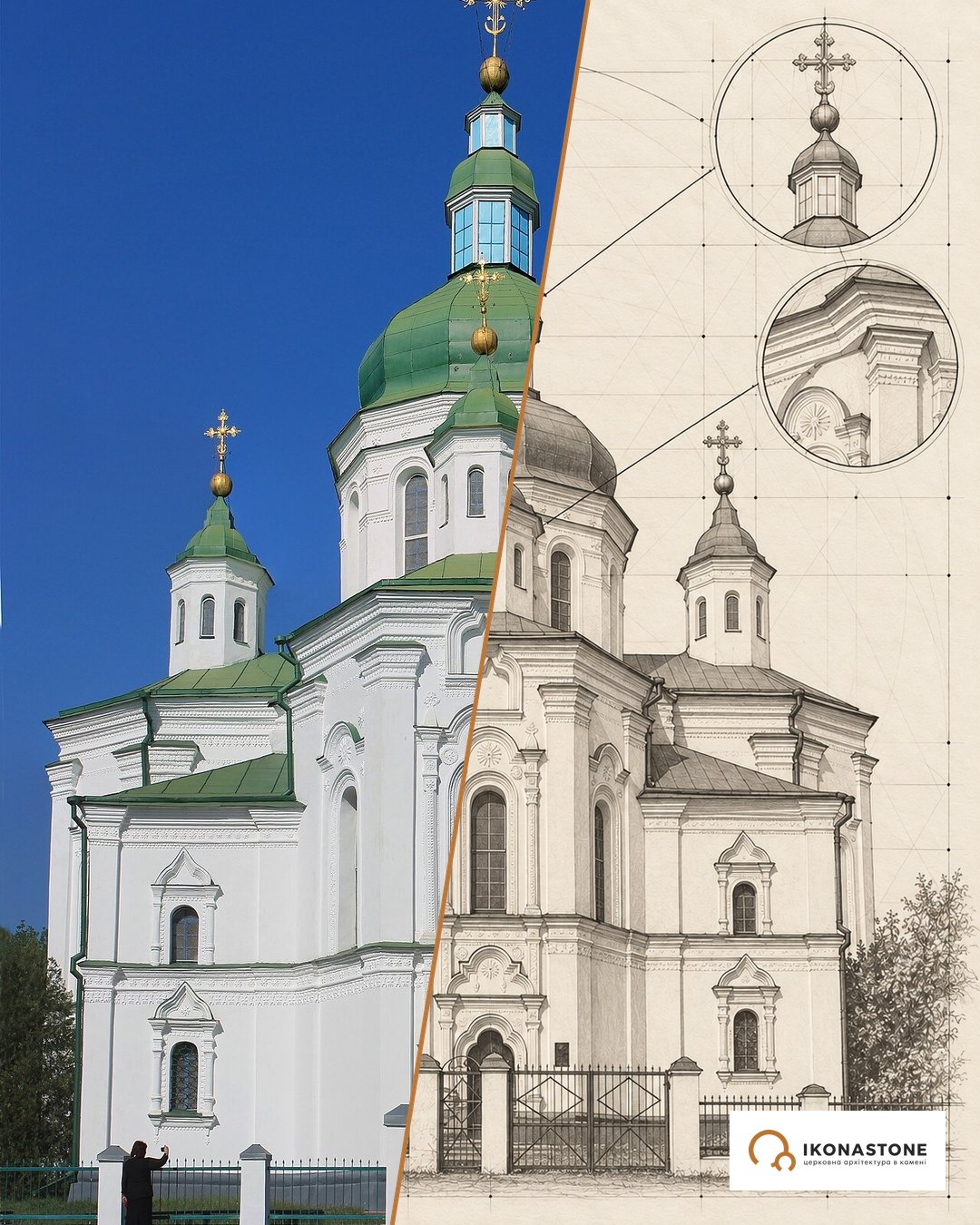
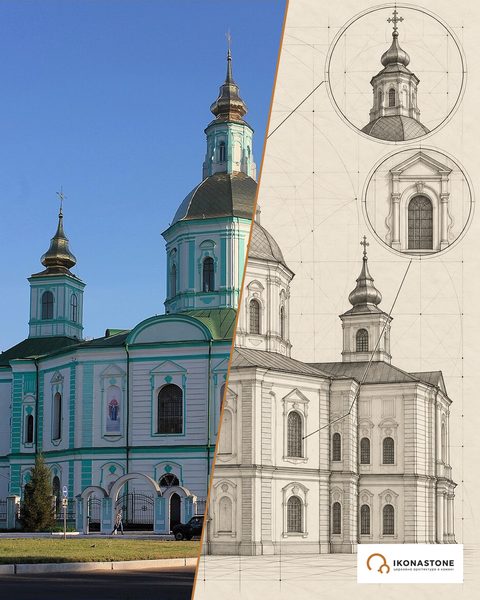
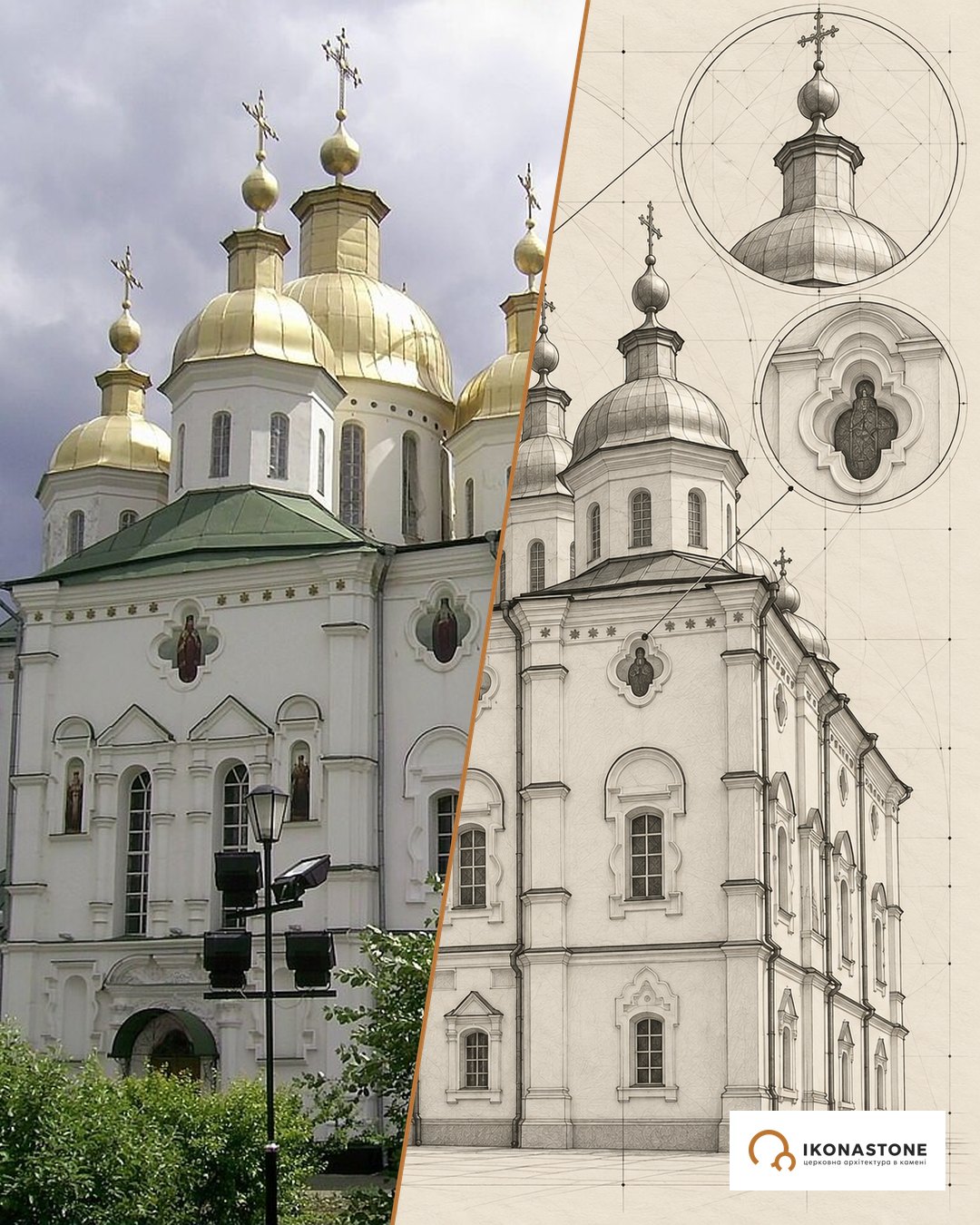
Below are two elements of the church: in a photo and in a drawing. The drawings show the form, not exact dimensions.
Seven domes
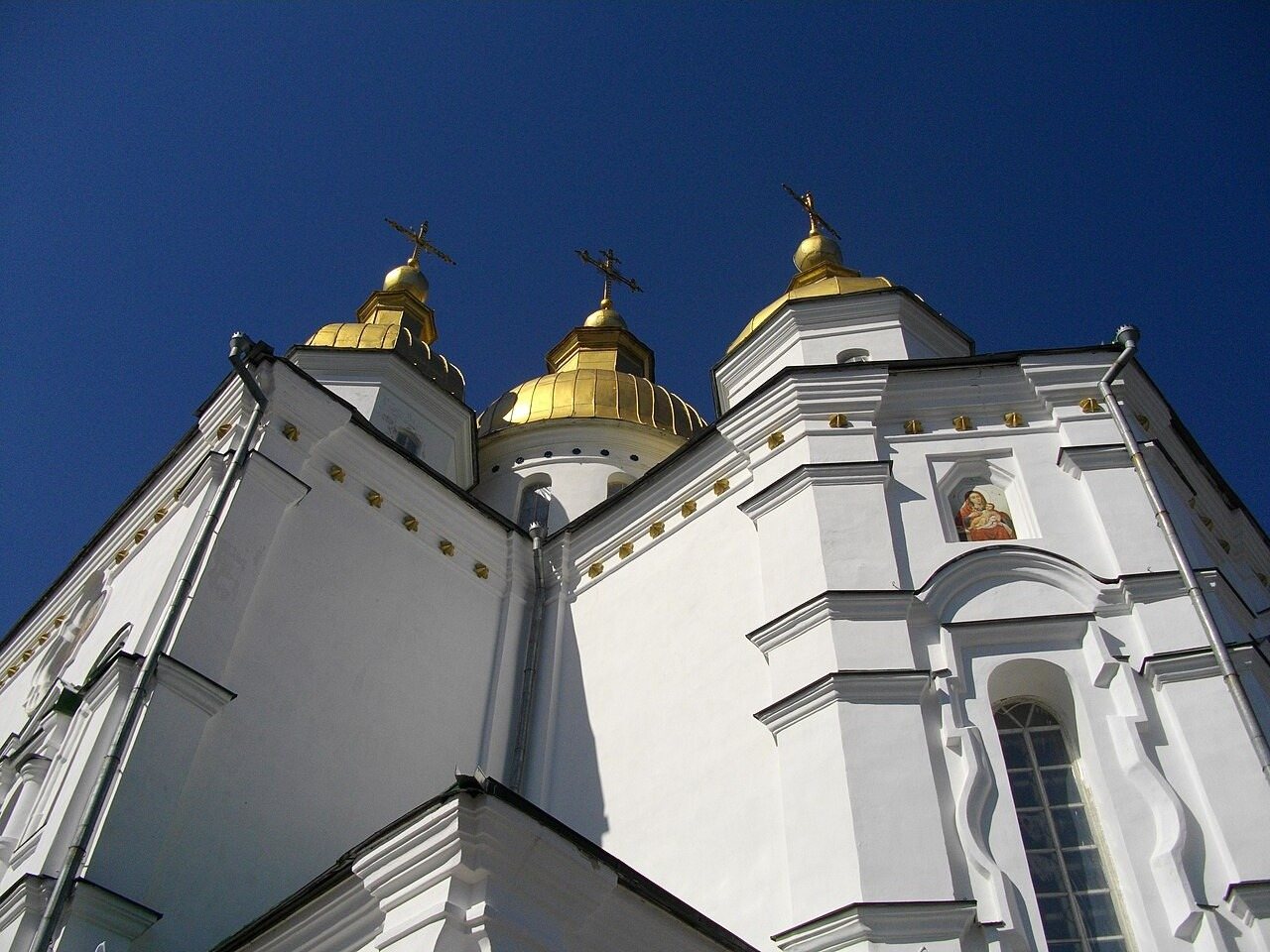
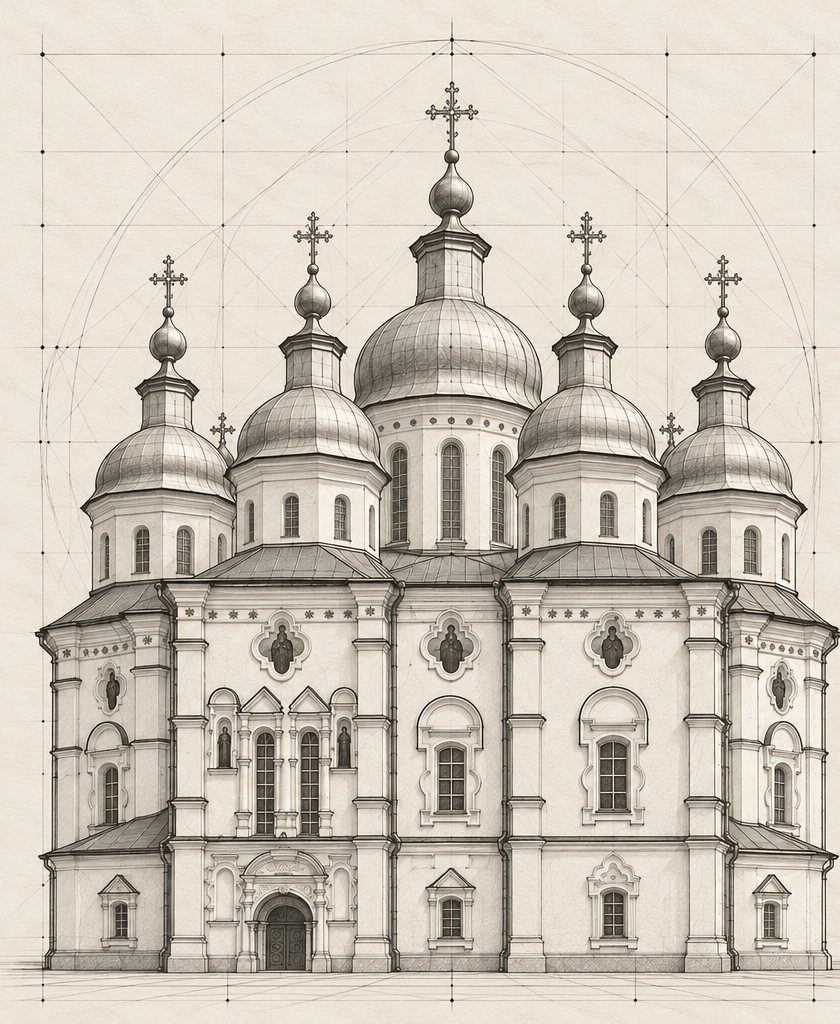
Seven domes on cylindrical drums make the cathedral’s silhouette recognisable from afar. Some sources write that the cathedral has no single main facade and that its sides are identical; the author of Ukraina Inkognita nevertheless notices differences between them.
The bell tower
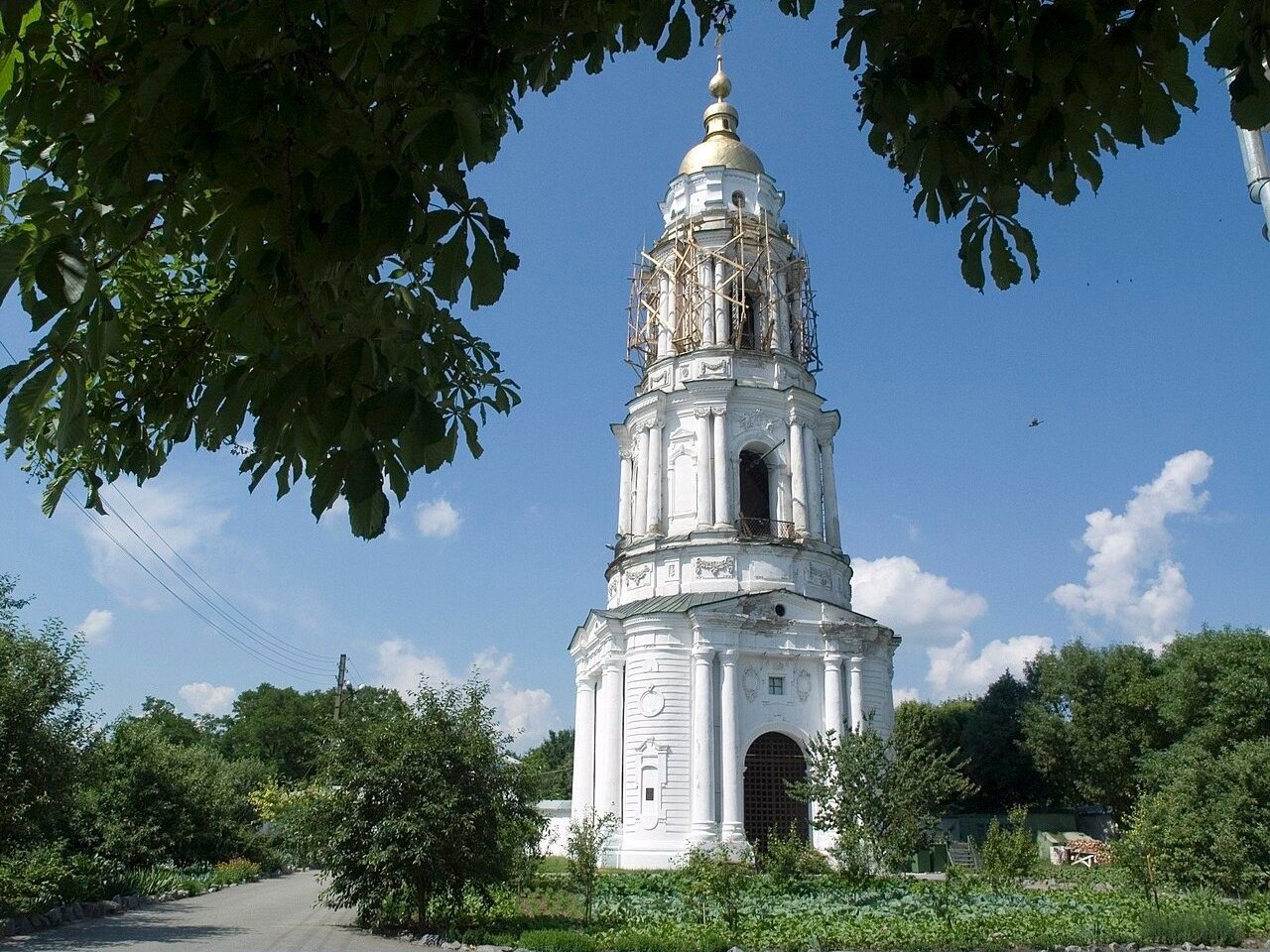
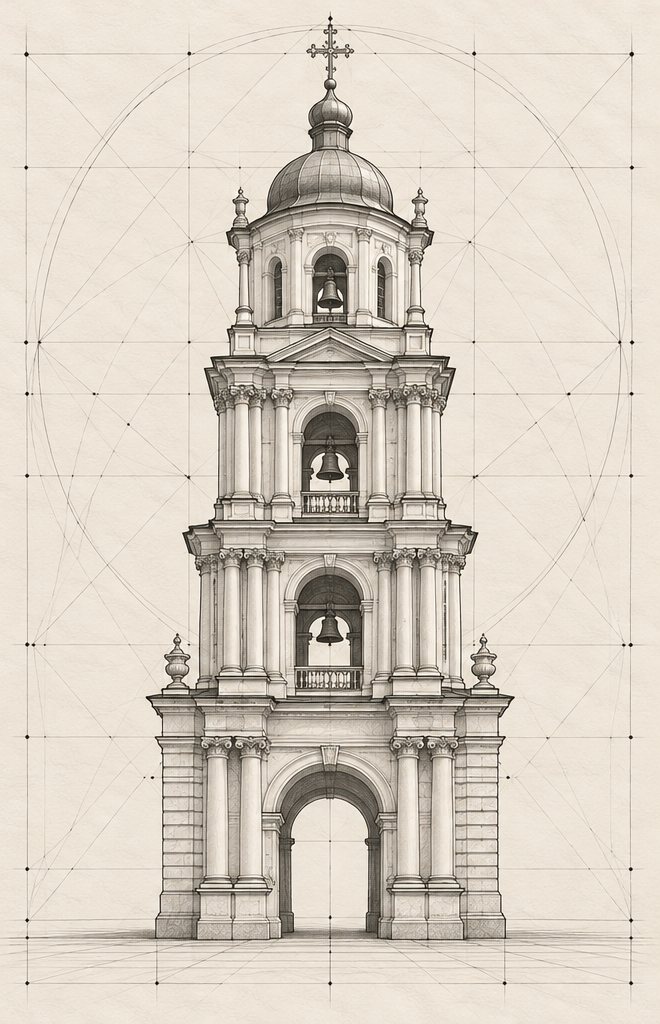
The gate bell tower of 1786 is the tallest structure of the monastery: 47 metres, four tiers, late Baroque forms. The first three tiers are decorated with columns of the Roman Doric, Ionic and Corinthian orders. The bells hung in the second and third tiers, and the fourth held a clock mechanism with chimes, which has not survived. The architect Artur Aroian notes that the bell towers of the Poltava and Mhar monasteries are essentially one design with different decoration.
Stone and material
The cathedral and the bell tower are of masonry; the bell tower is built of brick and rendered. Here the masonry works for scale: seven drums with domes are a considerable weight, which the piers and walls must carry down to the foundations. The more domes a church has, the more important it is that this weight comes down evenly.
The iconostasis is a separate story of material. Shalmatov’s carved wood perished in 1933, while the cathedral walls survived both the closure and the war. What stands in the church now is a recreation of 2010. Durability in a church is always unevenly distributed, and this is worth bearing in mind when designing an iconostasis or an altar table.
Another Left-Bank Baroque cathedral built at a hetman’s expense is the Ascension Cathedral in Pereiaslav. Another Left-Bank monument of the period, but with a different, three-domed scheme, is the Intercession Cathedral in Kharkiv.
FAQ
Who built the Holy Cross Exaltation Cathedral?
Construction began in 1689 at the expense of Hetman Ivan Samoilovych. After his fall the work was overseen by Hetman Ivan Mazepa and the Poltava colonel Ivan Iskra, and the Kochubei family completed the cathedral after the Battle of Poltava. The church was consecrated in 1756.
How many domes does the cathedral have?
Seven. The cathedral has three aisles and six piers, with a cross-domed core; the height to the top of the central dome is 28 metres.
What links the monastery with the Battle of Poltava?
In the spring of 1709, during the siege of Poltava, the Swedes seized the monastery and shelled the fortress from it. Charles XII visited it; according to a widespread version, his headquarters were here.
Is the monastery active today?
Yes, since 1990 it has been a convent of the Ukrainian Orthodox Church (Moscow Patriarchate). The cathedral's iconostasis, destroyed in 1933, was recreated in 2010.
Sources
- ВУЕ: Хрестовоздвиженський монастир у Полтаві
- Wikipedia: Holy Cross Exaltation Monastery, Poltava
- Україна Інкогніта: Полтавський Хрестовоздвиженський — жіночий монастир з чоловічою історією
- Visit Poltava: Хрестовоздвиженський монастир
- Суспільне Полтава: Які пам'ятки українського бароко збереглися на Полтавщині
- Town
- Poltava
- Built
- 1689–1709 (consecrated 1756)
- Type
- three-aisled six-pier seven-domed cathedral, Ukrainian Baroque
- Material
- masonry, brick
- Research depth
- 16%