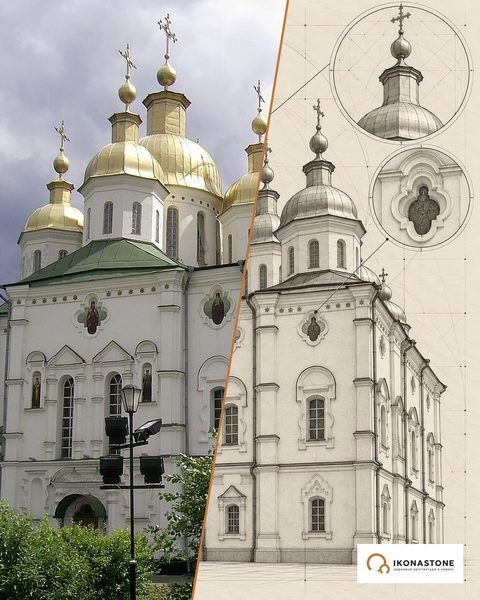
The Intercession Cathedral in Okhtyrka: a church on the site of a found icon
According to tradition, it all began with haymaking: in 1739 the priest Danylo Polianskyi was mowing grass and saw among it an icon that was shining. Fourteen years later a cathedral was founded on that spot, and it still defines the skyline of the town.
In brief
| Address | 1 Soborna Square, Okhtyrka, Sumy Oblast (in the State Register: 1 Pushkina Street) |
| Built | 1753–1768 (founded on 25 April 1753); main altar consecrated in 1773 |
| Type | Baroque tripartite church with a nine-part central volume |
| Height | about 46 m to the cross; interior height 39 m (according to the Great Ukrainian Encyclopedia) |
| Material | masonry, rendered walls |
| Status | architectural monument of national importance (protection No. 180041) |
| Ensemble | Presentation bell-tower church (1784), Church of the Nativity of Christ (1825; listed in the register as the Exaltation Church) |
History
The Okhtyrka Icon of the Mother of God became known far beyond Sloboda Ukraine. Father Danylo, according to tradition, was accused of misusing donations: he spent them on repairing his wooden church instead of sending them to the consistory. He was acquitted only in 1750. On 22 June 1751 the Synod recognised the icon as miracle-working, and the matter of building a church reached Empress Elizabeth. According to the sources, she donated two thousand silver roubles to it.
The cathedral was founded on 25 April 1753. The original plans and elevations, according to research by L. and O. Sokoliuk, came from Rastrelli’s St Petersburg workshop, although the author’s signature could not be identified; the Great Ukrainian Encyclopedia names the Moscow architect D. Ukhtomsky as the author. Construction went badly. The contractor H. Zaitsev departed from the design, the vaults cracked, and in 1757, by decree of the Senate, Stepan Dudynskyi, a pupil of Ukhtomsky, was sent to the site. In April 1758 he submitted a report, and in 1759 the faulty pillars were dismantled.
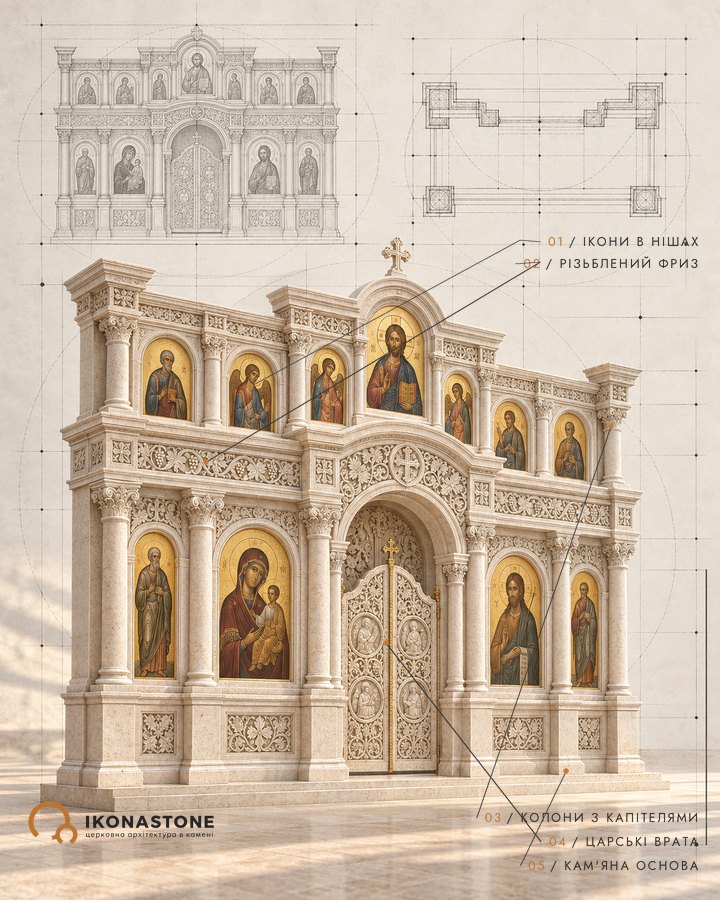
Construction was completed in 1768, and the main altar was consecrated in 1773. In 1769 a contract for the icons was signed with Ivan Sablukov, but because of illness he could not finish the work on time; later other masters painted icons as well. The iconostasis, according to some sources, was made by S. Shalmatov; according to others, the carver Vasyl Petrovskyi was invited for this work in 1782.
The icon itself has not survived to our day. It was stolen in 1905 (according to other sources, in 1903), and during the revolution it disappeared for good. A copy is venerated in the cathedral.
In the Soviet years the church was closed and turned into a warehouse. The original iconostasis was removed from the cathedral in 1930. In 1962 the local authorities petitioned to demolish the cathedral to make way for a department store, but a group of townspeople appealed to Khrushchev, and the building was spared. Restorations took place in 1970–1972, 1988 and 1991–2001. In 1991 the cathedral was returned to the religious community. According to researchers (2023), during the full-scale invasion the cathedral found itself in a zone of prolonged shelling.
Architecture
The cathedral is tripartite and has three tops in the Ukrainian tradition, but with a nine-part central volume. It is about 45 metres long. According to researchers’ descriptions, three tops stand on the longitudinal axis, and four smaller ones are placed at the corners of the central square. Four massive piers divide the central volume into nine parts; the transverse arches are reinforced with iron tie rods, and the pendentives bear images of the Evangelists.
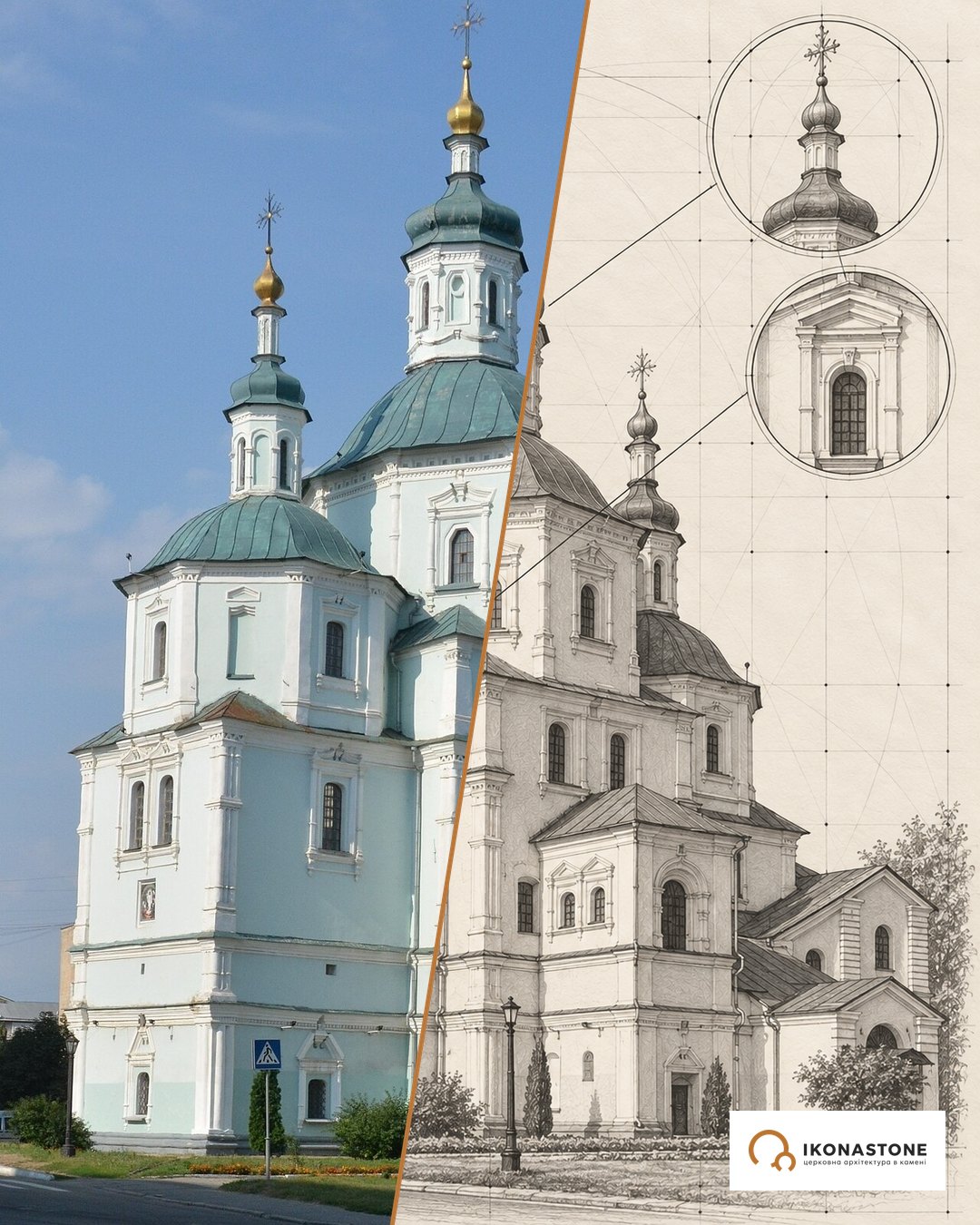
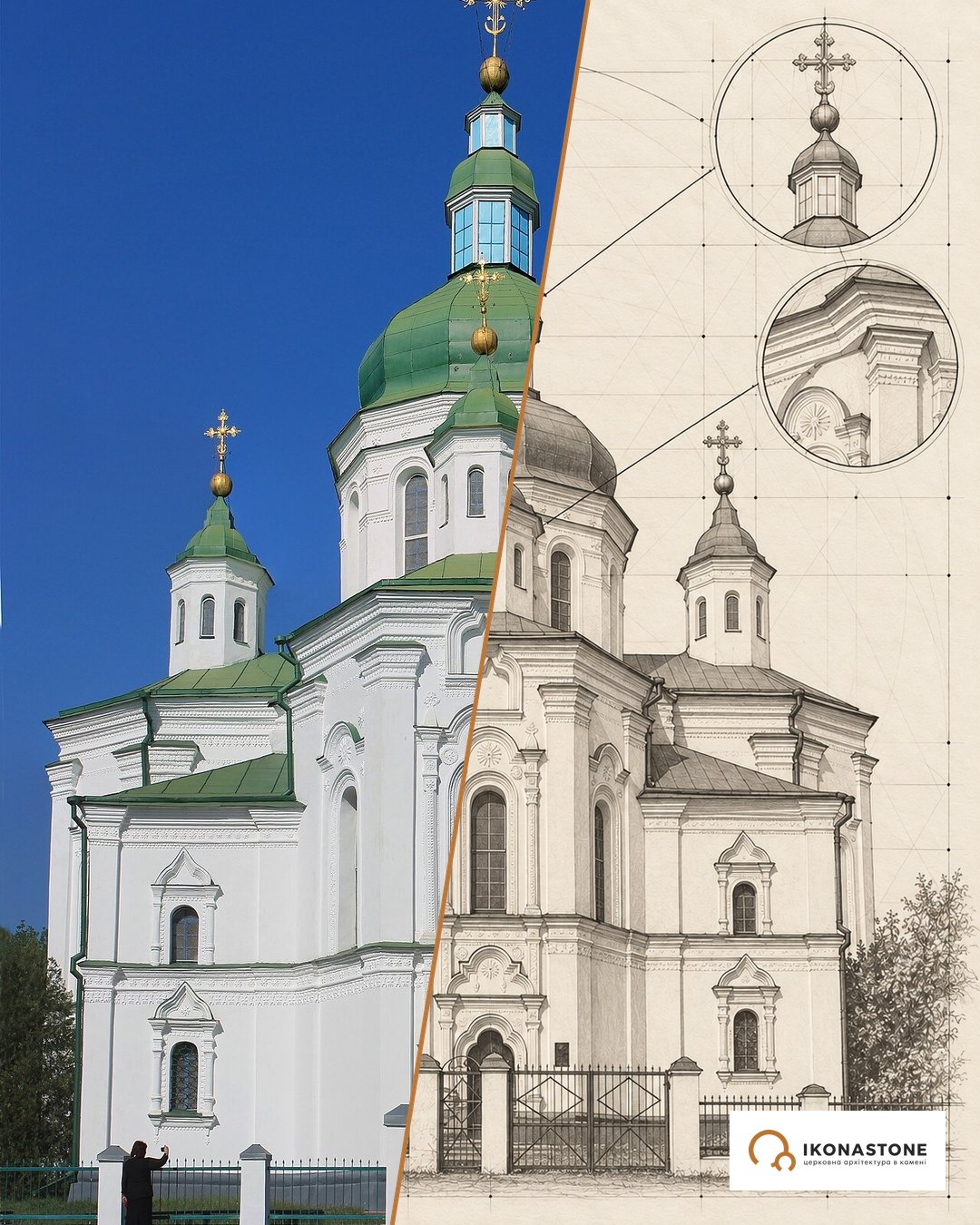
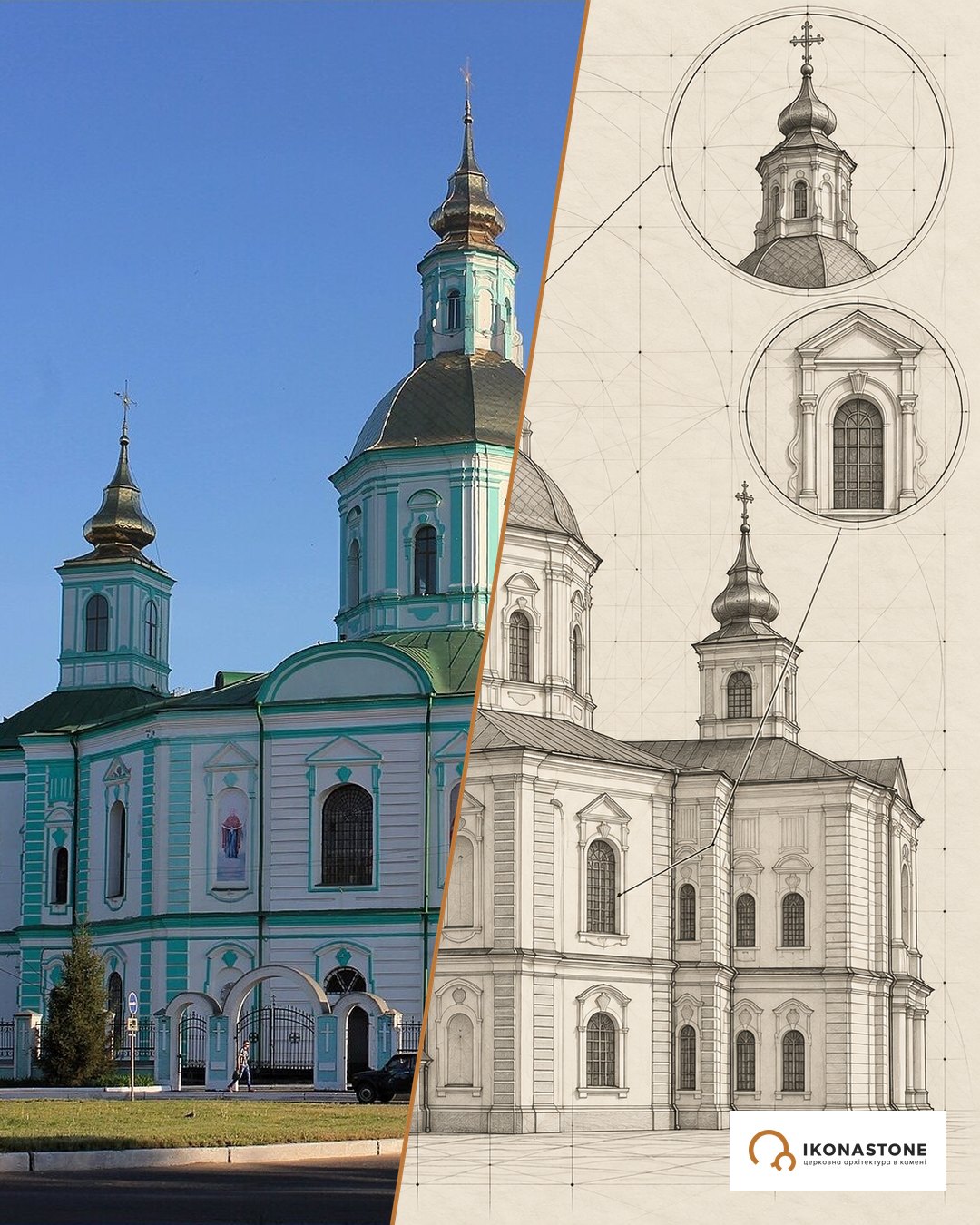
Below are two elements of the church: in a photo and in a drawing. The drawings show the form, not exact dimensions.
The tops of the cathedral
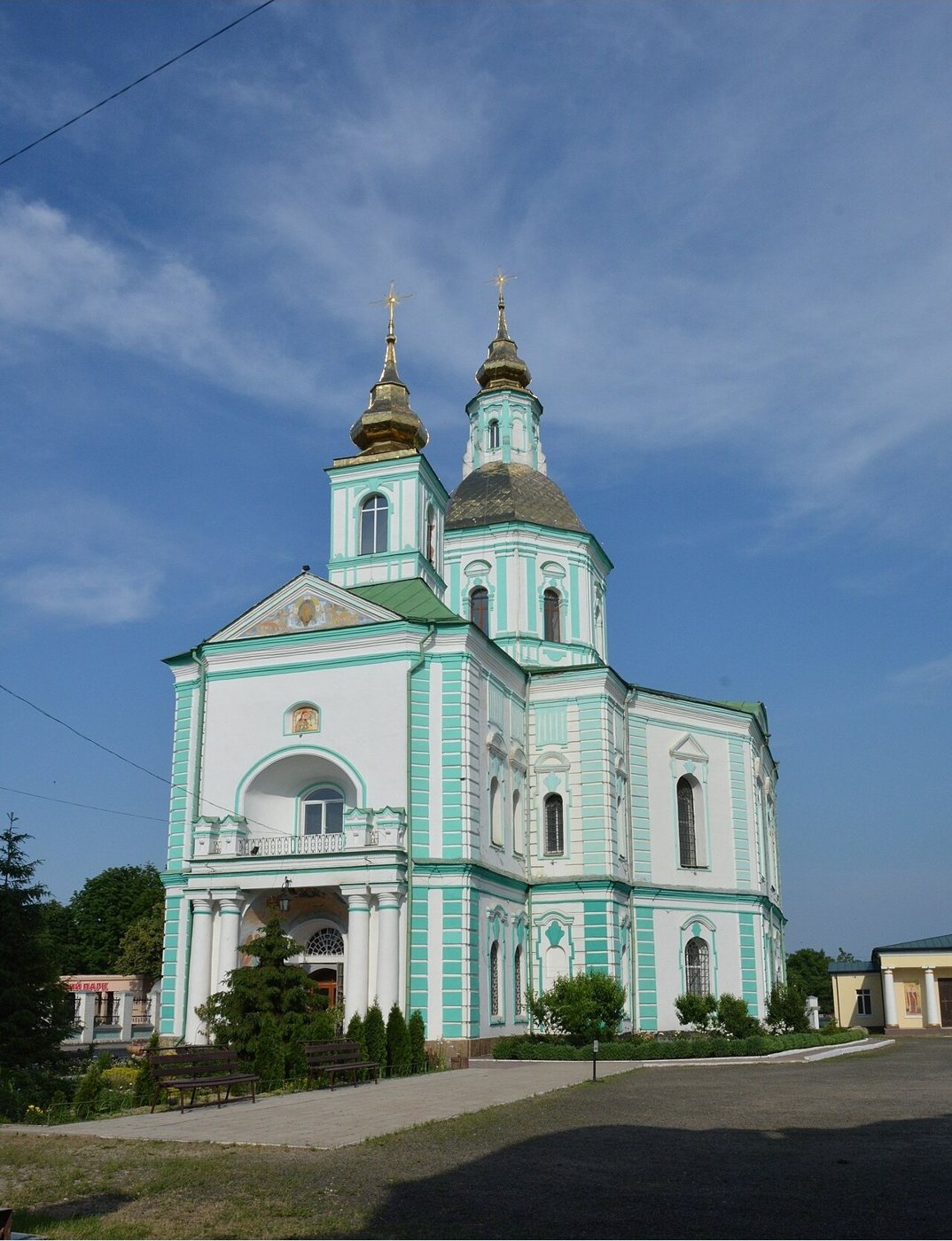
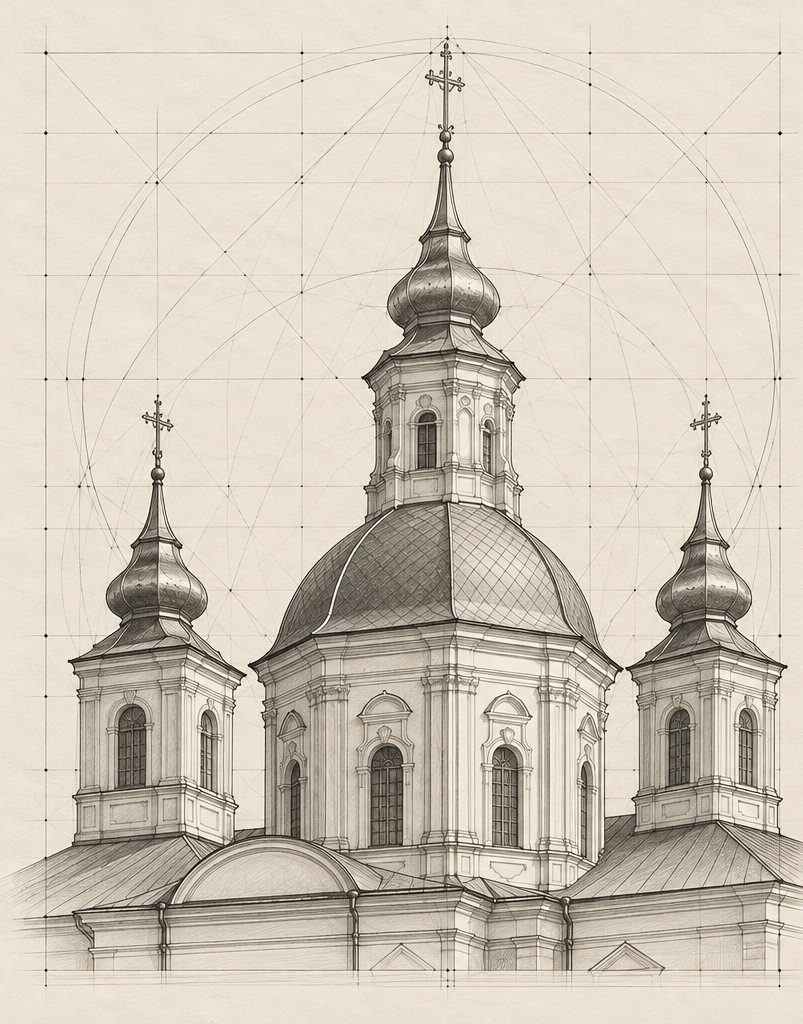
Dudynskyi noted on his plan that the drum of the central dome was supposed to be octagonal, but it had been built square. This detail explains a great deal in the history of the cathedral: here there was always a gap between the drawing and the building site. On the outside the cathedral is painted white and blue today.
The Presentation bell-tower church
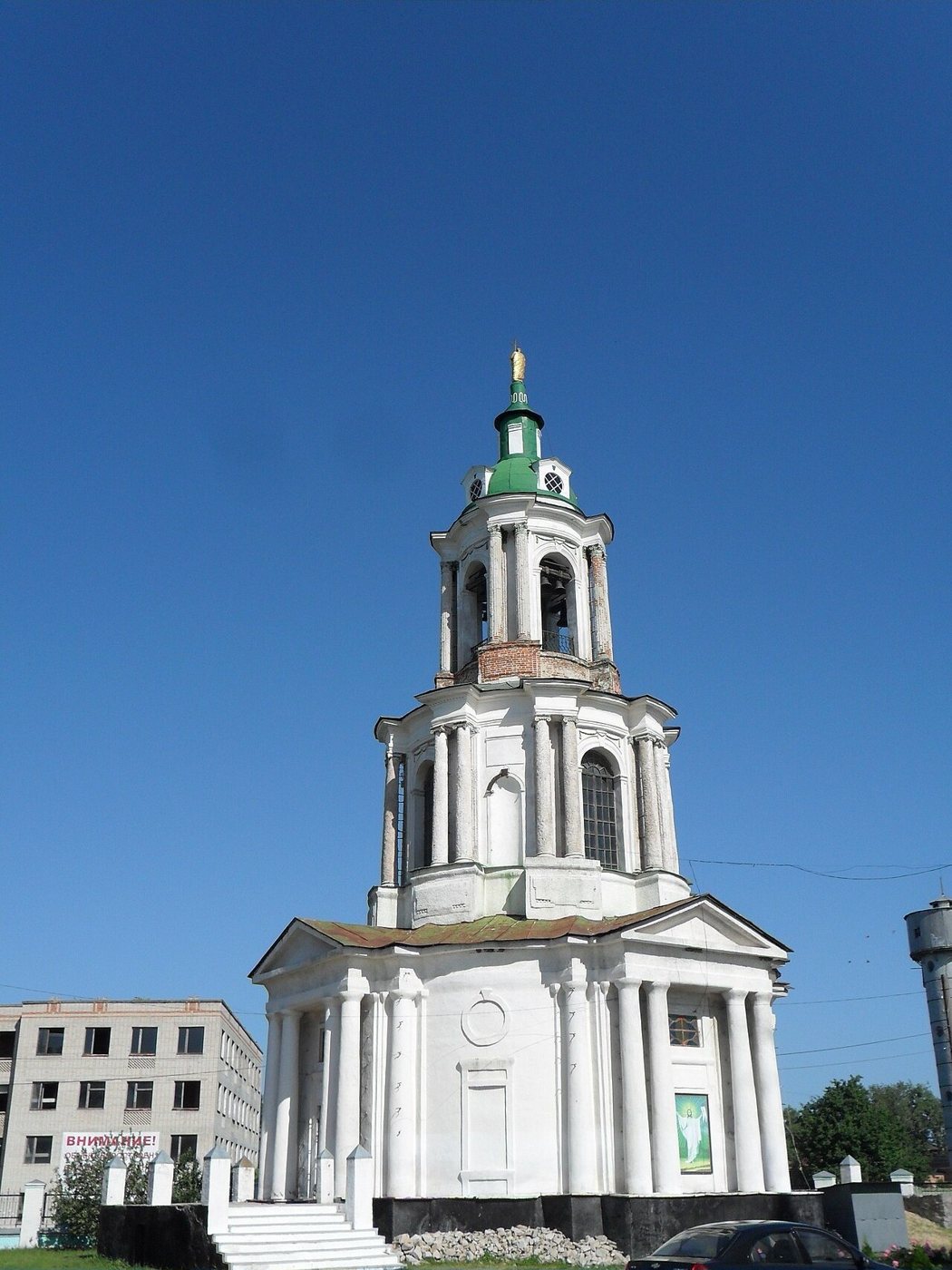
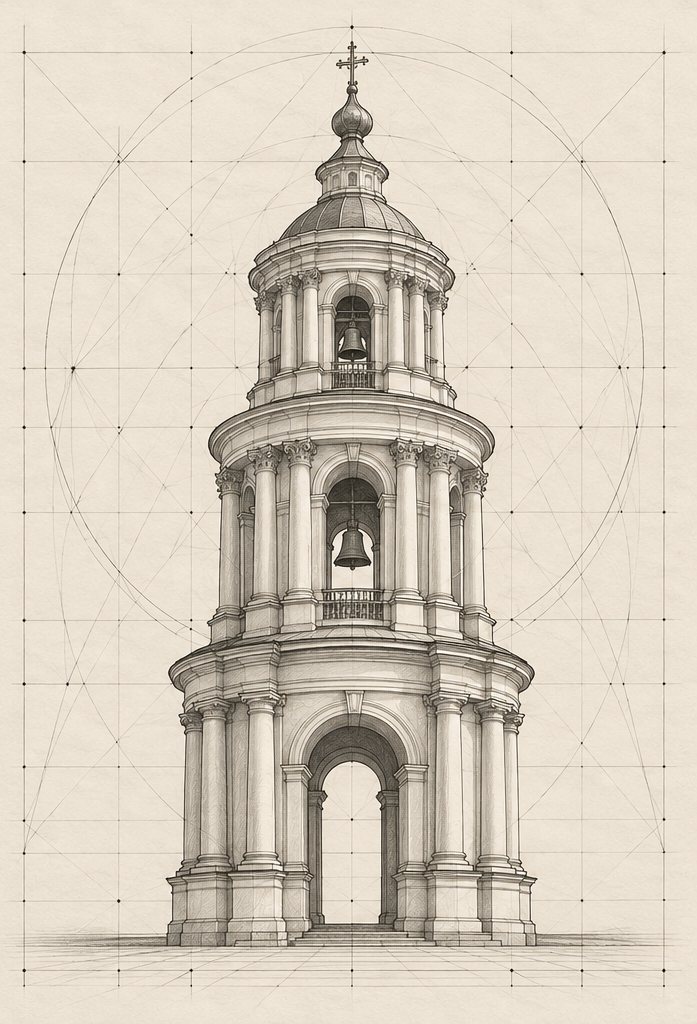
The bell tower was built by the architect Petro Yaroslavskyi, a native of Okhtyrka; it was consecrated in 1784 (the Sokoliuks’ study gives 1782). It is round in plan and has three tiers, whose diameters relate as 8 : 5 : 3. The proportion can be seen from afar even without a drawing: each tier is lighter than the one below, and the tower seems to taper upwards. Researchers see in it a transition from Baroque to Classicism.
The portico and the interior
Later, after 1762, a portico on paired Doric columns was added at the main entrance; on the west wall there is a high relief of the Archangel Michael. The interior is rendered and whitewashed, the walls are articulated by Ionic pilasters, and the vaults carry Baroque stucco with plant and rocaille ornament. The present iconostasis is made of plaster.
Stone and material
The cathedral is built of masonry and rendered. The most instructive episode of its construction concerns not the facade but the core of its supports. While inspecting the work, Dudynskyi found that the pillars had been laid of rubble on lime instead of brick. The vaults resting on them cracked, and the pillars had to be taken down.
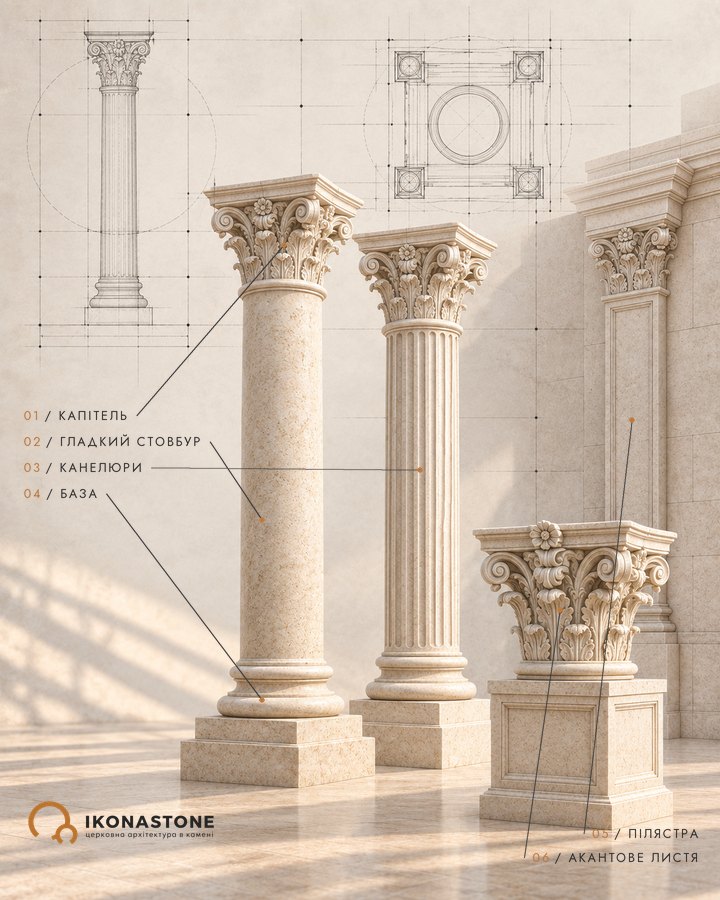
The craft has long known this truth: a support works not with its face but with its core. A column can be flawless on the outside, but it carries the load with what is inside it, and how columns and pilasters behave under load is decided before the first coat of render.
Another Intercession Cathedral of Sloboda Ukraine, more than half a century older, stands in Kharkiv.
FAQ
Where is the Intercession Cathedral located?
In the centre of Okhtyrka, Sumy Oblast, at 1 Soborna Square. The cathedral forms an ensemble with the Presentation bell-tower church and the Church of the Nativity of Christ.
When was the cathedral built?
It was founded on 25 April 1753, and construction was completed in 1768. The main altar was consecrated in 1773.
Who designed it?
The cathedral is traditionally attributed to Bartolomeo Rastrelli; researchers link the original design to his St Petersburg workshop. Other sources name the Moscow architect D. Ukhtomsky as the author. From 1757 the construction was supervised by the architect Stepan Dudynskyi, a pupil of Ukhtomsky.
What is the cathedral's protected status?
The Intercession Cathedral is an architectural monument of national importance (protection No. 180041, Cabinet of Ministers resolution No. 1079 of 13 October 2023). The Presentation bell-tower church (No. 180042) and the Church of the Nativity of Christ (No. 180043) are also on the register.
Sources
- ВУЕ: Покровського собору комплекс в Охтирці
- Соколюк Л., Соколюк О. Охтирський Покровський собор: між минулим і майбутнім (Вісник ХДАДМ, 2023)
- Wikipedia: Okhtyrka
- Мінкульт: постанова КМУ № 1079 (пам'ятки національного значення, Сумська обл.)
- Travels.in.ua: Свято-Покровський собор, Охтирка
- UOCC: Icon of the Most Holy Theotokos of Okhtyrka
- Town
- Okhtyrka, Sumy Oblast
- Built
- 1753–1768
- Type
- Baroque tripartite church with a nine-part central volume
- Material
- masonry, rendered
- Research depth
- 17%