The Dormition Cathedral in Volodymyr: a church built of thin brick
Some churches remember more than the chronicles ever managed to record. The Dormition Cathedral in Volodymyr is one of them: the only church of the pre-Mongol era in Volyn that has survived (though heavily rebuilt).
In brief
| Address | 25 Soborna Street, Volodymyr, Volyn Oblast |
| Built | 1156–1160, commissioned by Prince Mstyslav Iziaslavych |
| Type | six-pillar cross-in-square church with a single dome |
| Material | plinthos brick on lime mortar, rubble-and-brick foundations |
| Status | architectural monument of national significance |
| Church | since 14 January 2026 — a community of the Orthodox Church of Ukraine |
History
The cathedral was built by Prince Mstyslav Iziaslavych; the church was completed in 1160. The Hypatian Chronicle records that in 1170 the prince was buried in the church he himself had built. The façade carries memorial plaques to princes, but the chronicles and encyclopedias confirm a burial in the cathedral only for Mstyslav.
Then came a long series of trials: the sack during the Mongol invasion of 1240–1241 (the cathedral was not destroyed, but it was plundered), the Tatar raid and fire of 1491, the fire of 1683, the Baroque remodelling of the 18th century, and use as a warehouse from 1772. In 1829 and the 1830s the vaults and the dome collapsed (the sources give different dates), and the church stood in ruins.
Reconstruction began in 1896 to a design by the architect Hryhorii Kotov; the cathedral was consecrated in 1900. Scholars assess the restoration of that period ambivalently: the builders removed later accretions and recreated the church “in the ancient spirit” as it was then understood.
Timeline
The numbers in square brackets are source numbers in the list at the bottom of the page. The label "according to …" means that a fact is confirmed by only one source. The "Legends" section contains tales and legends: they are recorded in sources but not confirmed by documents.
The princely era
- 992 (traditional date)
According to church tradition, the Volyn eparchy was founded then, and its first see is linked with Volodymyr. The location of the church of that time is unknown. According to the Ukrainian Wikipedia. [2]
- 1156
Prince Mstyslav Iziaslavych, a great-grandson of Volodymyr Monomakh, began building the stone church of the Dormition of the Mother of God in Volodymyr. [1, 2, 3, 6, 7, 10]
- 1160
The church was painted and consecrated; it became the see of the Volyn eparchy. [1, 2, 3, 4]
- 19 August 1170
Mstyslav Iziaslavych died; the chronicle reports that he was buried in the church he had built. [3, 6, 8, 12]
- 1240–1241
The Mongol invasion reached Volodymyr. The cathedral was not destroyed, but it was plundered and abandoned. The sources differ on the date: 1240 or 1241. [2, 4, 5, 8]
- 1271
Prince Vasylko Romanovych died; according to [3], he was buried in the cathedral. [3, 5]
- 1289
Prince Volodymyr Vasylkovych was buried. [3, 5]
- 14th c.
Liubart Gediminaitis added the village of Sushychi to the estates of the bishopric. According to the "Tserkovnoe iskusstvo" article. [3]
The Lithuanian-Polish era and the Union of Brest
- 1444
Svitrigaila Algirdaitis confirmed the cathedral's right to its villages; the Polish kings Casimir IV and Sigismund I confirmed and expanded the grants. According to [3]. [3]
- 1491
After a Tatar raid, a fire damaged the church. According to istvolyn.info. [8]
- Late 15th c.
Bishop Vasian rebuilt the church. The bishop's residence (the "small castle") took shape with its walls; the house with the bell tower is dated to 1494. [2, 10, 18]
- 1565–1588
Theodosius Lazowski, Bishop of Chełm, seized the see and the cathedral fell into decline; in 1588, under pressure from Vasyl-Kostiantyn (Konstanty Wasyl) Ostrogski, he promised funds for repairs. According to [3]. [3]
- 1593–1613
Under Bishop Hypatius Pociej, Franciszek Włoch rebuilt the cathedral in the Renaissance style, but did not finish the work. According to [3]. [3]
- 1596
The Volodymyr eparchy accepted the Union of Brest, and the cathedral became Uniate. [2, 4, 5]
- 1683
A fire devastated the town and badly damaged the cathedral. [2, 3, 4, 5, 8]
- 1711–1728
Bishop (later Metropolitan) Lev Kishka restored the church after the fires. According to [3]. [3]
- 1753
Bishop Theophilus Godebski radically rebuilt the cathedral in the spirit of the late Baroque, which brought it closer to a Roman Catholic church. [2, 3, 4, 5]
- 1772
The church ceased to be used for worship: it was turned into a warehouse and fell into decay. [2, 5]
- 1782
During an attempt to cut a passage through the north-western pillar, the pillar and part of the vault collapsed. According to [3]. [3]
Ruin and revival in the Russian Empire
- 1795–1796
After the partition of the Polish-Lithuanian Commonwealth, Western Volyn passed to the Russian Empire; the Uniate eparchy was abolished and the cathedral was returned to the Orthodox. According to Wondermondo, the year of the transfer was 1796. [3, 4]
- 1829–1830s
The vaults and domes collapsed, and the cathedral became a ruin. The sources differ on the dates: 1829 [2, 4] and the first half of the 1830s [3]. [2, 3, 4]
- 1839
The architect Weitzler drew up a restoration project (about 58,000 roubles) that kept the later accretions; the Synod proposed dismantling the cathedral. Researchers of the 21st century consider Weitzler's project the most correct. [3, 7]
- 1886
A survey of the ruins began in the summer; the commission was headed by H. Borovykov and included Adrian Prakhov. According to [3]. [3]
- December 1887
The St Volodymyr Brotherhood, which oversaw the reconstruction, was opened in Volodymyr. According to the Ukrainian Wikipedia. [2]
- 1890
Prakhov submitted a project to restore the cathedral in the "Greek-Russian" forms of the 12th century; at the end of the year the Imperial Archaeological Commission rejected it. [2, 3, 7]
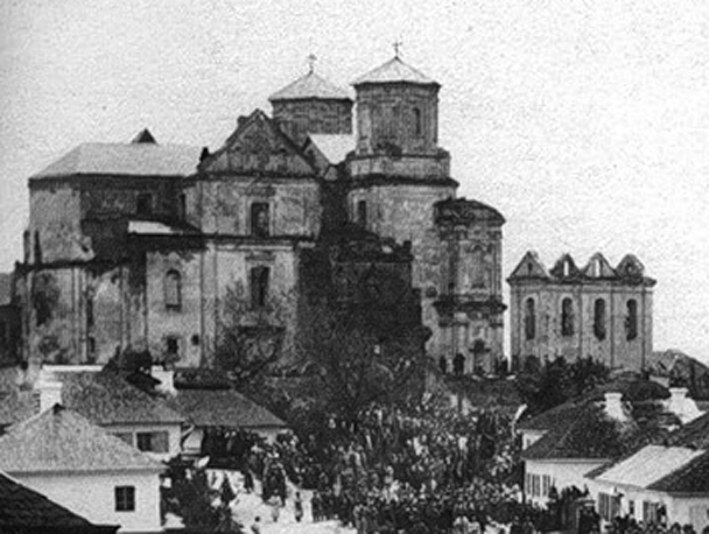
The Dormition Cathedral in Volodymyr, 1892. Wikimedia Commons, public domain - 1895
By order of Nicholas II, the first 30,000 roubles were allocated; the same year Hryhorii Kotov submitted his project. According to [3]. [3]
- 1896
The Imperial Archaeological Commission approved Kotov's project, and work began in the summer. All the accretions of the 16th–17th centuries were removed. [3, 6, 7, 8]
- 17 September 1900
Consecration of the rebuilt cathedral. The reconstruction in the "pseudo-Byzantine" spirit is assessed ambivalently. [2, 3, 8]
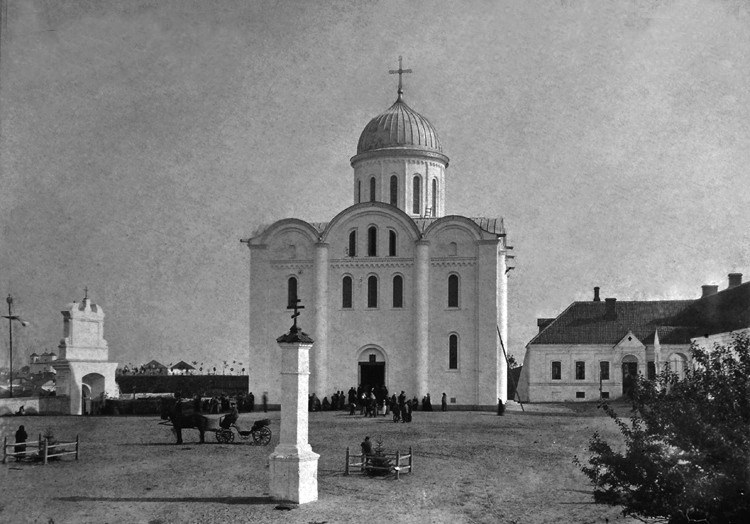
The Dormition Cathedral after the restoration, 1896–1900s. Wikimedia Commons, public domain
The 20th century
- 1927
The cathedral refused to bury the Ukrainian politician Vasyl Komarevych, which caused a public scandal. According to the Ukrainian Wikipedia. [2]
- 1944–2025
The cathedral was in the use of the Russian Orthodox Church. According to the Ukrainian Wikipedia. [2]
- 1992
A cross was erected near the cathedral in honour of the 1000th anniversary of the Volyn eparchy. According to the Ukrainian Wikipedia. [2]
- 1996
The cathedral became the cathedral church of the Volodymyr-Volynskyi eparchy of the UOC (MP). [2, 5]
The present day
- 11 May 2010
The 850th anniversary of the cathedral was marked. According to the Ukrainian Wikipedia. [2]
- April 2023
The Volyn Oblast Council and the Volodymyr City Council adopted a ban on the activity of the UOC (MP) and recommended terminating the lease agreements. As reported by Suspilne. [9]
- 1 July 2024
The period of free use of the complex expired; the community did not hand it over voluntarily. [10, 11]
- 12 November 2024
The Commercial Court in Lutsk ordered the UOC (MP) community to return the cathedral to the state. The Supreme Court left the cassation appeal without consideration. [9, 10]
- 10 October 2025
Police blocked the entrance, and state enforcement officers carried out an inventory of the property. The cathedral (1156), the house with the bell tower (1494) and the walls with gates (17th c.) passed into state ownership. [2, 9, 10, 18]
- 14 January 2026
The cathedral was transferred for five years to the community of the Volodymyr-Volynskyi eparchy of the OCU. [2, 9]
- 31 January 2026
Metropolitan Epiphanius led the first OCU service in the cathedral; according to Suspilne, the first within its walls in Ukrainian. [9]
Lost and restored
| What | It was | What happened | Where it is now |
|---|---|---|---|
| Original appearance of the church | 12th c., six-pillar, single-domed, three-apsed, plinthos brick | Remodellings of the 16th–18th c., collapses in 1782 and in the 1829–1830s | Rebuilt in 1896–1900 to H. Kotov’s design in a pseudo-Byzantine style [2, 3, 7] |
| Vaults and dome | Original | Collapsed | Recreated in 1896–1900 [2, 3] |
| Accretions of the 16th–18th c. | Renaissance and Baroque remodellings | Removed during the reconstruction | Lost [3, 6, 7] |
| 12th-century frescoes | Central apse, window splays | Some areas survived until the restoration | Their later fate is not specified in the sources [2] |
| Bishop’s “small castle” | Walls and the house with the bell tower, 1494 | Part of the complex | Owned by the state [2, 10, 18] |
| Crypts | The cathedral’s underground chambers | — | Six princely and two episcopal burials [2, 4, 5] |
Architecture
A six-pillar cross-in-square church with three naves, three apses and a single dome — about 35 metres long and over 20 metres wide (researchers’ figures differ). It is a rare example of pre-Mongol architecture that has come down to us in reconstructed form.
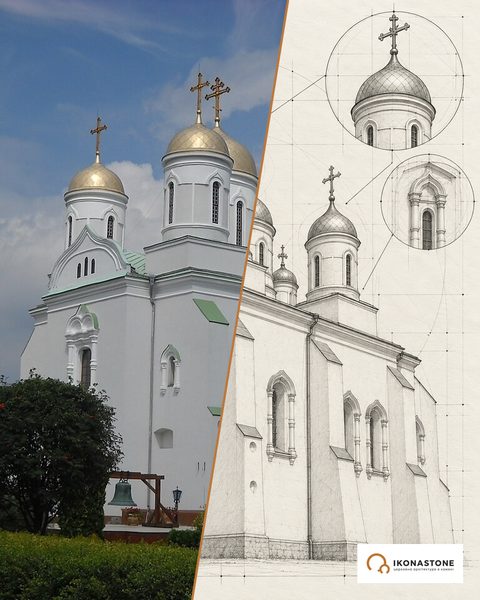
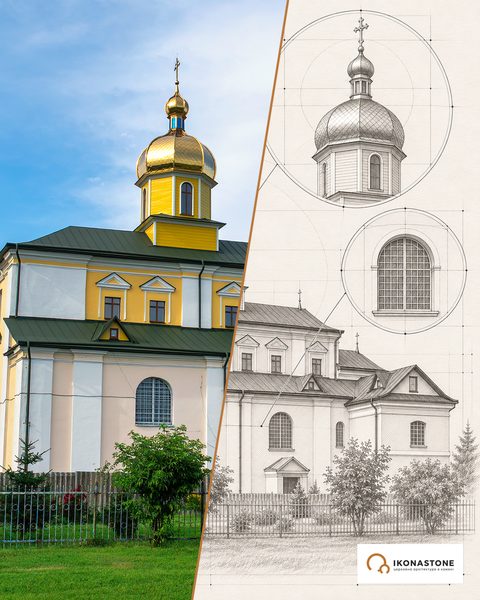
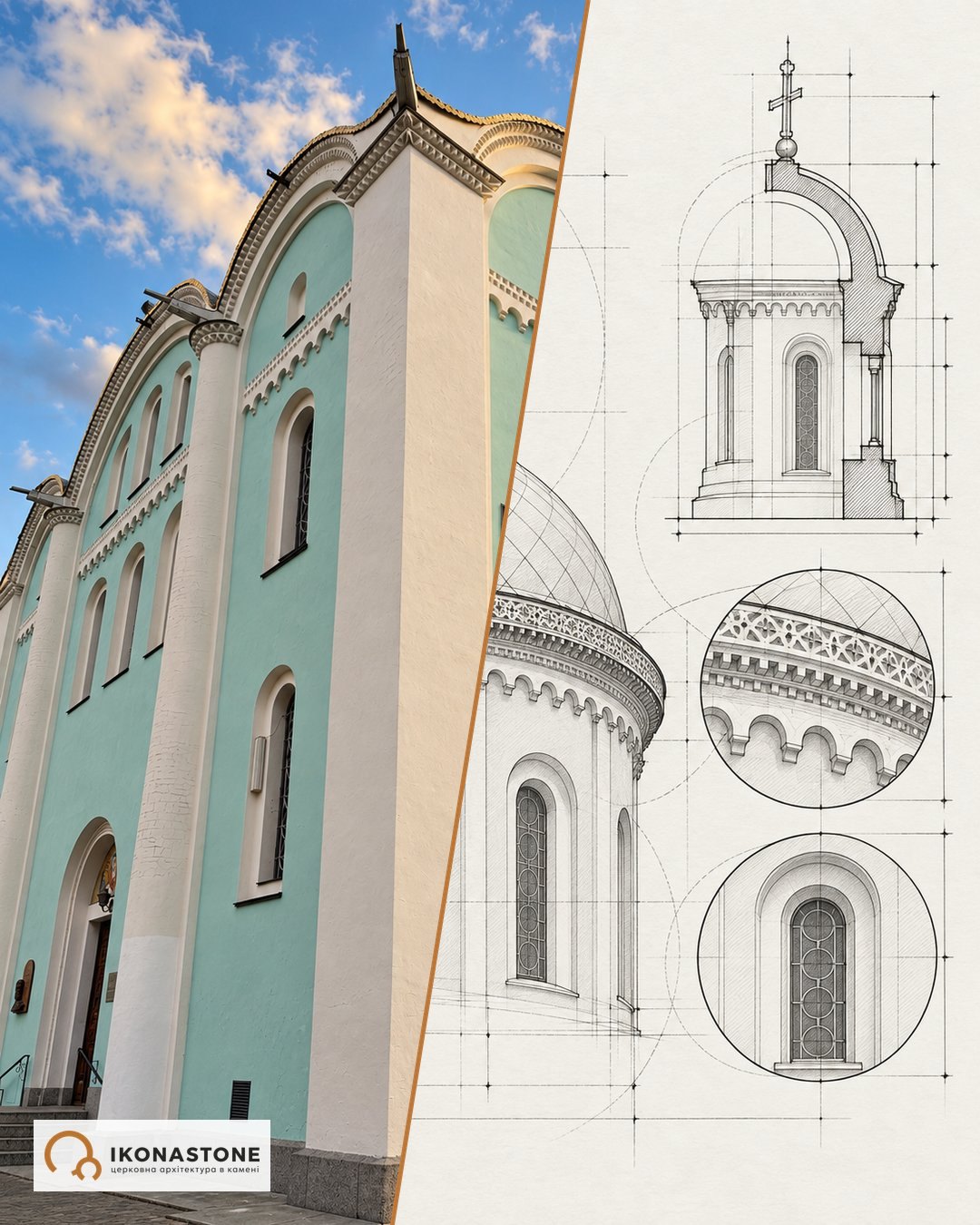
Below are three elements of the cathedral, in photographs and drawings. The drawings show form, not exact dimensions.
The drum and dome: light from above
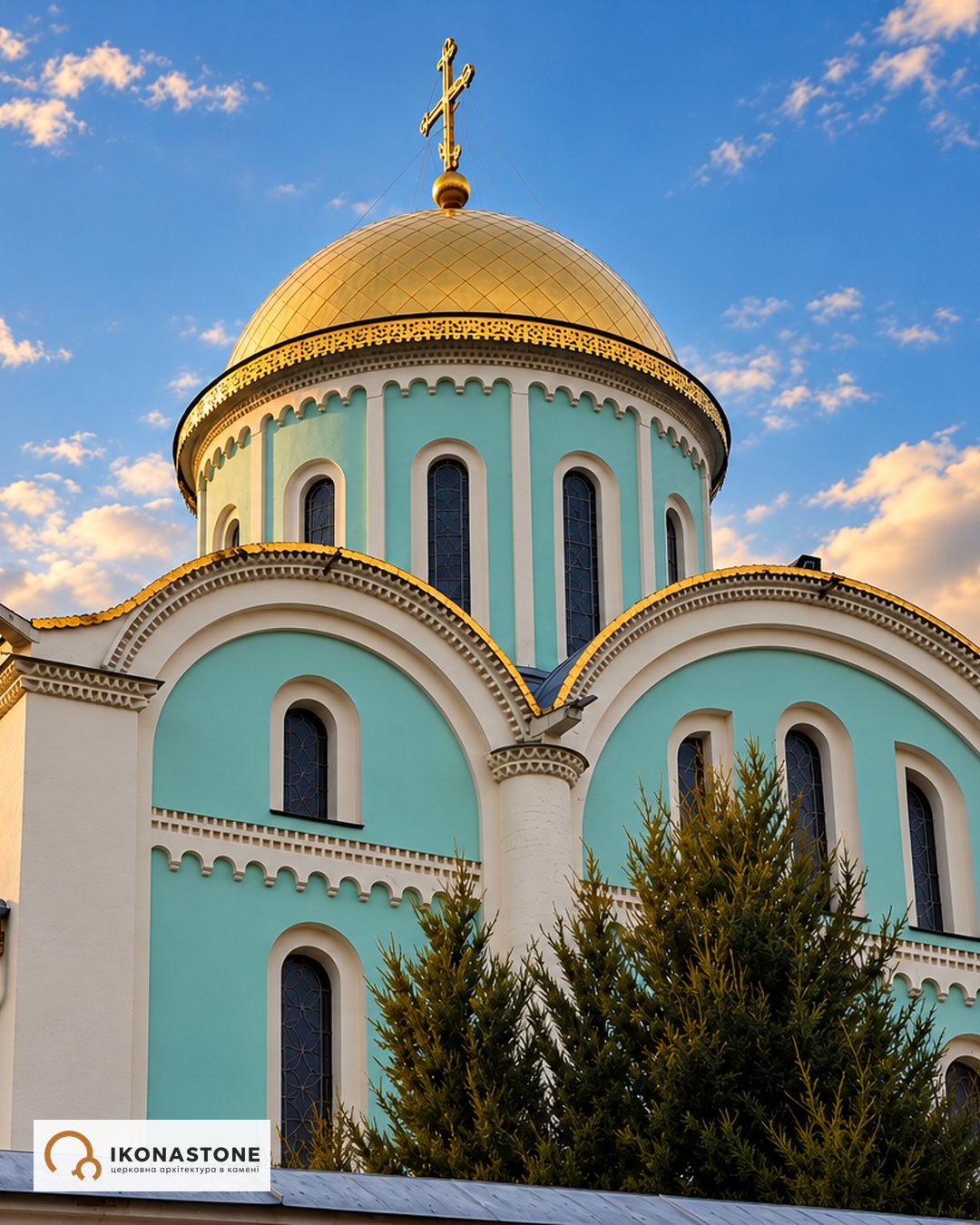
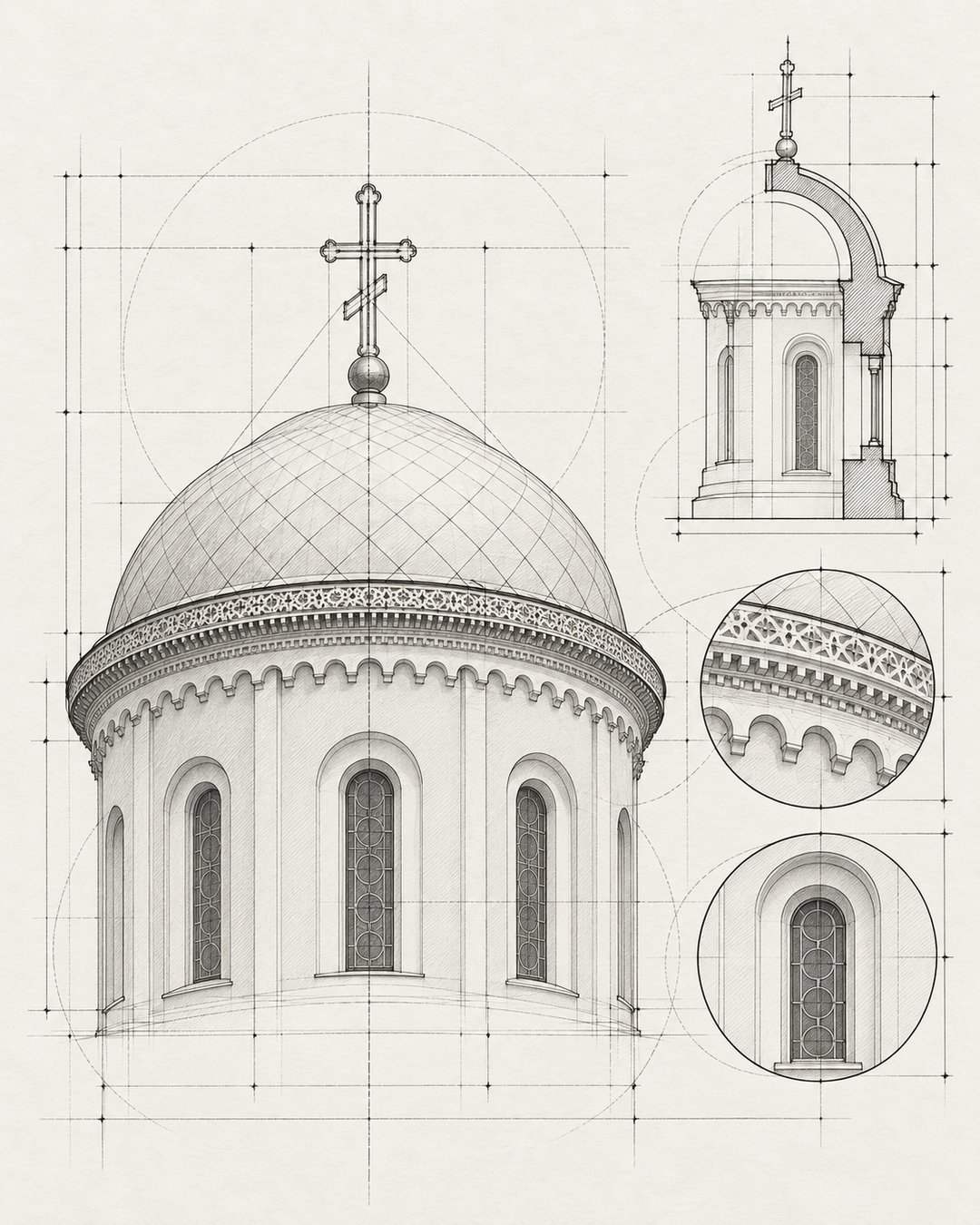
Above the centre of the church rises a drum with narrow arched windows, and on it a dome with a cross. Through these windows light falls straight into the space under the dome, and inside the cathedral this is the brightest place.
Under the cornice of the dome runs a corbel-table band — a row of small projections that give a rhythm of light and shade in the sun. The decoration we see today was largely recreated during the reconstruction of 1896–1900.
The zakomaras: a façade that echoes the vaults
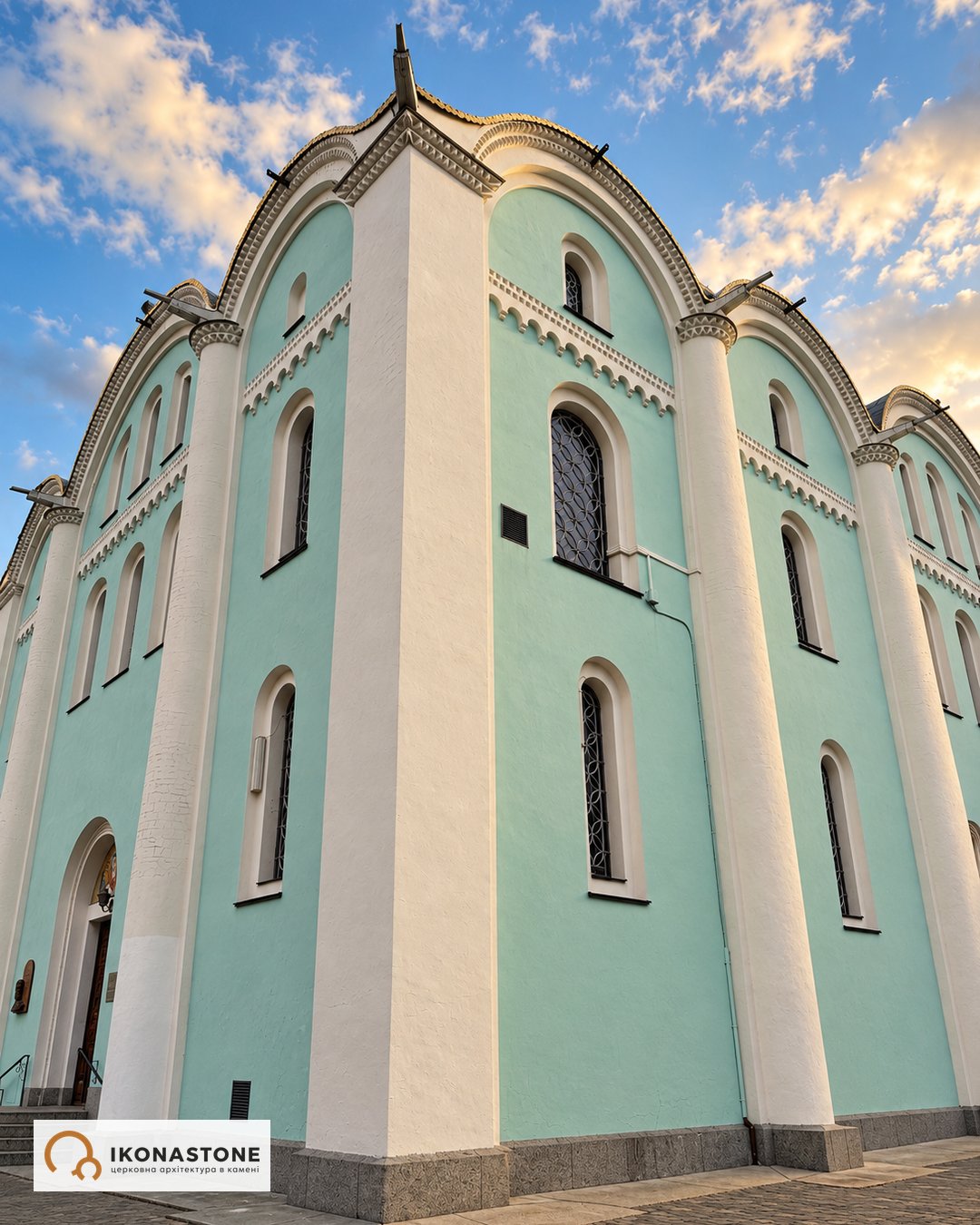
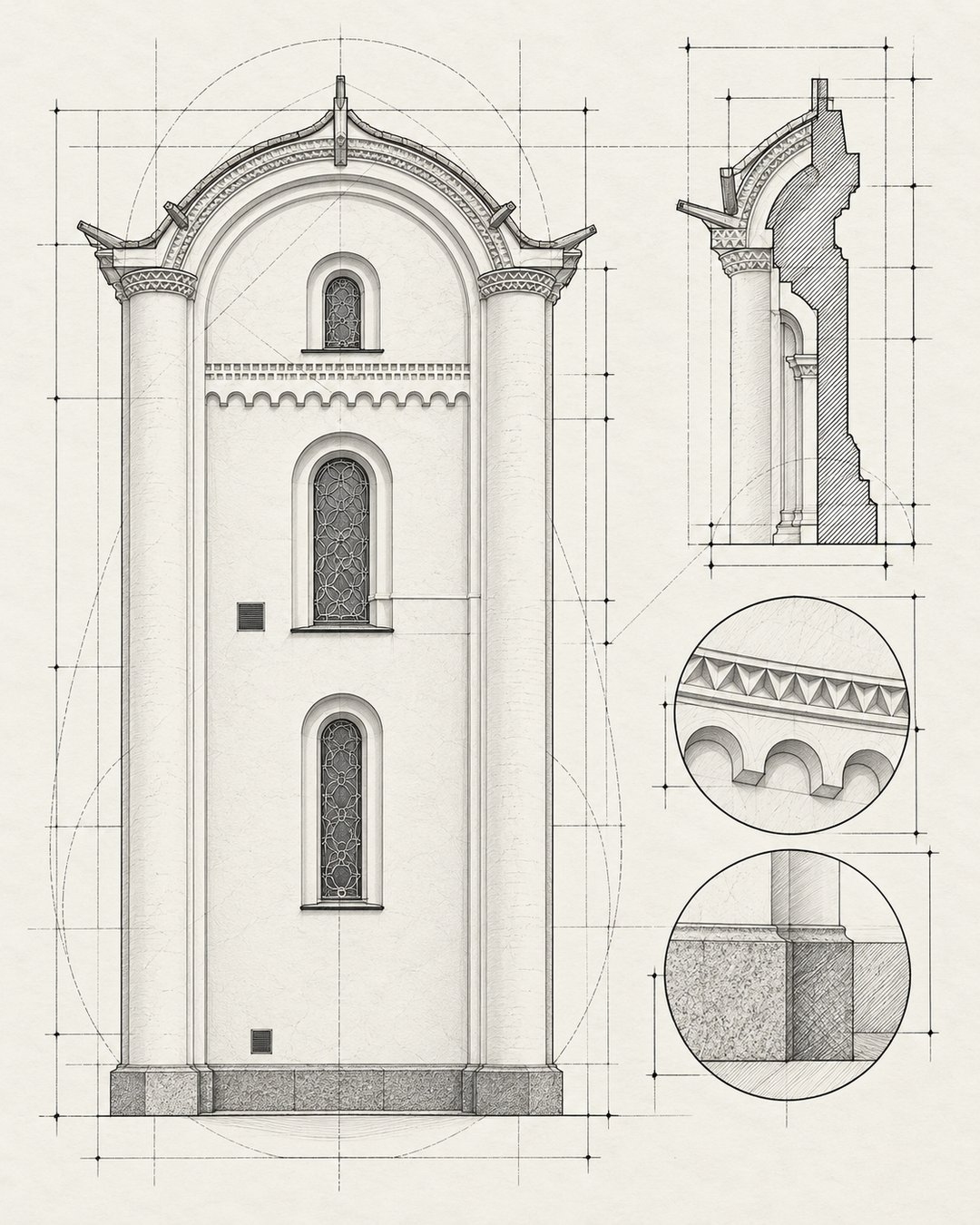
The semicircular crowns of the walls — the zakomaras — are not mere decoration: in Rus’-era cross-in-square churches they usually correspond to the vaults inside. So the façade can be read, to some extent, like a section: each bay ends in its own zakomara.
The bays are divided by pilaster strips, corbel-table bands cut across the façade horizontally, and a granite plinth runs around the whole building at the bottom.
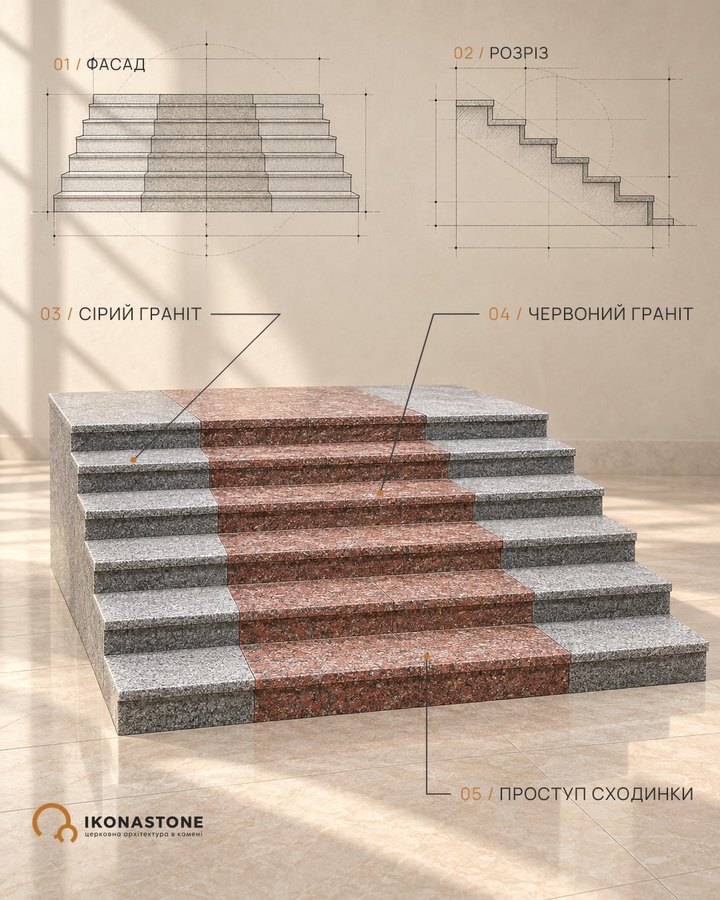
The portal and granite steps: stone where people walk
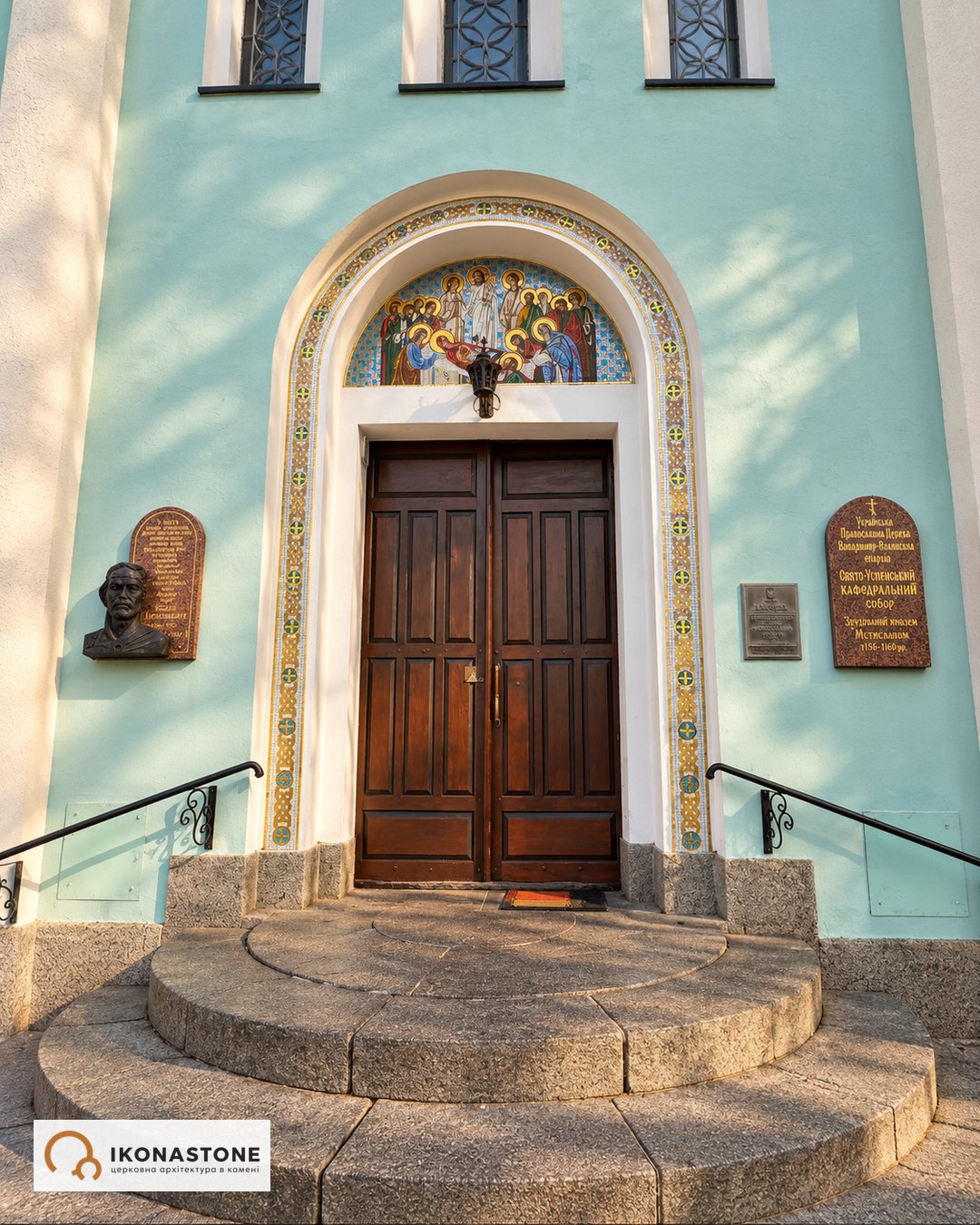
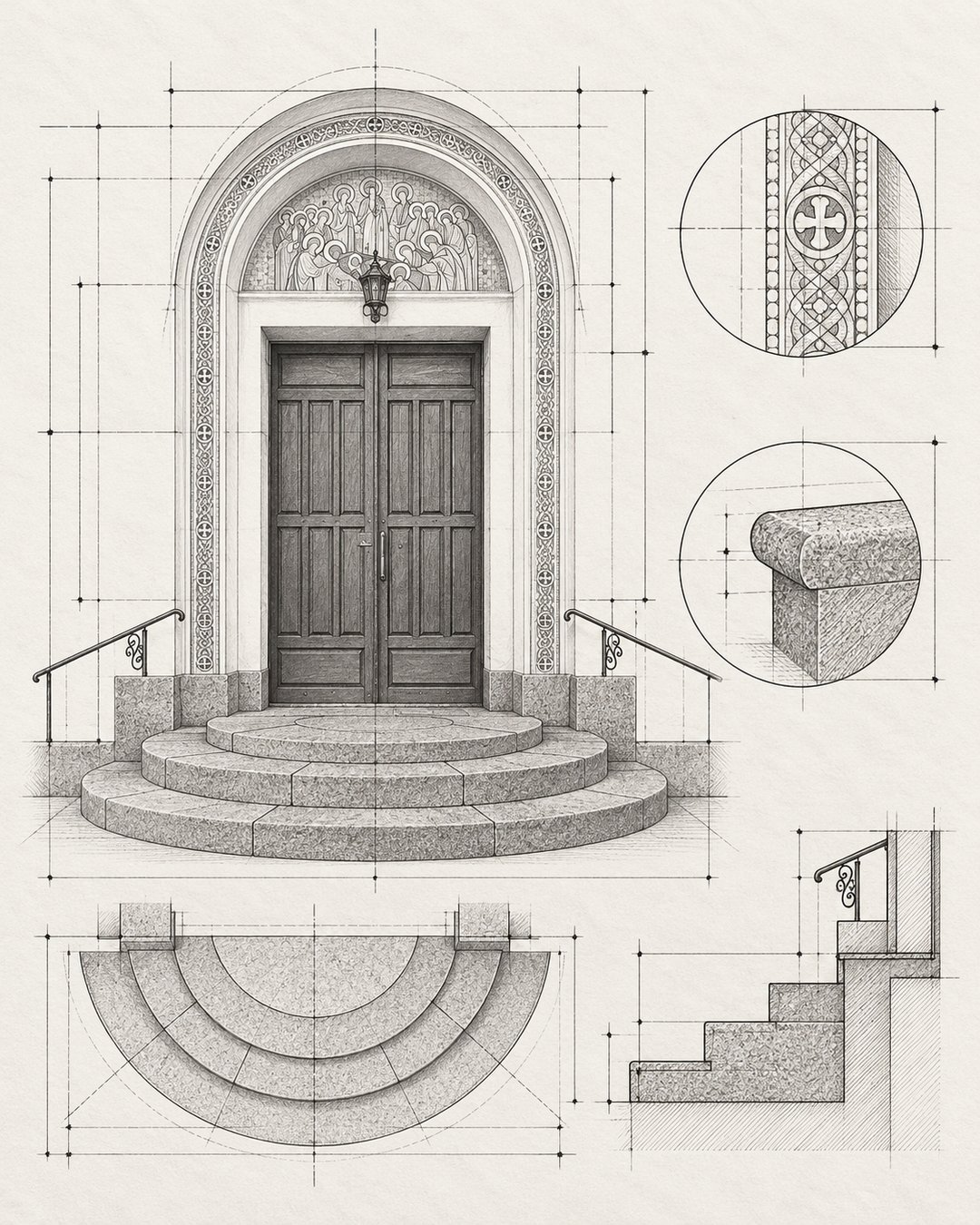
The west entrance is an arch with an ornamental border and a mosaic of the Dormition in the tympanum. Beneath it are semicircular granite steps: each one is smaller than the one below, so you approach the doors from any side.
Granite is in its place here: it withstands thousands of footsteps, frost and damp. The granite plinth continues the same idea — it protects the wall where it meets the ground and water. We design such granite steps for a church for the specific building.
Stone and brick
The main material of the cathedral is plinthos: thin, wide Rus’-era brick. It was laid in even courses on a lime mortar with a pinkish tint, and the thick joints here work on a par with the brick. A wall of such masonry is like a layered pastry: its strength comes not from a single brick but from the rhythm of the layers.
The stone in the cathedral is hidden, yet everything rests on it: the foundations are laid of rubble stone together with brick.
Stone near the cathedral
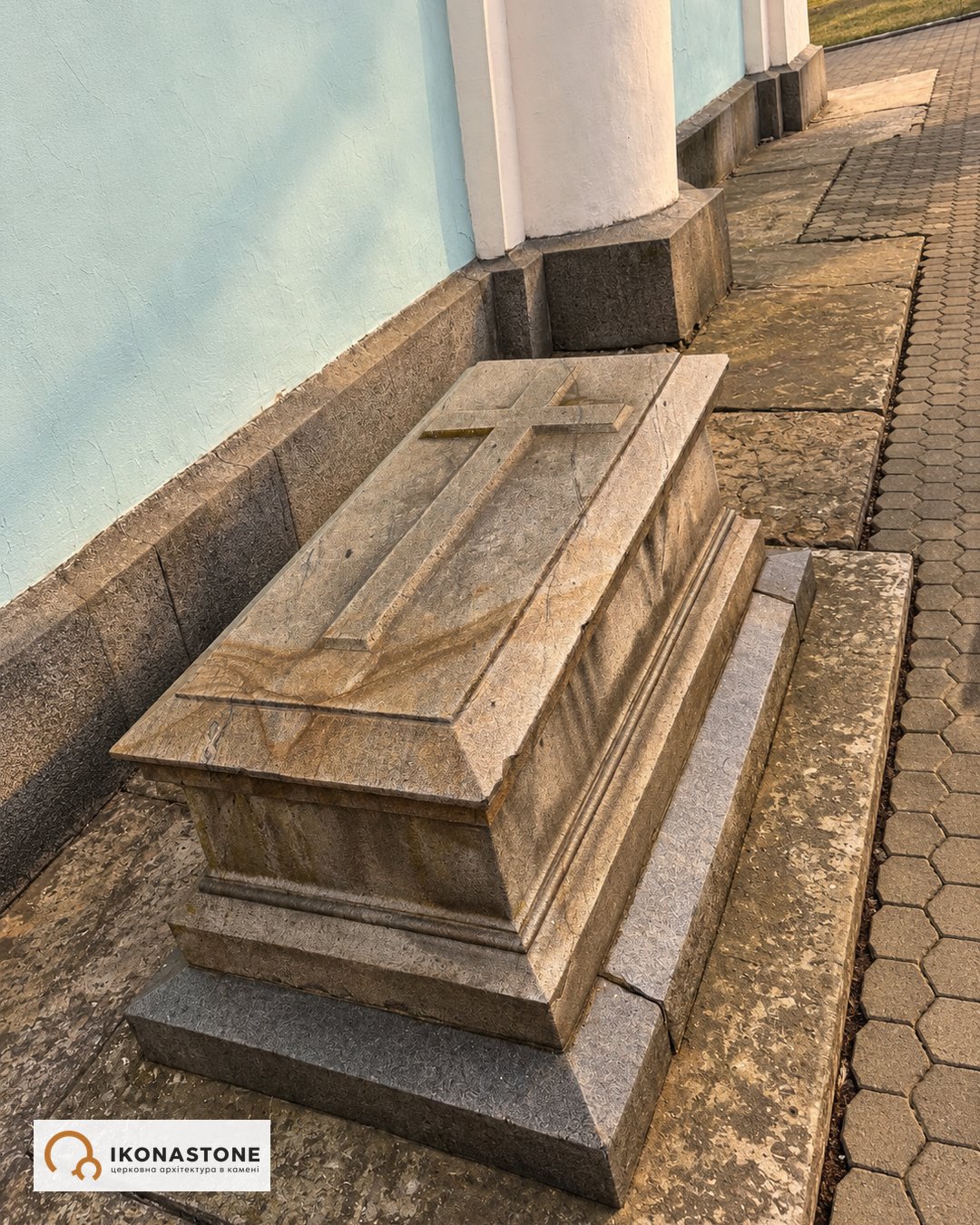
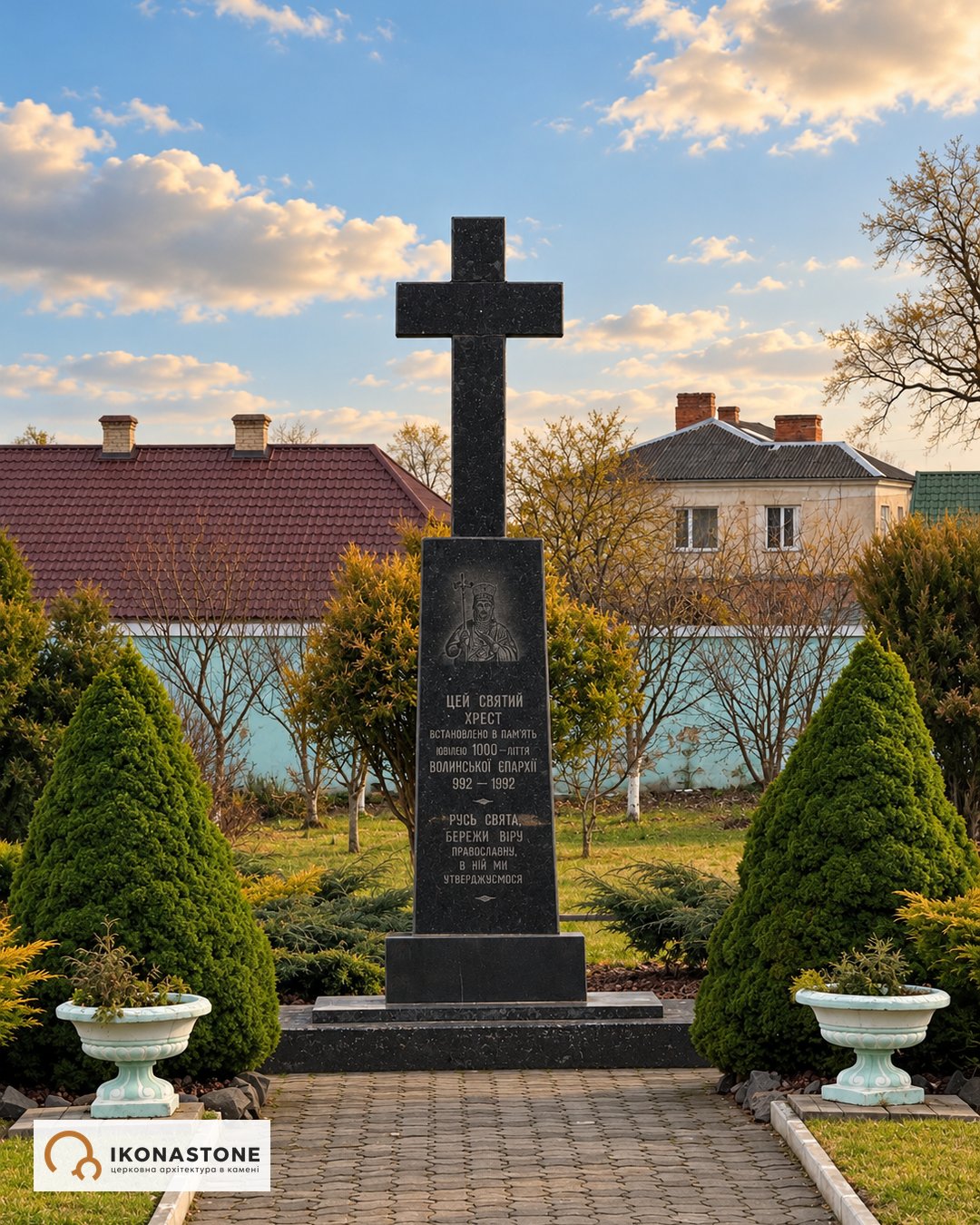
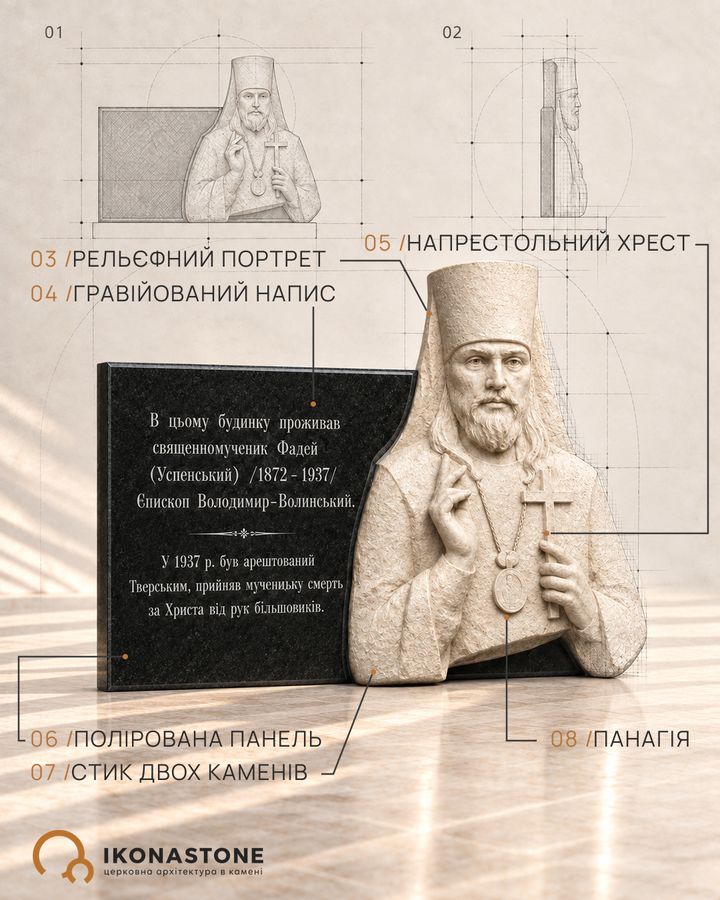
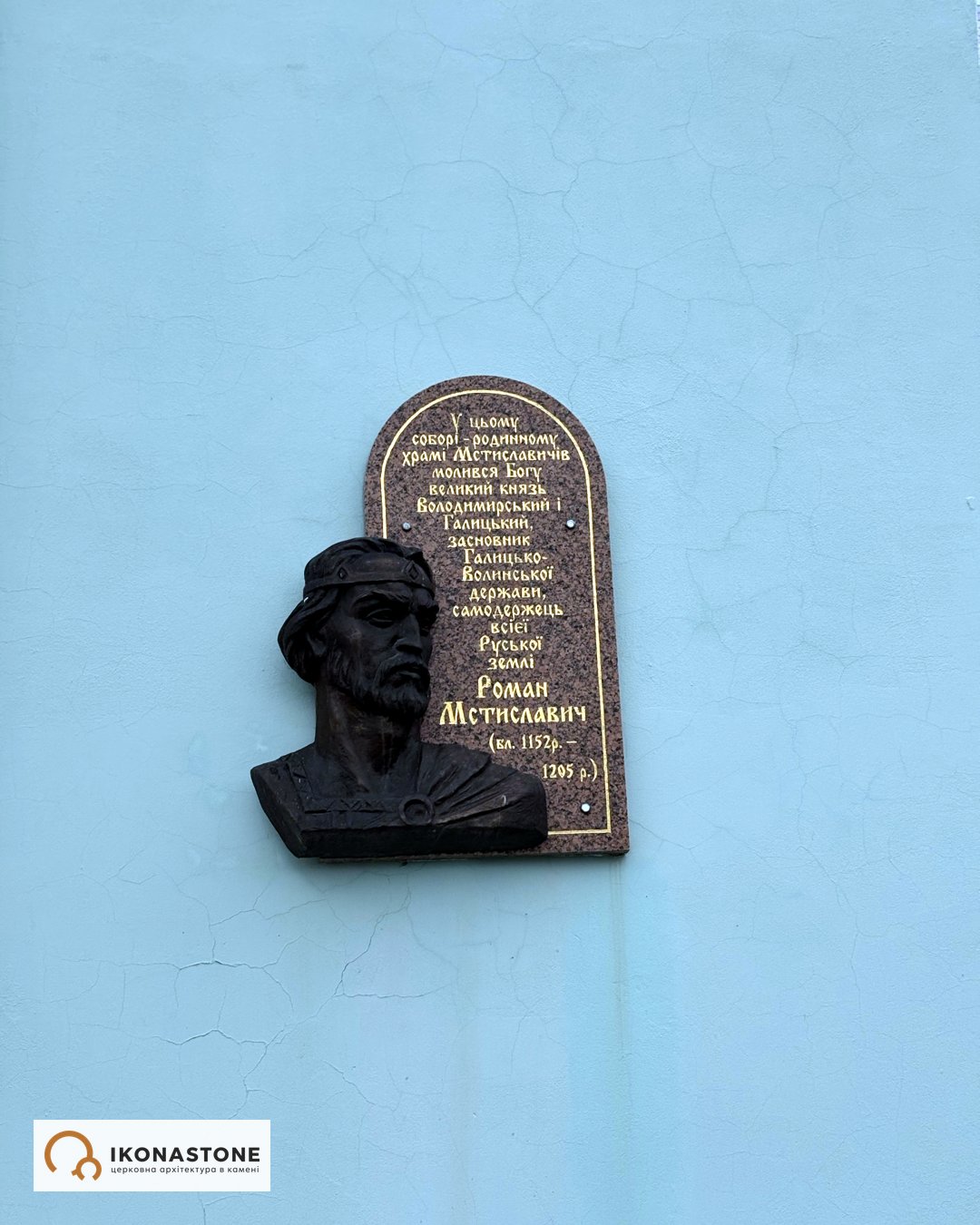
On the façade are granite memorial plaques to Princes Mstyslav and Roman. In the yard stands a granite cross of 1992; how crosses are told apart by their form is covered in the article “Forms of the cross”.
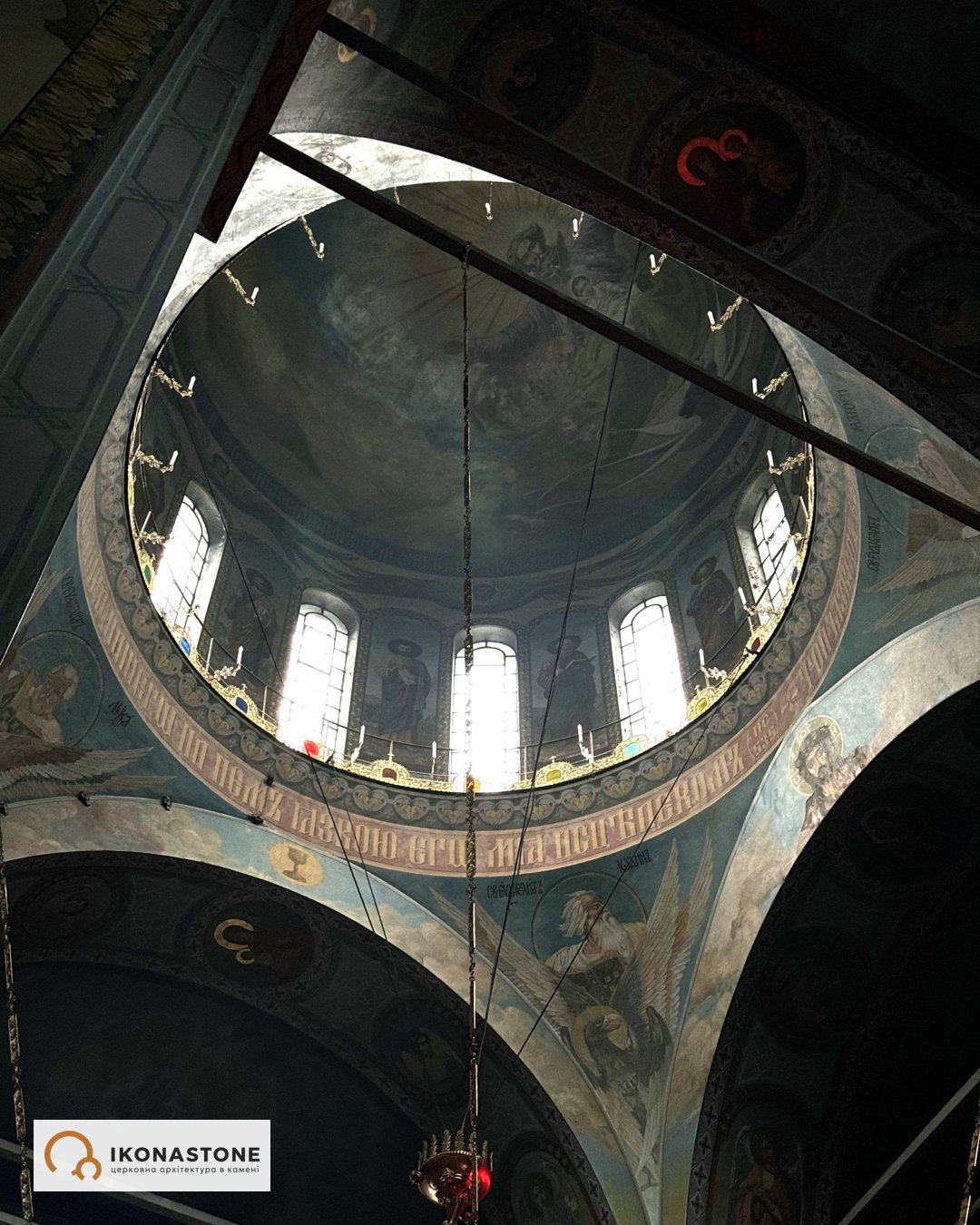
Inside the cathedral are the painted space under the dome and an iconostasis; how an iconostasis is built we explain in the article “What is an iconostasis”.
Did you know
The cathedral is also called Mstyslav's after its commissioner, Prince Mstyslav Iziaslavych. [5, 6, 12]
According to Wondermondo, it is the oldest church in Volyn; KuLaDig calls it the only church to survive from before the Mongol invasion, and "Istoriia Volyni" calls it the "oldest and only" monument of the pre-Mongol era in Volyn. [4, 5, 8]
This number of burials in the crypts is given in the Ukrainian Wikipedia, Wondermondo and KuLaDig. [2, 4, 5]
From the collapse of 1829 to the start of reconstruction in 1896, the cathedral stood in ruins. [2, 3]
The emperor allocated 30,000 roubles and the Ministry of Finance a further 25,000; about 127,000 roubles were raised in all. [3]
Modern researchers consider Weitzler's project of 1839 more correct than Kotov's reconstruction, which removed the historical accretions. [3, 7]
The reconstruction of 1896–1900 did not restore the cathedral's original appearance: according to researchers, the "ancient Rus'" style is atypical for Volyn. [7]
According to Suspilne, the service of 31 January 2026 was the first in Ukrainian within the cathedral's walls. [9]
Tourist guides link the burial of Roman Mstyslavych with the cathedral, although scholarly sources name only Mstyslav Iziaslavych, Vasylko Romanovych and Volodymyr Vasylkovych as buried there. [3, 12, 13]
The cathedral then refused to bury Vasyl Komarevych, a deputy of the Polish parliament. According to the Ukrainian Wikipedia. [2]
According to Rappoport's catalogue (via the Ukrainian Wikipedia), the cathedral is 34.7 m long and 20.6 m wide, with a height of about 18.5 m to the top of the central zakomara. [2]
Legends
Roman Mstyslavych in the cathedral
The tourist portal Travels in UA says that Roman Mstyslavych, the founder of the Galicia-Volhynia state, is buried in the cathedral. The Encyclopedia of Ukraine, by contrast, says only that he died on 14 October 1205 near Zawichost, and the English-language Wikipedia that his body was temporarily buried in Sandomierz. A burial in the cathedral is not confirmed by scholarly sources. [13, 14, 17]
The reconstruction restored the ancient look
A widespread view holds that Kotov recreated the cathedral as it was in the 12th century. Researchers disagree: the original appearance is not known, and the accretions that were removed were part of the church's history. [3, 6, 7]
Figures
- Mstyslav Iziaslavych (†1170) — Prince of Volodymyr, commissioner of the cathedral, buried in it.
- Vasylko Romanovych — Prince of Volyn, buried in the cathedral (†1271).
- Volodymyr Vasylkovych — Prince of Volyn, buried in the cathedral (†1289).
- Svitrigaila Algirdaitis — confirmed the cathedral’s rights to its villages (1444).
- Liubart Gediminaitis — added the village of Sushychi to the estates of the bishopric.
- Vasyl-Kostiantyn (Konstanty Wasyl) Ostrogski — pressed Bishop Lazowski to repair the church.
- Hypatius Pociej — bishop (1593–1613), a participant in the Union of Brest.
- Lev Kishka — bishop and metropolitan, restored the cathedral in 1711–1728.
- Theophilus Godebski — bishop, rebuilt the cathedral in 1753.
- Weitzler — architect, author of the project of 1839.
- Adrian Prakhov — member of the commission of 1886, author of the rejected project of 1890.
- Hryhorii Kotov — author of the reconstruction of 1896–1900.
- Epiphanius — Metropolitan of the OCU, led the first service on 31.01.2026.
How to cite
IKONASTONE. The Dormition Cathedral in Volodymyr // Guide to the Churches of Ukraine. URL: https://ikonastone.com/en/guide/dormition-cathedral-volodymyr/ (accessed DD.MM.YYYY).
FAQ
Where is the Dormition Cathedral located?
In the town of Volodymyr, Volyn Oblast, at 25 Soborna Street. It lies in Volodymyr Raion.
When was the cathedral built?
In 1156–1160, under Prince Mstyslav Iziaslavych, which is why it is also called Mstyslav's church. The cathedral took its present appearance after the reconstruction of 1896–1900, designed by the architect Hryhorii Kotov.
What is the cathedral built of?
The walls are laid in plinthos — thin, wide Rus'-era brick — on a lime mortar with a pinkish tint. The foundations are of rubble stone and brick.
Who does the cathedral belong to now?
The cathedral is an architectural monument of national significance. Since 14 January 2026 it has been in the use of a community of the Orthodox Church of Ukraine.
Sources
- Encyclopedia of Ukraine. Dormition Cathedral in Volodymyr
- Вікіпедія (укр.). Свято-Успенський кафедральний собор (Володимир)
- «Церковное искусство» (publishing.mpda.ru). Стаття про історію Успенського собору у Володимирі-Волинському
- Wondermondo. Assumption Cathedral in Volodymyr-Volynskyi
- KuLaDig. Uspenskiy (Saint Dormition) Cathedral, Volodymyr-Volynskyi
- Карпов В., Ємельянова Н. Успенський собор у Володимирі (НАУ)
- Карпов В., Ємельянова Н. BIM-реконструкція Успенського собору, «Український мистецький дискурс», 2023, № 4
- Історія Волині (istvolyn.info). Стаття про Успенський собор
- Суспільне Луцьк. Епіфаній очолив першу службу в Свято-Успенському соборі після передачі ПЦУ
- Суспільне Луцьк. Суд на Волині зобов'язав УПЦ МП повернути Успенський собор державі (12.11.2024)
- Главком. Московська церква не поспішає звільняти Успенський собор у Володимирі (02.07.2024)
- Encyclopedia of Ukraine. Mstyslav Iziaslavych
- Encyclopedia of Ukraine. Roman Mstyslavych
- Wikipedia (en). Roman the Great
- Дзеркало тижня. У Володимирі, християнському і державному
- REHERIT. Володимир-Волинський: профіль спадщини
- Travels in UA. Holy Assumption Cathedral, Volodymyr
- ZAXID.NET. УПЦ має звільнити територію Успенського собору у Володимирі на Волині
- Town
- Volodymyr
- Built
- 1156–1160
- Type
- cross-domed
- Material
- plinthos brick
- Research depth
- 27%