Forms of the Cross: How to Tell Them Apart and What They Mean
There are things in a church that cannot be accidental. The cross is the first of them. We see it so often that we stop seeing it: it becomes a sign that is “read” instantly, without looking closely. Yet two intersecting beams can have a dozen different faces, and behind each stand centuries of practice, taste, theology and simply the hand of the craftsman.
For anyone ordering a cross, this difference is not academic. A cross on a dome, a cross by the road and a cross on a grave live in different conditions and do different work. The first must be legible from a distance, the second must meet a person on their way, the third must hold memory. And the form a community feels to be “its own” is often older than any explanation we could give.
This article does not decide whose cross is more correct. It helps you tell the forms apart, know their names and traditional meanings, and ask the client the questions that are better asked before the stone reaches the machine.
In brief
- The form of a cross is not decoration but a choice of tradition: different traditions and localities developed their own types.
- The simplest distinction is by the number and length of the arms: four equal (Greek), four with a longer lower arm (Latin), six and eight (with a title board and a footrest).
- The slanted footrest on the eight-pointed cross has several traditional interpretations; they are handed down rather than proven, so it is correct to present them as different voices of the tradition.
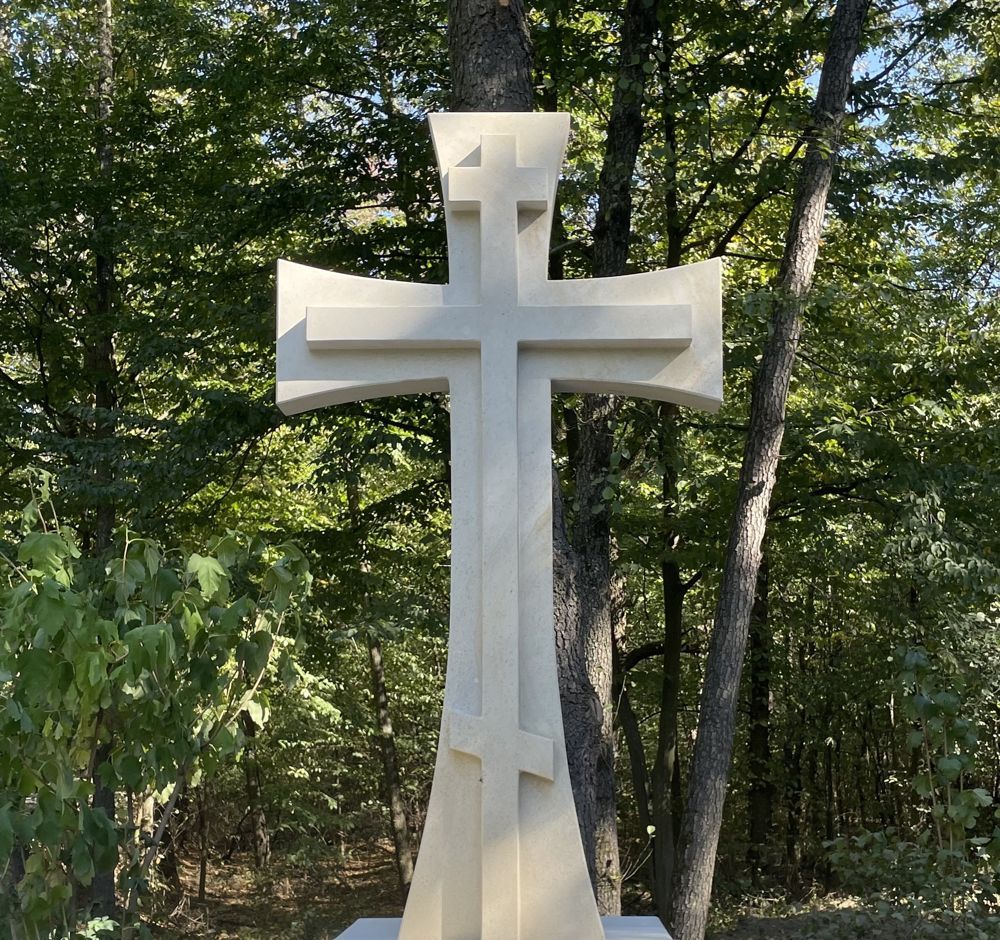
- In the Ukrainian stone tradition, a distinct layer is formed by pattée crosses with flared ends, which are called both “Cossack” and “Maltese”, although “Maltese” in the narrow sense means a different form.
- The name depends on the source, so when talking to a craftsman it is better to show the form in a drawing than to rely on a word alone.
- Before ordering a stone cross you need to decide on: the form according to the community’s tradition, the purpose, the proportions, the thickness of the arms, the inscription and the base, and to agree everything with the priest.
Why know the form of the cross?
The form answers three questions at once: which tradition the cross belongs to, where it will stand, and what it says.
Tradition comes first. That is why the demand that “they all must be like this” does not work here. What works is something else: what there was in this village, in this monastery, in this parish.
Place comes second. A study of folk memorial sculpture of the Stryi region mentions the classification of M. Sumtsov, according to which wayside crosses are divided into “votive”, “on blood” and “protective” ones, that is, crosses erected to fulfil a vow, on the site of a tragic event, or to protect the village from natural disaster. The same cross on a dome and the same cross on a grave are different tasks.
Symbolism comes third. It accumulates slowly. The cross did not become the principal sign at once: the four-pointed cross as a clear image, as opposed to hidden symbols, appears in the Catacombs of St Lucina in the 3rd century, and it became the main symbol of Christianity later.
What are the main forms of the cross?
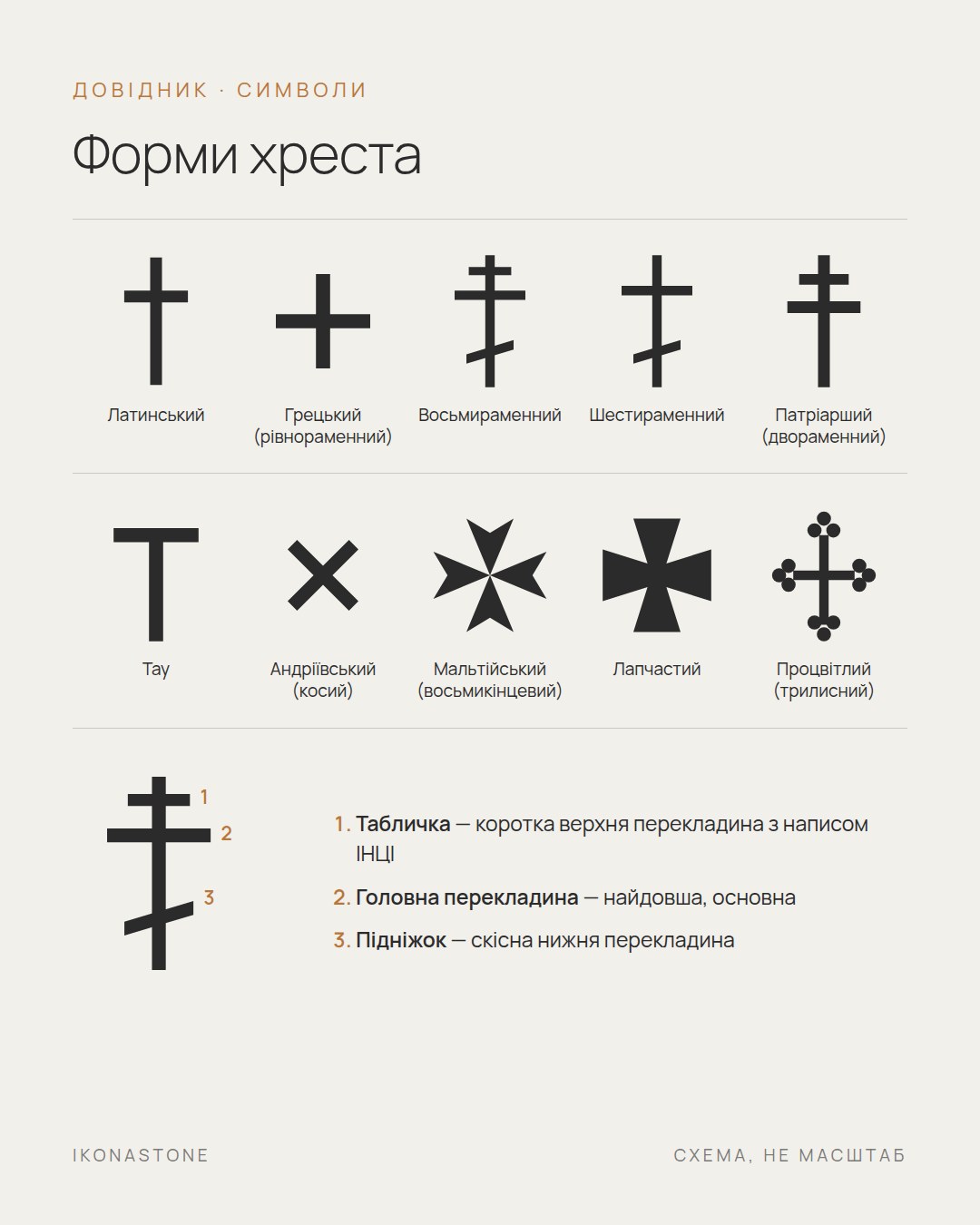
Latin. The lower arm is longer than the others, and the top of the upright extends above the crossbar. This form is especially widespread in Western Christianity: the “Latin cross” plan in architecture, a nave crossed by a transept, derives from it. In Catholic metalwork of the 18th–19th centuries such a cross often ends in Gothic four-lobed rosettes (quatrefoils) at its tips; in other words, the basic form stays the same, while the terminals of the arms change its character.
Greek (equal-armed). Four arms of equal length. In a composition, the equal-armed cross is visually concentrated around the point of intersection.
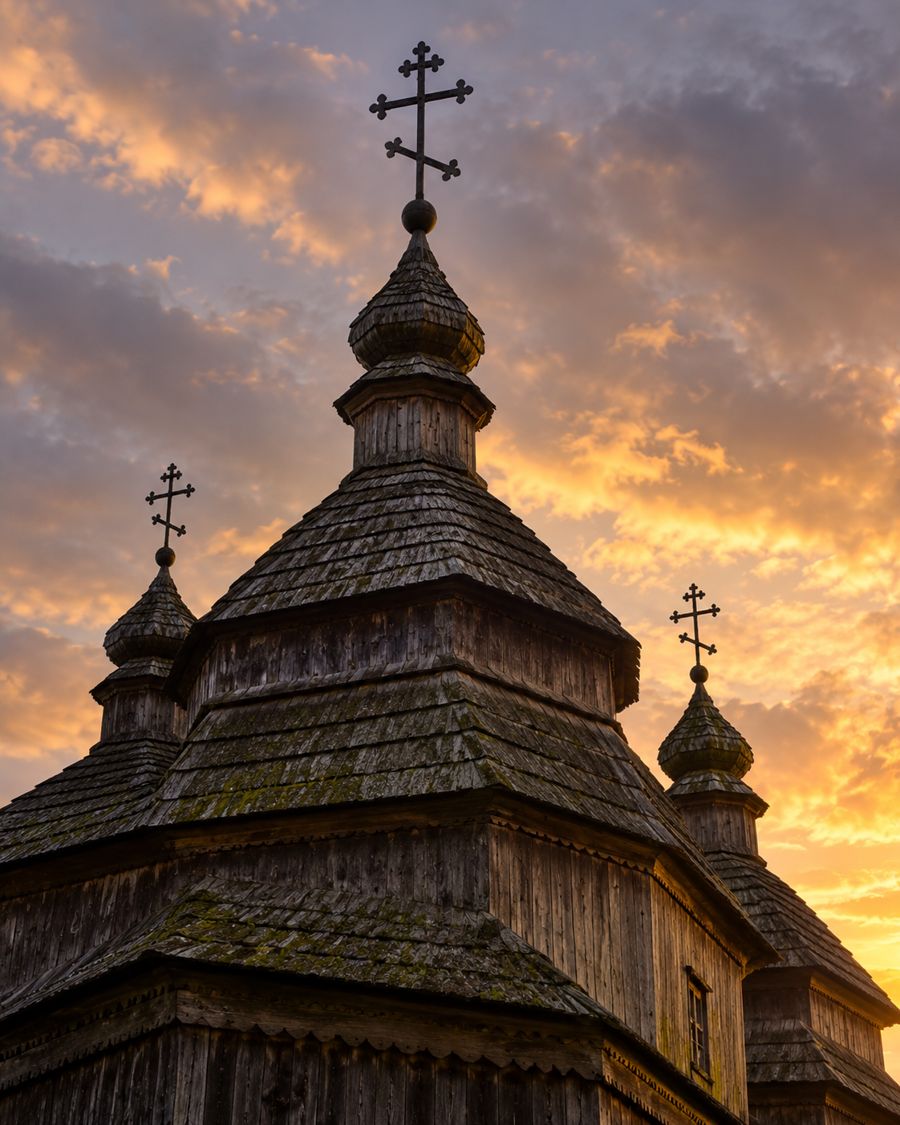
Eight-pointed. A vertical upright, two upper bars (a short one at the top, the title board, and a longer one beneath it, the crossbar for the hands) and a slanted lower bar, the footrest. The traditional explanations: the upper bar represents Pilate’s inscription (“Jesus of Nazareth, the King of the Jews”, John 19:19), abbreviated in Latin as INRI. The lower one is the footrest to which the feet were nailed.
Why is the footrest slanted? There are several traditional explanations, and none of them is the only one. According to one, the slant symbolises the suffering, the “agony and struggle” of the Saviour; according to another, it refers to the two thieves: the end raised upward points to the repentant one, the lowered end to the one who mocked. These are different voices, and they should be presented side by side rather than choosing the “correct” one.
Six-pointed. Six-, seven- and eight-pointed crosses appear in ancient manuscript Gospels and mosaics; six-pointed crosses with thickened ends are also known in Western metalwork. The meaning of the six ends is not fixed by a single explanation, so the form is recognised by the number of arms, and its meaning is established within the tradition of the particular community.
Patriarchal (double-barred). A vertical upright with two crossbars, the lower one longer. It is also called the Cross of Lorraine: that is how it is known in Western Europe. It appears on Byzantine coins, in particular under Justinian II (705–711). One of the meanings ascribed to it: the first bar is death, the second is resurrection; there are other readings too (the title board, the footrest, the scales of justice, the two thieves).
Tau cross. T-shaped, sometimes with flared ends. It takes its name from the Greek letter. Tertullian and Origen connected the mark on the forehead in Ezekiel 9:4 with the custom of the early Christians of tracing the sign of the cross on the forehead. The Franciscans and the Antonines are associated with it.
St Andrew’s (saltire). X-shaped. By tradition it is associated with the Apostle Andrew. The Roman typology of crosses knew the X-shaped form (crux decussata) as a separate type.
What are the “Maltese” cross and the cross pattée?
This is where terminological confusion is greatest, and it deserves separate attention.
In the narrow sense, the Maltese cross consists of four V-shaped elements whose points meet at the centre; it is associated with the Knights Hospitaller. But in everyday usage all crosses that widen toward their edges are often called “Maltese”, whereas these are properly designated by the term cross pattée. The encyclopedic entry on the Maltese cross even remarks directly that other crosses with flared arms are “often mistakenly” called Maltese.
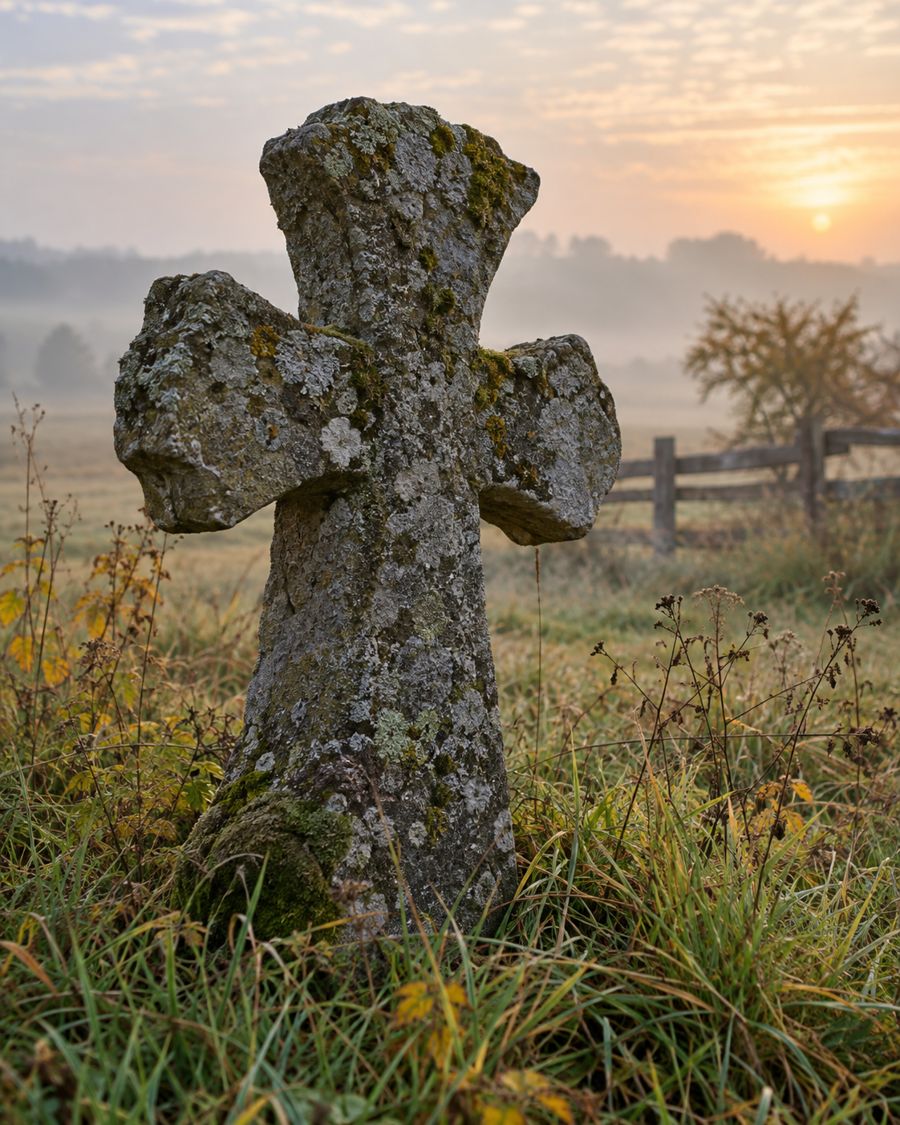
In the Ukrainian stone tradition this type has its own name and history. The Ternopil researcher Vasyl Ilchyshyn, quoted by Ukrinform, notes of the crosses of the Ternopil region that their form changed over time: the arms became rounded, and in the Cossack era crosses “of the Maltese type” appeared, which are also called “Cossack”. In the typology of grave crosses developed by Sapozhnikov, Sliusar and Shuvalov, a separate class of “pattée, or Korsun” crosses is distinguished; by analogy with dated monuments, simple pattée crosses are considered there the oldest of those studied. And earlier still, in 1908, Shyrotskyi, working with material from Podillia, identified four basic types of grave crosses: three-pointed, oblique, straight and six-to-eight-pointed; he regarded the Cossack crosses of the 17th–18th centuries as a special group.
One more detail for the client: at the Kuialnyk Cemetery near Odesa, which arose in the second half of the 18th century, four-pointed crosses predominate, and Greek and flared crosses are among the most common; all the gravestones there are carved from solid blocks of limestone. These forms are not an exception but the ordinary language of the period.
What else is found: the flowering cross, the cross with a circle, the cross with a crescent?
Flowering (floriated). The ends of the arms are decorated with floral or foliate terminals; in heraldry this is the cross fleury, a cross with flowers at its ends. A Ukrainian example from another field: in the explanation of the logo of the Patriarchal Commission of the UGCC for Evangelization, a “flowering two-armed cross” is depicted as a “living, blossoming organism” symbolising the Tree of Life. This is, of course, a modern reading of a particular sign, but it shows where this form leads: from geometry to image.
Cross with a circle (Celtic). A Latin cross with a ring around the intersection of the arms, which arose in Ireland and Britain in the early Middle Ages. There are several explanations of the ring, among them a transition from wooden crosses that needed supports, and a reminiscence of older crosses within a circle. The monumental stone “high crosses” of the 9th–12th centuries are among the best-known examples of the cross as architecture.
Cross on a crescent. There is a form with a crescent beneath the cross; its interpretations vary. At the Kuialnyk Cemetery there are crosses with a crescent at the base.
What do inscriptions say about crosses?
An inscription is a way of adding words to a cross. On the upper title board of the eight-pointed cross the abbreviation ІНЦІ is written (INRI in Latin): “Jesus of Nazareth, the King of the Jews”, according to the Gospel of John. The abbreviation ІС ХС means “Jesus Christ”, and the Greek НИКА means “conquers”. For more on how to read these and other inscriptions, see our article Inscriptions on Icons.
For stone there is a practical consequence: an inscription is also carving. Letters that merge with the relief require depth and width of stroke, not just a beautiful typeface. Researchers note that folk gravestones contain errors in dates and mirror-written numerals, and that inscriptions are not found everywhere: in the village, as they write, there “simply was no one literate in writing”. Today an error in an inscription is no longer folklore but a spoiled stone.
Table of forms
| Form | How to recognise it | Where it is found | What it means (by tradition) |
|---|---|---|---|
| Latin | Lower arm longer, top of the upright extends above the crossbar | Western tradition; Catholic crosses; church plan | A general sign of Christianity; in architecture, the nave and transept |
| Greek | Four equal arms | Byzantine tradition | Meaning not fixed |
| Eight-pointed | Title board, crossbar, slanted footrest | Eastern tradition: churches, wayside crosses, grave crosses | Title board: Pilate’s inscription; footrest: support for the feet; the slant is interpreted in different ways |
| Six-pointed | Six ends; number and position of bars vary | Manuscripts, mosaics, Catholic metalwork | Meaning not fixed |
| Patriarchal | Two crossbars, the lower one longer | Byzantine coins; “Cross of Lorraine” in the West | Death and resurrection (one of the readings) |
| Tau | T-shaped | Franciscans, Antonines | Reference to Ezekiel 9:4 (the mark on the forehead) |
| St Andrew’s | X-shaped | Tradition of the Apostle Andrew | Associated with the Apostle Andrew |
| Maltese | Four V-shaped elements meeting at the centre | Knights Hospitaller, heraldry | The eight points are explained differently in different sources |
| Pattée (“Cossack”) | Arms widen toward the ends | Folk gravestones; also described in the literature as “Cossack” | Associated in the literature with the Cossack era; names in the sources do not coincide |
| Flowering | Floral or foliate ends | Heraldry, modern church symbolism | Tree of Life (in a modern interpretation) |
| With a circle (Celtic) | Latin cross with a ring at the intersection | Ireland, Britain, high crosses | Several explanations of the ring, no single one |
| With a crescent | Cross above a crescent moon | Kuialnyk Cemetery | Interpretations vary |
A cross in stone: what to decide before ordering
Stone does not tolerate corrections, so most questions need to be settled before the first cut.
- The community’s tradition. What form the church or cemetery has, and where the cross fits in. A form alien to the local tradition will look out of place there.
- Purpose. A cross on a dome, a wayside cross, a memorial cross and a grave cross face different conditions: viewing distance, wind load, human touch.
- Blessing and approval. The form, the inscription and the location should be agreed with the priest or rector before the sketch, not after.
- Proportions. The ratio of the length and width of the arms, the height above the base. Folk crosses cut by hand show deviations in geometry and asymmetry; today this is no longer a tolerance but a choice.
- Thickness of the arms and ends. A flared end, a trefoil, a floral terminal: these are thin points. The more complex the outline, the more vulnerable the stone is to chipping; specific minimum cross-sections depend on the rock and the conditions, so they are determined at the design stage.
- Type of stone. Researchers note that limestone deteriorates quickly from lime, and that vertically placed slabs of shell limestone are less vulnerable to weathering. The choice of stone is part of the decision about form.
- Inscription. Text, typeface, depth of the letters, language. Spelling and the canonical abbreviation are checked before carving.
- Base and pedestal. Old crosses often sink into the ground, and their base is hard to see and examine. So the pedestal, its form, height and depth of setting should be thought through in advance.
- Location and orientation. Which way the cross faces, how the sun lights it, how the shadow falls on the inscription.
The cross as a decision
The form of a cross is chosen by tradition, not by taste. In short: first, what this place is and who its community is; then, which line the form belongs to; and only then, how to execute it in stone. These are exactly the questions worth settling before the stone reaches the machine. We design crosses like these for a specific church and a specific place, in conversation with the priest from the first sketch.
FAQ
How does a Latin cross differ from a Greek cross?
On a Latin cross the lower arm is longer than the others, and the top of the upright extends above the crossbar. On a Greek cross all four arms are the same length. The Latin form is associated primarily with the Western tradition and the Greek form with the Byzantine one, but both appear in both traditions.
Why does the eight-pointed cross have a slanted lower bar?
The lower bar represents the footrest to which the feet were nailed. Its slant has traditionally been interpreted in different ways: as a sign of suffering, or as a pointer to the two thieves (the end raised upward toward the repentant one, the end lowered toward the one who mocked). These are interpretations handed down by tradition, not documentary evidence, so they are presented as different voices of the tradition.
What is a cross pattée and why is it called a Cossack cross?
A cross pattée has arms that widen toward their ends. In the literature such forms are also called "Maltese" and "Cossack"; typologists single out "pattée, or Korsun" crosses as a separate class of grave crosses. The name "Cossack" became attached to a form associated with the Cossack era.
Is a cross with flared ends called the same thing in all sources?
No. In the narrow sense, a Maltese cross is made of four V-shaped elements meeting at the centre. A cross whose arms widen toward the edges is, strictly speaking, called pattée. In everyday usage these names are mixed up, and this is worth keeping in mind when describing the form to a craftsman.
What do the inscriptions ІНЦІ and ІС ХС НИКА mean?
ІНЦІ (INRI in Latin) is the abbreviation of Pilate's inscription above the crucifixion (John 19:19). ІС ХС is the abbreviated "Jesus Christ", and НИКА means "conquers". For more on inscriptions, see the article "Inscriptions on Icons".
Which form should be chosen for a stone cross?
The form is determined by the tradition of the community, the purpose of the cross (on a dome, a wayside cross, a memorial or a grave cross) and the blessing of the rector. Next come the proportions and the thickness of the arms suited to the chosen stone. It is best to start with the priest, not with a sketch.
Sources
- Ukrinform. Under the Sign of the Cross (a conversation about the old stone crosses of the Ternopil region)
- Makoida O. The Genesis of the Crucifixion Image in the Early Christian Period. Narodoznavchi Zoshyty, 2019, No. 6 (150)
- Taras Ya. Folk Memorial Sculpture of the Village of Duliby. Narodoznavchi Zoshyty, 2021, No. 4 (160)
- Fratseniuk Yu. A Typology of Stone Grave Monuments: Based on Village Cemeteries of the Odesa Region (master's thesis, I. I. Mechnikov Odesa National University, 2024)
- Popelnytska O. Metal Crosses of the Catholic Church of the 18th–19th Centuries in the Collection of the National Museum of the History of Ukraine. Scientific Bulletin of the NMHU, No. 5
- The Word of the Evangelist, vol. 2 (Patriarchal Commission of the UGCC for Evangelization), explanation of the School of Good News logo
- Christian cross variants (encyclopedic overview)
- Patriarchal cross (encyclopedic overview)
- Latin cross (encyclopedic overview)
- Cross pattée (encyclopedic overview)
- Maltese cross (encyclopedic overview)
- Cossack cross (encyclopedic overview)
- Kuialnyk Cemetery (encyclopedic overview)
- Celtic cross (encyclopedic overview)
- Tau cross (encyclopedic overview)
- Cross fleury (encyclopedic overview)
- Saunders W. The Eastern Cross. Arlington Catholic Herald / Catholic Education Resource Center
- Wikimedia Commons: Stone Cossack cross at the entrance to the settlement of Slavne (CC0)