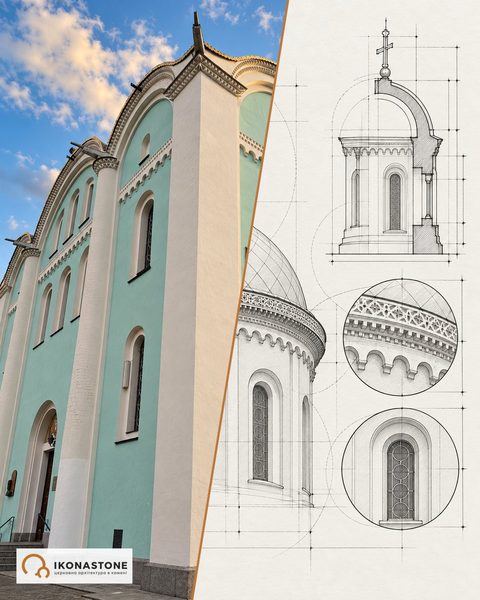
St Nicholas Church in Zhydychyn: a date on the tympanum and two inscriptions on the orb
Above the west entrance of the church in Zhydychyn stands a date: 1723. But the orb under the cross on the dome, removed in 1982, bore two inscriptions and two dates. Between them lie 129 years and a question that still has no answer: was this church rebuilt or built anew?
In brief
| Address | Zhydychyn village on the Styr river, Lutsk District, Volyn Oblast |
| First mention | 1227, Hypatian Chronicle (the monastery) |
| Built | 1723 (according to the inscription on the portal); founder — Bishop Yosyf Levytskyi of Kholm |
| Type | three-nave four-pillar basilica with a semicircular apse; style — Baroque |
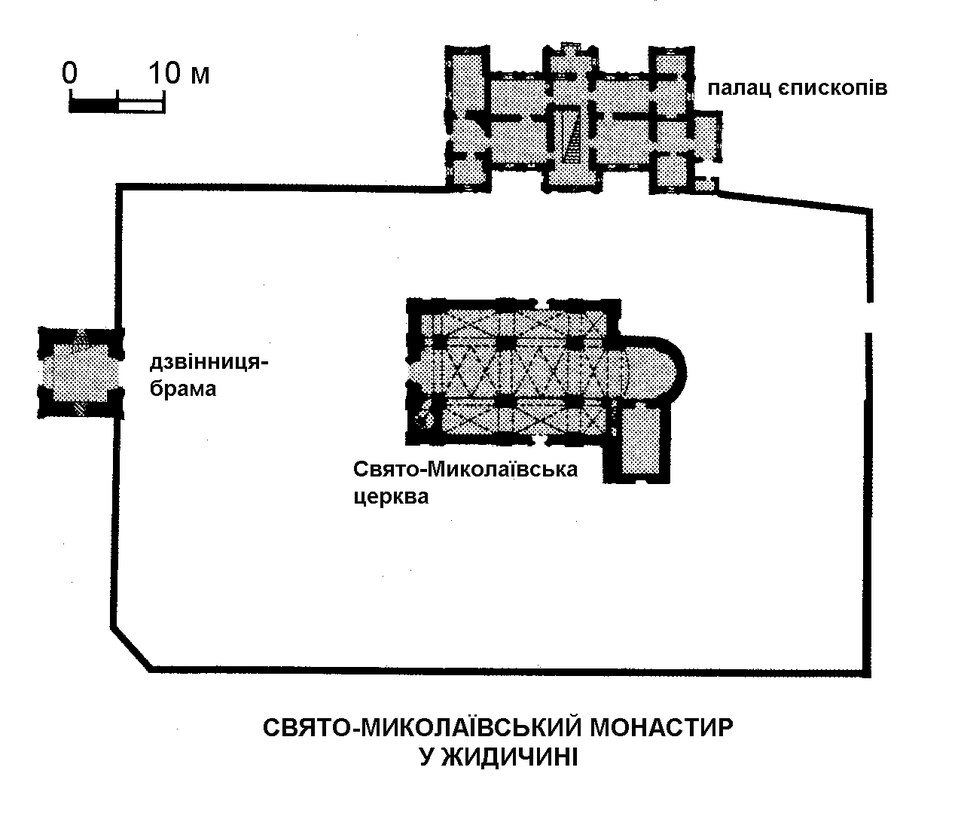
| Ensemble | church, gate bell tower, bishop’s house (palace), remains of the rampart |
| Status | architectural monument of national importance |
The story in plain words
A short account, about a 7-minute read. The full chronology, with all dates, disputes and sources, is below in the "Chronology" section.
A prayer stronger than advantage (13th century)
Zhydychyn lies a few kilometres from Lutsk, on the bank of the Styr. It enters recorded history through a single line in a chronicle. In 1227, Prince Danylo Romanovych came here “to bow and pray to Saint Nicholas”. Lutsk was then held by another prince, Yaroslav Inhvarovych, and the boyars advised Danylo to use the chance: seize his rival and take the city. Danylo refused. He had come to pray, not to fight.
This is how Zhydychyn entered history, as a place where prayer proved stronger than advantage. The monastery itself traces its origins back to 975, but that is its own tradition: there is no document to confirm it.
A rich monastery and the first fire (15th–16th centuries)
In the 15th and 16th centuries the monastery was one of the richest in Volhynia. It owned villages, forests, ponds with mills, and bee trees from which honey was gathered. A census of 1583 names it among the wealthiest Orthodox monasteries in the region.
The wealth attracted more than pilgrims. In 1496 the monastery was burned by the Tatars. The Ostrozkyi princes helped rebuild it, and in 1507 King Sigismund I gave the monastery to Prince Kostiantyn Ostrozkyi, with the right to appoint the archimandrite (the head of a large monastery) himself.
Then people began to fight over the monastery. In 1584 the Lutsk starosta, with a band of soldiers, drove out Archimandrite Borzobahatyi by force. A year later the Bishop of Lviv, Hedeon Balaban, seized the monastery and found it almost empty: only one priest lived here, and the wooden church stood plundered, with a collapsed roof.
Between two churches (1596–1668)
In 1596, in Brest (Berestia), some of the Orthodox bishops agreed to the Union, an alliance with Rome in which the church kept its rite but recognised the authority of the Pope. Balaban did not accept the Union. The following summer, servants of his rival attacked the monastery at night and wrecked it. Two weeks later Balaban took the monastery back by force.
In 1608 the monastery passed to the Basilians, a Greek Catholic monastic order. For almost two hundred years, bishops who were also archimandrites of Zhydychyn lived here. In the 1640s the monk Yakiv Susha wrote a book here called “Phoenix”, about the miracles of the Kholm icon of the Mother of God.
The Cossack era turned everything over again. In 1655, according to a Polish description from the late 19th century, the Cossacks took over the monastery and made it Orthodox. But already in 1668 the monastery was returned to the Basilians.
The hill, the dome and the puzzle of two dates (1719–1795)
The monastery we see today dates from the 18th century. The new archimandrite, Bishop Yosyf Levytskyi, according to the research of O. Lesyk-Bondaruk, moved the monastery from the river floodplain to the high hill opposite. Here arose the brick church of Saint Nicholas, the gate bell tower and a two-storey bishop’s house. Above the church entrance the date 1723 can still be seen.
But the church holds a puzzle. In 1982, during repairs, the apple, a metal ball beneath the cross, was taken down from the dome. Two inscriptions were found on it: that the church was founded by Hedeon Balaban in 1594, and that it was built by Yosyf Levytskyi in 1723. So the Baroque church may have grown on older walls, or it may have been built on a new site. There is still no answer.
The church is built as a basilica: a long hall divided by rows of pillars into three parts, called naves. The style is Baroque, with soft arcs of the pediment above the entrance and vaults on arches.
In October 1788 the heads of all the Basilian monasteries of the Lithuanian province gathered here for a week. Such a gathering was called a chapter: they settled economic matters and school affairs and elected new leadership. Zhydychyn was then one of the main centres of the order.
Closure (1828–1914)
After the partitions of Poland, Volhynia found itself in the Russian Empire, which did not tolerate the Union. In 1828 the Basilian monastery was closed and the church became an Orthodox parish church. This is what saved it: the church remained needed by the people. In 1839 the monastery was finally dissolved, some of the buildings were taken down, and the bricks, it is said, were carted off to Kivertsi to build the railway station.
The bishop’s house stood without repair for decades. In 1894 it was handed over, together with two gardens, to the Pochaiv Lavra. The garden brought in hundreds of roubles a year, and that money was used to restore the palace. A house church was consecrated in it.
Wars, school and silence (1914–2002)
The First World War passed right through Zhydychyn. Austrian soldiers were quartered in the church, and the altar, according to the recollection of the priest at the time, served them as a bedroom. On 30–31 August 1915 fighting took place near the village. Austrian newspapers that autumn printed the names of young men from Upper Austria who died “near Zhydychyn”, among them two brothers from one farm.
In the 1920s and 1930s, when Volhynia was part of Poland, the palace housed a shelter for orphans and people with disabilities, where teaching was in Ukrainian. Bishop Polikarp (Sikorskyi) lived here, and a commission that translated the Holy Scriptures into Ukrainian worked here.
Under Soviet rule the church remained a parish church, and from 1947 to 1990 a village school operated in the palace. The crypt, the underground burial vault beneath the church, was forgotten; according to different accounts, it was filled in or concreted over. In 1954 the church walls were plastered, and the inscription “1723” above the entrance was moulded anew.
Revival (2003 to today)
On 23 July 2003 the monastery was restored. The first monks settled in the half-ruined palace and began to restore it. Later, sketes (small monastic settlements, something like a farmstead) and new churches appeared around it.
At the end of 2019, while the floor in the Church of Saint Nicholas was being replaced, a drill fell through into an empty space. This is how the crypt was found, with burials on several levels. The monks spent two weeks hauling out the rubbish, and from 24 February 2022 the crypt served as a shelter for more than twenty villagers.
In 2024 the church, the bell tower and the metropolitan’s house were entered in the State Register of Immovable Monuments. Archaeologists are studying the burials beneath the floor, while the monastery itself receives tours, holds services and helps the military. Almost 800 years after Prince Danylo, people still come here in the same way to pray to Saint Nicholas.
Glossary
| Word | What it means |
|---|---|
| Archimandrite | the head of a large, important monastery |
| Union (1596) | an alliance of part of the Orthodox church with Rome: the rite stayed Eastern, but the authority of the Pope was recognised |
| Basilians | a Greek Catholic monastic order, named after Saint Basil the Great |
| Chapter | a general gathering of the heads of an order’s monasteries |
| Basilica | a hall-type church divided by rows of pillars into several lengthwise parts (naves) |
| Baroque | a style of the 17th–18th centuries: arcs, wavy pediments, rich moulding |
| Apple | a metal ball beneath the cross on a dome; records about the construction were often placed inside it |
| Crypt | an underground burial vault beneath a church |
| Skete | a small monastic settlement apart from the main monastery |
Chronology
The numbers in square brackets are the numbers of the sources in the list at the bottom of the page. The label "according to …" means that the fact is confirmed by only one source. The section "Legends" contains traditions and legends: they are recorded in the sources but not confirmed by documents.
Early Zhydychyn
- 8th–9th c.
At the settlement site near the monastery (excavation of 2009, 0.7 km south-east of the monastery), in household pit no. 1, hand-moulded pottery of the Luka-Raikovetska type was found; the excavators call the pit early Slavic. [52, 53] 10th–11th c. — According to Viktor Baiuk, the settlement arose as early as the La Tène period, and its heyday fell in the 10th–11th centuries; the excavation revealed layers of the Pomeranian culture, the Old Rus' period and the late Middle Ages. The settlement belonged to the northern suburbs of ancient Luchesk. [52, 53]
- 10th–13th c.
Nearby are the Skudelnychi hillfort (about 1.68 ha) and the Holy Spirit hill with an ancient quadrangular hillfort; materials of the 11th–12th centuries have been found. The sources give the status of the hillfort differently (local or national importance), and in scholarly literature Zhydychyn is described as a settlement complex of an Old Rus' town. [53, 76, 86] The eparchy's page calls the inhabitants of Skudelnychi potters who worked "to order for the prince's court"; archaeologically, this refers to marks on the bases of vessels. According to the Zhydychyn Center, the first monastic complex "with a palisade" already stood on the Holy Spirit hill in the 10th century; no documents are given for this. [53, 69, 80]
- 12th c.
Excavation of 2008 (56 m², right bank of the Styr, 0.6 km from the hillfort): dwellings of the 12th–13th centuries, a vessel base with a cross mark, and an oval structure with a furnace and a cluster of nozzles. [53] According to a report in "Moloda Ukraina", the monastery was patronised by Prince Mykola Sviatosha — a great-grandson of Yaroslav the Wise, son of the Chernihiv prince Davyd Sviatoslavych, who renounced the throne and took monastic vows. The eparchy's page places this patronage in the 14th–15th centuries; the title in the sources varies between "Prince of Lutsk" and "Prince of Chernihiv". [69, 96]
- 13th c.
The encyclopedias place the first information about the monastery on the Styr in the 13th century; a guidebook of 1929 says that it "already existed in the 13th century". [11, 61, 62]
- 975 (according to the monastery's tradition)
The monastery's website and a number of publications trace the monastery's history to 975: the Basilian chronicles allegedly mention Archimandrite Anekt, who gave the church a Gospel book. There is no primary document. [70, 97, 98]
- 1227
Hypatian Chronicle: Danylo Romanovych travels to Zhydychyn "to bow and pray to St Nicholas". Yaroslav Ingvarovych, who sat in Lutsk, summoned Danylo to him; according to the chronicle as rendered in L. Makhnovets's translation, the boyars advised seizing Yaroslav, but Danylo refused because he had come here to pray, and went to Volodymyr. This is the first written mention of Zhydychyn; the chronicle does not name an icon. [1, 2, 69] According to the Encyclopedia of Modern Ukraine, there were then about 80 monks in the monastery and its abbot was Anak; this name is given only by the ESU. The monastery's tradition names Anekt as the first abbot; neither name is confirmed by a primary document. [61, 70] The author of an essay in "Monitor Wołyński" believes that there was then rather a hermitage than a monastery; this is his assessment. A Polish essay of 1898 writes that the chronicles mention Zhydychyn and the Church of St Nicholas already in 1227, with a reference to "Zbornik letopisej" I, p. 176. [7, 99]
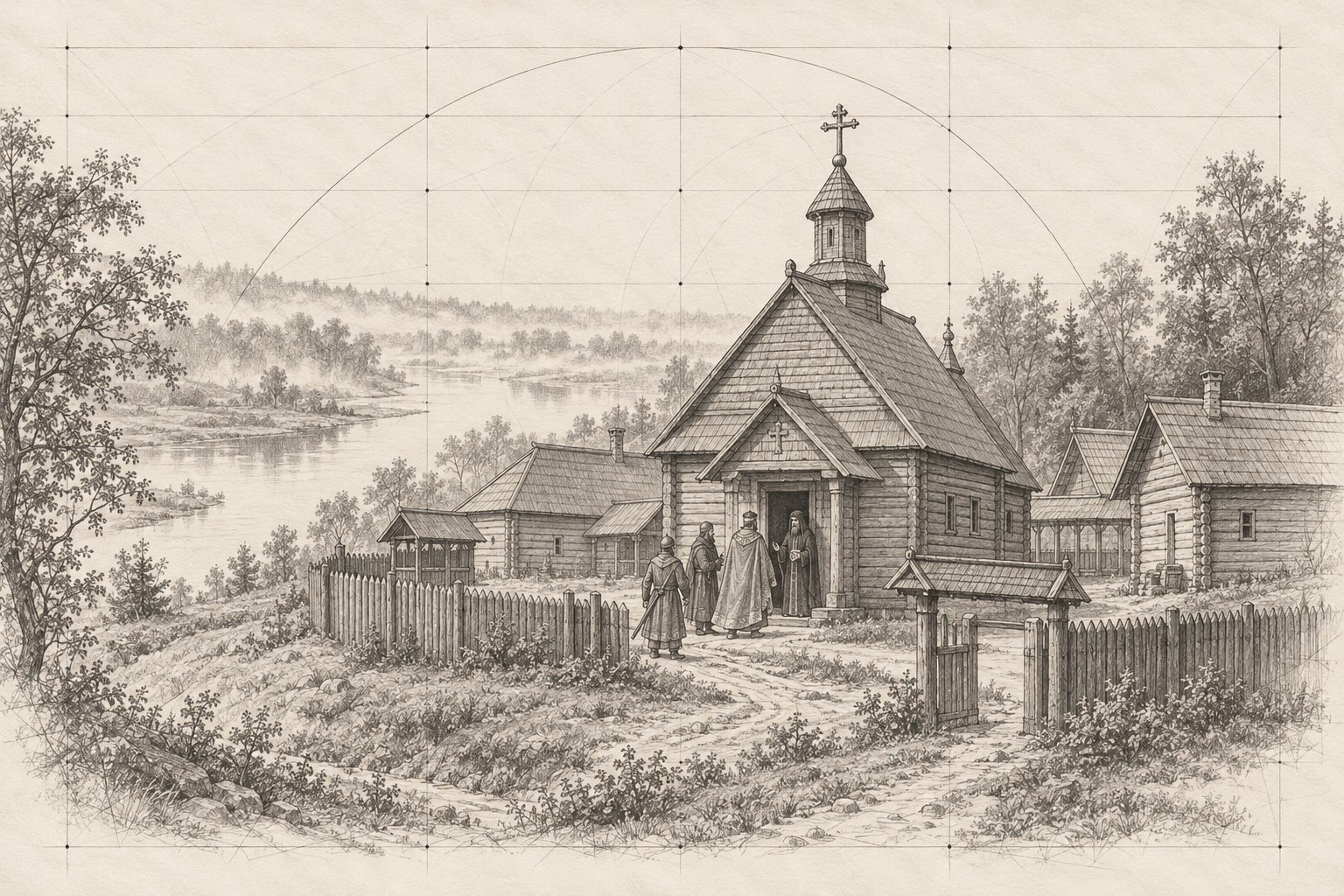
The year 1227: the monastery on the Styr (conjectural reconstruction). Illustration: IKONASTONE - 1236
A number of publications write that Danylo "visited here a second time", but give no reference to a source. [65, 100] 13th c. (disputed) — Oral and journalistic versions tell of an attack in which most of the brotherhood perished; they name about 80 or more than 100 monks, and the attackers as "Tatar-Mongols". No documents are given, and the year also differs between materials (13th or 15th century). [101, 102]
- 1240–1340
Zhydychyn is included in the corpus of strongholds of South-Western Rus' of this period in M. Kamińska's dissertation (Kraków, 2020, pp. 1158–1161). [54]
- Before 1335
The Encyclopedia of the History of Ukraine writes that it is "believed" that already before 1335 the heads of the monastery held the rank of archimandrite; the monastery's website places the status of an archimandria in the 14th century. No document is named. [59, 64, 70]
- 14th c.
Iron production at the settlement site: in structure 2, 4 whole nozzles and 27 fragments were found, dated by the pottery to the 14th century; the link of this production with the time of Prince Liubart is the authors' interpretation. Structure 1 is dated to the 12th–13th centuries, so these are two different structures, not two datings of one. [51, 53]
- Late 14th – early 17th c.
Jews lived in the village of Zhydychyn for more than 200 years: according to the pinkas of the Lutsk synagogue, recounted in 1938 in "Rocznik Wołyński", they settled 7 km from the city "in the time of Vytautas", and derived the name of the village "from the word Żyd". Between the settlement and Krasne there was a shared Jewish-Karaite cemetery (no traces remain now), and also a Jewish sanctuary "about which we know nothing in detail". [10]
- Ca. 1392–1430 (according to ikona.ua)
Zhydychyn is a market town "in the time of Vytautas": two fairs a year, customs tariffs much lower than in Lutsk; the monastery flourishes (beekeeping, fishing, beaver hunts, ponds with mills). The site gives neither references nor an exact date (according to one source). [103] Late 14th – early 15th c. — The monastery's website mentions "the miracle of the icon of St Nicholas in Lukoml"; the Encyclopedia of the History of Ukraine writes that the St Nicholas shrine from Zhydychyn was moved to Lukoml (now in Vitebsk Region). [64, 70]
- 1429
A congress of monarchs took place in Lutsk; according to the eparchy's page, part of the participants were received at Zhydychyn (according to one source). [69] 1431 / 16th c. — The monastery held the memorial book of Prince Fedir Liubartovych († 1431): according to the eparchy, "probably an altar book into which deeds of gift were entered". In a 16th-century lawsuit over the village of Okhmatkovo, Archimandrite Varsonofii placed this memorial book on the table as evidence. [69, 103]
- 15th c.
Publications without documentary references speak of about 100 monks, the status of a "lavra" and a substantial library; according to ikona.ua, around 1454 the archimandria owned 16 villages. [103, 104] Before 1480 — The Polish reference work "Rocznik Wołyński" (1938) calls the monastery "założony przed 1480 r." ("founded before 1480"). The source of this formula is an article by N. Petrov in "Volynskie eparkhialnye vedomosti" of 1867 (nos. 2–8), where Zhydychyn appears in a list of defunct Orthodox monasteries marked "founded before 1480" (according to one source). [10]
- 1491
According to the monastery's website, a handwritten Gospel book calls the monastery a lavra; the Gospel book with the entry "To the Archimandrite of the Zhydychyn Lavra" is kept in a Moscow archive. The link of this entry with 1491 is not proven, and the claim of "the oldest lavra" has not been verified. [70, 85, 98]
- 1496 (variant 1495)
The monastery was burned: according to the ESU and "Ridna Krayina", by Tatars; according to the Volyn Eparchy and the monastery's website, by Crimean Tatars, sons of Khan Mengli I Giray; many inhabitants were taken captive. The ESU gives 1496; the monastery's website writes "in 1496 (according to some data, 1495)". [61, 69, 70, 105] 1496 — A Polish publication of 1898: Mengli I Giray "destroyed the town with the surrounding villages, burned the church with the monastery, and drove the people into captivity"; the footnote refers to "Skarbiec Daniłowiczów" II, p. 244 — the same source as in Tsynkalovskyi, so this is not independent confirmation. [7] 1497 — In "Rocznik Wołyński" (1939), a broken-off fragment says that the Tatars "destroyed Zhydychyn", and then speaks of 1497 and Kremenets; the passage does not show who destroyed the village and when exactly. [12]
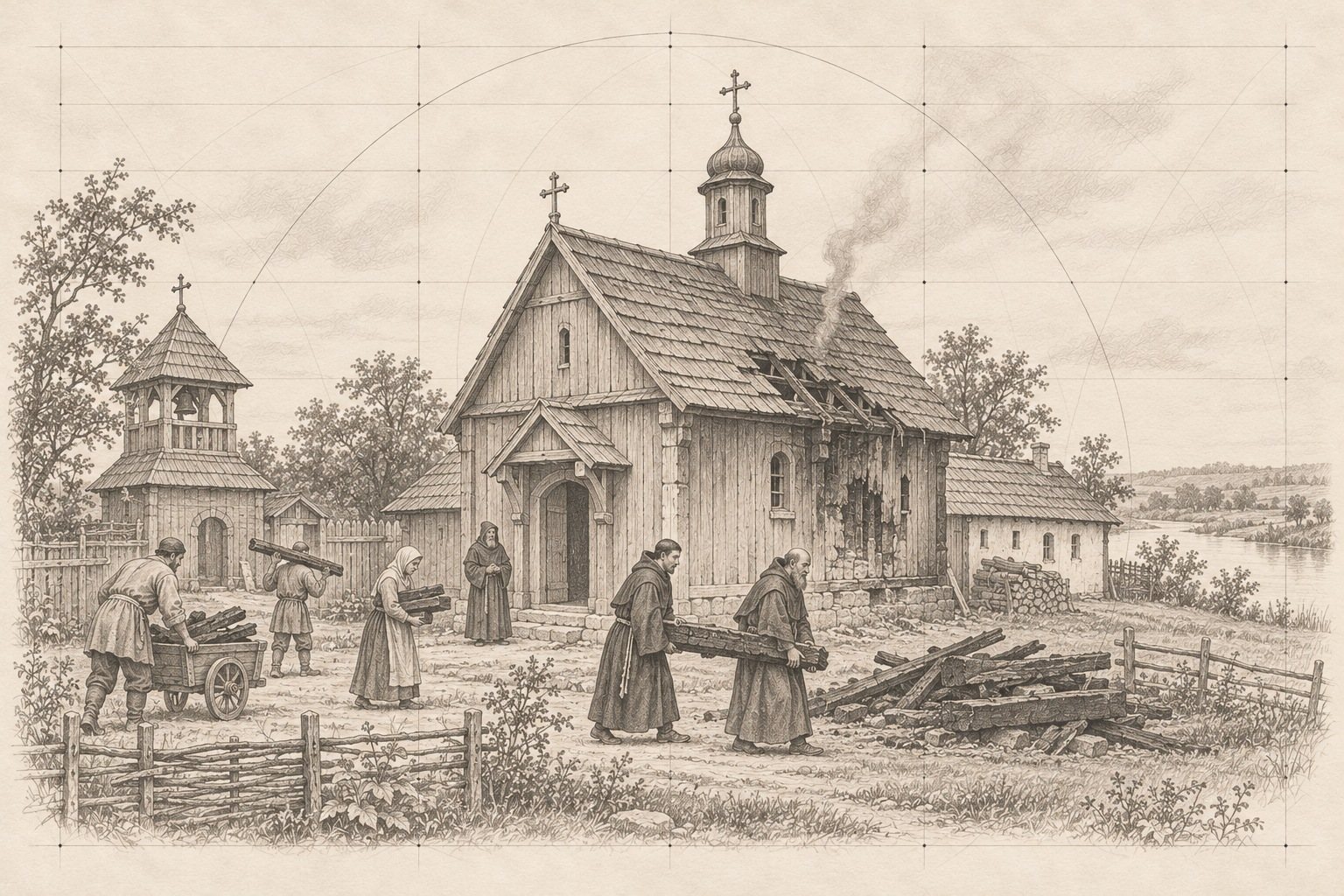
The year 1496: after the raid (conjectural reconstruction). Illustration: IKONASTONE - After 1496
The monastery was restored with the support of princes and the local Orthodox nobility; the ESU names the Ostrozky princes. [61, 69]
Under the king and the Ostrozkys
- 1500
Prince Parfenii Volodymyrovych gave Archimandrite Arsenii part of the village of Akhmatov with a pond, a mill, hayfields and fields; in return he asked to be entered in the monastery's memorial book. Another source under the same year names Archimandrite Iosaf and a confirmation of rights to the villages of Soltysy, Vasylky and Buremets. [47, 50] 1502 — King Alexander issued a charter for the same villages (Soltysy, Vasylky, Buremets) (according to one source). [50]
- 1507
Sigismund I, at the request of Kostiantyn Ostrozky, gave him the monastery for life use with the right to appoint the archimandrite. [47, 106]
- 1517
According to the monastery's website, the masonry church was built at the expense of Kostiantyn Ostrozky; the Encyclopedia of the History of Ukraine, however, writes that until the early 18th century all the buildings were wooden, while Rudetskyi describes in 1585 a masonry church beside a wooden one. [47, 64, 70]
- 1533
A tax levy was collected from Zhydychyn: 16 hearths, 11 gardens, 9 cottagers, 12 craftsmen, 2 boyars (according to Jabłonowski) (according to one source). [100]
- 1536
Archimandrite Varsonofii takes part in the sale of the voit's office of Boni (according to one source). [47] 1541 — Sigismund confirmed the right to Soltysy (mines, bee trees, diggings) (according to one source). [50] 1545 — The archimandrite was present at the inspection of Lutsk Castle; the monastery maintained one of the wall sections of the castle. [47, 50]
- 1552
The monastery's website writes that the monastery maintained the Archimandrite's Tower of Lutsk Castle; this is a different date from 1545 (according to one source). [70] 16th c. — Fairs in Zhydychyn were held twice a year; according to the eparchy, Ivan Vyshenskyi in his "Epistle to Prince Ostrozky" "sharply condemns" a fair near a notable church (according to one source). [69]
- 1555
Bishop Feodosii Hulevych bequeathed to the monastery 5 kopas of Lithuanian groschen (according to one source). [49] 1563 — "According to some claims", Zhydychyn had Magdeburg law; no confirmation is given in the sources (according to one source). [100]
- 1569
Archimandrite Iona (Ioan) Borzobohatyi bequeathed that he be buried in the monastery (will of 13.12.1569); the sources give his dates and the details of his tenure of the monastery differently. [47, 49, 64] 1570 — The defence of the estates was entrusted to the starosta Roman Sanguszko; Zhydychyn is named a "spiritual village" of the Volyn Voivodeship; the tax register records 108 whole holdings, 3 taverns and 3 water mills. [50, 66, 100] 1578 — An inventory of the estates was drawn up (according to one source). [50]
- 1580
King Stephen Báthory took the monastery away from Borzobohatyi and gave it to Bishop Feofan the Greek; the dispute continued (according to one source). [47] 1583 — According to the census of 1583, Zhydychyn is among the richest Orthodox monasteries of Volyn (alongside Derman and Dorohobuzh), with estates in the Lutsk and Volodymyr counties (W. Tomkiewicz). [9]
- 1584
The Lutsk starosta Oleksandr Pronskyi, with a company of soldiers, drove Borzobohatyi out of the monastery; the bones of his son and daughter-in-law buried there were thrown out of the monastery. [47] 1584–1597 — In "Rocznik Wołyński" (1934) we read: "Archimandryta Zydyczyński Bałaban tegoż Illę z tychże Dóbr wygnał" (Balaban's dispute with Illia over estates; "the Zhydychyn archimandrite Balaban drove the same Illia out of the same estates"); volume 5–6 mentions "jego walki o klasztor żydyczyński" ("his struggles for the Zhydychyn monastery"). The year is not visible in the OCR fragments. [13, 14]
- 1585–1586
The monastery was seized by Hedeon Balaban; in 1586 Sigismund III legalised this with a charter. The monastery was found neglected: only the priest Fedir lived there, and the wooden church that stood beside the masonry one had been plundered and had a collapsed roof. [47]
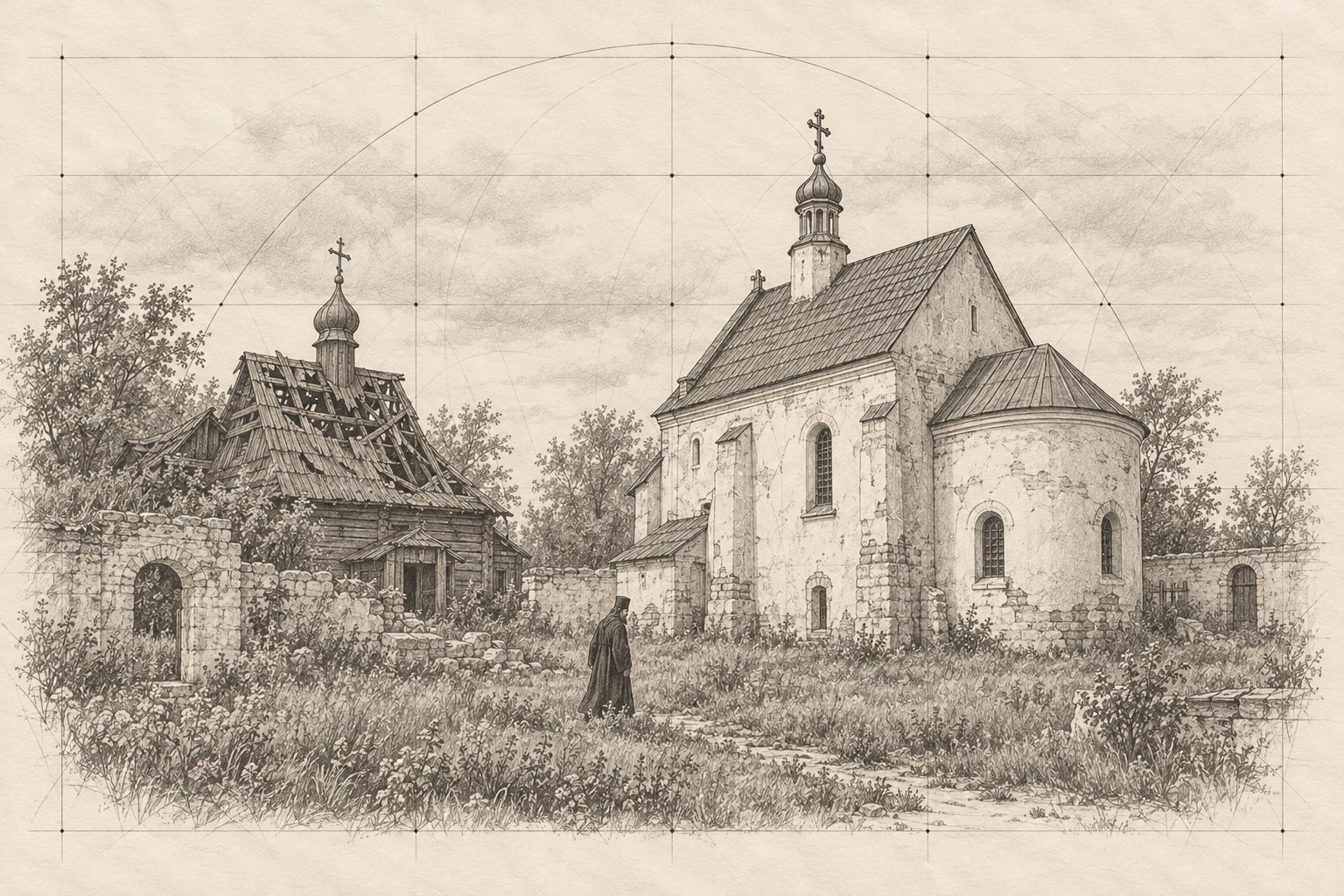
The year 1585: the neglected monastery. Illustration: IKONASTONE - 1594
According to the inscription on the orb under the dome, removed in 1982, it was in this year that Bishop Hedeon Balaban of Lviv laid the foundation of the church. [69, 107] 1595 — The ESU mentions the participation of inhabitants in the Nalyvaiko uprising (according to one source). [65]
- 16th–17th c.
The economy of the archimandria's estates rested on beekeeping, fishing, pitch, charcoal, iron ore and "beaver hunts" along the Styr; trade and crafts developed alongside (according to one source). [69]
The Union and disputes
- 1596
After the Council of Brest, at which Balaban sided with the opponents of the Union, an anathema was pronounced against him and his nephew Hryhorii on 8 October; Oleksandr Semashko was permitted to administer the monastery. The monastery later became Greek Catholic, but the sources disagree on the year of the transition. [47, 100, 108] After 1596 — A Polish essay of 1898: the monastery was "one of the first" to accept the Union and was raised to an abbey; the head is an archimandrite of the Basilian fathers; the abbot is a "high dignitary in Volyn" with "extensive estates". The essay does not name the year. [7] Late 16th – early 17th c. — According to the eparchy's page, because of the Union the archimandria became a centre of struggle; Balaban appointed his nephew Hryhorii-Hedeon as head, and the Lutsk bishop Kyryl Terletskyi wished to rule the "golden apple" (as the monastery was called); during one raid artillery was used, and Hryhorii-Hedeon was besieged under the dome for five days. The sources do not always distinguish Bishop Hedeon from his nephew (according to one source). [69]
- 1597
On the night of 21 August Semashko's servants attacked and sacked the monastery; Balaban's complaint is dated 28 August 1597; two weeks later Balaban retook the monastery by force. Semashko died in 1597 or 1598. [15, 47]
- 1603–1611
In 1603 Balaban's banition (outlawry) was lifted; in 1606–1611 the case with J. Charlinski continued; in 1607 the Lublin Tribunal pronounced perpetual banition on V. Svyshchovskyi (according to one source). [47]
- 1607
In May Kyryl Terletskyi died. According to the Encyclopedia of Ukraine, Hedeon Balaban died on 10 February 1607 in Lviv; other sources give around 1618, and the article on Shybynskyi gives December 1620. [16, 47, 48, 63] 1608 — According to the ESU, the monastery passed under the authority of the Basilians; according to the Encyclopedia of Ukraine, from then until 1826 it was the residence of the Uniate bishops of Lutsk and Ostroh, who were at the same time archimandrites. The date of the transfer is given differently in different materials: 1608, around 1617, 1618, "finally" 1638. [61, 62, 64, 100, 106]
- 1615
On 11 February Ivan Bohovytyn made a will providing for burial in the monastery. [49]
- 1618–1626
The sources give the dates of Yosyf Bakovetskyi-Mokosii's entry into the archimandria differently: 1618 (according to "Ukraina Inkognita"), 1619, and also "took office on 18.09.1626". Horin stresses that H. Bakovetskyi (the bridge-warden) and K. Mokosii Bakovetskyi are different persons. [48, 109] 1620 — Balaban leased Boholiube to Yu. Chernevskyi and Zaluttia to B. Dashkevych; the heirs Danylo, Dmytro and Martyn Balaban laid claim to the monastery's property. [48]
- 1621
Nikodym (Mokosii) Shybynskyi was appointed archimandrite: on 25 May a bailiff put him in possession, and on 27 May a register of property was drawn up. [48] In June Shybynskyi dissolved the Orthodox women's community at the Church of the Holy Spirit in Zhydychyn: it was expelled together with its property (complaint of the monastic women of 14 June). [48] 1621–1623 — Nikodym borrowed from the bridge-warden H. Bakovetskyi: 500 zlotys (12.06.1621), 800 zlotys (15.09.1621), 800 zlotys (23.09.1622); the debt was repaid in 1623; Kryshtof Mokosii Bakovetskyi was the monastery's attorney in court. [48]
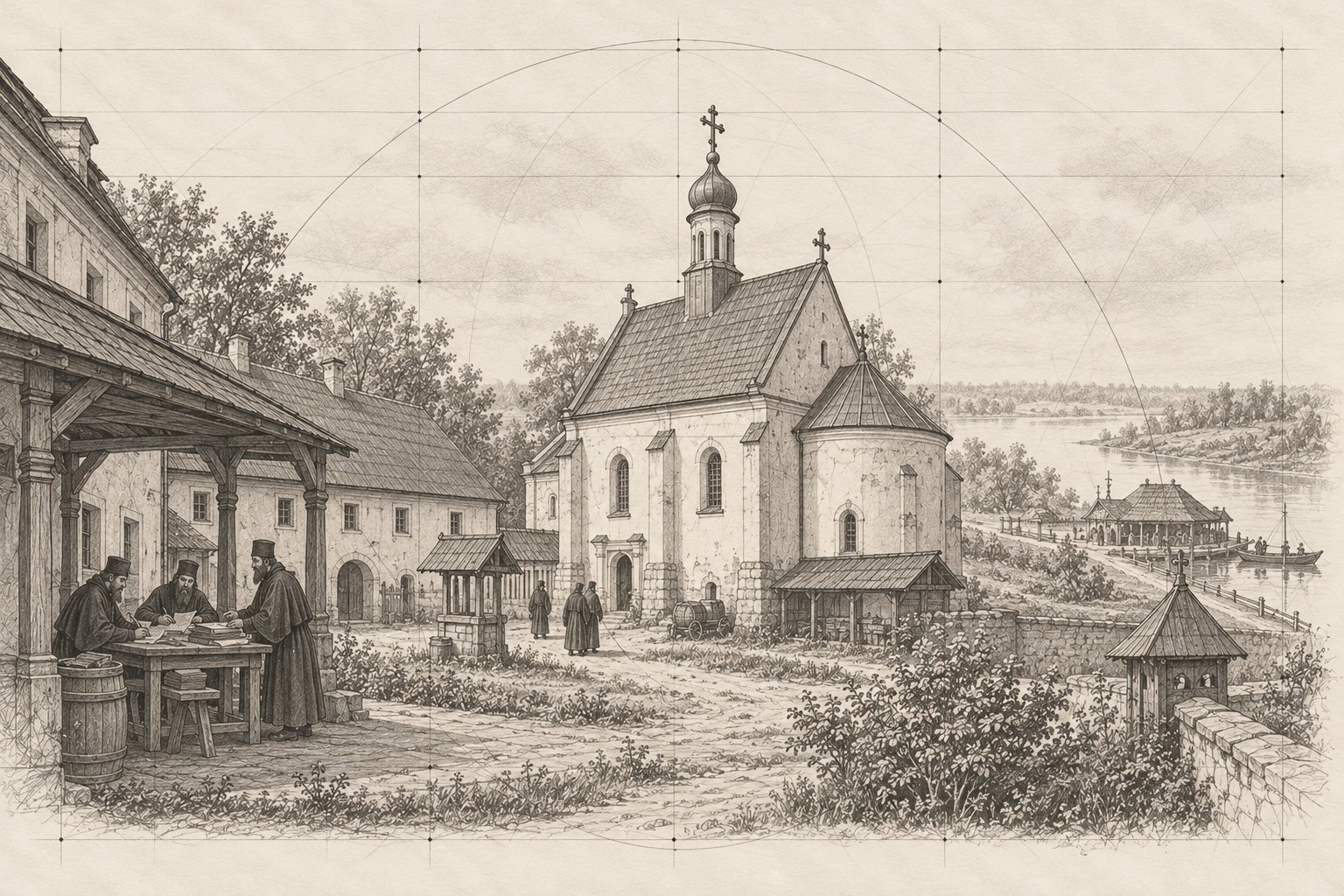
The year 1621: the monastery courtyard. Illustration: IKONASTONE - 1624
Will of Marusha Bohovytynivna providing for burial in the monastery. [49]
- 1625
On 11 September Metropolitan Rutskyi issued a protestation, and on 24 October the metropolitan's court deprived Shybynskyi of the archimandria and of his clerical rank; the leases he had concluded were declared unlawful. [48]
- 1626
On 22 July the monastery was sealed and handed over to Isakii Vichynskyi; on 12 September Shybynskyi was seized in Brest on the order of Bishop Yeremiia Pochapovskyi, and for more than six years he was held in custody in Vilnius. In 1626–1632 he was supported by Rafail Korsak. [48, 50]
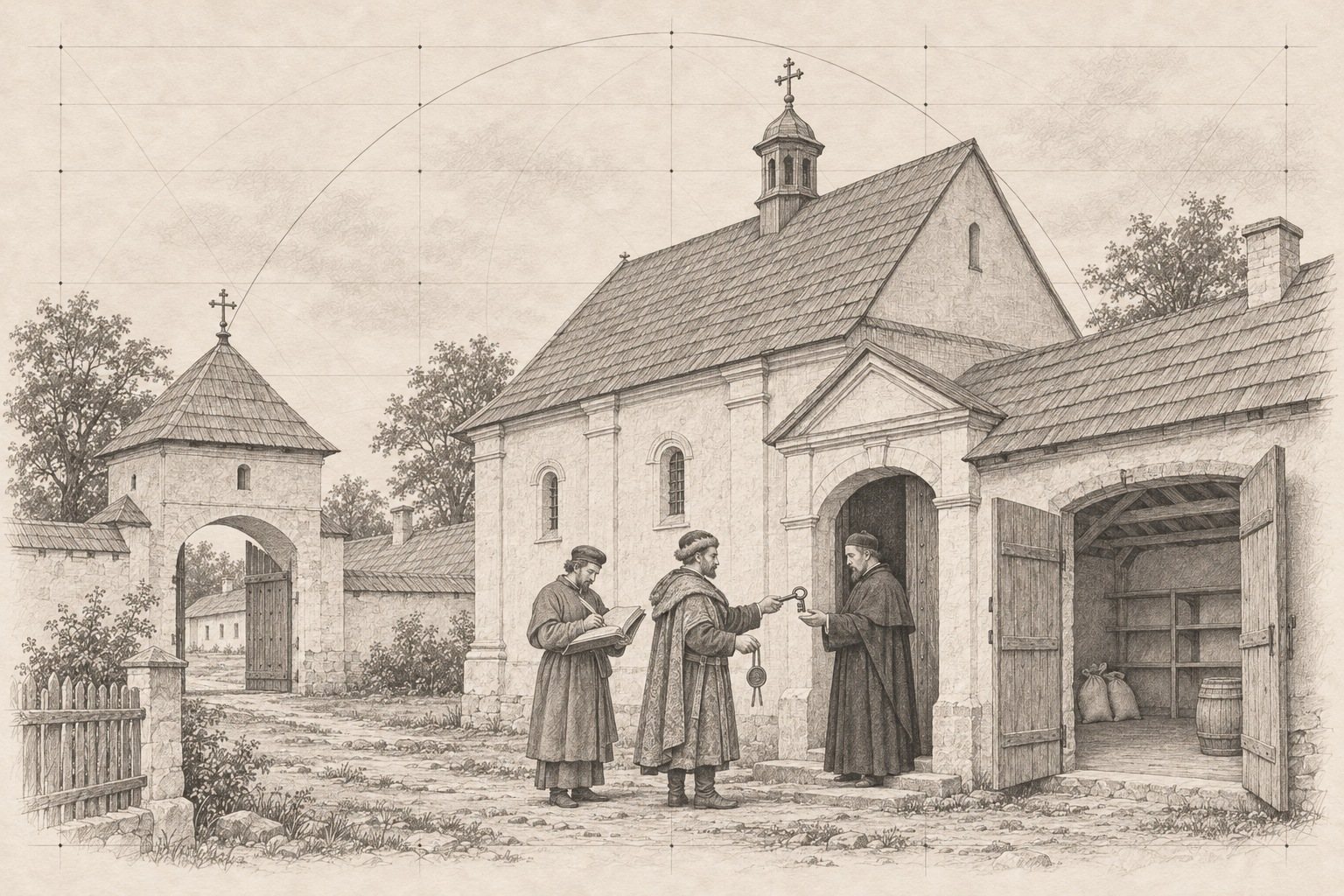
The year 1626: the inventory of the monastery (conjectural reconstruction). Illustration: IKONASTONE - 1628–1629
Archimandrite Iosyf (Mokosii-Bakovetskyi) recovered the estates that had been given away unlawfully: on 14 July 1628 he concluded an agreement with Prince Oleksandr Zaslavskyi on Soltysy, Vasylky, Didovychi and Sapotovychi, and in 1629 he obtained a banition (outlawry) of the prince's heirs in the Lublin Tribunal. [48, 50] 1629–1742 — The case of the monastery with the co-owners of Kulchyn is preserved (TsDIAK, fond 2071, series 1, file 250). [36]
- 1630s
The monastery's estates counted 291 households (according to Baranovych) (according to one source). [47]
- 1632
Under the "Articles of Pacification" of Władysław IV, the Uniate bishop Yeremiia Pochapovskyi yielded his see to an Orthodox one, but he was "free to keep for life" the Zhydychyn Monastery (W. Tomkiewicz; the year is from the context of the election). [9]
- 1636–1640
According to English-language Wikipedia, in 1636 the Lutsk-Ostroh eparchy was abolished, and afterwards it was administered by the archimandrite of Zhydychyn; Rafail Korsak is named archimandrite in 1637–1640. Other sources date him to 1638 and 1639. [68] 1638 — King Władysław IV granted the abbot two annual fairs and a weekly market (ESU); the Encyclopedia of the History of Ukraine, however, places in 1638 the final consolidation of the Union and the status of a permanent residence of the Uniate bishops of Lutsk. [64, 65] 1639 — Rafail Korsak began a lawsuit over the monastery's lands. [50]
- 1644–1645
Yakiv Susha writes in Zhydychyn the "Phoenix" on the miracles of the Kholm icon (about 700 miracles); the eparchy's page adds that in wartime the icon was hidden within the monastery's walls. Nafanail (1644) and Mykolai (1645) Lozovetskyi are named archimandrites. [50, 69, 108, 110]
The Cossack era and the return
- 1648
According to the newspaper "Volynska Yeparkhiia", in summer Kolodka's detachment liberated Kliavan, Lutsk and Zhydychyn. The exact day has not been established. [60] 1649 — End of the year: the Sejm confirms the Treaty of Zboriv; the Orthodox are awarded the Kholm eparchy and a number of Volyn shrines, including the "klasztor Żydyczyński". [9]
- 1650
Peasants defeated the Poles near Zhydychyn (Tysha); Archimandrite Makosei (Denysko) was tried for an attack on Kremenets, and the king returned the monastery to Neonil (Lozovytskyi); the monastery briefly passed to the Orthodox. [60, 65, 100]
- 1654
On 2 January a gentry assembly in Volodymyr demands the return of the archimandrite's villages. [60] 1655 — The Cossacks, according to a Polish essay of 1898, "took possession of the Zhydychyn monastery, turning it into an eastern, schismatic one" (footnote referring to Orgelbrand, vol. XXVIII, p. 1116). This is a third date (after 1649 and 1650) in the history of the transfer to the Orthodox, so we do not reduce them to a single event (according to one source). [7]
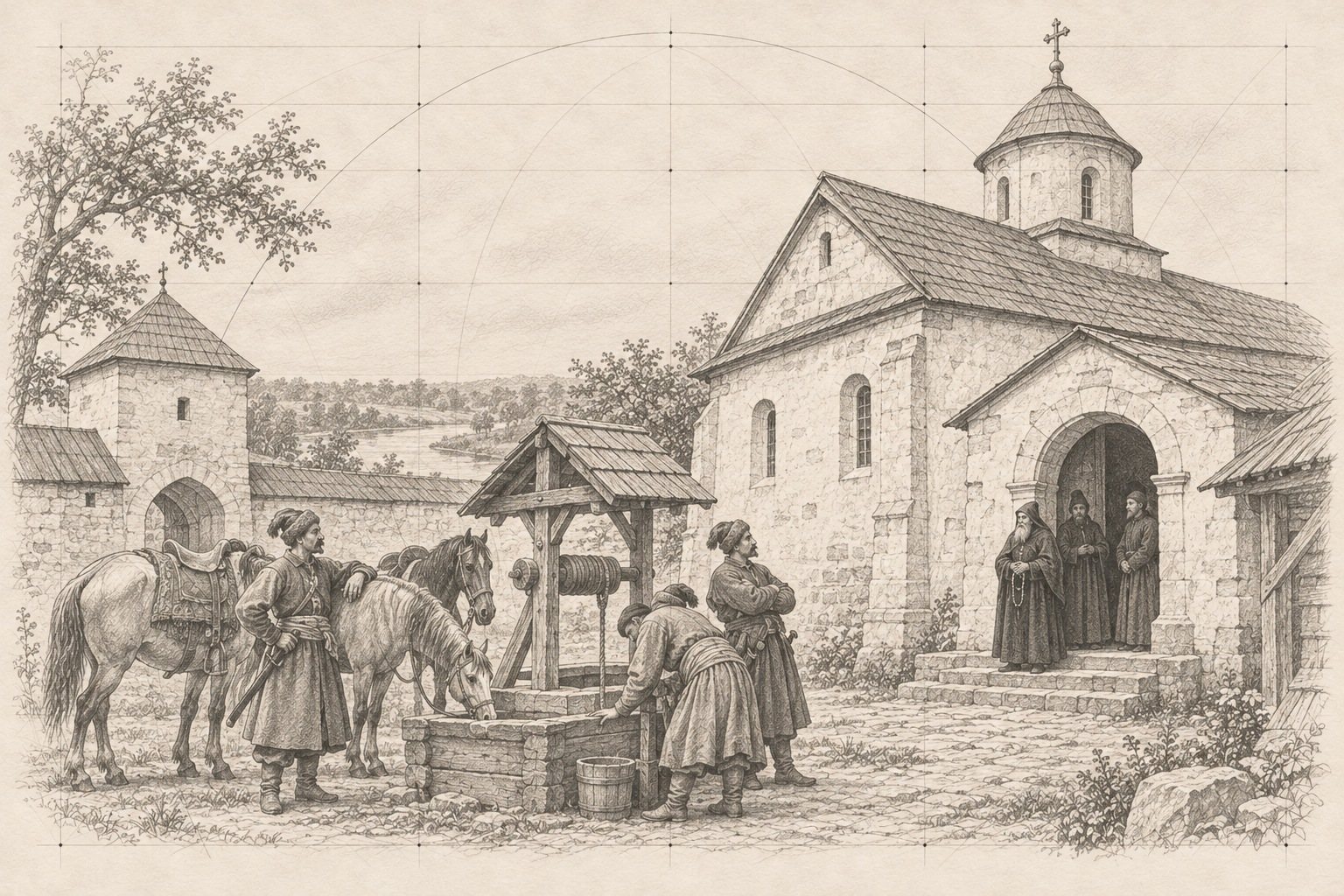
The year 1655: Cossacks in the monastery courtyard (conjectural reconstruction). Illustration: IKONASTONE - 1659
The Kholm icon was for a time kept in the monastery's underground vaults (the monastery's website); the Encyclopedia of the History of Ukraine says only "17th c.". [64, 70] 1662 — According to tradition, Yurii Khmelnytskyi lived in Zhydychyn under the name of the monk Hedeon; the Encyclopedia of the History of Ukraine regards this account as legendary. [64, 100]
- 1668
The monastery again becomes Basilian: "already in 1668 the monastery was returned to the Basilians". [7] 17th c. — The Church of the Holy Spirit is mentioned in documents of the 17th century; according to legend, it was later forgotten because "not far away a new, stone church had grown up". [69, 111]
- 1676
Yakiv Susha is archimandrite (according to Sushchuk and Maidanets). [50]
- Late 17th c.
The Basilians had up to 50 monasteries in two provinces (Ruthenian and Lithuanian); in Volyn, the abbeys of Zhydychyn, Pochaiv, Derman, Dorohobuzh and Meletsk (according to Batiushkov). [7]
The Baroque era and the Basilians
- 1703
Some reports and descriptions date the complex to "1703 – 19th c."; there is no confirmation by inscriptions. [110, 112]
- 1719–1723
According to the abstracts by O. Lesyk-Bondaruk (Lesya Ukrainka Volyn National University), Yosyf Levytskyi, "the newly appointed archimandrite", moved the monastery from the river floodplain to the high hill opposite and built a new Baroque complex: a church, a bell tower, a house of the bishops and archimandrites, a seminary, cells and outbuildings behind a masonry enclosure. These are abstracts without references to a document, so we present this as a version. [58] 1720s — Encyclopedia of the History of Ukraine: a two-storey bishop's house with a consistory, the bishop's apartments and cells; later a seminary and a two-tier bell tower. [64]
- 1723
The date in the moulded inscription on the tympanum of the west portal. According to the ESU, in this year Bishop Yosyf Levytskyi of Kholm built the church and the metropolitans' palace; according to "Istorychna Volyn" and the Volyn Eparchy, he rebuilt the church founded in 1594; the monastery's website describes a three-nave Baroque basilica. The guidebook of 1929 dates the church to 1726. The sources do not settle whether the church was rebuilt or built anew. [11, 61, 62, 69, 70, 107] The orb under the dome bore two inscriptions: on the foundation of the church in 1594 by Bishop Hedeon Balaban of Lviv and on the foundation in 1723 by Bishop Yosyf Levytskyi of Kholm; the eparchy's page writes that "for a long time 1723 was regarded as the date of birth". [69, 107]
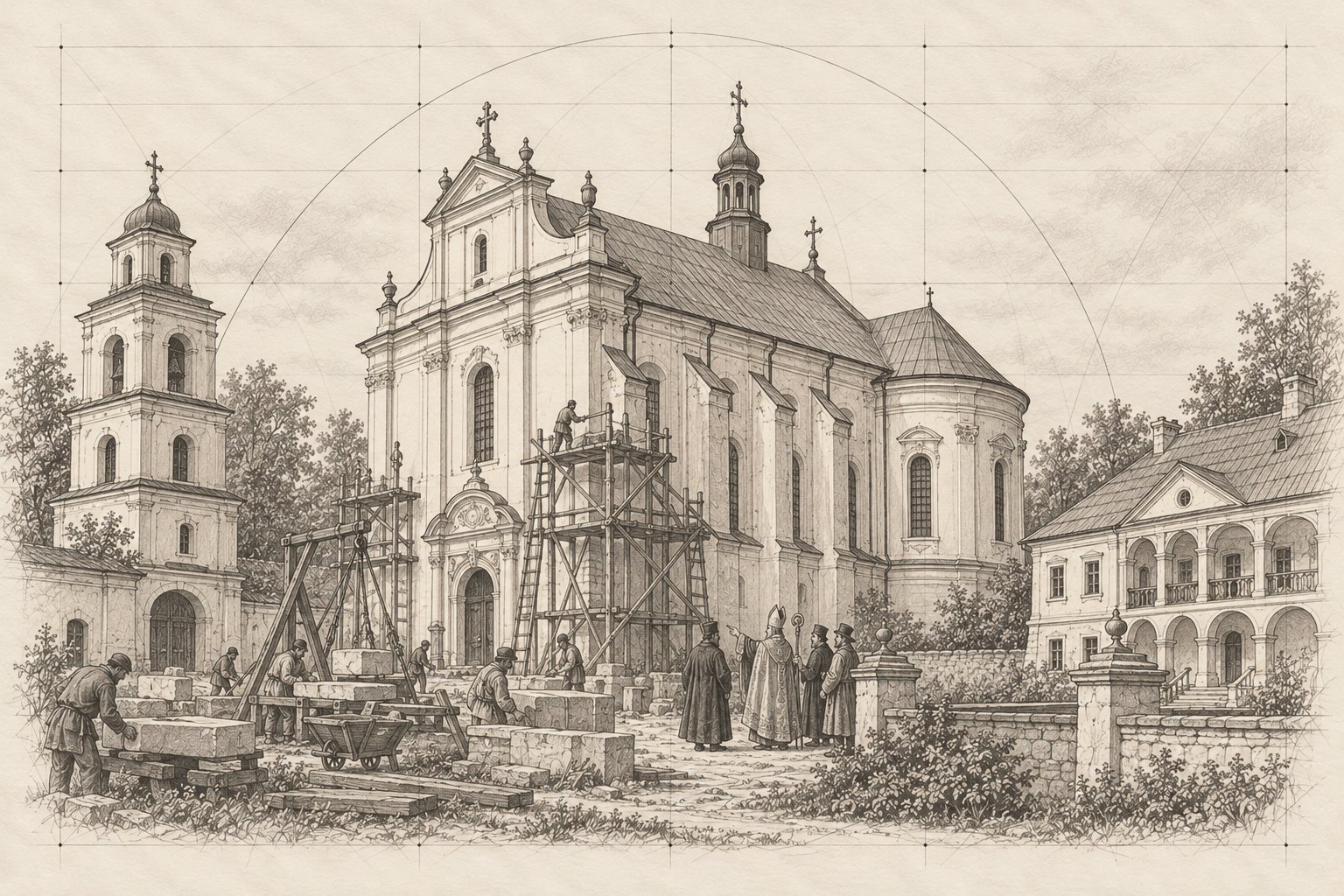
The year 1723: the building of the Baroque church. Illustration: IKONASTONE - 18th c.
The metropolitans' palace: the ESU and the Zhydychyn Center date it to 1723; the Zhydychyn Center specifies that it stands "on the site of the monastery's 16th-century refectory", while Zruchno.Travel gives "the late 18th century". [61, 77, 113] The great gate bell tower: the Zhydychyn Center and the Encyclopedia of the History of Ukraine call it two-tier (the lower tier is the gate); the 2024 survey describes it as three-tier. [64, 75, 92] According to ikona.ua, the monastery was enclosed with a high wall and mulberry trees were planted around it (according to one source). [103]
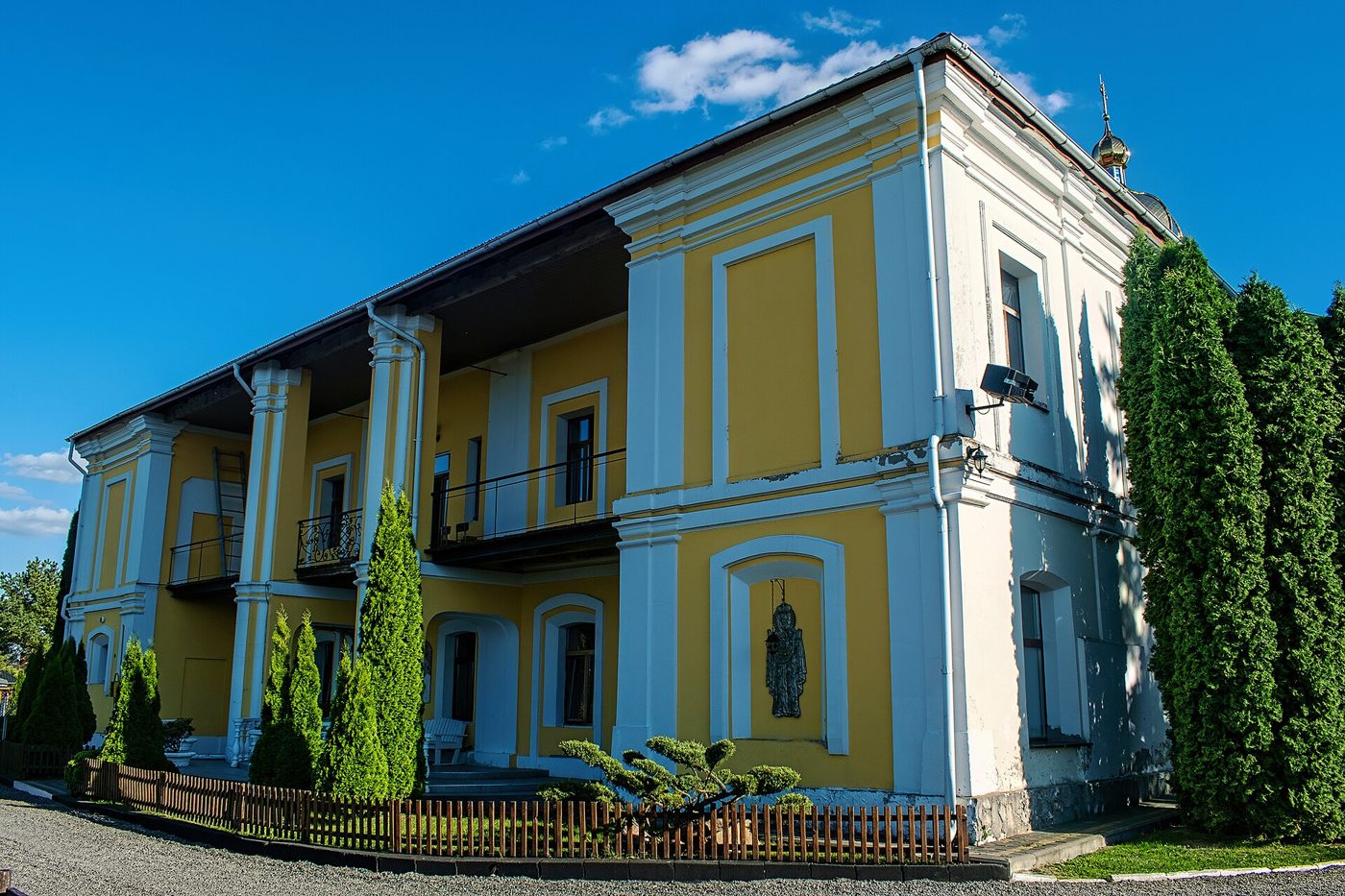
The palace (metropolitans' house) of the Zhydychyn Monastery, 2026. Photo: Vishchun, Wikimedia Commons, CC0 - 1736–1750
The monastery was in litigation with the Trinitarians of Lutsk. [50] 1739 — A statement to the Lutsk city court about violation of boundaries and felling of forest (TsDIAK, fond 2071, series 1, file 265). [37]
- 1740
The monastery's estates included, among others, Zhydychyn, Boholiuby, Nebizhka, Nezhel, Rokyni, Didovychi, Sopotovychi, Klepachiv, Ozertse, Omelianyky and Pidhaitsi (according to one source). [50] 1745 — The monastery was attached to the Lithuanian Basilian province. [57, 100]
- 1774–1778
Ihnatii Volodzko and Todosii Rostotskyi are archimandrites; in 1778 a royal decree in the case of Zmiievskyi against Abbot Volodzko. "Index nominum" (1928) confirms the name: "Żydyczyn, abbas v. Wołodźko Ignatius". [19, 50] 1775 — According to a report, the icon of St Nicholas that is now in the church was painted; it resembles the lost one. The Zhydychyn Center writes that the ancient image "of the 13th century" has not survived, and the present one is of the 18th century. [81, 96] 1778 — A collection of documents on the boundaries of the monastery's holdings is preserved (TsDIAK, fond 2071, series 1, file 25). [35]
- 1782–1811
"Archeion" (1935): "Od 1782 opat żydyczyński, od 1805 sufr. łucki z tyt. bpa ostrogskiego" ("from 1782 abbot of Zhydychyn, from 1805 suffragan of Lutsk with the title of bishop of Ostroh"; the name is not visible in the fragment; died 1811); the "Kalendarzyk Polityczny" of 1809 mentions the abbot of Zhydychyn in the chapter of the Ostroh bishopric. [18, 20]
- 6–15 October 1788
A chapter of the Lithuanian province of the Basilian order was held in the abbey monastery in Zhydychyn; it was presided over by the protoarchimandrite, the abbot of Zhydychyn Porfyrii Skarbek-Vazhynskyi, protector of the Volodymyr college. Some texts call it "general", but the primary record speaks of a provincial chapter. [5] 1788 — The chapter's agenda: numerous organisational and economic questions, including schooling; new governing bodies of the province were elected. [5]
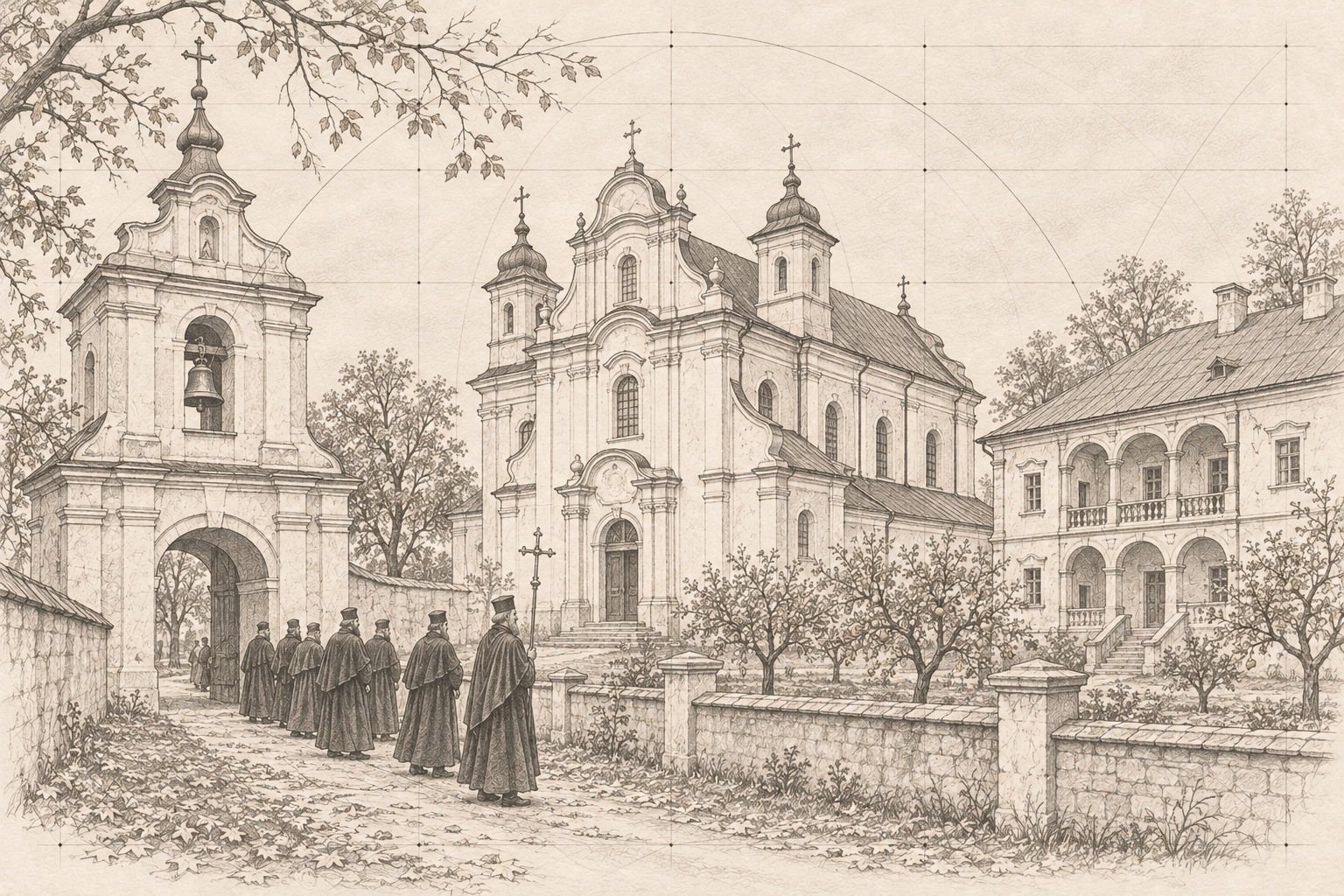
October 1788: the Basilian chapter at Zhydychyn (conjectural reconstruction). Illustration: IKONASTONE - 1789
On 17 January the Basilian superior general wrote a letter to the provincial, dated at Zhydychyn. [4] 1791–1792 — An ore-working smithy operated in Soltysy (blacksmith Grzegorz Kozłowski) (according to one source). [50]
- 1793
Archimandrite Benedykt Bakovetskyi (according to one source). [50]
The Empire, suppression and Pochaiv
- 1795
Drymba writes of a decree on the liquidation of the Basilians' centralised administration, after which within three years the monastery was handed to the Roman Catholics; "Konkurent" writes that Catherine II ordered the monastery to be closed. The Encyclopedia of the History of Ukraine does not mention this decree. [106, 108]
- 1797–1798
Trappist monks settled in the monastery: the year 1797 is given by Tsynkalovskyi, 1798 by the monastery's website; "Przegląd Kościelny" (1892) writes that Zhydychyn "was the capital of the Trappists in Poland". [21, 57, 70, 100]
- 1798–1799
The description of 1798 (O. Biriulina, 2007): Soltysy — 7 households and 42 persons, Didovychi — 13 households and 79 persons; the visitation of 1799 records 7 houses and 2 taverns in Didovychi — these are probably different types of source. [50, 58]
- Early 19th c.
The monastery's holdings counted 1,600 subjects (according to one source). [64]
- 1802–1835
The Zhydychyn abbey is the largest church landowner of the parish: the villages Żydyczyn, Bohoiuby (in the OCR scan; possibly Boholiuby), Jeziorko, Klepaczów, Nieboszczka, Rokinie, Sapohów, Żabka; the settlement Liplanki; four pitch works (żydyczyńska, klepaczowska, stepetycka, żeleżnicka). [8]
- 1826
The period when the monastery was the residence of the Uniate bishops ended; according to the eparchy's page, the archimandria was abolished by a tsarist decree, but the life of the monastery continued "until the early 1840s". [62, 69, 70]
- August 1827
Jan Damascen Krasowski, called in "Kuryer Litewski" "archbishop first of Polotsk, then of Lutsk, Greek Catholic", died in Zhydychyn, "in his residence"; the day of death is illegible in the scan (OCR gives "9.5"); he left a considerable estate. [6]
- 16 September 1827
An announcement "Given at Zhydychyn" signed by "Kyryl Serocinski, Uniate suffragan bishop of Lutsk": the heirs of the deceased are to appear with documents. The issue of the newspaper is dated 28 September 1827, Old Style. [6]
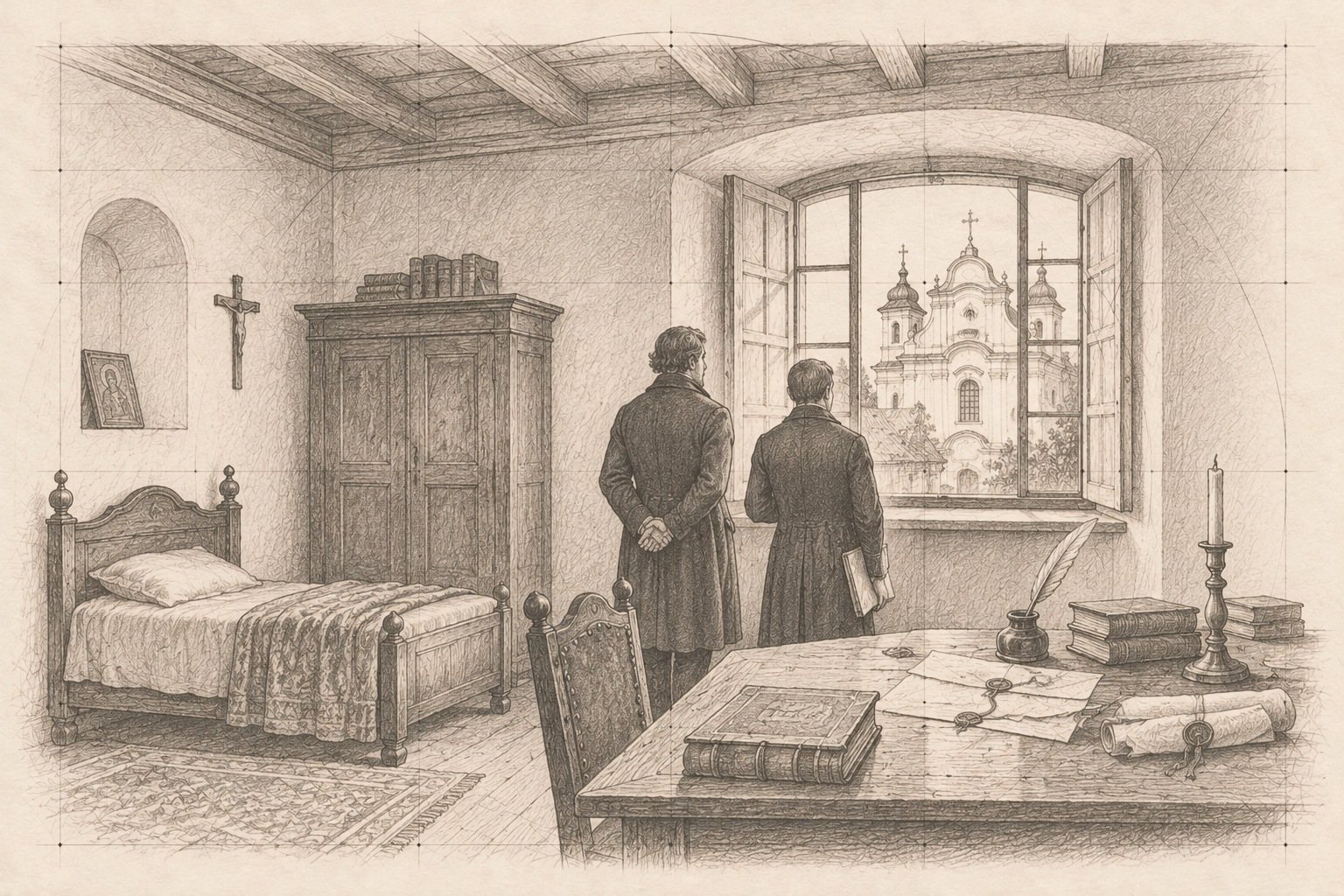
The year 1827: a room in the bishop's house (conjectural interior). Illustration: IKONASTONE - 1828
According to "Volynskie eparkhialnye vedomosti" of 1894 (no. 29), the Basilian monastery was closed, the church became Orthodox, and the buildings were handed over to the clerical department; the Encyclopedia of the History of Ukraine likewise writes of a closure in 1828 and a parish church. [3, 64]
- 1828–1833
According to "Istorychna Volyn", during the liquidation of the Uniate monastery the church was handed to the community and became a parish church, which saved it from destruction (according to one source). [107]
- 1829
According to "Ukraina Inkognita", the monastery was handed to the Roman Catholics (according to one source). [109]
- 1832
Suppression: the Polish guidebook of 1929 and Polish Wikipedia date the liquidation to 1832, and the buildings, according to Wikipedia, were again taken over by Orthodox monks. [11, 67]
- 1839
The monastery was closed and partly dismantled; services continued only in St Nicholas Church. The sources give the reason differently: the Encyclopedia of Ukraine — an order of Nicholas I, Konkurent and the ESU — a consequence of restrictions on the Basilians in the Russian Empire, a tourist publication — restrictions under Catherine II. [61, 62, 99, 101, 106]
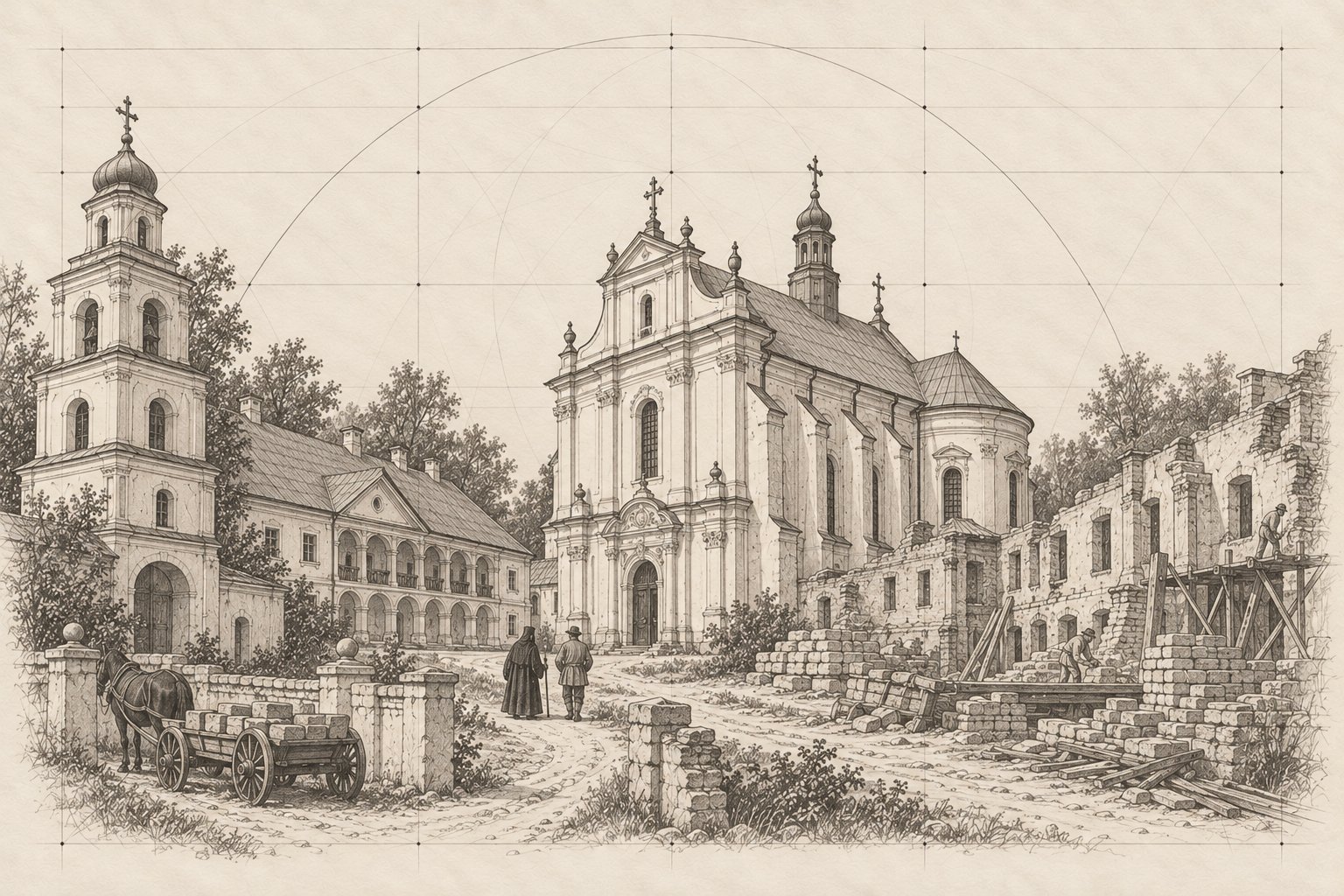
The year 1839: the closure of the monastery. Illustration: IKONASTONE - 1845
According to ikona.ua, the monastery was "finally closed" in 1845; St Nicholas Church was active, and its priests were Klyment Olenych, Roman and Fedir Tsybulskyi (according to one source). [103]
- 19th c.
The bricks from the dismantled monastery buildings were taken to Kivertsi: Konkurent, "Ridna Krayina" and the author of "Monitor Wołyński" link this with the construction of the railway station; a local account says that a "little school" (the former seminary) next to the monastery was dismantled. This is a tradition without a document. [99, 105, 106, 114]
- 1847
Parish registers of the Jews of Lutsk county, covering Lutsk, Kivertsi, Bakiv, Zhydychyn and Vyshenky (State Archive of Volyn Oblast, fond 96, series 1, files 7 and 8). [38, 39]
- 1865
According to "Volynskie eparkhialnye vedomosti" of 1894, the bishop's house needed a major overhaul already in 1865. [3]
- 1871–1872
The priest Roman Tsybulskyi opened a one-class folk school in Zhydychyn; the following year 56 boys studied there (according to one source). [103]
- 1872
The Synod resolved to hand the two-storey stone bishop's house to the clergy, but for lack of funds (estimate — up to 15,000 roubles) the decision was not carried out. [3]
- 1875
A family list of the peasants of the village of Zhydychyn was compiled (State Archive of Volyn Oblast, fond 3, series 1, file 10). [40]
- Late 19th c.
According to Tsynkalovskyi, Zhydychyn is a small town of the Rozhyshche volost: 86 houses, 687 inhabitants, a church, a school, two fairs a year. [57, 100]
- 1893
The monastery's archive passed to the Volyn Church Archaeological Repository. [115]
- 1894
On 9 September, Synod decree no. 3975 handed the buildings and two orchards to the Pochaiv Lavra: a bishop's residence with a house church; the lease of the orchards — 275 roubles a year. Archimandrite Filaret restored the orchard, and Archbishop Modest is repairing the palace. [3, 116]
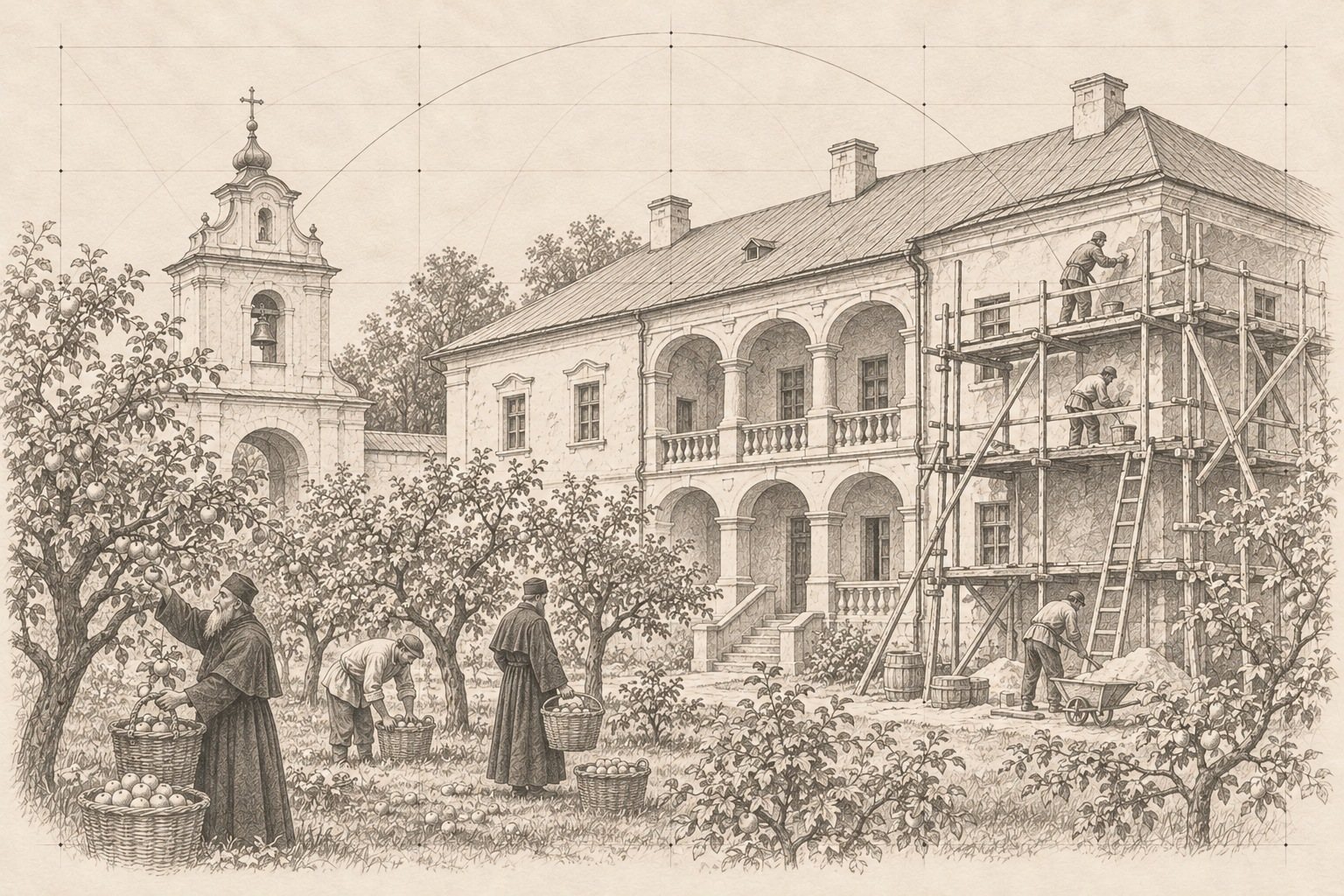
The 1890s: the orchard and the bishop's house (conjectural reconstruction). Illustration: IKONASTONE - 1894–1898
The parish register of St Nicholas Church in the village of Zhydychyn, Lutsk county, was kept (State Archive of Volyn Oblast, fond 35, series 9, file 56). [41]
- 1895
The orchard's harvest brought 500 roubles; this money went to restoring the palace (according to one source). [116]
- 1897
Archbishop Modest consecrated the house church of the Vilnius martyrs Anthony, John and Eustathius (the monastery's website); the eparchy's page says only that this happened "four years" after 1894, that is, in 1898. A safe wording is "the 1890s". [69, 70, 73]
- 1899–1905
Oleksandr Malevych publishes in "Volynskie eparkhialnye vedomosti" the series "The Ancient Zhydychyn Archimandria in Volyn": according to the annotation, the date of foundation is given as 1480, 1333–1370 or 1227, and "Zhydychyn already existed in 975" (about the village, not the monastery). We have not seen the text of the series itself. [10, 88]
- 1902–1908
The orchard was leased to Izer Vostiura for 400 roubles a year, and from 1908 for 830 roubles. [116]
- 1909
Fedir Tsybulskyi, son of Roman and a native of Zhydychyn, became priest of St Nicholas Church; the one-class school was turned into a one-class folk school (according to one source). [103]
- 1911
Census: 734 inhabitants, a one-class school, a credit association, a monastery (according to one source). [100]
- 21 April 1912
The Czech newspaper "Čech" quotes a Russian memorandum on the abolition of the Lutsk diocese: the suffragan (the priest Serochynskyi) "has a thousand roubles' annual salary from the revenues of the Zhydychyn monastery". The date of the memorandum itself is not given. [34]
- 1913
Restoration, painting and decoration of the church. [109]
War
- 1914
During the First World War the headquarters of the 11th Izium Regiment was housed in the complex (as given in the source: "of Emperor Heinrich of Prussia"; presumably the regiment of Prince Heinrich of Prussia is meant — the title in the source is inexact), later an orphanage. According to "Istorychna Volyn", the icons of the 18th century suffered in these years. [69, 101, 107, 114]
- 1914–1918
According to Drymba, Austrian soldiers were quartered in the church: the altar served as a bedroom, and the banners were used as foot-wraps (testimony of the priest F. Tsybulskyi). Photographs of the interior and the village of 1917–1918 were found by T. Yatsechko. [108, 112] The wonder-working icon of St Nicholas was, according to reports, evacuated to Zhytomyr, and from there it disappeared. [108, 110]
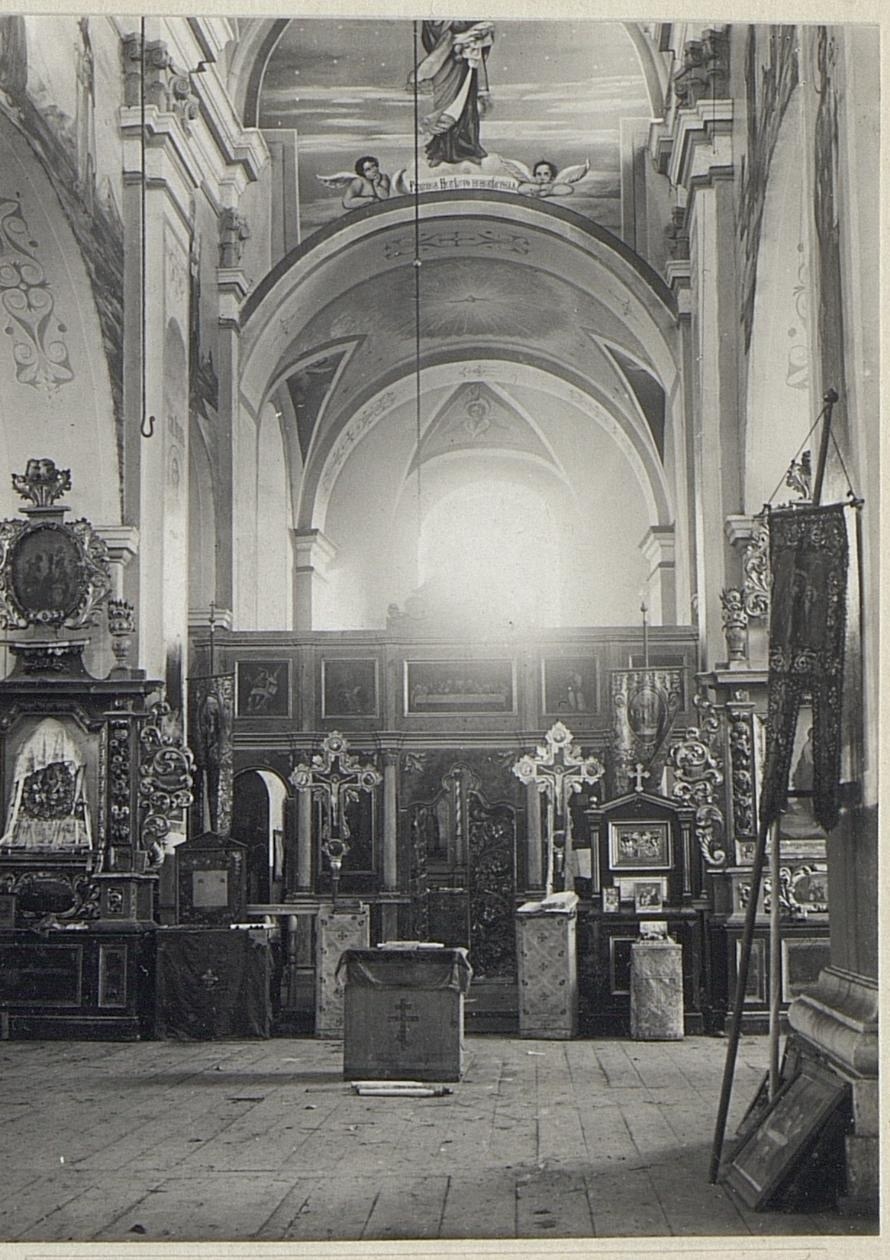
The interior of the church in Zhydychyn, photograph of the Austro-Hungarian army, 1914–1918. Wikimedia Commons, public domain - 30–31 August 1915
Fighting near Zhydychyn (Zydyczyn): Austro-Hungarian infantrymen from Upper Austria (Salzkammergut, Innviertel); Austrian newspapers of November 1915 – February 1916 reported on the fallen "bei Zydyczyn" ("near Zydyczyn"). The regiment is not named in every report (for IR 59 see below). In some OCR fragments the year is read as 1914 or 1916. [28, 29, 30, 31, 33]
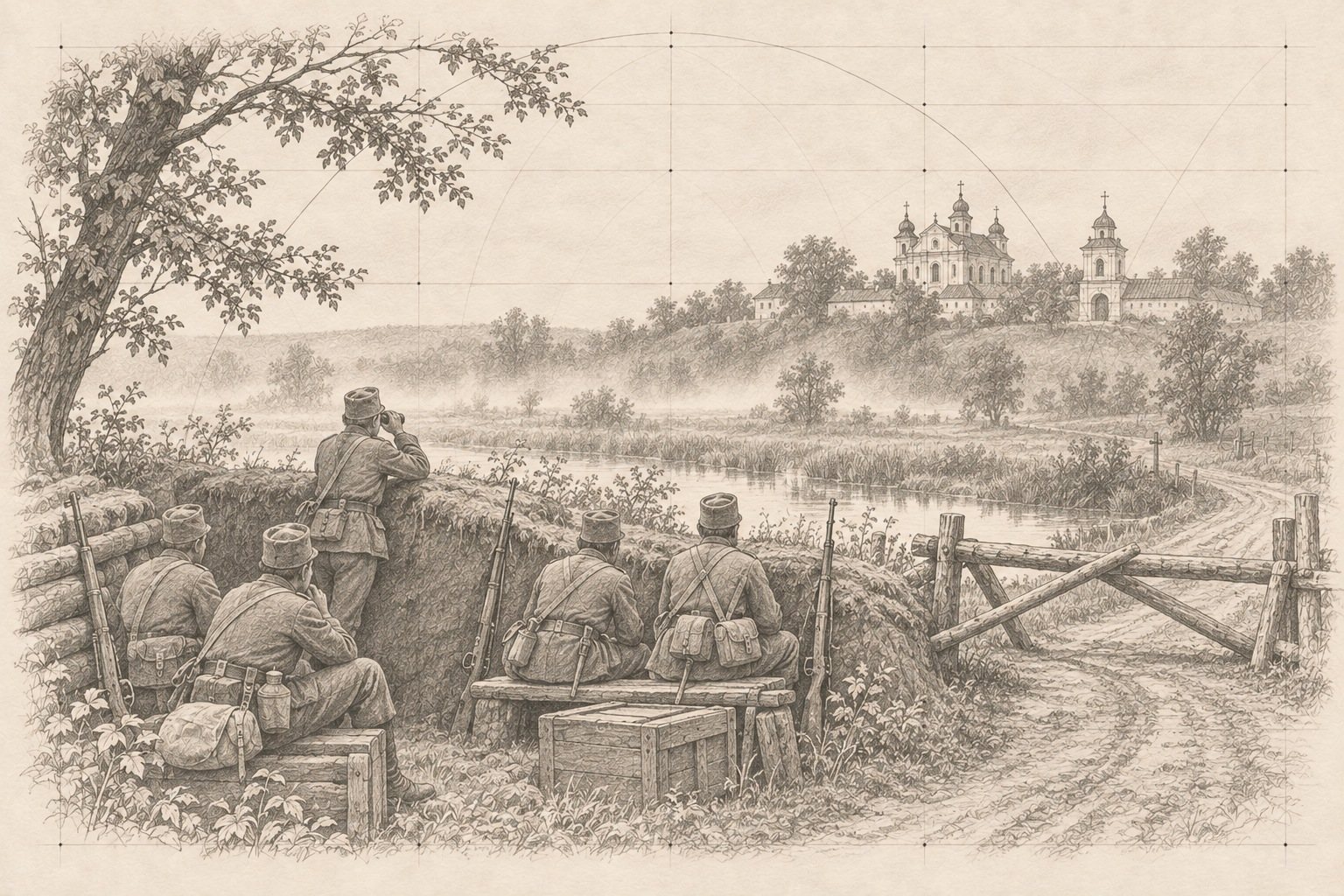
Summer 1915: positions above the Styr (conjectural reconstruction). Illustration: IKONASTONE - Autumn 1915 – January 1916
"Neue Warte am Inn" (Braunau) of 21.11.1915 (p. 4) reports: the brothers Johann and Matthias Eder from St. Konrad, sons from the Hochleiten farm, served in k.u.k. Infanterieregiment Nr. 59 and both fell on 31.08.1915 "bei einem Gefechte in Zydyczyn in Rußland" ("in an engagement at Zydyczyn in Russia"). The issue of 30.01.1916 (p. 4) reports that Franz Stadler of Fraunsdorf (parish of Ohlsdorf), a farmer's son, fell on 30.08.1915 "bei Zydyczyn" in his 28th year; the regiment is not given in the line. [28, 30] "Neue Warte am Inn" (12.12.1915) and "Salzkammergut-Zeitung" (05.12.1915) report the death on 31.08.1915 "bei Zydyczyn" of Karl Thanner of Gschwandt. [29, 31] The page of the "Salzkammergut-Zeitung" dated in ANNO 14.11.1915 contains a similar entry about the Eder brothers, but in its OCR the regiment is "Nr. 69" and the year "1916", and it mentions events of 1916; so the date of this issue is doubtful, and we do not rely on it. [32]
- 1915–1916
According to the "Innviertler Volkszeitung" (25.02.1916), Karl Schernhammer of Altheim, 20 years old, received a bullet in the head on 30 August "north of Lutsk, near Zhydychyn" and was buried in Zhydychyn "the next day"; the year is read in the OCR as 1914, from the context it is most likely 1915 (estimate). [33] Austrian photographers of the Kriegspressequartier photographed positions above the Styr, a road barrier, a tree by the Lutsk–Zhydychyn road and the church in Zhydychyn (whether this is the monastery church needs to be checked). [42, 43, 45, 46]
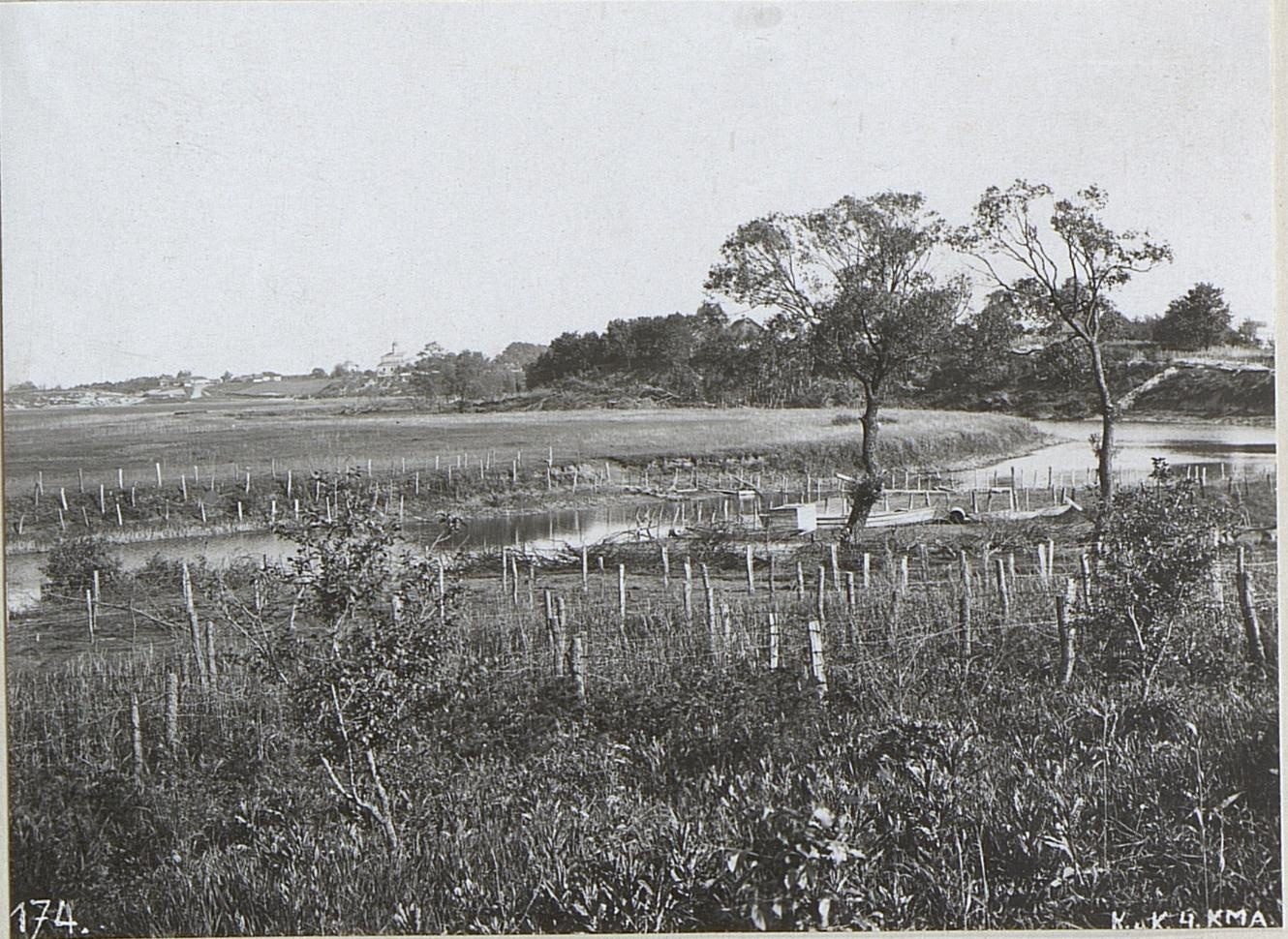
Positions on the Styr near Zhydychyn, photograph by the K.u.k. Kriegspressequartier, 1915–1916. Wikimedia Commons, public domain 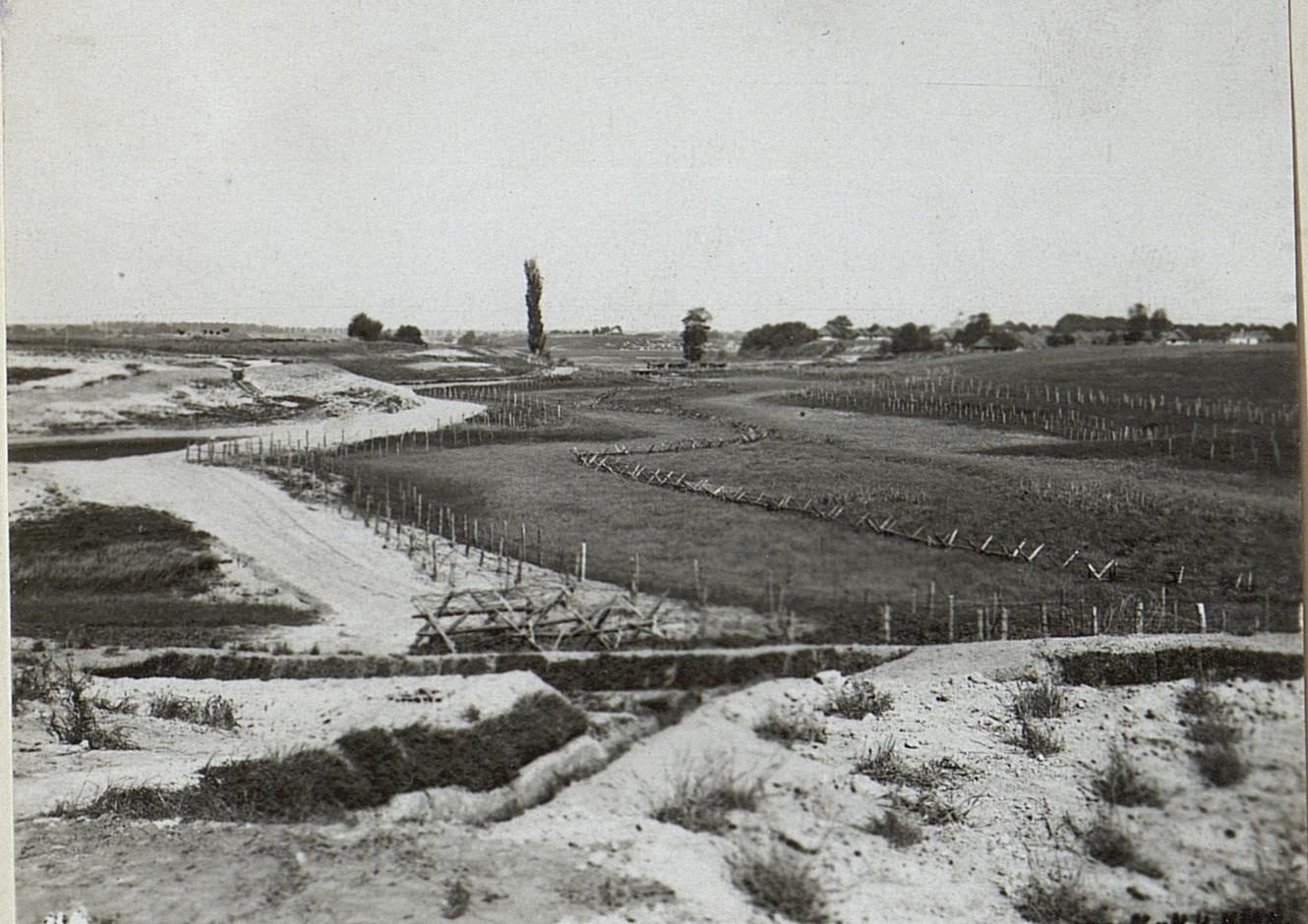
An infantry position in the marsh near Zhydychyn, photograph by the K.u.k. Kriegspressequartier, 1915–1916. Wikimedia Commons, public domain - 1916
The photograph "Infantry position in the marsh and mounted riders near Zhydychyn"; the date of the record in the archive (01.01.1916) is most likely conventional. [44]
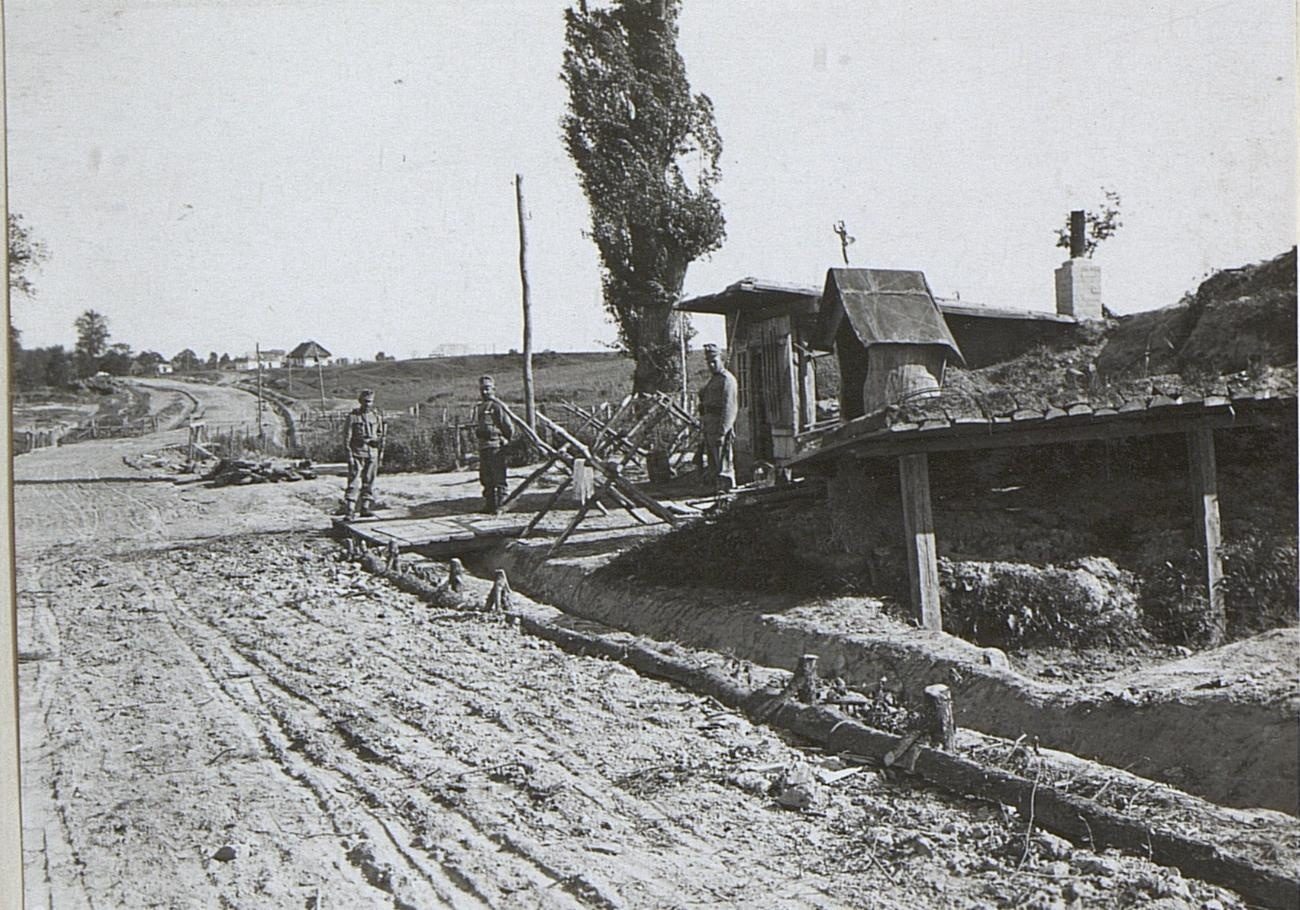
A barrier on the road in Zhydychyn, photograph by the K.u.k. Kriegspressequartier, 1915–1916. Wikimedia Commons, public domain 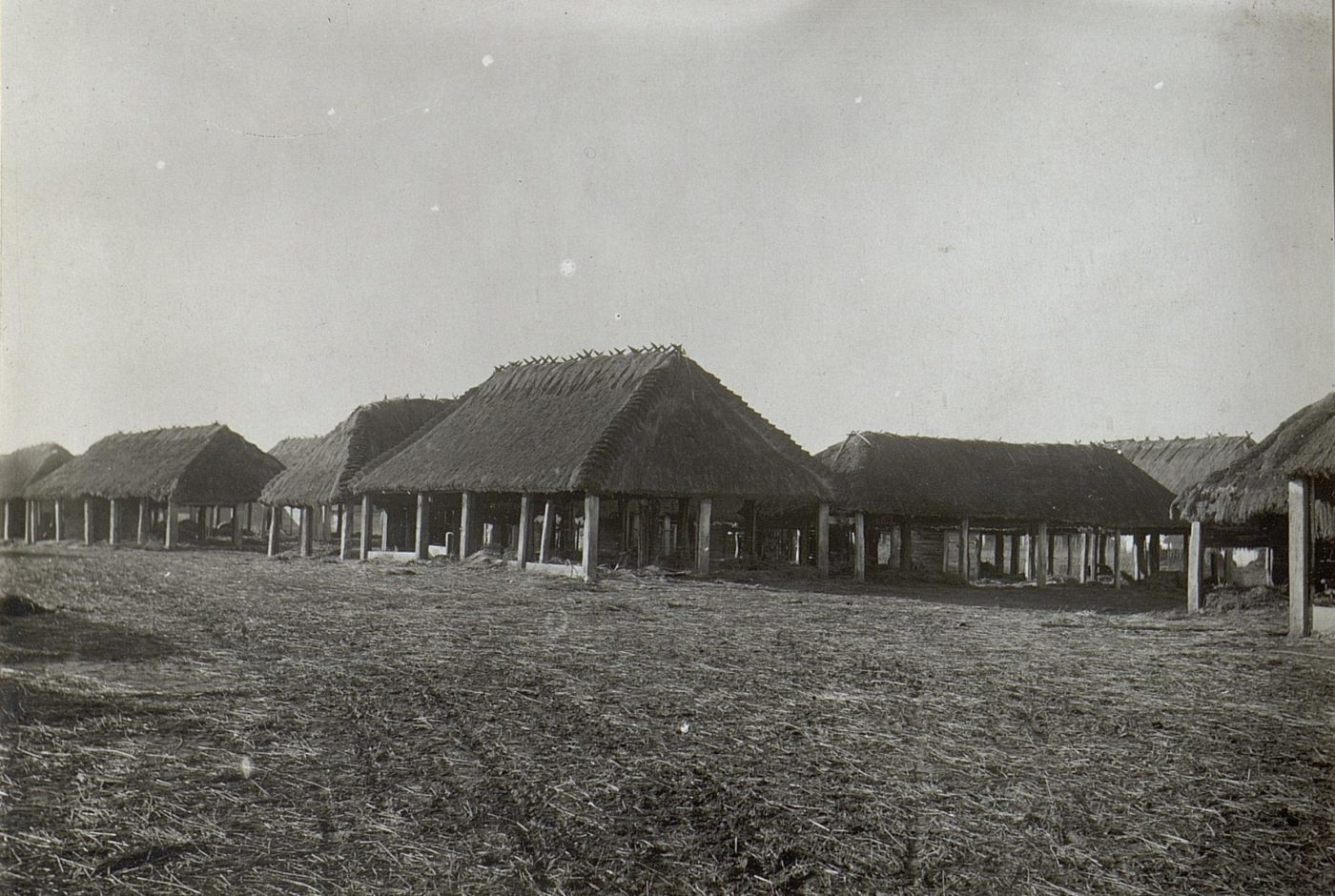
Outbuildings in Zhydychyn, photograph by the K.u.k. Kriegspressequartier, 1915–1916. Wikimedia Commons, public domain - December 1917
According to a note in the "History of Towns and Villages of the Ukrainian SSR", Soviet power was established in the village (according to one source). [100]
The Polish period and the Second World War
- 1921
A shelter for the disabled and orphans with instruction in Ukrainian operates in the palace (witness — Senator Olena Levchanivska); the eparchy's page calls it the only welfare institution in Volyn with teaching in Ukrainian. "Głos Wołyński" (12.11.1921) mentions "ochrony w Żydyczynie i Rożyszczach" ("shelters in Zhydychyn and Rozhyshche"). [26, 69, 108, 117]
- 3–10 October 1921
A congress of clergy and laity in Pochaiv: the first point of the resolution is to restore the Lutsk episcopal see, which was to be maintained from the revenues of the estates of the former Zhydychyn archimandria. [59]
- 1925
"Życie Wołynia": on 24 May an "ochronka" (nursery) in Zhydychyn is mentioned (activist Ivan Bondaruk); on 30 August — a survey of "ludność ruską w Żydyczynie" ("the Ruthenian population in Zhydychyn") on services in the Ruthenian language. [24, 25]
- 1929
"Ilustrowany przewodnik po Wołyniu" calls the monastery "the richest in Volyn" (10 villages), dates the church to 1726 and the liquidation to 1832; "Wołyński Dziennik Wojewódzki" (1929, no. 12, item 155) records "the bell tower of the former Basilian church (kościół)" in the style of "pseudo-gotyk" ("pseudo-Gothic"). [11, 17]
- 1930
"Samorząd" (7 September) mentions a "schronisko" (shelter) run by the district council in Zhydychyn (according to one source). [27]
- 1933
"Biuletyn Polsko-Ukraiński" (9 July) writes of a dispute over the estate of Żydyczyn near Lutsk (according to one source). [23]
- 1934
"Biuletyn Polsko-Ukraiński" (19 August): Polikarp of Lutsk is in Zhydychyn for the final check of the Ukrainian (translation) (according to one source). [22]
- Early 1930s – 1936
The residence of Polikarp (Sikorskyi); the commission for translating the Holy Scripture into Ukrainian worked in Zhydychyn: the monastery's website gives 1935, the eparchy 1936, other materials "the 1930s". [61, 64, 69, 70]
- 1938
In spring the OUN sub-district no. 6 "Zhydychyn" is active; arrests fall at the end of 1938 and the beginning of 1939. [100, 114]
- 1939
The bells were removed from the church (according to a local woman, as recorded by the district newspaper); during the war years the complex was used as a shelter for children, maintained by local residents. The Lutsk Tourism website writes that the church was never closed. [69, 93, 101, 114]
- 1941–1944
German occupation; according to a recollection, in 1942 a shell hit the church and did not pierce the wall. [100, 114]
- Soviet period
The crypt under the church was forgotten: according to various texts, it was filled in, damaged or concreted over; the upper burials were disturbed. The sources do not allow this to be attributed to any particular denomination. [70, 118, 119]
The Soviet years
- 1947
The bells, according to a local woman, were hung back. [114] A village school began to work in the palace (until 1990). [69, 99]
- 1954
Repairs in the church: the walls were plastered, the panels painted; the moulded inscription "RB 1723" on the portal was restored (according to one source). [107]
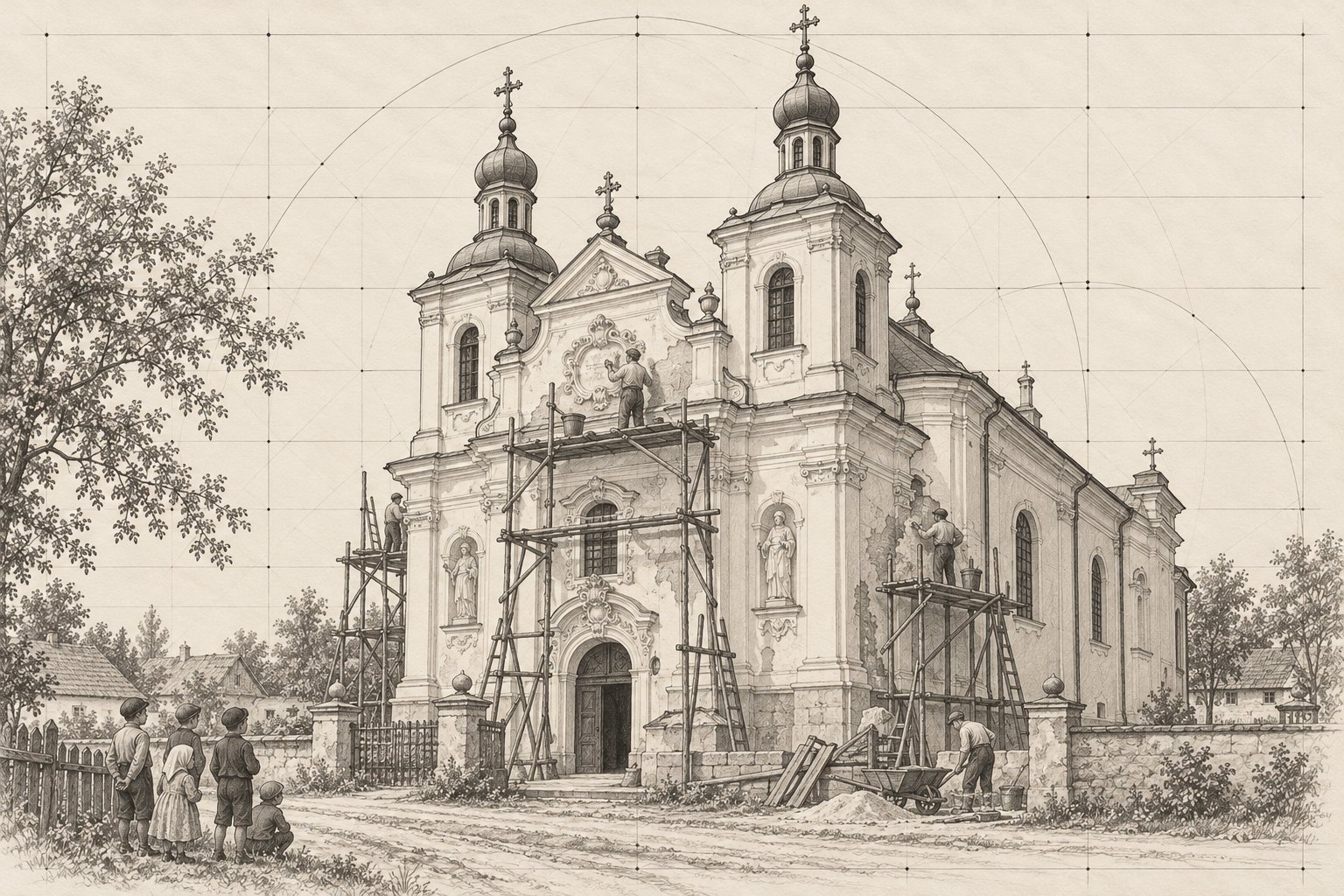
The year 1954: repairs to the church. Illustration: IKONASTONE - 6 September 1979
Resolution of the Council of Ministers of the Ukrainian SSR no. 442 includes the "Bell tower of the 18th c." in the list of monuments of urban planning and architecture under protection. [95]
- 1982
During repairs the orb with two inscriptions was removed from the dome: on the foundation of the church in 1594 by Bishop Hedeon Balaban and in 1723 by Bishop Yosyf Levytskyi. [69, 107]
- 1990
The school moved out, and the palace fell into decay again. [69, 99]
Revival
- 1999
State Register of Immovable Monuments (draft), "Pamiatky Ukrainy" 1999, no. 2–3: bell tower of the 18th century. [95]
- Early 2000s
Restoration of the palace was begun by the UOC-KP; the author of "Monitor Wołyński" then saw a "paradox": the palace belonged to the KP, while the church and bell tower belonged to the MP, and a fence divided the confessions. [99]
- 2003
On 23 July the Holy Synod of the Kyiv Patriarchate renewed the monastery's activity; the first abbot was Hieromonk Mark (Leviv). The first monks were Mark, Iov, Mykolai and Sviatopolk. [69, 85, 105, 117] A cell building of the monastery with a house church of St Mykola Sviatosha was established in the palace; the consecration of the house church — 19 February 2005 — is a different event. [70, 77]
- 24 November 2005
The brotherhood for the first time performed a new Ukrainian-language rhymed akathist to the Mother of God of Kholm. [69]
- 2007
Kostiantyn (Marchenko) moved to the monastery in May; the collection "Zhydychyn Through the Ages", no. 3, and the book by I. Maidanets and H. Marchuk "Figures of the Zhydychyn Archimandria" were published; no. 1 of "Mykolaivski chytannia" is dated 2007. [56, 58, 120]
- 2008
Mark was transferred to Kyiv; Kostiantyn (Marchenko) became abbot. [102]
- 14 October 2010
The Holy Spirit Skete was consecrated (Feast of the Protection, Archbishop Mykhail of the UOC-KP). The eparchy's page writes that the skete was "built in 2011" — this is a discrepancy in dates. [69, 72, 121]
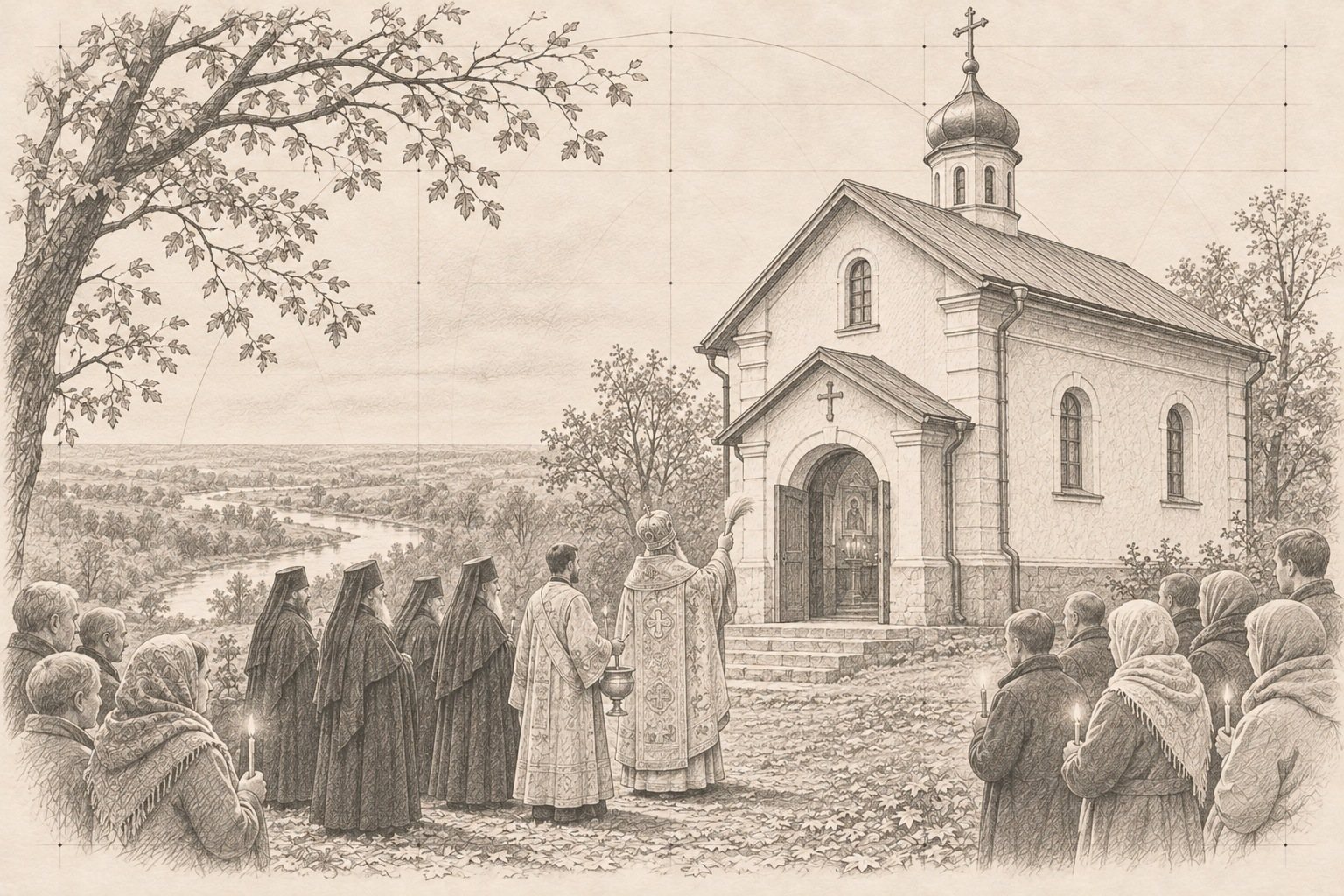
14 October 2010: the consecration of the skete (conjectural reconstruction). Illustration: IKONASTONE - 2011
The "Life-Giving Spring" skete was founded between Zhydychyn and Lyplyany; on 14 October a cross and the site of the rebuilding of the Resurrection Cathedral were consecrated. [60, 69, 79]
- 2003–2015
Restoration continued; a bakery was built. [69]
- 2012–2023
Construction of the Resurrection Church (the lower church is the Dormition Church); work resumed in spring 2023. [71, 122]
- 2014
On the Skudelnychi hillfort a kiln was found (over 2 m, 14th–15th c.); the lower walls of the Resurrection Church were laid. [76, 120]
- 2015
The Sts Peter and Paul women's skete in Lyplyany: in October the site was consecrated, in December a wooden church. [72, 83]
- 2016
The monastery's status as an archimandria was restored; it has about 15 monks. On 23 May Archimandrite Kostiantyn consecrated the administrative services centre in Zhydychyn. [59, 85, 89]
- 2017
On 22 May the bas-relief of King Danylo was unveiled (for the 790th anniversary of the first mention); on 3 September — the Jerusalem matins; on 11 December the bell tower and bells were consecrated; in December — the Small Bell Tower over the well. [74, 90, 123]
- 21 February 2018
Presentation of the project "The Zhydychyn Lavra – a Forgotten History"; those present included the rectors of the Volyn Professional Pedagogical Academy and of Lutsk National Technical University, and the head of the Zhydychyn amalgamated territorial community. [84, 124]
- February 2019
The community of St Nicholas Church joined the Orthodox Church of Ukraine; Polish Wikipedia writes "from 2018". [67, 106, 125, 126]
- 23 February 2019
At about 3:30 a.m. a shooting took place near St Nicholas Church; the police opened a criminal case under Article 129 of the Criminal Code (threat of murder). We do not give details or the assessments of the parties. [127, 128, 129]
- 25 August 2019
An information and tourist centre, the "Zhydychyn Center", was opened at the monastery; the initiator was the abbot Kostiantyn Marchenko, with about UAH 300,000 invested. [91, 101]
- 26 December 2019 – 15 February 2020
During the laying of a floor in St Nicholas Church, a drill fell into a void; an underground crypt with burials on several levels was opened. The underground was cleared for two weeks and several tonnes of rubbish were taken out; the crypt was opened to visitors before Candlemas 2020. [114, 118, 119]
- 18 February 2020
"Suspilne" reported the find; the local historian Petro Tronevych recalled similar crypts in Myltsi and Ivanivka. [119]
- 2020
According to "Monitor Wołyński", ten monks live at the monastery, restoration of the palace continues, and the Holy Spirit Skete has been restored. For three months of lockdown the brotherhood drove medical workers around. [99, 130]
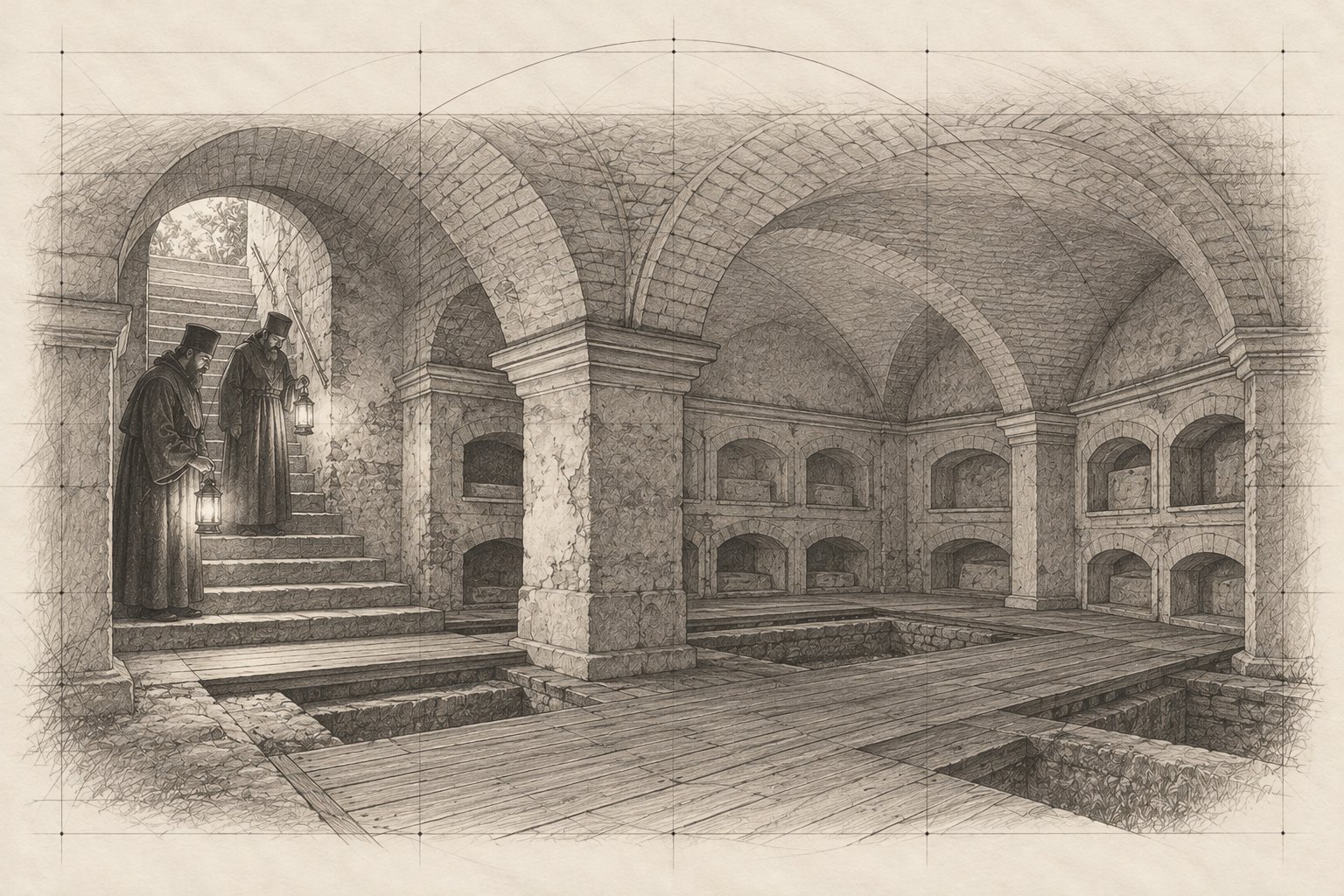
2019–2020: the exploration of the crypt. Illustration: IKONASTONE - 6 November 2020
The brotherhood wants to restore a wooden cemetery chapel. [131]
- 2021
About 55 tours, more than 1,100 visitors. [132]
- 29 March 2021
A meeting at the Zhydychyn Center on archaeological work on the foundations of the former cell building at the entrance to the monastery. [87]
- 2022
From 24 February the crypt became a shelter for more than 20 residents; in the Great Bell Tower the "Isykhiia" centre was opened. Ground-penetrating radar revealed voids and remains of structures under the hill. [75, 101, 133, 134]
- 2023
On 23 July the 20th anniversary of the revival was marked; in April the project won at the European Heritage Days; on 10 September a mobile exhibition "The Grand History of Ancient Zhydychyn" took place; the Sts Peter and Paul bell tower memorial was opened; a volunteer fire brigade was created at the monastery. [88, 117, 134, 135, 136] H. Okhrimenko and S. Lokaichuk published preliminary information on Old Rus' Zhydychyn and the St Nicholas Monastery (collection "Monuments of the Princely Era", Lutsk, pp. 17–26). [55]
- 19 April 2024
The complex of monuments of the St Nicholas Monastery (church, bell tower, metropolitan's house) was entered in the State Register of Immovable Monuments by Order of the Ministry of Culture no. 295; at the same time the Zhydychyn hillfort with a cultural layer of the 11th–13th centuries was identified (according to one source). [92]
- 23 December 2024
A new stone altar table was consecrated. [137]
- 2024–2025
Archaeologists of the I. Krypiakevych Institute of Ukrainian Studies, Uzhhorod University and Lviv Polytechnic, under the project "Between East and West", study burial monuments of the 11th–18th centuries: under the floor of the prayer hall there are four crypts, and one more chamber under the altar. [138]
- 16 July 2025
Vira Hupalo and Iryna Lutsyk completed the professional description of the finds. [139]
- 8–9 May 2025
Metropolitan Epiphanius for the first time led the liturgy at the monastery; "1050 years" since 975 were marked — according to the monastery's own tradition. [140]
- 2025
The riverside eco-cultural space "PryStan" was opened; on 18 August an "invincibility point" operates at the monastery with charity fairs in aid of the military. [141, 142]
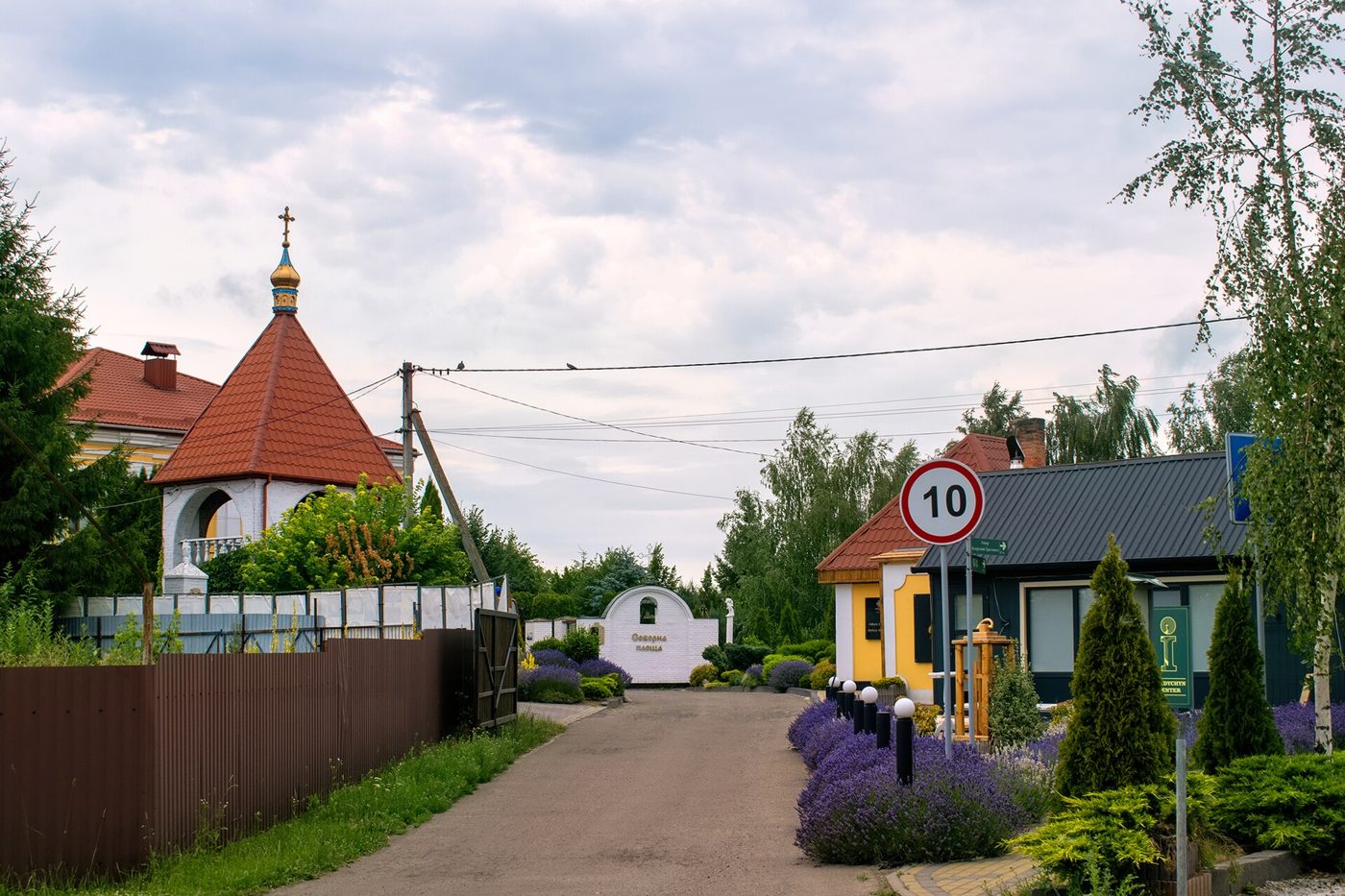
The entrance to the Zhydychyn Monastery, 2026. Photo: Vishchun, Wikimedia Commons, CC0 - 21 June 2026
The monastery is Ukraine's only representative in a European programme (Peer-Learning Visit in Rotterdam). [143]
Lost and recreated
| What | What there was | What happened | Where it is now |
|---|---|---|---|
| Wooden church | Stood beside the masonry one until 1585 | Plundered, roof collapsed | Not preserved; its later fate is not described in the sources [47] |
| Masonry church before 1723 | Existed in 1585 beside the wooden one; according to the monastery’s website, since 1517 | Whether it was rebuilt in 1723, built anew, or the monastery was moved to the hill (the version in the Volyn National University abstracts) is an open question | A Baroque church stands on its site or beside it [47, 58, 70, 107] |
| Orb under the dome with inscriptions of 1594 and 1723 | On the church dome | Removed during repairs in 1982 | Place of storage not stated in the sources [69, 107] |
| Moulded inscription “RB 1723” and the west portal | On the tympanum of the portal | According to “Istorychna Volyn”, the original portal was destroyed during the Second World War, and the inscription was restored in 1954 | On the portal [107] |
| Ancient image of St Nicholas | A venerated icon; dated from the 12th to the 17th century; according to the monastery’s website, it was preserved until 1914 | According to reports, in 1914–1918 it was evacuated to Zhytomyr and disappeared | In the church — an image that a report dates to 1775 (“similar to the lost one”) [70, 81, 96, 108, 110] |
| Kholm icon of the Mother of God | For a time in the monastery (1659 or the 17th century); Yakiv Susha described its miracles in 1644 | In 1996 transferred to the Museum of Volyn Icon | Museum of Volyn Icon [64, 70, 108, 110] |
| Metropolitans’ palace | A two-storey house with a consistory, the bishop’s apartments and cells | In 1947–1990 a school was in it; after the school moved out, the building fell into decay | Restoration by the brotherhood; cell building, house churches [64, 69, 73, 99] |
| Buildings, seminary (“little school”) | Monastery buildings of the 18th century | Dismantled after the closure; the bricks went to Kivertsi (according to tradition, for the railway station) | Not preserved; the church, bell tower and palace survive [92, 105, 106, 114] |
| Cell building at the entrance | A building on the monastery grounds | Lost | The foundations survive; in 2021 archaeological work was discussed [87] |
| Church of the Holy Spirit and the women’s community | An Orthodox women’s community at the Church of the Holy Spirit | The community was dissolved in 1621; the church, according to legend, collapsed, and the bells fell into the Styr | The Holy Spirit Skete on the hill (consecrated 2010); the link with 1621 is not proven [48, 69, 111, 121] |
| Villages of the monastery’s estates | Sopotovychi, Vasylky, Soltysy | Sopotovychi disappeared in the 18th century | The name “Soltysy” lives on as a micro-toponym in the village of Konopelka [50] |
| Crypt under the church | Burial vault of the clergy and founders | Forgotten; the upper burials were disturbed, bones were thrown about | Rediscovered at the end of 2019; surviving remains were reburied by the cross, deeper burials were covered with a wooden deck [114, 118, 119] |
| Burial coverings and scapulars of the 17th–18th centuries | In the burials | Preserved in the soil of the crypt | Need conservation and restoration [138] |
| Monastery archive | Rich; in 1893 it passed to the Volyn Church Archaeological Repository | Dispersed | Partly in Moscow and Lviv collections [115, 144] |
| Monastery orchard | A regular orchard of about 3 desiatinas; restored in 1894–1908 | Decline until 1894, then lease and restoration | Being restored, modern apple orchards have been planted [116, 145] |
Architecture
The church is a three-nave four-pillar basilica with a semicircular apse, entered from the west. This is how both “Istorychna Volyn” and Wikipedia describe it. A two-storey volume is attached on the south side. The style is Baroque.
Below, two elements of the church in more detail.
The portal with a segmental pediment
The central entrance is framed by a portal with a segmental pediment — an arched one, without the sharp angle of a triangular one. On the tympanum there is a moulded inscription with a date and a moulded coat of arms. The segmental pediment is a favourite device of the Baroque: it closes the composition with a soft arc and does not argue with the semicircular arches inside. We should remember only that the present inscription “RB 1723” is a reconstruction of 1954.
Vaulting on transverse arches
The nave is covered with groin vaults on transverse arches. A transverse arch is a rib thrown between the pillars across the nave: it divides the space into bays and takes part of the load of the vault. The four pillars on which the arches rest define the “four-pillar” scheme of the basilica. The windows of the central nave are rectangular, with triangular pediments — small cornices like canopies above the openings.
The gate bell tower
The bell tower over the entrance is two-tier: the lower tier is the monastery’s ceremonial gate, the upper one the bell tower proper. Wikipedia calls it a characteristic monument of Ukrainian Baroque of the early 18th century which, unlike many similar ones, did not undergo later rebuilding. The resolution of 1979 that entered the bell tower in the list of monuments dates it to the 18th century. Nearby, remains of the defensive rampart that surrounded the monastery survive.
The iconostasis and icons
The church’s iconostasis is of 1862, while the royal doors are older, of the early 18th century. “Istorychna Volyn” describes their carving: an acanthus stem, rosettes, a small column with a mitre and a cross. The icons of the iconostasis were painted in 1941 by the artist Stetsiuk after sketches by Ivan Izhakevych. The church has Baroque wall altars of the early 18th century — multi-tier carved decorative walls — and two icons of the 17th century in the Kyivan tradition: “Christ Pantocrator” and “Mother of God Hodegetria”, the latter in a silver-gilt oklad with the coat of arms of its patron.
The Encyclopedia of Modern Ukraine mentions among the shrines an icon of St Nicholas of the 15th century and an apostles’ tier of the 17th century.
The bishop’s house
Next to the church stands the bishop’s house — in Wikipedia the “metropolitans’ palace”, in the resolution of 1979 the “metropolitan’s house” of 1723. After the monastery was closed it stood half in ruins; later, according to Wikipedia, it was restored and a house church was arranged in it. The church, the bell tower and the palace together form an ensemble of the 18th century in which all three main volumes survive.
Stone and material
The sources describe the church as masonry but do not specify the material of the walls. It is known that later, in 1954, it was plastered. So the present surface is a 20th-century layer over 18th-century masonry (or, possibly, an older one).
What is worth seeing
- The west portal with a segmental pediment, a coat of arms and a date.
- The gate bell tower — a gate and a bell tower in one structure.
- The royal doors of the early 18th century with acanthus and rosettes.
- The bishop’s house (the metropolitans’ palace) next to the church.
- Remains of the rampart by the bell tower.
From Zhydychyn to Lutsk is a few kilometres; together with the Intercession Church and the Holy Trinity Cathedral it makes a good route through Volyn Baroque and what preceded it. And the four pillars of the basilica are a reason to recall how columns and pilasters work in a church.
Did you know
The "Kuryer Litewski" of 28 September 1827 printed an announcement with the note "Dan w Żydyczynie dnia 16 septembra 1827 roku" ("Given at Zhydychyn on 16 September 1827"), signed by the Uniate suffragan bishop of Lutsk Kyryl Serocinski: the heirs of the late Archbishop Krasowski were to appear with documents. [6]
In October 1788 a chapter of the Lithuanian province of the Basilians assembled in Zhydychyn. In places it is called "general", but the primary record in the Polonica digital repository speaks of a provincial chapter; the record itself has public domain status. [5]
According to the pinkas of the Lutsk synagogue, recounted in 1938, Jews settled in Zhydychyn "in the time of Vytautas" and lived here for more than 200 years; their cemetery was shared with the Karaites. The pinkas also derives the name of the village "from the word Żyd" — this is a version, not a proven fact. [10]
In the metropolitans' palace a village school worked from 1947 to 1990; before it, according to the Zhydychyn Center, the volost board, a parish school and a folk school were housed here. [69, 77]
The eparchy's page calls the monastery itself, over which Balaban and Terletskyi disputed, the "golden apple"; while the orb under the dome is the metal finial of the dome with the inscriptions of 1594 and 1723, removed during repairs in 1982. [69, 107]
In structure 2 at the settlement site, 4 whole nozzles and 27 fragments were found: according to Zlatohorskyi and Panyshko, these are remains of iron production. That it was connected with the time of Prince Liubart is the authors' interpretation. [51]
One of the letters of the superior general of the Basilian order to the Lithuanian provincial is dated at Zhydychyn, 17 January 1789; it survives in a collection whose digital copy has been given a public domain mark. [4]
The UaRoots catalogue lists 196 files of parish registers for Zhydychyn; the archival references are scattered among Lviv, Saint Petersburg, Zhytomyr and Lutsk. [94]
Resolution of the Council of Ministers of the Ukrainian SSR no. 442 of 6 September 1979 entered the "Bell tower of the 18th c." in the list of protected monuments; in the "Wołyński Dziennik Wojewódzki" of 1929 it is recorded as "the bell tower of the former Basilian church (kościół)" in the style of "pseudo-gotyk" ("pseudo-Gothic"). [17, 95]
In 1802–1835 the abbey also owned four pitch works (maidans): the Zhydychyn, Klepachiv, Stepets and Zhelezhnytsia ones. [8]
The series by Oleksandr Malevych "The Ancient Zhydychyn Archimandria in Volyn" appeared in "Volynskie eparkhialnye vedomosti" in 1899–1905; according to the annotation, he gives the dates of foundation 1480, 1333–1370 and 1227. We cannot access the text of the series itself. [10, 88]
Sopotovychi disappeared as early as the 18th century; the name "Soltysy" survives only as a micro-toponym in the village of Konopelka. [50]
The bas-relief of King Danylo was unveiled in 2017 "for the 790th anniversary" of the first mention: 1227 + 790 = 2017. A report in "Volyn" of 2006 mentions "the 770th anniversary next year"; arithmetically this does not match 1227. The next round count is 800 years in 2027. [74, 110]
On the oklad of the "Zhydychyn" icon of the Mother of God is depicted the Jastrzębiec coat of arms, commissioned by a noble local family; the hands of Mary and the little hands of the Child are carved in wood and project beyond the silver plate. The ikona.ua site calls the setting gilded, the Zhydychyn Center — silver. [82, 103]
The crypts of the Dormition Church in the Resurrection Cathedral under construction are a new structure; they should not be confused with the historic burial vault under St Nicholas Church. [78]
In 1895 the harvest of the monastery orchard brought 500 roubles, and this money was directed to restoring the palace; in 1902 the orchard was leased for 400 roubles a year, and from 1908 for 830 roubles. [116]
The newspaper "Čech" of 1912 quoted a Russian memorandum: the Lutsk suffragan "has a thousand roubles' annual salary from the revenues of the Zhydychyn monastery". [34]
The Encyclopedia of the History of Ukraine writes that the St Nicholas shrine was moved from Zhydychyn to Lukoml (now in Vitebsk Region), and the monastery's website mentions "the miracle of the icon of St Nicholas in Lukoml". [64, 70]
In 2023 a volunteer fire brigade was created at the monastery with the participation of the State Emergency Service and local self-government. [88]
Legends
Anekt and the Gospel book of 975
According to a tradition recorded on the monastery's website, in Religiana and in journalism, the monastery is already mentioned in the Basilian chronicles under 975: Archimandrite Anekt gave the church an altar Gospel book (Religiana calls it the "Throne" Gospel). In 2025 the monastery marked its "1050th anniversary". There is no independent written confirmation. [70, 97, 98, 140]
The Moravian eparchy
According to tradition, Zhydychyn belonged to the Moravian eparchy of Cyril and Methodius, whose boundary ran along an ancient channel of the Styr; hence there is a site called "Moravia" on the grounds. Not confirmed by scholarship. [98, 101, 146]
The missionaries and the image
According to an account recorded on the Volyn Eparchy's website, Moravian missionaries spent the night on the site of the future monastery, all dreamed of St Nicholas, and an image was found in the bushes. The eparchy's page gives another variant: a pagan prince drives the missionaries out, St Nicholas says in a dream "Found the church more boldly", and a church grows up. [69, 85]
A hundred fallen brothers
According to a tradition from a tourist publication, after an attack by the "Tatar-Mongols" more than 100 brothers perished in the monastery and three remained; the Encyclopedia of Modern Ukraine speaks of about 80 monks in 1227. No documents are given. [61, 101]
Bells in the Styr
According to tradition, the Church of the Holy Spirit collapsed because the Styr undercut its banks, and the bells fell into the river; before major feasts they are said to be heard. Another legend says that wounded soldiers of the Second World War were "healed" on the hill. [69, 121]
Balaban in the attic
According to the abbot, as recorded by "Religiina Pravda", Balaban defended himself in the attic of St Nicholas Church for almost a week; the eparchy's page speaks of five days' siege under the dome, but names the besieged as the nephew Hryhorii-Hedeon. [69, 130]
Underground passages
According to the abbot Kostiantyn Marchenko, as recorded by "Suspilne", there may be three floors of underground chambers beneath the monastery, and under the altar a separate empty chamber; this is not confirmed. Local residents told the district newspaper about crawl-ways and coffins in three tiers that crumbled at a touch, and one recollection of 1938 concerns an underground passage. [114, 119]
Yurii Khmelnytskyi — the monk Hedeon
According to tradition, in 1662 the hetman's son lived in Zhydychyn under the name of the monk Hedeon; the Encyclopedia of the History of Ukraine regards this as a legend, while other sources date the tonsure to 1663 and link it with the Mhar Monastery. [64, 100]
Danylo visited five times
According to the abbot, Prince Danylo came to Zhydychyn "at least five times"; the chronicle records only the visit of 1227. [1, 147]
"The golden apple of Volyn"
According to publications, the monastery was called the "golden apple": in the orchards there were hothouses with oranges and laurel, and the monastery had its own customs post. No documents are given. [86, 120, 145]
Figures
- Danylo Romanovych (of Halych) — the prince who came to Zhydychyn in 1227 to pray to St Nicholas; a bas-relief in the King Danylo Park was unveiled in 2017.
- Mykola Sviatosha — Prince of Lutsk, by tradition a patron of the monastery; the sources give his title and the time of his patronage differently.
- Fedir Liubartovych — a prince († 1431) whose memorial book was kept in the monastery.
- Mengli Giray and his sons — the Crimean khan and his sons, linked with the attack of 1496.
- Parfenii Volodymyrovych — a prince who in 1500 gave Archimandrite Arsenii part of the village of Akhmatov.
- Kostiantyn Ostrozky — received the monastery for life use from Sigismund I (1507) with the right to appoint the archimandrite.
- Feodosii Hulevych — a bishop of the mid-16th century; in 1555 he bequeathed funds to the monastery.
- Iona (Ioan) Borzobohatyi(-Krasenskyi) — an archimandrite who was driven out of the monastery in 1584; the sources give the years of his tenure differently.
- Hedeon Balaban — Bishop of Lviv; according to the inscription on the orb under the dome, he laid the foundation of the church in 1594; the eparchy’s page distinguishes him from his nephew Hryhorii-Hedeon, who was abbot.
- Kyryl Terletskyi — Bishop of Lutsk, a supporter of the Union, Balaban’s rival; † 1607.
- Oleksandr Semashko — a nobleman, starosta of Lutsk; in 1596 the administration of the monastery was handed to him; † 1597 or 1598.
- Oleksandr Pronskyi — starosta of Lutsk who in 1584 drove Borzobohatyi out of the monastery.
- Petro Rutskyi — the Uniate Metropolitan of Kyiv who in 1625 deprived Shybynskyi of the archimandria.
- Yeremiia Pochapovskyi — Uniate Bishop of Lutsk; in 1626 he ordered Shybynskyi’s seizure, and in 1632 he kept the Zhydychyn Monastery for life.
- Ivan Bohovytyn and Marusha Bohovytynivna — nobles who bequeathed that they be buried in the monastery (1615, 1624); according to researchers’ hypothesis, their burials may be in the crypt.
- Oleksandr Zaslavskyi — a prince with whom in 1628 Archimandrite Iosyf concluded an agreement on the return of the estates.
- Yakiv Susha — an archimandrite, later Bishop of Kholm; in Zhydychyn he wrote the “Phoenix” on the miracles of the Kholm icon.
- Yosyf Levytskyi — Bishop of Kholm; according to the ESU he built the church and the metropolitans’ palace in 1723, according to “Istorychna Volyn” he rebuilt the church.
- Porfyrii Skarbek-Vazhynskyi — abbot of Zhydychyn and protoarchimandrite who presided over the chapter of 1788.
- Jan Damascen Krasowski — the Uniate prelate of Lutsk who died in Zhydychyn in August 1827.
- Kyryl Serocinski — Uniate suffragan of Lutsk who on 16 September 1827 signed in Zhydychyn the announcement on Krasowski’s inheritance.
- Modest (Strelbytskyi) — Archbishop of Zhytomyr and Volyn; in the 1890s he looked after the palace and consecrated the house church of the Vilnius martyrs.
- Roman and Fedir Tsybulskyi — priests of St Nicholas Church; Roman opened a school in 1871, Fedir from 1909 was priest and testified about the state of the church in the war years.
- Oleksandr Malevych — author of the series “The Ancient Zhydychyn Archimandria in Volyn” (Volynskie eparkhialnye vedomosti, 1899–1905).
- Olena Levchanivska — a senator, witness of the shelter of 1921 with instruction in Ukrainian.
- Polikarp (Sikorskyi) — had his residence in Zhydychyn in the early 1930s; the commission for translating the Holy Scripture worked here.
- Mark (Leviv) — first abbot of the revived monastery (2003–2008), later an archbishop.
- Kostiantyn (Marchenko) — abbot of the monastery since 2008, archimandrite; initiator of the Zhydychyn Center and the clearing of the crypt.
- Iraida Maidanets — a local historian, author of the historical note on the Zhydychyn archimandria (2016) and co-author of works on the estates and figures of the archimandria.
- Viktor Baiuk and Oleksandr Zlatohorskyi — archaeologists who studied the settlement site and the nozzles (2008–2010).
- Vira Hupalo and Iryna Lutsyk — researchers of the I. Krypiakevych Institute of Ukrainian Studies who are processing the finds from the crypts.
- Archimandrites and abbots before the Union (to 1596–1608) — Anekt (975, legendary); Anak (1227; the name only in the ESU); Arsenii (1500); Iosaf (1500 or 1502); Varsonofii (1536); Iona Borzobohatyi (1569–1580 or 1582; driven out in 1584); Feofan the Greek (1580, bishop); Hedeon Balaban (1585–1607; for his life dates see “What different sources say”); Hryhorii-Hedeon Balaban (nephew; years not given); Oleksandr Semashko (administrator 1596–1597); Teodozii (Rudnytskyi) — a name from a Wikipedia category, years unknown. Kostiantyn Ostrozky (1507) was not an archimandrite — he held the monastery “by the right of a lifetime tenure”.
- Archimandrites of the Uniate line (1608–1828) — Yosyf (Mokosii-)Bakovetskyi (appointed 1618 or 1619; 1628–1629; † ca. 1655); Nikodym (Mokosii) Shybynskyi (1621–1626); Antin Selyava (1622 or 1623–1624; later Archbishop of Polotsk); Isakii Vichynskyi (canon, deputy in 1621; received the keys on 22.07.1626); Yeremiia Pochapovskyi (from 1632 he was to govern the monastery); Rafail Korsak (1637–1640 according to English-language Wikipedia; 1638 and 1639 according to others); Nafanail Lozovetskyi (1644); Mykolai Lozovetskyi (1645); Yakiv Susha (1644; administrator 1649–1652; 1676); Avhustyn (Oleksandr) Lodziata (1655–1691; † June 1691 in Zhydychyn); Pylyp Volodkovych (1730); Ihnatii Volodzko (1774–1778); Todosii Rostotskyi (1774–1778); an unknown abbot (1782–1811); Porfyrii Skarbek-Vazhynskyi (1788); Benedykt Bakovetskyi (1793); Florian Korsak and Iona II (dates unknown); Hryhorii Kokhanovych (Bishop of Lutsk and Ostroh 1807–1814, † 1814 in Zhydychyn); Jan Damascen Krasowski (Bishop of Lutsk from 1826; † 1827). The years of Lodziata, Volodkovych, Selyava and Kokhanovych are from Ukrainian Wikipedia.
- The Orthodox line of the 17th century — Oleksandr Atanasii Puzyna (Orthodox Bishop of Lutsk and Ostroh 1633–1647 or 1650, archimandrite of Zhydychyn until 1638; † 25.12.1650, according to Polish Wikipedia); Makosei (Denysko) (1649–1650); Neonil (Lozovytskyi) (1650; we do not identify him with the Lozovetskyi family).
- After 1828 — Filaret (1894, archimandrite of the Pochaiv Lavra, who restored the orchard); Modest (Strelbytskyi) (1894–1897, archbishop); Yosyf Semashko (19th c., received ordination here); Polikarp (Sikorskyi) (early 1930s – 1936).
- The revived monastery (since 2003) — Kostiantyn (a hermit among the ruins, until 2003); Mark (Leviv) (September 2003 – November 2008); Kostiantyn (Marchenko) (since 2008, archimandrite); Nikodym (Smilyi) (2016, dean); Iov (Bohush) (abbot of the Holy Spirit Skete since 2010); Yevlaliia (Stadniuk) (abbess of the Sts Peter and Paul Skete since 2020); Sylvestr (Hromyk) (hieromonk, 2021).
What different sources say
| Question | Versions | How we write it |
|---|---|---|
| Foundation | 931 (the abbot’s words); 935 (city council note); “9th–10th c.”; “before 988”; 975 (the monastery’s website and publications on the “Basilian chronicles”); 11th c.; 13th c. (encyclopedias); 1227 (chronicle); “before 1480” (Polish reference work of 1938); 1333–1370 and 1480 (according to the annotation of Malevych’s work) [1, 10, 61, 70, 85, 86, 114, 147, 148] | The first reliable written mention is the chronicle under 1227; by its own tradition the monastery traces its history to 975 (the 1050th anniversary was marked in 2025), but no primary document has been found |
| The first abbot and the gift | Anekt, 975 (the monastery’s website: archimandrite, gave an altar Gospel book; Religiana: the “Throne Gospel”) and Anak, 1227 (only the ESU) [61, 70, 97] | By tradition, Anekt gave the church a Gospel book; Anak — according to the ESU; we do not identify the names |
| The Tatar attack and the death of the brothers | 1495 (“according to some data”, the monastery’s website), 1496 (most, including the ESU), 1497 (a broken-off fragment of the Polish publication of 1939); about 80 perished (ESU, placed in 1227), more than 100 (the abbot’s words) or it is the 15th c. (Religiina Pravda) [7, 12, 61, 69, 101, 102] | In 1496 the monastery was burned by Tatars (1495–1497 in the sources); oral versions speak of the death of more than a hundred monks, but there are no documents |
| Date and author of the present church | 1594 (foundation, inscription on the orb); 1703 (reports); 1719–1723 (Volyn National University abstracts: the monastery moved to the hill); 1723 (inscription on the portal and on the orb); 1726 (guidebook of 1929); Levytskyi “built” (ESU) or “rebuilt” (Istorychna Volyn, eparchy) [11, 58, 61, 69, 107, 110] | The inscription of 1723 on the portal and two inscriptions on the orb; whether the church was rebuilt, built anew, or the monastery moved — the sources do not settle |
| Transition to the Union and the Basilians | 1596 (Council of Brest); 1608 (ESU, Encyclopedia of Ukraine); around 1617 (Polish Wikipedia, Tsynkalovskyi); 1618 (Konkurent); “finally” 1638 (EIU) [61, 62, 64, 67, 100, 106] | During the struggle over the Union (1596–1618) the monastery passed to the Basilians — without a single date |
| Hedeon Balaban and his nephew | † 10.02.1607 (Encyclopedia of Ukraine); around 1618 (PSB, according to reference articles); December 1620 (Horin); the eparchy’s page distinguishes Bishop Hedeon from the abbot — the nephew Hryhorii-Hedeon [16, 48, 63, 69] | We give the persons and dates separately; 1607 — “according to the Encyclopedia of Ukraine”, other dates in a note |
| Closure of the monastery | 1795 (Drymba, Konkurent); 1826 (eparchy, the monastery’s website); 1828 (VEV 1894, EIU); 1829 (“Ukraina Inkognita”); 1832 (guidebook of 1929, Polish Wikipedia); 1839 (ESU, Encyclopedia of Ukraine); 1845 (ikona.ua); “early 1840s” (eparchy). Reason: Nicholas I, restrictions on the Basilians, Catherine II [3, 11, 61, 62, 64, 67, 69, 70, 103, 106, 108, 109] | 1828–1839: liquidation and gradual closure; different sources give 1826, 1828, 1832, 1839; we do not ascribe the reason to a single person |
| Krasowski and the end of the residence | 1826 — end of the Uniate residence (Encyclopedia of Ukraine); “Kuryer Litewski”: a “Greek Catholic” archbishop, died in Zhydychyn “in his residence” in August 1827; VEV 1894: “the first to introduce the Orthodox rite here”; day of death 23.08.1827 (Cyclopedia, no reference) or illegible in the scan [3, 6, 62] | Died in Zhydychyn in August 1827; we specify the confessional characterisation and the exact day from the scan |
| Number of villages | 10 (guidebook of 1929); 11 (Volynski novyny, 2014); 12 names in 1740; 16 (ikona.ua); 24 (the abbot’s words); 8 villages, the settlement Liplanki and 4 pitch works (1802–1835) [8, 11, 50, 103, 120, 147] | More than ten villages (1740 — twelve names); the number depends on the year |
| Modest’s house church | 1894 (Lutsk Tourism); 1897 (the monastery’s website, Zhydychyn Center); 1898 (“four years” after 1894, according to the eparchy) [69, 70, 73, 93] | The 1890s (1897 according to the monastery) |
| Polikarp and the translation of Scripture | 19.08.1934 — Polikarp in Zhydychyn to check the translation; 1935 (the monastery’s website); 1936 (eparchy); “the 1930s” (media) [22, 69, 70, 117] | In the 1930s; the specific year of the commission — according to the monastery or the eparchy |
| Crypt | 3 levels (district newspaper); 4 levels (Suspilne); 4 crypts and a chamber under the altar (2025); year of discovery — end of 2019 (most) or “December 2020” (report of “Moloda Ukraina”) [96, 114, 119, 138] | Found at the end of 2019, opened to visitors on 15.02.2020; the number of levels — according to “Suspilne” |
| The battle near Zhydychyn in 1915 | 31.08.1915 (the Eders, Thanner — [28, 29, 31]); 30.08.1915 (Stadler — [30]; Schernhammer — [33], year in the OCR “1914”); “31 August 1916” on the page [32] with a doubtful issue date (OCR or ANNO error) | 30–31 August 1915; the regiment is named only for the Eder brothers (IR 59), for the rest it is not named |
| Icon of St Nicholas | 12th c. (report in “Volyn”); 15th c. (ESU); 17th c. (local texts); “13th c. not preserved, the present one 18th c.” (Zhydychyn Center); the present one painted in 1775 (report of “Moloda Ukraina”) [61, 81, 96, 110, 149] | The original, according to reports, disappeared during the First World War (evacuated to Zhytomyr); now a copy with a particle of relics is venerated |
| Cossack era | 1648 (Kolodka); 1649 (Sejm); 1650 (Tysha, “briefly”); 1655 (the Cossacks took possession); 1668 (returned to the Basilians) [7, 9, 60, 100] | These are different stages, not a single event; the year without a day if there is no source |
How to cite
IKONASTONE. St Nicholas Church of the Zhydychyn Monastery // Guide to the Churches of Ukraine. URL: https://ikonastone.com/en/guide/st-nicholas-church-zhydychyn/ (accessed DD.MM.YYYY).
FAQ
When is the Zhydychyn Monastery first mentioned?
The earliest reliable written mention is in the Hypatian Chronicle under the year 1227: Prince Danylo Romanovych travels to Zhydychyn to pray to St Nicholas. The monastery itself traces its history to 975, but no primary document for this has been found.
When was the present St Nicholas Church built?
The moulded inscription on the portal and the inscription on the orb under the dome date the church to 1723. The sources disagree on whether it was built anew then or rebuilt from an older church; the foundation of the church is also linked with the year 1594.
Is it true that there is a crypt under the church?
Yes. The burial vault under the church was discovered at the end of 2019 and opened to visitors on 15 February 2020. The sources differ on the number of levels.
When and why was the monastery closed?
The sources give 1826, 1828, 1832 and 1839. It was a gradual process of liquidating the Basilian monasteries in the Russian Empire rather than a single event, so we do not tie the closure to one year.
What happened near Zhydychyn in 1915?
On 30–31 August 1915 Austro-Hungarian units fought here. Austrian newspapers of 1915–1916 reported on fallen fellow countrymen, and military photographers recorded the positions above the Styr and a road barrier.
Can the monastery be visited today?
Yes. The monastery is active, and the Zhydychyn Center, which runs guided tours, operates at it; the crypt is shown to visitors. Current hours and conditions should be checked on the monastery's website.
Sources
- Rus' Chronicle according to the Hypatian Codex (1227)
- The Galician-Volhynian Chronicle // Rus' Chronicle, transl. L. Makhnovets. Kyiv: Dnipro, 1989
- Volynskiya eparkhialnyya vedomosti, 1894, no. 29 (11.10.1894), official section
- Europeana (Repozytorium Cyfrowe Poloników, Public Domain Mark): letter of the Basilian superior general to the Lithuanian provincial from Zhydychyn, 17.01.1789
- Europeana (Repozytorium Cyfrowe Poloników, Public Domain Mark): Capitulum provinciae Lituanae Ordinis SBM Congregationis Ruthenorum, Zhydychyn, October 1788
- Kuryer Litewski, Wilno, nr 115, 28.09.1827 (JBC)
- Przewodnik Naukowy i Literacki, 1898; J. Dunin-Karwicki, «Miejscowości nad Ikwą…», pp. 629–630 (JBC)
- Życie Wołynia, 19.10.1924, nr 38; A. Wojnicz, «Z dziejów łuckiej parafji rzymsko-katolickiej» (JBC)
- Rocznik Wołyński, t. II, Równe 1931; W. Tomkiewicz, «Wołyń w Koronie (1569–1795)» (JBC)
- Rocznik Wołyński, t. VII, Równe 1938; F. Kraszyńska, «Żydzi łuccy do końca XVII w.» (JBC)
- Ilustrowany przewodnik po Wołyniu, 1929 (article Łuck/Żydyczyn): «najbogatszy na Wołyniu», 10 villages, suppression 1832, «cerkiew z r. 1726»; Florjan Korsak
- Rocznik Wołyński, vol. VIII, 1939 (Jagiellonian Digital Library)
- Rocznik Wołyński, t. III, 1934 (JBC)
- Rocznik Wołyński, t. V–VI, 1936–1937 (JBC)
- Elpis, 1935, z. 1/2 (JBC)
- Znicz: miesięcznik regjonalny, R. 2, 1935, nr 9 (JBC)
- Wołyński Dziennik Wojewódzki, 1929, nr 12 (JBC)
- Archeion, 1935, z. 13 (JBC)
- Index nominum et rerum, 1928 (JBC)
- Kalendarzyk Polityczny na Rok 1809 (JBC)
- Przegląd Kościelny, 1892, nr 5 (JBC)
- Biuletyn Polsko-Ukraiński, R. 3, 1934, nr 33 (JBC)
- Biuletyn Polsko-Ukraiński, R. 2, 1933, nr 10 (JBC)
- Życie Wołynia, 1925, nr 35 (JBC)
- Życie Wołynia, 1925, nr 21 (JBC)
- Głos Wołyński, R. 1, nr 6, 12.11.1921 (JBC)
- Samorząd, R. 12, 1930, nr 36, 07.09.1930 (JBC)
- Neue Warte am Inn, 21.11.1915, p. 4 (ANNO, Austrian National Library)
- Neue Warte am Inn, 12.12.1915, p. 4 (ANNO)
- Neue Warte am Inn, 30.01.1916, p. 4 (ANNO)
- Salzkammergut-Zeitung, 05.12.1915, p. 12 (ANNO)
- Salzkammergut-Zeitung, 14.11.1915, p. 12 (ANNO)
- Innviertler Volkszeitung, 25.02.1916, p. 14 (ANNO)
- Čech / Der Böhme, 21.04.1912, p. 22 (ANNO)
- Wikimedia Commons: File:TsDIAK 2071-1-25.pdf (public domain)
- Wikimedia Commons: File:TsDIAK 2071-1-250.pdf (public domain)
- Wikimedia Commons: File:TsDIAK 2071-1-265.pdf (public domain)
- Wikimedia Commons: File:DAVoO 96-1-7. 1847. Metrychna knyha yevreiv Lutskoho povitu. Lutsk, Kivertsi, Bakiv, Zhydychyn, Vyshenky. Narodzhennia.pdf (public domain; Jewish birth register of Lutsk county, 1847)
- Wikimedia Commons: File:DAVoO 96-1-8. 1847. Metrychna knyha yevreiv Lutskoho povitu. Lutsk, Zhydychyn, Bakiv, Vyshenky. Narodzhennia.pdf (public domain; Jewish birth register of Lutsk county, 1847)
- Wikimedia Commons: File:DAVoO 3-1-10 Simeinyi spysok selian sela Zhydychyn (1875).pdf (public domain; family list of the peasants of Zhydychyn village, 1875)
- Wikimedia Commons: File:DAVoO 35-9-56. 1894-1898. Metrychna knyha Sv. Mykolaivskoi tserkvy s. Zhydychyn Lutskoho povitu.pdf (public domain; parish register of St Nicholas Church, Zhydychyn, 1894–1898)
- Wikimedia Commons: File:Stellungen beim Styr in Zydyczyn. (BildID 15691769).jpg (public domain)
- Wikimedia Commons: File:Strassensperre in Zydyczyn. (BildID 15691762).jpg (public domain)
- Wikimedia Commons: File:Inf.Stellung im Sumpf und spann.Reiter bei Zydyczyn. (BildID 15691419).jpg (public domain)
- Wikimedia Commons: File:Baum am Wege Luck-Zydyczyn. (BildID 15690817).jpg (public domain)
- Wikimedia Commons: File:Kirche in Zydyczyn. (BildID 15690824).jpg (public domain)
- Rudetskyi P. The Zhydychyn Monastery in the religious life of Volyn (16th – first third of the 17th century) // Ethnic History of the Peoples of Europe, no. 11, pp. 48–51
- Horin S. M. Archimandrite Nikodym (Mokosii Shybynskyi) of the Zhydychyn St Nicholas Monastery (1621–1626) // Magisterium, no. 28, 2007. EKMAiR, NaUKMA
- Horin S. Testaments as a source for the history of the monasteries of Volyn in the 16th – first half of the 17th century
- Sushchuk O., Maidanets I. The history of the villages of Vasylky, Soltysy, Didovychi and Sapotovychi in the economic development of the Zhydychyn archimandria in Volyn
- Zlatohorskyi O. Ye., Panyshko S. Nozzles from Zhydychyn // Arkheolohiia, 2010, no. 2, pp. 74–86
- Zlatohorskyi O. Ye., Baiuk V. H. Research of the suburb of the chronicle hillfort Zhydychyn in 2009 // Archaeological Research in Ukraine in 2009. Kyiv: IA NANU, 2010, pp. 151–152
- Baiuk V. New research materials on the suburbs of princely Luchesk // Odissos, Odesa, 2010, no. II, pp. 37–40
- Kamińska M. Grody południowo-zachodniej Rusi w okresie od 1240 do 1340 r. … Kraków: UJ, 2020, pp. 1158–1161 (dissertation)
- Okhrimenko H., Lokaichuk S. Old Rus' Zhydychyn and the St Nicholas Monastery (preliminary information) // Monuments of the Princely Era. Lutsk: Vezha-Druk, 2023, pp. 17–26
- Mytsko I. Nicholas Sviatosha — Nicholas of Zhydychyn — Nikalai of Mazhaisk // Mykolaivski chytannia. Lutsk, 2007, no. 1, pp. 17–25
- Tsynkalovskyi O. Old Volyn and Volyn Polissia. Winnipeg, 1984, vol. 1, pp. 393–394
- O. O. Lesyk-Bondaruk. Analysis of the restoration of the Zhydychyn St Nicholas Monastery complex: abstracts (Lesya Ukrainka Volyn National University)
- I. Maidanets. The Zhydychyn archimandria (20.04.2016). Volyn Eparchy
- Volyn Eparchy, eparchial newspaper (VYeV). «Slava ne polyazhe» (28.12.2011)
- Encyclopedia of Modern Ukraine. Zhydychyn St Nicholas Monastery for men of the OCU-KP
- Encyclopedia of Ukraine (CIUS). Zhydychyn Saint Nicholas's Monastery (1993)
- Encyclopedia of Ukraine (CIUS). Balaban, Hedeon
- Encyclopedia of the History of Ukraine, supplementary volume, book 1, 2021. Zhydychyn St Nicholas Monastery (D. Ya. Vortman)
- Encyclopedia of Modern Ukraine, vol. 9. «Zhydychyn» (village), author O. P. Dankevych (December 2009)
- Wikipedia (pl): «Żydyczyn»
- Wikipedia (pl): «Monaster św. Mikołaja w Żydyczynie»
- Wikipedia (en): «Rafajil Korsak»; «Eparchy of Lutsk–Ostroh (Ruthenian Uniate Church)»
- Volyn Eparchy. Zhydychyn Monastery
- Monastery website «Monasticism in Volyn»: History
- Monastery website «Monasticism in Volyn»: Church complex
- Monastery website «Monasticism in Volyn»: Sketes
- Zhydychyn Center: Metropolitan's Palace
- Zhydychyn Center: Bas-relief of King Danylo
- Zhydychyn Center: Great Bell Tower
- Zhydychyn Center: Skudelnychi hillfort
- Zhydychyn Center. Metropolitan's Palace (EN version)
- Zhydychyn Center. Crypts of the Dormition Church
- Zhydychyn Center. Skete «Life-Giving Spring»
- Zhydychyn Center. Holy Spirit Skete
- Zhydychyn Center. Icon of St Nicholas
- Zhydychyn Center. Zhydychyn Icon of the Mother of God
- Zhydychyn Center. Church of Sts Peter and Paul
- pravoslaviavolyni.org.ua. The Zhydychyn lavra – a forgotten history (21.02.2018)
- pravoslaviavolyni.org.ua. The Zhydychyn Monastery was once called a lavra! (31.10.2016)
- lutskrada.gov.ua. Historical note on the village of Zhydychyn
- Volyn Eparchy. Zhydychyn: preparing for archaeological research (29.03.2021)
- Monastery website «Monasticism in Volyn». News item on the ancient Zhydychyn archimandria (2026)
- Volyn Eparchy. Consecration of the administrative services centre (23.05.2016)
- «Volyn». News item on the monastery bell tower (11.12.2017)
- Tourist Map of Volyn. Zhydychyn
- Shatskyi Krai. The cultural heritage protection department inspected monuments in Zhydychyn (04.12.2024)
- Lutsk Tourism: Zhydychyn
- UaRoots. Zhydychyn (catalogue of parish registers)
- Pradidivska Slava (M. Zharkykh). Zhydychyn, bell tower of the St Nicholas Monastery
- Moloda Ukraina. A place of special silence… (31.07.2024)
- Religiana. Zhydychyn St. Nicolas Monastery
- Glavred. Neither Pochaiv nor Kyiv Pechersk: which lavra is the oldest in Ukraine (A. Halimov)
- Monitor Wołyński. W kilka dni po Wołyniu: Żydyczyn. Podróż na dwie tury
- ukrgenealogy.com.ua, topic «Zhydychyn» (16.02.2021)
- European Heritage Days. Zhydychyn: the village that develops tourism through cultural «highlights»
- Religiina Pravda. Unique relics are kept at the Zhydychyn Monastery of the OCU (29.03.2021)
- ikona.ua. Zhydychyn Icon of the Mother of God
- Zruchno.Travel. Zhydychyn St Nicholas Monastery (undated)
- Ridna Krayina. The oldest monastery in Ukraine is being restored (2021)
- Konkurent. The oldest monastery in Ukraine
- Istorychna Volyn (Olena Pchilka Volyn Regional Scientific Library). St Nicholas Church of the Zhydychyn St Nicholas Monastery for men
- Drymba. St Nicholas Monastery, Zhydychyn
- Ukraina Inkognita. Zhydychyn. The oldest monastery in Ukraine (R. Malenkov, summer 2021)
- «Volyn». HERE PRINCE DANYLO KNELT… (V. Shtynko, Ye. Kovalchuk), part 1 (26.01.2006)
- Monasticism of Volyn. History of the Church of the Holy Spirit (18.06.2019)
- Khroniky Lubarta. The Zhydychyn Monastery in the years of the First World War. Photos (25.06.2018)
- Zruchno.Travel. Metropolitan's Palace of the Zhydychyn St Nicholas Monastery
- Raionna hazeta Kivertsivshchyny. The underground of the Zhydychyn Monastery: how it was found and what locals remember (24.02.2020)
- Igotoworld. St Nicholas Monastery, Zhydychyn
- Konkurent. The forgotten «golden» orchard of Volyn… (01.03.2026)
- Konkurent. The revived monastery in Volyn is 20 years old (27.07.2023)
- Konkurent. An ancient burial vault found in the men's monastery in Zhydychyn (15.02.2020)
- Suspilne. Monks in Volyn discovered a crypt with burials (18.02.2020)
- Volynski novyny. Monks in Volyn are reviving the most ancient monastery in Ukraine (09.01.2014)
- Volynski novyny. A skete of one of the oldest monasteries in Ukraine was revived in Volyn (October 2010)
- Konkurent. A new Orthodox church is being built in Zhydychyn (03.04.2023): Resurrection Church from 2012, work resumed in 2023
- «Volyn». The Zhydychyn Monastery invites to a special service (31.08.2017)
- Khroniky Lubarta. The Zhydychyn lavra – a forgotten history (21.02.2018)
- Pershyi. Almost unanimously: villagers in Zhydychyn support the transition to the OCU (9.02.2019)
- Konkurent. As the law prescribes: the first community in Volyn officially joined the OCU (28.02.2019)
- Glavcom. In Volyn a Moscow-affiliated priest shot at fellow villagers over the move to the OCU (23.02.2019)
- Priamyi. A shooting took place in Volyn over a community's move to the OCU (23.02.2019)
- LB.ua. News item of 23.02.2019 on the event near St Nicholas Church
- VolynPost. Unique relics are kept at a monastery near Lutsk (29.03.2021)
- VolynPost. In a village near Lutsk they want to restore a chapel (06.11.2020)
- Khroniky Lubarta. Zhydychyn: century-old photos and a modern tourist centre
- VSN. After the explosions at the airfield people ran to us for safety: the history of the monastery near Lutsk (18.04.2023)
- «Active Community». Cultural «highlights» of the village of Zhydychyn in Volyn… (10.05.2023)
- VSN. Spectators in shock: actors told the striking history of a village near Lutsk (10.09.2023)
- Raion.Lutsk. A staged presentation of the mobile exhibition «The Grand History of Ancient Zhydychyn» will take place in Zhydychyn (06.09.2023)
- Raion.Lutsk. A new altar table was consecrated in Zhydychyn (23.12.2024)
- Suspilne Lutsk. Burial monuments and artefacts of the 17th–18th centuries are being studied in a village in Volyn (20.07.2025)
- Konkurent. Medieval treasures found in a village near Lutsk (16.07.2025)
- Volynski novyny. The monastery is 1,050 years old: Epiphanius, head of the OCU, led the liturgy for the first time… (09.05.2025)
- Misto.media. An eco-cultural space «PryStan» has appeared in Zhydychyn (24.01.2025)
- «Volyn». The Zhydychyn Monastery became an Invincibility Point for the military (18.08.2025)
- «Volyn». A Volyn monastery is Ukraine's only representative in a European programme (21.06.2026)
- Pershyi Lutskyi (pershyj.lutsk.ua). Zhydychyn Center rules (around August 2021)
- Misto.media. History in the silence of the Zhydychyn Monastery (01.07.2024)
- Konkurent. «Real History»: how Russia wanted to rewrite the history of the Galician-Volhynian state (02.06.2024)
- Volynski novyny. Spiritual centres on Volyn land contributed to the baptism of Kyivan Rus' (28.07.2018)
- we.org.ua. Picturesque corners of Ukraine: Zhydychyn (28.08.2015)
- Raion.Lutsk. A Volyn expedition from Zhydychyn and Kulchyn to the «Pine Forest» (29.07.2025)
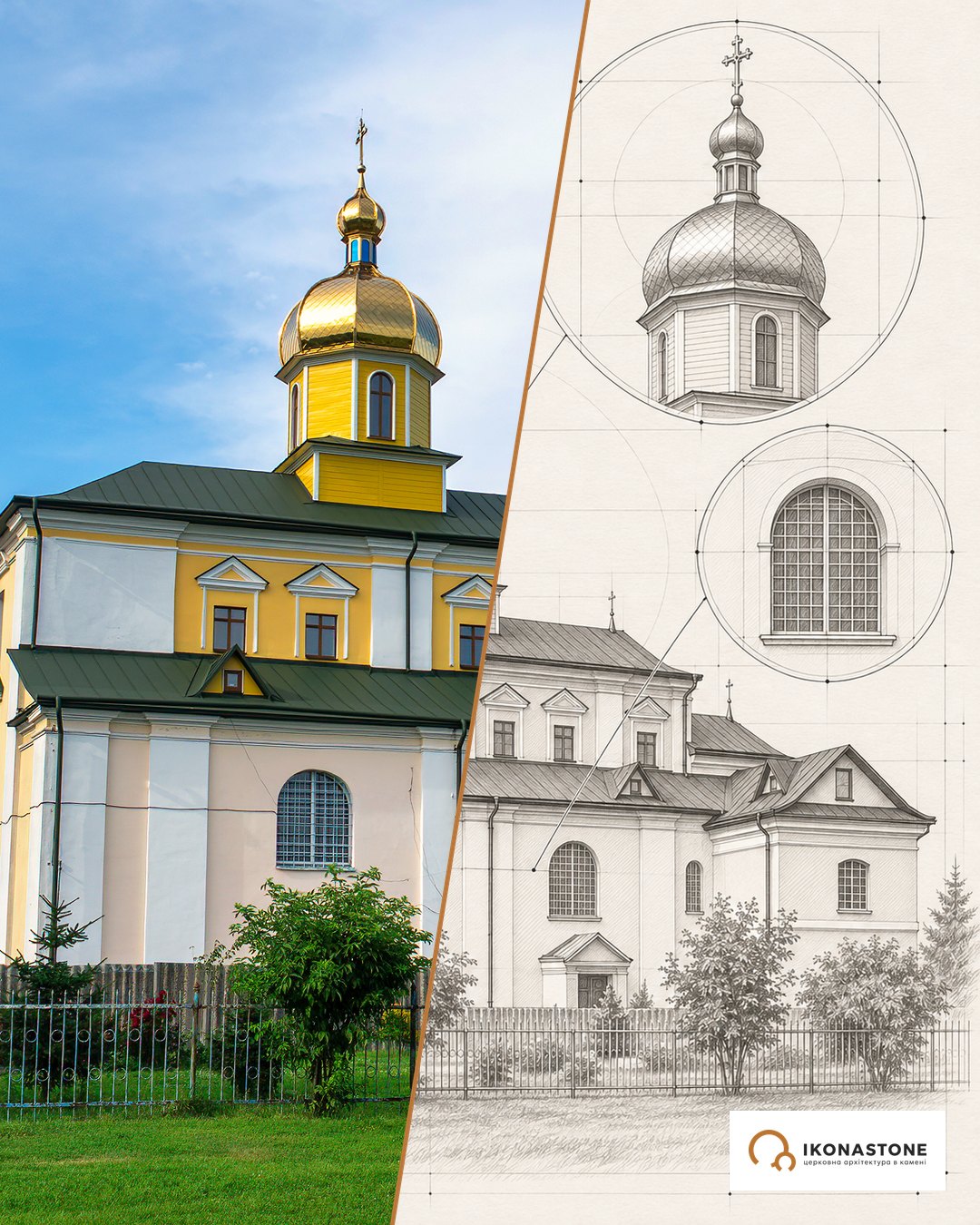
- Town
- Zhydychyn village, Lutsk District, Volyn Oblast
- Built
- 1723 (date on the portal; according to the inscription on the orb, foundation in 1594 and 1723)
- Type
- three-nave four-pillar basilica with an apse, part of a monastery
- Material
- masonry
- Research depth
- 100%