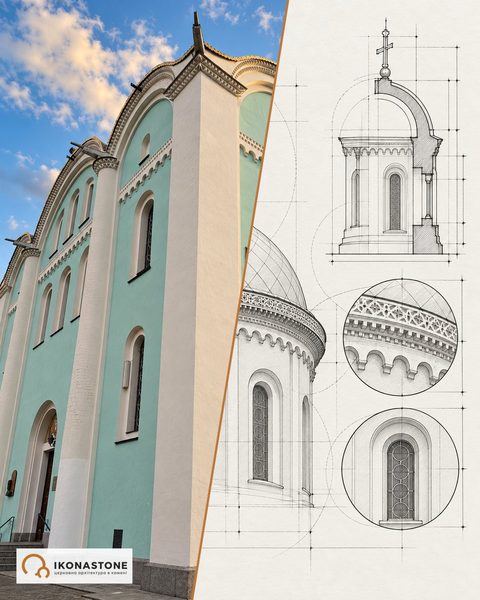
The Cathedral of Saints Peter and Paul in Lutsk: a Jesuit church by the castle gate
The first stone of this church lies in its own foundations. In 1610 Bishop Paweł Wołucki blessed the cornerstone — and it was built into the base of the new church, on which work began only six years later.
In brief
| Address | Lutsk, 6 Katedralna Street |
| Built | 1616–1639 (consecrated in 1639, according to other data in 1640) |
| Architects | Giacomo Briano; the work was continued by Maciej Maik; rebuilding after 1724 by Paweł Giżycki |
| Type | three-nave basilica with a dome and two towers on the main facade |
| Dimensions | 39 × 53 m in plan (according to “Istorychna Volyn”) |
| Status | architectural monument of national importance (protection No. 030108/1) |
| Church | cathedral of the Roman Catholic Diocese of Lutsk |
History
The Jesuits were invited to Lutsk in 1604 by Bishop Marcin Szyszkowski. In 1608 the mission school was reorganised into a collegium, and in 1609 King Sigismund III granted a privilege to buy a plot for the church and the new collegium. They built on the edge of the Outer Castle, by its entrance gate: the south-western wall stood on the site of former wooden fortifications and faced “the field”. Loopholes on the facades and in the basements are a reminder that the church also had a defensive role.
The design was created by the Italian Giacomo Briano, who supervised the work in 1616–1620 (according to different data, 1616–1619 or 1617–1621). After him the construction was led by Maciej Maik. The vaults were laid in 1630, and the dome was completed in 1637; the two towers and galleries appeared during the rebuilding of 1724–1730. Bishop Andrzej Gembicki consecrated the church in 1639 (according to other data, in 1640). Next to it rose the collegium, where, according to Wikipedia, from 150 to over 300 students studied.
The fire of 14 June 1724 badly damaged the church, and by 1730 it was rebuilt by the Jesuit architect Paweł Giżycki: galleries were added on both sides of the church, two towers appeared, and it acquired a Classicist look. The Cathedral of the Holy Trinity was not rebuilt after the fire of 1781, and in 1787 the see was moved to the former Jesuit church; according to “Monitor Wołyński”, it was consecrated as a cathedral by Bishop Jan Kaszkowski. The fire of 1818 forced the replacement of the shingle roof with a metal one, the fire of 1924 destroyed the high altar, and in May 1944 the church suffered from bombing.
After the war the see was abolished and the church was closed (in 1946, according to other data 1947 or 1948). Vegetables were stored in the vaults; in 1980 a museum of atheism was opened (according to other data, in the 1970s), and later the interior was remade for the “Cosmos” exhibition. The first service after the interruption took place on 27 September 1990; the church became a cathedral again in 1996, with the restoration of the Diocese of Lutsk.
Chronology
The figures in square brackets are the numbers of the sources in the list at the bottom of the page. The note “according to …” means that the fact is confirmed by a single source only. The “Legends” section contains traditions and legends: they are recorded in the sources but not confirmed by documents.
Era I. The earlier cathedral and the founding of the Jesuit house
- 1427–1428
Grand Duke Vytautas built the first wooden cathedral church of the Holy Trinity in Lutsk (1427 according to Suspilne); Latin plaques in the cathedral mention the transfer of the see from Volodymyr to Lutsk in 1428. [1, 13, 15]
- 1538–1544
Bishop Jerzy Falczewski replaced the wooden Trinity church with a masonry one (according to Suspilne, “probably in 1545”). [5, 13]
- 1604
The Bishop of Lutsk Marcin Szyszkowski initiated and endowed the Jesuit collegium. That same year a mission house with free public schools was opened. [1, 20]
- 1609
King Sigismund III granted a privilege to buy a plot for the church and the new large collegium. [1]
- 1610
According to the “Dziedzictwo Kulturowe” Foundation, Bishop Paweł Wołucki blessed the cornerstone, which was built into the foundation of the future church. Wołucki headed the Diocese of Lutsk from 1607 to 1616. The Ukrainian Wikipedia writes that he blessed the foundations after the laying of 1616. [1, 3, 19]
- 16 July 1616
The cornerstone of the church's foundations was laid with the participation of the Jesuit Giacomo Briano. Briano's supervision falls in 1616–1620 (according to Dziedzictwo, 1616–1619). [1, 3, 24]
- 1616–1639
Construction lasted 23 years. The church was built on the site of the entrance tower of the Outer Castle, so that it would replace a section of the castle wall, and the main facade faced the entrance gate. The plan is cruciform with a dome, based on a Greek cross inscribed in a square. [1, 23]
- 1627
Supervision of the construction passed to the architect Maciej Maik (May). According to Wikipedia, the vaults were laid in 1630 and the dome was completed in 1637. [1]
- 6 October 1639
Bishop Andrzej Gembicki consecrated the church; Catholics mark this date every year as a solemnity. Some sources date the consecration to 1640. [2, 3, 4, 9, 21]
Era II. The Jesuit collegium and the rebuilding
- 14 June 1724
A fire badly damaged the church and the collegium. Rebuilding continued until 1730 with the participation of the Jesuit architect Paweł Giżycki: galleries were added on both sides of the church, two towers appeared, and it acquired a Classicist look. [1, 2]
Era III. The see under foreign empires
- 1773
Pope Clement XIV abolished the Jesuit order; the complex was handed over to the Commission of National Education. [1, 2]
- 1781
The Cathedral of the Holy Trinity burned down and was not rebuilt. [1, 5]
- 1787
The see was moved to the former Jesuit church, which received the rank of cathedral. According to “Monitor Wołyński”, it was consecrated by Bishop Jan Kaszkowski. [1, 4, 5]
- 1795–1798
After the partitions of Poland, Volyn found itself within the Russian Empire; in 1798 the dioceses of Lutsk and Zhytomyr were merged, and Kasper Cecyszowski became bishop. [1, 2, 15]
- 1818
A fire; the shingle roof was replaced with a metal one. A round plaque about this work is set into the wall of the presbytery (according to “Monitor Wołyński”). [5]
- 1831
Bishop Kasper Cecyszowski died; he was buried in the underground church, and his epitaph was placed on a pillar of the upper church (according to “Monitor Wołyński”). [5]
- 19th century
In the middle of the century the Russian authorities closed Catholic monasteries and churches in Volyn; in Lutsk only the cathedral remained active. Valuables from closed churches were moved here, including the crowned image of Our Lady of Lutsk from the Dominican church (according to Wikipedia). [1]
Era IV. The interwar years, war and Soviet closure
- 1924
A fire destroyed the high altar together with the painting of the Holy Trinity by Kunitzer; according to Wikipedia, the crowned icon of Our Lady of Lutsk also burned. A new altar was built the following year. [1, 22]
- 14 December 1925
The Diocese of Lutsk was restored, and Adolf Piotr Szelążek became bishop (he governed until 1950). [15, 18]
- 17 September 1939
The Red Army entered Lutsk; Bishop Szelążek appointed Władysław Bukowiński parish priest of the cathedral. [7, 16]
- 1940
The cathedral was declared an architectural monument of state importance (according to “Monitor Wołyński”). [5]
- The night of 4 January 1945
Bishop Szelążek and Father Bukowiński were arrested. The bishop was released on 15 May 1946 and on 17 May was taken out to Poland; he died on 9 February 1950. [16, 17, 18]
- 1946 (according to other data 1947 or 1948)
The Soviet authorities closed the cathedral. The building was used as a warehouse and workshops; in the vaults vegetables were stored (according to other data, coal). [1, 3, 4, 5, 11, 22]
- December 1980
The Regional Museum of Atheism was opened in the former church (according to other data, 1981 or the 1970s). In 1982 the high altar was dismantled and the “Cosmos” exhibition appeared in its place (according to Wikipedia). The museum operated until 1992. [1, 3, 5, 11, 22]
Era V. Return and revival
- 27 September 1990
The first Roman Catholic service after the interruption took place (according to Wikipedia). [1]
- 25 June 1991
Decision No. 140 of the executive committee of the Volyn Regional Council to hand the church over to the Roman Catholic community (gcatholic gives 26 June). Services were at first held in a side chapel, while a museum still operated in the main hall. [4, 5, 6, 23]
- 18 May 1996
The Diocese of Lutsk was restored, and the church became a cathedral again. [4, 15]
- 16 May 1998
Bishop Markiyan Trofymiak was installed in the cathedral. [1, 15]
- 1999
An organ of 1953, the work of masters from Osnabrück, was brought from Germany and installed. [1, 2]
- 1 October 2004
The Diocesan Museum in Lutsk was founded on the basis of works preserved in the cathedral's galleries; Canon Augustyn Mednis became curator (according to Polonika). [11]
- 2014–2018
An expert examination (2014) found that the basements were getting damp because the roof had no drainage; in 2017 storm drains were laid, and in 2018 the chapel floor was restored (according to Dziedzictwo). [3]
- 2016
On 25 June the parish marked the 25th anniversary of the return of the church, and on 9 October the 400th anniversary of the laying of the foundation; the nuncio Claudio Gugerotti officiated at the celebration (according to other data from “Monitor”, the 25th anniversary was celebrated on 29 June). [6, 7]
- 24 July 2017
A Polish delegation headed by Deputy Minister of Culture Jarosław Sellin inspected the church and the vaults. [8]
- 2020
On 5 March updated exhibitions were opened in the vaults; on 13 July the first virtual tour of the Lutsk underground vaults on Google Maps was announced. [12, 14]
- 2021
Laser scanning of the cathedral (about 700 scans) for a Polish heritage protection project. [10]
- 8 September – 6 October 2024
A copy of the Kodeń icon of the Mother of God was blessed on 8 September; on 6 October, the anniversary of the church's consecration, it was solemnly brought into the cathedral. [9]
Lost and restored
| What | What there was | What happened | Where it is now |
|---|---|---|---|
| Cathedral of the Holy Trinity | The first cathedral of Lutsk, Outer Castle | Burned down in 1781, not rebuilt | According to Suspilne, in 2021 archaeologists found the foundations of the first cathedral church at 17–19 Katedralna Street [1, 5, 13] |
| High altar | Gilded sculptures, marble steps | Destroyed by the fire of 1924; a new one built in 1925; dismantled in 1982 | Now a high altar with 18th-century sculptures of Peter and Paul [1] |
| Crowned icon of Our Lady of Lutsk | From the Dominican church | Burned in 1924 (according to Wikipedia) | The cathedral now has a copy of the icon of Our Lady of Lutsk [1, 9] |
| Painting of the Holy Trinity by Kunitzer | Above the high altar | Burned in 1924 | Lost [1, 22] |
| Blue canopy with gilded stars above the pulpit | Decoration of the presbytery | Destroyed in 1982 when the “Cosmos” exhibition was set up (according to Wikipedia) | Lost [1] |
| Great organ | Interior | Destroyed in the Soviet period | In 1999 an organ of 1953 was brought from Osnabrück [1, 2] |
| Collegium library | The collegium was one of the richest in Volyn | By 1876 most of it was taken to Zhytomyr (according to Wikipedia) | The fate of the collection is not specified in the sources [1] |
| Shingle roof | Original covering | Replaced with metal after the fire of 1818 (according to “Monitor Wołyński”) | Metal covering [5] |
| Burials of bishops in the underground church | Falczewski, Wołucki (transferred from the Trinity Cathedral), Cecyszowski | In 1946–1990 the vaults were used as a warehouse; some of the copper “tombs” were turned in for scrap (according to Wikipedia) | The vaults are open to visitors [1, 5, 12] |
| Tomb of Magdalena Talitsyna | The vaults, wife of the Lutsk commandant (19 years old) | Looted as early as the 19th century; the original sarcophagus is gone | The tomb is present, the sarcophagus is not [1, 12] |
| Art collections of the cathedral | Furniture, reliefs, vestments, printed works | In the Soviet period part was lost; part was hidden in the galleries | The basis of the Diocesan Museum (since 2004) [11] |
| Stations of the Cross (reliefs) | A gift of 1936 | Fate not clarified in the sources | Not clarified [1] |
| Basements | Damp because of the lack of drainage | In 2017 storm drains were laid | The basements are protected from water [3] |
Architecture
The facade has three vertical axes: the central nave with a large dome and two side towers. According to the Polish foundation “Dziedzictwo Kulturowe”, the wide two-tower facade was designed by Benedetto Molli. The height from the floor to the cross above the central dome is 42.05 m (according to the Ukrainian Wikipedia; the English Wikipedia gives about 42 m, “Monitor Wołyński” 41 m).
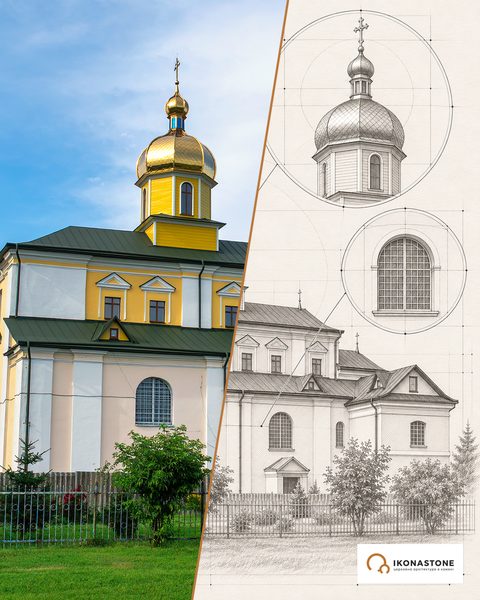
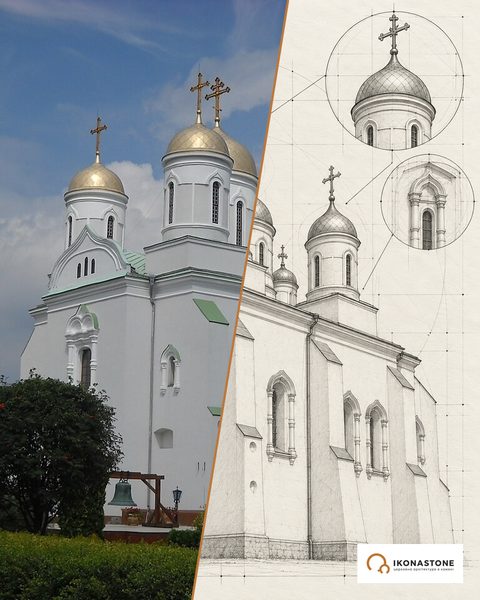
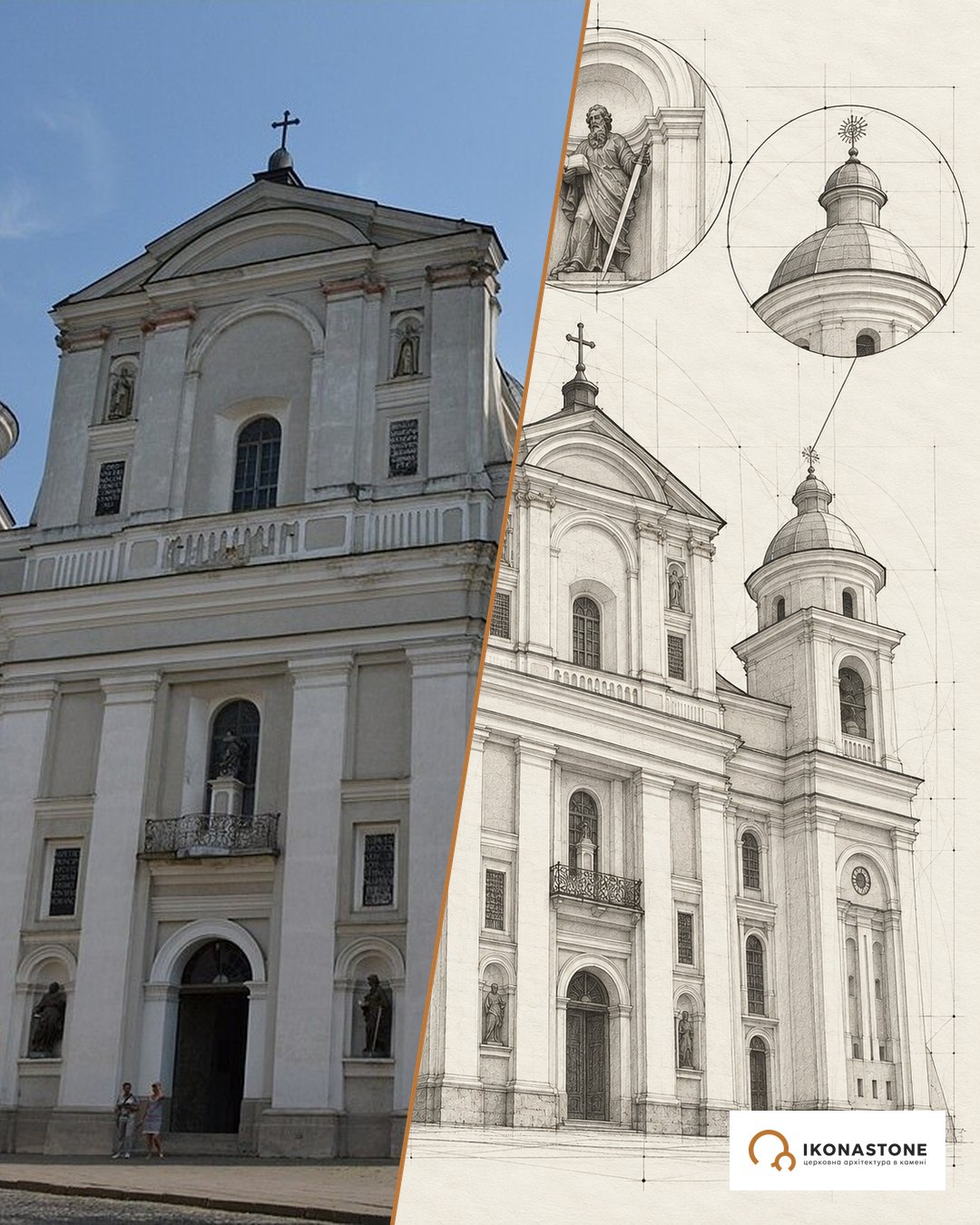
Below are two elements of the church, in a photograph and in a drawing. The drawings show the form, not exact dimensions.
The main facade with sculptures
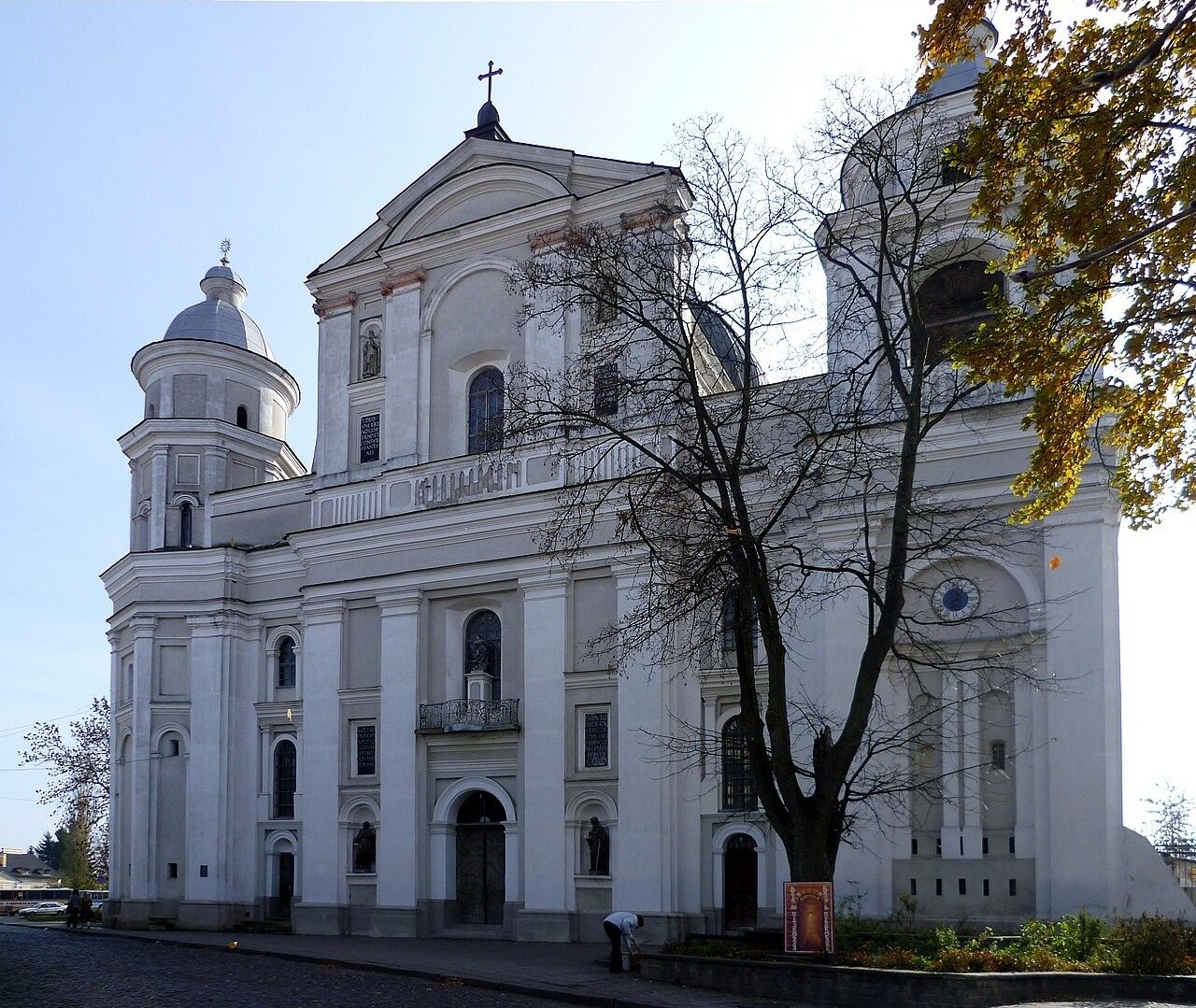
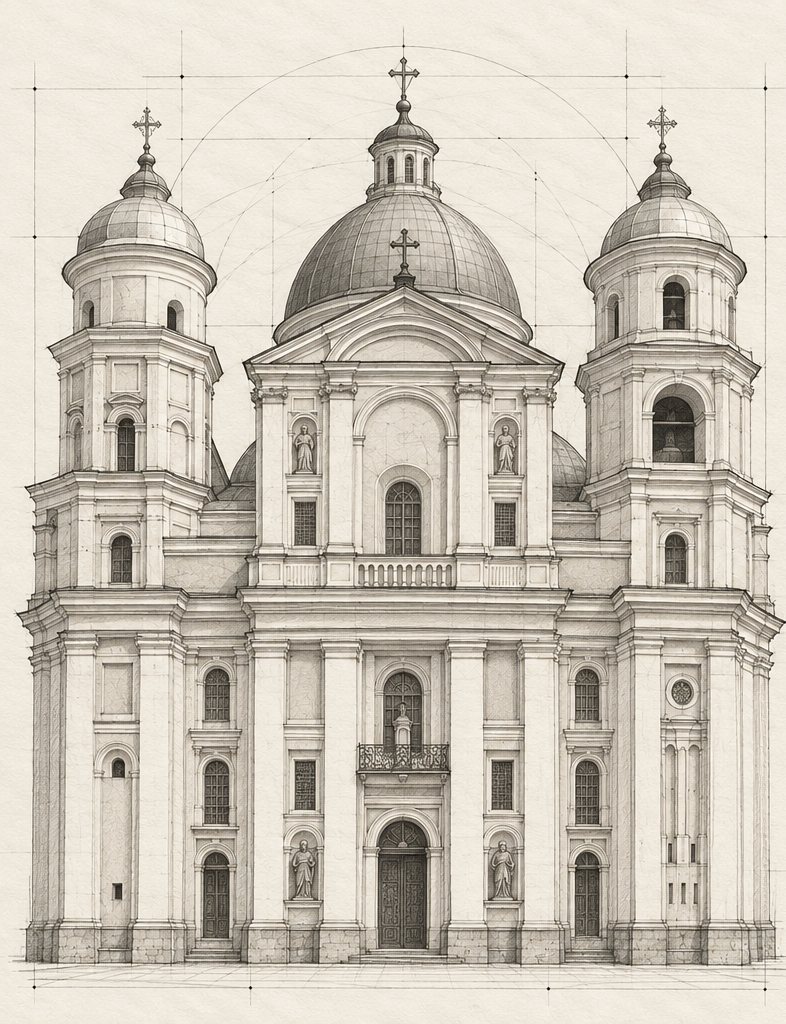
The decoration of the facade combines Renaissance, Baroque and Classicism. It is adorned with five sculptures: three in the lower tier and two in the upper. Above the main entrance, on the balcony, is the Mother of God; on either side of the entrances are sculptures of the Apostles Peter and Paul, made by different authors. One tower is octagonal, the other square, with an arch and a clock. Some of the loopholes on the facades and in the basements are now below ground level.
The dome
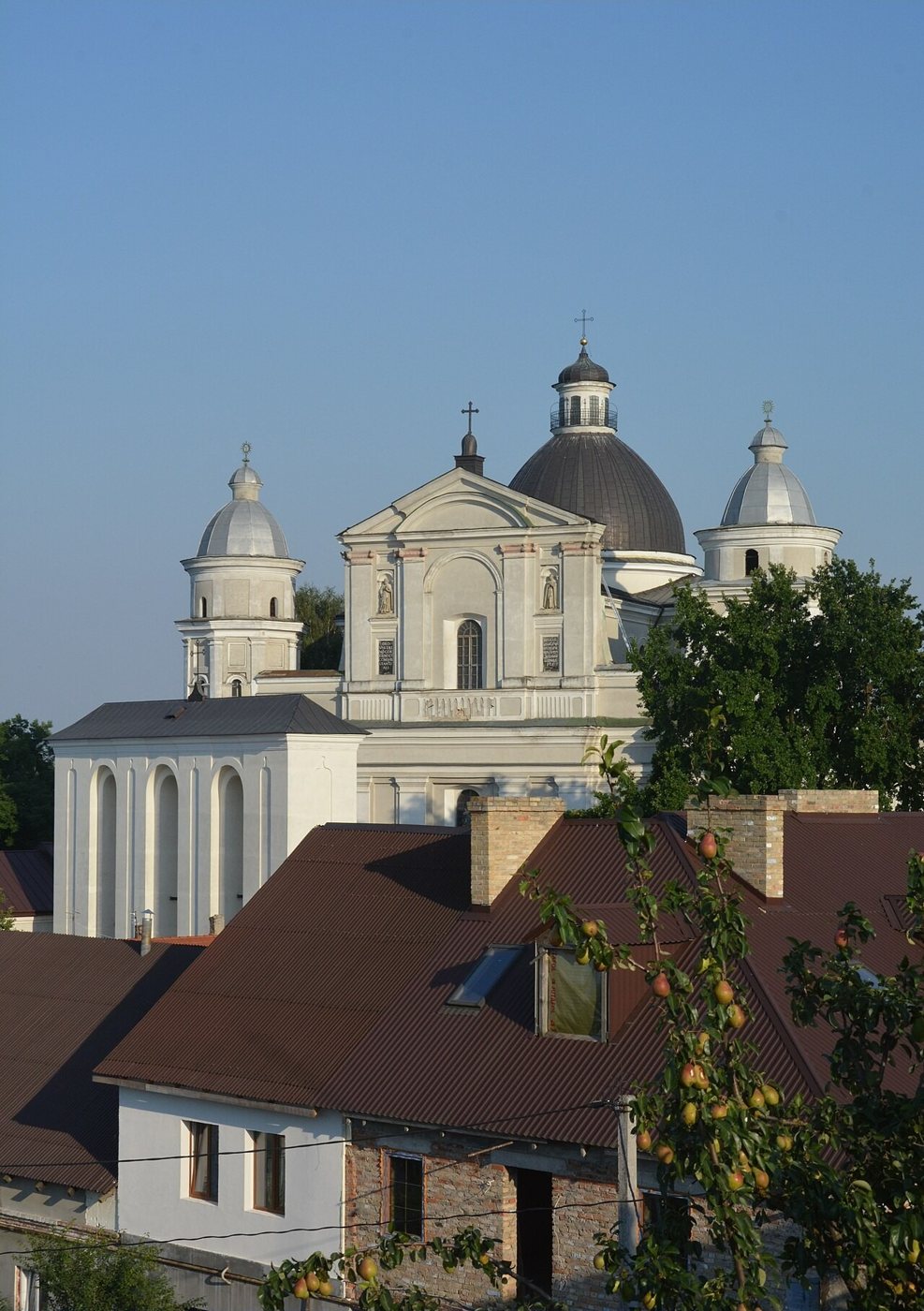
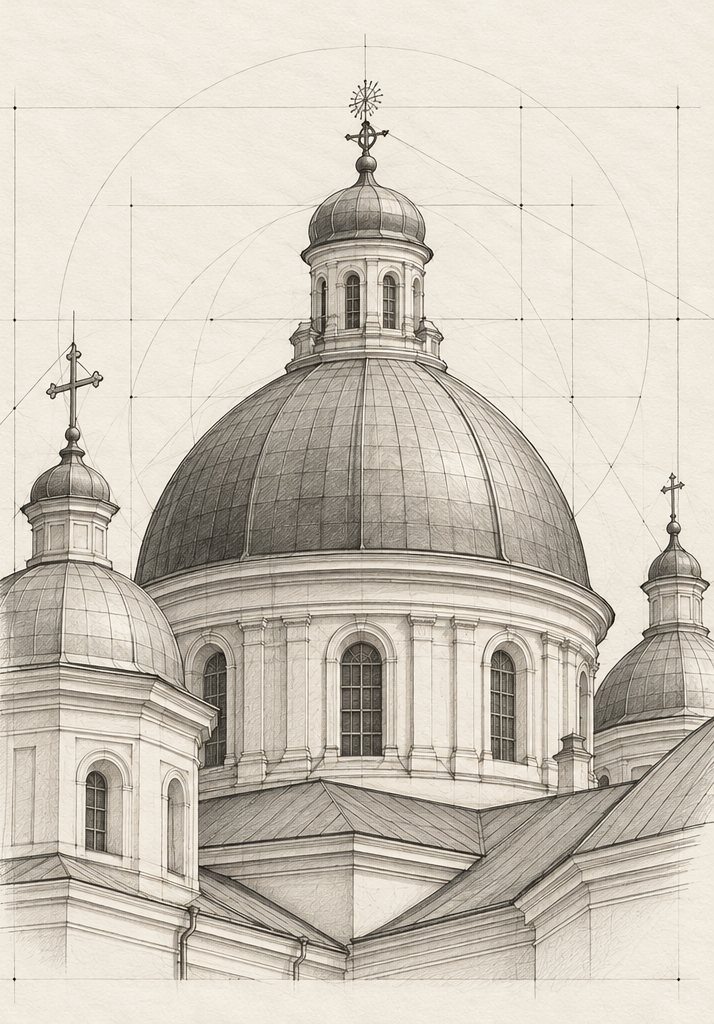
The dome was completed in 1637 (according to other data, 1638); according to “Lubart’s Chronicles”, the diameter of its base is 13.37 m. According to the same source, a document on the completion of the building was placed in the orb of the dome.
Stone and material
The sources we reviewed do not detail the material of the walls. What is known is that the cornerstone of 1610 lies in the foundation, and that the basements go down about 6 metres. In the vaults a stone portal, burials and Latin inscriptions survive. After the fire of 1724 the walls, according to “Lubart’s Chronicles”, were reinforced with “additional sectors”, and after 1818 the roof shingle gave way to metal.
The main threat to the church today is not fire but water. An expert examination in 2014 showed that the basements get damp because the roof has no drainage; in 2017 storm drains were laid and the joints of the walls with the ground were sealed. The simplest detail, the gutter, sometimes matters more for stone than any restoration.
The figures of the apostles on the facade are a reason to think about sculpture in church architecture. Another church where the dome decides the composition is St Andrew’s Church in Kyiv.
Did you know
Study at the collegium was free, so people came to Lutsk from Lviv, Ostroh and Kyiv; the collegium had a theatre, and fencing and dancing were taught. [1]
Kazimierz Florian Czartoryski, who later became primate, studied at the collegium (according to Wikipedia). [1]
In 1610–1657 founders and townspeople allocated about 40 thousand zlotys, two plots in the Outer Castle, estates and lands (according to Wikipedia). [1]
In a passage that led from the church towards the village of Zaborol, bricks marked “1554” and “1654” were found (according to Wikipedia). [1]
In one of the rooms of the second level of the vaults eight “tombs” of red copper were found, with coloured paintings above them; they were turned in for scrap (according to Wikipedia). [1]
The western tower is square, the eastern octagonal; Wikipedia notes that this difference has no obvious functional explanation. [1, 2]
The vaults have three levels (three to four according to Wikipedia), and their height in places reaches almost 6 metres. [1, 14]
According to Viktor Baiuk, deputy director of the heritage reserve, the vaults contain a common charnel house with about 200 burials. [12]
In 2019 the vaults were visited by about 25 thousand people. [12]
In 2021 laser scanning produced about 700 scans, 7 plans (crypts, attic, roof), 7 sections, 4 facades and a 3D model. [10]
In 1982 the blue canopy with gilded stars above the pulpit was destroyed to make room for the “Cosmos” exhibition. [1]
The cathedral now has copies of the icons of Our Lady of Kodeń, of Lutsk and of Letychiv. [9]
According to Polonika, after the closure in 1947 a coal warehouse was set up in the cathedral, and the works of art survived because they were hidden in the galleries. [11]
Legends
The ghost of a young girl
According to legend, the ghost of a young girl wanders the vaults; a visitor told journalists about it, and a guide confirmed that the girl's tomb exists but said he had never seen the ghost. Recorded in a report by “Suspilne” (2020). [12]
The passage to Lubart's Castle
According to eyewitness accounts, one of the underground passages connected the vaults of the church with the vaults of Lubart's Castle; in the 1960s it collapsed and was partly walled up. Recorded in Wikipedia. [1]
The passage to Zaborol
According to legend, another passage led towards the village of Zaborol; in the mid-20th century it was only 30 m long, beyond which there was a collapse. Recorded in Wikipedia. [1]
Vaults linked the fortresses
It is supposed that passages once linked the Old Town with the hillforts of Shepel and Zhydychyn, Olyka Castle and other fortifications. Recorded by Ukrinform; the article itself calls this only a supposition. [14]
The cell with a well
According to legend, in one of the rooms there was a narrow opening into a lower chamber where prisoners were kept; in the middle of the chamber was an opening to a well, from which water was drawn up in buckets in front of a prisoner who was not allowed to drink. Recorded in Wikipedia; not confirmed by documents. [1]
The image from Kodeń
According to a local legend, the icon of Our Lady of Kodeń was brought to Kodeń by Prince Mikołaj Sapieha, who had been healed in Rome; historians have not confirmed this, and the image was probably acquired in Spain. A copy of this icon has been in the Lutsk cathedral since 2024. [9]
People
- Marcin Szyszkowski — Bishop of Lutsk (1604–1607), initiator and founder of the Jesuit collegium (1604). [1, 20]
- Paweł Wołucki — Bishop of Lutsk (1607–1616), according to Dziedzictwo he blessed the cornerstone in 1610; his coat-of-arms relief is in the cathedral, and his coffin was moved to the underground church. [1, 3, 5, 19]
- Sigismund III Vasa — king, granted the privilege to buy the plot in 1609. [1]
- Giacomo Briano — Jesuit architect, author of the church’s design (supervision from 1616). [1, 3, 24]
- Maciej Maik (May) — architect who led the work from 1627. [1]
- Benedetto Molli — author of the collegium design (1646). [1, 3]
- Andrzej Gembicki — Bishop of Lutsk from 1638, consecrated the church in 1639. [9, 21]
- Paweł Giżycki — Jesuit architect, rebuilding after the fire of 1724. [1, 2]
- Baltazar Tyszka — canon, founder of the confraternity of mercy at the church (1640). [1]
- Jerzy Falczewski — bishop who in 1538–1544 built the masonry Cathedral of the Holy Trinity; his burial was moved to the vaults. [5, 13]
- Kasper Cecyszowski — Bishop of Lutsk and Zhytomyr from 1798, died in 1831, buried in the underground church. [1, 5]
- Adolf Piotr Szelążek — Bishop of Lutsk (1925–1950); arrested in 1945, released in 1946. [17, 18]
- Władysław Bukowiński — parish priest of the cathedral (1939–1945), blessed (beatified on 11 September 2016). [7, 16]
- Augustyn Mednis — canon (1932–2007), curator of the Diocesan Museum. [11]
- Markiyan Trofymiak — ordinary of the restored diocese from 1998. [1, 15]
- Witalij Skomarowski — bishop-ordinary of the Diocese of Lutsk since 2014. [1, 8]
How to cite
IKONASTONE. The Cathedral of Saints Peter and Paul in Lutsk // Guide to the Churches of Ukraine. URL: https://ikonastone.com/en/guide/sts-peter-and-paul-cathedral-lutsk/ (accessed DD.MM.YYYY).
FAQ
Where is the cathedral located?
In Lutsk, at 6 Katedralna Street, a few dozen metres from Lubart's Castle. The church stands on the edge of the former Outer Castle, where its wooden fortifications once were.
When was the church built?
The cornerstone was blessed in 1610, and construction to a design by Giacomo Briano began in July 1616. Bishop Andrzej Gembicki consecrated the church in 1639 (according to other data, in 1640).
Can you visit the underground vaults?
Yes, the vaults beneath the church are open to tourists. According to the sources, they have several levels and go down about 6 metres; a stone portal, burials and Latin inscriptions survive there.
Who holds services in the church?
A Roman Catholic community. It is the cathedral of the Diocese of Lutsk. The first service after the Soviet closure took place on 27 September 1990, and the church was officially returned on 25 June 1991.
Sources
- Wikipedia (uk). Cathedral of Saints Peter and Paul (Lutsk)
- Wikipedia (en). Saint Peter and Paul Cathedral, Lutsk
- Fundacja Dziedzictwo Kulturowe. Saint Peter and Paul Cathedral in Lutsk
- GCatholic. Cathedral of Sts. Peter and Paul (Lutsk)
- Monitor Wołyński, No. 10 (70), 24.05.2012, W. Piasecki, «Historia»
- Monitor Wołyński, No. 13, 07.07.2016, «Powrót do świątyni»
- Monitor Wołyński, No. 19 (171), 13.10.2016, «400-lecie łuckiej świątyni»
- Monitor Wołyński, No. 15 (191), 03.08.2017
- Monitor Wołyński, No. 19 (363), 10.10.2024, «Kodeńska Bogurodzica w łuckiej katedrze»
- POLONIKA. Łuck — katedra pw. Świętych Apostołów Piotra i Pawła — skanowanie laserowe
- POLONIKA. Badania i inwentaryzacja w kościele katedralnym w Łucku
- Suspilne. Updated exhibitions opened in one of Ukraine's largest underground complexes in Lutsk (05.03.2020)
- Suspilne. Archaeologists found the foundation and vaults of Lutsk's first cathedral church (04.11.2021)
- Ukrinform. Underground Lutsk became available online (13.07.2020)
- Lutsk Diocese of the Roman Catholic Church in Ukraine. History of the diocese
- Wikipedia (en). Władysław Bukowiński
- Słownik Biograficzny Powiatu Toruńskiego, t. 4, s. 122–135: bp A. P. Szelążek
- Catholic-Hierarchy. Bishop Adolf Piotr Szelążek
- Catholic-Hierarchy. Bishop Paweł Wołucki
- Catholic-Hierarchy. Bishop Marcin Szyszkowski
- Catholic-Hierarchy. Bishop Andrzej Gembicki
- Roczniki Humanistyczne (KUL). Conservation of Three Paintings From the Post-Jesuit Church in Łuck
- Article on the Roman Catholic churches of Volyn (the collegium, return on 25.06.1991)
- Wikipedia (en). Giacomo Briano
- Town
- Lutsk, Volyn Oblast
- Built
- 1616–1639/1640 (cornerstone blessed in 1610)
- Type
- three-nave basilica with a dome and two towers on the facade
- Material
- masonry; metal roof since 1818 (instead of shingles)
- Research depth
- 26%