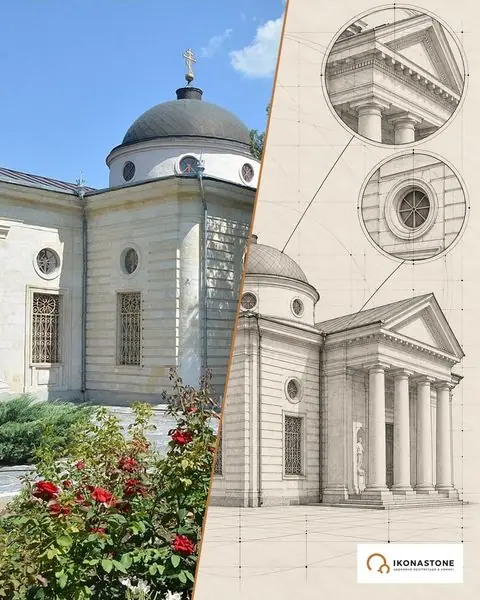
The Holy Dormition Cathedral in Odesa: from an Old Believer chapel to a cathedral
This cathedral grew out of a small Old Believer chapel consecrated in 1814 — and about a hundred and twenty years later it became the city’s main church, because the more senior one, the Transfiguration Cathedral, was closed.
In brief
| Address | 70 Preobrazhenska St, Odesa |
| Built | 1855–1869; lower church consecrated in 1875 |
| Architect | L. Ts. Otton (according to sobory.ru) |
| Type | two-level church: upper and lower; bell tower |
| Height | 56 m including the bell tower |
| Capacity | 5,000–6,000 people (according to Drevo) |
| Status | cathedral; one of the main shrines of southern Ukraine |
The story in plain words
A short account, about a 4-minute read. The full chronology, with all dates, disputes and sources, is below in the "Timeline" section.
A small chapel (1814-1845)
About twenty years after the city was founded, a community of Old Believers fitted out a small chapel in Odesa. It was consecrated on 7 July 1814. They say that the city governor, Duke Richelieu, helped with the building.
In 1841 the community reunited with the Orthodox Church, and the church became an Edinoverie one. In 1845 the plan for a new church with three altars was approved.
The icon and the fog (1853-1855)
First, the icon itself. According to tradition, in February 1840 Mrs Yulianiia Kasperova saw that the darkened face of the Mother of God on the icon had cleared. Since then it has been called the Kasperivska icon. In January 1844 it was moved from the Kasperov estate to the Church of St Nicholas.
In 1853 the Kasperivska icon of the Mother of God was brought into the old church. By another account this happened in August 1854, and the icon was carried to the city cathedral.
The following year, during the Crimean War, an Anglo-French-Turkish fleet appeared off Odesa. According to tradition, it was this icon that protected the city. In autumn 1854 a bombardment was expected on the feast of the Intercession, but a thick fog covered the sea and the city, and the ships withdrew.
Building the great cathedral (1855-1875)
On 17 July 1855 St Innocent (Borysov) laid the foundation of the new church. The money came from the Odesa merchants Yakiv and Mykola Cherepennykov. The architect was L. T. Otton.
The building took fourteen years. In April 1869 Archbishop Dymytrii (Muretov) consecrated the cathedral. Sources give both the 12th and the 13th. The cathedral came out in two tiers, with an upper and a lower church and a bell tower. Together with the bell tower it rose 56 metres, and it could hold 5-6 thousand people.
In 1875 the altars of the lower church were consecrated, among them ones in honour of St Nicholas and the Three Hierarchs. According to sobory.ru, in 1902 a five-tier porcelain iconostasis was installed in the upper church. It was made on the model of the iconostasis of the Trinity-St Sergius Lavra.
Closure and war (1932-1944)
In the 20th century the cathedral found itself at the centre of events its builders could not have foreseen. On 2 March 1932 the Soviet authorities closed the Transfiguration Cathedral, then the main church of Odesa. It was pulled down in 1936. So in 1932 the Dormition church became the cathedral church, with the blessing of Metropolitan Sergii.
At the end of the 1930s the Dormition Cathedral was closed too, along with other churches of the city. During the war a bomb destroyed the central dome and part of the building.
In 1942 the Romanian occupation authorities pumped the water out of the lower church. It had stood there a metre and a half deep. After that, services began again in the lower church.
Revival (after the war to 2012)
After the war the church was restored by Archbishop Nikon, Metropolitan Boris and Patriarch Alexy I. Patriarchs Alexy I, Pimen and Alexy II served here, as well as several Eastern patriarchs.
In 2008 a major overhaul was carried out, with new heating and wall paintings. On 30 October 2009 the regional council decided to hand the cathedral to the Odesa diocese of the UOC. One source dates the free transfer to other years, 2010-2014. The dome over the bell tower was gilded in 2010, and the main dome in 2012.
Glossary
| Word | What it means |
|---|---|
| Old Believers | Believers who rejected the 17th-century church reforms and kept the old rites |
| Edinovertsy (Edinoverie) | Former Old Believers who returned to the Orthodox Church but kept the old rite |
| Altar (prestol) | The main table in the sanctuary; “three-altar” means with three sanctuaries |
| Cathedral | The main church of a diocese, where the bishop presides |
| Diocese | A church region governed by a bishop |
| Iconostasis | A wall of icons between the altar and the rest of the church |
| Hierarch (svyatitel) | A bishop whom the church has recognised as a saint |
| Archbishop | A bishop of high rank |
| Lower church | A church on the lower floor of the building |
| Occupation | The seizure of territory by a foreign army |
Timeline
The numbers in square brackets are the numbers of the sources in the list at the bottom of the page. The note “according to …” means that the fact is confirmed by only one source. The “Legends” section contains traditions and legends: they are recorded in the sources but not documented.
From chapel to foundation
- 7 July 1814
A small Old Believer chapel was consecrated — the first Dormition church in Odesa, twenty years after the city was founded. [1, 2, 3]
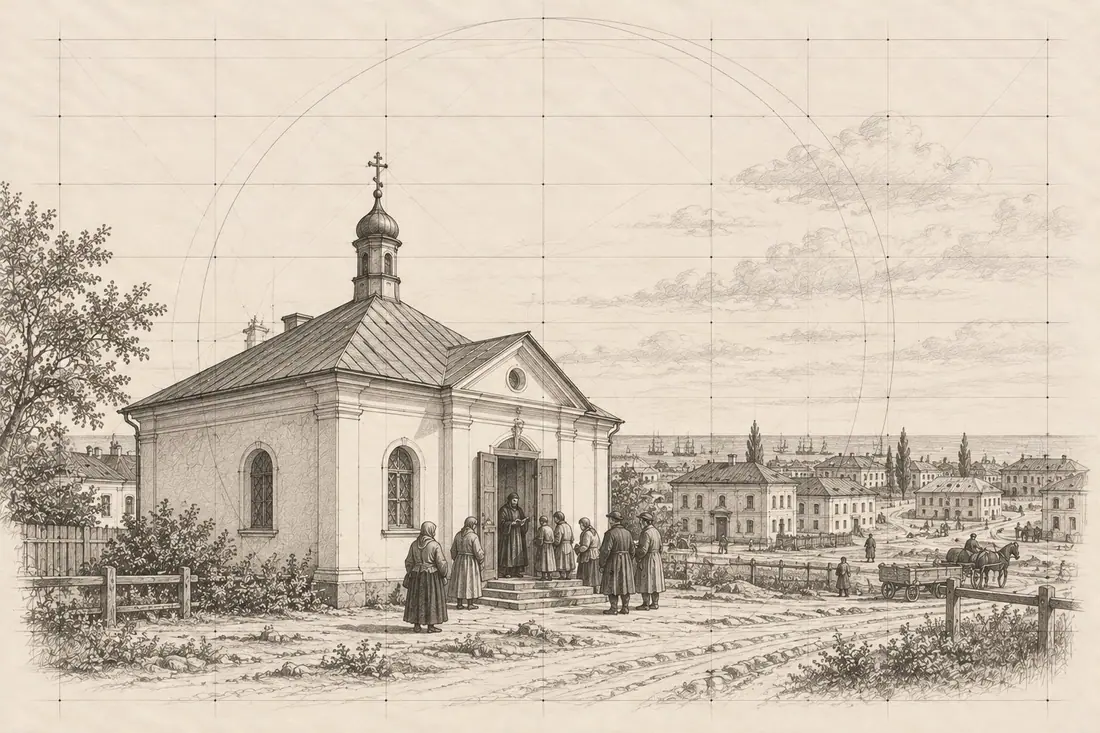
1814: the chapel on the site of the future cathedral. Illustration: IKONASTONE - 1814
According to sobory.ru, the construction was assisted by the city governor, the Duke de Richelieu. [1]
- February 1840
According to tradition, Yuliania Kasperova saw that the darkened face of the icon of the Mother of God had become clear; the icon became known as the Kasperov Icon. [11, 12]
- 1841
According to sobory.ru, the Old Believer community was reunited with the Orthodox Church, and the church became an Edinovertsy church. [1]
- January 1844
The Kasperov Icon was moved from the Kasperov estate to the local Church of St Nicholas. [11, 12]
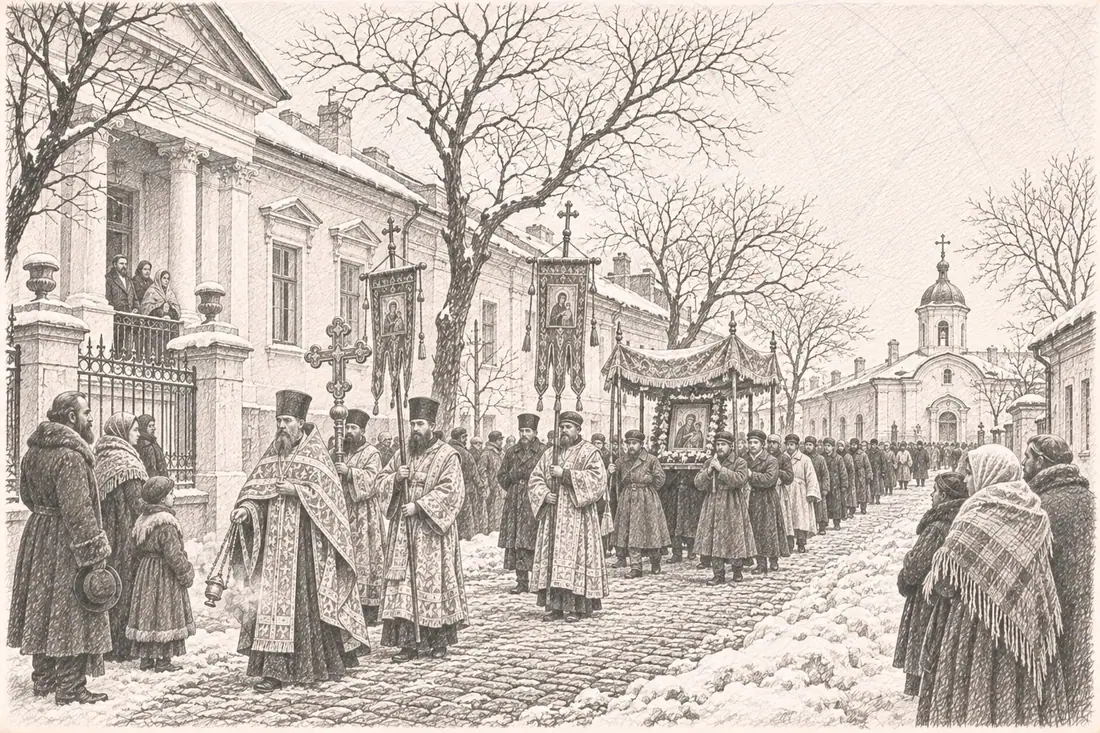
January 1844: the procession with the icon (conjectural reconstruction). Illustration: IKONASTONE - 1845
The plan for a three-altar church was approved. [1, 2]
- 1853–1854
The Kasperov Icon was brought into the Dormition chapel: sobory.ru and komandirovka.ru give the year 1853. According to the OCA, in August 1854 the icon was carried to the city cathedral, where it remained until 20 May 1856. [1, 3, 12]
- September 1854
During the Crimean War the allied fleet besieged Odesa; according to tradition, before the expected bombardment on the Feast of the Protection a thick fog covered the city and the sea, and the ships withdrew. [11]
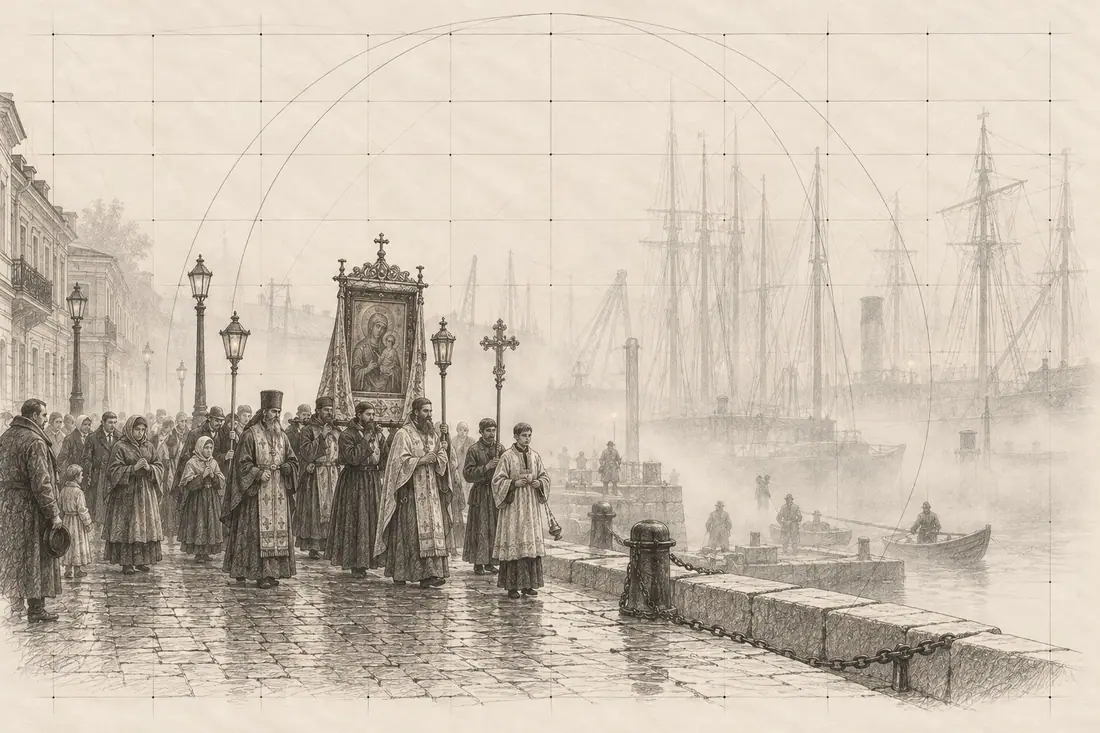
September 1854: fog over the Odesa harbour. Illustration: IKONASTONE - 17 July 1855
Archbishop Innocent (Borisov) laid the foundation of the new three-altar church. Drevo gives 17 June. According to sobory.ru, the architect was L. Ts. Otton, and the main funds were given by the merchants Yakiv and Mykola Cherepennikov. [1, 2, 3, 4]
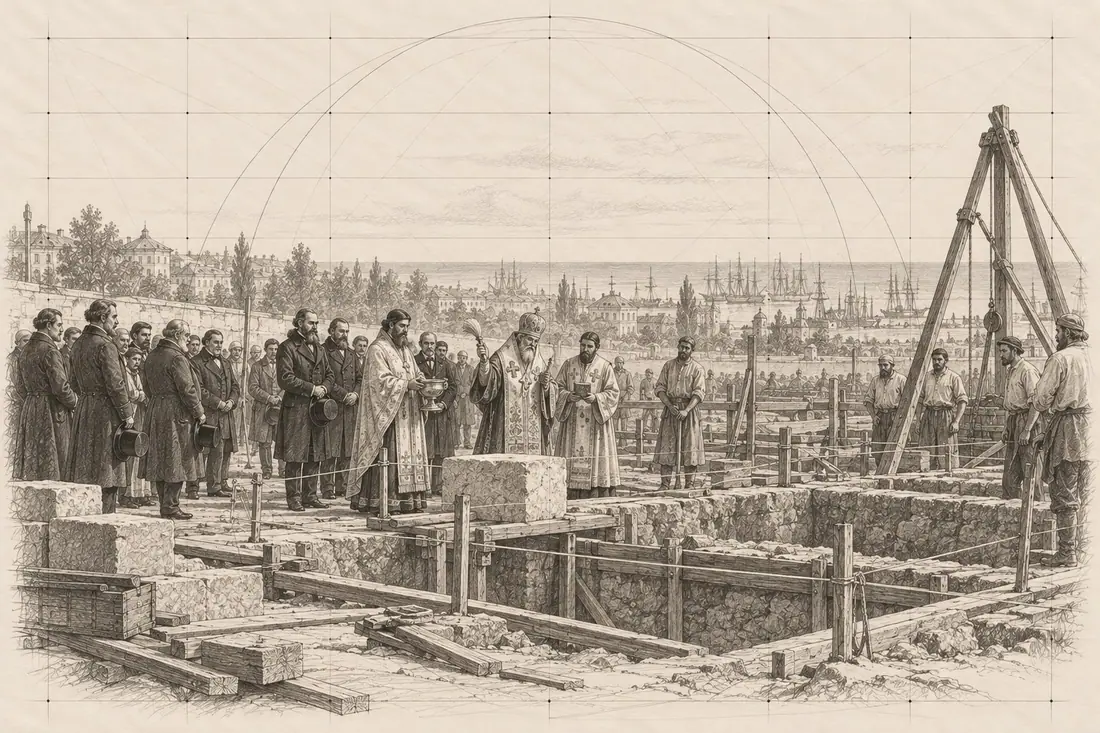
17 July 1855: the laying of the cathedral’s foundation. Illustration: IKONASTONE
Cathedral of the Odesa Eparchy
- 12 or 13 April 1869
Dmitry (Muretov), Archbishop of Kherson and Odesa, consecrated the cathedral after fourteen years of construction. The ESU and Drevo confirm only the year, 1869. [1, 2, 4, 5]
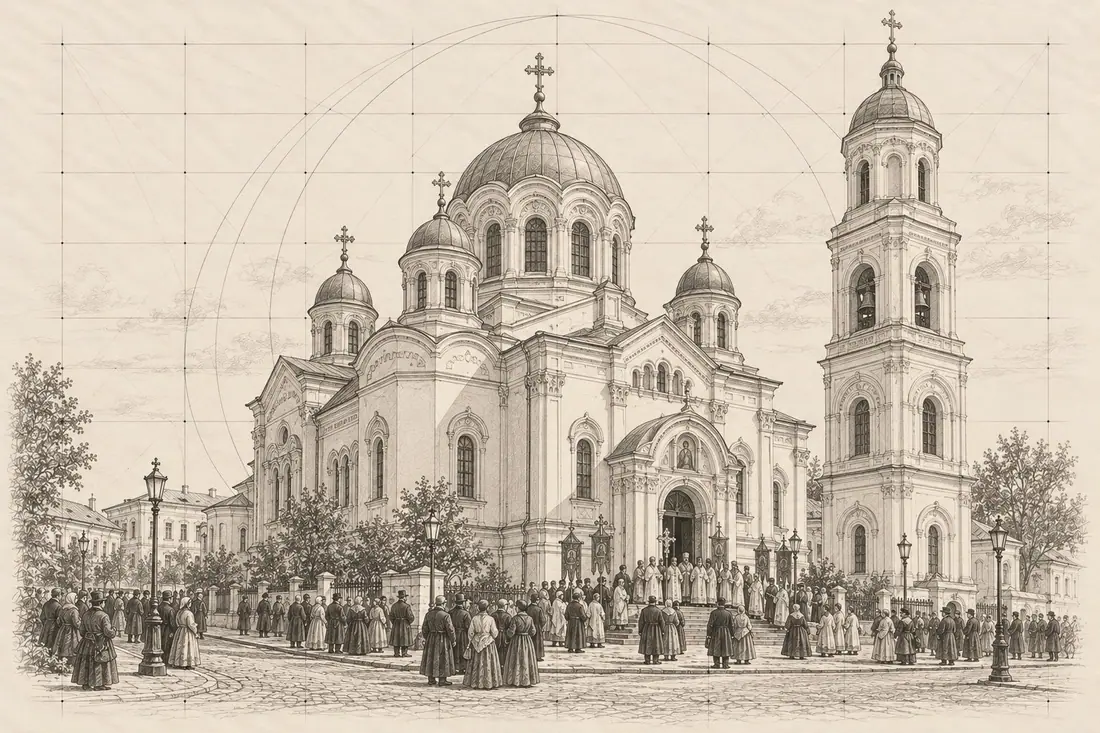
1869: the consecration of the cathedral. Illustration: IKONASTONE - 19 January 1875
Archbishop Leonty consecrated the main altar of the lower, Edinovertsy church — in honour of St Nicholas. [1, 2]
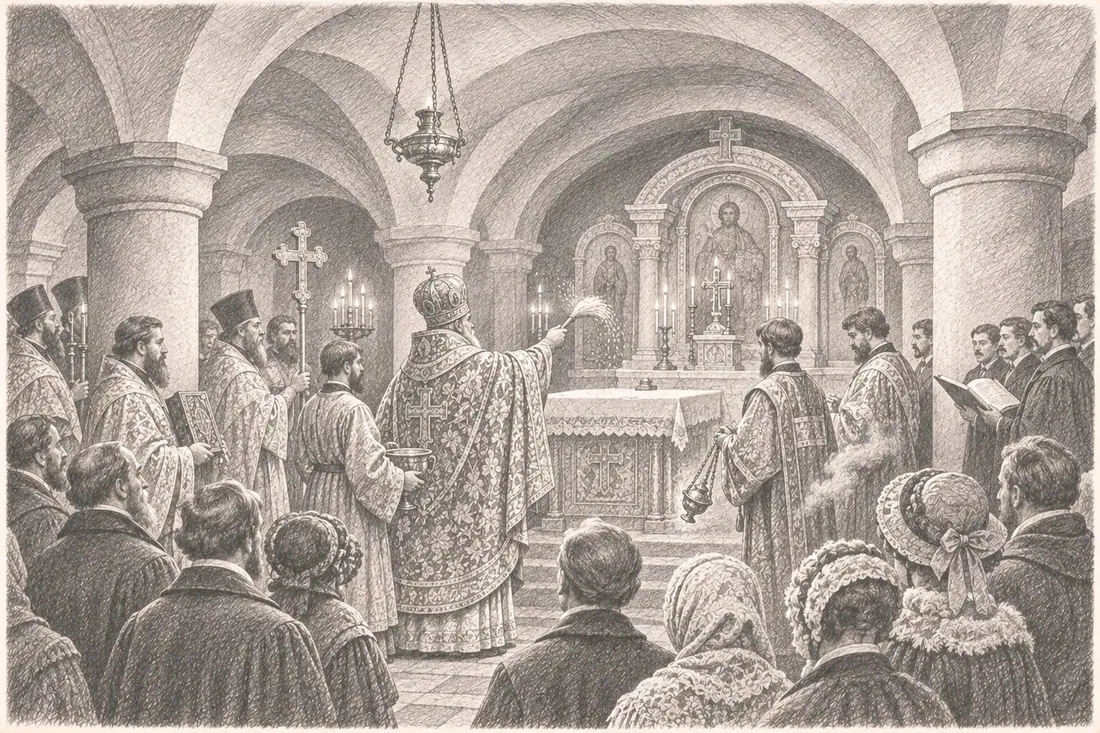
19 January 1875: consecration of the lower church (conjectural reconstruction). Illustration: IKONASTONE - 30 January 1875
The second altar of the lower church, that of the Three Hierarchs, was consecrated. [1, 2]
- 1897
The priest Jonah Atamansky was transferred to serve at the Dormition church in Odesa. [13, 14, 15]
- 1901
Father Jonah was appointed rector of the Church of St Nicholas in the port. [13, 14, 15]
- 1902
According to sobory.ru, a porcelain iconostasis, “the same as in the Trinity-Sergius Lavra”, was installed in the upper church. [1]
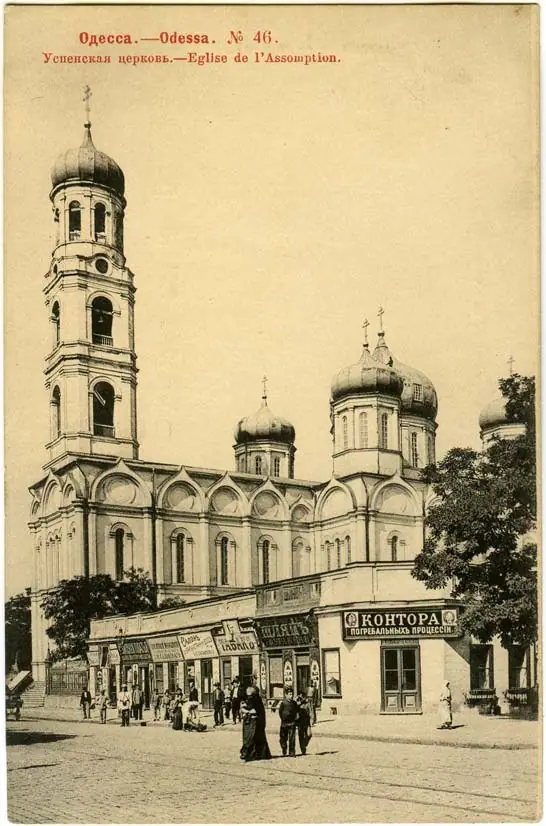
The Dormition church in Odesa, phototype by Scherer, Nabholz & Co., before 1902. Wikimedia Commons, public domain
Closure and war
- 30 May 1924
Father Jonah died. “All of believing Odesa” came to his funeral. [13, 14, 15, 17]
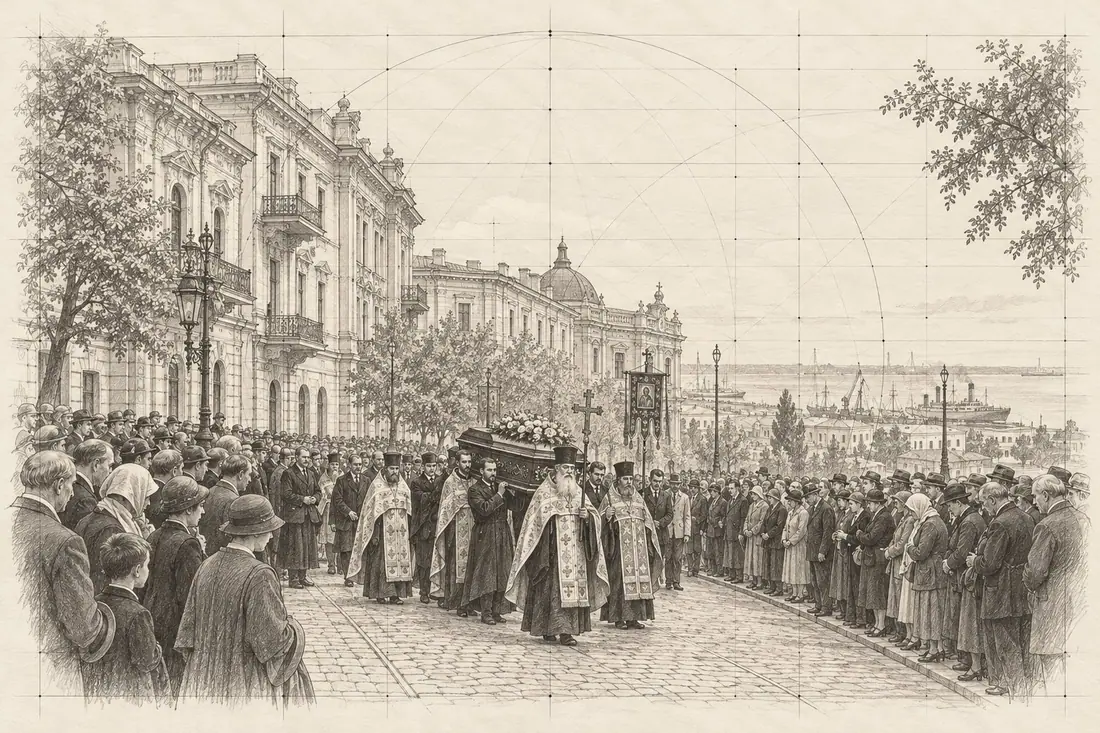
30 May 1924: the funeral of Father Jonah. Illustration: IKONASTONE - 2 March 1932
The Soviet authorities closed the Transfiguration Cathedral — at that time the main church of Odesa. [6, 7, 8]
- 1932
The Dormition church became the cathedral. According to sobory.ru, with the blessing of Metropolitan Sergius; the reason was the closure of the Transfiguration Cathedral. [1, 2]
- 1936
The Transfiguration Cathedral was dismantled (Radio Svoboda also gives 1937). It is a separate church, but its fate affected the status of the Dormition Cathedral. [5, 6, 7, 8, 9]
- End of the 1930s
The Dormition Cathedral was closed along with the other churches of the city. [1, 2]
- 1941–1944
Odesa under Romanian occupation. [5]
- 1942
The Romanian occupation authorities pumped out the water that had flooded the lower church to a depth of one and a half metres and allowed services to be restored there. [1, 2]
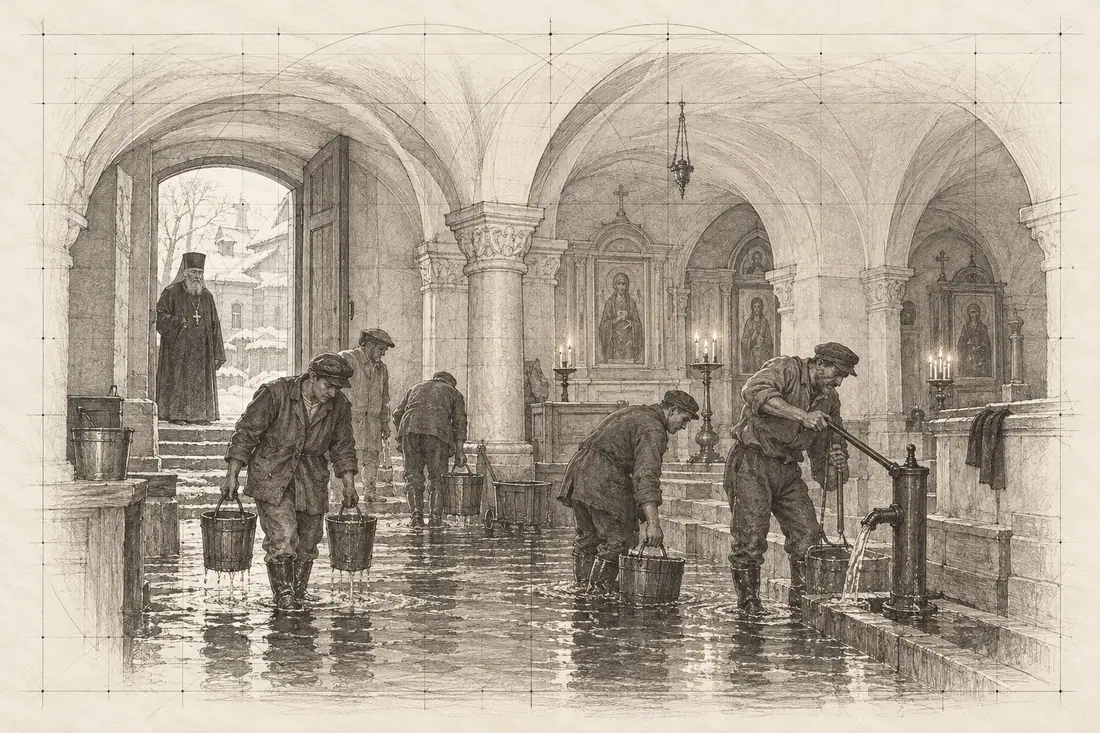
1942: the lower church after the flooding. Illustration: IKONASTONE - War years (year not given)
According to sobory.ru, a bomb destroyed the central dome and part of the building. [1]
- 1944
According to V. Shchetnikov’s article, the “Dormition Cathedral” appears in a Soviet list of 22 religious communities of Odesa; the parishioners collected 2,771 roubles for wounded Red Army soldiers. [10]
- Post-war years
According to sobory.ru, Archbishop Nikon, Metropolitan Boris and Patriarch Alexy I played a major role in the restoration of the church. [1]
- Post-war decades
According to sobory.ru, the Patriarchs Alexy I, Pimen and Alexy II and several Eastern patriarchs served in the cathedral. [1]
Recent history
- 22 November 1995
The Synod of the UOC (MP) added Father Jonah to the locally venerated saints of the Odesa Eparchy. [16]
- 1996
According to nyblago.org, the relics of the righteous Jonah were moved to the Dormition Cathedral. [14]
- 2008
Major renovation, with new heating and wall paintings, under Metropolitan Agafangel. [1, 4]
- 30 October 2009
The Odesa regional council decided to transfer the cathedral to the Odesa Eparchy of the UOC (MP). Dumskaya dates the free transfer of the cathedral to the eparchy to 2010–2014. [4, 19]
- 2010 and 2012
According to sobory.ru, the dome of the bell tower and the main dome were gilded. [1]
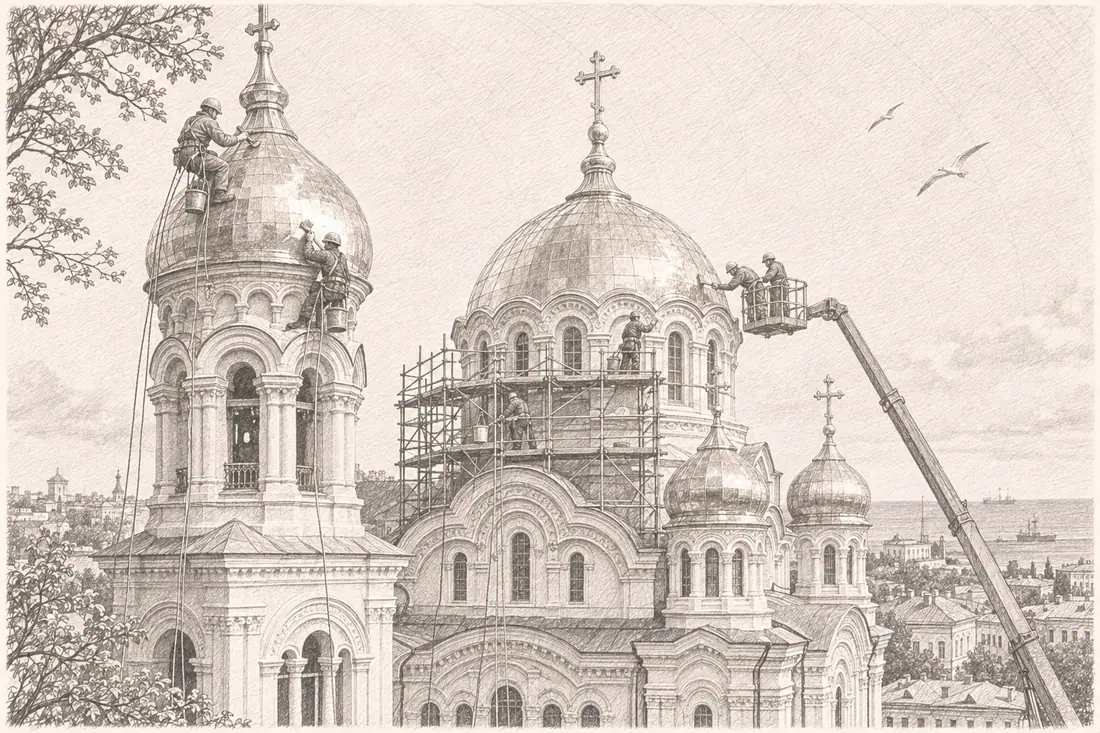
2010 and 2012: gilding the domes (conjectural reconstruction). Illustration: IKONASTONE - 21 July 2010
Patriarch Kirill consecrated the rebuilt Transfiguration Cathedral (the rebuilding lasted from 1999 to 2010). [23, 24]
- 27 October 2015
The Synod of the UOC entered Father Jonah in the calendar of saints; his memory is kept on the day his relics were found, 1 July. [16]
- 30–31 December 2015
Donations from believers were stolen from the cathedral; according to the eparchy, it was already the third such case. According to Dumskaya. [18]
- 23 July 2023
A Russian missile damaged the Transfiguration Cathedral; the Kasperov Icon, which was in it at the time, was pulled out from under the rubble. This does not concern the Dormition Cathedral. [22]
Lost and restored
| What | What it was | What happened | Where it is now |
|---|---|---|---|
| Old Believer chapel | 1814, the first Dormition church in Odesa | In 1841 it became an Edinovertsy church; a new church grew on its site | The fate of the building is not described in the sources [1, 2] |
| Porcelain iconostasis | Upper church, 1902 | Not preserved | One icon of the Dormition survives, 50 × 50 cm, 25 kg (according to sobory.ru) [1] |
| Central dome | Upper church | Destroyed by a bomb during the war | Restored; gilded in 2012 [1] |
| Lower church | Consecrated in January 1875 | Flooded to 1.5 m; the water was pumped out in 1942 | In use; the relics of the righteous Jonah are here [1, 2] |
| Cathedral status | From 1932 | The cathedral was closed at the end of the 1930s | Services in the lower church resumed in 1942; the cathedral is active [1, 2] |
| Transfiguration Cathedral (a separate church) | The main cathedral of Odesa | Closed in 1932, dismantled in 1936 | Rebuilt, consecrated in 2010; damaged in 2023 [5, 6, 7, 24] |
| Relics of the righteous Jonah | Buried in 1924 at the Slobidske Cemetery | The relics were found; the year is not given in the sources | In the lower church of the cathedral [1, 2, 13, 15] |
Architecture
Sobory.ru defines the style of the cathedral as Russian-Byzantine. Its main feature is the two-level structure: the cathedral consists of an upper and a lower church. As early as 1845 the plan for a three-altar church was approved; the main altar of the upper church is dedicated to the Dormition of the Most Holy Mother of God, while in the lower church the altars of St Nicholas the Wonderworker and the Three Hierarchs were consecrated in 1875. The lower church has its own altars and lives a life of its own: it was consecrated in 1875, six years after the upper one, and it was the first to be restored, in 1942. This two-level arrangement is a practical solution for a large city cathedral: two liturgical spaces under one roof, each with its own altars, its own light and its own rhythm of services.
According to Drevo, the height of the cathedral together with the bell tower is 56 metres, and its capacity is 5,000–6,000 people.
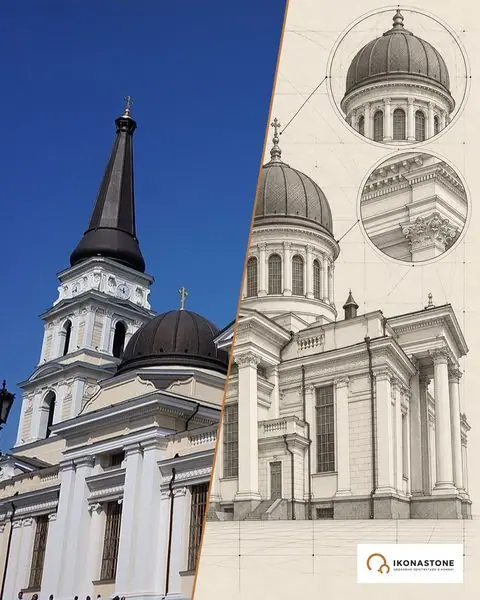
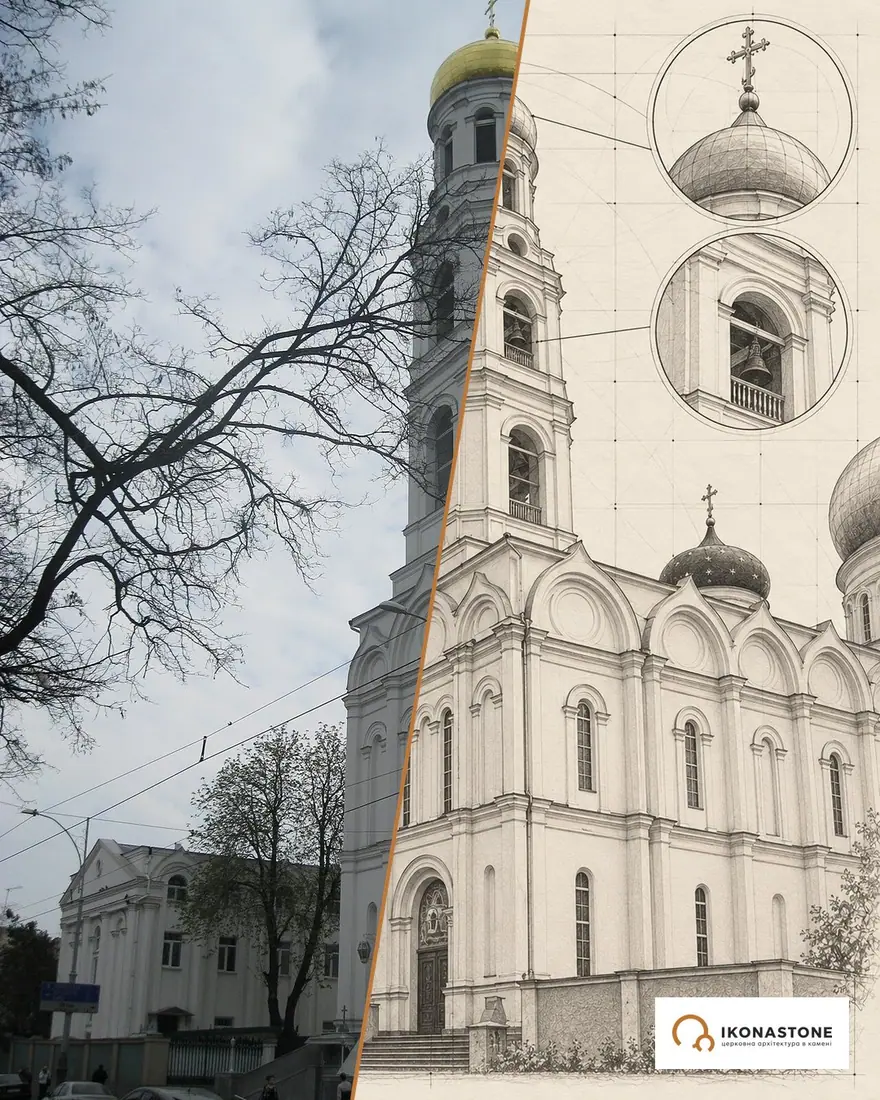
Below are two elements of the church, shown in a photo and in a drawing. The drawings show the form, not exact dimensions.
The bell tower
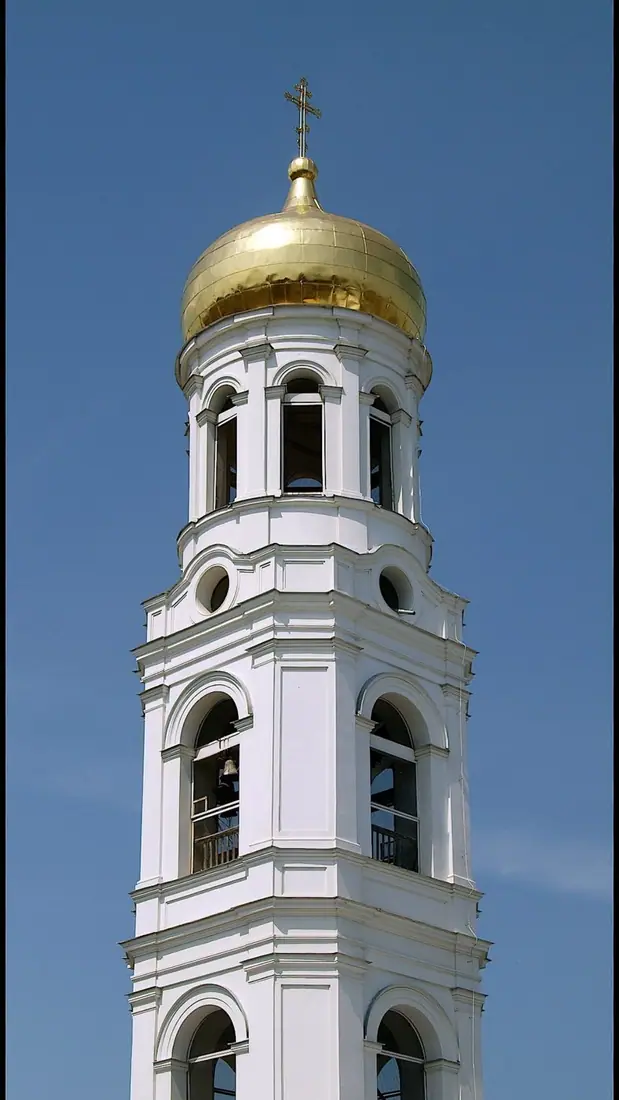
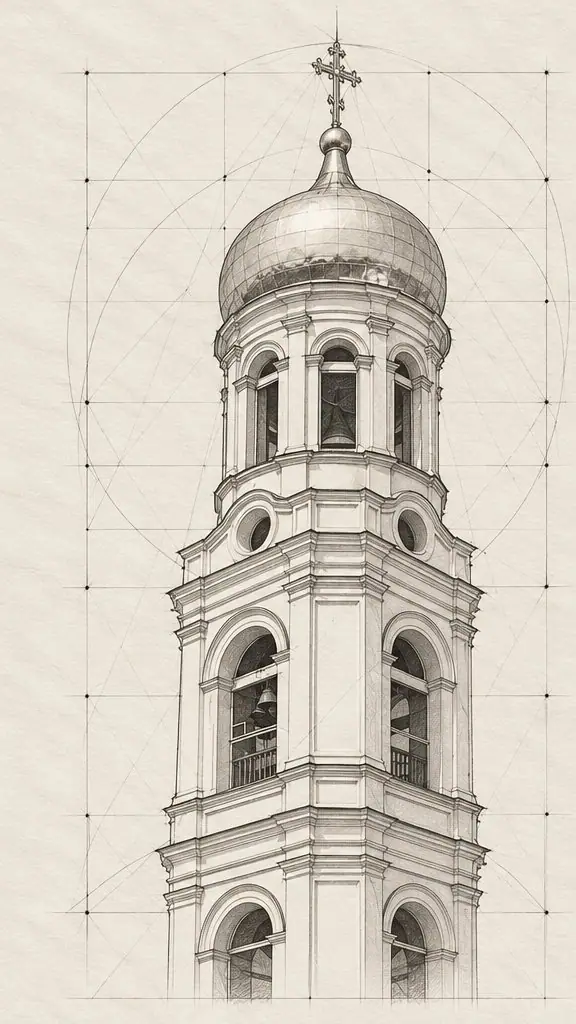
The bell tower determines the height of the cathedral — 56 metres. Its dome was gilded in 2010. According to sobory.ru, during the war the bell tower became one of the symbols of the Odesans’ struggle against the occupiers.
The central dome
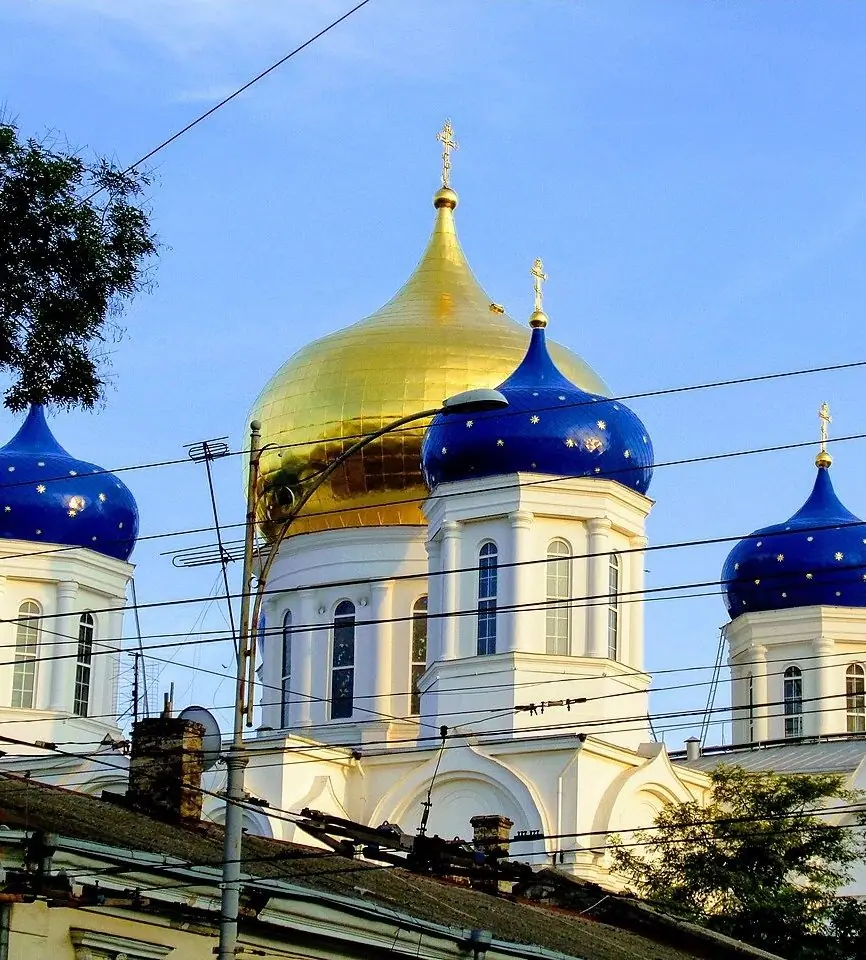
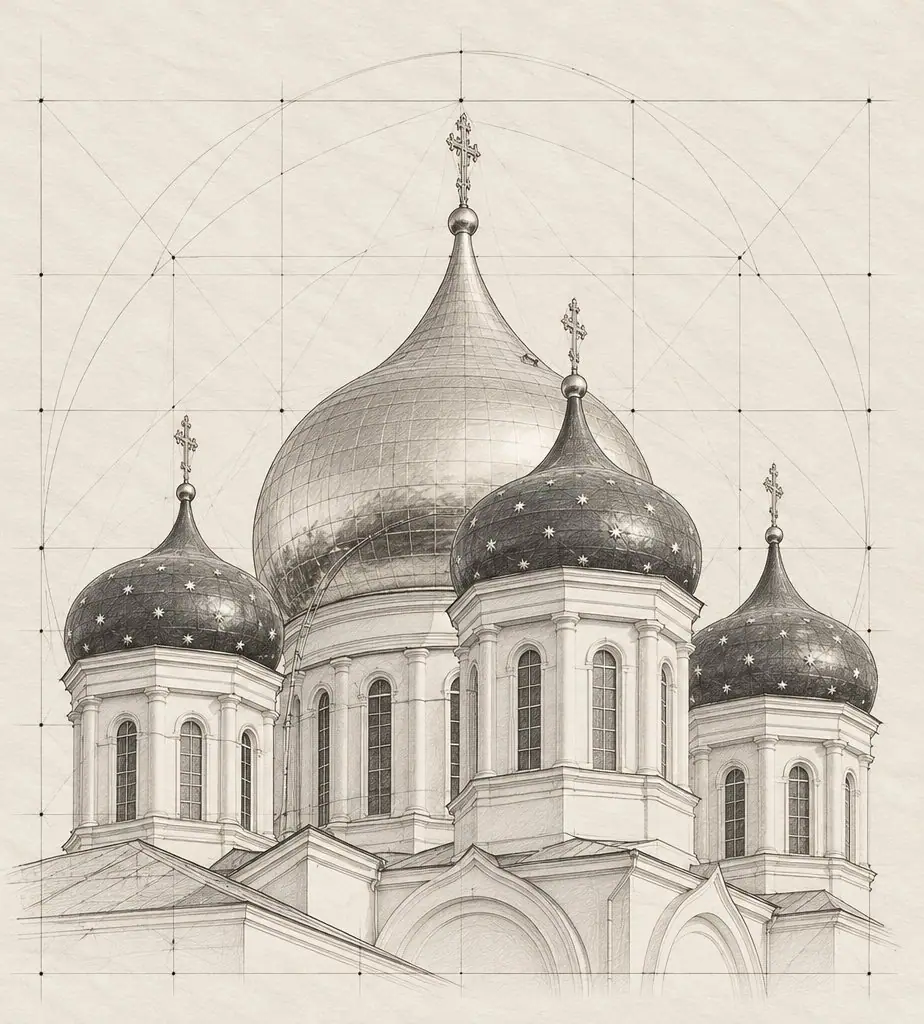
The central dome was destroyed by a bomb during the Second World War. The restored dome was gilded in 2012, and it now echoes the dome of the bell tower.
Details that are easy to miss
A cathedra “by inheritance”. The Dormition Cathedral became a cathedral not because it was conceived that way. According to sobory.ru and russian-church.ru, this happened in 1932, when the city’s main church — the Transfiguration Cathedral — was lost to worship; in 1936 it was blown up. That cathedral was later rebuilt, while the Dormition Cathedral is still called the cathedral.
The porcelain iconostasis. According to sobory.ru (we found no other sources), a five-tier porcelain iconostasis was installed in the cathedral in 1902. Only the icon of the Dormition has survived to our time, 50 × 50 cm and weighing 25 kg. For a stonemason this is an interesting example: an iconostasis can be made of wood, stone, metal — and even porcelain, but each material survives catastrophes in its own way.
A church under water. During the war the lower church was flooded to a depth of one and a half metres. In 1942 the Romanian authorities pumped out the water and restored services precisely in the lower church.
The flag on the bell tower is a legend. According to a tradition cited by sobory.ru, Soviet underground fighters hung a red flag on the bell tower, and the Romanian authorities took it down only the following evening.
The icon from Transylvania. According to tradition, the Kasperov Icon came from Transylvania: it was brought by a Serb who settled in the Kherson region. In 1809 it passed to Captain Mykola Kasperov and his wife Yuliania, and in 1840, according to the UOCC, it shone at night and was renewed. The Kasperov estate began to be called Kasperivka, and in 1844 the icon was moved to the local Church of St Nicholas. The OCA notes that the true origin of the icon is unknown. According to the UOCC, the icon travels every year: from the Feast of the Protection until Bright Thursday it is in Odesa, and then in Kherson and Mykolaiv.
The cross of the righteous Jonah. According to the Odesa Eparchy, the lower church holds the relics of the righteous Jonah of Odesa (Atamansky) and the cross with which he blessed water. This cross is one of the most venerated shrines of the cathedral. According to the UOCC and Pravoslavny Blagovest, Father Jonah was transferred to serve at the Dormition church in 1897; in 1901 he became rector of the Church of St Nicholas in the port. He died in 1924; despite the authorities’ efforts to play down the event, according to the UOCC no fewer than hundreds of thousands of people came to the funeral; other sources speak only of “all of believing Odesa”. On 22 November 1995 the Synod of the UOC glorified him as a locally venerated saint of the Odesa Eparchy, and in 2015 his name was entered in the calendar of saints. His relics rest in the lower church, where he once served. Sources give his year of birth differently — 1852 or 1855.
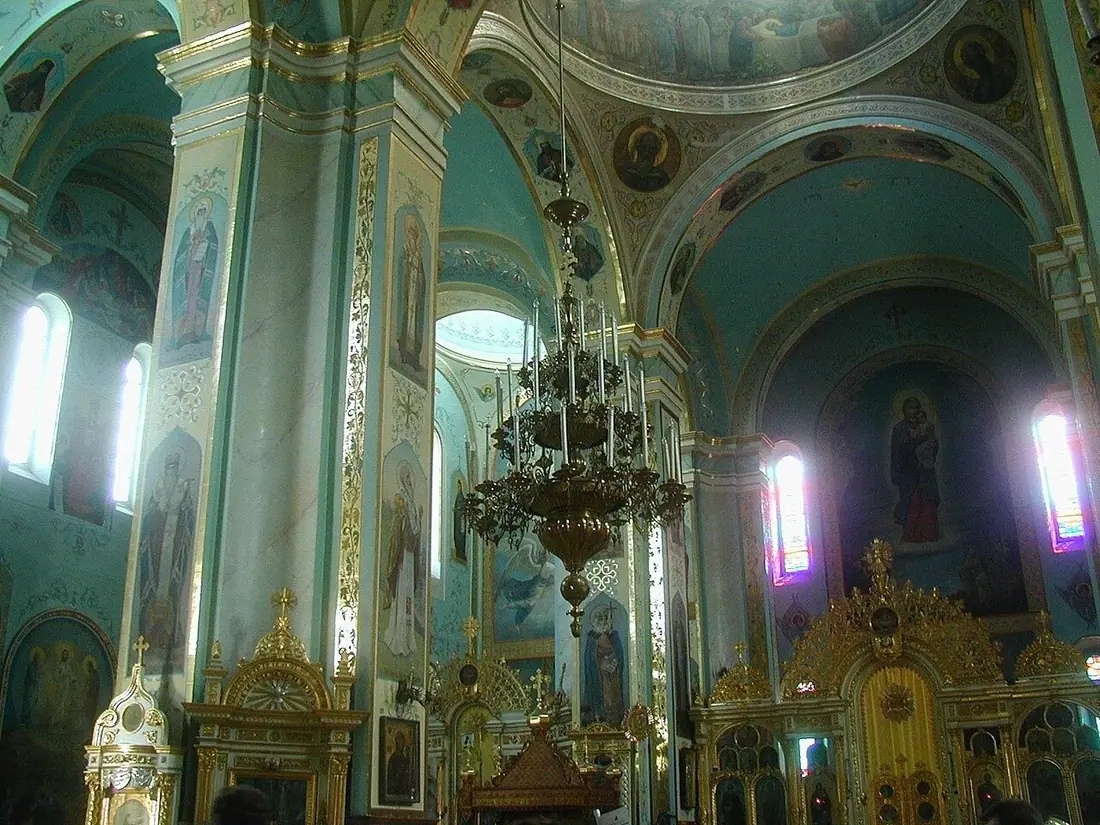
Photo gallery
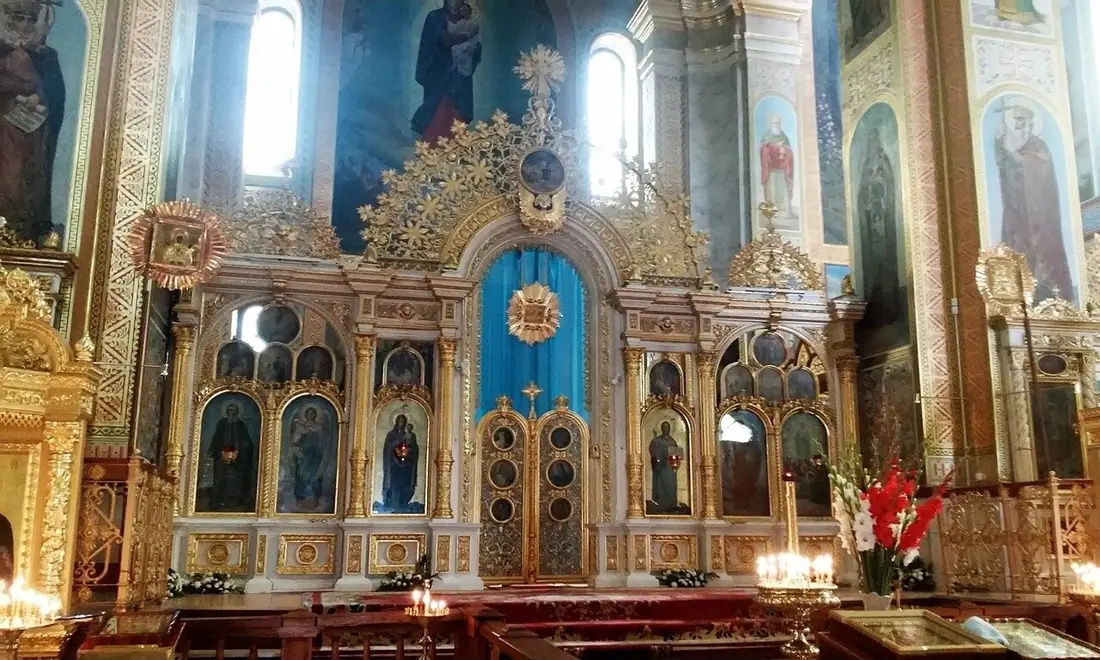
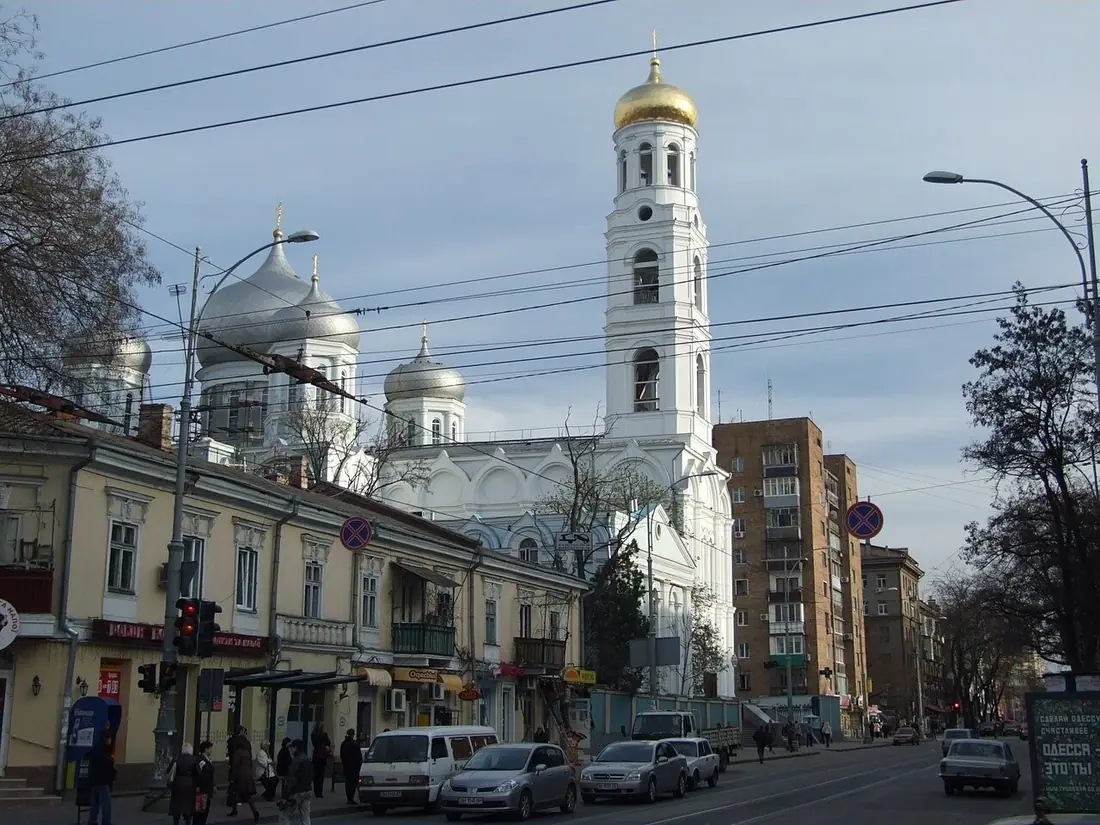
Stone and material
The sources we reviewed say little about the material of the walls, but describe in detail what the decoration was made of. The five-tier porcelain iconostasis of 1902, which sobory.ru writes about, is a rare solution for an Orthodox church. Porcelain gives a clean, light surface and fine relief, but withstands impact poorly: of the entire iconostasis only one icon remains. The gilding of the domes in 2010 and 2012 is another layer that changes more often than the walls.
The lower church adds another theme to this conversation — water. The lower church was flooded to a depth of one and a half metres, and before services could be held it had to be drained. Anyone who has worked with stone in basements and semi-basements knows: moisture does not ask how revered a space is. It rises through capillaries, brings salts to the surface, destroys joints. That is why in such churches the material of the floor, steps and plinth is chosen not for colour but for how it behaves in damp conditions.
The material of an iconostasis is not only a question of beauty but also of what will happen to it in a hundred years. Wood burns, porcelain breaks, stone is the hardest to move from its place. Such questions are worth deciding at the design stage — when choosing the material for an iconostasis. How an iconostasis is arranged and what each of its tiers holds is covered in the article “How Many Tiers Are in an Iconostasis”, and the stone version in the article “The Stone Iconostasis”.
The church whose destruction made the Dormition Cathedral a cathedra is the Transfiguration Cathedral in Odesa.
Did you know
The lower church was consecrated twice: on 19 January 1875 (the altar of St Nicholas) and on 30 January (the Three Hierarchs). [1, 2]
The lower church was an Edinovertsy church from the start; this is clear from the account of the 1875 consecration. [1, 2]
After the consecration of the lower church, Muscovites donated icons and utensils to it. According to Dumskaya. [2]
According to Drevo, the upper church has the altars of the Dormition, the Apostle James and St Xenia of Miletus, and the lower church those of Nicholas, the Three Hierarchs and the Entry into the Temple. [4]
According to Drevo, the height with the bell tower is 56 m, and the capacity is 5,000–6,000 people. [4]
Father Jonah had nine children. [13, 14, 15]
Before moving to Odesa, Father Jonah served for eight to ten years in the village of Kardashivka; there more than two hundred Stundists accepted Orthodoxy. [13, 14, 15]
According to the UOCC, hundreds of thousands of people came to Father Jonah’s funeral; the authorities forbade the funeral on Sunday, but on Monday even more people came. Other sources speak of “all of believing Odesa”. [13, 17]
Sources give different years for the birth of Jonah Atamansky. [13, 14, 15]
22 November 1995 — local glorification; 27 October 2015 — entry in the calendar of saints of the UOC. [16]
The ESU mentions the cathedral only in a list of surviving churches of Odesa: “Svyato-Uspen. sobor, tserkva ikony Presvyatoyi Bohorodytsi vsikh skorbotnykh radist (both — 1869)”. [5]
Odesa also has the Dormition Patriarchal Monastery (founded in 1824; its Dormition church was blown up in 1936). That is a different church. [25]
Services in the lower church resumed in 1942, and in 1944 the “Dormition Cathedral” was listed among the 22 communities of the city. [1, 2, 10]
Legends
The fog of 1854
According to tradition, when the allied fleet besieged Odesa and a bombardment was expected on the Feast of the Protection, a thick fog covered the sea and the city, and the ships withdrew. Recorded in a UOCC publication. The OCA dates the deliverance to 1 October 1855 and to a moleben by Archbishop Innocent. [11, 12]
The icon from Transylvania
According to tradition, the icon was brought by a Serb from Transylvania: the UOCC and the OCA give the 16th century, Ukrinform the middle of the 18th. [11, 12, 20]
The renewal of the icon
According to tradition, in February 1840 Yuliania Kasperova saw that the darkened face of the icon had become light. Recorded by the OCA and the UOCC. [11, 12]
The cholera of 1922
According to tradition, the icon protected the village of Hnyliakove in the Odesa region from the cholera of 1922. Recorded only in Ukrinform’s infographic. [20]
The flag on the bell tower
According to a tradition cited by sobory.ru, Soviet underground fighters hung a red flag on the bell tower, and the Romanians took it down only the following evening; a memorial plaque once commemorated this. [1]
The icon along the coast
According to Oleh Kiper (December 2024), at the start of the invasion Metropolitan Agafangel drove along the coast with an icon, a storm rose, and the landing did not take place. Kiper did not name the icon, and he himself called this a “legend”. [21]
Figures
- Armand-Emmanuel du Plessis, Duke de Richelieu — governor of Odesa; according to sobory.ru, he helped with the construction of the chapel in 1814.
- Innocent (Borisov) — Archbishop of Kherson and Taurida; laid the foundation of the cathedral on 17 July 1855.
- Yakiv and Mykola Cherepennikov — Odesa merchants who, according to sobory.ru, gave the main funds for the construction.
- L. Ts. Otton — architect of the cathedral (according to sobory.ru).
- Dmitry (Muretov) — Archbishop of Kherson and Odesa; consecrated the cathedral in April 1869.
- Leonty — archbishop; consecrated the altars of the lower church in January 1875.
- Jonah Atamansky (of Odesa) — priest; served at the Dormition church from 1897; died 30 May 1924; his relics are in the lower church of the cathedral.
- Mykola and Yuliania Kasperov — owners of the Kasperov Icon; the icon was renewed on their estate in 1840.
- Nikon, Boris, Agafangel — a bishop and metropolitans who, according to sobory.ru, restored and renovated the cathedral.
- Oleh Kiper — head of the Odesa Regional Military Administration; author of the 2022 account about the icon.
How to cite
IKONASTONE. The Holy Dormition Cathedral in Odesa // Guide to the Churches of Ukraine. URL: https://ikonastone.com/en/guide/dormition-cathedral-odesa/ (accessed DD.MM.YYYY).
Not sure what the piece is called? Walk through the church from sanctuary to churchyard →
Would you like to give something to a church? What to give a church →
Want to remember loved ones or a fallen parishioner? Remembrance at a church →
FAQ
When was the Holy Dormition Cathedral in Odesa built?
St Innocent laid the foundation of the new church on 17 July 1855. Construction took 14 years, and the cathedral was consecrated in April 1869 — sources give 12 or 13 April. The lower church was consecrated in 1875.
Who was the architect of the cathedral?
According to sobory.ru, the architect was L. Ts. Otton, and the main funds were given by the Odesa merchants Yakiv and Mykola Cherepennikov.
Why did the Dormition church become the cathedral?
According to sobory.ru and russian-church.ru, the Dormition church became the cathedral in 1932 with the blessing of Metropolitan Sergius, because the Soviet authorities closed the Transfiguration Cathedral on 2 March 1932; it was dismantled in 1936.
What holy objects are kept in the cathedral?
The relics of St Jonah of Odesa and the cross with which he blessed water, and an icon of St Innocent with a particle of his relics. The Kasperov Icon of the Mother of God is associated with the cathedral, but every year it travels between Odesa, Kherson and Mykolaiv.
How tall is the cathedral?
According to Drevo, the height of the cathedral together with the bell tower is 56 metres, and it holds 5,000–6,000 people.
Sources 25
- Sobory.ru. Кафедральный собор Успения Пресвятой Богородицы, Одесса
- Думская. Свято-Успенский собор Одессы. Нижний храм
- Komandirovka.ru. Свято-Успенский кафедральный собор
- Древо. Одесский Успенский собор
- ЕСУ. Одеса
- Українська правда. Життя. Двічі страждав від окупантів: що відомо про Спасо-Преображенський собор в Одесі (23.07.2023)
- Kyiv Post. The Troubled History of the Cathedral of Odesa: Foundation, Demolition and Revival
- Odessa Journal. History of the Spaso-Preobrazhensky Holy Transfiguration Cathedral of Odessa
- Радіо Свобода. «Знищили більшовики, знищили путінці, але українці знову відродять» (2023)
- В. Щетников. Православная церковь в Трансністрии (1941–1944 рр.) // Одесика, 2002, с. 248–253
- UOCC. Kasperivs'ka Icon of the Mother of God
- OCA. Icon of the Mother of God of Kasperov
- UOCC. The Righteous Priest of Odesa
- Православный благовест Нью-Йорка. Праведный Иона Одесский (+1924)
- Азбука веры. Праведный Иона, Одесский чудотворец (1855–1924)
- УПЦ. Журнали засідання Священного Синоду від 27 жовтня 2015 року
- St John the Wonderworker Church. Jonah Atamansky, of Odessa, Archpriest, righteous
- Думская. В Одессе накануне Нового года обокрали кафедральный собор (01.01.2016)
- Думская. Томосом по куполу: как отразятся процессы в украинском православии на Одесской области
- Укрінформ. Чудотворні ікони українських храмів. Інфографіка
- Zaxid.net. Голова Одеської ОВА вважає, що митрополит УПЦ МП завадив висадці російського десанту (16.12.2024)
- Orthochristian. Wonderworking icon survives severe damage to Odessa Cathedral (2023)
- LB.ua. Патриарх Кирилл освятил собор в Одессе (21.07.2010)
- Журнал «Art and Design» (КНУТД). Стаття про Одеський Спасо-Преображенський собор
- ЕСУ. Одеський Свято-Успенський патріарший чоловічий монастир
- Town
- Odesa, Odesa Oblast
- Built
- 1855–1869; lower church consecrated in 1875
- Type
- two-level church (upper and lower) with a bell tower; Russian-Byzantine style
- Material
- masonry
- Research depth
- 29%