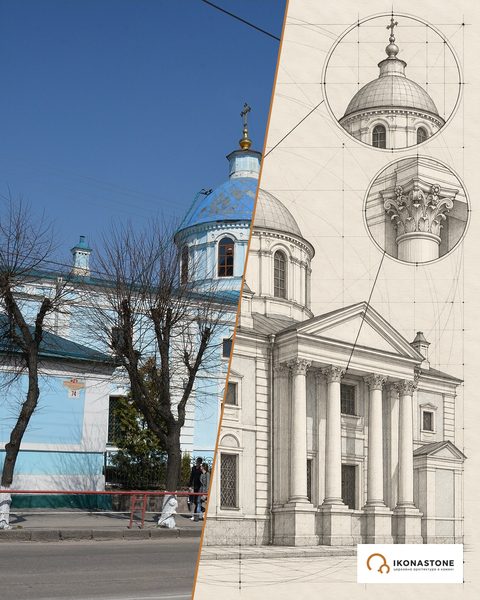
St Catherine's Cathedral in Kherson: limestone, a portico and a lantern drum
Kherson began as a fortress, and the cathedral within it was founded as a sign of victory. More than two centuries later, a shell in 2024 struck precisely the tier that gives the church its light: the drum beneath the dome.
In brief
| Address | 13 Perekopska Street, Kherson (grounds of the former fortress) |
| Built | 1781–1786 (consecrated on 17 May 1786); according to other sources, 1782–1787 |
| Architect | Ivan Starov (construction led by Ivan Sitnikov) |
| Type | single-domed early Classical church with a Tuscan portico |
| Material | pale yellow Inhulets limestone (according to English-language sources, sandstone) |
| Burials | crypt of Prince Grigory Potemkin (1791); next to the cathedral, the “Pantheon of the Kherson Fortress” |
History
The first stone of the cathedral was laid in 1781 by General Ivan Gannibal on behalf of Catherine II. The church was dedicated to the holy Great Martyr Catherine, the heavenly patron of the empress; it was meant to commemorate the annexation of the steppe Black Sea coast to the Russian Empire. The design is associated with the name of Ivan Starov, who worked for Prince Potemkin; the construction was directed by Ivan Sitnikov. According to M. Korsakov’s report to Potemkin of 26 May 1786, the cathedral was consecrated on 17 May by Nikephoros, Archbishop of Slaviansk and Kherson.
The iconostasis was painted by M. Shibanov in 1783–1786. English-language sources add that the icons were modelled on 17th-century Spanish paintings from the Hermitage, including works by Murillo; some images are attributed to Volodymyr Borovykovskyi and Dmytro Levytskyi. The cathedral still keeps a chair made specially for the empress.
In 1791 Grigory Potemkin was buried in the cathedral crypt. Military commanders killed in the Russo-Turkish War of 1787–1791 were buried beyond the enclosure; this place is called the “Pantheon of the Kherson Fortress”. At the end of October 2022, during the occupation of Kherson, Russian troops took Potemkin’s remains out of the city.
After 1917 the cathedral was closed, in 1922 its valuables were confiscated, and later an anti-religious museum was set up in it. Most of the icons were lost; a few ended up in the local art museum. During the German occupation the church was reopened, and in 1962, during Khrushchev’s anti-religious campaign, it was closed a second time. On 25 August 1991 the cathedral was returned to the church community.
The war reached the cathedral again after the city’s liberation. In August 2023 the roof caught fire after artillery shelling. On the night of 27 December 2023 the facade, roof and windows were damaged. On 20 December 2024, at five in the morning, a shell hit the lantern drum beneath the dome; according to church representatives, the facade and interior suffered significant damage.
Architecture
The cathedral belongs to early Classicism; the sources also note motifs of medieval Balkan architecture in it. The walls are heavily rusticated, and the building is crowned by a small hemispherical dome.
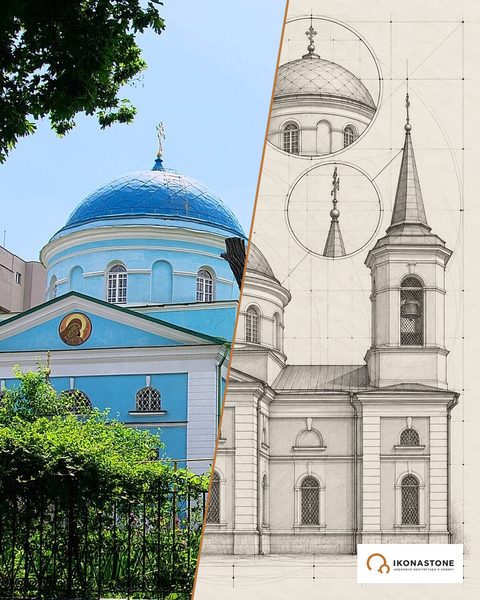
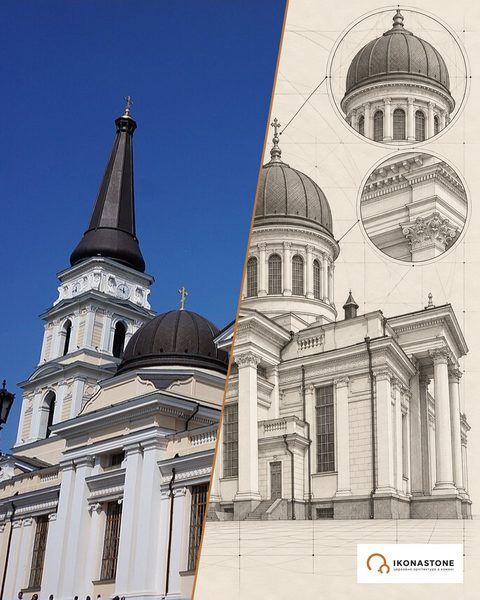
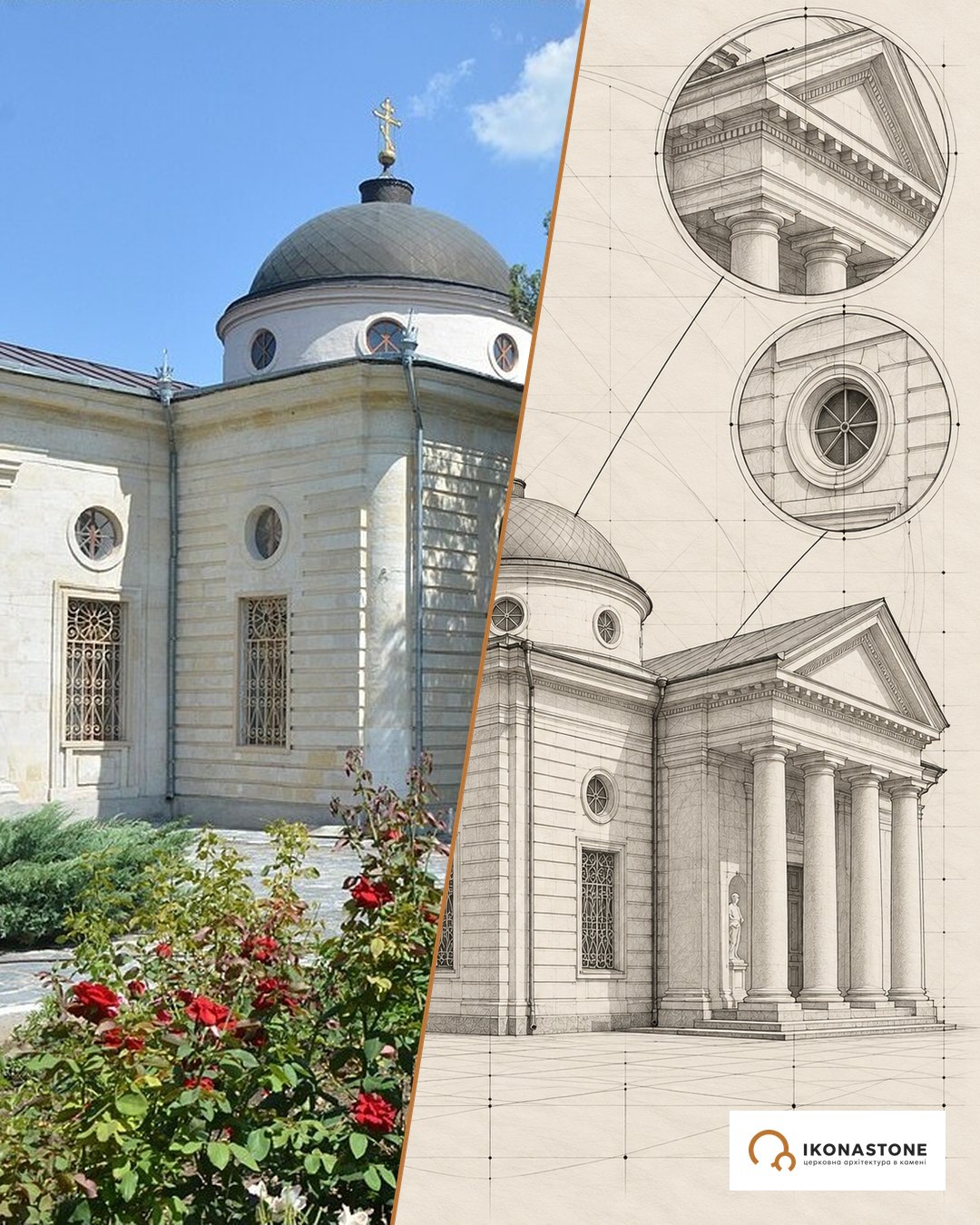
Below are two elements of the church: in a photo and in a drawing. The drawings show the form, not exact dimensions.
The Tuscan portico
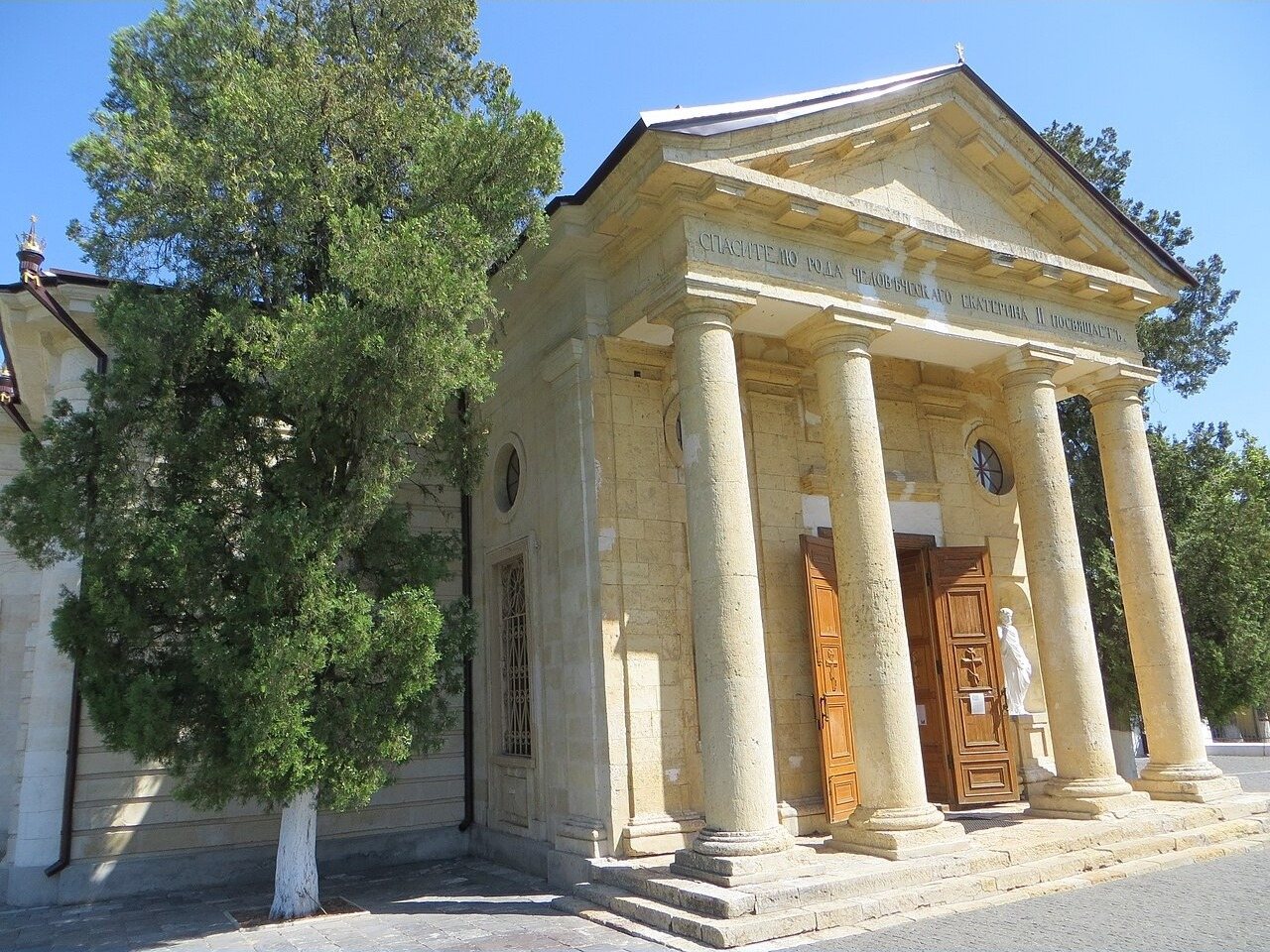
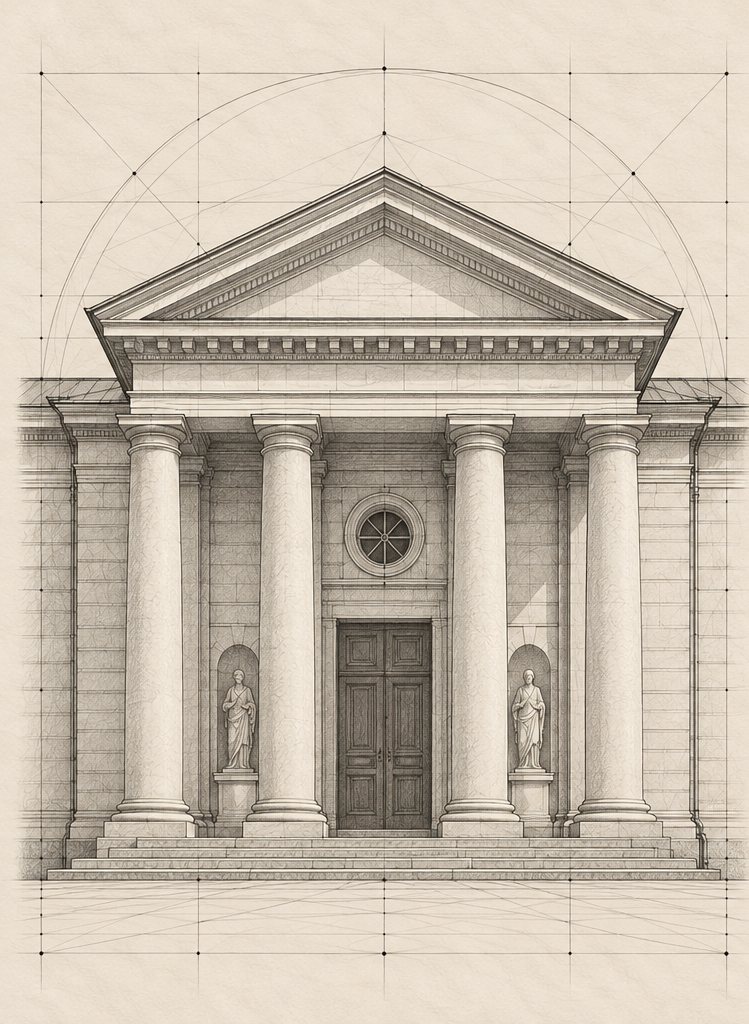
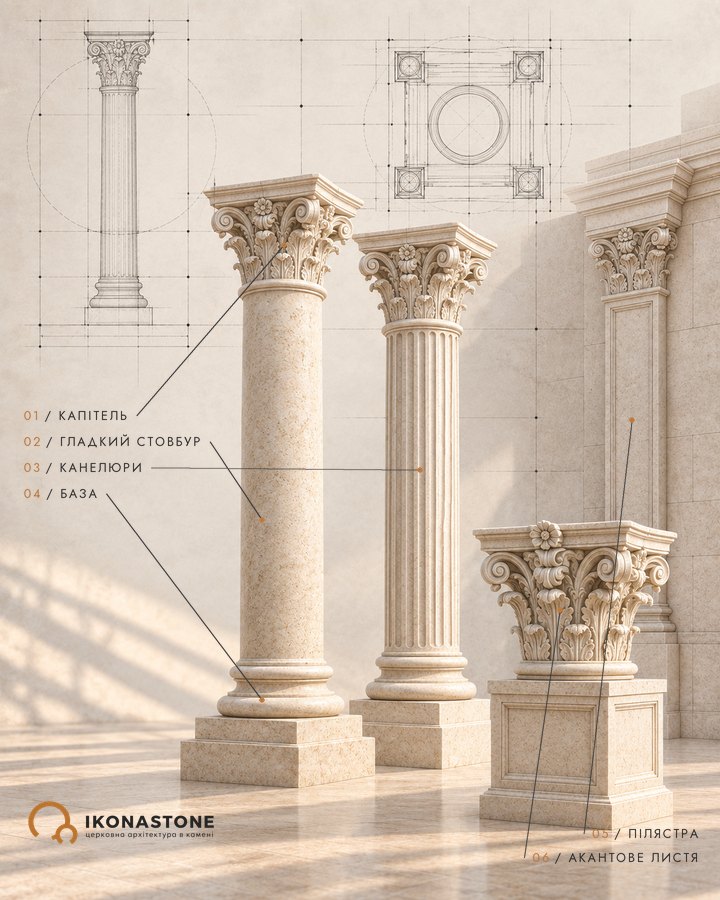
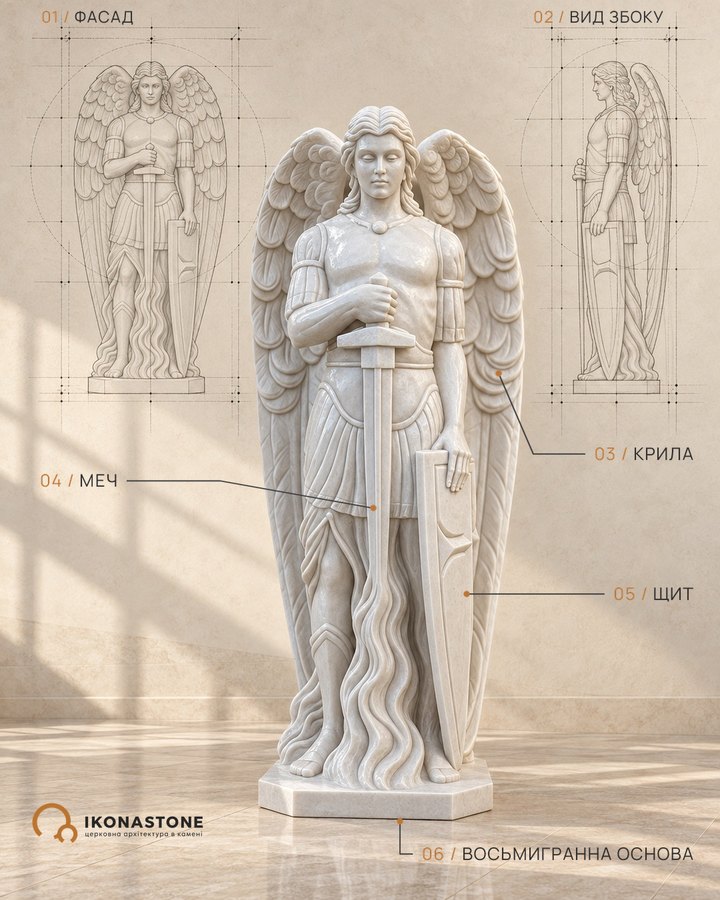
The Tuscan order is the simplest and heaviest of the classical orders: a smooth shaft, a sparse base, a capital without leaves. For a cathedral in a fortress it is an apt choice. According to the regional library, the niches of the facades hold statues by G. Zamaraev: the Apostles Peter and Paul by the central entrance, and Saints Barbara and Catherine on the north and south.
A dome on a lantern drum
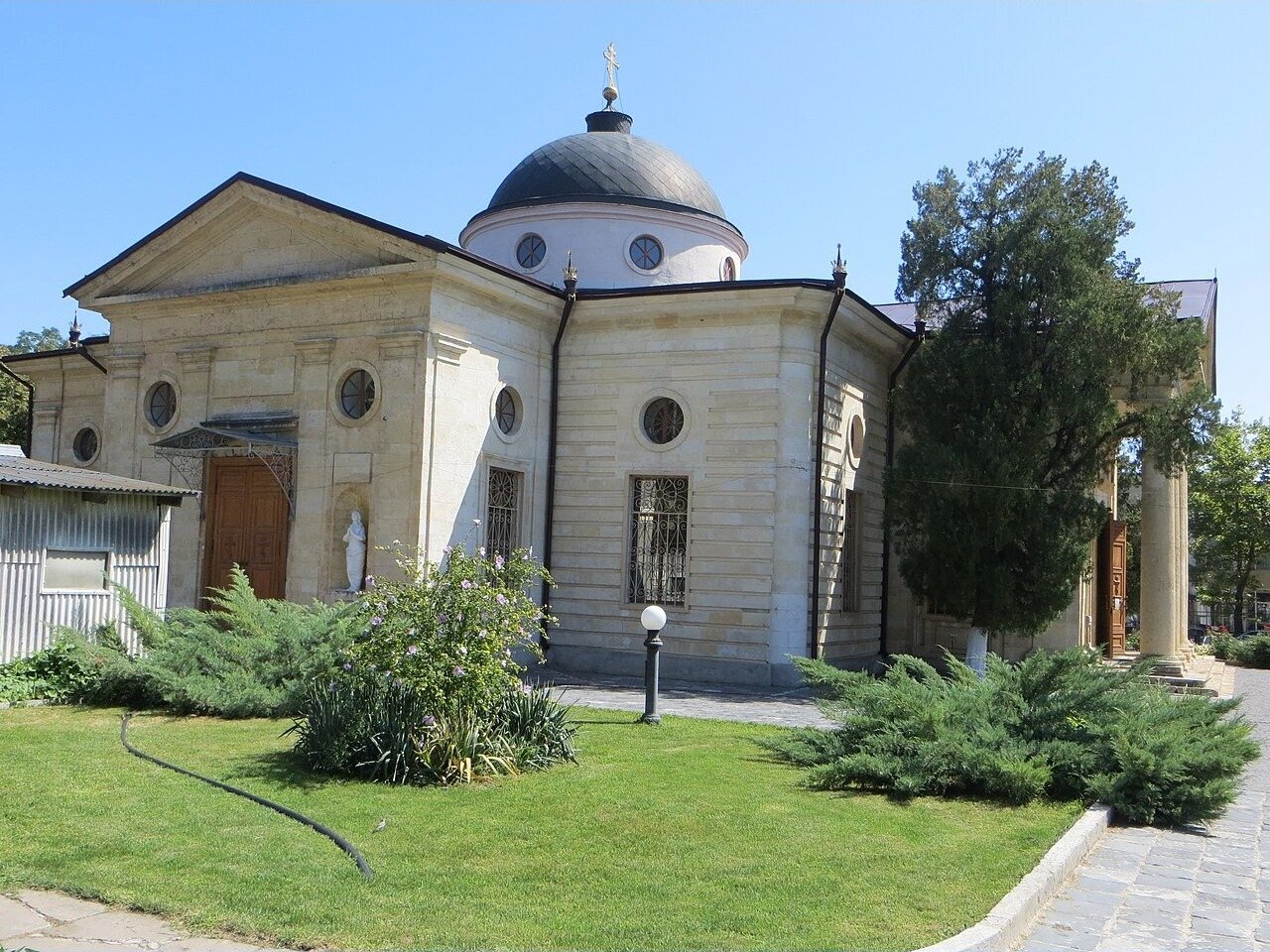
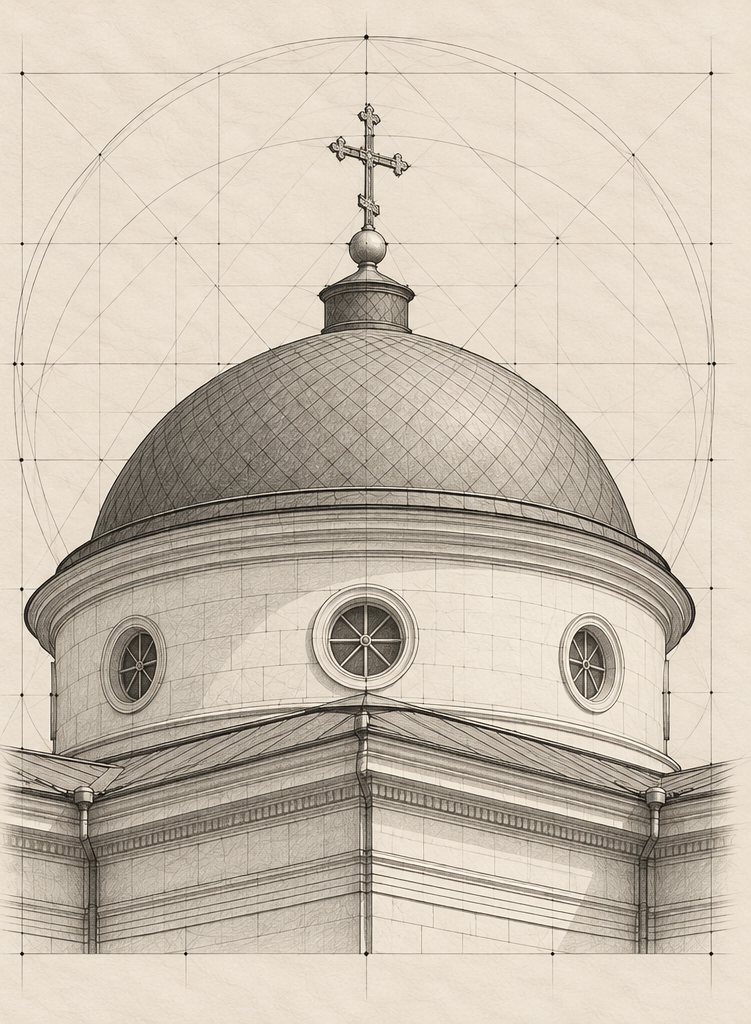
The dome is small and hemispherical. In 1790, according to English-language sources, Starov was asked to remodel it after the dome of Potemkin’s Tauride Palace in St Petersburg. The lantern drum beneath it is a tier of windows through which light falls into the centre of the church. It was this drum that the shell hit in December 2024.
The bell tower
The history of the bell tower is tangled in the sources. The first one, according to the library, was wooden. English-language sources mention a bell tower of 1800, dismantled after an earthquake, and a Classical bell tower of around 1806 that was later demolished. Today there is a bell tower next to the cathedral; we have not been able to confirm when it was rebuilt.
Stone and material
The Kherson Regional Library names pale yellow Inhulets limestone as the material of the cathedral; English-language sources speak of sandstone. Both are sedimentary rocks, and both take the chisel well. The heavy rustication of the walls is an old device: the joints between the blocks catch the shadow and make the masonry legible from afar.
A sedimentary stone that yields easily to the chisel reacts just as noticeably to time, water and blast waves. That is why restoring such facades is not a matter of replacing blocks but of choosing stone that will behave in the same way as the old. The statues in the niches of the facade are a reminder that sculpture in a church is conceived together with the architecture, while the Tuscan columns of the portico are the simplest example of how columns and capitals work.
FAQ
Where is the cathedral located?
In Kherson, on the grounds of the former Kherson fortress, at 13 Perekopska Street.
When was the cathedral built?
The first stone was laid in 1781 and construction was completed in 1786; according to M. Korsakov's report to Potemkin, the church was consecrated on 17 May 1786. Other sources give 1782–1787, and some extend the construction to 1806.
What stone is the cathedral built of?
The Kherson Regional Library names pale yellow Inhulets limestone as the material. English-language sources describe it as sandstone.
Was the cathedral damaged during the war?
Yes. In August 2023 the roof caught fire after artillery shelling; on the night of 27 December 2023 the facade, roof and windows were damaged; on 20 December 2024 a shell hit the lantern drum beneath the dome, and the facade and interior were badly damaged.
Sources
- Town
- Kherson
- Built
- 1781–1786
- Type
- single-domed early Classical church with porticoes
- Material
- limestone (according to other sources, sandstone)
- Research depth
- 16%