St Florian's Church in Sharhorod: a basilica with a wavy silhouette
St Florian on Sharhorod’s coat of arms puts out a fire with a jug of water. The church named after him has itself come through fire and ruin more than once.
In brief
| Address | 216 Heroiv Maidanu Street, Sharhorod, Vinnytsia Oblast |
| Built | 1590–1595; consecrated on 3 November 1596 (according to other data, 1595) |
| Type | three-aisled basilica |
| Material | rubble limestone, rendered and whitewashed |
| Status | architectural monument of national importance |
| Now | active parish church; Sanctuary of the Passion of the Lord, All-Ukrainian Calvary |
History
Sharhorod was founded by Crown Chancellor and Grand Crown Hetman Jan Zamoyski. In 1590–1595 a small masonry church was built here at his expense. According to the portal of the Roman Catholic Church in Ukraine, on 3 November 1596 it was consecrated by Bishop Paweł Wołucki in honour of St Florian, patron of the Zamoyski family; other sources give 3 November 1595 as the day of its opening. The parish received a village and other property from the founder, and the founder’s son Tomasz Zamoyski later increased its endowment. In the same years a fortress was being built in the town, and in 1589 a masonry synagogue.
In 1648, during the Cossack–Polish war, the church was destroyed. Then came the period of Turkish rule, when the church stood in ruins and the parish ceased to exist. In 1716, on the initiative of Bishop Stefan Rupniewski, the parish was restored; in 1717 the rebuilding of the church began, and it gathered pace after 1739. In 1750 the high altar was dedicated to Christ Crucified, and the side altars to St Anthony, St John of Nepomuk, St Anne and the Annunciation. By 1829 the church had nine altars and a wooden bell tower with three bells. The church took on its present appearance in 1844: the facade was rebuilt, the shingle roof was replaced with sheet metal and the interior was renovated. Another restoration was carried out at the beginning of the 20th century.
In the 1930s the Soviet authorities closed the church and turned it into a warehouse; the altars were destroyed and the bell tower dismantled. During the German–Romanian occupation services resumed, and at the turn of the 1950s and 1960s the faithful defended the parish from being dissolved. In 1993 a Franciscan friary was established at the church. In 2017 the church and the Way of the Cross were proclaimed a Sanctuary of the Passion of the Lord, and in 2024 an All-Ukrainian Calvary.
Architecture
The church is a three-aisled basilica with a tall nave and lower side aisles. The interior is covered by a barrel vault with lunettes over the windows; the vault bears ornamental painting in the grotesque manner, which the sources date to the time of construction or to the rebuilding of 1717. Along the walls are fourteen high reliefs of tinted alabaster in portal-like frames — the Stations of the Cross; CREDO considers them later than the church itself. According to the guidebook by Dmytro Malikov, the high altar holds a crucifix by old Italian masters, and an old portrait of Jan Zamoyski is kept in the sacristy. In 2007 the Sharhorod historical and cultural centre, which includes the church, was among the winners of the “Seven Wonders of the Vinnytsia Region” contest.
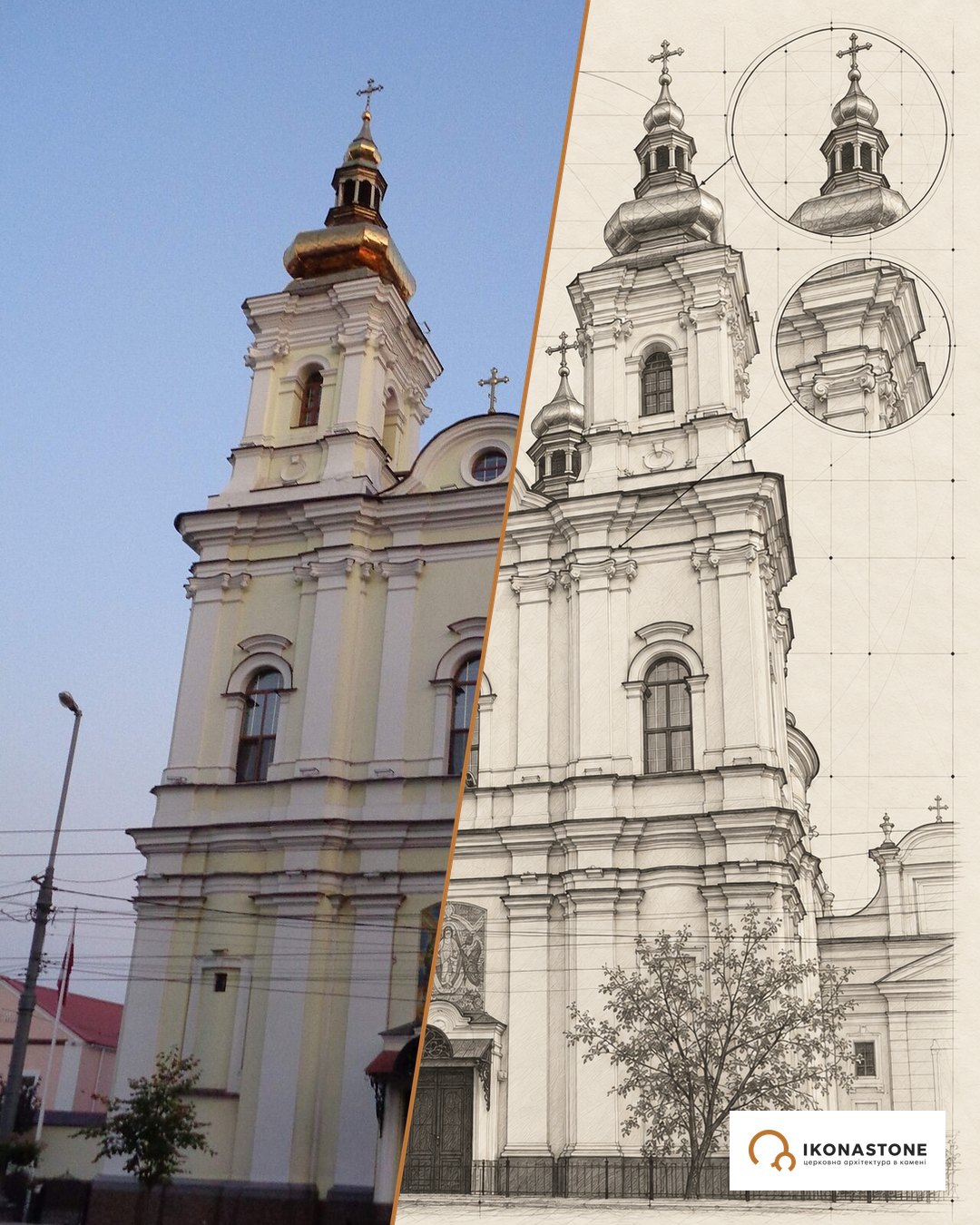
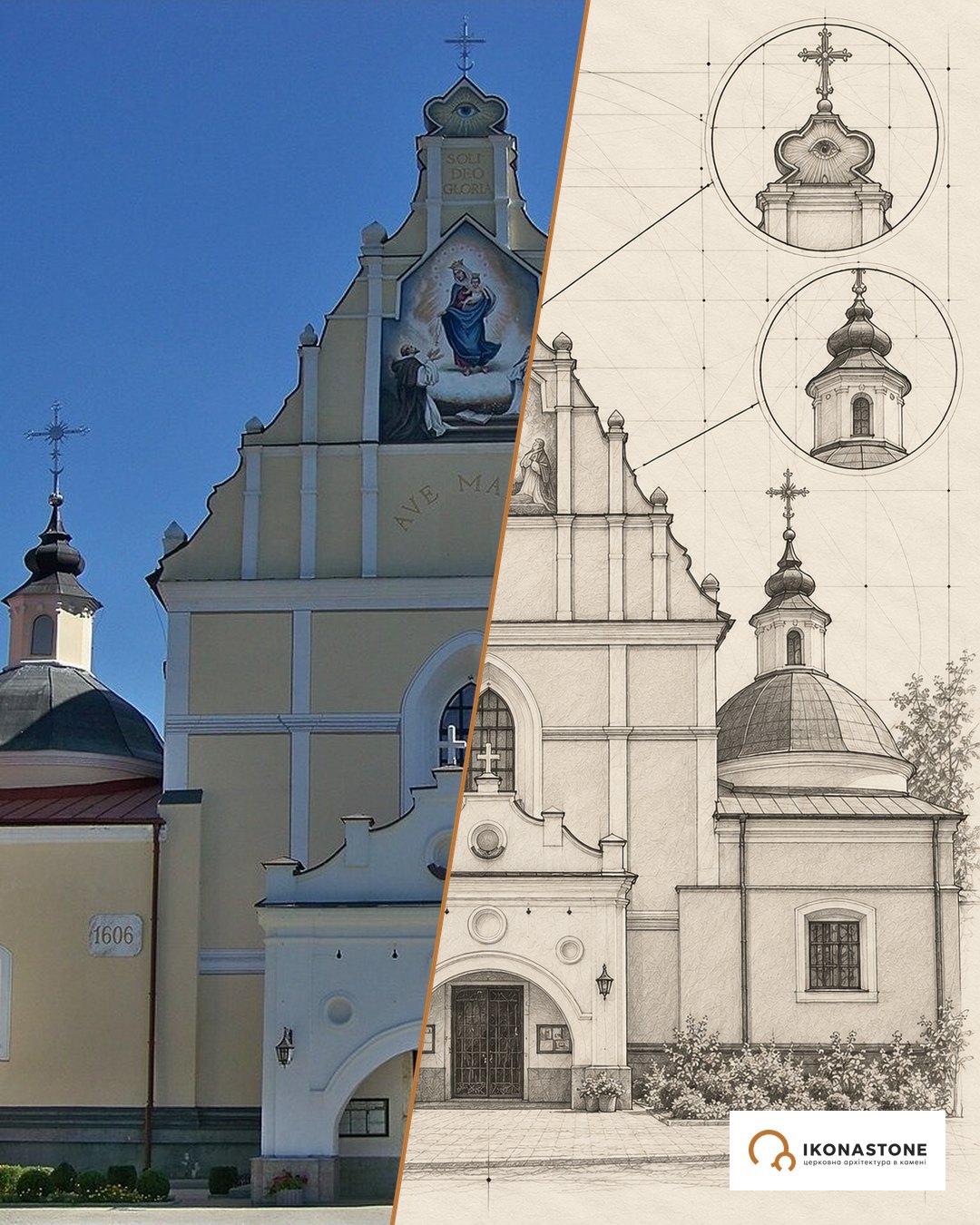
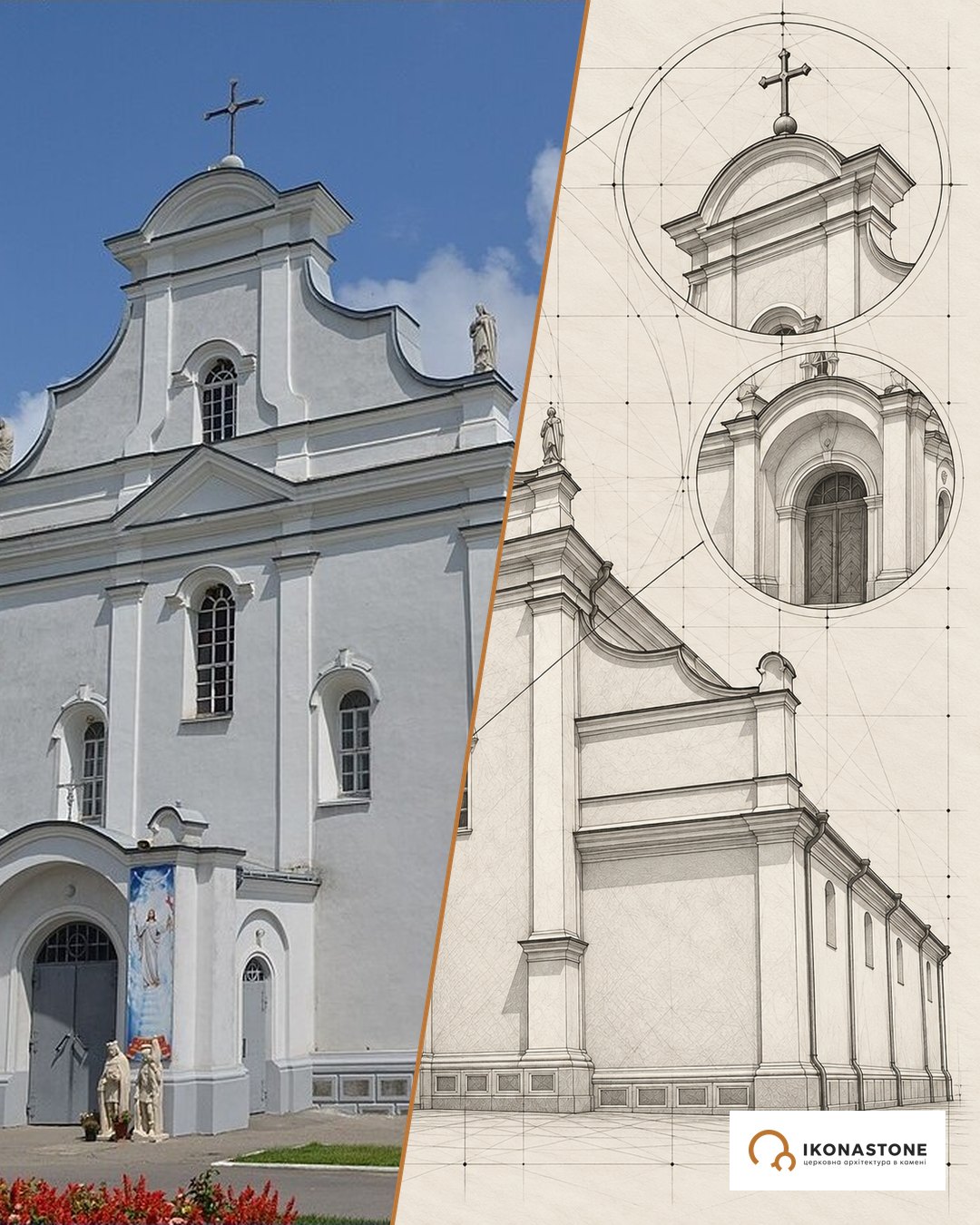
Below are two elements of the church: in a photo and in a drawing. The drawings show the form, not exact dimensions.
The main facade with attics
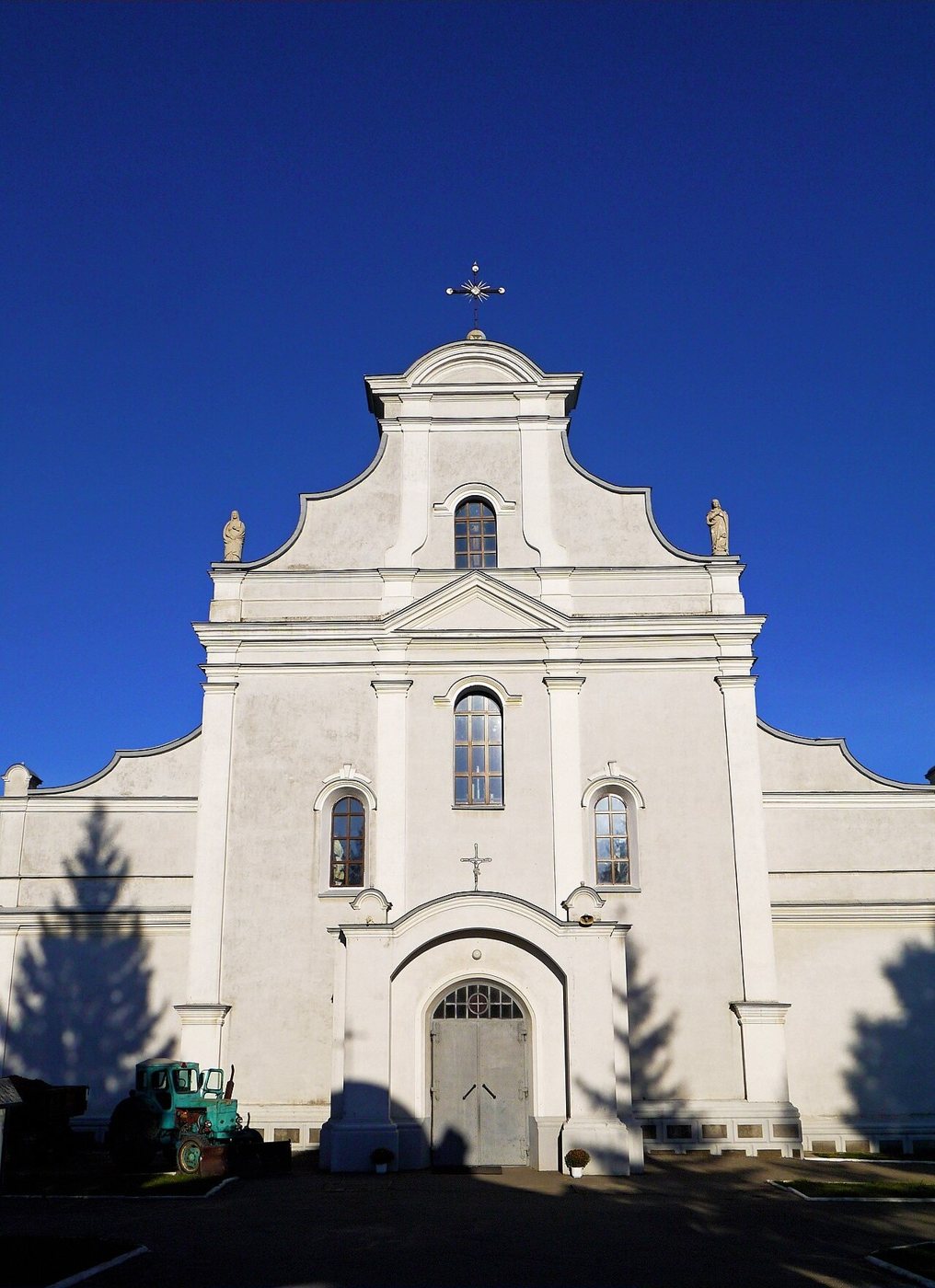
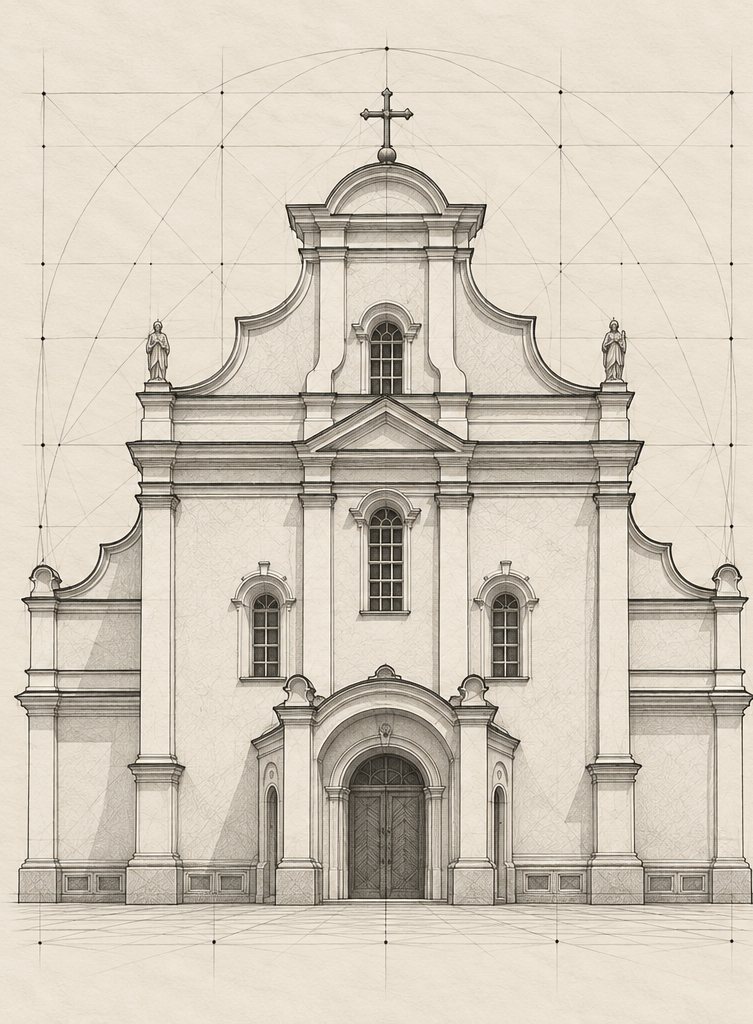
The facade decoration is restrained, but the silhouette is not. The wavy outlines of the attics above the side aisles are repeated in the tall central attic, crowned by a small semicircular pediment with a cross. The facade reads as three voices singing one melody at different pitches.
The gate
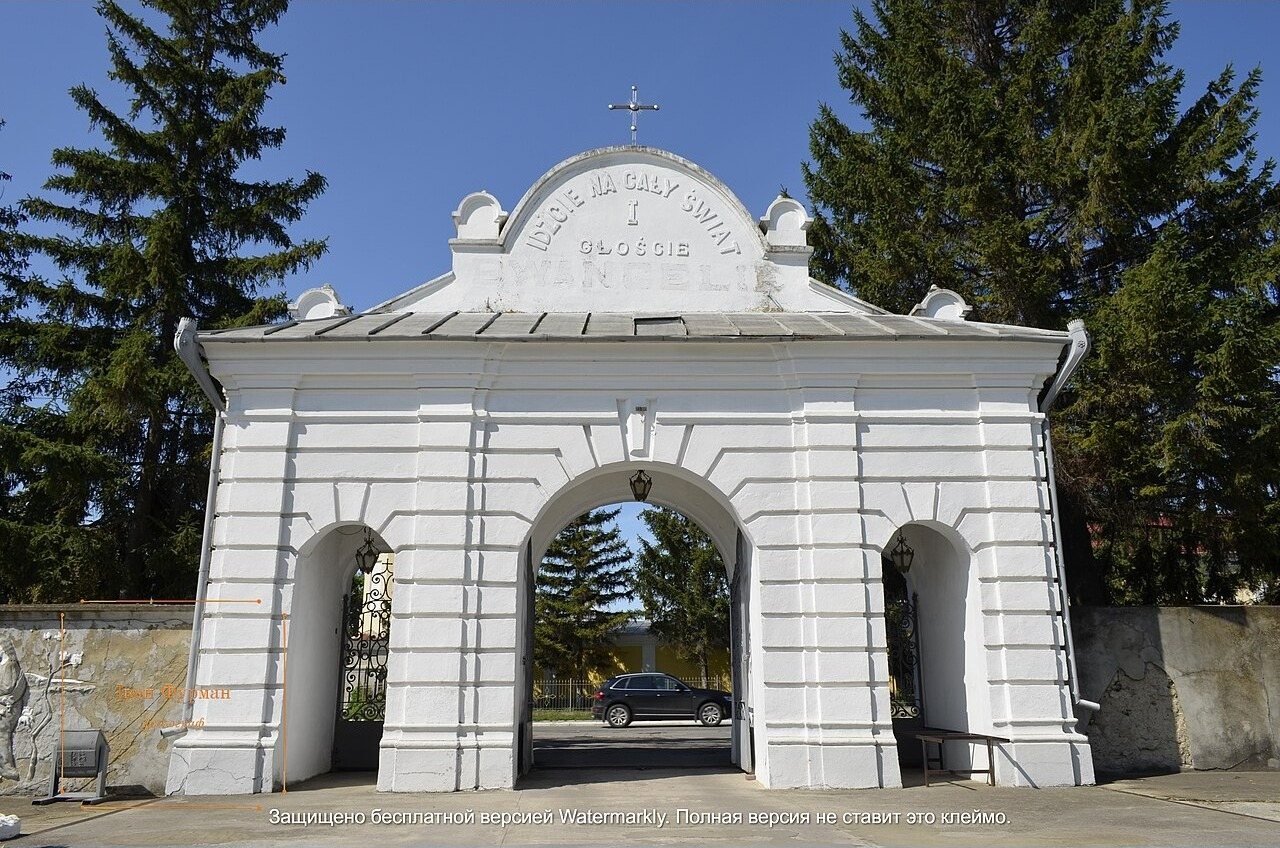
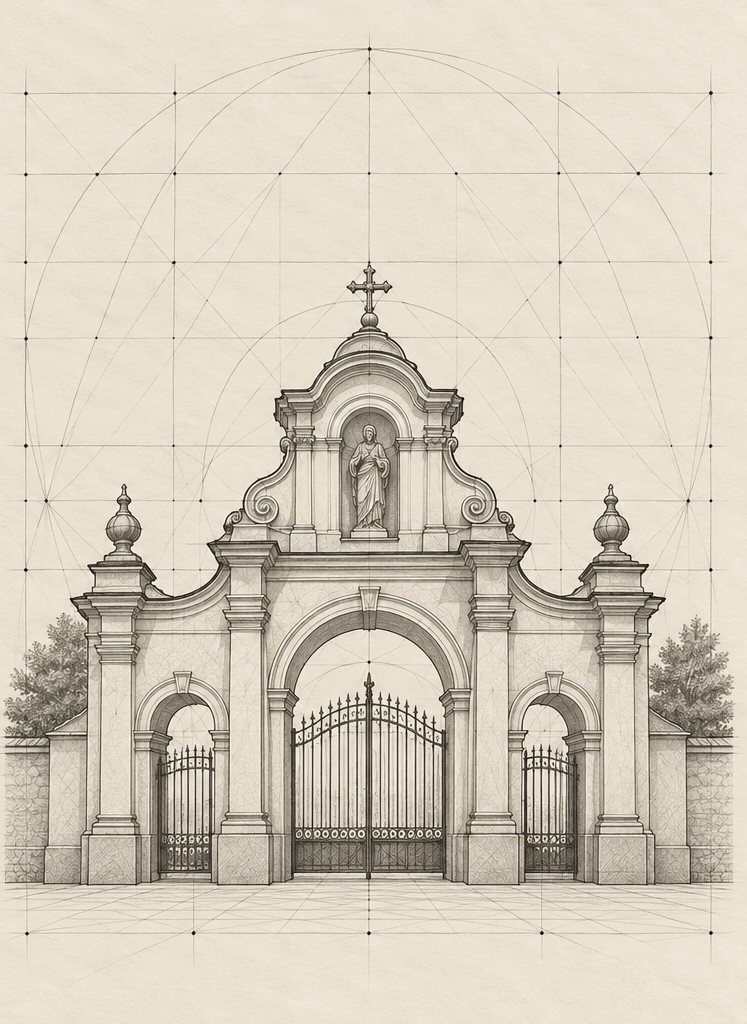
The church ensemble includes an 18th-century gate, an enclosure wall with a relief, a statue of St Florian and a fountain. The gate sets the first threshold: from the town street to the churchyard, and from the churchyard to the church.
Stone and material
The walls are built of rubble limestone — stone that is not dressed into regular blocks but laid as it came from the quarry, levelled with mortar. Such masonry is then rendered and whitewashed, so the stone hides beneath a light surface, and the form of the building is defined only by the lines of the attics and cornices.
Limestone is a forgiving material to work, but sensitive to water. The white surface of the facade on such a church is not just a colour but a protective layer that must be renewed in time.
The high reliefs of the Way of the Cross are a good example of how sculpture becomes part of a route of prayer rather than mere decoration. Another masonry church in Podillia with an equally dramatic history is the Intercession Church in Sutkivtsi.
FAQ
Who built St Florian's Church?
The church was built in 1590–1595 at the expense of the town's founder, Crown Chancellor and Grand Crown Hetman Jan Zamoyski. St Florian is the patron of the Zamoyski family.
When was the church consecrated?
According to the portal of the Roman Catholic Church in Ukraine, it was consecrated by Bishop Paweł Wołucki on 3 November 1596. Other sources give 3 November 1595 as the date of its opening.
What is the church today?
It is an active parish church, with a Franciscan friary attached to it since 1993. In 2017 the church and the Way of the Cross were proclaimed a Sanctuary of the Passion of the Lord, and in 2024 the sanctuary received the status of an All-Ukrainian Calvary.
Why is the town called Sharhorod?
The oldest version derives the name from the Polish for “grey town”. Local tradition links it to Florian Szary (the Grey), an ancestor of the Zamoyski family; St Florian also appears on the town's coat of arms.
Sources
- Town
- Sharhorod, Vinnytsia Oblast
- Built
- 1590–1595; rebuilt from 1716–1717
- Type
- three-aisled basilica
- Material
- rubble limestone, rendered and whitewashed
- Research depth
- 16%