Stone for Church Furnishings: Granite, Marble, Sandstone, Onyx
Sometimes the most expensive material turns out to be the wrong decision. A white marble slab that looks flawless under a lamp in the workshop can turn rough and greyish after a few winters on a church porch. And a modest grey granite that nobody wanted to pick from the samples will stand on the same steps a hundred years from now.
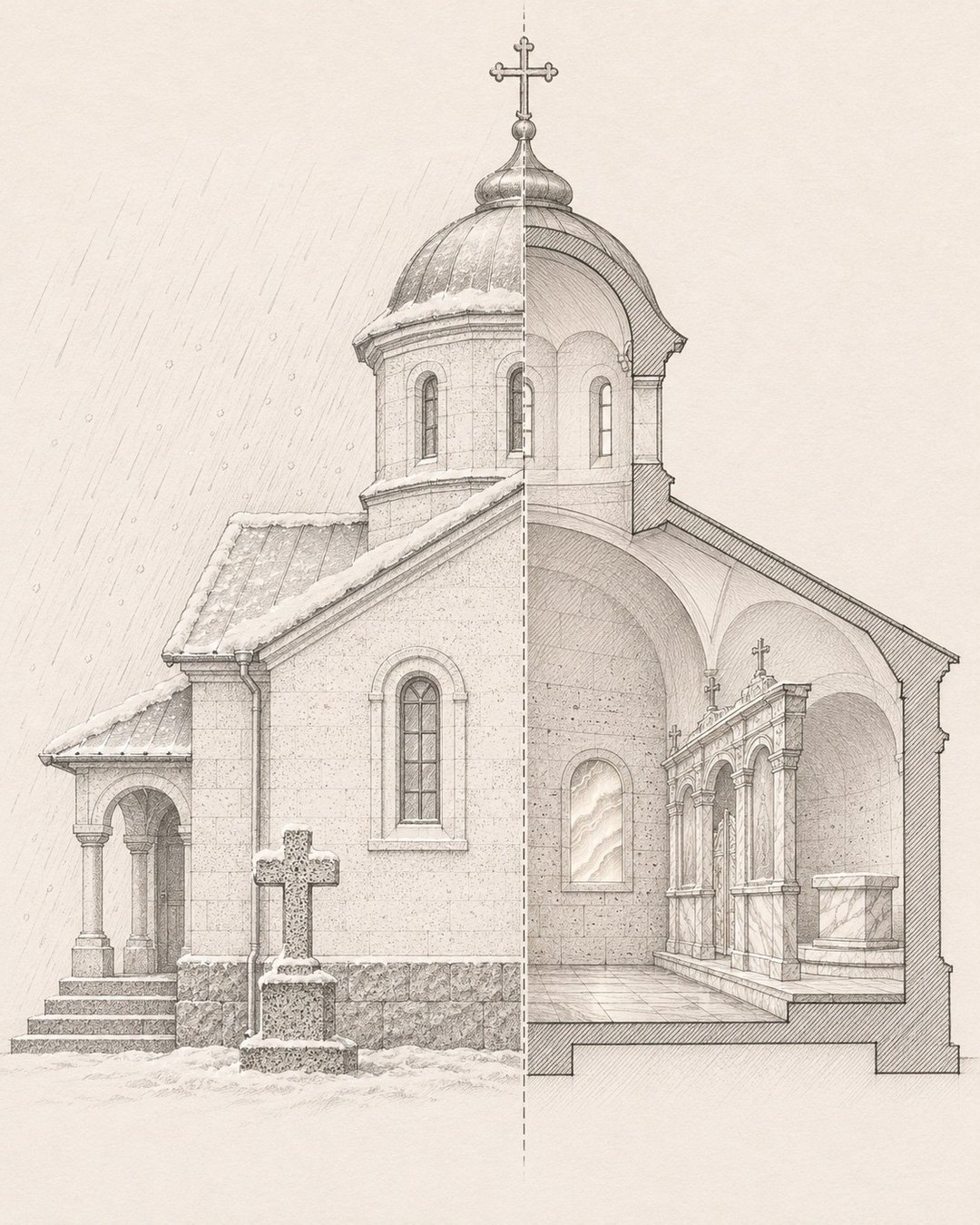
Stone for a church is chosen not by how a sample looks, but by the place where it will live. Inside there is quiet, steady temperature, the touch of hands and wax. Outside there is rain, frost, sun and the salt scattered on paths in winter. These are two different worlds, and stone behaves differently in each.
This article is for the rector, the building committee and donors. It explains in plain words the six stones most often used in a church: what kind of rock each is, what it fears and where it belongs.
In brief
- Granite is the hardest and most durable of the six. The first choice for everything outdoors and underfoot: steps, porch, floor, plinth, cross.
- Marble is softer and afraid of acids, but warmer in appearance and easier to carve. Its place is mostly indoors: the Holy Table, iconostasis, ciborium, cladding.
- Sandstone and limestone are porous stones with very different properties. They can last for centuries, or they can flake. You need test data for the specific batch.
- Travertine is a limestone with cavities. Good for walls and cladding; on a floor it needs careful selection.
- Onyx is translucent, but soft and afraid of acids. For interior accents only.
Granite or marble: which is better for a church?
The short answer: outdoors and underfoot, granite; in the sanctuary and on the iconostasis, most often marble or granite, depending on the design. The difference between them is not in price or prestige, but in what they are made of.
Granite is an igneous rock, a stone that solidified from a melt deep underground. It consists mostly of feldspar and quartz, hard silica-based minerals. These minerals resist acids, so rain and polluted air barely affect granite. Encyclopaedia Britannica directly lists paving stones, building stone and gravestones among its traditional uses: everything that has to stand a long time under the open sky.
Marble is a metamorphic rock. It used to be limestone that recrystallized under pressure and heat. It consists of calcite (a mineral, calcium carbonate), more rarely dolomite, and has a hardness of about 3 on the Mohs scale (a ten-point scale where talc is 1 and diamond is 10). Even an ordinary steel blade scratches marble. The main point is that calcite dissolves even in weak acid. In its guide to the effects of acid rain on Washington’s monuments, the US Geological Survey describes how marble in the rain gradually gets a “sugary” surface and loses fine carving.
Hence the logic. Marble feels fine where there is no rain, no frost and no sand on the soles of shoes. Granite is for where there is.
Can marble be used outdoors?
It can, but you need to understand the risk. Besides acid rain, marble has another, less well-known trait: thin slabs on a facade can bow over time.
The best-known example is Finlandia Hall in Helsinki, designed by Alvar Aalto. The facade was clad in Carrara marble, and a few years after the building was completed in 1971 the slabs began to bulge, and in places pulled out of their fixings. During the repairs of the 1990s they were replaced with another Carrara marble, and the problem soon returned. Methods for assessing in advance whether a facade slab will bow appeared thanks to the European research project TEAM, begun in 2000.
For a church this means something simple. A marble cross, relief or plaque under a canopy: possible. Marble steps and a porch that get snow and de-icing salt: a decision you will have to redo in time.
Sandstone and limestone: why are they so different?
Sandstone is compressed grains of sand, mostly quartz, bound by a natural “glue”. Everything depends on that glue. The US Geological Survey notes that sandstones are generally durable, but those with a carbonate cement dissolve in acid just like limestone. Another weakness is clay in the composition: it makes the stone less durable.
Limestone is made of the same calcite as marble, but without recrystallization. It is more porous than marble, so it absorbs more water. In appearance it is warm and matte, with soft light and shadow. It is easy to carve.
Both stones have a long history in church architecture. But the word “sandstone” on a drawing says little. Two sandstones from different quarries can differ as oak and linden do. That is why test data matter so much for them: water absorption (how much water the stone takes up), strength, frost resistance. What exactly to ask a supplier about frost resistance is explained in the article Frost resistance of stone.
Travertine and onyx: where do they belong?
Travertine is a kind of limestone that forms near hot mineral springs. As the water cools, calcium carbonate (the same calcite) precipitates out and builds up in layers. Leaves and twigs get caught in it; later they rot away and leave cavities. That gives the characteristic “pitted” pattern.
These cavities are both the beauty and the weak point. The trade publication Stone Specialist warns that near the surface the cavities may be covered only by a thin crust, which breaks under load, for example under a thin heel. So for a floor, take travertine with as few voids as possible and check the back of the slab. On walls and in cladding these risks are much smaller.
Onyx in stonework is not the onyx of jewelers. Britannica explains that the so-called “onyx” rock consists of calcite or aragonite deposited from cold solutions in caves and near springs in concentric bands. Thin plates of this stone are translucent. In a church it is a material for an accent: an insert in a ciborium, a panel against a light, a lamp. Like any calcite stone, onyx is soft and sensitive to acid, so in practice it is not laid on floors or used outdoors.
Which stone for the Holy Table and the iconostasis?
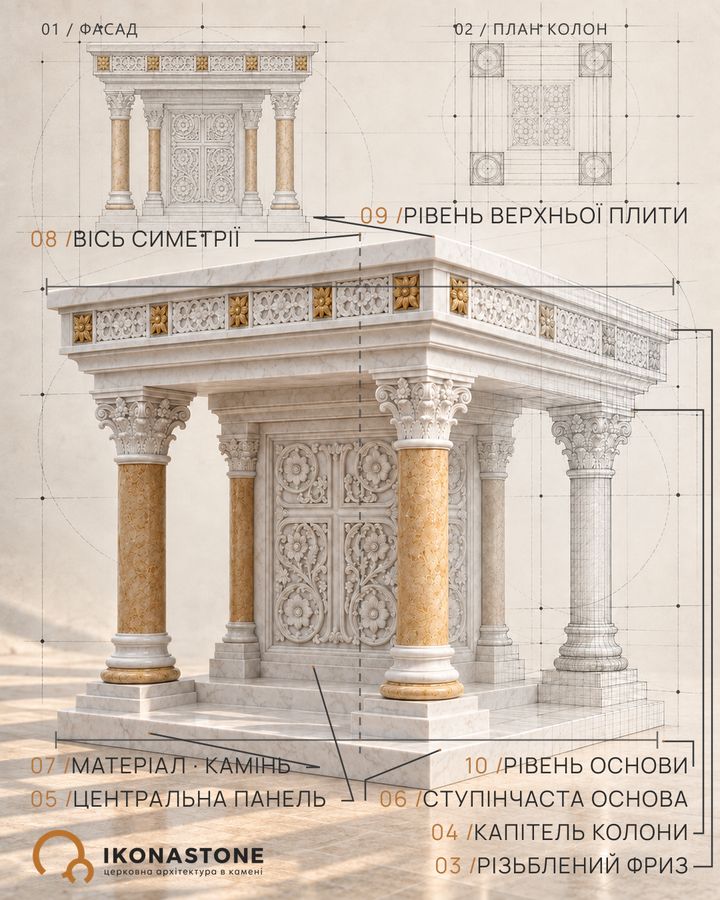
The Holy Table is the center of the church, and requirements for it differ between traditions. The Code of Canon Law of the Catholic Church (canon 1236; it applies to the Latin rite) says that by traditional practice the table of a fixed altar should be of stone, and of a single piece of natural stone. At the same time, the conference of bishops may permit another worthy and solid material, and the base of the altar may be of any material. In Orthodox and Greek Catholic practice both stone and wooden Holy Tables are found; this is decided by the rector and the diocese. More in the article What is an altar table made of.
If the Holy Table is of stone, marble or granite is most often chosen. Marble gives a soft light and is easier to carve. Granite looks heavier and resists acids better, so spilled wine will not leave a dull stain on it as it does on marble; oil, though, is better wiped up at once. Both options are appropriate; the decision depends on the architecture of the sanctuary and on who will look after the surface, and how. Examples can be seen in the section on altar tables.
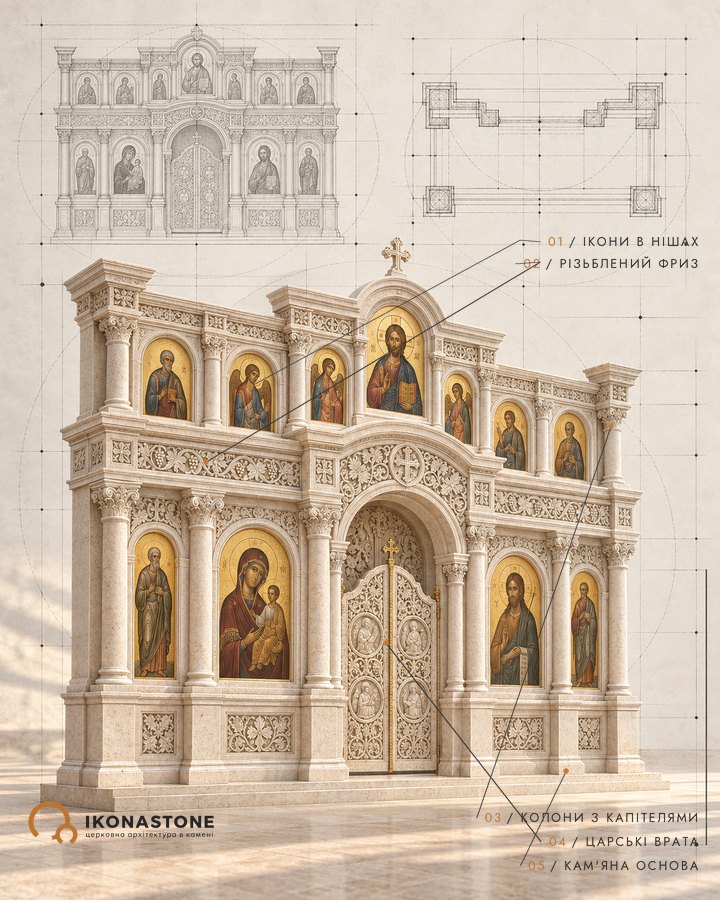
The iconostasis is a large vertical plane with many details: columns, cornices, frames for icons. Here weight matters, because a stone iconostasis rests on the floor and foundation, and so does the amount of carving. Marble and limestone are traditional here, and granite is possible in austere forms. More on this in the article Stone iconostasis.
Which stone for floors and steps?
Underfoot is where stone works hardest. There is sand on it, water from umbrellas, salt from the street. Two things decide here: resistance to abrasion and safety.
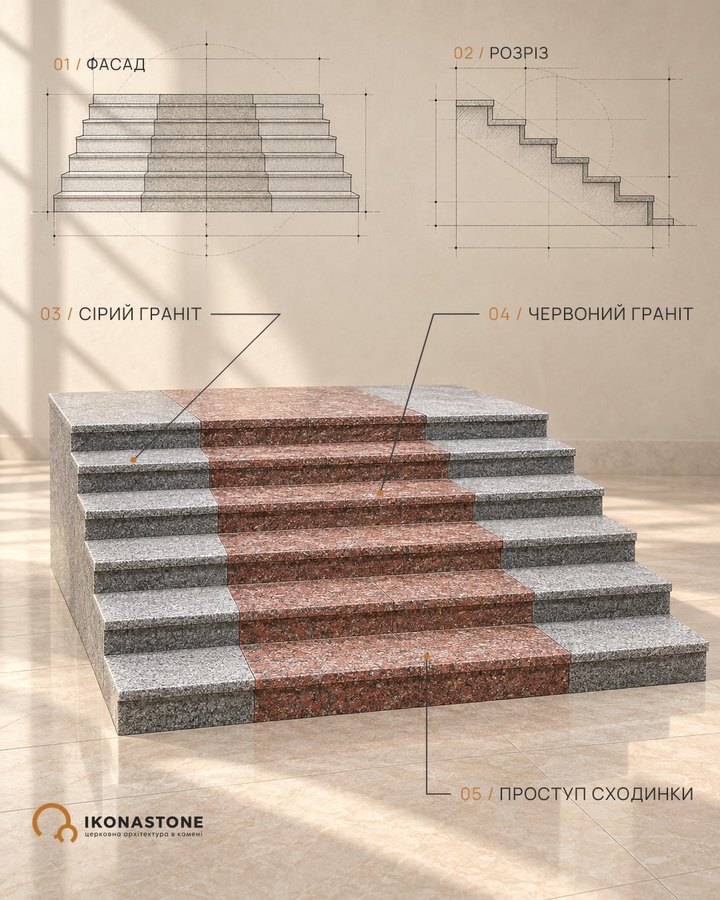
For outdoor steps and a porch, granite is most often chosen in practice. The main thing is the finish. A polished surface looks fine in a dry interior, but when wet it becomes slippery; for the street a flamed (burned with a torch), bush-hammered (worked with a toothed hammer) or other rough surface is made.
Indoors the choice is wider. A marble floor in a church is an old tradition, but near the entrance, where there is the most sand, it wears faster. Often granite is laid in the narthex and on the main aisles, and marble where fewer people walk, or as pattern inserts. More on this in the section on steps and floors.
Does Ukraine have its own granite and sandstone?
Yes, and quite a lot. A large part of Ukraine lies on the Ukrainian Shield, an ancient basement of igneous and metamorphic rock, so granites here come close to the surface in places. The Encyclopedia of Modern Ukraine names the red granites of Korostyshiv, Korosten and Novohrad-Volynskyi in the Zhytomyr region, grey and pink ones at Klesiv in the Rivne region, and dark grey ones near Vinnytsia.
A few deposits worth knowing by name:
- Omelianivske (Zhytomyr region, near Korosten; spelled Omelianivske in the encyclopedia) is a red-pink granite suitable for both exterior and interior finishing, and for monuments.
- Kapustynske (Kirovohrad region, Novoukrainka district) is a pink-red and red granite; the encyclopedia specifically mentions its use for ritual and memorial structures.
- Holovynske (Zhytomyr region, the village of Holovyne) is labradorite: a dark grey to black stone with blue and blue-turquoise play of color. Geologically it is not granite but a rock of the gabbro family, though in the trade it is often placed alongside granite.
Sandstone is harder. The block sandstones of the Middle Dniester region, the so-called Yampil sandstones, are well known: their outcrops run along the Dniester valley on the border of the Vinnytsia, Khmelnytskyi and Bukovyna regions. They have been quarried since at least the second half of the 17th century. Geologists of the National Academy of Sciences of Ukraine and Kyiv University name increased porosity and water absorption as the main flaw of these sandstones. That is not a verdict but a hint: for outdoor use such stone must be checked especially carefully.
How do you care for stone in a church?
Care depends on the stone, but one rule is shared: the gentler, the better. The US National Park Service, in its guide to cleaning masonry, advises starting with the gentlest method, that is, clean water, and testing any product on an inconspicuous area each time.
- Marble, limestone, travertine and onyx do not tolerate acids. Vinegar, lemon, “rust remover” products and many all-purpose household cleaners eat the surface and leave dull stains.
- Granite is tougher, but neutral products are better here too. Abrasive powders remove the polish.
- Wax from candlesticks is removed once it has hardened, with a wooden or plastic scraper, not metal.
- Oil (from lamps, anointing) soaks into porous stone. It is better wiped up at once.
As for sealers: water-repellent treatments that reduce water absorption are sometimes useful, but the same guide stresses that for most masonry they are not needed if the building is dry and in good repair. First remove the source of water, and only then think about chemistry.
What to decide before ordering
- Where the stone will live. Indoors or outdoors, under a canopy or under open sky, underfoot or on a wall.
- Tradition. Whether there are requirements for the material of the Holy Table in your church or diocese.
- Finish. Polished, honed (matte) or rough: for floors and steps, with slipperiness in mind.
- Weight. A stone iconostasis or Holy Table loads the floor; the structure below should be checked.
- Origin of the stone. The deposit, not just the name. One trade name can hide different quarries.
- Test data. For sandstone, limestone and travertine this is a must: water absorption, strength, frost resistance.
- Who will look after it. Marble and onyx are less forgiving than granite. Those who clean every week should know this.
- Combination. How the new stone will look next to the existing floor, walls and icons.
A final thought
There is no “better” or “worse” stone. There is stone in its place and stone out of place. Marble in the sanctuary and granite on the porch is not a compromise but a division of duties.
These are exactly the questions worth settling before the stone reaches the saw.
FAQ
Which is better for a church: granite or marble?
It depends on the place. Outdoors and on steps granite is more reliable: it is hard and almost unaffected by acids. Marble is softer and sensitive to acid, so it is more often chosen for interiors: the Holy Table, the iconostasis, wall cladding.
Can marble be used on the steps in front of a church?
It can, but it is a risky choice. Outdoors, marble gradually loses its polish to rain and polluted air, and a wet polished surface is slippery. For outdoor steps, granite with a non-slip finish is more often chosen in practice.
Is sandstone suitable for a church?
Yes, but sandstones differ greatly. Some have stood in walls for centuries, others flake quickly. Before ordering, ask the supplier for water absorption and frost resistance data for this particular batch.
Where is onyx appropriate in a church?
Mostly indoors, in small elements such as inserts, panels and lamps, where its translucency works. It is a soft carbonate stone, so it is usually not used for floors or outdoors.
Does Ukraine have its own granite for church work?
Yes. Well-known deposits are in the Zhytomyr region (Omelianivske near Korosten, a red-pink granite; Holovynske, a dark labradorite), the Kirovohrad region (Kapustynske, a pink-red granite) and the Rivne region (Klesiv, grey and pink granite).
Does a Holy Table have to be made of stone?
In the Latin-rite Catholic Church the table of a fixed altar should, as a rule, be of natural stone, although the conference of bishops may permit another worthy material. In Orthodox and Greek Catholic practice both stone and wooden Holy Tables are found; this is decided by the rector and the diocese.
Sources
- Granite — Encyclopaedia Britannica
- Marble — Galleries.com (Amethyst Galleries)
- Acid Rain and Our Nation's Capital: A Guide to Effects on Buildings and Monuments (USGS)
- Onyx marble — Encyclopaedia Britannica
- Mexican onyx — CAMEO, Museum of Fine Arts Boston
- Building with stone: Travertine — Stone Specialist
- Renovation of the marble facades of Finlandia Hall — Stone-Ideas
- Preservation Brief 1: Cleaning and Water-Repellent Treatments for Historic Masonry Buildings (NPS)
- Граніт — Енциклопедія Сучасної України
- Капустинське родовище граніту — Енциклопедія Сучасної України
- Омельянівське родовище граніту — Енциклопедія Сучасної України
- Токарський М., Захарченко П., Гелета О., Підлісний А. Товарознавчі характеристики, технологія видобутку та обробки декоративного каменю (лабрадориту) — репозитарій КНУБА
- Нестеровський В. А., Волконський О. О. Літологія ямпільських пісковиків Подільського басейну України // Геологія і корисні копалини Світового океану. 2025. Т. 21, № 2. С. 56–67
- Code of Canon Law, can. 1236 (Vatican)