The Halo on an Icon: What It Means and Why Christ's Bears a Cross
Painting light is hard. Painting it so that it does not depend on a lamp, a candle or the time of day is harder still. The old masters often solved this with gold: the radiance around the head was not depicted in paint but laid on the panel as gold leaf. The halo is the most noticeable part of this solution, and at the same time the part people look at least carefully.
We are used to reading it as a marker: you see a circle around the head, so it is a saint. But in the halo, especially Christ’s, geometry, the biblical word, Greek letters and the craftsman’s knowledge of how gold behaves in light all come together. All of this fits into a small circle on an icon.
In brief
- The halo is a golden radiance around the head, the mark of saints.
- The cruciform halo is depicted only for Christ: a circle with an inscribed cross, in whose arms the Greek letters Ο ΩΝ, “He Who Is”, are written.
- The shapes vary: the round halo is the basic one; a triangular halo is sometimes given to God the Father as a sign of the Trinity; in Italian images of roughly 500–1100 a square halo marked a living person.
- Gold did not become the usual colour of the halo at once: in early Christian art halos came in other colours too.
- On wood the halo is gilded over gesso and bole; on stone it can be incised, raised in relief, rendered through surface texture or engraved and gilded.
- Ukrainian icons contain departures from the Byzantine canon, and these too are part of their history.
What does the halo on an icon mean?
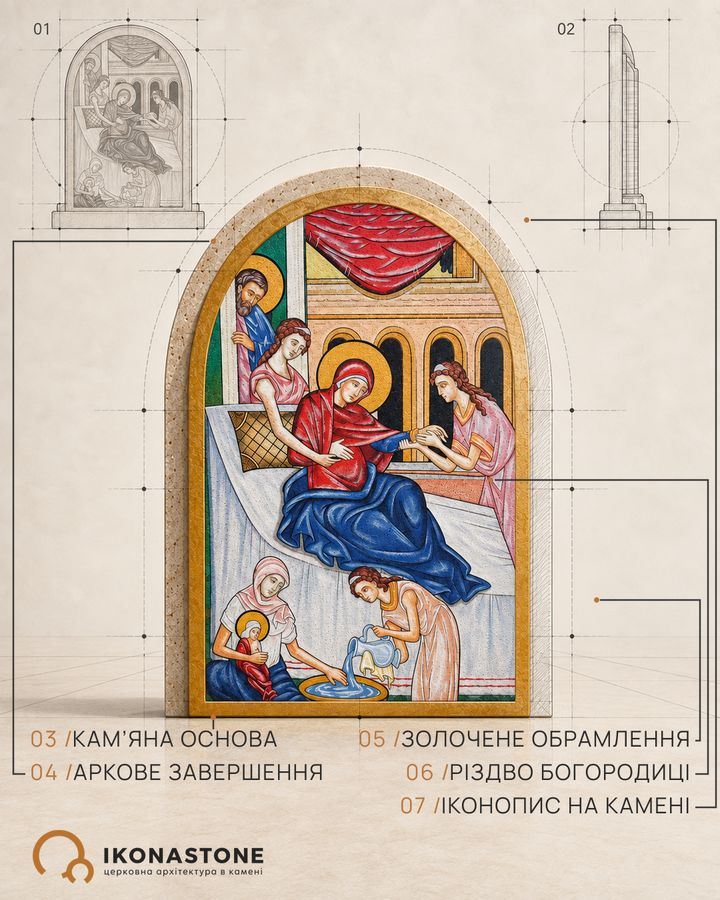
The simplest answer: the halo is the mark of saints. The Encyclopedia of Modern Ukraine puts it briefly: the mark of saints is the halo above their heads. Hence a practical rule for reading an icon: in multi-figure compositions, people without a halo are pious but uncanonised figures. Thus the shepherds on the icon of the Nativity of Christ are usually painted without halos.
The origin of the image is explained in different ways. According to one version, the halo appeared in the culture of Hellenistic Greece and Rome: the sun god Helios had a radiate crown, and Hellenistic rulers are often depicted in radiate crowns imitating this effect. The Ukrainian researcher Mariia Chikarkova disagrees with the classical origin and calls this way of thinking Eurocentric: in her words, the shining circle as a solar sign has been known since the Palaeolithic, and in sacred images it first appears in ancient Iran, from where it passed to India.
The halo entered Christian art in the 4th century. In early images it belonged above all to Christ; later it spread to the Mother of God, the apostles, martyrs and saints. At first its colour varied: Judas, Satan and other evil figures had a black halo. Gold became established later.
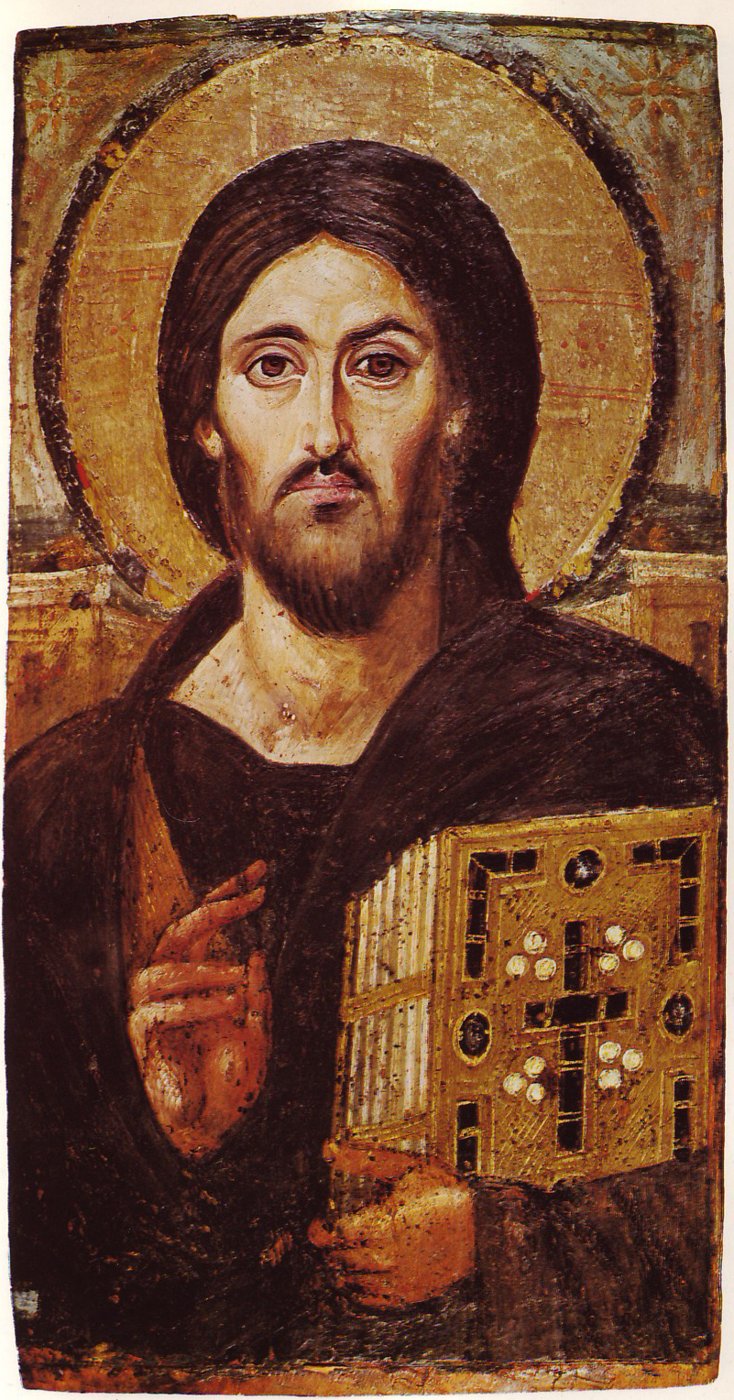
Why does Christ have a halo with a cross?
All saints have round halos. The cruciform one is depicted only for Christ. According to Chikarkova, its basis is the upper and two side arms of the Golgotha cross, inscribed in a circle. So this sign unites the circle of the halo and the cross of Golgotha.
There is also a practical observation for the client. Since such a halo belongs only to Christ, it is what allows Christ to be recognised in a complex composition. When a Deesis, an iconostasis or a stone relief has several figures with the same gilding, the cross in the circle names the main figure without any inscription.
What do the letters Ο ΩΝ on Christ’s halo mean?
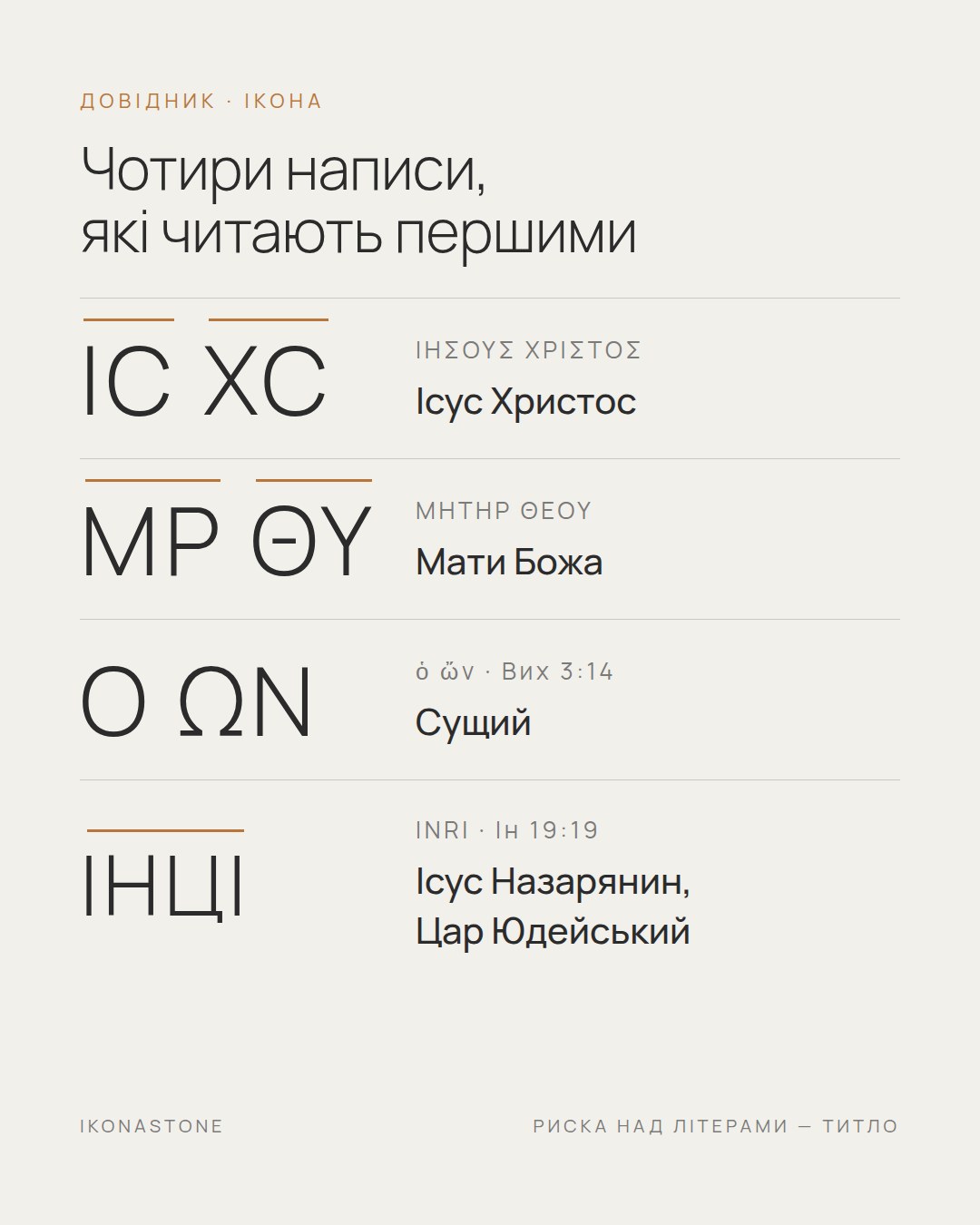
The Greek letters ὁ ὤν (Ο ΩΝ), “He Who Is”, are written in the arms of the cross. This refers to the Book of Exodus (3:13–14), where God reveals himself to Moses in the burning bush with the words “I am He Who Is”. The Serbian researcher Srećko Petrović devoted a separate article to the biblical basis of this inscription: how words spoken to Israel ended up on Christ’s halo.
Chikarkova notes that from the year 1200 precisely these letters are written in the arms of the cross. The cruciform halo is known earlier too: the Sinai icon of the Pantocrator, among others, has one. What we are dealing with is an established system of inscriptions.
There are several variants:
| Variant | What is in the cross | Where it occurs |
|---|---|---|
| Classic | the letters Ο ΩΝ | icon, fresco, mosaic |
| With a monogram | the chi-rho (ХР), supplemented by α and ω | a reference to Revelation 21:6 |
| Without letters | ornament instead of an inscription | for example, an Ethiopian icon where the inscription “He Who Is” is replaced by ornament |
| Baroque solution | a crown in place of the upper part of the halo | an icon of the early 18th century |
What other shapes of halo are there?
The round halo is the basis. But history knows several deviations, and each has its own explanation.
Square. In Italy, roughly from 500 to 1100, a square halo was sometimes used to mark living persons in donor portraits. The medieval author John the Deacon explained it this way: the square is the sign of a living person.
Triangular. It was sometimes given to God the Father to show the Trinity. Chikarkova also mentions oval, square and octagonal halos for certain saints.
Hexagonal. Hexagonal halos are sometimes given to personifications of the virtues, for example in the frescoes of Giotto’s workshop in the Lower Church at Assisi.
A plain circle instead of a cruciform halo. In Orthodox icon painting, a plain round nimbus in places spreads in place of the cruciform halo. Using the example of an “Image of the Sacred Heart” from the Hutsul region, late 19th century, Chikarkova links this to Western influence on the manner of painting. The canon, then, was not frozen: it lived in particular workshops and at particular times.
Why are halos gold, and sometimes almost invisible?
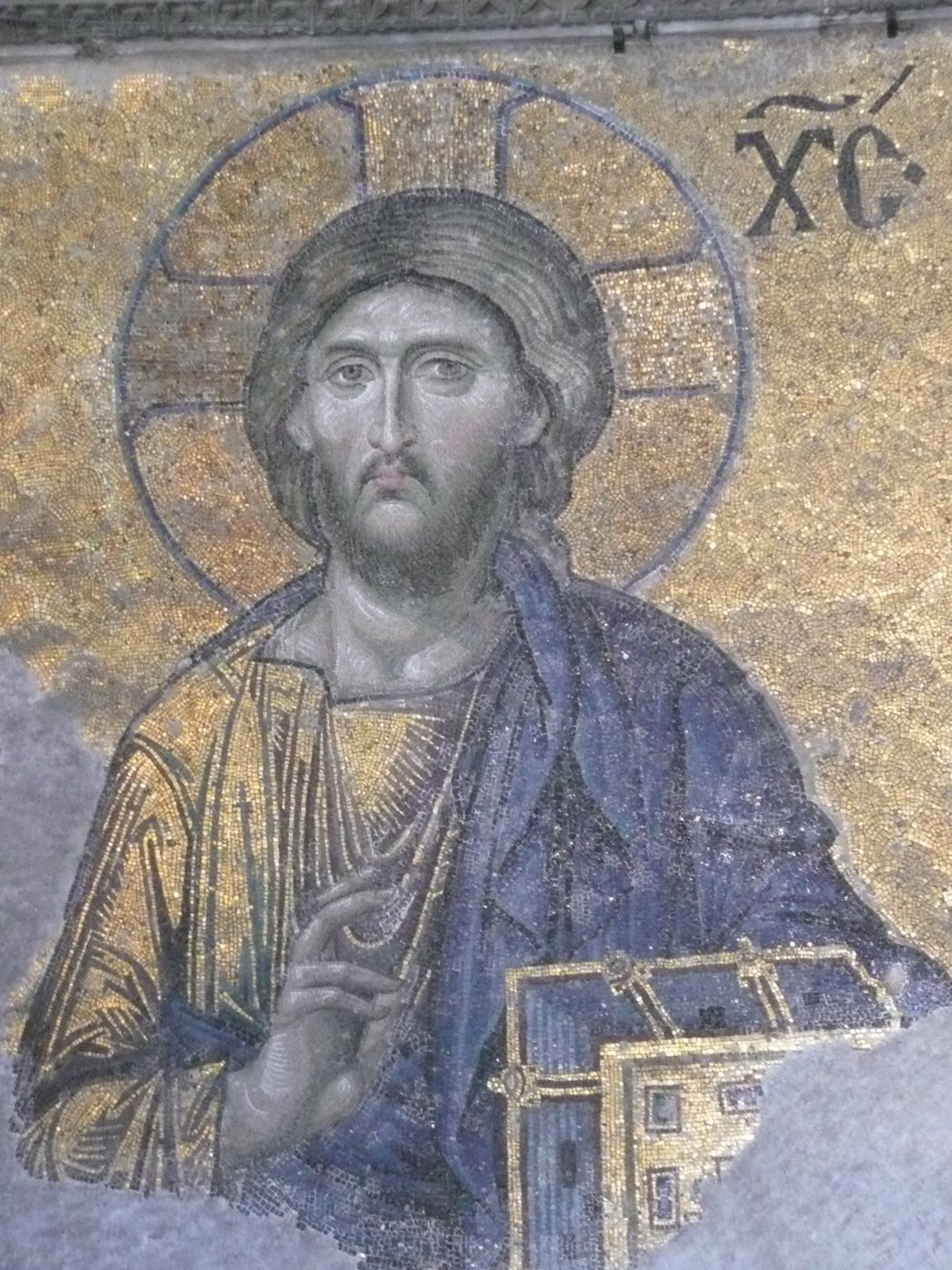
In an icon, gold signifies the heavenly kingdom. The mosaics of Saint Sophia of Kyiv (11th century) are executed on a gleaming gold ground, including the mosaic of Christ Pantocrator at the highest point of the main dome.
Gold can disappear from an icon, and this changes how it is read. On an 18th-century Volhynian icon of Christ Pantocrator, the halo is barely visible, almost dissolved into the brown background. Chikarkova writes that gold was meant to symbolise the heavenly kingdom, so its loss weakens the depth of the image. The painter tried to compensate with the red and blue of the garments, but this did not restore the symbolism of gold.
Other departures from the canon also occur in the 18th century. On one icon from the beginning of the century, the upper part of the halo with the letter ὤ was destroyed in order to place a Baroque crown of the Catholic type on Christ’s head. According to R. Kosiv, in the Pantocrator icons of the local tier painted by the Rybotychi masters in the first half of the 18th century, the Saviour’s head is crowned with a mitre-like crown.
At the same time, according to Chikarkova, Orthodox painters carefully adhered to the canon. As an example she cites the 15th-century icon of the Ascension of the Lord from Pidhorodtsi in the Lviv region.
And the oldest known surviving icon of Christ Pantocrator is kept in Saint Catherine’s Monastery on Sinai. It was painted in wax (encaustic) on a panel and is dated to the 6th or 7th century; it probably comes from Constantinople.
How a halo is made: gold, engraving, stone
The classic technique of icon gilding on wood consists of several layers. First the surface is levelled with gesso (a ground of chalk or gypsum bound with glue). Then red bole is applied, a thin layer of clay that glows through the gold and gives it a warm tone. Next, gold leaf is laid by water gilding (on diluted glue) and burnished, traditionally with an agate, until the surface becomes almost mirror-like. Lines, circles and small marks can be cut and punched into the gold, as on 14th-century Italian panels, and in places the gold within the circle is burnished with circular strokes.
Sometimes gold is laid not by water gilding but on an oil size. Then it does not give a mirror shine.
On stone the logic is different, and this is exactly where the line runs between an icon on a panel and an icon in stone. A halo on a stone relief can be made as follows:
- A deep line. The outline of the circle and the cross is incised, and they read through shadow.
- A relief disc. The halo is raised slightly above the plane, and its edge catches the side light.
- Engraving and gilding. The outline is cut, and the circle or the lines themselves can be covered with gold leaf. The method of gilding depends on the stone and the installation conditions and is agreed with the craftsman.
- Different texture. A matt field of the halo against a polished plane (or vice versa) gives an effect without any pigment.
Gold and a burnished surface look different in different light: the reflection changes with the angle of view. That is why the position of the halo relative to the windows and candles should be taken into account before the stone reaches the machine.
What to decide before ordering
- Whom the image depicts. Is it Christ (cruciform halo), the Mother of God or a saint (round)? The composition of the circle depends on this.
- Which inscriptions. Ο ΩΝ in the cross, a monogram or a plain field? In the original language or with transliteration?
- Gold or stone. The desired effect: gold, a deep line, relief, different texture. This decision should match the rest of the piece, not just one icon.
- Lighting. Where does the light fall in the church? Oil lamps, candles and windows change how the circle reads.
- Model. Agree with the rector or the iconographer which models the community follows.
- Installation conditions. Will the icon stand indoors or in the open air? The choice of finish depends on this.
In place of an afterword
The halo is one of those details that show how much a simple form can hold. A circle, a cross and three letters: a small circle that unites geometry, Holy Scripture and craft.
IKONASTONE designs icons on stone for a specific church interior, from the sketch of the halo to the final finish. You can read about our icons on stone in the Icons on stone section. For more on inscriptions on icons, including those on the halo, see the article Inscriptions on icons, and on the forms of the cross inscribed in the circle, the article Forms of the cross.
FAQ
What does the halo on an icon mean?
The halo is a golden radiance around the head, the mark of saints. On multi-figure icons, people without a halo are pious but uncanonised figures, for example the shepherds on the icon of the Nativity of Christ.
Why does Christ have a halo with a cross?
The cruciform halo is depicted only for Christ: the upper and side arms of the Golgotha cross are inscribed in the circle. The Mother of God and the saints are given a round halo without a cross.
What is written on Christ's halo?
The Greek letters Ο ΩΝ ("ὁ ὤν"), "He Who Is", are written in the arms of the cross. This refers to God's words from the burning bush (Exodus 3:14). Sometimes Christ's monogram with the letters alpha and omega (Revelation 21:6) is inscribed in the halo instead.
What shapes of halo appear on icons?
Most often the halo is round. The cruciform one belongs to Christ. A triangular halo is sometimes given to God the Father as a sign of the Trinity. In Italian images of roughly 500–1100, a square halo marked a living person, in particular a donor.
Why are halos gold?
In an icon, gold signifies the heavenly kingdom. In early Christian art halos also came in other colours; gold became customary later.
How is a halo made on a stone icon?
There are several ways: an incised line, a low relief disc, a different surface texture for the field, or engraving with gilding. The choice depends on the stone, the place of installation and the design, so it is agreed at the sketch stage.
Sources
- Chikarkova M. The Symbolism of the Cruciform Halo of Jesus Christ in the Ukrainian Icon (the Byzantine Canon and Its Modifications). Volynskyi Blahovisnyk, No. 13, 2025
- Halo (religious iconography), Wikipedia
- Christ Pantocrator, Wikipedia
- Christ Pantocrator (Sinai), Wikipedia
- Stepovyk D. Iconography. Encyclopedia of Modern Ukraine
- Petrović S. Christ as the One Who Is (ὁ ὤν): The Biblical Foundations of an Iconographic Solution. Teološki pogledi, LI, 2018
- Saint Sophia of Kyiv, World History Encyclopedia (Ukrainian)
- Medium and Message: Gilding, Eclectic Light Company
- Jacopo di Cione: Gold, Google Arts & Culture
- Gilding, Wikipedia