Inscriptions on Icons: What ІС ХС, МР ΘΥ and Ο ΩΝ Mean
On an icon, the letters stand as evenly and as deliberately as the faces. This is the first thing you notice when you look closely: the inscription is not added “as a caption” in a corner but built into the composition, like an arch into a wall. It has its own axis, its own rhythm, its own weight. Take it away and the image seems to lose its address.
This is not a metaphor. Most icons contain a calligraphic text naming the person or event depicted. There is also a linguistic detail that hints at how old this connection is: in Greek, the same verbal root means both “to write” and “to paint an icon”. The iconographer “writes” the image. Word and face come from the same hand.
For those who order an icon, a liturgical piece or an image in stone, a practical conclusion follows. The inscription must be read as carefully as the image. Below we look at the most common inscriptions, their languages, abbreviations and pitfalls. The sources are at the end of the article.
In brief
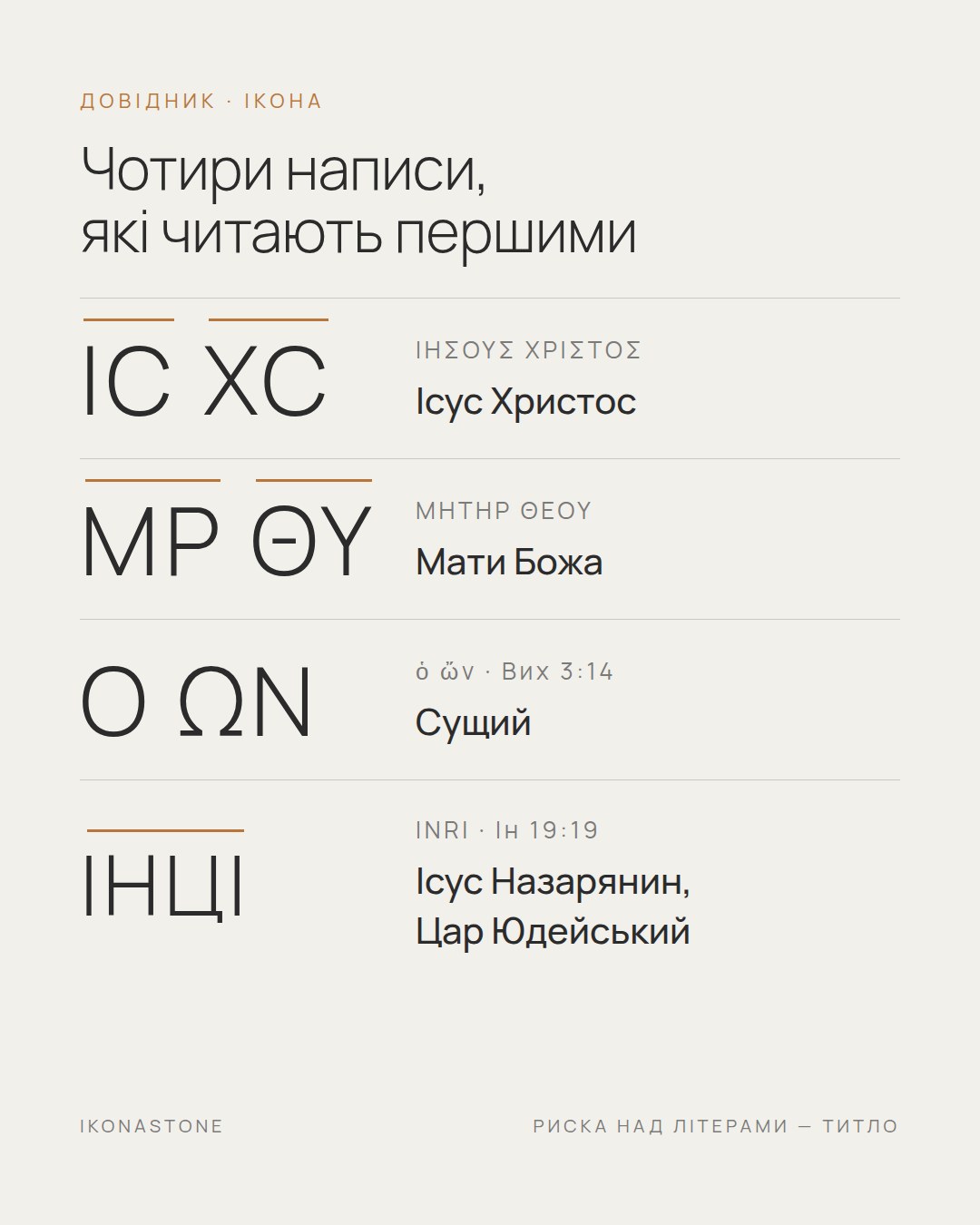
- ІС ХС means “Jesus Christ”, МР ΘΥ means “Mother of God”. These are not words but abbreviations of Greek words, marked with a titlo.
- Ο ΩΝ in the arms of the cross on Christ’s halo reads as “He Who Is” (ὁ ὤν) and refers to Exodus 3:14.
- ΝΙΚΑ adds the meaning “Jesus Christ conquers” to the monogram; ІНЦІ (Greek ΙΝΒΙ) renders the inscription above the cross.
- Ukrainian icons of the 17th century carry both Greek and Church Slavonic inscriptions, and Gospel quotations on books are in places given in Ukrainian.
- An error in an inscription carved in stone cannot be corrected “on top”. The text is agreed before production.
Why does an icon need an inscription?
The iconographic tradition understands the image as something more than a picture. The Second Council of Nicaea (787) put it this way: the honour paid to the image passes to its prototype. The image points to someone. And to show exactly to whom, a name is needed.
The inscription performs this function: it names the one to whom the image points. An icon without a name remains a depiction. With a name, it becomes an address to a specific person or event.
This is not a separate dogma but established practice: most icons have a text naming the person or event. That is why the inscription is treated as part of the image, not as an addition.
ІС ХС: four letters instead of two words
The most widespread monogram of Eastern Christianity consists of four letters and abbreviates the Greek Ἰησοῦς Χριστός, “Jesus Christ”. The abbreviation takes the first and last letters of each word. A titlo is placed above the letters: a horizontal stroke that marks the abbreviation itself. Medieval Greek often used the lunate form Ϲ for sigma, so on icons you will see ΙϹ ΧϹ.
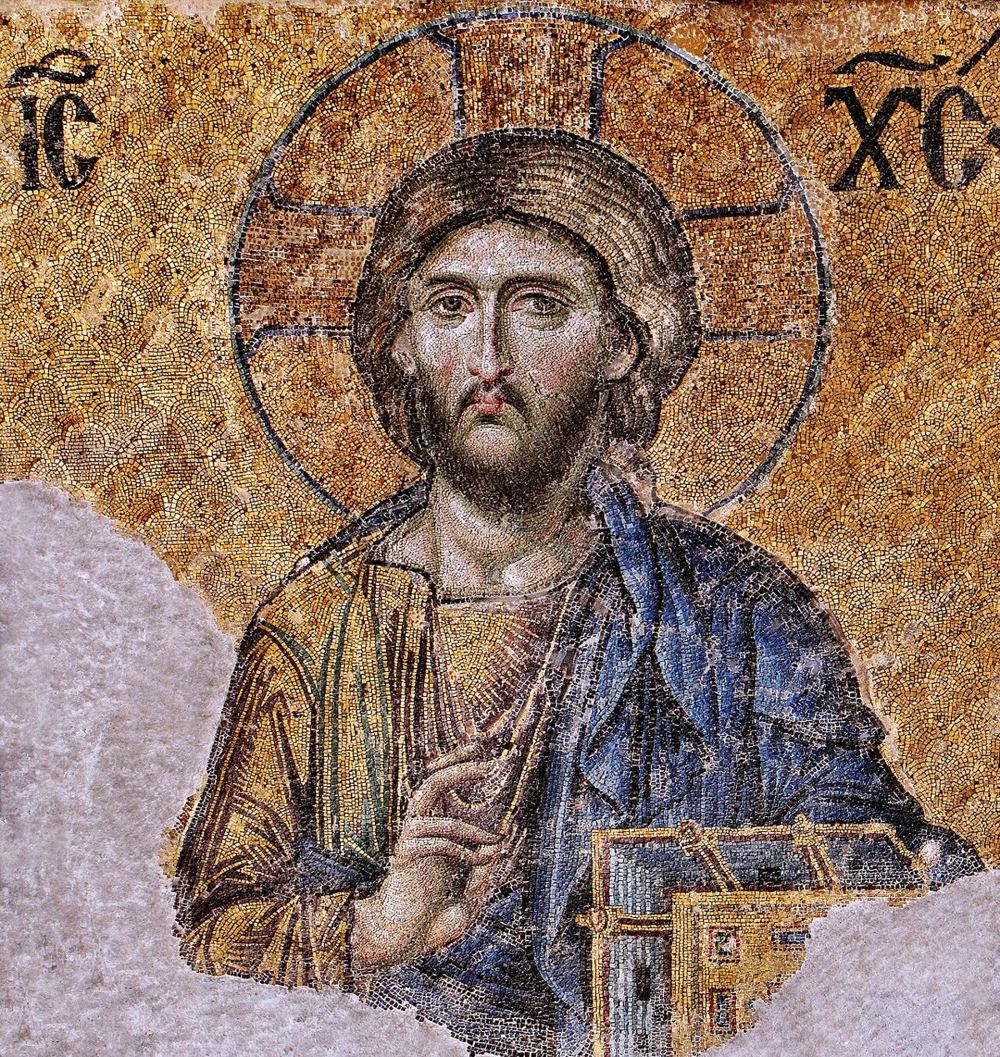
The monogram is often split. ІС is written on one side of Christ’s head, ХС on the other. So do not be surprised if in a photograph or on a drawing you see two pairs of letters where you expected a single word.
In Church Slavonic inscriptions the same monogram is written in Cyrillic: ІС ХС.
What does NIKA mean?
Sometimes the word ΝΙΚΑ is added to the monogram. Then ΙϹ ΧϹ ΝΙΚΑ reads as Ἰησοῦς Χριστὸς νικᾷ, “Jesus Christ conquers”.
МР ΘΥ: Mother of God
Beside the Mother of God stands the inscription ΜΡ ΘΥ, an abbreviation of the Greek Μήτηρ Θεοῦ, “Mother of God”. The same inscription was also on the original painting of the Vladimir icon of the Mother of God, of which only fragments survive.
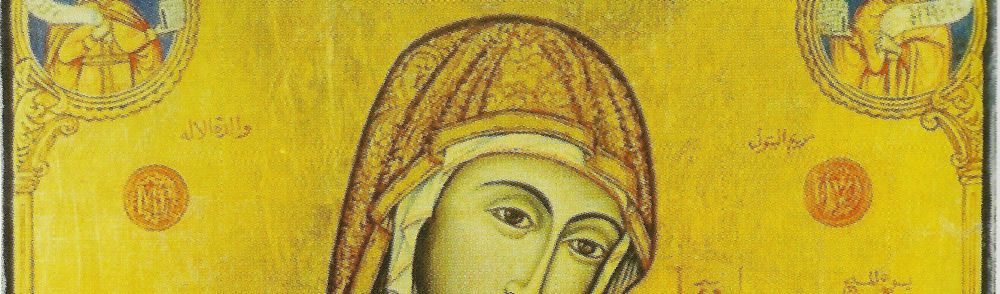
It is interesting how this abbreviation is constructed. In ancient manuscripts sacred names were abbreviated according to the system of nomina sacra, “sacred names”: a few letters of the word, including the ending, were kept and a stroke was placed above them. In this system “Mother” (ΜΗΡ, ΜΡ) and “God” (ΘΣ in the nominative, ΘΥ in the genitive) are recorded separately. The icon inscription ΜΡ ΘΥ follows the same logic: “Mother” in the nominative, “of God” in the genitive.
Be careful with other labels of the Mother of God. The word Παναγία, “All-Holy”, is used with her images; it emphasises her particular purity.
Ο ΩΝ on the halo: “He Who Is”
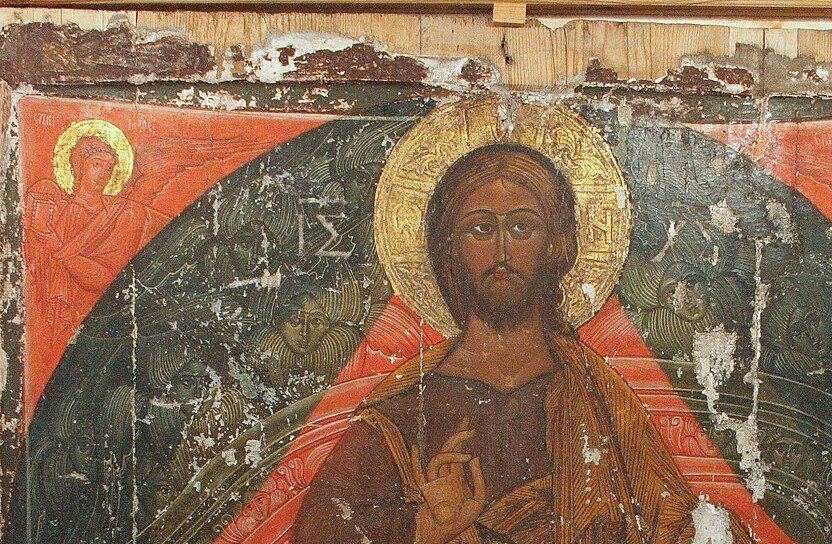
There is a cross within Christ’s halo. This is the so-called cruciform halo. In its arms three Greek letters are written: Ο, Ω and Ν. Together they give ὁ ὤν, “the One Who Is”, “He Who Is”. They point to the divinity of Christ. The researcher Mariia Chikarkova, who has studied the Ukrainian iconography of the halo, writes that from the year 1200 precisely these letters are written in the halo, and that this is a calque of God’s self-designation in the Book of Exodus (3:13–14).
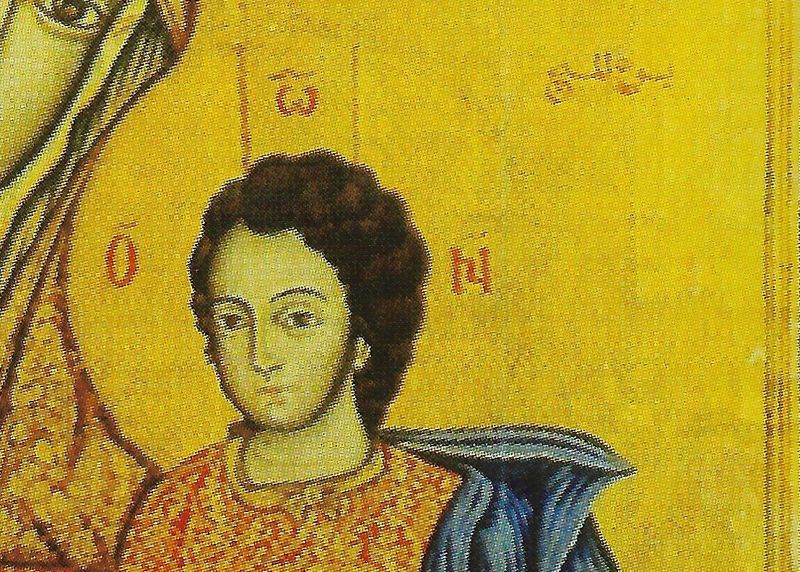
More precisely, the reference is to the Greek translation, the Septuagint: there God’s words in Exodus 3:14 read ἐγώ εἰμι ὁ ὤν. The biblical basis of this inscription is examined by Srećko Petrović in a study in the journal Teološki pogledi (2018).
There is also a visual detail here that is easy to miss. Later Orthodox depictions make each arm of the cross out of three lines. This is interpreted as a reminder of the Trinity, the unity of God and the two natures of Christ. And the description of the icon of the Saviour in the collection of the National Museum in Lviv says that the inscription on the halo is Greek (in the museum’s description, Ο WΝ, where W stands for the omega Ω), and that the Greek monogram ΙΣ ΧΣ is placed on the background. In other words, on a Ukrainian icon the most important word may be Greek.
It is also worth remembering that Chikarkova describes later changes: in the Baroque period the Greek letters could disappear, and a crown took their place. This is not a canon but historical practice, and it is useful for the client to understand the difference between the two.
ІНЦІ on the cross
On icons of the Crucifixion, the title board mentioned in the Gospel (John 19:19–20) is written above the cross. In the Eastern tradition it is the Greek ΙΝΒΙ, an abbreviation of Ἰησοῦς ὁ Ναζωραῖος ὁ βασιλεὺς τῶν Ἰουδαίων, “Jesus of Nazareth, the King of the Jews”. In the Church Slavonic tradition it is ІНЦІ. The Latin INRI, familiar from Catholic crucifixes, is not used on Eastern icons, except in certain traditions (such as the Romanian, where the abbreviation coincides with the Latin one).
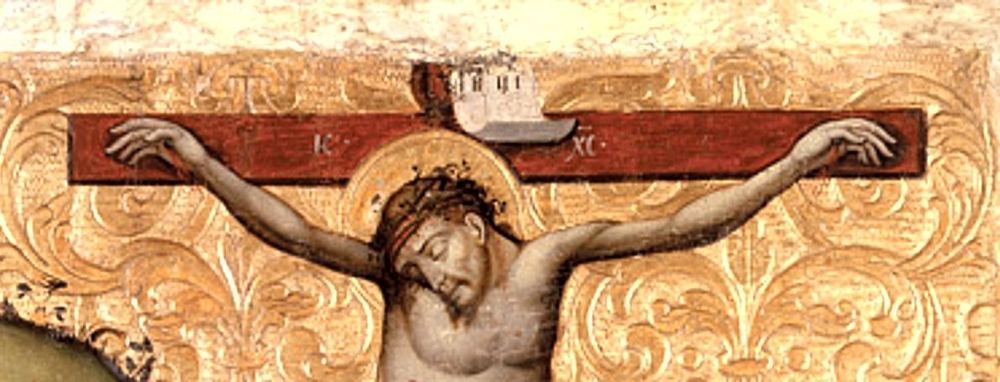
Sometimes ΙΝΒΚ is written on the icon, “King of the world” or “King of glory”. Such labels do not claim that this is exactly what was on the title board. They convey the spiritual reality the icon shows, not the physical one. Particular care is needed here: these are different texts with different letters.
Names of saints and names of feasts
For saints the formula is simple. The word “saint” is placed before the name. In Greek this is Ὁ ἍΓΙΟΣ, “the saint”, followed by the name, for example Ὁ ἍΓΙΟΣ ΓΕΩΡΓΙΟΣ. The inscription may be full or abbreviated. The form of the word “saint” in a Church Slavonic inscription should be agreed with the rector before production.
The names of feasts and events are also written. For example, Ἡ ἈΝΑΣΤΑΣΙΣ, “the Resurrection”. The inscription shows that what is depicted is not a person but an event. The wording depends on the language and the tradition, so it needs to be agreed.
Languages: Greek, Church Slavonic, Ukrainian
Greek underlies the best-known inscriptions: it gave us ІС ХС, МР ΘΥ, Ο ΩΝ. Church Slavonic is the second language of icon texts. The online exhibition “The Glory of Ukraine” notes that the text on the icon of Christ Enthroned from Volhynia, early 17th century, is written in Old Church Slavonic. In Roksolana Kosiv’s article on the iconostases of the Sian region of the 1670s–1760s, the Gospel quotations on Christ’s books are given in Ukrainian, while a Church Slavonic inscription appears on another icon, from Porokhnyk.
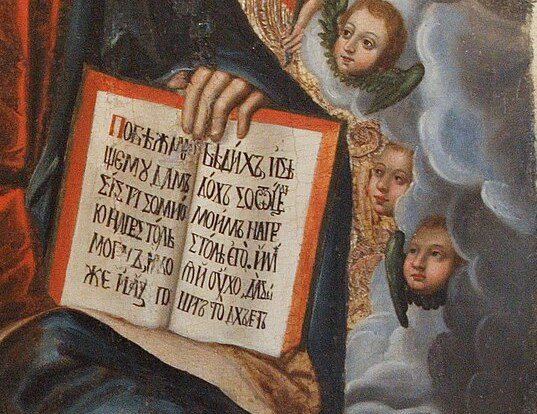
There is no single binding rule on what language to use on a new icon. This question is decided together with the priest or rector.
Titlos: a stroke that means something
A titlo is a stroke above letters. The word comes from the Greek τίτλος, “title”. It is known from Church Slavonic manuscripts and still appears in inscriptions on modern icons and in liturgical books. An example: the word “God” is written as Бг҃ъ.
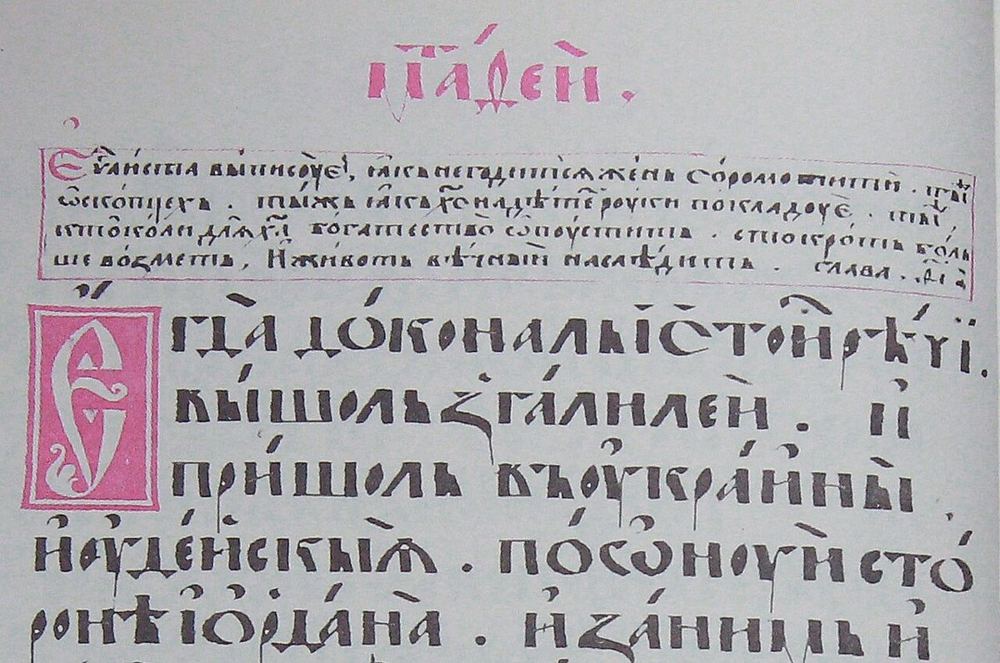
There is a subtlety here worth knowing. From roughly the 15th century, most schools restricted titlos to sacred concepts. The one God was abbreviated, while “god” in the sense of a false deity was written out in full. In other words, the titlo does not merely save space; it marks the word as sacred.
Where mistakes are most often made
Below are the risks we see on drawings more often than others.
- Letters that look alike but are not the same. The Greek sigma Ϲ and the Latin C, the Greek Ο and the Latin O, W instead of Ω: in a font set they are easily substituted, especially when the text is typed with a Cyrillic or Latin keyboard layout.
- A lost titlo. Without the stroke, the abbreviation reads as random letters. For sacred names it is an inseparable part of the writing.
- The wrong case. ΘΥ is genitive, ΘΣ is nominative. Swapping them changes the meaning.
- The wrong inscription above the cross. ΙΝΒΙ, ІНЦІ, INRI, ΙΝΒΚ are four different things.
- A halo without letters, or with letters that do not match the icon. For Christ these are the letters Ο, Ω, Ν in the arms of the cross, not a decorative ornament.
Why this matters especially for stone. Paint can be washed off and rewritten, but a carved inscription cannot. The line of the chisel or the cutter is final, and a gilded letter even more so. The error remains with the stone, and those who pray look at it every day.
What to check before ordering
- The text of the inscription in every place: beside Christ, beside the Mother of God, on the halo, on the title board above the cross, beneath the image of a saint.
- The language of each inscription (Greek, Church Slavonic, Ukrainian) and that it has been agreed with the rector.
- The spelling of saints’ names: full form or abbreviation, and exactly how the titlo is written.
- The letters: Greek, not their Latin look-alikes; Cyrillic where Cyrillic should be.
- The presence and form of the titlo over each abbreviation.
- The case of the words in the abbreviations (ΜΡ ΘΥ, ΙϹ ΧϹ).
- The lettering: a consistent style for all inscriptions on the piece, in proportion to the face.
- The placement: where ІС and where ХС, where МР and where ΘΥ, which letters go in which arms of the halo.
- The method of executing the inscription (relief, incised carving, gilding) and whether it is possible in this material at this letter size.
- Written confirmation of the final text from the client before work begins.
In place of an afterword
The inscriptions on an icon are modest in size, but they hold far more than it seems. A few letters bind the image to Scripture, to the language of the Church, to the memory of those who wrote icons before us.
At IKONASTONE the text of the inscription, its language, lettering and placement are agreed at the drawing stage, before the stone reaches the machine. For an icon on stone this is not a formality but the first stage of the work.
FAQ
What does ІС ХС mean on an icon?
It is an abbreviation of the Greek name Ἰησοῦς Χριστός, "Jesus Christ": the first and last letters of each word, with a titlo placed above them. On an icon the letters are often split: ІС to the left of the head, ХС to the right.
What does МР ΘΥ next to the Mother of God mean?
It is the Greek Μήτηρ Θεοῦ, "Mother of God". Both words are abbreviated on the same principle as the sacred names in ancient manuscripts, and a titlo is placed above the letters.
What is written on Christ's halo, and why?
In the three arms of the cross within the halo the Greek letters Ο, Ω, Ν are written, that is, ὁ ὤν, "He Who Is". This refers to God's words in the Book of Exodus (3:14) in the Greek Septuagint translation and points to the divinity of Christ.
How does ІНЦІ differ from INRI?
INRI is the Latin inscription above the cross. In the Orthodox and Eastern Catholic traditions, icons of the Crucifixion carry the Greek ΙΝΒΙ, and in the Church Slavonic rendering, ІНЦІ. The abbreviation conveys the words "Jesus of Nazareth, the King of the Jews".
In what language should the inscription on a new icon be written?
There is no single binding rule. Old Ukrainian icons carry both Greek inscriptions (Ο ΩΝ, ΙΣ ΧΣ) and Church Slavonic texts. The language should be agreed with the priest or rector before production.
Can an inscription be corrected after it has been carved in stone?
Practically not: a carved inscription cannot be rewritten like a layer of paint. That is why the text, language, lettering and placement are agreed on the drawing.
Sources
- Wikipedia: Christogram (IC XC, NIKA)
- Wikipedia: Nomina sacra
- Wikipedia: Titlo
- Wikipedia: Halo (religious iconography)
- Wikipedia: INRI (ΙΝΒΙ, ІНЦІ)
- Wikipedia: Second Council of Nicaea
- Wikipedia: Theotokos of Vladimir
- Wikipedia: Icon
- M. Chikarkova. The Symbolism of the Cruciform Halo of Jesus Christ in the Ukrainian Icon. Volynskyi Blahovisnyk, No. 13 (2025)
- S. Petrović. Christ as the One Who Is (ὁ ὤν). Teološki pogledi, LI (2018)
- Andrey Sheptytsky National Museum in Lviv: the icon of the Saviour (cat. 859)
- Roksolana Kosiv. The Image of Christ in Iconostases of the 1670s–1760s by Masters from Rybotychi in the Sian Region. Narodoznavchi Zoshyty, No. 6 (144), 2018
- The Glory of Ukraine: Sacred Images from the 11th to the 19th Centuries (online exhibition, Meridian International Center, 2011)
- Aleteia: The meaning behind Greek letters in icons (2024)
- Wikimedia Commons: Theotokos icon, Lebanon (14th century)
- Wikimedia Commons: Christ Pantocrator, Deesis mosaic, Hagia Sophia
- Wikimedia Commons: The Pyriatyn icon of the Crucifixion
- Wikimedia Commons: Peresopnytsia Gospel, Matthew 19:1