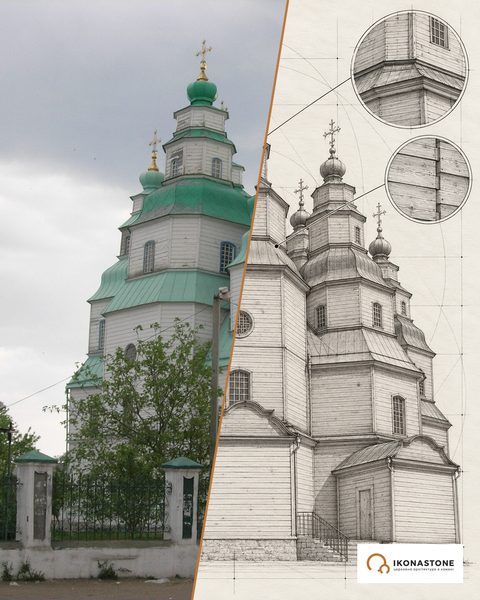
The Dormition Cathedral of the Sviatohirsk Lavra: a church beneath a chalk mountain
Above the cathedral stands a white chalk mountain; beneath it flows the Siverskyi Donets. Between the water and the rock there is exactly as much room as a church needs.
In brief
| Address | Sviatohirsk, Kramatorsk District, Donetsk Oblast, territory of the Sviatohirsk Lavra |
| Built | 1859–1868 (according to other sources, 1859–1860); the earlier cathedral dates from 1698–1708 |
| Architect | Aleksey Gornostayev |
| Type | cathedral church in a mixed Russian-Byzantine style |
| Status | as part of the lavra ensemble, an architectural monument of national significance |
| Church | UOC (MP); lavra status since 2004 |
History
The monastery at Sviati Hory grew out of caves in the chalk rock: from the 15th century monks lived and prayed there, above the Donets. The place name “Sviati Hory” is first described in a written source in 1526, and the first written mention of the monastery itself, according to the Encyclopedia of Ukraine, dates from 1624. The monastery was also a border stronghold: in 1679 it was devastated by the Tatars.
The earlier Dormition Cathedral was built from 1698 to 1708 at the expense of Fedir Shydlovsky, colonel of Izium; it was dismantled in 1867, when a new one was being raised beside it. In 1787 the monastery was closed by decree of Catherine II (the Encyclopedia of Ukraine gives 1783, when its property was secularised), and in 1790 the estate passed to Prince Grigory Potemkin. The revival began in 1844: the monastery was restored at the expense of Alexander and Tatiana Potemkin.
The new stone cathedral was designed by Aleksey Gornostayev, an architect who also worked on Valaam. The design is dated to 1858. The cathedral was built in 1859–1868; the Encyclopedia of Ukraine and “Castles and Churches of Ukraine” give a shorter span, 1859–1860. Gornostayev himself died in 1862.
In 1922 the monastery was closed and turned into a rest home (a sanatorium). The Dormition Cathedral became a cinema. During the Second World War the complex suffered heavy destruction; in 1969–1980 it was partly restored as a historical reserve. In 1992 the monastery was revived, and the cathedral, plundered and defiled, was returned to the monks. In 2004 the community received the status of a lavra.
War
In March–May 2022 the lavra came under fire several times. According to the UOC, almost all the windows in the lavra’s buildings were blown out; at the time about 520 refugees were sheltering there, about 200 of them children. On 30 May 2022, according to the Donetsk Eparchy of the UOC, three monks were killed; according to Metropolitan Kliment, four. On 4 June 2022 the wooden church of the All Saints Skete burned down, a separate building in the village of Tetianivka (sources differ on when it was built).
On 11 October 2023, according to the UOC, at seven in the morning a shell damaged the Dormition Cathedral: the south-western dome and the metal roofing.
Timeline
The figures in square brackets are the numbers of sources in the list at the bottom of the page. The note "according to ..." means that the fact is confirmed by only one source. The "Traditions" section contains traditions and legends: they are recorded in the sources but not documented.
Beginnings of the monastery
- 15th c.
According to the Encyclopedia of Ukraine, monks settled in the chalk caves above the Siverskyi Donets. The sources define the time of founding differently; no written or archaeological data reliably confirming any of the versions have been found. [2, 20]
- 1526
The Austrian envoy Sigismund von Herberstein mentions the place "Sviati Hory" (Holy Mountains), the earliest known written mention of the place. [1, 6]
- 1624
The Encyclopedia of Ukraine dates the first written mention of the monastery itself to 1624; Radio Svoboda gives 1654 (a tsar's charter). [2, 5]
- 1679
The Tatars devastated the monastery; it was rebuilt. According to the Ukrainian Wikipedia, Crimean troops also attacked in 1664, 1680, 1691 and 1737. [1, 2]
- 1698–1708
According to sobory.ru, the earlier Dormition Cathedral was built at the expense of Fedir Shydlovsky, colonel of Izium; it was consecrated in May 1708. The sources are not unambiguous about the material of the walls. [3, 4]
- 1783–1787
The monastery was abolished under Catherine II: the Encyclopedia of Ukraine gives 1783 (secularisation of property), Radio Svoboda 1786, Azbyka 1787. [2, 5, 6]
- 1790
Prince Grigory Potemkin received the estates of Sviatohiria. [6]
Revival and construction of the cathedral
- 1844
By decree of Nicholas I the monastery was restored. The abbot was chosen at the request of the Potemkin family; Countess Tatiana Potemkin invited Fr Arsenii, hegumen of the Sofroniev Hermitage. [6, 19]
- 1851
Opposite the future cathedral rose the Church of the Intercession with a bell tower of eight bells; the largest weighed 6,354 kg (according to the Ukrainian Wikipedia). [1]
- 1858
The St Petersburg architect Aleksey Gornostayev drew up the design of the Dormition Cathedral (according to the English Wikipedia). The design of the cathedral is also confirmed by sobory.ru. [3, 23]
- 1859
The cathedral was founded around September (the sources do not give the exact day). On 12 October 1859, a month after the foundation, Archimandrite Arsenii died; Archimandrite German continued the construction. The Russian Biographical Dictionary gives the year of foundation as 1850, probably in error. [3, 18]
- 1859–1868
Construction of the cathedral. The Encyclopedia of Ukraine gives 1859–1860, the other sources 1859–1868. Because of the steep slope the mountain had to be cut back and a ravine filled in. [1, 2, 3]
- 1867
The old 17th-century cathedral, which blocked the view of the new one, was dismantled; in 1869 a chapel was built on its site (according to sobory.ru). [3]
- 4 September 1868
The cathedral was consecrated; sobory.ru names Archbishop Makarii. The church is about 53 m high and 42 m long; it has three altars: the Dormition (main), Sts Barbara and Tatiana (south), and Sts Demetrius of Rostov, Mitrofan of Voronezh and Tikhon of Zadonsk (north). The year of consecration is also confirmed by the Russian Biographical Dictionary. [1, 3, 18]
- 1877–1900
The monastery was expanded: an almshouse (1877), cells (1887), a warden's house (1900). In 1908 it housed 280 monks and novices and 340 elderly residents. [2]
- 1884
The monastery suffered a fire and was restored (according to the Russian Biographical Dictionary). On 13 April 1890 Archimandrite German died. [18]
Soviet years
- 1917–1919
Persecution of the monastery began. According to a scholarly publication, the list of those killed in 1917–1919 contains nine names of monks, while the records of the Kyiv archive speak of about fifty victims. [19]
- 1922
The monastery was dissolved and a rest home (the Artem Sanatorium) was created in its place. The Dormition Cathedral became a club and cinema. [1, 2, 3, 6]
- 1920s–1930s
According to sobory.ru, the iconostasis was dismantled and destroyed, the sanctuary became a stage, and the crowning elements were removed from the domes. According to the Ukrainian Wikipedia, Sviati Hory was renamed Chervoni Hory, and Sviatohirsk was renamed Slovianohirsk. [1, 3]
- 1941–1945
The complex suffered heavy destruction during the Second World War; the sources give no details about the cathedral itself. [2]
- After the war
The cathedral was rebuilt as a palace of culture with a cinema hall (according to sobory.ru): the interior was entirely changed. [3]
- 1969–1980
The ensemble was partly restored and declared a historical reserve. According to sobory.ru, restoration work in the cathedral lasted from 1979 to 1986, and the paintings were restored by A. Marampolsky's team in 1986–1987. [2, 3]
Return to the Church
- 27 September 1991
In the former cathedral, then a sanatorium club, the first service after the interruption was held. According to Radio Svoboda (27 September), it was conducted in Ukrainian; Ihor Isichenko recalled the premises as "an ordinary club, without a dome, with chairs". In his own text Isichenko dates the service to 28 September and writes about a Kharkiv UAOC community. [5, 25]
- 1991–1992
The executive committee of the Donetsk Oblast Council transferred the cathedral and three outbuildings to the Donetsk Eparchy of the UOC (MP); in 1992 the monastery was reopened. [5, 6]
- 1995
The monastery began to dismantle the Soviet additions: about 2,600 t of reinforced-concrete floors (according to sobory.ru). On 24 August 1995 the venerable Ioann, the Sviatohirsk recluse, was glorified. [3, 6]
- 8 September 2000
According to sobory.ru, the restored cathedral was consecrated by Metropolitan Volodymyr; a five-tier carved iconostasis was made in 2000–2003. [3]
- 2004
On 9 March the Synod of the UOC (MP) granted the monastery the status of a lavra; in the spring of that year agreements were concluded on indefinite free use of the complex. [5, 6]
- 2008
On 12 July the Synaxis of the Sviatohirsk Fathers was glorified. [6]
The war and recent times
- 12 March 2022
A Russian aerial bomb exploded near the lavra. According to the information department of the UOC, 520 people were in the lavra, among them 200 children; almost all the windows in the buildings were broken, there were wounded, and no one was killed. [7, 24]
- May 2022
According to an Ukrainska Pravda article, on 7 May the St George Skete in the village of Dolyna was destroyed, on 9 May the Skete of St John of Shanghai in the village of Adamivka was damaged, and on 12 May the Cathedral of the Holy Women Martyrs in Sviatohirsk. [16]
- 30 May 2022
During the shelling of the cell buildings three people were killed: Archimandrite Galaktion, the monk Aristoklii and the nun Varvara; three more were wounded (according to the Donetsk Eparchy of the UOC). On 4 June Metropolitan Kliment reported a fourth, who died in hospital. [8, 9, 24]
- 4 June 2022
The wooden church of the All Saints Skete in the village of Tetianivka burned down. The Ukrainian side links the fire to shelling; the Russian Ministry of Defence denies shelling. [1, 22]
- June–September 2022
Sviatohirsk was occupied; in July about 100 monks remained in the lavra, which was being shelled by artillery. In September the town was liberated. [17, 24]
- 23 December 2022
Restoration of the lavra, damaged by shelling, began. [10]
- 11 October 2023
According to the lavra's press service, a shell damaged the south-western dome and the metal roofing of the Dormition Cathedral; another shell exploded on the slope above the service yard. No independent confirmation was found in the available sources. [21]
- 24 April 2024
The Security Service of Ukraine (SBU) announced a suspicion against the abbot of the lavra, Metropolitan Arsenii (Ihor Yakovenko), under Part 2 of Article 114-2 of the Criminal Code: according to the investigation, in September 2023 he told the faithful the locations of checkpoints and units of the Armed Forces. He was remanded in custody; on 28 June 2024 the case was sent to court. [10, 12]
- 2025–2026
On 28 October 2025 Arsenii was released on bail and detained the same day on a new suspicion (Article 436-2 of the Criminal Code); the proceedings were joined. In late February 2026 the court replaced custody with round-the-clock house arrest, which on 21 April 2026 was extended by two months. The case is being heard in court; there is no verdict. [10, 11]
- 9 April 2026
The government entered the complex of monuments of the Sviatohirsk Dormition Monastery in the State Register of Immovable Monuments of Ukraine, among 13 sites in Donetsk Oblast; the category is national significance. [10, 14]
- 22 June 2026
According to Yurii Vynokurov, First Deputy Head of the Donetsk Oblast Military Administration, a large number of monks remain in the lavra, along with laypeople who have lived there since 2022. The only route for delivering water and fuel is "constantly under enemy fire". [13]
- 23 August 2026
Unknown persons attacked with a knife on the territory of the lavra: according to the lavra's administration, the monk Varsonofii (Turianskyi) was killed and two people were wounded; a criminal case has been opened, and the attackers have not been identified. [10, 15]
Lost and recreated
| What | It was | What happened | Where it is now |
|---|---|---|---|
| The earlier Dormition Cathedral | 1698–1708, funded by F. Shydlovsky | Dismantled in 1867 because it blocked the view of the new one | A chapel was built on its site in 1869; the cathedral itself was not recreated [3] |
| The cathedral’s iconostasis | Pre-revolutionary (made in Moscow in 1868) | Dismantled and destroyed after the monastery was closed; the sanctuary became a stage | A five-tier carved iconostasis of 2000–2003 (oak, cedar, linden) [3] |
| Crowning of the domes | Crosses on the domes | Crowning elements removed in the Soviet period (according to sobory.ru) | The sources do not give the date the crosses were returned [3] |
| Interior of the cathedral | Paintings of the 1860s | Rebuilt as a palace of culture with a cinema hall (balcony, brick partitions, suspended ceiling) | Paintings restored in 1986–1987; in 1995 about 2,600 t of reinforced concrete were removed [3] |
| Churches of the Transfiguration, All Saints and Sts Peter and Paul | Pre-revolutionary skete churches | Destroyed in the Soviet years (according to the Ukrainian Wikipedia) | Not recreated [1] |
| All Saints Skete (Tetianivka) | Wooden church | Burned down on 4 June 2022 | No information on restoration [1, 22] |
| St George Skete (Dolyna) | A skete of the lavra | Destroyed on 7 May 2022 | As of April 2023, ruins [16] |
| Windows and dome of the cathedral (2022–2023) | Glazing; a dome with metal roofing | Windows in the lavra’s buildings blown out (March 2022); south-western dome damaged (11.10.2023, according to the lavra) | Restoration of the lavra began on 23.12.2022; no information on repair of the cathedral [7, 10, 21] |
| Bridge to the lavra | Pedestrian bridge over the Siverskyi Donets | Needed reconstruction (December 2022) | Work was planned to begin in spring 2023 [10] |
Architecture
The cathedral stands in the centre of the monastery courtyard, on a narrow terrace between the river and the rock. The sources call the style a mixed Russian-Byzantine one; above the main volume rise domes with gilded crosses, and these are the first thing seen from the opposite bank of the Donets.
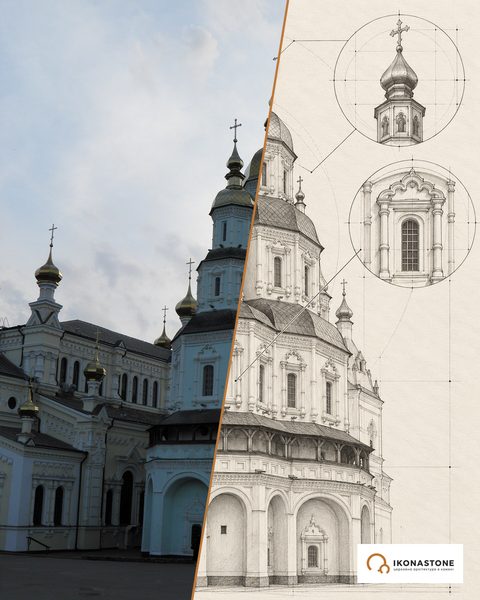
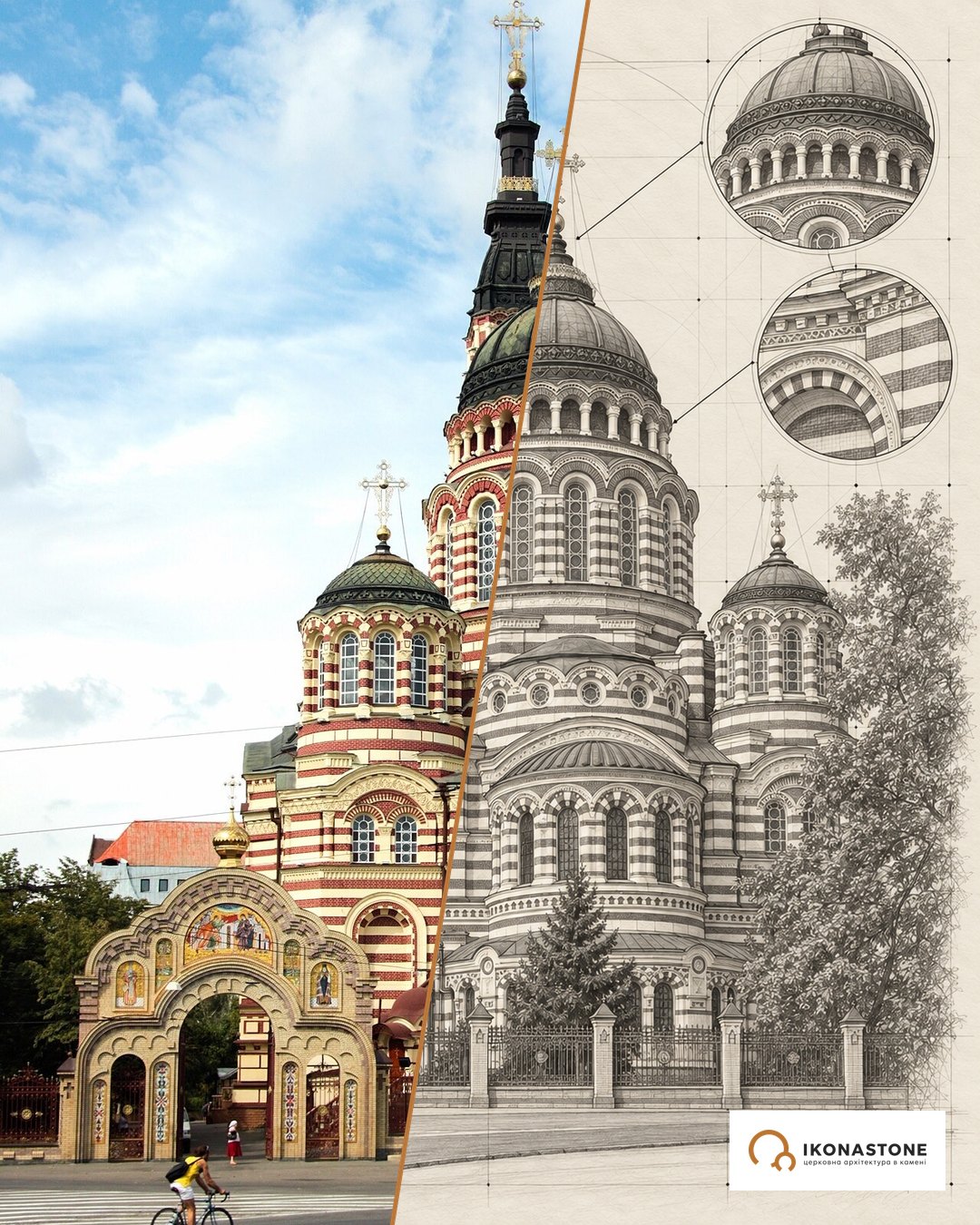
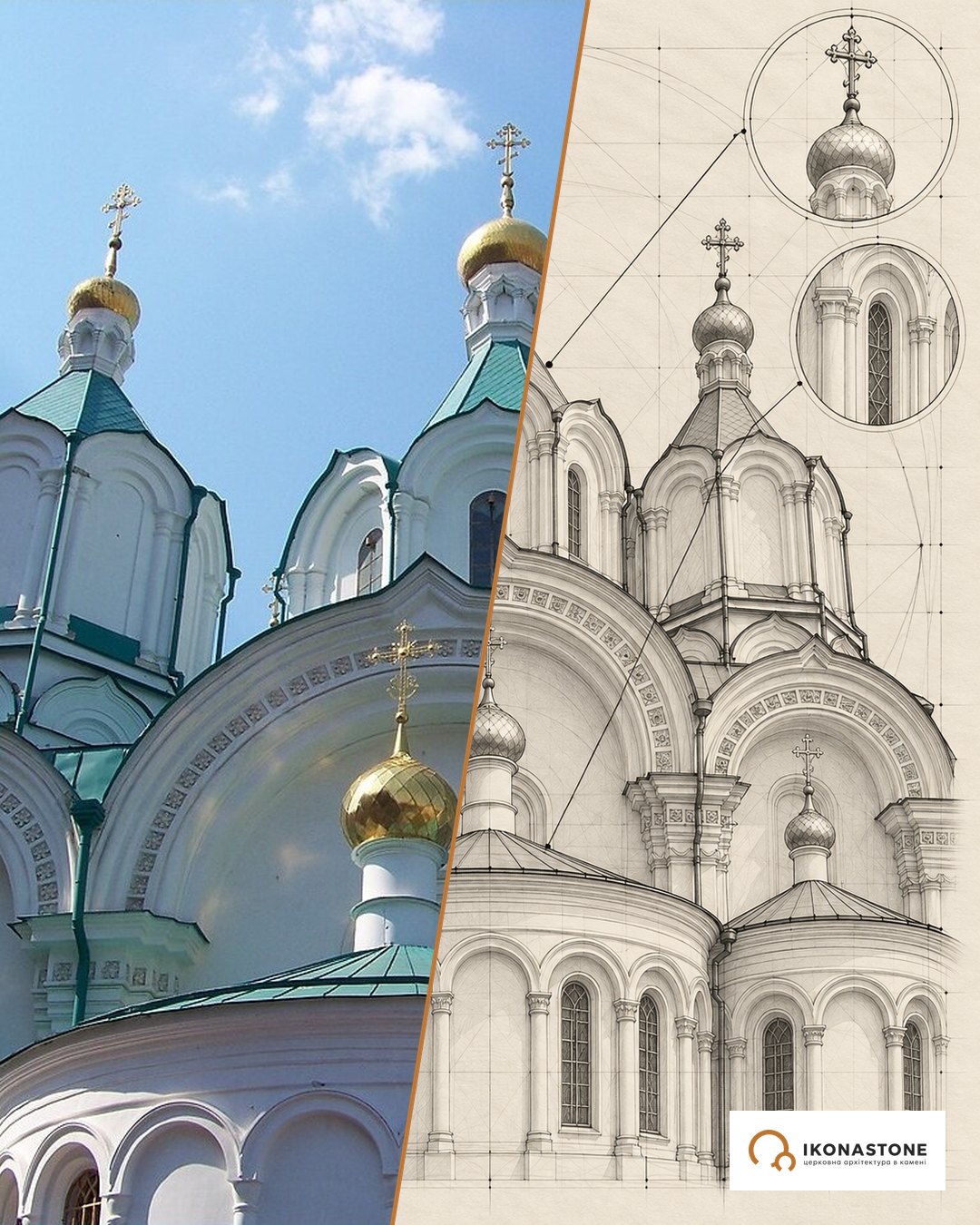
Below are two elements of the church: in a photograph and in a drawing. The drawings show form, not exact dimensions.
Domes with crosses
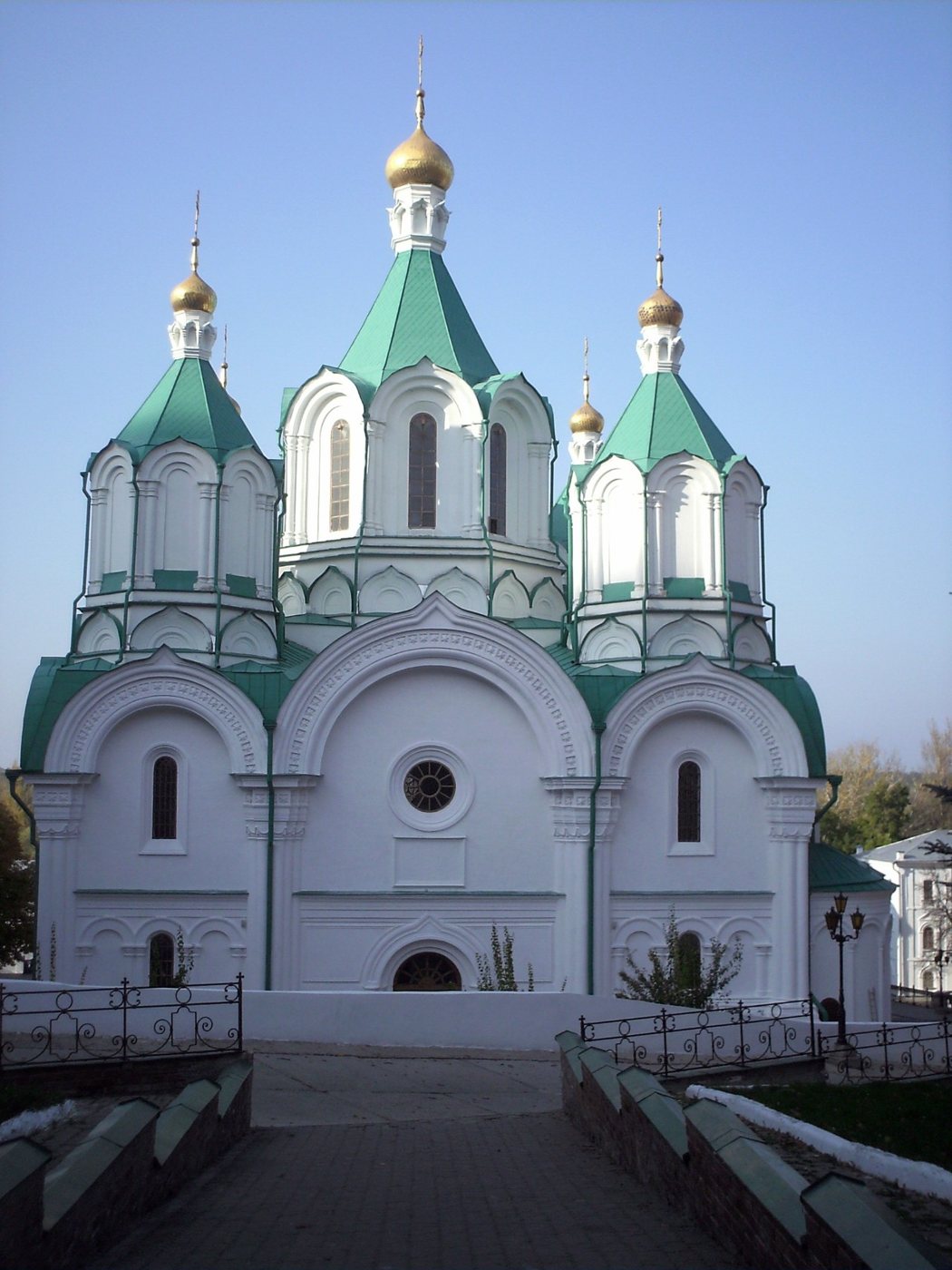
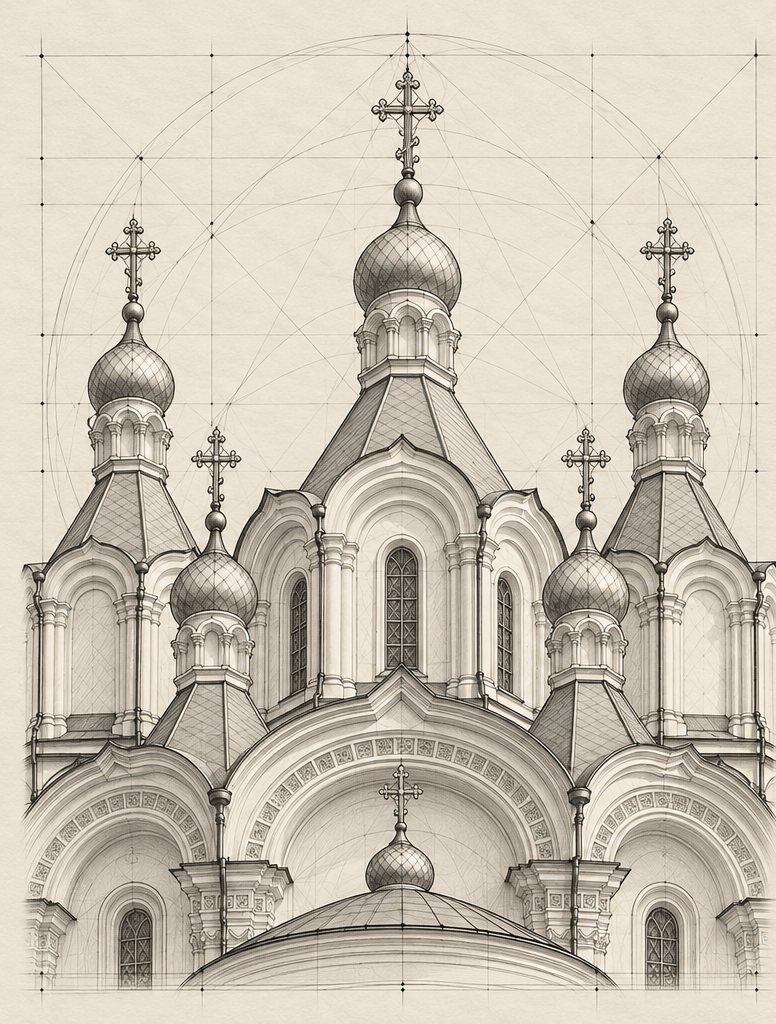
In such a landscape a dome is not merely the finish of a roof. Beneath a chalk cliff that is higher than any bell tower, a church cannot compete in height. It chooses something else: a silhouette and light on gold, visible from afar.
Side chapel
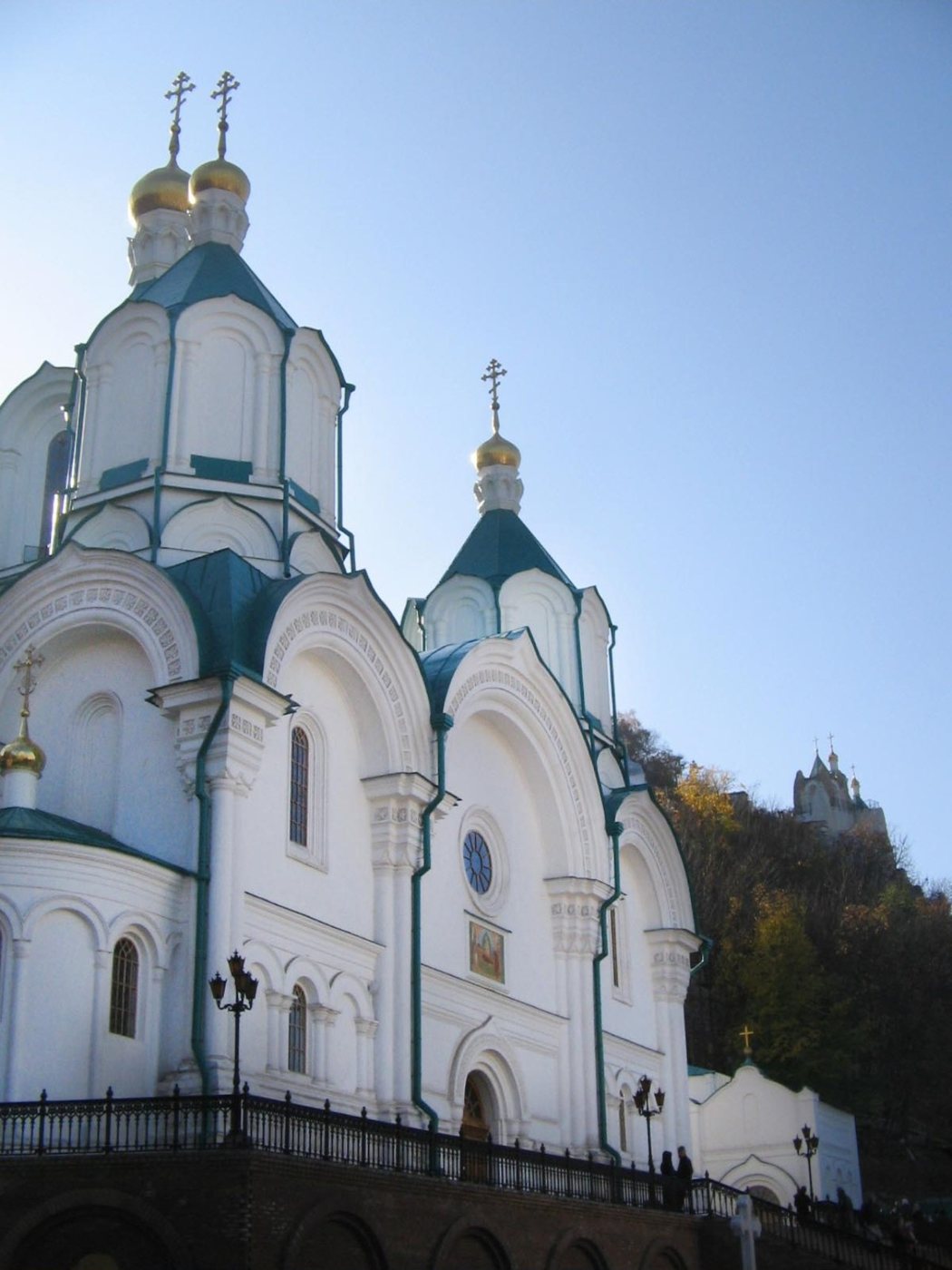
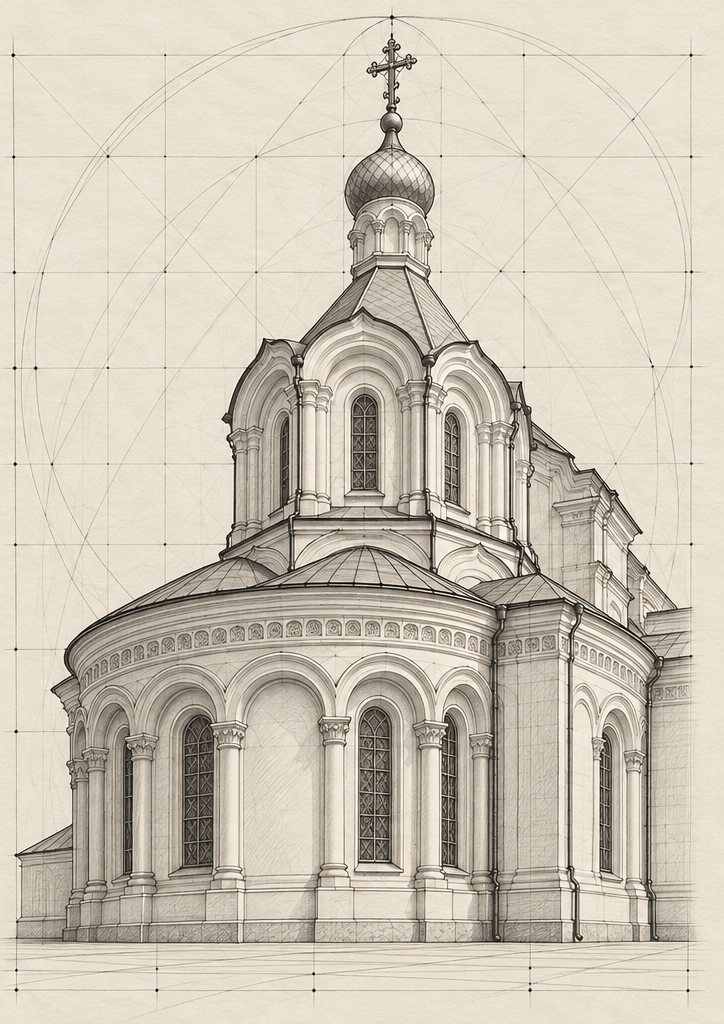
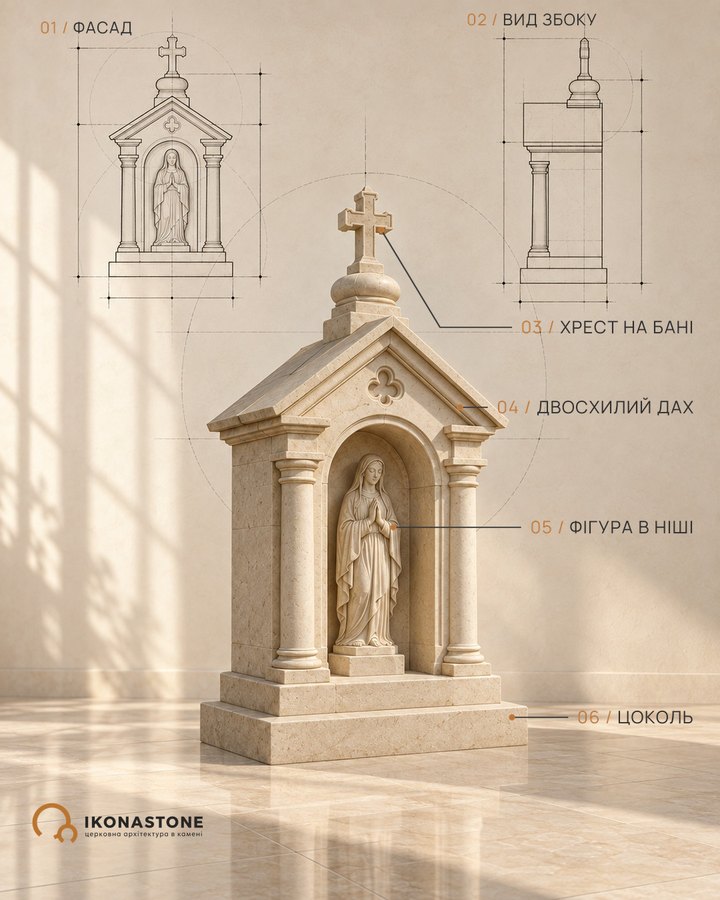
A side chapel is a separate altar with its own altar table within a single church. The cathedral’s south-western chapel has its own dome, and it was this dome that a shell pierced in October 2023.
Stone and material
The earlier cathedral was built in 1698–1708; the present one is masonry, of stone. But the main stone of Sviati Hory is not in the walls but around them: chalk. Soft, white, yielding, it is the rock in which the monks cut cells and cave churches, and it gave the monastery its name and its image.
Chalk teaches the builders humility. It yields easily to the chisel, and just as easily gives itself up to water and time. That is why the masonry cathedral stands on the terrace below, while the caves are in the rock above: each material in its place.
Side chapels with separate altars are a theme close to our chapels. Another lavra cathedral that we have examined is the Dormition Cathedral of the Pochaiv Lavra.
Did you know
The site for the church had to be levelled: the mountain was cut back, retaining walls were built and a ravine was filled in (according to sobory.ru). [3]
The cathedral has three altars: the Dormition, Sts Barbara and Tatiana, and the three hierarchs in the north. [3]
The cathedral is about 53 m high and 42 m long. [1]
After the restoration, 12 gilded chandeliers were hung in the cathedral; the central one weighs about 2.5 t and holds 168 candles (according to sobory.ru). [3]
In 1995 the monks began to remove the Soviet reinforced-concrete floors from the cathedral, about 2,600 t. [3]
The first service in 1991 was held in premises that an eyewitness described as "an ordinary club, without a dome, with chairs". [5]
Between the abolition of the monastery (1787) and its restoration (1844), 57 years passed. [6]
Among the writers who visited the monastery are named Anton Chekhov (1887) and Ivan Bunin (1895); a poem, "Sviatye Gory" (Holy Mountains, 1862), was dedicated to Fyodor Tyutchev, and in 1880 Ilya Repin painted the study "View of the Sviatogorsk Monastery on the Donets". [20]
The bell tower had eight bells, the largest 6,354 kg (according to the Ukrainian Wikipedia). [1]
According to the Ukrainian Wikipedia, the Soviet authorities renamed Sviati Hory as Chervoni Hory (Red Mountains) and Sviatohirsk as Slovianohirsk. [1]
The Italian traveller Alessandro Guagnini mentioned on the "Holy Mountains" "some images and ancient pagan pillars". [1]
The Encyclopedia of Ukraine dates the first written mention of the monastery to 1624, Radio Svoboda to 1654. [2, 5]
Traditions
Who founded the monastery
The sources relate several versions: monks of the Kyiv Caves Lavra who survived the sacking of Kyiv; Athonite monks who fled the Union of Florence in 1439; refugees from iconoclasm in the 8th–9th centuries; Ukrainian monks after the Union of Brest. None of them has convincing written or archaeological evidence. [20]
Ancient pillars
According to the record of Alessandro Guagnini (1578), "ancient pagan pillars" stood on the mountains. Interpreting them as a sanctuary is a conjecture. [1]
Figures
- Sigismund von Herberstein: an Austrian diplomat; in his notes of 1526 he mentioned the place “Sviati Hory”. [6]
- Fedir Shydlovsky: colonel of Izium; the earlier Dormition Cathedral (1698–1708) was built at his expense. [3, 4]
- Catherine II: the monastery was abolished during her reign (1787). [6]
- Grigory Potemkin: from 1790 the owner of Sviatohiria. [6]
- Tatiana Potemkin: invited Fr Arsenii to head the restored hermitage (1844). [19]
- Archimandrite Arsenii: the first abbot of the restored hermitage and the initiator of the construction of the cathedral; died on 12 October 1859. [3, 19]
- Aleksey Gornostayev (1808–1862): a St Petersburg architect, author of the cathedral’s design (1858); he also worked on Valaam. [23]
- Archimandrite German (d. 1890): abbot after Arsenii, who directed the construction of the cathedral. [3, 18]
- Makarii: an archbishop who consecrated the cathedral on 4 September 1868 (according to sobory.ru). [3]
- E. Kviring: chairman of the Donetsk gubernia committee of the RCP(b); according to the Ukrainian Wikipedia, he resolved to turn the monastery into a rest home (October 1922). [1]
- Ihor Isichenko, Oleksandr Vozniak: initiators of the first Ukrainian-language service in the former cathedral (1991). [5]
- The venerable Ioann, the recluse: a Sviatohirsk ascetic, glorified on 24 August 1995. [6]
- Metropolitan Arsenii (Ihor Yakovenko): abbot of the lavra since 1995; in the case based on the SBU’s suspicion, court proceedings are under way and there is no verdict. [5, 10, 11, 12]
- Archimandrite Galaktion, the monk Aristoklii, the nun Varvara: killed on 30 May 2022. [8]
- The monk Varsonofii (Turianskyi): killed on 23 August 2026. [15]
How to cite
IKONASTONE. The Dormition Cathedral of the Sviatohirsk Lavra // Guide to the Churches of Ukraine. URL: https://ikonastone.com/en/guide/dormition-cathedral-sviatohirsk-lavra/ (accessed DD.MM.YYYY).
FAQ
Where is the Dormition Cathedral?
In the town of Sviatohirsk, Kramatorsk District, Donetsk Oblast, on the chalk right bank of the Siverskyi Donets, at the centre of the Holy Dormition Sviatohirsk Lavra.
Who built the cathedral, and when?
The design was made by the architect Aleksey Gornostayev (1808–1862); in 1858 he designed the cathedral for the monastery. It was built in 1859–1868; the Encyclopedia of Ukraine gives 1859–1860.
What happened to the cathedral in Soviet times?
In 1922 the monastery was closed and a sanatorium was set up on its grounds, while the Dormition Cathedral was turned into a cinema. The building was returned to the monastery in 1992.
Was the cathedral damaged in the war?
Yes. In spring 2022, strikes on the lavra blew out the windows in its buildings. On 11 October 2023, according to the lavra's press service, a shell damaged the south-western dome and the metal roofing of the cathedral.
Sources
- Wikipedia (Ukrainian). Holy Dormition Sviatohirsk Lavra
- Encyclopedia of Ukraine (CIUS). Sviati Hory Dormition Monastery
- Sobory.ru. Dormition Cathedral of the Sviatogorsk Lavra
- Sobory.ru. Holy Dormition Sviatogorsk Lavra (Sviatohirsk)
- Radio Svoboda. The Sviatohirsk Lavra
- Azbyka.ru (forum). The Sviatogorsk Lavra, Donetsk Oblast
- Forbes Ukraine. Occupiers carried out an air strike on the Sviatohirsk Lavra (13.03.2022)
- Fakty ICTV. Shelling of the Sviatohirsk Lavra: three monks killed, three more wounded (02.06.2022)
- Fakty ICTV. Shelling of the Sviatohirsk Lavra: Bishop Kliment gave the number of killed and wounded (04.06.2022)
- Ukrinform. The Sviatohirsk Lavra: news tag page
- Suspilne Donbas. Metropolitan Arsenii did not appear in court after being released to house arrest (05.03.2026)
- LB.ua. Arsenii, abbot of the Sviatohirsk Lavra, suspected of surrendering Defence Forces positions, taken into custody (25.04.2024)
- Interfax-Ukraine. Monks and laypeople remain in the Sviatohirsk Lavra (22.06.2026)
- Cabinet of Ministers of Ukraine. The government entered the Church of St Nicholas in Druzhkivka and monuments of the Sviatohirsk Lavra in the State Register of Immovable Monuments (09.04.2026)
- Kyiv Post (Ukrainian). Attack on the monks of the Sviatohirsk Lavra (24.08.2026)
- Ukrainska Pravda. Zhyttia. Photo evidence: what the skete of the Sviatohirsk Lavra of the UOC MP destroyed by the Russians looks like (20.04.2023)
- RFE/RL. Liberation of Svyatohirsk Reveals War Damage To Revered Ukrainian Orthodox Monastery (05.10.2022)
- Russian Biographical Dictionary. German, archimandrite of the Sviatogorsk hermitage
- Academic publication on monastic landholding (PDF)
- Virtual Russian Museum. History of the Holy Dormition Sviatogorsk Lavra
- Community "Orthodoxy in Ukraine" (spzh.eu). Sviatohirsk Lavra comes under shelling (11.10.2023)
- The Insider. Fire at the All Saints Skete of the Sviatohirsk Lavra (04.06.2022)
- Wikipedia (en). Aleksey Gornostayev
- Suspilne. Some of the monks refuse to leave the territory of the Sviatohirsk Lavra (14.07.2022)
- L. Isichenko. Bombed-out myths (lb.ua)
- Town
- Sviatohirsk, Donetsk Oblast
- Built
- 1859–1868 (according to other sources, 1859–1860)
- Type
- cathedral church in the Russian-Byzantine style
- Material
- masonry (stone)
- Research depth
- 27%