Church Oil Lamp: What It Means and Where It Burns
A church has a lot of light, but there is one that is not switched on. A small flame in a glass cup, hanging on three chains before an icon. You do not notice it while it burns. You notice it when it goes out.
The oil lamp is one of the oldest objects in a church and at the same time one of the simplest. A vessel, oil, a wick. The design can be explained to a child in a minute. Why it burns in this particular place, before this particular image, and why it is not replaced by a light bulb, takes longer to explain.
This article is for those who are furnishing a church or a home corner with icons, and for those who simply want to understand what a lamp means. Where we speak of church order, the final word belongs to the priest of your community.
In brief
- A lamp is an oil light: a vessel with oil and a wick. The word comes from the Greek λαμπάς, “torch, lamp”.
- Its light is a reminder that Christ is the Light of the world, and oil has long meant God’s mercy.
- In a church, lamps burn before icons, on the Holy Table and beside it; one of them, the perpetual lamp, burns in the sanctuary all the time.
- At home a lamp is placed before icons and is most often lit for the time of prayer.
- The traditional oil is olive oil; the body of a lamp may be metal, glass or stone, but the flame is always in a separate cup.
- An open flame is never left unattended: a stable non-flammable base, distance from fabrics, children supervised.
What does a church oil lamp mean?
A lamp is a sign of reverence and a sign of prayer. It is lit before an icon to honor the one depicted on it, and to remind ourselves that Christ said of Himself, “I am the Light of the world.” This is how OrthodoxWiki also explains the meaning of the lamp: it recalls the One who enlightens our souls.
In the symbolism of the lamp each part has its meaning. The light is an image of the divine light. The flame is an image of love for Christ and of gratitude to God. The oil, according to Saint Symeon of Thessalonica, a 15th-century Greek theologian, points to God’s “oil”, that is, His mercy; modern Greek explanations add that it also recalls the Garden of Gethsemane, where Christ prayed among the olive trees. And the little flame, burning long and steadily, is an image of prayer rising to God.
Saint Nikolai Velimirovich of Serbia listed eight reasons why we light lamps. Among them: our faith is a light; the flame recalls the radiance of the saint before whose icon it burns; the lamp is a small offering of thanks; and one more, very precise: our inner lamp will not be lit without God’s grace. The lamp is similar in this: it never lights itself, someone’s hand lights it.
Where does the tradition of the lamp come from?
The roots are older than Christianity. In the Book of Exodus God tells Moses that the Israelites should bring pure olive oil for the lamp, so that it may burn continually (Ex 27:20). The Book of Leviticus repeats this requirement: the lamp in the tabernacle is to burn before the Lord from evening to morning as a perpetual statute (Lev 24:1–4).
The Church inherited this language of light. In the Revelation of John, seven lamps of fire burn before the throne of God (Rev 4:5), and this image is easy to recognize in the sanctuary of any church.
Where do lamps burn in a church?
Almost everywhere there is something holy: before the icons of the iconostasis, before the church’s own and venerated images along the walls. But there are places where the lamp is not a decoration but part of the order of worship.
Before the icons of the iconostasis. The iconostasis is a wall of icons that separates the sanctuary from the rest of the church. In front of it extends the solea, the raised platform from which the priest comes out to the people. Before the main (“local”) icons, that is, those at eye level, lamps hang on brackets or stand on floor candlesticks. Here every person who enters the church sees them. We wrote about how the iconostasis itself is built in the article What Is an Iconostasis.
On the Holy Table and beside it. The Holy Table (the altar table) is the sacred table in the middle of the sanctuary on which the Liturgy is celebrated. Oil lamps are still placed right on the Holy Table, and behind it, as seen from the nave, there usually stands a multi-branched candlestick, most often for seven candles or lamps. It is called the seven-branched candlestick, and it points directly to the seven lamps of Revelation. More about the Holy Table itself is in the article Holy Table and Table of Oblation.
Near the high place. The high place is the middle of the sanctuary’s east wall, opposite the Holy Table. In many churches a candlestick or a lamp is placed here too; exactly how depends on the tradition of the particular church. More about this place is in the article The High Place in the Sanctuary.
The large light under the dome, the chandelier (in Ukrainian, “panikadylo”), often carries lamps or candles too. But that is a different matter: it is lit during services, not kept burning all the time.
What is a perpetual lamp?
It is a lamp that burns without a break, day and night. In Ukrainian it is called “nevhasyma”, unquenchable. In the Greek tradition it is “akimitos”: unsleeping, the one that does not sleep. It burns in the sanctuary; in some churches and monasteries, lamps before an especially venerated icon or relics burn unceasingly in the same way.
The beginning of this fire is made at the consecration of the church. At the end of the rite the bishop lights a lamp right on the Holy Table. The Greek liturgist Panagiotis Skaltsis, explaining this moment after Nicholas Cabasilas, writes that this light is an image of Christ. The Wikipedia article on oil lamps adds that the sanctuary lamp is lit by the bishop at the consecration, and afterward ideally burns continuously.
In the Catholic Church a similar rule is written into the Code of Canon Law: before the tabernacle, where the Eucharist is reserved, a special lamp is to burn constantly (canon 940). Most often it is red, though the color is not prescribed. In Greek Catholic churches the practice combines the Eastern tradition with their own statutes, so where exactly the perpetual lamp burns in your church is best told by the rector.
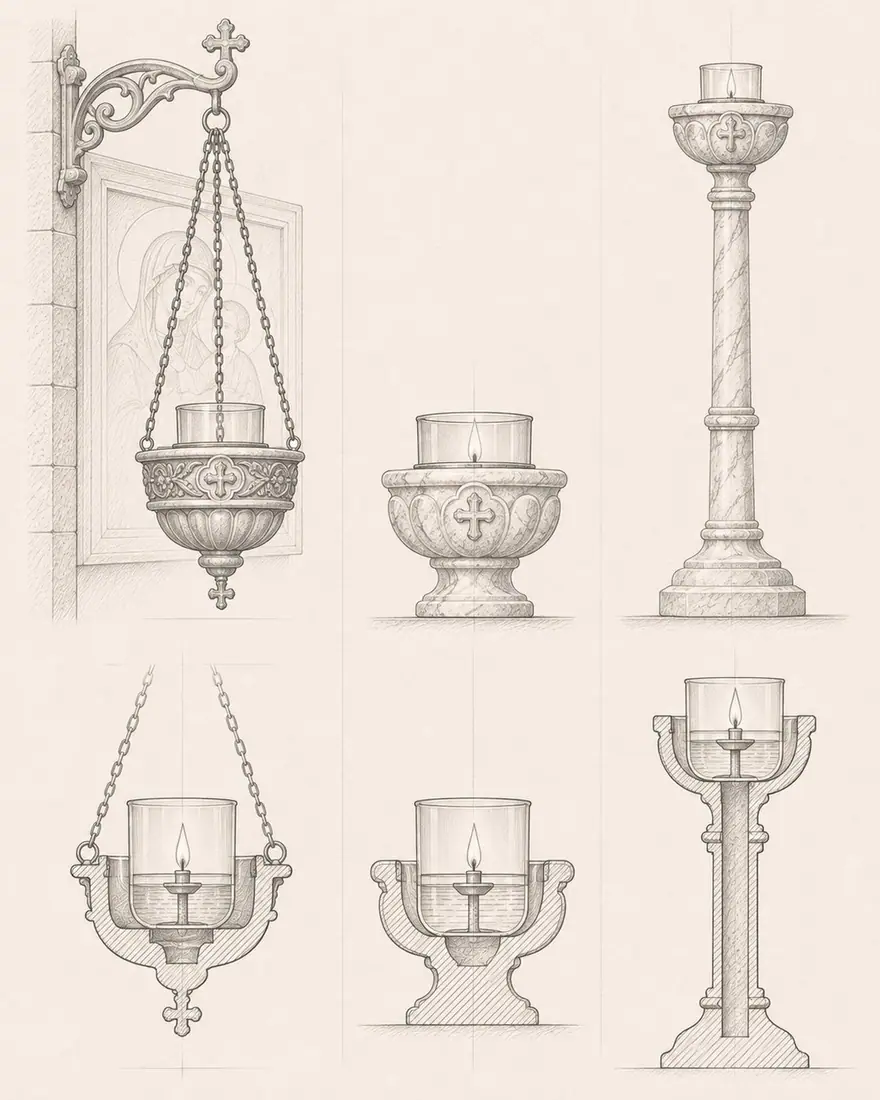
What kinds of lamp are there: hanging, table, floor
By the way they are set up, lamps fall into two large groups, hanging and standing. Standing ones include both small table lamps and tall floor lamps.
| Type | How it is made | Where it fits |
|---|---|---|
| Hanging | A cup on three chains, suspended from a bracket above the icon | Before icons on a wall, in the iconostasis, in an icon shrine |
| Table | A cup on a foot or stand | A home shelf with icons, a lectern, a small icon shrine |
| Floor | A tall stand-candlestick with a cup on top | Before a church icon, beside the iconostasis |
According to OrthodoxWiki, a hanging lamp is hung so that it ends up before the lower half of the icon. Standing ones fit where an icon hangs low above a table or shelf, or where people place their candles next to the lamp.
The construction is the same in all of them. A vessel for the oil, most often of heat-resistant glass; a float with a wick holder; the wick itself, which draws the oil up to the flame. The body around it can be anything: brass, silver-plated, ceramic, stone.
The color of the glass varies: red, blue, green, clear. There is no church rule about the color of a home lamp.
A lamp at home: where to put it and when to light it
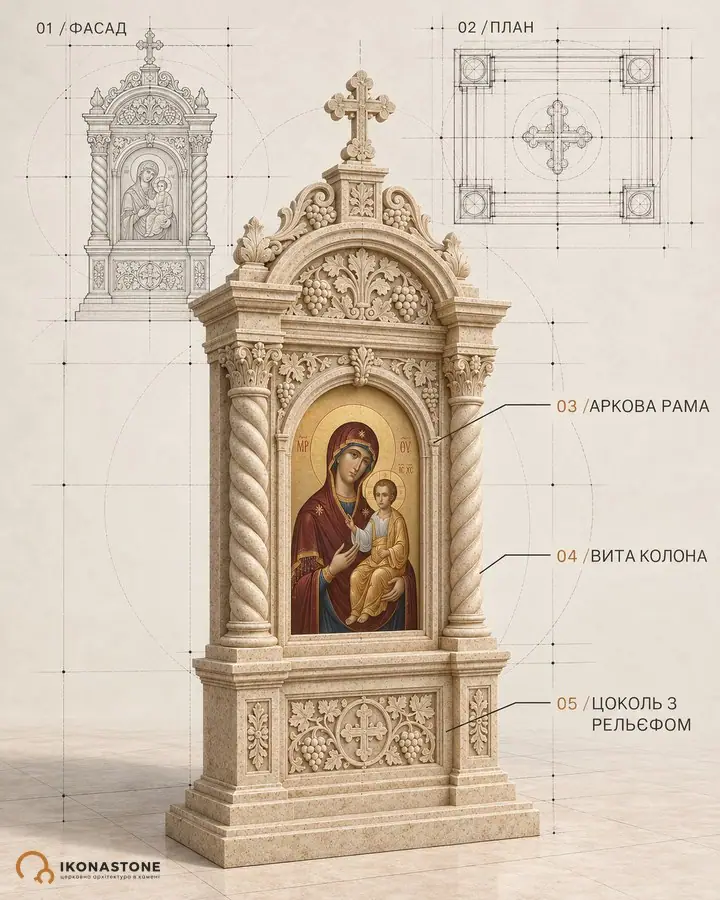
At home a lamp is placed before icons, in the “red corner” or on a home shelf. Sometimes an icon shrine is made for icons and a lamp: a glazed cabinet or niche that protects the image and gives it a place.
Must a home lamp burn around the clock? Not necessarily. An open flame in a dwelling without supervision is always a risk, so a lamp is often lit for the time of prayer, on Sundays and on feast days. The flame is kept small so that it does not smoke.
Which oil should go into the lamp?
The traditional answer is olive oil. It is called “eleos” (in Greek, oil), and it is pure olive oil for the lamp that the Book of Exodus mentions. Wikipedia and OrthodoxWiki confirm that olive oil is still the main one for lamps in Orthodox churches.
Church shops also sell mineral, so-called paraffin, lamp oil. Some consider it convenient, others a departure from tradition. This is a matter of practice, not of dogma, so it is better to ask the priest of your parish.
One simple rule without dispute: lamp oil is not meant for food, even if it is olive oil, because it may contain admixtures that kitchen oil does not.
A lamp made of stone: is it appropriate?
Stone is the oldest material of the lamp. Archaeologists find hollowed stone lamps at sites more than ten thousand years old. In the cave of Lascaux in France alone, over a hundred stone lamps were found, mostly limestone slabs with a hollow for fat, and the most famous of them was carved from red sandstone. Sumerian craftsmen carved lamps from alabaster in the shape of a shell. So a stone lamp is not an innovation but a return to the beginning.
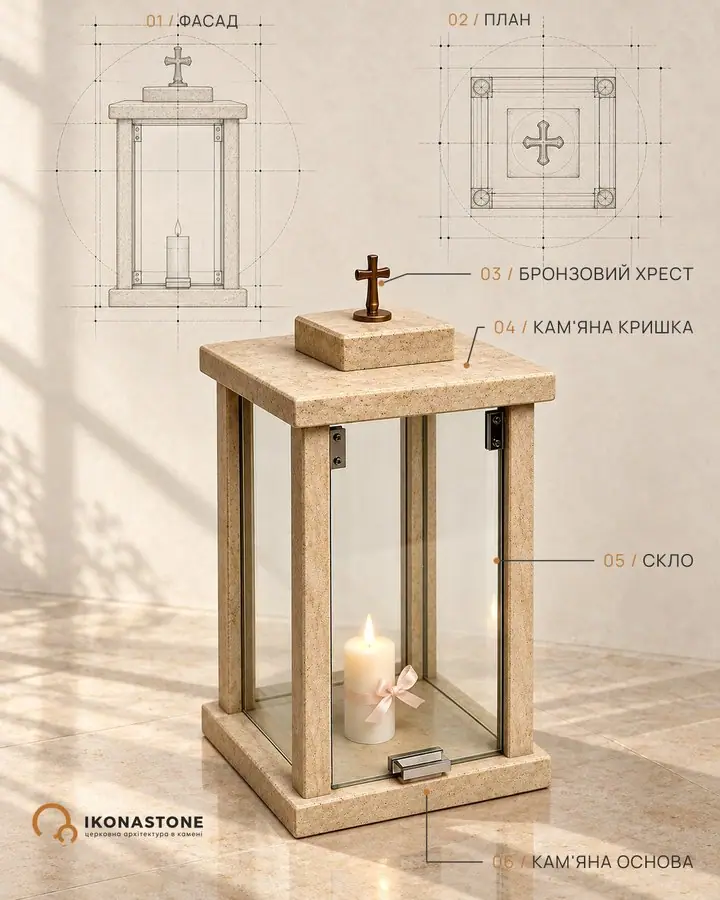
Today stone in a lamp works differently than it once did. Oil is not poured straight into marble: stone is porous, absorbs oil and over time darkens in patches. So a stone body always holds a separate glass cup, and the stone supplies the form, the weight and the balance.
Marble is good where the lamp stands and is looked at from close by: on a lectern, beside an icon in a chapel, on a home shelf. Granite is more resistant to weather, so stone lamps on graves and beside wayside crosses are made of granite. A hanging stone lamp is possible, but it is heavy: the bracket, the chains and the wall must be calculated for this weight, not for a small brass cup.
Stone has an advantage in safety too. It does not burn, does not melt, and a heavy stone base is hard to knock over. A stable non-flammable base is exactly what DSNS recommends for an open flame. We make stone lamps for a specific place; you can read about them in the lamps section.
How do you use a lamp safely?
DSNS, reminding people of the rules for candles, advises a few simple things. They apply fully to a lamp as well.
- Put the flame on a low, stable, non-flammable base.
- Keep it at a safe distance from anything flammable: curtains, towels, paper icons, dry branches.
- Do not leave the flame unattended.
- Do not let children play with an open flame.
It is worth adding a few tips from practice. A hanging lamp must not swing above a towel or an embroidered cloth. The shelf above a lamp darkens with soot over time, so there must be space between the flame and the wood. And if a lamp burns in an icon shrine, the shrine needs an opening for air and heat.
What to pay attention to
- The place. Before which icon the lamp will burn, and whether there is enough space above the flame.
- The type. Hanging, table or floor; for a hanging one, a reliable bracket and a wall that will bear the weight.
- The cup. Heat-resistant glass that is easy to take out, wash and replace.
- The oil. Olive oil by tradition; for other options, it is better to ask a priest.
- The material of the body. Metal is light, stone is heavy and durable; stone needs a glass insert.
- Safety. A non-flammable base, distance from fabrics, supervision.
- The order of the church. Where the perpetual lamp and the sanctuary lamps burn is decided by the rector, not by the workshop.
A final thought
The lamp is the smallest source of light in a church. It does not light the space; it marks a presence. So it is worth treating it as part of the architecture: think through where it will burn, what it will hang or stand on, and who will top up the oil.
Not sure what the piece is called? Walk through the church from sanctuary to churchyard →
Would you like to give something to a church? What to give a church →
Want to remember loved ones or a fallen parishioner? Remembrance at a church →
FAQ
What does a lamp before an icon mean?
The lamp is a sign of reverence for the one shown on the icon, and a reminder that Christ is the Light of the world. Oil has long been read as an image of God’s mercy, and the little flame as a prayer rising to God.
How is an oil lamp different from a candle?
A candle burns itself away, while a lamp is a vessel with oil and a wick that is refilled and lit again. So a lamp can burn for a long time and stays in one place, while a candle is brought and set down for the time of prayer.
Which oil should go into the lamp?
Traditionally olive oil: the Book of Exodus names pure olive oil for the lamp, and it is still used in Orthodox churches today. Mineral (paraffin) lamp oil is sold too; opinions about it differ, so it is better to ask a priest.
What is a perpetual lamp?
This is the lamp in the sanctuary that burns continuously, without a break. In the Greek tradition it is called “akimitos”, that is, unsleeping. In an Orthodox church the fire on the Holy Table is first lit by the bishop at the end of the rite of consecration of the church.
Can I leave a lamp burning at home overnight?
The State Emergency Service of Ukraine (DSNS) advises against leaving an open flame unattended. That is why at home a lamp is often lit only for the time of prayer, and if it burns longer it stands on a stable non-flammable base, far from fabrics and out of children’s reach.
Are there lamps made of stone?
Yes. The oldest lamps of humankind were in fact stone. Today the body or stand of a lamp may be made of marble or granite, while the oil burns in a glass cup inside.
Sources 14
- Vigil lamp — OrthodoxWiki
- Altar — OrthodoxWiki
- Oil lamp — Wikipedia
- Sanctuary lamp — Wikipedia
- Кодекс канонічного права, кан. 940 (Vatican, італ.)
- Π. Σκαλτσής. Η Τελετή των Εγκαινίων — poimin.gr
- Τι συμβολίζει το καντήλι και γιατί πρέπει να είναι πάντα αναμμένο — poimin.gr
- Γιατί βάζουμε λάδι στο καντήλι – Τι συμβολίζει — Orthodoxia News Agency
- Why we light oil lamps and candles (свт. Миколай Сербський) — Mystagogy
- Orthodox vigil lamp: meaning and symbolism — Monastiriaka
- λαμπάς (Strong's 2985) — Bible Hub
- Вихід 27:20–21 — Біблія, сучасний переклад (bible.com)
- Lascaux: Lighting — Міністерство культури Франції
- Відключення електроенергії: убезпечте себе, близьких і житло від пожежі (ДСНС) — Урядовий портал