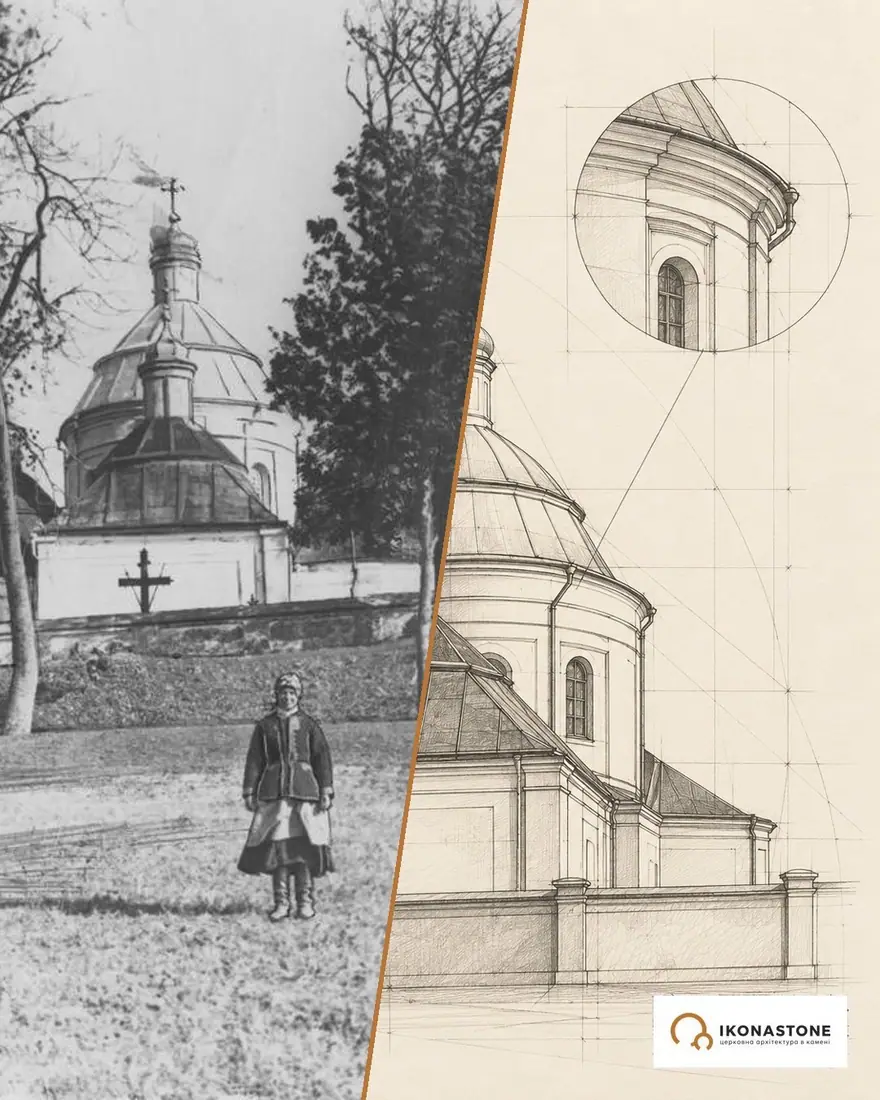
St Basil's Rotunda in Volodymyr: eight petals and not a single certain date
Most churches are read along an axis: from the entrance to the altar. St Basil’s Rotunda is read in a circle. Eight petal-exedrae radiate from the centre like rays, and only the eastern one, the sanctuary, projects slightly further than the others — as a reminder of where to look.
In brief
| Address | 30 Vasylivska Street, Volodymyr |
| Built | late 13th — early 14th century (by the masonry); according to other data, late 12th century |
| Type | centrally planned masonry rotunda, eight-petalled in plan |
| Dome | spherical, 12 m above the floor (original) |
| Rebuildings | 1844 (onion-shaped dome, porch), 1900–1901 (to a design by Kozlov, Neo-Russian style) |
| Status | architectural monument of national importance |
The story in plain words
A short account, about a 4-minute read. The full chronology, with all dates, disputes and sources, is below in the "Chronology" section.
A date no one knows (before the 14th century)
The Vasyl Rotunda in Volodymyr is a church with eight “petals” instead of ordinary walls. Nobody knows exactly when it was built. There are several versions.
The first is an inscription on a stone slab set into the wall. One scholar read it as the year 1194, and another, later, as 1294. During the First World War the slab was taken away. Some sources say its fate is unknown. Others say it is in the museum of the University of Zagreb, but the museum itself has not confirmed this. So neither reading can be checked now.
The second version comes from a chronicle. Around 1287 Prince Mstyslav Danylovych built a burial church over the grave of his grandmother. Whether this is the same church is unknown: Leonid Makhnovets thought so, other scholars did not.
The third version comes from the building itself. The thin “finger” brick and Gothic features point to the late 13th or early 14th century. Antonovych and Prakhov in the 19th century saw the 14th–15th centuries in it, though sources report their opinion differently.
The church tradition reaches deepest. It says the first wooden church here was built in one day in 992 by the retinue of Prince Volodymyr Sviatoslavych, on their way back from a campaign, and dedicated to Saint Basil.
Decline (1523–1844)
The documents begin in 1523, and already then the church was in poor condition. In 1695 it was the same: beside the church stood a house with a school and a hospice, and the church itself was ageing without repair. At the end of the 17th century the frescoes inside were whitewashed. Until the middle of the 19th century the rotunda stood neglected.
In 1844 the government allocated 5 thousand roubles for repairs. The old spherical roof was replaced by a large onion-shaped dome that did not suit the proportions of the church. A two-tier porch was added on the west, with a bell tower planned in its upper tier.
The last big rebuilding (1899–1901)
In 1899 the architect Kozlov drew up a new reconstruction project. It was carried out in 1900–1901 in the Neo-Russian style. The top of the rotunda was changed, a bell tower was made, and in front of the west entrance a vestibule with a tall triangular gable was added. Above the rotunda rose an onion-shaped dome on a drum with kokoshniks. Sources give the architect’s initials differently.
Quiet years (20th century)
After the First World War the rotunda remained a parish church. Father Damian Hershtanskyi served here for more than half a century; he died in 1936. From 1941 the rector was Yevhen Hershtanskyi, until his death in 1968. In 1988 Serhii Depo became head of the parish.
In 1946–1949 the rotunda was studied by Hryhorii Lohvyn. There is no information about the church being closed in Soviet times.
Today (2005 to the present)
In 2005–2006 part of the state funds went to repairs of the church, and then the restoration stopped. Today it is a parish church of the Volyn Eparchy of the Orthodox Church of Ukraine and an architectural monument of national importance. Inside is an icon of the Mother of God Hodegetria, which, according to a local legend, was brought from Byzantium. The iconostasis dates from the 18th century.
The form of this rotunda, in the words of its authors, has no analogues in world sacred architecture.
Glossary
| Word | What it means |
|---|---|
| Rotunda | a church or building round in plan, with a dome |
| Exedra | a semicircular niche projecting from the main volume |
| Graffito | an inscription or drawing scratched on a wall or slab |
| Chronicle | a medieval record of events year by year |
| Burial church | a building or vault where a family or notable people are buried |
| Porch | an annex in front of the church entrance |
| Kokoshniks | decorative small arches on a drum or roof in Russian style |
| Visitation | an inspection of a church by an official, with a description of its state |
| Iconostasis | a wall of icons between the altar and the rest of the church |
Chronology
Figures in square brackets are the numbers of the sources in the list at the bottom of the page. The note “according to …” means that the fact is confirmed by only one source. The “Legends” section contains traditions and legends: they are recorded in the sources but not confirmed by documents.
Legend and disputed dating
- 992 (according to legend)
According to church legend, the first wooden church on this spot was built in a single day by the retinue of Prince Volodymyr Sviatoslavych as they returned from a victorious campaign against the Croats; it was dedicated to St Basil in honour of the prince's baptismal name. Another variant of the legend ascribes the construction to the prince's wife. This is local tradition, not a document. [1, 2, 3, 6, 7]
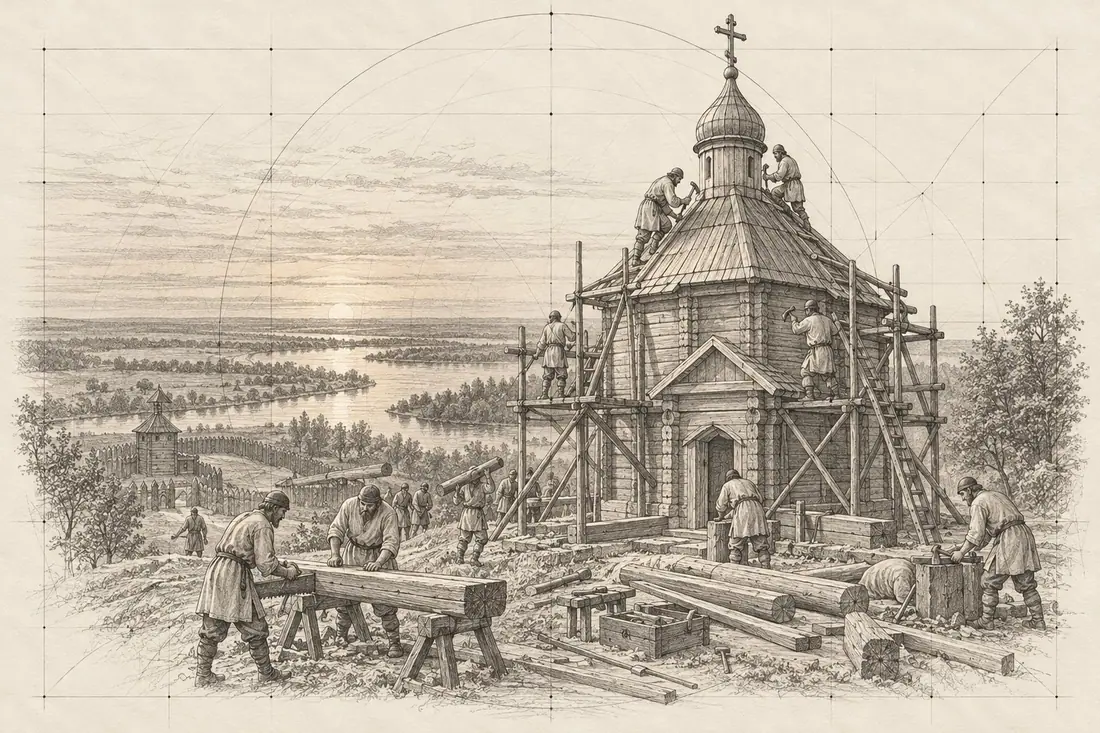
The legend of 992: a church in a single day. Illustration: IKONASTONE - 1194 (according to a reading of the inscription)
On a slate slab with graffiti set into the northern part of the church, Izmail Sreznevsky read a Church Slavonic inscription with a year from the creation of the world, corresponding to 1194. For a long time this was considered the date of construction; Wikipedia links it with the building activity of Prince Roman Mstyslavych. [1, 2, 3, 4]
- 1287
According to a chronicle report, Prince Mstyslav Danylovych (1230s — after 1292), son of Danylo of Halych, built a burial church over the grave of his grandmother. Leonid Makhnovets connected this precisely with St Basil's Church and suggested the burial of Anna, wife of Roman Mstyslavych; other researchers held that the burial was beyond the ramparts of the hillfort. The identification is not proven. [1, 3]
- 1294 (repeated reading)
VUE: the graffito, published at the end of the 19th century, was studied again (the VUE text gives “1996”) and the date was refined to 1294 — which brings it closer to the chronicle report of 1287. This reading is given only by VUE. [1]
- Late 13th — early 14th century
By the character of the bar-brick (palchatka) masonry and certain Gothic features, the church is now dated to the late 13th — early 14th century; VUE, KuLaDig and the REHERIT heritage profile converge on this dating; S. Tersky also writes of “St Basil's church of the end of the 13th century”. [1, 4, 6, 15]
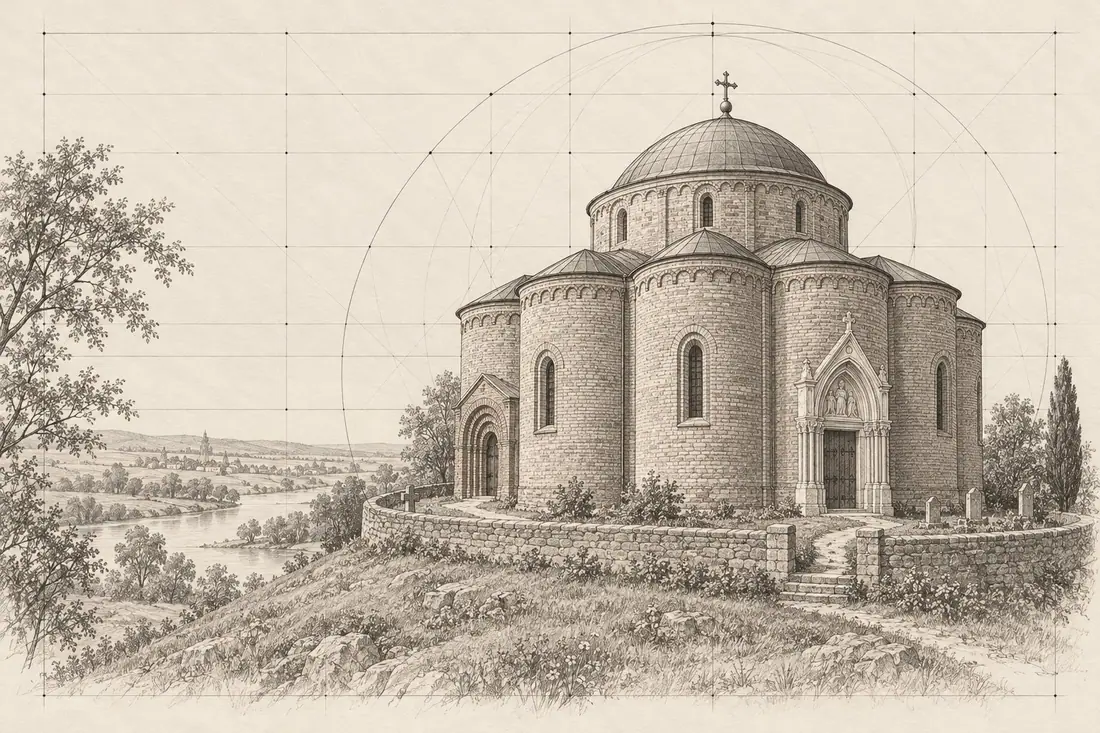
Around 1300: the rotunda (reconstruction). Illustration: IKONASTONE - 1419 (according to Wikipedia)
According to the visitation record of 1695, on a beam of the parish priest's house near the church there was an inscription “this church was built in the year 1419”. The authenticity of the inscription has not been verified. [2]
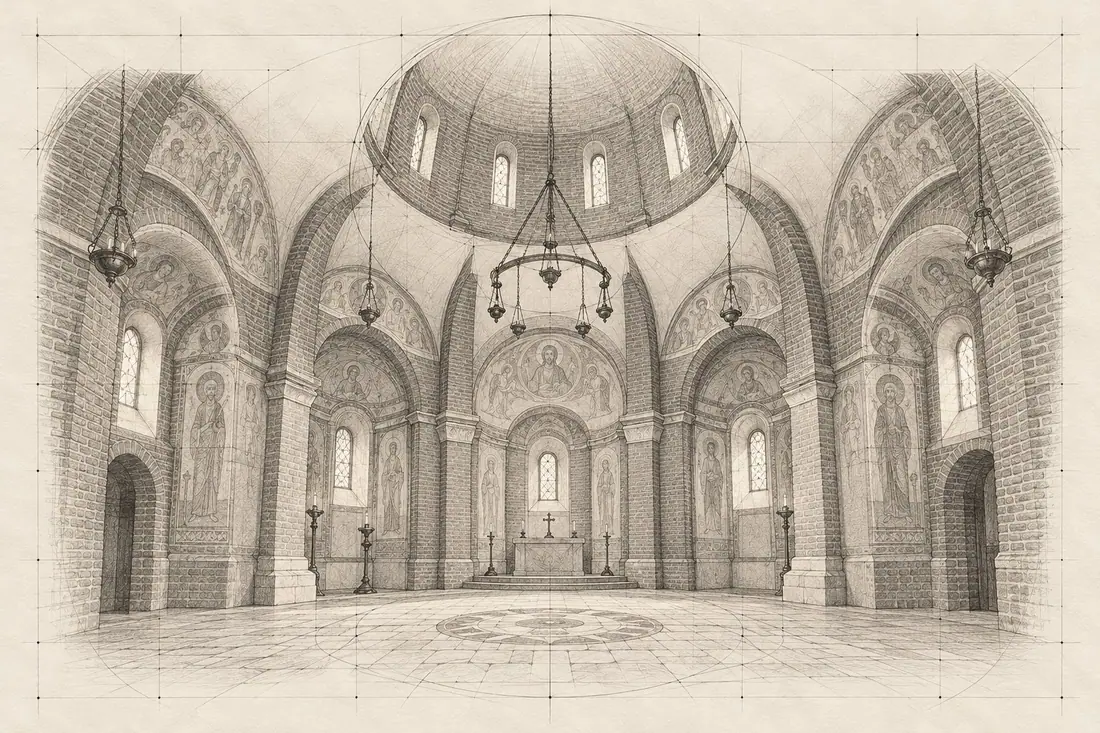
Interior of the rotunda, around 1300 (reconstruction). Illustration: IKONASTONE
The Polish-Lithuanian era
- 1523
First documentary mention: King Sigismund I transferred the right of presentation to St Basil's Church to Prince Vasyl Mykhailovych Sanhushko. VUE adds that this mention attests to the poor technical condition of the church. [1, 2, 3]
- 1558
The church is mentioned for the first time as being of stone. At the same time the patron Petro Zahorovsky, following suits in the land court, lost his rights to the church, which was seized by Prince Mikołaj Krzysztof Radziwiłł. According to Wikipedia. [2]
- 1570
The only mention of a monastic community founded at St Basil's Church. According to Wikipedia. [2]
- 1585
The right of presentation to St Basil's Church returned to Fedir Zahorovsky. According to Wikipedia. [2]
- 1601–1602
In 1602 Andrii and Oleksandr Zahorovsky complained about the Uniate Metropolitan of Kyiv Hypatius (Potii), alleging that in the previous year (1601) he had “sent” men who plundered the church and mocked the priest. The complaint was later published in the collection “Arkhiv Yugo-Zapadnoy Rossii” (1863). [2, 10]
- 1695
Visitation by Sevastian Kosovych: beside the church there was a house with a school and a hospital. VUE notes that the poor technical condition of the church was recorded then as well. [1, 2]
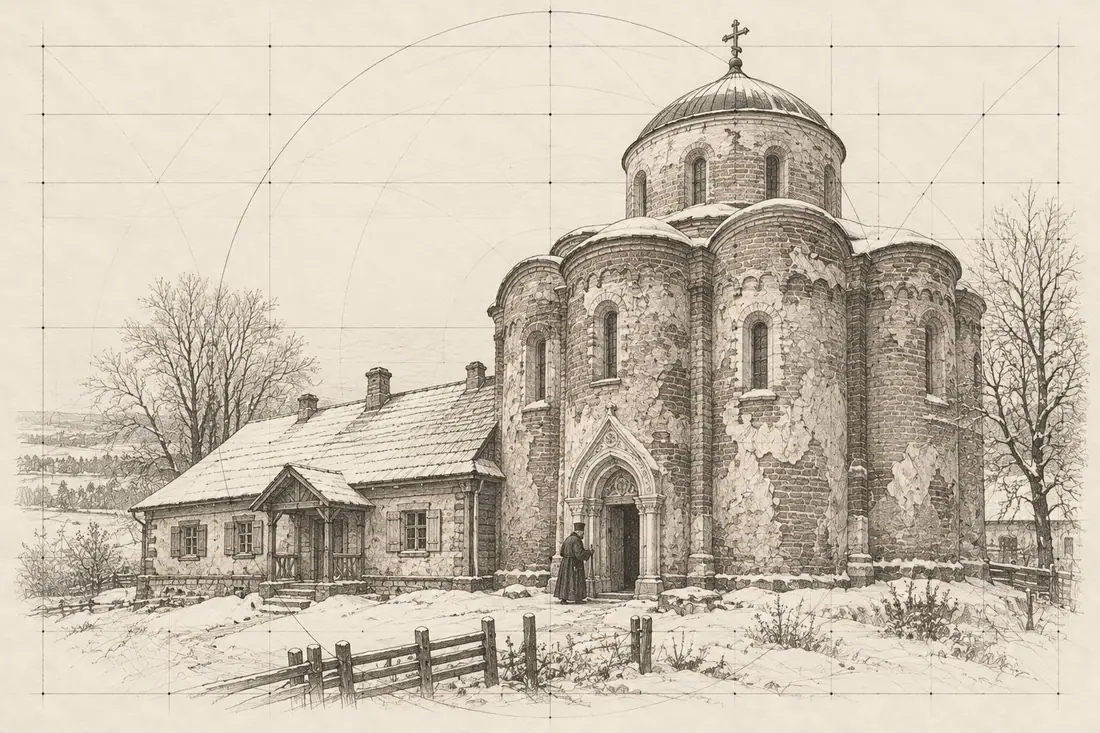
1695: the rotunda according to the visitation. Illustration: IKONASTONE - Late 17th century
The interior frescoes were whitewashed; according to the research of Hryhorii Lohvyn, at a height of 2 m in the northern projection a plaster ground prepared for painting has survived. From the end of the 17th to the middle of the 19th century the rotunda stood in disrepair. [1, 2, 3]
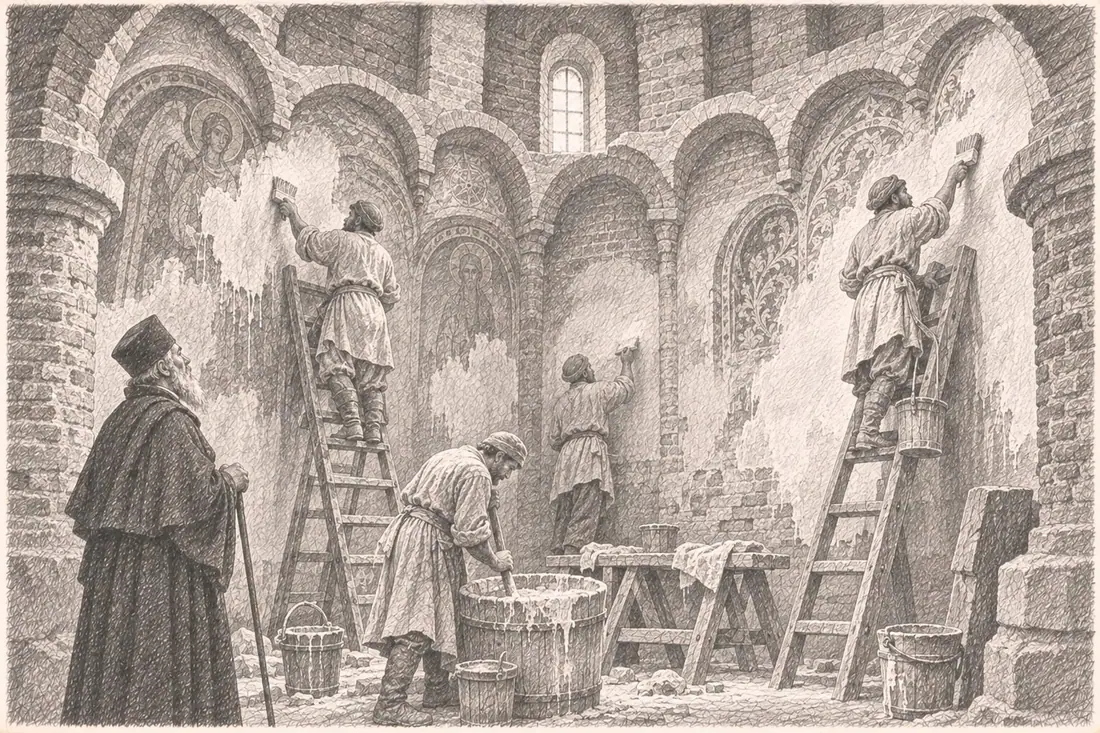
late 17th c.: whitewashing the frescoes (conjectural reconstruction). Illustration: IKONASTONE - 16th–18th century (icon)
An icon of the Mother of God Hodegetria was brought to St Basil's Church from the Church of the Presentation in the Temple of the Most Holy Mother of God, which had burned down; according to local legend, the image was brought from Byzantium. The iconostasis of the church is of the 18th century. [3, 5]
The Russian Empire
- 1795
Volodymyr passed to the Russian Empire and received the name Volodymyr-Volynskyi. [8]
- 1844
The government allocated 5,000 roubles for the renewal of the monument. According to VUE, the old spherical roof was replaced by a disproportionately large onion-shaped dome, and a two-tier porch was added on the west, the upper tier of which was to serve as a bell tower; Wikipedia adds that the roof was covered with sheet metal. Hryhorii Lohvyn also assigned the buttresses to this year, but VUE says only that they are “of later origin”. [1, 2, 3]
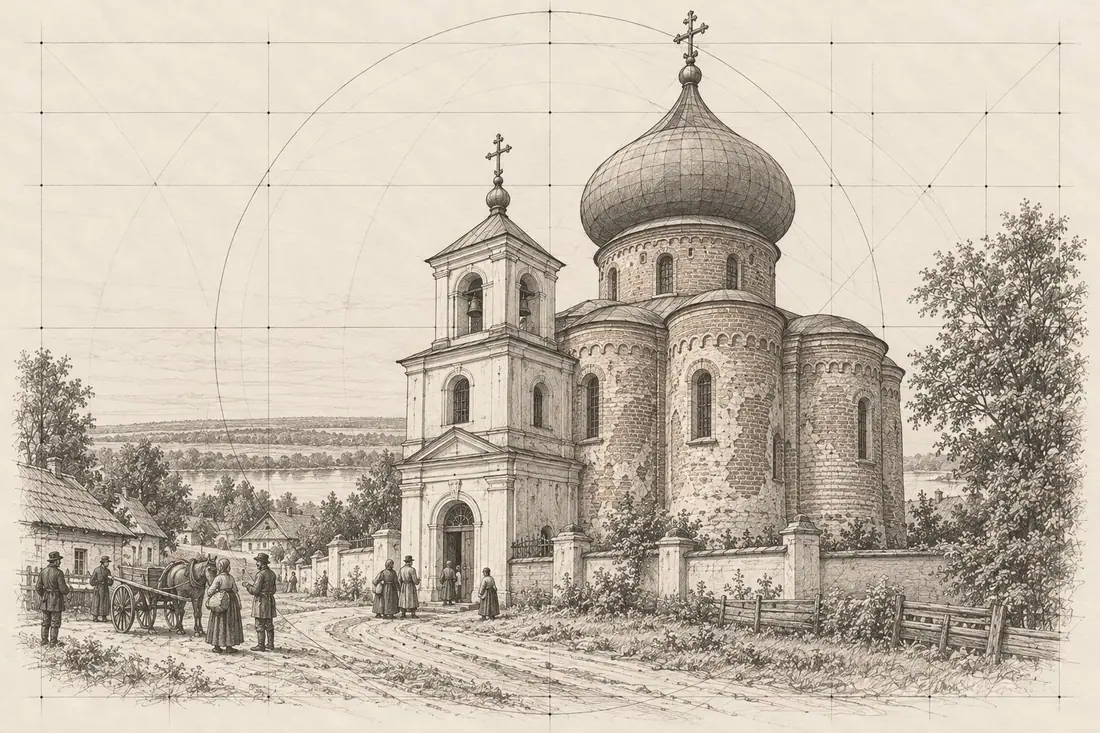
1844: the rotunda after rebuilding. Illustration: IKONASTONE - 1886
According to Wikipedia, Volodymyr Antonovych and Adrian Prakhov surveyed the church and proposed a date of the late 13th — early 14th century; according to VUE, these researchers dated the monument to the 14th–15th centuries. The sources differ. [1, 2]
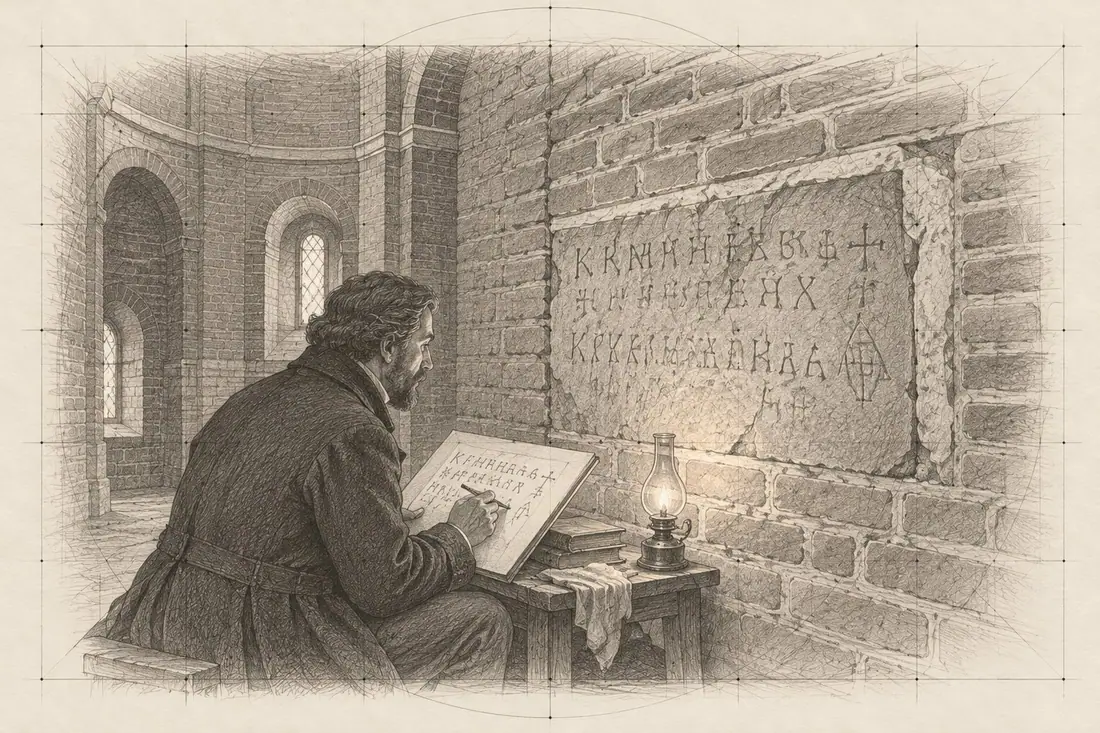
19th century: a researcher beside the inscribed slab. Illustration: IKONASTONE - 1899–1901
The architect Kozlov (VUE: M. Kozlov, 1870–?; Wikipedia: K. Kozlov; istvolyn: P. Kozlov) drew up in 1899 a reconstruction project, carried out in 1900–1901 in the Neo-Russian style: the crowning of the rotunda and of the annex, on which a bell tower was built, was changed, and a vestibule with a high triangular gable was added in front of the western entrance; above the rotunda rose an onion-shaped cupola on a drum with kokoshniks. The tourist site Travelsinua notes that the cupola of 1901 changed the look of the church beyond recognition. [1, 2, 3, 9]
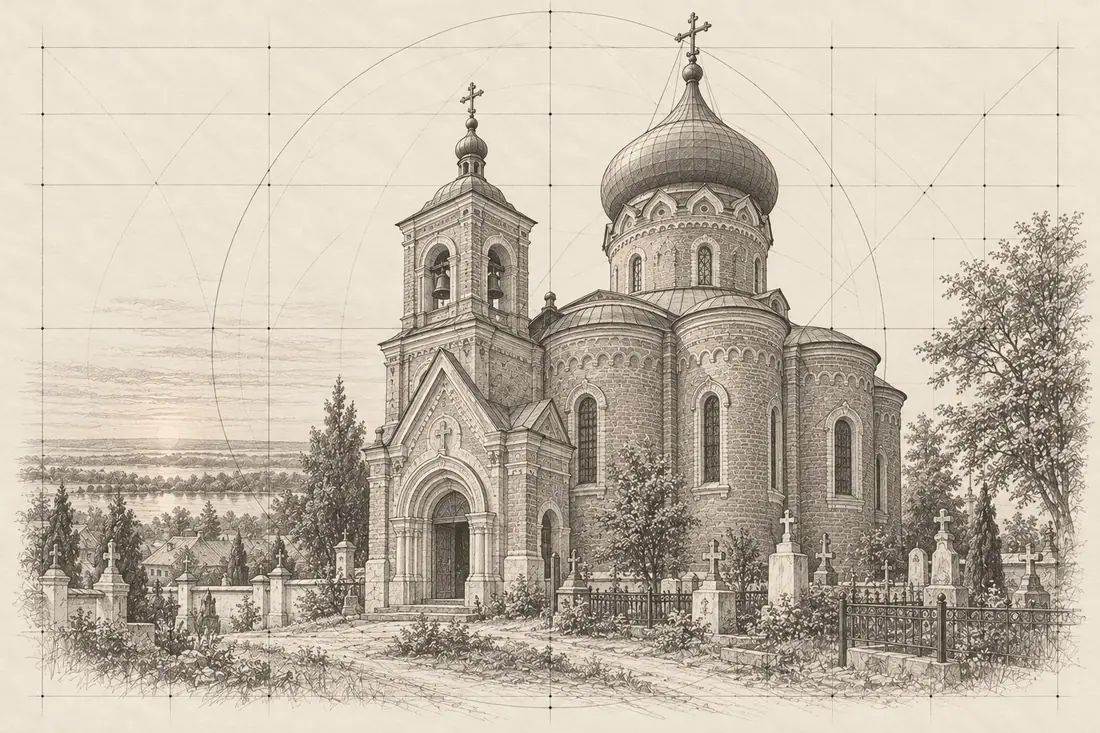
After 1901. Illustration: IKONASTONE - First World War
During the occupation of Volodymyr by the Austro-Hungarian army the slab with the graffito was removed and taken away. According to VUE, its fate is unknown; according to istvolyn.info and KuLaDig (without reference to a document), the slab was taken to Croatia and is now kept in the museum of the University of Zagreb. No confirmation from the museum itself has been found. [1, 2, 3, 4]
Wars and the interwar years
- 1919
In spring Volodymyr was seized by the Polish army; the city remained part of Poland until 1939. [8]
- 1925
The Polish researcher Michał Walicki surveyed the rotunda and assigned it to the turn of the 12th–13th centuries, considering that the original building was of the Romanesque type and the Gothic rebuilding later (after 1523); his article “Średniowieczne cerkwie Włodzimierza” appeared in 1931 in “Rocznik Wołyński”. Later Borys Voznytsky held to this dating. [2, 3]
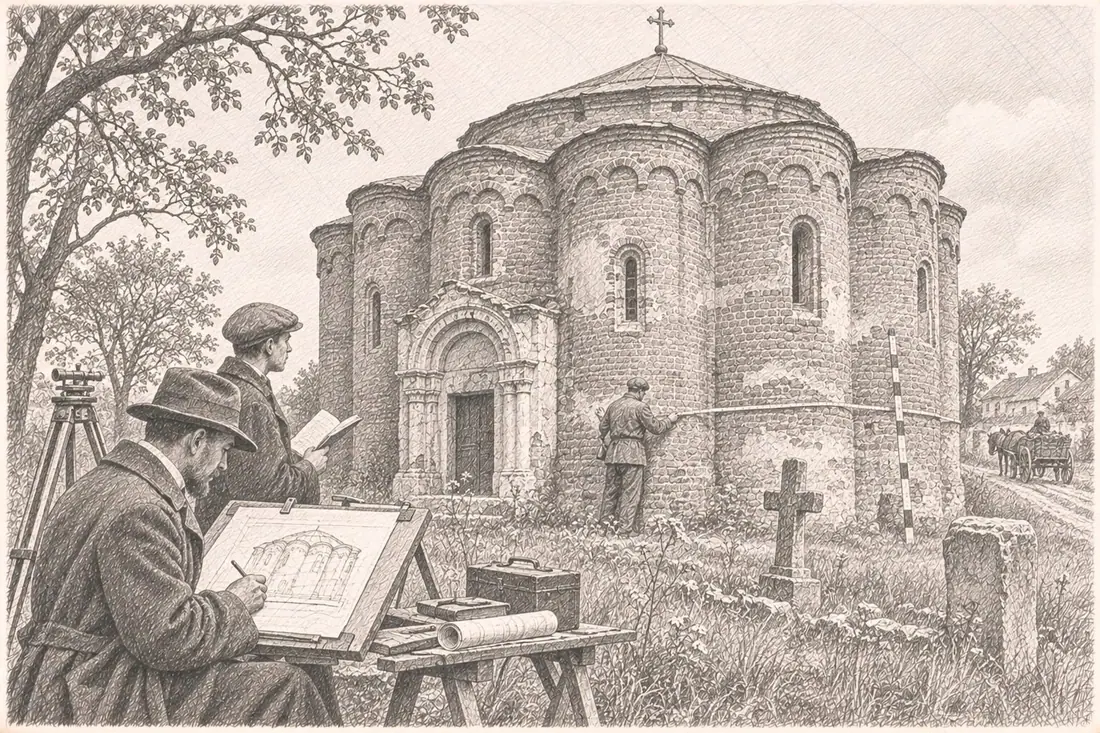
1925: surveying the rotunda (conjectural reconstruction). Illustration: IKONASTONE - 1929
Volodymyr Sichynsky's work “Rotundas in Ukraine” (Kyiv) was published; in the literature it is cited in the article on St Basil's Rotunda. [2]
- 1933
The engineer-architect Józef Dutkiewicz made a photographic record of the church (captioned “St Basil's Rotunda”); the photograph is held by the Institute of Art of the Polish Academy of Sciences and the German Digital Library. [12]
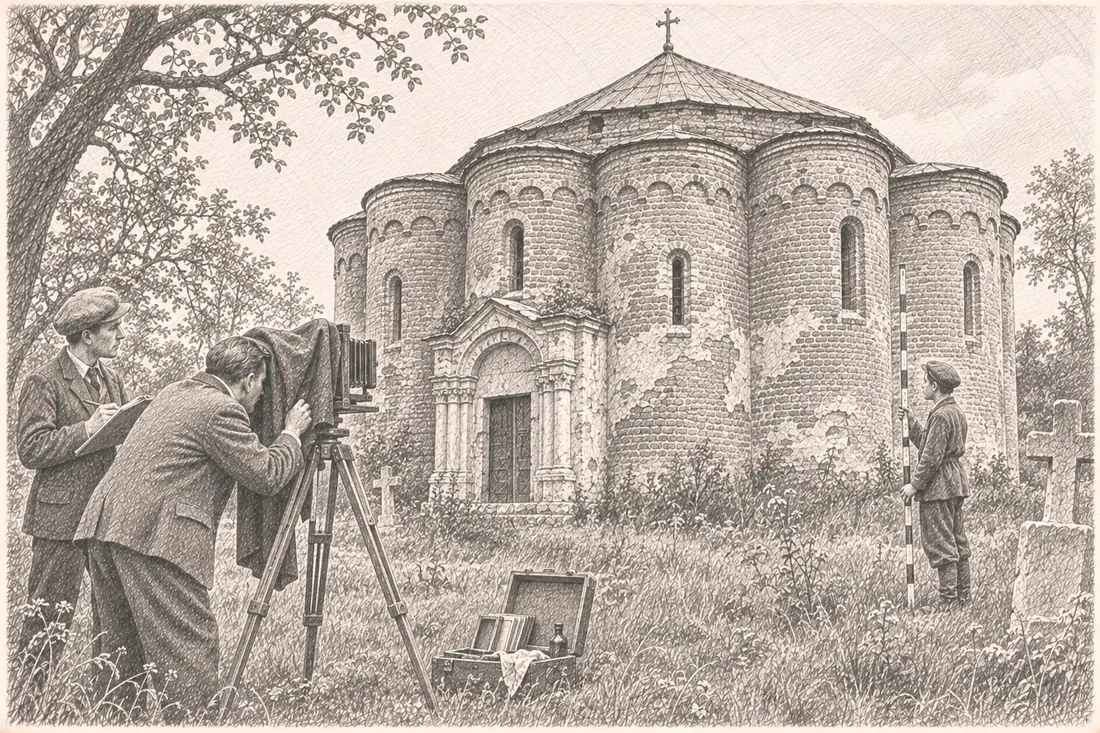
1933: photographic documentation of the rotunda (conjectural reconstruction). Illustration: IKONASTONE - 1936
Damian Hershtansky died, long-serving rector of St Basil's Church (he served for over fifty years), a member of the Second State Duma and a senator of the Polish Sejm. According to istvolyn.info. [3]
Postwar and Soviet years
- 1941
In December Yevhen Hershtansky became rector (Master of Theology of the University of Warsaw, 1934); he served until his death in 1968. In the verified sources there is no information about the closure or repurposing of the church in the Soviet period. According to istvolyn.info. [3]
- 1946–1949
Hryhorii Lohvyn studied the rotunda; he considered it a contemporary of Liubart's Castle in Lutsk, and the rebuilding of 1900–1901 as having completely changed the look of the church. According to istvolyn.info. [3]
- 1950s
A photograph “Rotunda church of St Basil” (author unknown) in the collection of the Lviv National Art Gallery. [14]
- 1972
Volodymyr Olkhomiak (1929–2018) recorded the church in the photograph “St Basil's Church, 13th–14th century”; it is held at the Lviv National Art Gallery. [13]
- 1988
Serhii Depo (1923–2008), a deacon since 1947 and later an honorary citizen of Volodymyr, became rector of St Basil's Church. According to istvolyn.info. [3]
Independent Ukraine
- 2005–2006
The city budget of Volodymyr received a state subvention for the restoration of monuments totalling UAH 4 million; part of the funds went to repairs of St Basil's Church, after which the restoration was suspended. According to ZN.UA. [7]
- 2008
On 20 October Serhii Depo died; according to istvolyn.info, his grave beside the church is still venerated. [3]
- 2012
An article in ZN.UA (19 October) names the rotunda among the monuments of national importance that are being restored “with great difficulty”, and notes that its eight-petalled form has no analogues in world sacred architecture. [7]
- 2020
The REHERIT heritage profile includes St Basil's Church (late 13th–14th century) among the most interesting tourist sites of Volodymyr and calls it one of the most original structures in world architecture. [6]
- 2022
VUE (article published 25.11.2022) describes St Basil's Rotunda as a parish church of the Volyn Eparchy of the Orthodox Church of Ukraine and an architectural monument of national importance. According to VUE. [1]
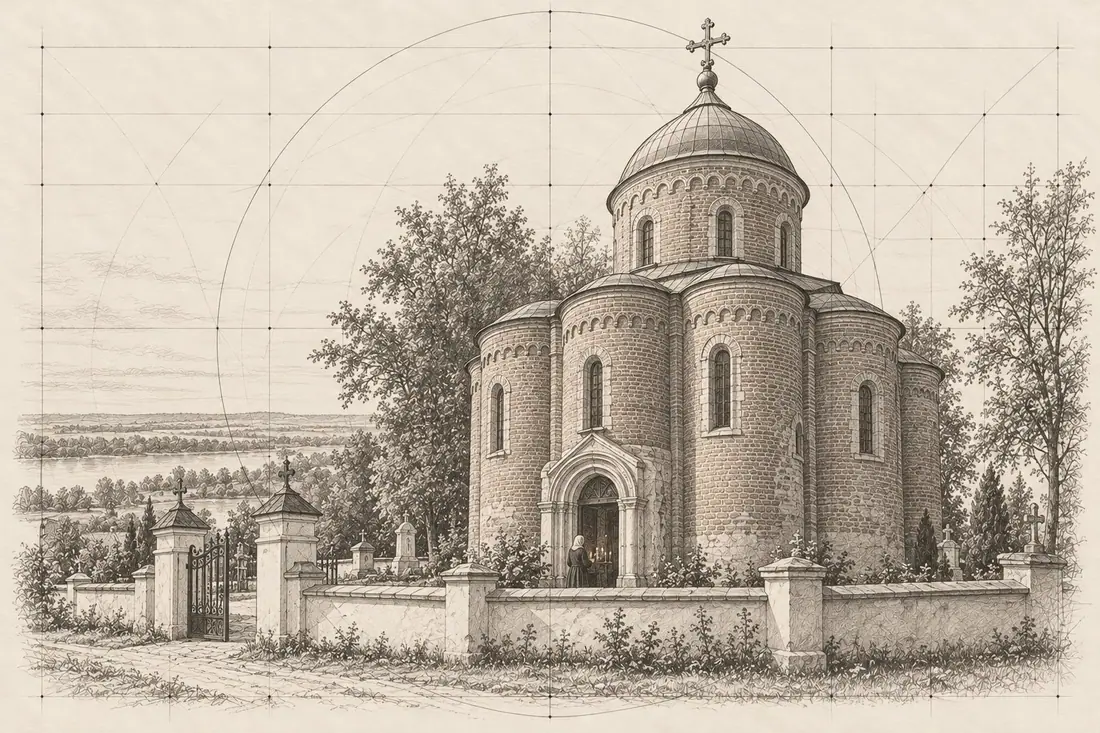
Today. Illustration: IKONASTONE
Lost and recreated
| What | What it was | What happened | Where it is now |
|---|---|---|---|
| Slate slab with graffito (1194/1294) | Set into the northern part of the church | Removed and taken away during the First World War | According to VUE — fate unknown; according to istvolyn.info and KuLaDig — museum of the University of Zagreb (unconfirmed) [1, 2, 3, 4] |
| Original spherical covering | Dome 12 m above the floor | Replaced in 1844 by a disproportionately large onion-shaped dome | Lost [1] |
| Frescoes | Interior and walls | Whitewashed at the end of the 17th century | Under the plaster; a ground prepared for painting found in the northern projection [1, 3] |
| Wooden church (according to legend, 992) | A predecessor on this spot | Unknown | Wikipedia says an earlier wooden church “probably” existed; there are no documents [1, 2] |
| House with a school and a hospital | Beside the church, according to the 1695 record | Unknown | Not preserved; the sources give no details [2] |
| Monastic community at the church | Mentioned only once, under 1570 | Unknown | Not preserved [2] |
| Two-tier porch with bell tower | 1844 | Reworked in 1900–1901 | Preserved in its rebuilt form [1, 2] |
| Cupola on a drum with kokoshniks | 1900–1901 (Kozlov’s design) | — | Preserved, the youngest part of the silhouette [1, 2] |
| Iconostasis and the Hodegetria icon | 18th century; 16th–18th century | — | In the church according to istvolyn.info and ViaRegia (present condition not verified) [3, 5] |
Architecture
Below, two elements of the church in more detail.
Eight exedrae
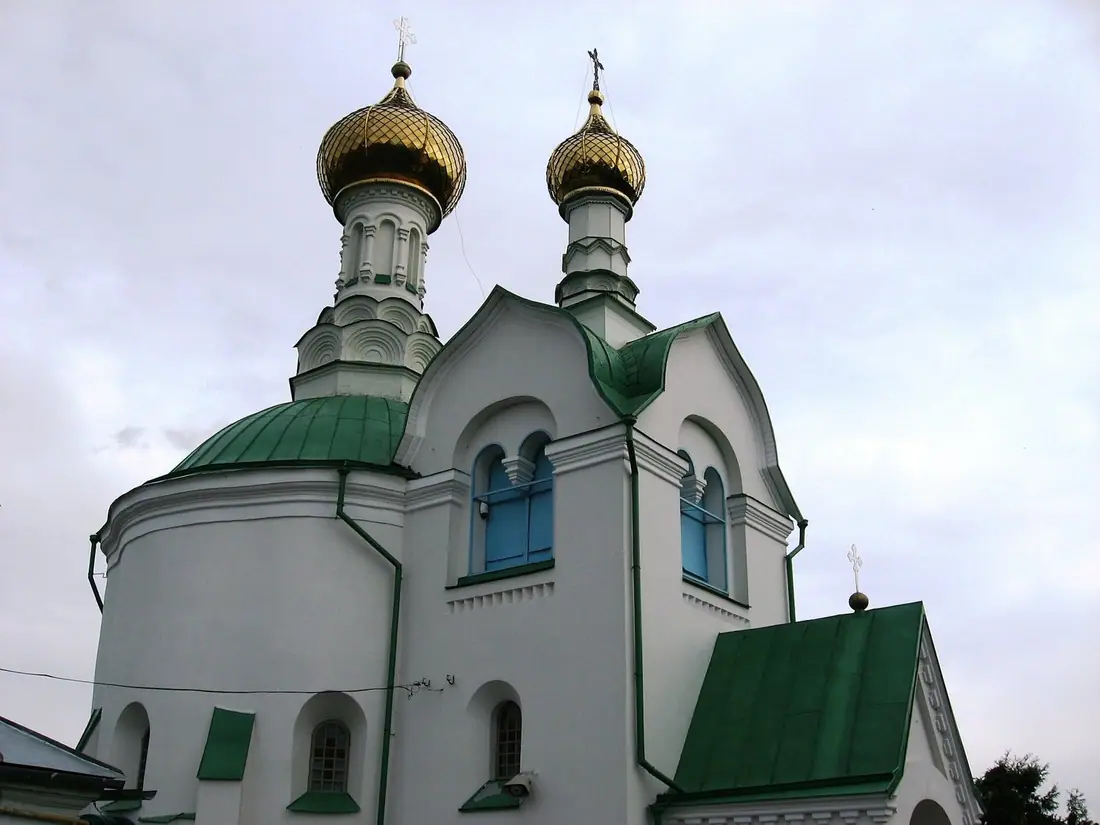
The rotunda is centrally planned and eight-petalled in plan. Around the circle are eight exedrae — semicircular niches: four large ones at the cardinal points and four small ones between them. The largest is the eastern, sanctuary apse: it projects to the east by the thickness of the wall, that is, by 1.35 m.
Between the exedrae stand pilasters. They pass into ribs — the ribs that carry the spherical dome, 12 m high from the floor. The terminology differs between sources: VUE calls the petals exedrae, Wikipedia calls them conches (the name usually given to the half-dome covering of a niche). Wikipedia also describes the same mechanism from another side: the vaulting is held by transverse arches, and their thrust is taken by low buttresses on the outside.
The undulating wall and the buttresses
Because of the exedrae, the façade walls of the rotunda are undulating. Later, according to VUE, they were reinforced with buttresses — opposite the interior pilasters. The logic here is plain: where inside a vault rib meets the wall, outside a support is needed. The petals give the wall rigidity but do not cancel the thrust of the dome.
Two portals
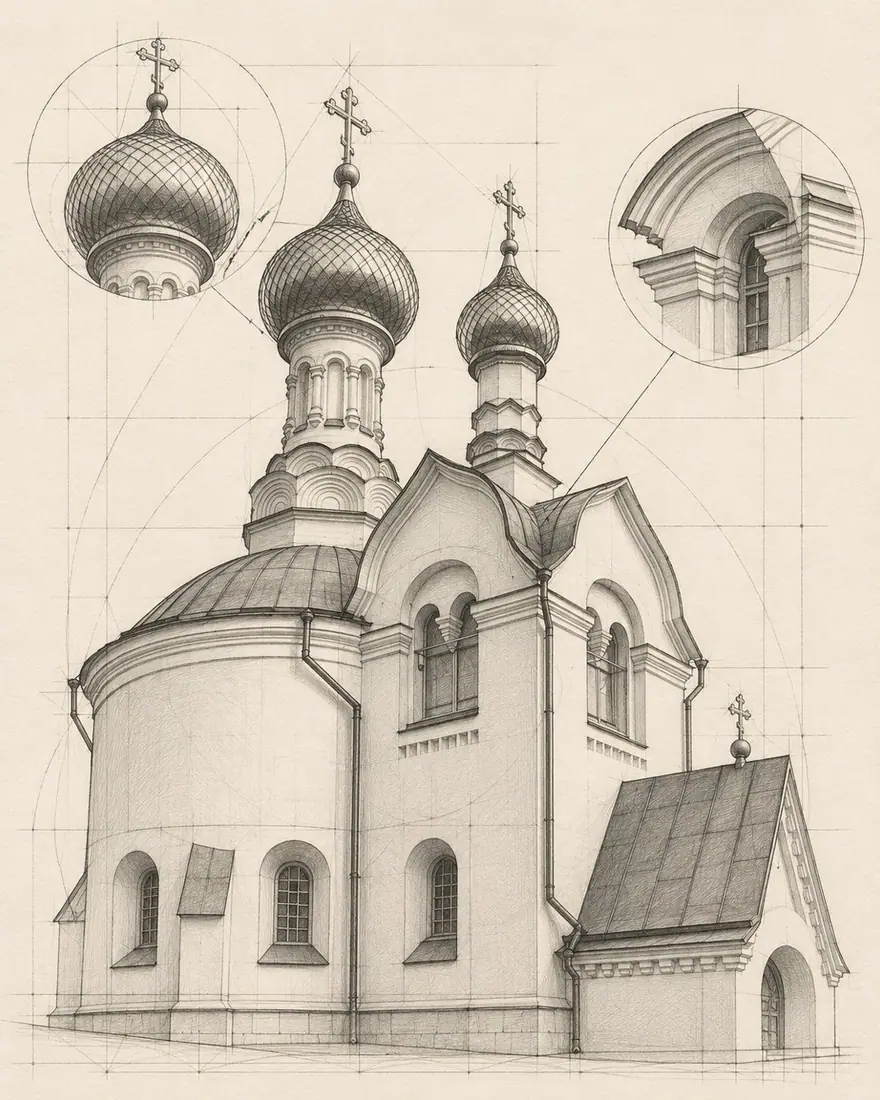
The church has two entrances — and two styles. The north portal, according to VUE, is of white stone, carved, Gothic. The west one is of brick, in a Romanesque style. Wikipedia calls the west portal “perspective”, that is, with several steps that gradually narrow toward the door.
The windows of the rotunda are decorated with symbolic images of the sun and moon.
According to Wikipedia, the rotunda probably served as a model for the rotunda chapel in the Stovpie Tower. If so, the Volyn eight-petalled scheme had followers beyond Volodymyr itself.
Stone and material
The main material is bar brick (“palchatka”). It was the brick, not documents, that gave the surest dating: the character of the masonry — the late 13th — early 14th century.
Stone appears here in two of the most important places. The first is the north portal of white stone, carved in Gothic forms. The second is the slab with graffito that was set into the north wall. According to Wikipedia, it was slate. That is, the date of the church was literally sought on a stone — and that stone was lost from sight: it vanished during the First World War.
VUE, relying on the assessment of the architect-restorer Oleksandr Hodovaniuk, links the rotunda with the Volyn architectural school. The encyclopedia writes that the monument has no analogues in Ukraine or Europe, and sees in it a combination of an original composition, the influence of Dalmatia and Great Moravia, and the Gothic.
How to read the rotunda today
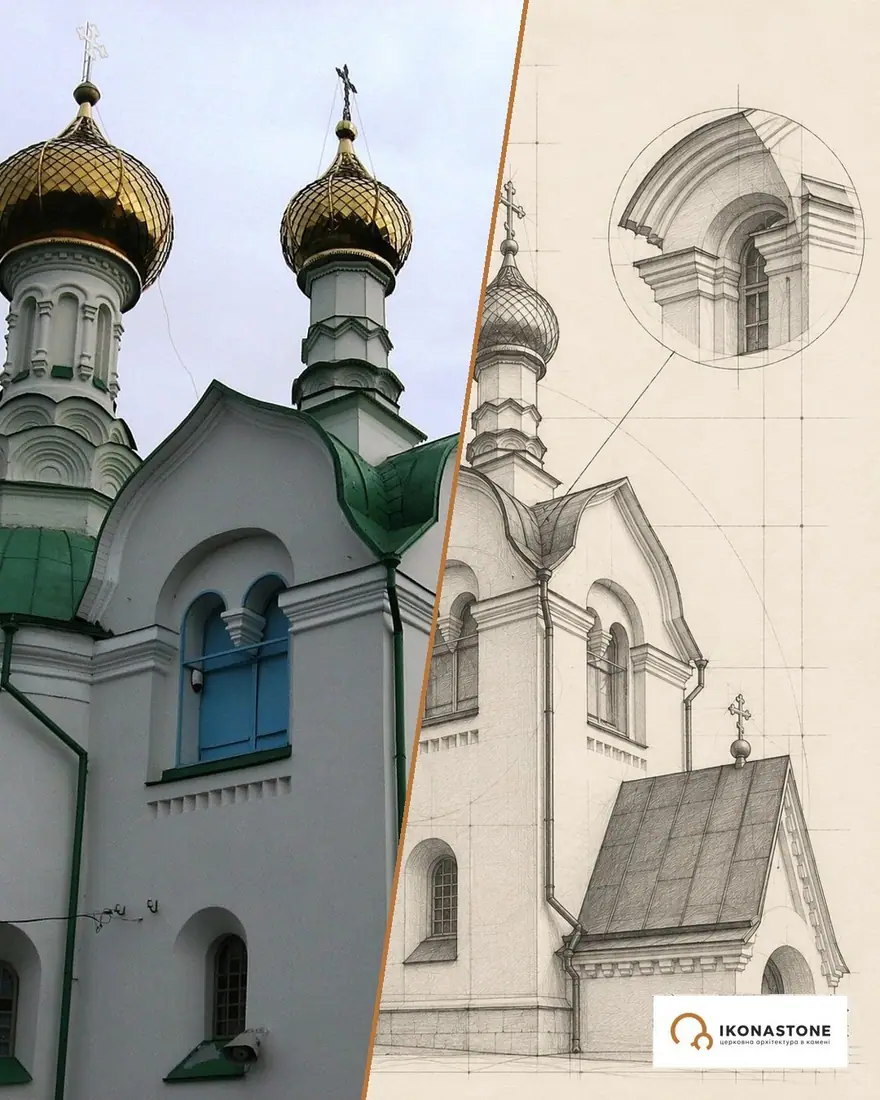
The present building is easy to divide into layers. The walls with the exedrae, the pilasters and the portals are the medieval core. The buttresses are a later reinforcement (according to VUE, “of later origin”; Hryhorii Lohvyn assigned them to 1844). The western annex appeared in 1844 and was reworked in 1900–1901 together with the bell tower and the vestibule. The onion-shaped cupola on a drum with kokoshniks also dates from 1900–1901. That is, the silhouette recognised from the street is the youngest part of the church, and the oldest is hidden behind it, in the plan.
What to see
- The petals of the plan. Walk around the church: the undulating wall shows where the exedrae are inside.
- The buttresses opposite the interior pilasters.
- The north white-stone portal — Gothic on an ancient Volyn church.
- The west brick portal in a Romanesque style.
- The surroundings. The rotunda stands on a hill above the Luha; from here, according to VUE, it dominates the southern part of the historic centre.
Another church of this land that changed its appearance over five centuries is the Dormition Church in Zymne. And pilasters that pass into ribs are a good reason to recall how columns and pilasters work.
Did you know
The church is named after St Basil because that was the baptismal name of Prince Volodymyr Sviatoslavych — Vasyl. This is local legend. [1]
According to ViaRegiaUkraine, in history the church was called an “obid”, that is, built in a single day. [5]
The eastern apse is the largest of the eight exedrae: it projects to the east by the thickness of the wall, 1.35 m. [1]
The windows of the rotunda are decorated with symbolic images of the sun and moon. [1, 2]
The same inscription was read as the year 1194 and as 1294. [1]
According to the 1695 record, beside the church stood a house with a school and a hospital. According to Wikipedia. [2]
A beam of the parish priest's house bore the inscription “this church was built in the year 1419” — yet another date that cannot be verified today. According to Wikipedia. [2]
Rector Damian Hershtansky was a member of the Second State Duma and a senator of the Polish Sejm. According to istvolyn.info. [3]
In 1601 men of the Uniate Metropolitan Hypatius (Potii), according to the Zahorovskys' complaint, plundered the church and mocked the priest. [2, 10]
According to Wikipedia, the rotunda probably served as a model for the rotunda chapel in the Stovpie Tower. [2]
The architect-restorer Oleksandr Hodovaniuk: in the perfection and refinement of its forms the rotunda “greatly surpasses the medieval rotunda churches” of neighbouring European countries. [1]
Volodymyr also has the rotunda church of St Michael's Monastery (2nd half of the 13th century) and the remains of a rotunda in the Stara Katedra tract; they should not be confused with St Basil's. According to P. Kraliuk. [11]
Legends
A church in a single day
According to church legend, the retinue of Prince Volodymyr Sviatoslavych built the first wooden church in a day in 992, returning from a campaign against the Croats. In the version given in the REHERIT profile, the prince's wife built the church in a day. [1, 6, 7]
The Hodegetria from Byzantium
According to local legend, the icon of the Mother of God was brought from Byzantium; the monk Ihnatii Kulchytsky supposed the same. The date the icon appeared is unknown. [3, 5]
The grandmother's grave
According to the chronicle report of a church over the burial of the grandmother of Mstyslav Danylovych and to the interpretation of Leonid Makhnovets, St Basil's Church stands over the grave of Anna, wife of Roman Mstyslavych. There is no proof. [1, 3]
“Obid”
By its popular name, the church is an “obid”: built in a single day. [5]
Figures
- Volodymyr Sviatoslavych (Vasyl) — prince, by legend the founder.
- Mstyslav Danylovych — prince, who according to the chronicle of 1287 built a burial church over his grandmother’s grave (the link with St Basil’s is a hypothesis).
- Roman Mstyslavych — prince; Wikipedia links the inscription of 1194 with his building activity.
- Izmail Sreznevsky — read the inscription on the slab as the year 1194.
- Volodymyr Antonovych, Adrian Prakhov — surveyed the church (according to Wikipedia, 1886) and dated it; VUE — 14th–15th century.
- Michał Walicki — Polish researcher, surveyed the rotunda in 1925, dated it to the turn of the 12th–13th centuries.
- Borys Voznytsky — held to Walicki’s dating.
- Kozlov (M./K./P.) — architect of the rebuilding of 1899–1901.
- Hryhorii Lohvyn — researcher, 1946–1949.
- Oleksandr Tsynkalovsky — local historian, recorded the legend of 992 (“Kniazhyi horod Volodymyr”, 1935).
- Oleksandr Hodovaniuk — architect-restorer, author of the assessment of the monument.
- Leonid Makhnovets — scholar, linked the chronicle’s “grandmother’s grave” with St Basil’s Church.
- Damian Hershtansky — rector, senator; died 1936.
- Yevhen Hershtansky — rector 1941–1968.
- Serhii Depo — rector from 1988 (1923–2008).
- Józef Dutkiewicz — author of the 1933 photograph.
- Volodymyr Olkhomiak (1929–2018) — photographer, photograph of 1972.
- Mykhailo Telezhynsky — composer and conductor; Wikipedia calls him parish priest of St Basil’s Church from 1936, but another istvolyn.info article writes that in 1939 he only took holy orders, and in Volodymyr he was a choir director. The discrepancy has not been resolved. [2, 16]
How to cite
IKONASTONE. St Basil's Rotunda in Volodymyr // Guide to the Churches of Ukraine. URL: https://ikonastone.com/en/guide/st-basils-rotunda-volodymyr/ (accessed DD.MM.YYYY).
Not sure what the piece is called? Walk through the church from sanctuary to churchyard →
Would you like to give something to a church? What to give a church →
Want to remember loved ones or a fallen parishioner? Remembrance at a church →
FAQ
Where is St Basil's Rotunda?
In the southern part of the historic centre of Volodymyr, on a hill above the Luha floodplain (30 Vasylivska Street). The oval courtyard is enclosed by a low wall with a gate on the north.
When was St Basil's Rotunda built?
There is no exact date. Judging by the character of the masonry ("palchatka" bar brick) and its Gothic features, it is dated to the late 13th — early 14th century. Different researchers have read the graffito on a slab set into the wall as the year 1194 or 1294; Antonovych and Prakhov, according to the Great Ukrainian Encyclopedia, dated the church to the 14th–15th centuries. Legend links the first wooden church with the year 992.
Why is the church called a rotunda?
It is centrally planned: eight exedrae (semicircular niche-petals) are arranged around a round space — four large ones at the cardinal points and four small ones between them. The spherical dome rises 12 m above the floor.
What is the monument's status?
An architectural monument of national importance (according to the Great Ukrainian Encyclopedia).
Sources 16
- В. В. Вечерський. Василівська ротонда у Володимирі // Велика українська енциклопедія (оприлюднено 25.11.2022)
- Вікіпедія. Василівська ротонда
- Автор не вказано. Стаття про Василівську церкву-ротонду (Цинкаловський, Логвин, настоятелі Герштанські та Депо) // istvolyn.info
- Ю. Карпюк. Saint Basil's Church in Volodymyr-Volynskyi // KuLaDig, Kultur.Landschaft.Digital (LVR), 2021
- ViaRegiaUkraine. Church of St. Basil (XIII–XIV centuries)
- REHERIT. Володимир-Волинський: профіль спадщини (2020)
- Р. Якель. У Володимирі, християнському і державному // ZN.UA, 19.10.2012
- Encyclopedia of Ukraine. Volodymyr-Volynskyi
- Travelsinua. Saint Basil's Rotunda Church, Volodymyr (адреса: Василівська, 28)
- Бібліографічний покажчик Володимира (uknol.info): запис про скаргу Загоровських на Іпатія Потія, ВЮЗЗР, 1863, т. 3, № 9
- П. Кралюк, 2008
- Німецька цифрова бібліотека. Ю. Дуткевич, «Orthodoxe Kirche Sankt Basilius, Wolodymyr-Wolynskyj», фото 1933 (Інститут мистецтва ПАН / Herder-Institut)
- Львівська національна галерея мистецтв ім. Б. Возницького. В. Ольхомяк, «Василівська церква XIII–XIV ст.», 1972
- Львівська національна галерея мистецтв ім. Б. Возницького. «Ротонда церква св. Василія», фото 1950-х
- С. Терський. Княже місто Володимир // Інститут українознавства, Львів (датування Василівського храму кінцем XIII ст.)
- Стаття про Михайла Тележинського (Волинь) // istvolyn.info
- Town
- Volodymyr, Volyn Oblast
- Built
- late 13th — early 14th century (according to other data, late 12th century); rebuilt 1844, 1900–1901
- Type
- centrally planned eight-petalled rotunda
- Material
- bar brick; north portal of white stone
- Research depth
- 28%