Kiot: where the word comes from and why an icon needs a stone frame
Some words live in several rooms at once. Кіот (kiot), the icon shrine, is one of them.
The academic dictionary defines it modestly: a folding frame or a small cabinet with glass doors for icons; a божник (bozhnyk). The etymological dictionary takes it further: the word was borrowed from Medieval Greek, where κιβωτός meant a chest, an ark. The older variant, кивот (kyvot) or ківот (kivot), is already marked as obsolete in this sense by the explanatory dictionary.
From the same Greek word comes a quite different object: the tabernacle, also called кивот (kyvot), which stands on the altar table and keeps the Holy Gifts. The two should not be confused. One holds an icon; the other belongs to the sanctuary.
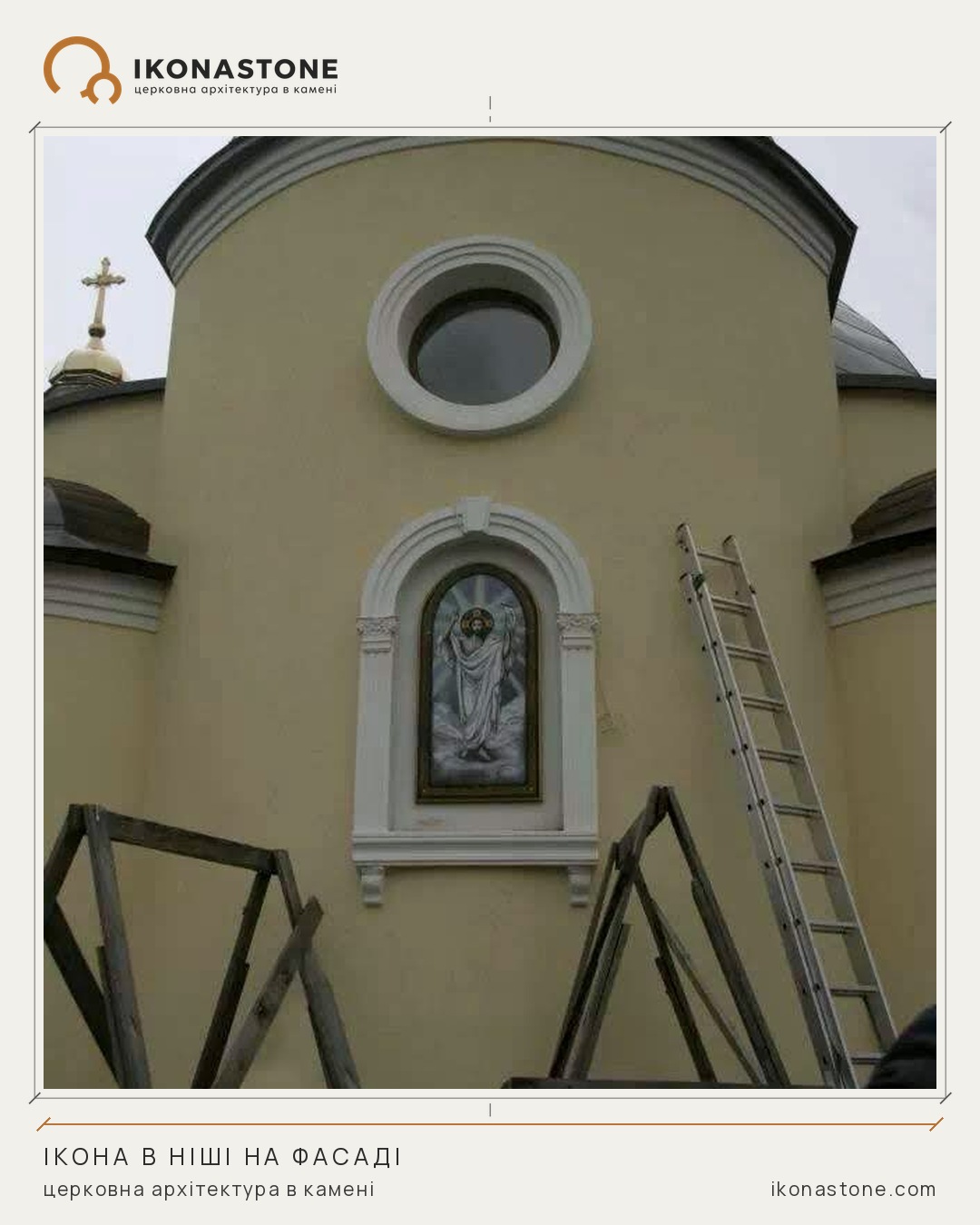
The one that interests us is the third meaning, the architectural one. The architectural dictionary describes a kiot thus: a small niche in a façade wall for the image of a saint, often covered with a small gabled roof. Here the kiot is no longer furniture but part of the wall.
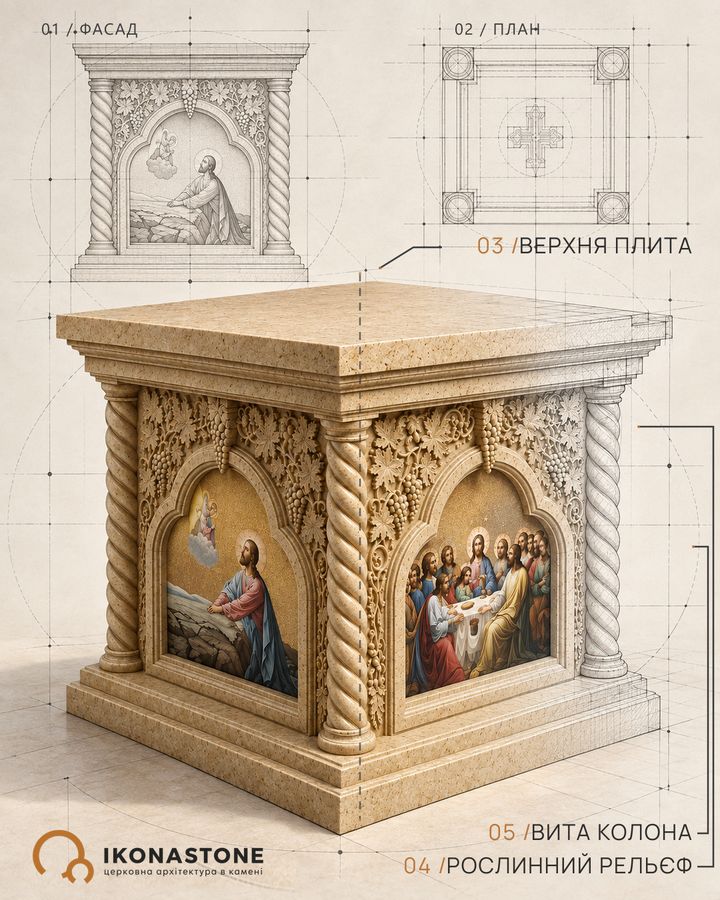
Stone enters this story early. In Byzantine churches of the middle and late periods, large images for veneration in carved frames, proskynetaria, were placed on the eastern piers on either side of the sanctuary screen. The scholar Sophia Kalopissi-Verti writes that the frames were usually made of marble, although craftsmen also worked in cheaper materials, such as stucco. The form of such a frame is a relief arch, often carried by paired colonnettes tied in a knot. One of the earliest examples is in the church of the Mother of God at the monastery of Hosios Loukas in Greece: the arch, now assembled from marble fragments, is dated to shortly after 961. From the tenth century, Christ was most often depicted to the right of the screen and the Mother of God to the left.
An honest note: in the sources we have not found a stone kiot in the old churches of Ukraine. Even in St Volodymyr’s Cathedral in Kyiv (1862–1896), where the iconostases are carved from Carrara marble, the kiots are bronze. So a stone kiot in Ukraine is a return to Byzantine logic rather than a local habit.
What follows from this for the drawing.
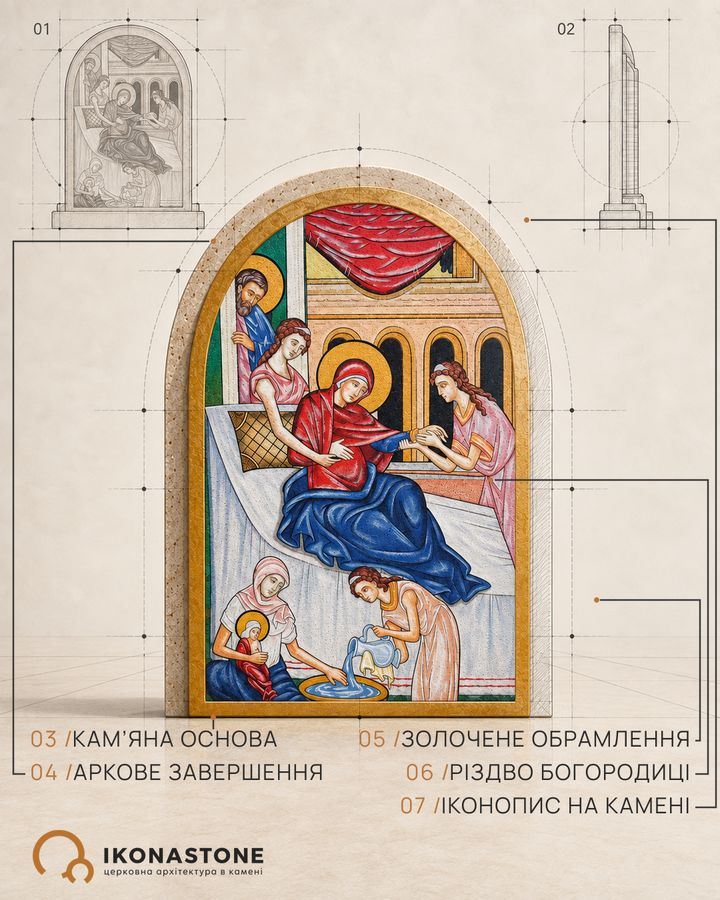
First the icon, then the frame. The size of the image, its proportions and the height at which it will be placed determine everything else. A kiot drawn separately and then adjusted to fit the icon can be spotted from a distance.
Next, the place. Inside a church the kiot lives in dry warmth, and marble is appropriate there. On a façade the conversation is different: a niche, a recess, a small roof over the image. The small gabled roof from that dictionary definition is not an ornament: water that does not reach the stone can do it no harm.
And finally, a sense of measure. The frame should hold the icon, not compete with it. The richer the image, the calmer the kiot. The rule is simple, and it is most often broken out of love for carving. We understand that love.
If you are planning a kiot for a church or a façade, send the size of the icon and a photograph of the place, and we will start from there. And on how an image reads from below, there is a separate article: an icon on a façade.