Wayside Cross: What It Is, Where to Place It and How
At the entrance to a village, the cross greets you before the first house does. You can see it from the field, from the road, from the bus window. Few people know when it was put up or by whom, yet almost everyone who passes it crosses themselves, or at least slows down.
Such a cross has many names: veneration cross (“poklinnyi”), wayside cross, memorial cross. In Volyn people say “figura”, in Polissia “khrest” or “kryzh”. The names differ, but the meaning is the same: this is a cross not on a grave but on a place that people want to put under the sign of the cross.
This article is for a village head, a parish council, or a family thinking of putting up such a cross or restoring an old one. It does not replace a conversation with your priest and your local council. But it helps you come to those conversations with the right questions.
In brief
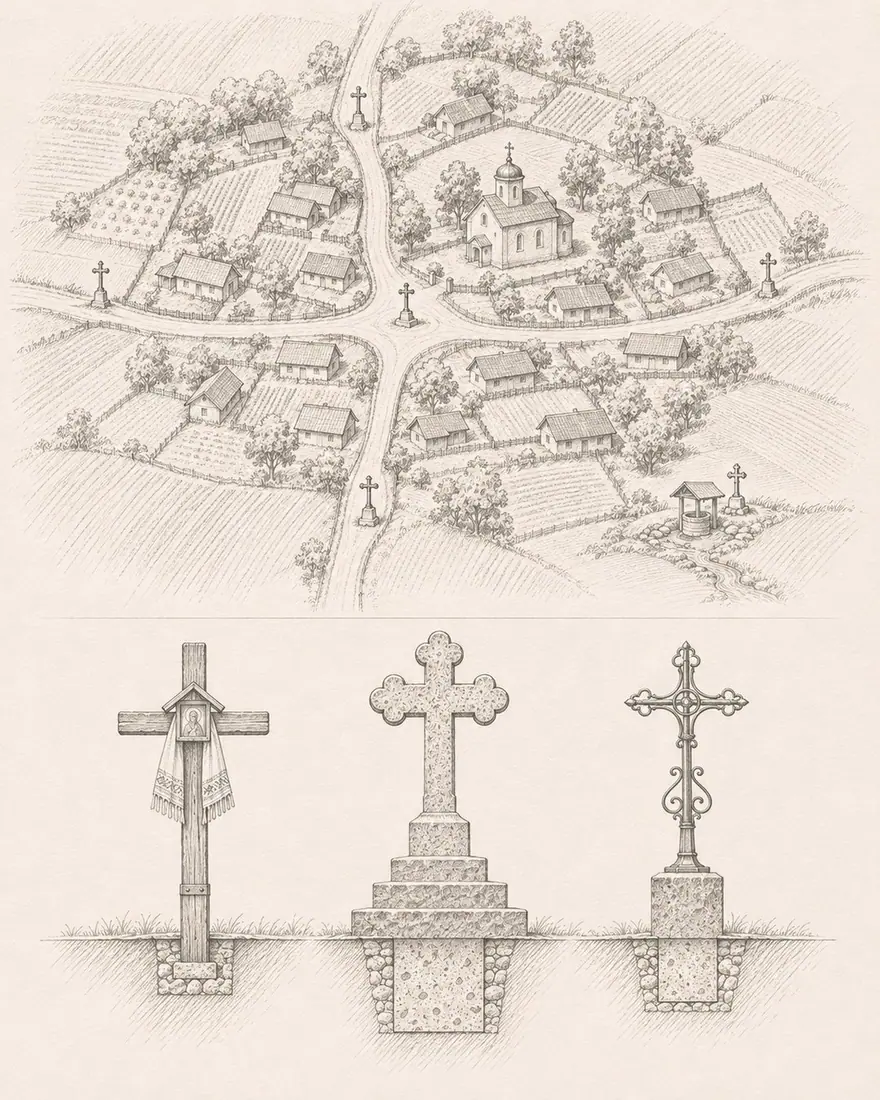
- A veneration (wayside) cross is placed not on a burial but at the entrance to a village, at a crossroads, by a well, on the site of a destroyed church or of an important event.
- The custom is old: the ethnologist Yaroslav Taras dates the earliest written mention of a wayside cross in Ukraine to the 11th century.
- Historically the materials were wood, local stone (limestone, sandstone) and, later, metal. Each has its own price in upkeep.
- A priest blesses the cross; it is worth agreeing its shape, inscription and blessing day with the parish priest before installation.
- The cross stands on someone’s land, so the owner’s consent is needed: for municipal land, a council decision. Roads and heritage sites have their own rules.
What is a veneration (wayside) cross?
A veneration, or wayside, cross is a cross set up outside a cemetery and outside a church: by the road, on the edge of a village, at a crossroads, by a well. Nobody is buried beside it; people pray there. Passers-by crossed themselves or bowed. The ethnologist Anna Nikolaieva recorded a belief in Volyn and Polissia that in the 19th century a person who did not bow to a wayside cross could be taken for a thief or a robber.
It differs from a grave cross in its place and purpose. It differs from a modern marker at an accident site in that such a marker is usually put up and tended by the family and friends of the person who died, while a wayside cross often belongs to the whole community and stands for decades. The line is not always sharp, though: crosses have long marked the place of a sudden death as well.
How is a wayside cross different from a chapel?
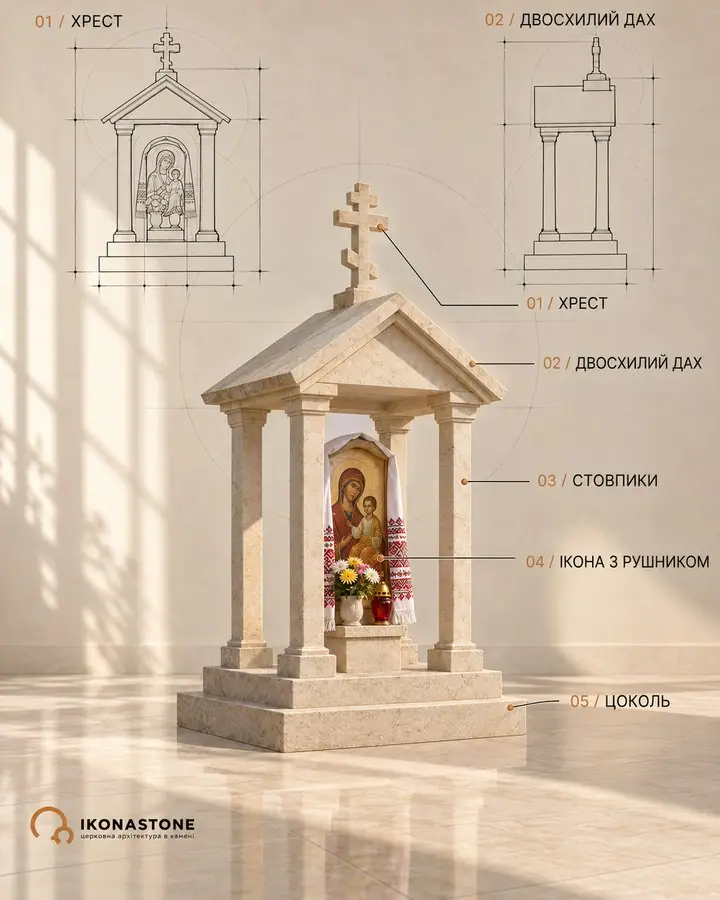
Beside roadside crosses there are also roadside chapels: small structures with a roof and a niche for an icon or a sculpture. Even the people who compile digital maps mark these two kinds of object separately.
The difference is not only size. A cross is a sign open on every side; it can be seen from afar and has no “inside”. A chapel already has an interior, however tiny, and needs a foundation, a roof and care for its walls. So the decisions differ too: a cross is often put up by local effort, while a chapel is designed and built as a small building.
Where does the custom of putting crosses by the roadside come from?
The custom is old. The ethnologist Yaroslav Taras writes that a wayside cross in Ukraine is first mentioned in historical documents in the 11th century. From the 16th century, monumental crosses with a crucifix were set up in the western lands: at the entrances to towns and villages, at crossroads, at river crossings, on squares.
The ethnographer Mykola Sumtsov divided such crosses into three groups: votive (set up in fulfilment of a vow), “blood” crosses (on the site of a murder or death) and protective ones (against natural disaster). Researchers of Volyn and Polissia also describe thanksgiving crosses: one might be set up to thank God that cholera had left the village.
A separate chapter is the crosses raised in memory of the abolition of serfdom (“panshchyna”) in Galicia in 1848. People walked to them in processions and prayed there. In Duliby, in the Stryi area, such crosses, as Taras describes, were surrounded with four linden trees.
A cross was put up by a family in fulfilment of a vow, or by the whole community. Folk accounts from Volyn and Polissia say it had to be made at night and finished before sunrise; in the same way, “oboydenni” towels, offered to the church, were woven in a single night. This is not a technical requirement but a sign: the task is special and cannot be put off.
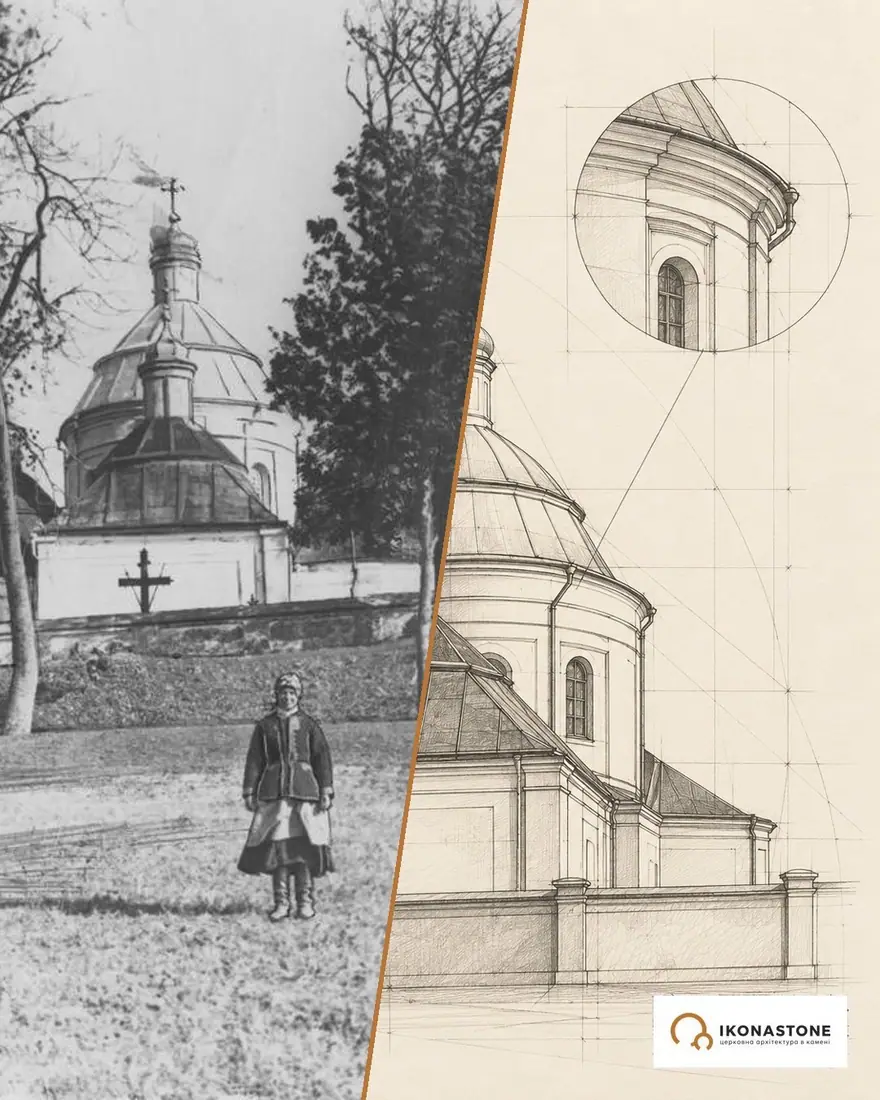
Under Soviet rule wayside crosses were destroyed or carted away. Villagers hid them in the forest, moved them to cemeteries, set them on graves in place of headstones. A wave of restoration began in the late 1980s and in the 1990s, and crosses often came back exactly to the spot where grandfathers had once set them.
Where is a wayside cross placed?
The place for a cross was never chosen at random. Most often it is:
- the entrance and exit of a village: the cross marks the edge of inhabited space; in Polissia, families who had lost someone in a war also put up crosses at the entrance;
- a crossroads: in folk belief a crossroads was the dwelling of “unclean” beings, and the cross was meant to render them harmless;
- fields and forest roads;
- wells and places where people were once baptized;
- the site of a destroyed church;
- the place of an event: a death, an accident, a rescue.
During cholera epidemics, crosses were sometimes set up on all four roads leading out of a village. In this way the community literally drew the sign of the cross around itself.
A practical piece of advice follows for a present-day customer. If a cross is being restored, first ask the older people and look in the parish archive for where the previous one stood. Returning the cross to its place is often the right decision.
What shapes are there and what do they mean?
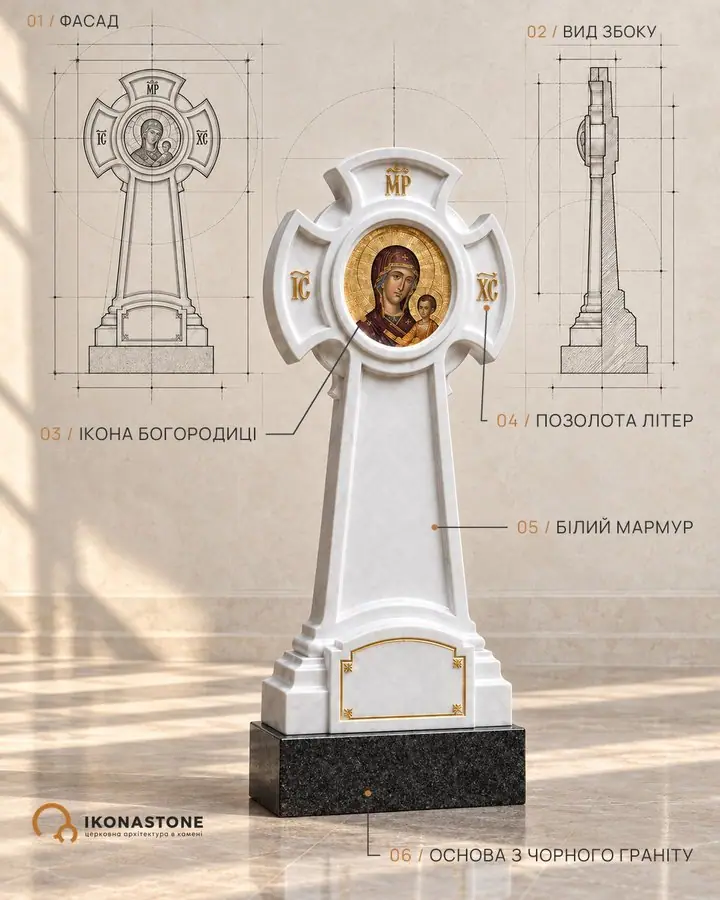
Wayside crosses are rarely “just a cross”. On the stone crosses of the Ternopil region, researchers describe arms ending in trefoils; the archaeologist Vasyl Ilchyshyn reads them as a sign of the Holy Trinity. Steps at the base are sometimes found, an image of Golgotha. The stone crosses of Duliby from the late 19th century have three arms and stand on a high or low pedestal.
A crucifix on the cross, an icon at the crossing of the arms, an inscription with the year and the names of the founders, a fence around it: all of these are familiar elements. For more on the types of cross and the symbolism of the arms, see our article Forms of the Cross, and for the abbreviations on plaques and reliefs, see IC XC NIKA.
The form should follow the tradition of the community. In Volyn, Galicia and Transcarpathia crosses looked different, and the differences between Orthodox, Greek Catholic and Roman Catholic practice are better discussed with your own priest than decided from a picture on the internet.
Wood, metal or stone?
Each material has a character, and that character shows not in the first year but in the twentieth.
Wood. In Volyn and Polissia wooden crosses were usual, most often of pine or oak. Wood is light and warm, and easy to put up by your own hands. But it rots in the ground and cracks in the sun, and without care a cross has to be replaced within a few decades. Of the wooden crosses marked on the Austrian military maps of the 18th and 19th centuries, nothing remains in Duliby.
Stone. In Galicia and the Ternopil region, stone crosses of local limestone or sandstone were more common. These are the ones that have survived: in the Ternopil region, according to Ilchyshyn, quite a few crosses are dated to the 15th–17th centuries. Stone does not fear fire or rot, and it keeps carved inscriptions and relief. But it is heavy, so it needs a foundation calculated for the weight and for frost; on how stone survives winter, see Frost Resistance of Stone.
Metal. Iron and cast-iron crosses appeared later. In Duliby, according to Taras, cast-iron ones came in the 1930s; one of them was put up in 1937. Metal gives a slender, openwork silhouette but needs protection from corrosion.
| Material | Strengths | What to consider |
|---|---|---|
| Wood | Lightness, warmth, the tradition of Polissia and Volyn | Rot, regular renewal |
| Stone | Durability, carving and inscription | Weight, foundation, frost |
| Metal | Slender silhouette, openwork | Corrosion, painting |
The oldest crosses that have come down to us are of stone. Not because stone is better than everything else, but because it remembers longest.
How is a wayside cross blessed?
A priest blesses the cross. As early as the 19th century, new wayside crosses were solemnly blessed by the local parish priest: a cross in Duliby from 1888 is carved with the words that Father Lev Shankovskyi blessed it.
In Orthodox practice the blessing of objects is the priest’s task: he reads a prayer, makes the sign of the cross over the object and sprinkles it with holy water. In the Catholic Church there is a separate rite for a cross set up for public veneration, in the Book of Blessings (chapter 35 of the English edition). A priest may perform it, though it is preferable that a bishop does, and a day is chosen when more people can come.
A practical order follows from this. The blessing is arranged in advance, not after the cross already stands: first a talk with the parish priest, then the design and installation, then the blessing. The priest should know about the plan from the start, because the shape and the inscription depend on him.
Do you need permission to put up a cross?
We found no separate law about wayside crosses. But a cross is a structure, and it stands on someone’s land. Several rules follow, which are worth checking in your own community:
- Municipal land (the verge of a village street, a square, a village entrance): as a rule a decision of the village, settlement or city council, or its executive committee, is needed. How exactly this is formalized depends on local rules.
- Private land: the owner’s written consent.
- Beside a public motor road: within the right-of-way, that is, on land belonging to the road itself, work and the placing of objects are permitted under Article 37 of the Law of Ukraine “On Motor Roads” (“Про автомобільні дороги”) by the road authority, in agreement with the National Police. This article is currently proposed for amendment, so check the current wording at zakon.rada.gov.ua. And whatever the paperwork says, the cross must not block drivers’ view.
- A church yard: a decision of the parish.
- A heritage site, its territory or protection zone: work there needs permission from the heritage protection authority (Article 26 of the Law “On the Protection of Cultural Heritage”, “Про охорону культурної спадщини”; for sites of local significance this permission is issued by the regional administration). If the old cross is itself a heritage site, its restoration must also be approved.
We put this cautiously: rules differ between communities, so the local council can give the final answer. It is best when the application to the council and the talk with the parish priest happen in parallel.
How do you care for a cross so it stands for a century?
Traditional care is part of the custom. Before Easter, crosses were cleaned and repainted, old ribbons taken off and new ones hung. In Polissia, crosses were “undressed” before Holy Week, and on Palm Sunday or before Holy Thursday “dressed” anew: with towels, headscarves, embroidered aprons.
Stone calls for more care. The archaeologist Vasyl Ilchyshyn warns that the habit of whitewashing old crosses with lime to make them look festive quickly destroys the stone, especially limestone, and wipes out inscriptions and ornament. An ancient stone cross is better cleaned gently with water. And before painting, patching or straightening it, call a conservator.
For wood and metal, inspect the base regularly: that is where decay begins unnoticed, near the ground.
What to decide before ordering
- The occasion and the text. What the cross commemorates: a vow, thanksgiving, the memory of a place, a date in the community’s life. The inscription depends on it.
- The place. Whose land it is, whether a cross stood here before, and whether it will get in the way of the road or drivers’ view.
- The landowner’s consent. A council decision for a municipal plot, the owner’s consent for a private one, a separate procedure near roads and heritage sites.
- A talk with the parish priest. The form of the cross according to the community’s tradition, and the blessing day.
- The material. Wood, stone or metal, considering who will care for it and how.
- The foundation. Depth and dimensions for the weight of the cross and the local soil.
- The elements. A crucifix, an icon at the crossing, an inscription, a fence, a place for a small lamp.
- Who looks after it. Who is responsible for the cross in a year, in ten years, in fifty.
A final thought
A wayside cross is the quietest sign of a community. It explains nothing and demands nothing; it simply stands at the edge where the road ends and home begins.
IKONASTONE designs stone crosses and chapels for a specific place and the tradition of a community; you can read about them in the sections on crosses and chapels.
Not sure what the piece is called? Walk through the church from sanctuary to churchyard →
Would you like to give something to a church? What to give a church →
Want to remember loved ones or a fallen parishioner? Remembrance at a church →
FAQ
How is a wayside cross different from a grave cross?
A grave cross stands on a burial. A wayside cross, also called a veneration cross, is set where there is no grave: at the entrance to a village, at a crossroads, by a well, on the site of a destroyed church. People pray and bow before it, which is where the Ukrainian name (“poklinnyi”, from “to bow”) comes from.
Who should bless a wayside cross?
A priest. Tell the parish priest about the plan before the cross is installed: the shape of the cross, the inscription and the day of the blessing are agreed with him.
Can I put up a cross without permission?
We found no separate law about wayside crosses in Ukraine. But a cross stands on someone’s land, so the landowner has to agree: on municipal land that means a decision of the village, settlement or city council; on private land, the owner’s consent. Beside a public road a separate procedure applies under the Law of Ukraine “On Motor Roads” (“Про автомобільні дороги”), and near a heritage site under the Law “On the Protection of Cultural Heritage” (“Про охорону культурної спадщини”). The local council can give you the final answer.
What is the best material for a cross that will stand outdoors?
Historically people put up wooden crosses (pine or oak), stone crosses (local limestone or sandstone) and, later, metal ones. Stone lasts longest but is also the heaviest and needs a reliable foundation. Wood is warmer and simpler, but it has to be renewed.
How do I care for an old stone cross?
Do not whitewash it with lime. According to the archaeologist Vasyl Ilchyshyn, lime quickly destroys stone, especially limestone, and wipes out inscriptions. Gentle cleaning with water is better, and before painting or repairing an ancient cross it is worth consulting a conservator.
Can I hang embroidered towels on a wayside cross?
Yes, it is an old custom. Ethnographers describe towels, headscarves, ribbons and embroidered aprons on crosses in Polissia and Volyn; they were often hung as a vow. Before Easter, crosses were traditionally cleaned, repainted and decorated anew.
Sources 11
- Я. Тарас. Народна меморіальна пластика села Дуліби // Народознавчі зошити, 2021, № 4
- І. Ігнатенко, О. Нагорнюк. Придорожні хрести Полісся: функції, семантика та символіка // Народознавчі зошити, 2013, № 1
- A. Nikolaieva. Krzyż przydrożny w tradycji Ukraińców Wołynia i Polesia // Prace Etnograficzne, 2014, 42(3)
- О. Снітовський. Під знаком хреста (інтерв'ю з В. Ільчишином) — Укрінформ, 27.09.2015
- R. Odrekhivskyi. Memorial buildings of Ternopil region (XIX – first third of XX century) — Culturology Ideas, 2022
- Roadside memorial — Wikipedia
- Tag:historic=wayside cross (укр.) — OpenStreetMap Wiki
- Order for the Blessing of a New Cross for Public Veneration (Book of Blessings, ch. 35) — Adoremus
- Consecration of items in Orthodox practice — Athos Guide
- Закон України «Про автомобільні дороги», ст. 37: чинна редакція в порівняльній таблиці до проєкту змін — Мінрозвитку (restoration.gov.ua), 2026
- Дозвіл на проведення робіт на пам'ятках місцевого значення, їх територіях та в зонах охорони (ст. 6, 26 Закону «Про охорону культурної спадщини») — інформаційна картка Харківської ОДА