IC XC NIKA (ІС ХС НИКА): What the Inscription on the Cross, the Icon and the Prosphora Means
Sometimes the most important sentence in a church consists of eight letters. It is not spoken but carved, stamped on bread, engraved at the corners of a silver cross. People see it every day and rarely read it: habit turns the inscription into decoration.
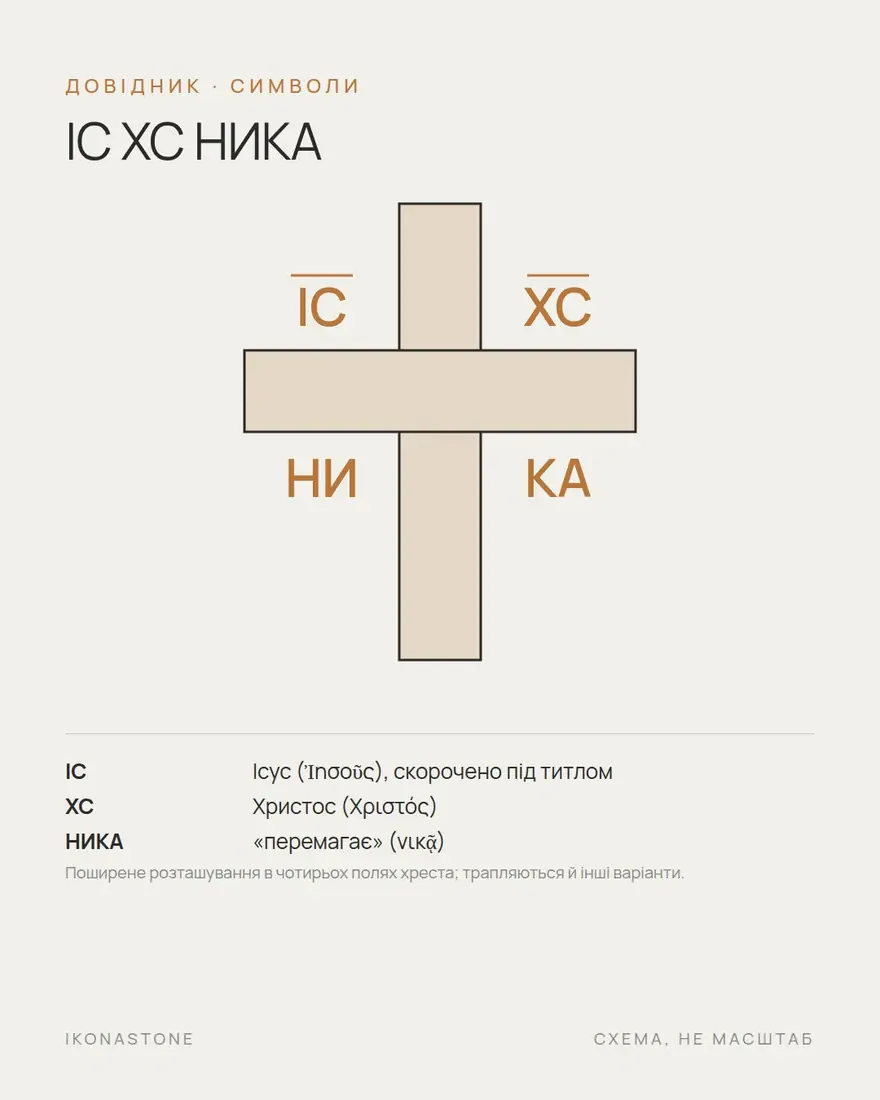
Yet it is not an ornament. “ІС ХС НИКА” is a statement compressed into four pairs of letters: Jesus Christ conquers. Not “conquered once” and not “will conquer one day”, but conquers, in the present tense, every time the cross stands in its place.
Below we look at how it reads, where the abbreviations and titlos came from, why the letters are distributed over the four fields of the cross, and what this means for someone ordering a cross, a slab or an image in stone. We discussed the general inscriptions on icons (ІС ХС, МР ΘΥ, Ο ΩΝ) separately in the article Inscriptions on icons; here we focus on one inscription, but on all of its surfaces.
In brief
- ІС ХС НИКА reads as the Greek Ἰησοῦς Χριστὸς νικᾷ: “Jesus Christ conquers”.
- ІС and ХС are abbreviated names: the first and last letters of each Greek word are taken, and a titlo is placed above them.
- НИКА (Greek νικᾷ) is the verb “conquers”, in the singular and in the present tense.
- The letters are usually written in the four corners of the cross, and ІС ХС НИКА is the most widespread of the Byzantine four-part inscriptions.
- The inscription lives on several surfaces: on the cross, on the icon of the Crucifixion, on the prosphora seal. It can also be carved in stone.
- The spelling (НИКА, НІКА, НІ КА) and the arrangement of the letters are agreed on the drawing before carving.
What does ІС ХС НИКА mean, letter by letter?
The inscription consists of three words. The first is the name Jesus, the second is Christ (“the Anointed One”), the third is “conquers”.
The name Ἰησοῦς in abbreviated form has two letters: the first and the last. In medieval Greek script the sigma was written in a crescent form (Ϲ), similar to the Cyrillic “С”. That is what ІС looks like. On the same principle, Χριστός gives ХС.
The third word, νικᾷ, comes from the verb νικάω, “to conquer, to win victory”. This verb is used in the Gospel of John, where Christ says, “I have overcome the world” (John 16:33), and in Revelation, where it is said of the Lion of the tribe of Judah that he has prevailed (Revelation 5:5). So this is New Testament vocabulary reduced to a single phrase.
| Letters | In Greek | In English |
|---|---|---|
| ІС | Ἰησοῦς | Jesus |
| ХС | Χριστός | Christ |
| НИКА (НІКА, НІ КА) | νικᾷ | conquers |
It is worth knowing about spelling. The Greek NIKA is rendered in Cyrillic in different ways: “НИКА”, “НІКА” and the divided “НІ КА” all occur (the last is written, for example, on the cross of 1546 in the National Museum of the History of Ukraine). All of this is one word. But on a stone cross you have to choose one variant, and choose it deliberately.
What is a titlo, and why is a stroke placed above the letters?
The word “titlo” comes from the Greek τίτλος. It is a line above the text that marks an abbreviation: short over a single letter or an abbreviation, long over a whole word. Titlos were used in old Cyrillic and Glagolitic manuscripts, in Old Church Slavonic and Old East Slavic texts, and still appear on modern icons and in printed liturgical books.
But for the name of Christ this is not simply a way of saving parchment. The tradition of abbreviating sacred names, the so-called nomina sacra, can be traced in the earliest Christian texts, from approximately the 2nd century. For Jesus and Christ these are ΙΣ or ΙΗΣ and ΧΣ or ΧΡΣ. Researchers stress that these abbreviations were an act of reverence, not merely a way of saving space. That is why on icons and crosses the titlo is usually kept above ІС and ХС.
For the carver this means small but real work. A titlo in stone is not a scratch but a separate element with its own depth, length and position. If it is omitted, the inscription will look incomplete.
Where did the inscription come from, and why “conquers”?
The phrase “Jesus Christ conquers” consists of Greek words, and this is how researchers of Byzantine inscriptions break it down. The inscription itself stands beside the cross: Austrian Byzantinists call it the best known of the four-part inscriptions that accompany images of the cross on any surface: on stone, in painting, on wood, on textile.
The inscription is usually linked with Eusebius’s account of the vision of Emperor Constantine. According to Eusebius, Constantine saw above the sun a cross of light, and with it the words Ἐν τούτῳ νίκα, “in this, conquer”. That is the imperative form, while the inscription on the cross uses “conquers”, but the root is the same. The Greek Orthodox Archdiocese of America, in the history of its emblem, connects the letters beside the four arms of the cross with these words. So this is a connection of meaning, not a proven line of descent for the inscription. Eusebius does not give a date for the vision: the year 312 and the Battle of the Milvian Bridge, established in the retelling, belong to a later combination of his account with other testimonies.
Why are the letters distributed over the four fields of the cross?
A cross naturally divides the surface around it into four fields between the arms. The four pairs of letters are placed in these fields: as Byzantine epigraphers describe it, ІС ХС НІ КА “is usually inscribed in the space of the four corners of the cross”.
The arrangement varies, and the sources describe several variants. In the description of the prosphora seal given by the Kyiv Orthodox Theological Academy, ІС and ХС stand above the cross and the word “victory” (NIKA) below it. In the description of the liturgy of the Lamb, by contrast, the four pairs of letters correspond to the four parts of the bread: ІС at the top, ХС at the bottom, НІ and КА on the left and right. On an altar cross made in Lviv in 1546 and preserved in the National Museum of the History of Ukraine, “ЦРЬ СЛВЬ” and “ІС ХС” stand on the upper crossbar, while “НІ КА” is placed on the slanted crossbar. So there is no single scheme: the arrangement depends on the form of the cross and on the tradition of the workshop.
For the client, a simple conclusion follows: before drawing the inscription, you need to decide which pair of letters will stand in which field and fix this in the design.
Where else does the inscription appear?
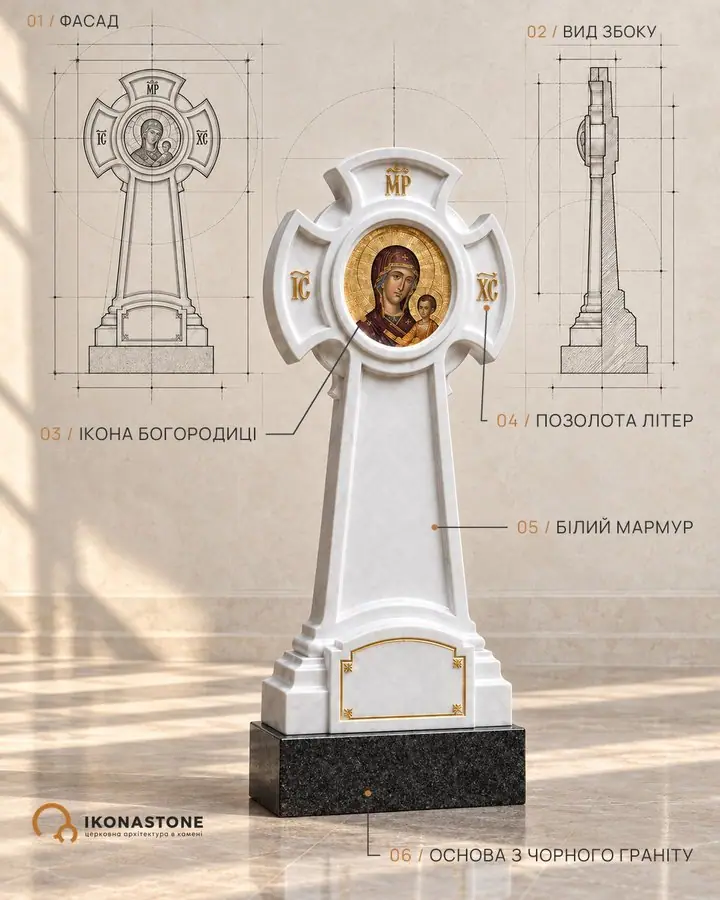
On the cross. The fields between the arms of the cross remain free, and it is in them, according to Byzantine epigraphers, that the inscription is usually written. The form of the cross and the arrangement of the letters are agreed in the design.
On the icon of the Crucifixion. On medieval icons of the Crucifixion, what is written above Christ is often not ІНЦІ (Pilate’s inscription) but “King of Glory”. The materials of the UGCC catechetical commission describe the variant “King of Glory Jesus Christ NIKA”, abbreviated as ЦР С ІС ХС N К. Here the word NIKA adds victory to the very image of suffering: the Crucified One is shown as the King of Glory. For more on ІНЦІ, ІС ХС and the halo, read the article Inscriptions on icons.
On the prosphora seal. Before baking, the bread for the liturgy is stamped with a special seal (sphragis). The seal shows a cross, and beside its arms ІС ХС НИКА. From the bread around the seal the priest cuts out the portion called the Lamb, and during the proskomedia he uses a liturgical knife in the shape of a spear, the lance. The impression serves as a guide for the priest who will cut the bread.
On stone crosses and slabs. The inscription does not depend on the material. The Austrian Academy of Sciences notes that four-part inscriptions accompany the cross regardless of the surface: “stone, painting, wood, textile, etc.”. So for a grave cross, a wayside cross or a memorial slab, ІС ХС НИКА is not a question of style but of choice: whether to write it, in what language and where.
There is one more practical detail that concerns stone specifically. The letters ІС ХС НИКА look almost the same in Cyrillic and in Greek script, but they are not identical: the crescent Greek sigma (Ϲ) resembles the Cyrillic “С”, and the Greek chi (Χ) resembles “Х”. A carver copying the inscription from an iconographic model must know what is in front of him: the Greek or the Slavonic version. Otherwise the letters will look the same but read differently.
Is the inscription read the same way in different traditions?
The inscription belongs to the Byzantine cross tradition shared by the Eastern Churches. In medieval Western Europe the most widespread christogram became IHS, and INRI is written above the cross. So when a chapel or memorial is ordered by a Latin-rite community, it is appropriate to clarify in advance which inscription is needed. The choice belongs to the community and the rector.
What to decide before ordering
- Whether the inscription is needed and on which parts of the piece (cross, plinth, slab).
- Language and alphabet. In Greek (ΙϹ ΧϹ ΝΙΚΑ), in Cyrillic, with or without a titlo.
- The spelling of the word. НИКА, НІКА or the divided НІ КА. Choose one and keep to it throughout the design.
- The arrangement of the letters over the four fields: what goes at the top, at the bottom, on the left, on the right. Draw it.
- The titlo. It must be above ІС and above ХС, with a defined length and depth.
- Letter height and carving depth. Whether the inscription can be read depends on the viewing distance. On a large cross, letters that look good up close may “disappear” from afar.
- Approval. It is better to show the text and the arrangement to the rector or priest before carving: corrections are not made on carved stone.
Why the inscription deserves careful thought
Stone does not tolerate ambiguity: an inscription that has not been carved does not exist, and one carved incorrectly stays forever. That is why ІС ХС НИКА, one of the shortest sentences of the Christian visual language, deserves careful thought before it is laid into granite or sandstone.
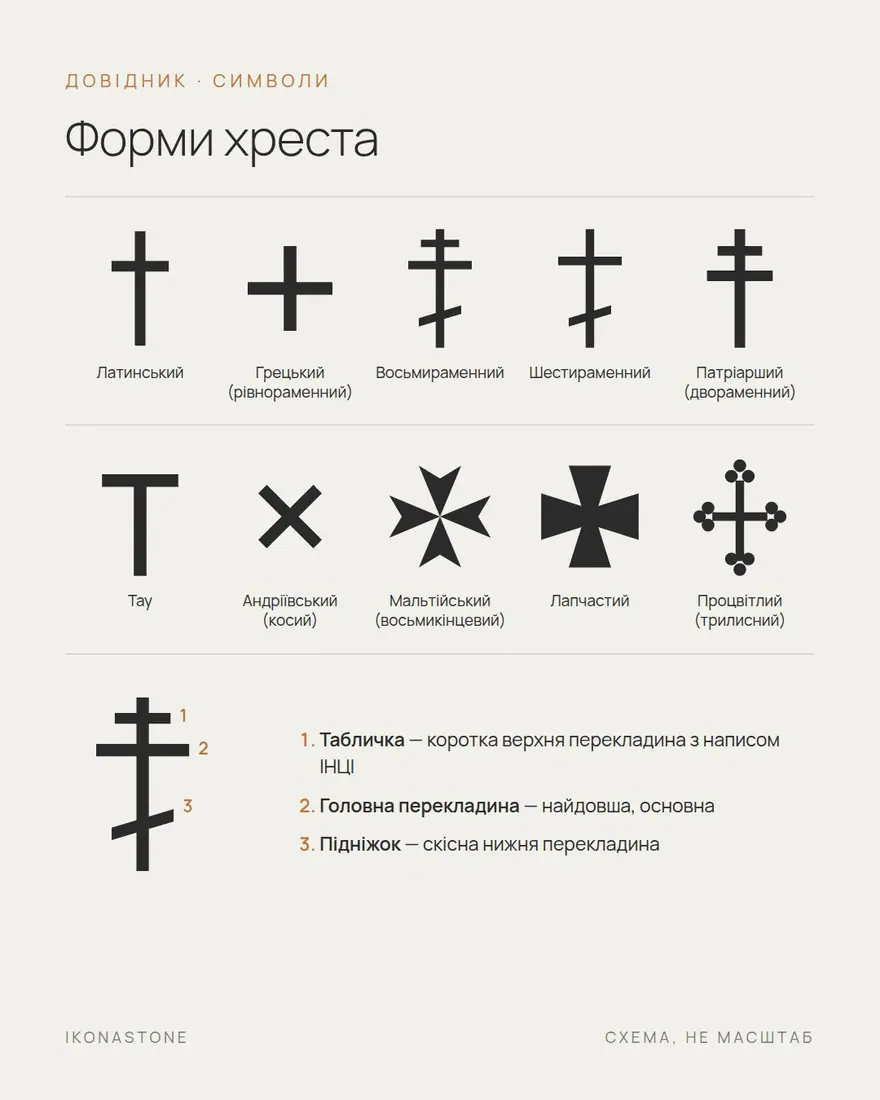
IKONASTONE makes crosses and stone icons in Lutsk, with inscriptions whose arrangement is agreed on the drawing. About our crosses, see the Crosses section; about icons on stone, the catalogue. Read about the forms of crosses in the article Forms of the cross, and about the general inscriptions in Inscriptions on icons.
Not sure what the piece is called? Walk through the church from sanctuary to churchyard →
Would you like to give something to a church? What to give a church →
Want to remember loved ones or a fallen parishioner? Remembrance at a church →
FAQ
What does ІС ХС НИКА mean?
These are four pairs of letters that read as the Greek Ἰησοῦς Χριστὸς νικᾷ, "Jesus Christ conquers". ІС and ХС abbreviate the names Jesus and Christ; НИКА (Greek νικᾷ) means "conquers".
Why are ІС ХС written this way, without vowels?
These are abbreviations of Greek words: the first and last letters of each are taken. A titlo, a small stroke marking the abbreviation, is placed above the letters. This way of honouring sacred names is known from the earliest Christian manuscripts.
Are НИКА and НІКА spelled the same?
No, the spellings vary: НИКА, НІКА, and on monuments the divided НІ КА also occurs. These are different renderings of one Greek word, not different words.
What is written on the prosphora seal?
The seal shows a cross, with ІС ХС НИКА around it. The impression remains on the bread and serves as a guide when the priest cuts out the portion called the Lamb.
Can ІС ХС НИКА be written on a grave cross or a memorial slab?
This inscription belongs to the cross tradition of the Eastern Churches and accompanies images of the cross on various surfaces, stone included. The language, the arrangement of the letters and the form of the cross should be agreed with the priest or rector before carving.
How does ІС ХС НИКА differ from ІНЦІ?
ІНЦІ reproduces Pilate's inscription above the cross, "Jesus of Nazareth, the King of the Jews". ІС ХС НИКА is not a historical inscription but a confession: Christ has conquered. That is why a cross may carry both, and on an icon of the Crucifixion ІНЦІ is sometimes replaced by "King of Glory".
Sources 14
- Christogram (IC XC, NIKA)
- Nomina sacra
- Titlo
- Austrian Academy of Sciences: Byzantine tetragrams (IC XC NI KA)
- Prosphora
- Lamb (liturgy)
- Kelsey Museum, University of Michigan: Prosphora seal (KM 1992.1.1)
- Kyiv Orthodox Theological Academy: The origin and symbolic meaning of the prosphora
- Patriarchal Catechetical Commission of the UGCC: The Proskomedia
- Patriarchal Catechetical Commission of the UGCC: Icons of the Passion and the Resurrection
- National Museum of the History of Ukraine: Cross, 1546, Lviv
- Labarum (the vision of Constantine, Ἐν τούτῳ νίκα)
- Greek Orthodox Archdiocese of America: History of the Archdiocese Logo
- Strong's Greek 3528: nikaō