Types of Icons of the Mother of God: How to Recognise the Hodegetria, Eleousa and Orans
An icon of the Mother of God can be recognised without reading the inscription. It is enough to look at the hands.
This is an old method, used both by worshippers and by iconographers. Each type of the Mother of God has its own “grammar” of gesture: where the hand rests, which way the head is turned, at what height the Child sits. Change the position of the palm, and instead of a story about the way we read a story about closeness, intercession or royal majesty. The names, which sound Greek and are therefore intimidating, are in fact only words for these gestures.
For anyone ordering an icon, an icon shrine or a relief in stone, this grammar is practical. The type determines the composition, the format, the place in the church and even how much space is needed around the image. Below we look at the five types that occur most often, and at the monuments on which they are easiest to learn.
There is one more reason to understand the types: they do not compete with one another. In a church the Hodegetria, the Orans and the Hagiosoritissa can live side by side, because they answer different questions. The first says where to go. The second, for whom to pray. The third, to whom to turn.
In brief
- Hodegetria (“She Who Shows the Way”): the Mother of God, with the Child on her arm, points to Him with her hand; the Child blesses.
- Eleousa (“Tenderness”, “Loving-Kindness”): the faces touch cheek to cheek, the Child embraces his mother.
- Orans: the Mother of God at full length with raised palms, usually without the Child; if Christ is depicted in a medallion, it is the variant called the Sign.
- Panachranta: the Mother of God sits on a throne, the Child on her knees.
- Hagiosoritissa: the Mother of God without the Child, turned sideways towards Christ, in prayer; a type that lives in the Deesis tier.
- The types are not rigid boxes: transitions and mixed compositions are common.
How to recognise the type: a short table
| Type | Posture | Hands | Child |
|---|---|---|---|
| Hodegetria | frontal, head slightly inclined | one supports the Child, the other points to Him | on her arm, blessing, often with a scroll |
| Eleousa | inclined towards the Son | embracing each other | cheek to cheek, the Child’s hand on his mother’s neck |
| Orans | standing at full length, frontal | raised, palms open | none (or a medallion on the breast: the Sign variant) |
| Panachranta | seated on a throne | holding the Child on her knees | on her knees, often among angels |
| Hagiosoritissa | full length, turned sideways towards Christ | open in prayer | none |
Hodegetria: the Mother of God who shows the way
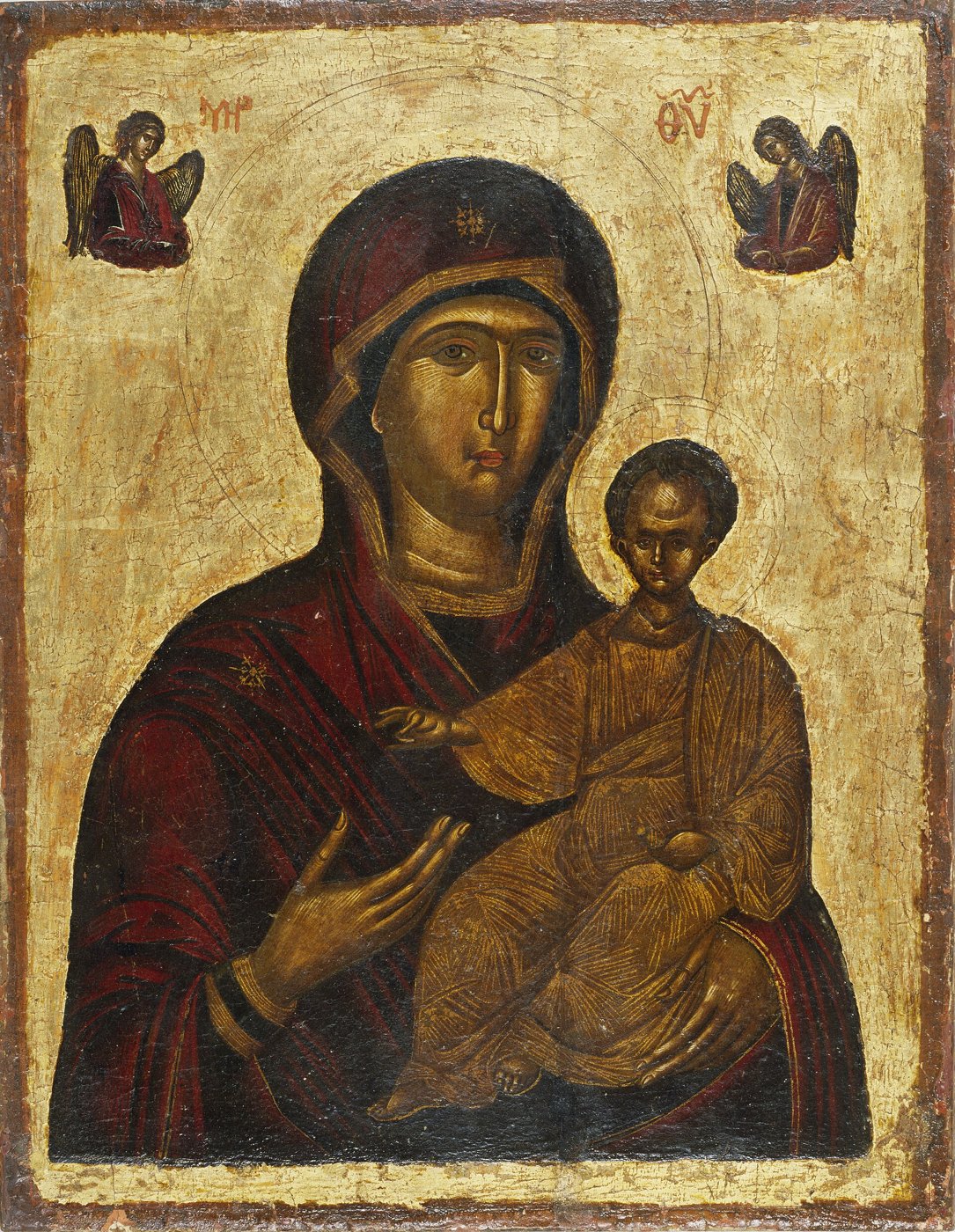
The word comes from the Greek “Οδηγήτρια”: she who shows the road, the guide. In our icon painting it is one of the most widespread types: the Mother of God holds the Child on her left arm and points to Him with her right hand. Christ sits upright, as if on a throne, blessing with one hand and holding a scroll in the other. Everything here is built on sequence: she points, He blesses. The icon is not about feeling; it is about direction.
According to tradition, the first such icon was painted by the Evangelist Luke; the original, kept in Constantinople, was later lost. This is a tradition, and it should be presented as such. What is known, however, is a detail about the Constantinopolitan prototype: every Tuesday it was carried out for public veneration, and this procession was one of the city’s spectacles. The image had an almost civic scale.
In Ukraine the Hodegetria type is represented by very old and very diverse monuments. Among them are the Chełm, Belz-Częstochowa, Dorohobuzh, Lviv and Lutsk icons. The Dorohobuzh Hodegetria from the Church of the Dormition in Dorohobuzh (researchers date it to the 12th–13th century, according to one version to the last third of the 13th century) is kept in the Rivne Regional Museum of Local Lore. The Lutsk Hodegetria is now in the National Art Museum of Ukraine in Kyiv. And 17th-century Volhynia produced one more example: the Hodegetria from the Church of the Dormition in the village of Tverdynia, Lokachi district, where the Mother of God inclines her head slightly towards her Son and a restrained smile shows on the faces.
The Chełm icon: a Hodegetria with a particular gesture
The Chełm icon of the Mother of God is associated with the Hodegetria type, more precisely with its variant Dexiokratousa (Greek, “holding on the right”), in which the Child sits on the right arm of the Mother of God. Scholars date it to approximately the 11th century (museum descriptions give the 11th–12th century); its mention in the Galician-Volhynian Chronicle falls in the year 1259. The image is painted on three cypress boards (95×66 cm), decorated with gold plates and a round silver plate with cloisonné enamel.
Its path was long: according to RISU, the icon was hidden, divided into parts, moved between cities and, in the end, restored. The restoration, led by Anatolii Kvasiuk, was completed in November 2009, and about 70% of the original painting has survived. Today the icon is in the Volyn Regional Museum of Local Lore in Lutsk. The Museum of Volhynian Icons, opened in August 1993, has more than 600 icons of the 16th–19th centuries in its collection, and a separate hall there is devoted to the Chełm icon.
Eleousa, or Tenderness: when gesture becomes tenderness
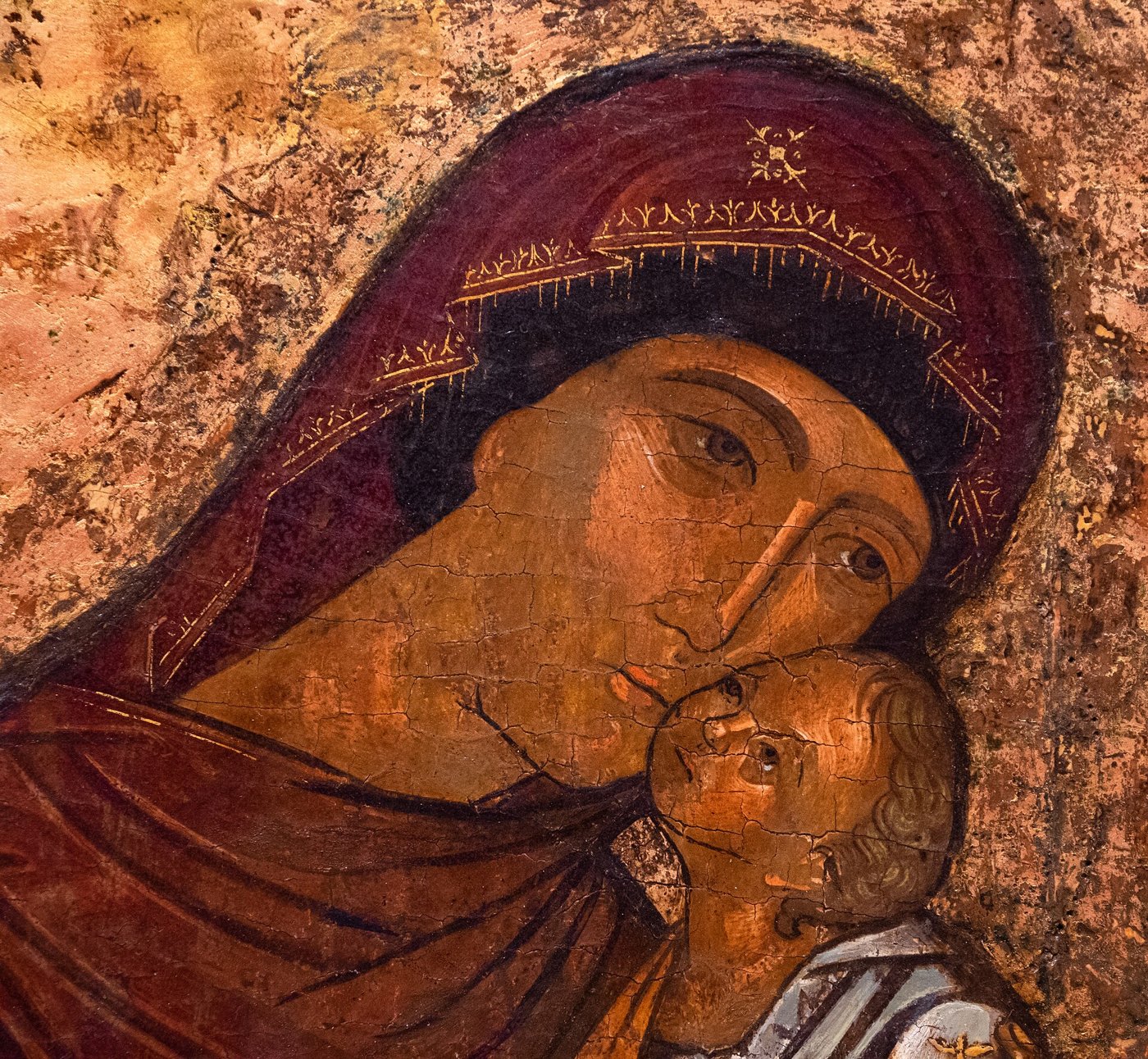
The Greek “Eleousa” means “compassionate”, and in the Ukrainian tradition the type is called Tenderness (Rozchulennia) or Loving-Kindness (Myluvannia). Its main feature is simple and unmistakable: mother and Son touch cheek to cheek. The Child embraces her around the neck. The Mother of God bends down, and the formal pointing gesture characteristic of the Hodegetria becomes an intimate one.
The type developed from the Hodegetria. In the sources it can be traced from the 10th century, and perhaps it existed even earlier; its spread is linked to the growing role of the services of the Passion: the image of a mother holding her Son recalls his fate. This is the strength of the Eleousa: there is no solemnity here, but there is foreboding.
In Ukrainian icon painting the type is known as “Myluvannia”; researchers also class the Pochaiv icon of the Mother of God as an Eleousa. For the client this has a practical consequence: the Eleousa requires a different composition from the Hodegetria. The two faces are so close that the craftsman must decide what will separate them: light, line or the depth of the relief.
Orans: the Mother of God with raised hands
The word comes from the Latin for “she who prays”. The figure stands at full length, hands raised and spread, palms open. There is no Child. This is how, praying, the Mother of God appears before the viewer in most images of the Orans. If, however, Christ Emmanuel is depicted in a medallion on her breast, the scholarly literature speaks of the Sign variant; both forms are associated with the idea of the Incarnation.
The best-known Ukrainian Orans is the mosaic in the apse of Saint Sophia Cathedral in Kyiv. It is 5.45 metres high, made of smalt (21 shades are counted in it) and dates from the 11th century. Beside it is a Greek inscription from the Psalter (Psalm 45:6 in the Septuagint numbering) saying that God is in the midst of the city and it shall not be moved. Hence the name “Unbreakable Wall”: the wall bearing this image has stood for almost a thousand years without destruction.
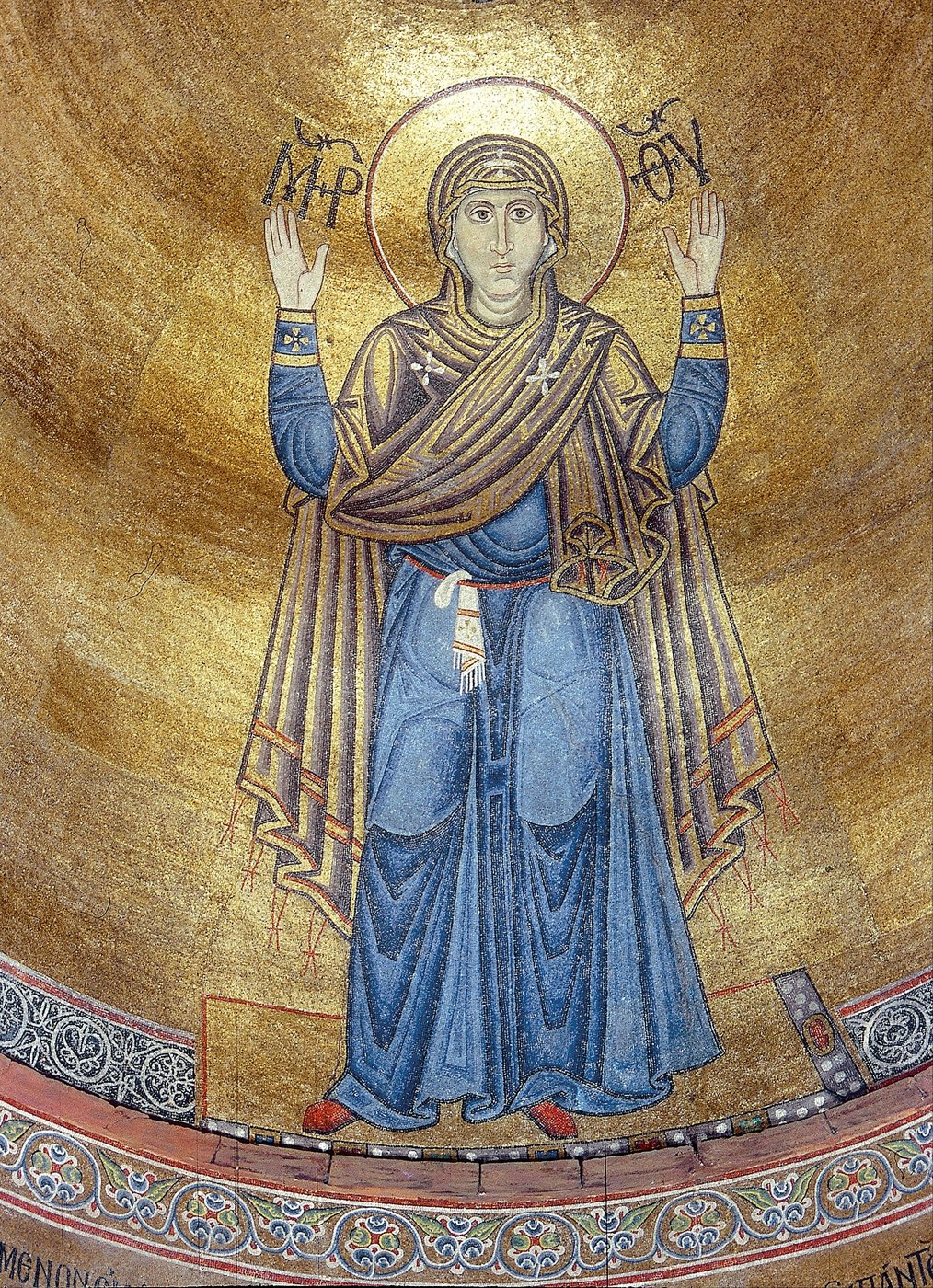
The Orans is an example of how size dictates type. Such a figure can only stand where there is room for a vertical: in the sanctuary conch, on a large surface. For a wall icon or an icon shrine this image needs a separate sketch, because it cannot be compressed without losing the gesture.
Panachranta: the Mother of God on a throne
“Panachranta” means “All-Immaculate” (Greek “πανάχραντος”). The Mother of God sits on a throne that embodies royal glory, with the Child on her knees, often between angels. This is an image of solemnity, not of movement or tenderness.
A Ukrainian example is the Mother of God of Mercy, known as the “Gracious”: it was painted in Lviv in 1598 by Józef Szolc-Wolfowicz, and the original is now kept in Kraków. The type is easy to recognise by its structure: a central axis, a throne, angels on either side. Such a symmetrical composition also reads well in relief: it is built almost like a small façade.
Hagiosoritissa: when there is no Child
According to one version, the name is connected with the Church of the Holy Soros (Ἁγία Σορός) in the Chalkoprateia quarter of Constantinople. The name is first recorded on Byzantine seals of the 11th century. The Mother of God is depicted without the Child, turned slightly sideways, with her hands raised in prayer. In Latin she is called “Maria Advocata”, that is, the Intercessor.
This is an image of the Deesis tier: the Mother of God stands before Christ and prays for the human race, and beside Him is John the Forerunner (more on this tier in the article on the Deesis). An example in Ukraine is the Deesis of 1688–1689 for the church in the village of Volia Vysotska, where the Mother of God is turned towards Christ; researchers assign this iconographic composition to the Hagiosoritissa type. Most often the Hagiosoritissa is found not as a separate icon but as part of an ensemble.
The Zarvanytsia icon: an image that does not fit the scheme
The Zarvanytsia icon of the Mother of God shows why one should not rush to definitions. According to its description, the image is executed on a lime-wood panel: only the faces and hands of the Mother of God and the Saviour are painted, while the garments are flat-carved and gilded wood on an engraved ground. Here the construction of the image, in which carving and painting are combined in one body, matters no less than the iconography. It is a language close to relief.
What to decide before ordering
- The place of the image. Apse, niche, icon shrine, side wall: this determines whether the vertical of the Orans, the symmetry of the Panachranta or a small, intimate Eleousa will suit.
- The type according to purpose. For a church icon of veneration, for the Deesis tier, for a baptistery or a chapel, different types.
- The rector’s blessing. The final choice of type and inscriptions is agreed with the rector and the community.
- The inscription. Each type has established forms of inscription; see the article on inscriptions on icons. On the halo, see the article The halo on an icon.
- The technique. Relief, inlay or engraving in stone render faces and hands differently; on choosing between stone and a wooden panel, see the article An icon on stone or on a wooden panel.
- The model. It is better to choose a specific historical monument as a reference rather than a “generic Mother of God”.
A quiet hint about stone
The hands on an icon are the most delicate part of the composition: in stone a finger or the edge of a palm is more sensitive to error than a face. That is exactly why the type must be decided before the sketch, not after it. At IKONASTONE we design icons, icon shrines and reliefs for a specific church interior; the catalogue is in the icons on stone section, and related pieces are in the icon shrines section.
FAQ
How does the Hodegetria differ from the Eleousa?
In the Hodegetria the Mother of God holds the Child on her arm and points to Him: the image is turned towards the viewer and speaks of the way. In the Eleousa (Tenderness) the faces of mother and Son touch cheek to cheek and the Child embraces his mother: the image speaks of closeness.
What does the word "Orans" mean?
The name comes from a Latin word meaning "she who prays". It is a full-length figure with the hands raised and spread to the sides, palms open, usually without the Child. If Christ is depicted in a medallion on the breast of the Mother of God, the type is called the Sign.
Why is the Hagiosoritissa depicted without the Child?
It is a type of prayerful intercession: the Mother of God turns to Christ, and the Child in her arms would be superfluous. On an iconostasis such an image naturally stands in the Deesis tier beside Christ.
Which Mother of God is best chosen for a church icon shrine or an icon on stone?
The type is chosen according to the place and purpose of the image: the Hodegetria or Eleousa for veneration in the nave, the Orans for the apse, the Hagiosoritissa for the Deesis tier. The final decision is agreed with the rector and the community.
Is the Chełm icon considered a Hodegetria?
Yes, it is classed as a Hodegetria, specifically the variant called Dexiokratousa ("holding on the right"): the Child sits on the right arm of the Mother of God. Today the icon is kept in the Volyn Regional Museum of Local Lore in Lutsk.
Can one and the same icon be assigned to two types?
The types are not rigid boxes. Transitional and mixed compositions occur, and different researchers often name the same image differently. That is why descriptions should rely on visible features: where the hands are, where the Mother of God is looking, how the Child sits.
Sources
- Iconographic types of icons of the Mother of God and their features (RISU, 2020)
- Demianchuk. The Mother of God in Ukrainian icon art (Visnyk, 2016)
- The Orans, light-bearing protectress of Kyiv — Local History
- The Orans on guard — Saint Sophia Cathedral (sophia.help)
- The icon of the Chełm Mother of God: the oldest surviving icon in Ukraine (RISU)
- Museum of Volhynian Icons in Lutsk (Department of Culture, Lutsk City Council)
- The icon of the Mother of God Hodegetria (Tverdynia village) — Istorychna Volyn
- Narodoznavchi Zoshyty, No. 1 (163), 2022: the icon of the Mother of God Hodegetria
- Kovalchuk I. Ukrainian iconography of the 14th–18th centuries (UARS)
- The miraculous Zarvanytsia icon of the Mother of God — Zarvanytsia Marian Spiritual Centre
- The icon of the Mother of God Hodegetria to be shown in Rivne after restoration (Ukrinform)
- Hodegetria
- Hagiosoritissa
- Panachranta (icon)
- The Virgin Eleousa — Cleveland Museum of Art
- Virgin Eleousa: Compassionate Mother in Byzantine Iconography