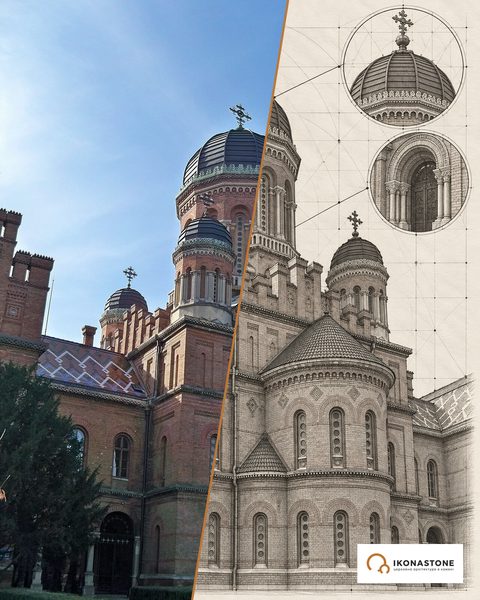
Sts Peter and Paul Cathedral in Kamianets-Podilskyi: the Mother of God on a minaret
Above the roof of a Catholic cathedral stands a minaret. On the minaret stands the Mother of God, treading on a crescent. It is rare for a single building to tell a story of war and peace without a word.
In brief
| Address | Kamianets-Podilskyi, Old Town, by Cathedral Square |
| Built | first church — 14th c. (wooden); masonry church — late 15th to early 16th c.; rebuilt 1742–1757 |
| Type | three-aisled church with side chapels, a minaret, a detached bell tower and a gateway |
| Material | masonry; the statue on the minaret — gilded copper |
| Status | architectural monument of national importance (protection No. 220132/1) |
| Church | Roman Catholic Church, cathedral of the Diocese of Kamianets-Podilskyi |
History
The first church on this site was wooden. It is linked with the founding of the Diocese of Kamianets in 1375 (according to other sources, 1373 or 1378) and with the Koriatovych princes, who, according to “Landmarks of Ukraine”, founded it. At the turn of the 15th and 16th centuries, probably under Bishop Jakub of Buczacz, the cathedral was rebuilt in stone; the sources also link its construction with Bishop Paweł of Boyanice. During the 16th century chapels and a presbytery were added to it.
In 1672, after a siege, the army of Sultan Mehmed IV took Kamianets. The cathedral became the city’s main mosque, and a minaret was built by its west wall. The Ottomans held the city for 27 years. In 1699, under the Treaty of Karlowitz, Podillia returned to Poland, and the cathedral was consecrated again as a Catholic church.
It was decided not to demolish the minaret. Bishop Mikołaj Dembowski commissioned a statue of the Mother of God for it; it was put in place on 10 May 1756. In 1737–1755 the interior was renewed in the late Baroque style (some sources date the rebuilding to 1742–1757); kamenca.net names Jan de Witte as the probable author of the design of the triumphal gate. In honour of the visit of King Stanisław August in 1781 a triumphal arch was built (the sources give 1781 or 1782).
In 1936 the church was closed (according to other sources, in 1930 or 1935) and turned into a museum; from the summer of 1941 to June 1945 services were held in it again, and from 1946 a museum of atheism operated there. In 1990 the cathedral was returned to the faithful — the first Mass took place on 29 June 1990 (according to other sources, the church was restored in 1991).
Chronology
The numbers in square brackets are the numbers of the sources in the list at the bottom of the page. The phrase “according to …” means that the fact is confirmed by only one source. The section “Legends” contains traditions and legends: they are recorded in the sources but not documented.
Era 1. The wooden and early masonry church
- 1375
Pope Gregory XI, at the request of King Louis of Hungary, founded the Diocese of Kamianets; its first bishop was the Dominican Wilhelm. The first cathedral church was probably wooden. The date varies in the sources: 1373 [1], 1375 [2, 7, 8], 1378 [5]; according to a review of the book by K. R. Prokop, the founding belongs to 1379–1384, no later than 1387 [13]. The exact date of the founding of the church itself is unknown [2].
- 15th – early 16th c.
A masonry church appears. It is attributed to Bishop Jakub of Buczacz (1502–1517) [2, 5, 8]; the English-language Wikipedia dates its construction to the 16th century [1].
- After 1483
According to W. Rożkow, construction of the masonry church began under Bishop Maciej of Stara Łomża; the construction was completed by Bishop Piotr of Lesew. [6]
- 16th – 17th c.
Chapels were added to the cathedral by the west front and on the south side; according to Z. Bania, they are dated to 1547–1563, 1627–1640 and about 1640. [3]
Era 2. The mosque
- 1672
At the end of August the Ottoman army took Kamianets (the siege began on 18 August; the Polish garrison left the city on 30 August). [15]
- 1672–1699
The cathedral was turned into the city's main mosque and the Christian furnishings were removed. Yusuf Efendi was appointed the first imam, and 20 more people assisted with the services (according to kamenca.net). Ottoman rule lasted 27–28 years [1, 2, 4, 6, 9, 11, 12].
- After 1672
The minaret was built on the west front, on the base of a walled-up Renaissance chapel of the 16th century. Its height is 36.5 m, with 136 stone steps inside (other sources: 135 and 145); at a height of 25 m it is anchored to the west wall [2, 3, 4, 5, 8, 9, 12]. Z. Bania considers “about 1690” the most widespread date [3]. A second minaret was planned on the north front but was not built [2, 3].
- 1687
The French traveller F. Dupont described two minarets in the spring; the reports of 1699 mention only one. According to Z. Bania [3].
- 1699, 22 September
The Turkish side handed the keys of the city to Poland; the cathedral became Catholic again. Jabłonowski valued the Turkish banner at 80,000 lei; in the cemetery there were almost two hundred Turkish gravestones (according to Z. Bania) [2, 3].
Era 3. The Baroque and the triumphal gate
- 1700, 3 July; 1704
Bishop Jan Gniński solemnly entered the church; the decoration and restoration were completed in 1704. According to kamenca.net [2].
- 1737–1755
The interior was renewed in the late Baroque style. [2, 8, 9]
- 1754
The chapter set up a plaque in gratitude to Bishop Mikołaj Dembowski. According to kamenca.net [2].
- 1756, 10 May
A gilded copper statue of the Mother of God, about 3.5 m tall, with a crown of twelve stars, was placed on the minaret; it was installed under Bishop Mikołaj Dembowski. According to kamenca.net, the statue was made in Gdańsk [2, 3, 6, 8, 9]. It may have been preceded by an earlier statue (Z. Bania dates it to 1699, N. Maltseva says it was wooden) [3, 10].
- 1781–1782
King Stanisław August Poniatowski visited Kamianets; in his honour, on the initiative of Bishop Adam Krasiński, a triumphal gate 10.6 m high was built. According to kamenca.net, the gate dates from 1782; Turpravda gives 1781. [2, 5]
Era 4. The 19th century
- 1853–1860
Giovanni Sampini painted the south Chapel of the Immaculate Conception; in the 1850s an organ by the Viennese master K. Hesse (972 pipes) was installed. According to kamenca.net [2].
- 1862, 29–30 June
A fire damaged the roof and the furnishings; services resumed on 7 December 1862. According to W. Rożkow [6].
- 1866, 5 June
The Diocese of Kamianets was abolished; the cathedral became a parish church. [6, 7]
- 1874–1876
The sculptor Wiktor Brodzki made the tombstone of Laura Przezdziecka from Carrara marble (about 4 t); in 1938 it was moved from Czarny Ostrów. [2, 5]
Era 5. The 20th century
- 1918–1919
The diocese was restored and the church became a cathedral again: according to GCatholic in 1918, according to W. Rożkow on 8 December 1919. [6, 7]
- 1922
The church was plundered. According to W. Rożkow [6].
- 1930–1936
The Soviet authorities closed the church and housed a museum of religion and atheism in it. The dates differ: 1930 [5, 6], 1935 [7, 9], 14 May 1936 [1].
- 1938
The tombstone of Laura Przezdziecka was moved to the Chapel of the Immaculate Conception. [2, 5]
- 1941–1945, 4 June
In the summer of 1941 the church was opened for services; it operated until 4 June 1945. [1, 6]
- 1946
The building was handed over to the regional museum, later a museum of atheism. [1, 6]
- 1970s; 1990s
During excavations near the Polish Gate a slab from the late 15th – early 16th century was found; in the 1990s it was placed in a pier inside the cathedral. According to kamenca.net [2].
- 1990, 13 and 29 June
The church was returned to the faithful (13 June); the first Mass was on 29 June 1990. According to GCatholic, on 16 January 1991. [1, 7, 9]
Era 6. The present day
- 1991
Jan Olszański was appointed bishop of the restored Diocese of Kamianets-Podilskyi; since 2002 it has been headed by Leon Dubrawski (as of 2008). According to [13].
- 2007, 29 June
A bronze statue of John Paul II, 2.55 m tall (inscription “Totus Tuus”), was unveiled by the cathedral. According to kamenca.net [2].
Lost and recreated
| What | What it was | What happened | Where it is now |
|---|---|---|---|
| Wooden cathedral church | Late 14th c., probably | Replaced by a masonry building | Not preserved [2, 8] |
| West chapel of the 16th c. | A Renaissance chapel by the front | Walled up; became the base of the minaret | The base of the minaret [4, 6, 9] |
| Second minaret | Planned on the north wall | Not built | Does not exist [2, 3] |
| Turkish gravestones | About 200 in the cemetery around the cathedral | Destroyed in 1699 (according to Z. Bania) | Lost [3] |
| Turkish banner | The banner of the mosque; valued at 80,000 lei | Taken down in 1699 | Fate unknown [3] |
| Earlier statue on the minaret | Possibly 1699 (wooden?) | Replaced by the copper one on 10.05.1756 | Not preserved [3, 10] |
| Roof and furnishings | Earlier appearance | Damaged by fire on 29–30.06.1862 | Restored by 07.12.1862 [6] |
| Red flag on the roof | Flown until 1866 (according to tradition) | Ceased with the abolition of the diocese | Not preserved [2] |
| Tombstone of L. Przezdziecka | Crypt in Czarny Ostrów | Moved to the cathedral in 1938 | Chapel of the Immaculate Conception [2, 5] |
| Bell tower (a probable donjon) | Up to 45 m, one tier taller | Shortened | Four tiers, side 12.7 m [2] |
Architecture
The cathedral is a three-aisled building in which at least four eras have left their layers: the early masonry church, Gothic features in the windows and interior, the Baroque of the 18th century and the Ottoman minaret. A separate bell tower stands beside it.
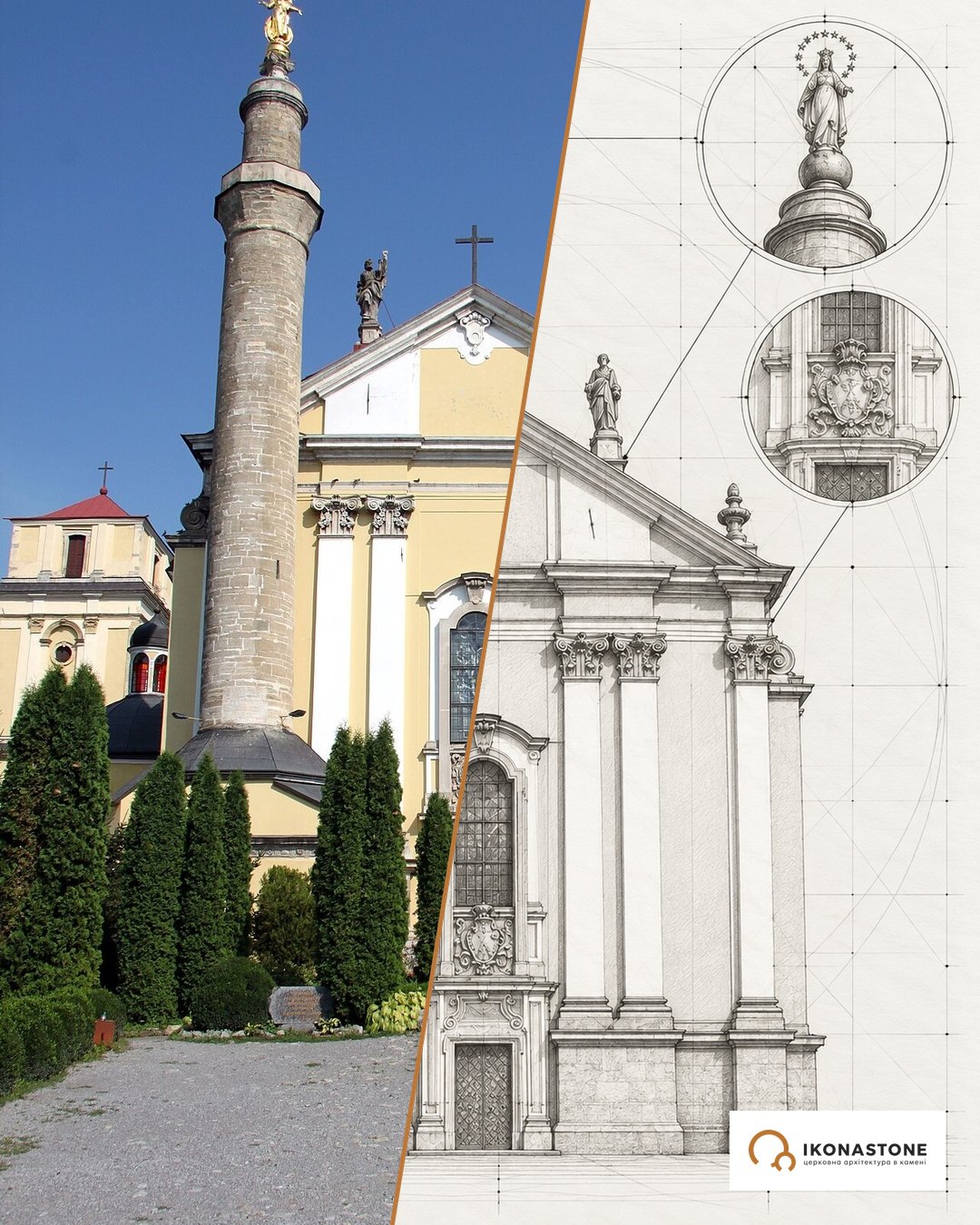
Below are two elements of the church, shown in a photograph and in a drawing. The drawings show form, not exact dimensions.
The minaret with the statue of the Mother of God
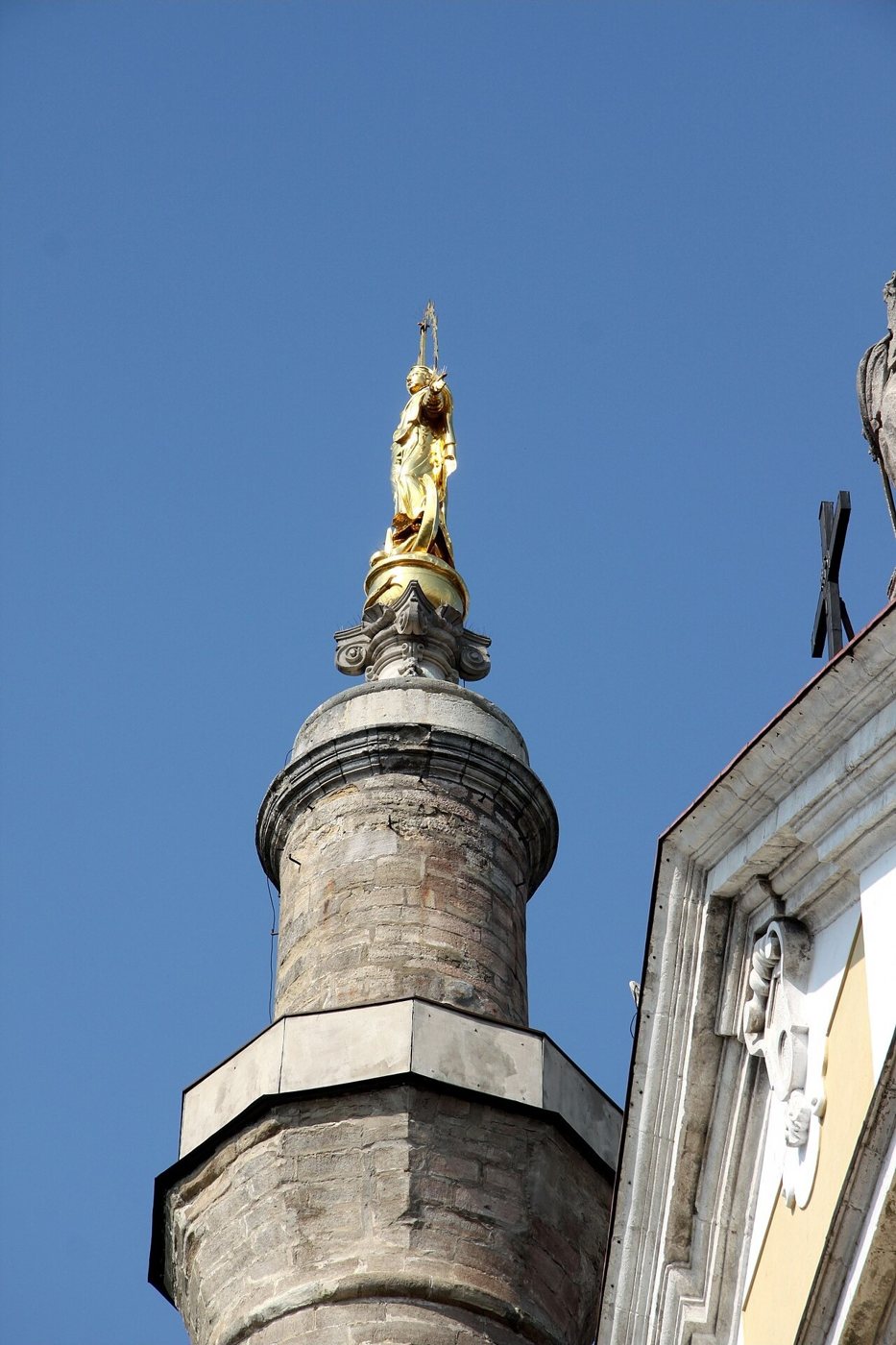
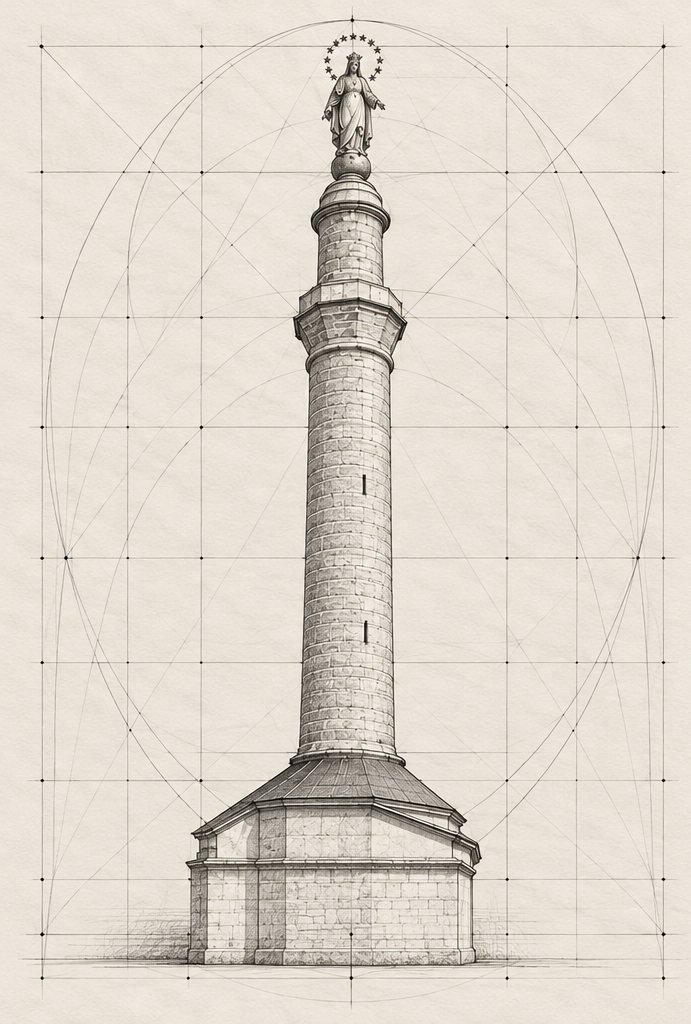
The height of the minaret is most often given as 36.5 metres; according to the Polish researcher Zdzisław Bania it is about 25 metres. According to “Landmarks of Ukraine”, inside there is a spiral staircase of 136 steps, and at a height of 25 metres the minaret is fastened to the west wall by a metal tie. The statue is about 3.5 metres tall: the Mother of God with outstretched arms stands on a crescent and a globe, with a crown of twelve stars above her head.
The triumphal arch
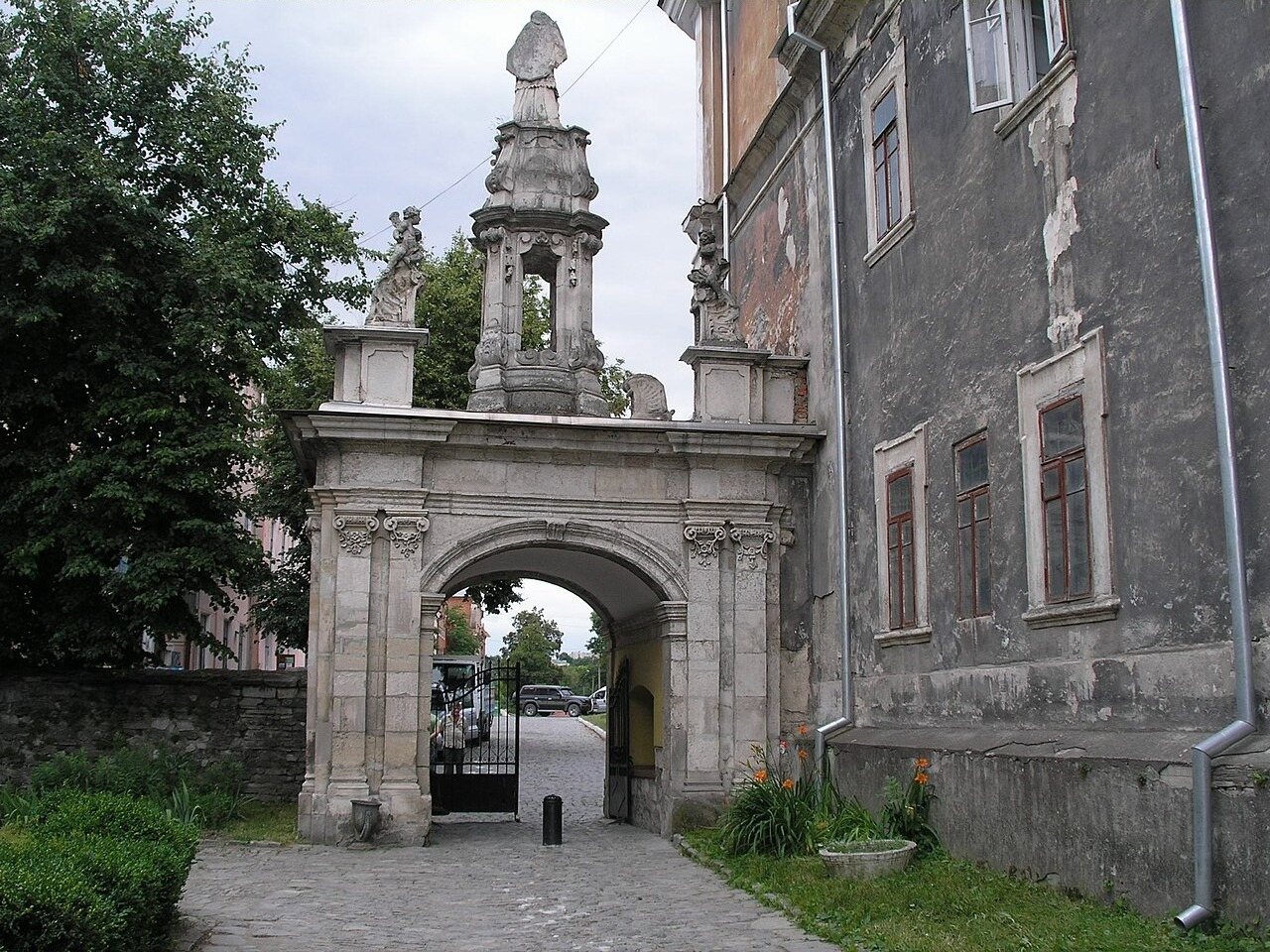
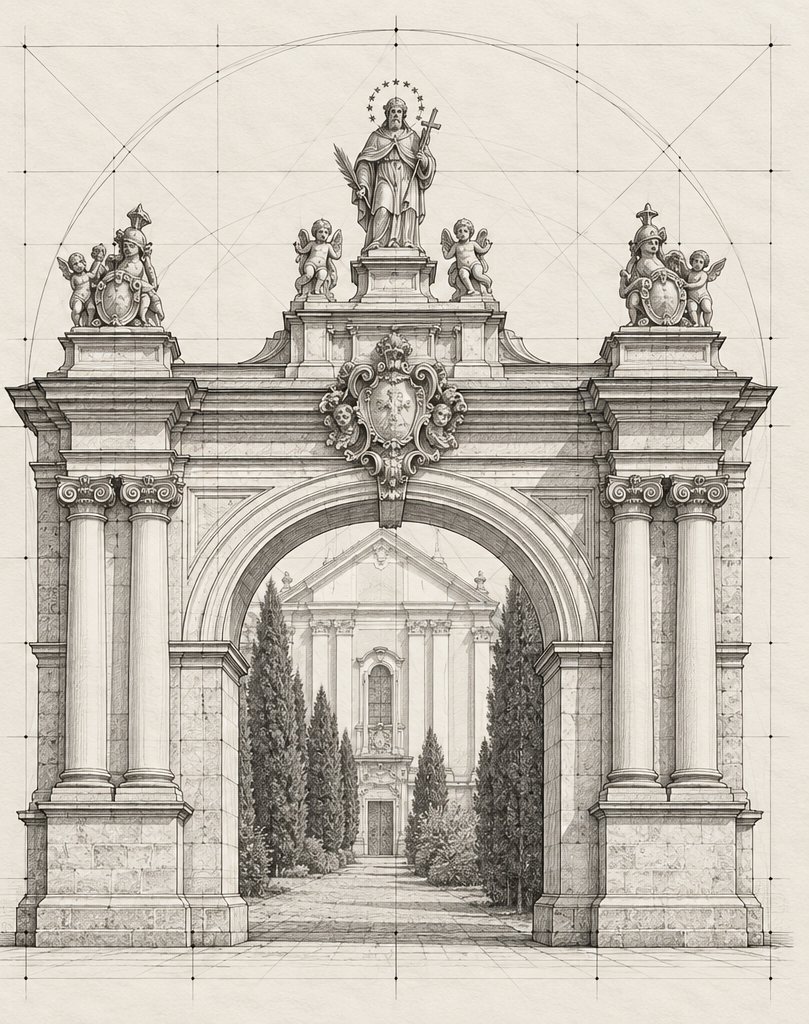
The Baroque gate of 1781 is decorated with sculptures of angels and of St John of Nepomuk. The gate is linked with the visit of King Stanisław August to Kamianets in 1781 (according to kamenca.net, it was built in 1782).
Stone and material
The minaret stands on stone from the cathedral’s own past: according to “Landmarks of Ukraine”, the base was made from a 16th-century chapel by the west front, which was walled up. The statue of the Mother of God of 1756 was made of copper and gilded; it was brought from Gdańsk. In a chapel of the cathedral is the tombstone of Laura Przezdziecka in Carrara marble, by Wiktor Brodzki (also spelled Brodski in the sources), 1874–1876.
It is interesting how the argument between materials was settled here. The minaret was left as a pedestal — the height was already built. On the summit, in wind and rain, gilded copper was placed. The marble went inside, under the roof. Each material ended up where it serves most easily — and this is how one should think when designing sculpture for a church. Another church of Podillia in our Guide is the Church of the Intercession in Sutkivtsi.
Did you know
The French traveller F. Dupont wrote in the spring of 1687 about two minarets; in 1699 only one is recorded. According to Z. Bania. [3]
The original entrance to the bell tower was in the west wall at a height of about 6 m; it was reached by a ladder that could easily be removed. For this reason the tower is considered a possible donjon. According to kamenca.net. [2]
Jabłonowski mentions that the Turks valued their banner at 80,000 lei. According to Z. Bania. [3]
In the cemetery around the cathedral there were almost two hundred Turkish gravestones. According to Z. Bania. [3]
Yusuf Efendi was appointed the first imam of the cathedral-mosque; 20 more people assisted with the services. According to kamenca.net. [2]
The organ of 972 pipes cost 3,000 silver roubles; it had 20 stops. According to kamenca.net. [2]
The sculpture of Laura Przezdziecka is made of Carrara marble, about 4 t. [2, 5]
Above the head of the Mother of God on the minaret is a crown of twelve stars. [2, 10]
The statue of the Mother of God was installed on 10 May 1756 to the sound of bells and cannons in the castle. According to kamenca.net. [2]
In the cathedral's basement rooms there are nine crypts with the burials of prominent figures of the Podillia diocese. According to Turpravda. [5]
Today people often make wishes under the triumphal gate. According to kamenca.net. [2]
On the square in front of the cathedral stands a column that a Polish author calls a symbolic monument to Wołodyjowski. According to Grajewski. [14]
Legends
The crescent underfoot
According to a legend spread by tour guides, the Mother of God stands on the Muslim crescent as a sign of victory over the Turks. The journalist Natalia Maltseva calls this a myth: in her view the Mother of God is treading on a serpent, and the crescent is visible only from a certain angle below. Recorded in the OBOZ.UA blog in 2015. [10]
The minaret in the peace treaty
According to one version, the Treaty of Karlowitz contained a separate stipulation that the minaret should not be dismantled; Maltseva doubts this and mentions another version: the Turkish custodians asked that the tower not be destroyed when the church was handed over. [10]
The red flag
According to tradition, until 1866 a dark red flag was flown on the cathedral roof in memory of the liberation from the Turks. Recorded on kamenca.net. [2]
The only church with a minaret
According to popular tradition, this is the only Christian church with a minaret; Zaxid.net is more cautious: “probably the only one”. Not verified by documents. [4]
The Little Knight
According to literary tradition, the prototype of the hero of Henryk Sienkiewicz's “Pan Michael” (“The Little Knight”) was Jan Jerzy Wołodyjowski, defender of Kamianets in 1672; the Polish journalist Andrzej Grajewski writes that he died in an accidental explosion after the capitulation. [14]
Figures
- Wilhelm — a Dominican, the first bishop of Kamianets (1375).
- Jakub of Buczacz — bishop (1502–1517), to whom the building of the masonry church is attributed.
- Maciej of Stara Łomża, Piotr of Lesew — bishops under whom, according to W. Rożkow, the masonry cathedral was built and completed.
- Mehmed IV — the Ottoman sultan under whom the church was turned into a mosque.
- Yusuf Efendi — the first imam of the mosque.
- Jan Gniński — the bishop who solemnly entered the church in 1700.
- Mikołaj Dembowski — the bishop who commissioned the statue of the Mother of God (1756).
- Jan de Witte — architect, probable author of the design of the triumphal gate (according to kamenca.net).
- Adam Krasiński — the bishop who initiated the gate for Stanisław August.
- Stanisław August Poniatowski — the king in whose honour the gate was built.
- Giovanni Sampini — the painter of the south chapel (1853–1860).
- Karl Hesse — organ builder from Vienna.
- Wiktor Brodzki, Laura Przezdziecka — the sculptor and the woman whose tombstone (1874–1876) is in the cathedral.
- Jan Olszański, Leon Dubrawski — bishops after 1991.
- Jan Jerzy Wołodyjowski — defender of Kamianets in 1672.
How to cite
IKONASTONE. Sts Peter and Paul Cathedral in Kamianets-Podilskyi // Guide to the Churches of Ukraine. URL: https://ikonastone.com/en/guide/sts-peter-and-paul-cathedral-kamianets-podilskyi/ (accessed DD.MM.YYYY).
FAQ
Where is the cathedral located?
In the Old Town of Kamianets-Podilskyi, Khmelnytskyi Oblast, by Cathedral Square. The cathedral stands on Cathedral Square in the Old Town.
Why does the cathedral have a minaret?
In 1672 the army of Sultan Mehmed IV took Kamianets, and for 27 years the cathedral served as the city's main mosque; the minaret was built beside it at that time. After the city returned to Poland in 1699 the minaret was not taken down, and in 1756 a statue of the Mother of God was placed on it.
How tall are the minaret and the statue?
The height of the minaret is most often given as 36.5 metres, although some sources give a different figure. The gilded copper statue of the Mother of God, made in Gdańsk according to kamenca.net, is about 3.5 metres tall.
Who serves in the cathedral today?
It is the cathedral of the Roman Catholic Diocese of Kamianets-Podilskyi. In the Soviet period it housed a museum; the church was returned to the faithful in 1990 (according to other sources, in 1991).
Sources
- Wikipedia (en). Sts. Peter and Paul Cathedral, Kamianets-Podilskyi
- Кам'янець-Подільський: кафедральний собор (kamenca.net)
- Z. Bania. Minaret czy minarety katedry w Kamieńcu Podolskim? // Roczniki Humanistyczne, t. L, z. 4 (2002), s. 507–514
- Zaxid.net. Османська спадщина Камʼянця-Подільського: що залишили турки після 27-річного панування
- Turpravda. Петропавловский кафедральный костел
- W. Rożkow. Визитация Римско-католического Кафедрального собора Св. Апостолов Петра и Павла в Каменце-Подольском // Res Historica 51 (2021), s. 719–751
- GCatholic. Cathedral of Sts. Peter and Paul, Kamyanets-Podilsky
- Збірник матеріалів (ХПІ). Фрагмент «Кам'янець-Подільський кафедральний собор святих Петра і Павла», с. 129
- Збірник ХПІ (інша частина репозиторію), фрагмент про собор
- Н. Мальцева. Тайны Каменец-Подольского. OBOZ.UA, 29.04.2015
- РІСУ. The Last Outpost of Christianity in Podillya
- Razom UA. Kamianets-Podilsky: Seven Places Where Every Building Is a Document of Someone Else's Defeat
- V. Rosovskyi. Рецензія на: K. R. Prokop. Biskupi kamienieccy od średniowiecza do współczesności, 2007 // Archiwa, Biblioteki i Muzea Kościelne 90 (2008)
- A. Grajewski. Orle gniazdo // Gość Niedzielny 34/2011
- Wikipedia (en). Siege of Kamenets (дзеркало)
- Town
- Kamianets-Podilskyi, Khmelnytskyi Oblast
- Built
- masonry church — 15th–16th c.; rebuilt 1742–1757; minaret — after 1672
- Type
- three-aisled church with a minaret
- Material
- masonry; the statue of the Mother of God — gilded copper
- Research depth
- 23%